𝙍𝙚𝙖𝙙𝙈𝙤𝙧𝙚👉 I Promised My Dying K9 One Last Patrol, but There Was One Place I Was Afraid to Take Him
𝗙𝗨𝗟𝗟 𝗦𝗧𝗢𝗥𝗬
A few minutes with his favorite rubber ball.
And, if the shift had been especially long, a chance to fall asleep with his head resting against the back of my seat.
To him, those were the rewards that mattered.
My wife, Ellen, used to say Bruno wasn’t a working dog.
He was a workaholic who happened to have four legs.
She wasn’t wrong.
Even at home, he followed me everywhere.
If I worked in the garage, he lay beside the tool cabinet.
If I mowed the lawn, he followed along the fence until he got tired of watching.
If I sat on the porch with a cup of coffee, he stretched out at my feet, keeping one eye on the road.
And when I put on my duty boots, he was at the door before I finished tying the laces.
But the thing I remember most about Bruno wasn’t his strength.
It was his ability to recognize when someone was afraid.
He approached frightened people differently.
With aggressive suspects, he was focused and unyielding.
With children, his whole body seemed to soften.
He moved more slowly.
He lowered his head.
He waited.
Sometimes I wondered whether he understood how intimidating he looked to a small child.
He certainly acted as though he did.
That’s why, when eight-year-old Lily Bennett disappeared on a cold October afternoon, I trusted Bruno even after every other clue seemed to lead us nowhere.
The call came just after five.
I remember the time because we’d been preparing to end our shift.
I had already completed most of the day’s paperwork.
Bruno was asleep in the rear compartment.
Then the dispatcher came over the radio.
“Unit Twelve, respond to a missing juvenile near Riverside Park. Female, eight years old. Last seen approximately forty minutes ago.”
I reached for the microphone.
“Unit Twelve responding.”
The dispatcher continued.
“Child’s name is Lily Bennett. Last seen wearing a yellow raincoat, blue jeans, and pink sneakers. Mother is on scene.”
I started the engine.
Behind me, Bruno lifted his head.
He recognized that change in the atmosphere.
He always did.
“Looks like we’re going to be late for dinner, buddy.”
His tail struck the floor once.
We arrived at Riverside Park six minutes later.
The sky was darkening.
Rain had begun falling in thin, cold sheets, and the wind was moving through the nearly bare trees.
Several patrol cars were parked along the curb.
Parents stood beside the playground calling Lily’s name.
A deputy was searching the restrooms.
Another was speaking with a woman near the picnic pavilion.
I knew immediately that she was the child’s mother.
She looked as though she’d aged ten years in the previous hour.
Her hair was wet.
Her hands were trembling.
She wore a gray sweater without a coat, despite the cold.
When she saw me remove Bruno from the patrol vehicle, she hurried toward us.
“Are you the K9 officer?”
“Yes, ma’am. I’m Officer Jack Mercer.”
She grabbed my sleeve.
“Please. Please find my little girl.”
Her voice shook so badly that I could barely understand her.
I placed one hand gently over hers.
“What’s your name?”
“Rebecca. Rebecca Bennett.”
“Okay, Rebecca. We’re going to do everything we can. I need you to tell me exactly what happened.”
She took a breath.
Lily had been playing at the park while Rebecca helped organize supplies for a school fundraiser.
Several children were running between the playground and the nearby walking trail.
At some point, Lily disappeared.
Rebecca initially assumed she’d gone to the restroom with another child.
When she realized nobody had seen her, she began searching.
Within minutes, other parents joined her.
Then someone called the police.
“Did Lily have a phone?” I asked.
Rebecca shook her head.
“No. She’s only eight.”
“Any medical conditions?”
“No.”
“Would she go somewhere alone?”
Rebecca hesitated.
“Not usually.”
“Is there anything nearby she might be interested in?”
The woman looked toward the trees.
“There’s an old factory by the river. She always asks about it when we drive past.”
I followed her gaze.
Riverside Mill stood several hundred yards beyond the park.
It was a large brick building that had been abandoned for nearly twenty years.
Parts of its roof had collapsed.
The windows were boarded.
A rusted chain-link fence surrounded the property, although I knew from previous patrols that the fence had several openings.
I looked at the growing darkness.
“Does Lily know she’s not supposed to go there?”
Rebecca nodded.
“Yes. I’ve told her a hundred times.”
That didn’t mean she hadn’t gone.
Children sometimes do dangerous things for reasons that make perfect sense only to them.
I asked whether Lily had recently played with any other children near the mill.
Rebecca said she didn’t know.
Then she began crying.
“I should’ve been watching her.”
I wanted to reassure her.
But I had learned that guilt often arrives before facts.
“Right now, we need to find her.”
She nodded quickly.
I asked for something Lily had worn recently.
Rebecca gave me a small pink sweatshirt from her car.
She said Lily had worn it to school that morning before changing into her raincoat.
I knelt beside Bruno and held the sweatshirt near his nose.
“Find Lily.”
He sniffed carefully.
Then he lifted his head and looked toward the walking trail.
I attached his tracking line.
“All right, partner.”
He started moving.
The first several minutes were difficult.
The park was filled with overlapping human scents.
Parents had been running everywhere searching for the child.
The rain was increasing.
People stood along the trail watching us, their faces full of hope and fear.
Bruno worked slowly at first.
He circled the playground.
Stopped beside a row of benches.
Moved toward the picnic tables.
Then turned sharply toward the narrow path leading through the trees.
I followed.
“Good boy. Find her.”
His pace increased.
The trail descended toward the river.
Wet leaves covered the ground.
Branches scratched against my jacket.
Bruno stopped near a wooden footbridge, raised his head, and tested the air.
Then he moved toward the old mill.
My stomach tightened.
“Bruno, track.”
He continued.
The fence surrounding the mill had been damaged near the riverbank.
A section of wire had been pulled away from one of the metal posts, leaving an opening just large enough for a child to squeeze through.
Bruno went straight to it.
He sniffed the ground.
Then he looked back at me.
I called dispatch.
“Unit Twelve. Strong indication the child entered Riverside Mill property. Request additional units and fire-rescue.”
The dispatcher acknowledged.
I followed Bruno through the opening.
Inside the fence, weeds grew through broken pavement.
Shattered windows reflected the darkening sky.
The building smelled of wet concrete, rust, and rotting wood.
I knew it was dangerous.
I also knew an eight-year-old girl might be somewhere inside.
Bruno moved toward a side entrance where a wooden door hung crookedly from its hinges.
He stopped.
Sniffed.
Then pulled hard against the leash.
“Easy, buddy.”
I shined my flashlight into the darkness.
A long corridor stretched beyond the doorway.
Broken glass glittered across the floor.
Somewhere deeper inside, water dripped steadily from the ceiling.
I called out.
“Lily? Lily Bennett? Police officer!”
Nothing.
I listened.
The wind moved through the building.
Rain struck the roof.
No answer.
Bruno strained against his lead.
I looked down.
His ears were forward.
His body was rigid with concentration.
He had something.
“Okay, partner. Show me.”
He moved through the corridor and toward a large room where the floor had partially collapsed.
A jagged opening stretched across one corner.
Below it was darkness.
Bruno stopped at the edge.
Then he barked.
Three sharp barks.
I felt my pulse accelerate.
“Lily?”
No answer.
Bruno barked again.
I dropped to one knee and shined my flashlight into the opening.
At first, all I saw were wooden beams and a pile of fallen debris.
Then something moved.
A small hand.
My breath caught.
“Lily!”
A weak voice answered.
“Help.”
I will never forget that voice.
It was barely louder than a whisper.
I leaned closer.
“Lily, my name is Jack. I’m a police officer. You’re going to be okay.”
“I’m stuck.”
“I know, sweetheart. We’ve got help coming.”
“My leg hurts.”
“Try not to move.”
I radioed our position.
Fire-rescue was on its way.
But when I looked down again, I noticed water collecting beneath the collapsed flooring.
A drainage channel passed under the building and connected to the river.
The storm had swollen the river, and runoff was beginning to back up through the old industrial tunnel.
Lily was lying on a narrow section of concrete beside the rising water.
Her yellow raincoat was caught beneath a beam.
One leg appeared trapped.
I could see only part of her face.
She was shivering.
“Lily, can you hear me?”
“Yes.”
“Keep talking to me.”
“Is my mommy here?”
My throat tightened.
“She’s waiting for you outside.”
“Is she mad?”
“No, sweetheart. She’s scared because she loves you.”
Lily began crying.
“I didn’t mean to.”
“What happened?”
“I saw a little cat.”
I looked toward the broken floor.
“What?”
“It went in here. I thought it was hurt.”
She sniffled.
“I wanted to help it.”
I closed my eyes for one brief second.
Of course.
An eight-year-old child had followed a frightened animal into a condemned building because she couldn’t bear the thought of leaving it alone.
“Did you find the cat?”
“No.”
“That’s okay. Right now we’re going to help you.”
She began coughing.
The water below her was rising.
I looked toward the entrance.
No rescuers yet.
Bruno stood beside me, staring into the hole.
Then he made a soft sound.
A whine.
Lily heard it.
“Is that a dog?”
I looked at him.
“Yes.”
“What’s his name?”
“Bruno.”
She was quiet for a moment.
Then she whispered, “Hi, Bruno.”
His ears moved.
I lowered him carefully beside the edge, keeping him clear of the broken boards.
Lily reached upward with one small hand.
She couldn’t touch him.
But Bruno lowered his head as far as he safely could and whined again.
“Is he a police dog?” she asked.
“The best one I’ve ever known.”
“Is he nice?”
I smiled despite the fear tightening my chest.
“To good kids? Absolutely.”
“I’m a good kid.”
“I know you are.”
Lily’s voice became smaller.
“Can he stay?”
I looked down at Bruno.
He was lying flat now, his nose pointed toward the little girl.
“Yeah,” I said. “He can stay.”
Minutes later, the first firefighters arrived.
They brought lights, stabilization equipment, and rescue gear.
The scene became a controlled but desperate operation.
We had to keep the floor from collapsing farther.
We had to reach Lily without shifting the beam pinning her leg.
And we had to move before rising water made the space beneath the building impossible to work in.
Bruno remained beside the opening.
Every time Lily stopped answering, he lifted his head.
Every time she cried, he whined softly.
At one point, a firefighter told me to move him away.
The dog was lying too close to the work area.
I understood.
I tried to lead him back.
Bruno resisted.
Not aggressively.
He simply planted his feet and refused to abandon the spot.
“Come on, buddy,” I whispered.
He looked at me.
Then toward the hole.
I understood exactly what he was asking.
I moved him to a safer position several feet away, where Lily could still hear him.
“Stay.”
He obeyed.
But his eyes never left the opening.
After nearly forty minutes, the rescue team freed Lily’s leg.
The firefighters lifted her carefully through the opening and placed her on a stretcher.
She was hypothermic, frightened, and suffering from a broken ankle.
But she was alive.
As they prepared to carry her outside, she saw Bruno.
Her face changed.
“Bruno!”
I stepped aside.
The little girl stretched out her arm.
Bruno approached slowly.
He lowered his head until his muzzle touched her hand.
Lily began to cry again.
But this time, she was smiling.
“You found me.”
Bruno licked her fingers.
She laughed through her tears.
Then she whispered the words that would stay with me for the next nine years.
“Good boy, Bruno. I knew you’d come.”
I stood beside them, exhausted and soaked from the rain.
I had never seen a child look at a police dog quite the way Lily looked at Bruno that evening.
She wasn’t impressed by his training.
She didn’t know how many searches he’d completed.
She knew only that she’d been cold and frightened beneath a broken floor.
And somehow, a dog had found her.
To Lily, that was enough.
When the ambulance arrived at the park, Rebecca Bennett came running.
She nearly collapsed when she saw her daughter.
I watched them hold each other.
Rebecca kept repeating Lily’s name.
Then she looked over her shoulder and found me.
“Thank you.”
I shook my head.
“Your daughter was very brave.”
Rebecca looked down at Bruno.
Her face crumpled.
She knelt in the wet grass and wrapped her arms around his neck.
“Thank you,” she whispered again.
Bruno stood patiently while she cried into his fur.
When she finally released him, he leaned against her knee.
He did that sometimes with frightened people.
It was as if he understood that they needed something solid to hold on to.
Later, when the scene was cleared and everyone else had gone home, I sat beside Bruno in the patrol car.
My uniform was soaked.
My hands were scratched.
I had mud on my face and a headache that wouldn’t go away.
Bruno lay in the back compartment, quietly chewing his rubber ball.
I looked in the rearview mirror.
“You know what, partner?”
His ears moved.
“You did good today.”
He continued chewing.
“Really good.”
I reached through the open barrier and scratched his neck.
He closed his eyes.
At the time, I had no idea that little girl would become one of the most important people in his life.
Or that, nine years later, her voice would reach a part of him I thought old age had already taken away.
Lily came to visit Bruno for the first time three weeks after the rescue.
Her mother called the station beforehand and asked whether it would be possible.
I remember smiling when the receptionist transferred the call.
“Of course,” I said. “He’d love to see her.”
“Are you sure?”
“Rebecca, he gets more attention than the sheriff. I think he can spare a few minutes.”
She laughed.
It was the first time I’d heard her laugh since the night of the search.
When Lily arrived, she was wearing a pink cast on her left leg and using a pair of small aluminum crutches.
She carried a paper bag decorated with colorful stickers.
Bruno was resting beside my desk.
The moment Lily called his name, he lifted his head.
“Bruno!”
His tail began striking the floor.
I took hold of his collar before he could rush toward her.
“Easy, buddy. Gentle.”
Lily lowered herself into a chair, set the bag on her lap, and reached toward him.
He approached slowly.
He sniffed her crutches.
Then her shoes.
Finally, he rested his head against her knee.
She wrapped both arms around his neck.
“I missed you.”
I stood beside my desk pretending to organize paperwork.
In reality, I was trying not to cry in front of an eight-year-old.
Lily opened the paper bag.
Inside was a homemade card and a small blue stuffed dinosaur.
The card showed a brown dog wearing a police badge.
Above the drawing, in uneven purple letters, she had written:
THANK YOU FOR FINDING ME WHEN I WAS LOST.
Below that, she’d added something else.
I WAS SCARED UNTIL I HEARD YOU.
I read those words several times.
Then I looked at Bruno.
He was sitting beside her chair, completely absorbed in the stuffed dinosaur.
“He likes it,” Lily said proudly.
“I can tell.”
“Does he have toys at home?”
“About a hundred.”
She frowned.
“That’s not very many.”
I laughed.
“Well, now he has a hundred and one.”
Before leaving, Lily asked if she could take a picture with him.
I crouched beside them while Rebecca held the camera.
Lily put one arm around Bruno’s neck.
He sat perfectly still.
At the last second, just before Rebecca pressed the button, Bruno turned and licked Lily’s cheek.
She burst into laughter.
The photograph captured the moment perfectly.
A little girl with a pink cast, laughing with her eyes closed, while a police dog pressed his black muzzle against her face.
I kept a copy in my locker for years.
When Bruno retired, I brought it home.
It still hangs in my hallway.
Over the next three years, Lily visited several times.
Sometimes her mother brought cookies for the deputies.
Sometimes Lily arrived with a drawing or a small toy.
Once she brought Bruno a handmade birthday hat because she thought police dogs should have birthday parties just like people.
He tolerated the hat for nearly thirty seconds.
That was a personal record.
But my favorite visit happened just before Lily turned eleven.
She was taller, more confident, and no longer walked with a limp.
We were sitting outside the station when she asked me something.
“Officer Mercer, does Bruno ever get scared?”
I looked at him.
He was lying in the shade, chewing on a tennis ball.
“I think everybody gets scared sometimes.”
“Even police dogs?”
“Even police dogs.”
She considered that.
“But he wasn’t scared when he found me.”
“How do you know?”
“Because he stayed.”
I leaned forward.
“Lily, being brave doesn’t mean you aren’t afraid.”
She looked at me.
“It doesn’t?”
“No. It means doing what you need to do even when you are.”
She was quiet.
Then she reached down and scratched Bruno’s head.
“I think he’s the bravest dog in the world.”
I smiled.
“He’s certainly the most stubborn.”
Bruno dropped his ball at my feet.
I tossed it across the grass.
He chased it like a rocket.
Watching him run, I couldn’t imagine a day when those legs would no longer carry him.
At that age, he seemed indestructible.
But a year later, everything began to change.
Bruno was ten when the department veterinarian first noticed significant deterioration in his hips.
At first, it was subtle.
A little stiffness after long shifts.
More time spent sleeping.
A reluctance to jump into the patrol vehicle without using the step.
I told myself it was temporary.
I’d seen dogs recover from injuries.
I’d seen them work through minor soreness.
But the veterinarian was clear.
“Jack, this isn’t something he’s going to recover from completely.”
I looked at Bruno.
He stood beside the examination table, alert and impatient.
“He can still work.”
“Yes,” she said. “But the question is whether he should.”
I didn’t answer.
She continued gently.
“He’s given you nine years. You need to think about what the next few years should look like for him.”
I drove home in silence.
Bruno sat behind me, watching the road.
At a traffic light, he gave a familiar impatient whine.
He wanted to keep going.
He wanted another call.
He wanted to work.
And I realized that someday I would have to be the one to tell him no.
Bruno officially retired that winter.
There was a ceremony at the station.
The county presented a plaque.
Several deputies gave speeches.
Someone brought a cake decorated with a badly drawn paw print.
Bruno spent most of the ceremony trying to steal a sandwich from the refreshment table.
Everybody laughed.
I laughed too.
But when we reached our patrol car afterward, he did what he’d always done.
He waited for me to open the rear door.
I stood there with the keys in my hand.
Then I walked around to the passenger side of my personal truck.
“Come on, partner.”
He looked at the patrol car.
Then back at me.
I opened the truck door.
He didn’t move.
“Bruno.”
His ears tilted.
“Let’s go home.”
Eventually, he followed.
I helped him into the truck and drove away.
That evening, Ellen found me sitting on the floor beside his bed.
Bruno was asleep.
I was staring at his old working harness.
“You know he doesn’t understand retirement,” I said.
Ellen sat beside me.
“He’ll learn.”
“He’s spent his whole life waiting to work.”
“Then teach him something else.”
“Like what?”
She smiled.
“How to enjoy being loved without having to earn it.”
I looked at Bruno.
His gray muzzle rested against my boot.
I wanted that for him.
More than anything.
For six years, I tried to give it to him.
Retirement changed our lives in ways I hadn’t anticipated.
At first, Bruno followed me around the house constantly.
If I picked up my car keys, he ran toward the front door.
If a siren sounded on television, he lifted his head.
If I put on an old uniform jacket to work in the garage, he stood beside me, waiting for instructions.
There were mornings when he paced between the front window and the door, restless and confused.
He missed the work.
I could see it.
And the truth was, so did I.
I continued serving another year before taking early retirement myself.
My knees were giving me trouble, the department was changing, and Ellen had spent too many evenings waiting for me to come home.
I had devoted most of my adult life to law enforcement.
For a long time, I didn’t know who I was without a badge.
Bruno and I learned retirement together.
We started taking slow walks through the neighborhood.
We spent afternoons by the lake.
I bought a small fishing boat, although Bruno seemed convinced its only purpose was to transport him to new places where he could bark at ducks.
We visited the elementary school for safety demonstrations.
Sometimes the local library invited us to children’s reading events.
Bruno lay on a rug while children read stories aloud.
He was an excellent listener.
Especially when someone had snacks.
As he grew older, our adventures became smaller.
The long hikes became short walks.
The short walks became trips to the mailbox.
Eventually, even those became difficult.
But Bruno adapted.
He never seemed embarrassed by needing help.
He never looked at me with the shame people sometimes feel when their bodies can no longer do what they once could.
He simply accepted each day as it came.
If he could walk, he walked.
If he couldn’t, he waited for me to help him.
If he was tired, he slept.
I envied that simplicity.
I struggled much more with his aging than he appeared to.
Every time I noticed another gray hair around his muzzle, I felt something tighten inside my chest.
Every time he stumbled, I remembered the dog who once cleared a six-foot obstacle during training.
Every time he needed my help climbing a step, I remembered how effortlessly he’d run across dangerous terrain.
I was mourning the younger Bruno while the older Bruno was still right in front of me.
Ellen noticed.
One evening, she watched me helping him settle onto his bed.
“Jack,” she said.
I looked up.
“Stop looking at him like he’s already gone.”
I frowned.
“What?”
“He’s right here.”
I looked at Bruno.
His tail thumped against the blanket.
“He doesn’t care that he can’t run like he used to,” she continued. “He cares that you’re sitting beside him.”
I lowered myself onto the floor.
Bruno immediately rested his head in my lap.
Ellen smiled sadly.
“See?”
I did.
And after that, I tried harder to stop measuring his remaining life against the life he’d already lived.
We still had good days.
Beautiful days.
Days when he lay in the sunshine and seemed perfectly content.
Days when he barked at squirrels with the enthusiasm of a puppy.
Days when he followed me into the kitchen because he knew I was about to open the refrigerator.
He loved warm towels from the dryer.
He loved vanilla ice cream, although he was allowed only the tiniest taste.
He loved having his ears scratched just before bedtime.
And even after he lost interest in most of his toys, he kept that little blue dinosaur Lily had given him.
The stuffing had flattened.
One leg was missing.
Its fabric had faded from bright blue to a dull grayish color.
But whenever I washed his bedding, I made sure the dinosaur went back beside him.
Sometimes I’d catch Bruno sleeping with his chin resting on it.
I often wondered whether he remembered the little girl who’d given it to him.
We had lost touch with Lily’s family after they moved away.
Rebecca had accepted a new job in another part of the state.
Lily was starting middle school, and the move had been difficult for her.
Before leaving, she mailed one last card.
It contained a photograph of her standing beside a moving truck.
On the back, she’d written:
Tell Bruno I’ll never forget him.
I placed it beside the first photograph in our hallway.
I occasionally wondered how she was doing.
Was she happy?
Had she made friends?
Did she still remember the old textile mill?
But time passed.
Children grew up.
Families moved on.
And Bruno gradually became an old dog who spent most of his days sleeping beside my chair.
Then, near the end of his fifteenth year, his health began declining faster than either Ellen or I could accept.
He developed serious weakness in his hindquarters.
His kidneys began failing.
He lost weight.
Some days he refused food.
Other days he ate a few bites and turned his head away.
Dr. Priya Shah, our veterinarian, adjusted his medication and helped us manage his discomfort.
We bought a support harness.
We installed ramps.
I placed soft rugs throughout the house so he wouldn’t slip.
For a while, those changes worked.
Then one morning, Bruno tried to get up and couldn’t.
I found him beside his bed, his front paws braced against the floor.
His rear legs dragged uselessly behind him.
He looked up when I entered.
His tail moved.
I knelt immediately.
“Hey, buddy.”
He tried again.
His front legs pushed.
His hips trembled.
Then he collapsed back onto the blanket.
I supported his body with the harness and helped him stand.
For a few seconds, he remained upright.
Then his legs gave way.
I lowered him gently.
He looked embarrassed.
Or perhaps that was simply what I projected onto him.
I wrapped my arms around his neck.
“It’s okay.”
His tongue brushed my wrist.
“We’ll figure it out.”
But we didn’t.
Not completely.
Over the next several weeks, he needed help with nearly everything.
I carried him outside.
I supported him while he relieved himself.
I brought his food and water to him.
When he became uncomfortable, I adjusted his position.
When he woke confused in the night, I sat beside him until he settled again.
Sometimes he gave a low whine when I left the room.
So I moved his bed beside ours.
Ellen and I took turns sleeping lightly, listening for changes in his breathing.
I knew what was happening.
I’d seen old dogs reach this stage before.
But knowing didn’t make it easier.
I kept searching for small signs that he might improve.
One morning, he ate nearly an entire bowl of chicken and rice.
I called Ellen into the kitchen as though we’d just won the lottery.
Another afternoon, he managed to hold himself upright for several seconds while I supported his hips.
I praised him until he wagged his tail.
I wanted those moments to mean something bigger.
I wanted them to be evidence that he was getting stronger.
But a good morning wasn’t the same as recovery.
Dr. Shah told me that gently.
And eventually, I understood.
The appointment that changed everything happened on a Tuesday.
It was a cold morning in late November.
Ellen helped me lift Bruno into the back of our SUV, and we drove to the veterinary clinic.
He lay quietly through the examination.
Dr. Shah listened to his heart, checked his abdomen, examined his hind legs, and reviewed his latest bloodwork.
Then she pulled a chair beside me.
I recognized the expression on her face.
I’d seen it on doctors too many times.
The careful gentleness.
The hesitation before telling someone something they already feared.
“Jack,” she said, “I think we need to have a difficult conversation.”
I looked down at Bruno.
He was lying on a padded mat beside my chair.
His eyes were half-closed.
“Okay.”
“His kidneys have deteriorated significantly. He’s very weak, and the loss of function in his hind legs has progressed.”
I nodded.
“We’ve been managing his pain and discomfort as well as we can,” she continued. “But I’m worried that his quality of life is declining.”
I stared at the wall.
“Is there anything else we can try?”
She explained the options.
Additional supportive treatment might give him a little more time.
But it wouldn’t reverse the damage.
It wouldn’t restore his ability to stand.
And it couldn’t promise him comfort for much longer.
I swallowed.
“How much time?”
She was quiet for a moment.
“I can’t tell you exactly. But I would prepare for days rather than weeks.”
I looked at Bruno.
He was sixteen.
He had survived dangerous searches, violent encounters, brutal winters, and nine years of police work.
And now the thing defeating him was time.
I reached down and touched his head.
He opened one eye.
“Hey, old man.”
His tail moved weakly.
Dr. Shah watched us.
“You’ve taken very good care of him.”
I shook my head.
“It doesn’t feel like enough.”
“I understand.”
“No, I mean…” I stopped.
I looked at my hands.
“He spent years protecting me. Every night I went home because he was watching my back.”
My voice broke.
“And now I can’t even help him stand up.”
Dr. Shah waited.
Then she said something I’ve never forgotten.
“Jack, Bruno doesn’t need you to give him his young body back. He needs you to keep him comfortable, loved, and safe. And when his suffering becomes more than he can bear, he needs you to help him rest.”
I covered my face.
I knew she was right.
But part of me still wanted to bargain.
One more month.
One more week.
One more good day.
Anything.
When we arrived home, Ellen helped me settle Bruno beside the living room fireplace.
He drank a little water.
Then he closed his eyes.
I sat beside him for nearly an hour.
The old blue dinosaur lay near his front paws.
I picked it up.
Its remaining glass eye had been scratched.
One ear was almost torn off.
I smiled faintly.
“Remember this thing?”
Bruno didn’t move.
“Little Lily gave you this.”
I placed it beside his head.
He sniffed it once.
Then rested his chin against it.
I sat quietly for a long time.
My gaze moved toward the hallway, where several photographs from our working years hung beside the coat closet.
There was one of us standing in front of the courthouse.
Another showed Bruno receiving a commendation after locating an elderly man during a blizzard.
A third showed us beside our patrol car.
I stood and walked toward it.
The photograph had been taken on an ordinary afternoon.
I was leaning against the driver’s door.
Bruno stood beside me, alert and proud, his leash hanging loosely from my hand.
Behind us was our old Ford Crown Victoria.
Unit Twelve.
That car had carried us through thousands of miles.
When the department retired it, I bought it at a county surplus auction.
I’d paid very little.
The police equipment had been removed, the official markings covered, and the vehicle cleared for civilian use.
Most people thought I was foolish for keeping an old patrol car.
It had terrible gas mileage.
The seats were worn.
The air conditioning worked only when it felt like it.
But it had been ours.
I kept it clean and maintained the engine, taking it out for occasional drives.
Sometimes I imagined Bruno riding in it again.
Just once.
The thought had always seemed unnecessary.
A sentimental old man’s fantasy.
But standing there, looking at the photograph, I suddenly understood how much it mattered to me.
I went back into the living room.
Bruno opened his eyes when I knelt beside him.
“Hey, partner.”
His ears moved faintly.
“I’ve got an idea.”
I stroked his head.
“How about one last patrol?”
Nothing.
I smiled sadly.
“Just you and me. We can take the old Crown Vic.”
At the word patrol, his right ear lifted.
I leaned closer.
“You want to go to work?”
His other ear moved.
Then his tail brushed the blanket.
Once.
It was such a small response.
But after days of watching him fade, it felt enormous.
I laughed through my tears.
“Yeah?”
His tail moved again.
I pressed my forehead against his.
“All right, buddy.”
I could barely get the words out.
“One last patrol. I promise.”
Ellen found me crying beside him.
I told her what I’d said.
She didn’t laugh.
She didn’t tell me I was being foolish.
She simply sat beside us and took my hand.
“When?”
“Tomorrow. If Dr. Shah thinks he’s comfortable enough.”
Ellen nodded.
“Then we’ll make sure he’s ready.”
That evening, I called Dr. Shah.
I explained what I wanted to do.
A short, quiet drive.
No rough roads.
No strenuous activity.
Just a final trip through familiar places in a well-padded car.
She asked about Bruno’s condition.
I described his breathing, his appetite, his level of awareness, and how much difficulty he was having with movement.
She agreed that a brief outing could be reasonable if he remained comfortable, and she gave me clear instructions about when to stop and bring him home.
We also made another decision.
A decision I had been avoiding.
Dr. Shah would come to our house the following afternoon, provided Bruno’s condition remained stable until then.
We would let him pass peacefully at home.
On his blanket.
Surrounded by people who loved him.
I hung up and sat in the kitchen for a long time.
Ellen came to stand behind my chair.
She rested her hands on my shoulders.
“You did the right thing.”
I stared at the table.
“Why does it feel like I’m betraying him?”
“Because you love him.”
I closed my eyes.
“I promised I’d never give up on him.”
She leaned down beside me.
“Helping him rest isn’t giving up.”
I looked toward the living room.
Bruno slept beneath the warm light of the lamp.
For the first time, I understood that loving him might require me to do the one thing I couldn’t bear.
Let him go.
But first, I intended to keep my promise.
One last patrol.
One final afternoon together.
And I had no idea what was waiting for us at the old Riverside Mill.
The next morning arrived clear and cold.
The storm clouds had moved east, leaving behind a pale blue sky and frost along the edges of the lawn.
I woke before sunrise.
For a few seconds, I lay in bed listening to Bruno breathe.
He was asleep beside me, his body tucked into the thick blanket Ellen had bought him the previous winter.
I watched his chest rise and fall.
Each breath felt precious.
I climbed out of bed quietly and knelt beside him.
“Morning, partner.”
His eyes opened.
His tail moved against the floor.
I scratched his ears.
“Big day today.”
He blinked.
“We’ve got somewhere to be.”
I made breakfast, although I barely touched mine.
Bruno accepted a little chicken from my hand and drank some water.
Then I gave him his prescribed medication and let him rest while I finished preparing the car.
The Crown Victoria sat in our garage beneath a thin layer of dust.
It was an old white sedan with faded blue trim where the department markings had once been.
The emergency equipment was gone.
The radio had been removed.
The official decals had been covered years earlier.
But the interior still smelled faintly of worn vinyl, old upholstery, and the countless hours we’d spent together.
I cleaned the windows.
Checked the tires.
Started the engine.
It turned over reluctantly, then settled into its familiar low rumble.
I sat behind the wheel for a moment.
My hands rested at ten and two.
For the first time in years, I felt as though I were sitting in my old patrol car again.
I could almost hear dispatch calling our unit number.
Almost feel the familiar vibration of Bruno shifting behind me.
Almost hear his impatient bark when he realized we were going somewhere interesting.
I turned off the engine and went inside.
Ellen was waiting beside Bruno.
She had brushed his coat.
His ears were clean.
His old working collar rested on the table.
I picked it up.
The leather was faded, and the metal buckle had been polished smooth by years of use.
I fastened it gently around his neck.
“There you go.”
Ellen watched.
“You sure you want to use that one?”
I nodded.
“He always wore it on duty.”
She smiled sadly.
“Then I guess he should wear it today.”
We placed Bruno in his support harness and carefully lifted him onto a thick padded blanket in the back seat.
I’d removed the old rear-seat divider years earlier, and there was enough room for him to stretch out comfortably.
I secured him with a padded restraint so he wouldn’t slide when the car turned.
His head rested on a folded towel near the window.
For several minutes, he seemed too tired to notice where he was.
Then I closed the door.
The sound was unmistakable.
That heavy metallic click.
The same sound he’d heard thousands of times throughout his career.
Bruno opened his eyes.
His ears moved.
I leaned through the open window.
“Recognize that sound?”
His tail brushed the blanket.
I felt my throat tighten.
“Yeah. I thought you might.”
Ellen kissed his forehead.
“You take care of your dad, Bruno.”
Then she kissed me.
“Don’t stay out too long.”
“I won’t.”
“And Jack?”
I looked at her.
“Don’t spend the whole drive thinking about tomorrow.”
I swallowed.
She glanced at Bruno.
“Just be with him today.”
I nodded.
Then I climbed into the driver’s seat.
The engine started.
I adjusted the mirror until I could see him.
“Unit Twelve,” I said quietly.
His ears lifted.
“K9 Bruno reporting for duty.”
I paused.
“Ready, partner?”
He made a faint sound in his throat.
Not quite a bark.
But close enough.
I smiled through my tears.
“Then let’s roll.”
We left the driveway slowly.
The first place I took him was the county courthouse.
For years, our shift had begun there.
The building looked almost exactly as it had when we worked.
The same stone steps.
The same flagpole.
The same row of benches beneath the maple trees.
I parked for a few minutes.
Bruno lay quietly.
I told him about the day he’d stolen a sandwich from Sergeant Alvarez during a training demonstration.
“Remember that, buddy? Tom was furious.”
I laughed.
“You didn’t care one bit.”
Bruno’s eyes remained half-closed.
But his tail moved when I spoke.
Next, we passed the old sheriff’s office.
A new building had replaced most of the original station, but the garage was still standing.
I slowed as we approached.
“That’s where we met Officer Daniels,” I told him. “You remember Daniels? Always gave you those awful liver treats.”
Bruno raised his nose slightly.
I smiled.
“Yeah, I know. You loved those things.”
We drove past the elementary school where he’d helped teach children about safety.
Then the small diner where I used to stop for coffee after night shifts.
The owner, Mrs. Collins, had always kept a few dog biscuits behind the counter.
Sometimes Bruno refused to settle until I took him there.
He knew the route better than I did.
I pulled into the diner’s parking lot and let the engine idle.
For a moment, I considered going inside to tell Mrs. Collins who was waiting in the car.
But Bruno was tired.
And I didn’t want our last patrol to become a series of goodbyes.
So I stayed with him.
I opened the rear window a little, letting the cool air drift through.
He lifted his nose.
I watched him in the mirror.
“You smell the diner, old man?”
His nostrils moved.
I laughed softly.
“Still hoping for biscuits, huh?”
We sat there for several minutes.
Then I reached back and stroked his shoulder.
“All right. One more stop.”
As we pulled onto the road toward Riverside, I felt my stomach tighten.
I hadn’t planned that final destination by accident.
For nine years, I’d carried the memory of Lily Bennett’s rescue with me.
I could still remember her voice from beneath the collapsed floor.
I could still see the water rising around her.
I could still feel the terror of knowing that we might lose her before the firefighters could reach her.
And I could still remember the way she looked at Bruno when they lifted her out.
You found me.
Those three words had meant more to me than any commendation I’d received.
Because they were the simplest possible explanation of what Bruno’s life had been about.
Finding people.
Helping them.
Bringing them home.
I wanted him to see that place once more.
Even if he didn’t remember it.
Even if he slept through the entire stop.
I wanted to thank him there.
Somewhere along the river road, Bruno’s breathing became heavier.
I checked the mirror.
He shifted slightly on the blanket.
“Doing okay, buddy?”
His eyes opened.
I slowed.
I was prepared to turn around.
But after a moment, he relaxed again.
His breathing settled.
I continued, keeping the ride smooth and quiet.
When we reached Riverside Mill, I barely recognized it.
The old fence was gone.
The broken windows had been replaced.
The dangerous sections of the building had been demolished or rebuilt.
A clean parking lot stretched along the front entrance, and a new sign identified the property as the Riverside Community Center.
The redbrick exterior remained.
So did the narrow service road along the eastern wall.
I remembered that road.
It was where the ambulance had waited nine years earlier.
I pulled into a quiet parking space beneath an old maple tree and turned off the engine.
For a while, I simply sat there.
Then I looked in the mirror.
Bruno was resting with his eyes closed.
I reached back.
“Well, partner.”
I stroked his shoulder.
“We made it.”
No response.
I looked toward the building.
“Remember that little girl?”
My voice grew quieter.
“Lily Bennett.”
Bruno slept.
“She was only eight.”
I swallowed.
“You found her when nobody else could.”
The memory came back so vividly that I could almost hear the rain striking the old roof.
Almost smell the wet concrete.
Almost feel Bruno pulling against the leash as he led me toward the collapsed floor.
I closed my eyes.
“You gave that girl her whole life back.”
Then I heard footsteps outside.
At first, I assumed someone from the community center was approaching to ask whether I needed assistance.
I opened my eyes.
A young woman stood several feet from the driver’s window.
She had long brown hair tied loosely behind her head.
She wore jeans, a dark green jacket, and a white sweater.
There was something familiar about her face.
Something in the shape of her eyes.
Then she looked past me into the back seat.
Her expression changed.
“Bruno?”
The name came out as a whisper.
I turned.
Bruno’s ears moved.
The young woman stepped closer.
“Oh my God.”
She covered her mouth.
“It’s really him.”
I stared at her.
Then I recognized those eyes.
“Lily?”
She looked at me.
“Officer Mercer?”
For a moment, neither of us moved.
Then she smiled through sudden tears.
“I can’t believe it’s you.”
She came closer to the window.
“I heard you might be stopping here today.”
I blinked.
“You did?”
She nodded.
“My mom got a call from Deputy Reynolds. He said Bruno wasn’t doing well.”
I remembered telling Ray Reynolds about Bruno’s condition several days earlier.
Ray had asked whether I was planning anything special.
I’d mentioned the old patrol car.
And the mill.
Apparently, he’d remembered the Bennett family.
Lily looked into the back seat again.
“Can I see him?”
My throat tightened.
“Of course.”
I opened the door carefully and walked around to Bruno.
Lily followed.
When I opened the rear door, she stopped.
I watched her face as she saw him clearly for the first time.
The dog she remembered had been strong and powerful.
His coat had shone.
His eyes had been bright.
He’d run across the station yard chasing balls and carried his working harness with pride.
Now his body was thin.
His muzzle was almost completely gray.
His hind legs lay motionless beneath the blanket.
And his once-alert eyes were clouded with age.
Lily pressed one hand against her chest.
“Oh, Bruno.”
Her voice cracked.
She lowered herself beside the car.
“Hey, beautiful boy.”
Bruno’s ears moved.
She leaned closer.
“Do you remember me?”
His eyes opened.
I watched something change in his expression.
At first, he seemed confused.
Then he lifted his head.
Slowly.
Painfully.
But with purpose.
His nose moved toward Lily.
She began crying.
“Hi, Bruno.”
His tail tapped the blanket.
Once.
Then again.
I felt my heart stop.
For nearly two weeks, I’d watched him struggle to raise his head enough to drink water.
Now he was staring at this young woman as though the years between them had suddenly disappeared.
Lily reached into the car.
“It’s me.”
Her fingers touched the gray fur beside his ear.
“It’s Lily.”
Bruno gave a soft whine.
Then another.
Lily began laughing through her tears.
“You remember.”
I stood beside them, unable to speak.
She leaned closer.
And then, in a voice that was older but carried the same gentle rhythm I’d heard beneath the broken floor nine years earlier, she whispered:
“Good boy, Bruno. I knew you’d come.”
Bruno moved.
His front paws pushed against the blanket.
His shoulders rose.
For a terrifying moment, I thought he was trying to stand.
“Easy, buddy.”
I reached for his harness.
His back legs couldn’t support him.
But he kept pulling forward.
Not toward the door.
Toward Lily.
I supported his chest and shoulders as she moved closer.
“It’s okay,” she whispered. “I’m right here.”
Bruno reached her.
He pressed his muzzle against her hand.
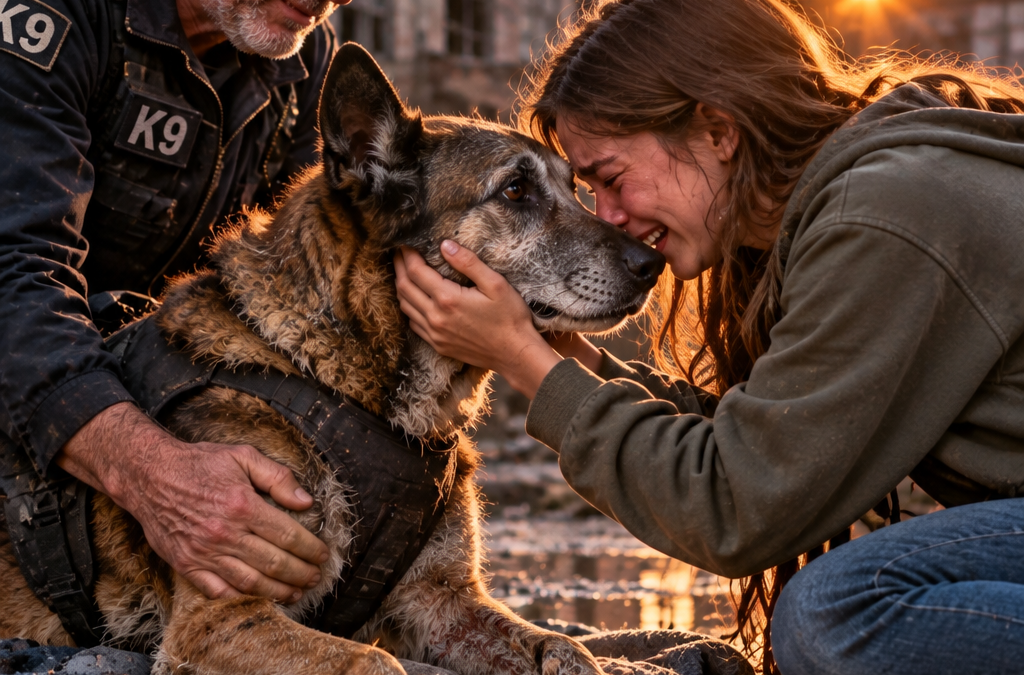
Then he rested his head against her chest.
Lily wrapped her arms around him.
And my old police dog, who had barely moved for thirteen days, gave one soft, unmistakable bark.
Just one.
It was weak.
Almost breathless.
But it was the same short bark he used to give when he’d completed a successful search and wanted me to know he’d found what we were looking for.
Lily buried her face in his fur.
“You found me again.”
I turned away.
My hands were shaking.
I had expected a quiet drive.
A few memories.
A final afternoon with the partner I’d loved for more than fifteen years.
I hadn’t expected this.
I hadn’t expected a child he’d saved to become a young woman standing beside his final patrol car.
I hadn’t expected him to recognize her voice.
And I certainly hadn’t expected to see that stubborn spark return to his tired eyes.
When I looked back, Lily was still holding him.
Bruno’s breathing had settled.
His head rested heavily against her arm.
He looked exhausted.
But peaceful.
Lily stroked his ears.
“He’s so tired.”
I nodded.
“He’s had a long life.”
She looked up.
“Is he…?”
She couldn’t finish.
I answered anyway.
“Yes.”
Her face crumpled.
“How long?”
I swallowed.
“Tomorrow.”
She lowered her eyes.
For several seconds, she said nothing.
Then she leaned forward and kissed Bruno between his ears.
“I’m really glad you came.”
Behind us, someone called her name.
I turned.
Rebecca Bennett was approaching from the community center.
She looked older, of course.
There were lines around her eyes.
Her hair had begun showing gray.
But I recognized her immediately.
She stopped when she saw Bruno.
“Oh, Jack.”
Her voice broke.
She came toward me and wrapped her arms around my shoulders.
“I’m so sorry.”
I held her briefly.
“He’s had a good life.”
She stepped back and looked at the dog.
“He gave Lily hers.”
I shook my head.
“He helped save her.”
Rebecca looked directly at me.
“Jack, she wouldn’t be here without him.”
I had no answer.
Rebecca knelt beside Lily.
For a moment, mother and daughter simply stroked Bruno’s fur.
Then Lily looked at me.
“Can I show you something?”
I nodded.
She reached into her jacket pocket and removed her phone.
After searching for a moment, she turned the screen toward me.
It showed a photograph.
A young girl in a pink cast, sitting beside a police dog.
Bruno was licking her cheek.
I recognized it immediately.
It was the photograph we’d taken at the station three weeks after the rescue.
Lily smiled sadly.
“I’ve kept this picture on my phone ever since I was old enough to have one.”
I stared at it.
She continued.
“When I was younger, I used to get scared during storms.”
Rebecca nodded.
“For years.”
Lily looked at Bruno.
“I had nightmares about the mill. About being trapped. About nobody hearing me.”
Her voice grew quiet.
“But Mom would show me this picture and remind me that somebody did hear me.”
I felt tears running down my face.
Lily wiped her own eyes.
“I used to think about how he found me. How he didn’t give up.”
She took a breath.
“Eventually, I stopped being afraid of every dark room. I learned to swim. I joined the hiking club. Last year, I started volunteering here at the community center.”
I looked toward the building.
“Here?”
She nodded.
“The part where I fell through the floor was removed during the renovation. The new building is safe. We have children’s programs, after-school tutoring, and community classes.”
She glanced at the old brick wall.
“I wanted to work somewhere that used to scare me.”
I listened quietly.
“I’m graduating high school this spring,” she said. “And I want to study emergency medicine.”
Rebecca smiled through her tears.
“She has her whole future planned.”
Lily laughed softly.
“Not all of it.”
Then she looked at Bruno.
“But I know I want to help people when they’re scared.”
I pressed my hand against the roof of the car.
There are moments when you realize the result of something you did years ago is still unfolding.
The rescue at Riverside Mill had lasted only a few hours.
It had been one call among hundreds.
But for Lily, it had shaped nearly everything that came afterward.
And Bruno had no idea.
He didn’t know about her nightmares.
He didn’t know she’d learned to swim.
He didn’t know she’d grown into a young woman who wanted to help frightened people.
He didn’t know what his courage had made possible.
He only knew that someone familiar was touching his head.
Someone whose voice belonged to a memory of a cold, dark place where he’d once found a little girl.
Lily reached into her bag.
“I brought something for him.”
She took out a small blue stuffed dinosaur.
For a moment, I couldn’t move.
It was almost identical to the one she’d given him years earlier.
“I found it online,” she explained. “I remembered the one I gave him when I was little.”
I laughed through my tears.
“He still has it.”
Her eyes widened.
“He does?”
“It’s beside his bed.”
She covered her mouth.
“Oh my God.”
I nodded.
“He’s slept with it for years.”
Lily began crying again.
She placed the new dinosaur beside Bruno.
He sniffed it.
Then he rested his muzzle against its soft fabric.
She smiled.
“Now you have two.”
We stayed in the parking lot for another twenty minutes.
I told Lily stories about Bruno she’d never heard.
About his stubbornness.
His love of stolen sandwiches.
The time he jumped into a shallow pond after a tennis ball and refused to return until he’d retrieved every floating stick nearby.
She laughed.
Rebecca laughed.
And for a little while, the sadness softened.
Bruno rested quietly while we talked.
Occasionally, Lily stroked his head.
Each time, his tail moved faintly.
Finally, I checked the time.
I knew he needed to go home.
He was becoming tired.
His breathing was slower, and he had stopped lifting his head.
I looked at Lily.
“I should get him back.”
She nodded.
“Of course.”
But she didn’t move immediately.
Instead, she took one of Bruno’s paws gently between her hands.
“Can I tell him something?”
I swallowed.
“Anything you want.”
She leaned close to him.
“Bruno, I don’t know if you remember that day the way I do.”
Her voice trembled.
“I was so scared. I thought nobody was coming.”
She paused.
“But then I heard you.”
I looked away.
Lily continued.
“You were barking above me, and Officer Mercer said you found me.”
Her fingers moved gently through the gray fur along his neck.
“I’ve had nine years since then. Nine birthdays. Nine Christmases. School dances. Friends. Graduation coming up.”
She was crying openly now.
“I got to grow up.”
Rebecca put one hand against her daughter’s back.
Lily leaned closer.
“And I got to do all of that because you didn’t give up on me.”
Bruno opened his eyes.
She smiled through her tears.
“So you don’t have to worry anymore.”
His ears shifted.
“I’m okay.”
Her voice became a whisper.
“You found me, Bruno. You brought me home.”
She kissed his forehead.
“Now you can go home too.”
I pressed my palm against my eyes.
I’d spent the previous twenty-four hours struggling to accept that I was going to lose him.
Some part of me still believed I owed him more time.
More care.
Another chance.
But hearing Lily speak, I suddenly understood something.
Bruno’s life wasn’t unfinished.
He had done what he’d come into the world to do.
He had loved.
He had protected.
He had changed lives.
And one of those lives was kneeling in front of him, living proof that what he’d given had never disappeared.
Before we left, Lily handed me a folded letter.
“I wrote this for him,” she said. “You can read it whenever you’re ready.”
I took it carefully.
“Thank you.”
She stood and hugged me.
Not the awkward embrace of a child greeting a police officer.
A genuine hug from a young woman who understood exactly what I was about to lose.
“You took care of him for a long time,” she whispered.
I nodded.
“He took care of me longer.”
She stepped back.
Then, one last time, she reached through the open door.
“Goodbye, Bruno.”
His tail moved.
Barely.
But enough.
I closed the door gently and climbed into the driver’s seat.
As I started the engine, I glanced in the mirror.
Bruno lay with his muzzle resting beside the new blue dinosaur.
His eyes were closed.
He looked peaceful.
I rolled down my window.
Lily and Rebecca stood beside the entrance.
They waved.
I lifted one hand.
Then we pulled away.
For a while, I couldn’t speak.
I drove slowly along the river road, passing the trees that had once sheltered our search teams from the cold October rain.
Eventually, I looked into the mirror.
“Did you hear her, partner?”
Bruno slept.
“She’s all grown up.”
My voice broke.
“She’s going to help people.”
I swallowed.
“You gave her that chance.”
The road blurred through my tears.
I pulled into a quiet turnout and stopped the car.
For several minutes, I sat with both hands resting on the steering wheel.
Then I turned toward him.
“Thank you, buddy.”
His ears moved faintly.
“For every search. Every night. Every time you stood beside me when things got bad.”
I reached back and stroked his shoulder.
“And thank you for today.”
He opened his eyes briefly.
I smiled.
“You did good, Bruno.”
His tail brushed the blanket.
“Really good.”
When we arrived home, Ellen was waiting on the porch.
She came down the steps as I parked.
“How was it?”
I opened the rear door.
She looked inside.
Then she noticed the new dinosaur.
Her hand flew to her mouth.
“Jack?”
I nodded.
“Lily was there.”
Ellen stared at me.
“The little girl?”
“All grown up.”
I smiled through my tears.
“And he remembered her.”
Ellen began crying before I finished telling her what had happened.
We carried Bruno inside together.
He was exhausted.
I settled him on his blanket beside the fireplace and placed both dinosaurs near his head.
The old one was faded and missing a leg.
The new one was bright blue and soft.
He rested between them.
I sat beside him while Ellen made tea.
Then I unfolded Lily’s letter.
The handwriting was neat and careful.
I read it aloud because I wanted Bruno to hear every word.
Dear Bruno,
When I was eight years old, I thought heroes were people in movies. I thought they were strong and fearless and always knew exactly what to do.
Then I got lost.
I remember the darkness. I remember how cold the water felt. I remember calling for my mom and thinking nobody could hear me.
But you heard me.
You didn’t know who I was. You didn’t know whether I was a good student or a good daughter. You didn’t know what I wanted to become when I grew up.
You just knew somebody needed help.
And you came.
For a long time, I was ashamed of being scared that day. I thought brave people weren’t supposed to cry.
But Officer Mercer once told me that bravery means doing what matters even when you’re afraid.
I understand that now.
I don’t know whether dogs understand how much they mean to people. I hope they do.
I hope you know that I never forgot you.
When I was scared of the dark, I remembered your bark.
When I was scared to try something new, I remembered how you kept searching.
And when I thought I wasn’t strong enough to do something difficult, I remembered that you found me when everything seemed hopeless.
I’m seventeen now.
I’m going to graduate soon. I want to study medicine. I want to help frightened children the way you helped me.
I hope I can spend my life doing even a small part of the good you did in yours.
Thank you for finding me.
Thank you for helping me grow up.
And thank you for teaching me that sometimes the bravest thing in the world is simply refusing to leave someone alone.
Love,
Lily.
I couldn’t finish the final sentence without stopping.
Ellen sat beside me.
We stayed there together, listening to the fire crackle softly.
Bruno slept.
For the first time in weeks, I wasn’t watching him and wishing he could become young again.
I was simply grateful he was still beside us.
That night, I carried his bed into our bedroom.
Ellen placed his favorite blanket beneath him.
I lay on the floor next to him for a long time.
Every so often, he opened his eyes.
I scratched his ears.
“You’re home, buddy.”
He sighed.
I thought about our first day together.
The young dog bouncing against the kennel gate.
The long months of training.
The countless nights we’d spent driving through darkness.
The frightened people he’d helped.
The families he’d reunited.
The little girl he’d found beneath a broken floor.
I thought about the years after retirement.
The slow walks.
The afternoons beside the lake.
The old dog who had learned to enjoy sunshine and warm blankets.
It was tempting to divide Bruno’s life into two parts.
The years when he was useful.
And the years when he wasn’t.
But that division suddenly seemed ridiculous.
He had never stopped being Bruno.
Not when his legs weakened.
Not when his muzzle turned gray.
Not when he could no longer jump into the car.
And not when he needed me to carry him outside.
His worth had never depended on how much work he could do.
I had simply taken too long to understand that.
At some point during the night, he shifted his head toward me.
I moved closer.
“Hey, partner.”
His eyes opened.
I pressed my forehead gently against his.
“You don’t have to do anything else.”
His breathing was soft.
“I’m proud of you.”
I kissed the gray fur between his ears.
“And I’m going to miss you more than I know how to explain.”
He gave a long, tired sigh.
Then closed his eyes.
Dr. Shah arrived the following afternoon.
Bruno had become weaker overnight.
He barely touched his breakfast.
He couldn’t hold his head up for more than a few seconds.
But when I spoke, his eyes still moved toward my voice.
We made him comfortable in the living room.
Sunlight came through the windows.
Ellen sat beside us.
Both blue dinosaurs lay near his front paws.
Dr. Shah examined him quietly.
Then she looked at me.
I nodded.
I didn’t need her to say anything.
I knew.
I had known for days.
I just hadn’t been ready.
I sat on the floor beside Bruno and rested his head in my lap.
Ellen stroked his shoulder.
Dr. Shah gave us time to say goodbye.
I looked down at my old partner.
Sixteen years.
It seemed impossible.
I remembered the first time he’d looked at me through the kennel gate.
The way he’d sniffed my fingers before deciding I was worth his attention.
I remembered how fiercely he’d worked, how stubbornly he’d loved, and how patiently he’d endured the indignities of growing old.
I thought about all the times he’d come running when I called.
And all the times he’d found his way back to me.
Now there was only one final thing I could give him.
Peace.
“Hey, buddy.”
His ears moved.
I smiled through my tears.
“Remember our old saying?”
I stroked his forehead.
“Good work. Time to go home.”
His eyes remained on mine.
I leaned closer.
“You finished your last patrol.”
My voice cracked.
“And you did it perfectly.”
Ellen began crying quietly.
I held Bruno gently while Dr. Shah administered the medication that would let him rest without pain.
His breathing slowed.
His body relaxed.
For a moment, he looked exactly as he had after a long shift, sleeping deeply while I finished paperwork.
I kept my hand against his cheek.
“You were a good boy.”
Then I whispered the words I’d said at the end of thousands of working days.
“End of shift, partner.”
A few moments later, Bruno was gone.
No struggle.
No fear.
Just a quiet ending to a life that had given so much.
I sat beside him long after Dr. Shah told us his heart had stopped.
I couldn’t bring myself to move.
The house seemed impossibly silent.
For sixteen years, Bruno had been part of its sounds.
His nails against the floor.
His collar jingling.
His heavy sighs.
His impatient bark when dinner was late.
Now there was nothing.
Ellen placed her hand against my back.
I began crying.
Not quietly.
Not with the restraint I’d learned during years in uniform.
I cried the way a man cries when he loses a member of his family.
Because that’s what Bruno had been.
Not a piece of equipment.
Not a retired police asset.
Not a dog whose value had ended when his working years were over.
He was my partner.
My friend.
My family.
And I had loved him through every season of his life.
We had Bruno cremated, and a few days later, I brought his ashes home in a simple wooden box.
I placed it on the mantel beside his old working collar.
The two stuffed dinosaurs sat nearby.
And I framed Lily’s letter.
Not because I wanted a shrine to the past.
But because I wanted something I could look at whenever grief made me forget how much good had come from Bruno’s life.
Several weeks later, Lily visited with Rebecca.
We sat at the kitchen table drinking coffee and hot chocolate.
She looked at the photographs lining the hallway.
Then she stopped in front of the one showing her with Bruno at eight years old.
She smiled.
“I still remember what his fur felt like.”
I stood beside her.
“Me too.”
She looked toward the mantel.
“Do you think he was happy that day?”
I knew which day she meant.
The final patrol.
The old mill.
Their reunion.
I thought about the way Bruno had raised his head when he heard her voice.
The way he’d pushed forward despite his failing body.
The soft bark he’d given when he reached her.
“I think he was,” I said.
Lily nodded.
“Me too.”
She was quiet for a moment.
Then she said, “I always thought he saved my life once.”
I looked at her.
She glanced at the photograph.
“But I think he helped me live it afterward too.”
I placed my hand gently against her shoulder.
Neither of us said anything else.
We didn’t need to.
It’s been a year since Bruno’s final patrol.
His old Crown Victoria still sits in my garage.
I keep it washed.
I start the engine every few weeks.
Sometimes I take it down the county road when the weather is clear.
But I no longer look into the rearview mirror expecting to see a young police dog waiting for his next assignment.
I remember the old dog instead.
The gray muzzle.
The tired eyes.
The small movement of his ears when he heard a familiar word.
The way he rested his head against Lily’s chest in that parking lot.
And the soft bark he gave when he recognized her.
Lily graduated high school that spring.
She sent Ellen and me a photograph of herself wearing her graduation gown.
She stood beneath the bright afternoon sun, smiling proudly.
Pinned near her shoulder was a tiny silver paw-print charm.
In the letter that came with the photograph, she wrote that she’d been accepted into a college program preparing her for a future in healthcare.
She wanted to work with children.
Especially frightened children.
Especially the ones who needed someone to tell them they weren’t alone.
I placed her graduation photograph beside the old picture of her and Bruno.
An eight-year-old child in a pink cast.
A seventeen-year-old young woman with a future stretching ahead of her.
Nine years between them.
Nine years she might never have had.
I stared at those two photographs for a long time.
Then I looked toward Bruno’s collar.
And I finally understood why that last patrol had mattered so much.
For months, I’d been grieving everything Bruno had lost.
His speed.
His strength.
His ability to work.
His ability to stand.
I had looked at his failing body and seen only the cruel passage of time.
But when Lily called his name outside Riverside Mill, something happened that no medication or treatment could have given us.
For one brief moment, I saw the full meaning of his life reflected in someone else’s.
I saw what remained after the strength was gone.
After the uniform was put away.
After the badge had been retired.
I saw a young woman who was alive because an old police dog had once refused to stop searching.
And I realized that Bruno had never needed one last heroic rescue.
He’d already done enough.
He only needed to see, in whatever way a dog can understand such things, that the little girl he’d found had made it home.
That she’d grown up.
That she was safe.
That the frightened child beneath the broken floor was now a brave young woman preparing to help others.
I don’t know exactly what Bruno remembered that afternoon.
I can’t say whether he recognized Lily’s face, her scent, her voice, or some combination of all three.
But I know what I saw.
A dog who had barely lifted his head in almost two weeks heard a familiar voice and found the strength to greet someone he hadn’t seen in years.
And when that young woman held him, he became peaceful in a way I hadn’t witnessed for a long time.
Sometimes people ask whether taking Bruno on that final patrol made losing him any easier.
The answer is no.
I still miss him.
I still reach toward the empty space beside my chair.
I still occasionally think I hear his nails clicking against the hallway floor.
And some mornings, I wake expecting to feel the familiar weight of his head resting against my hand.
Grief doesn’t disappear because the ending was meaningful.
But that patrol gave me something to hold on to besides the pain.
It reminded me that the final chapter of a life doesn’t erase the chapters that came before it.
It reminded me that being old isn’t the same as being forgotten.
And it reminded me that love doesn’t retire when the work is done.
Last month, I drove the Crown Victoria to Riverside Mill again.
The community center was open.
Children were playing in the yard.
A group of teenagers carried boxes through the entrance.
And near the old brick wall, I saw Lily helping a younger child who had fallen and scraped his knee.
She knelt beside him.
She spoke gently.
She waited until he stopped crying.
Then she helped him stand.
I watched from my parked car.
For a moment, I could almost imagine Bruno lifting his head behind me, watching her with the same quiet attention he’d given frightened people throughout his life.
I reached toward the empty back seat.
The blanket was still there.
Folded neatly.
Waiting for a passenger who would never ride with me again.
I rested my hand on the fabric.
Then I looked at Lily.
She was smiling at the little boy.
He was smiling back.
I felt tears rise, but this time I didn’t fight them.
“Look at her, partner,” I whispered.
“She’s doing good.”
Outside, the afternoon sun warmed the old brick walls.
Children’s voices drifted through the open windows.
Life continued.
And in that ordinary moment, I felt something I hadn’t expected to feel again.
Peace.
I started the engine.
The Crown Victoria gave its familiar rumble.
Before pulling away, I looked once more into the rearview mirror.
The back seat was empty.
But the life Bruno had saved was right there in front of me.
I smiled through my tears.
“Good work, buddy.”
Then I drove home.
End of shift, Bruno.
You brought everybody home.