𝗙𝗨𝗟𝗟 𝗦𝗧𝗢𝗥𝗬 I Opened My Car Door for a Shivering Puppy in the Rain, Never Knowing That One Small Decision Would Rebuild My Entire Life
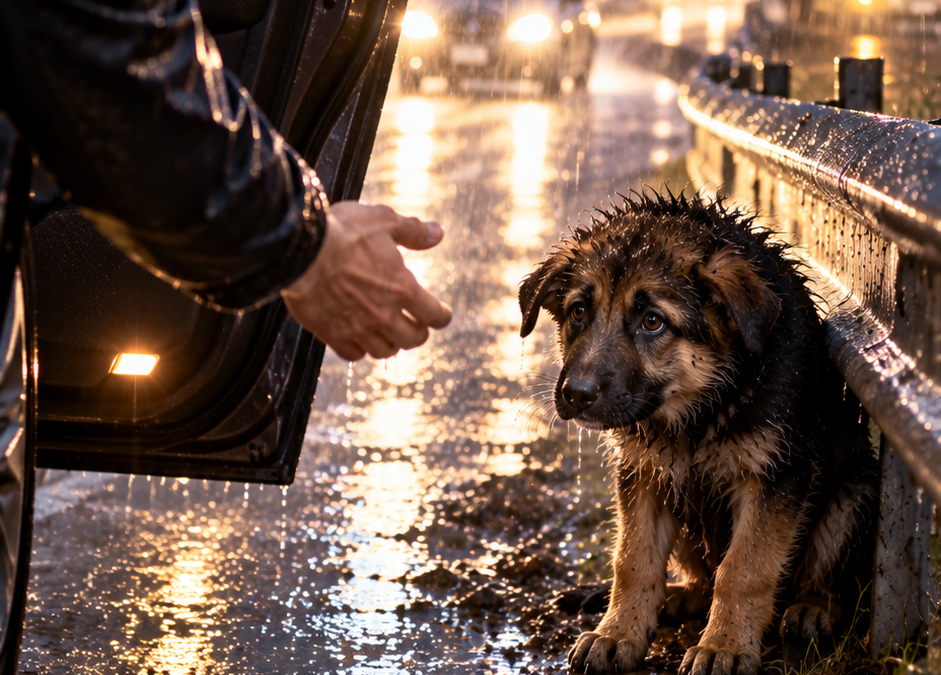
𝗙𝗨𝗟𝗟 𝗦𝗧𝗢𝗥𝗬
I caught him.
The puppy froze in my arms.
No growl.
No bite.
Just terror.
His body was so cold I could feel it through my wet jacket.
“Okay.”
I lifted him inside.
“You’re coming with me.”
He pressed himself into the corner of the passenger seat.
I closed the door.
When I returned to the driver’s side, he had not moved.
I turned the heater toward him.
For the first ten minutes, the puppy stared out the windshield.
Then slowly, his head lowered.
By the time we reached my neighborhood, he was asleep.
Or unconscious.
That thought frightened me enough that I touched his shoulder at a red light.
He opened one eye.
“Good.”
I exhaled.
“Sleeping is allowed.”
We reached my house around midnight.
The rain had softened.
I carried him inside.
He weighed almost nothing.
That frightened me too.
I put him on the kitchen floor near the heater.
He immediately tried to stand.
His legs shook.
“Stay.”
He had no idea what that meant.
Neither did I.
I found an old blanket.
Wrapped him.
Then opened every cabinet looking for something a dog could safely eat.
I had no dog food.
Of course.
Tuna.
That seemed reasonable.
I opened a can, mixed in warm water, and placed the bowl several feet away.
The puppy stared.
Food.
Me.
Food again.
He did not move.
I sat on the floor.
The tiles were cold even through my pants.
“I don’t know what I’m doing.”
His ears remained flat.
“That makes two of us.”
Nothing.
So I talked.
I talked because silence felt wrong.
Not about important things.
I told him about my day.
The meeting.
My idiot manager.
The traffic.
The rain.
I told him how I had ruined a presentation that morning by spilling coffee across printed plans.
I told him my refrigerator made a strange noise that I kept refusing to investigate.
I told him I hadn’t intended to bring home a dog.
At some point, his trembling slowed.
One ear lifted.
Then the other.
He looked at the bowl.
I kept talking.
Finally, after nearly twenty minutes, he moved.
One small step.
Then another.
He sniffed the tuna.
Ate one bite.
Stopped.
Looked at me.
“Go ahead.”
Another bite.
Then suddenly hunger took over.
He ate too fast.
I pulled the bowl away.
“Slow.”
The puppy looked offended.
“That is apparently a universal expression.”
I waited.
Returned the bowl.
This time he ate more carefully.
I smiled.
A real smile.
It surprised me.
I had smiled at work all week.
Smiled in meetings.
Smiled at people while wanting to leave.
Those had been expressions.
This was different.
The puppy finished.
Licked the bowl.
Then looked at me.
“Well.”
I stood.
“I guess we made it through dinner.”
I made him a bed from two old pillows and another blanket.
He circled three times.
Collapsed.
I turned off the kitchen light.
Halfway to my bedroom, I stopped.
Went back.
The puppy’s eyes were open.
Watching me.
“I’m right there.”
His ears moved.
I left the hallway light on.
That first night I woke several times.
Once because I thought I heard whining.
Once because the heater clicked off.
Once for no reason.
Every time, I walked to the kitchen.
The puppy was asleep.
At six thirty in the morning, something wet touched my face.
I opened my eyes.
Two oversized ears appeared beside the bed.
The puppy stood on his hind legs with his front paws against the mattress.
His nose touched my cheek again.
I stared.
He stared back.
Then barked once.
Sharp.
Demanding.
I laughed.
Not quietly.
The sound filled the bedroom.
The puppy’s tail moved.
“Hungry?”
Tail.
“I’m guessing yes.”
That was the first morning of the rest of my life.
The next two weeks were chaos.
I knew nothing about puppies.
Nothing.
I had never had a dog growing up.
My parents had believed animals belonged outside.
My adulthood had been too mobile for pets.
Suddenly, I was responsible for a creature who seemed designed to find every weakness in my lifestyle.
He needed food four times a day.
Small meals.
Water.
Vaccines.
Deworming.
Training.
Bathroom breaks.
Then more bathroom breaks.
Then one more bathroom break immediately after I thought the previous one was enough.
The first time he woke me at three in the morning, I stared at the ceiling.
“No.”
A bark came from the hallway.
“No.”
Another bark.
I covered my head.
Then heard scratching at the door.
“Fine.”
I put on shoes.
Outside, the temperature had dropped.
The puppy ran in circles for nine minutes before doing what we came outside for.
I stood in the cold.
“Are you serious?”
He looked delighted.
“This relationship is unequal.”
He chased a leaf.
The veterinarian gave him a clean bill of health aside from being underweight.
“Where did you get him?” she asked.
“Highway.”
“Meaning?”
“Literally.”
She looked at me.
“You found him?”
“Yes.”
“Microchip?”
“No.”
“Reported him?”
“Yes.”
We checked.
No owner came forward.
No missing dog notice matched.
No chip.
Nothing.
The vet estimated he was twelve to fourteen weeks old.
“How big will he get?”
She looked at his paws.
“Big.”
I looked at him.
He chewed the corner of her clipboard.
“Wonderful.”
The first week, I simply called him Puppy.
It became ridiculous.
“Puppy, no.”
“Puppy, come here.”
“Puppy, stop eating that.”
“Puppy, why is there toilet paper everywhere?”
I tried names.
Max.
Nothing.
Rocky.
Nothing.
Bruno.
He yawned.
Duke.
He walked away.
“You’re difficult.”
Tail wag.
On the sixth day, I sat on the couch exhausted.
The puppy had destroyed one shoe.
A remote control.
The leg of a coffee table.
And a paperback book I had owned for fifteen years.
I stared at the mess.
“You’re costing me money.”
He placed his head on my knee.
I sighed.
“You don’t care.”
I began thinking about where I found him.
Santa Fe Road.
“Santa Fe?”
He lifted his head.
“That’s too long.”
I tried again.
“Santa?”
Ear movement.
“Santino?”
His tail moved.
I stopped.
“Santino.”
More wagging.
“You like that?”
He climbed halfway onto my lap.
“Santino.”
Full-body wag.
I laughed.
“All right.”
That was it.
Santino.
Once he had a name, everything felt more real.
He was no longer a puppy I had found.
He was Santino.
My dog.
The first month was brutal.
Santino chewed everything.
Shoes.
Furniture.
Cables.
Books.
One morning I found him standing on the kitchen table eating an entire loaf of bread.
I had no idea how he got there.
“Santino!”
He froze.
Bread hanging from his mouth.
“How?”
Tail wag.
“No.”
He swallowed.
“You are not allowed on the table.”
He looked behind him as if checking whether another dog was responsible.
I grabbed the loaf.
Half gone.
“You’re unbelievable.”
He barked.
I laughed despite myself.
I yelled sometimes.
I am not proud of it.
Not cruelly.
But exhaustion changes people.
One night, after he had woken me for the fourth time, I snapped.
“What do you want from me?”
Santino froze.
His ears flattened.
That reaction stopped me instantly.
I crouched.
“Hey.”
He backed away.
I hated myself.
“No.”
I lowered my voice.
“I’m sorry.”
He watched.
“I’m tired.”
Not an excuse.
But true.
I sat on the floor.
Eventually, Santino approached.
He placed his nose against my hand.
Then rested his head on my knee.
That became something he did whenever I was upset.
Not only with him.
With anything.
Bad day?
Head on my knee.
Phone call with my boss?
Head on my knee.
Argument with a friend?
Head on my knee.
There was no advice.
No questions.
No “look on the bright side.”
Just presence.
It was astonishing how much that helped.
Before Santino, when I felt bad, I tried to escape the feeling.
Work more.
Travel.
Drink.
Scroll through my phone.
Call someone and pretend I wanted to talk about anything else.
Santino did not let me escape.
He simply sat with me.
At first, I thought I was teaching him how to live with a person.
Slowly, I realized he was teaching me how to stay.
Years passed faster than they had any right to.
Santino became enormous.
The awkward ears finally matched his body.
His coat grew thick, black and tan.
He developed that watchful intelligence German Shepherds seem to carry naturally.
He noticed everything.
Delivery trucks.
Neighbors.
The change in my breathing when I was angry.
The sound of my car from half a block away.
But beneath the impressive adult dog remained the puppy from Santa Fe Road.
He still hated heavy rain.
Still followed me everywhere.
Still slept near the bedroom door.
Still put his head on my knee when I was quiet too long.
We ran together in the mornings.
At first, two miles.
Then four.
Santino loved movement.
He ran beside me with effortless rhythm.
If I slowed, he looked back.
If I stopped, he stopped.
We traveled together whenever possible.
Mountains.
Coast.
Long drives.
Hotels that accepted dogs.
Campgrounds.
Santino had an extraordinary ability to make every place feel familiar.
If he was there, I was not alone.
That mattered more than I admitted.
At thirty-seven, I changed jobs.
The old one had begun consuming me.
More travel.
More meetings.
More money.
Less life.
The decision terrified me.
I spent weeks staring at spreadsheets.
Savings.
Retirement.
Insurance.
Risk.
One night, I sat on the porch.
Santino lay beside me.
“I don’t know what I’m doing.”
His head lifted.
“I could stay.”
Tail tap.
“It’s safe.”
He sighed.
“I hate it.”
Head on my shoe.
“You’re not helping.”
He looked up.
Actually, he was.
I took the new job.
Less money.
Less travel.
Better hours.
I started running with Santino every morning again.
That decision changed my life.
Santino had nothing to do with employment law or compensation packages.
But because of him, I understood something I had ignored for years.
Time mattered.
Being home mattered.
A life spent entirely preparing for later eventually runs out of later.
Then I met Claire.
She came to my house for dinner about a year after the job change.
Before she arrived, I gave her a warning.
“I have a German Shepherd.”
“I like dogs.”
“He has opinions.”
“About?”
“People.”
She laughed.
“I’m being serious.”
“So am I.”
Santino stood beside me when the doorbell rang.
I opened it.
Claire entered.
She did not rush toward him.
Good start.
She held out one hand.
Santino sniffed.
Walked around her once.
Then sat.
Claire looked at me.
“What does that mean?”
“I don’t know.”
Santino leaned against her leg.
I raised my eyebrows.
Claire smiled.
“I think I passed.”
Later, after we had been together almost a year, she told me something.
“The first time I came over, I was more nervous about Santino than you.”
“That’s insulting.”
“You were easy.”
“Thank you.”
“He watched me like a security interview.”
“He takes his job seriously.”
“Then he leaned against me.”
She smiled.
“I thought, if that dog accepts me, maybe I’m okay here.”
Santino accepted her.
Completely.
Soon I was no longer his only person.
If Claire and I sat on opposite ends of the couch, Santino lay between us.
If she cried, he went to her.
If I was sick, he stayed beside me.
He made room.
I think dogs understand expanding love better than people do.
Nothing needs to be replaced.
The circle simply gets larger.
For the first time in years, my life felt full rather than busy.
Then, during Santino’s seventh year, I noticed him slowing down.
At first, I denied it.
He stopped jumping onto the couch in one movement.
That’s age.
He lagged near the end of runs.
Weather.
He took longer standing after sleeping.
Stiffness.
Then one morning, he stopped halfway through our usual route.
Santino never stopped.
I looked back.
He stood with one rear leg slightly lifted.
“Santino?”
He tried another step.
Stopped.
I walked to him.
“Hey.”
I touched his hip.
He flinched.
My stomach tightened.
The veterinarian examined him.
Then ordered imaging.
I sat in the waiting room with Santino’s head on my shoe.
Claire beside me.
Neither of us spoke.
The veterinarian returned.
His expression told me before his words did.
“His hips are deteriorating.”
I stared.
“What does that mean?”
“Degenerative joint disease. Dysplasia changes.”
“Can you fix it?”
“We can manage pain.”
“That’s not what I asked.”
The vet sat.
“There are surgical options depending on severity, age, overall health.”
“Then surgery.”
“It may not be the best option.”
“Why?”
He explained.
Risks.
Recovery.
Progression.
Cost.
Quality of life.
I heard perhaps half.
Finally I asked the question every pet owner eventually asks even though we know no one can answer.
“How long?”
The vet paused.
“With good management?”
“Yes.”
“A year. Maybe two.”
My chest tightened.
“Two?”
“Maybe longer.”
Santino rested against my foot.
Seven years.
It felt impossible.
Seven years had disappeared.
I remembered the wet puppy in my passenger seat.
The bread theft.
The first run.
Claire at the door.
All of it suddenly looked small because I could see an ending behind it.
I looked at the vet.
“He’s only seven.”
“I know.”
That night, I sat on the floor beside Santino.
Claire went to bed.
I remained.
Santino was asleep.
My hand rested on his side.
I counted breaths.
I felt ridiculous.
Nothing had happened yet.
He was alive.
Warm.
Comfortable.
But grief had already arrived.
That is the cruelty of loving animals.
Sometimes you begin mourning before they leave.
Eventually I stopped.
Not the sadness.
The wasting.
I made a decision.
Whatever time Santino had left, I would not spend all of it fearing the last day.
I changed things.
No more business trips unless absolutely necessary.
No long separations.
Morning runs became walks.
Then slower walks.
I let Santino sniff everything.
Every tree.
Every patch of grass.
Every mailbox.
Before, I had tugged the leash.
“Come on.”
Now I waited.
Five minutes at a bush?
Fine.
Ten minutes examining a tree trunk?
Apparently important.
I began seeing walks differently.
I had thought walking meant distance.
To Santino, it meant information.
I had spent years rushing him through the world.
Now I let him read it.
I bought better food.
Cooked meat.
Not because I thought it would cure him.
Because he loved it.
When standing became difficult, I fed him by hand.
Claire laughed once.
“He has you completely trained.”
“Yes.”
Santino chewed steak from my fingers.
“No regrets.”
Pain medication helped.
Physical therapy helped.
There were good months.
Then harder ones.
He stopped using stairs.
We installed ramps.
He slept more.
Sunlight became his favorite thing.
He would find one warm patch on the floor and stay there for hours.
One evening, I sat beside him.
“You used to chase me around this house.”
Santino opened one eye.
“Remember?”
Tail movement.
“Now I have to bring dinner to you.”
Another tail movement.
“Royalty.”
He sighed.
Sometimes I told him the story of how we met.
I don’t know why.
Maybe I wanted to fix it in my own memory.
Maybe I wanted him to know he had always mattered.
We sat on the porch.
I stroked his ears.
“It was raining.”
He rested his head on my foot.
“You were disgusting.”
Ear twitch.
“Skinny.”
Tail movement.
“Uncooperative.”
He sighed.
“I opened the door.”
I looked at him.
“And you got in.”
That part always made me emotional.
One small action.
Open door.
Everything after.
If I had kept driving, there would have been no Santino.
No morning runs.
No Claire meeting him.
No job change.
No seven years.
My entire life had turned around something that took less than a minute.
That frightened and comforted me.
Life can pivot quietly.
No announcement.
No certainty.
Only a decision.
Stop or continue.
Open or close.
Stay or leave.
One night, Santino could no longer walk outside.
Not safely.
His back legs had become too weak.
I lifted him.
He was heavy.
Much heavier than the puppy I had carried from the passenger seat.
Claire opened the back door.
The sky was clear.
Full moon.
Cold but not bitter.
I carried Santino into the yard.
He rested his head against my shoulder.
I sat in the grass.
Placed him against my chest.
For a long time, neither of us moved.
Stars filled the sky.
Santino’s breathing was slow.
I could feel his heartbeat against me.
Strong enough.
Still there.
Claire stood in the doorway for a while.
Then quietly went inside.
She understood that the moment belonged to us.
I whispered, “You remember that road?”
Santino’s ear moved.
“Probably not.”
I smiled.
“I do.”
My hand moved through the fur along his neck.
“I thought I was saving you.”
His breathing remained steady.
“I really did.”
I looked up at the sky.
“I thought I was being a good person.”
My throat tightened.
“But I needed you.”
I had not admitted that until then.
Not completely.
When Santino entered my life, I had been functioning.
That is not the same as living.
I had money.
Plans.
Work.
A clean house.
I had no reason to come home except sleep.
Santino changed that.
Someone was waiting.
Someone needed food.
A walk.
A door opened.
A hand on his head.
Responsibility anchored me.
Then affection changed me.
Then routine healed things I had never given names.
Loneliness.
Fear of dependence.
The belief that needing another living thing made you weak.
Santino destroyed that belief.
Needing him did not make me smaller.
It made my life larger.
Seven years.
Seven years of waking because he needed me.
Seven years of being met at the door.
Seven years of runs, trips, chewed furniture, vet bills, muddy floors.
Seven years of a head placed quietly on my knee whenever the world felt too heavy.
I held him beneath the stars.
“You did all that.”
Santino sighed.
“I owe you.”
His eyes were partly closed.
“No.”
I changed the sentence.
“I’m grateful.”
That was better.
I made him a promise that night.
Not that I would never adopt another dog.
Not that I would remember every detail.
Memory changes whether we want it to or not.
I promised I would not waste what he had taught me.
I would not go back to living as though independence meant never needing anyone.
I would not keep choosing work over life simply because work rewarded me faster.
I would not assume I had more time than I did.
And when another door needed opening, I would try to open it.
Santino died three weeks later.
Quietly.
There was no emergency.
No dramatic rush to the clinic.
No final rescue.
His body had simply reached its limit.
That morning, he refused breakfast.
Even steak.
I knew.
Claire knew.
We called the veterinarian.
He came to the house.
Santino lay beside the fireplace.
His favorite place.
I sat on the floor with his head in my lap.
Claire sat beside us.
The vet examined him.
Then looked at me.
“He’s tired.”
I nodded.
I already knew.
“Is he in pain?”
“Some.”
“Can we fix it?”
“Not in a way that gives him meaningful recovery.”
There it was.
The sentence I had feared for two years.
I looked down.
Santino’s eyes were open.
Watching me.
“Hey.”
His tail moved once.
That nearly destroyed me.
Claire took my hand.
The vet gave us time.
I stroked Santino’s ears.
The same place I had touched thousands of times.
“I’m here.”
He breathed slowly.
“I’m not going anywhere.”
I said his name.
Again.
“Santino.”
His ear moved.
Again.
“Santino.”
Not because I thought he might forget.
Because I needed his name in the room.
When the medication began, his body relaxed.
No fear.
No struggle.
He looked as though he were becoming sleepy.
I leaned down.
Pressed my forehead against his.
“Good boy.”
His breathing slowed.
Then stopped.
I did not cry immediately.
That surprised me.
I had imagined collapsing.
Instead, a strange calm filled me.
My hand stayed on his head.
Claire cried quietly beside me.
The vet left us alone.
For a long time, I sat with Santino.
His body remained warm.
That was difficult.
Warmth makes absence confusing.
A moment earlier he had breathed.
Now he didn’t.
Same fur.
Same ears.
Same paws.
Everything that looked like Santino remained.
But he was gone.
I thought about the rain.
The highway.
My car door.
A tiny shaking puppy.
How improbable everything after that had been.
Eventually I cried.
Harder than I had cried in years.
Not only because he was gone.
Because seven years suddenly felt too short to contain what they had meant.
The house changed immediately.
Silence returned.
But it was not the old silence.
This one had shape.
No nails on the floor.
No collar jingling.
No body in the hallway.
No sigh beside the couch.
For months, I kept expecting him.
When I opened the refrigerator, I looked down.
When I entered the house, I listened.
When Claire and I sat on the porch, there was always a space between us where Santino should have been.
Grief is strange.
It does not only miss someone.
It misses routines.
Weight.
Noise.
Interruptions.
Responsibilities.
The small inconveniences you would give anything to have back.
I left his bed near the fireplace for almost two months.
Claire never asked me to remove it.
One evening, I finally picked it up.
I stood holding it.
Couldn’t move.
Claire came beside me.
“You don’t have to.”
“Yes.”
“You sure?”
“No.”
We both laughed through tears.
I put it away.
Not because I was done grieving.
Because grief had begun changing.
That was different.
A year passed.
My life changed more than I expected.
I left the job I had once been afraid to leave.
Completely.
Claire supported the decision.
“You’ve hated it for years.”
“I know.”
“Then why stay?”
“Money.”
“We’ll have enough.”
“Security.”
“We’ll build another kind.”
That reminded me of Santino.
Responsibility.
Not fear.
I opened a small dog supply shop.
Nothing glamorous.
Leashes.
Harnesses.
Food.
Beds.
Mobility aids.
Training equipment.
Practical things.
I found myself talking with people for hours about their dogs.
Old dogs.
Fearful dogs.
Puppies destroying houses.
Dogs with hip problems.
Whenever someone mentioned a German Shepherd slowing down, something tightened in my chest.
But gradually, helping became easier than avoiding.
Claire and I married.
Small ceremony.
Family.
Friends.
A photograph of Santino on a table near the entrance.
Claire placed it there.
I didn’t know until that morning.
When I saw it, I cried before the ceremony had even started.
“You did this.”
She smiled.
“He was part of us.”
Yes.
He was.
Soon after, Claire became pregnant.
Life kept expanding.
Still, something remained missing.
Not wrong.
Missing.
I did not want another dog.
For a long time, that was what I told myself.
Not yet.
Maybe never.
Santino had been unique.
I did not want to compare.
Did not want to replace.
Claire never pushed.
Then one afternoon, I walked through my old neighborhood.
A flyer was taped inside the window of a local shelter.
VOLUNTEERS NEEDED.
I stared at it.
Then went inside.
I had no intention of adopting.
That is how important things often begin.
The shelter coordinator gave me a tour.
Dogs barked from kennels.
Some jumped.
Some hid.
I helped clean.
Carried food.
Took one old Labrador outside.
Then I passed a kennel near the end.
A German Shepherd puppy sat in the back.
Small.
Maybe three months.
Not the same markings as Santino.
Darker face.
Thinner body.
But the posture stopped me.
Low.
Shaking.
Watching.
I crouched.
The puppy stared.
The room disappeared.
Rain.
Highway.
Headlights.
A door opening.
Not the same dog.
Never.
But the same question in the eyes.
Are you safe?
I sat outside the kennel.
“Hey.”
The puppy did not move.
“I’m Daniel.”
Ears flicked.
“I once knew another dog who made this very difficult.”
Nothing.
I smiled.
“He was better looking.”
One ear lifted.
“Don’t tell him I said that.”
I stayed.
Twenty minutes.
Thirty.
The puppy eventually approached.
Sniffed my fingers.
Then backed away.
Something inside me opened.
Not like before.
Not grief.
Recognition.
The shelter worker said his name was Johnny.
Temporary name.
No history.
Found wandering.
Underweight.
No chip.
I looked at him.
“Johnny.”
Tail movement.
I laughed.
“Well, at least you already have a name.”
I went home.
Told Claire.
She smiled before I finished.
“No.”
“What?”
“You’re adopting him.”
“I said I met a dog.”
“You’re adopting him.”
“I haven’t decided.”
“You came home talking faster than you have in months.”
“That proves nothing.”
“You showed me six pictures.”
I looked at my phone.
Seven.
The next day, Claire came with me.
Johnny took longer with her.
Then sniffed her hand.
Claire sat.
Waited.
He eventually approached.
She looked at me.
“You’re doomed.”
“I know.”
We completed the paperwork.
The day I brought Johnny home, I placed him in the passenger seat of my truck.
He trembled.
Not violently.
Enough.
I sat behind the wheel.
For a second, I saw Santino.
Not literally.
Memory.
A wet puppy.
Too-large ears.
Rain on the windshield.
I almost cried.
Johnny looked at me.
I smiled.
“Okay.”
I started the engine.
“Let’s go home.”
The words came naturally.
Same promise.
Different dog.
That mattered.
Santino had not returned.
Johnny was not a continuation in that sense.
He was himself.
He chewed different things.
Preferred different food.
Hated the vacuum cleaner.
Loved water, which Santino never had.
He barked at birds.
Slept upside down.
Was far more stubborn.
I loved him for those differences.
That is how I knew I was ready.
I did not need Johnny to become Santino.
I needed to let what Santino had taught me shape the way I loved Johnny.
That was inheritance.
Not replacement.
When our daughter was born, Johnny lay outside the nursery door.
Claire laughed.
“Another guardian.”
I sat beside him.
“You have no idea what you’ve signed up for.”
Tail wag.
Years earlier, a puppy had entered my life when I thought responsibility would trap me.
Now responsibility was the center of everything I valued.
Wife.
Child.
Dog.
Business.
Home.
Not a glamorous life.
A meaningful one.
Sometimes I think about the man I used to be before Santino.
He was not a bad man.
Just disconnected.
He believed freedom meant keeping options open.
He believed success meant progress that other people could measure.
Salary.
Title.
Flights.
Hotels.
He did not understand that coming home to someone who needs you can be a form of freedom too.
Santino taught me.
Not intentionally.
Dogs do not deliver philosophy.
They live.
We observe.
We learn if we are paying attention.
Santino taught me through routine.
Wake up.
Feed me.
Walk with me.
Come home.
Sit down.
Stay here.
Be present.
Again tomorrow.
That simple repetition rebuilt me.
The last promise I made beneath the stars was that I would not waste it.
For a while, I thought honoring Santino meant remembering him constantly.
Keeping photographs.
Keeping his collar.
Visiting places we walked.
Those things mattered.
But that was not the real promise.
The real promise was behavior.
Choose people over convenience sometimes.
Choose time over status when possible.
Stop when something vulnerable is standing beside the road.
Open the door.
Years later, I drove Santa Fe Road with Claire and our daughter.
Johnny was in the back.
The weather was clear.
Our daughter was asleep.
I recognized the stretch immediately.
The guardrail had been replaced.
One warehouse was gone.
Otherwise, the road looked similar.
I slowed.
Claire noticed.
“This is it?”
“Yes.”
“Where?”
“Somewhere around here.”
I pulled onto the shoulder.
Not exactly the same place.
Close.
Johnny stood.
Looked through the window.
I got out.
Claire followed.
The air smelled dry.
Nothing like that rainy night.
I stood beside the road.
For a moment, I saw myself opening the passenger door.
Young.
Tired.
Lonely without knowing how lonely.
Then the puppy.
That one decision.
Claire took my hand.
“You okay?”
“Yes.”
I meant it.
“I always thought I saved him here.”
“You did.”
“Maybe.”
I looked toward the car.
Johnny watched us.
Our daughter slept behind him.
“I think he saved a version of me I didn’t know was in trouble.”
Claire squeezed my hand.
“That sounds like him.”
We did not stay long.
There was no memorial.
No sign.
No dramatic moment.
Just asphalt.
Traffic.
Memory.
Before getting back into the truck, I looked once more at the shoulder.
“Thank you.”
I whispered it.
Then closed the door.
Johnny climbed between the seats.
“Back.”
He ignored me.
Claire laughed.
“He’s your dog.”
“Unfortunately.”
Johnny licked my face.
I pushed him gently away.
“Personal boundaries.”
Tail wag.
Our daughter woke.
Started laughing.
And suddenly the truck was full of sound.
Exactly what my life had once lacked.
People often ask whether losing Santino made adopting again harder.
Yes.
Of course.
Love creates the possibility of grief.
There is no way around that.
Every dog I love will eventually leave before I am ready.
If I am lucky enough to grow old, I will probably say goodbye more than once.
That used to seem like a reason to protect myself.
Now I think it is the price of being changed.
Santino’s life was seven years.
I wanted seventy.
That was impossible.
But seven years were not small simply because they ended.
Duration is not depth.
A short relationship can alter the architecture of a life.
Santino did.
I still have his collar.
It hangs in the back office of my shop.
Not where customers see it.
Just me.
Black leather.
Scratched buckle.
His tag still attached.
SANTINO.
Whenever someone brings in an old German Shepherd looking for a supportive harness or orthopedic bed, I sometimes touch that tag afterward.
Not because I am sad.
Not only.
Because memory keeps me honest.
The shop exists because of him.
My marriage, in some way, exists because he taught me to stay long enough to let someone in.
The father I became exists partly because I learned responsibility beside a dog bowl.
Johnny’s life changed because Santino had already taught me to stop.
People talk about legacy as though it requires achievements.
Buildings.
Companies.
Money.
Awards.
Sometimes legacy is much quieter.
A dog teaches a man to care.
The man carries that lesson forward.
Another dog gets a home.
A child grows up watching kindness.
A business helps people keep aging animals comfortable.
One opened door creates another.
That is enough.
Santino’s final night beneath the stars returns to me often.
I remember the weight of him.
How warm he still was.
His heartbeat against my chest.
The moon.
The silence.
I remember promising him I would not forget.
For years I was afraid forgetting meant not remembering every detail.
The exact pattern of his fur.
The sound of his bark.
The way his ears moved when I said steak.
Some details have softened.
That used to hurt.
Then I realized memory is not the only place love survives.
Love becomes habit.
Decision.
Character.
I may someday forget the exact sound of Santino’s paws running across my old kitchen floor.
But I will not forget to stop for a frightened animal.
That is where he lives now.
In action.
Johnny is older these days.
Not old.
But no longer a puppy.
He sleeps near my daughter’s bedroom.
He still hates the vacuum.
Still believes puddles exist specifically for him.
Sometimes he puts his head on my knee when I am tired.
The first time he did that, I froze.
Santino used to do it.
For one second, grief returned so quickly I could barely breathe.
Then Johnny looked up.
Different eyes.
Different dog.
I put my hand on his head.
“Thanks.”
He sighed.
That was enough.
One evening, my daughter asked about the collar in my office.
“Whose is this?”
I took it down.
“Santino’s.”
“Was he your dog before Johnny?”
“Yes.”
“Where is he?”
Children ask directly.
No fear of pain.
“He died before you were born.”
Her face changed.
“Oh.”
“It was a long time ago.”
“Were you sad?”
“Very.”
She looked at the tag.
“Why do you keep it?”
I thought about the answer.
“Because he taught me important things.”
“What things?”
I smiled.
“How to be responsible.”
She frowned.
“That sounds boring.”
I laughed.
“Fair.”
I tried again.
“He taught me that loving someone means showing up.”
She considered.
“Like when you come to my soccer games?”
“Exactly.”
“Even when it rains?”
“Especially then.”
She handed me the collar.
“Then I like Santino.”
My throat tightened.
“He would have liked you too.”
That evening, I put the collar back.
Not hidden.
Not displayed.
Just where it belonged.
Years ago, I thought kindness was a personality trait.
Something people either possessed or did not.
Now I think kindness is often a door.
You notice.
You choose.
You open it.
That night on Santa Fe Road, I could have kept driving.
Nobody would have known.
No one would have blamed me.
I had responsibilities.
I was tired.
It was raining.
There were shelters.
Police.
Other drivers.
A hundred reasonable arguments for making the puppy someone else’s problem.
I stopped.
Not because I was extraordinary.
Because for once, I listened to the part of myself that did not want an excuse.
I opened the door.
Santino climbed in.
Everything after came from that.
The ruined shoes.
The sleepless nights.
The laughter.
The runs.
Claire.
The better job.
The diagnosis.
The porch.
The stars.
The grief.
The business.
Johnny.
My daughter.
All of it connected to a door open in the rain.
That is what amazes me most.
We imagine life-changing decisions must feel enormous while we are making them.
Sometimes they don’t.
Sometimes they look like getting wet.
Stepping onto the shoulder of a highway.
Crouching in front of a frightened animal.
Saying:
“Come on.”
And then making room in the passenger seat.
Santino did not live as long as I wanted.
No dog does.
But he lived long enough to change what I believed a good life looked like.
A good life was not the one where I needed no one.
It was the one where my absence mattered because someone expected me home.
It was feeding a dog at three in the morning.
Cooking meat by hand when he was too weak to eat.
Changing work because time mattered more than money.
Sitting beneath the stars holding a friend whose body was failing.
Letting grief hurt because refusing love would have cost more.
Opening another door later.
That was the life Santino gave me.
Sometimes, after closing the shop, I sit alone for a few minutes.
Johnny may be at home with Claire.
The building is quiet.
Santino’s collar hangs nearby.
I think about that wet puppy.
If I could speak to the man I was that night, I would not tell him what comes next.
I would not warn him about the hip diagnosis.
Would not tell him how much the ending hurts.
Would not tell him seven years go impossibly fast.
I would simply say:
Stop the car.
Open the door.
Take him home.
Every hard thing will still be worth it.
Then I would let him discover the rest.
Because love is not valuable despite its ending.
The ending is part of why we must pay attention while it is here.
Santino taught me that too.
Johnny now waits by the door when I come home.
My daughter often waits with him.
Claire usually calls from the kitchen.
Three voices in three different languages.
A bark.
A child yelling, “Dad!”
A woman asking whether I remembered milk.
Ordinary.
Completely ordinary.
I once spent years chasing a life that looked impressive.
Now I know this is the one I wanted.
Sometimes I kneel beside Johnny and wrap an arm around him.
My daughter climbs on my back.
Chaos.
Noise.
Dog hair.
And I think of Santino.
Not with sadness anymore.
With gratitude.
He did not stay forever.
He stayed long enough.
Long enough to teach me that being needed can be a gift.
Long enough to show me that strength is not isolation.
Long enough to bring Claire into my life.
Long enough to make me brave enough to change.
Long enough that when another frightened German Shepherd sat inside a shelter years later, I knew what to do.
Open the door.
Make room.
Say:
“Come on, buddy. We’re going home.”
That is Santino’s legacy.
Not that he lives on magically inside every dog I meet.
He doesn’t.
Johnny is Johnny.
Santino was Santino.
What lives on is what I became because I loved him.
More patient.
More present.
Less impressed by status.
More willing to stay.
More willing to risk grief for connection.
More willing to stop.
And every time I choose kindness when it would be easier to continue driving, I feel that old rainy night somewhere inside me.
Hazard lights blinking.
Cars rushing past.
A puppy trembling beside the guardrail.
My hand on the passenger door.
One second before everything changed.
I opened it.
He climbed in.
And neither of us was ever alone in quite the same way again.
𝗧𝗛𝗘 𝗘𝗡𝗗
I Opened My Car Door for a Shivering Puppy in the Rain, Never Knowing That One Small Decision Would Rebuild My Entire Life
The puppy was standing on the shoulder of the highway in the rain, shaking so hard that at first I thought he was injured.
I almost kept driving.
That is the part I remember most clearly.
My foot stayed on the accelerator for three, maybe four seconds after I saw him.
Long enough to tell myself someone else would stop.
Long enough to remember that I was tired.
Long enough to think about the wet seats, the mud, the hour, the fact that I knew absolutely nothing about dogs.
Then I looked in the rearview mirror.
He was still there.
Small.
Dark.
Alone beneath the headlights of passing cars.
And something inside me refused to let the road carry me farther away.
I pulled over.
At the time, I thought I was saving a puppy.
Years later, I would understand that he was the one who had found me.
My name is Daniel.
I was thirty-four that year, working a job I told everyone I was lucky to have.
Good salary.
Travel.
Benefits.
A respectable title printed beneath my name in emails.
From the outside, my life looked organized.
Successful, even.
Inside, it felt like a series of rooms I passed through without belonging to any of them.
Work.
Airport.
Hotel.
Apartment.
Work again.
I knew dozens of people well enough to have dinner with them.
I knew very few well enough to call when something hurt.
Relationships had come and gone.
Not dramatically.
Nothing exploded.
People simply became busy, distant, tired.
Eventually I stopped expecting permanence from anyone.
That made life simpler.
It also made it empty.
The night I found the puppy, I was coming home after one of the worst weeks I could remember.
Three meetings had gone badly.
A project I had spent six months building had been reassigned.
My manager had smiled while telling me it was “a strategic adjustment.”
I had spent the next eight hours pretending I didn’t care.
Then traffic.
Then rain.
Then nearly midnight.
All I wanted was to get home, remove my shoes, pour something into a glass, and sleep until the world became tolerable again.
The rain had been falling for hours.
Not heavy enough to stop traffic.
Just persistent.
Cold.
The kind that soaked through everything.
I was on Santa Fe Road, a long stretch where warehouses eventually gave way to open ground.
That was where I saw him.
At first, he looked like a discarded bag.
Then lightning reflected off two eyes.
I slowed.
A truck passed me, spraying water across the shoulder.
The puppy flinched.
That was when I stopped.
I sat behind the wheel for a second.
“What are you doing?”
I said it to myself.
No answer.
I turned on the hazard lights.
Rain hit my face the moment I opened the door.
The puppy backed away.
“Hey.”
He was a German Shepherd.
Or mostly German Shepherd.
Maybe three months old.
Perhaps four.
Too thin.
Ears too large.
Paws muddy.
His fur clung to his body.
He stood near the guardrail with his tail tucked completely beneath him.
“Okay.”
I crouched several feet away.
“You’re not going to make this easy.”
The puppy stared at me.
Cars rushed past.
Every one made him flinch.
I held out a hand.
He moved backward.
“I don’t blame you.”
The rain ran down my neck.
I had no food in the car.
No leash.
No blanket.
No plan.
What I did have was an open passenger door.
So I walked back to the car.
Then waited.
The puppy watched.
“Your decision.”
I stood beside the door.
For almost a minute, nothing happened.
Then he stepped forward.
One paw.
Stop.
Another.
Stop.
He looked at the car.
Then at me.
A horn sounded somewhere behind us.
He dropped low.
“Come on.”
I lowered my voice.
“You don’t have to stay here.”
He took another step.
Then another.
When he reached me, I did not touch him.
That seemed important.
He sniffed the edge of my pants.
Then the open door.
I waited.
Finally he placed his front paws on the seat.
He was too weak to climb.
His back legs slipped.
I caught him.
The puppy froze in my arms.
No growl.
No bite.
Just terror.
His body was so cold I could feel it through my wet jacket.
“Okay.”
I lifted him inside.
“You’re coming with me.”
He pressed himself into the corner of the passenger seat.
I closed the door.
When I returned to the driver’s side, he had not moved.
I turned the heater toward him.
For the first ten minutes, the puppy stared out the windshield.
Then slowly, his head lowered.
By the time we reached my neighborhood, he was asleep.
Or unconscious.
That thought frightened me enough that I touched his shoulder at a red light.
He opened one eye.
“Good.”
I exhaled.
“Sleeping is allowed.”
We reached my house around midnight.
The rain had softened.
I carried him inside.
He weighed almost nothing.
That frightened me too.
I put him on the kitchen floor near the heater.
He immediately tried to stand.
His legs shook.
“Stay.”
He had no idea what that meant.
Neither did I.
I found an old blanket.
Wrapped him.
Then opened every cabinet looking for something a dog could safely eat.
I had no dog food.
Of course.
Tuna.
That seemed reasonable.
I opened a can, mixed in warm water, and placed the bowl several feet away.
The puppy stared.
Food.
Me.
Food again.
He did not move.
I sat on the floor.
The tiles were cold even through my pants.
“I don’t know what I’m doing.”
His ears remained flat.
“That makes two of us.”
Nothing.
So I talked.
I talked because silence felt wrong.
Not about important things.
I told him about my day.
The meeting.
My idiot manager.
The traffic.
The rain.
I told him how I had ruined a presentation that morning by spilling coffee across printed plans.
I told him my refrigerator made a strange noise that I kept refusing to investigate.
I told him I hadn’t intended to bring home a dog.
At some point, his trembling slowed.
One ear lifted.
Then the other.
He looked at the bowl.
I kept talking.
Finally, after nearly twenty minutes, he moved.
One small step.
Then another.
He sniffed the tuna.
Ate one bite.
Stopped.
Looked at me.
“Go ahead.”
Another bite.
Then suddenly hunger took over.
He ate too fast.
I pulled the bowl away.
“Slow.”
The puppy looked offended.
“That is apparently a universal expression.”
I waited.
Returned the bowl.
This time he ate more carefully.
I smiled.
A real smile.
It surprised me.
I had smiled at work all week.
Smiled in meetings.
Smiled at people while wanting to leave.
Those had been expressions.
This was different.
The puppy finished.
Licked the bowl.
Then looked at me.
“Well.”
I stood.
“I guess we made it through dinner.”
I made him a bed from two old pillows and another blanket.
He circled three times.
Collapsed.
I turned off the kitchen light.
Halfway to my bedroom, I stopped.
Went back.
The puppy’s eyes were open.
Watching me.
“I’m right there.”
His ears moved.
I left the hallway light on.
That first night I woke several times.
Once because I thought I heard whining.
Once because the heater clicked off.
Once for no reason.
Every time, I walked to the kitchen.
The puppy was asleep.
At six thirty in the morning, something wet touched my face.
I opened my eyes.
Two oversized ears appeared beside the bed.
The puppy stood on his hind legs with his front paws against the mattress.
His nose touched my cheek again.
I stared.
He stared back.
Then barked once.
Sharp.
Demanding.
I laughed.
Not quietly.
The sound filled the bedroom.
The puppy’s tail moved.
“Hungry?”
Tail.
“I’m guessing yes.”
That was the first morning of the rest of my life.
The next two weeks were chaos.
I knew nothing about puppies.
Nothing.
I had never had a dog growing up.
My parents had believed animals belonged outside.
My adulthood had been too mobile for pets.
Suddenly, I was responsible for a creature who seemed designed to find every weakness in my lifestyle.
He needed food four times a day.
Small meals.
Water.
Vaccines.
Deworming.
Training.
Bathroom breaks.
Then more bathroom breaks.
Then one more bathroom break immediately after I thought the previous one was enough.
The first time he woke me at three in the morning, I stared at the ceiling.
“No.”
A bark came from the hallway.
“No.”
Another bark.
I covered my head.
Then heard scratching at the door.
“Fine.”
I put on shoes.
Outside, the temperature had dropped.
The puppy ran in circles for nine minutes before doing what we came outside for.
I stood in the cold.
“Are you serious?”
He looked delighted.
“This relationship is unequal.”
He chased a leaf.
The veterinarian gave him a clean bill of health aside from being underweight.
“Where did you get him?” she asked.
“Highway.”
“Meaning?”
“Literally.”
She looked at me.
“You found him?”
“Yes.”
“Microchip?”
“No.”
“Reported him?”
“Yes.”
We checked.
No owner came forward.
No missing dog notice matched.
No chip.
Nothing.
The vet estimated he was twelve to fourteen weeks old.
“How big will he get?”
She looked at his paws.
“Big.”
I looked at him.
He chewed the corner of her clipboard.
“Wonderful.”
The first week, I simply called him Puppy.
It became ridiculous.
“Puppy, no.”
“Puppy, come here.”
“Puppy, stop eating that.”
“Puppy, why is there toilet paper everywhere?”
I tried names.
Max.
Nothing.
Rocky.
Nothing.
Bruno.
He yawned.
Duke.
He walked away.
“You’re difficult.”
Tail wag.
On the sixth day, I sat on the couch exhausted.
The puppy had destroyed one shoe.
A remote control.
The leg of a coffee table.
And a paperback book I had owned for fifteen years.
I stared at the mess.
“You’re costing me money.”
He placed his head on my knee.
I sighed.
“You don’t care.”
I began thinking about where I found him.
Santa Fe Road.
“Santa Fe?”
He lifted his head.
“That’s too long.”
I tried again.
“Santa?”
Ear movement.
“Santino?”
His tail moved.
I stopped.
“Santino.”
More wagging.
“You like that?”
He climbed halfway onto my lap.
“Santino.”
Full-body wag.
I laughed.
“All right.”
That was it.
Santino.
Once he had a name, everything felt more real.
He was no longer a puppy I had found.
He was Santino.
My dog.
The first month was brutal.
Santino chewed everything.
Shoes.
Furniture.
Cables.
Books.
One morning I found him standing on the kitchen table eating an entire loaf of bread.
I had no idea how he got there.
“Santino!”
He froze.
Bread hanging from his mouth.
“How?”
Tail wag.
“No.”
He swallowed.
“You are not allowed on the table.”
He looked behind him as if checking whether another dog was responsible.
I grabbed the loaf.
Half gone.
“You’re unbelievable.”
He barked.
I laughed despite myself.
I yelled sometimes.
I am not proud of it.
Not cruelly.
But exhaustion changes people.
One night, after he had woken me for the fourth time, I snapped.
“What do you want from me?”
Santino froze.
His ears flattened.
That reaction stopped me instantly.
I crouched.
“Hey.”
He backed away.
I hated myself.
“No.”
I lowered my voice.
“I’m sorry.”
He watched.
“I’m tired.”
Not an excuse.
But true.
I sat on the floor.
Eventually, Santino approached.
He placed his nose against my hand.
Then rested his head on my knee.
That became something he did whenever I was upset.
Not only with him.
With anything.
Bad day?
Head on my knee.
Phone call with my boss?
Head on my knee.
Argument with a friend?
Head on my knee.
There was no advice.
No questions.
No “look on the bright side.”
Just presence.
It was astonishing how much that helped.
Before Santino, when I felt bad, I tried to escape the feeling.
Work more.
Travel.
Drink.
Scroll through my phone.
Call someone and pretend I wanted to talk about anything else.
Santino did not let me escape.
He simply sat with me.
At first, I thought I was teaching him how to live with a person.
Slowly, I realized he was teaching me how to stay.
Years passed faster than they had any right to.
Santino became enormous.
The awkward ears finally matched his body.
His coat grew thick, black and tan.
He developed that watchful intelligence German Shepherds seem to carry naturally.
He noticed everything.
Delivery trucks.
Neighbors.
The change in my breathing when I was angry.
The sound of my car from half a block away.
But beneath the impressive adult dog remained the puppy from Santa Fe Road.
He still hated heavy rain.
Still followed me everywhere.
Still slept near the bedroom door.
Still put his head on my knee when I was quiet too long.
We ran together in the mornings.
At first, two miles.
Then four.
Santino loved movement.
He ran beside me with effortless rhythm.
If I slowed, he looked back.
If I stopped, he stopped.
We traveled together whenever possible.
Mountains.
Coast.
Long drives.
Hotels that accepted dogs.
Campgrounds.
Santino had an extraordinary ability to make every place feel familiar.
If he was there, I was not alone.
That mattered more than I admitted.
At thirty-seven, I changed jobs.
The old one had begun consuming me.
More travel.
More meetings.
More money.
Less life.
The decision terrified me.
I spent weeks staring at spreadsheets.
Savings.
Retirement.
Insurance.
Risk.
One night, I sat on the porch.
Santino lay beside me.
“I don’t know what I’m doing.”
His head lifted.
“I could stay.”
Tail tap.
“It’s safe.”
He sighed.
“I hate it.”
Head on my shoe.
“You’re not helping.”
He looked up.
Actually, he was.
I took the new job.
Less money.
Less travel.
Better hours.
I started running with Santino every morning again.
That decision changed my life.
Santino had nothing to do with employment law or compensation packages.
But because of him, I understood something I had ignored for years.
Time mattered.
Being home mattered.
A life spent entirely preparing for later eventually runs out of later.
Then I met Claire.
She came to my house for dinner about a year after the job change.
Before she arrived, I gave her a warning.
“I have a German Shepherd.”
“I like dogs.”
“He has opinions.”
“About?”
“People.”
She laughed.
“I’m being serious.”
“So am I.”
Santino stood beside me when the doorbell rang.
I opened it.
Claire entered.
She did not rush toward him.
Good start.
She held out one hand.
Santino sniffed.
Walked around her once.
Then sat.
Claire looked at me.
“What does that mean?”
“I don’t know.”
Santino leaned against her leg.
I raised my eyebrows.
Claire smiled.
“I think I passed.”
Later, after we had been together almost a year, she told me something.
“The first time I came over, I was more nervous about Santino than you.”
“That’s insulting.”
“You were easy.”
“Thank you.”
“He watched me like a security interview.”
“He takes his job seriously.”
“Then he leaned against me.”
She smiled.
“I thought, if that dog accepts me, maybe I’m okay here.”
Santino accepted her.
Completely.
Soon I was no longer his only person.
If Claire and I sat on opposite ends of the couch, Santino lay between us.
If she cried, he went to her.
If I was sick, he stayed beside me.
He made room.
I think dogs understand expanding love better than people do.
Nothing needs to be replaced.
The circle simply gets larger.
For the first time in years, my life felt full rather than busy.
Then, during Santino’s seventh year, I noticed him slowing down.
At first, I denied it.
He stopped jumping onto the couch in one movement.
That’s age.
He lagged near the end of runs.
Weather.
He took longer standing after sleeping.
Stiffness.
Then one morning, he stopped halfway through our usual route.
Santino never stopped.
I looked back.
He stood with one rear leg slightly lifted.
“Santino?”
He tried another step.
Stopped.
I walked to him.
“Hey.”
I touched his hip.
He flinched.
My stomach tightened.
The veterinarian examined him.
Then ordered imaging.
I sat in the waiting room with Santino’s head on my shoe.
Claire beside me.
Neither of us spoke.
The veterinarian returned.
His expression told me before his words did.
“His hips are deteriorating.”
I stared.
“What does that mean?”
“Degenerative joint disease. Dysplasia changes.”
“Can you fix it?”
“We can manage pain.”
“That’s not what I asked.”
The vet sat.
“There are surgical options depending on severity, age, overall health.”
“Then surgery.”
“It may not be the best option.”
“Why?”
He explained.
Risks.
Recovery.
Progression.
Cost.
Quality of life.
I heard perhaps half.
Finally I asked the question every pet owner eventually asks even though we know no one can answer.
“How long?”
The vet paused.
“With good management?”
“Yes.”
“A year. Maybe two.”
My chest tightened.
“Two?”
“Maybe longer.”
Santino rested against my foot.
Seven years.
It felt impossible.
Seven years had disappeared.
I remembered the wet puppy in my passenger seat.
The bread theft.
The first run.
Claire at the door.
All of it suddenly looked small because I could see an ending behind it.
I looked at the vet.
“He’s only seven.”
“I know.”
That night, I sat on the floor beside Santino.
Claire went to bed.
I remained.
Santino was asleep.
My hand rested on his side.
I counted breaths.
I felt ridiculous.
Nothing had happened yet.
He was alive.
Warm.
Comfortable.
But grief had already arrived.
That is the cruelty of loving animals.
Sometimes you begin mourning before they leave.
Eventually I stopped.
Not the sadness.
The wasting.
I made a decision.
Whatever time Santino had left, I would not spend all of it fearing the last day.
I changed things.
No more business trips unless absolutely necessary.
No long separations.
Morning runs became walks.
Then slower walks.
I let Santino sniff everything.
Every tree.
Every patch of grass.
Every mailbox.
Before, I had tugged the leash.
“Come on.”
Now I waited.
Five minutes at a bush?
Fine.
Ten minutes examining a tree trunk?
Apparently important.
I began seeing walks differently.
I had thought walking meant distance.
To Santino, it meant information.
I had spent years rushing him through the world.
Now I let him read it.
I bought better food.
Cooked meat.
Not because I thought it would cure him.
Because he loved it.
When standing became difficult, I fed him by hand.
Claire laughed once.
“He has you completely trained.”
“Yes.”
Santino chewed steak from my fingers.
“No regrets.”
Pain medication helped.
Physical therapy helped.
There were good months.
Then harder ones.
He stopped using stairs.
We installed ramps.
He slept more.
Sunlight became his favorite thing.
He would find one warm patch on the floor and stay there for hours.
One evening, I sat beside him.
“You used to chase me around this house.”
Santino opened one eye.
“Remember?”
Tail movement.
“Now I have to bring dinner to you.”
Another tail movement.
“Royalty.”
He sighed.
Sometimes I told him the story of how we met.
I don’t know why.
Maybe I wanted to fix it in my own memory.
Maybe I wanted him to know he had always mattered.
We sat on the porch.
I stroked his ears.
“It was raining.”
He rested his head on my foot.
“You were disgusting.”
Ear twitch.
“Skinny.”
Tail movement.
“Uncooperative.”
He sighed.
“I opened the door.”
I looked at him.
“And you got in.”
That part always made me emotional.
One small action.
Open door.
Everything after.
If I had kept driving, there would have been no Santino.
No morning runs.
No Claire meeting him.
No job change.
No seven years.
My entire life had turned around something that took less than a minute.
That frightened and comforted me.
Life can pivot quietly.
No announcement.
No certainty.
Only a decision.
Stop or continue.
Open or close.
Stay or leave.
One night, Santino could no longer walk outside.
Not safely.
His back legs had become too weak.
I lifted him.
He was heavy.
Much heavier than the puppy I had carried from the passenger seat.
Claire opened the back door.
The sky was clear.
Full moon.
Cold but not bitter.
I carried Santino into the yard.
He rested his head against my shoulder.
I sat in the grass.
Placed him against my chest.
For a long time, neither of us moved.
Stars filled the sky.
Santino’s breathing was slow.
I could feel his heartbeat against me.
Strong enough.
Still there.
Claire stood in the doorway for a while.
Then quietly went inside.
She understood that the moment belonged to us.
I whispered, “You remember that road?”
Santino’s ear moved.
“Probably not.”
I smiled.
“I do.”
My hand moved through the fur along his neck.
“I thought I was saving you.”
His breathing remained steady.
“I really did.”
I looked up at the sky.
“I thought I was being a good person.”
My throat tightened.
“But I needed you.”
I had not admitted that until then.
Not completely.
When Santino entered my life, I had been functioning.
That is not the same as living.
I had money.
Plans.
Work.
A clean house.
I had no reason to come home except sleep.
Santino changed that.
Someone was waiting.
Someone needed food.
A walk.
A door opened.
A hand on his head.
Responsibility anchored me.
Then affection changed me.
Then routine healed things I had never given names.
Loneliness.
Fear of dependence.
The belief that needing another living thing made you weak.
Santino destroyed that belief.
Needing him did not make me smaller.
It made my life larger.
Seven years.
Seven years of waking because he needed me.
Seven years of being met at the door.
Seven years of runs, trips, chewed furniture, vet bills, muddy floors.
Seven years of a head placed quietly on my knee whenever the world felt too heavy.
I held him beneath the stars.
“You did all that.”
Santino sighed.
“I owe you.”
His eyes were partly closed.
“No.”
I changed the sentence.
“I’m grateful.”
That was better.
I made him a promise that night.
Not that I would never adopt another dog.
Not that I would remember every detail.
Memory changes whether we want it to or not.
I promised I would not waste what he had taught me.
I would not go back to living as though independence meant never needing anyone.
I would not keep choosing work over life simply because work rewarded me faster.
I would not assume I had more time than I did.
And when another door needed opening, I would try to open it.
Santino died three weeks later.
Quietly.
There was no emergency.
No dramatic rush to the clinic.
No final rescue.
His body had simply reached its limit.
That morning, he refused breakfast.
Even steak.
I knew.
Claire knew.
We called the veterinarian.
He came to the house.
Santino lay beside the fireplace.
His favorite place.
I sat on the floor with his head in my lap.
Claire sat beside us.
The vet examined him.
Then looked at me.
“He’s tired.”
I nodded.
I already knew.
“Is he in pain?”
“Some.”
“Can we fix it?”
“Not in a way that gives him meaningful recovery.”
There it was.
The sentence I had feared for two years.
I looked down.
Santino’s eyes were open.
Watching me.
“Hey.”
His tail moved once.
That nearly destroyed me.
Claire took my hand.
The vet gave us time.
I stroked Santino’s ears.
The same place I had touched thousands of times.
“I’m here.”
He breathed slowly.
“I’m not going anywhere.”
I said his name.
Again.
“Santino.”
His ear moved.
Again.
“Santino.”
Not because I thought he might forget.
Because I needed his name in the room.
When the medication began, his body relaxed.
No fear.
No struggle.
He looked as though he were becoming sleepy.
I leaned down.
Pressed my forehead against his.
“Good boy.”
His breathing slowed.
Then stopped.
I did not cry immediately.
That surprised me.
I had imagined collapsing.
Instead, a strange calm filled me.
My hand stayed on his head.
Claire cried quietly beside me.
The vet left us alone.
For a long time, I sat with Santino.
His body remained warm.
That was difficult.
Warmth makes absence confusing.
A moment earlier he had breathed.
Now he didn’t.
Same fur.
Same ears.
Same paws.
Everything that looked like Santino remained.
But he was gone.
I thought about the rain.
The highway.
My car door.
A tiny shaking puppy.
How improbable everything after that had been.
Eventually I cried.
Harder than I had cried in years.
Not only because he was gone.
Because seven years suddenly felt too short to contain what they had meant.
The house changed immediately.
Silence returned.
But it was not the old silence.
This one had shape.
No nails on the floor.
No collar jingling.
No body in the hallway.
No sigh beside the couch.
For months, I kept expecting him.
When I opened the refrigerator, I looked down.
When I entered the house, I listened.
When Claire and I sat on the porch, there was always a space between us where Santino should have been.
Grief is strange.
It does not only miss someone.
It misses routines.
Weight.
Noise.
Interruptions.
Responsibilities.
The small inconveniences you would give anything to have back.
I left his bed near the fireplace for almost two months.
Claire never asked me to remove it.
One evening, I finally picked it up.
I stood holding it.
Couldn’t move.
Claire came beside me.
“You don’t have to.”
“Yes.”
“You sure?”
“No.”
We both laughed through tears.
I put it away.
Not because I was done grieving.
Because grief had begun changing.
That was different.
A year passed.
My life changed more than I expected.
I left the job I had once been afraid to leave.
Completely.
Claire supported the decision.
“You’ve hated it for years.”
“I know.”
“Then why stay?”
“Money.”
“We’ll have enough.”
“Security.”
“We’ll build another kind.”
That reminded me of Santino.
Responsibility.
Not fear.
I opened a small dog supply shop.
Nothing glamorous.
Leashes.
Harnesses.
Food.
Beds.
Mobility aids.
Training equipment.
Practical things.
I found myself talking with people for hours about their dogs.
Old dogs.
Fearful dogs.
Puppies destroying houses.
Dogs with hip problems.
Whenever someone mentioned a German Shepherd slowing down, something tightened in my chest.
But gradually, helping became easier than avoiding.
Claire and I married.
Small ceremony.
Family.
Friends.
A photograph of Santino on a table near the entrance.
Claire placed it there.
I didn’t know until that morning.
When I saw it, I cried before the ceremony had even started.
“You did this.”
She smiled.
“He was part of us.”
Yes.
He was.
Soon after, Claire became pregnant.
Life kept expanding.
Still, something remained missing.
Not wrong.
Missing.
I did not want another dog.
For a long time, that was what I told myself.
Not yet.
Maybe never.
Santino had been unique.
I did not want to compare.
Did not want to replace.
Claire never pushed.
Then one afternoon, I walked through my old neighborhood.
A flyer was taped inside the window of a local shelter.
VOLUNTEERS NEEDED.
I stared at it.
Then went inside.
I had no intention of adopting.
That is how important things often begin.
The shelter coordinator gave me a tour.
Dogs barked from kennels.
Some jumped.
Some hid.
I helped clean.
Carried food.
Took one old Labrador outside.
Then I passed a kennel near the end.
A German Shepherd puppy sat in the back.
Small.
Maybe three months.
Not the same markings as Santino.
Darker face.
Thinner body.
But the posture stopped me.
Low.
Shaking.
Watching.
I crouched.
The puppy stared.
The room disappeared.
Rain.
Highway.
Headlights.
A door opening.
Not the same dog.
Never.
But the same question in the eyes.
Are you safe?
I sat outside the kennel.
“Hey.”
The puppy did not move.
“I’m Daniel.”
Ears flicked.
“I once knew another dog who made this very difficult.”
Nothing.
I smiled.
“He was better looking.”
One ear lifted.
“Don’t tell him I said that.”
I stayed.
Twenty minutes.
Thirty.
The puppy eventually approached.
Sniffed my fingers.
Then backed away.
Something inside me opened.
Not like before.
Not grief.
Recognition.
The shelter worker said his name was Johnny.
Temporary name.
No history.
Found wandering.
Underweight.
No chip.
I looked at him.
“Johnny.”
Tail movement.
I laughed.
“Well, at least you already have a name.”
I went home.
Told Claire.
She smiled before I finished.
“No.”
“What?”
“You’re adopting him.”
“I said I met a dog.”
“You’re adopting him.”
“I haven’t decided.”
“You came home talking faster than you have in months.”
“That proves nothing.”
“You showed me six pictures.”
I looked at my phone.
Seven.
The next day, Claire came with me.
Johnny took longer with her.
Then sniffed her hand.
Claire sat.
Waited.
He eventually approached.
She looked at me.
“You’re doomed.”
“I know.”
We completed the paperwork.
The day I brought Johnny home, I placed him in the passenger seat of my truck.
He trembled.
Not violently.
Enough.
I sat behind the wheel.
For a second, I saw Santino.
Not literally.
Memory.
A wet puppy.
Too-large ears.
Rain on the windshield.
I almost cried.
Johnny looked at me.
I smiled.
“Okay.”
I started the engine.
“Let’s go home.”
The words came naturally.
Same promise.
Different dog.
That mattered.
Santino had not returned.
Johnny was not a continuation in that sense.
He was himself.
He chewed different things.
Preferred different food.
Hated the vacuum cleaner.
Loved water, which Santino never had.
He barked at birds.
Slept upside down.
Was far more stubborn.
I loved him for those differences.
That is how I knew I was ready.
I did not need Johnny to become Santino.
I needed to let what Santino had taught me shape the way I loved Johnny.
That was inheritance.
Not replacement.
When our daughter was born, Johnny lay outside the nursery door.
Claire laughed.
“Another guardian.”
I sat beside him.
“You have no idea what you’ve signed up for.”
Tail wag.
Years earlier, a puppy had entered my life when I thought responsibility would trap me.
Now responsibility was the center of everything I valued.
Wife.
Child.
Dog.
Business.
Home.
Not a glamorous life.
A meaningful one.
Sometimes I think about the man I used to be before Santino.
He was not a bad man.
Just disconnected.
He believed freedom meant keeping options open.
He believed success meant progress that other people could measure.
Salary.
Title.
Flights.
Hotels.
He did not understand that coming home to someone who needs you can be a form of freedom too.
Santino taught me.
Not intentionally.
Dogs do not deliver philosophy.
They live.
We observe.
We learn if we are paying attention.
Santino taught me through routine.
Wake up.
Feed me.
Walk with me.
Come home.
Sit down.
Stay here.
Be present.
Again tomorrow.
That simple repetition rebuilt me.
The last promise I made beneath the stars was that I would not waste it.
For a while, I thought honoring Santino meant remembering him constantly.
Keeping photographs.
Keeping his collar.
Visiting places we walked.
Those things mattered.
But that was not the real promise.
The real promise was behavior.
Choose people over convenience sometimes.
Choose time over status when possible.
Stop when something vulnerable is standing beside the road.
Open the door.
Years later, I drove Santa Fe Road with Claire and our daughter.
Johnny was in the back.
The weather was clear.
Our daughter was asleep.
I recognized the stretch immediately.
The guardrail had been replaced.
One warehouse was gone.
Otherwise, the road looked similar.
I slowed.
Claire noticed.
“This is it?”
“Yes.”
“Where?”
“Somewhere around here.”
I pulled onto the shoulder.
Not exactly the same place.
Close.
Johnny stood.
Looked through the window.
I got out.
Claire followed.
The air smelled dry.
Nothing like that rainy night.
I stood beside the road.
For a moment, I saw myself opening the passenger door.
Young.
Tired.
Lonely without knowing how lonely.
Then the puppy.
That one decision.
Claire took my hand.
“You okay?”
“Yes.”
I meant it.
“I always thought I saved him here.”
“You did.”
“Maybe.”
I looked toward the car.
Johnny watched us.
Our daughter slept behind him.
“I think he saved a version of me I didn’t know was in trouble.”
Claire squeezed my hand.
“That sounds like him.”
We did not stay long.
There was no memorial.
No sign.
No dramatic moment.
Just asphalt.
Traffic.
Memory.
Before getting back into the truck, I looked once more at the shoulder.
“Thank you.”
I whispered it.
Then closed the door.
Johnny climbed between the seats.
“Back.”
He ignored me.
Claire laughed.
“He’s your dog.”
“Unfortunately.”
Johnny licked my face.
I pushed him gently away.
“Personal boundaries.”
Tail wag.
Our daughter woke.
Started laughing.
And suddenly the truck was full of sound.
Exactly what my life had once lacked.
People often ask whether losing Santino made adopting again harder.
Yes.
Of course.
Love creates the possibility of grief.
There is no way around that.
Every dog I love will eventually leave before I am ready.
If I am lucky enough to grow old, I will probably say goodbye more than once.
That used to seem like a reason to protect myself.
Now I think it is the price of being changed.
Santino’s life was seven years.
I wanted seventy.
That was impossible.
But seven years were not small simply because they ended.
Duration is not depth.
A short relationship can alter the architecture of a life.
Santino did.
I still have his collar.
It hangs in the back office of my shop.
Not where customers see it.
Just me.
Black leather.
Scratched buckle.
His tag still attached.
SANTINO.
Whenever someone brings in an old German Shepherd looking for a supportive harness or orthopedic bed, I sometimes touch that tag afterward.
Not because I am sad.
Not only.
Because memory keeps me honest.
The shop exists because of him.
My marriage, in some way, exists because he taught me to stay long enough to let someone in.
The father I became exists partly because I learned responsibility beside a dog bowl.
Johnny’s life changed because Santino had already taught me to stop.
People talk about legacy as though it requires achievements.
Buildings.
Companies.
Money.
Awards.
Sometimes legacy is much quieter.
A dog teaches a man to care.
The man carries that lesson forward.
Another dog gets a home.
A child grows up watching kindness.
A business helps people keep aging animals comfortable.
One opened door creates another.
That is enough.
Santino’s final night beneath the stars returns to me often.
I remember the weight of him.
How warm he still was.
His heartbeat against my chest.
The moon.
The silence.
I remember promising him I would not forget.
For years I was afraid forgetting meant not remembering every detail.
The exact pattern of his fur.
The sound of his bark.
The way his ears moved when I said steak.
Some details have softened.
That used to hurt.
Then I realized memory is not the only place love survives.
Love becomes habit.
Decision.
Character.
I may someday forget the exact sound of Santino’s paws running across my old kitchen floor.
But I will not forget to stop for a frightened animal.
That is where he lives now.
In action.
Johnny is older these days.
Not old.
But no longer a puppy.
He sleeps near my daughter’s bedroom.
He still hates the vacuum.
Still believes puddles exist specifically for him.
Sometimes he puts his head on my knee when I am tired.
The first time he did that, I froze.
Santino used to do it.
For one second, grief returned so quickly I could barely breathe.
Then Johnny looked up.
Different eyes.
Different dog.
I put my hand on his head.
“Thanks.”
He sighed.
That was enough.
One evening, my daughter asked about the collar in my office.
“Whose is this?”
I took it down.
“Santino’s.”
“Was he your dog before Johnny?”
“Yes.”
“Where is he?”
Children ask directly.
No fear of pain.
“He died before you were born.”
Her face changed.
“Oh.”
“It was a long time ago.”
“Were you sad?”
“Very.”
She looked at the tag.
“Why do you keep it?”
I thought about the answer.
“Because he taught me important things.”
“What things?”
I smiled.
“How to be responsible.”
She frowned.
“That sounds boring.”
I laughed.
“Fair.”
I tried again.
“He taught me that loving someone means showing up.”
She considered.
“Like when you come to my soccer games?”
“Exactly.”
“Even when it rains?”
“Especially then.”
She handed me the collar.
“Then I like Santino.”
My throat tightened.
“He would have liked you too.”
That evening, I put the collar back.
Not hidden.
Not displayed.
Just where it belonged.
Years ago, I thought kindness was a personality trait.
Something people either possessed or did not.
Now I think kindness is often a door.
You notice.
You choose.
You open it.
That night on Santa Fe Road, I could have kept driving.
Nobody would have known.
No one would have blamed me.
I had responsibilities.
I was tired.
It was raining.
There were shelters.
Police.
Other drivers.
A hundred reasonable arguments for making the puppy someone else’s problem.
I stopped.
Not because I was extraordinary.
Because for once, I listened to the part of myself that did not want an excuse.
I opened the door.
Santino climbed in.
Everything after came from that.
The ruined shoes.
The sleepless nights.
The laughter.
The runs.
Claire.
The better job.
The diagnosis.
The porch.
The stars.
The grief.
The business.
Johnny.
My daughter.
All of it connected to a door open in the rain.
That is what amazes me most.
We imagine life-changing decisions must feel enormous while we are making them.
Sometimes they don’t.
Sometimes they look like getting wet.
Stepping onto the shoulder of a highway.
Crouching in front of a frightened animal.
Saying:
“Come on.”
And then making room in the passenger seat.
Santino did not live as long as I wanted.
No dog does.
But he lived long enough to change what I believed a good life looked like.
A good life was not the one where I needed no one.
It was the one where my absence mattered because someone expected me home.
It was feeding a dog at three in the morning.
Cooking meat by hand when he was too weak to eat.
Changing work because time mattered more than money.
Sitting beneath the stars holding a friend whose body was failing.
Letting grief hurt because refusing love would have cost more.
Opening another door later.
That was the life Santino gave me.
Sometimes, after closing the shop, I sit alone for a few minutes.
Johnny may be at home with Claire.
The building is quiet.
Santino’s collar hangs nearby.
I think about that wet puppy.
If I could speak to the man I was that night, I would not tell him what comes next.
I would not warn him about the hip diagnosis.
Would not tell him how much the ending hurts.
Would not tell him seven years go impossibly fast.
I would simply say:
Stop the car.
Open the door.
Take him home.
Every hard thing will still be worth it.
Then I would let him discover the rest.
Because love is not valuable despite its ending.
The ending is part of why we must pay attention while it is here.
Santino taught me that too.
Johnny now waits by the door when I come home.
My daughter often waits with him.
Claire usually calls from the kitchen.
Three voices in three different languages.
A bark.
A child yelling, “Dad!”
A woman asking whether I remembered milk.
Ordinary.
Completely ordinary.
I once spent years chasing a life that looked impressive.
Now I know this is the one I wanted.
Sometimes I kneel beside Johnny and wrap an arm around him.
My daughter climbs on my back.
Chaos.
Noise.
Dog hair.
And I think of Santino.
Not with sadness anymore.
With gratitude.
He did not stay forever.
He stayed long enough.
Long enough to teach me that being needed can be a gift.
Long enough to show me that strength is not isolation.
Long enough to bring Claire into my life.
Long enough to make me brave enough to change.
Long enough that when another frightened German Shepherd sat inside a shelter years later, I knew what to do.
Open the door.
Make room.
Say:
“Come on, buddy. We’re going home.”
That is Santino’s legacy.
Not that he lives on magically inside every dog I meet.
He doesn’t.
Johnny is Johnny.
Santino was Santino.
What lives on is what I became because I loved him.
More patient.
More present.
Less impressed by status.
More willing to stay.
More willing to risk grief for connection.
More willing to stop.
And every time I choose kindness when it would be easier to continue driving, I feel that old rainy night somewhere inside me.
Hazard lights blinking.
Cars rushing past.
A puppy trembling beside the guardrail.
My hand on the passenger door.
One second before everything changed.
I opened it.
He climbed in.
And neither of us was ever alone in quite the same way again.





