𝗙𝗨𝗟𝗟 𝗦𝗧𝗢𝗥𝗬 I Had Seven Days Left to Live, and My Old K9 Was Hiding Something I Wasn’t Ready to Discover
𝗣𝗔𝗥𝗧 𝟮
A few months later, he needed help.
One day, he could chase a tennis ball.
Then he only wanted to watch it roll.
But his eyes never changed.
They remained dark, intelligent, and stubbornly alert.
Whenever I picked up an old police photograph or spoke the name of someone we’d once searched for, Ranger would lift his head.
Sometimes I wondered whether he remembered those days as clearly as I did.
I hoped he didn’t remember the frightening parts.
I hoped he remembered the people we found alive.
The hands that stroked his head.
The children who hugged his neck.
The smell of home after a long shift.
Then, the previous spring, I started losing weight.
At first, I blamed my appetite.
After Helen died, I’d never been particularly interested in cooking for myself.
My daughter would bring casseroles and complain about the empty refrigerator.
I’d tell her that a man could survive on coffee, sandwiches, and stubbornness.
She would roll her eyes.
But by June, my trousers hung loose.
By July, I had persistent pain in my abdomen.
By August, I was tired after walking to the mailbox.
Grace made me see a doctor.
The tests revealed pancreatic cancer.
It had already spread to my liver.
I remember sitting in the examination room while the oncologist explained the scans.
He spoke calmly, carefully, as though each sentence were a fragile object he didn’t want to drop.
Treatment might slow the disease.
It couldn’t cure me.
I went home and sat beside Ranger on the porch.
He was lying in his favorite patch of sunlight.
I lowered myself into the old wooden chair and stared across the yard.
After a while, Ranger lifted his head.
I reached down and scratched behind his ears.
“Well, buddy.”
He looked at me.
“Looks like we’re both wearing out.”
His tail moved once.
I smiled.
“You probably knew before I did.”
I underwent treatment for several months.
Some days were manageable.
Others were miserable.
The chemotherapy left me exhausted and nauseated.
My hands trembled.
Food tasted like metal.
There were mornings when I could barely drag myself out of bed.
Ranger stayed close.
He followed me to the bathroom when I was sick.
He rested outside my bedroom when I slept.
Whenever I returned from treatment, he waited by the door.
Until he couldn’t.
That was when I began noticing how old he had become.
He sometimes struggled to rise.
His back legs shook on slippery floors.
He ate slowly.
And he slept so deeply that I occasionally placed my hand against his ribs just to reassure myself he was breathing.
I told myself it was arthritis.
Old age.
The natural slowing of a dog who had spent his best years running hard.
I didn’t want to consider anything worse.
By December, my condition had deteriorated.
I was admitted to the hospital with severe dehydration and complications from the cancer.
Grace took Ranger to her house.
She lived fifteen minutes away with her husband and their teenage son.
Ranger knew them well.
He had spent countless weekends there.
Still, when Grace came to collect him, he refused to get into her car.
He stood on the porch, staring at the front door.
Waiting for me.
Grace called from the driveway.
“Dad, he’s being stubborn.”
I was sitting in the living room, too weak to stand without help.
“Bring him inside.”
She led him to me.
Ranger pressed his nose against my knee.
I put both hands around his face.
“Hey, partner.”
He looked up.
“I need you to go with Grace for a little while.”
His ears moved.
“She’s going to take good care of you.”
He pressed closer.
I felt tears gathering.
“I’ll be back.”
He rested his forehead against my chest.
I kissed the gray fur between his ears.
“That’s a promise.”
It was the first promise I had made to him that I wasn’t sure I could keep.
Grace eventually persuaded him into the car.
I watched through the window as they drove away.
Ranger stood in the back seat, staring at the house until it disappeared around the bend.
That was forty-three days before the doctor gave me a week to live.
I spent those weeks moving between hospital rooms, treatments, scans, and conversations about what was no longer possible.
Every time Grace visited, I asked about Ranger.
“How’s the old man?”
“He’s doing okay, Dad.”
“Still eating?”
“Some.”
“Walking?”
“A little.”
“Sleeping on your couch?”
She smiled.
“Whenever he wants.”
But I noticed something.
She never volunteered much information.
Whenever I asked whether he could visit, she had a reason it wasn’t a good idea.
The roads were icy.
The hospital had restrictions.
Ranger was tired.
My immune system was weak.
Some of those explanations were reasonable.
Others sounded like excuses.
Eventually, I stopped asking.
Not because I didn’t want to see him.
Because I was afraid of what seeing me might do to him.
I looked nothing like the man he’d spent his life following.
My face had become thin.
My hair had mostly fallen out.
My skin had a yellowish tint.
I could no longer walk without assistance.
Sometimes I caught my reflection in the dark television screen and barely recognized the person staring back.
What would Ranger think?
Would he approach the bed?
Would he understand?
Or would he stand in the doorway, confused by the smell of sickness and the absence of the man he remembered?
Those thoughts kept me awake.
Then came the morning of the prognosis.
My cancer had progressed despite treatment.
My liver was failing.
The doctors explained that additional aggressive treatment was unlikely to help and could make the time I had left more difficult.
We discussed comfort care.
Hospice.
Pain management.
Where I wanted to spend my final days.
I listened.
I understood.
Then I asked how long.
The doctor hesitated.
“We can’t predict exactly, Michael.”
“I know.”
“Based on your current condition, we’re likely talking about days rather than weeks.”
I nodded.
“How many days?”
She looked directly at me.
“Perhaps a week.”
Seven days.
A week.
The length of an ordinary vacation.
The time between two Sunday mornings.
The amount of time it used to take Ranger and me to complete a training rotation and return to our familiar patrol schedule.
Seven days to finish a life.
I thought about all the things I had left undone.
The garage I’d promised to clean.
The fishing trip I’d planned with my grandson.
The birthday card I hadn’t mailed.
The box of Helen’s belongings I still hadn’t managed to open.
Then I thought about Ranger.
And I knew there was only one thing I wanted.
“Bring me my dog,” I said.
My doctor agreed to arrange a visit in the hospice room.
When Grace arrived that afternoon, I told her.
She went very still.
“Ranger?”
“Yes.”
“Dad…”
“Don’t tell me he’s too old. I’m older.”
She attempted a smile.
“That’s not what I was going to say.”
“Then what?”
She looked down at her hands.
“Nothing.”
I watched her.
Grace had her mother’s eyes.
She also had Helen’s habit of pressing her lips together whenever she was trying not to cry.
“Sweetheart, what’s wrong?”
She shook her head.
“Nothing. I’ll bring him tomorrow.”
I reached for her hand.
“Grace.”
She looked at me.
I waited.
For one moment, I thought she might tell me something important.
Instead, she squeezed my fingers.
“I promise, Dad. He’ll be here.”
That night, I dreamed about our first rescue together.
Not because it was our most dangerous assignment.
But because it was the first time I understood the kind of partner Ranger would become.
We had been working together for only six months when a seven-year-old boy named Noah Bennett disappeared near the Allegheny River.
It was early April.
Heavy rain had swollen the tributaries.
The riverbanks were muddy and unstable.
Noah had been playing near his grandfather’s cabin when he wandered away to follow a stray cat.
By the time his family realized he was missing, daylight was fading.
We arrived just before sunset.
Ranger was young, strong, and eager.
He pulled against his leash while I spoke with the family.
Noah’s mother handed me a small blue sweatshirt.
“Please,” she whispered. “It’s going to rain again.”
I nodded.
“We’ll do everything we can.”
She grabbed my arm.
“He doesn’t know how to swim.”
I remember those words.
I remember looking toward the river and hearing water moving faster than it should.
I knelt beside Ranger.
“Ready?”
He touched my boot twice.
I held out the sweatshirt.
“Find him.”
Ranger took the scent.
Then he turned toward the woods.
Within minutes, we were moving down a steep bank covered in wet leaves.
He followed the trail past a fallen oak, through dense brush, and toward a narrow drainage channel.
The rain intensified.
The ground became slippery.
At one point, Ranger stopped abruptly.
His tail went rigid.
He lifted his nose.
Then he pulled hard toward the river.
“Easy, boy.”
He ignored me.
I followed.
We reached a section of riverbank where the mud had collapsed beneath a tangle of exposed roots.
Below us, the water churned around the remains of an old wooden dock.
And there, clinging to one of the support beams, was Noah.
He was waist-deep in freezing water.
His small hands were wrapped around a piece of wood.
Every few seconds, the current pulled him lower.
“Help!” he screamed.
I grabbed my radio.
“Child located! Riverbank, west of the old dock! Immediate rescue assistance needed!”
Then I looked at the boy.
His hands were slipping.
There wasn’t time to wait.
I secured Ranger to a sturdy tree above the bank and started down.
The mud gave way beneath my boots.
I slid the last several feet into the water.
The cold struck like a hammer.
I grabbed the dock support and reached for Noah.
“Take my hand!”
He cried harder.
“I can’t!”
“Yes, you can!”
His fingers loosened.
For one terrible moment, I thought the river had him.
I lunged forward and caught his jacket.
The current slammed us against the timber.
Pain shot through my shoulder.
I pulled Noah against my chest.
“Hold on to me.”
He wrapped both arms around my neck.
I tried to climb back toward the bank.
My boots found nothing solid.
The mud kept collapsing.
The water climbed higher.
I realized I couldn’t get us out alone.
Above us, Ranger began barking.
Three sharp barks.
A pause.
Three more.
Not the usual excited bark of a young dog.
A deliberate alarm.
He repeated it until the sound cut through the rain.
Then I heard voices.
The backup officers had followed his barking.
They reached the bank with ropes.
A firefighter secured a line around a tree.
Within minutes, Noah was being hauled to safety.
I followed, coughing river water and shaking so badly I could barely stand.
His mother ran toward him.
She fell to her knees and held him.
I remember Ranger standing beside me, soaked from the rain, watching the reunion.
Then he looked up at me.
His tail began wagging.
I crouched and wrapped my arms around him.
“Good boy,” I whispered.
He pressed his forehead against mine.
It was the first life we saved together.
I never forgot it.
Neither, I suspected, did he.
That morning in hospice, I woke with the memory of cold river water still clinging to my skin.
For several seconds, I didn’t know where I was.
I reached toward the floor beside my bed.
My hand found nothing.
No familiar fur.
No warm breathing.
No two gentle taps against my slipper.
Then I remembered.
I was dying.
And Ranger was coming.
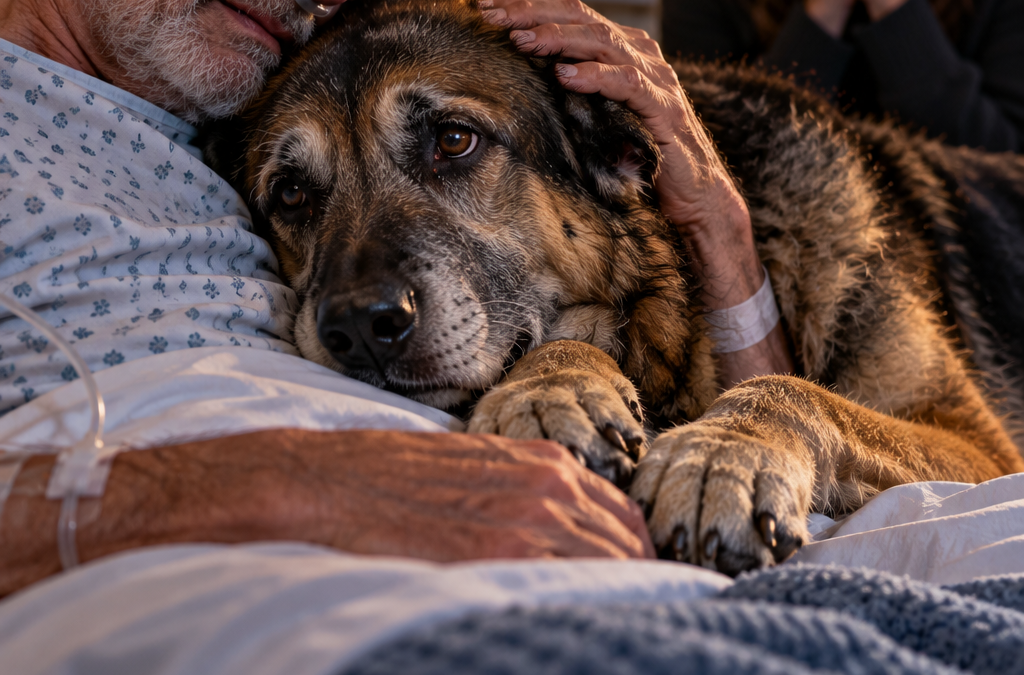
Ranger arrived at 10:17 the next morning.
I remember the exact time because I’d spent nearly an hour staring at the clock, convinced that every passing minute was stealing something I would never get back.
Grace entered first.
She was wearing her brown winter coat, the one Helen had given her years earlier.
Her eyes were red.
She smiled when she saw me.
“Hey, Dad.”
I tried to sit higher against my pillows.
“Where is he?”
She stepped aside.
And there he was.
Ranger stood in the doorway on a faded red leash.
For a moment, I forgot how to breathe.
He looked smaller than I remembered.
His shoulders had narrowed.
The thick black fur along his back had become dull, and white hairs surrounded both eyes.
His hind legs trembled slightly as he stood.
He wore no working harness.
Only his old brown collar.
The brass identification tag hanging beneath his chin was the same one Helen had bought him after retirement.
It read:
RANGER SULLIVAN
HOME IS WHERE MY PEOPLE ARE.
He stared at me.
Then his ears rose.
“Hey, buddy,” I whispered.
Ranger didn’t move.
My heart sank.
Forty-three days.
Forty-three days of hospitals, medication, pain, and loneliness.
Maybe I smelled too different.
Maybe my voice had changed.
Maybe the dog who once knew me better than anyone no longer recognized the frail old man lying in that bed.
I tried again.
“Ranger.”
His head tilted.
I lifted my left hand.
The same hand that had held his leash through thousands of miles of patrols.
“Come here, partner.”
Something changed in his face.
His ears lifted higher.
His tail moved once.
Then he began walking toward me.
Slowly.
Painfully.
Grace loosened the leash.
Ranger crossed the room with the careful, deliberate steps of a dog whose body no longer obeyed him easily.
He stopped beside my bed.
Raised his nose.
And pressed it against my palm.
I felt the familiar warmth of his breath.
The coarse texture of his muzzle.
The small scar beneath his right eye from an injury he had received years earlier.
“Hey, old man.”
My voice broke.
Ranger pushed his head farther into my hand.
Then he made a soft sound deep in his throat.
It wasn’t quite a whine.
It was the sound he used to make when I came home after leaving him with another handler for a long shift.
I reached toward him with both arms.
“Come here.”
He tried to lift his front paws onto the bed.
His hind legs buckled.
Grace caught his harness strap.
“Easy, Ranger.”
I froze.
He had never needed help standing beside me before.
Not like that.
I looked at my daughter.
“What’s wrong with his legs?”
“His arthritis has gotten worse.”
“That much?”
She looked away.
“He’s old, Dad.”
I knew that.
Of course I knew.
But I hadn’t expected age to arrive so brutally during the weeks we’d been apart.
Grace brought a sturdy chair beside the bed and placed a folded blanket across it.
Ranger couldn’t jump, so she helped him settle carefully.
He leaned toward me.
I reached out and wrapped one arm around his neck.
Then I buried my face in his fur.
I smelled shampoo.
Cold winter air.
That faint, familiar scent of a dog who had spent his life outdoors.
Underneath it, I could still recognize Ranger.
The same animal who had once slept beside my boots.
The same warm head that had rested on Helen’s lap.
The same partner who had watched me grow from a confident middle-aged officer into an old man.
“I’m sorry,” I whispered.
He pressed his muzzle against my cheek.
“I’m sorry I was gone so long.”
His tail moved against the chair.
I tried to smile.
“Look at us, huh?”
He looked at me.
“Two retired officers who can’t even get out of bed without help.”
Grace laughed quietly.
Then she started crying.
I looked toward her.
“Hey.”
She shook her head.
“I’m okay.”
“Your mother used to say that.”
“I know.”
“She was never convincing either.”
Grace covered her face.
For several minutes, the three of us stayed like that.
My daughter beside the window.
My old dog leaning against my bed.
And me, trying to memorize the weight of his head against my shoulder.
Eventually, the nurse returned.
Her name was Margaret Collins, a practical woman in her early fifties who had cared for hundreds of dying patients and somehow managed to speak about death without making it sound frightening.
She paused in the doorway.
“Well,” she said, smiling, “I see the important visitor made it.”
I nodded.
“Officer Ranger Sullivan, retired.”
She approached him.
“An honor to meet you, Officer.”
Ranger sniffed her hand.
She scratched behind his good ear.
Then she looked at me.
“How are you feeling, Michael?”
I glanced at Ranger.
“Better.”
She checked my medication pump and adjusted my pillows.
“You seem more comfortable.”
“I have my partner back.”
Margaret smiled.
“Sometimes that’s the medicine we can’t put in a bottle.”
She left us alone.
I turned toward Ranger.
“Well, buddy. Where were we?”
He blinked.
I looked at Grace.
“Did I ever tell you about the night this fool nearly got us killed in the mountains?”
Grace pulled her chair closer.
“Which time?”
I laughed.
“Fair point.”
Ranger rested his head against the edge of my mattress.
And for the first time in weeks, I began telling a story without thinking about how many days I had left.
It happened during our fourth year together.
A January snowstorm had trapped an elderly couple in their cabin near Laurel Ridge.
The husband managed to contact emergency services before the phone line failed.
His wife had suffered a stroke.
Their driveway was buried beneath nearly three feet of snow.
By the time our team reached the nearest accessible logging road, darkness had fallen.
We had coordinates for the cabin.
We didn’t know whether the couple had managed to stay warm.
The temperature was below zero.
Wind whipped through the pine trees.
A rescue team equipped with snowshoes and medical supplies prepared to follow the old access road.
I brought Ranger because there were several side trails, and drifting snow had obscured the route.
We also knew the husband had left the cabin earlier that afternoon to try to meet help.
He hadn’t returned.
That was the part that worried me most.
A seventy-four-year-old man with a bad heart, somewhere in the mountains, in temperatures cold enough to kill him.
We had no idea where to begin.
Ranger took the scent from a scarf the couple’s daughter had brought to the command post.
He sniffed it carefully.
Then he turned away from the old access road.
I frowned.
“Ranger, track.”
He moved farther left.
Toward a narrow deer trail.
I hesitated.
The cabin was northeast.
Ranger wanted to go northwest.
One of the rescue volunteers called, “Sullivan, where’s he going?”
I looked at the compass.
Then at my dog.
“He’s following something.”
“That’s the wrong direction.”
“Not if the old man left the road.”
We followed Ranger.
The trail dropped into a steep hollow where snow gathered between rocks.
The wind was less severe there, but the ground was treacherous.
Ranger moved steadily.
Then, halfway down the slope, he stopped.
His tail stiffened.
He lowered his nose.
I recognized the change.
“He’s close.”
We spread out.
Our flashlights swept through the trees.
Nothing.
Then Ranger began digging.
He pawed frantically at a mound of snow near a fallen pine.
I knelt beside him.
A dark shape emerged beneath the powder.
A glove.
I pulled it free.
Then I saw a hand.
“WE HAVE HIM!”
The man was lying partly beneath a collapsed branch.
Snow had nearly covered him.
His skin was frighteningly pale.
He was unconscious, but he was breathing.
We began treating him immediately.
Ranger stood beside us while the rescue team secured the man to a sled.
Then one of the volunteers asked the question that made my blood run cold.
“Where’s his wife?”
I looked toward the ridge.
The cabin was still more than a mile away.
The woman inside had suffered a stroke.
She might have been lying alone in an unheated room for hours.
We had to reach her.
The rescue team split.
Two volunteers began moving the husband toward the waiting ambulance.
I took Ranger and two others toward the cabin.
We followed the old trail uphill.
Within twenty minutes, the weather deteriorated.
Snow swept across the ridge in blinding waves.
The trail disappeared.
Our radio reception became unreliable.
Then one of the volunteers slipped near a narrow crossing and tumbled down a steep embankment.
He landed against a tree.
His leg was badly injured.
We secured him in place and radioed for help, but the response was broken by static.
Suddenly, we had another emergency.
I told the remaining volunteer to stay with the injured man.
Then I looked at Ranger.
He was standing beside me, snow collecting on his ears.
“All right, partner.”
He looked up.
“Find the cabin.”
We moved into the storm.
The wind was so loud I could barely hear my own breathing.
At times, I couldn’t see more than ten feet.
Ranger worked carefully, following the protected sections of the old trail where scent remained trapped beneath overhanging branches.
Then the ground vanished beneath my right foot.
I remember falling.
A sudden weightlessness.
Then a violent impact.
I struck the side of a rocky drainage chute and slid down into a narrow gully.
My flashlight flew from my hand.
Pain exploded through my chest.
For several seconds, I couldn’t breathe.
When I finally opened my eyes, I saw dark trees moving above me.
I had fallen nearly fifteen feet.
My left ankle was twisted.
Blood ran down my forehead.
I reached for my radio.
Gone.
I tried to stand.
My ankle collapsed beneath me.
The pain was so intense that I nearly blacked out.
I looked around.
“Ranger!”
No answer.
“RANGER!”
I imagined him standing somewhere above the gully, unable to reach me.
Then I heard claws scraping against stone.
A moment later, he appeared through the snow.
He scrambled down the slope, nearly losing his footing.
When he reached me, he pressed his nose against my face.
“Hey, buddy.”
I grabbed his collar.
“That was a bad one.”
He whined.
I tried to sit up.
My ribs screamed.
I couldn’t walk.
My radio was lost.
The temperature was dropping.
And I was alone in the mountains with an injured ankle and a dog.
I don’t know how long I sat there.
Twenty minutes.
Maybe forty.
Cold began creeping through my clothing.
My fingers stiffened.
I remember thinking that if I lost consciousness, I might never wake up.
Ranger circled me restlessly.
Then he pressed his head beneath my arm.
“Can’t go, buddy.”
He tried again.
I shook my head.
“Go find help.”
It was a command he knew.
During training, we’d practiced sending him to a secondary handler for emergency assistance.
But this was no training field.
We were in unfamiliar woods during a blizzard.
I wasn’t sure he’d find anyone.
Still, there was no better option.
I unclipped his lead.
“Find help, Ranger.”
He hesitated.
I pointed uphill.
“Go!”
He ran.
I watched his dark shape vanish into the snow.
Then I was alone.
I remember fighting to stay awake.
I talked to myself.
Recited police procedures.
Counted backward from a hundred.
Thought about Helen waiting at home.
At one point, I started laughing because I realized she’d be furious if I got myself killed during what was supposed to be a routine search.
Then I heard barking.
Faint.
Far away.
I lifted my head.
“Ranger?”
The barking grew louder.
Then I heard human voices.
Lights appeared above the gully.
A rescuer shouted my name.
Ranger emerged between two firefighters, pulling eagerly toward me.
He scrambled down the slope.
When he reached my side, he pressed his forehead against my chest so hard he almost knocked me over.
I wrapped my arms around him.
“You did it.”
His tail beat against the snow.
“You stubborn son of a gun. You did it.”
The rescue crew carried me out.
Another team reached the cabin and found the woman alive, though critically ill.
Both she and her husband survived.
So did the injured volunteer.
We all went home.
But Ranger refused to leave my hospital room until Helen came to collect him.
I woke the next morning to find him lying beneath my bed.
His head rested against my boot.
When I moved, he opened one eye.
I smiled.
“Good morning, hero.”
He thumped his tail.
Then he closed his eye again.
Back in the hospice room, I finished the story and looked at Ranger.
He had fallen asleep with his chin resting beside my hand.
Grace wiped her eyes.
“I remember Mom telling me about that.”
I nodded.
“She grounded me for two weeks.”
Grace laughed.
“She couldn’t ground you. You were a grown man.”
“Tell that to your mother.”
I looked down at Ranger.
“He wasn’t supposed to leave the rescue group. And he definitely wasn’t supposed to come down that gully after me.”
Grace leaned forward.
“But he did.”
I stroked his head.
“That was the thing about him.”
I smiled.
“He always believed the job wasn’t finished until everybody came home.”
Ranger shifted in his sleep.
A small tremor moved through his back legs.
I looked at him carefully.
“Grace?”
“Yeah?”
“Has he been doing that a lot?”
She followed my gaze.
“Sometimes.”
“Does he seem uncomfortable?”
“A little.”
I frowned.
“Did you take him to the vet?”
She didn’t answer immediately.
I looked up.
“Grace.”
She straightened.
“Yes, Dad. I took him.”
“And?”
“His arthritis is worse. He’s fifteen.”
I studied her face.
There it was again.
That hesitation.
The careful selection of words.
The expression Helen used to wear when she knew something I didn’t.
I wanted to ask more.
But Ranger opened his eyes and touched my hand with his nose.
I looked down.
“Hey.”
He blinked slowly.
“You listening to me talk about your glory days?”
His tail moved.
I smiled.
“Don’t worry. I left out the embarrassing parts.”
Grace stood.
“I should get him some water.”
She lifted a bowl from the bag beside her chair.
Ranger sniffed it but barely drank.
I noticed.
I noticed the way he shifted his weight away from his left side.
The way he held his abdomen slightly tense.
The way his breathing seemed too fast for a dog resting in a warm room.
I had spent years recognizing subtle changes in him.
I couldn’t simply forget how.
Something was wrong.
Something beyond old age.
But when I met his eyes, he looked back at me with the same patient expression he’d worn through years of pain, danger, and exhaustion.
And I did what frightened people often do when they don’t want the truth.
I pretended not to see.
That afternoon, Margaret came to explain the arrangements for my remaining days.
The hospice team had spoken with my family.
They believed I could be transferred home if we arranged appropriate equipment and round-the-clock support.
My symptoms could be managed there.
A hospital bed would be placed in the living room.
A nurse would visit regularly.
Medication and emergency supplies would be delivered.
Grace and her husband, Thomas, could stay with me.
I listened carefully.
Then I looked at Ranger.
He was asleep beside the window.
“Can he stay with me?”
Margaret nodded.
“Of course.”
I swallowed.
“Until the end?”
She took my hand.
“Until the end.”
I agreed to go home.
Not because I believed the change of scenery would save me.
I knew better.
I wanted to die in the house where Helen and I had raised our daughter.
I wanted to see the old maple tree outside the kitchen window.
I wanted to hear the floorboards creak when Grace walked down the hallway.
And I wanted Ranger to sleep beside me one last time without anyone telling him visiting hours were over.
We went home the following morning.
It was the third day of my final week.
The hospice transport van pulled into our driveway shortly before noon.
Snow lay in dirty patches along the road.
The sky was pale blue.
My house looked almost exactly as it always had.
The white porch railing.
The old stone chimney.
The bird feeder Helen insisted on hanging every winter.
But something about seeing it from a medical transport vehicle made the place feel unfamiliar.
I had spent decades leaving that house in uniform and coming home after difficult shifts.
Now I was being carried inside because I no longer had the strength to walk through my own front door.
Grace tried to hide her tears while the attendants settled me into the hospital bed.
Thomas helped arrange the oxygen equipment and supplies.
My grandson, sixteen-year-old Caleb, stood awkwardly near the doorway.
He looked frightened.
I understood.
Teenagers rarely know what to do when someone they love is dying.
I beckoned him closer.
“Come here, kid.”
He approached.
I took his hand.
“Your grandma would’ve hated what we’ve done to the living room.”
He glanced at the hospital bed.
Then he smiled.
“She would’ve complained it didn’t match the furniture.”
“Exactly.”
He laughed.
I squeezed his hand.
“You doing okay?”
He nodded too quickly.
“Yeah.”
I studied his face.
“You don’t have to pretend with me.”
His expression crumpled.
He looked away.
“I’m going to miss you, Grandpa.”
The words struck me harder than any medical diagnosis.
I pulled him close with what strength I had.
“I’m going to miss you too.”
He bent carefully and hugged me.
I held him as tightly as I could.
Then I whispered, “You take care of your mom for me.”
He nodded against my shoulder.
“And don’t let her get away with making that terrible meatloaf.”
He laughed through his tears.
“Promise.”
When Ranger arrived, he paused at the front door.
Grace had to help him up the small ramp.
He stood in the hallway, sniffing the familiar air.
Then his head lifted.
He looked toward the living room.
Toward me.
I smiled.
“Well, look who finally came home.”
He walked over.
Slowly.
Carefully.
Then he lowered himself onto the orthopedic bed Grace had placed beside mine.
The movement was awkward.
His legs trembled.
But when he finally settled, he rested his chin near my hand.
I leaned down and touched his ear.
“That’s better.”
For the first time since my hospitalization, the house felt complete.
That evening, Grace made chicken soup.
I managed four spoonfuls.
Ranger ate half a small bowl of softened food.
We were both praised as though we’d accomplished something remarkable.
“Look at us,” I told him. “Two champions.”
He blinked.
“Don’t tell anybody we used to be tougher than this.”
His tail moved once.
Grace smiled from the kitchen doorway.
But I saw her eyes fill with tears when she thought I wasn’t looking.
After dinner, I asked her to bring the wooden box from my bedroom closet.
It was heavy, dark oak, with a brass latch Helen had polished every Christmas.
Inside were photographs, medals, old police patches, Ranger’s retirement certificate, and a collection of handwritten notes from people we’d helped.
Grace placed it on the table beside my bed.
I opened the lid.
The smell of old paper rose into the room.
Ranger lifted his head.
“Recognize this stuff, buddy?”
He sniffed the edge of the box.
I pulled out a photograph taken outside an abandoned steel-processing warehouse.
It showed me at forty-nine, wearing a tactical vest, standing beside Ranger.
My left arm was bandaged.
Ranger’s right front leg was wrapped in a veterinary splint.
We looked exhausted.
And we were both smiling.
I stared at the picture for a long time.
Grace noticed.
“Was that the shooting?”
I nodded.
“The worst day of my career.”
She sat beside me.
“You never told me everything that happened.”
I looked at Ranger.
His eyes were fixed on the photograph.
“That’s because I didn’t want you worrying.”
“Dad, it was sixteen years ago.”
I smiled faintly.
“Your mother worried for sixteen years anyway.”
I turned the photograph over.
On the back, Helen had written:
My two stubborn heroes. Please stop trying to die before I do.
I ran my thumb across her handwriting.
Then I looked at Grace.
“All right.”
I settled against the pillows.
“I’ll tell you.”
It was a hot August afternoon when the call came in.
A robbery suspect had fled into an abandoned industrial warehouse outside the town of Westbridge.
He was believed to be armed.
A witness reported hearing gunfire.
The warehouse had been empty for years, but local teenagers sometimes entered through gaps in the perimeter fence.
We didn’t know whether anyone else was inside.
Our team established a perimeter while negotiators attempted to contact the suspect.
Ranger and I were assigned to assist with the search if the building was cleared for entry.
The situation changed when a frightened teenager emerged from a rear service door.
He was bleeding from a cut on his forehead.
He told officers that his younger brother was still inside.
The boys had been exploring when the suspect entered.
The younger child had hidden somewhere on the upper level.
Suddenly, waiting became much more complicated.
The suspect refused repeated demands to surrender.
A tactical team began moving into position.
Ranger and I accompanied two officers through a side entrance to help locate the missing boy while the other teams contained the armed suspect.
The building was enormous.
Rusting machinery stood beneath broken windows.
Dust hung in the air.
Sections of flooring had collapsed.
Ranger moved beside me, alert but quiet.
We searched a narrow corridor leading toward the old loading platforms.
Then I heard a faint sound overhead.
Crying.
I looked up.
“Police! Call out!”
A child’s voice answered from somewhere beyond the metal walkway.
“Help!”
I radioed the location.
Then I heard footsteps moving on the upper level.
Not the child.
Heavier.
Faster.
Ranger stiffened.
A man appeared at the far end of the walkway, partially obscured by machinery.
He raised his arm.
There was a flash.
A deafening crack.
Something slammed into my left side.
I fell backward against a steel support.
For a moment, I couldn’t understand what had happened.
Then I felt warmth spreading beneath my vest.
I’d been shot.
The bullet had entered near the lower edge of the protective panel, damaging my ribs and lung.
I dropped behind cover.
Ranger moved in front of me.
I remember shouting for him to stay.
The suspect fired again.
A round struck the metal railing above us.
Sparks scattered.
Ranger flinched but held his position.
I tried to call for help.
My radio slipped from my fingers.
I reached for it.
Pain tore through my chest.
My vision blurred.
The suspect began moving along the walkway toward the stairs.
I heard his boots striking metal.
He was coming down.
I drew my weapon.
My hands were shaking.
I knew I was losing blood.
I knew I might not remain conscious long enough for backup to reach me.
And I knew that if the suspect reached the lower corridor, he might find the frightened child before officers could intervene.
Ranger stood between us.
His body was rigid.
I whispered his name.
“Ranger.”
He glanced back.
It was the shortest glance imaginable.
But I remember it more clearly than almost anything else that happened that day.
He looked at me as if he were asking what I needed.
I swallowed blood.
“Stay.”
He held his position.
The suspect reached the bottom of the stairs.
He appeared around the corner with the gun in his hand.
I shouted a warning.
He raised the weapon.
And Ranger moved.
He launched forward with the explosive speed that had made him so effective throughout his career.
He struck the man’s lower arm and drove him sideways into a stack of wooden pallets.
The gun fell.
The suspect screamed.
They crashed against a broken glass panel.
Ranger yelped.
I struggled to rise.
Two officers rushed into the corridor.
They secured the suspect and called for medical assistance.
Ranger released his grip on command.
Then, instead of following the officers, he came back to me.
He was limping badly.
Blood stained his right front leg.
I remember trying to tell him to stay back.
He ignored me.
He pressed his body against my side.
I slid my hand into his fur.
“Good boy.”
My voice was barely audible.
“Good boy, Ranger.”
His face hovered above mine.
I heard distant shouting.
Someone was calling for a medic.
Someone else was asking about the child.
I tried to answer.
Couldn’t.
The edges of my vision darkened.
Then Ranger placed his paw against my boot.
Twice.
Tap.
Tap.
Our old signal.
Ready to work.
Ready to move.
Ready to keep going.
I smiled, even though breathing hurt.
“Not this time, buddy.”
He touched my boot again.
I whispered, “I know.”
Then everything went black.
When I woke in the hospital, Helen was sitting beside my bed.
Her eyes were swollen.
Her hands trembled around a paper cup of coffee.
I tried to speak.
She leaned forward.
“Don’t you dare.”
I blinked.
“You don’t get to apologize yet,” she said.
Tears spilled down her cheeks.
“You don’t get to tell me you’re fine. You don’t get to make some stupid joke.”
I tried anyway.
“How’s Ranger?”
She stared at me.
Then she started crying harder.
I felt panic rise.
“Helen?”
“He’s alive.”
I closed my eyes.
“Thank God.”
“He needed surgery on his leg. They removed glass and repaired some damaged tissue.”
I swallowed.
“Will he walk?”
“They think he’ll recover. He’ll need rehabilitation.”
I let my head fall back against the pillow.
Helen took my hand.
“Michael, you almost died.”
I looked at her.
“I know.”
“No, I don’t think you do.”
She squeezed my fingers.
“The doctor said you lost so much blood they weren’t sure you’d survive the surgery.”
I looked toward the window.
Helen’s voice broke.
“And when they brought Ranger out of the operating room, he kept trying to get off the table.”
I turned back.
“What?”
“He was looking for you.”
I stared at her.
“They said he wouldn’t settle. So I brought your old uniform shirt from the house and put it in his kennel.”
She smiled through tears.
“He finally went to sleep with his head on it.”
I couldn’t speak.
Helen leaned forward and kissed my forehead.
“You two are going to be the death of me.”
Then she whispered, “But I’m glad you’re both still here.”
I spent several weeks recovering.
Ranger recovered with me.
His injury left him with a slight permanent limp, but his determination never changed.
When he was finally allowed to visit my hospital room, he walked slowly to the side of the bed.
He looked at my bandaged chest.
Then he lowered himself carefully to the floor.
He remained there for hours.
Not moving.
Not asking for anything.
Just staying.
Back in my living room, I held the photograph with trembling hands.
Grace was crying.
“I knew he’d been hurt,” she whispered. “But I never knew he came back to you.”
I nodded.
“He could’ve stayed with the other officers.”
I looked down at Ranger.
“He could’ve followed the suspect. But once the threat was over, he came back.”
Ranger was watching me.
I smiled faintly.
“That was always his priority.”
Grace wiped her cheeks.
“You.”
I shook my head.
“Us.”
She looked confused.
I touched Ranger’s head.
“He never thought of the job as chasing bad people. He thought of it as bringing his people home.”
The room fell quiet.
I reached down and took the old brass K9 badge from the wooden box.
Its surface was scratched.
The edges were worn.
The lettering had faded.
I held it against the light.
“Do you remember this, partner?”
Ranger sniffed it.
Then he lowered his head.
A faint shiver passed through his body.
I frowned.
“Ranger?”
He shifted awkwardly.
His breathing became rapid.
I placed a hand against his ribs.
He was panting.
Not from excitement.
Not from heat.
From discomfort.
“Grace.”
She stood immediately.
“What?”
“Something’s wrong.”
Ranger tried to rise.
His hind legs slipped.
He gave a low whine.
I reached toward him.
“Easy, buddy.”
He managed to stand, but his legs trembled so badly that Grace had to support him.
I looked at her.
“Call the veterinarian.”
“Dad—”
“Now.”
She hesitated.
And in that moment, I saw everything she’d been trying to hide.
The fear.
The exhaustion.
The terrible knowledge sitting behind her eyes.
“Grace.”
My voice was weak, but it still carried enough of the old officer to make her stop.
“What aren’t you telling me?”
She looked toward Ranger.
Then she began crying.
And suddenly I knew that whatever secret she’d been carrying, it had nothing to do with arthritis.
Grace lowered herself into the chair beside my bed.
She covered her face with both hands.
For a moment, the only sound in the room was Ranger’s uneven breathing.
I waited.
Finally, she looked up.
“Dad, Ranger is dying too.”
The words seemed to empty the air from the room.
I stared at her.
“What?”
She swallowed.
“I took him to the veterinarian three weeks ago. He’d stopped eating normally, and he was having trouble breathing after short walks.”
I looked toward Ranger.
He was lying on his side, watching us.
“The doctor found a mass near his heart,” Grace continued. “There was fluid building up around it. His heart isn’t working properly anymore.”
My fingers tightened around the blanket.
“What kind of mass?”
“They think it’s cancer.”
I closed my eyes.
Not Ranger.
Not him too.
Grace was crying openly now.
“The specialist said treatment would be very hard on him. He’s fifteen, Dad. His kidneys are weak, and his arthritis is severe. They didn’t think he could tolerate much.”
I struggled to take a breath.
“How long?”
She looked at me.
“At first, they said a few weeks. But he got worse.”
“How much worse?”
“His veterinarian thought he might only have days.”
I stared at her.
“Days?”
She nodded.
I turned toward Ranger.
He was lying on his blanket, breathing too quickly, his dark eyes fixed on me.
For forty-three days, I’d been lying in a hospital bed imagining him waiting for me at home.
I’d pictured him sleeping in front of the fireplace.
Eating his dinner.
Walking slowly through Grace’s yard.
Maybe watching the driveway, wondering why I hadn’t returned.
But while I’d been fighting my disease, Ranger had been fighting his own.
And my daughter had known.
“Why didn’t you tell me?”
My voice was sharper than I intended.
Grace flinched.
“Dad…”
“Why?”
She wiped her cheeks.
“Because you were already so sick.”
“He’s my dog.”
“I know.”
“He’s my partner.”
“I know, Dad.”
“Then why the hell would you keep that from me?”
She stood abruptly.
“Because I thought losing him would kill you before the cancer did!”
Her words struck like a physical blow.
She began trembling.
“I watched you lose Mom. I watched you shut yourself inside this house for months. I watched you stop eating and stop answering the phone. And the only reason you kept getting up every morning was because Ranger needed you.”
I stared at her.
“So when the veterinarian told me he was dying, I panicked.”
She wiped at her tears.
“You were in the hospital. You could barely keep food down. Every time I visited, you asked whether Ranger was okay.”
Her voice broke.
“And I couldn’t tell you he wasn’t.”
I looked toward the window.
Grace continued quietly.
“I thought if you knew, you’d give up. I thought you’d stop fighting.”
I swallowed.
“Sweetheart…”
“I was trying to protect you.”
I looked back at her.
She stood beside the chair, looking suddenly like the little girl who used to cry when she’d done something wrong.
I held out my hand.
“Come here.”
She hesitated.
Then she approached.
I took her fingers.
“Grace, look at me.”
Her eyes met mine.
“You didn’t have to protect me from saying goodbye.”
She began crying again.
I squeezed her hand.
“That’s the one thing we should never take away from someone who loves us.”
She knelt beside my bed.
“I’m sorry.”
I brushed a strand of hair from her forehead.
“I know.”
She rested her head against my shoulder.
For several minutes, neither of us spoke.
Then I whispered, “Does he have pain medication?”
She nodded.
“The veterinarian prescribed medicine to keep him comfortable. She said we could bring him back whenever he seemed distressed.”
“Call her.”
Grace lifted her head.
“Now?”
“Yes.”
I glanced toward Ranger.
“We’re going to make sure he doesn’t suffer.”
Dr. Elizabeth Price arrived that evening.
She had been Ranger’s veterinarian for almost eight years.
She knew his medical history, his old injuries, and his extraordinary ability to turn a routine examination into a contest of wills.
When she entered the living room, Ranger lifted his head.
“Hello, handsome,” she said softly.
His tail moved once.
She knelt beside him.
“Still giving everybody a hard time?”
He pressed his nose against her fingers.
She examined him carefully.
I watched every movement.
Every pause.
Every small change in her expression.
Afterward, she sat beside my bed.
“Michael, Ranger is very weak.”
I nodded.
“Grace told me.”
“His heart disease has progressed. We’re seeing signs that he’s having difficulty circulating blood efficiently, and the fluid accumulation is becoming harder to manage.”
I looked at him.
“Is he hurting?”
“He’s uncomfortable, especially when he tries to move or breathe deeply. We can adjust his medication and keep him calm, but we can’t reverse what’s happening.”
My throat tightened.
“How much time?”
She looked at me with extraordinary kindness.
“I can’t predict exactly. It may be a few days. It could be less.”
I let out a long breath.
“So we’re racing each other.”
Dr. Price looked down.
“I’m sorry.”
I shook my head.
“Don’t be.”
I glanced at Ranger.
“He always hated losing.”
The doctor smiled sadly.
We discussed how to keep him comfortable.
She left medication and instructions with Grace.
She explained the signs that would mean Ranger was suffering and that we would need to make a decision.
Then she asked whether I wanted him moved to a veterinary facility where he could be monitored continuously.
I looked at Ranger.
He was lying beside my bed.
His eyes followed the sound of my voice.
“No.”
Dr. Price nodded.
“I thought you might say that.”
“He stays with me as long as he’s comfortable.”
She placed a hand on my shoulder.
“Then we’ll help you give him a peaceful goodbye here.”
That night, Grace moved Ranger’s bed closer to mine.
So close that I could reach down and touch him without lifting my shoulders from the mattress.
She placed a small lamp beside us.
Then she kissed my forehead.
“Good night, Dad.”
“Good night, sweetheart.”
She paused in the doorway.
“Dad?”
“Yeah?”
“I’m really sorry.”
I looked at her.
“Grace, you don’t have to apologize anymore.”
She nodded.
I smiled faintly.
“Your mother would’ve been proud of how you’ve taken care of us.”
Her face crumpled.
She came back and kissed my cheek.
Then she left the room.
I waited until her footsteps faded.
Outside, the wind moved gently through the trees.
Inside, Ranger lay beside me.
I reached down.
“Well, partner.”
His eyes opened.
“Seems we’ve both been keeping secrets.”
He blinked.
“I didn’t tell you how bad I was.”
His tail moved faintly.
“And you didn’t tell me how bad you were.”
I stroked his gray muzzle.
“Two stubborn old fools.”
He pressed his nose into my palm.
I smiled through tears.
“Your mother would have something to say about this.”
For a while, we lay quietly.
Then I whispered, “I’m scared, Ranger.”
The words surprised me.
I’d spent months telling everyone I was ready.
I’d told the doctors.
I’d told Grace.
I’d told my grandson that dying was part of life and there was no point fighting what couldn’t be changed.
But alone with Ranger, I finally admitted the truth.
“I don’t know what’s waiting.”
He watched me.
“I want to believe Helen is there.”
My voice trembled.
“I want to believe she has that ridiculous red stocking hanging by the fireplace and she’s going to tell me I’ve tracked mud into the house again.”
I laughed weakly.
Then I began crying.
“I’m afraid of leaving Grace.”
Ranger shifted closer.
“I’m afraid of how much it’s going to hurt her.”
His nose touched my fingertips.
“And I’m afraid you’re going to leave before I do.”
For a long time, I couldn’t speak.
Then I whispered, “I don’t think I can do that again, buddy.”
Ranger struggled to move.
His hind legs trembled.
He managed to push himself forward just enough to place his head against the side of my mattress.
I lowered my hand.
He touched it.
Then, with the last bit of strength he could gather, he lifted one front paw and pressed it against the bed frame.
Once.
Twice.
Tap.
Tap.
Our old signal.
I stared at him.
“Ready to work?”
His eyes remained fixed on mine.
My chest tightened.
I shook my head slowly.
“No, partner.”
I stroked his ear.
“No more work.”
He lowered his paw.
And then I told him something I should have said years earlier.
“You’ve done enough.”
The fourth day came quietly.
I woke to sunlight across the living room floor and the smell of coffee drifting from the kitchen.
For a moment, I forgot where I was.
I expected to hear Helen humming while she prepared breakfast.
I expected Ranger to nudge my elbow because he’d decided six in the morning was late enough for any respectable officer to sleep.
Instead, I heard the oxygen equipment humming softly beside my bed.
Ranger lay asleep near my hand.
Grace was speaking quietly with Margaret in the kitchen.
I listened to their voices.
They were discussing medication schedules.
My breathing.
My comfort.
Practical things.
Necessary things.
I closed my eyes again.
Then Ranger shifted.
I reached down.
“Morning, partner.”
He opened one eye.
His tail moved faintly.
“Still here, huh?”
He breathed out.
“Me too.”
Margaret came to check on me.
She examined my breathing, adjusted the medication, and helped me sit higher against the pillows.
“How are we doing today?” she asked.
I glanced at Ranger.
“We’re both still causing trouble.”
She smiled.
“That’s good.”
I watched her for a moment.
“Margaret?”
“Yes?”
“Have you ever had a patient die with a dog beside them?”
She nodded.
“Many times.”
I swallowed.
“Does it upset the dog?”
She considered the question.
“Animals can notice when someone is very ill or dies. Some become distressed. Others remain quiet. We try to support them and their families as gently as we can.”
I looked toward Ranger.
“What if the dog is dying too?”
Margaret followed my gaze.
Then she pulled a chair beside the bed.
“Michael, I think the most important thing is that neither of you has to be alone.”
I nodded.
She placed her hand over mine.
“And I think Ranger knows he’s where he belongs.”
That afternoon, I asked Grace to bring me the old K9 training logbooks.
They were stacked in a metal cabinet in the garage.
She carried them into the living room and placed them beside my bed.
There were five books.
Their covers were worn.
Some pages smelled faintly of damp paper and old leather.
I opened the first one.
Inside were dates, locations, training exercises, search summaries, and notes about Ranger’s performance.
I smiled.
“Listen to this.”
Grace sat beside me.
I read aloud.
“April seventeenth. Tracking exercise. Subject located in twelve minutes. Handler failed to follow canine indication and added six unnecessary minutes to search.”
Grace laughed.
“You wrote that about yourself?”
“Of course.”
“Why?”
“Because Ranger was right.”
I flipped another page.
“June second. Building search. Canine successfully located hidden subject. Handler slipped on wet concrete and fell into storage bin.”
Grace laughed harder.
I shook my head.
“That was a bad day.”
Ranger lifted his head at the sound of our laughter.
I looked down.
“Don’t you start.”
His tail moved.
“You remember that, don’t you?”
For the next hour, Grace read entries aloud.
Some were funny.
Others brought back memories that left us silent.
One described a missing teenager found after eighteen hours in the woods.
Another recorded a successful search for an elderly man who had wandered from a care facility.
There were notes about damaged equipment, lost boots, bad weather, injuries, and rescues.
So many rescues.
At one point, Grace stopped reading.
She looked at the pages.
“Dad, how many people did you and Ranger find?”
I thought about it.
“Depends what you count.”
“What do you mean?”
“Not every search ended with someone missing. Sometimes we located evidence. Sometimes we ruled out an area so other teams could focus somewhere else.”
She nodded.
“But people. How many people did you bring home?”
I looked toward Ranger.
“Forty-three confirmed live finds during his career.”
Grace stared at me.
“Forty-three?”
I nodded.
“Forty-three people who were alive when we found them.”
She looked down at the book.
“That’s incredible.”
I smiled faintly.
“He was incredible.”
Grace turned another page.
Then she stopped.
A small photograph had slipped out from between the sheets.
It showed a young girl with dark braids standing beside Ranger.
She was hugging his neck.
On the back, someone had written:
Thank you for bringing my daddy back.
Grace held up the picture.
“Who was she?”
I recognized it immediately.
“Her name was Lily.”
I swallowed.
“Her father was a volunteer firefighter. He went missing during a search operation after a landslide.”
I looked at Ranger.
“That was one of the hardest nights we ever had.”
The memory came slowly.
A rain-soaked hillside.
A collapsing road.
The smell of wet earth.
We had been searching for a trapped construction worker when part of the slope gave way.
A volunteer firefighter named Andrew Parker was separated from the team.
The radio went silent.
Nobody could find him.
We searched for hours.
Rain washed away tracks.
Loose soil made the hillside dangerous.
Ranger kept working despite the difficult conditions.
At one point, he stopped near a pile of branches and broken concrete.
He began sniffing.
Then he pawed at the debris.
I radioed the location.
Rescuers moved carefully toward us.
Beneath the broken earth, we heard someone calling for help.
Andrew was alive.
His leg was trapped.
Part of the hillside had collapsed around him.
We worked for nearly two hours to free him.
During that time, the ground shifted repeatedly.
At one point, a chunk of earth broke loose above us.
I grabbed Ranger’s harness and pulled him away as rocks and mud crashed where he’d been standing seconds earlier.
He yelped in surprise.
Then, the moment the debris stopped moving, he tried to return to the trapped firefighter.
I held him back.
“Not yet, buddy.”
He strained against the leash.
“We’re not leaving him.”
He looked at me.
I nodded.
“I know.”
The rescue team eventually freed Andrew.
He survived with a broken leg and several crushed ribs.
Months later, his wife brought their daughter Lily to the police station.
The little girl carried a paper bag filled with homemade dog biscuits.
She approached Ranger cautiously.
“Are you the dog who found my daddy?”
Ranger sat beside me.
I smiled.
“That’s him.”
She knelt and wrapped her arms around his neck.
“Thank you.”
Ranger rested his head against her shoulder.
Lily began crying.
“My daddy says he thought he was going to die.”
I knelt beside her.
“He was very brave.”
She shook her head.
“He says your dog was brave.”
Then she kissed Ranger’s forehead.
Before leaving, she handed me the photograph.
On the back, she’d written those seven words.
Thank you for bringing my daddy back.
I had kept it ever since.
Back in the living room, Grace held the picture for a long time.
Then she looked at Ranger.
“You really were something, weren’t you?”
He opened his eyes.
I smiled.
“Still is.”
That evening, my grandson Caleb came into the living room carrying a small cardboard box.
He looked nervous.
“Grandpa?”
I turned toward him.
“What’ve you got there?”
He approached the bed.
“I wanted to show you something.”
He opened the box.
Inside were several old photographs he’d printed from my computer.
Pictures of Ranger and me during training.
Pictures of Helen.
Pictures of Grace as a child.
One showed Ranger asleep beneath a Christmas tree, wearing an enormous red bow.
Caleb placed them on the table.
“I thought maybe we could make a scrapbook.”
I stared at him.
He shrugged.
“Mom said you have a lot of pictures nobody’s organized.”
I smiled.
“Your grandmother spent thirty years telling me that.”
He sat beside me.
For the next hour, we sorted photographs.
Caleb asked questions.
I answered as many as I could.
Sometimes my voice weakened.
Sometimes I had to stop because the pain medication made me sleepy.
But he waited patiently.
Then he found a picture of me standing beside Ranger on the day he officially retired.
Caleb studied it.
“Grandpa?”
“Yeah?”
“Do you think Ranger misses being a police dog?”
I looked at my old partner.
He lay quietly beside the bed.
His breathing was shallow.
“I think he misses being able to do the things he used to do.”
Caleb nodded.
“Like running?”
“Yeah.”
“And chasing people?”
I smiled.
“Probably.”
He considered that.
Then he asked, “Do you miss being a police officer?”
I thought about it.
“I miss parts of it.”
“Which parts?”
“The people. The purpose. Knowing somebody needed help and being able to do something about it.”
Caleb looked down at the photograph.
“Do you wish you could go back?”
I shook my head.
“No.”
He seemed surprised.
“Why not?”
I looked toward the kitchen, where Grace was washing dishes.
Then at the old photographs of Helen.
Then at Ranger.
“Because if I spent all my time wishing I was young again, I’d miss the time I still have.”
Caleb studied me.
I reached for his hand.
“Listen to me, kid.”
He leaned closer.
“Being strong isn’t about never getting old. And being brave isn’t about pretending nothing scares you.”
I glanced at Ranger.
“Sometimes courage is knowing you’re not going to win and still choosing to love the people beside you.”
Caleb’s eyes filled.
I squeezed his fingers.
“Don’t waste your life waiting to become somebody important. Be good to the people who love you. That’s important enough.”
He nodded.
Then he bent and hugged me.
I held him for a long time.
Ranger lifted his head and rested his nose against Caleb’s knee.
My grandson began crying.
He wrapped one arm around Ranger too.
And for a few minutes, the three of us stayed together.
An old man.
A dying dog.
And a boy just beginning his life.
The fifth day was difficult.
I woke before dawn with severe pain in my abdomen.
Margaret came and adjusted my medication.
Grace sat beside me while I struggled to get comfortable.
I was too exhausted to speak much.
Ranger seemed worse too.
He refused breakfast.
He drank only a little water.
His breathing remained rapid despite the medication.
When he tried to stand, his legs gave way.
Thomas helped him settle back onto the blanket.
I watched from my bed.
A terrible helplessness settled over me.
For nine years, I had been responsible for Ranger’s safety.
I checked his paws after every search.
I made sure he had water.
I watched for heat exhaustion in summer and frostbite in winter.
I carried extra supplies in my patrol vehicle because I knew he would keep working long after he should have stopped.
And now I couldn’t even climb out of bed to help him.
“Grace,” I whispered.
She approached.
“Yes?”
“Move him closer.”
She carefully shifted his bed beside mine.
I reached down.
My fingers barely touched his fur.
“That’s better.”
Ranger opened his eyes.
He looked at me.
I tried to smile.
“Rough morning, huh?”
His tail moved faintly.
“Mine too.”
I spent much of that day drifting in and out of sleep.
Sometimes I dreamed about the police station.
Sometimes I dreamed about Helen.
Once, I dreamed that Ranger and I were walking through a field beneath a bright summer sky.
He was young again.
His black-and-tan coat shone in the sunlight.
He ran ahead of me with effortless speed.
Every few yards, he looked back.
Waiting.
I called his name.
He stopped.
Then he touched my boot twice.
When I woke, my hand was resting against his head.
I began crying quietly.
Not because the dream had frightened me.
Because for a few seconds, I’d remembered what it felt like to be strong.
That afternoon, Dr. Price returned.
She examined Ranger and spoke quietly with Grace.
I could hear only fragments.
Heart rate.
Breathing.
Fluid.
Comfort.
Then she approached my bed.
“Michael?”
I looked at her.
“Tell me.”
She sat.
“Ranger is approaching the end of his life.”
I nodded.
“I know.”
“His medication is helping some, but his condition is worsening.”
I looked at him.
He lay motionless, his eyes half-open.
“Is he suffering?”
“He’s having periods of discomfort and difficulty breathing. We need to watch closely. If we can’t keep him comfortable, the kindest option may be to help him pass peacefully.”
I swallowed.
“How soon?”
She hesitated.
“Possibly today. Perhaps tomorrow.”
I turned my face toward the window.
For a moment, I felt an anger so fierce it surprised me.
Not at the doctor.
Not at Grace.
Not even at the disease.
At time.
At the unfairness of it.
At the cruelty of finally bringing my dog home only to lose him almost immediately.
I’d spent months preparing to die.
I’d made arrangements.
Signed documents.
Spoken with my daughter about the house.
Chosen what I wanted done with my ashes.
But I hadn’t prepared to watch Ranger go first.
I looked back at Dr. Price.
“Can you keep him comfortable tonight?”
“We can try, but if his distress becomes severe, we shouldn’t wait.”
I nodded.
“Then that’s what we’ll do.”
She adjusted his medication and explained what we needed to monitor.
Before leaving, she rested her hand against Ranger’s head.
“Good dog,” she whispered.
He opened his eyes.
His tail moved once.
She smiled sadly.
“Very good dog.”
That evening, Grace dimmed the living room lights.
Margaret adjusted my pillows.
Caleb brought his favorite blanket and sat nearby.
Thomas prepared tea nobody really wanted.
Ranger lay beside my bed.
His breathing was slower now, but still labored.
I reached down and stroked his head.
“Remember our first day, partner?”
His eyes moved toward me.
“The training field?”
I smiled.
“You stole my glove.”
His tail shifted.
“I chased you around like an idiot.”
I laughed weakly.
“And you looked so proud of yourself.”
I closed my eyes.
“I knew right then you were going to be trouble.”
The room was quiet.
Grace sat beside me.
I opened my eyes again.
“But you were the best kind of trouble.”
I looked at my dog.
“You know what I remember most?”
He watched me.
“Not the awards.”
I swallowed.
“Not the criminals we caught.”
I brushed my thumb across the gray fur beneath his ear.
“I remember coming home.”
The words were difficult now.
My breathing had become shallow.
But I needed him to hear them.
“I remember opening the door and hearing Helen laugh because you’d already found the kitchen.”
Grace smiled through tears.
“I remember you sleeping on the couch when you weren’t allowed.”
Caleb laughed softly.
“I remember you sitting beside me after your mother died.”
I paused.
“And I remember every time I was scared, you made me feel like I wasn’t alone.”
Ranger shifted.
His nose touched my fingers.
I began crying.
“You were never just a dog.”
My voice broke.
“You were my partner.”
He breathed slowly.
“My family.”
His eyes remained on mine.
“And my best friend.”
Grace reached for a tissue.
I shook my head.
I didn’t want to wipe away the tears.
Not this time.
I’d spent too much of my life pretending grief was something to conceal.
I wanted Ranger to hear every word.
“You did your job, buddy.”
I smiled through tears.
“You did it better than anybody.”
For a moment, I could almost see him as he had been years before.
Young.
Strong.
Standing beside my patrol car with his ears raised and his eyes shining.
Waiting for the next command.
Then I looked at the frail body lying beside me.
And I understood that there was one final command I needed to give.
The hardest one of all.
“Stand down, partner.”
My voice was barely a whisper.
“Your watch is over.”
Ranger blinked.
I touched his forehead.
“You don’t have to protect me anymore.”
His tail moved faintly.
“I’m okay.”
I wasn’t sure whether I was telling the truth.
But I wanted him to believe it.
“I’ve got Grace.”
I looked toward my daughter.
She was crying silently.
“I’ve got Caleb.”
He leaned closer.
“And I’ve got all the memories you gave me.”
I pressed my trembling fingers against Ranger’s cheek.
“So if you’re tired, buddy…”
My voice collapsed.
“It’s okay to rest.”
For a long time, he simply watched me.
Then his head settled against the blanket.
His eyes closed.
I stayed awake beside him through the night.
At some point, Margaret brought another blanket and helped me shift into a more comfortable position.
Grace dozed in a chair.
Caleb fell asleep on the couch.
Thomas kept watch from the kitchen.
The house was quiet.
Peaceful.
The way it had been before sickness and fear began taking over our lives.
Around three in the morning, Ranger stirred.
I opened my eyes.
His breathing had changed.
It was more difficult now.
He raised his head, then let it fall back onto the pillow.
I reached for the call button beside my bed.
Margaret came immediately.
She checked Ranger and called Dr. Price, who had agreed to remain available.
Grace woke and joined us.
Within minutes, we knew the truth.
Ranger was entering the final stage of his illness.
His body was exhausted.
His heart could no longer keep up.
Dr. Price arrived while it was still dark.
She examined him carefully.
Then she looked at me.
“Michael, I don’t think we should let him struggle.”
I nodded.
I had known this moment was coming.
But knowing didn’t make it easier.
“Will it hurt?”
“No. I’ll make sure he’s peaceful.”
I looked at Ranger.
His eyes were open.
He seemed to be searching for something.
I knew what.
“Bring him closer.”
Grace and Thomas carefully moved his bed until his head rested beside my hand.
I leaned toward him.
The movement sent pain through my abdomen.
I didn’t care.
“Hey, partner.”
His eyes found mine.
“Remember me?”
His tail moved once.
I smiled through tears.
“Yeah. I remember you too.”
Grace knelt beside him.
She stroked his shoulders.
Caleb sat on the floor, crying quietly.
Dr. Price gave Ranger medication to help him relax.
His breathing eased.
The tension slowly left his body.
I kept my hand against his cheek.
Then I reached toward the bedside table.
Grace understood.
She picked up Ranger’s old brass K9 badge and placed it in my palm.
I held it carefully.
For years, that small piece of metal had represented our partnership.
The hours.
The danger.
The trust.
The lives we had helped save.
I placed it beside Ranger’s paw.
“Officer Ranger Sullivan,” I whispered.
His ear moved faintly.
I smiled.
“Badge number K9-12.”
Grace began crying harder.
“Nine years of faithful service.”
My voice trembled.
“Forty-three confirmed live finds.”
I paused.
“Three occasions where you saved your handler’s life.”
Then I lowered my head.
“And one more time when you saved him from giving up.”
The room was silent.
I stroked his ear.
“Your service is complete.”
A tear fell onto his fur.
“You are relieved of duty.”
Ranger looked at me.
For one brief moment, his eyes seemed brighter.
I could almost see the young dog who had once stolen my glove and challenged me to chase him.
Then, slowly, he lifted one paw.
It trembled.
He reached toward the edge of my blanket.
And touched it.
Once.
Twice.
Tap.
Tap.
I broke.
I bent over him as far as my failing body would allow.
“Oh, buddy.”
My tears fell into his fur.
“Good boy.”
I kissed his forehead.
“Good boy, Ranger.”
He lowered his paw.
His breathing remained calm under the medication.
Dr. Price waited until I nodded.
Then she gave the final injection.
I kept my hand on Ranger’s head.
I felt one slow breath.
Then another.
A final, gentle exhale.
And my partner was gone.
For several seconds, I couldn’t understand the silence.
I waited for his tail to move.
For his ears to twitch.
For him to lift his head and give me that stubborn look.
Nothing happened.
I whispered his name.
“Ranger?”
Grace placed her hand over mine.
I stared at him.
Then I began sobbing.
Not quietly.
Not carefully.
I cried with the helplessness of a child.
I cried for the young dog who had stolen my glove.
For the partner who had pulled rescuers toward me through a blizzard.
For the friend who had protected me from a gunman.
For the animal who had stayed beside me when Helen died.
And for the old dog who had spent his final strength making sure I wasn’t alone.
My daughter held me.
I felt her tears against my shoulder.
“I’m sorry, Daddy,” she whispered.
I shook my head.
“No.”
I looked at Ranger.
“Don’t be sorry.”
I swallowed.
“He had a good life.”
Grace nodded.
“He did.”
I brushed my fingers across his ear.
“He had a brave life.”
Then I whispered the truth that hurt most.
“And he made mine worth living.”
Dr. Price gave us time.
Nobody rushed us.
Nobody told me to be strong.
Nobody tried to explain that he was only an animal.
They understood.
He had been my partner.
My family.
My home.
When the time came to take him, I couldn’t watch.
I turned my face toward the window.
Grace kissed my forehead.
“We’ll take care of everything.”
I nodded.
Then I remembered something.
“Wait.”
She stopped.
I held out my hand.
“His collar.”
Dr. Price gently removed it.
Grace placed it in my palm.
The leather was worn smooth from years of use.
The brass tag was scratched.
I closed my fingers around it.
“Thank you.”
After they carried Ranger away, the living room seemed impossibly large.
His bed remained beside mine.
His water bowl sat near the fireplace.
His old tennis ball rested beneath the wooden table.
Everywhere I looked, I saw evidence of a life that had just ended.
I stared at the empty blanket.
And for the first time since the doctor gave me one week to live, I wanted the days to pass faster.
The sixth morning arrived gray and cold.
I had little strength left.
My appetite was gone.
Speaking exhausted me.
Margaret adjusted my medication and helped me sit comfortably.
Grace stayed beside me.
At some point, she asked whether I wanted Ranger’s bed removed.
I shook my head.
“No.”
She hesitated.
“Are you sure?”
I nodded.
“Leave it.”
She smiled sadly.
“Okay.”
I looked toward the empty mattress.
For years, Ranger had always occupied the same place beside me.
In the patrol car.
At the dinner table.
On the porch.
Beside my bed.
Even in death, I wasn’t ready to change that.
Later that morning, Caleb came into the room carrying the scrapbook we’d started.
He’d finished it.
The cover was dark blue.
Across the front, in silver letters, he’d written:
MICHAEL & RANGER
PARTNERS FOREVER.
He placed it on my lap.
I opened the first page.
There we were.
Two younger versions of ourselves.
My hair still dark.
Ranger’s muzzle still black.
Both of us standing beside a patrol car beneath a bright summer sky.
The next pages held photographs from training.
Search operations.
Retirement.
Family birthdays.
Holidays.
And ordinary days at home.
Then I reached the final page.
Caleb had placed a photograph of Ranger lying beside my hospice bed.
Grace must have taken it during our first afternoon together.
I was smiling.
Ranger’s head rested against my hand.
Beneath the photograph, Caleb had written:
They spent their lives bringing people home. In the end, they brought each other home.
I stared at those words.
My eyes filled.
I looked at my grandson.
“Come here.”
He leaned toward me.
I touched his cheek.
“Your grandmother would have loved this.”
His lips trembled.
“Do you like it?”
I nodded.
“More than you know.”
He hugged me carefully.
I held him as long as my strength allowed.
Then I looked toward Grace.
“Sweetheart?”
She came closer.
“Yes, Dad?”
“I need to ask you something.”
“Anything.”
I swallowed.
“Don’t spend the rest of your life remembering me like this.”
She began crying.
I reached for her hand.
“Remember the fishing trips.”
She nodded.
“Remember the terrible pancakes I made.”
She laughed through tears.
“Remember your mother dancing in the kitchen when she thought nobody was watching.”
Grace smiled.
“And Ranger stealing food off the counter.”
I nodded.
“Especially that.”
She wiped her face.
I squeezed her fingers.
“When people die, we leave behind a lot of sadness. But that’s not all we leave.”
I looked toward the photographs.
“We leave stories.”
My voice weakened.
“We leave love.”
I took a slow breath.
“And sometimes, if we’re lucky, we leave people who can still laugh when they remember us.”
Grace leaned forward and kissed my forehead.
“I love you, Dad.”
I smiled.
“I know.”
Then I whispered, “I love you too.”
That afternoon, I asked her to bring me the small digital recorder I had used years earlier when preparing police reports.
It still worked.
Caleb found batteries in the kitchen drawer.
Grace placed it beside my bed.
“What do you want to record?”
I looked at Ranger’s empty blanket.
“A story.”
She sat beside me.
“Which one?”
I thought for a moment.
“All of them.”
She looked confused.
I smiled faintly.
“The ones that matter.”
I began recording.
At first, my voice was weak.
I had to pause often.
But once I started talking about Ranger, the memories came more easily.
I described our first training day.
His stubbornness.
The river rescue.
The mountain blizzard.
The warehouse shooting.
Helen’s laughter.
The retirement ceremony.
The quiet years after she died.
Then I described our final week.
How he’d recognized me despite everything sickness had done to my body.
How he’d struggled to reach the side of my bed.
How he’d stayed beside me even while his own strength was disappearing.
And how he’d touched my blanket twice before taking his final breath.
At one point, I stopped recording.
Grace leaned forward.
“Are you tired?”
I nodded.
“A little.”
“We can finish tomorrow.”
I looked at her.
Tomorrow.
Such a simple word.
For most of my life, I’d used it carelessly.
Tomorrow, I’ll fix the fence.
Tomorrow, I’ll call my brother.
Tomorrow, I’ll take Helen out to dinner.
Tomorrow, I’ll throw the ball for Ranger.
But now tomorrow was no longer something I could assume belonged to me.
I shook my head.
“No, sweetheart.”
I looked at the recorder.
“Let’s finish today.”
So I kept talking.
When I reached the end, I said something I hadn’t planned.
“If there’s one thing Ranger taught me, it’s that loyalty isn’t about staying forever. Nobody can do that.”
I paused.
“It’s about staying when it matters.”
My voice trembled.
“When someone is frightened. When they’re hurting. When there’s nothing left to gain and nothing you can do except sit beside them.”
I looked toward the empty dog bed.
“Ranger stayed.”
I swallowed.
“And because he stayed, I learned how to do the same.”
I stopped the recorder.
Grace was crying.
She leaned forward and wrapped her arms around me.
For a long time, neither of us spoke.
The final morning of my seventh day arrived with sunlight.
I woke to the sound of birds outside the window.
The pain medication had kept me comfortable through the night.
But I felt different.
Weaker.
Farther away from the world.
My hands were cold.
My breathing was shallow.
I knew.
I had seen enough people approaching death to recognize what was happening.
Margaret came early.
She examined me quietly.
Then she looked toward Grace.
They exchanged a glance.
My daughter understood.
She moved her chair closer and took my hand.
“Dad?”
I looked at her.
“Hey, sweetheart.”
Her eyes filled.
“How are you feeling?”
I tried to smile.
“Like an old truck that’s finally run out of gas.”
She laughed through tears.
I squeezed her fingers.
“Don’t look so worried.”
She shook her head.
“I don’t know how to do this.”
I studied her face.
For a moment, she was six years old again.
A little girl standing in the driveway after falling off her bicycle.
Her knees bleeding.
Her eyes wide.
Waiting for me to tell her everything would be okay.
I wished I could lift her into my arms the way I had back then.
Instead, I held her hand.
“You’re already doing it.”
She shook her head.
“No.”
“Yes.”
I looked toward the kitchen, where Thomas stood quietly with Caleb.
“You’ve built a good family.”
I took a slow breath.
“You’ve loved me through the hardest year of my life.”
My voice trembled.
“You brought my partner home when I needed him most.”
She lowered her head.
“And you stayed.”
I squeezed her fingers.
“That’s all anybody can ask.”
Grace leaned forward and kissed my cheek.
“I’m going to miss you so much.”
I closed my eyes.
“I know.”
A tear slid down my face.
“I’m going to miss you too.”
Later, Caleb came to sit beside me.
He held the scrapbook in his lap.
I looked at him.
“You finish those math assignments?”
He laughed despite his tears.
“Grandpa.”
“What?”
“You’re seriously asking me about homework?”
I smiled.
“Somebody has to.”
He wiped his cheeks.
“I finished them.”
“Good.”
I reached toward him.
He took my hand.
“Make something of yourself, kid.”
He nodded.
“But don’t forget to enjoy it.”
“I won’t.”
“And listen to your mother.”
He laughed weakly.
“Okay.”
“Most of the time.”
He smiled.
Then he bent and hugged me.
I whispered, “I’m proud of you.”
His shoulders shook.
“I love you, Grandpa.”
I closed my eyes.
“Love you too, kid.”
Afterward, I asked for a few minutes alone.
Grace hesitated.
Then she nodded.
She adjusted my blanket, kissed my forehead, and stepped into the kitchen with the others.
I lay quietly in the sunlight.
The house was still.
My eyes moved toward Ranger’s empty bed.
I could see the impression his body had left in the thick cushion.
His old red collar rested beside the lamp.
The brass tag caught the morning light.
I reached toward it.
My fingers closed around the leather.
I brought it against my chest.
Then I closed my eyes.
“Well, partner.”
The words came slowly.
“Looks like you beat me to the finish line.”
I smiled faintly.
“Always were faster.”
The room remained quiet.
I thought about the first time I’d seen Ranger running across the training field with my stolen glove.
The way he used to jump into the patrol car.
The way he leaned against Helen’s legs while she cooked.
The way he watched over Grace when she was young.
The years we spent searching for people who needed help.
The quiet nights after retirement.
The soft weight of his head against my knee.
All those memories moved through me.
Not as separate events.
But as one life.
A life we’d shared.
For months, I had been terrified of dying.
I had worried about the pain.
About leaving Grace.
About what would happen to Ranger.
About whether I would be forgotten.
But now, lying in my own home with his collar pressed against my heart, I understood something.
I wasn’t leaving behind an empty life.
I was leaving behind a life filled with people I’d loved.
A wife who had made me laugh.
A daughter who had grown into a remarkable woman.
A grandson with more kindness than he realized.
And a dog who had taught me that courage could have four paws, a torn ear, and a stubborn heart.
I opened my eyes.
Sunlight stretched across the floor.
For just a moment, I imagined Ranger lying in his usual place.
Young again.
Strong again.
His ears raised.
His tail moving slowly.
Waiting for me to finish whatever I was doing.
I smiled.
“All right, buddy.”
My voice was barely audible.
“I’m coming.”
I rested my hand against the empty blanket.
Then I called for Grace.
She appeared immediately.
“Yes, Dad?”
I looked at her.
“One more thing.”
She came closer.
“What is it?”
I held out Ranger’s collar.
“Keep this.”
She accepted it carefully.
I swallowed.
“And when you tell people about him…”
She nodded through tears.
“Tell them he was brave.”
“I will.”
“Tell them he saved lives.”
“I will, Dad.”
I looked directly into her eyes.
“But most of all, tell them he was loved.”
She began crying.
“I promise.”
I smiled.
“Good.”
Then I took her hand.
The house was warm.
The sunlight was gentle.
I could hear Caleb speaking softly in the kitchen.
Margaret was nearby.
Everyone I needed was close.
I looked at Grace one last time.
“You know something, sweetheart?”
She leaned forward.
“What, Dad?”
I smiled.
“I think your mother is going to be furious.”
Grace laughed through tears.
“Why?”
I closed my eyes.
“Because Ranger and I are going to get there with muddy boots.”
She laughed again.
Then she kissed my forehead.
“I love you, Daddy.”
I held her hand.
And for the first time since the doctors told me I was dying, I felt no fear.
I had been given seven days.
Seven days to remember.
Seven days to forgive.
Seven days to say the things I’d spent a lifetime assuming there would always be time to say.
And seven days with my old partner.
I had thought Ranger came home to help me face death.
But perhaps we’d been brought together so neither of us would have to face it alone.
I heard Grace whisper that she loved me.
I wanted to answer.
I wanted to tell her everything would be all right.
Instead, I squeezed her hand as gently as I could.
And somewhere in the quiet place between memory and sleep, I felt something familiar.
A warm weight beside my leg.
A cold nose brushing my palm.
And two soft taps against my boot.
Tap.
Tap.
For nine years, that signal had meant my partner was ready.
Ready to search.
Ready to serve.
Ready to go wherever I needed him.
But this time, I didn’t give him another assignment.
I didn’t ask him to be brave.
I didn’t tell him to keep working.
I simply smiled.
Because after a lifetime of searching, there was no one left for us to find.
Everyone we loved had made it home.
And at last, it was our turn to rest.