𝗙𝗨𝗟𝗟 𝗦𝗧𝗢𝗥𝗬 I Came Home After a 12-Hour Shift and Found My Own Key Useless, With One HOA Notice Taped to the Door
𝗙𝗨𝗟𝗟 𝗦𝗧𝗢𝗥𝗬
I looked at the photo.
“Maybe she’s starting a trash-can calendar.”
Patricia laughed.
At first, we all laughed.
That was the mistake.
Karen was ridiculous enough that people mistook her for harmless.
She talked about HOA rules constantly.
Not conversationally.
Authoritatively.
She would walk past while you were watering plants and mention that exterior hoses shouldn’t remain visible.
She would see somebody moving a trailer and remind them of the twenty-four-hour parking limitation.
If children left bicycles near the sidewalk, she would tell parents they created an obstruction.
Nobody remembered electing her to anything.
We simply assumed she had gotten involved with the board.
She acted official enough.
That mattered.
Confidence is one of the easiest disguises for authority.
If someone walks around carrying forms and citing section numbers, most people don’t stop them and ask for credentials.
They assume somebody else already did.
I stayed off her radar.
At least I thought I did.
I kept my lawn trimmed.
Trash bins behind the fence.
No loud music.
No vehicles parked on the street overnight.
I waved when Karen passed.
She rarely waved back.
Sometimes she stared at the house with the expression of a building inspector who had found structural concerns.
I ignored it.
Then I built the pergola.
I had wanted one since buying the house.
Nothing extravagant.
Four posts.
Wood beams.
Open roof.
Enough shade for a table and a grill.
I hired a licensed contractor.
Pulled the city permit.
Confirmed setbacks.
Asked the HOA for architectural approval because the guidelines required it.
The board approved the plans.
I still have the email.
Construction took four days.
It looked great.
The first Saturday after completion, I sat underneath it drinking coffee and felt more satisfied than I probably should have about a wooden rectangle.
Karen appeared at the fence.
“Daniel.”
I looked up.
“Morning.”
She didn’t return the greeting.
“Did you get approval for that?”
“The pergola?”
“Obviously.”
“Yes.”
“From who?”
“The architectural committee.”
She looked toward one post.
“How far is that from the property line?”
I already knew where this was going.
“Meets the approved setback.”
“How far?”
“Six feet.”
She took a tape measure from her bag.
That was the moment I stopped thinking the conversation was normal.
“Karen.”
“What?”
“You’re not coming into my yard with a tape measure.”
She looked almost offended.
“I’m just verifying.”
“Verifying what?”
“Compliance.”
“Who asked you?”
“The community has an interest in maintaining standards.”
“That’s not what I asked.”
Her mouth tightened.
“Do you have something to hide?”
“No.”
“Then why object?”
“Because this is my backyard.”
She looked toward the pergola again.
“I believe that post is two inches inside the permitted setback.”
I laughed.
I couldn’t help it.
“Two inches.”
“Yes.”
“From six feet away.”
“I have a good eye.”
“I’m sure you do.”
“You should take this seriously.”
“I already got approval.”
“Approval doesn’t excuse improper construction.”
“The contractor followed the permit.”
“City permits don’t supersede HOA standards.”
“Correct. Which is why I also have HOA approval.”
She stared at me.
Then said, “We’ll see.”
She walked away.
The first notice came three days later.
Not an official HOA notice.
That distinction mattered later.
At the time, I didn’t realize there was a difference.
It had the Maplewood Estates logo.
A header.
A violation number.
A reference to Section 8.12.
UNAPPROVED SETBACK ENCROACHMENT – PERGOLA STRUCTURE
Below that:
Corrective action required within ten days.
Signed:
Karen Bellamy
HOA Compliance Officer
I read it twice.
Compliance officer.
That explained everything.
Or so I thought.
I emailed the HOA management address with my approval letter attached.
No answer.
Two days later, another notice appeared.
This one warned of escalating fines.
I called the phone number printed at the bottom.
Karen answered.
“Compliance office.”
I almost laughed.
“Karen?”
“Daniel.”
“You sent me another notice.”
“Yes.”
“I emailed the approval.”
“I’ve reviewed it.”
“Then you know the structure was approved.”
“The approved drawing differs from actual placement.”
“By two inches?”
“Approximately.”
“Who measured it?”
“I did.”
“You came onto my property?”
There was a pause.
“I took measurements from the perimeter.”
“From my fence?”
“That is sufficient.”
“No, it isn’t.”
“Daniel, this doesn’t need to become adversarial.”
“Then stop sending fake violations.”
Silence.
“Fake?”
“The city inspected it. The contractor measured it. The architectural committee approved it.”
“The compliance office has discretion.”
“According to what?”
“The governing standards.”
“Which section?”
She gave me a section number.
I pulled the guidelines while she talked.
Section 8.12 addressed rear-yard accessory structures.
It required five feet from the lot boundary.
My pergola was six.
I told her that.
She said the measurement was disputed.
“By you.”
“By compliance.”
“You’re saying that like it’s an agency.”
“Daniel.”
“No. Seriously. Who appointed you?”
She was quiet long enough that I should have recognized the warning.
Then she said, “You can raise procedural questions at the next meeting.”
And hung up.
The notices continued.
A yellow warning.
Then a red one.
Then a notice stating that accumulated noncompliance could result in restricted community privileges.
I didn’t care about the clubhouse.
I didn’t use the pool.
I stopped responding.
That probably infuriated her.
Karen escalated from paper to presence.
She began appearing near my property.
Sometimes when I left for work.
Sometimes when I came home.
Once I found her standing beside the side fence taking photographs.
“What are you doing?”
“Documenting.”
“From where you’re standing, you’re on my driveway.”
She looked down.
Then back at me.
“It’s an easement area.”
“No, it’s not.”
“It serves neighborhood utility access.”
“Karen, get off my property.”
She smiled slightly.
“Hostility won’t improve your position.”
“My position is that you’re standing on my driveway.”
She left.
My neighbor Mike Alvarez witnessed that exchange.
Mike lived next door.
Early forties.
Mechanic.
Two daughters.
One of those neighbors who owned every tool known to humanity and never acted annoyed when you borrowed one.
After Karen left, he leaned over the fence.
“What did you do to make her love you so much?”
“Pergola.”
He looked at it.
“That?”
“Two inches.”
“Two inches of what?”
“Apparently criminal lumber.”
He laughed.
“She’s crazy.”
“Isn’t she the compliance officer?”
Mike shrugged.
“I guess.”
There it was again.
I guess.
Nobody knew.
Everybody assumed.
Months passed.
The fines Karen claimed I owed increased.
I continued paying normal HOA dues directly through the portal.
I did not pay her “compliance penalties.”
Every few weeks, she left another document.
Some threatened liens.
Some threatened hearings.
One claimed the pergola created “continuing architectural harm.”
I sent copies to the actual HOA email address twice.
I received generic responses saying concerns had been forwarded.
Nothing happened.
I assumed Karen was legitimate but overzealous.
I did not understand that something more absurd was happening.
Then came the Tuesday.
I remember the shift because everything had gone wrong at work.
I manage operations at a regional distribution warehouse.
That particular week, one supervisor was out sick, a shipment was delayed, and a piece of sorting equipment failed before lunch.
I started before six in the morning.
Left after six that evening.
Twelve hours on concrete floors.
By the time I pulled into Maplewood, my lower back ached.
My feet hurt.
I hadn’t eaten since noon.
I wanted a shower, food, and exactly zero human conversation.
Mike was standing in his driveway when I turned into the cul-de-sac.
He waved both arms.
Not a normal wave.
The kind that means stop.
I lowered the window.
“What’s wrong?”
“You didn’t get my calls?”
I looked at my phone.
Six missed calls.
“I was on the floor all day.”
“Daniel, something happened at your house.”
My stomach tightened.
“What?”
“Front door.”
“What about it?”
He looked genuinely nervous.
“Somebody changed your lock.”
I thought I had misheard him.
“Changed my what?”
“The deadbolt.”
I parked halfway into my driveway.
Left the truck.
Walked toward the porch.
Mike followed.
The deadbolt was brand new.
Silver.
Bright.
The old brass lock was gone.
For a few seconds, I stared at it without understanding.
Then I inserted my key.
It stopped.
Wrong cylinder.
Wrong keyway.
I tried anyway.
Once.
Twice.
Nothing.
A white sheet of paper had been taped beside the door.
The Maplewood logo appeared at the top.
NOTICE OF COMPLIANCE CONTROL
My hands started shaking before I finished reading.
This property is now under HOA compliance control.
Resident access restricted pending resolution of active violations.
Contact Karen Bellamy, HOA Compliance Officer, for reinstatement procedure.
I read the last line again.
Then the first.
Then the last.
Mike said, “I saw a locksmith here around two.”
I turned.
“What?”
“Karen was with him.”
“You saw her change the lock?”
“I saw a locksmith working on the door. I thought maybe you hired him.”
“Why would I hire someone to lock me out?”
“I didn’t know you were being locked out.”
I touched the deadbolt.
Brand new.
On my house.
I owned the property.
No foreclosure.
No court order.
No eviction.
No police action.
Just Karen.
Somewhere inside were my clothes.
My medication.
My wallet backup.
My passport.
My dog food—thank God I had taken my dog to my brother’s place that week because I was working long shifts.
Everything.
Mike said, “You okay?”
“No.”
“What are you going to do?”
I pulled out my phone.
“Call the police.”
I dialed the nonemergency line.
The dispatcher initially sounded confused.
“You’re saying your landlord changed the locks?”
“I’m not renting.”
“Former spouse?”
“No.”
“Bank?”
“No.”
“Who changed them?”
“Someone claiming to represent my HOA.”
Another pause.
“Are you current on your mortgage?”
“Yes.”
“Any court orders involving the property?”
“No.”
“Any foreclosure?”
“No.”
“Did you give anyone permission to change the locks?”
“No.”
“Okay. An officer will respond.”
After I hung up, I sat on the porch step.
The exhaustion from work disappeared.
Adrenaline replaced it.
Mike stood beside me.
“What does ‘compliance control’ even mean?”
“I don’t know.”
“Can an HOA do that?”
“I don’t think so.”
Then I remembered Laura.
Forty-two pages.
Three years earlier.
Her finger tapping the deed packet.
Read it.
I opened the document archive on my phone.
I kept closing files digitally because Laura had insisted.
It took several minutes to find the section.
Declaration.
Property rights.
Enforcement limitations.
Section 9.
I scrolled.
Paragraph 4.
Then stopped.
I read it once.
Then again.
Then a third time slowly.
The language wasn’t ambiguous.
No HOA entity, board member, officer, agent, compliance representative, or affiliated individual could restrict, deny, interfere with, or condition physical access to an owner-occupied private residence without lawful court authority.
Any unauthorized attempt to do so constituted a prohibited trespass and interference with possession.
The offending party would bear all reasonable legal fees and restoration costs arising from enforcement.
I felt something shift inside me.
Not joy.
Clarity.
Mike looked at my face.
“What?”
“I found something.”
“Good something?”
“Very.”
I showed him.
He read slowly.
Then looked toward the door.
“Karen is in trouble.”
“For the first time today, I hope you’re right.”
The officer arrived about twenty minutes later.
Officer Ramirez.
Mid-thirties.
Calm.
He listened while I explained.
I showed him my ID.
Mortgage statement.
Property tax record.
HOA notice.
Deed clause.
Mike gave a statement about the locksmith.
Ramirez walked to the door.
Examined the lock.
Read the notice.
Then asked, “Do you have any documentation showing the HOA obtained a court order?”
“No.”
“Any notice of formal legal action?”
“No.”
“Eviction proceedings?”
“No.”
“I know you’re the owner. I’m asking because this is an unusual situation.”
“I understand.”
He photographed the door.
Then called dispatch.
While he was doing that, I saw movement across the street.
Karen.
Of course.
She had apparently been waiting.
She walked toward us slowly.
No clipboard this time.
But she had a folder.
Her expression was almost triumphant.
“Officer.”
Ramirez turned.
“Ma’am.”
“I’m Karen Bellamy. HOA compliance officer.”
He looked at the notice.
Then at her.
“Did you authorize this lock change?”
She didn’t hesitate.
“Yes.”
Mike made a sound under his breath.
Ramirez asked, “Did the homeowner consent?”
“He is under enforcement.”
“That wasn’t my question.”
Karen folded her arms.
“Mr. Harper has refused to cure ongoing violations.”
Ramirez looked at me.
Then back at her.
“Do you have a court order authorizing you to deny access to his residence?”
“The association has enforcement authority.”
“Do you have a court order?”
“No, but—”
“Foreclosure order?”
“No.”
“Eviction order?”
“That terminology doesn’t apply.”
“Then what legal authority did you use to change the lock?”
Karen looked irritated.
“This is a private covenant matter.”
Ramirez nodded.
“Then provide documentation showing your authority.”
“I have the community guidelines.”
“Not guidelines.”
His voice stayed calm.
“Documentation showing you personally are authorized to act for the HOA and restrict access to this residence.”
Karen opened her folder.
Flipped through pages.
Bylaws.
Violation sheets.
Photographs of my pergola.
A printout of the architectural section.
Ramirez waited.
“Where is the board authorization?”
“It’s part of my position.”
“Show me appointment paperwork.”
Karen stopped flipping.
“It’s at home.”
“Go get it.”
Her expression changed.
“Excuse me?”
“If you’re an HOA officer exercising enforcement authority, bring documentation showing you hold that office.”
She stared at him.
Then at me.
“This is harassment.”
Ramirez did not react.
“I’ll wait.”
Karen walked back across the street.
Mike whispered, “This is getting good.”
I gave him a look.
“Sorry.”
Ten minutes passed.
Then fifteen.
Karen returned empty-handed.
No folder.
No appointment letter.
Nothing.
Ramirez asked, “Do you have it?”
“The board doesn’t issue formal appointment certificates.”
“So how is your authority recorded?”
“Meeting minutes.”
“Do you have those?”
“Not with me.”
“Can you access them online?”
Karen hesitated.
“Not right now.”
Ramirez looked toward me.
Then back at her.
“Ma’am, unless you can show lawful authority, this appears to be unauthorized interference with the owner’s access.”
Karen raised her chin.
“I acted on behalf of the community.”
“That’s not documentation.”
She began talking faster.
“The pergola violates setbacks. He ignored repeated notices. He refused fines. Residents have a right to expect enforcement.”
Ramirez interrupted.
“Did the HOA board instruct you to hire a locksmith?”
Karen stopped.
“Compliance procedures do not require a vote every time.”
“Who paid the locksmith?”
No answer.
“Ma’am?”
“I handled it.”
“Personally?”
Silence.
“Did HOA funds pay?”
“I said I handled it.”
That was the first moment I knew something much bigger was wrong.
Ramirez looked at me.
“Call a locksmith.”
“I can?”
“It’s your residence.”
He pointed toward the new deadbolt.
“Have it removed. Keep the hardware if possible. Get an invoice.”
Then he looked at Karen.
“I am documenting your statement that you personally authorized the lock change.”
Karen’s face went pale.
“This is a civil matter.”
“Parts may be.”
He looked at the deed clause I had shown him.
“But changing locks on a residence you do not own without legal authority is not something I’m going to dismiss because you put an HOA logo on the paper.”
Karen turned toward me.
“You are making this much worse than it needs to be.”
I almost laughed.
“I’m making it worse?”
“You could have resolved the violations months ago.”
“The pergola was approved.”
“It’s noncompliant.”
“Then show me the official board decision.”
She opened her mouth.
Nothing came out.
I called the locksmith.
While waiting, I did something I should have done months earlier.
I called the actual HOA board.
The number on the dues portal went to voicemail.
Then I found an email from a previous annual meeting with the president’s personal number.
Gerald Winters.
Retired structural engineer.
I had spoken to him once.
I called.
He answered on the second ring.
“Gerald?”
“Yes.”
“It’s Daniel Harper. Oak Hollow Court.”
There was a pause.
“Daniel. Is this about Karen?”
I looked across the street.
“Apparently.”
He sighed.
Not a normal sigh.
The sigh of a man who had been dealing with something for far too long.
“What happened?”
“She changed the locks on my house.”
Silence.
Then:
“She did what?”
“Had a locksmith replace my deadbolt. Left a notice saying the property was under HOA compliance control.”
Another silence.
This one longer.
Finally Gerald said, very softly, “Oh, God.”
“She says she’s the compliance officer.”
“She is not.”
I stopped breathing for half a second.
“What?”
“Karen Bellamy has never held an elected or appointed position with Maplewood Estates.”
I looked at Officer Ramirez.
Then Mike.
Then Karen.
“Gerald.”
“Yes?”
“She’s been signing notices as compliance officer for months.”
“I know.”
“You know?”
“We knew she was sending complaints.”
“No. Not complaints. Violation notices. Fines.”
Silence again.
Gerald said, “Daniel, I need you to send me everything.”
“What do you mean she’s not compliance officer?”
“She applied for the open compliance coordinator role eight months ago.”
“And?”
“The board rejected her.”
“Why?”
“Unanimously.”
I laughed once.
Not because anything was funny.
“You rejected her, and she just started doing the job anyway?”
Gerald sounded exhausted.
“Apparently.”
“Apparently?”
“We believed she was submitting complaints to management, not issuing independent enforcement.”
“She’s been signing official-looking notices.”
“I didn’t know.”
“She fined me.”
Another pause.
“Did you pay her?”
“No.”
“Did she tell you where to send payment?”
“Sometimes through a payment app.”
Gerald swore.
That was the moment the whole situation turned.
He told me the board had no “HOA compliance officer” currently.
Routine violations were processed through the management company after board review.
Karen had no authority to issue fines.
No authority to send compliance notices.
No authority to threaten liens.
Absolutely no authority to change anyone’s locks.
“Gerald.”
“Yes?”
“How many people think she’s official?”
“I don’t know.”
“She acts like she is.”
“I know.”
“No, I don’t think you do.”
My voice rose.
“She changed the locks on my house.”
“I understand.”
“Do you?”
“I’m calling the rest of the board now.”
“Call the management company too.”
“I will.”
“And Gerald?”
“Yes?”
“I want written confirmation tonight that Karen Bellamy has never been authorized to act for the HOA.”
“You’ll have it.”
I hung up.
Officer Ramirez had heard enough of my side to understand.
“What did he say?”
“She isn’t on the board.”
Karen’s face changed instantly.
Mike said, “What?”
“She applied. They rejected her.”
Ramirez turned toward Karen.
“Ma’am?”
Karen crossed her arms.
“That’s a technical characterization.”
I stared at her.
“A technical characterization?”
“I’ve been performing compliance functions because the board failed to enforce standards.”
Ramirez asked, “Were you appointed?”
“I was acting in the community’s interest.”
“That is not what I asked.”
“No formal appointment was finalized.”
Mike let out a low whistle.
Ramirez’s expression hardened.
“So you told the homeowner you were the HOA compliance officer.”
“I effectively was.”
“No. You either held the office or you didn’t.”
Karen looked at me.
“You knew violations existed.”
“That has nothing to do with whether you had authority.”
“The pergola—”
“Was approved.”
“Two inches—”
“Stop.”
I had never spoken to her that sharply.
She stopped.
“For months, you’ve walked around this neighborhood pretending people gave you power they didn’t give you.”
“I was protecting property values.”
“You hired somebody to lock me out of my own house.”
“You refused compliance.”
“You are my neighbor.”
That sentence landed differently.
Karen stared at me.
I said it again.
“You’re my neighbor.”
Not officer.
Not official.
Not authority.
Neighbor.
One woman who had decided the rules became hers if she said them loudly enough.
The locksmith arrived.
He removed the new deadbolt.
Bagged it at Officer Ramirez’s suggestion.
Installed a replacement.
I kept the old lock hardware.
The emergency callout cost $286.
At 9:14 that evening, Gerald emailed every homeowner in Maplewood Estates.
The subject line was:
URGENT CLARIFICATION REGARDING HOA AUTHORITY
The letter stated that Karen Bellamy had never served as a board member, officer, compliance official, employee, contractor, or authorized agent of the Maplewood Estates HOA.
Any notice, fine, payment demand, or enforcement action signed solely by Karen was unauthorized.
Residents were asked to preserve all communications and payment records.
The board scheduled an emergency meeting for the following evening.
My phone began exploding within minutes.
Mike.
Patricia.
Two neighbors I barely knew.
One message simply said:
SHE TOOK $600 FROM US.
Another:
WE PAID HER CASH.
Another:
CALL ME. PLEASE.
By midnight, Gerald knew of seven homeowners who had paid money directly to Karen.
Three had given her cash.
Four had used digital transfers.
Total identified payments exceeded $4,000.
Nobody had questioned it because Karen provided receipts bearing the HOA logo.
She had created forms.
Generated notices.
Used section numbers.
Copied the association branding.
She hadn’t merely behaved like an official.
She had constructed the appearance of an office that did not exist.
I barely slept.
Not because I feared Karen.
Because the house no longer felt quite the same.
I kept looking at the new deadbolt.
Someone had stood on my porch.
Removed the lock.
Put in another.
Held the key to my house.
Even knowing nobody had entered, I felt invaded.
People imagine property violations as financial.
Sometimes they are.
But a front-door lock is psychological.
It separates outside from inside.
Public from private.
Safe from exposed.
When someone changes it without permission, they aren’t just touching hardware.
They’re telling you the barrier exists for them, not for you.
The next morning, I called Laura Mendes.
My closing attorney.
She remembered me immediately.
“Daniel Harper. The man who complained about reading forty-two pages.”
“I owe you an apology.”
She laughed.
“I’ve waited three years for this.”
“Someone changed the locks on my house.”
She stopped laughing.
“What?”
I explained everything.
Karen.
The fake office.
The notices.
The deed clause.
The police report.
Laura became very quiet.
“Send me the report.”
“I will.”
“And every notice.”
“I have most of them.”
“Payment demands?”
“Yes.”
“Photos?”
“Yes.”
“Locksmith invoice?”
“Yes.”
“Board confirmation she’s unauthorized?”
“Got it last night.”
She exhaled.
“Daniel.”
“Yeah?”
“This is unusually clean.”
“What does that mean?”
“It means most disputes involve competing versions of authority. Here, the governing document expressly prohibits access restrictions, the board says she had no authority, the police documented her admission, and she had your lock changed.”
“So?”
“So I’m sending a demand letter.”
“For what?”
“Everything.”
Within forty-eight hours, Laura sent Karen a formal demand.
Emergency locksmith.
Legal review.
Document preparation.
Lost work time.
Additional security expenses.
Emotional distress associated with wrongful exclusion from my residence.
And under the fee-shifting provision in the deed, all reasonable legal costs arising from enforcement.
Total demand:
$8,940.
I stared at the number.
“Do you really think she’ll pay?”
Laura shrugged.
“She can pay nine thousand now or possibly much more after litigation.”
“She’s going to argue good faith.”
“She can.”
“Does that matter?”
“Good faith is not magic.”
She leaned back.
“Suppose I sincerely believe your car belongs to me.”
“It doesn’t.”
“Correct. If I tow it away, sincerity doesn’t create ownership.”
I smiled.
“Law school sounds fun.”
“It wasn’t.”
Karen hired an attorney.
His response arrived four days later.
Three pages.
He argued that Karen acted in good faith based on her understanding of community authority.
He claimed she believed her role had been informally recognized.
He described the lock replacement as a temporary compliance measure.
Laura read that phrase aloud.
“Temporary compliance measure.”
She looked at me.
“That is an adventurous way to describe locking a man out of his own house.”
“What happens now?”
“We respond.”
She did.
Her letter attached:
The deed clause.
Gerald’s written confirmation that Karen had never held office.
The police report documenting Karen’s admission.
The locksmith invoice.
Copies of unauthorized fine notices.
Payment requests.
Board records showing her application had been rejected.
Three days later, Karen’s attorney withdrew from representing her in the dispute.
I called Laura.
“He quit?”
“Withdrew.”
“Why?”
“I’m guessing he finally read the documents.”
“Can he do that?”
“Lawyers aren’t required to continue every civil representation.”
“What happens to Karen?”
“She can hire somebody else.”
She didn’t.
Meanwhile, the HOA board held the emergency meeting.
The clubhouse was packed.
I had never seen so many residents attend anything.
People stood against walls.
Gerald sat at the front beside three board members and a representative from the management company.
Karen did not attend.
Gerald opened with an apology.
Not the vague organizational kind.
A real one.
“We failed to identify and stop unauthorized conduct occurring under the appearance of HOA authority.”
People murmured.
He continued.
“That failure caused homeowners to believe Ms. Bellamy had powers she did not have.”
Patricia raised her hand.
Gerald recognized her.
“Why didn’t you stop her?”
He looked at her.
“Because we misunderstood what she was doing.”
“She sent me three fines.”
“We thought she was submitting complaints.”
“She collected money.”
“I know.”
“You didn’t know because none of you talked to us.”
That silenced the room.
Patricia continued.
“You all sit up there assuming people know who has authority. We don’t. Someone hands us a paper with your logo, we think it’s official.”
Gerald nodded.
“You’re right.”
No defense.
That helped.
The board formally voided every violation notice issued solely by Karen.
Every fine.
Every compliance threat.
Every purported hearing notice.
Residents who had paid Karen were asked to submit proof.
The HOA agreed to reimburse victims immediately and pursue recovery separately.
Seven people ultimately received money back.
More than $4,000.
One man named Charles had given Karen $900 in cash over eight months.
“Why cash?” someone asked him.
“She said cash avoided a processing surcharge.”
The room groaned.
Karen had invented the surcharge too.
Another family paid her through a personal payment account labelled “Maplewood Compliance.”
She had created an entire system.
No board authorization.
No oversight.
Just a logo, confidence, and neighbors who assumed someone else had verified her.
The board also adopted a new rule.
Every official enforcement notice had to include:
A unique verification number.
A management-company contact.
The name of the authorized board official.
A link to the homeowner portal where the violation could be independently confirmed.
No private person could collect fines directly.
It was the most useful policy Maplewood had ever written.
The criminal side became less dramatic than people expected.
Karen faced investigation regarding impersonation, unauthorized collections, and the lock incident.
Some issues were resolved through restitution and agreements rather than a television-style criminal trial.
I cared less than people thought I should.
I didn’t want revenge.
I wanted my house secure.
My money reimbursed.
My legal expenses paid.
And Karen’s ability to terrorize people through fake authority permanently destroyed.
Laura negotiated the civil resolution.
Final amount:
$9,240.
More than the original demand because additional costs had accumulated.
Karen agreed to pay rather than fight.
The payment had to be by cashier’s check.
I didn’t ask for that.
Laura did.
“No failed checks.”
Fair.
The morning Karen delivered it was a Saturday.
I was outside watering plants near the porch.
That sounds staged.
It wasn’t.
She pulled up around ten.
Dark sedan.
No clipboard.
No forms.
No HOA logo.
She got out holding a white envelope.
I turned off the hose.
She walked toward me.
For months, Karen had always approached with her shoulders back and her chin slightly raised.
That morning, she looked smaller.
Not physically.
Just stripped of performance.
She stopped at the bottom of the porch.
“Daniel.”
“Karen.”
She held out the envelope.
I took it.
Inside was the cashier’s check.
$9,240.
I checked the name.
Amount.
Bank.
Everything correct.
She said nothing.
Neither did I.
There are moments where people expect speeches.
Some dramatic line.
A final insult.
I didn’t have one.
What was left to say?
She had pretended to hold authority.
The neighborhood believed her.
She crossed a line.
The documents corrected the lie.
That was enough.
Karen turned.
Then a sound came from across the street.
Clap.
One slow clap.
We both looked.
Patricia stood on her porch.
Clap.
Pause.
Clap.
Mike stepped out of his garage.
He started clapping too.
Then another neighbor.
Karen closed her eyes for half a second.
I felt almost sorry for her.
Almost.
She walked to the car.
Got in.
Drove away.
Mike crossed the street laughing.
“That was unbelievable.”
“That was cruel.”
“You enjoyed it.”
“I enjoyed maybe fifteen percent.”
“Only fifteen?”
“Twenty.”
Patricia called from her porch.
“One hundred!”
I laughed.
Six weeks later, a FOR SALE sign appeared in Karen’s yard.
Nobody celebrated publicly.
At least not officially.
The group text was another matter.
She moved out before the end of summer.
The corner house sold to a couple with a toddler and two dogs.
They were normal.
Almost suspiciously normal.
During their first week, the husband asked me if Maplewood had a strict HOA.
I said, “Not anymore.”
He looked confused.
“Long story.”
For months afterward, I remained more cautious than I used to be.
I checked the lock twice.
Installed a doorbell camera.
Saved every HOA email.
Downloaded meeting minutes.
I knew who sat on the board.
Knew the management company’s number.
Knew exactly how official notices were supposed to arrive.
Some people thought that meant Karen had made me paranoid.
Maybe.
But informed isn’t the same as paranoid.
There is a difference between fearing authority and verifying it.
I learned that distinction late.
The pergola stayed.
Of course it did.
Gerald personally came over with the architectural approval file.
We measured it together.
Six feet one and three-quarter inches from the property line.
Not two inches too close.
More than a foot beyond the five-foot requirement.
Gerald stared at the tape.
“She fabricated the measurement.”
“Looks like it.”
He shook his head.
“Why?”
I looked at the pergola.
“Because I told her she couldn’t enter my yard.”
He thought about that.
“You think this was personal?”
“Eventually.”
“Over a boundary?”
“Exactly.”
Gerald looked uncomfortable.
“She applied to the compliance role because she said the neighborhood lacked discipline.”
“That sounds like Karen.”
“We rejected her because she wanted authority to issue immediate fines without board review.”
“That sounds even more like Karen.”
He sighed.
“We should have told everyone she was rejected.”
“Yes.”
“I thought that would embarrass her.”
“It might have saved seven people money.”
He nodded.
“I know.”
That answer mattered.
No excuses.
No pretending the board had no responsibility.
Karen had created the fraud.
But the board’s silence made it easier.
Authority is partly a communication problem.
If ordinary people cannot tell who has it, the costume becomes almost as useful as the real thing.
A logo.
A title.
A form.
A confident voice.
That was all Karen needed.
Months after she moved, Patricia invited several of us over for coffee.
She brought out a folder.
Karen notices.
At least fifteen.
“Why did you keep them?”
“Because my husband taught me never to throw away threats.”
Her husband had died five years earlier.
Smart man.
One notice fined Patricia because her rose bush extended six inches beyond an “approved visual plane.”
“What is an approved visual plane?” I asked.
“Whatever Karen wanted it to be.”
Mike flipped through the pages.
“She fined you for a bird feeder?”
Patricia nodded.
“Said it attracted wildlife.”
We all stared at her.
Mike said, “It’s a bird feeder.”
“I made that argument.”
“What happened?”
“She said birds were only one category of wildlife.”
We laughed until Patricia started crying.
Not sad exactly.
Release.
Months of fear turning ridiculous once the fear no longer had power.
She wiped her eyes.
“I thought she could put a lien on my house.”
I stopped laughing.
“She told you that?”
“Twice.”
“Why didn’t you call the board?”
Patricia looked at me.
“Because she told me she was the board.”
That sentence explains the entire story better than anything else.
Karen didn’t need legal authority if nobody tested it.
She only needed people to believe resistance would be worse than compliance.
Most people are busy.
Tired.
Working.
Raising children.
Caring for parents.
Paying bills.
They do not want to spend Thursday evening reading bylaws because a neighbor says their rose bush violates a visual plane.
So they pay.
They trim.
They apologize.
They move the bin.
Karen understood that.
Maybe not consciously at first.
But she learned.
Each time someone obeyed, the costume became more convincing.
Then she reached me.
I ignored her fines.
Refused her authority.
Told her to leave my property.
So she escalated to the most extreme thing she could imagine.
She changed my locks.
That was her mistake.
Not morally.
She had made plenty before that.
Strategically.
A $60 fine can be ignored.
A warning letter can be thrown in a drawer.
A fake title can survive because nobody wants to investigate.
But lock a homeowner out of his house and suddenly police officers ask for paperwork.
Lawyers read deeds.
Boards hold emergency meetings.
Money trails appear.
Neighbors compare stories.
The costume gets inspected.
And underneath Karen’s official-looking notices there was nothing.
No appointment.
No vote.
No legal office.
No authority.
Just a woman who had decided that because she cared more about the rules than everybody else, the rules belonged to her.
That is what I remember now.
Not the check.
Not Patricia clapping.
Not even the new lock.
The emptiness behind Karen’s title.
HOA Compliance Officer.
Three words.
Completely invented.
Yet those three words made people hand her thousands of dollars.
Titles are powerful.
Even fake ones.
Especially when they resemble something we already fear.
I teach younger employees at work now.
Supervisors.
Team leads.
People newly promoted.
One lesson I repeat has nothing to do with warehouses.
“Authority is not something you perform. It’s something that has a source.”
They usually look at me strangely.
Then I explain.
If you can hire someone, you should know where that authority comes from.
Company policy.
Job description.
Delegation.
Law.
Contract.
Something.
If the answer is “because people listen to me,” that’s not authority.
That’s momentum.
Karen had momentum.
For eight months, maybe longer.
People listened.
Then I came home after twelve hours, exhausted, and my key wouldn’t turn.
I still remember that sensation perfectly.
The resistance in the lock.
Metal against metal.
My brain refusing to accept what my hand already knew.
I remember the note.
The words “compliance control.”
The absurdity of standing three feet from my living room and being told by a neighbor that I no longer had permission to enter.
That kind of moment teaches you something.
Home isn’t just the building.
It’s the assumption that the door belongs to you.
The key works because you are supposed to be on the other side of it.
You don’t think about that privilege until somebody takes it away.
Mine was taken for less than two hours.
Some people lose homes through foreclosure.
Eviction.
Disaster.
War.
Compared with that, what happened to me was small.
But those two hours were enough to make me understand why possession matters so deeply.
Every day after work, I still put the key into that door.
Same house.
Different lock.
Usually I don’t think about Karen anymore.
I unlock it.
Step inside.
Drop my keys into the bowl near the entrance.
Normal.
That normality is valuable.
The pergola is still in the backyard.
I replaced the furniture under it last year.
Mike helped.
We measured nothing.
Patricia still has the rose bush.
It has grown considerably past whatever an approved visual plane might be.
Nobody cares.
Maplewood didn’t become lawless after Karen left.
That’s what people like her never understand.
Without extreme enforcement, grass did not suddenly reach three feet.
Trash did not cover the streets.
Property values did not collapse.
People still maintained their homes because most people want to live somewhere decent.
The HOA still exists.
Dues get collected.
Shared landscaping gets maintained.
Architectural applications still happen.
But every notice now includes verification.
Every board member is listed publicly.
No cash payments.
No private collection accounts.
No unofficial officers.
Once a year, Gerald sends out a reminder:
If anyone claims HOA enforcement authority, verify through the resident portal before acting or paying.
I smile every time.
Laura still teases me about the forty-two pages.
I took her to lunch after everything ended.
She brought the original closing folder.
“Remember this?”
“I hate that folder.”
“You love this folder.”
“One paragraph.”
“One paragraph saved you thousands.”
“Technically, the paragraph cost me several hundred dollars when you billed me to read it three years earlier.”
She smiled.
“And now?”
“Worth it.”
“I want that in writing.”
“No.”
She laughed.
Then I asked her something.
“Why was that clause even there?”
She explained that Maplewood’s original developer had apparently been unusually concerned about overreach involving owner access.
There had been disputes in another development in the 1980s over associations attempting to control access during enforcement actions.
So the developer included explicit language preventing it.
Almost forty years later, that clause stopped Karen.
History leaves strange gifts.
I had spent three years forgetting it existed.
Then one exhausted afternoon, standing outside my own locked house, I remembered enough to look.
That was the real turning point.
Not anger.
Information.
Karen expected me to react emotionally.
Argue.
Beg.
Call her.
Maybe negotiate.
She probably imagined me standing on the porch and dialing her number.
“Karen, what do I need to do to get back inside?”
That would have confirmed everything she believed.
That she controlled access.
That I accepted her authority.
That the only question was the price of compliance.
Instead, I read.
That sounds boring.
Reading rarely gets a dramatic soundtrack.
But information destroys false authority faster than shouting.
I read the deed.
The officer asked for appointment paperwork.
Gerald checked board records.
Laura compared the documents.
Neighbors reviewed payments.
Once everybody started asking for proof, Karen’s world collapsed almost instantly.
She had confidence.
We had records.
Confidence wins until records arrive.
The $9,240 went back into my savings.
I used part of it to install better exterior lighting and cameras.
Not because I expected another Karen.
Because security felt different after the lock incident.
The rest stayed in the bank.
Sometimes I jokingly call it the Karen Fund.
Mike suggested I buy a larger pergola.
I told him not to tempt me.
Patricia wanted me to install one exactly two inches closer to the fence.
That would have been funny.
Also childish.
I considered it for several minutes.
I didn’t.
The original pergola was enough.
It had become a monument of sorts.
Not to victory.
To boundaries.
Karen saw a wooden structure and decided it represented disobedience.
I saw shade.
A grill.
A place to drink coffee.
Same object.
Different meaning.
That’s often how power conflicts begin.
One person sees ordinary life.
Another person sees something they need to control.
Years later, if someone asks what happened with the woman who changed my locks, I usually give them the short version.
“She wasn’t actually with the HOA.”
They almost always laugh.
Then they ask the same question.
“How did nobody know?”
That’s harder.
Because the answer isn’t satisfying.
We didn’t ask.
Not soon enough.
Karen said she was official.
She used the logo.
She knew the rules.
She walked with a clipboard.
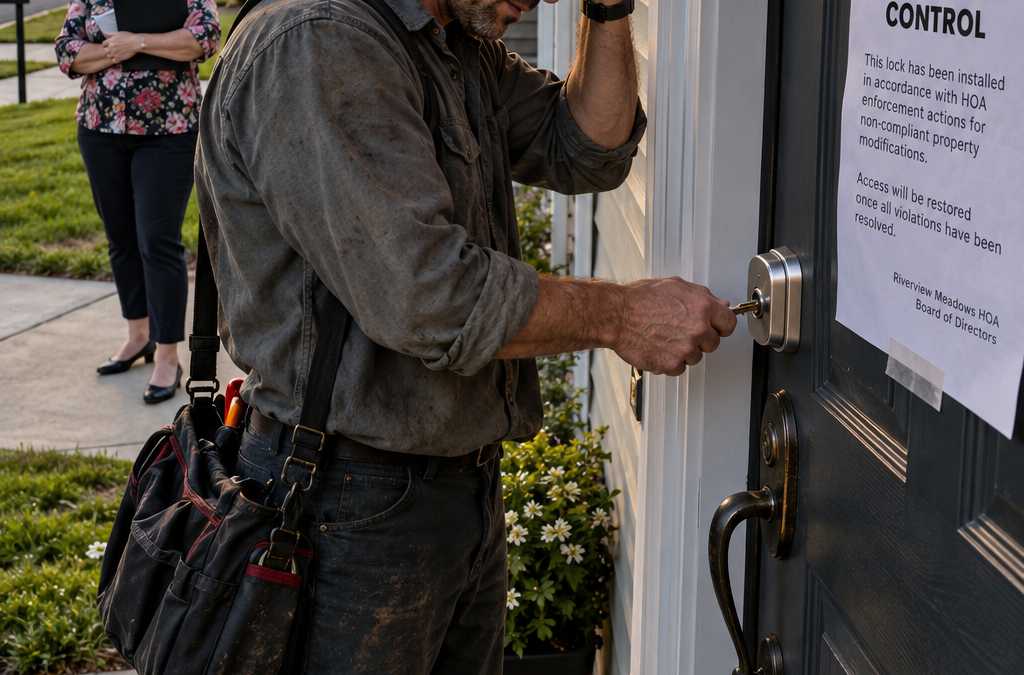
She spoke like decisions had already been made.
People complied.
The board knew she was difficult but didn’t realize how far she had gone.
Neighbors assumed the board approved her.
Everyone possessed one piece.
Nobody put them together.
That is how fake authority grows.
In the spaces between people’s assumptions.
Karen didn’t need to forge a judge’s signature.
Didn’t need sophisticated software.
Didn’t need to hack the HOA system.
She needed residents too busy to confirm who she was.
That was all.
I was one of them.
I wish I could say I questioned her from the beginning.
I didn’t.
I paid attention only when the intrusion became impossible to ignore.
That makes the story less flattering.
It also makes it true.
The lesson I kept wasn’t “fight every HOA.”
Most HOAs are boring organizations run by volunteers trying to manage shared property.
The lesson is simpler.
Verify authority before surrendering rights.
A uniform doesn’t answer every question.
A letterhead doesn’t prove every claim.
A clipboard doesn’t create jurisdiction.
A confident neighbor is still a neighbor until somebody can show the legal mechanism that makes her something more.
Karen forgot that distinction.
For a while, so did we.
Then she changed my locks.
And once she did that, every assumption came under examination.
The final time I saw her was moving day.
A truck sat outside the corner house.
Boxes everywhere.
She was standing near the driveway while movers carried furniture.
I walked past with my dog.
We made eye contact.
I considered saying nothing.
She spoke first.
“Daniel.”
I stopped.
“Karen.”
She looked older.
Stress does that.
“I hope you’re happy.”
The old instinct in me wanted to defend myself.
Then I realized I didn’t need to.
“I am.”
Her face tightened.
“You ruined my reputation.”
“No.”
“You told everyone—”
“The board told everyone.”
“You brought police into it.”
“You changed my locks.”
“I was trying to enforce standards.”
“You weren’t authorized.”
“I did more for this neighborhood than half the board.”
“Maybe.”
That surprised her.
I continued.
“But effort doesn’t create authority.”
She looked away.
“They should have appointed me.”
“Maybe that’s what you still don’t understand.”
Her eyes returned to mine.
“They said no.”
Silence.
“You applied.”
I remembered Gerald’s explanation.
“They voted.”
“Politics.”
“They rejected you unanimously.”
Her jaw tightened.
“And then you decided their answer didn’t matter.”
She folded her arms.
“Nobody was enforcing anything.”
“Then you could have run for the board.”
“I tried to help.”
“No.”
My voice stayed calm.
“You tried to occupy a position after the people with the power to give it to you refused.”
She stared.
“That’s not helping.”
For the first time, Karen had no response.
One of the movers called her.
She turned away.
Then paused.
“That pergola still looks too close.”
I laughed.
Actually laughed.
“So that’s what we’re ending on?”
She almost smiled.
Almost.
Then she walked toward the moving truck.
I kept going.
The pergola remains exactly where it was.
Six feet one and three-quarter inches from the property line.
Completely compliant.
Completely mine.
So is the house.
That is the ending people usually want.
Karen gone.
Money repaid.
Neighbors vindicated.
Locks restored.
But when I think about the story, the ending I care about happens every evening.
I pull into the driveway after work.
Sometimes after ten hours.
Sometimes twelve.
Sometimes tired enough that I barely remember the drive.
I walk up the porch.
Take out my key.
Insert it.
Turn.
The deadbolt slides back.
A simple mechanical sound.
Click.
Then the door opens.
Nobody’s permission.
Nobody’s approval.
No invented officer.
No compliance control.
Just my key.
My house.
My right to walk inside.
For most of my life, I never thought that sound meant anything.
Now I do.
𝗧𝗛𝗘 𝗘𝗡𝗗
I Came Home After a 12-Hour Shift and Found My Own Key Useless, With One HOA Notice Taped to the Door
I had worked twelve hours that day, my feet hurt, my head was pounding, and all I wanted was to unlock my front door and disappear onto the couch.
Instead, my key stopped halfway into a brand-new deadbolt, and taped beside it was a notice claiming my house was now under “HOA compliance control.”
My name is Daniel Harper, and until that afternoon, I thought the worst thing a difficult neighbor could do was make your life annoying.
I was wrong.
Annoyance is a letter.
Annoyance is a complaint about your grass.
Annoyance is somebody measuring your fence because they have too much time and not enough hobbies.
Changing the locks on a house you own is something else.
That is not inconvenience.
That is somebody looking at your home, your privacy, your property, and deciding their confidence is worth more than your rights.
I had lived in Maplewood Estates for three years by then.
When I bought the house, I genuinely thought I had found the place I would stay for a long time.
It wasn’t enormous.
Three bedrooms.
Two bathrooms.
A narrow front porch.
Small fenced backyard.
The kitchen needed new cabinets eventually, but the roof was solid, the plumbing had been updated, and the cul-de-sac was quiet enough that I could leave the bedroom window cracked at night without hearing traffic.
I had spent most of my twenties renting.
Apartments.
A duplex.
One miserable basement unit where I learned more about my landlord’s washing-machine schedule than any human being should know.
Buying a house felt different.
Permanent.
Adult.
Mine.
I remember sitting in the empty living room the first night after closing, surrounded by boxes, eating takeout straight from the container because I hadn’t unpacked the plates.
I kept looking around.
Not because the house was beautiful.
Because nobody could tell me my lease ended in twelve months.
Nobody could raise the rent.
Nobody could decide they wanted the unit back.
I had a deed.
A mortgage.
A front door with my name on the utility bill.
It felt like the American dream people always talk about, except less cinematic and with significantly more paperwork.
Maplewood Estates had an HOA.
That worried me at first.
My closing attorney, Laura Mendes, had insisted that I read everything before signing.
Everything.
Not the summary packet.
Not the realtor’s explanation.
The actual governing documents.
Declarations.
Amendments.
Architectural standards.
Recorded covenants.
All forty-two pages of the property deed package.
At the time, I complained.
“Laura, nobody reads this.”
“That’s why people call me six years later saying they had no idea what they signed.”
“Can you just tell me if there are any disasters?”
“No.”
“That’s literally why I’m paying you.”
“You’re paying me to make sure you understand what you’re buying.”
I leaned back in the chair.
“This feels punitive.”
“It is educational.”
She made me read.
I signed.
Then I forgot almost all of it.
For the first six months, Maplewood was exactly what I hoped.
Neighbors waved.
Kids played basketball in driveways.
Somebody organized a Fourth of July cookout in the cul-de-sac.
The HOA sent newsletters reminding us about trash collection and annual dues.
Nothing dramatic.
Then Karen Bellamy moved into the corner house.
You knew Karen was coming before she reached you because she walked quickly and always looked as though she had identified a problem.
Mid-fifties.
Short blond hair.
Athletic visor on sunny days.
Clipboard.
Sometimes binoculars.
I am not exaggerating about the binoculars.
The first time I saw her use them, she was standing in her driveway looking toward another neighbor’s side yard.
I thought she was watching birds.
Then a violation complaint appeared two days later concerning that neighbor’s fence.
Karen had lived in Maplewood less than a month when people began knowing her name.
Not because she was friendly.
Because she filed eleven complaints against seven homeowners in her first thirty days.
Grass height.
Trash cans.
Holiday lights.
A basketball hoop.
One resident had left Christmas lights attached to his gutters until January sixteenth.
Karen apparently believed January fifteenth was the boundary between civilized society and complete collapse.
Another neighbor, Patricia Ellis, received a complaint because her trash bin was visible from the street for four hours on a noncollection day.
Patricia was seventy-two.
Her son had moved the bin while repairing something beside her garage and forgotten to return it.
Karen photographed it.
Timestamped it.
Submitted it.
Patricia showed me the picture.
“She stood across the street and took this.”
I looked at the photo.
“Maybe she’s starting a trash-can calendar.”
Patricia laughed.
At first, we all laughed.
That was the mistake.
Karen was ridiculous enough that people mistook her for harmless.
She talked about HOA rules constantly.
Not conversationally.
Authoritatively.
She would walk past while you were watering plants and mention that exterior hoses shouldn’t remain visible.
She would see somebody moving a trailer and remind them of the twenty-four-hour parking limitation.
If children left bicycles near the sidewalk, she would tell parents they created an obstruction.
Nobody remembered electing her to anything.
We simply assumed she had gotten involved with the board.
She acted official enough.
That mattered.
Confidence is one of the easiest disguises for authority.
If someone walks around carrying forms and citing section numbers, most people don’t stop them and ask for credentials.
They assume somebody else already did.
I stayed off her radar.
At least I thought I did.
I kept my lawn trimmed.
Trash bins behind the fence.
No loud music.
No vehicles parked on the street overnight.
I waved when Karen passed.
She rarely waved back.
Sometimes she stared at the house with the expression of a building inspector who had found structural concerns.
I ignored it.
Then I built the pergola.
I had wanted one since buying the house.
Nothing extravagant.
Four posts.
Wood beams.
Open roof.
Enough shade for a table and a grill.
I hired a licensed contractor.
Pulled the city permit.
Confirmed setbacks.
Asked the HOA for architectural approval because the guidelines required it.
The board approved the plans.
I still have the email.
Construction took four days.
It looked great.
The first Saturday after completion, I sat underneath it drinking coffee and felt more satisfied than I probably should have about a wooden rectangle.
Karen appeared at the fence.
“Daniel.”
I looked up.
“Morning.”
She didn’t return the greeting.
“Did you get approval for that?”
“The pergola?”
“Obviously.”
“Yes.”
“From who?”
“The architectural committee.”
She looked toward one post.
“How far is that from the property line?”
I already knew where this was going.
“Meets the approved setback.”
“How far?”
“Six feet.”
She took a tape measure from her bag.
That was the moment I stopped thinking the conversation was normal.
“Karen.”
“What?”
“You’re not coming into my yard with a tape measure.”
She looked almost offended.
“I’m just verifying.”
“Verifying what?”
“Compliance.”
“Who asked you?”
“The community has an interest in maintaining standards.”
“That’s not what I asked.”
Her mouth tightened.
“Do you have something to hide?”
“No.”
“Then why object?”
“Because this is my backyard.”
She looked toward the pergola again.
“I believe that post is two inches inside the permitted setback.”
I laughed.
I couldn’t help it.
“Two inches.”
“Yes.”
“From six feet away.”
“I have a good eye.”
“I’m sure you do.”
“You should take this seriously.”
“I already got approval.”
“Approval doesn’t excuse improper construction.”
“The contractor followed the permit.”
“City permits don’t supersede HOA standards.”
“Correct. Which is why I also have HOA approval.”
She stared at me.
Then said, “We’ll see.”
She walked away.
The first notice came three days later.
Not an official HOA notice.
That distinction mattered later.
At the time, I didn’t realize there was a difference.
It had the Maplewood Estates logo.
A header.
A violation number.
A reference to Section 8.12.
UNAPPROVED SETBACK ENCROACHMENT – PERGOLA STRUCTURE
Below that:
Corrective action required within ten days.
Signed:
Karen Bellamy
HOA Compliance Officer
I read it twice.
Compliance officer.
That explained everything.
Or so I thought.
I emailed the HOA management address with my approval letter attached.
No answer.
Two days later, another notice appeared.
This one warned of escalating fines.
I called the phone number printed at the bottom.
Karen answered.
“Compliance office.”
I almost laughed.
“Karen?”
“Daniel.”
“You sent me another notice.”
“Yes.”
“I emailed the approval.”
“I’ve reviewed it.”
“Then you know the structure was approved.”
“The approved drawing differs from actual placement.”
“By two inches?”
“Approximately.”
“Who measured it?”
“I did.”
“You came onto my property?”
There was a pause.
“I took measurements from the perimeter.”
“From my fence?”
“That is sufficient.”
“No, it isn’t.”
“Daniel, this doesn’t need to become adversarial.”
“Then stop sending fake violations.”
Silence.
“Fake?”
“The city inspected it. The contractor measured it. The architectural committee approved it.”
“The compliance office has discretion.”
“According to what?”
“The governing standards.”
“Which section?”
She gave me a section number.
I pulled the guidelines while she talked.
Section 8.12 addressed rear-yard accessory structures.
It required five feet from the lot boundary.
My pergola was six.
I told her that.
She said the measurement was disputed.
“By you.”
“By compliance.”
“You’re saying that like it’s an agency.”
“Daniel.”
“No. Seriously. Who appointed you?”
She was quiet long enough that I should have recognized the warning.
Then she said, “You can raise procedural questions at the next meeting.”
And hung up.
The notices continued.
A yellow warning.
Then a red one.
Then a notice stating that accumulated noncompliance could result in restricted community privileges.
I didn’t care about the clubhouse.
I didn’t use the pool.
I stopped responding.
That probably infuriated her.
Karen escalated from paper to presence.
She began appearing near my property.
Sometimes when I left for work.
Sometimes when I came home.
Once I found her standing beside the side fence taking photographs.
“What are you doing?”
“Documenting.”
“From where you’re standing, you’re on my driveway.”
She looked down.
Then back at me.
“It’s an easement area.”
“No, it’s not.”
“It serves neighborhood utility access.”
“Karen, get off my property.”
She smiled slightly.
“Hostility won’t improve your position.”
“My position is that you’re standing on my driveway.”
She left.
My neighbor Mike Alvarez witnessed that exchange.
Mike lived next door.
Early forties.
Mechanic.
Two daughters.
One of those neighbors who owned every tool known to humanity and never acted annoyed when you borrowed one.
After Karen left, he leaned over the fence.
“What did you do to make her love you so much?”
“Pergola.”
He looked at it.
“That?”
“Two inches.”
“Two inches of what?”
“Apparently criminal lumber.”
He laughed.
“She’s crazy.”
“Isn’t she the compliance officer?”
Mike shrugged.
“I guess.”
There it was again.
I guess.
Nobody knew.
Everybody assumed.
Months passed.
The fines Karen claimed I owed increased.
I continued paying normal HOA dues directly through the portal.
I did not pay her “compliance penalties.”
Every few weeks, she left another document.
Some threatened liens.
Some threatened hearings.
One claimed the pergola created “continuing architectural harm.”
I sent copies to the actual HOA email address twice.
I received generic responses saying concerns had been forwarded.
Nothing happened.
I assumed Karen was legitimate but overzealous.
I did not understand that something more absurd was happening.
Then came the Tuesday.
I remember the shift because everything had gone wrong at work.
I manage operations at a regional distribution warehouse.
That particular week, one supervisor was out sick, a shipment was delayed, and a piece of sorting equipment failed before lunch.
I started before six in the morning.
Left after six that evening.
Twelve hours on concrete floors.
By the time I pulled into Maplewood, my lower back ached.
My feet hurt.
I hadn’t eaten since noon.
I wanted a shower, food, and exactly zero human conversation.
Mike was standing in his driveway when I turned into the cul-de-sac.
He waved both arms.
Not a normal wave.
The kind that means stop.
I lowered the window.
“What’s wrong?”
“You didn’t get my calls?”
I looked at my phone.
Six missed calls.
“I was on the floor all day.”
“Daniel, something happened at your house.”
My stomach tightened.
“What?”
“Front door.”
“What about it?”
He looked genuinely nervous.
“Somebody changed your lock.”
I thought I had misheard him.
“Changed my what?”
“The deadbolt.”
I parked halfway into my driveway.
Left the truck.
Walked toward the porch.
Mike followed.
The deadbolt was brand new.
Silver.
Bright.
The old brass lock was gone.
For a few seconds, I stared at it without understanding.
Then I inserted my key.
It stopped.
Wrong cylinder.
Wrong keyway.
I tried anyway.
Once.
Twice.
Nothing.
A white sheet of paper had been taped beside the door.
The Maplewood logo appeared at the top.
NOTICE OF COMPLIANCE CONTROL
My hands started shaking before I finished reading.
This property is now under HOA compliance control.
Resident access restricted pending resolution of active violations.
Contact Karen Bellamy, HOA Compliance Officer, for reinstatement procedure.
I read the last line again.
Then the first.
Then the last.
Mike said, “I saw a locksmith here around two.”
I turned.
“What?”
“Karen was with him.”
“You saw her change the lock?”
“I saw a locksmith working on the door. I thought maybe you hired him.”
“Why would I hire someone to lock me out?”
“I didn’t know you were being locked out.”
I touched the deadbolt.
Brand new.
On my house.
I owned the property.
No foreclosure.
No court order.
No eviction.
No police action.
Just Karen.
Somewhere inside were my clothes.
My medication.
My wallet backup.
My passport.
My dog food—thank God I had taken my dog to my brother’s place that week because I was working long shifts.
Everything.
Mike said, “You okay?”
“No.”
“What are you going to do?”
I pulled out my phone.
“Call the police.”
I dialed the nonemergency line.
The dispatcher initially sounded confused.
“You’re saying your landlord changed the locks?”
“I’m not renting.”
“Former spouse?”
“No.”
“Bank?”
“No.”
“Who changed them?”
“Someone claiming to represent my HOA.”
Another pause.
“Are you current on your mortgage?”
“Yes.”
“Any court orders involving the property?”
“No.”
“Any foreclosure?”
“No.”
“Did you give anyone permission to change the locks?”
“No.”
“Okay. An officer will respond.”
After I hung up, I sat on the porch step.
The exhaustion from work disappeared.
Adrenaline replaced it.
Mike stood beside me.
“What does ‘compliance control’ even mean?”
“I don’t know.”
“Can an HOA do that?”
“I don’t think so.”
Then I remembered Laura.
Forty-two pages.
Three years earlier.
Her finger tapping the deed packet.
Read it.
I opened the document archive on my phone.
I kept closing files digitally because Laura had insisted.
It took several minutes to find the section.
Declaration.
Property rights.
Enforcement limitations.
Section 9.
I scrolled.
Paragraph 4.
Then stopped.
I read it once.
Then again.
Then a third time slowly.
The language wasn’t ambiguous.
No HOA entity, board member, officer, agent, compliance representative, or affiliated individual could restrict, deny, interfere with, or condition physical access to an owner-occupied private residence without lawful court authority.
Any unauthorized attempt to do so constituted a prohibited trespass and interference with possession.
The offending party would bear all reasonable legal fees and restoration costs arising from enforcement.
I felt something shift inside me.
Not joy.
Clarity.
Mike looked at my face.
“What?”
“I found something.”
“Good something?”
“Very.”
I showed him.
He read slowly.
Then looked toward the door.
“Karen is in trouble.”
“For the first time today, I hope you’re right.”
The officer arrived about twenty minutes later.
Officer Ramirez.
Mid-thirties.
Calm.
He listened while I explained.
I showed him my ID.
Mortgage statement.
Property tax record.
HOA notice.
Deed clause.
Mike gave a statement about the locksmith.
Ramirez walked to the door.
Examined the lock.
Read the notice.
Then asked, “Do you have any documentation showing the HOA obtained a court order?”
“No.”
“Any notice of formal legal action?”
“No.”
“Eviction proceedings?”
“No.”
“I know you’re the owner. I’m asking because this is an unusual situation.”
“I understand.”
He photographed the door.
Then called dispatch.
While he was doing that, I saw movement across the street.
Karen.
Of course.
She had apparently been waiting.
She walked toward us slowly.
No clipboard this time.
But she had a folder.
Her expression was almost triumphant.
“Officer.”
Ramirez turned.
“Ma’am.”
“I’m Karen Bellamy. HOA compliance officer.”
He looked at the notice.
Then at her.
“Did you authorize this lock change?”
She didn’t hesitate.
“Yes.”
Mike made a sound under his breath.
Ramirez asked, “Did the homeowner consent?”
“He is under enforcement.”
“That wasn’t my question.”
Karen folded her arms.
“Mr. Harper has refused to cure ongoing violations.”
Ramirez looked at me.
Then back at her.
“Do you have a court order authorizing you to deny access to his residence?”
“The association has enforcement authority.”
“Do you have a court order?”
“No, but—”
“Foreclosure order?”
“No.”
“Eviction order?”
“That terminology doesn’t apply.”
“Then what legal authority did you use to change the lock?”
Karen looked irritated.
“This is a private covenant matter.”
Ramirez nodded.
“Then provide documentation showing your authority.”
“I have the community guidelines.”
“Not guidelines.”
His voice stayed calm.
“Documentation showing you personally are authorized to act for the HOA and restrict access to this residence.”
Karen opened her folder.
Flipped through pages.
Bylaws.
Violation sheets.
Photographs of my pergola.
A printout of the architectural section.
Ramirez waited.
“Where is the board authorization?”
“It’s part of my position.”
“Show me appointment paperwork.”
Karen stopped flipping.
“It’s at home.”
“Go get it.”
Her expression changed.
“Excuse me?”
“If you’re an HOA officer exercising enforcement authority, bring documentation showing you hold that office.”
She stared at him.
Then at me.
“This is harassment.”
Ramirez did not react.
“I’ll wait.”
Karen walked back across the street.
Mike whispered, “This is getting good.”
I gave him a look.
“Sorry.”
Ten minutes passed.
Then fifteen.
Karen returned empty-handed.
No folder.
No appointment letter.
Nothing.
Ramirez asked, “Do you have it?”
“The board doesn’t issue formal appointment certificates.”
“So how is your authority recorded?”
“Meeting minutes.”
“Do you have those?”
“Not with me.”
“Can you access them online?”
Karen hesitated.
“Not right now.”
Ramirez looked toward me.
Then back at her.
“Ma’am, unless you can show lawful authority, this appears to be unauthorized interference with the owner’s access.”
Karen raised her chin.
“I acted on behalf of the community.”
“That’s not documentation.”
She began talking faster.
“The pergola violates setbacks. He ignored repeated notices. He refused fines. Residents have a right to expect enforcement.”
Ramirez interrupted.
“Did the HOA board instruct you to hire a locksmith?”
Karen stopped.
“Compliance procedures do not require a vote every time.”
“Who paid the locksmith?”
No answer.
“Ma’am?”
“I handled it.”
“Personally?”
Silence.
“Did HOA funds pay?”
“I said I handled it.”
That was the first moment I knew something much bigger was wrong.
Ramirez looked at me.
“Call a locksmith.”
“I can?”
“It’s your residence.”
He pointed toward the new deadbolt.
“Have it removed. Keep the hardware if possible. Get an invoice.”
Then he looked at Karen.
“I am documenting your statement that you personally authorized the lock change.”
Karen’s face went pale.
“This is a civil matter.”
“Parts may be.”
He looked at the deed clause I had shown him.
“But changing locks on a residence you do not own without legal authority is not something I’m going to dismiss because you put an HOA logo on the paper.”
Karen turned toward me.
“You are making this much worse than it needs to be.”
I almost laughed.
“I’m making it worse?”
“You could have resolved the violations months ago.”
“The pergola was approved.”
“It’s noncompliant.”
“Then show me the official board decision.”
She opened her mouth.
Nothing came out.
I called the locksmith.
While waiting, I did something I should have done months earlier.
I called the actual HOA board.
The number on the dues portal went to voicemail.
Then I found an email from a previous annual meeting with the president’s personal number.
Gerald Winters.
Retired structural engineer.
I had spoken to him once.
I called.
He answered on the second ring.
“Gerald?”
“Yes.”
“It’s Daniel Harper. Oak Hollow Court.”
There was a pause.
“Daniel. Is this about Karen?”
I looked across the street.
“Apparently.”
He sighed.
Not a normal sigh.
The sigh of a man who had been dealing with something for far too long.
“What happened?”
“She changed the locks on my house.”
Silence.
Then:
“She did what?”
“Had a locksmith replace my deadbolt. Left a notice saying the property was under HOA compliance control.”
Another silence.
This one longer.
Finally Gerald said, very softly, “Oh, God.”
“She says she’s the compliance officer.”
“She is not.”
I stopped breathing for half a second.
“What?”
“Karen Bellamy has never held an elected or appointed position with Maplewood Estates.”
I looked at Officer Ramirez.
Then Mike.
Then Karen.
“Gerald.”
“Yes?”
“She’s been signing notices as compliance officer for months.”
“I know.”
“You know?”
“We knew she was sending complaints.”
“No. Not complaints. Violation notices. Fines.”
Silence again.
Gerald said, “Daniel, I need you to send me everything.”
“What do you mean she’s not compliance officer?”
“She applied for the open compliance coordinator role eight months ago.”
“And?”
“The board rejected her.”
“Why?”
“Unanimously.”
I laughed once.
Not because anything was funny.
“You rejected her, and she just started doing the job anyway?”
Gerald sounded exhausted.
“Apparently.”
“Apparently?”
“We believed she was submitting complaints to management, not issuing independent enforcement.”
“She’s been signing official-looking notices.”
“I didn’t know.”
“She fined me.”
Another pause.
“Did you pay her?”
“No.”
“Did she tell you where to send payment?”
“Sometimes through a payment app.”
Gerald swore.
That was the moment the whole situation turned.
He told me the board had no “HOA compliance officer” currently.
Routine violations were processed through the management company after board review.
Karen had no authority to issue fines.
No authority to send compliance notices.
No authority to threaten liens.
Absolutely no authority to change anyone’s locks.
“Gerald.”
“Yes?”
“How many people think she’s official?”
“I don’t know.”
“She acts like she is.”
“I know.”
“No, I don’t think you do.”
My voice rose.
“She changed the locks on my house.”
“I understand.”
“Do you?”
“I’m calling the rest of the board now.”
“Call the management company too.”
“I will.”
“And Gerald?”
“Yes?”
“I want written confirmation tonight that Karen Bellamy has never been authorized to act for the HOA.”
“You’ll have it.”
I hung up.
Officer Ramirez had heard enough of my side to understand.
“What did he say?”
“She isn’t on the board.”
Karen’s face changed instantly.
Mike said, “What?”
“She applied. They rejected her.”
Ramirez turned toward Karen.
“Ma’am?”
Karen crossed her arms.
“That’s a technical characterization.”
I stared at her.
“A technical characterization?”
“I’ve been performing compliance functions because the board failed to enforce standards.”
Ramirez asked, “Were you appointed?”
“I was acting in the community’s interest.”
“That is not what I asked.”
“No formal appointment was finalized.”
Mike let out a low whistle.
Ramirez’s expression hardened.
“So you told the homeowner you were the HOA compliance officer.”
“I effectively was.”
“No. You either held the office or you didn’t.”
Karen looked at me.
“You knew violations existed.”
“That has nothing to do with whether you had authority.”
“The pergola—”
“Was approved.”
“Two inches—”
“Stop.”
I had never spoken to her that sharply.
She stopped.
“For months, you’ve walked around this neighborhood pretending people gave you power they didn’t give you.”
“I was protecting property values.”
“You hired somebody to lock me out of my own house.”
“You refused compliance.”
“You are my neighbor.”
That sentence landed differently.
Karen stared at me.
I said it again.
“You’re my neighbor.”
Not officer.
Not official.
Not authority.
Neighbor.
One woman who had decided the rules became hers if she said them loudly enough.
The locksmith arrived.
He removed the new deadbolt.
Bagged it at Officer Ramirez’s suggestion.
Installed a replacement.
I kept the old lock hardware.
The emergency callout cost $286.
At 9:14 that evening, Gerald emailed every homeowner in Maplewood Estates.
The subject line was:
URGENT CLARIFICATION REGARDING HOA AUTHORITY
The letter stated that Karen Bellamy had never served as a board member, officer, compliance official, employee, contractor, or authorized agent of the Maplewood Estates HOA.
Any notice, fine, payment demand, or enforcement action signed solely by Karen was unauthorized.
Residents were asked to preserve all communications and payment records.
The board scheduled an emergency meeting for the following evening.
My phone began exploding within minutes.
Mike.
Patricia.
Two neighbors I barely knew.
One message simply said:
SHE TOOK $600 FROM US.
Another:
WE PAID HER CASH.
Another:
CALL ME. PLEASE.
By midnight, Gerald knew of seven homeowners who had paid money directly to Karen.
Three had given her cash.
Four had used digital transfers.
Total identified payments exceeded $4,000.
Nobody had questioned it because Karen provided receipts bearing the HOA logo.
She had created forms.
Generated notices.
Used section numbers.
Copied the association branding.
She hadn’t merely behaved like an official.
She had constructed the appearance of an office that did not exist.
I barely slept.
Not because I feared Karen.
Because the house no longer felt quite the same.
I kept looking at the new deadbolt.
Someone had stood on my porch.
Removed the lock.
Put in another.
Held the key to my house.
Even knowing nobody had entered, I felt invaded.
People imagine property violations as financial.
Sometimes they are.
But a front-door lock is psychological.
It separates outside from inside.
Public from private.
Safe from exposed.
When someone changes it without permission, they aren’t just touching hardware.
They’re telling you the barrier exists for them, not for you.
The next morning, I called Laura Mendes.
My closing attorney.
She remembered me immediately.
“Daniel Harper. The man who complained about reading forty-two pages.”
“I owe you an apology.”
She laughed.
“I’ve waited three years for this.”
“Someone changed the locks on my house.”
She stopped laughing.
“What?”
I explained everything.
Karen.
The fake office.
The notices.
The deed clause.
The police report.
Laura became very quiet.
“Send me the report.”
“I will.”
“And every notice.”
“I have most of them.”
“Payment demands?”
“Yes.”
“Photos?”
“Yes.”
“Locksmith invoice?”
“Yes.”
“Board confirmation she’s unauthorized?”
“Got it last night.”
She exhaled.
“Daniel.”
“Yeah?”
“This is unusually clean.”
“What does that mean?”
“It means most disputes involve competing versions of authority. Here, the governing document expressly prohibits access restrictions, the board says she had no authority, the police documented her admission, and she had your lock changed.”
“So?”
“So I’m sending a demand letter.”
“For what?”
“Everything.”
Within forty-eight hours, Laura sent Karen a formal demand.
Emergency locksmith.
Legal review.
Document preparation.
Lost work time.
Additional security expenses.
Emotional distress associated with wrongful exclusion from my residence.
And under the fee-shifting provision in the deed, all reasonable legal costs arising from enforcement.
Total demand:
$8,940.
I stared at the number.
“Do you really think she’ll pay?”
Laura shrugged.
“She can pay nine thousand now or possibly much more after litigation.”
“She’s going to argue good faith.”
“She can.”
“Does that matter?”
“Good faith is not magic.”
She leaned back.
“Suppose I sincerely believe your car belongs to me.”
“It doesn’t.”
“Correct. If I tow it away, sincerity doesn’t create ownership.”
I smiled.
“Law school sounds fun.”
“It wasn’t.”
Karen hired an attorney.
His response arrived four days later.
Three pages.
He argued that Karen acted in good faith based on her understanding of community authority.
He claimed she believed her role had been informally recognized.
He described the lock replacement as a temporary compliance measure.
Laura read that phrase aloud.
“Temporary compliance measure.”
She looked at me.
“That is an adventurous way to describe locking a man out of his own house.”
“What happens now?”
“We respond.”
She did.
Her letter attached:
The deed clause.
Gerald’s written confirmation that Karen had never held office.
The police report documenting Karen’s admission.
The locksmith invoice.
Copies of unauthorized fine notices.
Payment requests.
Board records showing her application had been rejected.
Three days later, Karen’s attorney withdrew from representing her in the dispute.
I called Laura.
“He quit?”
“Withdrew.”
“Why?”
“I’m guessing he finally read the documents.”
“Can he do that?”
“Lawyers aren’t required to continue every civil representation.”
“What happens to Karen?”
“She can hire somebody else.”
She didn’t.
Meanwhile, the HOA board held the emergency meeting.
The clubhouse was packed.
I had never seen so many residents attend anything.
People stood against walls.
Gerald sat at the front beside three board members and a representative from the management company.
Karen did not attend.
Gerald opened with an apology.
Not the vague organizational kind.
A real one.
“We failed to identify and stop unauthorized conduct occurring under the appearance of HOA authority.”
People murmured.
He continued.
“That failure caused homeowners to believe Ms. Bellamy had powers she did not have.”
Patricia raised her hand.
Gerald recognized her.
“Why didn’t you stop her?”
He looked at her.
“Because we misunderstood what she was doing.”
“She sent me three fines.”
“We thought she was submitting complaints.”
“She collected money.”
“I know.”
“You didn’t know because none of you talked to us.”
That silenced the room.
Patricia continued.
“You all sit up there assuming people know who has authority. We don’t. Someone hands us a paper with your logo, we think it’s official.”
Gerald nodded.
“You’re right.”
No defense.
That helped.
The board formally voided every violation notice issued solely by Karen.
Every fine.
Every compliance threat.
Every purported hearing notice.
Residents who had paid Karen were asked to submit proof.
The HOA agreed to reimburse victims immediately and pursue recovery separately.
Seven people ultimately received money back.
More than $4,000.
One man named Charles had given Karen $900 in cash over eight months.
“Why cash?” someone asked him.
“She said cash avoided a processing surcharge.”
The room groaned.
Karen had invented the surcharge too.
Another family paid her through a personal payment account labelled “Maplewood Compliance.”
She had created an entire system.
No board authorization.
No oversight.
Just a logo, confidence, and neighbors who assumed someone else had verified her.
The board also adopted a new rule.
Every official enforcement notice had to include:
A unique verification number.
A management-company contact.
The name of the authorized board official.
A link to the homeowner portal where the violation could be independently confirmed.
No private person could collect fines directly.
It was the most useful policy Maplewood had ever written.
The criminal side became less dramatic than people expected.
Karen faced investigation regarding impersonation, unauthorized collections, and the lock incident.
Some issues were resolved through restitution and agreements rather than a television-style criminal trial.
I cared less than people thought I should.
I didn’t want revenge.
I wanted my house secure.
My money reimbursed.
My legal expenses paid.
And Karen’s ability to terrorize people through fake authority permanently destroyed.
Laura negotiated the civil resolution.
Final amount:
$9,240.
More than the original demand because additional costs had accumulated.
Karen agreed to pay rather than fight.
The payment had to be by cashier’s check.
I didn’t ask for that.
Laura did.
“No failed checks.”
Fair.
The morning Karen delivered it was a Saturday.
I was outside watering plants near the porch.
That sounds staged.
It wasn’t.
She pulled up around ten.
Dark sedan.
No clipboard.
No forms.
No HOA logo.
She got out holding a white envelope.
I turned off the hose.
She walked toward me.
For months, Karen had always approached with her shoulders back and her chin slightly raised.
That morning, she looked smaller.
Not physically.
Just stripped of performance.
She stopped at the bottom of the porch.
“Daniel.”
“Karen.”
She held out the envelope.
I took it.
Inside was the cashier’s check.
$9,240.
I checked the name.
Amount.
Bank.
Everything correct.
She said nothing.
Neither did I.
There are moments where people expect speeches.
Some dramatic line.
A final insult.
I didn’t have one.
What was left to say?
She had pretended to hold authority.
The neighborhood believed her.
She crossed a line.
The documents corrected the lie.
That was enough.
Karen turned.
Then a sound came from across the street.
Clap.
One slow clap.
We both looked.
Patricia stood on her porch.
Clap.
Pause.
Clap.
Mike stepped out of his garage.
He started clapping too.
Then another neighbor.
Karen closed her eyes for half a second.
I felt almost sorry for her.
Almost.
She walked to the car.
Got in.
Drove away.
Mike crossed the street laughing.
“That was unbelievable.”
“That was cruel.”
“You enjoyed it.”
“I enjoyed maybe fifteen percent.”
“Only fifteen?”
“Twenty.”
Patricia called from her porch.
“One hundred!”
I laughed.
Six weeks later, a FOR SALE sign appeared in Karen’s yard.
Nobody celebrated publicly.
At least not officially.
The group text was another matter.
She moved out before the end of summer.
The corner house sold to a couple with a toddler and two dogs.
They were normal.
Almost suspiciously normal.
During their first week, the husband asked me if Maplewood had a strict HOA.
I said, “Not anymore.”
He looked confused.
“Long story.”
For months afterward, I remained more cautious than I used to be.
I checked the lock twice.
Installed a doorbell camera.
Saved every HOA email.
Downloaded meeting minutes.
I knew who sat on the board.
Knew the management company’s number.
Knew exactly how official notices were supposed to arrive.
Some people thought that meant Karen had made me paranoid.
Maybe.
But informed isn’t the same as paranoid.
There is a difference between fearing authority and verifying it.
I learned that distinction late.
The pergola stayed.
Of course it did.
Gerald personally came over with the architectural approval file.
We measured it together.
Six feet one and three-quarter inches from the property line.
Not two inches too close.
More than a foot beyond the five-foot requirement.
Gerald stared at the tape.
“She fabricated the measurement.”
“Looks like it.”
He shook his head.
“Why?”
I looked at the pergola.
“Because I told her she couldn’t enter my yard.”
He thought about that.
“You think this was personal?”
“Eventually.”
“Over a boundary?”
“Exactly.”
Gerald looked uncomfortable.
“She applied to the compliance role because she said the neighborhood lacked discipline.”
“That sounds like Karen.”
“We rejected her because she wanted authority to issue immediate fines without board review.”
“That sounds even more like Karen.”
He sighed.
“We should have told everyone she was rejected.”
“Yes.”
“I thought that would embarrass her.”
“It might have saved seven people money.”
He nodded.
“I know.”
That answer mattered.
No excuses.
No pretending the board had no responsibility.
Karen had created the fraud.
But the board’s silence made it easier.
Authority is partly a communication problem.
If ordinary people cannot tell who has it, the costume becomes almost as useful as the real thing.
A logo.
A title.
A form.
A confident voice.
That was all Karen needed.
Months after she moved, Patricia invited several of us over for coffee.
She brought out a folder.
Karen notices.
At least fifteen.
“Why did you keep them?”
“Because my husband taught me never to throw away threats.”
Her husband had died five years earlier.
Smart man.
One notice fined Patricia because her rose bush extended six inches beyond an “approved visual plane.”
“What is an approved visual plane?” I asked.
“Whatever Karen wanted it to be.”
Mike flipped through the pages.
“She fined you for a bird feeder?”
Patricia nodded.
“Said it attracted wildlife.”
We all stared at her.
Mike said, “It’s a bird feeder.”
“I made that argument.”
“What happened?”
“She said birds were only one category of wildlife.”
We laughed until Patricia started crying.
Not sad exactly.
Release.
Months of fear turning ridiculous once the fear no longer had power.
She wiped her eyes.
“I thought she could put a lien on my house.”
I stopped laughing.
“She told you that?”
“Twice.”
“Why didn’t you call the board?”
Patricia looked at me.
“Because she told me she was the board.”
That sentence explains the entire story better than anything else.
Karen didn’t need legal authority if nobody tested it.
She only needed people to believe resistance would be worse than compliance.
Most people are busy.
Tired.
Working.
Raising children.
Caring for parents.
Paying bills.
They do not want to spend Thursday evening reading bylaws because a neighbor says their rose bush violates a visual plane.
So they pay.
They trim.
They apologize.
They move the bin.
Karen understood that.
Maybe not consciously at first.
But she learned.
Each time someone obeyed, the costume became more convincing.
Then she reached me.
I ignored her fines.
Refused her authority.
Told her to leave my property.
So she escalated to the most extreme thing she could imagine.
She changed my locks.
That was her mistake.
Not morally.
She had made plenty before that.
Strategically.
A $60 fine can be ignored.
A warning letter can be thrown in a drawer.
A fake title can survive because nobody wants to investigate.
But lock a homeowner out of his house and suddenly police officers ask for paperwork.
Lawyers read deeds.
Boards hold emergency meetings.
Money trails appear.
Neighbors compare stories.
The costume gets inspected.
And underneath Karen’s official-looking notices there was nothing.
No appointment.
No vote.
No legal office.
No authority.
Just a woman who had decided that because she cared more about the rules than everybody else, the rules belonged to her.
That is what I remember now.
Not the check.
Not Patricia clapping.
Not even the new lock.
The emptiness behind Karen’s title.
HOA Compliance Officer.
Three words.
Completely invented.
Yet those three words made people hand her thousands of dollars.
Titles are powerful.
Even fake ones.
Especially when they resemble something we already fear.
I teach younger employees at work now.
Supervisors.
Team leads.
People newly promoted.
One lesson I repeat has nothing to do with warehouses.
“Authority is not something you perform. It’s something that has a source.”
They usually look at me strangely.
Then I explain.
If you can hire someone, you should know where that authority comes from.
Company policy.
Job description.
Delegation.
Law.
Contract.
Something.
If the answer is “because people listen to me,” that’s not authority.
That’s momentum.
Karen had momentum.
For eight months, maybe longer.
People listened.
Then I came home after twelve hours, exhausted, and my key wouldn’t turn.
I still remember that sensation perfectly.
The resistance in the lock.
Metal against metal.
My brain refusing to accept what my hand already knew.
I remember the note.
The words “compliance control.”
The absurdity of standing three feet from my living room and being told by a neighbor that I no longer had permission to enter.
That kind of moment teaches you something.
Home isn’t just the building.
It’s the assumption that the door belongs to you.
The key works because you are supposed to be on the other side of it.
You don’t think about that privilege until somebody takes it away.
Mine was taken for less than two hours.
Some people lose homes through foreclosure.
Eviction.
Disaster.
War.
Compared with that, what happened to me was small.
But those two hours were enough to make me understand why possession matters so deeply.
Every day after work, I still put the key into that door.
Same house.
Different lock.
Usually I don’t think about Karen anymore.
I unlock it.
Step inside.
Drop my keys into the bowl near the entrance.
Normal.
That normality is valuable.
The pergola is still in the backyard.
I replaced the furniture under it last year.
Mike helped.
We measured nothing.
Patricia still has the rose bush.
It has grown considerably past whatever an approved visual plane might be.
Nobody cares.
Maplewood didn’t become lawless after Karen left.
That’s what people like her never understand.
Without extreme enforcement, grass did not suddenly reach three feet.
Trash did not cover the streets.
Property values did not collapse.
People still maintained their homes because most people want to live somewhere decent.
The HOA still exists.
Dues get collected.
Shared landscaping gets maintained.
Architectural applications still happen.
But every notice now includes verification.
Every board member is listed publicly.
No cash payments.
No private collection accounts.
No unofficial officers.
Once a year, Gerald sends out a reminder:
If anyone claims HOA enforcement authority, verify through the resident portal before acting or paying.
I smile every time.
Laura still teases me about the forty-two pages.
I took her to lunch after everything ended.
She brought the original closing folder.
“Remember this?”
“I hate that folder.”
“You love this folder.”
“One paragraph.”
“One paragraph saved you thousands.”
“Technically, the paragraph cost me several hundred dollars when you billed me to read it three years earlier.”
She smiled.
“And now?”
“Worth it.”
“I want that in writing.”
“No.”
She laughed.
Then I asked her something.
“Why was that clause even there?”
She explained that Maplewood’s original developer had apparently been unusually concerned about overreach involving owner access.
There had been disputes in another development in the 1980s over associations attempting to control access during enforcement actions.
So the developer included explicit language preventing it.
Almost forty years later, that clause stopped Karen.
History leaves strange gifts.
I had spent three years forgetting it existed.
Then one exhausted afternoon, standing outside my own locked house, I remembered enough to look.
That was the real turning point.
Not anger.
Information.
Karen expected me to react emotionally.
Argue.
Beg.
Call her.
Maybe negotiate.
She probably imagined me standing on the porch and dialing her number.
“Karen, what do I need to do to get back inside?”
That would have confirmed everything she believed.
That she controlled access.
That I accepted her authority.
That the only question was the price of compliance.
Instead, I read.
That sounds boring.
Reading rarely gets a dramatic soundtrack.
But information destroys false authority faster than shouting.
I read the deed.
The officer asked for appointment paperwork.
Gerald checked board records.
Laura compared the documents.
Neighbors reviewed payments.
Once everybody started asking for proof, Karen’s world collapsed almost instantly.
She had confidence.
We had records.
Confidence wins until records arrive.
The $9,240 went back into my savings.
I used part of it to install better exterior lighting and cameras.
Not because I expected another Karen.
Because security felt different after the lock incident.
The rest stayed in the bank.
Sometimes I jokingly call it the Karen Fund.
Mike suggested I buy a larger pergola.
I told him not to tempt me.
Patricia wanted me to install one exactly two inches closer to the fence.
That would have been funny.
Also childish.
I considered it for several minutes.
I didn’t.
The original pergola was enough.
It had become a monument of sorts.
Not to victory.
To boundaries.
Karen saw a wooden structure and decided it represented disobedience.
I saw shade.
A grill.
A place to drink coffee.
Same object.
Different meaning.
That’s often how power conflicts begin.
One person sees ordinary life.
Another person sees something they need to control.
Years later, if someone asks what happened with the woman who changed my locks, I usually give them the short version.
“She wasn’t actually with the HOA.”
They almost always laugh.
Then they ask the same question.
“How did nobody know?”
That’s harder.
Because the answer isn’t satisfying.
We didn’t ask.
Not soon enough.
Karen said she was official.
She used the logo.
She knew the rules.
She walked with a clipboard.
She spoke like decisions had already been made.
People complied.
The board knew she was difficult but didn’t realize how far she had gone.
Neighbors assumed the board approved her.
Everyone possessed one piece.
Nobody put them together.
That is how fake authority grows.
In the spaces between people’s assumptions.
Karen didn’t need to forge a judge’s signature.
Didn’t need sophisticated software.
Didn’t need to hack the HOA system.
She needed residents too busy to confirm who she was.
That was all.
I was one of them.
I wish I could say I questioned her from the beginning.
I didn’t.
I paid attention only when the intrusion became impossible to ignore.
That makes the story less flattering.
It also makes it true.
The lesson I kept wasn’t “fight every HOA.”
Most HOAs are boring organizations run by volunteers trying to manage shared property.
The lesson is simpler.
Verify authority before surrendering rights.
A uniform doesn’t answer every question.
A letterhead doesn’t prove every claim.
A clipboard doesn’t create jurisdiction.
A confident neighbor is still a neighbor until somebody can show the legal mechanism that makes her something more.
Karen forgot that distinction.
For a while, so did we.
Then she changed my locks.
And once she did that, every assumption came under examination.
The final time I saw her was moving day.
A truck sat outside the corner house.
Boxes everywhere.
She was standing near the driveway while movers carried furniture.
I walked past with my dog.
We made eye contact.
I considered saying nothing.
She spoke first.
“Daniel.”
I stopped.
“Karen.”
She looked older.
Stress does that.
“I hope you’re happy.”
The old instinct in me wanted to defend myself.
Then I realized I didn’t need to.
“I am.”
Her face tightened.
“You ruined my reputation.”
“No.”
“You told everyone—”
“The board told everyone.”
“You brought police into it.”
“You changed my locks.”
“I was trying to enforce standards.”
“You weren’t authorized.”
“I did more for this neighborhood than half the board.”
“Maybe.”
That surprised her.
I continued.
“But effort doesn’t create authority.”
She looked away.
“They should have appointed me.”
“Maybe that’s what you still don’t understand.”
Her eyes returned to mine.
“They said no.”
Silence.
“You applied.”
I remembered Gerald’s explanation.
“They voted.”
“Politics.”
“They rejected you unanimously.”
Her jaw tightened.
“And then you decided their answer didn’t matter.”
She folded her arms.
“Nobody was enforcing anything.”
“Then you could have run for the board.”
“I tried to help.”
“No.”
My voice stayed calm.
“You tried to occupy a position after the people with the power to give it to you refused.”
She stared.
“That’s not helping.”
For the first time, Karen had no response.
One of the movers called her.
She turned away.
Then paused.
“That pergola still looks too close.”
I laughed.
Actually laughed.
“So that’s what we’re ending on?”
She almost smiled.
Almost.
Then she walked toward the moving truck.
I kept going.
The pergola remains exactly where it was.
Six feet one and three-quarter inches from the property line.
Completely compliant.
Completely mine.
So is the house.
That is the ending people usually want.
Karen gone.
Money repaid.
Neighbors vindicated.
Locks restored.
But when I think about the story, the ending I care about happens every evening.
I pull into the driveway after work.
Sometimes after ten hours.
Sometimes twelve.
Sometimes tired enough that I barely remember the drive.
I walk up the porch.
Take out my key.
Insert it.
Turn.
The deadbolt slides back.
A simple mechanical sound.
Click.
Then the door opens.
Nobody’s permission.
Nobody’s approval.
No invented officer.
No compliance control.
Just my key.
My house.
My right to walk inside.
For most of my life, I never thought that sound meant anything.
Now I do.








