𝗙𝗨𝗟𝗟 𝗦𝗧𝗢𝗥𝗬 I Almost Walked Past the Cardboard Box Until the Puppy’s Tail Moved Once
𝗙𝗨𝗟𝗟 𝗦𝗧𝗢𝗥𝗬
A pharmacy.
A laundromat.
A bakery.
A hardware store.
Nothing memorable.
I almost passed the box without noticing it.
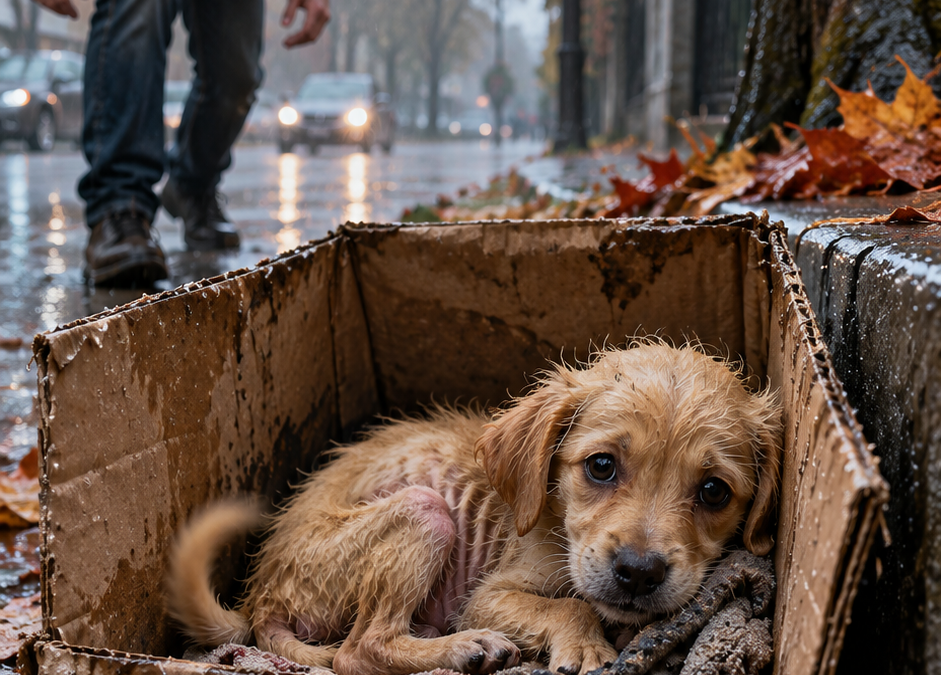
Brown cardboard.
One side crushed.
Rain stains along the bottom.
It sat near the base of a maple tree, slightly back from the sidewalk.
Somebody had written something on one side in black marker, but water had blurred it beyond recognition.
I walked past.
Three steps.
Four.
Then I heard a sound.
Not barking.
Not crying exactly.
A faint scraping noise.
I stopped.
Looked back.
Nothing.
I almost continued.
Then the box shifted.
Very slightly.
I stared.
“Seriously?”
I turned around.
As I approached, a smell reached me.
Wet fur.
Urine.
Something sour.
Something alive.
I looked inside.
At first, I couldn’t understand what I was seeing.
A dog.
A puppy, really.
Yellow coat.
Dirty enough to look gray in places.
Thin.
Painfully thin.
He was curled into himself, nose tucked near his hind legs.
His ribs were visible.
One ear was folded beneath his head.
His eyes were open.
That was the worst part.
He wasn’t whining.
Wasn’t trying to climb out.
Wasn’t calling for help.
He just looked at me.
Flatly.
Like nothing good had happened recently enough for him to expect it now.
“Oh, no.”
I crouched.
The puppy didn’t move.
“Hey.”
Nothing.
I looked around.
People were walking past.
A man carrying dry cleaning.
A teenager looking at his phone.
A woman pushing a stroller.
Nobody stopped.
Maybe they had already noticed him.
Maybe they’d decided what I usually decided.
Someone else will handle it.
A woman came out of the pharmacy and saw me crouched there.
“Is that a dog?”
“Yeah.”
She leaned slightly closer but stayed several feet away.
“Poor thing.”
“Do you know how long he’s been here?”
“No.”
She frowned.
“I think I saw the box this morning.”
“This morning?”
“Maybe.”
She adjusted her shopping bag.
“You should call the city.”
“Animal services?”
“Probably.”
Then she walked away.
That seemed sensible.
Call professionals.
Don’t touch an unknown animal.
Don’t make it personal.
I pulled out my phone.
I searched for the municipal animal control number.
My thumb hovered.
The puppy shifted.
Barely.
His tail moved.
Once.
Not wagging.
Nothing enthusiastic.
Just one weak movement against the cardboard.
Tap.
I stared.
His eyes remained on me.
Something about that tiny motion destroyed every logical argument I had prepared.
He wasn’t asking me to save him.
I know dogs don’t think in those exact words.
But that tail movement felt like the smallest possible vote in favor of staying alive.
“Okay.”
I put my phone away.
“Okay, buddy.”
I reached toward him.
He didn’t growl.
That concerned me more than if he had.
A frightened puppy should react.
This one seemed too exhausted.
I touched the side of his neck.
Cold fur.
Warm skin beneath.
He trembled.
“You’re freezing.”
I looked around for anything useful.
Nothing.
So I took off my jacket.
I wrapped it around him as carefully as I could.
He didn’t resist.
When I slid my hands beneath his body, I was shocked by how little he weighed.
Maybe six months old.
Maybe younger.
He should have been awkward and energetic.
Instead, lifting him felt like lifting a bundle of sticks wrapped in fur.
His head dropped against my wrist.
“Hey.”
I panicked.
“Stay with me.”
His eyes opened again.
“Good.”
The box was too weak to carry comfortably, so I reinforced the bottom with my jacket beneath him and lifted the whole thing.
My car was parked four blocks away.
It felt much farther.
People stared.
One man said, “You found that dog?”
“Yeah.”
“Been there all day.”
I stopped.
“All day?”
He shrugged.
“Saw him around lunch.”
“Why didn’t anyone do anything?”
The question came out harsher than intended.
The man looked offended.
“I figured somebody called.”
Somebody.
There it was again.
Somebody.
I kept walking.
By the time I reached my car, the puppy was breathing faster.
I put the box on the passenger seat.
My hands shook.
I searched for the closest veterinary clinic.
Maplewood Veterinary Center.
34 West Street.
Seven minutes away.
Seven minutes.
Nothing.
I started the car.
Then every traffic light in Maplewood turned red.
At least, that’s how it felt.
I drove with one hand on the steering wheel and the other resting against the side of the cardboard box.
“Come on.”
The puppy’s eyes were closed.
“Stay with me.”
Red light.
I looked over.
“You hear me?”
Nothing.
“Don’t make me regret getting involved.”
It was a stupid thing to say.
I laughed nervously.
“You don’t know me, but I’m apparently responsible for you now, so…”
The light changed.
I drove.
At the next intersection, I looked again.
His chest still moved.
Too quickly.
I touched the cardboard.
“Just a little longer.”
I don’t know why I thought touching the box helped.
Maybe I needed to believe some warmth could pass through.
Maybe I needed to feel useful.
The clinic parking lot was almost full.
I parked badly.
Didn’t care.
I carried the box inside.
A receptionist looked up.
“Can I help—”
“I found him outside.”
One glance changed her expression.
“Bring him here.”
A technician appeared almost immediately.
Then a young veterinarian with dark hair tied back.
“I’m Dr. Emily Carter.”
“Daniel.”
“How long has he been like this?”
“I don’t know.”
“Your dog?”
“No.”
“Where did you find him?”
“West Street. In a box.”
Her mouth tightened.
She lifted him out carefully.
The puppy didn’t resist.
“Come on, little guy.”
She placed him on the exam table.
Temperature.
Gums.
Heart.
Abdomen.
Paws.
Eyes.
Everything happened quickly.
I stood against the wall uselessly.
Finally, Emily looked at me.
“He’s severely dehydrated.”
“How bad?”
“Bad enough that I’m concerned.”
“What else?”
“Malnourished.”
She ran her hand gently along his back.
“Probably hasn’t had a proper meal in several days.”
“Three?”
“At least.”
My stomach tightened.
“He’s a puppy.”
“Five or six months, I’d guess.”
“Can he recover?”
She didn’t answer immediately.
That scared me.
“His teeth look good. Bones feel stable. I don’t see obvious trauma.”
“So?”
“So he’s young.”
Her eyes met mine.
“That’s in his favor.”
“What does he need?”
“Fluids immediately. Bloodwork. Parasite testing. Careful nutrition.”
“Careful?”
“If we feed too aggressively after severe deprivation, we can cause more problems.”
I nodded even though I didn’t understand all of it.
“Do it.”
Emily hesitated.
“There’s something else.”
“What?”
“If he survives the medical part, behavioral recovery can take longer.”
I looked at the puppy.
He stared at the wall.
“He doesn’t seem aggressive.”
“That’s not what I’m worried about.”
“What are you worried about?”
“Shutdown.”
“Meaning?”
“Some animals stop responding.”
She lowered her voice.
“They learn that reacting changes nothing.”
I hated that sentence.
“Can that be fixed?”
“Sometimes.”
“How?”
“Time.”
“Medicine?”
“Not for trust.”
That stayed with me.
Not for trust.
She continued.
“He may be afraid of food.”
“Food?”
“If it was withheld. Or taken away.”
My jaw tightened.
“He may hide. Avoid touch. Eat only when alone.”
“What do I do?”
Emily looked at me carefully.
“Are you planning to keep him?”
I hadn’t thought that far.
“I just found him.”
“Right.”
“We can contact a rescue.”
“Okay.”
“Or animal services.”
“Okay.”
She paused.
“But treatment isn’t free.”
There it was.
Money.
Of course.
“How much?”
She gave me an estimate.
My stomach dropped.
It wasn’t impossible.
It was just extremely inconvenient.
I had debt.
Credit card balance.
Car repairs.
Medical bills from two years earlier.
Savings that weren’t really savings because most of it had already been mentally assigned to emergencies.
This qualified.
I just hadn’t expected the emergency to have fur.
Emily seemed to read my face.
“You don’t have to decide everything today.”
I looked at the table.
The puppy had turned his head slightly.
He was watching me.
Not pleading.
Not hopeful.
Just watching.
And something strange happened.
I recognized the expression.
Not because I had ever been abandoned in a box.
Because I knew what it looked like when someone stopped expecting much.
My wife had said I was emotionally unavailable.
She was right.
After she left, I had become worse.
I had stopped expecting friendships to last.
Calls to matter.
Even happiness to become anything more than a temporary interruption.
I looked at the puppy.
He looked back.
And I said, “Do whatever he needs.”
Emily waited.
“You’re sure?”
“No.”
That surprised her.
I swallowed.
“But do it anyway.”
Her expression softened.
“Okay.”
“What happens now?”
“We stabilize him.”
“Can I stay?”
“You can wait.”
“I will.”
I sat in the waiting room for almost four hours.
Nobody asked me to.
I could have left.
Several times I told myself I should.
The dog wasn’t mine.
Professionals had him.
There was nothing useful I could do.
But every time I stood, I remembered that tail.
One weak movement.
So I sat back down.
Around nine that evening, Emily came out.
“Daniel?”
I stood immediately.
“How is he?”
“Stable.”
The word felt enormous.
“Really?”
“He’s on IV fluids. Bloodwork is better than I feared.”
“Can I see him?”
“For a minute.”
She led me into the treatment area.
The puppy lay inside a kennel with a blanket beneath him.
An IV line ran to one leg.
His eyes opened when I approached.
“Hey.”
No response.
I crouched.
“Still here.”
His eyes closed.
Emily stood beside me.
“He needs a name for the paperwork.”
I looked at her.
“I thought the rescue would name him.”
“Eventually, maybe.”
She smiled.
“For tonight, I need something better than ‘yellow puppy from cardboard box.'”
I looked at him.
The first name that came to mind was Jack.
No profound reason.
No symbolism.
Just Jack.
“Jack.”
Emily wrote it down.
“Jack it is.”
That night, I went home alone.
My apartment felt different.
Not emptier.
Guilty.
I noticed how warm it was.
How much food sat in my refrigerator.
How many blankets I owned.
I thought about Jack in the clinic.
I barely slept.
At six thirty the next morning, I was back.
Emily looked surprised when I appeared.
“You know visiting hours technically haven’t started.”
“I brought coffee.”
“For Jack?”
“For you.”
She took it.
“Acceptable.”
“How is he?”
“Eating small amounts.”
“Good.”
“Very small.”
“But eating.”
“Yes.”
I saw him before work.
Then again after.
He didn’t recognize me.
At least, not in any way I could see.
He lay with his face toward the kennel wall.
I spoke anyway.
“Long day.”
No response.
“My manager asked why I looked tired.”
His ear stayed still.
“I told him I had a family emergency.”
That word felt strange.
Family.
I laughed softly.
“Don’t get ideas.”
Nothing.
“I’ve known you twenty-four hours.”
Jack’s breathing remained slow.
I visited every day.
Sometimes before work.
Sometimes after.
Once at lunch.
The nurses began greeting me by name.
“He ate better today.”
“Jack stood up for five minutes.”
“Jack let us change his bedding without shaking.”
Small victories.
Tiny things.
I learned to celebrate them.
At first, Jack only ate when no one watched.
If a person stood nearby, he ignored the bowl.
Leave the room, and eventually the food disappeared.
Emily said it could mean fear.
“Someone may have taken food from him.”
“Why?”
“People do things that don’t make sense.”
I looked at Jack.
“That’s an understatement.”
One rainy evening, I sat beside his kennel after the clinic had grown quiet.
Rain tapped steadily against the windows.
I slid my hand between the bars.
Not toward him.
Just inside.
Open palm.
Available.
Jack looked at it.
Then away.
I kept it there.
Five minutes.
Ten.
My arm began to hurt.
“This is awkward.”
His ear moved slightly.
I almost laughed.
“Was that commentary?”
Nothing.
“Okay.”
I stayed.
Jack never touched me.
But he didn’t move farther away either.
On the drive home, I realized something.
This was going to require patience.
Actual patience.
Not waiting in traffic.
Not waiting for a promotion.
Patience without guarantee.
I hated that.
I had structured my entire adult life around effort producing results.
Work harder.
Sell more.
Earn more.
Fix problem.
Receive outcome.
Jack didn’t care about my preferred system.
Trust wasn’t a project.
I couldn’t optimize it.
I couldn’t finish it faster by staying late.
I could only show up.
At the end of the second week, Emily called.
“Jack can go home.”
I stood from my desk.
“Home?”
“Assuming you’re still taking him.”
The question embarrassed me.
“Yes.”
I hadn’t officially decided.
Apparently, some part of me had.
That evening, Emily handed me a bag full of medication and instructions.
“Special food.”
“Got it.”
“Small meals.”
“Okay.”
“Medication twice daily.”
“Okay.”
“Don’t force interaction.”
“I won’t.”
“Give him somewhere quiet.”
“I can do that.”
“Expect setbacks.”
I frowned.
“What kind?”
“Refusing food. Hiding. Fear responses.”
“Anything else?”
“Daniel.”
“What?”
“Don’t take it personally.”
I looked at Jack.
“He doesn’t even like me.”
“Exactly.”
She smiled slightly.
“Don’t turn his fear into a referendum on you.”
That was uncomfortably accurate advice for more than dog ownership.
I drove Jack to my apartment.
The same cardboard box wasn’t involved.
I had bought a proper carrier, a soft bed, bowls, food, toys, a blanket.
Far too much.
Jack entered the apartment cautiously.
He sniffed the doorway.
The wall.
The kitchen.
Then he walked into the hallway and chose the darkest corner.
He turned toward the wall and lay down.
I stood with the expensive dog bed in my hands.
“Great.”
Nothing.
“This cost forty dollars.”
Jack closed his eyes.
“Clearly your standards are unreasonable.”
I placed the bed nearby.
He never used it.
That first night, I put food in the kitchen.
Jack didn’t eat.
I sat across the room.
Still nothing.
Eventually, I went to bed.
At two in the morning, I heard movement.
Soft footsteps.
A bowl scraping.
I smiled into the darkness.
The next morning, the food was gone.
“Good.”
Jack remained in the hallway.
“Excellent work.”
Nothing.
“Strong communication.”
That became our first routine.
I fed him.
He waited.
I slept.
He ate.
Every morning, empty bowl.
Every morning, relief.
But emotionally, it was harder than I expected.
I imagined bringing a rescued dog home meant gratitude.
Maybe not instantly.
But eventually.
I had seen enough movies.
Dog recovers.
Dog bonds.
Dog waits at door.
Reality was quieter.
I came home from work.
Jack didn’t move.
I woke in the morning.
Jack barely acknowledged me.
I bought toys.
Nothing.
I rolled a ball gently.
Jack watched it stop against the wall.
I tried sitting nearby.
Nothing.
Sometimes I wondered whether I had made a mistake.
Not adopting him.
Expecting anything.
One night, exhausted from work, I stood in the hallway looking at him.
“Do you even know I’m here?”
Jack didn’t move.
Immediately, I hated myself.
Of course he knew.
He just didn’t know what my presence meant yet.
Safe?
Danger?
Temporary?
Another person who would disappear?
I sat on the floor.
Back against the opposite wall.
“I shouldn’t have said that.”
His ear moved.
I stared.
“You heard me.”
Nothing.
So I kept talking.
Not to train him.
Because silence had become unbearable.
“My job is terrible.”
Ear.
“Not terrible exactly.”
I looked toward the ceiling.
“They just measure everything.”
I told Jack about monthly targets.
About being ranked against coworkers.
About bonuses.
About the strange emptiness of being congratulated for numbers that didn’t matter after five o’clock.
He stayed still.
I told him about my ex-wife.
“Her name was Laura.”
No movement.
“She said I didn’t talk.”
I laughed.
“She should see me now.”
Jack’s ear rotated toward me.
“Apparently all I needed was an audience that couldn’t interrupt.”
I told him about my mother.
We weren’t estranged exactly.
We simply didn’t know how to speak anymore.
Christmas.
Birthdays.
Occasional weather updates.
I told him how loneliness worked.
Not like sadness all the time.
More like a room you eventually stopped noticing was empty.
“Do you know that?”
Jack’s eyes opened.
I lowered my voice.
“Probably.”
We sat together for almost an hour.
At the end, I said, “You don’t have to trust me.”
He blinked.
“Not yet.”
I rested my head against the wall.
“But I’m not taking your food.”
Ear movement.
“I’m not putting you back in a box.”
Nothing.
“And I’m coming home tomorrow.”
I stood.
“That’s all I’ve got.”
That became another routine.
Every night, I sat in the hallway.
Sometimes ten minutes.
Sometimes an hour.
I talked.
Jack listened.
Or slept.
Or ignored me.
But he stopped turning his face completely toward the wall.
Then came the third week.
Tuesday evening.
I was opening a can of tuna for dinner.
The instant the lid peeled back, Jack lifted his head.
I froze.
He looked toward the kitchen.
“Oh.”
His nose moved.
“You like tuna.”
He stared.
I put a small amount in his bowl.
“Technically, I should probably ask Emily whether this is allowed.”
Jack watched.
“Don’t tell her.”
I placed the bowl several feet from him.
Then sat on the kitchen floor.
Jack looked at me.
Then the food.
Then me again.
His body tightened.
“It’s yours.”
Nothing.
I moved farther back.
“You can have it.”
Jack stood.
That alone felt huge.
He took one step.
Stopped.
I didn’t move.
Another.
His head stayed low.
He approached the bowl as if it might disappear.
Then he looked at me.
I held both hands where he could see them.
“I’m not taking it.”
He ate.
Slowly.
Every few bites, he checked me.
I stayed still.
When the bowl was empty, Jack licked the bottom.
Then looked at me.
There was something new in his eyes.
Not affection.
Not trust.
Curiosity.
It was enough.
That night, I fell asleep on the couch.
Around three in the morning, something woke me.
Not sound.
Presence.
I opened my eyes halfway.
Jack stood beside the couch.
His face was inches from my hand.
I almost moved.
Stopped myself.
He sniffed.
His nose came closer.
I held my breath.
Then he touched my fingertips.
One brief contact.
Warm nose.
That was all.
Jack stepped back immediately.
Returned to his hallway corner.
I lay awake for another hour smiling like an idiot.
The next morning, I called Emily.
“He touched me.”
“Good morning to you too.”
“Jack.”
“I assumed.”
“With his nose.”
“Excellent.”
“He came over by himself.”
“Even better.”
I waited for more.
Emily laughed.
“You want a parade?”
“Maybe.”
“Daniel, that’s significant.”
“I know.”
“Then enjoy it.”
“I am.”
“Don’t push.”
“I won’t.”
“Seriously.”
“I won’t.”
Trust arrived in fragments.
A nose against my hand.
An ear turning toward my voice.
Eating while I remained in the room.
Standing instead of flattening himself when I walked past.
Small things.
Then, in the fifth week, I came home late on a Wednesday.
Nearly ten.
I’d had a terrible day.
A client cancelled.
My manager blamed our team.
I missed dinner.
My phone died.
By the time I reached my apartment, I expected nothing except another quiet room.
I opened the door.
Jack was standing in the hallway.
Not hiding.
Standing.
Looking at me.
I froze.
“Hey.”
His tail moved.
Low.
Slow.
Left.
Right.
Left.
My throat tightened.
“Jack.”
He took one step.
Stopped.
I crouched.
“Hi.”
Another step.
His body trembled slightly.
“You’re okay.”
He approached until he stood just within reach.
I didn’t touch him.
Not first.
Jack leaned forward.
Licked my hand once.
One small touch.
Then pulled back.
I started crying.
Immediately.
Embarrassingly.
“Oh.”
Jack watched.
I laughed and wiped my face.
“Sorry.”
His tail moved again.
“You don’t know what you just did.”
Maybe he did.
Maybe he didn’t.
But he stayed.
That night, he didn’t return immediately to his hallway corner.
He lay several feet from the couch.
The next week, two feet closer.
Then beside it.
Eventually, beneath my desk while I worked.
He followed me into the kitchen.
Then bedroom.
Then bathroom, which felt invasive but apparently meaningful.
“Privacy.”
Jack sat outside the shower.
“You really don’t understand boundaries.”
His tail moved.
I loved it.
The first time he climbed onto the couch, he chose the farthest corner.
I pretended not to notice.
For twenty minutes, we watched television with an entire cushion between us.
The next night, less distance.
A week later, Jack rested his chin on my thigh.
I stopped breathing.
He closed his eyes.
I placed one hand behind his ears.
Slowly.
He relaxed.
I thought about the cardboard box.
The blank eyes.
That single tail movement.
I had spent weeks believing I was teaching Jack how to trust.
Sitting there with his head on my lap, I understood the exchange had gone both ways.
Jack had also been teaching me.
How to wait without demanding.
How to show up without being praised.
How to care for someone without immediately receiving evidence that the care mattered.
I had never been good at that.
Maybe that was what Laura had meant.
Emotionally unavailable.
I used to believe love was mostly feeling.
Jack taught me it was often repetition.
Food in the bowl.
Medication on time.
Sitting on the floor.
Coming home.
Not reaching too quickly.
Being present again tomorrow.
And again.
And again.
A month later, Emily said Jack was ready for walks outside.
“Start slowly.”
“I know.”
“He may react to traffic.”
“I know.”
“People.”
“I know.”
“Sudden noises.”
“Emily.”
“What?”
“I’ve been listening.”
“Good.”
Our first walk was terrible.
Jack froze at the building entrance.
A truck passed.
He tried to back away.
I knelt.
“We don’t have to.”
He looked at me.
I opened the door behind us.
“You can go home.”
Jack stayed.
Eventually, he stepped onto the sidewalk.
Five minutes later, a trash can lid slammed.
He nearly pulled the leash from my hand.
“Easy.”
I didn’t drag him.
Didn’t force him forward.
We waited.
The city continued around us.
Jack eventually relaxed enough to move.
We made it half a block.
I treated it like a marathon.
The next day, farther.
Then farther.
Eventually, Maplewood Park.
Jack hated bicycles.
Distrusted men wearing hats.
Was fascinated by squirrels.
One afternoon, an elderly woman approached.
“Beautiful dog.”
I almost looked behind me.
Jack?
Beautiful?
His coat had changed.
I hadn’t noticed gradually.
The dull yellow fur now had shine.
His weight was healthy.
Eyes bright.
Body stronger.
“What breed is he?”
The woman asked.
I looked at Jack.
“I don’t really know.”
“Rescue?”
“Yes.”
She smiled.
“Lucky boy.”
I looked down.
Jack was looking at me.
Warm eyes.
No emptiness.
“He is.”
Then I added, “So am I.”
The woman smiled.
Maybe she thought it was sentimental.
It was also true.
Word spread around the neighborhood.
Apparently people remembered me carrying the cardboard box.
One afternoon, someone knocked on my apartment door.
A woman from the building next door stood there holding a rubber dog toy.
Green.
Ridiculously shaped.
“Hi.”
“Hi.”
She looked past me.
“Is he here?”
Jack appeared cautiously.
Her face brightened.
“Oh, wow.”
“You know him?”
“I saw you take him.”
That surprised me.
“That day?”
She nodded.
“I was across the street.”
“Did you see who left him?”
“No.”
My disappointment must have shown.
“I’m sorry.”
“It’s okay.”
She handed me the toy.
“I thought this might be for him.”
“Thank you.”
She hesitated.
“I remember thinking you were crazy.”
I laughed.
“That’s fair.”
“Everybody kept saying someone should call the city.”
“Yeah.”
“But you picked him up.”
I looked at Jack.
She continued.
“I don’t know.”
Her voice softened.
“That stuck with me.”
“Why?”
“Because most of us saw him.”
My chest tightened.
“You weren’t the first person.”
I already knew that.
Still, hearing it hurt.
“We saw the box.”
She swallowed.
“Somebody put water nearby.”
“Someone else called, I think.”
“But you stopped.”
I looked down.
Jack had moved closer to my leg.
The woman smiled.
“I thought you were taking on a problem.”
She looked at him.
“Now I think you were just the person who refused to walk away.”
I didn’t know what to say.
“Thank you.”
She left.
I closed the door.
Then sat on the floor.
Jack came over immediately.
He rested his head against my knees.
Emotion rose unexpectedly.
The thought that people had seen him.
That multiple people had passed.
Then I remembered how close I had come to doing the same.
Three more steps.
That’s all.
Four, maybe.
I could have continued.
Maybe someone else would have stopped.
Maybe not.
I wrapped one arm around Jack.
“I almost left too.”
He licked my wrist.
“I know.”
Over the following months, my life changed in ways I hadn’t planned.
I started leaving work on time.
My manager noticed.
“Everything okay?”
“Yeah.”
“You usually stay late.”
“I have to get home.”
The first time I said that, the words felt strange.
Have to get home.
Not because I was tired.
Because someone was there.
Jack waited at the door now.
Not always.
But often.
The first time he greeted me with real excitement, I nearly dropped my bag.
His tail whipped back and forth.
He trotted in a small circle.
“You’ve been waiting.”
Jack jumped up slightly, then seemed to remember he wasn’t sure whether that was allowed.
“It’s okay.”
I crouched.
He pushed his head against my chest.
That became homecoming.
I called my mother more.
I don’t fully know why.
Maybe once Jack taught me that relationships survive through repetition, I realized I had been neglecting more than one.
The first conversation was awkward.
“Daniel?”
“Hi, Mom.”
“Is everything okay?”
“Yeah.”
“You never call on Tuesdays.”
“I know.”
Silence.
“What happened?”
I laughed.
“Nothing.”
She didn’t believe me.
We talked twenty minutes.
Then again the next week.
Eventually, I told her about Jack.
She wanted photographs.
Then daily photographs.
Then complained that I sent too many photographs.
That was progress.
I also contacted Laura.
Not to get her back.
That chapter was over.
I wrote a short message.
You were right about some things. I’m sorry I couldn’t hear it then.
She replied the next day.
I hope you’re doing well.
I looked at Jack asleep near my feet.
I am, I wrote.
And for the first time in years, I meant it.
There were still hard moments.
Jack’s progress wasn’t a straight line.
Thunderstorms sent him under the table.
Once, a cardboard delivery box left in the hallway caused him to freeze completely.
I hadn’t understood why until I saw his face.
I moved the box immediately.
That night, he wouldn’t eat.
I sat with him.
“We’re not going backward.”
His ears moved.
“Even if it feels like it.”
I said that for both of us.
Another time, I reached too quickly for his collar and he snapped.
Not biting.
Warning.
I stepped back.
Jack flattened himself, trembling.
Like he expected punishment.
My heart broke.
“Hey.”
I sat on the floor.
“I’m not angry.”
His eyes avoided mine.
“You said no.”
I waited.
“That’s allowed.”
An hour later, he came near me again.
Trust isn’t perfection.
It’s recovery after fear.
I learned that too.
Eventually, we returned to Maplewood Veterinary Center for his full follow-up.
Emily barely recognized him.
“Jack?”
His tail moved.
She crouched.
“Look at you.”
Jack approached cautiously.
Then sniffed her hand.
Emily laughed.
“That’s new.”
“He has standards.”
“Apparently.”
She examined him.
Healthy weight.
Good bloodwork.
Coat restored.
Vaccinations current.
Everything normal.
When she finished, she looked at me.
“He’s a different dog.”
I shook my head.
“No.”
“What?”
“Same dog.”
She smiled.
“Fair.”
“He’s just not exhausted anymore.”
Emily considered that.
“That’s probably true.”
Jack looked toward me.
I touched his back.
I understood then that people say healing changes someone.
Maybe.
But sometimes healing doesn’t turn you into somebody new.
It simply gives the original person enough safety to return.
Jack had always been curious.
Playful.
Affectionate.
That puppy hadn’t disappeared.
Fear had buried him.
Weeks of food, quiet, consistency, and patience had slowly uncovered him.
The same might have been true of me.
A year after I found him, I walked down West Street again.
Same maple tree.
Different weather.
Sunlight.
People shopping.
Cars passing.
Jack walked beside me.
When we reached the place where the box had been, he didn’t react.
No hesitation.
No fear.
Nothing.
He sniffed the tree.
Then a discarded sandwich wrapper.
I laughed.
“So much for dramatic memory.”
Jack looked up.
I sat on the bench nearby.
He sat beside me.
For a moment, I tried to imagine the scene as it had been.
Wet cardboard.
Thin body.
Blank eyes.
One tail movement.
I still don’t know who left him.
Maybe I never will.
I used to imagine confronting them.
Demanding answers.
How could you?
Why didn’t you take him to a shelter?
Why starve a puppy?
Why put him in a box?
Eventually, those questions became less important.
Not because what happened didn’t matter.
Because Jack’s life became bigger than what had been done to him.
He wasn’t “the dog from the box” anymore.
He was Jack.
He loved tuna.
Hated bicycles.
Slept upside down.
Snored.
Stole socks.
Liked children.
Disliked vacuum cleaners.
Sat beside me while I worked.
Pressed his paw against my foot while I drank coffee.
He had preferences.
Habits.
A life.
Trauma was part of his story.
Not his entire identity.
I think people deserve the same distinction.
For years, I had described myself internally by what failed.
Marriage ended.
Friendships faded.
Career stalled.
Mother distant.
Alone.
Jack didn’t know any of that.
He judged me by simpler things.
Did I come home?
Did I fill the bowl?
Did I sit nearby?
Did I keep my voice gentle?
Was I there tomorrow?
The answers became yes.
And somehow that made me see myself differently too.
I wasn’t only the man whose wife left.
I was also the man who stopped.
The man who picked up a cardboard box.
The man who went back to the clinic every morning.
The man who sat on a hallway floor and talked to a dog facing a wall.
Maybe identity can change through repeated choices.
Maybe that’s all change really is.
One morning, a year and a half after Jack came home, I woke at six to find him standing beside the bed.
His tail wagged.
“Too early.”
He nudged my hand.
“No.”
Nudge.
“It’s raining.”
Tail.
“You don’t care.”
Nudge.
I got up.
We walked through Maplewood in light rain.
Jack jumped into a puddle.
I told him he was disgusting.
He shook water over my pants.
I laughed.
People passed us.
Some knew our story.
Most didn’t.
To them, we were just a man and his dog.
I loved that.
Ordinary.
No rescue.
No tragedy.
No dramatic meaning.
Just morning.
At the park, we passed the elderly woman who had once asked what breed Jack was.
She recognized us.
“There’s my rescue boy.”
Jack approached her.
She scratched behind his ears.
“Still doing well?”
“Better than me.”
She smiled.
“I remember what you said.”
“What?”
“‘He’s a rescue, and so am I.'”
I felt embarrassed.
“That was overly dramatic.”
“No.”
She looked at Jack.
“It was probably accurate.”
Then she walked away.
I watched her go.
Jack leaned against my leg.
Maybe she was right.
I used to dislike people saying animals “save” humans.
It sounded sentimental.
Simplified.
Jack didn’t pay my debts.
He didn’t fix my career.
Didn’t restore my marriage.
Didn’t solve every difficult thing inside me.
What he did was smaller.
He gave me a reason to participate in my own life.
Walk.
Feed.
Return.
Care.
Notice.
That led to other things.
Calling my mother.
Leaving work.
Talking to neighbors.
Sitting in the park.
Being present.
Maybe rescue often starts that way.
Not with one huge transformation.
With one responsibility that makes tomorrow matter.
Today, Jack is asleep beside my feet while I drink coffee.
Six o’clock used to be an hour I hated.
Now it’s ours.
He wakes before my alarm.
Stares at me.
Waits until I acknowledge him.
Then begins negotiations.
Walk.
Breakfast.
Maybe tuna if he thinks he’s entitled.
He is completely healthy now.
His coat shines.
He has more toys than necessary.
The expensive dog bed I bought during his first week finally became useful after four months.
Then I bought a better one.
He still sleeps on the couch whenever possible.
Sometimes, at night, I wake up and listen to him breathe.
Steady.
Deep.
Peaceful.
I think about the box.
Does he remember it?
I don’t know.
Dogs remember fear.
Places.
Smells.
Associations.
But I don’t know whether Jack carries that Tuesday as a story the way I do.
Part of me hopes he doesn’t.
Part of me hopes the memory has faded beneath better ones.
The hallway.
Tuna.
The couch.
Maplewood Park.
Morning rain.
My apartment door opening every evening.
Maybe enough good repetition can make old fear quieter.
Not gone.
Quieter.
I understand that better now.
People sometimes ask how I knew to stop that day.
I didn’t.
There was no instinct.
No grand moral certainty.
I almost walked away.
That’s important.
I wasn’t some extraordinary person who immediately saw a suffering animal and knew exactly what to do.
I hesitated.
I thought about calling somebody else.
I worried about cost.
Time.
Responsibility.
Disease.
Whether the dog might bite.
Whether I was making a mistake.
Then his tail moved.
Once.
So weakly I almost missed it.
That was enough.
Sometimes people think kindness requires confidence.
It doesn’t.
You can help while afraid.
You can stay while uncertain.
You can say yes before you know how you’ll manage the consequences.
The important part isn’t being fearless.
It’s noticing the small moment when leaving becomes a choice.
That afternoon, mine was three steps past a cardboard box.
I turned around.
That’s the whole beginning.
Not heroic.
Just a turn.
My life could have continued exactly as before.
Work.
North Street.
Television.
Sleep.
Silence.
Maybe someone else would have helped Jack.
I hope so.
But I know what I would have lost.
Not ownership of a dog.
Something more difficult to describe.
Proof that I could still care deeply enough to inconvenience myself.
Proof that I wasn’t as emotionally unreachable as I had believed.
Proof that showing up repeatedly can repair things speeches cannot.
Jack taught me patience.
But not the soft, inspirational kind people print on greeting cards.
Real patience.
Frustrating patience.
Sitting beside someone who doesn’t respond.
Feeding someone who won’t eat while you’re watching.
Loving without being recognized.
Waiting weeks for one voluntary touch.
Returning anyway.
That’s hard.
It’s also the closest thing I know to trust.
Trust isn’t built when things are easy.
It’s built when someone expects you to leave and you don’t.
Jack expected people to leave.
Maybe I did too.
So every day, without realizing it, we asked each other the same question.
Are you still here?
Morning.
Yes.
Evening.
Yes.
Bad day.
Yes.
Fear.
Yes.
Silence.
Still yes.
Eventually, neither of us needed to ask as often.
One evening last winter, I came home later than expected.
Heavy snow had slowed traffic.
My phone was dead.
I was almost two hours late.
As I hurried up the stairs, guilt hit me.
Jack would be waiting.
I unlocked the door.
He stood in the hallway.
For half a second, I saw the old Jack.
Body tense.
Eyes alert.
Then he recognized me.
His entire posture softened.
Tail wag.
I dropped my bag.
“Sorry.”
He came forward.
I knelt.
“I’m sorry.”
Jack licked my face.
No accusation.
No punishment.
Just return.
I held him.
“I came back.”
That sentence felt familiar.
I realized I had said it hundreds of times by then.
Maybe that was the promise beneath every routine we had built.
I came back.
Not because leaving never happens.
Because returning can become dependable.
Laura had once told me she didn’t know how to reach me.
I understand more now.
I had treated relationships as if people should already know what I felt.
If I stayed married, wasn’t that love?
If I showed up for holidays, wasn’t that enough?
If I paid bills and did what I was supposed to do, wasn’t caring obvious?
Jack taught me that presence has to be felt, not merely assumed.
Sometimes you have to sit on the floor.
Sometimes you have to repeat yourself.
Sometimes you have to leave your hand between the bars for ten minutes even when nothing touches it.
Sometimes love is simply making yourself emotionally visible enough for someone else to believe you are safe.
I wish I had known that earlier.
But regret has limits.
You can learn from the past without living there.
Jack doesn’t live in his box.
I don’t live in my failed marriage.
We both carry what happened.
Then we go for a walk.
There is one toy Jack keeps more carefully than the others.
The green rubber toy my neighbor brought.
Most of his toys eventually lose ears, legs, stuffing, dignity.
Not that one.
He carries it to bed.
Sometimes places it beside my shoe.
I don’t know why.
Maybe it’s just the right texture.
Maybe meaning is something humans add later.
Either way, whenever I see it, I remember the woman at my door.
You were just someone who refused to walk away.
I don’t think that description is completely fair.
I almost did walk away.
Maybe that’s why it matters.
Good choices aren’t always natural.
Sometimes they happen after the wrong instinct.
I have become more forgiving of people because of that.
Including myself.
When I see someone hesitate before helping, I don’t immediately decide they’re uncaring.
Maybe they’re afraid.
Tired.
Unsure.
Maybe they need one small thing to change the balance.
For me, it was a tail.
Tap.
One movement.
Almost nothing.
Enough.
The maple tree on West Street is still there.
I pass it sometimes.
The city replaced the bench nearby.
The pharmacy changed owners.
The laundromat became a coffee shop.
Life edits places without permission.
But I always look toward the spot where the box sat.
Jack usually doesn’t.
He’s busy sniffing something far more important.
That’s probably healthy.
I carry the memory for both of us.
Not because I want to preserve his suffering.
Because I don’t want to forget the distance between noticing and acting.
It is often very small.
A few steps.
A few seconds.
A decision.
One afternoon, I stopped there with Jack and sat beneath the tree.
He rested beside me.
A young man walked past and smiled.
“Nice dog.”
“Thanks.”
“What breed?”
I looked at Jack.
Still no idea.
“Mixed.”
The man continued.
Jack leaned against me.
I smiled.
That was all.
No explanation.
No story.
He no longer needed to be introduced by his pain.
Neither did I.
We sat there until the sun began dropping behind the buildings.
Then I stood.
“Home?”
Jack’s tail started moving.
We walked back to North Street.
The apartment at number 17 still has two rooms.
Same narrow hallway.
Same view of the brick wall.
But it no longer feels temporary.
There are dog bowls in the kitchen.
A leash beside the door.
Mud on the floor more often than I’d like.
A blanket on the couch.
Toys under furniture.
Hair everywhere.
Sometimes my mother visits.
Sometimes neighbors stop.
Sometimes Emily from the veterinary clinic sees us in the park and says Jack looks spoiled.
He is.
And some nights, after a difficult day, I still sit on the hallway floor.
Jack joins me now.
That’s the difference.
I talk.
He puts his head on my leg.
I don’t need him to understand every word.
I only need him there.
Maybe he feels the same about me.
I once believed the most important moment in Jack’s story was the day I picked up that cardboard box.
It wasn’t.
That was only the first decision.
The important moments came afterward.
The first night I sat beside him.
The first time I didn’t touch him when I wanted to.
The first bowl I let him eat without watching.
The first piece of tuna.
The nose against my fingers.
The tail in the hallway.
The lick on my hand.
The first walk.
The first time he slept with his back toward me because he finally trusted what was behind him.
Rescue is often described as an event.
I think it’s usually a process.
You don’t save someone once.
You create enough safe days that survival stops being their entire life.
Jack needed that.
So did I.
People still sometimes ask why I took him.
I give them the simplest answer.
“His tail moved.”
They laugh.
They expect something bigger.
I tell them:
“He looked like he had nothing left, and then his tail moved once.”
That’s the truth.
It told me, whether I imagined it or not, that some part of him was still participating.
Still responding.
Still willing to try one more thing.
I understood that language.
Because underneath all my routines and distance, I wasn’t completely done either.
I still wanted something to matter.
I just hadn’t admitted it.
Jack did not ask me for a perfect life.
He didn’t ask for wealth.
Or certainty.
Or expertise.
He needed someone to stop.
Then stay.
That’s all I had to offer.
It turned out to be enough.
Right now, he’s asleep on the rug beside my chair.
One paw rests on my shoe.
He often sleeps like that.
Touching me somewhere.
Foot.
Ankle.
Hand.
As if a small physical connection confirms what words can’t.
I am here.
You are here.
We’re both still here.
I look at that paw sometimes and think about how close I came to missing all of this.
Three steps.
Maybe four.
That’s the distance.
I almost passed the cardboard box.
I almost listened to the sensible voice saying:
Call someone else.
Keep walking.
You have enough problems.
Not your responsibility.
Then a thin yellow tail moved.
Once.
And for reasons I still cannot fully explain, I turned around.
People like to say I saved Jack.
I know what they mean.
I carried him to a clinic.
Paid the bills.
Fed him.
Gave him medicine.
Waited.
But the longer we have lived together, the less accurate that sentence feels.
Jack saved nothing for me in one dramatic moment.
He didn’t need to.
He changed me through ordinary days.
He made me come home.
Made me speak.
Made me notice.
Made me reach toward my mother again.
Made me understand that trust cannot be demanded and love cannot be assumed.
Most importantly, he gave me something to protect without turning protection into control.
That changed the way I understood every relationship I’d ever had.
I had spent years thinking vulnerability was the dangerous part.
Jack showed me the more dangerous thing was refusing it completely.
Yes, opening your life means somebody can hurt you.
Leave you.
Disappoint you.
Die.
But closing everything doesn’t prevent loss.
It simply prevents connection.
Jack had every reason to close.
Somebody had starved him.
Abandoned him.
Put him in a box.
Still, five weeks later, he licked my hand.
That’s courage.
Not forgetting what happened.
Trying again while remembering.
I try to do the same.
Some mornings, when Jack wakes me at six, I complain.
“Five minutes.”
His tail hits the dresser.
“You’re impossible.”
He puts one paw on the mattress.
“Fine.”
I get up.
We walk.
Sunrise over Maplewood.
Empty sidewalks.
Coffee shop opening.
Birds.
Ordinary life.
The kind I once thought wasn’t enough.
Now I know ordinary is a privilege.
A healthy dog.
A warm apartment.
Someone waiting for breakfast.
Someone coming home.
Someone who knows where you are.
Nothing grand.
Everything important.
That Tuesday afternoon, I thought I was choosing whether to help an abandoned puppy.
I wasn’t.
I was choosing what kind of person I was willing to become next.
I chose badly for the first few seconds.
I kept walking.
Then Jack’s tail moved.
And I chose again.
That second choice gave both of us a life we didn’t know was still possible.
So when people ask me how everything changed, I don’t tell them about some grand rescue.
I tell them about wet cardboard beneath a maple tree.
A puppy too weak to stand.
A man too tired to get involved.
And one tiny movement that almost disappeared before anyone noticed.
A tail.
Once.
Just enough to say there was still something left worth staying for.
I stayed.
And eventually, so did Jack.
𝗧𝗛𝗘 𝗘𝗡𝗗
I Almost Walked Past the Cardboard Box Until the Puppy’s Tail Moved Once
I almost kept walking that Tuesday afternoon.
The cardboard box under the maple tree looked like another piece of trash someone had abandoned beside the curb.
Then something inside it moved, and a thin yellow tail tapped the wet cardboard once, as if whatever was in there had just enough strength left to ask me not to leave.
My name is Daniel, and before that Tuesday, I had become very good at walking past things.
Not cruelly.
Not intentionally.
I was simply tired.
There is a kind of exhaustion that makes the entire world feel like somebody else’s responsibility.
A broken bottle on the sidewalk?
Someone would clean it.
A stranger crying at a bus stop?
Maybe they wanted privacy.
A dog wandering near traffic?
Call animal control.
A person sleeping beneath an awning?
Someone else probably knew what to do.
I had spent years becoming efficient at not getting involved.
At the time, I told myself that was adulthood.
You work.
You pay your bills.
You deal with your own problems.
You don’t collect other people’s emergencies.
I already had enough of my own.
My wife had left three years earlier.
Not suddenly.
That would almost have been easier.
She left slowly.
First, conversations became shorter.
Then dinners became quieter.
Then she stopped waiting for me to come home before eating.
Eventually, she told me something I hated because I knew there was truth in it.
“You are emotionally unavailable.”
I remember standing in the kitchen with one hand still on the refrigerator door.
“What does that even mean?”
“It means I don’t know how to reach you anymore.”
“I’m right here.”
“No.”
She looked at me with an exhaustion that made her seem older.
“You’re physically here.”
I had no answer.
She left two months later.
At first, I blamed her.
Then myself.
Then work.
Then nobody.
After enough time, blame simply becomes another piece of furniture you stop noticing.
I lived alone in a small second-floor apartment at 17 North Street in Maplewood.
Two rooms.
Kitchen.
Narrow hallway.
A window facing a brick wall.
The place wasn’t terrible.
It also wasn’t home.
I slept there.
Showered there.
Kept clothes there.
But most evenings I stayed at work until somebody else turned off the lights.
My job was in sales analysis for a regional distribution company, which meant my worth could be summarized in columns.
Targets.
Growth.
Accounts.
Percentages.
Quarterly performance.
I liked numbers because they didn’t ask complicated questions.
They didn’t say:
How are you really doing?
They didn’t notice when you stopped calling your friends.
They didn’t ask why your mother had only spoken to you once since Christmas.
Numbers either worked or they didn’t.
People were harder.
That Tuesday afternoon, I left work earlier than usual.
Not because I was having a good day.
Because my manager had told everyone to go home after the building’s heating system failed.
It was cold for early May, the kind of gray afternoon where the air smelled like wet pavement and rain that hadn’t quite decided whether to fall.
I walked instead of taking the bus.
I needed groceries.
My route took me down West Street.
Maple trees lined one side.
Small shops lined the other.
A pharmacy.
A laundromat.
A bakery.
A hardware store.
Nothing memorable.
I almost passed the box without noticing it.
Brown cardboard.
One side crushed.
Rain stains along the bottom.
It sat near the base of a maple tree, slightly back from the sidewalk.
Somebody had written something on one side in black marker, but water had blurred it beyond recognition.
I walked past.
Three steps.
Four.
Then I heard a sound.
Not barking.
Not crying exactly.
A faint scraping noise.
I stopped.
Looked back.
Nothing.
I almost continued.
Then the box shifted.
Very slightly.
I stared.
“Seriously?”
I turned around.
As I approached, a smell reached me.
Wet fur.
Urine.
Something sour.
Something alive.
I looked inside.
At first, I couldn’t understand what I was seeing.
A dog.
A puppy, really.
Yellow coat.
Dirty enough to look gray in places.
Thin.
Painfully thin.
He was curled into himself, nose tucked near his hind legs.
His ribs were visible.
One ear was folded beneath his head.
His eyes were open.
That was the worst part.
He wasn’t whining.
Wasn’t trying to climb out.
Wasn’t calling for help.
He just looked at me.
Flatly.
Like nothing good had happened recently enough for him to expect it now.
“Oh, no.”
I crouched.
The puppy didn’t move.
“Hey.”
Nothing.
I looked around.
People were walking past.
A man carrying dry cleaning.
A teenager looking at his phone.
A woman pushing a stroller.
Nobody stopped.
Maybe they had already noticed him.
Maybe they’d decided what I usually decided.
Someone else will handle it.
A woman came out of the pharmacy and saw me crouched there.
“Is that a dog?”
“Yeah.”
She leaned slightly closer but stayed several feet away.
“Poor thing.”
“Do you know how long he’s been here?”
“No.”
She frowned.
“I think I saw the box this morning.”
“This morning?”
“Maybe.”
She adjusted her shopping bag.
“You should call the city.”
“Animal services?”
“Probably.”
Then she walked away.
That seemed sensible.
Call professionals.
Don’t touch an unknown animal.
Don’t make it personal.
I pulled out my phone.
I searched for the municipal animal control number.
My thumb hovered.
The puppy shifted.
Barely.
His tail moved.
Once.
Not wagging.
Nothing enthusiastic.
Just one weak movement against the cardboard.
Tap.
I stared.
His eyes remained on me.
Something about that tiny motion destroyed every logical argument I had prepared.
He wasn’t asking me to save him.
I know dogs don’t think in those exact words.
But that tail movement felt like the smallest possible vote in favor of staying alive.
“Okay.”
I put my phone away.
“Okay, buddy.”
I reached toward him.
He didn’t growl.
That concerned me more than if he had.
A frightened puppy should react.
This one seemed too exhausted.
I touched the side of his neck.
Cold fur.
Warm skin beneath.
He trembled.
“You’re freezing.”
I looked around for anything useful.
Nothing.
So I took off my jacket.
I wrapped it around him as carefully as I could.
He didn’t resist.
When I slid my hands beneath his body, I was shocked by how little he weighed.
Maybe six months old.
Maybe younger.
He should have been awkward and energetic.
Instead, lifting him felt like lifting a bundle of sticks wrapped in fur.
His head dropped against my wrist.
“Hey.”
I panicked.
“Stay with me.”
His eyes opened again.
“Good.”
The box was too weak to carry comfortably, so I reinforced the bottom with my jacket beneath him and lifted the whole thing.
My car was parked four blocks away.
It felt much farther.
People stared.
One man said, “You found that dog?”
“Yeah.”
“Been there all day.”
I stopped.
“All day?”
He shrugged.
“Saw him around lunch.”
“Why didn’t anyone do anything?”
The question came out harsher than intended.
The man looked offended.
“I figured somebody called.”
Somebody.
There it was again.
Somebody.
I kept walking.
By the time I reached my car, the puppy was breathing faster.
I put the box on the passenger seat.
My hands shook.
I searched for the closest veterinary clinic.
Maplewood Veterinary Center.
34 West Street.
Seven minutes away.
Seven minutes.
Nothing.
I started the car.
Then every traffic light in Maplewood turned red.
At least, that’s how it felt.
I drove with one hand on the steering wheel and the other resting against the side of the cardboard box.
“Come on.”
The puppy’s eyes were closed.
“Stay with me.”
Red light.
I looked over.
“You hear me?”
Nothing.
“Don’t make me regret getting involved.”
It was a stupid thing to say.
I laughed nervously.
“You don’t know me, but I’m apparently responsible for you now, so…”
The light changed.
I drove.
At the next intersection, I looked again.
His chest still moved.
Too quickly.
I touched the cardboard.
“Just a little longer.”
I don’t know why I thought touching the box helped.
Maybe I needed to believe some warmth could pass through.
Maybe I needed to feel useful.
The clinic parking lot was almost full.
I parked badly.
Didn’t care.
I carried the box inside.
A receptionist looked up.
“Can I help—”
“I found him outside.”
One glance changed her expression.
“Bring him here.”
A technician appeared almost immediately.
Then a young veterinarian with dark hair tied back.
“I’m Dr. Emily Carter.”
“Daniel.”
“How long has he been like this?”
“I don’t know.”
“Your dog?”
“No.”
“Where did you find him?”
“West Street. In a box.”
Her mouth tightened.
She lifted him out carefully.
The puppy didn’t resist.
“Come on, little guy.”
She placed him on the exam table.
Temperature.
Gums.
Heart.
Abdomen.
Paws.
Eyes.
Everything happened quickly.
I stood against the wall uselessly.
Finally, Emily looked at me.
“He’s severely dehydrated.”
“How bad?”
“Bad enough that I’m concerned.”
“What else?”
“Malnourished.”
She ran her hand gently along his back.
“Probably hasn’t had a proper meal in several days.”
“Three?”
“At least.”
My stomach tightened.
“He’s a puppy.”
“Five or six months, I’d guess.”
“Can he recover?”
She didn’t answer immediately.
That scared me.
“His teeth look good. Bones feel stable. I don’t see obvious trauma.”
“So?”
“So he’s young.”
Her eyes met mine.
“That’s in his favor.”
“What does he need?”
“Fluids immediately. Bloodwork. Parasite testing. Careful nutrition.”
“Careful?”
“If we feed too aggressively after severe deprivation, we can cause more problems.”
I nodded even though I didn’t understand all of it.
“Do it.”
Emily hesitated.
“There’s something else.”
“What?”
“If he survives the medical part, behavioral recovery can take longer.”
I looked at the puppy.
He stared at the wall.
“He doesn’t seem aggressive.”
“That’s not what I’m worried about.”
“What are you worried about?”
“Shutdown.”
“Meaning?”
“Some animals stop responding.”
She lowered her voice.
“They learn that reacting changes nothing.”
I hated that sentence.
“Can that be fixed?”
“Sometimes.”
“How?”
“Time.”
“Medicine?”
“Not for trust.”
That stayed with me.
Not for trust.
She continued.
“He may be afraid of food.”
“Food?”
“If it was withheld. Or taken away.”
My jaw tightened.
“He may hide. Avoid touch. Eat only when alone.”
“What do I do?”
Emily looked at me carefully.
“Are you planning to keep him?”
I hadn’t thought that far.
“I just found him.”
“Right.”
“We can contact a rescue.”
“Okay.”
“Or animal services.”
“Okay.”
She paused.
“But treatment isn’t free.”
There it was.
Money.
Of course.
“How much?”
She gave me an estimate.
My stomach dropped.
It wasn’t impossible.
It was just extremely inconvenient.
I had debt.
Credit card balance.
Car repairs.
Medical bills from two years earlier.
Savings that weren’t really savings because most of it had already been mentally assigned to emergencies.
This qualified.
I just hadn’t expected the emergency to have fur.
Emily seemed to read my face.
“You don’t have to decide everything today.”
I looked at the table.
The puppy had turned his head slightly.
He was watching me.
Not pleading.
Not hopeful.
Just watching.
And something strange happened.
I recognized the expression.
Not because I had ever been abandoned in a box.
Because I knew what it looked like when someone stopped expecting much.
My wife had said I was emotionally unavailable.
She was right.
After she left, I had become worse.
I had stopped expecting friendships to last.
Calls to matter.
Even happiness to become anything more than a temporary interruption.
I looked at the puppy.
He looked back.
And I said, “Do whatever he needs.”
Emily waited.
“You’re sure?”
“No.”
That surprised her.
I swallowed.
“But do it anyway.”
Her expression softened.
“Okay.”
“What happens now?”
“We stabilize him.”
“Can I stay?”
“You can wait.”
“I will.”
I sat in the waiting room for almost four hours.
Nobody asked me to.
I could have left.
Several times I told myself I should.
The dog wasn’t mine.
Professionals had him.
There was nothing useful I could do.
But every time I stood, I remembered that tail.
One weak movement.
So I sat back down.
Around nine that evening, Emily came out.
“Daniel?”
I stood immediately.
“How is he?”
“Stable.”
The word felt enormous.
“Really?”
“He’s on IV fluids. Bloodwork is better than I feared.”
“Can I see him?”
“For a minute.”
She led me into the treatment area.
The puppy lay inside a kennel with a blanket beneath him.
An IV line ran to one leg.
His eyes opened when I approached.
“Hey.”
No response.
I crouched.
“Still here.”
His eyes closed.
Emily stood beside me.
“He needs a name for the paperwork.”
I looked at her.
“I thought the rescue would name him.”
“Eventually, maybe.”
She smiled.
“For tonight, I need something better than ‘yellow puppy from cardboard box.'”
I looked at him.
The first name that came to mind was Jack.
No profound reason.
No symbolism.
Just Jack.
“Jack.”
Emily wrote it down.
“Jack it is.”
That night, I went home alone.
My apartment felt different.
Not emptier.
Guilty.
I noticed how warm it was.
How much food sat in my refrigerator.
How many blankets I owned.
I thought about Jack in the clinic.
I barely slept.
At six thirty the next morning, I was back.
Emily looked surprised when I appeared.
“You know visiting hours technically haven’t started.”
“I brought coffee.”
“For Jack?”
“For you.”
She took it.
“Acceptable.”
“How is he?”
“Eating small amounts.”
“Good.”
“Very small.”
“But eating.”
“Yes.”
I saw him before work.
Then again after.
He didn’t recognize me.
At least, not in any way I could see.
He lay with his face toward the kennel wall.
I spoke anyway.
“Long day.”
No response.
“My manager asked why I looked tired.”
His ear stayed still.
“I told him I had a family emergency.”
That word felt strange.
Family.
I laughed softly.
“Don’t get ideas.”
Nothing.
“I’ve known you twenty-four hours.”
Jack’s breathing remained slow.
I visited every day.
Sometimes before work.
Sometimes after.
Once at lunch.
The nurses began greeting me by name.
“He ate better today.”
“Jack stood up for five minutes.”
“Jack let us change his bedding without shaking.”
Small victories.
Tiny things.
I learned to celebrate them.
At first, Jack only ate when no one watched.
If a person stood nearby, he ignored the bowl.
Leave the room, and eventually the food disappeared.
Emily said it could mean fear.
“Someone may have taken food from him.”
“Why?”
“People do things that don’t make sense.”
I looked at Jack.
“That’s an understatement.”
One rainy evening, I sat beside his kennel after the clinic had grown quiet.
Rain tapped steadily against the windows.
I slid my hand between the bars.
Not toward him.
Just inside.
Open palm.
Available.
Jack looked at it.
Then away.
I kept it there.
Five minutes.
Ten.
My arm began to hurt.
“This is awkward.”
His ear moved slightly.
I almost laughed.
“Was that commentary?”
Nothing.
“Okay.”
I stayed.
Jack never touched me.
But he didn’t move farther away either.
On the drive home, I realized something.
This was going to require patience.
Actual patience.
Not waiting in traffic.
Not waiting for a promotion.
Patience without guarantee.
I hated that.
I had structured my entire adult life around effort producing results.
Work harder.
Sell more.
Earn more.
Fix problem.
Receive outcome.
Jack didn’t care about my preferred system.
Trust wasn’t a project.
I couldn’t optimize it.
I couldn’t finish it faster by staying late.
I could only show up.
At the end of the second week, Emily called.
“Jack can go home.”
I stood from my desk.
“Home?”
“Assuming you’re still taking him.”
The question embarrassed me.
“Yes.”
I hadn’t officially decided.
Apparently, some part of me had.
That evening, Emily handed me a bag full of medication and instructions.
“Special food.”
“Got it.”
“Small meals.”
“Okay.”
“Medication twice daily.”
“Okay.”
“Don’t force interaction.”
“I won’t.”
“Give him somewhere quiet.”
“I can do that.”
“Expect setbacks.”
I frowned.
“What kind?”
“Refusing food. Hiding. Fear responses.”
“Anything else?”
“Daniel.”
“What?”
“Don’t take it personally.”
I looked at Jack.
“He doesn’t even like me.”
“Exactly.”
She smiled slightly.
“Don’t turn his fear into a referendum on you.”
That was uncomfortably accurate advice for more than dog ownership.
I drove Jack to my apartment.
The same cardboard box wasn’t involved.
I had bought a proper carrier, a soft bed, bowls, food, toys, a blanket.
Far too much.
Jack entered the apartment cautiously.
He sniffed the doorway.
The wall.
The kitchen.
Then he walked into the hallway and chose the darkest corner.
He turned toward the wall and lay down.
I stood with the expensive dog bed in my hands.
“Great.”
Nothing.
“This cost forty dollars.”
Jack closed his eyes.
“Clearly your standards are unreasonable.”
I placed the bed nearby.
He never used it.
That first night, I put food in the kitchen.
Jack didn’t eat.
I sat across the room.
Still nothing.
Eventually, I went to bed.
At two in the morning, I heard movement.
Soft footsteps.
A bowl scraping.
I smiled into the darkness.
The next morning, the food was gone.
“Good.”
Jack remained in the hallway.
“Excellent work.”
Nothing.
“Strong communication.”
That became our first routine.
I fed him.
He waited.
I slept.
He ate.
Every morning, empty bowl.
Every morning, relief.
But emotionally, it was harder than I expected.
I imagined bringing a rescued dog home meant gratitude.
Maybe not instantly.
But eventually.
I had seen enough movies.
Dog recovers.
Dog bonds.
Dog waits at door.
Reality was quieter.
I came home from work.
Jack didn’t move.
I woke in the morning.
Jack barely acknowledged me.
I bought toys.
Nothing.
I rolled a ball gently.
Jack watched it stop against the wall.
I tried sitting nearby.
Nothing.
Sometimes I wondered whether I had made a mistake.
Not adopting him.
Expecting anything.
One night, exhausted from work, I stood in the hallway looking at him.
“Do you even know I’m here?”
Jack didn’t move.
Immediately, I hated myself.
Of course he knew.
He just didn’t know what my presence meant yet.
Safe?
Danger?
Temporary?
Another person who would disappear?
I sat on the floor.
Back against the opposite wall.
“I shouldn’t have said that.”
His ear moved.
I stared.
“You heard me.”
Nothing.
So I kept talking.
Not to train him.
Because silence had become unbearable.
“My job is terrible.”
Ear.
“Not terrible exactly.”
I looked toward the ceiling.
“They just measure everything.”
I told Jack about monthly targets.
About being ranked against coworkers.
About bonuses.
About the strange emptiness of being congratulated for numbers that didn’t matter after five o’clock.
He stayed still.
I told him about my ex-wife.
“Her name was Laura.”
No movement.
“She said I didn’t talk.”
I laughed.
“She should see me now.”
Jack’s ear rotated toward me.
“Apparently all I needed was an audience that couldn’t interrupt.”
I told him about my mother.
We weren’t estranged exactly.
We simply didn’t know how to speak anymore.
Christmas.
Birthdays.
Occasional weather updates.
I told him how loneliness worked.
Not like sadness all the time.
More like a room you eventually stopped noticing was empty.
“Do you know that?”
Jack’s eyes opened.
I lowered my voice.
“Probably.”
We sat together for almost an hour.
At the end, I said, “You don’t have to trust me.”
He blinked.
“Not yet.”
I rested my head against the wall.
“But I’m not taking your food.”
Ear movement.
“I’m not putting you back in a box.”
Nothing.
“And I’m coming home tomorrow.”
I stood.
“That’s all I’ve got.”
That became another routine.
Every night, I sat in the hallway.
Sometimes ten minutes.
Sometimes an hour.
I talked.
Jack listened.
Or slept.
Or ignored me.
But he stopped turning his face completely toward the wall.
Then came the third week.
Tuesday evening.
I was opening a can of tuna for dinner.
The instant the lid peeled back, Jack lifted his head.
I froze.
He looked toward the kitchen.
“Oh.”
His nose moved.
“You like tuna.”
He stared.
I put a small amount in his bowl.
“Technically, I should probably ask Emily whether this is allowed.”
Jack watched.
“Don’t tell her.”
I placed the bowl several feet from him.
Then sat on the kitchen floor.
Jack looked at me.
Then the food.
Then me again.
His body tightened.
“It’s yours.”
Nothing.
I moved farther back.
“You can have it.”
Jack stood.
That alone felt huge.
He took one step.
Stopped.
I didn’t move.
Another.
His head stayed low.
He approached the bowl as if it might disappear.
Then he looked at me.
I held both hands where he could see them.
“I’m not taking it.”
He ate.
Slowly.
Every few bites, he checked me.
I stayed still.
When the bowl was empty, Jack licked the bottom.
Then looked at me.
There was something new in his eyes.
Not affection.
Not trust.
Curiosity.
It was enough.
That night, I fell asleep on the couch.
Around three in the morning, something woke me.
Not sound.
Presence.
I opened my eyes halfway.
Jack stood beside the couch.
His face was inches from my hand.
I almost moved.
Stopped myself.
He sniffed.
His nose came closer.
I held my breath.
Then he touched my fingertips.
One brief contact.
Warm nose.
That was all.
Jack stepped back immediately.
Returned to his hallway corner.
I lay awake for another hour smiling like an idiot.
The next morning, I called Emily.
“He touched me.”
“Good morning to you too.”
“Jack.”
“I assumed.”
“With his nose.”
“Excellent.”
“He came over by himself.”
“Even better.”
I waited for more.
Emily laughed.
“You want a parade?”
“Maybe.”
“Daniel, that’s significant.”
“I know.”
“Then enjoy it.”
“I am.”
“Don’t push.”
“I won’t.”
“Seriously.”
“I won’t.”
Trust arrived in fragments.
A nose against my hand.
An ear turning toward my voice.
Eating while I remained in the room.
Standing instead of flattening himself when I walked past.
Small things.
Then, in the fifth week, I came home late on a Wednesday.
Nearly ten.
I’d had a terrible day.
A client cancelled.
My manager blamed our team.
I missed dinner.
My phone died.
By the time I reached my apartment, I expected nothing except another quiet room.
I opened the door.
Jack was standing in the hallway.
Not hiding.
Standing.
Looking at me.
I froze.
“Hey.”
His tail moved.
Low.
Slow.
Left.
Right.
Left.
My throat tightened.
“Jack.”
He took one step.
Stopped.
I crouched.
“Hi.”
Another step.
His body trembled slightly.
“You’re okay.”
He approached until he stood just within reach.
I didn’t touch him.
Not first.
Jack leaned forward.
Licked my hand once.
One small touch.
Then pulled back.
I started crying.
Immediately.
Embarrassingly.
“Oh.”
Jack watched.
I laughed and wiped my face.
“Sorry.”
His tail moved again.
“You don’t know what you just did.”
Maybe he did.
Maybe he didn’t.
But he stayed.
That night, he didn’t return immediately to his hallway corner.
He lay several feet from the couch.
The next week, two feet closer.
Then beside it.
Eventually, beneath my desk while I worked.
He followed me into the kitchen.
Then bedroom.
Then bathroom, which felt invasive but apparently meaningful.
“Privacy.”
Jack sat outside the shower.
“You really don’t understand boundaries.”
His tail moved.
I loved it.
The first time he climbed onto the couch, he chose the farthest corner.
I pretended not to notice.
For twenty minutes, we watched television with an entire cushion between us.
The next night, less distance.
A week later, Jack rested his chin on my thigh.
I stopped breathing.
He closed his eyes.
I placed one hand behind his ears.
Slowly.
He relaxed.
I thought about the cardboard box.
The blank eyes.
That single tail movement.
I had spent weeks believing I was teaching Jack how to trust.
Sitting there with his head on my lap, I understood the exchange had gone both ways.
Jack had also been teaching me.
How to wait without demanding.
How to show up without being praised.
How to care for someone without immediately receiving evidence that the care mattered.
I had never been good at that.
Maybe that was what Laura had meant.
Emotionally unavailable.
I used to believe love was mostly feeling.
Jack taught me it was often repetition.
Food in the bowl.
Medication on time.
Sitting on the floor.
Coming home.
Not reaching too quickly.
Being present again tomorrow.
And again.
And again.
A month later, Emily said Jack was ready for walks outside.
“Start slowly.”
“I know.”
“He may react to traffic.”
“I know.”
“People.”
“I know.”
“Sudden noises.”
“Emily.”
“What?”
“I’ve been listening.”
“Good.”
Our first walk was terrible.
Jack froze at the building entrance.
A truck passed.
He tried to back away.
I knelt.
“We don’t have to.”
He looked at me.
I opened the door behind us.
“You can go home.”
Jack stayed.
Eventually, he stepped onto the sidewalk.
Five minutes later, a trash can lid slammed.
He nearly pulled the leash from my hand.
“Easy.”
I didn’t drag him.
Didn’t force him forward.
We waited.
The city continued around us.
Jack eventually relaxed enough to move.
We made it half a block.
I treated it like a marathon.
The next day, farther.
Then farther.
Eventually, Maplewood Park.
Jack hated bicycles.
Distrusted men wearing hats.
Was fascinated by squirrels.
One afternoon, an elderly woman approached.
“Beautiful dog.”
I almost looked behind me.
Jack?
Beautiful?
His coat had changed.
I hadn’t noticed gradually.
The dull yellow fur now had shine.
His weight was healthy.
Eyes bright.
Body stronger.
“What breed is he?”
The woman asked.
I looked at Jack.
“I don’t really know.”
“Rescue?”
“Yes.”
She smiled.
“Lucky boy.”
I looked down.
Jack was looking at me.
Warm eyes.
No emptiness.
“He is.”
Then I added, “So am I.”
The woman smiled.
Maybe she thought it was sentimental.
It was also true.
Word spread around the neighborhood.
Apparently people remembered me carrying the cardboard box.
One afternoon, someone knocked on my apartment door.
A woman from the building next door stood there holding a rubber dog toy.
Green.
Ridiculously shaped.
“Hi.”
“Hi.”
She looked past me.
“Is he here?”
Jack appeared cautiously.
Her face brightened.
“Oh, wow.”
“You know him?”
“I saw you take him.”
That surprised me.
“That day?”
She nodded.
“I was across the street.”
“Did you see who left him?”
“No.”
My disappointment must have shown.
“I’m sorry.”
“It’s okay.”
She handed me the toy.
“I thought this might be for him.”
“Thank you.”
She hesitated.
“I remember thinking you were crazy.”
I laughed.
“That’s fair.”
“Everybody kept saying someone should call the city.”
“Yeah.”
“But you picked him up.”
I looked at Jack.
She continued.
“I don’t know.”
Her voice softened.
“That stuck with me.”
“Why?”
“Because most of us saw him.”
My chest tightened.
“You weren’t the first person.”
I already knew that.
Still, hearing it hurt.
“We saw the box.”
She swallowed.
“Somebody put water nearby.”
“Someone else called, I think.”
“But you stopped.”
I looked down.
Jack had moved closer to my leg.
The woman smiled.
“I thought you were taking on a problem.”
She looked at him.
“Now I think you were just the person who refused to walk away.”
I didn’t know what to say.
“Thank you.”
She left.
I closed the door.
Then sat on the floor.
Jack came over immediately.
He rested his head against my knees.
Emotion rose unexpectedly.
The thought that people had seen him.
That multiple people had passed.
Then I remembered how close I had come to doing the same.
Three more steps.
That’s all.
Four, maybe.
I could have continued.
Maybe someone else would have stopped.
Maybe not.
I wrapped one arm around Jack.
“I almost left too.”
He licked my wrist.
“I know.”
Over the following months, my life changed in ways I hadn’t planned.
I started leaving work on time.
My manager noticed.
“Everything okay?”
“Yeah.”
“You usually stay late.”
“I have to get home.”
The first time I said that, the words felt strange.
Have to get home.
Not because I was tired.
Because someone was there.
Jack waited at the door now.
Not always.
But often.
The first time he greeted me with real excitement, I nearly dropped my bag.
His tail whipped back and forth.
He trotted in a small circle.
“You’ve been waiting.”
Jack jumped up slightly, then seemed to remember he wasn’t sure whether that was allowed.
“It’s okay.”
I crouched.
He pushed his head against my chest.
That became homecoming.
I called my mother more.
I don’t fully know why.
Maybe once Jack taught me that relationships survive through repetition, I realized I had been neglecting more than one.
The first conversation was awkward.
“Daniel?”
“Hi, Mom.”
“Is everything okay?”
“Yeah.”
“You never call on Tuesdays.”
“I know.”
Silence.
“What happened?”
I laughed.
“Nothing.”
She didn’t believe me.
We talked twenty minutes.
Then again the next week.
Eventually, I told her about Jack.
She wanted photographs.
Then daily photographs.
Then complained that I sent too many photographs.
That was progress.
I also contacted Laura.
Not to get her back.
That chapter was over.
I wrote a short message.
You were right about some things. I’m sorry I couldn’t hear it then.
She replied the next day.
I hope you’re doing well.
I looked at Jack asleep near my feet.
I am, I wrote.
And for the first time in years, I meant it.
There were still hard moments.
Jack’s progress wasn’t a straight line.
Thunderstorms sent him under the table.
Once, a cardboard delivery box left in the hallway caused him to freeze completely.
I hadn’t understood why until I saw his face.
I moved the box immediately.
That night, he wouldn’t eat.
I sat with him.
“We’re not going backward.”
His ears moved.
“Even if it feels like it.”
I said that for both of us.
Another time, I reached too quickly for his collar and he snapped.
Not biting.
Warning.
I stepped back.
Jack flattened himself, trembling.
Like he expected punishment.
My heart broke.
“Hey.”
I sat on the floor.
“I’m not angry.”
His eyes avoided mine.
“You said no.”
I waited.
“That’s allowed.”
An hour later, he came near me again.
Trust isn’t perfection.
It’s recovery after fear.
I learned that too.
Eventually, we returned to Maplewood Veterinary Center for his full follow-up.
Emily barely recognized him.
“Jack?”
His tail moved.
She crouched.
“Look at you.”
Jack approached cautiously.
Then sniffed her hand.
Emily laughed.
“That’s new.”
“He has standards.”
“Apparently.”
She examined him.
Healthy weight.
Good bloodwork.
Coat restored.
Vaccinations current.
Everything normal.
When she finished, she looked at me.
“He’s a different dog.”
I shook my head.
“No.”
“What?”
“Same dog.”
She smiled.
“Fair.”
“He’s just not exhausted anymore.”
Emily considered that.
“That’s probably true.”
Jack looked toward me.
I touched his back.
I understood then that people say healing changes someone.
Maybe.
But sometimes healing doesn’t turn you into somebody new.
It simply gives the original person enough safety to return.
Jack had always been curious.
Playful.
Affectionate.
That puppy hadn’t disappeared.
Fear had buried him.
Weeks of food, quiet, consistency, and patience had slowly uncovered him.
The same might have been true of me.
A year after I found him, I walked down West Street again.
Same maple tree.
Different weather.
Sunlight.
People shopping.
Cars passing.
Jack walked beside me.
When we reached the place where the box had been, he didn’t react.
No hesitation.
No fear.
Nothing.
He sniffed the tree.
Then a discarded sandwich wrapper.
I laughed.
“So much for dramatic memory.”
Jack looked up.
I sat on the bench nearby.
He sat beside me.
For a moment, I tried to imagine the scene as it had been.
Wet cardboard.
Thin body.
Blank eyes.
One tail movement.
I still don’t know who left him.
Maybe I never will.
I used to imagine confronting them.
Demanding answers.
How could you?
Why didn’t you take him to a shelter?
Why starve a puppy?
Why put him in a box?
Eventually, those questions became less important.
Not because what happened didn’t matter.
Because Jack’s life became bigger than what had been done to him.
He wasn’t “the dog from the box” anymore.
He was Jack.
He loved tuna.
Hated bicycles.
Slept upside down.
Snored.
Stole socks.
Liked children.
Disliked vacuum cleaners.
Sat beside me while I worked.
Pressed his paw against my foot while I drank coffee.
He had preferences.
Habits.
A life.
Trauma was part of his story.
Not his entire identity.
I think people deserve the same distinction.
For years, I had described myself internally by what failed.
Marriage ended.
Friendships faded.
Career stalled.
Mother distant.
Alone.
Jack didn’t know any of that.
He judged me by simpler things.
Did I come home?
Did I fill the bowl?
Did I sit nearby?
Did I keep my voice gentle?
Was I there tomorrow?
The answers became yes.
And somehow that made me see myself differently too.
I wasn’t only the man whose wife left.
I was also the man who stopped.
The man who picked up a cardboard box.
The man who went back to the clinic every morning.
The man who sat on a hallway floor and talked to a dog facing a wall.
Maybe identity can change through repeated choices.
Maybe that’s all change really is.
One morning, a year and a half after Jack came home, I woke at six to find him standing beside the bed.
His tail wagged.
“Too early.”
He nudged my hand.
“No.”
Nudge.
“It’s raining.”
Tail.
“You don’t care.”
Nudge.
I got up.
We walked through Maplewood in light rain.
Jack jumped into a puddle.
I told him he was disgusting.
He shook water over my pants.
I laughed.
People passed us.
Some knew our story.
Most didn’t.
To them, we were just a man and his dog.
I loved that.
Ordinary.
No rescue.
No tragedy.
No dramatic meaning.
Just morning.
At the park, we passed the elderly woman who had once asked what breed Jack was.
She recognized us.
“There’s my rescue boy.”
Jack approached her.
She scratched behind his ears.
“Still doing well?”
“Better than me.”
She smiled.
“I remember what you said.”
“What?”
“‘He’s a rescue, and so am I.'”
I felt embarrassed.
“That was overly dramatic.”
“No.”
She looked at Jack.
“It was probably accurate.”
Then she walked away.
I watched her go.
Jack leaned against my leg.
Maybe she was right.
I used to dislike people saying animals “save” humans.
It sounded sentimental.
Simplified.
Jack didn’t pay my debts.
He didn’t fix my career.
Didn’t restore my marriage.
Didn’t solve every difficult thing inside me.
What he did was smaller.
He gave me a reason to participate in my own life.
Walk.
Feed.
Return.
Care.
Notice.
That led to other things.
Calling my mother.
Leaving work.
Talking to neighbors.
Sitting in the park.
Being present.
Maybe rescue often starts that way.
Not with one huge transformation.
With one responsibility that makes tomorrow matter.
Today, Jack is asleep beside my feet while I drink coffee.
Six o’clock used to be an hour I hated.
Now it’s ours.
He wakes before my alarm.
Stares at me.
Waits until I acknowledge him.
Then begins negotiations.
Walk.
Breakfast.
Maybe tuna if he thinks he’s entitled.
He is completely healthy now.
His coat shines.
He has more toys than necessary.
The expensive dog bed I bought during his first week finally became useful after four months.
Then I bought a better one.
He still sleeps on the couch whenever possible.
Sometimes, at night, I wake up and listen to him breathe.
Steady.
Deep.
Peaceful.
I think about the box.
Does he remember it?
I don’t know.
Dogs remember fear.
Places.
Smells.
Associations.
But I don’t know whether Jack carries that Tuesday as a story the way I do.
Part of me hopes he doesn’t.
Part of me hopes the memory has faded beneath better ones.
The hallway.
Tuna.
The couch.
Maplewood Park.
Morning rain.
My apartment door opening every evening.
Maybe enough good repetition can make old fear quieter.
Not gone.
Quieter.
I understand that better now.
People sometimes ask how I knew to stop that day.
I didn’t.
There was no instinct.
No grand moral certainty.
I almost walked away.
That’s important.
I wasn’t some extraordinary person who immediately saw a suffering animal and knew exactly what to do.
I hesitated.
I thought about calling somebody else.
I worried about cost.
Time.
Responsibility.
Disease.
Whether the dog might bite.
Whether I was making a mistake.
Then his tail moved.
Once.
So weakly I almost missed it.
That was enough.
Sometimes people think kindness requires confidence.
It doesn’t.
You can help while afraid.
You can stay while uncertain.
You can say yes before you know how you’ll manage the consequences.
The important part isn’t being fearless.
It’s noticing the small moment when leaving becomes a choice.
That afternoon, mine was three steps past a cardboard box.
I turned around.
That’s the whole beginning.
Not heroic.
Just a turn.
My life could have continued exactly as before.
Work.
North Street.
Television.
Sleep.
Silence.
Maybe someone else would have helped Jack.
I hope so.
But I know what I would have lost.
Not ownership of a dog.
Something more difficult to describe.
Proof that I could still care deeply enough to inconvenience myself.
Proof that I wasn’t as emotionally unreachable as I had believed.
Proof that showing up repeatedly can repair things speeches cannot.
Jack taught me patience.
But not the soft, inspirational kind people print on greeting cards.
Real patience.
Frustrating patience.
Sitting beside someone who doesn’t respond.
Feeding someone who won’t eat while you’re watching.
Loving without being recognized.
Waiting weeks for one voluntary touch.
Returning anyway.
That’s hard.
It’s also the closest thing I know to trust.
Trust isn’t built when things are easy.
It’s built when someone expects you to leave and you don’t.
Jack expected people to leave.
Maybe I did too.
So every day, without realizing it, we asked each other the same question.
Are you still here?
Morning.
Yes.
Evening.
Yes.
Bad day.
Yes.
Fear.
Yes.
Silence.
Still yes.
Eventually, neither of us needed to ask as often.
One evening last winter, I came home later than expected.
Heavy snow had slowed traffic.
My phone was dead.
I was almost two hours late.
As I hurried up the stairs, guilt hit me.
Jack would be waiting.
I unlocked the door.
He stood in the hallway.
For half a second, I saw the old Jack.
Body tense.
Eyes alert.
Then he recognized me.
His entire posture softened.
Tail wag.
I dropped my bag.
“Sorry.”
He came forward.
I knelt.
“I’m sorry.”
Jack licked my face.
No accusation.
No punishment.
Just return.
I held him.
“I came back.”
That sentence felt familiar.
I realized I had said it hundreds of times by then.
Maybe that was the promise beneath every routine we had built.
I came back.
Not because leaving never happens.
Because returning can become dependable.
Laura had once told me she didn’t know how to reach me.
I understand more now.
I had treated relationships as if people should already know what I felt.
If I stayed married, wasn’t that love?
If I showed up for holidays, wasn’t that enough?
If I paid bills and did what I was supposed to do, wasn’t caring obvious?
Jack taught me that presence has to be felt, not merely assumed.
Sometimes you have to sit on the floor.
Sometimes you have to repeat yourself.
Sometimes you have to leave your hand between the bars for ten minutes even when nothing touches it.
Sometimes love is simply making yourself emotionally visible enough for someone else to believe you are safe.
I wish I had known that earlier.
But regret has limits.
You can learn from the past without living there.
Jack doesn’t live in his box.
I don’t live in my failed marriage.
We both carry what happened.
Then we go for a walk.
There is one toy Jack keeps more carefully than the others.
The green rubber toy my neighbor brought.
Most of his toys eventually lose ears, legs, stuffing, dignity.
Not that one.
He carries it to bed.
Sometimes places it beside my shoe.
I don’t know why.
Maybe it’s just the right texture.
Maybe meaning is something humans add later.
Either way, whenever I see it, I remember the woman at my door.
You were just someone who refused to walk away.
I don’t think that description is completely fair.
I almost did walk away.
Maybe that’s why it matters.
Good choices aren’t always natural.
Sometimes they happen after the wrong instinct.
I have become more forgiving of people because of that.
Including myself.
When I see someone hesitate before helping, I don’t immediately decide they’re uncaring.
Maybe they’re afraid.
Tired.
Unsure.
Maybe they need one small thing to change the balance.
For me, it was a tail.
Tap.
One movement.
Almost nothing.
Enough.
The maple tree on West Street is still there.
I pass it sometimes.
The city replaced the bench nearby.
The pharmacy changed owners.
The laundromat became a coffee shop.
Life edits places without permission.
But I always look toward the spot where the box sat.
Jack usually doesn’t.
He’s busy sniffing something far more important.
That’s probably healthy.
I carry the memory for both of us.
Not because I want to preserve his suffering.
Because I don’t want to forget the distance between noticing and acting.
It is often very small.
A few steps.
A few seconds.
A decision.
One afternoon, I stopped there with Jack and sat beneath the tree.
He rested beside me.
A young man walked past and smiled.
“Nice dog.”
“Thanks.”
“What breed?”
I looked at Jack.
Still no idea.
“Mixed.”
The man continued.
Jack leaned against me.
I smiled.
That was all.
No explanation.
No story.
He no longer needed to be introduced by his pain.
Neither did I.
We sat there until the sun began dropping behind the buildings.
Then I stood.
“Home?”
Jack’s tail started moving.
We walked back to North Street.
The apartment at number 17 still has two rooms.
Same narrow hallway.
Same view of the brick wall.
But it no longer feels temporary.
There are dog bowls in the kitchen.
A leash beside the door.
Mud on the floor more often than I’d like.
A blanket on the couch.
Toys under furniture.
Hair everywhere.
Sometimes my mother visits.
Sometimes neighbors stop.
Sometimes Emily from the veterinary clinic sees us in the park and says Jack looks spoiled.
He is.
And some nights, after a difficult day, I still sit on the hallway floor.
Jack joins me now.
That’s the difference.
I talk.
He puts his head on my leg.
I don’t need him to understand every word.
I only need him there.
Maybe he feels the same about me.
I once believed the most important moment in Jack’s story was the day I picked up that cardboard box.
It wasn’t.
That was only the first decision.
The important moments came afterward.
The first night I sat beside him.
The first time I didn’t touch him when I wanted to.
The first bowl I let him eat without watching.
The first piece of tuna.
The nose against my fingers.
The tail in the hallway.
The lick on my hand.
The first walk.
The first time he slept with his back toward me because he finally trusted what was behind him.
Rescue is often described as an event.
I think it’s usually a process.
You don’t save someone once.
You create enough safe days that survival stops being their entire life.
Jack needed that.
So did I.
People still sometimes ask why I took him.
I give them the simplest answer.
“His tail moved.”
They laugh.
They expect something bigger.
I tell them:
“He looked like he had nothing left, and then his tail moved once.”
That’s the truth.
It told me, whether I imagined it or not, that some part of him was still participating.
Still responding.
Still willing to try one more thing.
I understood that language.
Because underneath all my routines and distance, I wasn’t completely done either.
I still wanted something to matter.
I just hadn’t admitted it.
Jack did not ask me for a perfect life.
He didn’t ask for wealth.
Or certainty.
Or expertise.
He needed someone to stop.
Then stay.
That’s all I had to offer.
It turned out to be enough.
Right now, he’s asleep on the rug beside my chair.
One paw rests on my shoe.
He often sleeps like that.
Touching me somewhere.
Foot.
Ankle.
Hand.
As if a small physical connection confirms what words can’t.
I am here.
You are here.
We’re both still here.
I look at that paw sometimes and think about how close I came to missing all of this.
Three steps.
Maybe four.
That’s the distance.
I almost passed the cardboard box.
I almost listened to the sensible voice saying:
Call someone else.
Keep walking.
You have enough problems.
Not your responsibility.
Then a thin yellow tail moved.
Once.
And for reasons I still cannot fully explain, I turned around.
People like to say I saved Jack.
I know what they mean.
I carried him to a clinic.
Paid the bills.
Fed him.
Gave him medicine.
Waited.
But the longer we have lived together, the less accurate that sentence feels.
Jack saved nothing for me in one dramatic moment.
He didn’t need to.
He changed me through ordinary days.
He made me come home.
Made me speak.
Made me notice.
Made me reach toward my mother again.
Made me understand that trust cannot be demanded and love cannot be assumed.
Most importantly, he gave me something to protect without turning protection into control.
That changed the way I understood every relationship I’d ever had.
I had spent years thinking vulnerability was the dangerous part.
Jack showed me the more dangerous thing was refusing it completely.
Yes, opening your life means somebody can hurt you.
Leave you.
Disappoint you.
Die.
But closing everything doesn’t prevent loss.
It simply prevents connection.
Jack had every reason to close.
Somebody had starved him.
Abandoned him.
Put him in a box.
Still, five weeks later, he licked my hand.
That’s courage.
Not forgetting what happened.
Trying again while remembering.
I try to do the same.
Some mornings, when Jack wakes me at six, I complain.
“Five minutes.”
His tail hits the dresser.
“You’re impossible.”
He puts one paw on the mattress.
“Fine.”
I get up.
We walk.
Sunrise over Maplewood.
Empty sidewalks.
Coffee shop opening.
Birds.
Ordinary life.
The kind I once thought wasn’t enough.
Now I know ordinary is a privilege.
A healthy dog.
A warm apartment.
Someone waiting for breakfast.
Someone coming home.
Someone who knows where you are.
Nothing grand.
Everything important.
That Tuesday afternoon, I thought I was choosing whether to help an abandoned puppy.
I wasn’t.
I was choosing what kind of person I was willing to become next.
I chose badly for the first few seconds.
I kept walking.
Then Jack’s tail moved.
And I chose again.
That second choice gave both of us a life we didn’t know was still possible.
So when people ask me how everything changed, I don’t tell them about some grand rescue.
I tell them about wet cardboard beneath a maple tree.
A puppy too weak to stand.
A man too tired to get involved.
And one tiny movement that almost disappeared before anyone noticed.
A tail.
Once.
Just enough to say there was still something left worth staying for.
I stayed.
And eventually, so did Jack.





