𝗙𝗨𝗟𝗟 𝗦𝗧𝗢𝗥𝗬 For Six Years, a Stray Dog Broke Into Room Seven Every Night, and None of Us Had the Heart to Stop Him
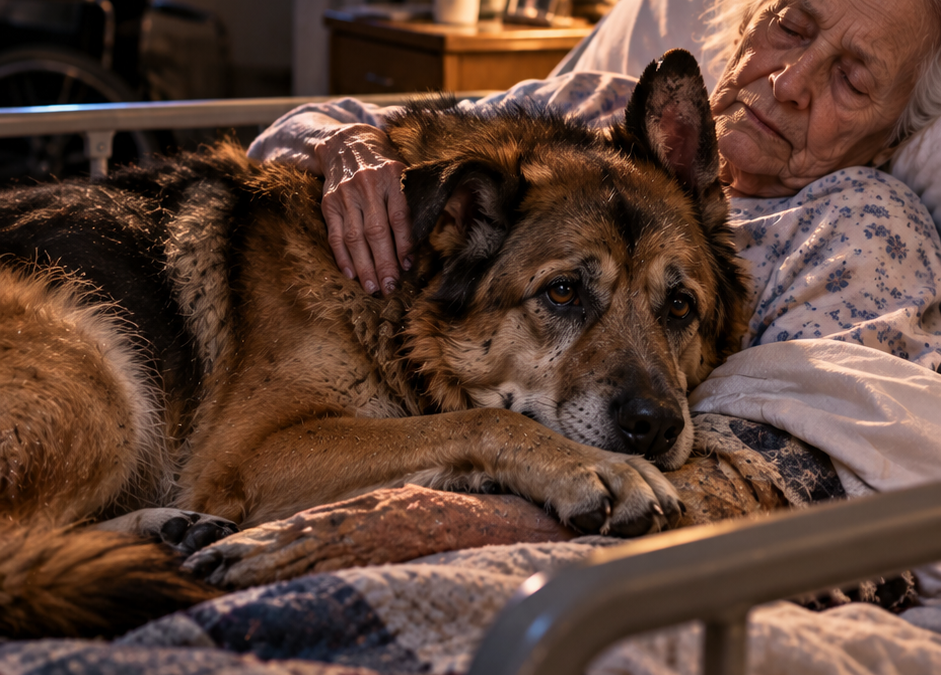
𝗙𝗨𝗟𝗟 𝗦𝗧𝗢𝗥𝗬
The first months were difficult.
Margaret refused most activities.
She disliked the dining room.
She hated being helped into the shower.
She accused one nurse of stealing jewelry Margaret had not owned in fifteen years.
She sometimes woke screaming.
Sometimes she slept fourteen hours.
Some days she spoke clearly enough to make you question the diagnosis.
Other days she stared at her own reflection as if waiting for the woman in the mirror to introduce herself.
I learned not to correct everything.
That is one of the hardest lessons in dementia care.
When a woman asks where her husband is and you know he died eleven years ago, truth can become cruelty if delivered every morning as if the death happened for the first time.
We learned to enter Margaret’s world carefully.
If she believed she needed to make dinner for her parents, we did not say, “Your parents are dead.”
We asked what her mother liked to eat.
If she wanted to catch a bus that no longer existed, we said the bus was late.
If she told me she had to get home before dark, I asked what home looked like.
You do not always bring someone back to reality.
Sometimes you sit beside them wherever memory has taken them.
Still, Margaret resisted us.
She tolerated Eleanor.
Sometimes.
The rest of us were strangers who kept reappearing.
Then Ghost came.
That was not his name at first.
He had no name.
At least none that we knew.
The first sighting happened in late September.
Night shift.
Around 11:40.
I had just finished checking room twelve when I heard metal scrape somewhere near the basement stairwell.
Rosewood was an old building.
Built in sections.
Badly renovated.
Full of noises that became ordinary once you worked there long enough.
Pipes knocked.
Radiators sighed.
Floorboards complained.
But this sound was different.
A scrape.
Pause.
Scrape again.
I took a flashlight and went downstairs.
The basement smelled of laundry detergent, dust, and damp concrete.
We stored old wheelchairs, holiday decorations, extra bedding, and boxes of files nobody had opened in years.
At the far end was a narrow window near ground level.
One pane had cracked months earlier.
Maintenance had covered part of it temporarily with plywood.
Temporarily is a dangerous word in institutions.
Temporary repairs often live long lives.
That night, the plywood had shifted.
The window stood partly open.
And on the floor beneath it were muddy paw prints.
I followed them.
Up the stairs.
Across the service hallway.
Toward the residential wing.
My first thought was raccoon.
Then I heard claws clicking against the tile.
I rounded the corner.
A dog stood ten feet away.
Large.
Gray-brown.
Some kind of shepherd mix.
One ear torn near the tip.
Ribs visible.
Coat rough.
Mud along his legs.
He looked at me.
I looked at him.
“Absolutely not.”
The dog blinked.
“This is a nursing home.”
Nothing.
“You cannot be here.”
He turned.
Walked away.
“Hey.”
I followed.
He moved down the hallway as if he knew exactly where he was going.
Past room three.
Past four.
Past five.
He ignored every open doorway.
Then stopped outside room seven.
Margaret’s door.
I stepped between him and the room.
“No.”
He looked around my legs.
“Go back.”
His ears lifted.
“Outside.”
He sat.
I pointed toward the stairwell.
That accomplished nothing.
“Don’t make me call security.”
We did not have real security at night.
We had a retired police officer named Hank who worked three evenings a week and spent most of his shift doing crossword puzzles.
The dog stood.
I thought I had won.
Then he stepped around me.
I blocked him again.
He went the other way.
“Really?”
That was when Margaret made a sound inside the room.
Not a word.
A soft moan.
The dog froze.
Every part of him changed.
His head lifted.
His body tightened.
He stared at the door.
Then, before I could stop him, he slipped past my leg and entered.
I followed.
Margaret was awake.
Moonlight came through the curtains.
She lay on her side, facing the door.
The dog stopped beside the bed.
Margaret stared at him.
I expected fear.
A scream.
She hated unexpected touch.
She had slapped a physical therapist two days earlier for adjusting her pillow without warning.
“Margaret,” I said carefully, “it’s okay.”
She did not look at me.
The dog moved closer.
Slowly.
He placed his nose against the edge of her mattress.
Margaret’s hand moved.
Just an inch.
Then another.
Her fingers touched the top of his head.
I stopped breathing.
The dog closed his eyes.
Margaret exhaled.
A long breath.
Something left her face.
Tension.
Confusion.
Fear.
I had seen sedatives take longer.
The dog put his front paws against the bed.
I moved toward him.
“No.”
Margaret turned her head sharply toward me.
For one second, her eyes were fierce.
Protective.
I stopped.
The dog climbed onto the mattress.
Turned once.
Then curled against Margaret’s side.
Her hand settled on his back.
I stood there thinking about infection control, policy, fleas, liability, administrators, and at least six reasons I should immediately remove him.
Instead I pulled the blanket over Margaret’s legs.
Then I went to find a bowl of water.
That was the first night.
I did throw him out before morning.
Around five, after Margaret had fallen into the deepest sleep I had seen from her in weeks, I coaxed the dog into the hallway with a piece of turkey from the staff refrigerator.
He followed me downstairs.
I opened the service door.
He walked out.
Turned once.
Then disappeared into the dark.
I reported him.
Of course I did.
The next morning our director, Mrs. Collins, looked at me as if I had personally invited a wolf into the facility.
“A stray dog was in a resident’s bed?”
“Yes.”
“Jennifer.”
“I know.”
“How?”
“Basement window.”
“That window was supposed to be repaired.”
“Yes.”
“Was Margaret bitten?”
“No.”
“Scratched?”
“No.”
“Was she distressed?”
I hesitated.
“No.”
“Then what?”
“She slept.”
Mrs. Collins stared at me.
“She sleeps every night.”
“No.”
I shook my head.
“You know what I mean.”
She did.
Everyone knew Margaret’s nights.
Restlessness.
Calling out.
Trying to climb from bed.
Tearing at her blankets.
Sometimes medication helped.
Sometimes nothing did.
“With the dog?” Mrs. Collins asked.
“Quiet.”
She closed her eyes.
“That does not make this acceptable.”
“I know.”
“We cannot allow a stray animal to roam a medical facility.”
“I know.”
“The window gets fixed today.”
It didn’t.
Someone put another piece of plywood over it.
The second night, Ghost came back.
I know because Sarah, the younger nurse on shift, called me at home at 12:20.
“You are not going to believe this.”
“The dog?”
Silence.
“How did you know?”
I sat up.
“Room seven?”
“Yes.”
“Is Margaret okay?”
“Jennifer, she’s petting him.”
I closed my eyes.
“Get him out.”
“You get him out.”
“I’m not there.”
“Exactly.”
Sarah was twenty-three then.
Good nurse.
Terrible liar.
She wanted the dog to stay.
“Sarah.”
“I know.”
“Rules.”
“I know.”
“Fleas.”
“I checked.”
“You checked?”
“I found a flea comb.”
“At midnight?”
“We have one in activities.”
“Why?”
“I don’t know, Jennifer.”
I could hear her smiling.
“Margaret’s asleep.”
That stopped me.
“How long?”
“Twenty minutes.”
“She was agitated before?”
“Very.”
“And now?”
“Out.”
I looked at the clock.
“Get the dog out by five.”
“Yes, ma’am.”
“Do not call me ma’am.”
“Yes, ma’am.”
He came the third night.
Then the fourth.
Every night, almost the same route.
Broken basement window.
Stairs.
Service hallway.
Room seven.
Never another room.
Never the kitchen.
Never the dining hall.
He did not roam.
He came for Margaret.
At first, we fought it.
We tried closing the basement window more securely.
The dog scratched until the plywood shifted.
We locked the basement stairwell.
He found an exterior side door one of the kitchen workers had left ajar.
We moved Margaret temporarily to room nine while room seven was being cleaned.
That night the dog walked into room seven, found it empty, paced the hallway, then eventually located her.
After that, even Mrs. Collins stopped calling it coincidence.
Still, policy was policy.
We contacted animal control.
They came twice.
Both times the dog vanished before they arrived.
We left food in a trap outside.
He ignored it.
We tried approaching during daylight.
No one could find him.
It was as if the animal existed only at night.
That was when Hank started calling him Ghost.
“Your ghost dog is back,” he would say over the radio.
The name stuck.
Ghost.
He appeared from darkness.
Moved silently through the building.
Disappeared before sunrise.
And somehow, Margaret knew him.
Or seemed to.
That was the impossible part.
No one could establish a connection.
Eleanor had never seen him.
When I first told her, she thought I was joking.
“A dog?”
“Yes.”
“In Mom’s bed?”
“Yes.”
“You allow this?”
“Technically, no.”
“What does technically mean?”
“It means the director would prefer I answer differently.”
Eleanor stared at me.
“Is he dangerous?”
“No.”
“Dirty?”
“Originally.”
“What does originally mean?”
“We may have cleaned him.”
“You bathed a stray dog in the nursing home?”
“In the laundry utility sink.”
Eleanor covered her face.
“Jennifer.”
“You asked.”
The truth was that by then several of us had become accomplices.
One night Ghost arrived soaked and shivering.
Sarah found an old towel.
I found flea treatment.
Hank produced dog shampoo from the trunk of his car because apparently he carried dog shampoo everywhere.
Nobody asked why.
Ghost tolerated exactly twelve minutes of our help before escaping.
He returned to Margaret’s room damp, offended, and smelling vaguely of oatmeal.
Margaret touched his ear.
She smiled.
Not a large smile.
Barely there.
But Eleanor saw it.
That was the beginning of her acceptance.
“Mom hasn’t smiled at me in weeks,” she whispered.
I wanted to say something comforting.
Nothing came.
Sometimes love is painful even when no one has done anything wrong.
Eleanor visited every Sunday.
She brought flowers.
Old photographs.
Music Margaret once liked.
She told stories.
Some days Margaret recognized her.
Some days she called her “Mother.”
Some days she seemed to think Eleanor was a nurse.
Eleanor would leave the room and cry in the hallway where her mother could not see.
But Ghost could walk through the door and Margaret’s face changed.
Not recognition exactly.
Something more physical.
Her shoulders relaxed.
Her breathing slowed.
Her hands stopped searching at the blankets.
I watched it dozens of times.
Hundreds eventually.
There is a phrase nurses use: non-pharmacological intervention.
It sounds clinical.
Cold.
But sometimes it means music.
Sometimes hand-holding.
Sometimes a familiar scent.
Sometimes a gray dog with a torn ear climbing illegally through a basement window.
Months passed.
Ghost became part of the night shift.
We still pretended otherwise.
That was the strange agreement.
No official policy permitted him.
No memo approved him.
No veterinarian had cleared him.
But every night a ceramic bowl began appearing near the basement stairs.
No one admitted putting it there.
Then food appeared.
Then an old blanket.
If Mrs. Collins noticed, she said nothing.
One new employee did.
Her name was Lisa.
Third week on the job.
She found Ghost walking down the hallway at 1:10 in the morning and nearly called emergency services.
“What is that?”
Sarah looked up from the nurses’ station.
“A dog.”
“I can see that.”
“Good.”
“Why is there a dog inside?”
Sarah continued charting.
“He visits.”
Lisa stared.
“This is prohibited.”
“Yes.”
“So remove him.”
Sarah finally looked up.
“Go ahead.”
Ghost passed without glancing at either woman.
Lisa followed him to room seven.
A minute later she came back.
Her expression had changed.
“Whose dog is he?”
“No one’s.”
“Then why is he here?”
Sarah answered, “Because he belongs here more than we do.”
I heard that story the next morning.
I told Sarah she was dramatic.
She told me she learned from me.
Years passed that way.
Not quickly.
Lives never feel quick while we are inside them.
But looking back, the years collapse.
Margaret turned ninety.
Then ninety-one.
Her language faded.
At first she lost nouns.
She would ask for “the thing” and point at water.
Then sentences shortened.
Then conversation became fragments.
“Yes.”
“No.”
“Cold.”
“Eleanor.”
Eventually even Eleanor’s name disappeared.
By ninety-three, Margaret could go days without speaking.
She still vocalized.
Laughed occasionally.
Cried.
Called out.
But clear language became rare.
Ghost aged too.
We saw it.
Gray spread along his muzzle.
His movements became slower.
The scar on his ear remained.
Sometimes he limped after cold nights.
We worried about where he spent his days.
We searched.
Animal control searched again.
Eleanor offered to adopt him.
So did Sarah.
So did I.
Ghost refused every version of domestic life we proposed.
Once Sarah managed to get him into her car after sunrise.
She took him home.
He stayed six hours.
At dusk, he scratched the door until she let him out.
By midnight he was back in room seven.
Another time Eleanor tried keeping him at her house overnight.
Ghost paced until nearly ten.
Then escaped through a gate.
At 12:43, he appeared at Rosewood.
We stopped trying.
Ghost had a schedule.
He had a place.
Margaret.
That was enough for him.
One Sunday morning changed everything.
Margaret was ninety-three.
Her speech had deteriorated dramatically during the previous year.
Eleanor came earlier than usual.
Around six thirty.
Ghost was still there.
Normally he left before sunrise.
That morning, perhaps because of rain, perhaps because he was tired, he remained curled against Margaret’s left side.
I was checking medication when Eleanor entered.
She stopped in the doorway.
The room was filled with pale morning light.
Margaret lay on her back.
Eyes open.
Ghost pressed beside her.
One of Margaret’s hands rested on his rough coat.
Her fingers moved slowly.
Back.
Forward.
Back.
Forward.
Eleanor walked toward the bed.
“Mom?”
Margaret did not look at her.
Eleanor sat.
She had seen Ghost before, but usually at a distance.
This was the first time she sat beside both of them while they were still in that quiet nighttime state.
Ghost barely acknowledged her.
His attention remained on Margaret.
Eleanor watched her mother’s hand move through the fur.
“Mom.”
No response.
Eleanor’s eyes filled.
She touched Margaret’s arm.
“Do you know who this is?”
Margaret stared at Ghost.
Eleanor glanced at me.
I wanted to tell her not to push.
Instead, I stayed silent.
“Mom?”
Margaret’s lips moved.
Nothing came out.
Then she breathed.
Once.
Twice.
Ghost lifted his head.
Margaret looked directly at him.
And said:
“He comes every night.”
Four words.
Clear.
Complete.
Perfect.
I dropped the medication cup in my hand.
Eleanor froze.
“What?”
Margaret did not repeat it.
Her hand continued stroking Ghost’s back.
Eleanor covered her mouth.
She began crying.
Not the quiet hallway tears I had seen so many Sundays.
This was different.
Shock.
Relief.
Gratitude.
Grief.
All mixed together.
“He comes every night,” Eleanor whispered.
Margaret’s eyes stayed on Ghost.
Eleanor bent forward and pressed her forehead against her mother’s shoulder.
I stepped out.
I closed the door.
Then I leaned against the hallway wall and cried too.
People later exaggerated that moment.
They said Ghost brought Margaret’s memory back.
He didn’t.
They said he cured something.
He didn’t.
They said he accomplished what doctors could not.
That is not the way I understand it.
Margaret remained ill.
Her decline continued.
She did not suddenly recognize everyone.
She did not return to the person Eleanor remembered from childhood.
But those four words proved something mattered inside her even when language had almost disappeared.
Some part of her still tracked Ghost’s arrival.
Night after night.
He comes every night.
She knew.
Maybe not who we were.
Maybe not what year it was.
Maybe not where Rosewood was.
But she knew consistency.
She knew warmth.
She knew him.
After that morning, nobody pretended anymore.
Mrs. Collins bought a ceramic water bowl herself.
Blue with white flowers.
She placed it near the basement stairs.
“You didn’t see me do this,” she told me.
“I’m looking directly at you.”
“Jennifer.”
“Yes, ma’am.”
“Don’t start.”
We laughed.
A food bowl appeared outside room seven.
An old fleece blanket became Ghost’s.
We paid for vaccinations through a local vet who agreed to examine him during one of the rare mornings he stayed long enough.
The chart never listed Ghost as treatment.
But nurses began mentioning him in notes.
“Resident agitated at 2300, settled after dog arrived.”
“Resident restless; calm once Ghost present.”
“Resident sleeping, hand on dog.”
I started keeping my own notebook.
Not official.
Small.
Black cover.
Each night Ghost appeared, I wrote the date.
Sometimes one sentence.
October 4: Ghost entered 12:11. Room 7. Margaret settled within minutes.
November 16: Heavy snow. Thought he wouldn’t come. Arrived 12:46 soaked.
January 8: Margaret cried for Eleanor until 1:00. Ghost arrived. She stopped calling.
March 21: Ghost limping right front leg. Fed him. Margaret touched his paw.
Year after year.
Page after page.
I don’t know why I kept it.
Maybe because dementia is built from disappearance.
Words disappear.
Names.
Skills.
Faces.
When you work around that long enough, you begin wanting proof that something stayed.
Ghost stayed.
Margaret kept weakening.
By ninety-four, she needed help with everything.
Eating.
Turning.
Bathing.
Positioning.
She could no longer sit alone.
Her hands, once restless, moved less.
We used cushions to protect her skin.
Her appetite declined.
Respiratory infections came more often.
Eleanor asked me once, “How much time?”
I hated that question.
Families believe nurses know.
Sometimes we can estimate.
Often we cannot.
“Could be months,” I told her.
“Could it be years?”
“Yes.”
“Do you think she knows me?”
That was harder.
“Sometimes.”
Eleanor looked through the glass toward her mother’s room.
“And Ghost?”
I took too long to answer.
She noticed.
“Every time?”
I sighed.
“He responds differently with her.”
“No.”
She looked at me.
“Does she respond differently to him?”
“Yes.”
Eleanor nodded.
“I thought so.”
There was no jealousy in her voice.
Not anymore.
That surprised me.
Years earlier, it hurt her.
Now she seemed grateful.
“I’m glad somebody gets through,” she said.
I touched her shoulder.
“You get through too.”
“How do you know?”
“Because she relaxes when you read.”
“She doesn’t look at me.”
“She doesn’t have to.”
Eleanor smiled sadly.
“Maybe that’s what Ghost knows.”
“What?”
“That being recognized isn’t the same as being loved.”
I never forgot that.
Margaret turned ninety-five.
We put no balloons in her room because balloons frightened her.
Instead, Eleanor brought flowers and lemon cake.
Margaret ate two bites.
Ghost arrived after midnight.
He received a small piece of plain chicken.
That was our celebration.
By then, even day staff knew him.
New administrators occasionally tried raising concerns.
Legal.
Sanitation.
Infection.
All legitimate.
Then they watched him with Margaret.
Policies became complicated.
Perhaps that was irresponsible.
Maybe another facility would have handled it differently.
But after six years, Ghost had become woven into Rosewood.
He never entered the kitchen.
Never bothered other residents.
Never growled at staff.
Never had an accident indoors.
He came.
He went to room seven.
He stayed.
He left.
That was his entire relationship with the building.
Then March came.
Cold rain.
Gray skies.
Margaret declined rapidly during the first week.
First food.
She stopped taking more than a few spoonfuls.
Then fluids.
Then responses.
Eleanor sat beside her for hours.
“Mom?”
Nothing.
“Can you hear me?”
Sometimes a blink.
Nothing more.
The physician met Eleanor in the family room.
I sat with them.
There comes a moment when medicine changes goals.
Not recovery.
Comfort.
The doctor used careful words.
Eleanor listened.
Then asked, “Are you saying she’s dying?”
Silence.
“Yes.”
Eleanor nodded.
One small nod.
Then pressed both hands against her face.
She booked a room at a small inn nearby.
She came every morning.
Stayed until late.
Sometimes slept in the chair beside Margaret.
Ghost continued his schedule.
Every night.
Some nights Margaret did not react visibly when he climbed onto the bed.
But if we tried moving him, her hand tightened.
So we stopped moving him.
March 14 began quietly.
Margaret barely opened her eyes all day.
Eleanor sat beside her until almost eleven that night.
I was not scheduled overnight.
Sarah was.
Before leaving, Eleanor kissed her mother’s forehead.
“I’ll be back in the morning.”
She hesitated at the door.
Then turned.
“Jennifer?”
“Yes?”
“Do you think she’s scared?”
I wanted to lie.
Instead I answered carefully.
“I don’t think she’s alone.”
Eleanor understood.
She looked at Ghost’s empty blanket near the wall.
“He’ll come.”
“Yes.”
“He always does.”
“Yes.”
She left.
At 11:52, according to Sarah’s later notes, Ghost entered.
Same basement window.
Same stairs.
Same hallway.
Same room.
But something changed.
Normally Ghost curled against Margaret’s left side.
That night he climbed higher.
He positioned himself across her chest.
His head tucked beneath her chin.
Body over the place where her heart beat.
Sarah entered at 1:15.
She called me later and described it.
“I’ve never seen him lie there.”
“What did Margaret do?”
“Her hand is on him.”
“Is she awake?”
“I don’t know.”
“Breathing?”
“Yes.”
“Comfortable?”
“Yes.”
“Then leave them.”
At 2:40, Sarah checked again.
Same position.
Ghost awake.
Watching Margaret’s face.
At 3:30.
Same.
At approximately four in the morning, Sarah entered the room.
Margaret had stopped breathing.
There was no struggle.
No alarm.
No frantic movement.
She looked asleep.
Ghost remained on her chest.
His head resting where her hand had been.
Sarah told me she knew before checking the pulse.
Nurses learn that stillness.
She touched Margaret’s neck.
Then wrist.
Nothing.
Ghost watched.
Sarah cried.
Not loudly.
She called the physician.
Then Eleanor.
Eleanor arrived before five.
She entered room seven already crying.
Ghost did not move.
She approached the bed.
“Mom.”
No response.
Of course.
Eleanor touched Margaret’s face.
Then looked at Ghost.
“You stayed.”
Ghost’s ears moved.
Eleanor sat.
For nearly two hours, he remained there.
Staff came and went.
Paperwork.
Calls.
Quiet voices.
Eleanor held her mother’s hand.
Ghost stayed on the other side.
Nobody touched him.
Finally, when it was time to prepare Margaret, I arrived.
I had driven in as soon as Sarah called.
I entered room seven.
Morning light had begun behind the curtains.
Same kind of light as the morning Margaret spoke those four words.
Ghost looked at me.
His eyes seemed exhausted.
I stood beside the bed.
“Hey.”
He did not move.
I touched his shoulder.
He stayed.
“We need her now.”
The sentence broke my voice.
Ghost lowered his head.
I slid my arms beneath him carefully.
For six years, I had rarely lifted him.
He hated being carried.
That morning, he did not resist.
He let me lower him onto the floor.
He stood beside the bed.
Looked up.
Margaret’s hand lay motionless on the sheet.
Ghost sniffed it once.
Then turned.
Walked toward the door.
At the threshold, he stopped.
Looked back.
I have spent three decades trying not to put human emotions into animals.
I know the danger.
We interpret.
Project.
Romanticize.
But I will say only what I saw.
Ghost stood at that doorway for nearly ten seconds.
He looked at the bed.
Then he walked away.
Down the hallway.
Past the nurses’ station.
Down the basement stairs.
Through the broken window.
Gone.
Sarah watched until he disappeared.
“He knows.”
I said nothing.
What could I say?
We prepared Margaret’s room.
Removed bedding.
Personal items went into boxes.
Eleanor chose which photographs to take.
The blue cardigan.
Books.
A porcelain bird.
Margaret’s wedding ring stayed with Eleanor.
By afternoon, room seven no longer looked like Margaret’s room.
That transformation is one of the cruelest parts of institutional life.
A person occupies a space for six years.
Then within hours, the room begins becoming available for someone else.
Bedsheets removed.
Drawers emptied.
Nameplate taken down.
Life compressed into boxes.
At seven that evening, room seven was bare.
No blankets.
No pillows.
Nothing on the nightstand.
Ghost’s ceramic bowl remained outside.
Nobody moved it.
That night, I stayed late.
I don’t know why.
Maybe I knew.
At 12:09, I heard the basement scrape.
My hands froze over the chart.
Sarah looked at me.
“No.”
Then the claws.
Click.
Click.
Click.
Ghost appeared at the end of the hallway.
He moved exactly as always.
Toward room seven.
My throat tightened.
“Ghost.”
He did not stop.
He entered.
The bed was stripped.
Empty.
He stood beside it.
Sniffed.
Then jumped onto the mattress.
Turned once.
Twice.
Three times.
The exact ritual he had performed for six years.
Then lay down.
He placed his head where Margaret’s hand had usually rested.
Closed his eyes.
Sarah began crying behind me.
“He came back.”
“Yes.”
“What do we do?”
“Nothing.”
Ghost stayed until morning.
The next night, he returned again.
Same time.
Same path.
Same bed.
Third night.
Fourth.
Fifth.
I started writing in the notebook again.
March 15: Ghost returned. Room 7 empty. Slept on bed until dawn.
March 16: Returned 12:14.
March 17: Returned.
March 18: Returned.
One week.
Then two.
Management delayed assigning room seven.
Officially, maintenance work.
Unofficially, none of us could bear moving a stranger into Margaret’s room while Ghost was still arriving every night.
Eleanor came several times.
She sat in the dark beside him.
The first time, Ghost opened his eyes but did not leave the bed.
Eleanor whispered, “She’s not coming back.”
Ghost rested his head again.
“I know.”
She sat there until three in the morning.
“I don’t know why I’m telling you.”
No movement.
“You probably know better than I do.”
I watched from the doorway.
Eleanor touched the edge of the mattress.
“I spent years wishing she would remember me.”
Her voice shook.
“I thought that was what I needed.”
Ghost breathed slowly.
“Now I’d give anything just to have her there not remembering.”
She laughed through tears.
“Isn’t that stupid?”
I stepped inside.
“No.”
Eleanor looked at me.
“No,” I repeated.
She turned back toward Ghost.
“He misses her.”
“Yes.”
“So do I.”
“Yes.”
For thirty-four consecutive nights, Ghost returned.
Thirty-four.
I counted every one.
The staff stopped expecting the pattern to end.
Every evening, I filled the blue ceramic bowl with water.
Ghost almost never drank from it.
Still, I filled it.
Sarah placed food near the bed.
He rarely ate.
He came for one reason.
He slept.
He waited.
Then left.
Night thirty-four was April 17.
Ghost arrived at 12:22.
Stayed until 5:41.
I wrote it down.
April 18, I filled the bowl.
Midnight came.
No Ghost.
12:30.
Nothing.
1:00.
Nothing.
Sarah walked to the basement window.
“Maybe he’s late.”
“Maybe.”
2:00.
No dog.
At three, I knew.
Something had ended.
The next night he did not come.
Nor the next.
We searched.
Staff checked nearby roads.
Animal control checked shelters.
Eleanor posted photographs online.
Hank drove around after his shift.
Farmers were asked.
Nobody knew.
Then a farmer several miles north called.
“I saw a dog like that.”
“When?”
“Couple days ago.”
“Where?”
“Walking along the north road.”
“Was he injured?”
“Didn’t look like it.”
“Where was he going?”
The farmer laughed.
“North, I guess.”
That was the last confirmed sighting.
A large gray dog.
Torn ear.
Walking alone beside a road.
No one ever found him.
Maybe somebody took him in.
Maybe he found another farm.
Maybe he lived years afterward.
Maybe he didn’t.
I learned long ago that not every story gives you the ending you want.
Sometimes disappearance is the ending.
A few months later, maintenance finally repaired the basement window.
The actual repair this time.
New glass.
New frame.
Proper seal.
The worker removed the old plywood and found something wedged along the ledge.
A small black notebook.
Mine.
I had forgotten leaving it there one night.
He brought it to the nurses’ station.
The cover was warped from dampness.
Pages swollen.
But the writing remained.
Six years.
Dates.
Tiny observations.
Ghost arrived.
Margaret settled.
Ghost stayed.
Margaret slept.
Night after night.
I turned through the pages.
My hands began shaking.
I had not realized how much of their story I had recorded.
Not important medical facts.
Not lab values.
Not diagnoses.
Just presence.
Eleanor visited that Sunday.
I handed her the notebook.
“What is this?”
“Your mother.”
She opened it.
The first pages made her smile.
Then cry.
She sat in the Rosewood garden beneath a maple tree and read every line.
I left her alone.
Almost two hours later, she found me.
She held the notebook against her chest.
“Can I keep it?”
“It belongs to you.”
She nodded.
Then asked, “What happened to the bowl?”
“What bowl?”
“Ghost’s water bowl.”
It was still near the basement stairs.
We had never moved it.
Eleanor took it home.
The following Sunday, she went to Margaret’s grave.
She filled the ceramic bowl with clean water.
Placed it beside the headstone.
No dog appeared.
She returned the next Sunday.
Emptied the old water.
Washed the bowl.
Filled it again.
Week after week.
I once asked why.
She smiled.
“Habit.”
I knew that was not the answer.
She looked at Margaret’s grave.
“Someone should leave water in case he comes.”
“Eleanor.”
“I know.”
Her smile trembled.
“I know he won’t.”
I sat beside her.
“Then why?”
She thought for a long time.
“Because for six years, he kept showing up without knowing whether she would know him.”
I looked at the bowl.
“And?”
“Maybe love deserves somebody to keep showing up for it.”
I had no better answer.
Years have passed.
I am older now.
Retired.
Sarah became head nurse.
Rosewood renovated the basement.
Room seven eventually belonged to other residents.
The birch tree near the cemetery has grown taller.
Eleanor still visits her mother.
Not every Sunday anymore.
Life changes.
But often enough.
Sometimes she sends me photographs.
Margaret’s stone.
Flowers.
That small blue-and-white bowl.
Filled with water.
No dog beside it.
People who hear this story always ask the same questions.
“How did Ghost know Margaret?”
I don’t know.
“Was he her dog before?”
As far as anyone could establish, no.
“Did they meet somewhere earlier?”
Possibly.
No evidence.
“Did he smell something?”
Maybe.
“Why room seven?”
I don’t know.
“Why every night?”
I don’t know.
“Why six years?”
I don’t know.
When I was younger, not knowing bothered me.
Thirty years in nursing changed that.
Some truths matter without explaining themselves completely.
I know Margaret was calmer when Ghost was beside her.
I know she touched him even after she stopped reaching for almost everything else.
I know she said four clear words after more than a year without a complete sentence.
“He comes every night.”
I know Ghost came the night she died.
I know he positioned himself over her heart.
I know he stayed after her breathing stopped.
I know he returned to the empty room for thirty-four nights.
Those are the facts I witnessed.
Everything beyond them belongs to interpretation.
I do not say Ghost kept Margaret alive six extra years.
I have heard people say that.
I understand why.
But medicine does not work that cleanly.
Love does not either.
Margaret lived because her body lived.
Because nurses cared for her.
Because physicians treated infections.
Because Eleanor kept visiting.
Because food was offered again and again.
Because hundreds of small acts accumulated.
Ghost was one of those acts.
Perhaps one of the most important.
Not because he cured anything.
Because he gave Margaret a form of comfort her disease could not erase.
Touch.
Warmth.
Routine.
Presence.
The body remembers things the mind cannot always name.
That is what I believe after watching them.
Margaret did not need to remember Ghost’s name.
He did not have one she ever used.
She did not need to know the date.
Or the facility.
Or what relationship connected them.
She knew the feeling of his fur beneath her fingers.
She knew the weight beside her.
She knew that after dark, someone came.
Every night.
That certainty became a bridge.
A narrow one.
Fragile.
But real.
I think about one particular night more than all the others.
It was during Margaret’s ninety-fourth year.
She had been agitated for hours.
Calling for her mother.
Trying to remove her blanket.
Begging to go home.
Nothing helped.
Around midnight, I sat beside her.
“Margaret.”
She looked at me.
“Where’s Mama?”
Her mother had been dead more than seventy years.
“She’s resting.”
“I need to go.”
“We’ll go soon.”
“No.”
Her voice rose.
“Now.”
She tried sitting.
I stopped her gently.
She became frightened.
“Don’t touch me!”
I backed away.
“It’s okay.”
“No!”
Her breathing quickened.
Then we heard claws in the hallway.
Margaret stopped.
Ghost entered.
No drama.
He walked to the bed.
Climbed up.
Lay beside her.
Margaret stared.
Her hand found his ear.
Her breathing slowed.
Thirty seconds.
Maybe forty.
She closed her eyes.
I sat in the chair beside them until dawn.
At some point, I realized I was jealous.
Not of the dog.
Of simplicity.
We humans bring histories into every room.
Guilt.
Expectations.
Old arguments.
Unanswered questions.
Eleanor loved Margaret desperately, but that love carried decades.
Motherhood.
Childhood.
Disappointments.
Regret.
Ghost carried none of that.
He asked nothing from Margaret.
Not recognition.
Not conversation.
Not gratitude.
Not even memory.
He only came.
That was why his presence was so pure.
He did not need Margaret to be the woman she had once been.
He accepted the woman she was that night.
Then the next.
Then the next.
Perhaps that is why she accepted him too.
I think that is the hardest form of love for humans.
To stop demanding that someone remain who they used to be.
Families struggle with that in dementia.
They say:
“That isn’t my mother.”
“He would never have said that.”
“She used to love music.”
“He always knew my birthday.”
All true.
All painful.
But the person in front of us still exists.
Changed.
Reduced in some ways.
Unreachable in others.
But there.
Ghost never compared Margaret with an earlier version.
He had no expectations of recovery.
He did not wait for her to remember.
He simply adjusted himself against her body and slept.
When Margaret could still stroke him, he accepted the touch.
When she could barely move her fingers, he moved closer.
When she stopped speaking, he did not require speech.
When she died, he stayed.
Then, when she was gone, he returned until somehow he no longer needed to.
That is why I never corrected Eleanor when she said Ghost had kept Margaret connected to life.
Maybe medically that is impossible to prove.
Emotionally, I knew what she meant.
I saw Margaret before Ghost arrived.
And I saw her after.
The disease continued.
Her body continued aging.
But something changed in those nights.
She belonged to something.
Something belonged to her.
Even when almost every other connection became blurred.
One winter years later, Eleanor and I met for coffee.
She brought the notebook.
The same black one.
Now wrapped carefully in clear protective covering.
“You kept it.”
“Of course.”
She opened to the page from that Sunday morning.
I recognized my handwriting.
Ghost still in room at 6:30. Eleanor arrived. Margaret said clearly: “He comes every night.”
Eleanor touched the sentence.
“I read this whenever I start remembering only the ending.”
“What do you mean?”
“The last months.”
She looked at me.
“That’s what grief does sometimes.”
I nodded.
“It takes a whole life and compresses it into the worst part.”
“Yes.”
She closed the notebook.
“This reminds me she still had good moments.”
“She did.”
“With him.”
“With you too.”
Eleanor smiled.
“You always say that.”
“Because you always forget it.”
We sat quietly.
Then she asked, “Do you think Ghost knew she died?”
I took my time.
“I think something changed for him.”
“That’s not an answer.”
“It’s the only one I have.”
“He came back thirty-four nights.”
“Yes.”
“Why thirty-four?”
“I don’t know.”
“Why not thirty-three?”
I laughed.
“Eleanor.”
“I’m serious.”
“I know.”
She stared into her coffee.
“Maybe on night thirty-four he finally understood.”
“Maybe.”
“Or maybe he got tired.”
“Maybe.”
“Or found somewhere else.”
“Yes.”
She smiled.
“You hate making up endings.”
“I spent thirty years writing charts. We document what we see.”
“That’s why Mom liked the dog better.”
“Probably.”
We laughed.
Then Eleanor said something that has stayed with me.
“I don’t actually need to know where he went.”
I looked at her.
“That’s new.”
“Yes.”
She touched the notebook.
“For years I thought I did.”
“What changed?”
“I realized disappearing wasn’t betrayal.”
The words stopped me.
“Mom disappeared a little at a time.”
Her voice remained steady.
“I used to think she was leaving me.”
I said nothing.
“She wasn’t.”
“No.”
“The disease was taking things.”
“Yes.”
“And Ghost disappeared too.”
She smiled sadly.
“But he stayed as long as he needed to.”
I reached across the table.
She took my hand.
“That’s enough now.”
Maybe that is what age teaches if we are lucky.
Enough.
Not perfect answers.
Enough.
Not permanent presence.
Enough presence when it matters.
Margaret had spent her final six years with a dog nobody owned.
Ghost spent six years entering a building where he was technically forbidden.
Staff members risked reprimands.
A director ignored a broken window longer than she should have.
A daughter learned that being forgotten did not mean being unloved.
And I, a nurse who once tried to chase a stray animal out with a piece of turkey, learned that care does not always arrive in approved forms.
Sometimes it walks through the front door with credentials.
Sometimes it comes in a medication cup.
Sometimes it is a daughter reading beside a bed.
And sometimes it crawls through broken glass at midnight with mud on its paws.
I used to think professionalism meant maintaining distance from stories like Margaret’s.
You chart.
You treat.
You document.
You move on.
But after nearly thirty years, I think professionalism without tenderness becomes another kind of failure.
People do not live inside policies.
They live inside relationships.
Rosewood was full of them.
Resident and daughter.
Nurse and patient.
Roommate and roommate.
Old man and photograph.
Woman and music.
And one old woman with a gray stray dog.
Ghost broke almost every rule we had.
He also taught us something no training seminar ever had.
Sometimes comfort is not something you administer.
Sometimes you recognize it when it appears and have enough humility not to interfere.
The last time I visited Margaret’s grave with Eleanor, the afternoon was warm.
Birds moved between the trees.
The cemetery was nearly empty.
Eleanor carried the ceramic bowl.
She emptied yesterday’s water into the grass.
Wiped the inside with a cloth.
Then poured fresh water.
I watched.
“You still do this?”
“When I can.”
“For Ghost?”
She considered.
“For both of them.”
She placed the bowl against the headstone.
Margaret Ellis.
Beloved Mother.
No mention of Ghost.
Of course not.
Cemeteries leave out most of what matters.
Eleanor sat on the grass.
I joined her.
For several minutes we said nothing.
Then she smiled.
“You know what Mom would say if she could see me doing this?”
“What?”
“Waste of perfectly good water.”
I laughed.
“Probably.”
“She hated waste.”
“True.”
Eleanor looked toward the path.
“No dog has ever come.”
“I know.”
“Not once.”
“I know.”
She touched the rim of the bowl.
“But I still like it full.”
I understood.
Waiting can be its own form of love.
Not because you truly believe someone will return.
Because leaving a place ready for them means admitting they mattered.
A bowl of water.
A door left cracked.
A blanket at the foot of a bed.
A notebook full of dates.
Small things.
That is how humans build monuments when stone is not enough.
Before we left, Eleanor stood beside the grave.
“Bye, Mom.”
Then she glanced at the bowl.
“And if you’re out there, Ghost…”
She smiled.
“Good boy.”
The wind moved through the trees.
Nothing else happened.
No dog appeared.
No miracle.
We walked away.
I was glad.
Not every love needs one final dramatic sign.
Some stories are powerful precisely because they end quietly.
Margaret died with Ghost on her chest.
Ghost returned thirty-four nights.
Then left.
Eleanor filled the bowl.
Life continued.
That was enough.
Sometimes, when people ask me what was the most extraordinary thing I ever saw in thirty years of nursing, they expect something medical.
A recovery nobody predicted.
A patient waking from a coma.
A last-minute diagnosis.
I tell them about room seven.
About the broken basement window.
About muddy paw prints.
About a dog with one torn ear.
About a woman whose memory was disappearing.
I tell them that for six years, every night, Ghost crossed the basement, climbed the stairs, walked down the same hallway, entered the same room, and curled beside the same woman.
I tell them that Margaret forgot almost everything.
But one Sunday morning, when her daughter asked whether she knew who the dog was, Margaret looked at him and said:
“He comes every night.”
Those four words explain more than I ever could.
She did not say his name.
She did not say where he came from.
She did not say she loved him.
She said he came.
Consistency.
Presence.
The most basic promise one living creature can make to another.
I will come back.
Ghost kept that promise for six years.
Then, after Margaret could no longer be there to receive him, he kept it for thirty-four nights more.
Maybe that was grief.
Maybe habit.
Maybe instinct.
Maybe love.
I stopped needing to choose.
I only know that on his thirty-fifth night, the hallway remained empty.
And for the first time in six years, room seven stayed silent until morning.
I filled the water bowl anyway.
For a long time afterward, I kept listening for paws.
Sometimes I thought I heard them.
Old buildings make strange noises.
Memory does too.
But Ghost never returned.
Eventually I accepted that whatever had brought him through that broken window night after night had finally released him.
Maybe he had completed something.
Maybe Margaret’s absence finally became part of the world he understood.
Or maybe somewhere north of Rosewood Haven, another person needed a gray dog with a torn ear to sit beside them in the dark.
I like that possibility.
I cannot prove it.
I don’t need to.
Because after all those years, Margaret taught me that memory is not the only place love lives.
And Ghost taught me that loyalty does not always ask to be understood.
Sometimes it just appears.
Mud on its paws.
Rain in its coat.
No permission.
No explanation.
Then it climbs onto the bed beside someone everyone else is slowly losing.
And it stays.
Night after night.
For as long as it takes.
𝗧𝗛𝗘 𝗘𝗡𝗗
For Six Years, a Stray Dog Broke Into Room Seven Every Night, and None of Us Had the Heart to Stop Him
The first time I saw the dog inside the nursing home, I tried to throw him out.
Six years later, I stood beside room seven at four in the morning and watched that same dog refuse to leave the body of a ninety-five-year-old woman who no longer remembered my name.
By then, none of us called him a stray anymore.
None of us remembered exactly when we had stopped pretending he wasn’t allowed inside.
And none of us could explain why Margaret—who had forgotten her daughter’s birthday, forgotten where she lived, and eventually forgotten how to ask for a glass of water—still softened every single time that torn-eared dog climbed onto her bed.
My name is Jennifer Walsh.
I had worked at Rosewood Haven for almost thirty years by the time Margaret died.
People hear “nursing home” and imagine quiet hallways, television sets playing too loudly, nurses pushing medication carts, and old people sleeping beneath knitted blankets.
That is part of it.
But places like Rosewood are filled with entire worlds most visitors never notice.
A man in room sixteen once built suspension bridges.
The woman across from him had sung onstage in Chicago before she married.
Mr. Klein spoke almost no English by the time I knew him, but every Thursday morning he polished shoes the way his father taught him when he was eight.
Mrs. Patterson kept letters from a husband dead forty years beneath her pillow and still corrected anyone who referred to him in the past tense.
Every room contained a life much larger than the bed inside it.
Margaret’s room was number seven.
She arrived when she was eighty-nine.
Thin.
Proud.
Gray hair cut just below her ears.
Her daughter, Eleanor, brought three suitcases, a box of framed photographs, a blue cardigan, and enough books to fill half the shelf beside her bed.
Margaret looked at none of it.
She stood near the window with both hands clasped in front of her and stared at the trees.
Her diagnosis was some form of progressive dementia.
Doctors used precise language.
Her daughter preferred none.
“She forgets,” Eleanor told me.
That was how she described it.
“She forgets.”
At first, Margaret forgot appointments.
Then names.
Then familiar streets.
She once called Eleanor by her sister’s name.
Another time she walked into her own kitchen and asked whose house she was in.
Eleanor kept her at home as long as she could.
Almost too long.
When Margaret began wandering at night, Eleanor installed locks.
When she forgot to eat, Eleanor cooked and sat beside her.
When she left the stove on, Eleanor disconnected it.
The final incident happened in February.
Margaret walked outside at two in the morning wearing slippers and a summer blouse.
A delivery driver found her nearly a mile from home.
She had no idea where she was going.
That was when Eleanor made the decision every adult child fears making.
Rosewood.
I met them on intake day.
Eleanor cried twice.
Margaret did not cry once.
She simply watched us.
Suspicious.
Distant.
As though we were actors in some play whose plot she had already lost.
The first months were difficult.
Margaret refused most activities.
She disliked the dining room.
She hated being helped into the shower.
She accused one nurse of stealing jewelry Margaret had not owned in fifteen years.
She sometimes woke screaming.
Sometimes she slept fourteen hours.
Some days she spoke clearly enough to make you question the diagnosis.
Other days she stared at her own reflection as if waiting for the woman in the mirror to introduce herself.
I learned not to correct everything.
That is one of the hardest lessons in dementia care.
When a woman asks where her husband is and you know he died eleven years ago, truth can become cruelty if delivered every morning as if the death happened for the first time.
We learned to enter Margaret’s world carefully.
If she believed she needed to make dinner for her parents, we did not say, “Your parents are dead.”
We asked what her mother liked to eat.
If she wanted to catch a bus that no longer existed, we said the bus was late.
If she told me she had to get home before dark, I asked what home looked like.
You do not always bring someone back to reality.
Sometimes you sit beside them wherever memory has taken them.
Still, Margaret resisted us.
She tolerated Eleanor.
Sometimes.
The rest of us were strangers who kept reappearing.
Then Ghost came.
That was not his name at first.
He had no name.
At least none that we knew.
The first sighting happened in late September.
Night shift.
Around 11:40.
I had just finished checking room twelve when I heard metal scrape somewhere near the basement stairwell.
Rosewood was an old building.
Built in sections.
Badly renovated.
Full of noises that became ordinary once you worked there long enough.
Pipes knocked.
Radiators sighed.
Floorboards complained.
But this sound was different.
A scrape.
Pause.
Scrape again.
I took a flashlight and went downstairs.
The basement smelled of laundry detergent, dust, and damp concrete.
We stored old wheelchairs, holiday decorations, extra bedding, and boxes of files nobody had opened in years.
At the far end was a narrow window near ground level.
One pane had cracked months earlier.
Maintenance had covered part of it temporarily with plywood.
Temporarily is a dangerous word in institutions.
Temporary repairs often live long lives.
That night, the plywood had shifted.
The window stood partly open.
And on the floor beneath it were muddy paw prints.
I followed them.
Up the stairs.
Across the service hallway.
Toward the residential wing.
My first thought was raccoon.
Then I heard claws clicking against the tile.
I rounded the corner.
A dog stood ten feet away.
Large.
Gray-brown.
Some kind of shepherd mix.
One ear torn near the tip.
Ribs visible.
Coat rough.
Mud along his legs.
He looked at me.
I looked at him.
“Absolutely not.”
The dog blinked.
“This is a nursing home.”
Nothing.
“You cannot be here.”
He turned.
Walked away.
“Hey.”
I followed.
He moved down the hallway as if he knew exactly where he was going.
Past room three.
Past four.
Past five.
He ignored every open doorway.
Then stopped outside room seven.
Margaret’s door.
I stepped between him and the room.
“No.”
He looked around my legs.
“Go back.”
His ears lifted.
“Outside.”
He sat.
I pointed toward the stairwell.
That accomplished nothing.
“Don’t make me call security.”
We did not have real security at night.
We had a retired police officer named Hank who worked three evenings a week and spent most of his shift doing crossword puzzles.
The dog stood.
I thought I had won.
Then he stepped around me.
I blocked him again.
He went the other way.
“Really?”
That was when Margaret made a sound inside the room.
Not a word.
A soft moan.
The dog froze.
Every part of him changed.
His head lifted.
His body tightened.
He stared at the door.
Then, before I could stop him, he slipped past my leg and entered.
I followed.
Margaret was awake.
Moonlight came through the curtains.
She lay on her side, facing the door.
The dog stopped beside the bed.
Margaret stared at him.
I expected fear.
A scream.
She hated unexpected touch.
She had slapped a physical therapist two days earlier for adjusting her pillow without warning.
“Margaret,” I said carefully, “it’s okay.”
She did not look at me.
The dog moved closer.
Slowly.
He placed his nose against the edge of her mattress.
Margaret’s hand moved.
Just an inch.
Then another.
Her fingers touched the top of his head.
I stopped breathing.
The dog closed his eyes.
Margaret exhaled.
A long breath.
Something left her face.
Tension.
Confusion.
Fear.
I had seen sedatives take longer.
The dog put his front paws against the bed.
I moved toward him.
“No.”
Margaret turned her head sharply toward me.
For one second, her eyes were fierce.
Protective.
I stopped.
The dog climbed onto the mattress.
Turned once.
Then curled against Margaret’s side.
Her hand settled on his back.
I stood there thinking about infection control, policy, fleas, liability, administrators, and at least six reasons I should immediately remove him.
Instead I pulled the blanket over Margaret’s legs.
Then I went to find a bowl of water.
That was the first night.
I did throw him out before morning.
Around five, after Margaret had fallen into the deepest sleep I had seen from her in weeks, I coaxed the dog into the hallway with a piece of turkey from the staff refrigerator.
He followed me downstairs.
I opened the service door.
He walked out.
Turned once.
Then disappeared into the dark.
I reported him.
Of course I did.
The next morning our director, Mrs. Collins, looked at me as if I had personally invited a wolf into the facility.
“A stray dog was in a resident’s bed?”
“Yes.”
“Jennifer.”
“I know.”
“How?”
“Basement window.”
“That window was supposed to be repaired.”
“Yes.”
“Was Margaret bitten?”
“No.”
“Scratched?”
“No.”
“Was she distressed?”
I hesitated.
“No.”
“Then what?”
“She slept.”
Mrs. Collins stared at me.
“She sleeps every night.”
“No.”
I shook my head.
“You know what I mean.”
She did.
Everyone knew Margaret’s nights.
Restlessness.
Calling out.
Trying to climb from bed.
Tearing at her blankets.
Sometimes medication helped.
Sometimes nothing did.
“With the dog?” Mrs. Collins asked.
“Quiet.”
She closed her eyes.
“That does not make this acceptable.”
“I know.”
“We cannot allow a stray animal to roam a medical facility.”
“I know.”
“The window gets fixed today.”
It didn’t.
Someone put another piece of plywood over it.
The second night, Ghost came back.
I know because Sarah, the younger nurse on shift, called me at home at 12:20.
“You are not going to believe this.”
“The dog?”
Silence.
“How did you know?”
I sat up.
“Room seven?”
“Yes.”
“Is Margaret okay?”
“Jennifer, she’s petting him.”
I closed my eyes.
“Get him out.”
“You get him out.”
“I’m not there.”
“Exactly.”
Sarah was twenty-three then.
Good nurse.
Terrible liar.
She wanted the dog to stay.
“Sarah.”
“I know.”
“Rules.”
“I know.”
“Fleas.”
“I checked.”
“You checked?”
“I found a flea comb.”
“At midnight?”
“We have one in activities.”
“Why?”
“I don’t know, Jennifer.”
I could hear her smiling.
“Margaret’s asleep.”
That stopped me.
“How long?”
“Twenty minutes.”
“She was agitated before?”
“Very.”
“And now?”
“Out.”
I looked at the clock.
“Get the dog out by five.”
“Yes, ma’am.”
“Do not call me ma’am.”
“Yes, ma’am.”
He came the third night.
Then the fourth.
Every night, almost the same route.
Broken basement window.
Stairs.
Service hallway.
Room seven.
Never another room.
Never the kitchen.
Never the dining hall.
He did not roam.
He came for Margaret.
At first, we fought it.
We tried closing the basement window more securely.
The dog scratched until the plywood shifted.
We locked the basement stairwell.
He found an exterior side door one of the kitchen workers had left ajar.
We moved Margaret temporarily to room nine while room seven was being cleaned.
That night the dog walked into room seven, found it empty, paced the hallway, then eventually located her.
After that, even Mrs. Collins stopped calling it coincidence.
Still, policy was policy.
We contacted animal control.
They came twice.
Both times the dog vanished before they arrived.
We left food in a trap outside.
He ignored it.
We tried approaching during daylight.
No one could find him.
It was as if the animal existed only at night.
That was when Hank started calling him Ghost.
“Your ghost dog is back,” he would say over the radio.
The name stuck.
Ghost.
He appeared from darkness.
Moved silently through the building.
Disappeared before sunrise.
And somehow, Margaret knew him.
Or seemed to.
That was the impossible part.
No one could establish a connection.
Eleanor had never seen him.
When I first told her, she thought I was joking.
“A dog?”
“Yes.”
“In Mom’s bed?”
“Yes.”
“You allow this?”
“Technically, no.”
“What does technically mean?”
“It means the director would prefer I answer differently.”
Eleanor stared at me.
“Is he dangerous?”
“No.”
“Dirty?”
“Originally.”
“What does originally mean?”
“We may have cleaned him.”
“You bathed a stray dog in the nursing home?”
“In the laundry utility sink.”
Eleanor covered her face.
“Jennifer.”
“You asked.”
The truth was that by then several of us had become accomplices.
One night Ghost arrived soaked and shivering.
Sarah found an old towel.
I found flea treatment.
Hank produced dog shampoo from the trunk of his car because apparently he carried dog shampoo everywhere.
Nobody asked why.
Ghost tolerated exactly twelve minutes of our help before escaping.
He returned to Margaret’s room damp, offended, and smelling vaguely of oatmeal.
Margaret touched his ear.
She smiled.
Not a large smile.
Barely there.
But Eleanor saw it.
That was the beginning of her acceptance.
“Mom hasn’t smiled at me in weeks,” she whispered.
I wanted to say something comforting.
Nothing came.
Sometimes love is painful even when no one has done anything wrong.
Eleanor visited every Sunday.
She brought flowers.
Old photographs.
Music Margaret once liked.
She told stories.
Some days Margaret recognized her.
Some days she called her “Mother.”
Some days she seemed to think Eleanor was a nurse.
Eleanor would leave the room and cry in the hallway where her mother could not see.
But Ghost could walk through the door and Margaret’s face changed.
Not recognition exactly.
Something more physical.
Her shoulders relaxed.
Her breathing slowed.
Her hands stopped searching at the blankets.
I watched it dozens of times.
Hundreds eventually.
There is a phrase nurses use: non-pharmacological intervention.
It sounds clinical.
Cold.
But sometimes it means music.
Sometimes hand-holding.
Sometimes a familiar scent.
Sometimes a gray dog with a torn ear climbing illegally through a basement window.
Months passed.
Ghost became part of the night shift.
We still pretended otherwise.
That was the strange agreement.
No official policy permitted him.
No memo approved him.
No veterinarian had cleared him.
But every night a ceramic bowl began appearing near the basement stairs.
No one admitted putting it there.
Then food appeared.
Then an old blanket.
If Mrs. Collins noticed, she said nothing.
One new employee did.
Her name was Lisa.
Third week on the job.
She found Ghost walking down the hallway at 1:10 in the morning and nearly called emergency services.
“What is that?”
Sarah looked up from the nurses’ station.
“A dog.”
“I can see that.”
“Good.”
“Why is there a dog inside?”
Sarah continued charting.
“He visits.”
Lisa stared.
“This is prohibited.”
“Yes.”
“So remove him.”
Sarah finally looked up.
“Go ahead.”
Ghost passed without glancing at either woman.
Lisa followed him to room seven.
A minute later she came back.
Her expression had changed.
“Whose dog is he?”
“No one’s.”
“Then why is he here?”
Sarah answered, “Because he belongs here more than we do.”
I heard that story the next morning.
I told Sarah she was dramatic.
She told me she learned from me.
Years passed that way.
Not quickly.
Lives never feel quick while we are inside them.
But looking back, the years collapse.
Margaret turned ninety.
Then ninety-one.
Her language faded.
At first she lost nouns.
She would ask for “the thing” and point at water.
Then sentences shortened.
Then conversation became fragments.
“Yes.”
“No.”
“Cold.”
“Eleanor.”
Eventually even Eleanor’s name disappeared.
By ninety-three, Margaret could go days without speaking.
She still vocalized.
Laughed occasionally.
Cried.
Called out.
But clear language became rare.
Ghost aged too.
We saw it.
Gray spread along his muzzle.
His movements became slower.
The scar on his ear remained.
Sometimes he limped after cold nights.
We worried about where he spent his days.
We searched.
Animal control searched again.
Eleanor offered to adopt him.
So did Sarah.
So did I.
Ghost refused every version of domestic life we proposed.
Once Sarah managed to get him into her car after sunrise.
She took him home.
He stayed six hours.
At dusk, he scratched the door until she let him out.
By midnight he was back in room seven.
Another time Eleanor tried keeping him at her house overnight.
Ghost paced until nearly ten.
Then escaped through a gate.
At 12:43, he appeared at Rosewood.
We stopped trying.
Ghost had a schedule.
He had a place.
Margaret.
That was enough for him.
One Sunday morning changed everything.
Margaret was ninety-three.
Her speech had deteriorated dramatically during the previous year.
Eleanor came earlier than usual.
Around six thirty.
Ghost was still there.
Normally he left before sunrise.
That morning, perhaps because of rain, perhaps because he was tired, he remained curled against Margaret’s left side.
I was checking medication when Eleanor entered.
She stopped in the doorway.
The room was filled with pale morning light.
Margaret lay on her back.
Eyes open.
Ghost pressed beside her.
One of Margaret’s hands rested on his rough coat.
Her fingers moved slowly.
Back.
Forward.
Back.
Forward.
Eleanor walked toward the bed.
“Mom?”
Margaret did not look at her.
Eleanor sat.
She had seen Ghost before, but usually at a distance.
This was the first time she sat beside both of them while they were still in that quiet nighttime state.
Ghost barely acknowledged her.
His attention remained on Margaret.
Eleanor watched her mother’s hand move through the fur.
“Mom.”
No response.
Eleanor’s eyes filled.
She touched Margaret’s arm.
“Do you know who this is?”
Margaret stared at Ghost.
Eleanor glanced at me.
I wanted to tell her not to push.
Instead, I stayed silent.
“Mom?”
Margaret’s lips moved.
Nothing came out.
Then she breathed.
Once.
Twice.
Ghost lifted his head.
Margaret looked directly at him.
And said:
“He comes every night.”
Four words.
Clear.
Complete.
Perfect.
I dropped the medication cup in my hand.
Eleanor froze.
“What?”
Margaret did not repeat it.
Her hand continued stroking Ghost’s back.
Eleanor covered her mouth.
She began crying.
Not the quiet hallway tears I had seen so many Sundays.
This was different.
Shock.
Relief.
Gratitude.
Grief.
All mixed together.
“He comes every night,” Eleanor whispered.
Margaret’s eyes stayed on Ghost.
Eleanor bent forward and pressed her forehead against her mother’s shoulder.
I stepped out.
I closed the door.
Then I leaned against the hallway wall and cried too.
People later exaggerated that moment.
They said Ghost brought Margaret’s memory back.
He didn’t.
They said he cured something.
He didn’t.
They said he accomplished what doctors could not.
That is not the way I understand it.
Margaret remained ill.
Her decline continued.
She did not suddenly recognize everyone.
She did not return to the person Eleanor remembered from childhood.
But those four words proved something mattered inside her even when language had almost disappeared.
Some part of her still tracked Ghost’s arrival.
Night after night.
He comes every night.
She knew.
Maybe not who we were.
Maybe not what year it was.
Maybe not where Rosewood was.
But she knew consistency.
She knew warmth.
She knew him.
After that morning, nobody pretended anymore.
Mrs. Collins bought a ceramic water bowl herself.
Blue with white flowers.
She placed it near the basement stairs.
“You didn’t see me do this,” she told me.
“I’m looking directly at you.”
“Jennifer.”
“Yes, ma’am.”
“Don’t start.”
We laughed.
A food bowl appeared outside room seven.
An old fleece blanket became Ghost’s.
We paid for vaccinations through a local vet who agreed to examine him during one of the rare mornings he stayed long enough.
The chart never listed Ghost as treatment.
But nurses began mentioning him in notes.
“Resident agitated at 2300, settled after dog arrived.”
“Resident restless; calm once Ghost present.”
“Resident sleeping, hand on dog.”
I started keeping my own notebook.
Not official.
Small.
Black cover.
Each night Ghost appeared, I wrote the date.
Sometimes one sentence.
October 4: Ghost entered 12:11. Room 7. Margaret settled within minutes.
November 16: Heavy snow. Thought he wouldn’t come. Arrived 12:46 soaked.
January 8: Margaret cried for Eleanor until 1:00. Ghost arrived. She stopped calling.
March 21: Ghost limping right front leg. Fed him. Margaret touched his paw.
Year after year.
Page after page.
I don’t know why I kept it.
Maybe because dementia is built from disappearance.
Words disappear.
Names.
Skills.
Faces.
When you work around that long enough, you begin wanting proof that something stayed.
Ghost stayed.
Margaret kept weakening.
By ninety-four, she needed help with everything.
Eating.
Turning.
Bathing.
Positioning.
She could no longer sit alone.
Her hands, once restless, moved less.
We used cushions to protect her skin.
Her appetite declined.
Respiratory infections came more often.
Eleanor asked me once, “How much time?”
I hated that question.
Families believe nurses know.
Sometimes we can estimate.
Often we cannot.
“Could be months,” I told her.
“Could it be years?”
“Yes.”
“Do you think she knows me?”
That was harder.
“Sometimes.”
Eleanor looked through the glass toward her mother’s room.
“And Ghost?”
I took too long to answer.
She noticed.
“Every time?”
I sighed.
“He responds differently with her.”
“No.”
She looked at me.
“Does she respond differently to him?”
“Yes.”
Eleanor nodded.
“I thought so.”
There was no jealousy in her voice.
Not anymore.
That surprised me.
Years earlier, it hurt her.
Now she seemed grateful.
“I’m glad somebody gets through,” she said.
I touched her shoulder.
“You get through too.”
“How do you know?”
“Because she relaxes when you read.”
“She doesn’t look at me.”
“She doesn’t have to.”
Eleanor smiled sadly.
“Maybe that’s what Ghost knows.”
“What?”
“That being recognized isn’t the same as being loved.”
I never forgot that.
Margaret turned ninety-five.
We put no balloons in her room because balloons frightened her.
Instead, Eleanor brought flowers and lemon cake.
Margaret ate two bites.
Ghost arrived after midnight.
He received a small piece of plain chicken.
That was our celebration.
By then, even day staff knew him.
New administrators occasionally tried raising concerns.
Legal.
Sanitation.
Infection.
All legitimate.
Then they watched him with Margaret.
Policies became complicated.
Perhaps that was irresponsible.
Maybe another facility would have handled it differently.
But after six years, Ghost had become woven into Rosewood.
He never entered the kitchen.
Never bothered other residents.
Never growled at staff.
Never had an accident indoors.
He came.
He went to room seven.
He stayed.
He left.
That was his entire relationship with the building.
Then March came.
Cold rain.
Gray skies.
Margaret declined rapidly during the first week.
First food.
She stopped taking more than a few spoonfuls.
Then fluids.
Then responses.
Eleanor sat beside her for hours.
“Mom?”
Nothing.
“Can you hear me?”
Sometimes a blink.
Nothing more.
The physician met Eleanor in the family room.
I sat with them.
There comes a moment when medicine changes goals.
Not recovery.
Comfort.
The doctor used careful words.
Eleanor listened.
Then asked, “Are you saying she’s dying?”
Silence.
“Yes.”
Eleanor nodded.
One small nod.
Then pressed both hands against her face.
She booked a room at a small inn nearby.
She came every morning.
Stayed until late.
Sometimes slept in the chair beside Margaret.
Ghost continued his schedule.
Every night.
Some nights Margaret did not react visibly when he climbed onto the bed.
But if we tried moving him, her hand tightened.
So we stopped moving him.
March 14 began quietly.
Margaret barely opened her eyes all day.
Eleanor sat beside her until almost eleven that night.
I was not scheduled overnight.
Sarah was.
Before leaving, Eleanor kissed her mother’s forehead.
“I’ll be back in the morning.”
She hesitated at the door.
Then turned.
“Jennifer?”
“Yes?”
“Do you think she’s scared?”
I wanted to lie.
Instead I answered carefully.
“I don’t think she’s alone.”
Eleanor understood.
She looked at Ghost’s empty blanket near the wall.
“He’ll come.”
“Yes.”
“He always does.”
“Yes.”
She left.
At 11:52, according to Sarah’s later notes, Ghost entered.
Same basement window.
Same stairs.
Same hallway.
Same room.
But something changed.
Normally Ghost curled against Margaret’s left side.
That night he climbed higher.
He positioned himself across her chest.
His head tucked beneath her chin.
Body over the place where her heart beat.
Sarah entered at 1:15.
She called me later and described it.
“I’ve never seen him lie there.”
“What did Margaret do?”
“Her hand is on him.”
“Is she awake?”
“I don’t know.”
“Breathing?”
“Yes.”
“Comfortable?”
“Yes.”
“Then leave them.”
At 2:40, Sarah checked again.
Same position.
Ghost awake.
Watching Margaret’s face.
At 3:30.
Same.
At approximately four in the morning, Sarah entered the room.
Margaret had stopped breathing.
There was no struggle.
No alarm.
No frantic movement.
She looked asleep.
Ghost remained on her chest.
His head resting where her hand had been.
Sarah told me she knew before checking the pulse.
Nurses learn that stillness.
She touched Margaret’s neck.
Then wrist.
Nothing.
Ghost watched.
Sarah cried.
Not loudly.
She called the physician.
Then Eleanor.
Eleanor arrived before five.
She entered room seven already crying.
Ghost did not move.
She approached the bed.
“Mom.”
No response.
Of course.
Eleanor touched Margaret’s face.
Then looked at Ghost.
“You stayed.”
Ghost’s ears moved.
Eleanor sat.
For nearly two hours, he remained there.
Staff came and went.
Paperwork.
Calls.
Quiet voices.
Eleanor held her mother’s hand.
Ghost stayed on the other side.
Nobody touched him.
Finally, when it was time to prepare Margaret, I arrived.
I had driven in as soon as Sarah called.
I entered room seven.
Morning light had begun behind the curtains.
Same kind of light as the morning Margaret spoke those four words.
Ghost looked at me.
His eyes seemed exhausted.
I stood beside the bed.
“Hey.”
He did not move.
I touched his shoulder.
He stayed.
“We need her now.”
The sentence broke my voice.
Ghost lowered his head.
I slid my arms beneath him carefully.
For six years, I had rarely lifted him.
He hated being carried.
That morning, he did not resist.
He let me lower him onto the floor.
He stood beside the bed.
Looked up.
Margaret’s hand lay motionless on the sheet.
Ghost sniffed it once.
Then turned.
Walked toward the door.
At the threshold, he stopped.
Looked back.
I have spent three decades trying not to put human emotions into animals.
I know the danger.
We interpret.
Project.
Romanticize.
But I will say only what I saw.
Ghost stood at that doorway for nearly ten seconds.
He looked at the bed.
Then he walked away.
Down the hallway.
Past the nurses’ station.
Down the basement stairs.
Through the broken window.
Gone.
Sarah watched until he disappeared.
“He knows.”
I said nothing.
What could I say?
We prepared Margaret’s room.
Removed bedding.
Personal items went into boxes.
Eleanor chose which photographs to take.
The blue cardigan.
Books.
A porcelain bird.
Margaret’s wedding ring stayed with Eleanor.
By afternoon, room seven no longer looked like Margaret’s room.
That transformation is one of the cruelest parts of institutional life.
A person occupies a space for six years.
Then within hours, the room begins becoming available for someone else.
Bedsheets removed.
Drawers emptied.
Nameplate taken down.
Life compressed into boxes.
At seven that evening, room seven was bare.
No blankets.
No pillows.
Nothing on the nightstand.
Ghost’s ceramic bowl remained outside.
Nobody moved it.
That night, I stayed late.
I don’t know why.
Maybe I knew.
At 12:09, I heard the basement scrape.
My hands froze over the chart.
Sarah looked at me.
“No.”
Then the claws.
Click.
Click.
Click.
Ghost appeared at the end of the hallway.
He moved exactly as always.
Toward room seven.
My throat tightened.
“Ghost.”
He did not stop.
He entered.
The bed was stripped.
Empty.
He stood beside it.
Sniffed.
Then jumped onto the mattress.
Turned once.
Twice.
Three times.
The exact ritual he had performed for six years.
Then lay down.
He placed his head where Margaret’s hand had usually rested.
Closed his eyes.
Sarah began crying behind me.
“He came back.”
“Yes.”
“What do we do?”
“Nothing.”
Ghost stayed until morning.
The next night, he returned again.
Same time.
Same path.
Same bed.
Third night.
Fourth.
Fifth.
I started writing in the notebook again.
March 15: Ghost returned. Room 7 empty. Slept on bed until dawn.
March 16: Returned 12:14.
March 17: Returned.
March 18: Returned.
One week.
Then two.
Management delayed assigning room seven.
Officially, maintenance work.
Unofficially, none of us could bear moving a stranger into Margaret’s room while Ghost was still arriving every night.
Eleanor came several times.
She sat in the dark beside him.
The first time, Ghost opened his eyes but did not leave the bed.
Eleanor whispered, “She’s not coming back.”
Ghost rested his head again.
“I know.”
She sat there until three in the morning.
“I don’t know why I’m telling you.”
No movement.
“You probably know better than I do.”
I watched from the doorway.
Eleanor touched the edge of the mattress.
“I spent years wishing she would remember me.”
Her voice shook.
“I thought that was what I needed.”
Ghost breathed slowly.
“Now I’d give anything just to have her there not remembering.”
She laughed through tears.
“Isn’t that stupid?”
I stepped inside.
“No.”
Eleanor looked at me.
“No,” I repeated.
She turned back toward Ghost.
“He misses her.”
“Yes.”
“So do I.”
“Yes.”
For thirty-four consecutive nights, Ghost returned.
Thirty-four.
I counted every one.
The staff stopped expecting the pattern to end.
Every evening, I filled the blue ceramic bowl with water.
Ghost almost never drank from it.
Still, I filled it.
Sarah placed food near the bed.
He rarely ate.
He came for one reason.
He slept.
He waited.
Then left.
Night thirty-four was April 17.
Ghost arrived at 12:22.
Stayed until 5:41.
I wrote it down.
April 18, I filled the bowl.
Midnight came.
No Ghost.
12:30.
Nothing.
1:00.
Nothing.
Sarah walked to the basement window.
“Maybe he’s late.”
“Maybe.”
2:00.
No dog.
At three, I knew.
Something had ended.
The next night he did not come.
Nor the next.
We searched.
Staff checked nearby roads.
Animal control checked shelters.
Eleanor posted photographs online.
Hank drove around after his shift.
Farmers were asked.
Nobody knew.
Then a farmer several miles north called.
“I saw a dog like that.”
“When?”
“Couple days ago.”
“Where?”
“Walking along the north road.”
“Was he injured?”
“Didn’t look like it.”
“Where was he going?”
The farmer laughed.
“North, I guess.”
That was the last confirmed sighting.
A large gray dog.
Torn ear.
Walking alone beside a road.
No one ever found him.
Maybe somebody took him in.
Maybe he found another farm.
Maybe he lived years afterward.
Maybe he didn’t.
I learned long ago that not every story gives you the ending you want.
Sometimes disappearance is the ending.
A few months later, maintenance finally repaired the basement window.
The actual repair this time.
New glass.
New frame.
Proper seal.
The worker removed the old plywood and found something wedged along the ledge.
A small black notebook.
Mine.
I had forgotten leaving it there one night.
He brought it to the nurses’ station.
The cover was warped from dampness.
Pages swollen.
But the writing remained.
Six years.
Dates.
Tiny observations.
Ghost arrived.
Margaret settled.
Ghost stayed.
Margaret slept.
Night after night.
I turned through the pages.
My hands began shaking.
I had not realized how much of their story I had recorded.
Not important medical facts.
Not lab values.
Not diagnoses.
Just presence.
Eleanor visited that Sunday.
I handed her the notebook.
“What is this?”
“Your mother.”
She opened it.
The first pages made her smile.
Then cry.
She sat in the Rosewood garden beneath a maple tree and read every line.
I left her alone.
Almost two hours later, she found me.
She held the notebook against her chest.
“Can I keep it?”
“It belongs to you.”
She nodded.
Then asked, “What happened to the bowl?”
“What bowl?”
“Ghost’s water bowl.”
It was still near the basement stairs.
We had never moved it.
Eleanor took it home.
The following Sunday, she went to Margaret’s grave.
She filled the ceramic bowl with clean water.
Placed it beside the headstone.
No dog appeared.
She returned the next Sunday.
Emptied the old water.
Washed the bowl.
Filled it again.
Week after week.
I once asked why.
She smiled.
“Habit.”
I knew that was not the answer.
She looked at Margaret’s grave.
“Someone should leave water in case he comes.”
“Eleanor.”
“I know.”
Her smile trembled.
“I know he won’t.”
I sat beside her.
“Then why?”
She thought for a long time.
“Because for six years, he kept showing up without knowing whether she would know him.”
I looked at the bowl.
“And?”
“Maybe love deserves somebody to keep showing up for it.”
I had no better answer.
Years have passed.
I am older now.
Retired.
Sarah became head nurse.
Rosewood renovated the basement.
Room seven eventually belonged to other residents.
The birch tree near the cemetery has grown taller.
Eleanor still visits her mother.
Not every Sunday anymore.
Life changes.
But often enough.
Sometimes she sends me photographs.
Margaret’s stone.
Flowers.
That small blue-and-white bowl.
Filled with water.
No dog beside it.
People who hear this story always ask the same questions.
“How did Ghost know Margaret?”
I don’t know.
“Was he her dog before?”
As far as anyone could establish, no.
“Did they meet somewhere earlier?”
Possibly.
No evidence.
“Did he smell something?”
Maybe.
“Why room seven?”
I don’t know.
“Why every night?”
I don’t know.
“Why six years?”
I don’t know.
When I was younger, not knowing bothered me.
Thirty years in nursing changed that.
Some truths matter without explaining themselves completely.
I know Margaret was calmer when Ghost was beside her.
I know she touched him even after she stopped reaching for almost everything else.
I know she said four clear words after more than a year without a complete sentence.
“He comes every night.”
I know Ghost came the night she died.
I know he positioned himself over her heart.
I know he stayed after her breathing stopped.
I know he returned to the empty room for thirty-four nights.
Those are the facts I witnessed.
Everything beyond them belongs to interpretation.
I do not say Ghost kept Margaret alive six extra years.
I have heard people say that.
I understand why.
But medicine does not work that cleanly.
Love does not either.
Margaret lived because her body lived.
Because nurses cared for her.
Because physicians treated infections.
Because Eleanor kept visiting.
Because food was offered again and again.
Because hundreds of small acts accumulated.
Ghost was one of those acts.
Perhaps one of the most important.
Not because he cured anything.
Because he gave Margaret a form of comfort her disease could not erase.
Touch.
Warmth.
Routine.
Presence.
The body remembers things the mind cannot always name.
That is what I believe after watching them.
Margaret did not need to remember Ghost’s name.
He did not have one she ever used.
She did not need to know the date.
Or the facility.
Or what relationship connected them.
She knew the feeling of his fur beneath her fingers.
She knew the weight beside her.
She knew that after dark, someone came.
Every night.
That certainty became a bridge.
A narrow one.
Fragile.
But real.
I think about one particular night more than all the others.
It was during Margaret’s ninety-fourth year.
She had been agitated for hours.
Calling for her mother.
Trying to remove her blanket.
Begging to go home.
Nothing helped.
Around midnight, I sat beside her.
“Margaret.”
She looked at me.
“Where’s Mama?”
Her mother had been dead more than seventy years.
“She’s resting.”
“I need to go.”
“We’ll go soon.”
“No.”
Her voice rose.
“Now.”
She tried sitting.
I stopped her gently.
She became frightened.
“Don’t touch me!”
I backed away.
“It’s okay.”
“No!”
Her breathing quickened.
Then we heard claws in the hallway.
Margaret stopped.
Ghost entered.
No drama.
He walked to the bed.
Climbed up.
Lay beside her.
Margaret stared.
Her hand found his ear.
Her breathing slowed.
Thirty seconds.
Maybe forty.
She closed her eyes.
I sat in the chair beside them until dawn.
At some point, I realized I was jealous.
Not of the dog.
Of simplicity.
We humans bring histories into every room.
Guilt.
Expectations.
Old arguments.
Unanswered questions.
Eleanor loved Margaret desperately, but that love carried decades.
Motherhood.
Childhood.
Disappointments.
Regret.
Ghost carried none of that.
He asked nothing from Margaret.
Not recognition.
Not conversation.
Not gratitude.
Not even memory.
He only came.
That was why his presence was so pure.
He did not need Margaret to be the woman she had once been.
He accepted the woman she was that night.
Then the next.
Then the next.
Perhaps that is why she accepted him too.
I think that is the hardest form of love for humans.
To stop demanding that someone remain who they used to be.
Families struggle with that in dementia.
They say:
“That isn’t my mother.”
“He would never have said that.”
“She used to love music.”
“He always knew my birthday.”
All true.
All painful.
But the person in front of us still exists.
Changed.
Reduced in some ways.
Unreachable in others.
But there.
Ghost never compared Margaret with an earlier version.
He had no expectations of recovery.
He did not wait for her to remember.
He simply adjusted himself against her body and slept.
When Margaret could still stroke him, he accepted the touch.
When she could barely move her fingers, he moved closer.
When she stopped speaking, he did not require speech.
When she died, he stayed.
Then, when she was gone, he returned until somehow he no longer needed to.
That is why I never corrected Eleanor when she said Ghost had kept Margaret connected to life.
Maybe medically that is impossible to prove.
Emotionally, I knew what she meant.
I saw Margaret before Ghost arrived.
And I saw her after.
The disease continued.
Her body continued aging.
But something changed in those nights.
She belonged to something.
Something belonged to her.
Even when almost every other connection became blurred.
One winter years later, Eleanor and I met for coffee.
She brought the notebook.
The same black one.
Now wrapped carefully in clear protective covering.
“You kept it.”
“Of course.”
She opened to the page from that Sunday morning.
I recognized my handwriting.
Ghost still in room at 6:30. Eleanor arrived. Margaret said clearly: “He comes every night.”
Eleanor touched the sentence.
“I read this whenever I start remembering only the ending.”
“What do you mean?”
“The last months.”
She looked at me.
“That’s what grief does sometimes.”
I nodded.
“It takes a whole life and compresses it into the worst part.”
“Yes.”
She closed the notebook.
“This reminds me she still had good moments.”
“She did.”
“With him.”
“With you too.”
Eleanor smiled.
“You always say that.”
“Because you always forget it.”
We sat quietly.
Then she asked, “Do you think Ghost knew she died?”
I took my time.
“I think something changed for him.”
“That’s not an answer.”
“It’s the only one I have.”
“He came back thirty-four nights.”
“Yes.”
“Why thirty-four?”
“I don’t know.”
“Why not thirty-three?”
I laughed.
“Eleanor.”
“I’m serious.”
“I know.”
She stared into her coffee.
“Maybe on night thirty-four he finally understood.”
“Maybe.”
“Or maybe he got tired.”
“Maybe.”
“Or found somewhere else.”
“Yes.”
She smiled.
“You hate making up endings.”
“I spent thirty years writing charts. We document what we see.”
“That’s why Mom liked the dog better.”
“Probably.”
We laughed.
Then Eleanor said something that has stayed with me.
“I don’t actually need to know where he went.”
I looked at her.
“That’s new.”
“Yes.”
She touched the notebook.
“For years I thought I did.”
“What changed?”
“I realized disappearing wasn’t betrayal.”
The words stopped me.
“Mom disappeared a little at a time.”
Her voice remained steady.
“I used to think she was leaving me.”
I said nothing.
“She wasn’t.”
“No.”
“The disease was taking things.”
“Yes.”
“And Ghost disappeared too.”
She smiled sadly.
“But he stayed as long as he needed to.”
I reached across the table.
She took my hand.
“That’s enough now.”
Maybe that is what age teaches if we are lucky.
Enough.
Not perfect answers.
Enough.
Not permanent presence.
Enough presence when it matters.
Margaret had spent her final six years with a dog nobody owned.
Ghost spent six years entering a building where he was technically forbidden.
Staff members risked reprimands.
A director ignored a broken window longer than she should have.
A daughter learned that being forgotten did not mean being unloved.
And I, a nurse who once tried to chase a stray animal out with a piece of turkey, learned that care does not always arrive in approved forms.
Sometimes it walks through the front door with credentials.
Sometimes it comes in a medication cup.
Sometimes it is a daughter reading beside a bed.
And sometimes it crawls through broken glass at midnight with mud on its paws.
I used to think professionalism meant maintaining distance from stories like Margaret’s.
You chart.
You treat.
You document.
You move on.
But after nearly thirty years, I think professionalism without tenderness becomes another kind of failure.
People do not live inside policies.
They live inside relationships.
Rosewood was full of them.
Resident and daughter.
Nurse and patient.
Roommate and roommate.
Old man and photograph.
Woman and music.
And one old woman with a gray stray dog.
Ghost broke almost every rule we had.
He also taught us something no training seminar ever had.
Sometimes comfort is not something you administer.
Sometimes you recognize it when it appears and have enough humility not to interfere.
The last time I visited Margaret’s grave with Eleanor, the afternoon was warm.
Birds moved between the trees.
The cemetery was nearly empty.
Eleanor carried the ceramic bowl.
She emptied yesterday’s water into the grass.
Wiped the inside with a cloth.
Then poured fresh water.
I watched.
“You still do this?”
“When I can.”
“For Ghost?”
She considered.
“For both of them.”
She placed the bowl against the headstone.
Margaret Ellis.
Beloved Mother.
No mention of Ghost.
Of course not.
Cemeteries leave out most of what matters.
Eleanor sat on the grass.
I joined her.
For several minutes we said nothing.
Then she smiled.
“You know what Mom would say if she could see me doing this?”
“What?”
“Waste of perfectly good water.”
I laughed.
“Probably.”
“She hated waste.”
“True.”
Eleanor looked toward the path.
“No dog has ever come.”
“I know.”
“Not once.”
“I know.”
She touched the rim of the bowl.
“But I still like it full.”
I understood.
Waiting can be its own form of love.
Not because you truly believe someone will return.
Because leaving a place ready for them means admitting they mattered.
A bowl of water.
A door left cracked.
A blanket at the foot of a bed.
A notebook full of dates.
Small things.
That is how humans build monuments when stone is not enough.
Before we left, Eleanor stood beside the grave.
“Bye, Mom.”
Then she glanced at the bowl.
“And if you’re out there, Ghost…”
She smiled.
“Good boy.”
The wind moved through the trees.
Nothing else happened.
No dog appeared.
No miracle.
We walked away.
I was glad.
Not every love needs one final dramatic sign.
Some stories are powerful precisely because they end quietly.
Margaret died with Ghost on her chest.
Ghost returned thirty-four nights.
Then left.
Eleanor filled the bowl.
Life continued.
That was enough.
Sometimes, when people ask me what was the most extraordinary thing I ever saw in thirty years of nursing, they expect something medical.
A recovery nobody predicted.
A patient waking from a coma.
A last-minute diagnosis.
I tell them about room seven.
About the broken basement window.
About muddy paw prints.
About a dog with one torn ear.
About a woman whose memory was disappearing.
I tell them that for six years, every night, Ghost crossed the basement, climbed the stairs, walked down the same hallway, entered the same room, and curled beside the same woman.
I tell them that Margaret forgot almost everything.
But one Sunday morning, when her daughter asked whether she knew who the dog was, Margaret looked at him and said:
“He comes every night.”
Those four words explain more than I ever could.
She did not say his name.
She did not say where he came from.
She did not say she loved him.
She said he came.
Consistency.
Presence.
The most basic promise one living creature can make to another.
I will come back.
Ghost kept that promise for six years.
Then, after Margaret could no longer be there to receive him, he kept it for thirty-four nights more.
Maybe that was grief.
Maybe habit.
Maybe instinct.
Maybe love.
I stopped needing to choose.
I only know that on his thirty-fifth night, the hallway remained empty.
And for the first time in six years, room seven stayed silent until morning.
I filled the water bowl anyway.
For a long time afterward, I kept listening for paws.
Sometimes I thought I heard them.
Old buildings make strange noises.
Memory does too.
But Ghost never returned.
Eventually I accepted that whatever had brought him through that broken window night after night had finally released him.
Maybe he had completed something.
Maybe Margaret’s absence finally became part of the world he understood.
Or maybe somewhere north of Rosewood Haven, another person needed a gray dog with a torn ear to sit beside them in the dark.
I like that possibility.
I cannot prove it.
I don’t need to.
Because after all those years, Margaret taught me that memory is not the only place love lives.
And Ghost taught me that loyalty does not always ask to be understood.
Sometimes it just appears.
Mud on its paws.
Rain in its coat.
No permission.
No explanation.
Then it climbs onto the bed beside someone everyone else is slowly losing.
And it stays.
Night after night.
For as long as it takes.





