𝗙𝗨𝗟𝗟 𝗦𝗧𝗢𝗥𝗬 For Seven Days, a Dog Sat Beside Pump Three in the Snow, and I Didn’t Understand What He Was Begging Me to Do
𝗙𝗨𝗟𝗟 𝗦𝗧𝗢𝗥𝗬
I went inside, found a package of sausage near its expiration date, and brought a piece outside.
The moment he smelled it, his nose moved.
So he was hungry.
I could see that.
I held it out.
“Come on.”
He stood.
Took two steps.
Then stopped.
His eyes moved past me toward the highway.
“Food.”
I held it closer.
“You’re skin and bones.”
He looked at the sausage again.
Then turned his head away.
I laughed.
“Seriously?”
He sat back down.
I left the sausage on the pavement a few feet away.
“Fine.”
“Your loss.”
A customer arrived.
Then another.
Work started.
By seven, I looked through the window.
The dog was gone.
The sausage remained.
I didn’t think much about it.
Strays move.
Maybe he had found somewhere warmer.
Then the next morning, at 5:41, I opened the station.
He was back.
Same place.
Pump three.
Sitting.
Waiting.
I stepped outside.
“You again.”
His ears lifted.
“Still too good for sausage?”
I tried dog food that day.
A customer had left an unopened can in the trash near the RV parking area.
The dog sniffed it.
Wouldn’t eat.
He drank some water I put down.
Not much.
Then he sat facing me.
“Do you want something?”
No movement.
I walked toward him.
He stood.
Took several steps away from the station.
Stopped.
Looked back.
I thought he was nervous.
“Okay.”
I stepped backward.
“Nobody’s chasing you.”
He remained there for a second.
Then walked away.
When I turned toward the store, I heard one short bark.
I looked back.
He was watching me.
“What?”
Another bark.
Then he walked toward the edge of the property.
Stopped.
Looked back again.
I shook my head.
“I’ve got work.”
He stood there a moment longer.
Then disappeared behind the snowbank.
That should have been enough for me to understand.
It wasn’t.
The third day was the same.
5:41.
Pump three.
Dog.
Snow.
He looked worse.
His coat was damp.
Ice had formed between his toes.
I brought him inside.
Or tried.
I opened the door.
“Come on.”
He stepped toward it.
Warm air spilled outside.
He could smell food.
Coffee.
Heat.
He placed one paw over the threshold.
Then backed away.
“What are you doing?”
He turned.
Walked toward the road.
Looked back.
I pointed inside.
“Warm.”
He stared.
I pointed toward him.
“Cold.”
Nothing.
“You’re terrible at negotiations.”
His tail didn’t move.
He walked another ten feet.
Looked back again.
There was something in his expression I didn’t understand then.
Urgency.
Not fear.
Not hunger.
Urgency.
I went back inside.
I had customers.
Deliveries.
Accounts.
A business does not stop because a stray dog has decided to become mysterious.
That afternoon, I asked around.
“You know that dog outside?”
One trucker shook his head.
A woman from town said she had seen him near the highway earlier in the week.
Another customer said, “Probably dumped.”
That made sense.
People dump animals near rural roads more often than I like to admit.
Maybe his owner had driven away.
Maybe pump three had become some random place where he decided to wait.
The thought irritated me.
Not at the dog.
At whoever had left him.
That night, he disappeared again.
Day four.
Back.
Day five.
Back.
Every morning, the same place.
Every morning, he refused food.
Every morning, he walked away a short distance and looked back.
On day five, I finally followed him twenty or thirty yards.
The instant I did, his entire behavior changed.
He moved faster.
Not running.
Leading.
Every few steps, he turned to make sure I was behind him.
I remember stopping beside the trash bins.
The dog continued.
Then looked back.
I laughed.
“Absolutely not.”
He froze.
I pointed toward the station.
“I have customers.”
His body seemed to collapse slightly.
That’s the only way I can describe it.
Like disappointment.
I walked back.
He didn’t follow.
By the time I looked outside again fifteen minutes later, he was gone.
That evening, I couldn’t stop thinking about the way he had looked at me.
My wife had been gone for years by then.
No children at home.
Most nights, I ate dinner alone in the apartment behind the station.
The dog occupied my thoughts more than I wanted.
Why didn’t he eat?
Why return every day?
Why only the morning?
Why leave at night?
I told myself there was some ordinary explanation.
Dogs develop habits.
Animals can become anxious.
Maybe he had pups somewhere.
Except he was male.
Maybe he belonged to a farm nearby.
But if he had a home, why was he so thin?
Day six arrived with heavy snow.
I expected he wouldn’t come.
At 5:41, I unlocked the station.
Pump three looked empty.
I felt relieved.
Then disappointed.
That surprised me.
I started the coffee.
Five minutes later, I saw movement.
The dog emerged from the falling snow.
Walking slowly.
One paw at a time.
He reached pump three.
Sat.
His entire body trembled.
I went outside immediately.
“Are you trying to die out here?”
He looked at me.
I took off my gloves.
Touched his neck carefully.
Freezing.
I brought out an old blanket.
He let me drape it across his back.
“You’re coming inside.”
I tried guiding him.
He resisted.
Not aggressively.
He simply planted his feet.
Then turned toward the far edge of the property.
Again.
Walked.
Stopped.
Looked back.
I stared at him.
“What is over there?”
He barked.
One sharp bark.
I almost followed.
Almost.
Then a delivery truck pulled into the station.
Fuel inventory.
Work.
Responsibility.
I pointed at the dog.
“Tomorrow.”
As if he understood calendars.
“I’ll figure you out tomorrow.”
He stood there in the snow.
I went inside.
That decision stayed with me later.
Because by then, James Wilson had already been trapped in the wreck for almost six days.
Six days.
While I poured coffee.
Sold fuel.
Complained about invoices.
Shoveled snow.
And watched the one creature trying to reach him sit ten yards from my front door.
Day seven.
I arrived early.
5:32.
Couldn’t sleep.
Snow had stopped sometime during the night.
The world looked pale and silent.
I pulled into the parking lot.
My headlights crossed pump three.
The dog was already there.
Not sitting.
Standing.
Waiting.
When I stepped from my truck, he immediately walked toward me.
That was new.
He came close enough that his nose touched my hand.
Then turned.
Started walking.
Looked back.
Something inside me finally changed.
Maybe it was guilt.
Maybe curiosity.
Maybe the accumulation of six mornings.
Maybe I simply had enough sense to realize the dog had been repeating the same message and I was the one failing to understand it.
“All right.”
I locked the truck.
“You win.”
His ears lifted.
“Show me.”
That was all I said.
Show me.
The dog moved.
Immediately.
Not toward the highway.
Behind the station.
Past the dumpsters.
I followed.
The cold pushed through my jacket.
Snow crunched beneath my boots.
The dog stayed ten or fifteen feet ahead.
Every few steps, he turned.
Checked.
Continued.
“Yeah.”
“I’m here.”
We passed the dumpsters.
He paused with his ears raised.
Listened.
Then moved again.
Behind the station was a narrow service alley.
I had walked it thousands of times.
Mostly to inspect drainage.
Clear trash.
Check the propane cage.
Beyond it were bushes and rough ground that belonged to nobody I knew.
I rarely looked farther.
The dog went straight toward the bushes.
Branches were heavy with snow.
He pushed through.
I stopped.
“You’ve got to be kidding.”
He looked back.
Then disappeared.
I sighed.
Followed.
Snow fell from branches down the back of my collar.
“Great.”
The dog moved deeper.
We emerged onto rough ground beyond the brush.
That was where I saw tire tracks.
Almost completely filled by snow.
Old.
Barely visible.
My stomach tightened.
“Wait.”
The dog continued.
The tracks angled down a shallow embankment.
Broken branches.
Something dark farther ahead.
At first, I thought it was another cluster of trees.
Then sunlight caught glass.
A windshield.
I stopped breathing.
A car.
Or what remained of one.
The front end had smashed directly into a large oak.
Hard enough to split bark from the trunk.
The hood was crushed.
Windshield shattered.
Driver’s door hanging partly open.
Snow covered the roof and hood so heavily that from the road or station side, the car disappeared into the landscape.
No wonder nobody had seen it.
The dog began running.
“Hey!”
He reached the driver’s side.
Jumped toward the broken window.
That’s when I saw the man.
Head tilted sideways.
Still wearing his seat belt.
Skin gray-blue.
Lips cracked.
One arm hanging at an unnatural angle.
For half a second, I thought he was dead.
Then the dog climbed through the broken window.
He shoved his nose under the man’s chin.
Licked his face.
Pushed against him.
The man’s eyelids moved.
I ran.
“Oh God.”
I leaned into the car.
“Sir?”
No response.
“Sir, can you hear me?”
His chest moved.
Barely.
I touched the side of his neck.
Pulse.
Weak.
The dog kept nudging him.
Then something extraordinary happened.
The man’s eyes opened.
Not fully.
Just enough.
He stared without recognition.
Then his gaze dropped toward the dog.
His lips moved.
No sound.
He tried again.
“Rex?”
The dog’s tail moved.
For the first time in seven days, I saw it.
Not a full wag.
A small trembling motion.
Then another.
Rex.
He had a name.
And the man knew him.
“Sir.”
I moved closer.
“My name doesn’t matter.”
“You’re near my station.”
“Help is coming.”
I hadn’t even called yet.
I grabbed my phone.
My fingers shook so badly I nearly dropped it.
The operator answered.
I gave the location.
Explained the wreck.
Adult male.
Trapped.
Conscious intermittently.
Severe cold exposure.
Possible fractures.
“Is he breathing?”
I looked.
Rex had placed his head across the man’s chest.
The rise and fall was barely visible.
“Yes.”
“Very weak.”
“Stay with him.”
“Ambulance and rescue units are being dispatched.”
“How far?”
“They’re en route.”
That phrase feels much longer when someone is dying beside you.
I put the phone on speaker.
The man looked at me.
“Rex…”
“He’s here.”
I pointed.
“He brought me.”
The man’s eyes filled with tears.
His lips moved again.
“He…”
His voice was barely sound.
“He kept…”
I leaned closer.
“What?”
“Kept coming back.”
I looked at Rex.
The dog licked his hand.
The man’s fingers moved weakly against his fur.
“Every time…”
He swallowed painfully.
“I fell asleep…”
“he pulled me.”
“Wouldn’t let…”
“me sleep.”
I understood.
Cold.
Hypothermia.
Injury.
Loss of consciousness.
Rex had been keeping him awake.
“How long have you been here?”
His eyes closed.
“Sir.”
I touched his shoulder.
“Stay with me.”
His eyes opened again.
“Days.”
“How many?”
No answer.
Rex barked once beside his ear.
The man’s eyes opened wider.
I almost laughed from shock.
“That’s right.”
I told him.
“Listen to your dog.”
“He apparently outranks both of us.”
The man’s mouth moved in something close to a smile.
I sat in the snow beside the car.
Cold soaked through my pants.
I didn’t care.
“What’s your name?”
“James.”
“James what?”
“Wilson.”
“Okay, James.”
“I’m going to keep talking.”
“You don’t need to answer everything.”
“Just stay awake.”
His eyes began closing.
“James.”
Rex growled softly.
Not at me.
At James.
The man’s eyes opened.
I stared at the dog.
“You’ve been doing that all week?”
Rex placed one paw against the driver’s seat.
James whispered:
“First night…”
“he stayed.”
“Second…”
I listened.
“Third morning…”
His voice faded.
“James.”
He forced another breath.
“He left.”
I looked at Rex.
“Then came back.”
“When?”
“Night.”
My stomach tightened.
Every morning at my station.
Every night disappearing.
I understood.
Rex had been walking from the wreck to the gas station.
Then back.
Again.
Again.
Again.
Trying to bring someone.
Trying to find help.
And every day, I had offered him food.
I felt sick.
“I’m sorry.”
I whispered.
James frowned faintly.
He probably thought I was talking to him.
I wasn’t.
I was talking to the dog.
Rex didn’t care.
He kept his head against James.
The ambulance took twelve minutes.
Twelve minutes can become a lifetime.
I talked constantly.
“James.”
“Tell me about Rex.”
His eyes opened.
“Good dog.”
“Clearly.”
“How long have you had him?”
“Years.”
His voice cracked.
“Farm.”
“You live nearby?”
“Three miles.”
There it was.
Nearly three miles.
I looked back through the trees toward a station I couldn’t see.
Rex had walked that distance every morning.
In snow.
With an injured leg.
Starving.
Then returned.
“Why didn’t anyone see the car?”
“Road…”
James whispered.
“Deer.”
“What?”
“Deer came out.”
“I turned.”
“Lost…”
His eyes closed.
“James.”
Rex barked.
He opened them.
“Good.”
I said.
“Keep doing that.”
“How did the car get this far from the road?”
“Slid down.”
“Bushes.”
“Snow.”
Made sense.
Hidden.
The driver couldn’t move.
No obvious visibility.
No phone within reach, maybe broken or lost in the crash.
I looked inside.
A phone lay shattered near the passenger floor.
Everything aligned.
“Rex stayed with you?”
James nodded faintly.
“Warm.”
“Kept me…”
“awake.”
Then he looked at the dog.
His eyes filled.
“He knew.”
I didn’t ask how.
Some moments don’t need analysis.
Sirens finally reached us.
Faint at first.
Then louder.
Red lights flashed through the trees.
“James.”
I leaned close.
“You hear that?”
His eyes moved.
“That’s for you.”
Rex lifted his head.
Rescue crews arrived carrying equipment.
Everything became movement.
Assessment.
Cervical precautions.
Cutting tools.
Thermal blankets.
Questions.
One medic crouched beside James.
Another looked at me.
“How long has he been here?”
“Possibly seven days.”
The medic stared.
“Seven?”
“That’s what it sounds like.”
He looked at Rex.
“Dog?”
“Dog found help.”
I said it without hesitation now.
They cut James free.
His leg had been trapped.
Arm fractured.
Severe dehydration.
Hypothermia.
Other injuries I didn’t understand.
As they moved him onto the stretcher, Rex climbed out.
Then followed.
One medic tried to block him.
“Easy, boy.”
Rex growled.
Deep.
Protective.
His lips pulled back slightly.
Not attacking.
Warning.
I stepped closer.
“Don’t separate them.”
“We can’t have a dog loose in the ambulance.”
“That dog kept him alive for a week.”
The medic looked at me.
Then at Rex.
Then toward James.
James’s eyes opened.
“Rex.”
One word.
That settled it.
The medic sighed.
“Fine.”
They lifted Rex inside.
He curled near James’s feet.
The doors closed.
The ambulance pulled away.
I stood alone in the snow.
Red lights faded through the trees.
My body started shaking.
Not only from cold.
I looked at the tracks Rex had made.
Dog prints.
Human boot prints.
The hidden wreck.
For six days, I had been within walking distance of a dying man.
And the only reason he was alive on day seven was because his dog refused to stop asking.
I walked back to the station slowly.
Everything looked different.
Pump three stood empty.
For the first time in a week.
I went inside.
The sausage I had once tried to give Rex was long gone.
But I could picture him there perfectly.
Sitting.
Watching.
Waiting.
I had thought he wanted food.
He wanted a follower.
That evening, a police officer came to take my statement.
He sat across from me at the small table near the coffee machine.
I explained everything.
First morning.
Second.
Third.
The refused food.
The walking away.
Looking back.
The seventh morning.
The wreck.
The officer wrote for a long time.
Then stopped.
“You know what’s strange?”
“What?”
“We tracked the route.”
“What route?”
“The dog’s.”
I stared.
“We found prints and likely paths.”
He took a drink of coffee.
“Your station is almost exactly three miles from the crash.”
I said nothing.
“He appears to have come here repeatedly.”
“How do you know?”
“Tracks at the scene.”
“Patterns.”
“People reported seeing a dog matching him near your station throughout the week.”
He looked at me.
“Looks like every morning he came here.”
“And every night?”
“Returned to the wreck.”
I stared toward the front window.
Pump three.
Seven mornings.
Seven nights.
Almost six miles round-trip.
Roughly forty miles over the week, depending on route.
In snow.
Hungry.
Injured.
The officer shook his head.
“I’ve seen loyal dogs.”
“But that’s something else.”
He was right.
Loyalty is staying.
Rex had done something harder.
He left.
He left the person he loved because staying alone wasn’t enough.
He somehow understood that love sometimes means walking away from someone long enough to bring back help.
That thought hit me harder than almost anything else.
I had always described loyalty as presence.
Don’t leave.
Stay beside people.
Rex taught me another version.
Sometimes staying is useless if the person beside you needs something you cannot provide.
Sometimes the bravest thing is to leave temporarily.
Search.
Risk.
Ask.
Return.
I called the hospital the next morning.
They couldn’t tell me much.
Eventually, through James’s permission and the officers involved, I learned he had survived the night.
Critical but stable.
The next day, still alive.
Then improving.
Rex stayed nearby as much as the hospital would allow.
When he couldn’t stay inside, one of the paramedics who had transported James temporarily cared for him.
A veterinarian treated the dog’s paws.
He had cuts.
Ice damage.
Old joint problems.
He was severely underweight.
Of course he was.
For seven days, he had refused my sausage because eating wasn’t his priority.
I cried when I heard that.
I don’t cry often.
Not because I consider it weakness.
I’m simply not built that way.
But imagining him smelling food every morning while starving, then turning away because James was still trapped—
that got me.
Weeks passed.
Snow began melting.
Life at the station returned to ordinary routines.
Except pump three never felt ordinary again.
Every morning at 5:41, I looked toward it.
Empty.
I should have been relieved.
Instead, I missed him.
Then one afternoon, a car pulled into the parking lot.
Not James’s wrecked vehicle, obviously.
A different car.
The driver stepped out slowly.
He walked with a limp.
Thinner than healthy.
But upright.
Alive.
Beside him jumped Rex.
The dog looked completely different.
Clean coat.
More weight.
Bright eyes.
Tail high.
I came out from behind the counter.
“James?”
He smiled.
“You remember me.”
“Hard to forget someone you find frozen inside a car.”
He laughed.
Then winced slightly.
Ribs still healing, maybe.
Rex saw me.
He ran.
Actually ran.
Across the store.
Straight into me.
I crouched.
“Hey.”
His tail became a weapon.
“Now you wag?”
He licked my face.
“Seven days you wouldn’t give me one.”
James laughed.
“He was busy.”
I stood.
James walked over.
Then took my hand in both of his.
His grip was weak.
The emotion behind it wasn’t.
“I don’t know how to thank you.”
“You don’t have to.”
“I do.”
“No.”
I looked at Rex.
“Thank him.”
James’s eyes immediately became wet.
“I do.”
“Every day.”
He put one hand on Rex’s head.
“He kept me alive.”
Then he told me the full story.
He had been driving at night.
A deer appeared.
He swerved.
The car left the road.
Down the embankment.
Through brush.
Into the oak.
His leg became pinned.
His arm broke.
Phone shattered.
Nobody on the road saw where he’d gone.
Snow began covering the vehicle.
Rex survived with relatively minor injury.
The first night, he stayed pressed against James.
Warmth.
Body heat.
James said every time he began drifting unconscious, Rex licked him.
Barked.
Pulled at his jacket.
Sometimes bit the fabric and tugged.
“He knew I shouldn’t sleep.”
James said.
“I don’t know how.”
“Maybe he could tell my breathing changed.”
“Maybe he was afraid.”
“But every time I was going under, he brought me back.”
The second day, Rex left briefly.
Returned.
The third morning, he went farther.
Much farther.
James had assumed the dog abandoned him.
“I was angry.”
James admitted.
“For maybe ten minutes.”
“Then I thought…”
He looked ashamed.
“I thought at least he’d survive.”
“At least one of us.”
That evening, Rex returned.
Covered in snow.
No help.
Fourth morning, left again.
Fourth night, back.
Every day.
Every night.
Until day seven.
“Why this station?”
I asked.
That question had been bothering me since the rescue.
“There are houses closer.”
“A roadside café east of here.”
“He could’ve gone toward town.”
“Why here?”
James smiled.
A strange smile.
Warm.
Almost amused.
“You don’t remember.”
“Remember what?”
“Years ago.”
“Rex was a puppy.”
I frowned.
“How many years?”
“Five or six.”
“We stopped here one night.”
“Summer.”
“Very hot.”
I searched my memory.
Nothing.
James continued.
“Rex was maybe four months old.”
“We’d been driving too long.”
“I stopped for fuel.”
“He was thirsty.”
“I didn’t have enough water in the car.”
“And your outside tap wasn’t working.”
I stared.
“You came out.”
“You saw him.”
“You didn’t ask anything.”
“You brought a metal bowl of water.”
“And half a piece of bread.”
A memory flickered.
Not clearly.
A puppy near a truck.
Hot night.
Maybe.
I had helped countless travelers.
Water for dogs.
Phone charger.
Jump-starts.
Bandages.
Coffee.
Directions.
Small things.
“I barely remember.”
“I know.”
James looked down at Rex.
“But he did.”
I laughed softly.
“You’re telling me he remembered my gas station from when he was a puppy?”
James shrugged.
“I can’t prove it.”
“But it’s the only explanation I have.”
He scratched behind Rex’s ear.
“You gave him water.”
“He remembered this place as somewhere safe.”
I looked at the dog.
Rex looked back.
The thought unsettled me in the best possible way.
A bowl of water.
A piece of bread.
Something I had done without thought.
Forgotten completely.
Years later, when the most important creature in Rex’s world was dying, he came back.
To me.
Not because I was special.
Because once, for one small moment, I had been kind.
I sat down.
James did too.
For several minutes, neither of us spoke.
Then I said:
“That’s terrifying.”
He laughed.
“What?”
“That something I don’t even remember mattered that much.”
James nodded.
“Maybe that’s how most kindness works.”
“You don’t know what people keep.”
Or dogs.
From then on, James and Rex became regulars.
Every morning?
Not literally at first.
James still had recovery.
Physical therapy.
Appointments.
But once he could drive regularly, they started coming by.
5:41 became 6:15 for them.
Then sometimes 5:50.
Eventually James joked that Rex had an internal clock.
The first place Rex went was pump three.
Always.
He would sit beside it.
Not the desperate way he had during those seven days.
Now he sat comfortably.
Tail moving.
Watching the door.
I started keeping sausage for him.
Good sausage.
Not expired scraps.
The first morning I offered it after the rescue, I expected him to refuse.
He sniffed.
Looked at James.
Looked at me.
Then ate the entire piece in two bites.
I laughed so hard James nearly spilled his coffee.
“Oh, now you’ll eat.”
Rex wagged.
“Unbelievable.”
James said, “Mission accomplished.”
That phrase became our joke.
Sausage meant mission accomplished.
On difficult mornings, I’d look at Rex eating and think:
This is what safety looks like.
Hunger allowed.
Rest allowed.
Pleasure allowed.
When danger is over, the body can finally want ordinary things again.
Years passed.
The story spread around town.
Customers asked:
“Is that him?”
“That the dog?”
Some wanted photos.
Some brought treats.
Rex accepted fame better than most people I know.
No false modesty.
If someone offered chicken, he understood celebrity immediately.
I painted a sign one night after closing.
I’m not an artist.
The lettering was uneven.
James complained.
I told him to paint his own.
The sign said:
REX’S PLACE
THE MOST LOYAL FRIEND I’VE EVER MET
I mounted it beside pump three.
James saw it the next morning.
He stood reading for a long time.
Then looked at me.
“You know he’s going to become impossible now.”
“He already is.”
Rex sat beneath the sign.
Tail moving.
Customers started calling it Rex’s pump.
I didn’t mind.
One morning, a woman traveling alone stopped with two children.
Her youngest noticed Rex.
“Why does the dog have his own gas pump?”
The mother laughed.
I told them a shorter version.
Dog.
Crash.
Seven days.
Help.
The little boy looked at Rex.
“Wasn’t he scared?”
Probably.
That question stayed with me.
Adults always asked:
How did he know?
Why didn’t he eat?
How far did he walk?
Kids asked:
Was he scared?
I crouched beside Rex.
“I think he was.”
The boy frowned.
“Then why did he go?”
Before I could answer, James said:
“Because I needed him to.”
The child accepted that immediately.
Adults might call it loyalty.
Courage.
Instinct.
Attachment behavior.
Children understand something simpler.
Someone needed him.
So he went.
James and I became friends.
Real friends.
Not customer and shopkeeper.
He lived alone on a small farm outside town.
His wife had died years before the crash.
No children nearby.
Rex had become his family.
After surviving the accident, James changed.
He admitted it openly.
“I used to put things off.”
“What things?”
“Everything.”
“Doctor visits.”
“Calling my sister.”
“Fixing the porch.”
“Seeing people.”
He sipped coffee.
“After you spend a week wondering whether you’re going to die in a frozen car, postponing things starts to feel stupid.”
“Useful revelation.”
“Expensive method.”
“Very.”
He laughed.
Rex slept near his boots.
James looked down.
“Especially him.”
“What about him?”
“I assumed we’d have years.”
“You probably do.”
“Probably isn’t guaranteed.”
No.
It isn’t.
Dogs teach that whether we want them to or not.
Their lives move faster than ours.
You can watch time happen in their faces.
Black fur becomes gray.
Running becomes walking.
Stairs become difficult.
Years later, Rex began slowing down.
His bad hind leg worsened.
Winter bothered him.
The distance from James’s car to the store became slower.
I started taking sausage outside.
The first time, James protested.
“Don’t spoil him.”
I looked at Rex.
“Man walked forty miles in a week to save you.”
“He’s entitled to curbside service.”
James conceded.
Rex ate.
Slowly now.
That was another change.
Young Rex would have swallowed sausage instantly.
Old Rex took his time.
Chewed.
Looked around.
Enjoyed.
Maybe animals know something about aging we don’t.
One winter morning, snow fell almost exactly like it had the week of the crash.
I opened at 5:41.
For a second, pump three looked exactly as it did years earlier.
White ground.
Dark sky.
Station lights.
I saw Rex sitting there.
My heart stopped.
Then I realized James’s truck was parked nearby.
He had arrived early.
I opened the door.
“What are you doing here?”
James stood beside Rex holding two coffees.
“Anniversary.”
I knew immediately.
The rescue date.
I hadn’t realized.
James handed me a cup.
“Thought we should be here.”
Rex sat beneath his sign.
Snow landed on his head.
I brushed it away.
“No seven-day wait this time.”
Tail wag.
James looked toward the bushes.
“Sometimes I still dream about the car.”
I nodded.
“Me too.”
“You?”
“I didn’t spend a week in it.”
“No.”
“But I keep dreaming I don’t follow him.”
James became quiet.
“What happens?”
“I wake up before I find out.”
“Probably for the best.”
We stood in silence.
Then James said:
“You did follow.”
“I know.”
“That’s the only version that happened.”
That sentence helped me more than he knew.
Because guilt had remained in me too.
Why didn’t I follow on day one?
Day two?
Day five?
What if James had died on day six?
Rex had told me.
I hadn’t understood.
For years, I carried that.
James refused to let me.
“You didn’t know.”
“He was trying.”
“Yes.”
“I ignored him.”
“You fed him.”
“He wouldn’t eat.”
“Exactly.”
James smiled.
“Eventually you listened.”
Eventually.
Sometimes eventually is enough.
Sometimes it isn’t.
That difference has made me more attentive.
Not paranoid.
Attentive.
A customer acting strangely.
An animal behaving unusually.
A car parked too long.
Someone sleeping in the lot during dangerous heat or cold.
I check.
Most times, nothing.
Once, a driver was having a diabetic episode.
Another time, an elderly woman had become confused and driven eighty miles in the wrong direction.
Maybe I would have checked before Rex.
Maybe not.
What I know is that after Rex, I stopped assuming strange behavior was none of my business.
Kindness doesn’t require solving every problem.
Often it just means noticing.
That was the first gift I gave Rex without remembering.
Water.
Bread.
Noticing.
Years later, he returned the favor by making me notice harder.
When people tell this story, they usually make Rex the hero.
They’re right.
But sometimes they try to make me one too.
I reject that.
I did one important thing.
I followed.
That’s all.
No courage compared with what Rex did.
No seven-day march.
No freezing nights beside an injured man.
No returning after failed attempts.
I followed a dog for several hundred yards and made a phone call.
Still, I’ve learned not to dismiss small roles.
Maybe rescues often work that way.
One person notices.
Another acts.
Another treats.
Nobody has to be the entire miracle.
You only have to do your part before the chain breaks.
Rex’s part was impossible to miss.
Mine was smaller.
But if I’d refused, his work might have failed.
That thought changed how I think about responsibility.
You don’t always choose when someone else’s survival touches your day.
You may simply be making coffee.
Unlocking a door.
Driving home.
Then something appears.
A person.
A dog.
A strange sound.
A problem.
You can keep walking.
Often, that’s understandable.
Or you can ask:
What if this matters?
Rex mattered.
James mattered.
That morning mattered.
A few years after the crash, James asked me something over coffee.
“If I hadn’t survived, what would you have done with Rex?”
I hated the question.
“Why would you ask that?”
“Curious.”
“I don’t know.”
“Yes, you do.”
I looked down.
Rex was asleep beside my chair.
“I would’ve kept him.”
James smiled.
“Knew it.”
“Don’t look pleased.”
“Very pleased.”
“You alive is the better arrangement.”
“Obviously.”
Rex opened one eye.
James said:
“You hear that?”
“Backup plan.”
Rex closed his eye again.
That became another joke.
But eventually jokes about mortality stop being theoretical.
James aged.
So did Rex.
So did I.
One morning, James came without him.
The passenger seat was empty.
I knew immediately.
“What happened?”
James looked exhausted.
“Vet.”
My stomach dropped.
“He’s alive.”
He said quickly.
“But he had a bad night.”
Joint pain.
Fever.
Some infection.
Nothing catastrophic.
Not yet.
Still, the empty space beside pump three felt wrong.
For three days, Rex didn’t come.
On the fourth, James pulled in.
Passenger door opened.
Rex climbed out slowly.
I went outside with sausage.
“Welcome back.”
His tail moved.
He ate half.
Left the rest.
That scared me more than I admitted.
James looked at the uneaten sausage.
“So.”
“Don’t.”
I said.
“Okay.”
Some conversations do not need to happen before they have to.
Rex recovered.
For a while.
Then time resumed doing what time does.
His muzzle went white.
His hearing faded.
One eye clouded slightly.
He still recognized the station.
Still knew pump three.
Still knew me.
That was enough.
On what turned out to be one of his last visits, Rex walked from James’s truck to pump three.
Sat.
Looked at the sign.
Then at me.
I brought sausage.
He sniffed.
Didn’t eat.
My heart sank.
Then he took it gently from my hand.
Chewed.
Slow.
Tail moved.
I sat on the concrete beside him.
James stood nearby.
“You’ll freeze.”
He told me.
“I’ve survived worse.”
“No, you haven’t.”
“Fair.”
I put one hand on Rex’s shoulder.
His fur was warm despite the cold air.
“You gave me a lot of trouble.”
He leaned against me.
“Seven days of it.”
Tail moved.
“I should’ve followed sooner.”
James said, “He doesn’t care.”
“I know.”
Rex turned his head.
Looked at me.
I remembered the first week.
The stare.
The urgency.
The way I misunderstood everything.
Now his eyes were calm.
Mission accomplished.
Eventually, Rex died at home beside James.
James called me early.
Before 5:41.
I saw his name and knew.
“He’s gone.”
No greeting.
No explanation.
I sat on the edge of my bed.
“I’m sorry.”
“He waited until I woke up.”
Of course he did.
James’s voice broke.
“I had my hand on him.”
“Good.”
“He wasn’t alone.”
“No.”
That mattered.
Maybe more than anything.
For years, Rex’s whole story had been about refusing to let James die alone.
In the end, James returned the favor.
The station opened late that morning.
5:58.
First time in years I missed 5:41 without weather or emergency forcing me.
I didn’t care.
I stood beside pump three.
Snow had fallen lightly overnight.
The sign remained.
REX’S PLACE
THE MOST LOYAL FRIEND I’VE EVER MET
I touched the wood.
Then cried.
Not dramatically.
Just enough.
James buried Rex on the farm beneath a maple tree near the porch.
I attended.
Only a few people.
The veterinarian.
Two neighbors.
Me.
James.
Someone asked whether we should say something.
James couldn’t.
So I did.
I hadn’t prepared.
I said:
“People call loyalty staying.”
Then I stopped.
Looked at James.
“But Rex taught me loyalty can also mean leaving.”
Everyone stared.
“He left James when James needed him most.”
“He walked away.”
“Not because he loved him less.”
“Because loving him meant finding what he couldn’t provide himself.”
“Help.”
I swallowed.
“Then Rex came back.”
“Again and again.”
“Until somebody finally understood.”
James covered his face.
I finished quickly.
“He spent his life returning.”
“That’s what I’ll remember.”
We stood there in the cold.
Afterward, James handed me Rex’s old collar.
I tried to refuse.
“No.”
“He was yours.”
James shook his head.
“Keep it at the station.”
“Why?”
“He chose that place too.”
So I did.
Rex’s collar now hangs inside the store beside the old photograph someone took after James’s recovery.
Rex by pump three.
James beside him.
Me in the doorway.
Three beings connected by a story none of us planned.
Years later, James still comes for coffee.
Not every morning now.
We’re both slower.
He sits in the same chair.
Sometimes we talk.
Sometimes read.
Sometimes watch snow.
The station has changed.
New pumps.
Updated registers.
Better coffee machine.
Pump three is still pump three.
I insisted on that.
Someone from the equipment company said numbering could change after renovation.
I said no.
He asked why.
I pointed at the sign.
He stopped asking.
Customers still notice it.
Some know the story.
Some don’t.
A child will occasionally ask:
“Who’s Rex?”
If I have time, I tell them.
A dog.
A crash.
Seven days.
Three miles.
A man alive because someone refused to give up.
I always include the bowl of water.
That detail matters more to me as I get older.
I had forgotten it completely.
Rex hadn’t.
People talk about kindness as if the value exists only in the moment.
You help.
The moment passes.
Done.
Maybe not.
Maybe kindness stores itself somewhere you cannot see.
In memory.
In trust.
In a person’s decision years later.
In a dog who remembers one safe place when the entire world becomes dangerous.
That scares me and comforts me.
Because it means the smallest things may outlive our awareness of them.
A bowl of water.
Bread.
Holding a door.
Checking on a neighbor.
Following something you don’t fully understand.
We rarely know which actions matter most while we’re performing them.
If we knew, kindness would be easy.
The challenge is doing it when it feels ordinary.
When nobody applauds.
When no story will be written.
I gave a thirsty puppy water because he looked thirsty.
No heroism.
No sacrifice.
Years later, that puppy walked through snow to find me because somewhere inside him, my station meant safety.
I still have difficulty accepting that.
James once told me:
“Maybe Rex didn’t remember you personally.”
“Maybe he remembered smell.”
“The building.”
“The location.”
“The feeling.”
I said:
“Isn’t that remembering?”
He laughed.
“Fair.”
Maybe that’s how all of us remember kindness anyway.
Not the exact words.
Not the date.
The feeling.
Safe here.
Someone helped me here.
Go back.
Today, when I unlock the doors at 5:41, I still look toward pump three.
Habit.
There is no dog sitting there anymore.
Some mornings, snow settles on the concrete exactly as it did that week.
For half a second, I can almost see him.
Thin.
Wet.
Waiting.
I don’t imagine ghosts.
I don’t believe Rex is literally there.
Memory doesn’t need supernatural help to be powerful.
I simply remember.
How close I came to missing what he was asking.
How many times he looked back.
How patient he was with my stupidity.
How determined.
Then I start the coffee.
James arrives sometimes.
We sit.
And when snow falls outside, one of us eventually says his name.
Rex.
Always enough to make the other smile.
I’ve spent years running a gas station where people come because they are going somewhere else.
Nobody stays long.
That’s the nature of the place.
Fuel.
Coffee.
Bathroom.
Back on the road.
Rex made the station feel different.
For one week, he turned it into a place of waiting.
Then into a place of rescue.
Then into a place he chose to return to even after he no longer needed help.
I think that’s why I never sold the business when I had the chance.
Someone once offered a decent price.
I considered retiring.
Then imagined another person repainting the sign.
Removing Rex’s place.
Changing pump numbers.
Ridiculous reason to reject a business offer?
Maybe.
I don’t care.
Some places become more than property.
They become evidence that something important happened.
Pump three is mine.
And his.
James jokes that Rex owns it permanently.
He’s right.
There are people who hear this story and focus on the impossible parts.
“How did Rex know to go for help?”
“How did he know the station?”
“Why did he refuse food?”
“How could he navigate three miles through snow?”
I can’t answer all of that.
Neither can James.
Maybe experts could explain some of it.
Scent.
Spatial memory.
Attachment.
Routine.
Survival instinct.
That’s fine.
Explanation does not make an act less extraordinary.
Knowing why birds migrate doesn’t make migration ordinary when you truly think about what it requires.
Knowing dogs have excellent smell doesn’t make seven days of persistence less remarkable.
Rex was a dog.
That is enough.
He didn’t have to be magical.
He was loyal.
Observant.
Determined.
He understood something we humans often take too long to understand.
If the person you love cannot save themselves, asking for help is not betrayal.
Leaving temporarily is not abandonment when your intention is to return.
That lesson changed James.
It changed me too.
I had always been the kind of man who handled things alone.
Business trouble?
Handle it.
Grief?
Handle it.
Loneliness?
Handle it.
Rex made me question that.
Because even he knew there are problems loyalty alone cannot solve.
He could keep James warm.
Wake him.
Stay beside him.
But Rex could not cut a seat belt.
Treat hypothermia.
Call an ambulance.
So eventually, he did the smartest thing possible.
He found someone else.
That is not weakness.
It is intelligence.
It is courage.
Sometimes love says:
I can’t do this alone.
Come with me.
That’s what Rex had been saying every morning.
Come with me.
I just didn’t speak his language yet.
He kept asking until I learned.
I think about that whenever someone tells me they don’t want to bother anyone.
When James refuses a ride to a doctor’s appointment.
When an old customer says he is fine but clearly isn’t.
When I catch myself struggling with something and thinking I should handle it.
I remember Rex.
If a dog can ask for help, so can I.
Funny lesson from a gas station.
But the best ones rarely come where you expect.
Years ago, I thought a good life meant self-sufficiency.
Work hard.
Pay your bills.
Don’t burden people.
Take care of yourself.
I still value all of that.
But self-sufficiency has limits.
Nobody survives entirely alone.
Even James, trapped in that car, had Rex.
Even Rex needed me.
I needed paramedics.
Paramedics needed hospitals.
Recovery needed doctors.
Later James needed neighbors.
I needed the story to remind me what kindness meant.
We were all links.
No single hero saved everything.
Rex simply refused to let the chain end with him.
Sometimes I wonder what he experienced during those journeys.
Morning.
Leaving James behind.
Walking through snow.
Was he afraid James would be dead when he returned?
Could dogs imagine that future?
I don’t know.
Did he hesitate at the station after I failed to follow him?
Did he think I was hopeless?
Probably.
Did he consider another place?
Maybe.
What I know is that he returned anyway.
Morning after morning.
He gave me multiple chances to become useful.
That may be my favorite part of the story now.
Rex did not give up on James.
But he also did not give up on me.
Even though I kept failing to understand.
That’s a form of grace.
One day, long after Rex died, James and I sat near the front window while snow fell.
He said:
“Do you know what I remember most?”
“The crash?”
“No.”
“The cold?”
“No.”
“Rex?”
“Obviously.”
He smiled.
“But one specific thing.”
“What?”
“The moment you leaned into the car.”
I didn’t remember anything special.
“You said help was coming.”
“Standard line.”
“Not to me.”
James stared into his coffee.
“I’d been alone almost a week.”
“Rex was there.”
“But no human voice.”
“No guarantee anyone knew.”
“Then you appeared and said help was coming.”
He swallowed.
“I believed you because Rex was standing beside you.”
I sat quietly.
James continued.
“Funny.”
“He had been trying to tell me the same thing all week.”
“What?”
“Don’t quit.”
“Someone’s coming.”
I looked out toward pump three.
“Eventually.”
James smiled.
“Eventually.”
That’s why I still open at 5:41.
I know the habit is ridiculous.
I could open at six.
Hire someone else.
Retire.
But there is something about entering that station before sunrise that keeps me connected to that morning.
The quiet.
Snow sometimes.
The pumps.
The front lights coming on one by one.
I walk to the window.
Look at Rex’s place.
And remember this:
Somewhere in the world, someone is always waiting for another person to notice.
Not necessarily dramatically.
Maybe they need food.
Maybe a phone call.
Maybe a ride.
Maybe a question.
Maybe someone to follow when they keep looking back.
We cannot respond to everything.
No one can.
But we can become harder to ignore.
More attentive.
Less certain that inconvenience is meaningless.
Seven mornings, I saw a dog.
On the seventh, I finally saw a message.
There is a difference.
That difference saved James Wilson’s life.
If you ask James, he will tell you Rex saved him.
If you ask me, I agree.
If you ask what I did, I’ll tell you the truth.
I finally paid attention.
Sometimes that’s where rescue begins.
Not with expertise.
Not bravery.
Just attention.
A strange dog at the edge of a parking lot.
A repeated behavior.
A feeling that something does not fit.
Then one decision:
Show me.
I wish I had said it on day one.
But life rarely gives us the wisdom of the ending at the beginning.
All we can do is use the lesson next time.
So now I look twice.
I listen longer.
When something keeps returning, I ask why.
And every snowy morning, when the station lights fall across pump three, I remember a half-frozen dog who once sat there refusing sausage because three miles away, the only person he loved was still waiting.
Rex had every reason to stay beside James.
Instead, he walked away.
He had every reason to eat.
Instead, he kept searching.
He had every reason to give up on me after I failed to follow.
Instead, he came back the next morning.
Again.
Again.
Again.
Until I understood.
That is the kind of loyalty I had never known how to name before him.
Not blind attachment.
Purpose.
The courage to leave when leaving is necessary.
The determination to return.
And the faith that somewhere, eventually, somebody will listen.
Rex found that somebody at a little gas station beside an empty winter highway.
It took me seven days to become the person he needed.
But on the seventh morning, I followed.
And because I did, James came home.
Rex came home.
And pump number three has never been just a gas pump again.
𝗧𝗛𝗘 𝗘𝗡𝗗
For Seven Days, a Dog Sat Beside Pump Three in the Snow, and I Didn’t Understand What He Was Begging Me to Do
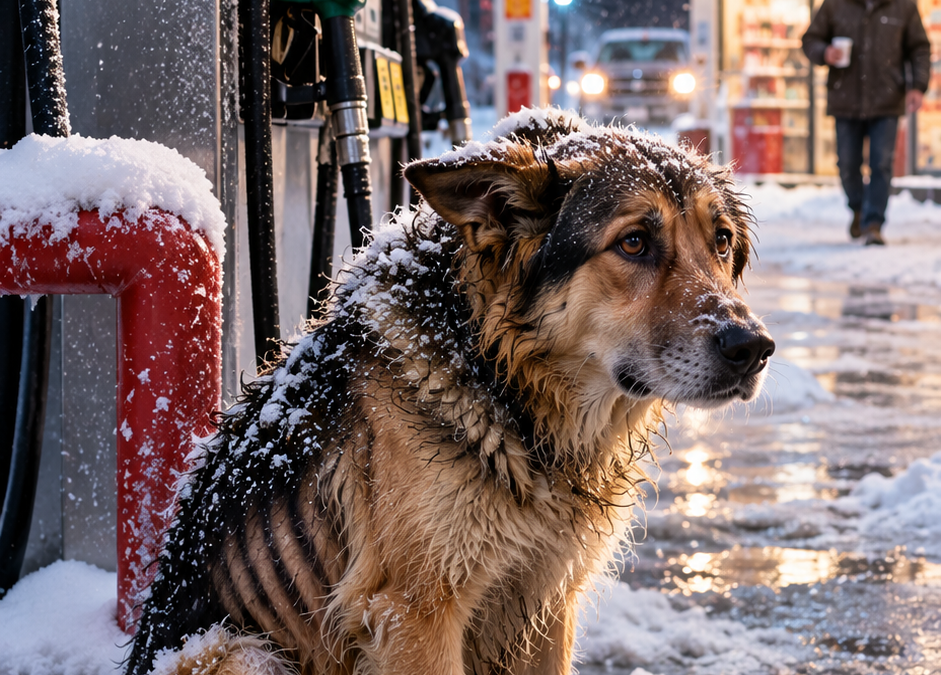
For seven straight mornings, the same dog was waiting beside pump number three when I opened my gas station.
Snow on his back.
Ice clinging to the fur around his paws.
Ribs visible beneath a dirty coat.
And every single day, he refused the food I offered him.
I thought he was stubborn.
I thought he was lost.
I thought he had chosen my station because it was warm, bright, and close to the road.
I never imagined that almost three miles away, hidden behind snow-covered brush, a man was dying inside a wrecked car.
And I certainly never imagined that the dog had spent an entire week trying to make me follow him there.
My name isn’t important.
For most of my adult life, people around town simply knew me as the man who ran the small twenty-four-hour gas station on the edge of the highway.
It wasn’t much to look at.
Four fuel pumps.
A narrow convenience store.
Two coffee machines, one of which worked when it felt generous.
A refrigerator full of sodas.
Shelves of chips, candy, motor oil, windshield fluid, and all the strange things people suddenly decide they need at two in the morning.
I had owned the place long enough to recognize most regulars by headlights.
Truck drivers.
Night-shift nurses.
Farmers starting early.
Teenagers pretending they weren’t buying energy drinks at midnight.
People traveling through who would never see me again.
I liked the predictability.
Every morning, I unlocked the front doors at 5:41.
Not 5:40.
Not 5:45.
5:41.
There was no important reason.
Years earlier, my father had told me that a man should have at least one habit precise enough to prove he still controlled something.
So 5:41 became mine.
That winter had been especially brutal.
Snow came early and never seemed to leave.
The temperature dropped low enough at night that the fuel hoses became stiff.
The parking lot developed permanent gray mountains where the plow pushed snow.
Most mornings, I arrived while the sky was still completely black.
I would turn on the pumps.
Start the coffee.
Check the registers.
Then stand for a minute beside the front window and watch the highway slowly wake up.
The first morning I saw the dog, I almost didn’t notice him.
He was sitting near pump three.
Not beneath the awning where he could have stayed relatively dry.
Beside it.
Out in the snow.
At first, I thought somebody had stopped for gas and let their dog out.
I looked around.
No vehicle.
No footprints I could see besides his.
I stepped outside.
Cold hit me immediately.
“Hey.”
The dog looked up.
He was some kind of shepherd mix.
Large enough that he should have looked intimidating.
He didn’t.
He looked exhausted.
His coat was dark brown and black, though mud and snow made it difficult to tell.
His ears were upright but uneven.
One had an old scar along the edge.
His body was too thin.
Far too thin.
He sat with one hind leg held strangely, as though an old injury made it uncomfortable to put his full weight down.
“Where’d you come from?”
He stared.
No collar.
No tag.
I walked closer.
He didn’t growl.
Didn’t retreat.
Didn’t wag either.
That was the first thing that felt strange.
Most friendly dogs give you something.
Tail.
Ears.
Movement.
This one simply watched me.
“You hungry?”
I went inside, found a package of sausage near its expiration date, and brought a piece outside.
The moment he smelled it, his nose moved.
So he was hungry.
I could see that.
I held it out.
“Come on.”
He stood.
Took two steps.
Then stopped.
His eyes moved past me toward the highway.
“Food.”
I held it closer.
“You’re skin and bones.”
He looked at the sausage again.
Then turned his head away.
I laughed.
“Seriously?”
He sat back down.
I left the sausage on the pavement a few feet away.
“Fine.”
“Your loss.”
A customer arrived.
Then another.
Work started.
By seven, I looked through the window.
The dog was gone.
The sausage remained.
I didn’t think much about it.
Strays move.
Maybe he had found somewhere warmer.
Then the next morning, at 5:41, I opened the station.
He was back.
Same place.
Pump three.
Sitting.
Waiting.
I stepped outside.
“You again.”
His ears lifted.
“Still too good for sausage?”
I tried dog food that day.
A customer had left an unopened can in the trash near the RV parking area.
The dog sniffed it.
Wouldn’t eat.
He drank some water I put down.
Not much.
Then he sat facing me.
“Do you want something?”
No movement.
I walked toward him.
He stood.
Took several steps away from the station.
Stopped.
Looked back.
I thought he was nervous.
“Okay.”
I stepped backward.
“Nobody’s chasing you.”
He remained there for a second.
Then walked away.
When I turned toward the store, I heard one short bark.
I looked back.
He was watching me.
“What?”
Another bark.
Then he walked toward the edge of the property.
Stopped.
Looked back again.
I shook my head.
“I’ve got work.”
He stood there a moment longer.
Then disappeared behind the snowbank.
That should have been enough for me to understand.
It wasn’t.
The third day was the same.
5:41.
Pump three.
Dog.
Snow.
He looked worse.
His coat was damp.
Ice had formed between his toes.
I brought him inside.
Or tried.
I opened the door.
“Come on.”
He stepped toward it.
Warm air spilled outside.
He could smell food.
Coffee.
Heat.
He placed one paw over the threshold.
Then backed away.
“What are you doing?”
He turned.
Walked toward the road.
Looked back.
I pointed inside.
“Warm.”
He stared.
I pointed toward him.
“Cold.”
Nothing.
“You’re terrible at negotiations.”
His tail didn’t move.
He walked another ten feet.
Looked back again.
There was something in his expression I didn’t understand then.
Urgency.
Not fear.
Not hunger.
Urgency.
I went back inside.
I had customers.
Deliveries.
Accounts.
A business does not stop because a stray dog has decided to become mysterious.
That afternoon, I asked around.
“You know that dog outside?”
One trucker shook his head.
A woman from town said she had seen him near the highway earlier in the week.
Another customer said, “Probably dumped.”
That made sense.
People dump animals near rural roads more often than I like to admit.
Maybe his owner had driven away.
Maybe pump three had become some random place where he decided to wait.
The thought irritated me.
Not at the dog.
At whoever had left him.
That night, he disappeared again.
Day four.
Back.
Day five.
Back.
Every morning, the same place.
Every morning, he refused food.
Every morning, he walked away a short distance and looked back.
On day five, I finally followed him twenty or thirty yards.
The instant I did, his entire behavior changed.
He moved faster.
Not running.
Leading.
Every few steps, he turned to make sure I was behind him.
I remember stopping beside the trash bins.
The dog continued.
Then looked back.
I laughed.
“Absolutely not.”
He froze.
I pointed toward the station.
“I have customers.”
His body seemed to collapse slightly.
That’s the only way I can describe it.
Like disappointment.
I walked back.
He didn’t follow.
By the time I looked outside again fifteen minutes later, he was gone.
That evening, I couldn’t stop thinking about the way he had looked at me.
My wife had been gone for years by then.
No children at home.
Most nights, I ate dinner alone in the apartment behind the station.
The dog occupied my thoughts more than I wanted.
Why didn’t he eat?
Why return every day?
Why only the morning?
Why leave at night?
I told myself there was some ordinary explanation.
Dogs develop habits.
Animals can become anxious.
Maybe he had pups somewhere.
Except he was male.
Maybe he belonged to a farm nearby.
But if he had a home, why was he so thin?
Day six arrived with heavy snow.
I expected he wouldn’t come.
At 5:41, I unlocked the station.
Pump three looked empty.
I felt relieved.
Then disappointed.
That surprised me.
I started the coffee.
Five minutes later, I saw movement.
The dog emerged from the falling snow.
Walking slowly.
One paw at a time.
He reached pump three.
Sat.
His entire body trembled.
I went outside immediately.
“Are you trying to die out here?”
He looked at me.
I took off my gloves.
Touched his neck carefully.
Freezing.
I brought out an old blanket.
He let me drape it across his back.
“You’re coming inside.”
I tried guiding him.
He resisted.
Not aggressively.
He simply planted his feet.
Then turned toward the far edge of the property.
Again.
Walked.
Stopped.
Looked back.
I stared at him.
“What is over there?”
He barked.
One sharp bark.
I almost followed.
Almost.
Then a delivery truck pulled into the station.
Fuel inventory.
Work.
Responsibility.
I pointed at the dog.
“Tomorrow.”
As if he understood calendars.
“I’ll figure you out tomorrow.”
He stood there in the snow.
I went inside.
That decision stayed with me later.
Because by then, James Wilson had already been trapped in the wreck for almost six days.
Six days.
While I poured coffee.
Sold fuel.
Complained about invoices.
Shoveled snow.
And watched the one creature trying to reach him sit ten yards from my front door.
Day seven.
I arrived early.
5:32.
Couldn’t sleep.
Snow had stopped sometime during the night.
The world looked pale and silent.
I pulled into the parking lot.
My headlights crossed pump three.
The dog was already there.
Not sitting.
Standing.
Waiting.
When I stepped from my truck, he immediately walked toward me.
That was new.
He came close enough that his nose touched my hand.
Then turned.
Started walking.
Looked back.
Something inside me finally changed.
Maybe it was guilt.
Maybe curiosity.
Maybe the accumulation of six mornings.
Maybe I simply had enough sense to realize the dog had been repeating the same message and I was the one failing to understand it.
“All right.”
I locked the truck.
“You win.”
His ears lifted.
“Show me.”
That was all I said.
Show me.
The dog moved.
Immediately.
Not toward the highway.
Behind the station.
Past the dumpsters.
I followed.
The cold pushed through my jacket.
Snow crunched beneath my boots.
The dog stayed ten or fifteen feet ahead.
Every few steps, he turned.
Checked.
Continued.
“Yeah.”
“I’m here.”
We passed the dumpsters.
He paused with his ears raised.
Listened.
Then moved again.
Behind the station was a narrow service alley.
I had walked it thousands of times.
Mostly to inspect drainage.
Clear trash.
Check the propane cage.
Beyond it were bushes and rough ground that belonged to nobody I knew.
I rarely looked farther.
The dog went straight toward the bushes.
Branches were heavy with snow.
He pushed through.
I stopped.
“You’ve got to be kidding.”
He looked back.
Then disappeared.
I sighed.
Followed.
Snow fell from branches down the back of my collar.
“Great.”
The dog moved deeper.
We emerged onto rough ground beyond the brush.
That was where I saw tire tracks.
Almost completely filled by snow.
Old.
Barely visible.
My stomach tightened.
“Wait.”
The dog continued.
The tracks angled down a shallow embankment.
Broken branches.
Something dark farther ahead.
At first, I thought it was another cluster of trees.
Then sunlight caught glass.
A windshield.
I stopped breathing.
A car.
Or what remained of one.
The front end had smashed directly into a large oak.
Hard enough to split bark from the trunk.
The hood was crushed.
Windshield shattered.
Driver’s door hanging partly open.
Snow covered the roof and hood so heavily that from the road or station side, the car disappeared into the landscape.
No wonder nobody had seen it.
The dog began running.
“Hey!”
He reached the driver’s side.
Jumped toward the broken window.
That’s when I saw the man.
Head tilted sideways.
Still wearing his seat belt.
Skin gray-blue.
Lips cracked.
One arm hanging at an unnatural angle.
For half a second, I thought he was dead.
Then the dog climbed through the broken window.
He shoved his nose under the man’s chin.
Licked his face.
Pushed against him.
The man’s eyelids moved.
I ran.
“Oh God.”
I leaned into the car.
“Sir?”
No response.
“Sir, can you hear me?”
His chest moved.
Barely.
I touched the side of his neck.
Pulse.
Weak.
The dog kept nudging him.
Then something extraordinary happened.
The man’s eyes opened.
Not fully.
Just enough.
He stared without recognition.
Then his gaze dropped toward the dog.
His lips moved.
No sound.
He tried again.
“Rex?”
The dog’s tail moved.
For the first time in seven days, I saw it.
Not a full wag.
A small trembling motion.
Then another.
Rex.
He had a name.
And the man knew him.
“Sir.”
I moved closer.
“My name doesn’t matter.”
“You’re near my station.”
“Help is coming.”
I hadn’t even called yet.
I grabbed my phone.
My fingers shook so badly I nearly dropped it.
The operator answered.
I gave the location.
Explained the wreck.
Adult male.
Trapped.
Conscious intermittently.
Severe cold exposure.
Possible fractures.
“Is he breathing?”
I looked.
Rex had placed his head across the man’s chest.
The rise and fall was barely visible.
“Yes.”
“Very weak.”
“Stay with him.”
“Ambulance and rescue units are being dispatched.”
“How far?”
“They’re en route.”
That phrase feels much longer when someone is dying beside you.
I put the phone on speaker.
The man looked at me.
“Rex…”
“He’s here.”
I pointed.
“He brought me.”
The man’s eyes filled with tears.
His lips moved again.
“He…”
His voice was barely sound.
“He kept…”
I leaned closer.
“What?”
“Kept coming back.”
I looked at Rex.
The dog licked his hand.
The man’s fingers moved weakly against his fur.
“Every time…”
He swallowed painfully.
“I fell asleep…”
“he pulled me.”
“Wouldn’t let…”
“me sleep.”
I understood.
Cold.
Hypothermia.
Injury.
Loss of consciousness.
Rex had been keeping him awake.
“How long have you been here?”
His eyes closed.
“Sir.”
I touched his shoulder.
“Stay with me.”
His eyes opened again.
“Days.”
“How many?”
No answer.
Rex barked once beside his ear.
The man’s eyes opened wider.
I almost laughed from shock.
“That’s right.”
I told him.
“Listen to your dog.”
“He apparently outranks both of us.”
The man’s mouth moved in something close to a smile.
I sat in the snow beside the car.
Cold soaked through my pants.
I didn’t care.
“What’s your name?”
“James.”
“James what?”
“Wilson.”
“Okay, James.”
“I’m going to keep talking.”
“You don’t need to answer everything.”
“Just stay awake.”
His eyes began closing.
“James.”
Rex growled softly.
Not at me.
At James.
The man’s eyes opened.
I stared at the dog.
“You’ve been doing that all week?”
Rex placed one paw against the driver’s seat.
James whispered:
“First night…”
“he stayed.”
“Second…”
I listened.
“Third morning…”
His voice faded.
“James.”
He forced another breath.
“He left.”
I looked at Rex.
“Then came back.”
“When?”
“Night.”
My stomach tightened.
Every morning at my station.
Every night disappearing.
I understood.
Rex had been walking from the wreck to the gas station.
Then back.
Again.
Again.
Again.
Trying to bring someone.
Trying to find help.
And every day, I had offered him food.
I felt sick.
“I’m sorry.”
I whispered.
James frowned faintly.
He probably thought I was talking to him.
I wasn’t.
I was talking to the dog.
Rex didn’t care.
He kept his head against James.
The ambulance took twelve minutes.
Twelve minutes can become a lifetime.
I talked constantly.
“James.”
“Tell me about Rex.”
His eyes opened.
“Good dog.”
“Clearly.”
“How long have you had him?”
“Years.”
His voice cracked.
“Farm.”
“You live nearby?”
“Three miles.”
There it was.
Nearly three miles.
I looked back through the trees toward a station I couldn’t see.
Rex had walked that distance every morning.
In snow.
With an injured leg.
Starving.
Then returned.
“Why didn’t anyone see the car?”
“Road…”
James whispered.
“Deer.”
“What?”
“Deer came out.”
“I turned.”
“Lost…”
His eyes closed.
“James.”
Rex barked.
He opened them.
“Good.”
I said.
“Keep doing that.”
“How did the car get this far from the road?”
“Slid down.”
“Bushes.”
“Snow.”
Made sense.
Hidden.
The driver couldn’t move.
No obvious visibility.
No phone within reach, maybe broken or lost in the crash.
I looked inside.
A phone lay shattered near the passenger floor.
Everything aligned.
“Rex stayed with you?”
James nodded faintly.
“Warm.”
“Kept me…”
“awake.”
Then he looked at the dog.
His eyes filled.
“He knew.”
I didn’t ask how.
Some moments don’t need analysis.
Sirens finally reached us.
Faint at first.
Then louder.
Red lights flashed through the trees.
“James.”
I leaned close.
“You hear that?”
His eyes moved.
“That’s for you.”
Rex lifted his head.
Rescue crews arrived carrying equipment.
Everything became movement.
Assessment.
Cervical precautions.
Cutting tools.
Thermal blankets.
Questions.
One medic crouched beside James.
Another looked at me.
“How long has he been here?”
“Possibly seven days.”
The medic stared.
“Seven?”
“That’s what it sounds like.”
He looked at Rex.
“Dog?”
“Dog found help.”
I said it without hesitation now.
They cut James free.
His leg had been trapped.
Arm fractured.
Severe dehydration.
Hypothermia.
Other injuries I didn’t understand.
As they moved him onto the stretcher, Rex climbed out.
Then followed.
One medic tried to block him.
“Easy, boy.”
Rex growled.
Deep.
Protective.
His lips pulled back slightly.
Not attacking.
Warning.
I stepped closer.
“Don’t separate them.”
“We can’t have a dog loose in the ambulance.”
“That dog kept him alive for a week.”
The medic looked at me.
Then at Rex.
Then toward James.
James’s eyes opened.
“Rex.”
One word.
That settled it.
The medic sighed.
“Fine.”
They lifted Rex inside.
He curled near James’s feet.
The doors closed.
The ambulance pulled away.
I stood alone in the snow.
Red lights faded through the trees.
My body started shaking.
Not only from cold.
I looked at the tracks Rex had made.
Dog prints.
Human boot prints.
The hidden wreck.
For six days, I had been within walking distance of a dying man.
And the only reason he was alive on day seven was because his dog refused to stop asking.
I walked back to the station slowly.
Everything looked different.
Pump three stood empty.
For the first time in a week.
I went inside.
The sausage I had once tried to give Rex was long gone.
But I could picture him there perfectly.
Sitting.
Watching.
Waiting.
I had thought he wanted food.
He wanted a follower.
That evening, a police officer came to take my statement.
He sat across from me at the small table near the coffee machine.
I explained everything.
First morning.
Second.
Third.
The refused food.
The walking away.
Looking back.
The seventh morning.
The wreck.
The officer wrote for a long time.
Then stopped.
“You know what’s strange?”
“What?”
“We tracked the route.”
“What route?”
“The dog’s.”
I stared.
“We found prints and likely paths.”
He took a drink of coffee.
“Your station is almost exactly three miles from the crash.”
I said nothing.
“He appears to have come here repeatedly.”
“How do you know?”
“Tracks at the scene.”
“Patterns.”
“People reported seeing a dog matching him near your station throughout the week.”
He looked at me.
“Looks like every morning he came here.”
“And every night?”
“Returned to the wreck.”
I stared toward the front window.
Pump three.
Seven mornings.
Seven nights.
Almost six miles round-trip.
Roughly forty miles over the week, depending on route.
In snow.
Hungry.
Injured.
The officer shook his head.
“I’ve seen loyal dogs.”
“But that’s something else.”
He was right.
Loyalty is staying.
Rex had done something harder.
He left.
He left the person he loved because staying alone wasn’t enough.
He somehow understood that love sometimes means walking away from someone long enough to bring back help.
That thought hit me harder than almost anything else.
I had always described loyalty as presence.
Don’t leave.
Stay beside people.
Rex taught me another version.
Sometimes staying is useless if the person beside you needs something you cannot provide.
Sometimes the bravest thing is to leave temporarily.
Search.
Risk.
Ask.
Return.
I called the hospital the next morning.
They couldn’t tell me much.
Eventually, through James’s permission and the officers involved, I learned he had survived the night.
Critical but stable.
The next day, still alive.
Then improving.
Rex stayed nearby as much as the hospital would allow.
When he couldn’t stay inside, one of the paramedics who had transported James temporarily cared for him.
A veterinarian treated the dog’s paws.
He had cuts.
Ice damage.
Old joint problems.
He was severely underweight.
Of course he was.
For seven days, he had refused my sausage because eating wasn’t his priority.
I cried when I heard that.
I don’t cry often.
Not because I consider it weakness.
I’m simply not built that way.
But imagining him smelling food every morning while starving, then turning away because James was still trapped—
that got me.
Weeks passed.
Snow began melting.
Life at the station returned to ordinary routines.
Except pump three never felt ordinary again.
Every morning at 5:41, I looked toward it.
Empty.
I should have been relieved.
Instead, I missed him.
Then one afternoon, a car pulled into the parking lot.
Not James’s wrecked vehicle, obviously.
A different car.
The driver stepped out slowly.
He walked with a limp.
Thinner than healthy.
But upright.
Alive.
Beside him jumped Rex.
The dog looked completely different.
Clean coat.
More weight.
Bright eyes.
Tail high.
I came out from behind the counter.
“James?”
He smiled.
“You remember me.”
“Hard to forget someone you find frozen inside a car.”
He laughed.
Then winced slightly.
Ribs still healing, maybe.
Rex saw me.
He ran.
Actually ran.
Across the store.
Straight into me.
I crouched.
“Hey.”
His tail became a weapon.
“Now you wag?”
He licked my face.
“Seven days you wouldn’t give me one.”
James laughed.
“He was busy.”
I stood.
James walked over.
Then took my hand in both of his.
His grip was weak.
The emotion behind it wasn’t.
“I don’t know how to thank you.”
“You don’t have to.”
“I do.”
“No.”
I looked at Rex.
“Thank him.”
James’s eyes immediately became wet.
“I do.”
“Every day.”
He put one hand on Rex’s head.
“He kept me alive.”
Then he told me the full story.
He had been driving at night.
A deer appeared.
He swerved.
The car left the road.
Down the embankment.
Through brush.
Into the oak.
His leg became pinned.
His arm broke.
Phone shattered.
Nobody on the road saw where he’d gone.
Snow began covering the vehicle.
Rex survived with relatively minor injury.
The first night, he stayed pressed against James.
Warmth.
Body heat.
James said every time he began drifting unconscious, Rex licked him.
Barked.
Pulled at his jacket.
Sometimes bit the fabric and tugged.
“He knew I shouldn’t sleep.”
James said.
“I don’t know how.”
“Maybe he could tell my breathing changed.”
“Maybe he was afraid.”
“But every time I was going under, he brought me back.”
The second day, Rex left briefly.
Returned.
The third morning, he went farther.
Much farther.
James had assumed the dog abandoned him.
“I was angry.”
James admitted.
“For maybe ten minutes.”
“Then I thought…”
He looked ashamed.
“I thought at least he’d survive.”
“At least one of us.”
That evening, Rex returned.
Covered in snow.
No help.
Fourth morning, left again.
Fourth night, back.
Every day.
Every night.
Until day seven.
“Why this station?”
I asked.
That question had been bothering me since the rescue.
“There are houses closer.”
“A roadside café east of here.”
“He could’ve gone toward town.”
“Why here?”
James smiled.
A strange smile.
Warm.
Almost amused.
“You don’t remember.”
“Remember what?”
“Years ago.”
“Rex was a puppy.”
I frowned.
“How many years?”
“Five or six.”
“We stopped here one night.”
“Summer.”
“Very hot.”
I searched my memory.
Nothing.
James continued.
“Rex was maybe four months old.”
“We’d been driving too long.”
“I stopped for fuel.”
“He was thirsty.”
“I didn’t have enough water in the car.”
“And your outside tap wasn’t working.”
I stared.
“You came out.”
“You saw him.”
“You didn’t ask anything.”
“You brought a metal bowl of water.”
“And half a piece of bread.”
A memory flickered.
Not clearly.
A puppy near a truck.
Hot night.
Maybe.
I had helped countless travelers.
Water for dogs.
Phone charger.
Jump-starts.
Bandages.
Coffee.
Directions.
Small things.
“I barely remember.”
“I know.”
James looked down at Rex.
“But he did.”
I laughed softly.
“You’re telling me he remembered my gas station from when he was a puppy?”
James shrugged.
“I can’t prove it.”
“But it’s the only explanation I have.”
He scratched behind Rex’s ear.
“You gave him water.”
“He remembered this place as somewhere safe.”
I looked at the dog.
Rex looked back.
The thought unsettled me in the best possible way.
A bowl of water.
A piece of bread.
Something I had done without thought.
Forgotten completely.
Years later, when the most important creature in Rex’s world was dying, he came back.
To me.
Not because I was special.
Because once, for one small moment, I had been kind.
I sat down.
James did too.
For several minutes, neither of us spoke.
Then I said:
“That’s terrifying.”
He laughed.
“What?”
“That something I don’t even remember mattered that much.”
James nodded.
“Maybe that’s how most kindness works.”
“You don’t know what people keep.”
Or dogs.
From then on, James and Rex became regulars.
Every morning?
Not literally at first.
James still had recovery.
Physical therapy.
Appointments.
But once he could drive regularly, they started coming by.
5:41 became 6:15 for them.
Then sometimes 5:50.
Eventually James joked that Rex had an internal clock.
The first place Rex went was pump three.
Always.
He would sit beside it.
Not the desperate way he had during those seven days.
Now he sat comfortably.
Tail moving.
Watching the door.
I started keeping sausage for him.
Good sausage.
Not expired scraps.
The first morning I offered it after the rescue, I expected him to refuse.
He sniffed.
Looked at James.
Looked at me.
Then ate the entire piece in two bites.
I laughed so hard James nearly spilled his coffee.
“Oh, now you’ll eat.”
Rex wagged.
“Unbelievable.”
James said, “Mission accomplished.”
That phrase became our joke.
Sausage meant mission accomplished.
On difficult mornings, I’d look at Rex eating and think:
This is what safety looks like.
Hunger allowed.
Rest allowed.
Pleasure allowed.
When danger is over, the body can finally want ordinary things again.
Years passed.
The story spread around town.
Customers asked:
“Is that him?”
“That the dog?”
Some wanted photos.
Some brought treats.
Rex accepted fame better than most people I know.
No false modesty.
If someone offered chicken, he understood celebrity immediately.
I painted a sign one night after closing.
I’m not an artist.
The lettering was uneven.
James complained.
I told him to paint his own.
The sign said:
REX’S PLACE
THE MOST LOYAL FRIEND I’VE EVER MET
I mounted it beside pump three.
James saw it the next morning.
He stood reading for a long time.
Then looked at me.
“You know he’s going to become impossible now.”
“He already is.”
Rex sat beneath the sign.
Tail moving.
Customers started calling it Rex’s pump.
I didn’t mind.
One morning, a woman traveling alone stopped with two children.
Her youngest noticed Rex.
“Why does the dog have his own gas pump?”
The mother laughed.
I told them a shorter version.
Dog.
Crash.
Seven days.
Help.
The little boy looked at Rex.
“Wasn’t he scared?”
Probably.
That question stayed with me.
Adults always asked:
How did he know?
Why didn’t he eat?
How far did he walk?
Kids asked:
Was he scared?
I crouched beside Rex.
“I think he was.”
The boy frowned.
“Then why did he go?”
Before I could answer, James said:
“Because I needed him to.”
The child accepted that immediately.
Adults might call it loyalty.
Courage.
Instinct.
Attachment behavior.
Children understand something simpler.
Someone needed him.
So he went.
James and I became friends.
Real friends.
Not customer and shopkeeper.
He lived alone on a small farm outside town.
His wife had died years before the crash.
No children nearby.
Rex had become his family.
After surviving the accident, James changed.
He admitted it openly.
“I used to put things off.”
“What things?”
“Everything.”
“Doctor visits.”
“Calling my sister.”
“Fixing the porch.”
“Seeing people.”
He sipped coffee.
“After you spend a week wondering whether you’re going to die in a frozen car, postponing things starts to feel stupid.”
“Useful revelation.”
“Expensive method.”
“Very.”
He laughed.
Rex slept near his boots.
James looked down.
“Especially him.”
“What about him?”
“I assumed we’d have years.”
“You probably do.”
“Probably isn’t guaranteed.”
No.
It isn’t.
Dogs teach that whether we want them to or not.
Their lives move faster than ours.
You can watch time happen in their faces.
Black fur becomes gray.
Running becomes walking.
Stairs become difficult.
Years later, Rex began slowing down.
His bad hind leg worsened.
Winter bothered him.
The distance from James’s car to the store became slower.
I started taking sausage outside.
The first time, James protested.
“Don’t spoil him.”
I looked at Rex.
“Man walked forty miles in a week to save you.”
“He’s entitled to curbside service.”
James conceded.
Rex ate.
Slowly now.
That was another change.
Young Rex would have swallowed sausage instantly.
Old Rex took his time.
Chewed.
Looked around.
Enjoyed.
Maybe animals know something about aging we don’t.
One winter morning, snow fell almost exactly like it had the week of the crash.
I opened at 5:41.
For a second, pump three looked exactly as it did years earlier.
White ground.
Dark sky.
Station lights.
I saw Rex sitting there.
My heart stopped.
Then I realized James’s truck was parked nearby.
He had arrived early.
I opened the door.
“What are you doing here?”
James stood beside Rex holding two coffees.
“Anniversary.”
I knew immediately.
The rescue date.
I hadn’t realized.
James handed me a cup.
“Thought we should be here.”
Rex sat beneath his sign.
Snow landed on his head.
I brushed it away.
“No seven-day wait this time.”
Tail wag.
James looked toward the bushes.
“Sometimes I still dream about the car.”
I nodded.
“Me too.”
“You?”
“I didn’t spend a week in it.”
“No.”
“But I keep dreaming I don’t follow him.”
James became quiet.
“What happens?”
“I wake up before I find out.”
“Probably for the best.”
We stood in silence.
Then James said:
“You did follow.”
“I know.”
“That’s the only version that happened.”
That sentence helped me more than he knew.
Because guilt had remained in me too.
Why didn’t I follow on day one?
Day two?
Day five?
What if James had died on day six?
Rex had told me.
I hadn’t understood.
For years, I carried that.
James refused to let me.
“You didn’t know.”
“He was trying.”
“Yes.”
“I ignored him.”
“You fed him.”
“He wouldn’t eat.”
“Exactly.”
James smiled.
“Eventually you listened.”
Eventually.
Sometimes eventually is enough.
Sometimes it isn’t.
That difference has made me more attentive.
Not paranoid.
Attentive.
A customer acting strangely.
An animal behaving unusually.
A car parked too long.
Someone sleeping in the lot during dangerous heat or cold.
I check.
Most times, nothing.
Once, a driver was having a diabetic episode.
Another time, an elderly woman had become confused and driven eighty miles in the wrong direction.
Maybe I would have checked before Rex.
Maybe not.
What I know is that after Rex, I stopped assuming strange behavior was none of my business.
Kindness doesn’t require solving every problem.
Often it just means noticing.
That was the first gift I gave Rex without remembering.
Water.
Bread.
Noticing.
Years later, he returned the favor by making me notice harder.
When people tell this story, they usually make Rex the hero.
They’re right.
But sometimes they try to make me one too.
I reject that.
I did one important thing.
I followed.
That’s all.
No courage compared with what Rex did.
No seven-day march.
No freezing nights beside an injured man.
No returning after failed attempts.
I followed a dog for several hundred yards and made a phone call.
Still, I’ve learned not to dismiss small roles.
Maybe rescues often work that way.
One person notices.
Another acts.
Another treats.
Nobody has to be the entire miracle.
You only have to do your part before the chain breaks.
Rex’s part was impossible to miss.
Mine was smaller.
But if I’d refused, his work might have failed.
That thought changed how I think about responsibility.
You don’t always choose when someone else’s survival touches your day.
You may simply be making coffee.
Unlocking a door.
Driving home.
Then something appears.
A person.
A dog.
A strange sound.
A problem.
You can keep walking.
Often, that’s understandable.
Or you can ask:
What if this matters?
Rex mattered.
James mattered.
That morning mattered.
A few years after the crash, James asked me something over coffee.
“If I hadn’t survived, what would you have done with Rex?”
I hated the question.
“Why would you ask that?”
“Curious.”
“I don’t know.”
“Yes, you do.”
I looked down.
Rex was asleep beside my chair.
“I would’ve kept him.”
James smiled.
“Knew it.”
“Don’t look pleased.”
“Very pleased.”
“You alive is the better arrangement.”
“Obviously.”
Rex opened one eye.
James said:
“You hear that?”
“Backup plan.”
Rex closed his eye again.
That became another joke.
But eventually jokes about mortality stop being theoretical.
James aged.
So did Rex.
So did I.
One morning, James came without him.
The passenger seat was empty.
I knew immediately.
“What happened?”
James looked exhausted.
“Vet.”
My stomach dropped.
“He’s alive.”
He said quickly.
“But he had a bad night.”
Joint pain.
Fever.
Some infection.
Nothing catastrophic.
Not yet.
Still, the empty space beside pump three felt wrong.
For three days, Rex didn’t come.
On the fourth, James pulled in.
Passenger door opened.
Rex climbed out slowly.
I went outside with sausage.
“Welcome back.”
His tail moved.
He ate half.
Left the rest.
That scared me more than I admitted.
James looked at the uneaten sausage.
“So.”
“Don’t.”
I said.
“Okay.”
Some conversations do not need to happen before they have to.
Rex recovered.
For a while.
Then time resumed doing what time does.
His muzzle went white.
His hearing faded.
One eye clouded slightly.
He still recognized the station.
Still knew pump three.
Still knew me.
That was enough.
On what turned out to be one of his last visits, Rex walked from James’s truck to pump three.
Sat.
Looked at the sign.
Then at me.
I brought sausage.
He sniffed.
Didn’t eat.
My heart sank.
Then he took it gently from my hand.
Chewed.
Slow.
Tail moved.
I sat on the concrete beside him.
James stood nearby.
“You’ll freeze.”
He told me.
“I’ve survived worse.”
“No, you haven’t.”
“Fair.”
I put one hand on Rex’s shoulder.
His fur was warm despite the cold air.
“You gave me a lot of trouble.”
He leaned against me.
“Seven days of it.”
Tail moved.
“I should’ve followed sooner.”
James said, “He doesn’t care.”
“I know.”
Rex turned his head.
Looked at me.
I remembered the first week.
The stare.
The urgency.
The way I misunderstood everything.
Now his eyes were calm.
Mission accomplished.
Eventually, Rex died at home beside James.
James called me early.
Before 5:41.
I saw his name and knew.
“He’s gone.”
No greeting.
No explanation.
I sat on the edge of my bed.
“I’m sorry.”
“He waited until I woke up.”
Of course he did.
James’s voice broke.
“I had my hand on him.”
“Good.”
“He wasn’t alone.”
“No.”
That mattered.
Maybe more than anything.
For years, Rex’s whole story had been about refusing to let James die alone.
In the end, James returned the favor.
The station opened late that morning.
5:58.
First time in years I missed 5:41 without weather or emergency forcing me.
I didn’t care.
I stood beside pump three.
Snow had fallen lightly overnight.
The sign remained.
REX’S PLACE
THE MOST LOYAL FRIEND I’VE EVER MET
I touched the wood.
Then cried.
Not dramatically.
Just enough.
James buried Rex on the farm beneath a maple tree near the porch.
I attended.
Only a few people.
The veterinarian.
Two neighbors.
Me.
James.
Someone asked whether we should say something.
James couldn’t.
So I did.
I hadn’t prepared.
I said:
“People call loyalty staying.”
Then I stopped.
Looked at James.
“But Rex taught me loyalty can also mean leaving.”
Everyone stared.
“He left James when James needed him most.”
“He walked away.”
“Not because he loved him less.”
“Because loving him meant finding what he couldn’t provide himself.”
“Help.”
I swallowed.
“Then Rex came back.”
“Again and again.”
“Until somebody finally understood.”
James covered his face.
I finished quickly.
“He spent his life returning.”
“That’s what I’ll remember.”
We stood there in the cold.
Afterward, James handed me Rex’s old collar.
I tried to refuse.
“No.”
“He was yours.”
James shook his head.
“Keep it at the station.”
“Why?”
“He chose that place too.”
So I did.
Rex’s collar now hangs inside the store beside the old photograph someone took after James’s recovery.
Rex by pump three.
James beside him.
Me in the doorway.
Three beings connected by a story none of us planned.
Years later, James still comes for coffee.
Not every morning now.
We’re both slower.
He sits in the same chair.
Sometimes we talk.
Sometimes read.
Sometimes watch snow.
The station has changed.
New pumps.
Updated registers.
Better coffee machine.
Pump three is still pump three.
I insisted on that.
Someone from the equipment company said numbering could change after renovation.
I said no.
He asked why.
I pointed at the sign.
He stopped asking.
Customers still notice it.
Some know the story.
Some don’t.
A child will occasionally ask:
“Who’s Rex?”
If I have time, I tell them.
A dog.
A crash.
Seven days.
Three miles.
A man alive because someone refused to give up.
I always include the bowl of water.
That detail matters more to me as I get older.
I had forgotten it completely.
Rex hadn’t.
People talk about kindness as if the value exists only in the moment.
You help.
The moment passes.
Done.
Maybe not.
Maybe kindness stores itself somewhere you cannot see.
In memory.
In trust.
In a person’s decision years later.
In a dog who remembers one safe place when the entire world becomes dangerous.
That scares me and comforts me.
Because it means the smallest things may outlive our awareness of them.
A bowl of water.
Bread.
Holding a door.
Checking on a neighbor.
Following something you don’t fully understand.
We rarely know which actions matter most while we’re performing them.
If we knew, kindness would be easy.
The challenge is doing it when it feels ordinary.
When nobody applauds.
When no story will be written.
I gave a thirsty puppy water because he looked thirsty.
No heroism.
No sacrifice.
Years later, that puppy walked through snow to find me because somewhere inside him, my station meant safety.
I still have difficulty accepting that.
James once told me:
“Maybe Rex didn’t remember you personally.”
“Maybe he remembered smell.”
“The building.”
“The location.”
“The feeling.”
I said:
“Isn’t that remembering?”
He laughed.
“Fair.”
Maybe that’s how all of us remember kindness anyway.
Not the exact words.
Not the date.
The feeling.
Safe here.
Someone helped me here.
Go back.
Today, when I unlock the doors at 5:41, I still look toward pump three.
Habit.
There is no dog sitting there anymore.
Some mornings, snow settles on the concrete exactly as it did that week.
For half a second, I can almost see him.
Thin.
Wet.
Waiting.
I don’t imagine ghosts.
I don’t believe Rex is literally there.
Memory doesn’t need supernatural help to be powerful.
I simply remember.
How close I came to missing what he was asking.
How many times he looked back.
How patient he was with my stupidity.
How determined.
Then I start the coffee.
James arrives sometimes.
We sit.
And when snow falls outside, one of us eventually says his name.
Rex.
Always enough to make the other smile.
I’ve spent years running a gas station where people come because they are going somewhere else.
Nobody stays long.
That’s the nature of the place.
Fuel.
Coffee.
Bathroom.
Back on the road.
Rex made the station feel different.
For one week, he turned it into a place of waiting.
Then into a place of rescue.
Then into a place he chose to return to even after he no longer needed help.
I think that’s why I never sold the business when I had the chance.
Someone once offered a decent price.
I considered retiring.
Then imagined another person repainting the sign.
Removing Rex’s place.
Changing pump numbers.
Ridiculous reason to reject a business offer?
Maybe.
I don’t care.
Some places become more than property.
They become evidence that something important happened.
Pump three is mine.
And his.
James jokes that Rex owns it permanently.
He’s right.
There are people who hear this story and focus on the impossible parts.
“How did Rex know to go for help?”
“How did he know the station?”
“Why did he refuse food?”
“How could he navigate three miles through snow?”
I can’t answer all of that.
Neither can James.
Maybe experts could explain some of it.
Scent.
Spatial memory.
Attachment.
Routine.
Survival instinct.
That’s fine.
Explanation does not make an act less extraordinary.
Knowing why birds migrate doesn’t make migration ordinary when you truly think about what it requires.
Knowing dogs have excellent smell doesn’t make seven days of persistence less remarkable.
Rex was a dog.
That is enough.
He didn’t have to be magical.
He was loyal.
Observant.
Determined.
He understood something we humans often take too long to understand.
If the person you love cannot save themselves, asking for help is not betrayal.
Leaving temporarily is not abandonment when your intention is to return.
That lesson changed James.
It changed me too.
I had always been the kind of man who handled things alone.
Business trouble?
Handle it.
Grief?
Handle it.
Loneliness?
Handle it.
Rex made me question that.
Because even he knew there are problems loyalty alone cannot solve.
He could keep James warm.
Wake him.
Stay beside him.
But Rex could not cut a seat belt.
Treat hypothermia.
Call an ambulance.
So eventually, he did the smartest thing possible.
He found someone else.
That is not weakness.
It is intelligence.
It is courage.
Sometimes love says:
I can’t do this alone.
Come with me.
That’s what Rex had been saying every morning.
Come with me.
I just didn’t speak his language yet.
He kept asking until I learned.
I think about that whenever someone tells me they don’t want to bother anyone.
When James refuses a ride to a doctor’s appointment.
When an old customer says he is fine but clearly isn’t.
When I catch myself struggling with something and thinking I should handle it.
I remember Rex.
If a dog can ask for help, so can I.
Funny lesson from a gas station.
But the best ones rarely come where you expect.
Years ago, I thought a good life meant self-sufficiency.
Work hard.
Pay your bills.
Don’t burden people.
Take care of yourself.
I still value all of that.
But self-sufficiency has limits.
Nobody survives entirely alone.
Even James, trapped in that car, had Rex.
Even Rex needed me.
I needed paramedics.
Paramedics needed hospitals.
Recovery needed doctors.
Later James needed neighbors.
I needed the story to remind me what kindness meant.
We were all links.
No single hero saved everything.
Rex simply refused to let the chain end with him.
Sometimes I wonder what he experienced during those journeys.
Morning.
Leaving James behind.
Walking through snow.
Was he afraid James would be dead when he returned?
Could dogs imagine that future?
I don’t know.
Did he hesitate at the station after I failed to follow him?
Did he think I was hopeless?
Probably.
Did he consider another place?
Maybe.
What I know is that he returned anyway.
Morning after morning.
He gave me multiple chances to become useful.
That may be my favorite part of the story now.
Rex did not give up on James.
But he also did not give up on me.
Even though I kept failing to understand.
That’s a form of grace.
One day, long after Rex died, James and I sat near the front window while snow fell.
He said:
“Do you know what I remember most?”
“The crash?”
“No.”
“The cold?”
“No.”
“Rex?”
“Obviously.”
He smiled.
“But one specific thing.”
“What?”
“The moment you leaned into the car.”
I didn’t remember anything special.
“You said help was coming.”
“Standard line.”
“Not to me.”
James stared into his coffee.
“I’d been alone almost a week.”
“Rex was there.”
“But no human voice.”
“No guarantee anyone knew.”
“Then you appeared and said help was coming.”
He swallowed.
“I believed you because Rex was standing beside you.”
I sat quietly.
James continued.
“Funny.”
“He had been trying to tell me the same thing all week.”
“What?”
“Don’t quit.”
“Someone’s coming.”
I looked out toward pump three.
“Eventually.”
James smiled.
“Eventually.”
That’s why I still open at 5:41.
I know the habit is ridiculous.
I could open at six.
Hire someone else.
Retire.
But there is something about entering that station before sunrise that keeps me connected to that morning.
The quiet.
Snow sometimes.
The pumps.
The front lights coming on one by one.
I walk to the window.
Look at Rex’s place.
And remember this:
Somewhere in the world, someone is always waiting for another person to notice.
Not necessarily dramatically.
Maybe they need food.
Maybe a phone call.
Maybe a ride.
Maybe a question.
Maybe someone to follow when they keep looking back.
We cannot respond to everything.
No one can.
But we can become harder to ignore.
More attentive.
Less certain that inconvenience is meaningless.
Seven mornings, I saw a dog.
On the seventh, I finally saw a message.
There is a difference.
That difference saved James Wilson’s life.
If you ask James, he will tell you Rex saved him.
If you ask me, I agree.
If you ask what I did, I’ll tell you the truth.
I finally paid attention.
Sometimes that’s where rescue begins.
Not with expertise.
Not bravery.
Just attention.
A strange dog at the edge of a parking lot.
A repeated behavior.
A feeling that something does not fit.
Then one decision:
Show me.
I wish I had said it on day one.
But life rarely gives us the wisdom of the ending at the beginning.
All we can do is use the lesson next time.
So now I look twice.
I listen longer.
When something keeps returning, I ask why.
And every snowy morning, when the station lights fall across pump three, I remember a half-frozen dog who once sat there refusing sausage because three miles away, the only person he loved was still waiting.
Rex had every reason to stay beside James.
Instead, he walked away.
He had every reason to eat.
Instead, he kept searching.
He had every reason to give up on me after I failed to follow.
Instead, he came back the next morning.
Again.
Again.
Again.
Until I understood.
That is the kind of loyalty I had never known how to name before him.
Not blind attachment.
Purpose.
The courage to leave when leaving is necessary.
The determination to return.
And the faith that somewhere, eventually, somebody will listen.
Rex found that somebody at a little gas station beside an empty winter highway.
It took me seven days to become the person he needed.
But on the seventh morning, I followed.
And because I did, James came home.
Rex came home.
And pump number three has never been just a gas pump again.





