𝗙𝗨𝗟𝗟 𝗦𝗧𝗢𝗥𝗬 Every Afternoon at 3:47, I Pulled My Dying Dog Back to the School Gate Where Our Story Had Begun Eleven Years Earlier
𝗙𝗨𝗟𝗟 𝗦𝗧𝗢𝗥𝗬
She looked down at the puppy, who had buried his face beneath my jacket.
Then back at me.
“Of course not.”
That afternoon, I bought food.
A blanket.
Bowls.
A collar he was too small to wear properly.
And a ridiculous little bed he refused to sleep in.
He slept on my chest instead.
I named him Barley.
There wasn’t a profound reason.
I’d heard the name somewhere, said it out loud, and one of his ears moved.
“Barley?”
Ear movement.
“That’s apparently legally binding.”
Barley grew fast.
Unfortunately, his judgment did not.
He chewed everything.
Chair legs.
The corner of the couch.
My television remote.
A pair of brand-new shoes.
Three separate dish towels.
And the wooden handle of the broom I used in the kitchen.
I found him one afternoon sitting beside the destroyed broom handle looking extremely satisfied.
“Do you understand,” I asked him, “that I make a living cleaning things?”
Tail wag.
“That was a professional tool.”
More wagging.
I bought another broom handle.
That became our relationship.
Barley caused a problem.
I pretended to be angry.
He looked at me.
I fixed the problem.
For years, it was just the two of us.
I never married.
That wasn’t a tragedy.
Life simply went another direction.
Friends came and went.
Family lived in other states.
The school gave structure to my days.
Barley gave structure to everything else.
Every morning, he waited by the door.
Every evening, he knew roughly when I would come home.
On weekends, we walked through the park.
During thunderstorms, all of his courage disappeared.
The same dog who once barked at a delivery truck like he intended to arrest the driver would hear thunder and crawl under my bed.
“You are humiliating yourself.”
He didn’t care.
I would sit on the floor beside the bed until the storm passed.
Then one night, Barley repaid every piece of furniture he’d ever destroyed.
I had worked late at the school.
By the time I got home, I was exhausted.
I ate something.
Watched half an hour of television.
Then fell asleep without checking the garage door.
I had left it partly open.
Sometime after midnight, Barley began barking.
I ignored him.
He barked again.
And again.
“Barley.”
More barking.
I pulled the blanket over my head.
“Enough.”
He didn’t stop.
By three in the morning, I was furious.
I got out of bed, turned on the hallway light, and marched toward the garage.
“What is wrong with you?”
He was standing at the top of the basement stairs.
Not the garage.
The basement.
His body was rigid.
He barked again.
Then I smelled it.
Smoke.
My anger disappeared instantly.
The smoke detector near the basement door was silent.
I looked up.
The little red indicator light wasn’t blinking.
Dead battery.
I opened the basement door.
Smoke rolled upward.
An old electrical wire I’d been meaning to replace had shorted near a storage area.
Boxes of books and old Christmas decorations were already beginning to smolder.
The situation could have become catastrophic within minutes.
I shut down the power.
Called the fire department.
Opened windows where I safely could.
We caught it before flames spread through the house.
Later, a firefighter told me that if I’d slept another twenty or thirty minutes, the story might have been different.
That night, sitting outside wrapped in a blanket while emergency lights flashed across my yard, Barley leaned against my leg.
I rubbed his head.
“Good dog.”
He looked up.
“Very good dog.”
That was all I ever said about it.
A neighbor asked me a few days later what had happened.
“Barley woke me.”
“He saved you.”
“Yeah.”
“You must feel lucky.”
I looked at the dog.
“He’s a good dog.”
Then I changed the subject.
Some things feel too important to explain.
Years passed.
Children graduated.
Teachers retired.
Principals changed.
Barley grew gray around the muzzle.
So did I.
Eventually, I retired from the school.
That was harder than I expected.
When you spend thirty years waking before sunrise because hundreds of people depend on you to open a building, retirement feels unnatural.
The first Monday morning after I left, I woke at five.
Got dressed.
Put on my shoes.
Then remembered I had nowhere to go.
Barley watched from his bed.
“You could’ve reminded me.”
His tail moved.
We went to the park instead.
That’s how retirement began.
Slow mornings.
Longer walks.
Coffee on the back porch.
I told Barley stories about former students.
Sometimes I saw them around town.
Daniel, who once got his head stuck between two playground rails, went off to college.
Sarah, who gave me a piece of candy every morning despite my protests, became a dentist.
When I told Barley that, I said,
“There’s irony for you.”
He looked unimpressed.
Then, when Barley was thirteen, everything changed.
It happened quickly.
One morning, he tried to stand and couldn’t.
His back legs collapsed beneath him.
I thought he’d slipped.
Helped him up.
He tried again.
Same thing.
The veterinarian examined him.
Tests.
Questions.
Long silence.
Then she sat across from me.
“He had a spinal event.”
“A stroke?”
“Something similar.”
“Will he walk again?”
Her expression answered before she did.
“His hind legs have very limited function.”
I stared at Barley.
He was lying on the examination blanket.
Alert.
Watching us.
“What do we do?”
“There are mobility carts.”
I looked at her.
“What?”
“A wheelchair for dogs. His front legs are still strong.”
“Then we’ll get one.”
“Frank.”
“We’ll get one.”
“He’s thirteen.”
“I know how old he is.”
“He has had a very good life.”
I hated the direction of the conversation.
“You said there’s a cart.”
“Yes.”
“Then we’ll get the cart.”
She sighed gently.
“You should also prepare yourself.”
I didn’t hear the rest.
Not because she stopped talking.
Because I had already taken the one sentence I needed.
There was a cart.
The next morning, I was awake at five.
Old habits.
I sat at the kitchen table with coffee.
Barley lay nearby.
I looked at him.
“You saved me once.”
His ears moved.
“I’m not letting two bad legs end the discussion.”
I went shopping.
The salesman at the pet mobility store showed me several options.
I chose the lightest model.
Strong enough to support Barley’s hindquarters without making his front legs work harder than necessary.
I pushed it through the aisle.
The salesman watched.
“Testing it?”
“Thinking.”
“About?”
“Whether he’ll hate it.”
“Most dogs adapt.”
“He has opinions.”
The man smiled.
“Most dogs do.”
Barley hated it.
For approximately six minutes.
The first time I secured him into the cart, he stood there looking at me like I’d betrayed every principle our friendship had ever been built on.
“Try.”
Nothing.
“Come on.”
He turned his head away.
I pulled a small piece of cheese from my pocket.
His eyes returned.
“You remember our original arrangement.”
He took one step.
The wheels moved.
He stopped.
Another step.
Then another.
Within fifteen minutes, he was rolling down the driveway.
His nose lifted toward the sun.
And for the first time since the stroke, I saw the old Barley.
Two weeks later, he tried to chase a squirrel.
The squirrel won easily.
Barley didn’t seem embarrassed.
For almost two years, we kept going.
His front legs grew stronger.
I learned how to adjust the straps.
How to check for pressure spots.
How far was too far.
We went to the park.
Walked around the block.
Sometimes back toward the school.
People stared occasionally.
Children asked questions.
“Why does your dog have wheels?”
“Because his legs retired before he did.”
They usually accepted that.
Barley did too.
At home, I carried him when necessary.
I lifted him into the bath.
Cleaned him.
Moved his bed.
Aging reduces dignity if you let it.
I tried never to let it.
Then one morning, Barley didn’t eat.
That worried me more than the stroke had.
Barley had always eaten.
Everything.
Food.
Things that weren’t food.
Items that vaguely resembled food if you were extremely irresponsible.
I filled his bowl.
He sniffed it.
Turned away.
“Not hungry?”
Nothing.
The next day, same thing.
He drank water.
But no food.
Third day.
Nothing.
He stopped wagging when I entered the room.
Didn’t bark when someone rang the doorbell.
He simply lay in his bed.
Eyes open.
Watching me.
The vet examined him again.
This time, she didn’t have to tell me much.
I already knew.
His body was tired.
Not a temporary tired.
The kind you recognize even if you’ve spent your whole life pretending you wouldn’t.
That afternoon, I sat in my backyard.
No radio.
No coffee.
No newspaper.
Just me.
I watched clouds move.
For nearly an hour, I said nothing.
I remembered thirty years at the school.
Thousands of children.
Morning bells.
Winter coats.
Lost backpacks.
Skinned knees.
Then I remembered Barley as a puppy beside the dumpster.
His teeth around my broom handle.
His body pressed beneath my bed during thunderstorms.
The smoke.
The basement.
His wheels.
The way he still lifted his face toward sunlight even when half his body no longer worked.
I went inside.
Barley looked at me.
His eyes were tired.
There was no panic in them.
No fear.
I don’t know whether animals understand death.
I’m not going to pretend I know things nobody can know.
But I understood his expression.
It said:
I’m tired.
And maybe:
Are you going to be okay?
I sat beside him.
“I don’t know.”
He blinked.
“But you don’t have to worry about me.”
That night, I made a decision.
I wasn’t going to hide Barley in a back room while he faded.
I wasn’t going to let his final days become only medicine, blankets, bowls, and waiting for something terrible.
There was one place that belonged to both of us.
The school.
The sidewalk near the gate.
The place where our story had started.
So the next afternoon, at 3:47, I took Barley back.
Why 3:47?
That was the time the last dismissal wave usually cleared when I worked there.
For decades, 3:47 had meant the end of the school day.
Doors opening.
Children shouting.
Buses pulling away.
Parents calling names from cars.
The building releasing all its noise into the world.
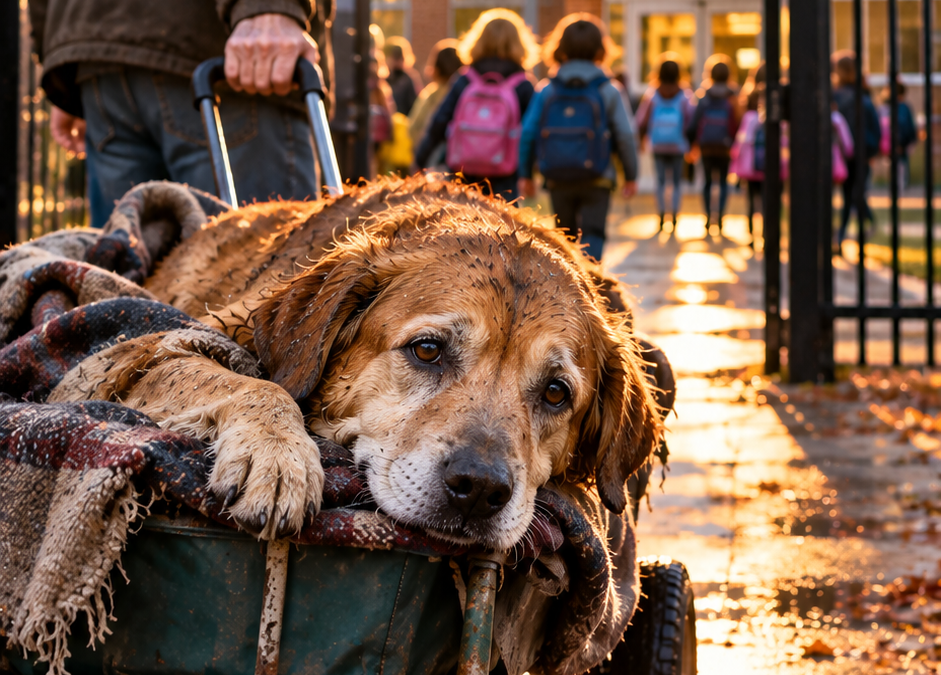
I put Barley into a small wagon rather than his mobility cart.
By then, he tired too easily to push himself for three blocks.
I lined the wagon with blankets.
Lifted him carefully inside.
“Field trip.”
One ear moved.
We left the house.
Three blocks.
Same neighborhood.
Same old trees.
I pulled slowly.
At the school gate, I stopped.
Children were streaming out.
Some stared.
A few recognized me.
“Mr. Frank!”
I waved.
I lifted Barley from the wagon and settled him on his blanket near the fence.
His nose moved.
He smelled the air.
Children.
Leaves.
Pavement warmed by afternoon sun.
Maybe other things only dogs notice.
I scratched behind his ear.
“You remember this place?”
His eyes moved toward me.
“Don’t lie. You tried to bite me right over there.”
His tail gave the faintest movement.
I smiled.
“That’s more like it.”
We sat.
Ten minutes.
Then twenty.
I didn’t hurry.
Eventually, Barley became restless.
That meant home.
The next afternoon, we returned.
3:47.
And the next.
And the next.
Every day.
Sometimes we stayed ten minutes.
Sometimes an hour.
Once, we stayed until sunset.
That evening, I told Barley about my childhood.
A small town I had left and never returned to.
My father.
My mother.
The first bicycle I owned.
The girl I almost married.
Things I’d never told anyone because nobody had ever asked.
Barley listened.
Exactly as he always had.
I had no idea someone was watching us.
Across the street, an insurance agent named Charles worked in a second-floor office.
Later, he told me he’d noticed us on the third day.
At first, he thought it was funny.
An old man pulling an old dog in a wagon to an elementary school.
Then he kept watching.
Every afternoon.
Same time.
Same gate.
Same dog.
He saw me lift Barley.
Sit beside him.
Talk to him.
Sometimes sit without saying anything.
Charles eventually stopped finding it funny.
One afternoon, he recorded fifty-one seconds on his phone.
No dramatic music.
No explanation.
Just me.
The wagon.
Barley.
The school gate.
He posted it online.
I didn’t know.
I don’t use much social media.
The next morning, my neighbor asked,
“Frank, are you famous?”
“No.”
“You’ve got millions of views.”
“That sounds medically concerning.”
He showed me.
I stared at the screen.
There I was.
Pulling Barley.
Apparently people had shared the video everywhere.
Messages came from countries I’d barely heard of.
People wrote about their grandparents.
Their dogs.
Their parents.
Their losses.
Someone sent a letter saying her father had pushed his old Labrador in a stroller for the last year of its life.
Another said she had started taking her elderly mother’s dog back to the park they used to visit together.
I didn’t know what to do with any of it.
I hadn’t been trying to make a statement.
I was taking my dog somewhere he liked.
That was all.
Then a reporter appeared.
Young woman.
Red hair.
Small recorder.
Very polite.
“Mr. Frank, can I ask why you do this every day?”
I looked at her.
There were many answers.
I could have told her about the fire.
About Barley waking me.
About the thirteen years before his stroke.
About carrying him into the house.
About changing bedding at two in the morning.
About the way an empty house feels different when a dog is breathing in the next room.
Instead, I looked at Barley.
Then said,
“This dog gave people more love than I could give in a lifetime. I’m giving him mine now.”
That became the quote.
People printed it.
Shared it.
Put it over photographs.
I found that strange.
For me, it wasn’t wisdom.
It was obvious.
If someone spends a lifetime showing up for you, you show up when they need you.
No philosophy required.
Nothing changed after the attention.
The next day:
3:47.
Wagon.
Three blocks.
School gate.
Barley.
Me.
Day after that:
Same.
Six weeks passed.
Winter settled over town.
By December, the trees were bare.
The afternoons ended too early.
Barley became weaker.
Some days, I wondered whether taking him outside was too much.
But every time I brought out the blanket and touched the wagon, his eyes changed.
So we continued.
Then came that afternoon.
Cold.
Clear.
The winter sun was low enough to turn everything gold.
I loaded Barley into the wagon.
He barely lifted his head.
“You sure?”
His eyes met mine.
I decided that meant yes.
We walked the three blocks.
Slowly.
I stopped at the gate.
Most of the leaves were gone, but a few brown ones clung to the edge of the sidewalk.
I spread his blanket.
Lifted him.
He felt lighter than he should have.
That scared me.
I sat beside him.
Children moved past us.
Voices.
Backpacks.
Parents.
Cars.
The familiar chaos gradually faded.
I scratched the white fur behind Barley’s ear.
“You remember that cheese?”
His eyes opened.
“The first piece cost me half a sandwich.”
His breathing was slow.
“You were expensive from the beginning.”
His tail moved.
Once.
Barely.
I stopped smiling.
There was something different in his eyes.
No discomfort.
No confusion.
Peace.
I wish I had a better word.
I don’t.
He looked at me.
And I knew.
I placed my hand on his chest.
“Okay.”
The word nearly disappeared in my throat.
“Okay, buddy.”
His breathing slowed.
One breath.
Then another.
Longer space between them.
I kept my hand on him.
“I’m right here.”
His eyes closed.
The last breath felt like a tiny wind leaving beneath my palm.
Then nothing.
No dramatic movement.
No sound.
Just stillness.
For eleven years, Barley had always been moving somehow.
Tail.
Ears.
Nose.
Breath.
Something.
Suddenly, none of it moved.
I left my hand on him.
The sun lowered.
People passed.
Nobody approached.
I’m grateful for that.
Sometimes kindness means coming closer.
Sometimes kindness means understanding when not to.
The school windows began going dark one by one.
Streetlights came on.
I remained beside Barley.
I thought I would cry.
I didn’t.
Not then.
What I felt was heavier and quieter than tears.
Gratitude.
He hadn’t died alone.
He hadn’t died in some cold room wondering where I was.
He had died outside.
Beside me.
At the place where I’d found him.
With children’s voices nearby.
Leaves on the pavement.
The last sunlight on his fur.
It was more than most of us get.
Stars appeared.
I finally moved.
I slid both arms beneath him.
His body weighed almost exactly the way I remembered from eleven years earlier.
Or perhaps memory made it feel that way.
I held him against my chest.
For one moment, I was standing beside the school dumpster again with a frightened puppy inside my coat.
“Let’s go home.”
I carried him all three blocks.
I left the wagon behind.
Someone returned it the next morning.
I buried Barley beneath a large old tree near the school property, with permission.
The tree had probably been there a hundred years.
Its branches shaded part of the playground in summer.
In autumn, its leaves gathered exactly where Barley and I had spent those final weeks.
I didn’t place a large stone.
Didn’t build a fence.
Didn’t want a memorial that told strangers what to feel.
I planted a small flowering shrub.
White blossoms in spring.
Simple.
The first afternoon after I buried him, 3:47 arrived.
I was sitting at my kitchen table.
I looked at the clock.
Then at the empty corner where Barley’s bed had been.
The house was silent.
I could hear the refrigerator.
A truck outside.
Someone’s television through an open window.
Nothing else.
I stood up.
Put on my coat.
And walked to the school.
No wagon.
That was the hardest part.
My right hand kept expecting the handle.
Three blocks.
At the gate, I went beneath the tree.
Sat down.
Placed one hand on the ground near the little shrub.
“Afternoon.”
I felt ridiculous.
Then I remembered I had spent eleven years speaking full conversations to a dog.
There was no reason to become dignified now.
So I stayed.
The next day, I returned.
3:47.
And the next.
Some people assumed I would stop eventually.
I didn’t.
Children noticed.
A little boy approached one afternoon.
“Are you the man with the dog?”
“I was.”
“Where is he?”
I pointed toward the tree.
The boy stared at the ground.
“Oh.”
“Yeah.”
He stood quietly.
Then sat beside me.
No permission.
Children rarely wait for formal invitations.
“What was his name?”
“Barley.”
“That’s a weird name.”
“I agree.”
“Why did you call him that?”
“He approved it.”
The boy considered this.
“Okay.”
We sat together until his mother called him.
After that, other children sometimes came.
“C’est toi, l’homme?” one asked once after apparently seeing the video.
“Depends what I’ve been accused of.”
“The dog man.”
“I suppose.”
“Why do you come every day if your dog is dead?”
Children ask clean questions.
Adults soften everything until the truth becomes impossible to recognize.
I looked toward the little white-flowering shrub.
“Because I remember him here.”
The child frowned.
“You could remember at home.”
“True.”
“Then why here?”
I thought about it.
Finally I said,
“I’m waiting for a friend.”
“But he’s gone.”
“Yes.”
“Then how can you wait?”
I smiled.
“Love doesn’t disappear when someone leaves. Sometimes it just changes what it asks you to do.”
The child clearly didn’t understand.
That’s all right.
Some lessons arrive before we’re old enough to need them.
Years earlier, I wouldn’t have understood either.
I began telling the children Barley’s stories.
Not sad ones.
Mostly the ridiculous ones.
The broom handle.
The shoes.
His fear of thunder.
The time he stole half a hamburger from a teacher during a school picnic and hid behind me as though I were legal representation.
Then I told them about the basement fire.
“Did he really save your life?” a girl asked.
“Yes.”
“Did he know there was a fire?”
“I don’t know.”
“But he kept barking.”
“All night.”
“So he knew.”
“Maybe.”
She looked toward the tree.
“He was smart.”
“When convenient.”
The children liked that answer.
I watered the shrub.
Watched it grow.
Each spring, white flowers appeared.
Each fall, leaves covered the ground.
Every afternoon at 3:47, I returned.
Some days I stayed ten minutes.
Some days an hour.
Occasionally nobody joined me.
Those were good days too.
I listened.
School doors.
Children.
Wind.
Cars.
Birds.
There was a time when I thought grief was mostly absence.
An empty bed.
A leash without a dog attached.
A food bowl you no longer needed.
An untouched bag of treats.
Now I think grief is also evidence.
Evidence that something was there long enough to become part of you.
Barley is gone.
I understand that.
I don’t believe his body is beneath the tree waiting for me.
I don’t pretend I hear him barking in the wind.
But when afternoon sun warms my shoulders, I remember how he used to lift his muzzle toward it from that little cart.
When children laugh near the gate, I remember the morning I found him trembling behind a dumpster.
When leaves move across the pavement, I remember his wheels rolling through them.
And sometimes, when I’m walking home after dark, I remember waking at three in the morning to his barking.
The smoke.
The basement.
The life I still had because he refused to let me sleep.
People still occasionally recognize me.
“The man from the video.”
Thirty-one million views, someone once told me.
That number means almost nothing.
Thirty-one million strangers saw fifty-one seconds.
I got eleven years.
That’s the number that matters.
Eleven years of mornings.
Eleven years of coming home.
Eleven years of wet paw prints.
Ruined shoes.
Veterinary bills.
Park walks.
Storms.
Silences.
And two years of a little cart rolling over pavement because neither of us was interested in giving up early.
A reporter once asked whether I thought what I did for Barley was extraordinary.
I told her no.
She seemed disappointed.
People like extraordinary stories.
But love becomes important through ordinary repetition.
Feeding.
Cleaning.
Walking.
Waiting.
Returning.
Showing up again tomorrow.
That’s what Barley did for me.
That’s what I did for him.
Nothing heroic.
Just consistent.
I still live in the same small house.
The back door has scratches near the bottom where Barley used to paw when he wanted outside.
I could repair them.
I won’t.
His old collar is in a drawer.
The cart went to another family whose dog lost the use of his hind legs.
That felt right.
The first time they came to pick it up, their dog stared at the wheels with the same offended expression Barley had.
I told him,
“You’ll get over it.”
His owner laughed.
“Did yours?”
“Six minutes.”
“That fast?”
“Cheese was involved.”
At 3:47, I still leave home.
Three blocks.
Same road.
Same gate.
Same tree.
I walk more slowly now.
Age does that.
Sometimes my knees hurt.
Sometimes winter makes me consider staying home.
Then the clock reaches 3:47.
I put on my coat.
Maybe someday I won’t be able to.
But today, I can.
So I go.
I sit beneath the branches.
Place my hand near the white flowers when they’re in bloom.
Close my eyes.
And remember.
Not the moment Barley died.
That’s only one moment.
I remember the rest.
The puppy who tried to bite my fingers.
The cheese.
The chewed remote.
The barking at three in the morning.
The smoke.
The park.
The cart.
The squirrel he still believed he could catch.
His head resting against my leg.
All of it.
Sometimes a child sits beside me.
Sometimes nobody does.
Either way, I stay until I’m ready.
Barley taught me many things.
That courage can hide beneath a bed during thunderstorms.
That a creature can lose half the use of its body and still be interested in chasing squirrels.
That saving someone once doesn’t settle a debt.
There was never a debt between us.
That’s not how love works.
He saved me because I was his person.
I carried him because he was mine.
Simple.
And maybe that’s why I still return.
Not because I believe grief needs a schedule.
Not because I think loyalty can change what happened.
I return because for thirty years I opened those school doors and watched children come and go.
Then one morning, beside that same school, life handed me a four-week-old puppy.
For eleven years, we walked away from that place together.
Near the end, I brought him back.
Now I walk there alone.
But I don’t feel alone in the way people imagine.
At 3:47, the doors open.
Children pour through the gate.
Sunlight falls between the branches.
Leaves move across the ground.
And for a few minutes, the distance between then and now becomes very small.
I can almost feel the handle of the wagon in my hand.
Almost hear the little wheels behind me.
Almost look down and see Barley with his nose lifted toward the afternoon sun.
Then the feeling passes.
I stand.
Brush the leaves from my pants.
Touch the ground once.
“See you tomorrow, buddy.”
And I walk home.
Because tomorrow, at 3:47, I’ll come back.
The way he always trusted I would.
𝗧𝗛𝗘 𝗘𝗡𝗗
Every Afternoon at 3:47, I Pulled My Dying Dog Back to the School Gate Where Our Story Had Begun Eleven Years Earlier
At exactly 3:47 every afternoon, I pulled my old dog three blocks through town in a little cart and stopped beside the gate of the elementary school where I’d found him eleven years earlier.
People eventually began watching us, filming us, and asking why an old man would repeat the same journey every single day when his dog could barely move.
What they didn’t know was that Barley had once refused to let me die alone, and now I had made him a promise of my own.
My name is Frank.
For thirty years, I worked as a custodian at William T. Sherman Elementary School, two blocks off West End Avenue.
People hear the word custodian and usually think of mops, trash cans, broken toilets, and keys.
They aren’t wrong.
I dealt with all of those things.
But schools are strange places.
If you stay in one long enough, it stops feeling like a building and starts feeling like a living thing.
I knew which boiler pipe knocked every winter.
Which classroom door stuck when it rained.
Which teachers forgot their keys.
Which kids arrived early because their parents had to work.
Which children dragged their feet into the building on Monday and ran out like escaped prisoners on Friday afternoon.
Every morning, I was there before six.
I’d unlock the front doors.
Turn on the hallway lights.
Check the bathrooms.
Clean mud from the entrance.
Back then, teachers still used chalk more often, so I filled chalk trays and replaced erasers.
By seven, children began appearing.
I stood near the entrance whenever I could.
“Morning, Daniel.”
“Morning, Mr. Frank.”
“Sarah, that’s the third piece of candy I’ve seen before eight a.m.”
“It’s breakfast.”
“No, it’s evidence.”
She’d grin and run inside.
I knew hundreds of names.
Not because anyone told me I had to.
I simply liked knowing them.
I knew who had lost a tooth.
Who had a new baby brother.
Who had failed a spelling test and was pretending not to care.
Who needed someone to say good morning because nobody at home had remembered.
I wasn’t a teacher.
I wasn’t important in the official sense.
But children don’t care much about job titles.
If you show up every day, remember their names, and help them when their zipper breaks or their lunchbox opens across the hallway, eventually you become part of the place.
That’s how I liked it.
Predictable.
Useful.
Simple.
Then one cold November morning, something beside the school dumpster changed the next eleven years of my life.
I had stepped outside before classes began to check the sidewalk near the bus stop.
The wind was hard that morning.
The kind that slips inside your coat no matter how tightly you close it.
I was halfway across the pavement when I heard a sound.
A tiny whimper.
I stopped.
At first, I thought it was a cat.
Then maybe wind pushing something metal against the dumpster.
I kept walking.
The sound came again.
Definitely alive.
I went around the side of the trash enclosure.
And there he was.
A puppy.
So small I could have picked him up with one hand.
His fur was brown and tan, though dirt made it hard to tell the exact color.
He sat curled against the concrete, trembling so badly his whole body shook.
His eyes looked far too large for his face.
“Well,” I said, “what are you doing here?”
The puppy tried to move backward.
There was nowhere to go.
I reached toward him.
He snapped at my fingers.
Not hard.
Mostly fear.
“All right.”
I pulled my hand away.
“Good boundaries. I respect that.”
The puppy stared at me.
I happened to have a cheese sandwich in my lunch bag.
I’m not claiming destiny.
I was simply a man who ate too much cheese.
I tore off a small piece.
Held it near the ground.
The puppy sniffed.
Didn’t move.
I placed the cheese a little closer and sat on the pavement.
“You can freeze or you can negotiate.”
He continued staring.
Then hunger defeated pride.
He crept forward.
One step.
Two.
Sniffed my fingers.
Grabbed the cheese.
Retreated.
“Good start.”
I gave him another piece.
That one disappeared faster.
Ten minutes later, he let me touch his head.
Twenty minutes later, he was inside my coat.
That morning, for the first time in years, the front doors of William T. Sherman Elementary opened late.
Not dramatically late.
But late enough that Mrs. Carter from the main office came looking for me.
I wasn’t there.
I was standing outside a veterinary clinic holding a trembling puppy against my chest.
The veterinarian examined him.
“About four weeks old.”
“That young?”
“Maybe five.”
She looked at me.
“He’ll need frequent feeding.”
“How frequent?”
“Every three hours for now.”
I stared at her.
She smiled.
“Congratulations.”
“I didn’t say I was keeping him.”
She looked down at the puppy, who had buried his face beneath my jacket.
Then back at me.
“Of course not.”
That afternoon, I bought food.
A blanket.
Bowls.
A collar he was too small to wear properly.
And a ridiculous little bed he refused to sleep in.
He slept on my chest instead.
I named him Barley.
There wasn’t a profound reason.
I’d heard the name somewhere, said it out loud, and one of his ears moved.
“Barley?”
Ear movement.
“That’s apparently legally binding.”
Barley grew fast.
Unfortunately, his judgment did not.
He chewed everything.
Chair legs.
The corner of the couch.
My television remote.
A pair of brand-new shoes.
Three separate dish towels.
And the wooden handle of the broom I used in the kitchen.
I found him one afternoon sitting beside the destroyed broom handle looking extremely satisfied.
“Do you understand,” I asked him, “that I make a living cleaning things?”
Tail wag.
“That was a professional tool.”
More wagging.
I bought another broom handle.
That became our relationship.
Barley caused a problem.
I pretended to be angry.
He looked at me.
I fixed the problem.
For years, it was just the two of us.
I never married.
That wasn’t a tragedy.
Life simply went another direction.
Friends came and went.
Family lived in other states.
The school gave structure to my days.
Barley gave structure to everything else.
Every morning, he waited by the door.
Every evening, he knew roughly when I would come home.
On weekends, we walked through the park.
During thunderstorms, all of his courage disappeared.
The same dog who once barked at a delivery truck like he intended to arrest the driver would hear thunder and crawl under my bed.
“You are humiliating yourself.”
He didn’t care.
I would sit on the floor beside the bed until the storm passed.
Then one night, Barley repaid every piece of furniture he’d ever destroyed.
I had worked late at the school.
By the time I got home, I was exhausted.
I ate something.
Watched half an hour of television.
Then fell asleep without checking the garage door.
I had left it partly open.
Sometime after midnight, Barley began barking.
I ignored him.
He barked again.
And again.
“Barley.”
More barking.
I pulled the blanket over my head.
“Enough.”
He didn’t stop.
By three in the morning, I was furious.
I got out of bed, turned on the hallway light, and marched toward the garage.
“What is wrong with you?”
He was standing at the top of the basement stairs.
Not the garage.
The basement.
His body was rigid.
He barked again.
Then I smelled it.
Smoke.
My anger disappeared instantly.
The smoke detector near the basement door was silent.
I looked up.
The little red indicator light wasn’t blinking.
Dead battery.
I opened the basement door.
Smoke rolled upward.
An old electrical wire I’d been meaning to replace had shorted near a storage area.
Boxes of books and old Christmas decorations were already beginning to smolder.
The situation could have become catastrophic within minutes.
I shut down the power.
Called the fire department.
Opened windows where I safely could.
We caught it before flames spread through the house.
Later, a firefighter told me that if I’d slept another twenty or thirty minutes, the story might have been different.
That night, sitting outside wrapped in a blanket while emergency lights flashed across my yard, Barley leaned against my leg.
I rubbed his head.
“Good dog.”
He looked up.
“Very good dog.”
That was all I ever said about it.
A neighbor asked me a few days later what had happened.
“Barley woke me.”
“He saved you.”
“Yeah.”
“You must feel lucky.”
I looked at the dog.
“He’s a good dog.”
Then I changed the subject.
Some things feel too important to explain.
Years passed.
Children graduated.
Teachers retired.
Principals changed.
Barley grew gray around the muzzle.
So did I.
Eventually, I retired from the school.
That was harder than I expected.
When you spend thirty years waking before sunrise because hundreds of people depend on you to open a building, retirement feels unnatural.
The first Monday morning after I left, I woke at five.
Got dressed.
Put on my shoes.
Then remembered I had nowhere to go.
Barley watched from his bed.
“You could’ve reminded me.”
His tail moved.
We went to the park instead.
That’s how retirement began.
Slow mornings.
Longer walks.
Coffee on the back porch.
I told Barley stories about former students.
Sometimes I saw them around town.
Daniel, who once got his head stuck between two playground rails, went off to college.
Sarah, who gave me a piece of candy every morning despite my protests, became a dentist.
When I told Barley that, I said,
“There’s irony for you.”
He looked unimpressed.
Then, when Barley was thirteen, everything changed.
It happened quickly.
One morning, he tried to stand and couldn’t.
His back legs collapsed beneath him.
I thought he’d slipped.
Helped him up.
He tried again.
Same thing.
The veterinarian examined him.
Tests.
Questions.
Long silence.
Then she sat across from me.
“He had a spinal event.”
“A stroke?”
“Something similar.”
“Will he walk again?”
Her expression answered before she did.
“His hind legs have very limited function.”
I stared at Barley.
He was lying on the examination blanket.
Alert.
Watching us.
“What do we do?”
“There are mobility carts.”
I looked at her.
“What?”
“A wheelchair for dogs. His front legs are still strong.”
“Then we’ll get one.”
“Frank.”
“We’ll get one.”
“He’s thirteen.”
“I know how old he is.”
“He has had a very good life.”
I hated the direction of the conversation.
“You said there’s a cart.”
“Yes.”
“Then we’ll get the cart.”
She sighed gently.
“You should also prepare yourself.”
I didn’t hear the rest.
Not because she stopped talking.
Because I had already taken the one sentence I needed.
There was a cart.
The next morning, I was awake at five.
Old habits.
I sat at the kitchen table with coffee.
Barley lay nearby.
I looked at him.
“You saved me once.”
His ears moved.
“I’m not letting two bad legs end the discussion.”
I went shopping.
The salesman at the pet mobility store showed me several options.
I chose the lightest model.
Strong enough to support Barley’s hindquarters without making his front legs work harder than necessary.
I pushed it through the aisle.
The salesman watched.
“Testing it?”
“Thinking.”
“About?”
“Whether he’ll hate it.”
“Most dogs adapt.”
“He has opinions.”
The man smiled.
“Most dogs do.”
Barley hated it.
For approximately six minutes.
The first time I secured him into the cart, he stood there looking at me like I’d betrayed every principle our friendship had ever been built on.
“Try.”
Nothing.
“Come on.”
He turned his head away.
I pulled a small piece of cheese from my pocket.
His eyes returned.
“You remember our original arrangement.”
He took one step.
The wheels moved.
He stopped.
Another step.
Then another.
Within fifteen minutes, he was rolling down the driveway.
His nose lifted toward the sun.
And for the first time since the stroke, I saw the old Barley.
Two weeks later, he tried to chase a squirrel.
The squirrel won easily.
Barley didn’t seem embarrassed.
For almost two years, we kept going.
His front legs grew stronger.
I learned how to adjust the straps.
How to check for pressure spots.
How far was too far.
We went to the park.
Walked around the block.
Sometimes back toward the school.
People stared occasionally.
Children asked questions.
“Why does your dog have wheels?”
“Because his legs retired before he did.”
They usually accepted that.
Barley did too.
At home, I carried him when necessary.
I lifted him into the bath.
Cleaned him.
Moved his bed.
Aging reduces dignity if you let it.
I tried never to let it.
Then one morning, Barley didn’t eat.
That worried me more than the stroke had.
Barley had always eaten.
Everything.
Food.
Things that weren’t food.
Items that vaguely resembled food if you were extremely irresponsible.
I filled his bowl.
He sniffed it.
Turned away.
“Not hungry?”
Nothing.
The next day, same thing.
He drank water.
But no food.
Third day.
Nothing.
He stopped wagging when I entered the room.
Didn’t bark when someone rang the doorbell.
He simply lay in his bed.
Eyes open.
Watching me.
The vet examined him again.
This time, she didn’t have to tell me much.
I already knew.
His body was tired.
Not a temporary tired.
The kind you recognize even if you’ve spent your whole life pretending you wouldn’t.
That afternoon, I sat in my backyard.
No radio.
No coffee.
No newspaper.
Just me.
I watched clouds move.
For nearly an hour, I said nothing.
I remembered thirty years at the school.
Thousands of children.
Morning bells.
Winter coats.
Lost backpacks.
Skinned knees.
Then I remembered Barley as a puppy beside the dumpster.
His teeth around my broom handle.
His body pressed beneath my bed during thunderstorms.
The smoke.
The basement.
His wheels.
The way he still lifted his face toward sunlight even when half his body no longer worked.
I went inside.
Barley looked at me.
His eyes were tired.
There was no panic in them.
No fear.
I don’t know whether animals understand death.
I’m not going to pretend I know things nobody can know.
But I understood his expression.
It said:
I’m tired.
And maybe:
Are you going to be okay?
I sat beside him.
“I don’t know.”
He blinked.
“But you don’t have to worry about me.”
That night, I made a decision.
I wasn’t going to hide Barley in a back room while he faded.
I wasn’t going to let his final days become only medicine, blankets, bowls, and waiting for something terrible.
There was one place that belonged to both of us.
The school.
The sidewalk near the gate.
The place where our story had started.
So the next afternoon, at 3:47, I took Barley back.
Why 3:47?
That was the time the last dismissal wave usually cleared when I worked there.
For decades, 3:47 had meant the end of the school day.
Doors opening.
Children shouting.
Buses pulling away.
Parents calling names from cars.
The building releasing all its noise into the world.
I put Barley into a small wagon rather than his mobility cart.
By then, he tired too easily to push himself for three blocks.
I lined the wagon with blankets.
Lifted him carefully inside.
“Field trip.”
One ear moved.
We left the house.
Three blocks.
Same neighborhood.
Same old trees.
I pulled slowly.
At the school gate, I stopped.
Children were streaming out.
Some stared.
A few recognized me.
“Mr. Frank!”
I waved.
I lifted Barley from the wagon and settled him on his blanket near the fence.
His nose moved.
He smelled the air.
Children.
Leaves.
Pavement warmed by afternoon sun.
Maybe other things only dogs notice.
I scratched behind his ear.
“You remember this place?”
His eyes moved toward me.
“Don’t lie. You tried to bite me right over there.”
His tail gave the faintest movement.
I smiled.
“That’s more like it.”
We sat.
Ten minutes.
Then twenty.
I didn’t hurry.
Eventually, Barley became restless.
That meant home.
The next afternoon, we returned.
3:47.
And the next.
And the next.
Every day.
Sometimes we stayed ten minutes.
Sometimes an hour.
Once, we stayed until sunset.
That evening, I told Barley about my childhood.
A small town I had left and never returned to.
My father.
My mother.
The first bicycle I owned.
The girl I almost married.
Things I’d never told anyone because nobody had ever asked.
Barley listened.
Exactly as he always had.
I had no idea someone was watching us.
Across the street, an insurance agent named Charles worked in a second-floor office.
Later, he told me he’d noticed us on the third day.
At first, he thought it was funny.
An old man pulling an old dog in a wagon to an elementary school.
Then he kept watching.
Every afternoon.
Same time.
Same gate.
Same dog.
He saw me lift Barley.
Sit beside him.
Talk to him.
Sometimes sit without saying anything.
Charles eventually stopped finding it funny.
One afternoon, he recorded fifty-one seconds on his phone.
No dramatic music.
No explanation.
Just me.
The wagon.
Barley.
The school gate.
He posted it online.
I didn’t know.
I don’t use much social media.
The next morning, my neighbor asked,
“Frank, are you famous?”
“No.”
“You’ve got millions of views.”
“That sounds medically concerning.”
He showed me.
I stared at the screen.
There I was.
Pulling Barley.
Apparently people had shared the video everywhere.
Messages came from countries I’d barely heard of.
People wrote about their grandparents.
Their dogs.
Their parents.
Their losses.
Someone sent a letter saying her father had pushed his old Labrador in a stroller for the last year of its life.
Another said she had started taking her elderly mother’s dog back to the park they used to visit together.
I didn’t know what to do with any of it.
I hadn’t been trying to make a statement.
I was taking my dog somewhere he liked.
That was all.
Then a reporter appeared.
Young woman.
Red hair.
Small recorder.
Very polite.
“Mr. Frank, can I ask why you do this every day?”
I looked at her.
There were many answers.
I could have told her about the fire.
About Barley waking me.
About the thirteen years before his stroke.
About carrying him into the house.
About changing bedding at two in the morning.
About the way an empty house feels different when a dog is breathing in the next room.
Instead, I looked at Barley.
Then said,
“This dog gave people more love than I could give in a lifetime. I’m giving him mine now.”
That became the quote.
People printed it.
Shared it.
Put it over photographs.
I found that strange.
For me, it wasn’t wisdom.
It was obvious.
If someone spends a lifetime showing up for you, you show up when they need you.
No philosophy required.
Nothing changed after the attention.
The next day:
3:47.
Wagon.
Three blocks.
School gate.
Barley.
Me.
Day after that:
Same.
Six weeks passed.
Winter settled over town.
By December, the trees were bare.
The afternoons ended too early.
Barley became weaker.
Some days, I wondered whether taking him outside was too much.
But every time I brought out the blanket and touched the wagon, his eyes changed.
So we continued.
Then came that afternoon.
Cold.
Clear.
The winter sun was low enough to turn everything gold.
I loaded Barley into the wagon.
He barely lifted his head.
“You sure?”
His eyes met mine.
I decided that meant yes.
We walked the three blocks.
Slowly.
I stopped at the gate.
Most of the leaves were gone, but a few brown ones clung to the edge of the sidewalk.
I spread his blanket.
Lifted him.
He felt lighter than he should have.
That scared me.
I sat beside him.
Children moved past us.
Voices.
Backpacks.
Parents.
Cars.
The familiar chaos gradually faded.
I scratched the white fur behind Barley’s ear.
“You remember that cheese?”
His eyes opened.
“The first piece cost me half a sandwich.”
His breathing was slow.
“You were expensive from the beginning.”
His tail moved.
Once.
Barely.
I stopped smiling.
There was something different in his eyes.
No discomfort.
No confusion.
Peace.
I wish I had a better word.
I don’t.
He looked at me.
And I knew.
I placed my hand on his chest.
“Okay.”
The word nearly disappeared in my throat.
“Okay, buddy.”
His breathing slowed.
One breath.
Then another.
Longer space between them.
I kept my hand on him.
“I’m right here.”
His eyes closed.
The last breath felt like a tiny wind leaving beneath my palm.
Then nothing.
No dramatic movement.
No sound.
Just stillness.
For eleven years, Barley had always been moving somehow.
Tail.
Ears.
Nose.
Breath.
Something.
Suddenly, none of it moved.
I left my hand on him.
The sun lowered.
People passed.
Nobody approached.
I’m grateful for that.
Sometimes kindness means coming closer.
Sometimes kindness means understanding when not to.
The school windows began going dark one by one.
Streetlights came on.
I remained beside Barley.
I thought I would cry.
I didn’t.
Not then.
What I felt was heavier and quieter than tears.
Gratitude.
He hadn’t died alone.
He hadn’t died in some cold room wondering where I was.
He had died outside.
Beside me.
At the place where I’d found him.
With children’s voices nearby.
Leaves on the pavement.
The last sunlight on his fur.
It was more than most of us get.
Stars appeared.
I finally moved.
I slid both arms beneath him.
His body weighed almost exactly the way I remembered from eleven years earlier.
Or perhaps memory made it feel that way.
I held him against my chest.
For one moment, I was standing beside the school dumpster again with a frightened puppy inside my coat.
“Let’s go home.”
I carried him all three blocks.
I left the wagon behind.
Someone returned it the next morning.
I buried Barley beneath a large old tree near the school property, with permission.
The tree had probably been there a hundred years.
Its branches shaded part of the playground in summer.
In autumn, its leaves gathered exactly where Barley and I had spent those final weeks.
I didn’t place a large stone.
Didn’t build a fence.
Didn’t want a memorial that told strangers what to feel.
I planted a small flowering shrub.
White blossoms in spring.
Simple.
The first afternoon after I buried him, 3:47 arrived.
I was sitting at my kitchen table.
I looked at the clock.
Then at the empty corner where Barley’s bed had been.
The house was silent.
I could hear the refrigerator.
A truck outside.
Someone’s television through an open window.
Nothing else.
I stood up.
Put on my coat.
And walked to the school.
No wagon.
That was the hardest part.
My right hand kept expecting the handle.
Three blocks.
At the gate, I went beneath the tree.
Sat down.
Placed one hand on the ground near the little shrub.
“Afternoon.”
I felt ridiculous.
Then I remembered I had spent eleven years speaking full conversations to a dog.
There was no reason to become dignified now.
So I stayed.
The next day, I returned.
3:47.
And the next.
Some people assumed I would stop eventually.
I didn’t.
Children noticed.
A little boy approached one afternoon.
“Are you the man with the dog?”
“I was.”
“Where is he?”
I pointed toward the tree.
The boy stared at the ground.
“Oh.”
“Yeah.”
He stood quietly.
Then sat beside me.
No permission.
Children rarely wait for formal invitations.
“What was his name?”
“Barley.”
“That’s a weird name.”
“I agree.”
“Why did you call him that?”
“He approved it.”
The boy considered this.
“Okay.”
We sat together until his mother called him.
After that, other children sometimes came.
“C’est toi, l’homme?” one asked once after apparently seeing the video.
“Depends what I’ve been accused of.”
“The dog man.”
“I suppose.”
“Why do you come every day if your dog is dead?”
Children ask clean questions.
Adults soften everything until the truth becomes impossible to recognize.
I looked toward the little white-flowering shrub.
“Because I remember him here.”
The child frowned.
“You could remember at home.”
“True.”
“Then why here?”
I thought about it.
Finally I said,
“I’m waiting for a friend.”
“But he’s gone.”
“Yes.”
“Then how can you wait?”
I smiled.
“Love doesn’t disappear when someone leaves. Sometimes it just changes what it asks you to do.”
The child clearly didn’t understand.
That’s all right.
Some lessons arrive before we’re old enough to need them.
Years earlier, I wouldn’t have understood either.
I began telling the children Barley’s stories.
Not sad ones.
Mostly the ridiculous ones.
The broom handle.
The shoes.
His fear of thunder.
The time he stole half a hamburger from a teacher during a school picnic and hid behind me as though I were legal representation.
Then I told them about the basement fire.
“Did he really save your life?” a girl asked.
“Yes.”
“Did he know there was a fire?”
“I don’t know.”
“But he kept barking.”
“All night.”
“So he knew.”
“Maybe.”
She looked toward the tree.
“He was smart.”
“When convenient.”
The children liked that answer.
I watered the shrub.
Watched it grow.
Each spring, white flowers appeared.
Each fall, leaves covered the ground.
Every afternoon at 3:47, I returned.
Some days I stayed ten minutes.
Some days an hour.
Occasionally nobody joined me.
Those were good days too.
I listened.
School doors.
Children.
Wind.
Cars.
Birds.
There was a time when I thought grief was mostly absence.
An empty bed.
A leash without a dog attached.
A food bowl you no longer needed.
An untouched bag of treats.
Now I think grief is also evidence.
Evidence that something was there long enough to become part of you.
Barley is gone.
I understand that.
I don’t believe his body is beneath the tree waiting for me.
I don’t pretend I hear him barking in the wind.
But when afternoon sun warms my shoulders, I remember how he used to lift his muzzle toward it from that little cart.
When children laugh near the gate, I remember the morning I found him trembling behind a dumpster.
When leaves move across the pavement, I remember his wheels rolling through them.
And sometimes, when I’m walking home after dark, I remember waking at three in the morning to his barking.
The smoke.
The basement.
The life I still had because he refused to let me sleep.
People still occasionally recognize me.
“The man from the video.”
Thirty-one million views, someone once told me.
That number means almost nothing.
Thirty-one million strangers saw fifty-one seconds.
I got eleven years.
That’s the number that matters.
Eleven years of mornings.
Eleven years of coming home.
Eleven years of wet paw prints.
Ruined shoes.
Veterinary bills.
Park walks.
Storms.
Silences.
And two years of a little cart rolling over pavement because neither of us was interested in giving up early.
A reporter once asked whether I thought what I did for Barley was extraordinary.
I told her no.
She seemed disappointed.
People like extraordinary stories.
But love becomes important through ordinary repetition.
Feeding.
Cleaning.
Walking.
Waiting.
Returning.
Showing up again tomorrow.
That’s what Barley did for me.
That’s what I did for him.
Nothing heroic.
Just consistent.
I still live in the same small house.
The back door has scratches near the bottom where Barley used to paw when he wanted outside.
I could repair them.
I won’t.
His old collar is in a drawer.
The cart went to another family whose dog lost the use of his hind legs.
That felt right.
The first time they came to pick it up, their dog stared at the wheels with the same offended expression Barley had.
I told him,
“You’ll get over it.”
His owner laughed.
“Did yours?”
“Six minutes.”
“That fast?”
“Cheese was involved.”
At 3:47, I still leave home.
Three blocks.
Same road.
Same gate.
Same tree.
I walk more slowly now.
Age does that.
Sometimes my knees hurt.
Sometimes winter makes me consider staying home.
Then the clock reaches 3:47.
I put on my coat.
Maybe someday I won’t be able to.
But today, I can.
So I go.
I sit beneath the branches.
Place my hand near the white flowers when they’re in bloom.
Close my eyes.
And remember.
Not the moment Barley died.
That’s only one moment.
I remember the rest.
The puppy who tried to bite my fingers.
The cheese.
The chewed remote.
The barking at three in the morning.
The smoke.
The park.
The cart.
The squirrel he still believed he could catch.
His head resting against my leg.
All of it.
Sometimes a child sits beside me.
Sometimes nobody does.
Either way, I stay until I’m ready.
Barley taught me many things.
That courage can hide beneath a bed during thunderstorms.
That a creature can lose half the use of its body and still be interested in chasing squirrels.
That saving someone once doesn’t settle a debt.
There was never a debt between us.
That’s not how love works.
He saved me because I was his person.
I carried him because he was mine.
Simple.
And maybe that’s why I still return.
Not because I believe grief needs a schedule.
Not because I think loyalty can change what happened.
I return because for thirty years I opened those school doors and watched children come and go.
Then one morning, beside that same school, life handed me a four-week-old puppy.
For eleven years, we walked away from that place together.
Near the end, I brought him back.
Now I walk there alone.
But I don’t feel alone in the way people imagine.
At 3:47, the doors open.
Children pour through the gate.
Sunlight falls between the branches.
Leaves move across the ground.
And for a few minutes, the distance between then and now becomes very small.
I can almost feel the handle of the wagon in my hand.
Almost hear the little wheels behind me.
Almost look down and see Barley with his nose lifted toward the afternoon sun.
Then the feeling passes.
I stand.
Brush the leaves from my pants.
Touch the ground once.
“See you tomorrow, buddy.”
And I walk home.
Because tomorrow, at 3:47, I’ll come back.
The way he always trusted I would.





