𝗙𝗨𝗟𝗟 𝗦𝗧𝗢𝗥𝗬 By My 47th HOA Fine, I Had Started Questioning My Own Memory Until One Page in My Folder Made Me Stop Doubting Myself
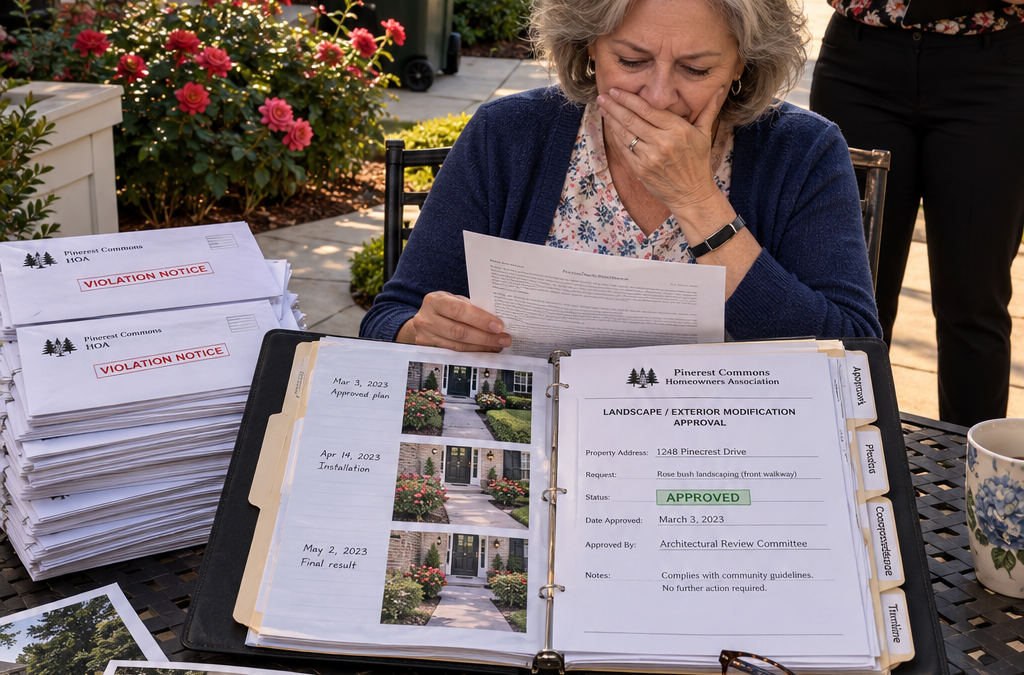
𝗙𝗨𝗟𝗟 𝗦𝗧𝗢𝗥𝗬
The section referred broadly to exterior modifications requiring approval.
“Do rose bushes count as modifications?”
“Apparently the board determined they do.”
“Was there a warning first?”
“The notice you received is the enforcement notice.”
“So no warning?”
“Not in this case.”
I didn’t like it.
But I paid.
One hundred twenty-five dollars.
I told myself that perhaps retirement required learning a different kind of bureaucracy.
Three weeks later, the second fine arrived.
Fifty dollars.
Improper waste container placement.
The letter said my trash bin had been outside the designated storage zone after the permitted collection period.
I thought that was strange.
I had brought the bin back from the curb before lunch.
Then I looked at the attached notation.
It claimed the container had been positioned two inches outside the approved area beside my garage.
Two inches.
I went outside with a tape measure.
Yes.
The bin was slightly beyond the edge of the painted storage line.
I laughed.
Then I paid.
Again.
Fifty dollars was not worth a war.
That was what I told myself.
A week later, I moved the bin exactly inside the line.
I even took a photograph because something about the precision irritated me.
At the time, I did not know that photograph would become the first page in a folder that eventually grew thick enough to barely close.
Fine number three came six weeks later.
Improper exterior decoration.
I had a small metal bird ornament in the garden.
I removed it.
Fine number four involved an alleged parking violation.
My car had supposedly extended beyond the driveway boundary.
It had not.
That one I questioned.
I called.
A man named Gerald Puit returned my call.
He introduced himself as president of the Pinerest Commons board.
Gerald was in his mid-sixties.
Retired insurance broker.
Always neatly dressed.
Always calm.
I had seen him walking through the neighborhood with a tablet under one arm.
He had a way of greeting residents that made ordinary conversation sound like an inspection.
“Mrs. Holloway,” he said when he called, “I understand you have a question about the parking notice.”
“Yes.”
“The violation was documented.”
“How?”
“Through the association’s compliance process.”
“Do you have a photograph?”
“Documentation is maintained internally.”
“May I see it?”
“We don’t routinely provide compliance photographs because they can include neighboring properties.”
“My car is the subject of the fine.”
“I understand.”
“So how am I supposed to dispute something if I can’t see the evidence?”
His tone never changed.
“If you’d like to dispute the fine, you’re welcome to attend the next monthly board meeting.”
“I’d like to know what I’m disputing.”
“The notice explains that.”
“It says my vehicle crossed the driveway boundary.”
“Correct.”
“It didn’t.”
“Then bring whatever documentation you have to the meeting.”
That irritated me.
But I attended.
The board sat at a long table in the clubhouse.
Gerald sat in the center.
Two women and two men sat beside him.
I explained the parking fine.
Gerald listened with his fingers folded.
Then he said, “Mrs. Holloway, the violation was observed by a compliance representative.”
“Who?”
“We don’t identify individuals involved in reporting.”
“Do you have a photograph?”
“As I explained, those records are internal.”
I had brought my own photograph.
Taken the morning after the notice.
It showed my car well within the driveway.
Gerald glanced at it.
“That was taken after the date of violation.”
“Yes.”
“So it doesn’t establish the position on the date in question.”
“No. But you won’t show me your evidence from that date.”
He smiled.
Not kindly.
Not cruelly either.
That was worse.
It was the smile of someone explaining gravity.
“Mrs. Holloway, nobody is accusing you of dishonesty.”
“Then why am I being fined for something I didn’t do?”
“The rules apply consistently.”
I remember those words.
Consistently.
For months afterward, I thought perhaps he was right.
Maybe I had backed slightly too far one morning.
Maybe I forgot.
Memory becomes a vulnerable thing after sixty.
Not because sixty is old.
It isn’t.
But everyone around you has spent years joking about age.
Forgot your keys?
Getting old.
Walk into a room and forget why?
Getting old.
Misplace a receipt?
Getting old.
When enough authority figures tell you something happened differently than you remember, a small part of you begins asking the question you don’t want to ask.
Was it me?
That was how they got inside my head.
Fine number five involved a hose visible from the street.
I paid.
Fine six claimed my porch light remained on during prohibited daylight hours.
I started using a timer.
Fine seven arrived two weeks later.
Another landscaping violation.
This time, they claimed my shrubs exceeded the approved width.
I measured them.
They didn’t.
I measured again.
Then I took photographs.
Front.
Side.
Tape measure visible.
Date written on a card placed beside the shrubs.
That evening, I opened a manila folder.
On the tab, I wrote:
PINEREST HOA.
I placed the notice inside.
Then I added every earlier letter I still had.
I regretted that I had thrown away the envelopes from the first few fines.
After that, I threw away nothing.
Every notice.
Every envelope.
Every payment receipt.
Every email.
Every date.
Every phone call.
I wrote notes in the margins.
Called office 9:12 a.m. Spoke with Cheryl. Asked for photo. Refused.
Board meeting 7:00 p.m. Gerald stated records confidential.
Photographed front lawn 7:42 a.m. No visible violation.
I had no plan.
I was simply doing what I had done my entire professional life.
Creating a record.
The fines continued.
Number eight.
Number nine.
Number ten.
One claimed my garage door had remained open too long.
Another said a planter was not an approved neutral color.
Another alleged weeds along the side fence.
I found three tiny sprouts.
Three.
I pulled them.
Paid another fine.
By number twelve, I had stopped telling my sister about every letter because she was getting angry on my behalf.
“Margaret, this isn’t normal.”
“They’re strict.”
“They’re ridiculous.”
“It’s a gated community.”
“That doesn’t mean they get to invent problems.”
“They’re not inventing them.”
The words came out automatically.
She went quiet.
“How do you know?”
I looked at the latest notice.
I didn’t answer.
By the fifteenth fine, I started photographing my property every morning.
Not every corner.
Just the areas that seemed to generate complaints.
Driveway.
Trash bin.
Front landscaping.
Porch.
Mailbox.
At first, I felt foolish.
What kind of person photographs her own garbage can before breakfast?
I did.
Every day.
7:11 a.m.
7:06.
7:18.
The pictures accumulated.
Then something changed.
Fine number seventeen claimed my waste container was visible from the street overnight on September 14.
I opened my phone.
September 14.
7:03 a.m.
Photo.
The bin was inside the garage.
I checked the evening before.
Another photograph.
Garage closed.
I called Gerald.
“I have proof this one is wrong.”
“You’re welcome to appeal.”
“No. I’m telling you the bin was physically inside my garage.”
“Then bring the evidence.”
“Will you bring yours?”
A pause.
“The association’s documentation is confidential.”
“Why?”
“Resident privacy.”
“Whose privacy? My trash bin?”
His tone sharpened by a degree.
“Mrs. Holloway, I don’t think sarcasm is productive.”
“I don’t think charging me money for something that didn’t happen is productive.”
Another pause.
“If you believe the board is acting improperly, there are procedures.”
“I have followed your procedures.”
“Then continue following them.”
That was the first conversation that left me shaking.
Not from fear.
From frustration.
I had spent my career helping teenagers find information.
When a student claimed a source said something, we opened the source.
When two records contradicted each other, we checked the dates.
Evidence was supposed to resolve disagreement.
At Pinerest Commons, evidence only seemed to travel in one direction.
I had to prove innocence.
They did not have to prove accusation.
At fine number twenty, I spread every notice across my dining table.
Twenty.
The total was already well into the thousands.
Some I had paid immediately.
Some after appeal.
Some reduced.
None dismissed.
I organized them chronologically.
Date.
Type.
Amount.
Response.
Outcome.
Then I noticed something.
The amounts were rising.
Not simply because repeated violations carried escalation.
Different categories were escalating too.
Early fines: fifty.
Seventy-five.
One hundred twenty-five.
Then two hundred.
Three hundred.
One notice included administrative fees.
Another included a “repeat compliance surcharge.”
I checked the handbook.
I could not find that exact phrase.
Then I charted the timing.
The fines arrived every few weeks.
Sometimes almost predictably.
Long enough apart that no single month looked outrageous.
Close enough together that I never stopped feeling behind.
That bothered me.
Then another pattern appeared.
The descriptions became vaguer.
“Exterior maintenance deficiency.”
“Improper visual condition.”
“Landscaping noncompliance.”
Not specific enough to know exactly what was wrong.
I went outside with the latest notice and stood in my front yard.
Everything looked normal.
Grass cut.
Bushes trimmed.
No weeds.
Trash inside.
Car properly parked.
Porch clear.
I suddenly felt frightened.
Not of Gerald.
Of myself.
I remember sitting on the front step thinking:
What if I am missing things?
What if everybody else understands rules I don’t?
What if retirement has made me careless?
That thought lasted three days.
Then I met Rosa Delgado.
The Delgados lived four houses down.
Rosa and her husband Miguel had moved into Pinerest about six months after I did.
They were in their thirties.
Two small children.
I knew them enough to wave.
One evening, I saw Rosa standing at her mailbox holding a white HOA envelope.
She looked angry.
That envelope looked exactly like mine.
I don’t know what made me do it.
Normally, I would never ask a neighbor about private mail.
“Rosa?”
She looked up.
“Hi, Margaret.”
“Is that a violation notice?”
Her face changed.
“How did you know?”
I held up the one in my own hand.
For a second, neither of us said anything.
Then she laughed.
It sounded close to crying.
“We thought it was just us.”
Those six words changed everything.
I walked over.
“How many?”
She looked toward her house.
“Nine.”
My stomach dropped.
“For what?”
“Everything.”
She started listing them.
Trash placement.
Grass height.
A children’s toy visible beside the garage.
Parking.
Landscaping.
A porch decoration.
Almost the same categories.
“When did they start?”
“About a year after we moved in.”
I felt cold.
“Come to my house.”
Ten minutes later, Rosa and I sat at my kitchen table surrounded by paper.
She had saved her notices too.
Not as carefully.
But enough.
I lined them beside mine.
The dates were different.
The rhythm wasn’t.
Initial lower fines.
Escalation.
Vague descriptions.
Repeated warnings.
Gerald’s signature on several letters.
I pointed to one.
“Did they show you evidence?”
“No.”
“Did you ask?”
“Three times.”
“What did they say?”
“Privacy.”
Same word.
Rosa looked at me.
“What is happening?”
“I don’t know.”
That was the truth.
But for the first time, I knew the problem was not my memory.
The relief almost made me cry.
I had not realized how deeply I had begun distrusting myself until another person confirmed she was experiencing the same thing.
The next week, I started talking quietly to other newer residents.
I was careful.
I did not knock on every door accusing the HOA of fraud.
I asked questions.
A young teacher named Priya Patel had received fourteen violations since moving in eighteen months earlier.
A single father named Kevin Ellis had received eleven.
Another couple on Orchard View had paid almost three thousand dollars in fines after living there less than two years.
The pattern was clear.
Newer homeowners.
Almost always within their first two years.
Repeated minor violations.
Vague evidence.
Escalating penalties.
Older residents had complaints too, but nothing close to the same frequency.
I updated my spreadsheet.
Yes.
A librarian can make spreadsheets.
Quite good ones.
Resident.
Move-in date.
Fine date.
Category.
Amount.
Appeal.
Outcome.
By the time my thirty-first fine arrived, the total assessed against me had passed six thousand dollars.
$6,040.
I stared at that number.
Six thousand forty dollars.
For grass.
Bins.
Parking.
Bushes.
Lights.
Objects.
Things I had either corrected immediately or could not prove had ever existed.
Then came fine number thirty-two.
The amount was not what frightened me.
The final line was.
Continued non-compliance may result in a lien being placed against the property.
I read it once.
Then again.
A lien.
On my home.
The house I had bought after thirty-two years of work.
The place I intended to spend the rest of my life.
That was when fear became anger.
Not loud anger.
I have never been a loud person.
It became something colder.
Organized.
I called David Chin.
David was a property attorney recommended by a former teacher I had worked with.
Soft-spoken.
Mid-forties.
Glasses.
The kind of person who never seemed in a hurry even when he was moving quickly.
I carried my folder into his office.
Then a second folder.
Then a binder.
He looked at the stack.
“How long has this been happening?”
“Less than two years.”
He opened the first file.
“How many fines?”
“Thirty-two.”
He looked up.
“Thirty-two?”
“So far.”
For nearly an hour, he barely spoke.
He read.
He made notes.
He examined photographs.
He compared dates.
He looked at my payment receipts.
Then he opened the spreadsheet showing the other residents.
“Did you make this?”
“Yes.”
“Why?”
“Because the timing looked strange.”
He studied it.
Then leaned back.
“This is not normal enforcement.”
I felt something loosen in my chest.
“You believe me?”
He looked surprised.
“Of course.”
I looked down.
“I’m sorry.”
“For what?”
“I’ve spent almost two years wondering if I was somehow causing this.”
David closed the folder.
“Mrs. Holloway, this looks like textbook predatory enforcement.”
Finally.
Someone with no connection to the HOA had said it.
Predatory.
Not strict.
Not consistent.
Not my imagination.
“Can we stop it?”
“We can challenge it.”
“Can you prove it?”
“That’s the harder question.”
He tapped my spreadsheet.
“This shows pattern.”
“Isn’t that proof?”
“It helps. But if we’re alleging coordinated intentional misconduct rather than an overzealous board, I need internal evidence.”
“What kind?”
“Violation logs. Board communications. Financial records. Management agreements. Records showing who generated the fines and how money was handled.”
“Will they give us that?”
David looked at me.
“Probably not voluntarily.”
He was right.
He sent formal records requests.
Gerald delayed.
Administrative backlog.
Privacy review.
Legal review.
Records unavailable within requested period.
Then partial production.
Then more delay.
By that point, Gerald knew I had counsel.
That was when the fines accelerated.
Thirty-three.
Thirty-four.
Thirty-five.
A supposed mailbox maintenance issue.
A driveway discoloration.
A bush allegedly obstructing sight lines.
I trimmed the bush even though David told me not to let the notices control my life.
Fine thirty-six claimed decorative material had been stored in a prohibited area.
It was a bag of potting soil behind my porch for less than a day.
Fine thirty-seven.
Thirty-eight.
Thirty-nine.
By November, fine number forty arrived.
I had stopped paying automatically.
David disputed them formally.
The HOA added late charges.
Then forty-one.
Forty-two.
It felt deliberate now.
As though someone had realized we were asking questions and decided the solution was more pressure.
David agreed.
“They’re trying to exhaust you.”
“Why?”
“Because exhaustion is effective.”
Kevin proved that.
Kevin Ellis lived three streets over with his nine-year-old daughter.
He worked long hours.
His wife had left years earlier.
He was kind.
Always tired.
One afternoon, he called me.
“I sold.”
I knew immediately what he meant.
“Your house?”
“Closing next month.”
“Kevin.”
“I can’t do this anymore.”
He sounded ashamed.
That broke my heart.
“Don’t apologize.”
“I’m not. I just… every month it’s something. I come home and there’s another envelope. I can’t keep paying David’s consultation fees and fighting the board.”
“You should talk to him.”
“I did.”
He paused.
“My daughter hates it here now.”
That ended the argument.
“When do you leave?”
“Three weeks.”
After we hung up, I sat in my garden for a long time.
It was cold.
The roses I had planted during my first year were dormant.
The same roses that had generated fine number one.
I looked at my house and wondered whether I was being stubborn.
I was sixty-one.
Retired.
I had moved to Pinerest for peace.
Was the house worth this?
Maybe Kevin was smarter.
Sell.
Leave.
Let Gerald keep his kingdom.
I almost called a real estate agent.
Three days later, the email arrived.
No sender name I recognized.
The address was a random string of characters.
Subject:
YOU SHOULD SEE WHAT THEY’RE DOING.
There was no greeting.
No explanation.
Only:
Look at column N. Page 37 has the approvals.
Attached was a spreadsheet file and several PDF exports.
I did not open it immediately.
Thirty-two years working around school computers had taught me not to open unknown attachments casually.
I called David.
He had me forward the message unopened.
His office checked it safely.
Two hours later, he called.
“Margaret.”
His voice sounded different.
“What?”
“Where are you?”
“Home.”
“Sit down.”
I did.
“The files appear legitimate.”
My hand tightened around the phone.
“What files?”
“Internal violation logs.”
I stopped breathing normally.
“Gerald’s?”
“HOA records. At least they appear to be.”
“What do they show?”
A pause.
“Everything.”
David emailed me a sanitized copy.
Forty-three pages.
Resident names.
Addresses.
Violation dates.
Fine categories.
Amounts.
Payment status.
Timestamps.
Most of it looked like the records Gerald had refused to give us.
Then I found column N.
COMMISSION.
I stared at the word.
Beside nearly every fine issued to a newer resident was a number.
$18.75.
$30.
$45.
$60.
Fifteen percent.
I calculated several manually.
Exactly fifteen percent.
The receiving entity was listed elsewhere.
PUIT HOLDINGS LLC.
I searched the Ohio business registry.
Registered owner:
Gerald Puit.
The room seemed to tilt.
I stood and walked away from the laptop.
Then came back.
Read it again.
Puit Holdings LLC.
Gerald.
The HOA president.
The man who had told me the rules applied consistently.
The man who had refused to show evidence.
The man whose board had generated forty-plus fines against me.
His private company received fifteen percent of collected violation revenue from targeted enforcement accounts.
I felt physically sick.
Not because of the money.
Because I understood the structure.
The fines were not an unfortunate side effect of strict governance.
They were revenue.
And Gerald was personally paid more when more fines were collected.
David called again.
“Go to page thirty-seven.”
I opened it.
Attached behind the spreadsheet was an email thread.
Board members.
Gerald.
Management.
Three of the five directors had explicitly approved the arrangement.
The language called it an enforcement administration incentive.
That phrase made me laugh.
Then cry.
Incentive.
They had created a financial incentive to find violations.
And the residents most heavily targeted were people least familiar with the HOA.
People like me.
Rosa.
Kevin.
Priya.
New homeowners who assumed the letters were legitimate.
People who had not yet built relationships.
People who didn’t know board history.
Easy accounts.
Revenue.
I forwarded everything to David at 11:48 that night.
Four minutes later, he replied.
Don’t delete anything. We’re filing tomorrow.
I did not sleep.
I walked through my house.
Kitchen.
Living room.
Bedroom.
Garden visible through the back window.
For almost two years, Gerald had made me feel foolish.
Careless.
Old.
Difficult.
Every time I questioned a fine, he responded with that calm voice.
The documentation is clear.
The rules apply consistently.
Perhaps you weren’t aware.
Perhaps you overlooked it.
That was the part I could not forgive.
Money could be refunded.
What he had done to people’s confidence was harder.
He had weaponized uncertainty.
He made residents believe their own memory was unreliable while hiding the evidence that would prove otherwise.
By morning, I was no longer afraid of him.
The legal filing went out within forty-eight hours.
David notified the appropriate county housing authority.
He also preserved claims involving the financial arrangement, conflicts of interest, improper enforcement, and misuse of association authority.
We did not warn Gerald personally.
There was no need.
The next monthly HOA meeting was scheduled two weeks later.
Gerald expected me to attend.
I had attended many times.
Always with my folder.
Always polite.
Always asking the same questions.
That evening, I arrived behind David.
I wore navy slacks and a gray sweater.
Nothing dramatic.
Rosa and Miguel came.
Priya Patel came.
Two other residents joined us.
Kevin had already moved, but David had a statement from him.
A local news reporter sat in the back row.
She had learned about the filing through public records.
And near the side wall sat a county housing investigator.
Gerald did not recognize him at first.
I did.
David had pointed him out in the parking lot.
The clubhouse filled.
Gerald sat in his usual center seat.
The two board members who had not approved the commission agreement looked confused by the crowd.
The other two looked nervous.
Gerald tapped the microphone.
“Good evening. I’d like to call the regular meeting of the Pinerest Commons Homeowners Association to order.”
David walked forward.
Gerald stopped.
“Can I help you?”
David placed a printed copy of the spreadsheet on the table.
Then another set.
Gerald’s face changed before David said a word.
That told me everything.
David opened the binder.
“We’d like to start with page thirty-seven.”
Seven words.
The room went completely silent.
Gerald stared at the page.
One board member leaned toward him.
“What is that?”
Gerald didn’t answer.
David placed the email thread in front of them.
The first woman on the board picked it up.
Read.
Then looked at Gerald.
“What is Puit Holdings?”
No answer.
She repeated the question.
“Gerald. What is Puit Holdings LLC?”
His mouth opened.
Closed.
Finally he said, “This isn’t the appropriate forum for privileged business arrangements.”
The reporter’s pen began moving.
David said, “It’s an HOA meeting discussing an HOA enforcement contract funded through homeowner penalties.”
Gerald’s eyes flicked toward the back.
That’s when he saw the reporter.
Then the county investigator.
The color left his face.
One of the other board members whispered, “Oh my God.”
Rosa was sitting beside me.
She reached over and took my hand.
I hadn’t realized mine was shaking.
Gerald tried to recover.
“The management arrangement was approved.”
David nodded.
“By three directors, including you.”
“It was designed to improve compliance.”
“And your private company received fifteen percent of fine revenue?”
Gerald looked at the board.
“That is not a fair characterization.”
David turned the spreadsheet.
“Then characterize column N.”
Nobody moved.
The silence lasted long enough that someone in the audience finally said, “Answer him.”
Then another voice.
“Is that our money?”
Gerald raised his hands.
“Please. We will maintain order.”
A man behind me laughed bitterly.
“Now you care about order?”
The meeting fell apart.
People stood.
Questions came from every direction.
How much?
How long?
Who knew?
Were violations fabricated?
Why were new residents targeted?
Did management know?
Was the board paid?
Gerald kept repeating that the arrangement had been reviewed.
That nothing had been proven.
That people should wait for counsel.
But the authority in his voice was gone.
For six years, Gerald had controlled rooms by sounding as though every answer was already settled.
Now he was the only person who didn’t have one.
The two directors who had not approved the arrangement demanded the meeting be suspended.
One of the directors named in the emails tried to leave.
The county investigator asked him not to destroy or remove association records.
That sentence changed the room again.
This wasn’t a neighborhood argument anymore.
It was an investigation.
I sat quietly.
That surprised Rosa.
She leaned toward me.
“Are you okay?”
“Yes.”
“You haven’t said anything.”
“I’ve been saying it for two years.”
I didn’t need to say it again.
The documents were talking now.
Gerald was removed from his board role within the week.
Two other board members resigned the same night as the meeting.
The fourth month after the filing felt longer than the previous year.
Investigators examined Puit Holdings.
Bank transfers.
Contracts.
Fine records.
Board approvals.
Resident histories.
Management communications.
David’s team compared alleged violation dates against homeowner evidence.
My folder became evidence.
Every photograph.
Every notice.
Every note.
Every receipt.
At one point, an investigator sat across from me and asked, “Mrs. Holloway, why did you keep all of this?”
I looked at the stacks.
“I was a librarian.”
He smiled.
“That explains it.”
It did.
The forty-seven fines became something different once examined together.
Not isolated enforcement.
Pattern.
Several had no reliable supporting evidence.
Others were based on interpretations more aggressive than the written rules.
Some were inconsistent with photographs taken on the same dates.
The internal records showed that newer residents had been flagged for enhanced monitoring.
Enhanced monitoring.
That was their phrase.
The commission structure rewarded volume.
More fines collected.
More money to Puit Holdings.
The deeper investigators went, the less the whole operation looked accidental.
Gerald ultimately faced charges involving fraud, breach of fiduciary duty, and unlawful enrichment.
I did not attend every hearing.
I didn’t want my retirement to become his criminal case.
David kept me informed.
The remaining fines associated with the scheme were cancelled.
All forty-seven.
Not just mine.
Across the affected group.
Expunged from association records.
The liens threatened against residents disappeared.
Payments were reviewed.
Refunds issued.
My total reimbursement was $6,040.
The check arrived in another crisp white envelope from the HOA.
I sat at my kitchen table holding it.
For a long time, I did nothing.
Six thousand forty dollars.
I thought about every time I had opened a violation notice and felt embarrassed.
Every phone call.
Every meeting.
Every ruler beside a shrub.
Every photograph of a trash bin.
Every night I wondered whether I was becoming forgetful.
Money could not refund that.
But I deposited the check anyway.
I’m retired.
Principles are expensive.
Pinerest Commons held new board elections.
Rosa Delgado ran.
I asked her why.
“Because I’m angry.”
“That’s a terrible reason to serve.”
She laughed.
“You’re the librarian. What’s a better one?”
“Because you want the system to work.”
She thought about it.
“Fine. I’m angry because I want the system to work.”
“Better.”
She won.
Rosa became chair of the new board.
New policies followed.
No financial incentives tied to violation volume.
No board member with a personal financial relationship to a vendor could participate without disclosure.
Violation evidence had to be retained.
Homeowners had the right to review documentation supporting fines, subject to reasonable privacy protections.
Appeals went to people who had not participated in the original enforcement decision.
Warnings became the default for minor first-time violations unless there was an immediate safety issue.
None of those rules were revolutionary.
That was the tragedy.
Nobody should need a scandal to realize the people issuing penalties should not earn a percentage of them.
Kevin heard about the outcome from another resident.
He called me one evening.
“I should’ve stayed.”
“No.”
“I sold because of them.”
“You left because your daughter needed peace.”
He became quiet.
“I hate that they won.”
“They didn’t.”
“They made me move.”
“Kevin, leaving wasn’t losing.”
“It feels like it.”
I understood.
I felt guilty too.
Not because he left.
Because we hadn’t found the proof sooner.
“You did what you needed to do.”
“I wish I’d kept more records.”
“You kept enough.”
He laughed.
“Not like you.”
“No one keeps records like me.”
That was finally something I could joke about.
The rose bushes survived everything.
Those two ridiculous rose bushes.
Fine number one.
One hundred twenty-five dollars.
Unauthorized landscaping modification.
After the case ended, Rosa called me.
“We reviewed the original rose notice.”
“Why?”
“Because I was curious.”
“And?”
“There was no clear rule violation.”
I closed my eyes.
“Of course there wasn’t.”
“Do you want written confirmation?”
“Absolutely.”
She laughed.
“Margaret.”
“I have a folder.”
“I know.”
The letter arrived three days later.
I put it behind the first fine.
I could have thrown the original notice away.
I didn’t.
Some documents become more valuable after they’re proven wrong.
The following spring, the roses bloomed harder than they ever had.
Bright red.
I stood beside them one morning with pruning shears.
Gerald’s old house was visible farther down the street.
He no longer lived there.
The property sold after the investigation.
I felt nothing looking at it.
That surprised me.
For months, I had imagined relief would feel like triumph.
It didn’t.
It felt quiet.
The absence of envelopes.
The absence of dread.
The ability to park my car without photographing the tires.
The ability to put my trash bin away and trust that nobody was inventing an infraction.
Peace is easiest to recognize after someone has made you live without it.
Rosa stopped by one afternoon carrying a binder.
“You’re not going to like this.”
“What?”
“I need your help.”
I looked at the binder.
“No.”
“You haven’t even heard me.”
“I’m retired.”
“We’re reorganizing the association archive.”
I stared at her.
Then she smiled.
“We have six years of meeting records with inconsistent filing.”
“How inconsistent?”
“Terrible.”
“Chronological?”
“Sometimes.”
“Vendor files?”
“Mixed.”
“Minutes?”
“Some digital. Some paper.”
I sighed.
“Bring it inside.”
That was how I ended up volunteering three hours a week helping rebuild the Pinerest document system.
Apparently retirement has a sense of humor.
I created retention schedules.
Digitization labels.
Vendor folders.
Board-resolution indexes.
Violation records separated by year and category.
Nothing could be deleted simply because leadership changed.
Every decision needed a trail.
Rosa once asked whether that was excessive.
I looked at her.
She raised both hands.
“Forget I asked.”
The anonymous sender who gave me the spreadsheet was never publicly identified.
David knew more than he told me.
I could tell.
I never pushed.
Whoever it was had taken a risk.
Perhaps a management employee.
Perhaps a board insider.
Perhaps someone who had watched Gerald operate for years and finally had enough.
Sometimes I wonder whether Suzanne—if there was a Suzanne in this story, some quiet person in the background—had been waiting for someone like me.
Not someone brave.
Someone persistent.
That’s different.
I wasn’t brave when the fines started.
I paid them.
I doubted myself.
I apologized for things I might not have done.
I went to meetings hoping people in authority would explain what I had misunderstood.
Persistence came later.
It began with the folder.
One document.
Then another.
Then another.
That’s the part people misunderstand when they tell the story now.
They say, “Margaret exposed the HOA.”
I didn’t.
Not by myself.
Rosa spoke.
David filed.
Someone sent the spreadsheet.
Investigators subpoenaed records.
Residents compared experiences.
The news reporter made the story visible.
The county examined the evidence.
The new board repaired the system.
All I did at the beginning was refuse to throw anything away.
But sometimes that’s enough to start.
Six years.
That’s how long Gerald’s arrangement had operated before I moved into Pinerest Commons.
Six years.
Dozens of homeowners had been fined.
Some probably paid without question.
Some fought once and stopped.
Some sold.
Some assumed they were the problem.
That is the part I still think about.
How many people went home after a board meeting believing Gerald was right?
How many stood in their yards measuring something that didn’t need measuring?
How many spouses argued because one thought the other forgot a rule?
How many older residents wondered whether age was catching up with them?
Fraud rarely steals only money.
Sometimes it steals confidence.
Gerald understood that whether consciously or not.
The most effective thing he did was not the fifteen-percent commission.
It was the calm.
He never shouted.
Never threatened directly.
Never needed to.
The envelope did the work.
Official logo.
Rule number.
Amount due.
Deadline.
Then a man in a clean shirt told you the evidence existed.
You simply couldn’t see it.
That is a powerful kind of manipulation.
If you challenge the authority, you look difficult.
If you obey it, the system grows stronger.
I was a librarian.
I should have recognized the structure earlier.
Information controlled power.
Gerald controlled the records.
Therefore, he controlled the story.
Until he didn’t.
Page thirty-seven still sits in my file.
A printed copy.
I know the case is over.
I know I don’t need it anymore.
But I keep it.
Three board approvals.
Commission structure.
Puit Holdings.
Signatures.
The page that turned suspicion into evidence.
Sometimes I open the folder and look at fine number one.
Rose bushes.
Then fine number forty-seven.
The last one.
Exterior maintenance deficiency.
Vague to the end.
Forty-seven notices.
Forty-seven attempts to tell me the truth was something I could not verify.
Now the folder sits in a cabinet beside my gardening books.
It is labeled differently.
Not PINEREST HOA.
I changed the tab after everything ended.
It now says:
RECORD.
Singular.
Because that’s what it became.
The record.
Not my memory.
Not Gerald’s explanation.
Not the board’s interpretation.
The paper.
The dates.
The photographs.
The numbers.
Facts have a way of becoming patient allies if you give them somewhere to live.
My garden looks good now.
The roses are taller.
I added hydrangeas near the side fence after submitting an approval request under the new process.
Rosa called me when it came through.
“Approved.”
“Did you review it yourself?”
“No.”
“Conflict?”
“You’re impossible.”
“I learned from professionals.”
She laughed.
Sometimes new residents ask about the old board.
Not often anymore.
Time moves.
People change.
Gerald’s name fades.
The scandal becomes something that happened before they arrived.
That’s healthy.
A community cannot live forever in its worst chapter.
But I hope they keep the policies.
I hope nobody decides documentation is too burdensome.
I hope no future president complains that independent review takes too much time.
Because systems do not become abusive all at once.
A shortcut here.
An exception there.
One person gets trusted because “he knows how things work.”
Records become harder to see.
Questions become annoying.
Then one day, somebody receives forty-seven fines and nobody remembers when that became normal.
I still attend board meetings occasionally.
I sit near the back.
I bring water.
I listen.
The first time I returned after the new board took over, Rosa saw me and smiled.
“Are you here to keep us honest?”
“No.”
“What, then?”
“I live here.”
That felt good to say.
Not target.
Not complainant.
Not plaintiff.
Resident.
Just resident.
At the end of that meeting, an older gentleman raised his hand.
He had received a warning about a tree branch hanging too low over the sidewalk.
Rosa asked staff to show him the photograph.
They did.
Right there.
On the screen.
Clear branch.
Clear measurement.
Clear rule.
He looked at it.
“Oh.”
Everyone laughed gently.
He said he’d trim it.
No fine.
No secrecy.
No humiliation.
Five minutes.
Problem solved.
I sat there thinking how easy fairness looked when nobody was profiting from confusion.
That’s all most people want.
Not no rules.
Not special treatment.
Proof.
Consistency.
A chance to correct something.
A system that doesn’t punish questions.
I spent thirty-two years helping students learn one principle above almost every other one.
Check the source.
Not the rumor.
Not the summary.
Not what someone tells you the book says.
Open the book.
Read the page.
Maybe that’s why Gerald’s system offended me so deeply once I understood it.
He built his authority around preventing people from checking the source.
He told us the evidence existed.
He told us the records supported him.
He told us the rules were clear.
He expected us to accept his interpretation because he controlled access.
Then someone leaked the source.
And the whole thing collapsed.
I sometimes think about that anonymous email arriving three days after Kevin left.
If it had come three days later, maybe I would have listed my house.
If it had never come, David might eventually have obtained the records anyway.
Maybe.
Or maybe Gerald would have continued another year.
Two.
More people would have paid.
More people would have left.
Nobody knows.
History often turns on documents nobody expects to survive.
An email.
A receipt.
A spreadsheet.
A signature.
A folder.
One of the first things I taught new library assistants was simple:
Never assume a document is unimportant just because you don’t understand its value yet.
File it correctly.
You can decide later.
That lesson followed me home.
By the end, I had forty-seven violation notices.
Forty-seven envelopes.
Photographs.
Payment confirmations.
Notes.
Board correspondence.
Copies of appeals.
Every page mattered because together they showed something no single page could.
Pattern.
That is what predators depend on people never seeing.
One incident can be explained.
Two can be coincidence.
Five can be strict enforcement.
Forty-seven becomes a system.
Gerald saw individuals.
Margaret.
Rosa.
Kevin.
Priya.
Separate homeowners receiving separate fines.
He believed we would each fight alone.
The moment we put our papers on the same table, the system became visible.
That was his real mistake.
Not taking fifteen percent.
Not even putting it in writing.
His mistake was believing nobody would compare folders.
The final refund letter from Pinerest Commons is still in the file too.
It confirms $6,040 returned to me.
Below the amount is one sentence:
All related violation findings have been expunged from the Association’s enforcement history.
Expunged.
Forty-seven times I had been told I was noncompliant.
Then, with one investigation, the official record admitted that record itself could not be trusted.
I read that sentence whenever I feel embarrassed that I ever doubted myself.
Because I did.
That’s important.
I don’t want to rewrite myself into someone tougher than I was.
I was frightened.
I was confused.
I paid fines I shouldn’t have paid.
I sat across from Gerald and wondered whether he understood my own property better than I did.
I almost sold my home.
Courage did not arrive first.
Documentation did.
Then certainty.
Then anger.
Then action.
Maybe that’s how it works for most ordinary people.
Not dramatic bravery.
One small piece of proof at a time.
The roses bloom every June.
I prune them carefully.
No approval required now because the board clarified the rule.
They sit beside the same front walkway where this began.
People tell me they’re beautiful.
Sometimes Rosa teases me.
“Most expensive roses in Ohio.”
I tell her she’s wrong.
“They made me money eventually.”
She says the refund doesn’t count.
I disagree.
One afternoon, about a year after the investigation ended, I found an old violation envelope tucked inside a cookbook.
Fine number nine.
I had forgotten it was there.
My first instinct was to put it in the folder.
Then I laughed.
Even after everything, the habit remained.
I filed it.
Of course I did.
Some people collect stamps.
I collect evidence.
And if there is one thing I learned from forty-seven fines, six thousand forty dollars, one anonymous spreadsheet, a corrupt board president, and a room full of neighbors who finally saw the same pattern I had been seeing alone, it is this:
Never let someone else’s confidence become a substitute for your evidence.
Authority can sound certain and still be wrong.
A rule book can be quoted and still be misused.
A board can vote and still violate its duty.
A polite man can smile while taking money from the people he’s supposed to protect.
And a sixty-one-year-old retired librarian can spend two years wondering whether she’s losing her mind when the real problem is that someone has built a business model around making her doubt herself.
Gerald Puit had six years.
He had the board.
The management system.
The enforcement records.
The rule book.
The meeting table.
The official seal.
I had a folder.
In the end, the folder was enough.
𝗧𝗛𝗘 𝗘𝗡𝗗
By My 47th HOA Fine, I Had Started Questioning My Own Memory Until One Page in My Folder Made Me Stop Doubting Myself
By the time the forty-seventh violation notice arrived, I had begun checking my own photographs twice because the HOA had spent nearly two years convincing me that every mistake was mine, every fine was justified, and every missing piece of proof existed somewhere I simply wasn’t allowed to see.
What they never understood was that I had spent thirty-two years as a librarian, and librarians do not throw away records just because someone powerful tells them the records do not matter.
My name is Margaret Holloway.
I was sixty-one years old when I retired from the public school system and moved into Pinerest Commons.
For most of my adult life, I had been a high school librarian.
People hear that and imagine silence.
Shelves.
Reading glasses.
Students whispering between stacks.
That was part of it.
But a good librarian spends as much time organizing disorder as protecting quiet.
Books arrive mislabeled.
Records get filed in the wrong year.
Students return materials to the wrong shelf.
Teachers swear they sent a form that never arrived.
Administrators ask for information from six years earlier and expect it before lunch.
You learn very quickly that memory is not enough.
You write things down.
You date them.
You keep copies.
You file everything where you can find it later.
For thirty-two years, that habit made me good at my job.
I never imagined it would eventually save my home.
When I retired, I wanted a smaller life.
Not a sad life.
Not an empty one.
Just smaller.
My husband had died four years earlier.
Our old house had three bedrooms we no longer needed, a basement full of things I kept postponing decisions about, and a yard that took an entire Saturday to maintain.
I had spent decades following bells, school calendars, teacher schedules, budget deadlines, testing weeks, graduation dates, and library inventories.
Retirement felt like the first time in my life when nobody else could tell me what time the day began.
I wanted mornings in my garden.
Coffee on the patio.
A neighborhood where I could walk safely in the evening.
Enough room for books.
Not much else.
Pinerest Commons seemed perfect.
It was a gated community in suburban Ohio.
Not luxurious.
Comfortable.
About one hundred and sixty homes arranged around curved streets with names like Pine Hollow Drive and Orchard View Lane.
The houses were tidy.
Most had small front lawns.
The community maintained several common green spaces and a little clubhouse where residents held meetings, birthday parties, exercise classes, and holiday dinners.
The HOA fee was reasonable.
The rules were strict enough to keep the neighborhood neat but, at least on paper, not absurd.
I read every page before I bought my house.
Of course I did.
Thirty-two years in a library had trained me never to sign something I had not read.
The rules covered exterior paint colors.
Fences.
Trash containers.
Parking.
Landscaping.
Holiday decorations.
Nothing unusual.
I signed the closing documents and moved into a small brick house near the eastern entrance.
I loved it immediately.
There was a front walkway with enough space on either side for flowers.
The previous owner had planted boxwoods, but they were tired and uneven.
I trimmed them.
Added lavender near the porch.
And eleven months after I moved in, I planted two rose bushes beside the walkway.
That was the beginning.
The first fine arrived in a white envelope bearing the Pinerest Commons logo.
I remember opening it at my kitchen table.
One hundred twenty-five dollars.
Unauthorized landscaping modification.
I read the letter twice.
Then I went outside and stared at the roses.
Two small bushes.
Barely eighteen inches tall.
I went back inside and opened the HOA handbook.
There was a landscaping section.
It required approval for significant changes to hardscape, removal of mature trees, retaining walls, and expansion of planting beds.
I could not find anything clearly prohibiting two rose bushes within an existing bed.
But I was new.
Maybe I had missed something.
That thought became very important later.
Maybe I missed something.
I called the management office.
A woman answered.
I explained the notice.
She said the violation had been issued by the board.
I asked which rule I had violated.
She gave me a section number.
I checked it while she waited.
The section referred broadly to exterior modifications requiring approval.
“Do rose bushes count as modifications?”
“Apparently the board determined they do.”
“Was there a warning first?”
“The notice you received is the enforcement notice.”
“So no warning?”
“Not in this case.”
I didn’t like it.
But I paid.
One hundred twenty-five dollars.
I told myself that perhaps retirement required learning a different kind of bureaucracy.
Three weeks later, the second fine arrived.
Fifty dollars.
Improper waste container placement.
The letter said my trash bin had been outside the designated storage zone after the permitted collection period.
I thought that was strange.
I had brought the bin back from the curb before lunch.
Then I looked at the attached notation.
It claimed the container had been positioned two inches outside the approved area beside my garage.
Two inches.
I went outside with a tape measure.
Yes.
The bin was slightly beyond the edge of the painted storage line.
I laughed.
Then I paid.
Again.
Fifty dollars was not worth a war.
That was what I told myself.
A week later, I moved the bin exactly inside the line.
I even took a photograph because something about the precision irritated me.
At the time, I did not know that photograph would become the first page in a folder that eventually grew thick enough to barely close.
Fine number three came six weeks later.
Improper exterior decoration.
I had a small metal bird ornament in the garden.
I removed it.
Fine number four involved an alleged parking violation.
My car had supposedly extended beyond the driveway boundary.
It had not.
That one I questioned.
I called.
A man named Gerald Puit returned my call.
He introduced himself as president of the Pinerest Commons board.
Gerald was in his mid-sixties.
Retired insurance broker.
Always neatly dressed.
Always calm.
I had seen him walking through the neighborhood with a tablet under one arm.
He had a way of greeting residents that made ordinary conversation sound like an inspection.
“Mrs. Holloway,” he said when he called, “I understand you have a question about the parking notice.”
“Yes.”
“The violation was documented.”
“How?”
“Through the association’s compliance process.”
“Do you have a photograph?”
“Documentation is maintained internally.”
“May I see it?”
“We don’t routinely provide compliance photographs because they can include neighboring properties.”
“My car is the subject of the fine.”
“I understand.”
“So how am I supposed to dispute something if I can’t see the evidence?”
His tone never changed.
“If you’d like to dispute the fine, you’re welcome to attend the next monthly board meeting.”
“I’d like to know what I’m disputing.”
“The notice explains that.”
“It says my vehicle crossed the driveway boundary.”
“Correct.”
“It didn’t.”
“Then bring whatever documentation you have to the meeting.”
That irritated me.
But I attended.
The board sat at a long table in the clubhouse.
Gerald sat in the center.
Two women and two men sat beside him.
I explained the parking fine.
Gerald listened with his fingers folded.
Then he said, “Mrs. Holloway, the violation was observed by a compliance representative.”
“Who?”
“We don’t identify individuals involved in reporting.”
“Do you have a photograph?”
“As I explained, those records are internal.”
I had brought my own photograph.
Taken the morning after the notice.
It showed my car well within the driveway.
Gerald glanced at it.
“That was taken after the date of violation.”
“Yes.”
“So it doesn’t establish the position on the date in question.”
“No. But you won’t show me your evidence from that date.”
He smiled.
Not kindly.
Not cruelly either.
That was worse.
It was the smile of someone explaining gravity.
“Mrs. Holloway, nobody is accusing you of dishonesty.”
“Then why am I being fined for something I didn’t do?”
“The rules apply consistently.”
I remember those words.
Consistently.
For months afterward, I thought perhaps he was right.
Maybe I had backed slightly too far one morning.
Maybe I forgot.
Memory becomes a vulnerable thing after sixty.
Not because sixty is old.
It isn’t.
But everyone around you has spent years joking about age.
Forgot your keys?
Getting old.
Walk into a room and forget why?
Getting old.
Misplace a receipt?
Getting old.
When enough authority figures tell you something happened differently than you remember, a small part of you begins asking the question you don’t want to ask.
Was it me?
That was how they got inside my head.
Fine number five involved a hose visible from the street.
I paid.
Fine six claimed my porch light remained on during prohibited daylight hours.
I started using a timer.
Fine seven arrived two weeks later.
Another landscaping violation.
This time, they claimed my shrubs exceeded the approved width.
I measured them.
They didn’t.
I measured again.
Then I took photographs.
Front.
Side.
Tape measure visible.
Date written on a card placed beside the shrubs.
That evening, I opened a manila folder.
On the tab, I wrote:
PINEREST HOA.
I placed the notice inside.
Then I added every earlier letter I still had.
I regretted that I had thrown away the envelopes from the first few fines.
After that, I threw away nothing.
Every notice.
Every envelope.
Every payment receipt.
Every email.
Every date.
Every phone call.
I wrote notes in the margins.
Called office 9:12 a.m. Spoke with Cheryl. Asked for photo. Refused.
Board meeting 7:00 p.m. Gerald stated records confidential.
Photographed front lawn 7:42 a.m. No visible violation.
I had no plan.
I was simply doing what I had done my entire professional life.
Creating a record.
The fines continued.
Number eight.
Number nine.
Number ten.
One claimed my garage door had remained open too long.
Another said a planter was not an approved neutral color.
Another alleged weeds along the side fence.
I found three tiny sprouts.
Three.
I pulled them.
Paid another fine.
By number twelve, I had stopped telling my sister about every letter because she was getting angry on my behalf.
“Margaret, this isn’t normal.”
“They’re strict.”
“They’re ridiculous.”
“It’s a gated community.”
“That doesn’t mean they get to invent problems.”
“They’re not inventing them.”
The words came out automatically.
She went quiet.
“How do you know?”
I looked at the latest notice.
I didn’t answer.
By the fifteenth fine, I started photographing my property every morning.
Not every corner.
Just the areas that seemed to generate complaints.
Driveway.
Trash bin.
Front landscaping.
Porch.
Mailbox.
At first, I felt foolish.
What kind of person photographs her own garbage can before breakfast?
I did.
Every day.
7:11 a.m.
7:06.
7:18.
The pictures accumulated.
Then something changed.
Fine number seventeen claimed my waste container was visible from the street overnight on September 14.
I opened my phone.
September 14.
7:03 a.m.
Photo.
The bin was inside the garage.
I checked the evening before.
Another photograph.
Garage closed.
I called Gerald.
“I have proof this one is wrong.”
“You’re welcome to appeal.”
“No. I’m telling you the bin was physically inside my garage.”
“Then bring the evidence.”
“Will you bring yours?”
A pause.
“The association’s documentation is confidential.”
“Why?”
“Resident privacy.”
“Whose privacy? My trash bin?”
His tone sharpened by a degree.
“Mrs. Holloway, I don’t think sarcasm is productive.”
“I don’t think charging me money for something that didn’t happen is productive.”
Another pause.
“If you believe the board is acting improperly, there are procedures.”
“I have followed your procedures.”
“Then continue following them.”
That was the first conversation that left me shaking.
Not from fear.
From frustration.
I had spent my career helping teenagers find information.
When a student claimed a source said something, we opened the source.
When two records contradicted each other, we checked the dates.
Evidence was supposed to resolve disagreement.
At Pinerest Commons, evidence only seemed to travel in one direction.
I had to prove innocence.
They did not have to prove accusation.
At fine number twenty, I spread every notice across my dining table.
Twenty.
The total was already well into the thousands.
Some I had paid immediately.
Some after appeal.
Some reduced.
None dismissed.
I organized them chronologically.
Date.
Type.
Amount.
Response.
Outcome.
Then I noticed something.
The amounts were rising.
Not simply because repeated violations carried escalation.
Different categories were escalating too.
Early fines: fifty.
Seventy-five.
One hundred twenty-five.
Then two hundred.
Three hundred.
One notice included administrative fees.
Another included a “repeat compliance surcharge.”
I checked the handbook.
I could not find that exact phrase.
Then I charted the timing.
The fines arrived every few weeks.
Sometimes almost predictably.
Long enough apart that no single month looked outrageous.
Close enough together that I never stopped feeling behind.
That bothered me.
Then another pattern appeared.
The descriptions became vaguer.
“Exterior maintenance deficiency.”
“Improper visual condition.”
“Landscaping noncompliance.”
Not specific enough to know exactly what was wrong.
I went outside with the latest notice and stood in my front yard.
Everything looked normal.
Grass cut.
Bushes trimmed.
No weeds.
Trash inside.
Car properly parked.
Porch clear.
I suddenly felt frightened.
Not of Gerald.
Of myself.
I remember sitting on the front step thinking:
What if I am missing things?
What if everybody else understands rules I don’t?
What if retirement has made me careless?
That thought lasted three days.
Then I met Rosa Delgado.
The Delgados lived four houses down.
Rosa and her husband Miguel had moved into Pinerest about six months after I did.
They were in their thirties.
Two small children.
I knew them enough to wave.
One evening, I saw Rosa standing at her mailbox holding a white HOA envelope.
She looked angry.
That envelope looked exactly like mine.
I don’t know what made me do it.
Normally, I would never ask a neighbor about private mail.
“Rosa?”
She looked up.
“Hi, Margaret.”
“Is that a violation notice?”
Her face changed.
“How did you know?”
I held up the one in my own hand.
For a second, neither of us said anything.
Then she laughed.
It sounded close to crying.
“We thought it was just us.”
Those six words changed everything.
I walked over.
“How many?”
She looked toward her house.
“Nine.”
My stomach dropped.
“For what?”
“Everything.”
She started listing them.
Trash placement.
Grass height.
A children’s toy visible beside the garage.
Parking.
Landscaping.
A porch decoration.
Almost the same categories.
“When did they start?”
“About a year after we moved in.”
I felt cold.
“Come to my house.”
Ten minutes later, Rosa and I sat at my kitchen table surrounded by paper.
She had saved her notices too.
Not as carefully.
But enough.
I lined them beside mine.
The dates were different.
The rhythm wasn’t.
Initial lower fines.
Escalation.
Vague descriptions.
Repeated warnings.
Gerald’s signature on several letters.
I pointed to one.
“Did they show you evidence?”
“No.”
“Did you ask?”
“Three times.”
“What did they say?”
“Privacy.”
Same word.
Rosa looked at me.
“What is happening?”
“I don’t know.”
That was the truth.
But for the first time, I knew the problem was not my memory.
The relief almost made me cry.
I had not realized how deeply I had begun distrusting myself until another person confirmed she was experiencing the same thing.
The next week, I started talking quietly to other newer residents.
I was careful.
I did not knock on every door accusing the HOA of fraud.
I asked questions.
A young teacher named Priya Patel had received fourteen violations since moving in eighteen months earlier.
A single father named Kevin Ellis had received eleven.
Another couple on Orchard View had paid almost three thousand dollars in fines after living there less than two years.
The pattern was clear.
Newer homeowners.
Almost always within their first two years.
Repeated minor violations.
Vague evidence.
Escalating penalties.
Older residents had complaints too, but nothing close to the same frequency.
I updated my spreadsheet.
Yes.
A librarian can make spreadsheets.
Quite good ones.
Resident.
Move-in date.
Fine date.
Category.
Amount.
Appeal.
Outcome.
By the time my thirty-first fine arrived, the total assessed against me had passed six thousand dollars.
$6,040.
I stared at that number.
Six thousand forty dollars.
For grass.
Bins.
Parking.
Bushes.
Lights.
Objects.
Things I had either corrected immediately or could not prove had ever existed.
Then came fine number thirty-two.
The amount was not what frightened me.
The final line was.
Continued non-compliance may result in a lien being placed against the property.
I read it once.
Then again.
A lien.
On my home.
The house I had bought after thirty-two years of work.
The place I intended to spend the rest of my life.
That was when fear became anger.
Not loud anger.
I have never been a loud person.
It became something colder.
Organized.
I called David Chin.
David was a property attorney recommended by a former teacher I had worked with.
Soft-spoken.
Mid-forties.
Glasses.
The kind of person who never seemed in a hurry even when he was moving quickly.
I carried my folder into his office.
Then a second folder.
Then a binder.
He looked at the stack.
“How long has this been happening?”
“Less than two years.”
He opened the first file.
“How many fines?”
“Thirty-two.”
He looked up.
“Thirty-two?”
“So far.”
For nearly an hour, he barely spoke.
He read.
He made notes.
He examined photographs.
He compared dates.
He looked at my payment receipts.
Then he opened the spreadsheet showing the other residents.
“Did you make this?”
“Yes.”
“Why?”
“Because the timing looked strange.”
He studied it.
Then leaned back.
“This is not normal enforcement.”
I felt something loosen in my chest.
“You believe me?”
He looked surprised.
“Of course.”
I looked down.
“I’m sorry.”
“For what?”
“I’ve spent almost two years wondering if I was somehow causing this.”
David closed the folder.
“Mrs. Holloway, this looks like textbook predatory enforcement.”
Finally.
Someone with no connection to the HOA had said it.
Predatory.
Not strict.
Not consistent.
Not my imagination.
“Can we stop it?”
“We can challenge it.”
“Can you prove it?”
“That’s the harder question.”
He tapped my spreadsheet.
“This shows pattern.”
“Isn’t that proof?”
“It helps. But if we’re alleging coordinated intentional misconduct rather than an overzealous board, I need internal evidence.”
“What kind?”
“Violation logs. Board communications. Financial records. Management agreements. Records showing who generated the fines and how money was handled.”
“Will they give us that?”
David looked at me.
“Probably not voluntarily.”
He was right.
He sent formal records requests.
Gerald delayed.
Administrative backlog.
Privacy review.
Legal review.
Records unavailable within requested period.
Then partial production.
Then more delay.
By that point, Gerald knew I had counsel.
That was when the fines accelerated.
Thirty-three.
Thirty-four.
Thirty-five.
A supposed mailbox maintenance issue.
A driveway discoloration.
A bush allegedly obstructing sight lines.
I trimmed the bush even though David told me not to let the notices control my life.
Fine thirty-six claimed decorative material had been stored in a prohibited area.
It was a bag of potting soil behind my porch for less than a day.
Fine thirty-seven.
Thirty-eight.
Thirty-nine.
By November, fine number forty arrived.
I had stopped paying automatically.
David disputed them formally.
The HOA added late charges.
Then forty-one.
Forty-two.
It felt deliberate now.
As though someone had realized we were asking questions and decided the solution was more pressure.
David agreed.
“They’re trying to exhaust you.”
“Why?”
“Because exhaustion is effective.”
Kevin proved that.
Kevin Ellis lived three streets over with his nine-year-old daughter.
He worked long hours.
His wife had left years earlier.
He was kind.
Always tired.
One afternoon, he called me.
“I sold.”
I knew immediately what he meant.
“Your house?”
“Closing next month.”
“Kevin.”
“I can’t do this anymore.”
He sounded ashamed.
That broke my heart.
“Don’t apologize.”
“I’m not. I just… every month it’s something. I come home and there’s another envelope. I can’t keep paying David’s consultation fees and fighting the board.”
“You should talk to him.”
“I did.”
He paused.
“My daughter hates it here now.”
That ended the argument.
“When do you leave?”
“Three weeks.”
After we hung up, I sat in my garden for a long time.
It was cold.
The roses I had planted during my first year were dormant.
The same roses that had generated fine number one.
I looked at my house and wondered whether I was being stubborn.
I was sixty-one.
Retired.
I had moved to Pinerest for peace.
Was the house worth this?
Maybe Kevin was smarter.
Sell.
Leave.
Let Gerald keep his kingdom.
I almost called a real estate agent.
Three days later, the email arrived.
No sender name I recognized.
The address was a random string of characters.
Subject:
YOU SHOULD SEE WHAT THEY’RE DOING.
There was no greeting.
No explanation.
Only:
Look at column N. Page 37 has the approvals.
Attached was a spreadsheet file and several PDF exports.
I did not open it immediately.
Thirty-two years working around school computers had taught me not to open unknown attachments casually.
I called David.
He had me forward the message unopened.
His office checked it safely.
Two hours later, he called.
“Margaret.”
His voice sounded different.
“What?”
“Where are you?”
“Home.”
“Sit down.”
I did.
“The files appear legitimate.”
My hand tightened around the phone.
“What files?”
“Internal violation logs.”
I stopped breathing normally.
“Gerald’s?”
“HOA records. At least they appear to be.”
“What do they show?”
A pause.
“Everything.”
David emailed me a sanitized copy.
Forty-three pages.
Resident names.
Addresses.
Violation dates.
Fine categories.
Amounts.
Payment status.
Timestamps.
Most of it looked like the records Gerald had refused to give us.
Then I found column N.
COMMISSION.
I stared at the word.
Beside nearly every fine issued to a newer resident was a number.
$18.75.
$30.
$45.
$60.
Fifteen percent.
I calculated several manually.
Exactly fifteen percent.
The receiving entity was listed elsewhere.
PUIT HOLDINGS LLC.
I searched the Ohio business registry.
Registered owner:
Gerald Puit.
The room seemed to tilt.
I stood and walked away from the laptop.
Then came back.
Read it again.
Puit Holdings LLC.
Gerald.
The HOA president.
The man who had told me the rules applied consistently.
The man who had refused to show evidence.
The man whose board had generated forty-plus fines against me.
His private company received fifteen percent of collected violation revenue from targeted enforcement accounts.
I felt physically sick.
Not because of the money.
Because I understood the structure.
The fines were not an unfortunate side effect of strict governance.
They were revenue.
And Gerald was personally paid more when more fines were collected.
David called again.
“Go to page thirty-seven.”
I opened it.
Attached behind the spreadsheet was an email thread.
Board members.
Gerald.
Management.
Three of the five directors had explicitly approved the arrangement.
The language called it an enforcement administration incentive.
That phrase made me laugh.
Then cry.
Incentive.
They had created a financial incentive to find violations.
And the residents most heavily targeted were people least familiar with the HOA.
People like me.
Rosa.
Kevin.
Priya.
New homeowners who assumed the letters were legitimate.
People who had not yet built relationships.
People who didn’t know board history.
Easy accounts.
Revenue.
I forwarded everything to David at 11:48 that night.
Four minutes later, he replied.
Don’t delete anything. We’re filing tomorrow.
I did not sleep.
I walked through my house.
Kitchen.
Living room.
Bedroom.
Garden visible through the back window.
For almost two years, Gerald had made me feel foolish.
Careless.
Old.
Difficult.
Every time I questioned a fine, he responded with that calm voice.
The documentation is clear.
The rules apply consistently.
Perhaps you weren’t aware.
Perhaps you overlooked it.
That was the part I could not forgive.
Money could be refunded.
What he had done to people’s confidence was harder.
He had weaponized uncertainty.
He made residents believe their own memory was unreliable while hiding the evidence that would prove otherwise.
By morning, I was no longer afraid of him.
The legal filing went out within forty-eight hours.
David notified the appropriate county housing authority.
He also preserved claims involving the financial arrangement, conflicts of interest, improper enforcement, and misuse of association authority.
We did not warn Gerald personally.
There was no need.
The next monthly HOA meeting was scheduled two weeks later.
Gerald expected me to attend.
I had attended many times.
Always with my folder.
Always polite.
Always asking the same questions.
That evening, I arrived behind David.
I wore navy slacks and a gray sweater.
Nothing dramatic.
Rosa and Miguel came.
Priya Patel came.
Two other residents joined us.
Kevin had already moved, but David had a statement from him.
A local news reporter sat in the back row.
She had learned about the filing through public records.
And near the side wall sat a county housing investigator.
Gerald did not recognize him at first.
I did.
David had pointed him out in the parking lot.
The clubhouse filled.
Gerald sat in his usual center seat.
The two board members who had not approved the commission agreement looked confused by the crowd.
The other two looked nervous.
Gerald tapped the microphone.
“Good evening. I’d like to call the regular meeting of the Pinerest Commons Homeowners Association to order.”
David walked forward.
Gerald stopped.
“Can I help you?”
David placed a printed copy of the spreadsheet on the table.
Then another set.
Gerald’s face changed before David said a word.
That told me everything.
David opened the binder.
“We’d like to start with page thirty-seven.”
Seven words.
The room went completely silent.
Gerald stared at the page.
One board member leaned toward him.
“What is that?”
Gerald didn’t answer.
David placed the email thread in front of them.
The first woman on the board picked it up.
Read.
Then looked at Gerald.
“What is Puit Holdings?”
No answer.
She repeated the question.
“Gerald. What is Puit Holdings LLC?”
His mouth opened.
Closed.
Finally he said, “This isn’t the appropriate forum for privileged business arrangements.”
The reporter’s pen began moving.
David said, “It’s an HOA meeting discussing an HOA enforcement contract funded through homeowner penalties.”
Gerald’s eyes flicked toward the back.
That’s when he saw the reporter.
Then the county investigator.
The color left his face.
One of the other board members whispered, “Oh my God.”
Rosa was sitting beside me.
She reached over and took my hand.
I hadn’t realized mine was shaking.
Gerald tried to recover.
“The management arrangement was approved.”
David nodded.
“By three directors, including you.”
“It was designed to improve compliance.”
“And your private company received fifteen percent of fine revenue?”
Gerald looked at the board.
“That is not a fair characterization.”
David turned the spreadsheet.
“Then characterize column N.”
Nobody moved.
The silence lasted long enough that someone in the audience finally said, “Answer him.”
Then another voice.
“Is that our money?”
Gerald raised his hands.
“Please. We will maintain order.”
A man behind me laughed bitterly.
“Now you care about order?”
The meeting fell apart.
People stood.
Questions came from every direction.
How much?
How long?
Who knew?
Were violations fabricated?
Why were new residents targeted?
Did management know?
Was the board paid?
Gerald kept repeating that the arrangement had been reviewed.
That nothing had been proven.
That people should wait for counsel.
But the authority in his voice was gone.
For six years, Gerald had controlled rooms by sounding as though every answer was already settled.
Now he was the only person who didn’t have one.
The two directors who had not approved the arrangement demanded the meeting be suspended.
One of the directors named in the emails tried to leave.
The county investigator asked him not to destroy or remove association records.
That sentence changed the room again.
This wasn’t a neighborhood argument anymore.
It was an investigation.
I sat quietly.
That surprised Rosa.
She leaned toward me.
“Are you okay?”
“Yes.”
“You haven’t said anything.”
“I’ve been saying it for two years.”
I didn’t need to say it again.
The documents were talking now.
Gerald was removed from his board role within the week.
Two other board members resigned the same night as the meeting.
The fourth month after the filing felt longer than the previous year.
Investigators examined Puit Holdings.
Bank transfers.
Contracts.
Fine records.
Board approvals.
Resident histories.
Management communications.
David’s team compared alleged violation dates against homeowner evidence.
My folder became evidence.
Every photograph.
Every notice.
Every note.
Every receipt.
At one point, an investigator sat across from me and asked, “Mrs. Holloway, why did you keep all of this?”
I looked at the stacks.
“I was a librarian.”
He smiled.
“That explains it.”
It did.
The forty-seven fines became something different once examined together.
Not isolated enforcement.
Pattern.
Several had no reliable supporting evidence.
Others were based on interpretations more aggressive than the written rules.
Some were inconsistent with photographs taken on the same dates.
The internal records showed that newer residents had been flagged for enhanced monitoring.
Enhanced monitoring.
That was their phrase.
The commission structure rewarded volume.
More fines collected.
More money to Puit Holdings.
The deeper investigators went, the less the whole operation looked accidental.
Gerald ultimately faced charges involving fraud, breach of fiduciary duty, and unlawful enrichment.
I did not attend every hearing.
I didn’t want my retirement to become his criminal case.
David kept me informed.
The remaining fines associated with the scheme were cancelled.
All forty-seven.
Not just mine.
Across the affected group.
Expunged from association records.
The liens threatened against residents disappeared.
Payments were reviewed.
Refunds issued.
My total reimbursement was $6,040.
The check arrived in another crisp white envelope from the HOA.
I sat at my kitchen table holding it.
For a long time, I did nothing.
Six thousand forty dollars.
I thought about every time I had opened a violation notice and felt embarrassed.
Every phone call.
Every meeting.
Every ruler beside a shrub.
Every photograph of a trash bin.
Every night I wondered whether I was becoming forgetful.
Money could not refund that.
But I deposited the check anyway.
I’m retired.
Principles are expensive.
Pinerest Commons held new board elections.
Rosa Delgado ran.
I asked her why.
“Because I’m angry.”
“That’s a terrible reason to serve.”
She laughed.
“You’re the librarian. What’s a better one?”
“Because you want the system to work.”
She thought about it.
“Fine. I’m angry because I want the system to work.”
“Better.”
She won.
Rosa became chair of the new board.
New policies followed.
No financial incentives tied to violation volume.
No board member with a personal financial relationship to a vendor could participate without disclosure.
Violation evidence had to be retained.
Homeowners had the right to review documentation supporting fines, subject to reasonable privacy protections.
Appeals went to people who had not participated in the original enforcement decision.
Warnings became the default for minor first-time violations unless there was an immediate safety issue.
None of those rules were revolutionary.
That was the tragedy.
Nobody should need a scandal to realize the people issuing penalties should not earn a percentage of them.
Kevin heard about the outcome from another resident.
He called me one evening.
“I should’ve stayed.”
“No.”
“I sold because of them.”
“You left because your daughter needed peace.”
He became quiet.
“I hate that they won.”
“They didn’t.”
“They made me move.”
“Kevin, leaving wasn’t losing.”
“It feels like it.”
I understood.
I felt guilty too.
Not because he left.
Because we hadn’t found the proof sooner.
“You did what you needed to do.”
“I wish I’d kept more records.”
“You kept enough.”
He laughed.
“Not like you.”
“No one keeps records like me.”
That was finally something I could joke about.
The rose bushes survived everything.
Those two ridiculous rose bushes.
Fine number one.
One hundred twenty-five dollars.
Unauthorized landscaping modification.
After the case ended, Rosa called me.
“We reviewed the original rose notice.”
“Why?”
“Because I was curious.”
“And?”
“There was no clear rule violation.”
I closed my eyes.
“Of course there wasn’t.”
“Do you want written confirmation?”
“Absolutely.”
She laughed.
“Margaret.”
“I have a folder.”
“I know.”
The letter arrived three days later.
I put it behind the first fine.
I could have thrown the original notice away.
I didn’t.
Some documents become more valuable after they’re proven wrong.
The following spring, the roses bloomed harder than they ever had.
Bright red.
I stood beside them one morning with pruning shears.
Gerald’s old house was visible farther down the street.
He no longer lived there.
The property sold after the investigation.
I felt nothing looking at it.
That surprised me.
For months, I had imagined relief would feel like triumph.
It didn’t.
It felt quiet.
The absence of envelopes.
The absence of dread.
The ability to park my car without photographing the tires.
The ability to put my trash bin away and trust that nobody was inventing an infraction.
Peace is easiest to recognize after someone has made you live without it.
Rosa stopped by one afternoon carrying a binder.
“You’re not going to like this.”
“What?”
“I need your help.”
I looked at the binder.
“No.”
“You haven’t even heard me.”
“I’m retired.”
“We’re reorganizing the association archive.”
I stared at her.
Then she smiled.
“We have six years of meeting records with inconsistent filing.”
“How inconsistent?”
“Terrible.”
“Chronological?”
“Sometimes.”
“Vendor files?”
“Mixed.”
“Minutes?”
“Some digital. Some paper.”
I sighed.
“Bring it inside.”
That was how I ended up volunteering three hours a week helping rebuild the Pinerest document system.
Apparently retirement has a sense of humor.
I created retention schedules.
Digitization labels.
Vendor folders.
Board-resolution indexes.
Violation records separated by year and category.
Nothing could be deleted simply because leadership changed.
Every decision needed a trail.
Rosa once asked whether that was excessive.
I looked at her.
She raised both hands.
“Forget I asked.”
The anonymous sender who gave me the spreadsheet was never publicly identified.
David knew more than he told me.
I could tell.
I never pushed.
Whoever it was had taken a risk.
Perhaps a management employee.
Perhaps a board insider.
Perhaps someone who had watched Gerald operate for years and finally had enough.
Sometimes I wonder whether Suzanne—if there was a Suzanne in this story, some quiet person in the background—had been waiting for someone like me.
Not someone brave.
Someone persistent.
That’s different.
I wasn’t brave when the fines started.
I paid them.
I doubted myself.
I apologized for things I might not have done.
I went to meetings hoping people in authority would explain what I had misunderstood.
Persistence came later.
It began with the folder.
One document.
Then another.
Then another.
That’s the part people misunderstand when they tell the story now.
They say, “Margaret exposed the HOA.”
I didn’t.
Not by myself.
Rosa spoke.
David filed.
Someone sent the spreadsheet.
Investigators subpoenaed records.
Residents compared experiences.
The news reporter made the story visible.
The county examined the evidence.
The new board repaired the system.
All I did at the beginning was refuse to throw anything away.
But sometimes that’s enough to start.
Six years.
That’s how long Gerald’s arrangement had operated before I moved into Pinerest Commons.
Six years.
Dozens of homeowners had been fined.
Some probably paid without question.
Some fought once and stopped.
Some sold.
Some assumed they were the problem.
That is the part I still think about.
How many people went home after a board meeting believing Gerald was right?
How many stood in their yards measuring something that didn’t need measuring?
How many spouses argued because one thought the other forgot a rule?
How many older residents wondered whether age was catching up with them?
Fraud rarely steals only money.
Sometimes it steals confidence.
Gerald understood that whether consciously or not.
The most effective thing he did was not the fifteen-percent commission.
It was the calm.
He never shouted.
Never threatened directly.
Never needed to.
The envelope did the work.
Official logo.
Rule number.
Amount due.
Deadline.
Then a man in a clean shirt told you the evidence existed.
You simply couldn’t see it.
That is a powerful kind of manipulation.
If you challenge the authority, you look difficult.
If you obey it, the system grows stronger.
I was a librarian.
I should have recognized the structure earlier.
Information controlled power.
Gerald controlled the records.
Therefore, he controlled the story.
Until he didn’t.
Page thirty-seven still sits in my file.
A printed copy.
I know the case is over.
I know I don’t need it anymore.
But I keep it.
Three board approvals.
Commission structure.
Puit Holdings.
Signatures.
The page that turned suspicion into evidence.
Sometimes I open the folder and look at fine number one.
Rose bushes.
Then fine number forty-seven.
The last one.
Exterior maintenance deficiency.
Vague to the end.
Forty-seven notices.
Forty-seven attempts to tell me the truth was something I could not verify.
Now the folder sits in a cabinet beside my gardening books.
It is labeled differently.
Not PINEREST HOA.
I changed the tab after everything ended.
It now says:
RECORD.
Singular.
Because that’s what it became.
The record.
Not my memory.
Not Gerald’s explanation.
Not the board’s interpretation.
The paper.
The dates.
The photographs.
The numbers.
Facts have a way of becoming patient allies if you give them somewhere to live.
My garden looks good now.
The roses are taller.
I added hydrangeas near the side fence after submitting an approval request under the new process.
Rosa called me when it came through.
“Approved.”
“Did you review it yourself?”
“No.”
“Conflict?”
“You’re impossible.”
“I learned from professionals.”
She laughed.
Sometimes new residents ask about the old board.
Not often anymore.
Time moves.
People change.
Gerald’s name fades.
The scandal becomes something that happened before they arrived.
That’s healthy.
A community cannot live forever in its worst chapter.
But I hope they keep the policies.
I hope nobody decides documentation is too burdensome.
I hope no future president complains that independent review takes too much time.
Because systems do not become abusive all at once.
A shortcut here.
An exception there.
One person gets trusted because “he knows how things work.”
Records become harder to see.
Questions become annoying.
Then one day, somebody receives forty-seven fines and nobody remembers when that became normal.
I still attend board meetings occasionally.
I sit near the back.
I bring water.
I listen.
The first time I returned after the new board took over, Rosa saw me and smiled.
“Are you here to keep us honest?”
“No.”
“What, then?”
“I live here.”
That felt good to say.
Not target.
Not complainant.
Not plaintiff.
Resident.
Just resident.
At the end of that meeting, an older gentleman raised his hand.
He had received a warning about a tree branch hanging too low over the sidewalk.
Rosa asked staff to show him the photograph.
They did.
Right there.
On the screen.
Clear branch.
Clear measurement.
Clear rule.
He looked at it.
“Oh.”
Everyone laughed gently.
He said he’d trim it.
No fine.
No secrecy.
No humiliation.
Five minutes.
Problem solved.
I sat there thinking how easy fairness looked when nobody was profiting from confusion.
That’s all most people want.
Not no rules.
Not special treatment.
Proof.
Consistency.
A chance to correct something.
A system that doesn’t punish questions.
I spent thirty-two years helping students learn one principle above almost every other one.
Check the source.
Not the rumor.
Not the summary.
Not what someone tells you the book says.
Open the book.
Read the page.
Maybe that’s why Gerald’s system offended me so deeply once I understood it.
He built his authority around preventing people from checking the source.
He told us the evidence existed.
He told us the records supported him.
He told us the rules were clear.
He expected us to accept his interpretation because he controlled access.
Then someone leaked the source.
And the whole thing collapsed.
I sometimes think about that anonymous email arriving three days after Kevin left.
If it had come three days later, maybe I would have listed my house.
If it had never come, David might eventually have obtained the records anyway.
Maybe.
Or maybe Gerald would have continued another year.
Two.
More people would have paid.
More people would have left.
Nobody knows.
History often turns on documents nobody expects to survive.
An email.
A receipt.
A spreadsheet.
A signature.
A folder.
One of the first things I taught new library assistants was simple:
Never assume a document is unimportant just because you don’t understand its value yet.
File it correctly.
You can decide later.
That lesson followed me home.
By the end, I had forty-seven violation notices.
Forty-seven envelopes.
Photographs.
Payment confirmations.
Notes.
Board correspondence.
Copies of appeals.
Every page mattered because together they showed something no single page could.
Pattern.
That is what predators depend on people never seeing.
One incident can be explained.
Two can be coincidence.
Five can be strict enforcement.
Forty-seven becomes a system.
Gerald saw individuals.
Margaret.
Rosa.
Kevin.
Priya.
Separate homeowners receiving separate fines.
He believed we would each fight alone.
The moment we put our papers on the same table, the system became visible.
That was his real mistake.
Not taking fifteen percent.
Not even putting it in writing.
His mistake was believing nobody would compare folders.
The final refund letter from Pinerest Commons is still in the file too.
It confirms $6,040 returned to me.
Below the amount is one sentence:
All related violation findings have been expunged from the Association’s enforcement history.
Expunged.
Forty-seven times I had been told I was noncompliant.
Then, with one investigation, the official record admitted that record itself could not be trusted.
I read that sentence whenever I feel embarrassed that I ever doubted myself.
Because I did.
That’s important.
I don’t want to rewrite myself into someone tougher than I was.
I was frightened.
I was confused.
I paid fines I shouldn’t have paid.
I sat across from Gerald and wondered whether he understood my own property better than I did.
I almost sold my home.
Courage did not arrive first.
Documentation did.
Then certainty.
Then anger.
Then action.
Maybe that’s how it works for most ordinary people.
Not dramatic bravery.
One small piece of proof at a time.
The roses bloom every June.
I prune them carefully.
No approval required now because the board clarified the rule.
They sit beside the same front walkway where this began.
People tell me they’re beautiful.
Sometimes Rosa teases me.
“Most expensive roses in Ohio.”
I tell her she’s wrong.
“They made me money eventually.”
She says the refund doesn’t count.
I disagree.
One afternoon, about a year after the investigation ended, I found an old violation envelope tucked inside a cookbook.
Fine number nine.
I had forgotten it was there.
My first instinct was to put it in the folder.
Then I laughed.
Even after everything, the habit remained.
I filed it.
Of course I did.
Some people collect stamps.
I collect evidence.
And if there is one thing I learned from forty-seven fines, six thousand forty dollars, one anonymous spreadsheet, a corrupt board president, and a room full of neighbors who finally saw the same pattern I had been seeing alone, it is this:
Never let someone else’s confidence become a substitute for your evidence.
Authority can sound certain and still be wrong.
A rule book can be quoted and still be misused.
A board can vote and still violate its duty.
A polite man can smile while taking money from the people he’s supposed to protect.
And a sixty-one-year-old retired librarian can spend two years wondering whether she’s losing her mind when the real problem is that someone has built a business model around making her doubt herself.
Gerald Puit had six years.
He had the board.
The management system.
The enforcement records.
The rule book.
The meeting table.
The official seal.
I had a folder.
In the end, the folder was enough.








