𝗙𝗨𝗟𝗟 𝗦𝗧𝗢𝗥𝗬 At Seventy-Five, I Fell Alone in My Garden With a Broken Wrist, and the Dog Everyone Feared Was the Only One Who Knew How to Save Me
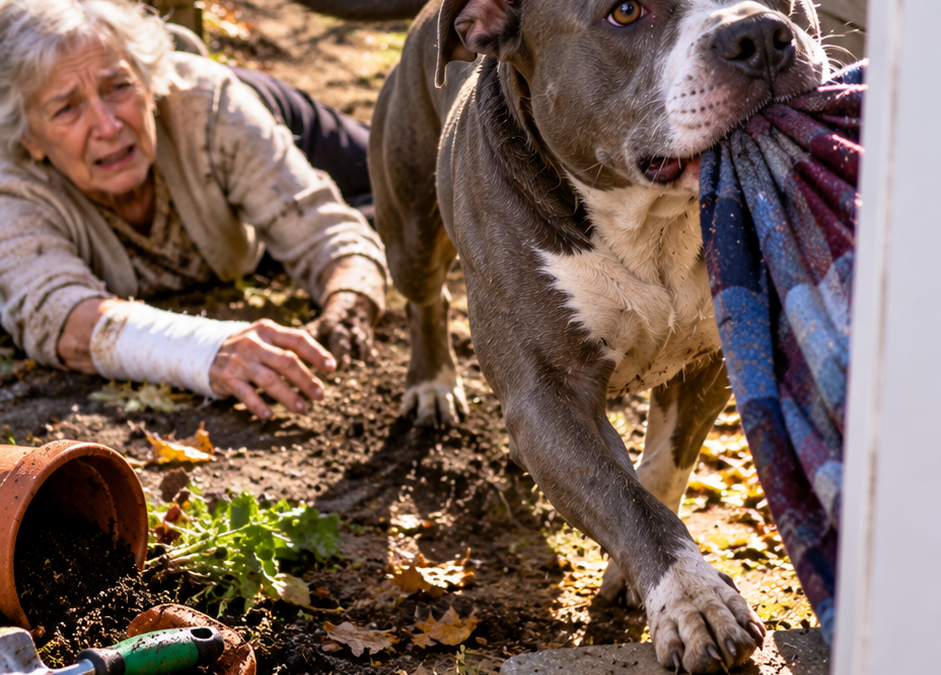
𝗙𝗨𝗟𝗟 𝗦𝗧𝗢𝗥𝗬
The word disappeared into the yard.
No answer.
I tried again.
Louder.
“HELP!”
Pain pulsed through my arm.
I stopped.
At seventy-five, you become aware that energy is a resource.
I was already sweating.
The sun was rising.
There was no water within reach.
I forced myself to breathe slowly.
In.
Out.
Don’t panic.
Think.
The garden was about forty feet from the house.
Forty feet might as well have been forty miles.
Could I crawl?
Maybe.
I tried shifting onto my left side.
The injured wrist moved slightly.
Pain shot through my arm.
I cried out.
That was when Nellie heard me.
I did not see the exact second she woke beneath the kitchen chair.
I have imagined it many times since.
Her head lifting.
Ears forward.
Listening.
Maybe the first cry sounded like any strange noise from outside.
Then I cried again.
“Nellie!”
A few seconds later, she exploded through the open screen door.
Gray and white across the lawn.
Fast.
Focused.
Her ears flattened backward from speed.
She reached the garden and stopped so suddenly dirt shifted beneath her paws.
“Nellie.”
She stared at me.
I had seen that dog confused.
Excited.
Afraid.
Hungry.
Playful.
Stubborn.
I had never seen the expression she wore then.
She looked at my face.
Then my arm.
Then around us.
Her body became tense.
Not panicked.
Thinking.
I know people will tell me dogs don’t think the way humans do.
Fine.
Use any word you want.
But Nellie was assessing something.
I expected her to come lie beside me.
That was what she normally did if I sat on the ground.
Instead, she began circling.
One circle.
Two.
Three.
Quick, tight loops around me.
Each time, she came closer to my face.
“Nellie, stop.”
She didn’t.
Four.
Five.
Then she planted herself in front of me.
Her front legs lowered slightly.
And she barked.
One sharp bark.
Pause.
Another.
Pause.
Another.
Not her mailman bark.
Not the ridiculous sound she made at squirrels.
These were controlled.
Short.
Insistent.
She faced the house.
Bark.
Pause.
Bark.
I stared at her.
“Nobody’s there.”
Another bark.
Then Nellie ran.
Straight toward the back door.
For one absurd second, I thought she was leaving me.
“Nellie!”
She reached the porch.
Turned.
Ran back.
Stopped beside me.
Panted.
Looked at my face.
Then looked at the house.
Then back at me.
I understood the question even though no words existed.
There?
Is help there?
“Nellie.”
My voice shook.
“The phone.”
Of course that meant nothing to her.
Or so I thought.
“The phone is inside.”
She ran back toward the house.
Returned.
Again.
House.
Me.
House.
Me.
Six times.
I counted because counting gave my mind something to do besides pain.
By the sixth trip, she stayed beside me longer.
Her tongue hung from her mouth.
She looked frustrated.
I knew why.
The doors.
I had closed them before gardening.
Habit.
When you live alone, you lock things.
Even in a quiet neighborhood.
“Nellie.”
I swallowed.
“The door’s closed.”
She stopped panting for a second.
“The door is closed, baby.”
She looked toward the house.
Then toward me.
“I’m sorry.”
I don’t know why I apologized to her.
Maybe because she was trying so desperately to solve a problem I had created.
Nellie stood still.
Then she turned.
Ran toward the house again.
But this time she did not stop at the door.
She disappeared around the side.
“Nellie?”
No answer.
I heard paws on dry grass.
Then wood.
The back deck.
Then something metal.
Scraping.
I frowned.
“Nellie!”
Scrape.
A harsh tearing sound.
Then a thump.
My heart started racing.
Behind the house, below the edge of the small deck, Frank had installed a basement ventilation opening years earlier.
It was not meant for entry.
It was covered with old wire mesh.
Maybe eight inches across at its widest point.
I barely thought about it.
Apparently Nellie had.
I heard more scraping.
Metal bending.
Then silence.
“Nellie?”
For several seconds, nothing.
Then—
Claws on linoleum.
Inside the kitchen.
I stopped breathing.
“No.”
There was no possible way.
Nellie weighed sixty-one pounds.
That opening was tiny.
Later, I examined it myself.
I still cannot understand how she got through.
Maybe she widened it by pulling the rusted wire away.
Maybe the frame was looser than I realized.
Maybe desperation makes bodies attempt things they normally would not.
All I know is that I heard my dog’s claws running inside my locked house.
“Nellie!”
She ran across the kitchen.
Then came a heavy thump.
Something hit furniture.
Another thump.
Then—
Crash.
My phone.
I knew the sound immediately.
Glass or plastic against tile.
I closed my eyes.
“Oh, Nellie.”
I had left the phone charging on the kitchen table.
Nellie was never allowed on that table.
Never.
Four years.
Not once.
That morning, I heard her jump.
I heard the phone hit the floor.
Then silence.
Long.
Terrible.
I lay in the garden wondering whether she had broken the phone.
Whether she had pushed it somewhere unreachable.
Whether she was now trapped inside.
Whether I had simply made everything worse.
“Nellie.”
My voice came out as a whisper.
The sun warmed the left side of my face.
My mouth had become dry.
I checked the wrist.
Bad idea.
Pain rolled through me again.
I breathed slowly.
Then I heard a sound from inside.
Tap.
Scrape.
Tap.
Something on the phone screen.
I remembered that Laura’s number was pinned among my emergency contacts.
I had also used voice calling enough times that certain touches sometimes brought up recent contacts.
But a dog could not deliberately use a smartphone.
Could she?
The phone produced a faint electronic tone.
Then another.
I heard Nellie bark.
Loudly.
Then a voice.
Far away.
Tinny.
But unmistakable.
“Mom?”
My heart stopped.
“Mom?”
Laura.
Then louder:
“MOM?”
I started crying before I answered.
“I’m here.”
“Mom, what’s happening?”
Nellie barked.
Laura spoke quickly.
“I can hear Nellie. Why did your phone call me? What happened?”
“I fell.”
“What?”
“In the garden.”
My voice sounded weaker than I expected.
“I fell in the vegetable garden.”
“Are you hurt?”
“I think I broke my wrist.”
“Can you stand?”
“I don’t know.”
“Don’t.”
Immediate.
Firm.
My daughter.
Forty-five years old and suddenly speaking to me with the authority I had once used on her.
“Do not try to stand.”
“I wasn’t planning—”
“Mom.”
“I’m lying still.”
“Are you bleeding?”
“No.”
“Dizzy?”
“A little.”
“Where’s the phone?”
I almost laughed.
“Inside.”
Silence.
“What?”
“Nellie got inside.”
“How?”
“I have absolutely no idea.”
Nellie barked again.
Laura’s voice changed.
Fear.
She was trying to hide it.
I knew because mothers recognize the tones their children think they have outgrown.
“I’m calling emergency services.”
“Laura—”
“And Jack.”
“He’s not home.”
“I’ll call anyway.”
“Okay.”
“I’m leaving now.”
“No need to drive like—”
“Do not give me driving advice right now.”
Despite everything, I smiled.
Then Laura said, “Don’t hang up.”
“I won’t.”
But the phone was not in my hand.
It was somewhere inside the kitchen.
I couldn’t reach it.
Nellie barked again.
“Laura?”
“I’m here!”
“Nellie made the call.”
“I know.”
“No, sweetheart.”
My eyes filled.
“I mean she really made the call.”
Laura became quiet.
“I know.”
I don’t remember exactly when the connection ended.
Perhaps Nellie’s paw hit the screen.
Perhaps the phone slipped somewhere.
All I know is that Laura’s voice disappeared.
I was alone again.
Almost.
A few moments later, Nellie came out.
How she exited that opening, I cannot tell you.
Maybe she forced herself all the way through.
Maybe part of the vent gave way.
I later saw bent wire and gray fur caught along one edge.
Her side had a small scrape.
Nothing serious.
She ran back to me.
I expected her to sit near my head.
Instead, she pressed her entire body along my left side.
Chest against my ribs.
Warm.
Solid.
I could feel her heartbeat.
Fast.
Hard.
Her breath touched my neck.
Then she rested her head on my shoulder.
The position reminded me so strongly of Frank that another wave of tears came.
When we were young, Frank used to sit beside me on the sofa and rest his head against my shoulder during television programs.
He always denied doing it.
“You leaned into me.”
“I did not.”
“You absolutely did.”
Now Nellie’s weight rested in almost the same place.
I lifted my good hand and touched her neck.
“You did good.”
Her ears moved.
“Very good.”
She lifted her head.
Then began barking toward the road.
Not loudly.
Rhythmically.
Bark.
Pause.
Bark.
Pause.
“We’re here,” I whispered.
Another bark.
“Tell them.”
She did.
I don’t know how long eighteen minutes feels under normal circumstances.
On the ground with a broken wrist, no shade, and no idea whether your daughter has successfully reached anyone, eighteen minutes becomes an entire season.
I watched the edge of the garden.
Listened.
Nellie barked.
Then paused to look at me.
Then barked again.
At one point, I felt tired.
Too tired.
My eyelids wanted to close.
“No.”
I said it aloud.
Nellie immediately turned.
She licked my cheek.
“I’m awake.”
Another lick.
“Stop.”
She licked my nose.
I laughed weakly.
“Disgusting.”
Tail.
That helped.
Then I heard tires.
Nellie heard them first.
Her body lifted.
Ears forward.
Another engine.
Two vehicles.
“Laura.”
I tried sitting.
Pain stopped me.
Nellie barked continuously now.
A gate opened somewhere.
Voices.
“Mrs.—?”
“Back here!”
My voice wasn’t strong.
Nellie barked louder.
Footsteps ran.
Two young men came over the fence because the back gate had jammed.
Emergency responders.
One had reddish hair.
The other dark hair and glasses.
They saw me.
Then Nellie.
The red-haired one stopped.
“Pit bull.”
He said it to his partner.
“Careful.”
Pain disappeared beneath anger.
I raised my head.
“Don’t.”
They both looked at me.
“Ma’am, we need to get close to you.”
“You can.”
I pointed weakly with my good hand.
“But if you hurt that dog, I refuse treatment.”
The red-haired responder blinked.
“Ma’am—”
“She saved me.”
Nellie stood.
Tail low but moving.
“Do you hear me?”
The other responder nodded.
“We hear you.”
The red-haired man crouched a few feet away.
He extended his hand slowly.
Palm down at first, then turned slightly.
Nellie looked at me.
I touched her shoulder.
“It’s okay.”
She approached.
Sniffed him.
Her tail moved once.
Then again.
He gently touched the top of her head.
No growl.
No tension.
Nellie returned to my side.
The responder looked at his partner.
“She’s fine.”
“Of course she’s fine.”
My voice had regained remarkable strength.
“I told you.”
The other man smiled.
“Yes, ma’am.”
They began examining me.
Questions.
Name.
Age.
Medication.
Head injury.
Loss of consciousness.
Pain scale.
“I hate that question.”
“What question?”
“Pain from one to ten.”
The dark-haired responder smiled.
“Why?”
“Because if I say ten, you’ll think I’m dramatic.”
“No.”
“If I say six, you’ll think I’m fine.”
“Fair.”
“Eight.”
He nodded.
“Eight it is.”
Laura arrived before they had finished stabilizing my wrist.
I heard her before I saw her.
“Mom!”
She came through the yard.
Face pale.
Hair half tied back.
“Laura.”
She dropped beside me.
“Don’t ever do that again.”
I almost laughed.
“I didn’t schedule it.”
She hugged me awkwardly around the medical equipment.
Then noticed Nellie.
The dog stood several feet away now, watching.
Laura looked at her.
“You.”
Nellie’s tail moved.
Laura crawled over and wrapped her arms around the dog’s neck.
“I don’t know how you did that.”
Nellie licked her cheek.
Laura laughed and cried at the same time.
“I don’t even care.”
The responders placed me onto a stretcher.
Nellie became anxious.
The moment they lifted me, she moved forward.
“It’s okay.”
She whined.
“I’m going with them.”
She tried following.
Laura held her collar.
“I’ve got her, Mom.”
“Nellie.”
The dog looked at me.
“I’ll come back.”
I don’t know whether dogs understand promises.
But Nellie stopped pulling.
She sat beside Laura.
Watching.
The ambulance ride was not cinematic.
No sirens screaming through intersections.
No dramatic helicopter.
Just a boxy vehicle that bounced over every pothole in the county.
The red-haired responder sat beside me.
He checked my blood pressure.
“Your dog is something.”
“Yes.”
He smiled.
“I’m sorry about what I said.”
“About her being a pit bull?”
“Yeah.”
I looked at him.
“You were being cautious.”
“I was making an assumption.”
“Both can be true.”
He nodded.
I appreciated that.
“What’s her name?”
“Nellie.”
“How long have you had her?”
“Four years.”
“Training?”
“Basic obedience.”
“Service training?”
“No.”
“Emergency response?”
I laughed.
“Absolutely not.”
He shook his head.
“She got your phone?”
“Apparently.”
“And called your daughter?”
“Apparently.”
“That’s…”
He stopped.
“Impossible?”
“I was going to say unbelievable.”
“So was I.”
At the hospital, X-rays confirmed what I already knew.
The wrist was broken in three places.
The orthopedic surgeon looked at the images.
“You’re lucky.”
“People keep saying that.”
“At seventy-five, falls can become much worse.”
“I know.”
“You didn’t hit your head.”
“No.”
“No hip fracture.”
“No.”
“And someone found you quickly.”
I looked toward the window.
“Not someone.”
He smiled politely.
“Your dog?”
“Nellie.”
“Nellie.”
He checked my chart.
“How long were you outside?”
“Under twenty minutes after the call, I think.”
He nodded.
“That’s important.”
Later, another doctor discussed dehydration and heat exposure.
“If you’d remained out there another hour, especially in direct sun, we could have been dealing with cardiac stress in addition to the fracture.”
I stared at him.
“An hour?”
“Possibly less depending on hydration.”
I thought about the garden.
Phone inside.
Locked doors.
No neighbors.
Then Nellie tearing through the vent.
“I wasn’t lucky.”
The doctor looked at me.
“I had Nellie.”
He didn’t argue.
I stayed in the hospital for two days.
I hated almost every minute.
Hospitals are places where everyone tells you to rest while interrupting you every forty minutes.
Laura stayed as much as she could.
When she left, it was usually to care for Nellie.
Every phone call began the same way.
“How is she?”
Laura would sigh.
“You’re the patient.”
“Answer.”
“She’s fine.”
“Eating?”
“Yes.”
“Drinking?”
“Yes.”
“Sleeping?”
“Not much.”
That worried me.
“What is she doing?”
“Sitting near the back door.”
My throat tightened.
“Looking at the garden?”
“Yes.”
Silence.
Then Laura said, “Mom, she keeps going to where you fell.”
I turned my face away so she wouldn’t hear my voice change.
“Tell her I’m coming home.”
“I do.”
“Every time?”
“Every time.”
The doctor wanted to keep me another night.
I refused.
“Mrs.—”
“Doctor.”
“We’d prefer twenty-four more hours of observation.”
“My dog is waiting.”
He stared.
I held up my cast.
“My heart works.”
“Your wrist doesn’t.”
“I have another one.”
He smiled despite himself.
“Your daughter says you’re stubborn.”
“My daughter talks too much.”
Eventually, they discharged me with instructions that filled several pages.
No lifting.
Keep the cast dry.
Medication.
Follow-up.
Call if swelling worsened.
And, apparently, stop falling in vegetable gardens.
Laura drove me home.
The moment we turned onto my street, my heart began beating faster.
“Slow down.”
“I’m doing thirty.”
“Slower.”
“Mom.”
“Just slow down.”
She did.
The house looked completely ordinary.
That almost made me cry.
Same porch.
Same windows.
Same garden.
The vent behind the house was now bent open and surrounded by broken wire.
Evidence.
Laura parked.
“Ready?”
“Yes.”
She helped me out.
The front door opened.
Jack had been inside with Nellie.
The dog stood in the hallway.
She did not charge toward me.
That surprised me.
She simply stared.
Her tail moved.
Left.
Right.
Left.
Right.
Slowly.
“Hi.”
Nellie took one step.
Stopped.
I moved toward her.
Another tail sweep.
“Come here.”
That was enough.
She crossed the distance.
I couldn’t kneel properly.
I didn’t care.
I lowered myself onto the floor with Laura helping.
My cast stuck awkwardly beside me.
Then I put my good arm around Nellie.
She pressed into me.
Hard.
I buried my face in her fur.
“Thank you.”
Her tongue hit my ear.
“Thank you.”
My nose.
“Nellie.”
My chin.
I started laughing.
Real laughter.
Painful laughter because my arm hurt every time my body moved.
“Stop!”
She licked the tears from my cheeks.
Laura sat on the floor beside us.
She was crying too.
“She’s ridiculous.”
“She’s perfect.”
Nellie sneezed.
“See?”
That night, something changed.
For four years, Nellie had never been allowed on my bed.
I had rules.
Dogs had beds.
People had beds.
Nellie’s bed was expensive, padded, and far more luxurious than anything dogs had when I was young.
There was no reason for her to sleep on mine.
That night, I woke around midnight.
Nellie stood in the bedroom doorway.
Watching.
“What?”
She didn’t move.
“You have a bed.”
Tail.
“Nellie.”
One step.
“No.”
Another.
“You are taking advantage of my injury.”
She approached the side of the bed.
Put her chin on the mattress.
I stared at her.
Frank would have laughed.
He had been the one constantly suggesting dogs belonged on furniture.
I had been the strict one.
I moved toward the far side.
“One night.”
Nellie jumped carefully onto the bed.
Turned three circles.
Lay beside me.
Head on the edge of my pillow.
I looked at her.
“This is absurd.”
One eye opened.
“One night.”
That was years ago.
She still sleeps there.
The morning after I came home, I wrote a letter.
I don’t know why.
Maybe because the experience had shaken loose emotions I didn’t know what to do with.
I used the fountain pen Frank gave me on our twentieth anniversary.
I sat at the kitchen table.
Nellie slept beneath the velvet chair.
I wrote:
Nellie,
I am sorry for every time I let someone make me doubt what I already knew about you.
I am sorry for every moment I thought a label mattered more than the dog standing in front of me.
You were braver that morning than I was.
You understood something I didn’t teach you.
You stayed.
You tried again when the first solution failed.
Then again.
Then again.
You did not care whether the door was locked.
You did not care whether climbing through that vent made sense.
You simply knew I needed help.
And you found a way.
I stopped there.
Cried.
Then continued.
Frank used to say character shows itself when plans fail.
I thought he was talking about people.
Maybe he was talking about you too.
I folded the letter.
Put it in the drawer beside Frank’s old letters.
No one else needed to read it.
Writing it was enough.
Recovery took longer than I wanted.
Broken bones do not respect impatience.
For weeks, Laura came by constantly.
Jack repaired the damaged vent.
I told him not to make it too secure.
He stared at me.
“What?”
“If Nellie ever needs to get inside again.”
He laughed.
“She destroyed half of it.”
“Good.”
“Margaret, that’s not what vents are for.”
“I know.”
We compromised.
He repaired it properly.
But he also installed a dog door through the back entry.
Nellie inspected it suspiciously.
“That is yours.”
She looked at me.
“You don’t have to commit burglary anymore.”
She eventually learned to use it.
My neighbors changed too.
Not immediately.
Stories travel quickly in small neighborhoods.
Within a week, everyone knew.
Some versions claimed Nellie had dialed emergency services herself.
Not exactly.
Another version said she had dragged me into shade.
She hadn’t.
By the third version, she had apparently climbed through a second-story window.
I corrected people.
“The truth is impressive enough.”
A woman from three houses down came by with her grandson.
For years, she had crossed the street when walking past us.
She stood at the gate.
“Can he meet Nellie?”
I almost said something unkind.
Then I looked at the boy.
Maybe seven.
Nervous.
Curious.
“Of course.”
Nellie came outside.
The grandmother stiffened.
Nellie sat.
The boy held out his hand.
“Slowly,” I said.
He approached.
Nellie sniffed.
Tail.
He touched her head.
Then behind her ears.
She leaned into him.
The boy smiled.
“She’s soft.”
“Very.”
His grandmother looked embarrassed.
“I may have judged her.”
I appreciated the honesty.
“Most people do.”
Nellie looked at me.
There it was again.
That expression I had begun interpreting however it suited me.
See?
Good dog.
“I know,” I told her.
After that, other neighbors came.
Children who had been warned to stay away.
Adults who had never met her.
Nellie sat.
Accepted hands.
Sometimes rolled onto her back demanding belly rubs, which ruined whatever dignity the story had given her.
The emergency responder with red hair visited too.
His name was Ethan.
He came by one afternoon carrying dog treats.
“I thought I owed her.”
Nellie recognized him.
Or recognized the bag.
Hard to say.
He crouched.
“Hi, hero.”
Nellie’s tail turned violent.
“You’re buying her affection.”
“I thought that’s how this works.”
“It is.”
He gave her a treat.
Then another.
I pointed.
“One more and you’re responsible for dinner.”
He laughed.
Before leaving, he touched the bent piece of old wire Jack had saved from the vent.
“She went through that?”
“Yes.”
He shook his head.
“Still don’t believe it.”
“Neither do I.”
That was the truth.
People wanted me to explain Nellie’s behavior.
Training?
Instinct?
Accident?
Did she deliberately hit the phone?
Did she recognize Laura’s picture?
Had she seen me use it enough times to imitate me?
I don’t know.
I refuse to pretend certainty makes the story better.
What I know is this:
She heard me.
She came.
She recognized something was wrong.
She tried the house.
The door was locked.
She found another route.
She got inside.
She knocked down my phone.
A call reached Laura.
Then Nellie returned to me and stayed until help arrived.
Those are facts.
Everything else belongs to mystery.
Maybe that is part of why the memory remains so powerful.
Some intelligence is easy to measure.
Sit.
Stay.
Come.
Find.
But what do you call the ability to keep solving a problem after every obvious option fails?
I call it Nellie.
My wrist healed.
Slowly.
Three fractures meant weeks in a cast, then exercises.
The first day I returned to the vegetable garden, Laura nearly had a heart attack.
“Absolutely not.”
“I’m standing five feet from the porch.”
“That’s where it happened.”
“The garden isn’t cursed.”
“Mom.”
Nellie stood between us.
Laura pointed at her.
“You watch her.”
Nellie wagged.
“Traitor,” I said.
I started carefully.
No heavy tools.
No reaching.
No stepping backward.
And Nellie stayed beside me.
Not under the kitchen chair.
Not even on the porch.
Beside me.
For almost an hour.
Every time I moved from one raised bed to another, she moved too.
“You’re hovering.”
Tail.
“I’m fine.”
Tail.
“You did your job.”
Nellie sat.
Apparently she had decided her job description had expanded.
I allowed it.
Some months later, I found myself thinking about the moment the responder had said:
It’s a pit bull. Be careful.
I wasn’t angry anymore.
Caution around an unknown dog is sensible.
But labels become dangerous when caution turns into certainty.
People had seen Nellie’s body and written the story before meeting her.
Broad head.
Strong jaw.
Muscular chest.
Therefore dangerous.
They missed the dog who slept under a velvet chair.
The dog who watched chickens without chasing them.
The dog who recognized pain before I could tell her what was wrong.
The dog who tore through rusty wire because the person she loved couldn’t reach a phone.
I don’t believe Nellie proved every dog is safe.
That would be foolish.
Dogs are individuals.
They have histories.
Temperaments.
Limits.
They deserve to be understood as individuals.
That is exactly the point.
Nellie had spent years being judged by what people expected her to be.
Then, on the worst morning of my life, she showed us exactly who she was.
Brave.
Persistent.
Gentle.
Smart.
Mine.
Laura eventually stopped asking me to move.
Mostly.
She did install more safety measures.
A wearable emergency button.
A second phone charger near the back door.
Grab rails.
A water bottle station near the garden.
I complained about all of them.
Then used all of them.
“You’re becoming reasonable,” she said.
“Don’t tell anyone.”
Nellie supervised the installations.
Naturally.
The little emergency button hung around my neck whenever I gardened.
I showed it to Nellie.
“This means you can retire.”
She sniffed it.
“You don’t need to call anyone anymore.”
She looked toward the garden.
“You’re still coming with me, aren’t you?”
Tail.
Yes.
The answer was yes.
One evening, about a year after the accident, Laura and I sat outside while Nellie slept between our chairs.
The sun was setting behind the fence.
Laura said, “Do you ever think about what would’ve happened if she hadn’t been there?”
“No.”
She looked at me.
“Never?”
“I used to.”
“And now?”
“I don’t.”
“Why?”
Because there are questions that create only pain.
What if Nellie had been outside somewhere else?
What if the vent had been stronger?
What if my phone had landed face down?
What if Laura hadn’t answered?
What if help had taken an hour?
You can build entire tragedies out of events that never happened.
I had no interest.
“What happened is enough,” I said.
Laura nodded.
Then looked down at Nellie.
“She saved you.”
“Yes.”
The word saved used to embarrass me.
It sounded dramatic.
Now I accept it.
Nellie saved me.
Not by pulling me from a river.
Not by fighting an attacker.
Not by doing anything she’d been taught.
She saved me because she refused to stop when the obvious solution failed.
That mattered.
I reached down.
Nellie opened one eye.
“Good girl.”
Tail.
Even now, years later, she watches me differently in the garden.
Maybe I’m imagining it.
Probably.
But if I stumble even slightly, her head comes up.
If I sit on the ground, she approaches immediately.
Once, I intentionally sat beside the tomatoes to weed.
Nellie appeared.
Stared.
“I’m fine.”
No movement.
“Really.”
She came closer.
“I am sitting voluntarily.”
She touched my shoulder with her nose.
“See?”
She remained beside me anyway.
I let her.
At seventy-five, I thought independence meant doing everything myself.
That accident changed my definition.
Independence is not refusing help.
Sometimes independence survives because someone—or some dog—is willing to help when you cannot help yourself.
Frank had taught me part of that.
Marriage does.
You spend decades leaning on another person in tiny ways you barely notice.
After he died, I became determined to prove I could manage alone.
Then Nellie arrived.
Four years later, I discovered I had never actually been alone.
That knowledge changed something in me.
Not weakness.
Something better.
Trust.
The night Nellie first climbed onto my bed after the hospital, I told her she could stay only once.
She has slept beside me nearly every night since.
Sometimes she takes most of the pillow.
Sometimes she snores.
Sometimes she dreams and her paws twitch.
When that happens, I put one hand on her back.
“It’s okay.”
Her breathing settles.
Other nights, I wake and find her already watching me.
“What?”
Tail.
“I’m alive.”
She lowers her head.
I laugh.
“We’re both becoming ridiculous.”
Maybe we are.
I don’t mind.
The old velvet chair is still in the kitchen.
Nellie still sleeps beneath it during the day.
My phone now stays in my pocket whenever I go outside.
The garden beds are still there.
Jack reinforced the boards.
Laura added a small bench in the shade.
The damaged piece of wire from the basement vent hangs in my garage.
I kept it.
Not as a trophy.
As evidence.
When people doubt the story, I show them.
“She fit through that?”
“Apparently.”
“Impossible.”
“Tell Nellie.”
Nellie usually sits nearby looking uninterested in her own legend.
That’s another thing I admire about dogs.
They don’t build identities around their best moment.
Nellie did something extraordinary.
Then went back to being Nellie.
Eating.
Sleeping.
Stealing warm spots.
Following me to the garden.
Demanding scratches.
The world called her a hero.
She wanted dinner.
There is wisdom in that.
My letter to her remains in the drawer beside Frank’s.
Sometimes I read it.
Most of the time I don’t need to.
The important part wasn’t what I wrote.
It was that I finally understood something.
Courage doesn’t always look the way we expect.
Neither does intelligence.
Neither does goodness.
Sometimes goodness has a broad head, a powerful jaw, sixty-one pounds of muscle, and a reputation it never earned.
Sometimes it sleeps beneath a kitchen chair.
And sometimes, when a seventy-five-year-old woman falls alone in a garden and every reasonable path to help is closed, goodness tears through rusty wire, knocks a phone off a table, and refuses to leave her side.
People still ask me how Nellie knew.
I give them the same answer.
“I don’t know.”
Then they ask how she called Laura.
“I don’t know exactly.”
“Did you train her?”
“No.”
“Had she done anything like that before?”
“Never.”
“But she understood?”
I look at Nellie.
At those eyes.
At the same dog who once ran six times between me and a locked house because she knew there had to be an answer somewhere.
“Yes.”
That part I know.
She understood enough.
Maybe that is all any of us ever do.
We don’t need to understand the whole emergency.
We only need to understand that someone needs us.
Then we try.
And if one way fails, we try another.
Nellie taught me that.
More importantly, she lived it.
I am older now than I was that morning.
So is she.
Her muzzle has begun turning white.
She gets up more slowly.
Sometimes I help her onto the bed she once invited herself onto.
Life has a sense of symmetry.
She once stayed beside me because I could not stand.
Now, on stiff mornings, I wait beside her while she finds her footing.
“Take your time.”
She looks at me.
“No rush.”
Eventually she rises.
We walk to the kitchen.
Tea for me.
Breakfast for her.
Then the garden.
Always the garden.
One morning last spring, I sat on the bench Laura had installed.
Nellie lay at my feet.
A neighbor walked past with two children.
Years ago, that same neighbor would have pulled them away from the fence.
This time, the little girl called:
“Hi, Nellie!”
Nellie’s tail moved.
“Can we pet her?”
“Ask her.”
The children approached.
Nellie stood.
Sniffed both hands.
Then sat.
Two little hands touched her head.
Another scratched behind her ears.
Nellie closed her eyes.
The mother smiled at me.
“She’s such a good dog.”
I looked down at Nellie.
For years, I had said those words when nobody believed me.
Now I didn’t need to argue.
“I know.”
Nellie opened one eye.
And I swear the look she gave me said the same thing it always has.
I told you.
That night, she climbed into bed.
I turned off the lamp.
Her body settled beside mine.
I put my hand on her shoulder.
For a moment, I remembered the vegetable garden.
The broken wrist.
The sun.
The phone inside.
The sound of wire tearing behind the house.
Laura’s frightened voice.
The ambulance.
The hospital.
Then I let the memory go.
Because the most important part is not the moment I fell.
It is everything that happened after Nellie heard me.
She came.
She understood.
She tried.
She failed.
She tried again.
She found another way.
And when help was finally on its way, she returned to lie against me so I would not have to wait alone.
That last part matters most.
The phone call saved time.
The responders saved my wrist from further damage and protected me from dehydration.
But Nellie did something beyond logistics.
She stayed.
Her heartbeat against my ribs told me I was not alone.
Her breathing against my neck gave me something to concentrate on besides pain.
Her barking told the road where we were.
And every time my eyes wanted to close, that warm, stubborn body reminded me there was still something beside me worth staying awake for.
So yes, I call her the best dog in the world.
I know millions of people say the same thing about their dogs.
They’re probably right too.
But this one is mine.
My Nellie.
The pit bull people once crossed the street to avoid.
The dog a responder saw and instinctively warned his partner about.
The dog children were told not to touch.
The same dog who, when I was helpless and alone, became the only creature on earth who understood that something had gone wrong and refused to accept that there was nothing she could do.
I will never know exactly what happened inside her mind that morning.
I don’t need to.
I know what happened inside her heart.
She heard me.
And she came.
For the rest of my life, that will be enough.
𝗧𝗛𝗘 𝗘𝗡𝗗
At Seventy-Five, I Fell Alone in My Garden With a Broken Wrist, and the Dog Everyone Feared Was the Only One Who Knew How to Save Me
At seventy-five years old, I learned how quickly an ordinary morning can become dangerous.
One moment, I was standing between the raised garden beds behind my house, pulling weeds from around the tomatoes.
The next, I was on the ground.
My wrist was broken.
My phone was inside the house.
The doors were locked.
And the only living creature close enough to help me was the pit bull my neighbors had spent years telling their children to avoid.
Her name was Nellie.
What she did that morning is something I still struggle to explain.
Not because I don’t remember it.
I remember every second.
I struggle because even now, after replaying it hundreds of times, I still don’t understand how she knew what to do.
I had been living alone since my husband, Frank, died.
By then, solitude had become less frightening than familiar.
People worried about me.
My daughter Laura worried most.
“Mom, you should move somewhere smaller.”
“No.”
“Somewhere without stairs.”
“No.”
“At least closer to me.”
“You live twenty minutes away.”
“Exactly.”
“That is already too close.”
She would sigh.
I would smile.
We had the same argument every few months.
The truth was, I didn’t want to leave the house.
Frank and I had spent most of our marriage there.
He had built the wooden borders around the vegetable garden with our neighbor Jack nearly thirty years earlier.
He had planted the apple tree.
He had repaired the porch.
He had installed the little basement vent behind the house that I never thought about until the day it saved my life.
Every corner carried something of him.
Leaving felt less like moving and more like abandoning a person who was no longer physically there to object.
So I stayed.
I gardened.
I cooked.
I read.
I called Laura every evening.
And four years before my fall, Nellie entered my life.
She was sixty-one pounds of gray-and-white muscle, broad-headed, strong-chested, and equipped with the kind of face that made certain people cross the street before they knew anything about her.
I had heard every warning.
“Be careful with that breed.”
“You never know.”
“Those dogs can turn.”
“Don’t let her around children.”
The interesting thing was that most of the people saying these things had never touched Nellie.
They didn’t know that she slept beneath the velvet kitchen chair because she liked being near my feet.
They didn’t know she was frightened of the vacuum cleaner.
They didn’t know she refused to step into puddles unless I went first.
They didn’t know she would sit beside the chicken enclosure for an hour without bothering a bird.
They didn’t know that when thunderstorms came, she pressed herself against my legs but pretended she wasn’t nervous.
To them, she was a pit bull.
To me, she was Nellie.
She had routines.
So did I.
Every morning, I made tea at seven.
Nellie ate at seven-fifteen.
At seven-thirty, she inspected the backyard as though she had been appointed by the city.
After that, I usually worked in the garden.
Nellie would eventually get bored and return to the kitchen, where she slept beneath the velvet chair near the back door.
That morning began exactly that way.
The sky was clear.
The air was already warming.
I remember thinking I should finish before the sun became too strong.
At my age, heat is not something to challenge out of pride.
I had a small basket beside me.
Tomatoes.
A few green beans.
Two cucumbers.
I moved from one raised bed to the next.
The ground between them was dry but uneven.
I had walked across it thousands of times.
That may have been the problem.
Familiar places make you careless.
I stepped backward.
My heel caught the edge of one of the wooden boards.
I tried to correct myself.
For half a second, I thought I had.
Then my balance disappeared.
I fell sideways.
Instinct made me put out my right hand.
I heard the sound before I understood the pain.
A dull crack.
Not loud.
But unmistakable.
My body hit the ground.
For several seconds, I simply lay there.
No screaming.
No dramatic panic.
Just confusion.
I stared at the sky.
Blue.
Completely blue.
A bird crossed above me.
I remember thinking how strange it was that the world looked exactly the same when something inside your body had just gone badly wrong.
Then the pain arrived.
Heavy.
Deep.
Not sharp the way I expected a fracture to feel.
It felt as though someone had pushed a stone inside my forearm and was slowly increasing the pressure.
I tried to sit up.
My wrist moved.
I almost blacked out.
“Oh God.”
I fell back.
My breathing became shallow.
The right wrist had already begun swelling.
I could see that the shape was wrong.
Not grotesquely wrong.
Just enough.
Enough to know.
Broken.
“Laura.”
Of course Laura wasn’t there.
No one was.
Jack, the neighbor, had gone somewhere that morning.
His truck wasn’t in the driveway.
The houses on the other side were farther away than they looked.
My phone was on the kitchen table.
I always carried it outside.
Except that morning.
Because the battery had been charging.
Because I planned to be in the garden only twenty minutes.
Because emergencies are very good at selecting the one day you break your own rules.
I shouted.
“Help!”
The word disappeared into the yard.
No answer.
I tried again.
Louder.
“HELP!”
Pain pulsed through my arm.
I stopped.
At seventy-five, you become aware that energy is a resource.
I was already sweating.
The sun was rising.
There was no water within reach.
I forced myself to breathe slowly.
In.
Out.
Don’t panic.
Think.
The garden was about forty feet from the house.
Forty feet might as well have been forty miles.
Could I crawl?
Maybe.
I tried shifting onto my left side.
The injured wrist moved slightly.
Pain shot through my arm.
I cried out.
That was when Nellie heard me.
I did not see the exact second she woke beneath the kitchen chair.
I have imagined it many times since.
Her head lifting.
Ears forward.
Listening.
Maybe the first cry sounded like any strange noise from outside.
Then I cried again.
“Nellie!”
A few seconds later, she exploded through the open screen door.
Gray and white across the lawn.
Fast.
Focused.
Her ears flattened backward from speed.
She reached the garden and stopped so suddenly dirt shifted beneath her paws.
“Nellie.”
She stared at me.
I had seen that dog confused.
Excited.
Afraid.
Hungry.
Playful.
Stubborn.
I had never seen the expression she wore then.
She looked at my face.
Then my arm.
Then around us.
Her body became tense.
Not panicked.
Thinking.
I know people will tell me dogs don’t think the way humans do.
Fine.
Use any word you want.
But Nellie was assessing something.
I expected her to come lie beside me.
That was what she normally did if I sat on the ground.
Instead, she began circling.
One circle.
Two.
Three.
Quick, tight loops around me.
Each time, she came closer to my face.
“Nellie, stop.”
She didn’t.
Four.
Five.
Then she planted herself in front of me.
Her front legs lowered slightly.
And she barked.
One sharp bark.
Pause.
Another.
Pause.
Another.
Not her mailman bark.
Not the ridiculous sound she made at squirrels.
These were controlled.
Short.
Insistent.
She faced the house.
Bark.
Pause.
Bark.
I stared at her.
“Nobody’s there.”
Another bark.
Then Nellie ran.
Straight toward the back door.
For one absurd second, I thought she was leaving me.
“Nellie!”
She reached the porch.
Turned.
Ran back.
Stopped beside me.
Panted.
Looked at my face.
Then looked at the house.
Then back at me.
I understood the question even though no words existed.
There?
Is help there?
“Nellie.”
My voice shook.
“The phone.”
Of course that meant nothing to her.
Or so I thought.
“The phone is inside.”
She ran back toward the house.
Returned.
Again.
House.
Me.
House.
Me.
Six times.
I counted because counting gave my mind something to do besides pain.
By the sixth trip, she stayed beside me longer.
Her tongue hung from her mouth.
She looked frustrated.
I knew why.
The doors.
I had closed them before gardening.
Habit.
When you live alone, you lock things.
Even in a quiet neighborhood.
“Nellie.”
I swallowed.
“The door’s closed.”
She stopped panting for a second.
“The door is closed, baby.”
She looked toward the house.
Then toward me.
“I’m sorry.”
I don’t know why I apologized to her.
Maybe because she was trying so desperately to solve a problem I had created.
Nellie stood still.
Then she turned.
Ran toward the house again.
But this time she did not stop at the door.
She disappeared around the side.
“Nellie?”
No answer.
I heard paws on dry grass.
Then wood.
The back deck.
Then something metal.
Scraping.
I frowned.
“Nellie!”
Scrape.
A harsh tearing sound.
Then a thump.
My heart started racing.
Behind the house, below the edge of the small deck, Frank had installed a basement ventilation opening years earlier.
It was not meant for entry.
It was covered with old wire mesh.
Maybe eight inches across at its widest point.
I barely thought about it.
Apparently Nellie had.
I heard more scraping.
Metal bending.
Then silence.
“Nellie?”
For several seconds, nothing.
Then—
Claws on linoleum.
Inside the kitchen.
I stopped breathing.
“No.”
There was no possible way.
Nellie weighed sixty-one pounds.
That opening was tiny.
Later, I examined it myself.
I still cannot understand how she got through.
Maybe she widened it by pulling the rusted wire away.
Maybe the frame was looser than I realized.
Maybe desperation makes bodies attempt things they normally would not.
All I know is that I heard my dog’s claws running inside my locked house.
“Nellie!”
She ran across the kitchen.
Then came a heavy thump.
Something hit furniture.
Another thump.
Then—
Crash.
My phone.
I knew the sound immediately.
Glass or plastic against tile.
I closed my eyes.
“Oh, Nellie.”
I had left the phone charging on the kitchen table.
Nellie was never allowed on that table.
Never.
Four years.
Not once.
That morning, I heard her jump.
I heard the phone hit the floor.
Then silence.
Long.
Terrible.
I lay in the garden wondering whether she had broken the phone.
Whether she had pushed it somewhere unreachable.
Whether she was now trapped inside.
Whether I had simply made everything worse.
“Nellie.”
My voice came out as a whisper.
The sun warmed the left side of my face.
My mouth had become dry.
I checked the wrist.
Bad idea.
Pain rolled through me again.
I breathed slowly.
Then I heard a sound from inside.
Tap.
Scrape.
Tap.
Something on the phone screen.
I remembered that Laura’s number was pinned among my emergency contacts.
I had also used voice calling enough times that certain touches sometimes brought up recent contacts.
But a dog could not deliberately use a smartphone.
Could she?
The phone produced a faint electronic tone.
Then another.
I heard Nellie bark.
Loudly.
Then a voice.
Far away.
Tinny.
But unmistakable.
“Mom?”
My heart stopped.
“Mom?”
Laura.
Then louder:
“MOM?”
I started crying before I answered.
“I’m here.”
“Mom, what’s happening?”
Nellie barked.
Laura spoke quickly.
“I can hear Nellie. Why did your phone call me? What happened?”
“I fell.”
“What?”
“In the garden.”
My voice sounded weaker than I expected.
“I fell in the vegetable garden.”
“Are you hurt?”
“I think I broke my wrist.”
“Can you stand?”
“I don’t know.”
“Don’t.”
Immediate.
Firm.
My daughter.
Forty-five years old and suddenly speaking to me with the authority I had once used on her.
“Do not try to stand.”
“I wasn’t planning—”
“Mom.”
“I’m lying still.”
“Are you bleeding?”
“No.”
“Dizzy?”
“A little.”
“Where’s the phone?”
I almost laughed.
“Inside.”
Silence.
“What?”
“Nellie got inside.”
“How?”
“I have absolutely no idea.”
Nellie barked again.
Laura’s voice changed.
Fear.
She was trying to hide it.
I knew because mothers recognize the tones their children think they have outgrown.
“I’m calling emergency services.”
“Laura—”
“And Jack.”
“He’s not home.”
“I’ll call anyway.”
“Okay.”
“I’m leaving now.”
“No need to drive like—”
“Do not give me driving advice right now.”
Despite everything, I smiled.
Then Laura said, “Don’t hang up.”
“I won’t.”
But the phone was not in my hand.
It was somewhere inside the kitchen.
I couldn’t reach it.
Nellie barked again.
“Laura?”
“I’m here!”
“Nellie made the call.”
“I know.”
“No, sweetheart.”
My eyes filled.
“I mean she really made the call.”
Laura became quiet.
“I know.”
I don’t remember exactly when the connection ended.
Perhaps Nellie’s paw hit the screen.
Perhaps the phone slipped somewhere.
All I know is that Laura’s voice disappeared.
I was alone again.
Almost.
A few moments later, Nellie came out.
How she exited that opening, I cannot tell you.
Maybe she forced herself all the way through.
Maybe part of the vent gave way.
I later saw bent wire and gray fur caught along one edge.
Her side had a small scrape.
Nothing serious.
She ran back to me.
I expected her to sit near my head.
Instead, she pressed her entire body along my left side.
Chest against my ribs.
Warm.
Solid.
I could feel her heartbeat.
Fast.
Hard.
Her breath touched my neck.
Then she rested her head on my shoulder.
The position reminded me so strongly of Frank that another wave of tears came.
When we were young, Frank used to sit beside me on the sofa and rest his head against my shoulder during television programs.
He always denied doing it.
“You leaned into me.”
“I did not.”
“You absolutely did.”
Now Nellie’s weight rested in almost the same place.
I lifted my good hand and touched her neck.
“You did good.”
Her ears moved.
“Very good.”
She lifted her head.
Then began barking toward the road.
Not loudly.
Rhythmically.
Bark.
Pause.
Bark.
Pause.
“We’re here,” I whispered.
Another bark.
“Tell them.”
She did.
I don’t know how long eighteen minutes feels under normal circumstances.
On the ground with a broken wrist, no shade, and no idea whether your daughter has successfully reached anyone, eighteen minutes becomes an entire season.
I watched the edge of the garden.
Listened.
Nellie barked.
Then paused to look at me.
Then barked again.
At one point, I felt tired.
Too tired.
My eyelids wanted to close.
“No.”
I said it aloud.
Nellie immediately turned.
She licked my cheek.
“I’m awake.”
Another lick.
“Stop.”
She licked my nose.
I laughed weakly.
“Disgusting.”
Tail.
That helped.
Then I heard tires.
Nellie heard them first.
Her body lifted.
Ears forward.
Another engine.
Two vehicles.
“Laura.”
I tried sitting.
Pain stopped me.
Nellie barked continuously now.
A gate opened somewhere.
Voices.
“Mrs.—?”
“Back here!”
My voice wasn’t strong.
Nellie barked louder.
Footsteps ran.
Two young men came over the fence because the back gate had jammed.
Emergency responders.
One had reddish hair.
The other dark hair and glasses.
They saw me.
Then Nellie.
The red-haired one stopped.
“Pit bull.”
He said it to his partner.
“Careful.”
Pain disappeared beneath anger.
I raised my head.
“Don’t.”
They both looked at me.
“Ma’am, we need to get close to you.”
“You can.”
I pointed weakly with my good hand.
“But if you hurt that dog, I refuse treatment.”
The red-haired responder blinked.
“Ma’am—”
“She saved me.”
Nellie stood.
Tail low but moving.
“Do you hear me?”
The other responder nodded.
“We hear you.”
The red-haired man crouched a few feet away.
He extended his hand slowly.
Palm down at first, then turned slightly.
Nellie looked at me.
I touched her shoulder.
“It’s okay.”
She approached.
Sniffed him.
Her tail moved once.
Then again.
He gently touched the top of her head.
No growl.
No tension.
Nellie returned to my side.
The responder looked at his partner.
“She’s fine.”
“Of course she’s fine.”
My voice had regained remarkable strength.
“I told you.”
The other man smiled.
“Yes, ma’am.”
They began examining me.
Questions.
Name.
Age.
Medication.
Head injury.
Loss of consciousness.
Pain scale.
“I hate that question.”
“What question?”
“Pain from one to ten.”
The dark-haired responder smiled.
“Why?”
“Because if I say ten, you’ll think I’m dramatic.”
“No.”
“If I say six, you’ll think I’m fine.”
“Fair.”
“Eight.”
He nodded.
“Eight it is.”
Laura arrived before they had finished stabilizing my wrist.
I heard her before I saw her.
“Mom!”
She came through the yard.
Face pale.
Hair half tied back.
“Laura.”
She dropped beside me.
“Don’t ever do that again.”
I almost laughed.
“I didn’t schedule it.”
She hugged me awkwardly around the medical equipment.
Then noticed Nellie.
The dog stood several feet away now, watching.
Laura looked at her.
“You.”
Nellie’s tail moved.
Laura crawled over and wrapped her arms around the dog’s neck.
“I don’t know how you did that.”
Nellie licked her cheek.
Laura laughed and cried at the same time.
“I don’t even care.”
The responders placed me onto a stretcher.
Nellie became anxious.
The moment they lifted me, she moved forward.
“It’s okay.”
She whined.
“I’m going with them.”
She tried following.
Laura held her collar.
“I’ve got her, Mom.”
“Nellie.”
The dog looked at me.
“I’ll come back.”
I don’t know whether dogs understand promises.
But Nellie stopped pulling.
She sat beside Laura.
Watching.
The ambulance ride was not cinematic.
No sirens screaming through intersections.
No dramatic helicopter.
Just a boxy vehicle that bounced over every pothole in the county.
The red-haired responder sat beside me.
He checked my blood pressure.
“Your dog is something.”
“Yes.”
He smiled.
“I’m sorry about what I said.”
“About her being a pit bull?”
“Yeah.”
I looked at him.
“You were being cautious.”
“I was making an assumption.”
“Both can be true.”
He nodded.
I appreciated that.
“What’s her name?”
“Nellie.”
“How long have you had her?”
“Four years.”
“Training?”
“Basic obedience.”
“Service training?”
“No.”
“Emergency response?”
I laughed.
“Absolutely not.”
He shook his head.
“She got your phone?”
“Apparently.”
“And called your daughter?”
“Apparently.”
“That’s…”
He stopped.
“Impossible?”
“I was going to say unbelievable.”
“So was I.”
At the hospital, X-rays confirmed what I already knew.
The wrist was broken in three places.
The orthopedic surgeon looked at the images.
“You’re lucky.”
“People keep saying that.”
“At seventy-five, falls can become much worse.”
“I know.”
“You didn’t hit your head.”
“No.”
“No hip fracture.”
“No.”
“And someone found you quickly.”
I looked toward the window.
“Not someone.”
He smiled politely.
“Your dog?”
“Nellie.”
“Nellie.”
He checked my chart.
“How long were you outside?”
“Under twenty minutes after the call, I think.”
He nodded.
“That’s important.”
Later, another doctor discussed dehydration and heat exposure.
“If you’d remained out there another hour, especially in direct sun, we could have been dealing with cardiac stress in addition to the fracture.”
I stared at him.
“An hour?”
“Possibly less depending on hydration.”
I thought about the garden.
Phone inside.
Locked doors.
No neighbors.
Then Nellie tearing through the vent.
“I wasn’t lucky.”
The doctor looked at me.
“I had Nellie.”
He didn’t argue.
I stayed in the hospital for two days.
I hated almost every minute.
Hospitals are places where everyone tells you to rest while interrupting you every forty minutes.
Laura stayed as much as she could.
When she left, it was usually to care for Nellie.
Every phone call began the same way.
“How is she?”
Laura would sigh.
“You’re the patient.”
“Answer.”
“She’s fine.”
“Eating?”
“Yes.”
“Drinking?”
“Yes.”
“Sleeping?”
“Not much.”
That worried me.
“What is she doing?”
“Sitting near the back door.”
My throat tightened.
“Looking at the garden?”
“Yes.”
Silence.
Then Laura said, “Mom, she keeps going to where you fell.”
I turned my face away so she wouldn’t hear my voice change.
“Tell her I’m coming home.”
“I do.”
“Every time?”
“Every time.”
The doctor wanted to keep me another night.
I refused.
“Mrs.—”
“Doctor.”
“We’d prefer twenty-four more hours of observation.”
“My dog is waiting.”
He stared.
I held up my cast.
“My heart works.”
“Your wrist doesn’t.”
“I have another one.”
He smiled despite himself.
“Your daughter says you’re stubborn.”
“My daughter talks too much.”
Eventually, they discharged me with instructions that filled several pages.
No lifting.
Keep the cast dry.
Medication.
Follow-up.
Call if swelling worsened.
And, apparently, stop falling in vegetable gardens.
Laura drove me home.
The moment we turned onto my street, my heart began beating faster.
“Slow down.”
“I’m doing thirty.”
“Slower.”
“Mom.”
“Just slow down.”
She did.
The house looked completely ordinary.
That almost made me cry.
Same porch.
Same windows.
Same garden.
The vent behind the house was now bent open and surrounded by broken wire.
Evidence.
Laura parked.
“Ready?”
“Yes.”
She helped me out.
The front door opened.
Jack had been inside with Nellie.
The dog stood in the hallway.
She did not charge toward me.
That surprised me.
She simply stared.
Her tail moved.
Left.
Right.
Left.
Right.
Slowly.
“Hi.”
Nellie took one step.
Stopped.
I moved toward her.
Another tail sweep.
“Come here.”
That was enough.
She crossed the distance.
I couldn’t kneel properly.
I didn’t care.
I lowered myself onto the floor with Laura helping.
My cast stuck awkwardly beside me.
Then I put my good arm around Nellie.
She pressed into me.
Hard.
I buried my face in her fur.
“Thank you.”
Her tongue hit my ear.
“Thank you.”
My nose.
“Nellie.”
My chin.
I started laughing.
Real laughter.
Painful laughter because my arm hurt every time my body moved.
“Stop!”
She licked the tears from my cheeks.
Laura sat on the floor beside us.
She was crying too.
“She’s ridiculous.”
“She’s perfect.”
Nellie sneezed.
“See?”
That night, something changed.
For four years, Nellie had never been allowed on my bed.
I had rules.
Dogs had beds.
People had beds.
Nellie’s bed was expensive, padded, and far more luxurious than anything dogs had when I was young.
There was no reason for her to sleep on mine.
That night, I woke around midnight.
Nellie stood in the bedroom doorway.
Watching.
“What?”
She didn’t move.
“You have a bed.”
Tail.
“Nellie.”
One step.
“No.”
Another.
“You are taking advantage of my injury.”
She approached the side of the bed.
Put her chin on the mattress.
I stared at her.
Frank would have laughed.
He had been the one constantly suggesting dogs belonged on furniture.
I had been the strict one.
I moved toward the far side.
“One night.”
Nellie jumped carefully onto the bed.
Turned three circles.
Lay beside me.
Head on the edge of my pillow.
I looked at her.
“This is absurd.”
One eye opened.
“One night.”
That was years ago.
She still sleeps there.
The morning after I came home, I wrote a letter.
I don’t know why.
Maybe because the experience had shaken loose emotions I didn’t know what to do with.
I used the fountain pen Frank gave me on our twentieth anniversary.
I sat at the kitchen table.
Nellie slept beneath the velvet chair.
I wrote:
Nellie,
I am sorry for every time I let someone make me doubt what I already knew about you.
I am sorry for every moment I thought a label mattered more than the dog standing in front of me.
You were braver that morning than I was.
You understood something I didn’t teach you.
You stayed.
You tried again when the first solution failed.
Then again.
Then again.
You did not care whether the door was locked.
You did not care whether climbing through that vent made sense.
You simply knew I needed help.
And you found a way.
I stopped there.
Cried.
Then continued.
Frank used to say character shows itself when plans fail.
I thought he was talking about people.
Maybe he was talking about you too.
I folded the letter.
Put it in the drawer beside Frank’s old letters.
No one else needed to read it.
Writing it was enough.
Recovery took longer than I wanted.
Broken bones do not respect impatience.
For weeks, Laura came by constantly.
Jack repaired the damaged vent.
I told him not to make it too secure.
He stared at me.
“What?”
“If Nellie ever needs to get inside again.”
He laughed.
“She destroyed half of it.”
“Good.”
“Margaret, that’s not what vents are for.”
“I know.”
We compromised.
He repaired it properly.
But he also installed a dog door through the back entry.
Nellie inspected it suspiciously.
“That is yours.”
She looked at me.
“You don’t have to commit burglary anymore.”
She eventually learned to use it.
My neighbors changed too.
Not immediately.
Stories travel quickly in small neighborhoods.
Within a week, everyone knew.
Some versions claimed Nellie had dialed emergency services herself.
Not exactly.
Another version said she had dragged me into shade.
She hadn’t.
By the third version, she had apparently climbed through a second-story window.
I corrected people.
“The truth is impressive enough.”
A woman from three houses down came by with her grandson.
For years, she had crossed the street when walking past us.
She stood at the gate.
“Can he meet Nellie?”
I almost said something unkind.
Then I looked at the boy.
Maybe seven.
Nervous.
Curious.
“Of course.”
Nellie came outside.
The grandmother stiffened.
Nellie sat.
The boy held out his hand.
“Slowly,” I said.
He approached.
Nellie sniffed.
Tail.
He touched her head.
Then behind her ears.
She leaned into him.
The boy smiled.
“She’s soft.”
“Very.”
His grandmother looked embarrassed.
“I may have judged her.”
I appreciated the honesty.
“Most people do.”
Nellie looked at me.
There it was again.
That expression I had begun interpreting however it suited me.
See?
Good dog.
“I know,” I told her.
After that, other neighbors came.
Children who had been warned to stay away.
Adults who had never met her.
Nellie sat.
Accepted hands.
Sometimes rolled onto her back demanding belly rubs, which ruined whatever dignity the story had given her.
The emergency responder with red hair visited too.
His name was Ethan.
He came by one afternoon carrying dog treats.
“I thought I owed her.”
Nellie recognized him.
Or recognized the bag.
Hard to say.
He crouched.
“Hi, hero.”
Nellie’s tail turned violent.
“You’re buying her affection.”
“I thought that’s how this works.”
“It is.”
He gave her a treat.
Then another.
I pointed.
“One more and you’re responsible for dinner.”
He laughed.
Before leaving, he touched the bent piece of old wire Jack had saved from the vent.
“She went through that?”
“Yes.”
He shook his head.
“Still don’t believe it.”
“Neither do I.”
That was the truth.
People wanted me to explain Nellie’s behavior.
Training?
Instinct?
Accident?
Did she deliberately hit the phone?
Did she recognize Laura’s picture?
Had she seen me use it enough times to imitate me?
I don’t know.
I refuse to pretend certainty makes the story better.
What I know is this:
She heard me.
She came.
She recognized something was wrong.
She tried the house.
The door was locked.
She found another route.
She got inside.
She knocked down my phone.
A call reached Laura.
Then Nellie returned to me and stayed until help arrived.
Those are facts.
Everything else belongs to mystery.
Maybe that is part of why the memory remains so powerful.
Some intelligence is easy to measure.
Sit.
Stay.
Come.
Find.
But what do you call the ability to keep solving a problem after every obvious option fails?
I call it Nellie.
My wrist healed.
Slowly.
Three fractures meant weeks in a cast, then exercises.
The first day I returned to the vegetable garden, Laura nearly had a heart attack.
“Absolutely not.”
“I’m standing five feet from the porch.”
“That’s where it happened.”
“The garden isn’t cursed.”
“Mom.”
Nellie stood between us.
Laura pointed at her.
“You watch her.”
Nellie wagged.
“Traitor,” I said.
I started carefully.
No heavy tools.
No reaching.
No stepping backward.
And Nellie stayed beside me.
Not under the kitchen chair.
Not even on the porch.
Beside me.
For almost an hour.
Every time I moved from one raised bed to another, she moved too.
“You’re hovering.”
Tail.
“I’m fine.”
Tail.
“You did your job.”
Nellie sat.
Apparently she had decided her job description had expanded.
I allowed it.
Some months later, I found myself thinking about the moment the responder had said:
It’s a pit bull. Be careful.
I wasn’t angry anymore.
Caution around an unknown dog is sensible.
But labels become dangerous when caution turns into certainty.
People had seen Nellie’s body and written the story before meeting her.
Broad head.
Strong jaw.
Muscular chest.
Therefore dangerous.
They missed the dog who slept under a velvet chair.
The dog who watched chickens without chasing them.
The dog who recognized pain before I could tell her what was wrong.
The dog who tore through rusty wire because the person she loved couldn’t reach a phone.
I don’t believe Nellie proved every dog is safe.
That would be foolish.
Dogs are individuals.
They have histories.
Temperaments.
Limits.
They deserve to be understood as individuals.
That is exactly the point.
Nellie had spent years being judged by what people expected her to be.
Then, on the worst morning of my life, she showed us exactly who she was.
Brave.
Persistent.
Gentle.
Smart.
Mine.
Laura eventually stopped asking me to move.
Mostly.
She did install more safety measures.
A wearable emergency button.
A second phone charger near the back door.
Grab rails.
A water bottle station near the garden.
I complained about all of them.
Then used all of them.
“You’re becoming reasonable,” she said.
“Don’t tell anyone.”
Nellie supervised the installations.
Naturally.
The little emergency button hung around my neck whenever I gardened.
I showed it to Nellie.
“This means you can retire.”
She sniffed it.
“You don’t need to call anyone anymore.”
She looked toward the garden.
“You’re still coming with me, aren’t you?”
Tail.
Yes.
The answer was yes.
One evening, about a year after the accident, Laura and I sat outside while Nellie slept between our chairs.
The sun was setting behind the fence.
Laura said, “Do you ever think about what would’ve happened if she hadn’t been there?”
“No.”
She looked at me.
“Never?”
“I used to.”
“And now?”
“I don’t.”
“Why?”
Because there are questions that create only pain.
What if Nellie had been outside somewhere else?
What if the vent had been stronger?
What if my phone had landed face down?
What if Laura hadn’t answered?
What if help had taken an hour?
You can build entire tragedies out of events that never happened.
I had no interest.
“What happened is enough,” I said.
Laura nodded.
Then looked down at Nellie.
“She saved you.”
“Yes.”
The word saved used to embarrass me.
It sounded dramatic.
Now I accept it.
Nellie saved me.
Not by pulling me from a river.
Not by fighting an attacker.
Not by doing anything she’d been taught.
She saved me because she refused to stop when the obvious solution failed.
That mattered.
I reached down.
Nellie opened one eye.
“Good girl.”
Tail.
Even now, years later, she watches me differently in the garden.
Maybe I’m imagining it.
Probably.
But if I stumble even slightly, her head comes up.
If I sit on the ground, she approaches immediately.
Once, I intentionally sat beside the tomatoes to weed.
Nellie appeared.
Stared.
“I’m fine.”
No movement.
“Really.”
She came closer.
“I am sitting voluntarily.”
She touched my shoulder with her nose.
“See?”
She remained beside me anyway.
I let her.
At seventy-five, I thought independence meant doing everything myself.
That accident changed my definition.
Independence is not refusing help.
Sometimes independence survives because someone—or some dog—is willing to help when you cannot help yourself.
Frank had taught me part of that.
Marriage does.
You spend decades leaning on another person in tiny ways you barely notice.
After he died, I became determined to prove I could manage alone.
Then Nellie arrived.
Four years later, I discovered I had never actually been alone.
That knowledge changed something in me.
Not weakness.
Something better.
Trust.
The night Nellie first climbed onto my bed after the hospital, I told her she could stay only once.
She has slept beside me nearly every night since.
Sometimes she takes most of the pillow.
Sometimes she snores.
Sometimes she dreams and her paws twitch.
When that happens, I put one hand on her back.
“It’s okay.”
Her breathing settles.
Other nights, I wake and find her already watching me.
“What?”
Tail.
“I’m alive.”
She lowers her head.
I laugh.
“We’re both becoming ridiculous.”
Maybe we are.
I don’t mind.
The old velvet chair is still in the kitchen.
Nellie still sleeps beneath it during the day.
My phone now stays in my pocket whenever I go outside.
The garden beds are still there.
Jack reinforced the boards.
Laura added a small bench in the shade.
The damaged piece of wire from the basement vent hangs in my garage.
I kept it.
Not as a trophy.
As evidence.
When people doubt the story, I show them.
“She fit through that?”
“Apparently.”
“Impossible.”
“Tell Nellie.”
Nellie usually sits nearby looking uninterested in her own legend.
That’s another thing I admire about dogs.
They don’t build identities around their best moment.
Nellie did something extraordinary.
Then went back to being Nellie.
Eating.
Sleeping.
Stealing warm spots.
Following me to the garden.
Demanding scratches.
The world called her a hero.
She wanted dinner.
There is wisdom in that.
My letter to her remains in the drawer beside Frank’s.
Sometimes I read it.
Most of the time I don’t need to.
The important part wasn’t what I wrote.
It was that I finally understood something.
Courage doesn’t always look the way we expect.
Neither does intelligence.
Neither does goodness.
Sometimes goodness has a broad head, a powerful jaw, sixty-one pounds of muscle, and a reputation it never earned.
Sometimes it sleeps beneath a kitchen chair.
And sometimes, when a seventy-five-year-old woman falls alone in a garden and every reasonable path to help is closed, goodness tears through rusty wire, knocks a phone off a table, and refuses to leave her side.
People still ask me how Nellie knew.
I give them the same answer.
“I don’t know.”
Then they ask how she called Laura.
“I don’t know exactly.”
“Did you train her?”
“No.”
“Had she done anything like that before?”
“Never.”
“But she understood?”
I look at Nellie.
At those eyes.
At the same dog who once ran six times between me and a locked house because she knew there had to be an answer somewhere.
“Yes.”
That part I know.
She understood enough.
Maybe that is all any of us ever do.
We don’t need to understand the whole emergency.
We only need to understand that someone needs us.
Then we try.
And if one way fails, we try another.
Nellie taught me that.
More importantly, she lived it.
I am older now than I was that morning.
So is she.
Her muzzle has begun turning white.
She gets up more slowly.
Sometimes I help her onto the bed she once invited herself onto.
Life has a sense of symmetry.
She once stayed beside me because I could not stand.
Now, on stiff mornings, I wait beside her while she finds her footing.
“Take your time.”
She looks at me.
“No rush.”
Eventually she rises.
We walk to the kitchen.
Tea for me.
Breakfast for her.
Then the garden.
Always the garden.
One morning last spring, I sat on the bench Laura had installed.
Nellie lay at my feet.
A neighbor walked past with two children.
Years ago, that same neighbor would have pulled them away from the fence.
This time, the little girl called:
“Hi, Nellie!”
Nellie’s tail moved.
“Can we pet her?”
“Ask her.”
The children approached.
Nellie stood.
Sniffed both hands.
Then sat.
Two little hands touched her head.
Another scratched behind her ears.
Nellie closed her eyes.
The mother smiled at me.
“She’s such a good dog.”
I looked down at Nellie.
For years, I had said those words when nobody believed me.
Now I didn’t need to argue.
“I know.”
Nellie opened one eye.
And I swear the look she gave me said the same thing it always has.
I told you.
That night, she climbed into bed.
I turned off the lamp.
Her body settled beside mine.
I put my hand on her shoulder.
For a moment, I remembered the vegetable garden.
The broken wrist.
The sun.
The phone inside.
The sound of wire tearing behind the house.
Laura’s frightened voice.
The ambulance.
The hospital.
Then I let the memory go.
Because the most important part is not the moment I fell.
It is everything that happened after Nellie heard me.
She came.
She understood.
She tried.
She failed.
She tried again.
She found another way.
And when help was finally on its way, she returned to lie against me so I would not have to wait alone.
That last part matters most.
The phone call saved time.
The responders saved my wrist from further damage and protected me from dehydration.
But Nellie did something beyond logistics.
She stayed.
Her heartbeat against my ribs told me I was not alone.
Her breathing against my neck gave me something to concentrate on besides pain.
Her barking told the road where we were.
And every time my eyes wanted to close, that warm, stubborn body reminded me there was still something beside me worth staying awake for.
So yes, I call her the best dog in the world.
I know millions of people say the same thing about their dogs.
They’re probably right too.
But this one is mine.
My Nellie.
The pit bull people once crossed the street to avoid.
The dog a responder saw and instinctively warned his partner about.
The dog children were told not to touch.
The same dog who, when I was helpless and alone, became the only creature on earth who understood that something had gone wrong and refused to accept that there was nothing she could do.
I will never know exactly what happened inside her mind that morning.
I don’t need to.
I know what happened inside her heart.
She heard me.
And she came.
For the rest of my life, that will be enough.





