FULL ENDING At 5 A.M., My Old K9 Was Desperately Trying to Reach Something I Had Sworn Never to Wear Again
FULL ENDING
He stood.
“All right. Give me five minutes.”
The next morning, he was there again.
And the morning after that.
Within a month, I stopped setting an alarm.
I didn’t need one.
Ace had taken over the responsibility.
Margaret used to call him my furry time clock.
“If that dog could write reports,” she’d say, “the department wouldn’t need you at all.”
I always pretended to be offended.
Ace always looked pleased.
Our routine became the foundation of our lives.
Five o’clock.
The front door.
My coffee.
My jacket.
His collar.
Then the words he seemed to love more than anything.
“Ready, partner?”
He would stand, stretch his front legs, and wait for me to open the door.
No matter how exhausting the previous shift had been, he was always ready.
There were mornings when I was angry.
Mornings when I’d slept only three hours.
Mornings when another officer had been injured or I’d spent the night dealing with something too terrible to bring home.
Ace didn’t know the details.
He simply waited.
And somehow, his certainty made it easier for me to face the day.
Over the years, we worked hundreds of calls together.
Some were ordinary.
Some were dangerous.
A few changed us.
I remember one night in particular.
It was the middle of January, during the worst snowstorm Briarwood had experienced in nearly twenty years.
Dispatch received a call about a missing eight-year-old boy.
His name was Lucas Bennett.
He had wandered away from his family’s farmhouse after an argument with his older brother.
His parents thought he was hiding in the barn.
By the time they realized he’d left the property, darkness had fallen and snow was coming down hard.
The temperature was already below freezing.
Frank called me at home.
“Bobby, I need you and Ace.”
I looked toward the kitchen.
Margaret was washing dishes.
Ace was sleeping near the fireplace.
“Where?”
Frank gave me the address.
I grabbed my jacket.
Before I spoke another word, Ace stood.
His ears rose.
He recognized the movement.
Margaret turned.
“You’re going out?”
“Missing kid.”
Her expression changed.
“How old?”
“Eight.”
She dried her hands.
Then walked over and placed a hand against my cheek.
“Bring him home.”
I nodded.
“I’ll try.”
She looked down at Ace.
“You too, sweetheart.”
Ace pressed his nose against her hand.
We reached the farmhouse shortly after nine.
Wind drove snow across the driveway.
The boy’s mother stood beneath the porch light, shaking so badly she could barely speak.
His father held a flashlight.
“Please,” the woman said as I approached. “He’s never been out alone in weather like this.”
I asked for something carrying Lucas’s scent.
She brought me a sweatshirt from his bedroom.
Ace sniffed it carefully.
Then lowered his head toward the ground.
Within seconds, he moved toward the fence behind the house.
I followed with the tracking leash.
Snow filled my boots.
Branches struck my face.
The wind was so strong I could barely hear the radio.
For nearly forty minutes, Ace followed a trail through fields and a narrow stretch of woodland.
Twice, we lost sight of the farmhouse lights.
Three times, the wind erased our footprints behind us.
I began worrying about how long Lucas could survive outside.
Then Ace stopped.
His body became rigid.
I knew that posture.
He had found something.
“What is it, buddy?”
He pulled toward a shallow ravine.
I followed.
The ground dropped sharply.
Ace moved down the slope, his paws digging into the snow.
Then he began barking.
Not his warning bark.
His indication that he’d found someone.
I hurried after him.
Beneath a fallen tree, partially sheltered from the wind, lay a little boy wearing a red winter coat.
His face was pale.
His eyes were barely open.
“Lucas?”
He didn’t answer.
I dropped beside him.
He was conscious, but his body was dangerously cold.
I radioed our location.
Then pulled an emergency blanket from my pack.
Ace lay beside the boy.
He pressed his warm body against Lucas while I wrapped the blanket around them.
The boy’s eyelids fluttered.
He looked at Ace.
“Dog?”
I swallowed.
“Yeah, buddy. His name’s Ace.”
Lucas tried to raise one hand.
Ace gently touched it with his nose.
“Is he good?” the boy whispered.
I looked at my partner.
“He’s the best.”
The rescue team reached us fifteen minutes later.
Lucas survived.
He spent two days in the hospital recovering from hypothermia, but doctors expected a full recovery.
His mother came to the station afterward.
She brought cookies and a handwritten letter.
I still have that letter.
It says that because Ace refused to stop searching, a family got another chance to grow old together.
The department gave us a commendation.
Newspapers printed our photograph.
People congratulated me for weeks.
But Ace didn’t care about the recognition.
He cared that I took him home afterward, fed him dinner, and let him sleep beside the fireplace.
Margaret sat with us that night.
She scratched his ears.
“You saved somebody’s little boy today.”
Ace rested his head on her lap.
“You know that?”
His eyes closed.
Margaret looked at me.
“People keep saying he’s lucky to have you.”
I smiled.
“He is.”
She shook her head.
“Bobby.”
“What?”
“I think you’re the lucky one.”
I didn’t argue.
I was beginning to understand how right she was.
For years, our lives followed a rhythm that felt permanent.
Work.
Home.
Five o’clock.
The front door.
Margaret humming in the kitchen.
Ace waiting beside my boots.
I thought those ordinary things would last forever.
Then Margaret got sick.
It started with pain she’d been dismissing for months.
She said she was tired.
Then she stopped eating properly.
Then a doctor’s appointment became a hospital admission.
Stage-four ovarian cancer.
I remember sitting across from the specialist while he explained the diagnosis.
Margaret held my hand.
I stared at the scan on the screen.
I had spent decades responding to emergencies, but I’d never felt so completely powerless.
“What can we do?” I asked.
The doctor explained the treatment options.
Surgery.
Chemotherapy.
Medication.
Ways to slow the disease.
Ways to control the pain.
I listened to every word, hoping he’d eventually mention the one thing I needed.
A cure.
He didn’t.
Margaret squeezed my hand.
“Bobby.”
I looked at her.
She was smiling.
That almost destroyed me.
“We’re going to handle this,” she whispered.
I nodded because I couldn’t speak.
During the months that followed, I took leave whenever I could.
Other officers covered shifts.
Frank arranged a lighter schedule.
The department treated us with a kindness I’ll never forget.
Ace seemed to understand something was wrong.
He became gentler around Margaret.
He stopped jumping onto the couch when she was resting there.
He walked slowly beside her.
When she was too weak to leave the bedroom, he lay outside her door.
Sometimes she called him inside.
“Come here, handsome.”
He would approach carefully.
Rest his chin beside her hand.
And remain there until she fell asleep.
One evening, I stood in the bedroom doorway watching them.
Margaret was sitting against a pile of pillows.
Ace rested his head on the mattress.
Her fingers moved slowly through the fur around his ears.
She looked up at me.
“Promise me something.”
I walked closer.
“Anything.”
“When he’s old, don’t treat him like he’s useless.”
I frowned.
“What?”
She looked down at Ace.
“Police dogs work so hard. Everybody loves them when they’re strong and fast. When they can chase people and find things.”
She stroked his face.
“But one day, he’s going to be slow. He’ll need help standing. Maybe he won’t hear you so well.”
My throat tightened.
“Maggie—”
“Promise me you’ll love him just as much then.”
I looked at Ace.
He was watching her with those serious brown eyes.
“Of course I will.”
She nodded.
“Good.”
Then she gave me a small, tired smile.
“Because he’ll love you exactly the same way.”
Margaret died eleven months after her diagnosis.
She was fifty-seven years old.
We had been married for thirty-four years.
I buried her on a rainy Thursday.
Ace attended the funeral beside me.
He wore his black service harness.
He sat so quietly through the ceremony that several people later asked whether he’d been specially trained for funerals.
He hadn’t.
He simply stayed beside me.
When the service ended, I stood beside Margaret’s grave after everyone else had begun walking toward their cars.
I couldn’t move.
The funeral director approached and gently told me the family was waiting.
I nodded.
But my feet remained rooted to the ground.
Then Ace leaned against my leg.
I looked down.
His eyes were fixed on me.
I crouched and wrapped both arms around his neck.
“She’s gone, buddy.”
He pressed his head against my shoulder.
“She’s really gone.”
I cried into his fur.
And Ace didn’t move.
He stayed there until I was ready to stand.
The next morning, I woke at five.
I hadn’t slept.
The bedroom felt enormous without Margaret.
Her slippers were still beside the closet.
Her robe hung behind the door.
Her reading glasses lay on the nightstand.
I stared at them for a long time.
Then I heard a familiar sound.
Click.
Click.
Click.
Ace’s nails against the hallway floor.
I sat up.
He was moving toward the front door.
The same as every other morning.
A minute later, I heard him settle into place.
I wanted to scream.
Didn’t he understand?
Nothing was normal anymore.
Margaret was dead.
The house was empty.
The life we’d built had been torn apart.
Yet Ace was sitting by the door as though it were an ordinary Friday.
I stayed in bed.
Five minutes passed.
Then ten.
Finally, he appeared in the bedroom doorway.
His ears were raised.
He looked at me.
I turned my face toward the wall.
“Not today.”
He remained there.
“Go away, Ace.”
He took one step closer.
I closed my eyes.
“Please.”
He approached the bed.
Pressed his cold nose against my hand.
I pulled away.
“I said go.”
He stopped.
For several seconds, neither of us moved.
Then he lowered himself beside the bed.
I heard his long sigh.
And he waited.
I don’t know how long I stayed there.
An hour.
Maybe two.
Eventually, I rolled over.
Ace was still beside me.
Watching.
He hadn’t gone downstairs.
Hadn’t scratched at the door.
Hadn’t demanded breakfast.
He had simply decided that if I wasn’t ready to get up, he would wait wherever I was.
I began crying.
He moved closer.
I rested my hand on his head.
“I don’t know how to do this without her.”
Ace leaned into my palm.
I stared at the ceiling.
“I don’t know how to live in this house anymore.”
He gave a small whine.
Then placed his chin on the edge of the mattress.
Somehow, that was enough to make me sit up.
I got dressed.
Fed him.
Made coffee.
And when he walked toward the front door, I followed.
That morning, we went to work.
I don’t remember much about the shift.
I remember people touching my shoulder.
I remember Frank telling me to take more time off.
I remember walking into the locker room and crying where nobody could see.
But I also remember Ace.
Waiting beside my chair.
Resting his head against my knee.
Looking at me every time I seemed ready to disappear inside my own thoughts.
For months, I believed I was getting up at five because I needed to go to work.
Later, I understood something else.
I was getting up because Ace was waiting.
That dog gave structure to days I didn’t want to face.
He made me eat because he needed breakfast.
He made me go outside because he needed exercise.
He made me come home because somebody was waiting there.
And every morning, when I heard his nails clicking toward the front door, he reminded me that the world had not stopped turning.
Even when I desperately wanted it to.
We continued working together for another three years.
Ace grew older.
So did I.
His muzzle became gray.
His jumps became shorter.
He needed more time to recover after long training sessions.
The department veterinarian began noticing stiffness in his hips.
At first, it was manageable.
Medication.
Physical therapy.
Shorter assignments.
But eventually, the changes became impossible to ignore.
One afternoon, Ace struggled to climb into the patrol vehicle.
I reached to help him.
He resisted, then tried again.
His front paws reached the edge.
His hind legs slipped.
He landed awkwardly on the pavement.
I rushed toward him.
“Easy!”
He immediately tried again.
I caught his harness.
“Stop. I’ve got you.”
He looked at me.
There was frustration in his eyes.
He had spent years clearing fences, racing over obstacles, and climbing into that vehicle without hesitation.
Now he needed help with a step that used to be effortless.
I understood his frustration more than I wanted to.
By then, my own knees hurt every morning.
My back reminded me of every fight, fall, and injury I’d collected during three decades of police work.
Some days, I needed several minutes just to straighten up after getting out of bed.
Ace and I were both getting old.
Neither of us liked admitting it.
A month later, Frank asked me to come into his office.
He had become captain by then.
He looked uncomfortable.
That told me everything.
“Bobby, we need to talk about Ace.”
I sat down.
“He’s still working.”
Frank nodded.
“I know.”
“His detection work is excellent.”
“Nobody’s questioning that.”
“He’s still sharp.”
Frank folded his hands.
“His mind isn’t the problem.”
I stared at him.
He sighed.
“His body is telling us something.”
I looked away.
“He just needs lighter duty.”
“We’ve already done that.”
“Then shorter shifts.”
“Bobby.”
I turned back.
“What?”
Frank’s voice softened.
“He’s given this department eleven years.”
I swallowed.
“I know.”
“He’s earned the right to rest.”
I stared at the framed photographs on Frank’s wall.
Officers.
Ceremonies.
Retirement celebrations.
People smiling beside patrol cars.
I thought about the younger version of myself in those photographs.
Strong.
Confident.
Certain there would always be another shift.
Frank continued.
“And maybe it’s time you thought about retiring too.”
I laughed bitterly.
“Trying to get rid of both of us?”
He shook his head.
“Trying to make sure both of you get to enjoy something after the job.”
I looked at the floor.
“I don’t know what that looks like.”
Frank was quiet for a moment.
Then he said, “That’s something you’ll have to figure out.”
Ace and I retired together eighteen months later.
The department held a ceremony in the training yard.
Officers stood along the fence.
The chief presented me with a framed certificate.
Ace received a small medal attached to a ribbon.
People applauded.
Somebody brought a cake.
There were photographs and speeches and enough handshakes to make my shoulder ache.
Frank stepped up to the microphone.
“For eleven years, Sergeant Robert Hayes and K9 Ace have served this community with dedication and courage.”
I looked down at Ace.
He sat beside my left leg.
His ears were raised.
His eyes followed the movements around us.
Frank continued.
“Together, they’ve helped bring missing people home, protected fellow officers, and reminded all of us what partnership means.”
His voice grew softer.
“Today, we’re proud to send them both home.”
Everyone applauded.
I smiled.
Ace wagged his tail.
But when I removed his working harness for the final time, he looked confused.
He nudged it with his nose.
I laughed quietly.
“No more of that, buddy.”
He looked toward the patrol vehicles.
“We’re done.”
His ears moved.
I scratched his chin.
“You and me. Retirement.”
Ace leaned against my leg.
I wanted to believe I was excited.
I wanted to believe that after thirty-one years, I would enjoy sleeping late, fishing, and spending quiet afternoons in the garden.
But the truth was that I was frightened.
The job had defined most of my adult life.
Margaret was gone.
Our daughter, Hannah, lived two hours away with her husband and children.
My closest friends were officers.
My habits were built around duty schedules.
Without work, I wasn’t sure who I was.
Ace, however, seemed to have no such doubts.
The first morning after retirement, I woke at exactly five.
Not because an alarm rang.
Because I heard his nails clicking against the hardwood.
I opened my eyes.
Listened.
A moment later, he settled beside the front door.
I laughed.
“You’ve got to be kidding.”
I went downstairs.
Ace was sitting in his usual place.
Ears up.
Tail moving.
Waiting.
I crouched beside him.
“We’re retired, buddy.”
He looked at me.
“No police station today.”
His ears shifted toward the closet where I kept my jacket.
I shook my head.
“No uniform.”
He stood.
Walked to the closet.
Sat.
And stared at it.
I laughed so hard I had to lean against the wall.
“You’re unbelievable.”
Eventually, I clipped on his ordinary walking leash.
“All right. You want an assignment?”
His tail began moving.
I opened the door.
“Let’s go inspect the neighborhood.”
That became our new routine.
Five o’clock.
The front door.
Coffee for me.
Breakfast for Ace.
Then a slow walk through the quiet streets of Briarwood.
We passed the same houses.
The same mailboxes.
The same corner where a golden retriever named Charlie barked at us from behind a fence.
Sometimes we walked to the park.
Sometimes we stopped beside the creek.
On cold mornings, I wore Margaret’s old knitted scarf.
Ace sniffed every bush as though conducting an official investigation.
I began calling our walks morning patrol.
“Any suspicious squirrels today?” I’d ask.
He would lift his nose.
“Keep your eyes open.”
He seemed happy.
So did I.
At least, happier than I’d expected.
There was comfort in keeping one small part of our old life intact.
The morning ritual became something neither of us questioned.
Even on days when my knees hurt, I got up.
Even on days when Ace moved slowly, he waited.
We were still partners.
Just without the badge.
Then, during the final months of that first year, Ace began changing.
At first, it was subtle.
He slept longer.
Sometimes he needed help standing after a nap.
His back paws occasionally scraped against the floor.
I noticed he was reluctant to climb the porch steps.
I mentioned these things during his regular veterinary appointment.
Dr. Sarah Mitchell examined him carefully.
She had treated Ace throughout most of his career.
Her expression became serious as she checked his hind legs.
“Robert, how often is he dragging his paws?”
I frowned.
“Only occasionally.”
“And is he stumbling?”
I hesitated.
“Sometimes.”
She looked up.
“How long has this been happening?”
“A couple of months.”
Her face changed.
“You should have called sooner.”
I looked away.
“I thought it was just arthritis.”
She gently moved Ace’s hind paw, testing how quickly he corrected its position.
He was slow to respond.
She repeated the test.
Then examined his spine.
“There’s definitely arthritis,” she said. “But I’m concerned there may also be a neurological problem.”
My stomach tightened.
“What kind?”
“Something affecting his spinal cord or the nerves controlling his back legs.”
I looked at Ace.
He was standing patiently beside the examination table.
“Can you fix it?”
Dr. Mitchell took a slow breath.
“We need more information. But at his age, some conditions are progressive, and not all are reversible.”
I felt the room becoming smaller.
“He’s still walking.”
“Yes.”
“He still eats.”
“I know.”
“He waits by the door every morning.”
She looked at me.
“Robert, I understand how important that is to both of you.”
I swallowed.
“Then help me keep him doing it.”
Her expression softened.
“We’ll do everything we reasonably can. But we need to think about his comfort too.”
We started a treatment plan for his arthritis and arranged additional neurological evaluation.
The specialist suspected a progressive spinal condition, complicated by the wear of eleven demanding working years.
There were tests we could pursue.
Possible treatments to relieve symptoms.
But nobody could promise me that Ace would recover the strength he’d lost.
I listened.
Asked questions.
Took notes.
Then drove him home and told myself he would be fine.
That was my mistake.
Not loving him too little.
Refusing to accept what was happening because I loved him so much.
Over the following weeks, I bought nonslip rugs for the hallway.
A support harness.
A ramp for the porch.
An orthopedic bed.
I moved his food bowls closer to the living room.
I stopped taking long walks.
I shortened our morning patrol to the mailbox and back.
Ace still waited at five.
Sometimes he struggled to stand.
But he always reached the door.
I would find him sitting there with his hind legs slightly crooked beneath him.
His ears raised.
His eyes bright.
Waiting.
I told myself that as long as he could make it to that door, we were managing.
I didn’t realize how desperately I was clinging to that idea.
My daughter Hannah noticed during a weekend visit.
She arrived with her husband and their seven-year-old son, Benjamin.
Ben adored Ace.
He’d grown up hearing stories about the police dog who had found missing children and protected his grandfather.
The moment he entered the house, he ran toward Ace.
“Grandpa! Where’s Officer Ace?”
Ace lifted his head from his bed.
His tail moved.
Ben stopped beside him.
“Hey, buddy.”
He knelt and carefully rubbed Ace’s ears.
I smiled.
“He’s off duty, remember?”
Ben grinned.
“He doesn’t know that.”
Hannah watched Ace attempt to stand.
He pushed forward.
His back legs shook.
I reached for the support harness.
“Easy, buddy.”
With my help, he rose.
Hannah looked at me.
“Dad?”
“What?”
“How long has he been having trouble like that?”
I adjusted the harness.
“He’s old.”
“I can see that.”
“The veterinarian knows.”
She crouched beside him.
Ace leaned against her hand.
“He looks thinner.”
“He’s eating.”
“Dad.”
I sighed.
“What?”
She stood.
“You don’t have to pretend he’s fine.”
The words irritated me.
“I’m not pretending.”
She glanced toward Ace.
Then lowered her voice.
“You’re doing the same thing you did with Mom.”
I froze.
“Don’t.”
“Dad—”
“I said don’t.”
Hannah’s eyes filled.
“I’m not blaming you.”
I looked away.
“Then stop talking like that.”
She was quiet for a moment.
Then she said something I would remember later.
“I know you want more time with him.”
I stared at the window.
“Of course I do.”
“But making him prove he’s still strong isn’t going to give you that time.”
I turned toward her.
“I am not making him prove anything.”
Hannah’s voice remained gentle.
“Then why do you keep saying he’s okay because he still makes it to the front door?”
I had no answer.
She touched my arm.
“Dad, he doesn’t have to do that anymore.”
I looked toward Ace.
He had settled beside Ben, who was quietly explaining the rules of a board game to him.
I swallowed.
“It’s our routine.”
“I know.”
“It’s been eleven years.”
Hannah nodded.
“Then maybe it’s time you changed the routine for him.”
I didn’t speak to her much for the rest of the afternoon.
I wasn’t angry because she was wrong.
I was angry because some part of me knew she was right.
That night, after everyone left, I sat beside Ace’s bed.
He was sleeping.
His paws twitched occasionally.
I wondered what he dreamed about.
Running through the training field?
Chasing a scent through the woods?
Sitting beside Margaret while she fed him chicken?
Or perhaps the dreams of dogs were simpler than ours.
Perhaps he dreamed only of familiar voices and safe places.
I reached down and stroked his gray muzzle.
“You know you’re allowed to rest, right?”
His eyes opened.
I smiled sadly.
“Nobody’s going to fire you.”
He placed his head against my hand.
I looked toward the front door.
“You don’t have to keep showing up for work.”
His tail moved.
I swallowed.
“I don’t either.”
But the next morning, at five, he was beside the door again.
And I couldn’t bring myself to tell him not to be.
Then came that Tuesday in February.
The morning I woke seventeen minutes late.
The morning the hallway was silent.
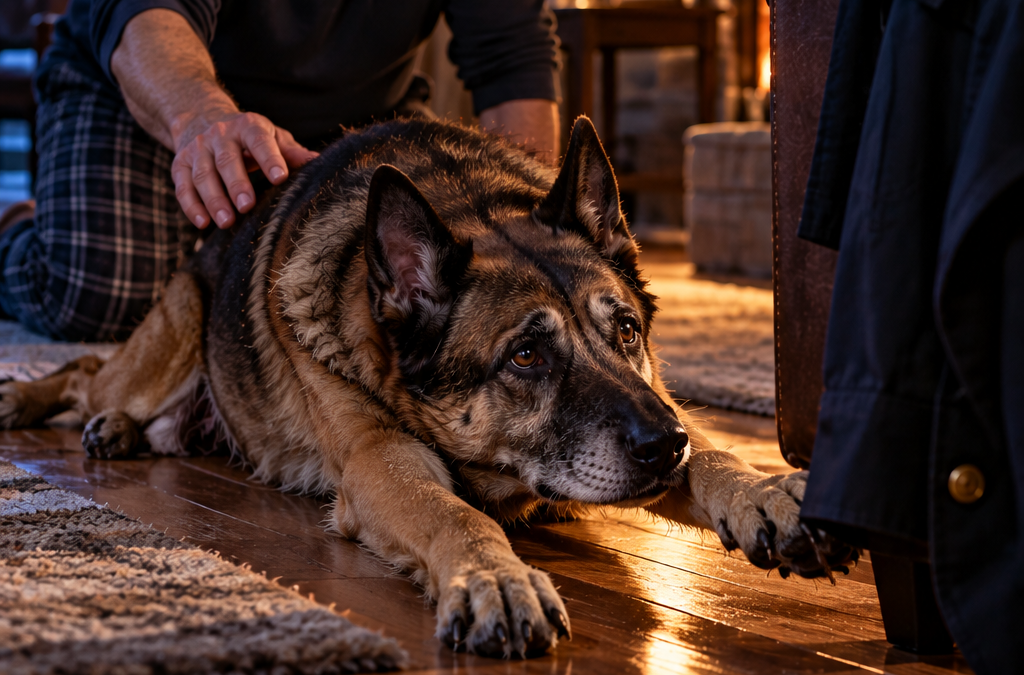
The morning I found Ace dragging himself toward my old police jacket.
I didn’t waste time after that.
I called Dr. Mitchell’s emergency line.
She told me to keep Ace as still and comfortable as possible and bring him to the clinic immediately.
I spread a blanket beside him.
Gently lifted him onto it.
Then used the blanket and his support harness to transfer him into the truck without twisting his spine.
He didn’t cry out.
But his breathing was fast.
His eyes followed me constantly.
I kept one hand against his shoulder as I arranged the blankets around him.
“I’m right here.”
His ears moved.
“You’re okay, partner.”
I wished I believed it.
The drive took twenty-three minutes.
I remember every one of them.
Every red light.
Every pothole.
Every glance toward the passenger seat.
Ace lay quietly with his head resting against my old jacket.
I had brought it because he wouldn’t let me move it away.
At one intersection, he tried to lift his head.
I reached across the seat.
“Easy, buddy.”
He looked at me.
I forced a smile.
“No need to supervise my driving.”
His tail moved weakly.
I laughed.
Then began crying.
I wiped my face before the light turned green.
Dr. Mitchell met us outside.
Two technicians helped carry Ace into the clinic.
I followed.
The examination seemed to last forever.
Dr. Mitchell tested his reflexes.
Checked his spine.
Examined his legs.
Reviewed the progression of his symptoms.
Additional imaging and blood work helped rule out some immediate causes, but the neurological findings were deeply concerning.
She sat across from me in the consultation room.
I recognized that expression.
I’d seen it on doctors’ faces before.
The careful kindness.
The reluctance to hurt somebody with the truth.
“Robert.”
I shook my head.
“Just tell me.”
She took a breath.
“Ace has lost significant function in his hind legs. His condition has progressed faster than we’d hoped.”
I stared at the floor.
“Can he walk again?”
“I can’t promise that.”
“Surgery?”
“We don’t yet have evidence of a surgically correctable lesion. More advanced testing might clarify the cause, but given his age, his overall condition, and the severity of his deficits, we need to weigh whether that would lead to a meaningful improvement.”
I looked at her.
“What are you saying?”
She leaned forward.
“I’m saying Ace is very old. He’s worked hard for most of his life. His body is failing him, and we need to be realistic about what treatment can accomplish.”
My hands began shaking.
“He’s still alert.”
“Yes.”
“He knows me.”
“He does.”
“He was trying to get to my jacket this morning.”
She looked puzzled.
“Your jacket?”
I explained.
The living room.
The scraping sound.
The way he’d dragged himself across the floor.
The way he’d pressed his face into the fabric.
Dr. Mitchell listened quietly.
When I finished, she looked toward the examination room.
“That jacket probably means a great deal to him.”
I nodded.
“Work.”
“Maybe.”
She hesitated.
“But it also smells like you.”
I looked at her.
“What?”
“Dogs form strong associations with familiar scents. Your jacket was part of the routine you shared for years.”
She smiled sadly.
“It may represent safety. Familiarity. Being close to you.”
I stared at my hands.
“So he wasn’t trying to go to work?”
“I can’t know exactly what he wanted.”
She paused.
“But I wouldn’t assume this was about work.”
Something tightened painfully inside my chest.
I thought about Ace sitting beside the door after Margaret died.
About the mornings he had waited while I lay in bed.
About every day he’d stood ready, even after our careers ended.
I had always believed he was waiting for the job.
But perhaps the job had never been the most important part.
Perhaps the routine had become his way of staying close to me.
His way of knowing we would begin another day together.
I swallowed.
“How much time does he have?”
Dr. Mitchell was quiet.
Then she said, “I can’t give you an exact number. But I am concerned that his quality of life may deteriorate significantly over the coming days or weeks.”
I closed my eyes.
“Weeks?”
“Possibly.”
My throat tightened.
“And then?”
Her voice softened.
“We’ll need to make a decision based on his comfort, his ability to rest, and whether he can still enjoy the things that matter to him.”
I covered my face.
For eleven years, Ace had followed me into situations where I was the one giving orders.
I knew what needed to happen.
I knew how to protect him.
I knew how to get us home.
But sitting in that consultation room, I felt like a frightened rookie.
I didn’t know what to do.
Dr. Mitchell waited.
Eventually, I asked, “Can I take him home?”
She nodded.
“Yes. We can manage his pain and help you provide supportive care. But I want you to call if he becomes distressed, can’t rest, or his condition worsens.”
“I will.”
“And Robert?”
I looked up.
She spoke gently.
“Don’t measure how well he’s doing by whether he can get to the door.”
My eyes filled.
“I know.”
“Measure it by whether he’s comfortable. Whether he can still enjoy being with you.”
I nodded.
She placed a hand over mine.
“He’s already done his job.”
I looked toward the door.
“I know.”
But knowing something and accepting it are two very different things.
I brought Ace home that afternoon.
The house felt different.
The front door looked farther away.
His bed seemed too small for the weight of what was happening.
I carried him inside with the help of a neighbor and settled him on a thick mattress beside the fireplace.
Then I placed my old police jacket beside his head.
He immediately rested his muzzle against it.
I sat on the floor.
“There you go.”
His breathing slowed.
I stroked his ears.
“You’ve got it.”
For nearly an hour, we stayed like that.
I thought about calling Hannah.
Then decided not to.
I didn’t want to hear the concern in her voice.
Didn’t want her to remind me that Ace was dying.
Didn’t want to watch her expression change when she saw him.
Mostly, I didn’t want to speak the truth aloud.
Because once I said it, I knew I couldn’t pretend anymore.
But around six that evening, my phone rang.
Hannah.
I answered.
“Hey, sweetheart.”
“Dad? How’s Ace?”
I stared at the dog beside me.
“He’s resting.”
She became quiet.
“What happened?”
“Nothing.”
“Dad.”
I closed my eyes.
She knew me too well.
“He couldn’t stand this morning.”
Silence.
Then she whispered, “Oh, Dad.”
I swallowed.
“I took him to the veterinarian.”
“What did she say?”
I tried to explain.
The weakness.
The neurological problem.
The possibility that he might never walk properly again.
Halfway through, my voice broke.
Hannah didn’t interrupt.
When I finished, she said, “I’m coming over.”
“You don’t have to.”
“I know.”
“It’s a two-hour drive.”
“Dad.”
I looked down at Ace.
She spoke softly.
“You were there every time I needed you when I was little.”
My eyes filled.
“Hannah—”
“Let me be there for you now.”
I couldn’t answer.
She continued.
“I’ll leave in twenty minutes.”
I nodded, though she couldn’t see.
“Okay.”
Then I hung up and cried.
Hannah arrived after dark.
She brought a bag of groceries, extra blankets, and the quiet determination she’d inherited from her mother.
The moment she saw Ace, her face changed.
She set everything down and knelt beside him.
“Hey, handsome.”
Ace lifted his head.
His tail moved.
Hannah smiled through tears.
“There he is.”
She stroked his face.
“Still taking care of Grandpa?”
Ace rested his chin against her hand.
I stood in the doorway.
“He’s been trying.”
Hannah looked up at me.
“He doesn’t have to anymore.”
I swallowed.
“I know.”
She stood and embraced me.
I hadn’t realized how badly I needed someone to hold me until she did.
I wrapped my arms around my daughter.
Then I began crying against her shoulder.
“I can’t lose him too.”
Hannah held me tighter.
“I know, Dad.”
“I already lost your mother.”
“I know.”
“I don’t know how to go through this again.”
She gently pulled back.
Her eyes were wet.
“You don’t have to do it alone.”
I looked toward Ace.
“He was there for everything.”
Hannah nodded.
“I know.”
“When Mom died. When I couldn’t get out of bed. When I didn’t want to come home.”
My voice broke.
“He was always there.”
Hannah took my hand.
“Then we’re going to make sure you’re there for him now.”
That night, we sat together in the living room.
Hannah made soup.
I barely ate.
Ace slept with his head resting on my jacket.
Around ten, Hannah noticed me watching him.
“Dad?”
“Yeah?”
“Why did he want the jacket?”
I looked at the dark navy fabric.
“I don’t know.”
She smiled faintly.
“Mom used to say he loved the sound of your keys.”
I nodded.
“He did.”
“Remember how he’d get excited whenever you put on your boots?”
I laughed softly.
“He’d nearly knock me over.”
Hannah looked toward Ace.
“Maybe the jacket reminds him of being young.”
I considered that.
“Maybe.”
She hesitated.
“Or maybe it reminds him of you.”
I looked at her.
She smiled sadly.
“Dad, I don’t think Ace spent eleven years waiting for a police officer.”
My chest tightened.
“What?”
She glanced toward the front door.
“I think he spent eleven years waiting for his favorite person.”
I didn’t answer.
Hannah continued.
“When you were working, that meant waiting for you to put on your uniform. After you retired, it meant waiting for you to get up and take him outside.”
She looked at Ace.
“He wasn’t waiting for the job.”
Her voice softened.
“He was waiting for you.”
I stared at the old jacket.
Then at Ace.
And suddenly, memories began arranging themselves differently.
All those mornings after Margaret died.
The way Ace had refused to leave the bedroom until I stood.
The way he’d waited beside my chair when I came home exhausted.
The way he’d continued our five o’clock ritual even after the patrol car and duty belt were gone.
I had believed he needed the routine because he missed being a police dog.
But maybe the routine had always meant something more.
A beginning.
A promise.
Another day together.
I covered my face.
“Oh, Ace.”
He opened his eyes.
His tail moved weakly.
I knelt beside him.
“You weren’t waiting for work.”
He looked at me.
I placed my hand against his chest.
“You were waiting for me.”
He pressed his muzzle against my palm.
I began crying.
Hannah sat beside us.
For a long time, neither of us spoke.
The next morning, I woke at 4:45.
I lay in bed staring at the ceiling.
At five, I listened.
No nails clicking down the hallway.
No movement beside the front door.
The silence still hurt.
But this time, I knew where Ace was.
I got up.
Put on warm clothes.
Went downstairs.
He was lying on his bed beside the fireplace.
His head rested on the police jacket.
When he saw me, his tail moved.
I crouched beside him.
“Morning, partner.”
He lifted his head.
I smiled.
“You’re right on time.”
I sat beside him.
For the first time in eleven years, we began the morning without going to the front door.
And nothing terrible happened.
The world kept turning.
The sun still rose.
Ace still loved me.
I still loved him.
Our partnership hadn’t disappeared simply because his legs no longer worked.
I prepared his breakfast.
Helped him drink water.
Gave him the medication Dr. Mitchell had prescribed.
Then carried my coffee into the living room and sat beside him.
Outside, snow fell softly across the yard.
Ace watched through the window.
I rubbed his ears.
“Looks like we would’ve had a rough patrol today.”
His ears twitched.
“Probably three suspicious squirrels.”
His tail moved.
I smiled.
“Maybe four.”
That became our new routine.
Five o’clock.
The living room.
Coffee for me.
Breakfast for Ace.
No front door.
No rush.
No expectation that he needed to stand.
I simply sat beside him.
Sometimes we watched the sunrise.
Sometimes I read aloud from the newspaper.
Sometimes I talked about Margaret.
The years of our marriage.
Her terrible singing.
The way she used to hide dog biscuits in her sweater pockets because she believed Ace deserved treats whenever he looked particularly handsome.
One morning, I found an old photograph of Margaret sitting on the porch with Ace.
He was young.
Strong.
His dark face pressed against her knee.
She was laughing.
I placed the photograph beside his bed.
“Remember her?”
Ace sniffed it.
I smiled sadly.
“She loved you.”
He rested his chin on my hand.
“You know that?”
His eyes closed.
I rubbed his neck.
“She told me to take care of you when you got old.”
My throat tightened.
“I’m trying, buddy.”
The days became a mixture of small blessings and difficult truths.
Ace still enjoyed certain things.
He liked the smell of chicken warming in the kitchen.
He enjoyed having his ears rubbed.
He watched birds through the window.
Sometimes, when Hannah called and I held the phone near him, his ears moved at the sound of her voice.
But his body continued weakening.
He needed more help changing positions.
Some nights, he struggled to settle comfortably.
His appetite became inconsistent.
Dr. Mitchell adjusted his care plan.
We monitored his pain.
His hydration.
His breathing.
His ability to rest.
Every day, I asked myself the same question.
Was I keeping him comfortable?
Or was I keeping him here because I couldn’t face losing him?
I hated that question.
But I knew Margaret would have wanted me to ask it.
One afternoon, Frank came to visit.
He’d retired six months after I did.
He brought a bag of treats approved by Dr. Mitchell and a framed photograph from our old K9 unit.
When he saw Ace, he stopped in the doorway.
His expression changed.
“Oh, buddy.”
Ace lifted his head.
Frank knelt beside him.
“Hey, Sergeant Ace.”
His tail moved.
Frank laughed softly.
“Still outrank me, huh?”
He stroked Ace’s face.
Then looked at me.
“How are you holding up?”
I shrugged.
“One day at a time.”
He nodded.
“That’s all you can do.”
We sat in the living room drinking coffee while Ace slept.
Frank told me stories about the department.
New officers.
Promotions.
People retiring.
The chief’s latest attempts to improve the training budget.
For a while, it felt like the old days.
Then Frank became quiet.
He looked at Ace.
“Remember that warehouse call?”
I frowned.
“Which one?”
“The one where the suspect came through the side door with a gun.”
My stomach tightened.
I remembered.
It had happened seven years earlier.
We were searching an abandoned warehouse after a robbery.
Ace had stopped suddenly near a doorway.
I’d been about to step inside.
He moved across my path and gave a sharp warning.
I stopped.
Seconds later, an armed suspect appeared from the shadows.
Ace’s warning gave me time to take cover and call for backup.
Nobody was hurt.
But if I’d taken one more step, the outcome might have been very different.
Frank looked at me.
“You know what he did that night?”
I nodded.
“He warned me.”
Frank shook his head.
“He refused to let you walk into danger.”
I looked at Ace.
Frank continued.
“We praised him for that. We gave him a commendation.”
He paused.
“But now he’s the one who needs somebody to protect him.”
I swallowed.
Frank leaned forward.
“And you know what that means.”
I looked away.
“I know.”
“You don’t have to be ready.”
My eyes filled.
“I don’t think I ever will be.”
Frank nodded.
“I wasn’t ready when my father died. Wasn’t ready when my old Shepherd went. Nobody’s ready.”
He looked down at Ace.
“You just have to love him enough to do what he needs when the time comes.”
I stared at my coffee.
“What if I make the wrong decision?”
Frank was quiet for a moment.
Then he said, “You’ve spent eleven years learning to listen to that dog.”
I looked up.
“Keep listening.”
After Frank left, I sat beside Ace for a long time.
I thought about every command I’d given him.
Every time he’d trusted me.
Every dangerous situation we’d entered together.
He had never questioned whether I would protect him.
I couldn’t let fear make me forget that responsibility now.
Three days later, Ace stopped eating.
I tried his favorite food.
Warm chicken.
Small pieces of scrambled egg.
A little broth.
He sniffed everything.
Then turned away.
His breathing became faster.
He struggled to rest.
At night, he occasionally whimpered despite the medication.
I called Dr. Mitchell.
She came to the house that afternoon.
She examined Ace gently.
Checked his breathing.
His heart.
His responsiveness.
His pain.
Then she looked at me.
I knew before she spoke.
“Robert, I’m concerned that we’re reaching the point where comfort care isn’t enough.”
I stared at Ace.
“He’s still looking at me.”
Her expression softened.
“I know.”
“He knows I’m here.”
“Yes.”
“He wagged his tail this morning.”
She nodded.
“That matters. But we also have to consider the rest of his day.”
I looked away.
“I don’t want him to suffer.”
“I know you don’t.”
She sat beside me.
“We can continue reassessing him, but I want you to consider a peaceful goodbye before he experiences a severe crisis.”
My hands began shaking.
“How soon?”
She took a breath.
“I think we’re talking about days, Robert. Possibly less.”
I covered my eyes.
I had known this was coming.
But the words still felt impossible.
“Can you give me one more night?”
She looked at Ace.
Then back at me.
“If he’s comfortable and we’re able to manage his symptoms, yes. But if his distress worsens, call me immediately. We won’t make him wait in pain.”
I nodded.
“I promise.”
She placed a hand on my shoulder.
“He trusts you.”
I looked at Ace.
His head rested against my old police jacket.
“I know.”
After she left, I called Hannah.
This time, I didn’t pretend everything was fine.
“Sweetheart,” I said, “I think it’s time.”
She began crying.
Then quietly told me she’d come that evening.
I called Frank.
He asked if I wanted him there.
I said yes.
By sunset, the house was full of people who loved Ace.
Not a crowd.
Just Hannah, Frank, and Ben.
Hannah’s husband stayed home with their younger child, giving Ben the chance to say goodbye to the dog he’d always considered a hero.
Ben entered the living room carrying a piece of folded paper.
He knelt beside Ace.
“Hey, Officer Ace.”
Ace lifted his head.
Ben smiled through tears.
“I made you something.”
He unfolded the paper.
It was a drawing.
A police officer standing beside a large brown dog.
Both wore blue uniforms.
Above them, in uneven letters, were the words:
BEST PARTNERS FOREVER.
I looked away because I couldn’t stop crying.
Ben placed the drawing beside Ace.
“That’s you and Grandpa.”
Ace sniffed the paper.
Ben rubbed his ears.
“Mom says you’re really old.”
Hannah laughed softly through tears.
“Ben.”
He looked up.
“What?”
“Be gentle.”
“I am.”
He looked back at Ace.
“It’s okay if you can’t chase bad guys anymore.”
His little voice trembled.
“Grandpa can do that.”
I laughed despite myself.
“Not anymore, kiddo.”
Ben frowned.
“Then who catches them?”
Frank smiled.
“The younger officers.”
Ben looked relieved.
Then he leaned close to Ace.
“You can rest now.”
Ace closed his eyes beneath the boy’s hand.
I pressed my fingers against my mouth.
Children sometimes say the words adults spend days trying to find.
We ate dinner in the living room.
Nobody wanted to leave Ace alone.
Frank sat in the recliner.
Hannah beside me.
Ben on the rug.
We shared stories.
The time Ace stole Frank’s sandwich from an unattended desk.
The time he knocked over a bucket of soapy water during training.
The time he refused to leave the station because he’d discovered somebody had hidden treats in a storage cabinet.
We laughed.
Then cried.
Then laughed again.
I showed Ben photographs of Ace as a young police dog.
Running.
Jumping.
Sitting proudly beside my patrol vehicle.
Ben stared at one picture.
“He was really fast.”
I smiled.
“Fastest dog I ever worked with.”
“Was he brave?”
I looked at Ace.
His breathing was slow and tired.
“Braver than most people I’ve known.”
Ben considered that.
Then asked, “Was he ever scared?”
I nodded.
“I’m sure he was.”
“But he still did his job?”
“Yeah.”
Ben looked down at Ace.
“That’s really brave.”
I reached across the rug and squeezed my grandson’s shoulder.
“It is.”
Later that evening, after Ben had fallen asleep on the couch, Hannah found me sitting beside Ace.
I was holding the old police jacket.
She lowered herself onto the floor.
“Dad?”
I nodded.
“Yeah?”
“Are you okay?”
I laughed bitterly.
“No.”
She rested her head against my shoulder.
“I know.”
We sat quietly.
Then she asked, “Do you remember what Mom said when you first brought Ace home?”
I smiled faintly.
“That he had better manners than me?”
Hannah laughed.
“Besides that.”
I shook my head.
She looked toward the sleeping dog.
“She said he was going to teach you how to slow down.”
I closed my eyes.
I remembered.
Margaret had said it one evening while Ace slept beneath the kitchen table.
I’d been complaining about how much time training required.
She’d smiled.
“Maybe that’s exactly what you need, Bobby.”
I had laughed.
Now I understood.
Ace had spent eleven years teaching me how to show up.
How to be patient.
How to recognize fear without being ruled by it.
How to trust.
How to love without keeping score.
And now, in the final days of his life, he was teaching me something I wanted desperately not to learn.
How to let go.
I looked toward the front door.
“You know what scares me most?”
Hannah waited.
“Tomorrow morning.”
Her hand tightened around mine.
I continued.
“For eleven years, he was there at five.”
My voice broke.
“Even after your mother died.”
I swallowed.
“I don’t know what I’m supposed to do when he’s not.”
Hannah leaned closer.
“You get up anyway.”
Tears ran down my face.
She continued.
“You make coffee. You open the curtains. You remember him.”
I shook my head.
“It’s not that easy.”
“I know.”
She looked toward Ace.
“But that’s what he taught you, Dad.”
I stared at the old dog.
Hannah whispered, “He taught you to keep showing up.”
I cried quietly into my daughter’s hair.
That night, I refused to go upstairs.
Hannah brought me a pillow and blanket.
Frank offered to stay, but I told him to go home and rest.
Ben kissed Ace goodnight.
Then Hannah took him to the guest room.
The house became quiet.
I sat beside Ace’s bed.
The fireplace had burned down to glowing embers.
Outside, snow fell against the windows.
I rested my hand on his chest.
His heartbeat was steady but weak.
I could feel every breath.
“Hey, partner.”
His eyes opened.
“Just you and me.”
His tail moved faintly.
I smiled through tears.
“Like old times.”
I thought about all those years when I’d come home after midnight and find Margaret asleep upstairs.
Ace would lie beside the fireplace while I filled out reports or cleaned equipment.
Sometimes I’d talk to him.
Tell him things I couldn’t explain to anyone else.
He never interrupted.
Never judged.
Never asked whether I could have done something differently.
He simply stayed.
I stroked his head.
“You know, I always thought I was taking care of you.”
His eyes remained on mine.
“Feeding you. Training you. Making sure you came home.”
I swallowed.
“But you were taking care of me too.”
His breathing slowed.
“When Maggie died, I didn’t want to keep going.”
My voice trembled.
“I never told anybody how bad it got.”
I looked down.
“Some mornings, the only reason I got out of bed was because you were waiting.”
Tears fell onto the blanket.
“I couldn’t let you down.”
I pressed my forehead gently against his.
“And somehow, that kept me alive long enough to want to live again.”
Ace rested his muzzle against my hand.
I closed my eyes.
“Thank you.”
We stayed like that for a long time.
At some point, I fell asleep beside his bed.
When I woke, the room was dark.
The fire had gone out.
I looked at the clock.
4:52.
Ace was awake.
He was watching me.
I leaned closer.
“Morning, buddy.”
His ears moved.
I glanced toward the front door.
The space beside it was empty.
I felt the familiar ache.
But this time, I didn’t look away.
I looked at Ace.
His eyes were tired.
His breathing was shallow.
He had little strength left.
Yet he was still watching me.
Waiting.
I picked up the old police jacket.
For a moment, I held it in my hands.
The fabric was faded.
The elbows worn.
A small tear near the cuff had been repaired years earlier by Margaret.
I remembered her sitting at the kitchen table with a needle and thread.
“You need a new jacket,” she’d said.
“This one’s fine.”
She’d rolled her eyes.
“You say that about everything.”
I touched the repaired seam.
My chest tightened.
Then I put the jacket on.
Slowly.
Carefully.
For the first time since retirement.
It felt heavier than I remembered.
Not because of the fabric.
Because of everything it represented.
The years.
The people.
The life that was gone.
I knelt beside Ace.
His ears lifted.
His eyes followed the movement of the jacket.
I smiled through tears.
“There he is.”
His tail moved once.
I reached down and scratched his chest.
“Your old partner.”
I glanced at the clock.
4:59.
I took a breath.
Then placed my hand against the back of his neck.
“You know what time it is?”
His eyes stayed on mine.
Five o’clock.
I smiled.
“Right on time.”
I waited for the familiar movement.
The lift of his head.
The twitch of his ears.
The excited push toward the door.
Ace tried to raise his chest.
His front legs trembled.
I immediately supported him.
“No, buddy.”
He looked toward the hallway.
I shook my head.
“Not today.”
He tried again.
A small whine escaped him.
I placed both hands gently against his shoulders.
“Ace.”
His eyes returned to mine.
My voice broke.
“You don’t have to get up.”
He stared at me.
I swallowed.
“You hear me?”
Tears filled my eyes.
“You don’t have to wait at the door anymore.”
His head rested against my palm.
I leaned closer.
“You did your job.”
My voice shook.
“Eleven years. Every morning.”
I pressed my forehead against his.
“You never missed a day when I needed you.”
His breathing grew slower.
I stroked his gray muzzle.
“But now it’s my turn.”
I wrapped the old police jacket around his shoulders.
He sighed.
A long, tired breath.
Then relaxed against the blanket.
I sat beside him.
“I’m right here.”
Outside, the first pale light of dawn began touching the snow.
Ace closed his eyes.
I listened to him breathe.
And for the first time in eleven years, five o’clock wasn’t the beginning of another shift.
It was the beginning of our goodbye.
Hannah found us an hour later.
I was still sitting on the floor wearing my old police jacket.
Ace lay against my leg.
His breathing had become more labored.
Hannah stopped in the doorway.
“Dad?”
I looked up.
She saw my face.
Then looked at Ace.
She knelt beside us.
“Is it time?”
I nodded.
“I think so.”
Her eyes filled.
She placed a hand against Ace’s head.
“Oh, sweetheart.”
I reached for my phone.
My hands were shaking.
Dr. Mitchell answered immediately.
I told her what was happening.
The difficulty breathing.
The weakness.
The way Ace couldn’t settle comfortably even with his medication.
She listened carefully.
Then said she’d come as soon as possible.
While we waited, Hannah made fresh coffee.
Frank arrived after I called him.
Ben stayed upstairs with his mother for a little while, then came down to say one more goodbye.
He knelt beside Ace.
“Hey, Officer Ace.”
His little voice trembled.
“Grandpa says you can rest now.”
Ace opened his eyes.
Ben kissed his forehead.
“Thank you for taking care of him.”
I covered my mouth.
Hannah guided Ben gently toward the kitchen.
Frank stood beside the fireplace.
He looked at me in my old jacket.
A sad smile crossed his face.
“Still fits.”
I laughed through tears.
“Barely.”
He nodded toward Ace.
“He always liked that jacket.”
I looked down.
“I know.”
Frank approached and knelt beside him.
“Hey, partner.”
Ace’s ears moved.
Frank stroked his head.
“You did good.”
His voice broke.
“You did real good.”
When Dr. Mitchell arrived, she examined Ace quietly.
Her expression confirmed what I already knew.
His body was exhausted.
His condition had deteriorated.
Keeping him alive longer would not return the things he’d lost.
It would only risk prolonging his suffering.
She explained what would happen.
That she would first give him medication to help him relax and fall asleep.
That he would be comfortable.
That I could hold him.
That there was no need to rush.
I listened carefully.
Then asked for a few minutes alone.
Everyone stepped into the kitchen.
I remained on the floor beside Ace.
I looked around the living room.
Margaret’s photograph on the mantel.
The clock above the fireplace.
The front door visible through the hallway.
The same room where Ace had slept for eleven years.
The same house where Margaret had laughed, cooked, cried, and eventually said goodbye.
I thought about how much love those walls had held.
And how much loss.
I reached for Ace’s collar.
The brass identification tag was worn smooth around the edges.
I ran my thumb over his name.
ACE.
Four letters.
Such a small word for everything he had been.
I leaned down.
“Hey, buddy.”
His eyes opened.
I smiled through tears.
“I need you to listen to me one last time.”
His ears moved.
I took a breath.
“You were the best partner I ever had.”
His tail shifted faintly.
“And I worked with some pretty good people.”
I laughed softly.
Then began crying again.
“You saved lives.”
I stroked his cheek.
“You found people who were lost.”
My throat tightened.
“You protected me when I didn’t even know I was in danger.”
I looked toward Margaret’s photograph.
“And when I lost her, you stayed.”
Tears ran down my face.
“You stayed when I was angry.”
I swallowed.
“You stayed when I was broken.”
I pressed my hand against his chest.
“You stayed when I couldn’t find a reason to get out of bed.”
His breathing was shallow.
I bent closer.
“And for eleven years, every morning at five, you were there.”
My voice broke completely.
“Waiting for me.”
I rested my forehead against his.
“I know now.”
I closed my eyes.
“I know you weren’t waiting for the uniform.”
My tears fell into his fur.
“You were waiting for us.”
Ace gave a small sigh.
I kissed his forehead.
“But you don’t have to wait anymore.”
I reached for his paw.
It rested in my hand, heavy and warm.
“I’ll keep getting up.”
I nodded through tears.
“I promise.”
I looked into his eyes.
“I’ll take care of myself.”
His ears moved faintly.
“I’ll call Hannah.”
I tried to smile.
“I’ll let Ben visit more.”
My throat tightened.
“Maybe I’ll even go fishing with Frank.”
Ace rested his head against the jacket.
I stroked his face.
“You’ve taken care of me long enough.”
Then I spoke the words I’d said thousands of times.
The words that had always meant another day, another patrol, another chance to come home together.
“Ready, partner?”
His eyes stayed on mine.
I swallowed.
“This time, you don’t have to come with me.”
I kissed his head.
“I’ll be okay.”
Dr. Mitchell returned a few minutes later.
Hannah sat beside me.
Frank stood quietly near the fireplace.
I held Ace’s head in my lap while the veterinarian gave him the medication that would help him fall into a deep, peaceful sleep.
His breathing eased.
The tension left his body.
I kept stroking his ears.
“Good boy.”
His eyes grew heavy.
I leaned down.
“That’s it.”
My voice trembled.
“Rest, buddy.”
He sighed.
Then settled more deeply against me.
Dr. Mitchell waited until he was fully asleep.
She asked whether I was ready.
I looked at Ace.
His face was peaceful.
The same dog who had once raced through snowdrifts and jumped across training obstacles now lay quietly in my arms.
I nodded.
“Yes.”
The final medication was administered gently.
I held him through the last moments.
His breathing became slower.
Then stopped.
Dr. Mitchell listened to his heart.
She looked at me with tears in her eyes.
“He’s gone, Robert.”
I didn’t move.
I kept my hand against his chest.
Waiting for another breath.
Another heartbeat.
Another small movement of his tail.
But there was nothing.
My partner was gone.
And suddenly, the room felt impossibly large.
I bent over him.
Pressed my face against his fur.
And cried.
I cried for the young dog who had stolen my glove.
For the brave K9 who had found Lucas in the snow.
For the loyal companion who had comforted Margaret.
For every morning he’d waited beside the door.
For the final morning when he’d tried to crawl toward my jacket because his body could no longer carry him where his heart wanted to go.
And for the terrible, beautiful privilege of loving him until the end.
Hannah wrapped her arms around me.
Frank placed a hand against my shoulder.
Nobody told me to be strong.
Nobody said he was just a dog.
They stayed.
Just as Ace had stayed for me.
That afternoon, the house was painfully quiet.
Ace’s bed remained beside the fireplace.
His water bowl sat near the kitchen.
His leash hung on its hook.
The old police jacket was still draped across the recliner.
I couldn’t bring myself to move any of it.
Hannah offered to stay the night.
I told her I would be okay.
She looked uncertain.
I smiled sadly.
“I’ll call if I need you.”
She hugged me.
“Promise?”
I nodded.
“Promise.”
After she left, I sat alone in the living room.
The sun disappeared behind the trees.
Shadows moved across the floor.
I looked toward the front door.
For eleven years, Ace had sat there.
Right beside the narrow window.
Always facing the hallway.
Always waiting.
I walked over and lowered myself onto the floor.
The wood was cold beneath me.
I looked around from the place where he’d spent so many mornings.
From there, I could see the bedroom hallway.
The kitchen.
The coat closet.
The front porch through the window.
I could even see the recliner where Margaret used to sit with her morning coffee.
I had never really noticed the view from that spot.
I thought about Ace sitting there at five every day.
Watching.
Listening.
Waiting for the people he loved to begin another morning.
And something inside me shifted.
I had spent years assuming that Ace’s favorite part of the day was going to work.
Maybe, at first, it had been.
But after Margaret died, and especially after retirement, that doorway had become something else.
A place where he could be near the rhythm of our home.
A place where he knew I would appear.
A place where the day began with the person he trusted most.
I sat there until my knees began aching.
Then I stood.
Picked up his old collar.
And placed it on the mantel beside Margaret’s photograph.
I looked at them together.
My wife.
My dog.
The two souls who had made that house feel like home.
I whispered, “Thank you.”
Then I went upstairs.
I didn’t sleep much.
At 4:55 the next morning, I woke automatically.
I stared at the ceiling.
Five minutes later, the clock struck five.
I listened.
No nails clicking against the hardwood.
No familiar sigh.
No tail tapping beside the door.
Only silence.
I closed my eyes.
For a moment, I wanted to stay in bed.
I wanted to pull the blankets over my head and pretend the day hadn’t begun.
Then I remembered the promise I’d made.
I’ll keep getting up.
I sat up.
My chest hurt.
My eyes filled.
But I got dressed.
Went downstairs.
Made coffee.
And stood beside the front door.
The space was empty.
I looked at it for a long time.
Then whispered, “Morning, partner.”
My voice broke.
“I’m up.”
I opened the door.
The morning air was cold.
Snow covered the lawn.
The street was quiet.
I stepped onto the porch and breathed deeply.
For the first time in eleven years, I faced a new day without Ace beside me.
I didn’t feel brave.
I didn’t feel ready.
But I was standing.
And I knew he would have wanted that.
The Briarwood Police Department held a memorial for Ace the following Saturday.
Frank organized it.
I hadn’t asked for anything elaborate.
I didn’t want television cameras or a public spectacle.
I wanted the people who had known Ace to remember him.
That was all.
But when I arrived at the training yard, I found more people than I’d expected.
Retired officers.
Current K9 handlers.
Dispatchers.
Veterinarians.
Families whose lives Ace had touched.
And standing near the entrance was a young man I almost didn’t recognize.
Lucas Bennett.
The little boy Ace had found in the snow years earlier.
He was nearly grown now.
Tall.
Broad-shouldered.
Wearing a dark winter coat.
When he saw me, he approached.
“Sergeant Hayes?”
I smiled.
“Lucas?”
He nodded.
Then embraced me.
“My mom told me about Ace.”
I swallowed.
“I’m glad you came.”
He looked toward the framed photograph of Ace displayed beside the podium.
“I wanted to thank him.”
My throat tightened.
Lucas continued.
“I don’t remember much from that night.”
He paused.
“But I remember being cold.”
I nodded.
“You were.”
“And I remember a dog.”
His eyes filled.
“I remember touching his fur.”
I looked away.
Lucas swallowed.
“Mom says I kept asking for him after I got out of the hospital.”
I smiled through tears.
“You did.”
He looked toward the photograph.
“I wouldn’t be here if he hadn’t found me.”
I placed a hand on his shoulder.
“He was a good dog.”
Lucas nodded.
“He was more than that.”
Those words stayed with me through the ceremony.
Frank spoke about Ace’s service.
Eleven years.
Countless training hours.
Dozens of searches.
Lives protected.
Families reunited.
Officers kept safe.
Then he invited me to the podium.
I’d prepared a speech.
Three pages.
Carefully written.
Full of memories and accomplishments.
But when I looked at the audience, I couldn’t read it.
Instead, I folded the pages and placed them aside.
I looked at Ace’s photograph.
Then began speaking.
“For thirty-one years, I wore a badge.”
The crowd became quiet.
“I thought that badge made me responsible for protecting people.”
I paused.
“Then I met a dog who taught me that responsibility has nothing to do with what you wear.”
My throat tightened.
“Ace was brave. He was intelligent. He saved lives.”
I looked toward Lucas.
“But the greatest thing he ever did wasn’t something the department gave him a medal for.”
I took a breath.
“It happened every morning at five o’clock.”
Several officers smiled.
They knew the story.
I continued.
“For eleven years, Ace waited beside my front door.”
My voice shook.
“I thought he was waiting to go to work.”
I paused.
“I was wrong.”
I looked down at the old collar resting beside the photograph.
“He was waiting for me.”
Tears filled my eyes.
“After my wife died, I went through a period when I didn’t know how to keep living the life we’d built.”
I swallowed.
“Ace never knew how to fix my grief.”
The room was silent.
“He couldn’t tell me things would get better. Couldn’t explain why the world could be so cruel.”
I looked toward Hannah.
She was crying.
“But every morning, he waited.”
My voice broke.
“And because he waited, I got up.”
I rested my hands against the podium.
“When his body finally failed him, he tried to crawl across my living room toward my old police jacket.”
I paused.
“He couldn’t walk anymore.”
Tears ran down my face.
“But he was still trying to reach something familiar. Something that had belonged to the life we shared.”
I took a breath.
“I used to think loyalty meant never abandoning your duty.”
I looked toward Ace’s photograph.
“Now I think it means something simpler.”
My voice grew quiet.
“It means staying beside someone when they need you.”
I looked at the officers gathered before me.
“Ace did that for eleven years.”
I swallowed.
“And when he finally needed me, I hope I gave him the same.”
I stepped away from the podium.
Frank embraced me.
The crowd stood.
There was applause.
But I barely heard it.
I was looking at Ace’s photograph.
The familiar dark face.
The intelligent brown eyes.
The ears that always seemed ready for another call.
And for a moment, I could almost feel his head pressing against my leg.
After the ceremony, the department presented me with a small wooden box.
Inside was Ace’s service badge.
His identification tag.
And a photograph taken during our retirement ceremony.
In the picture, I was standing beside him with one hand resting on his head.
We were both smiling in our own way.
I took the box home and placed it on the mantel beside Margaret’s photograph.
Then I hung the old police jacket in the closet.
Not because I wanted to forget Ace.
Because I finally understood that neither of us needed to wear it anymore.
The weeks passed.
Some mornings were harder than others.
I still woke at five.
Sometimes I expected to hear Ace moving through the hallway.
Sometimes I caught myself reaching for his leash.
Once, I even called his name before remembering.
The silence never stopped hurting completely.
But gradually, it changed.
I began walking every morning.
At first, only to the mailbox.
Then to the corner.
Eventually, all the way to the park.
I passed the places Ace and I had visited together.
The old oak tree where he always stopped to sniff.
The fence where Charlie the golden retriever used to bark.
The creek where Ace liked to stand and watch the water.
Sometimes I talked to him as I walked.
Quietly.
The way I had during our years together.
“Morning patrol, partner.”
Or, “Looks like rain.”
Or, “You would’ve hated that squirrel.”
People probably thought I was strange.
I didn’t care.
Hannah began visiting more often.
Ben sometimes joined me on my walks.
He asked questions about Ace.
Hundreds of them.
What was his first command?
Did he ever get scared?
Was he faster than a police car?
Did he really save that boy in the snow?
I answered every question.
Sometimes I told the same story more than once.
Ben never complained.
He loved hearing about Ace.
And I loved having someone to tell.
Three months after Ace died, Hannah came over with a small wrapped package.
We were sitting at the kitchen table.
She pushed it toward me.
“I found something I thought you should have.”
I frowned.
“What’s this?”
“Open it.”
I removed the paper.
Inside was a framed photograph.
It showed me asleep in my recliner years earlier.
Margaret had taken it.
Ace was lying on the floor beside me, his head resting against my boot.
His eyes were open.
Watching.
Waiting.
I stared at the photograph.
“Where did you find this?”
Hannah smiled sadly.
“Mom had it in one of her albums.”
I swallowed.
She pointed to the bottom.
There was a handwritten note beneath the picture.
Margaret’s handwriting.
I recognized it immediately.
Six simple words.
He always makes sure Bobby’s home.
I read them again.
Then again.
My eyes filled.
Hannah touched my hand.
“Mom knew.”
I looked at her.
“Knew what?”
She smiled through tears.
“That Ace wasn’t just your partner at work.”
I stared at the photograph.
Margaret had understood something years before I did.
Ace wasn’t waiting beside the door because he loved police work more than anything.
He was waiting because he loved the life we shared.
The familiar sounds.
The ordinary mornings.
The certainty that his person would come down the hallway.
I pressed the photograph against my chest.
“Thank you.”
Hannah hugged me.
That evening, I placed the photograph beside Ace’s collar.
Then I sat in my recliner.
The house was quiet.
But for the first time since his death, the silence didn’t feel quite so empty.
It felt filled with memories.
Margaret laughing in the kitchen.
Ace racing toward the door.
My own voice calling out before another shift.
The sound of nails clicking against the hardwood at 4:55.
I realized that grief hadn’t taken those things away.
It had simply made remembering them painful for a while.
Slowly, the memories were becoming something I could hold without breaking.
On the first anniversary of Ace’s death, I woke at 4:55.
As always.
I lay in bed for a few minutes.
Then got up.
Dressed.
Went downstairs.
The front door stood at the end of the hallway.
Empty.
Familiar.
I walked toward it.
On the small table beside the door sat Ace’s old collar.
I picked it up and held it in my hand.
The leather was worn.
The brass tag scratched.
I could still picture it around his neck.
I looked at the clock.
4:59.
I smiled faintly.
“Almost time, buddy.”
I waited.
Five o’clock.
The house remained silent.
But this time, I didn’t cry.
Not immediately.
I opened the front door.
Cold morning air drifted inside.
The sky was dark blue.
The streetlights still glowed.
Somewhere in the distance, a dog barked.
I stepped onto the porch.
Took a deep breath.
Then looked down at the empty space beside my feet.
For eleven years, Ace had stood there waiting for me.
Now, every morning, I stood there remembering him.
I thought about the first day we’d met.
The stolen glove.
The training field.
The snowstorm.
The years of work.
Margaret.
Retirement.
And that terrible final morning when he couldn’t reach the door.
I had once believed that morning was proof that time had defeated my partner.
That age had taken away everything that made him extraordinary.
But I knew better now.
Age had taken his speed.
His strength.
His ability to run.
Eventually, even his ability to stand.
But it had never taken the part of him that mattered most.
His trust.
His devotion.
His love.
He had spent eleven years beginning every day beside me.
And when his body could no longer carry him to the door, he had still tried to reach the familiar jacket that reminded him of our life together.
The memory still hurt.
It probably always would.
But it no longer felt like a story about how he failed to stand.
It was a story about how deeply he had loved.
I looked toward the sunrise.
“Morning, Ace.”
My voice was quiet.
“Five o’clock.”
I slipped his collar gently over the wooden hook beside the door.
Then stepped outside.
The road was empty.
The air smelled of frost and wet earth.
I began walking toward the park.
Slowly, the way we used to walk during our retirement.
At the corner, I stopped beside the old oak tree.
Ace had investigated that tree every morning as though it contained the secrets of the entire neighborhood.
I smiled.
“Nothing suspicious today, partner.”
A breeze moved through the branches.
I adjusted my coat.
Then continued walking.
I was still an old man.
My knees still hurt.
My hair had gone gray.
I still missed my wife.
I still missed my dog.
But I was here.
Still getting up.
Still facing another morning.
Still living the life they had taught me to value.
And as the first sunlight reached the tops of the houses, I realized something that brought tears to my eyes.
For eleven years, Ace had waited at the front door because he knew I would come.
On the morning he couldn’t stand, he had tried anyway.
He didn’t need one more patrol.
He didn’t need another badge.
He didn’t need to prove he was still a brave police dog.
He needed his person.
And in the end, I had finally understood.
I hadn’t been the only one who needed those five o’clock mornings.
We both had.
Two aging partners.
One familiar doorway.
Eleven years of promises neither of us had ever needed to speak aloud.
I reached the park and sat on the bench overlooking the creek.
The sunlight reflected across the water.
I could almost picture Ace standing beside me, ears raised, watching the morning come alive.
I rested my hand on the empty space beside my leg.
“You did good, partner.”
My eyes filled.
“You did real good.”
I sat there until the sun rose fully above the trees.
Then I stood and began walking home.
There would be no dog waiting at the front door.
No tail tapping against the floor.
No familiar eyes lifting when I reached for my keys.
But the house would never truly be empty of him.
Not while I remembered the sound of his paws.
Not while his collar hung beside the door.
Not while I could still hear Margaret laughing about the two of us.
And not while I continued keeping the promise I’d made on his final morning.
To get up.
To keep living.
To face the world even when the people and animals I loved were no longer beside me.
Ace had waited for me for eleven years.
Now, the best way I could honor him was to stop waiting for my old life to return and live the one that remained.
So I went home.
I made breakfast.
I called Hannah.
I told her I loved her.
And when I passed the front door, I touched the old leather collar one more time.
“All clear, Ace,” I whispered.
“You can rest now.”
Then I went on with my day.
Because that was the final gift my partner had left me.
He had taught me that loyalty wasn’t measured by how long you could stand beside someone. It was measured by the love that remained when standing was no longer possible.
And even though Ace would never sit beside that front door again, every morning at five, I still carried him with me.
Not as a police dog.
Not as a retired K9.
But as the friend who had spent eleven years making sure I never had to face the morning alone.