𝗙𝗨𝗟𝗟 𝗦𝗧𝗢𝗥𝗬 After the Longest Night of My Career, I Sat Alone in a Hospital Hallway Until Something Walked Out of the Shadows and Sat Beside Me
𝗙𝗨𝗟𝗟 𝗦𝗧𝗢𝗥𝗬
It is difficult to explain unless you’ve experienced it.
Exhaustion disappears.
Your body becomes secondary.
Every decision narrows down to the next necessary action.
Do this.
Then that.
Correct the problem in front of you.
Reassess.
Continue.
At some point near midnight, my shoulders began hurting.
I ignored them.
My lower back tightened.
Ignored that too.
Then my left hand trembled.
Barely.
Once.
I stopped for half a second.
Margaret saw it.
Of course she did.
Anesthesiologists see everything.
Her eyes met mine over her mask.
“You okay?”
“I’m fine.”
It was the most common lie in the hospital.
She knew it.
I knew she knew it.
But she also knew what I meant.
I can continue.
So we continued.
I hadn’t eaten.
Couldn’t remember the last time I’d taken a proper drink.
My mouth was dry behind the mask.
The lights above the table seemed brighter than usual.
But every time fatigue tried to enter my thoughts, I pushed it aside.
One of my old mentors used to tell me:
“James, you cannot save everybody.”
I hated that sentence when I was young.
It sounded like surrender.
Then he would add:
“But you can do everything that is humanly possible. When you’ve done that, you are allowed to be human too.”
At thirty, I understood the first half.
At fifty, I still hadn’t learned the second.
That night, I kept hearing his voice.
Everything humanly possible.
So I did.
Hour after hour.
Suture.
Clamp.
Assess.
Correct.
Wait.
Continue.
At one point, Lily’s numbers changed sharply.
Margaret’s voice became firmer.
I looked at the monitors.
Then at the field.
For several minutes, the entire room tightened.
Nobody panicked.
But everyone knew.
There are moments during surgery when a patient’s future seems to balance on something so small you could hold it between two fingers.
This was one of them.
“Come on,” I whispered.
I don’t know whether I was speaking to Lily.
Her body.
Myself.
Maybe all three.
The numbers stabilized.
Nobody celebrated.
You never celebrate too early.
We kept working.
Sometime after three, one of the nurses asked if I wanted someone else called in.
“No.”
“Dr. Holloway—”
“I’m good.”
Margaret looked at me again.
This time I said,
“We’re almost there.”
She nodded.
“Then finish.”
So I did.
The final stitch went in shortly before dawn.
I remember looking up at the clock and having trouble processing the numbers.
Margaret checked the monitors.
Waited.
Then she looked at me.
Her eyes softened.
“She’s stable.”
I didn’t answer.
Couldn’t.
All the tension I had been holding in my chest for hours shifted at once.
The nurses began the closing procedures.
I stepped backward.
My hands were still held slightly away from my body.
They were trembling again.
This time, I couldn’t command them to stop.
One of the nurses said,
“Dr. Holloway?”
“I’m okay.”
Another lie.
But Lily was stable.
That was what mattered.
I left the operating room.
Removed my gloves.
Then my cap.
My hair was soaked with sweat.
The collar of my scrubs felt stiff against my neck.
I should have gone somewhere warm.
Should have eaten.
Should have called Claire.
Should have spoken with Lily’s parents.
There were dozens of things I should have done.
Instead, my feet carried me toward an old secondary corridor near a service exit.
Almost nobody used it before dawn.
That was why I liked it.
I reached the wall.
Then simply slid down until I was sitting on the floor.
Cold linoleum beneath me.
Cold wall against my back.
Fluorescent light buzzing overhead.
Silence.
Finally.
I closed my eyes.
The first few minutes after a surgery like that are strange.
During the operation, your mind refuses to imagine outcomes.
You cannot allow yourself to picture the child’s parents.
You cannot think about birthdays.
School.
Christmas.
The possibility that the patient on the table might have been laughing with friends twelve hours earlier.
That would make the work impossible.
Afterward, all of it comes back.
I saw Lily’s face before anesthesia.
I wondered what she would remember when she woke.
I wondered whether she would be frightened of cars afterward.
Whether she would blame whoever had been driving.
Whether her parents would blame themselves.
I wondered whether saving a life from the immediate danger was only the beginning of everything that family would now have to survive.
Then I thought about Claire.
I opened my eyes.
My hands were shaking.
Not violently.
But enough.
I looked at them.
Those hands had just spent hours doing exactly what I’d trained them to do.
Now I couldn’t make them hold still.
I pulled out my phone.
Claire’s messages were still there.
Are you still calling tonight?
It’s okay if you’re busy.
I typed:
I’m sorry.
Deleted it.
Typed:
Emergency surgery. I’ll call when you wake up.
Deleted that too.
Everything sounded inadequate.
I put the phone away.
The hallway was completely empty.
For twenty-two years, I had told myself I preferred those moments alone.
That solitude helped.
That I didn’t need anyone asking whether I was okay because the question itself required too much effort.
Maybe that was partly true.
But sitting there that morning, I felt something I had rarely allowed myself to name.
Loneliness.
Profound, exhausting loneliness.
I had spent an entire career surrounded by people.
Nurses.
Residents.
Patients.
Families.
Administrators.
Students.
Colleagues.
And somehow, after the hardest nights, I always ended up alone against a wall.
Maybe because I chose it.
Maybe because I didn’t know how to do anything else.
I rested my head back and closed my eyes again.
Then I heard footsteps.
At first, I assumed security.
But the sound was wrong.
Too light.
Click.
Click.
Click.
Claws against linoleum.
I opened my eyes.
At the far end of the corridor stood a dog.
Medium-sized.
Brown coat faded almost tan in places.
One ear upright.
The other tipped slightly to the side.
I recognized him.
Everyone in the hospital did.
His name was Hendrix.
At least that was what the staff called him.
Years earlier, Hendrix had apparently wandered onto hospital property as a stray.
Nobody knew exactly where he’d come from.
Security had tried to remove him.
He came back.
Someone from dietary services started feeding him.
Then nurses did.
Then half the hospital did.
Eventually, Hendrix became one of those strange institutional facts nobody officially approved but everyone accepted.
He slept near the cafeteria sometimes.
Near the loading area other nights.
He wandered certain corridors freely.
Security knew him.
Maintenance knew him.
Nurses knew him.
Patients occasionally asked who owned him.
The honest answer was probably:
Nobody.
Or everybody.
I’d seen him dozens of times.
Maybe hundreds.
I had never paid much attention.
Until that morning.
Hendrix stood at the end of the hallway looking at me.
“Hey.”
My voice sounded awful.
He started walking.
Not quickly.
Not cautiously.
Just directly toward me.
His nails clicked softly against the floor.
He didn’t sniff doorways.
Didn’t investigate trash cans.
Didn’t stop.
He came straight to where I was sitting.
Then stopped about a foot away.
I expected him to lick my hand.
Dogs usually want something.
Food.
Attention.
Movement.
Hendrix wanted nothing.
He simply sat.
Beside me.
Not touching.
Not staring aggressively.
Just there.
I looked at him.
He looked at me.
His eyes were calm.
That was the first thing I noticed.
Not sad.
Not excited.
Calm.
There was no demand in them.
No question.
He didn’t need me to explain why I was sitting on the floor.
Didn’t need to know whether Lily would recover.
Didn’t need my professional confidence.
Didn’t need Dr. Holloway.
He seemed perfectly willing to sit beside James.
That was different.
“Long night,” I whispered.
One ear moved.
“Yeah.”
I don’t know why I started talking to him.
Maybe because silence with an animal feels safer than silence with another person.
“I think she’s going to make it.”
Hendrix remained still.
“But I don’t know.”
There it was.
The sentence I would never have said in front of Lily’s parents.
The sentence surgeons learn to hold carefully.
I didn’t know.
We never completely know.
Even when the operation goes perfectly.
Even when the monitors stabilize.
Human bodies keep their own secrets.
I rested my forearms on my knees.
“I hate that part.”
Hendrix blinked.
I almost laughed.
“Excellent feedback.”
My hands were still shaking.
Without thinking, I reached toward him.
Slowly.
I placed my palm on his back.
His fur was warm.
That surprised me.
The hallway was cold.
I had been cold without noticing.
But Hendrix was warm.
He didn’t move closer.
Didn’t move away.
He simply allowed my hand to remain there.
I felt his breathing.
Slow.
In.
Out.
In.
Out.
My own breathing had been shallow.
I realized that only because his wasn’t.
So I matched him.
Not intentionally at first.
Then consciously.
In.
Out.
My fingers tightened slightly in his fur.
The tremor continued.
Then weakened.
Minutes passed.
I don’t know how many.
Time had stopped mattering.
My hand moved from his back to his shoulder.
Hendrix lowered his head.
Nothing dramatic happened.
No revelation.
No miracle.
The hospital didn’t disappear.
Lily wasn’t suddenly guaranteed to recover.
My divorce remained real.
My daughter was still waiting for a father who had missed another call.
I was still exhausted.
But something in my chest loosened.
Just enough.
There is a particular kind of mercy in being with someone who doesn’t need you to perform.
People ask,
“Are you okay?”
Then we often say yes because saying no creates another conversation.
A dog doesn’t ask.
Hendrix didn’t care whether I had an answer.
He stayed.
That was all.
Much later, a security officer told me he had checked the camera footage.
Forty-three minutes.
Hendrix and I sat on that floor for forty-three minutes.
It felt like five.
Maybe less.
For most of that time, I said nothing.
Sometimes my eyes closed.
Sometimes I watched the empty hallway.
My hand stayed on him.
Gradually, the trembling stopped.
Completely.
At 5:34, I looked down.
My hands were steady.
Hendrix was still there.
“How did you know?”
His ear moved.
“I wasn’t even supposed to be down here.”
Nothing.
“You stalking surgeons now?”
His tail gave one slow thump against the floor.
I smiled.
It was the first genuine smile I’d managed all night.
“Fair enough.”
I scratched the top of his head.
Then I pushed myself up.
My legs complained immediately.
I had spent too many hours standing still over an operating table.
I looked toward the main corridor.
I had responsibilities.
Lily.
Her parents.
Claire.
My life waiting outside that strange forty-three-minute pause.
Before leaving, I looked down at Hendrix.
“Thank you.”
Very quiet.
His tail moved once.
Just once.
Then he stayed seated while I walked away.
He didn’t follow.
That struck me.
Dogs usually follow people who pet them.
Hendrix didn’t seem interested in collecting gratitude.
He had finished whatever he’d come to do.
When I turned at the corner, he was still sitting beneath the fluorescent light.
Watching me go.
I went to recovery first.
Lily was still unconscious.
Her numbers were good.
Stable.
Margaret stood near the monitors.
She looked at me.
“You disappear?”
“Briefly.”
“You look better.”
“I feel better.”
She gave me the suspicious stare anesthesiologists reserve for surgeons who admit to having emotions.
“What happened?”
“Nothing.”
That wasn’t entirely true.
But I wasn’t ready to explain it.
I stayed near Lily for several minutes.
Then I went to speak with her parents.
They were holding hands in the waiting room.
Her mother stood the second she saw me.
I had delivered this kind of conversation hundreds of times.
This one felt different.
“She’s stable,” I said.
The mother covered her mouth.
Her father closed his eyes.
I explained what we’d done.
What we knew.
What we still had to watch.
I didn’t promise things I couldn’t promise.
But I gave them the truth.
There was reason to hope.
When I finished, Lily’s father grabbed my hand.
“Thank you.”
For years, I’d usually responded with something professional.
The whole team worked very hard.
Or:
She’s not out of danger yet.
Both true.
That morning, I simply said,
“You’re welcome.”
Then I stepped away.
A nurse named Jennifer caught me near the recovery unit.
She had worked nights almost as long as I had.
“James.”
I stopped.
“You okay?”
Normally I would have answered automatically.
Fine.
Tired.
Long night.
Instead, I thought about Hendrix.
Then I said,
“Something sat beside me this morning that didn’t need me to explain anything.”
Jennifer frowned.
I continued.
“Twenty-two years doing this, and I think that’s the first time I didn’t feel alone after a case like that.”
Her expression changed.
She glanced toward the service corridor.
“Hendrix?”
I looked at her.
“How did you know?”
A small smile.
“He has a habit.”
“What habit?”
“Finding people.”
I thought she was joking.
She wasn’t.
I called Claire before leaving the hospital.
She answered sleepily.
“Dad?”
“Hey.”
“What time is it?”
“Early.”
“Are you okay?”
That question again.
This time, I answered differently.
“Yeah.”
Pause.
“I’m tired. But yeah.”
“Was it surgery?”
“Yes.”
“A bad one?”
“A hard one.”
She was quiet.
Then:
“Did it go okay?”
“I think so.”
“Good.”
I leaned against the wall near the staff exit.
“Claire?”
“Yeah?”
“I’m sorry I didn’t call.”
“It’s okay.”
“No.”
I closed my eyes.
“It’s not always okay just because my job is important.”
She didn’t answer immediately.
Then she said,
“I know you try.”
“I need to try better.”
That conversation lasted only ten minutes.
But I remember it almost as clearly as the operation.
Something shifted in me after that morning.
Not dramatically.
I didn’t quit medicine.
Didn’t reduce my schedule to three days a week and discover meditation.
Real change is usually less cinematic.
I began calling Claire when I said I would.
Not every single time.
I’m human.
But far more often.
I stayed at patients’ bedsides a little longer.
Listened when nurses talked.
Sometimes I even ate before hour twelve of a shift.
Margaret called that my greatest medical breakthrough.
And whenever I saw Hendrix in a hallway, I nodded.
That was our thing.
No baby talk.
No dramatic reunion.
I’d see him.
He’d see me.
I would tilt my head.
He’d wag his tail once.
Then we would continue in opposite directions.
Months passed.
I started noticing Hendrix more carefully.
Jennifer had been right.
He found people.
One night, a newly licensed nurse named Anna lost her first patient.
The death wasn’t her fault.
Nothing she could have done would have changed it.
That doesn’t matter the first time.
She disappeared into a storage room and cried.
Hendrix found her.
Nobody sent him.
He simply appeared.
Sat beside her.
Stayed until she came back out.
A young resident had a panic attack after a brutal emergency surgery.
Hendrix was in the hallway before anyone realized what was happening.
Marc, one of our custodians, received a phone call one night telling him that his mother had died.
He sat on an overturned bucket near the maintenance corridor.
Hendrix rested at his feet.
Again and again, the same pattern.
No training.
No command.
No handler.
No vest that said THERAPY DOG.
He just knew.
Or perhaps “knew” is the wrong word.
Maybe he noticed details we missed.
Changes in posture.
Breathing.
Smell.
The way someone walked after receiving terrible news.
Whatever the mechanism was, the result remained the same.
He found people when they were trying hardest not to be found.
Years went by.
Lily recovered.
Not instantly.
There were more procedures.
Rehabilitation.
Hard months.
But she recovered.
Her family sent us a photograph about a year later.
Lily was standing outside holding a soccer ball.
I kept that photograph in my desk.
I never told them about Hendrix.
It wasn’t their story.
That moment belonged to the empty hallway.
Hendrix aged too.
The brown in his coat faded.
His muzzle turned pale.
His steps slowed.
Someone near the cafeteria made him a proper sleeping area.
Old cushion.
Soft blanket.
Water bowl.
The hospital administration pretended not to notice that we had effectively adopted a dog.
Security pretended not to know who kept bringing him better food.
Nurses definitely knew.
Eventually, Hendrix spent more time sleeping than wandering.
But he still walked the halls at night.
Slowly.
Purposefully.
One evening, I watched him struggle to stand from his cushion.
“Stay down, old man.”
He looked at me.
Then got up anyway.
“Fine.”
His tail moved.
“You’re worse than my patients.”
He walked past me.
Down the corridor.
Ten minutes later, I saw him sitting beside a woman whose husband was in intensive care.
She was alone.
Of course.
That was Hendrix.
By then, I had stopped asking how.
The night before my retirement, I remained at the hospital later than necessary.
I had spent twenty-two years as a surgeon when Hendrix first sat beside me.
Many more had passed since.
My hair had gone gray.
My back hurt for reasons no operating table could fully explain.
Claire was grown.
We were closer.
Not perfect.
Closer.
That mattered.
My office was nearly empty.
Photographs removed.
Books boxed.
Old certificates taken down.
I walked through the hospital after midnight.
One final unnecessary tour.
ICU.
Recovery.
Surgical floor.
Cafeteria.
Then I found Hendrix.
He was curled on his cushion.
Very old now.
His breathing was slow.
One ear—the bent one—barely moved when I approached.
“Hey.”
His eyes opened.
I crouched.
My knees hated me for it.
“I know.”
I placed a hand against his head.
He leaned into it very slightly.
I smiled.
“You know, I’ve been trying to figure you out for years.”
His eyes stayed on mine.
“No luck.”
Tail.
One movement.
“Typical.”
I sat on the floor beside him.
Not against a hallway wall this time.
Beside his bed.
For a while, neither of us moved.
Then I said,
“That night with Lily…”
His ear twitched.
“You probably don’t remember.”
I smiled.
“I do.”
My hand moved slowly over his old fur.
“I thought I needed to be alone.”
I looked down.
“I was wrong.”
Hendrix breathed out.
“Nobody ever told me that needing somebody didn’t mean I was weak.”
The words felt strange even after all those years.
“But you didn’t ask permission.”
Tail.
Once.
“You just sat down.”
I swallowed.
“Best consultation I ever had.”
Hendrix closed his eyes.
I laughed quietly.
“Don’t let that go to your head.”
Before leaving, I bent closer.
“Thank you.”
His tail moved.
Once.
Exactly as it had the first morning.
I stood slowly.
Then walked away.
At the end of the corridor, I turned around.
Hendrix was watching me.
For a second, I was back there again.
Exhausted.
Hands trembling.
Lily fighting for her life somewhere behind hospital doors.
Claire waiting for a phone call.
Me convinced I had to carry everything alone because that was what capable men were supposed to do.
And one stray dog sitting close enough to touch but far enough not to ask anything from me.
I nodded.
Hendrix’s tail moved.
Then I left.
People at the hospital still tell stories about him.
At least, they did the last time I visited.
Hendrix was older.
Slower.
Sleeping more.
But still wandering when he felt like it.
Still turning up in odd places at odd hours.
Near grieving families.
Young doctors.
Exhausted nurses.
People sitting on stairwells because they needed five minutes before going back to work.
Nobody formally assigned him that role.
Nobody could have.
It was simply what he did.
I’ve spent most of my life believing action solves problems.
Cut.
Repair.
Suture.
Drain.
Stabilize.
Medicine trains you to intervene.
Hendrix taught me something almost opposite.
Sometimes intervention isn’t what a person needs.
Sometimes you don’t need advice.
You don’t need encouragement.
You don’t need someone explaining that things will improve.
You don’t need them asking for the fifth time whether you’re okay.
Sometimes what you need is much simpler.
A warm body beside you.
A quiet presence.
Someone willing to stay without asking you to perform your pain for them.
I don’t remember every operation I’ve done.
That’s impossible.
Cases blur together after enough years.
Names fade.
Dates disappear.
But I remember Lily.
And I remember 4:00-something in the morning.
The empty corridor.
The buzzing fluorescent light.
My shaking hands.
The sound of claws approaching from the darkness.
I remember Hendrix sitting exactly one foot away.
Not touching me until I touched him.
Not leaving.
Forty-three minutes.
That was all.
Forty-three minutes in a career measured in decades.
Yet somehow, those forty-three minutes changed the way I lived the years that followed.
Not because Hendrix fixed me.
He didn’t.
He simply stayed long enough for me to remember I was not a machine that repaired other people.
I was a person too.
And sometimes even the person everyone depends on needs someone beside him when the room finally becomes quiet.
Hendrix understood that before I did.
Maybe he understood it better than any of us.
And that is why, whenever I think about the most important lessons I learned in a hospital, I don’t first remember a professor.
Or a textbook.
Or a surgical conference.
I remember a stray dog with one crooked ear walking down an empty hallway before dawn.
He didn’t say anything.
He didn’t need to.
He sat beside me.
And stayed.
𝗧𝗛𝗘 𝗘𝗡𝗗
After the Longest Night of My Career, I Sat Alone in a Hospital Hallway Until Something Walked Out of the Shadows and Sat Beside Me
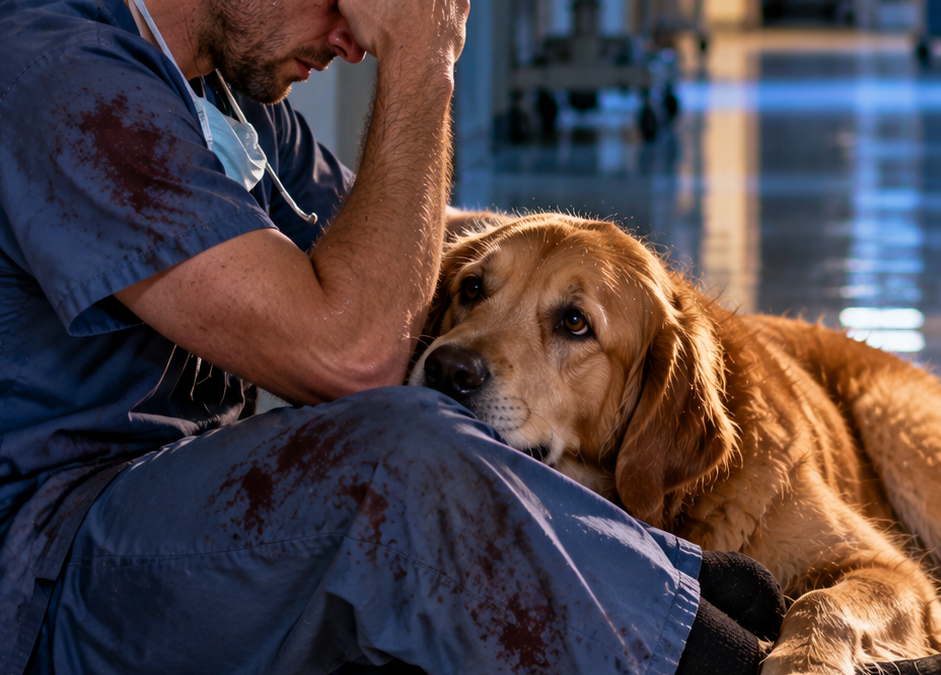
After the longest night of my surgical career, I walked out of the operating room with blood on my scrubs, trembling hands, and no strength left to pretend I was fine.
I hid in a deserted hallway before dawn because I didn’t want my nurses, my colleagues, or anyone else to see what happened to me after the doors closed behind a patient.
Then I heard claws clicking softly against the linoleum, and a dog I had barely noticed for years came out of the shadows as if he’d known exactly where to find me.
My name is James Holloway.
By the time Hendrix found me sitting on that hospital floor, I had been a surgeon for twenty-two years.
Twenty-two years is long enough to become very skilled at hiding certain things.
Fatigue.
Fear.
Doubt.
Grief.
People want surgeons to be calm.
Patients need us to be calm.
Families need us to walk into waiting rooms looking as though every decision we’ve just made was obvious, controlled, and inevitable.
The operating room demands the same thing.
You can’t let your hands reflect what your mind is feeling.
You can’t hesitate because you’re tired.
You can’t become emotional because a patient reminds you of your daughter.
You can’t stop in the middle of a crisis and admit that you’re scared.
So you learn to separate yourself.
There is the person who enters the operating room.
And there is the person waiting somewhere inside you when the operation is over.
For years, I had a ritual for meeting that second man.
I never told anyone about it.
After difficult cases, I avoided the staff lounge.
I didn’t go straight to the cafeteria.
I didn’t stand around discussing the operation unless I absolutely had to.
Instead, I would find a quiet hallway somewhere away from the main units.
Sit for a few minutes.
Breathe.
Let my hands stop being a surgeon’s hands and become mine again.
Sometimes five minutes was enough.
Sometimes ten.
Then I’d stand up, straighten my shoulders, and return to being Dr. Holloway.
That had worked for more than two decades.
Until Lily.
She was twelve years old.
I remember that before I remember almost anything else.
Twelve.
The helicopter landed on the hospital roof at 8:45 that evening, just as I was supposed to be finishing my shift.
I had already been at the hospital most of the day.
I was tired.
Hungry.
My daughter had texted twice.
The first message said:
Are you still calling tonight?
The second came forty minutes later.
It’s okay if you’re busy.
That one hurt more.
My daughter, Claire, lived nearly two hundred miles away with my ex-wife.
I saw her regularly, but never enough.
There was always another shift.
Another emergency.
Another patient whose body had no interest in respecting the promises I’d made outside the hospital.
I had told Claire I’d call that evening.
I meant it when I said it.
Then the helicopter arrived.
One of the trauma nurses met me outside the emergency department.
“Motor vehicle accident,” she said while walking beside me. “Twelve-year-old female. Multiple injuries. Unstable pressure.”
I remember thinking:
There are other surgeons here.
Technically, I could have handed the case off.
My scheduled shift was ending.
Another surgeon was available.
No one would have blamed me.
Then the doors opened.
I saw the girl.
Small body.
Blood.
Paramedics speaking over one another.
One hand hanging over the side of the stretcher, fingers no bigger than Claire’s had been a few years earlier.
And in that instant, every plan I had for the evening disappeared.
“What do we have?” I asked.
The paramedic started listing injuries.
I listened.
Asked questions.
Looked at the scans.
Then I turned toward the operating room staff.
“Prep OR Three.”
Someone asked, “You’re taking it?”
“Yes.”
The operation began at 9:10 p.m.
The first part was chaos disguised as choreography.
That’s what good emergency surgery often looks like.
From the outside, people imagine shouting.
Running.
Panic.
In a competent operating room, the opposite is usually true.
Everyone becomes quieter.
More precise.
Margaret, our anesthesiologist, stood at Lily’s head monitoring every change.
Two nurses moved around me with the efficiency that comes from working together for years.
Instruments arrived before I had to ask twice.
Numbers were called out.
Medication doses.
Blood pressure.
Oxygenation.
Fluid.
Blood loss.
Nothing existed outside that room.
Not my phone.
Not Claire.
Not my hunger.
Not time.
Only Lily.
For the first few hours, I felt the familiar clarity settle over me.
It is difficult to explain unless you’ve experienced it.
Exhaustion disappears.
Your body becomes secondary.
Every decision narrows down to the next necessary action.
Do this.
Then that.
Correct the problem in front of you.
Reassess.
Continue.
At some point near midnight, my shoulders began hurting.
I ignored them.
My lower back tightened.
Ignored that too.
Then my left hand trembled.
Barely.
Once.
I stopped for half a second.
Margaret saw it.
Of course she did.
Anesthesiologists see everything.
Her eyes met mine over her mask.
“You okay?”
“I’m fine.”
It was the most common lie in the hospital.
She knew it.
I knew she knew it.
But she also knew what I meant.
I can continue.
So we continued.
I hadn’t eaten.
Couldn’t remember the last time I’d taken a proper drink.
My mouth was dry behind the mask.
The lights above the table seemed brighter than usual.
But every time fatigue tried to enter my thoughts, I pushed it aside.
One of my old mentors used to tell me:
“James, you cannot save everybody.”
I hated that sentence when I was young.
It sounded like surrender.
Then he would add:
“But you can do everything that is humanly possible. When you’ve done that, you are allowed to be human too.”
At thirty, I understood the first half.
At fifty, I still hadn’t learned the second.
That night, I kept hearing his voice.
Everything humanly possible.
So I did.
Hour after hour.
Suture.
Clamp.
Assess.
Correct.
Wait.
Continue.
At one point, Lily’s numbers changed sharply.
Margaret’s voice became firmer.
I looked at the monitors.
Then at the field.
For several minutes, the entire room tightened.
Nobody panicked.
But everyone knew.
There are moments during surgery when a patient’s future seems to balance on something so small you could hold it between two fingers.
This was one of them.
“Come on,” I whispered.
I don’t know whether I was speaking to Lily.
Her body.
Myself.
Maybe all three.
The numbers stabilized.
Nobody celebrated.
You never celebrate too early.
We kept working.
Sometime after three, one of the nurses asked if I wanted someone else called in.
“No.”
“Dr. Holloway—”
“I’m good.”
Margaret looked at me again.
This time I said,
“We’re almost there.”
She nodded.
“Then finish.”
So I did.
The final stitch went in shortly before dawn.
I remember looking up at the clock and having trouble processing the numbers.
Margaret checked the monitors.
Waited.
Then she looked at me.
Her eyes softened.
“She’s stable.”
I didn’t answer.
Couldn’t.
All the tension I had been holding in my chest for hours shifted at once.
The nurses began the closing procedures.
I stepped backward.
My hands were still held slightly away from my body.
They were trembling again.
This time, I couldn’t command them to stop.
One of the nurses said,
“Dr. Holloway?”
“I’m okay.”
Another lie.
But Lily was stable.
That was what mattered.
I left the operating room.
Removed my gloves.
Then my cap.
My hair was soaked with sweat.
The collar of my scrubs felt stiff against my neck.
I should have gone somewhere warm.
Should have eaten.
Should have called Claire.
Should have spoken with Lily’s parents.
There were dozens of things I should have done.
Instead, my feet carried me toward an old secondary corridor near a service exit.
Almost nobody used it before dawn.
That was why I liked it.
I reached the wall.
Then simply slid down until I was sitting on the floor.
Cold linoleum beneath me.
Cold wall against my back.
Fluorescent light buzzing overhead.
Silence.
Finally.
I closed my eyes.
The first few minutes after a surgery like that are strange.
During the operation, your mind refuses to imagine outcomes.
You cannot allow yourself to picture the child’s parents.
You cannot think about birthdays.
School.
Christmas.
The possibility that the patient on the table might have been laughing with friends twelve hours earlier.
That would make the work impossible.
Afterward, all of it comes back.
I saw Lily’s face before anesthesia.
I wondered what she would remember when she woke.
I wondered whether she would be frightened of cars afterward.
Whether she would blame whoever had been driving.
Whether her parents would blame themselves.
I wondered whether saving a life from the immediate danger was only the beginning of everything that family would now have to survive.
Then I thought about Claire.
I opened my eyes.
My hands were shaking.
Not violently.
But enough.
I looked at them.
Those hands had just spent hours doing exactly what I’d trained them to do.
Now I couldn’t make them hold still.
I pulled out my phone.
Claire’s messages were still there.
Are you still calling tonight?
It’s okay if you’re busy.
I typed:
I’m sorry.
Deleted it.
Typed:
Emergency surgery. I’ll call when you wake up.
Deleted that too.
Everything sounded inadequate.
I put the phone away.
The hallway was completely empty.
For twenty-two years, I had told myself I preferred those moments alone.
That solitude helped.
That I didn’t need anyone asking whether I was okay because the question itself required too much effort.
Maybe that was partly true.
But sitting there that morning, I felt something I had rarely allowed myself to name.
Loneliness.
Profound, exhausting loneliness.
I had spent an entire career surrounded by people.
Nurses.
Residents.
Patients.
Families.
Administrators.
Students.
Colleagues.
And somehow, after the hardest nights, I always ended up alone against a wall.
Maybe because I chose it.
Maybe because I didn’t know how to do anything else.
I rested my head back and closed my eyes again.
Then I heard footsteps.
At first, I assumed security.
But the sound was wrong.
Too light.
Click.
Click.
Click.
Claws against linoleum.
I opened my eyes.
At the far end of the corridor stood a dog.
Medium-sized.
Brown coat faded almost tan in places.
One ear upright.
The other tipped slightly to the side.
I recognized him.
Everyone in the hospital did.
His name was Hendrix.
At least that was what the staff called him.
Years earlier, Hendrix had apparently wandered onto hospital property as a stray.
Nobody knew exactly where he’d come from.
Security had tried to remove him.
He came back.
Someone from dietary services started feeding him.
Then nurses did.
Then half the hospital did.
Eventually, Hendrix became one of those strange institutional facts nobody officially approved but everyone accepted.
He slept near the cafeteria sometimes.
Near the loading area other nights.
He wandered certain corridors freely.
Security knew him.
Maintenance knew him.
Nurses knew him.
Patients occasionally asked who owned him.
The honest answer was probably:
Nobody.
Or everybody.
I’d seen him dozens of times.
Maybe hundreds.
I had never paid much attention.
Until that morning.
Hendrix stood at the end of the hallway looking at me.
“Hey.”
My voice sounded awful.
He started walking.
Not quickly.
Not cautiously.
Just directly toward me.
His nails clicked softly against the floor.
He didn’t sniff doorways.
Didn’t investigate trash cans.
Didn’t stop.
He came straight to where I was sitting.
Then stopped about a foot away.
I expected him to lick my hand.
Dogs usually want something.
Food.
Attention.
Movement.
Hendrix wanted nothing.
He simply sat.
Beside me.
Not touching.
Not staring aggressively.
Just there.
I looked at him.
He looked at me.
His eyes were calm.
That was the first thing I noticed.
Not sad.
Not excited.
Calm.
There was no demand in them.
No question.
He didn’t need me to explain why I was sitting on the floor.
Didn’t need to know whether Lily would recover.
Didn’t need my professional confidence.
Didn’t need Dr. Holloway.
He seemed perfectly willing to sit beside James.
That was different.
“Long night,” I whispered.
One ear moved.
“Yeah.”
I don’t know why I started talking to him.
Maybe because silence with an animal feels safer than silence with another person.
“I think she’s going to make it.”
Hendrix remained still.
“But I don’t know.”
There it was.
The sentence I would never have said in front of Lily’s parents.
The sentence surgeons learn to hold carefully.
I didn’t know.
We never completely know.
Even when the operation goes perfectly.
Even when the monitors stabilize.
Human bodies keep their own secrets.
I rested my forearms on my knees.
“I hate that part.”
Hendrix blinked.
I almost laughed.
“Excellent feedback.”
My hands were still shaking.
Without thinking, I reached toward him.
Slowly.
I placed my palm on his back.
His fur was warm.
That surprised me.
The hallway was cold.
I had been cold without noticing.
But Hendrix was warm.
He didn’t move closer.
Didn’t move away.
He simply allowed my hand to remain there.
I felt his breathing.
Slow.
In.
Out.
In.
Out.
My own breathing had been shallow.
I realized that only because his wasn’t.
So I matched him.
Not intentionally at first.
Then consciously.
In.
Out.
My fingers tightened slightly in his fur.
The tremor continued.
Then weakened.
Minutes passed.
I don’t know how many.
Time had stopped mattering.
My hand moved from his back to his shoulder.
Hendrix lowered his head.
Nothing dramatic happened.
No revelation.
No miracle.
The hospital didn’t disappear.
Lily wasn’t suddenly guaranteed to recover.
My divorce remained real.
My daughter was still waiting for a father who had missed another call.
I was still exhausted.
But something in my chest loosened.
Just enough.
There is a particular kind of mercy in being with someone who doesn’t need you to perform.
People ask,
“Are you okay?”
Then we often say yes because saying no creates another conversation.
A dog doesn’t ask.
Hendrix didn’t care whether I had an answer.
He stayed.
That was all.
Much later, a security officer told me he had checked the camera footage.
Forty-three minutes.
Hendrix and I sat on that floor for forty-three minutes.
It felt like five.
Maybe less.
For most of that time, I said nothing.
Sometimes my eyes closed.
Sometimes I watched the empty hallway.
My hand stayed on him.
Gradually, the trembling stopped.
Completely.
At 5:34, I looked down.
My hands were steady.
Hendrix was still there.
“How did you know?”
His ear moved.
“I wasn’t even supposed to be down here.”
Nothing.
“You stalking surgeons now?”
His tail gave one slow thump against the floor.
I smiled.
It was the first genuine smile I’d managed all night.
“Fair enough.”
I scratched the top of his head.
Then I pushed myself up.
My legs complained immediately.
I had spent too many hours standing still over an operating table.
I looked toward the main corridor.
I had responsibilities.
Lily.
Her parents.
Claire.
My life waiting outside that strange forty-three-minute pause.
Before leaving, I looked down at Hendrix.
“Thank you.”
Very quiet.
His tail moved once.
Just once.
Then he stayed seated while I walked away.
He didn’t follow.
That struck me.
Dogs usually follow people who pet them.
Hendrix didn’t seem interested in collecting gratitude.
He had finished whatever he’d come to do.
When I turned at the corner, he was still sitting beneath the fluorescent light.
Watching me go.
I went to recovery first.
Lily was still unconscious.
Her numbers were good.
Stable.
Margaret stood near the monitors.
She looked at me.
“You disappear?”
“Briefly.”
“You look better.”
“I feel better.”
She gave me the suspicious stare anesthesiologists reserve for surgeons who admit to having emotions.
“What happened?”
“Nothing.”
That wasn’t entirely true.
But I wasn’t ready to explain it.
I stayed near Lily for several minutes.
Then I went to speak with her parents.
They were holding hands in the waiting room.
Her mother stood the second she saw me.
I had delivered this kind of conversation hundreds of times.
This one felt different.
“She’s stable,” I said.
The mother covered her mouth.
Her father closed his eyes.
I explained what we’d done.
What we knew.
What we still had to watch.
I didn’t promise things I couldn’t promise.
But I gave them the truth.
There was reason to hope.
When I finished, Lily’s father grabbed my hand.
“Thank you.”
For years, I’d usually responded with something professional.
The whole team worked very hard.
Or:
She’s not out of danger yet.
Both true.
That morning, I simply said,
“You’re welcome.”
Then I stepped away.
A nurse named Jennifer caught me near the recovery unit.
She had worked nights almost as long as I had.
“James.”
I stopped.
“You okay?”
Normally I would have answered automatically.
Fine.
Tired.
Long night.
Instead, I thought about Hendrix.
Then I said,
“Something sat beside me this morning that didn’t need me to explain anything.”
Jennifer frowned.
I continued.
“Twenty-two years doing this, and I think that’s the first time I didn’t feel alone after a case like that.”
Her expression changed.
She glanced toward the service corridor.
“Hendrix?”
I looked at her.
“How did you know?”
A small smile.
“He has a habit.”
“What habit?”
“Finding people.”
I thought she was joking.
She wasn’t.
I called Claire before leaving the hospital.
She answered sleepily.
“Dad?”
“Hey.”
“What time is it?”
“Early.”
“Are you okay?”
That question again.
This time, I answered differently.
“Yeah.”
Pause.
“I’m tired. But yeah.”
“Was it surgery?”
“Yes.”
“A bad one?”
“A hard one.”
She was quiet.
Then:
“Did it go okay?”
“I think so.”
“Good.”
I leaned against the wall near the staff exit.
“Claire?”
“Yeah?”
“I’m sorry I didn’t call.”
“It’s okay.”
“No.”
I closed my eyes.
“It’s not always okay just because my job is important.”
She didn’t answer immediately.
Then she said,
“I know you try.”
“I need to try better.”
That conversation lasted only ten minutes.
But I remember it almost as clearly as the operation.
Something shifted in me after that morning.
Not dramatically.
I didn’t quit medicine.
Didn’t reduce my schedule to three days a week and discover meditation.
Real change is usually less cinematic.
I began calling Claire when I said I would.
Not every single time.
I’m human.
But far more often.
I stayed at patients’ bedsides a little longer.
Listened when nurses talked.
Sometimes I even ate before hour twelve of a shift.
Margaret called that my greatest medical breakthrough.
And whenever I saw Hendrix in a hallway, I nodded.
That was our thing.
No baby talk.
No dramatic reunion.
I’d see him.
He’d see me.
I would tilt my head.
He’d wag his tail once.
Then we would continue in opposite directions.
Months passed.
I started noticing Hendrix more carefully.
Jennifer had been right.
He found people.
One night, a newly licensed nurse named Anna lost her first patient.
The death wasn’t her fault.
Nothing she could have done would have changed it.
That doesn’t matter the first time.
She disappeared into a storage room and cried.
Hendrix found her.
Nobody sent him.
He simply appeared.
Sat beside her.
Stayed until she came back out.
A young resident had a panic attack after a brutal emergency surgery.
Hendrix was in the hallway before anyone realized what was happening.
Marc, one of our custodians, received a phone call one night telling him that his mother had died.
He sat on an overturned bucket near the maintenance corridor.
Hendrix rested at his feet.
Again and again, the same pattern.
No training.
No command.
No handler.
No vest that said THERAPY DOG.
He just knew.
Or perhaps “knew” is the wrong word.
Maybe he noticed details we missed.
Changes in posture.
Breathing.
Smell.
The way someone walked after receiving terrible news.
Whatever the mechanism was, the result remained the same.
He found people when they were trying hardest not to be found.
Years went by.
Lily recovered.
Not instantly.
There were more procedures.
Rehabilitation.
Hard months.
But she recovered.
Her family sent us a photograph about a year later.
Lily was standing outside holding a soccer ball.
I kept that photograph in my desk.
I never told them about Hendrix.
It wasn’t their story.
That moment belonged to the empty hallway.
Hendrix aged too.
The brown in his coat faded.
His muzzle turned pale.
His steps slowed.
Someone near the cafeteria made him a proper sleeping area.
Old cushion.
Soft blanket.
Water bowl.
The hospital administration pretended not to notice that we had effectively adopted a dog.
Security pretended not to know who kept bringing him better food.
Nurses definitely knew.
Eventually, Hendrix spent more time sleeping than wandering.
But he still walked the halls at night.
Slowly.
Purposefully.
One evening, I watched him struggle to stand from his cushion.
“Stay down, old man.”
He looked at me.
Then got up anyway.
“Fine.”
His tail moved.
“You’re worse than my patients.”
He walked past me.
Down the corridor.
Ten minutes later, I saw him sitting beside a woman whose husband was in intensive care.
She was alone.
Of course.
That was Hendrix.
By then, I had stopped asking how.
The night before my retirement, I remained at the hospital later than necessary.
I had spent twenty-two years as a surgeon when Hendrix first sat beside me.
Many more had passed since.
My hair had gone gray.
My back hurt for reasons no operating table could fully explain.
Claire was grown.
We were closer.
Not perfect.
Closer.
That mattered.
My office was nearly empty.
Photographs removed.
Books boxed.
Old certificates taken down.
I walked through the hospital after midnight.
One final unnecessary tour.
ICU.
Recovery.
Surgical floor.
Cafeteria.
Then I found Hendrix.
He was curled on his cushion.
Very old now.
His breathing was slow.
One ear—the bent one—barely moved when I approached.
“Hey.”
His eyes opened.
I crouched.
My knees hated me for it.
“I know.”
I placed a hand against his head.
He leaned into it very slightly.
I smiled.
“You know, I’ve been trying to figure you out for years.”
His eyes stayed on mine.
“No luck.”
Tail.
One movement.
“Typical.”
I sat on the floor beside him.
Not against a hallway wall this time.
Beside his bed.
For a while, neither of us moved.
Then I said,
“That night with Lily…”
His ear twitched.
“You probably don’t remember.”
I smiled.
“I do.”
My hand moved slowly over his old fur.
“I thought I needed to be alone.”
I looked down.
“I was wrong.”
Hendrix breathed out.
“Nobody ever told me that needing somebody didn’t mean I was weak.”
The words felt strange even after all those years.
“But you didn’t ask permission.”
Tail.
Once.
“You just sat down.”
I swallowed.
“Best consultation I ever had.”
Hendrix closed his eyes.
I laughed quietly.
“Don’t let that go to your head.”
Before leaving, I bent closer.
“Thank you.”
His tail moved.
Once.
Exactly as it had the first morning.
I stood slowly.
Then walked away.
At the end of the corridor, I turned around.
Hendrix was watching me.
For a second, I was back there again.
Exhausted.
Hands trembling.
Lily fighting for her life somewhere behind hospital doors.
Claire waiting for a phone call.
Me convinced I had to carry everything alone because that was what capable men were supposed to do.
And one stray dog sitting close enough to touch but far enough not to ask anything from me.
I nodded.
Hendrix’s tail moved.
Then I left.
People at the hospital still tell stories about him.
At least, they did the last time I visited.
Hendrix was older.
Slower.
Sleeping more.
But still wandering when he felt like it.
Still turning up in odd places at odd hours.
Near grieving families.
Young doctors.
Exhausted nurses.
People sitting on stairwells because they needed five minutes before going back to work.
Nobody formally assigned him that role.
Nobody could have.
It was simply what he did.
I’ve spent most of my life believing action solves problems.
Cut.
Repair.
Suture.
Drain.
Stabilize.
Medicine trains you to intervene.
Hendrix taught me something almost opposite.
Sometimes intervention isn’t what a person needs.
Sometimes you don’t need advice.
You don’t need encouragement.
You don’t need someone explaining that things will improve.
You don’t need them asking for the fifth time whether you’re okay.
Sometimes what you need is much simpler.
A warm body beside you.
A quiet presence.
Someone willing to stay without asking you to perform your pain for them.
I don’t remember every operation I’ve done.
That’s impossible.
Cases blur together after enough years.
Names fade.
Dates disappear.
But I remember Lily.
And I remember 4:00-something in the morning.
The empty corridor.
The buzzing fluorescent light.
My shaking hands.
The sound of claws approaching from the darkness.
I remember Hendrix sitting exactly one foot away.
Not touching me until I touched him.
Not leaving.
Forty-three minutes.
That was all.
Forty-three minutes in a career measured in decades.
Yet somehow, those forty-three minutes changed the way I lived the years that followed.
Not because Hendrix fixed me.
He didn’t.
He simply stayed long enough for me to remember I was not a machine that repaired other people.
I was a person too.
And sometimes even the person everyone depends on needs someone beside him when the room finally becomes quiet.
Hendrix understood that before I did.
Maybe he understood it better than any of us.
And that is why, whenever I think about the most important lessons I learned in a hospital, I don’t first remember a professor.
Or a textbook.
Or a surgical conference.
I remember a stray dog with one crooked ear walking down an empty hallway before dawn.
He didn’t say anything.
He didn’t need to.
He sat beside me.
And stayed.





