We Trapped the Same Orange Cat 11 Times — Then We Realized He Was Never Coming Alone
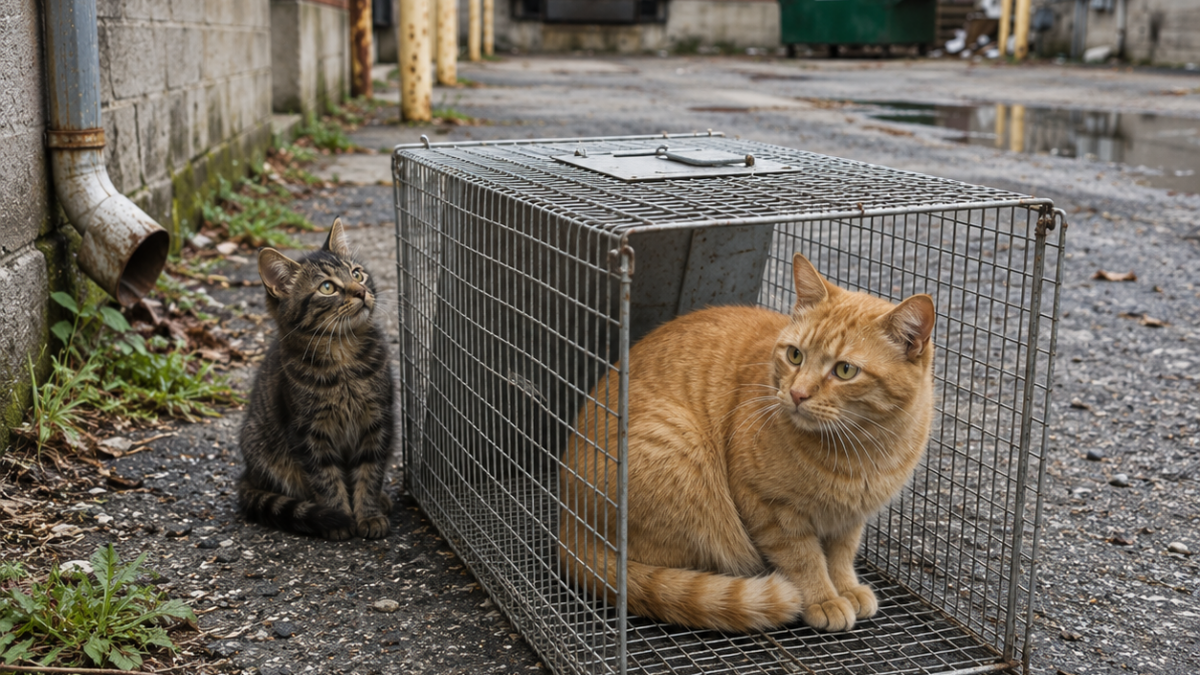
The same orange tom walked into our TNR traps eleven different times over four years, even though he had already been neutered, ear-tipped, and had absolutely no reason to keep doing it.
What bothered me wasn’t that he kept getting caught—it was that nearly every time we found him sitting behind that metal door, another unsterilized cat seemed to be waiting somewhere nearby.
For years I called it coincidence, right up until one freezing winter night forced me to admit that maybe I had been looking at the wrong cat the entire time.
His name was Bruiser.
We didn’t give him that name because he was aggressive.
Actually, he was surprisingly calm for a large outdoor tom.
But the first time we trapped him behind the strip mall in March of 2019, he looked like he had spent his whole life collecting evidence of fights.
He was a big orange male, about twelve pounds, maybe four years old.
Broad head.
Heavy cheeks.
A scar near his nose.
One notch in an ear that had nothing to do with TNR.
He looked like a retired boxer who had somehow wandered into a cat colony.
So Pat looked through the trap and said, “Well, hello, Bruiser.”
The name stayed.
At the time, I thought Bruiser would be one of the easiest cats in the colony.
Trap him.
Neuter him.
Vaccinate him.
Ear-tip him.
Release him.
Done.
That is how trap-neuter-return is supposed to work.
For anyone unfamiliar with TNR, the process is simple in theory and exhausting in practice.
You set humane traps in an area where community cats live.
The cats enter for food.
They are taken to a clinic, spayed or neutered, vaccinated, and given a small ear tip so rescuers can immediately recognize them later.
Then, once they recover, they are returned to the same territory where they were found.
You do not keep retrapping an ear-tipped cat if you can avoid it.
Every trap occupied by a cat already sterilized is a trap unavailable for the one cat you are still desperately trying to catch.
And every colony has those cats.
The suspicious ones.
The cats who watch five others walk into traps and decide that tuna is not worth dying for.
The ones who seem capable of identifying a trap from forty yards away.
Those are the cats that keep colony managers awake at night.
Bruiser was not supposed to be one of our problems.
We neutered him in March.
Released him behind the strip mall.
And assumed his trapping career was over.
Then June came.
I pulled into the parking lot just before sunrise and saw Pat standing beside trap number two with her hands on her hips.
“That bad?” I asked.
She pointed.
Bruiser was sitting inside.
Perfectly relaxed.
He looked at me as though we were inconveniencing him.
“You again?”
He blinked.
I crouched beside the trap.
His left ear now carried the clean tip marking him as already neutered.
I started laughing.
“Repeat offender.”
Pat didn’t laugh.
She was staring past him.
About three feet from the trap sat a young gray-and-white female.
No ear tip.
She wasn’t running.
She wasn’t hiding.
She was simply sitting near Bruiser’s trap.
Watching.
“Interesting,” Pat said.
“What?”
“That cat.”
“She wants the food.”
“Maybe.”
We released Bruiser.
He walked a few feet away.
The female followed.
That night, she went into one of our traps.
We had her spayed.
I forgot about the whole thing.
Then August came.
Bruiser appeared in trap number one.
Again.
This time a young black male was circling nearby.
No ear tip.
We caught him too.
“Bruiser brought another friend,” Pat joked.
“He didn’t bring anybody.”
“Okay.”
“Cats don’t organize TNR appointments.”
“Okay.”
Pat had a way of saying okay that made it clear she believed nothing I had just said.
November came.
Bruiser again.
Two kittens beneath the dumpster.
Both unsterilized.
Both trapped within hours.
I remember standing under the yellow parking-lot lights with Pat, watching Bruiser eat bait from inside a trap he had already entered several times.
“He’s just food-motivated,” I said.
Pat wrote something in her notebook.
“What are you writing?”
“Nothing.”
“That looks like something.”
She closed the notebook.
“Go reset trap four.”
I did.
At the time, I still believed I was right.
A hungry outdoor cat finds food.
He enters a trap.
Other cats live nearby.
Naturally, sometimes you catch them during the same trapping session.
Coincidence.
Statistics.
Nothing mysterious.
Nothing sentimental.
Certainly nothing intentional.
I would repeat that explanation for almost four years.
What I didn’t understand yet was that Pat had already started keeping a second set of notes.
Not just when Bruiser entered the traps.
Who appeared with him.
Where they stood.
How long they stayed.
And whether they were already ear-tipped.
Years later, after Bruiser was gone, I would sit in our supply shed with those notebooks spread across the table and realize something that still makes my throat tighten.
Every time that orange cat walked voluntarily into one of our traps, we caught someone new.
Every single time.
PART 2
At first, none of us treated Bruiser like anything unusual.
He was simply part of the strip-mall colony.
And that colony gave us plenty of other things to worry about.
The cats lived behind a row of businesses that included a discount grocery store, a nail salon, a laundromat, a pizza place, and a vacant unit that seemed to change tenants every six months.
Behind the buildings ran a narrow service lane.
Dumpsters lined one wall.
Loading docks interrupted the other.
There were pallets, cardboard boxes, grease stains, drainage pipes, and just enough sheltered space beneath concrete structures for cats to disappear whenever they wanted.
It was not an easy colony.
People abandoned cats there regularly.
That was one of the reasons the population had grown so quickly.
Someone would decide they no longer wanted a cat.
Instead of surrendering it properly, they would drive behind the strip mall after dark and let it out.
Sometimes the cat was friendly.
Sometimes terrified.
Sometimes pregnant.
Sometimes there would be a cardboard carrier left beside a dumpster.
Once, we found three kittens inside a laundry basket.
No note.
Nothing.
That was the reality Pat had been managing since 2018.
When she first started counting, there were thirty-one cats.
Thirty-one visible cats, anyway.
With community colonies, the actual number often changes depending on weather, feeding time, breeding cycles, newcomers, and how suspicious individual cats are.
Pat knew nearly all of them.
Not just by color.
By behavior.
There was a tortoiseshell who would only eat after every other cat left.
A black male who slept near the loading dock but never crossed the alley.
A tiny tabby female who could somehow remove chicken from a trap without triggering the plate.
We called her Houdini.
Pat hated that cat.
Loved her too.
But definitely hated her.
Then there was Bruiser.
He had no sense of caution around traps.
None.
That should have made him boring.
Instead, it became the thing that made him unforgettable.
The fourth time we trapped him, Pat called me before I reached the colony.
“You’ll never guess.”
I was driving.
“Did Houdini finally go in?”
“No.”
“Someone dumped kittens?”
“No.”
“Then what?”
“Your boyfriend is back.”
I knew immediately.
“Bruiser?”
“Trap six.”
I laughed.
“Again?”
“And he has company.”
I sighed.
“Pat.”
“What?”
“You’re doing it again.”
“Doing what?”
“Making it sound like he invited them.”
“I didn’t say that.”
“You were thinking it.”
“I’m always thinking things.”
I parked behind the grocery store ten minutes later.
Bruiser was in trap six.
Beside the loading dock sat a slender calico.
She had no ear tip.
When we approached, she moved away.
Bruiser remained calm.
He had eaten most of the sardine bait and was washing one front paw.
Pat crouched beside him.
“You’re ridiculous.”
Bruiser blinked.
“You know you’ve already had surgery, right?”
Another blink.
Pat glanced at me.
“He looks offended.”
“He looks orange.”
“Same thing sometimes.”
We opened the trap.
Bruiser walked out.
He did not run.
That was another thing about him.
Most cats released from traps disappeared immediately.
Bruiser would step out, stretch, look around, then walk away as though he had just completed a minor administrative task.
That evening, the calico went into a trap.
She was spayed the next morning.
I remember Pat drawing a little orange circle beside her record.
“What’s that?”
“Bruiser.”
“You’re seriously tracking this?”
“Yes.”
“Why?”
“Because I’m curious.”
“About coincidence?”
“Sure.”
I rolled my eyes.
Pat had been in animal rescue for twenty-two years.
I had not.
That difference mattered more often than I liked admitting.
She had seen cats survive things I would have thought impossible.
She had watched feral mothers move entire litters after realizing humans had discovered a nest.
She had watched bonded cats wait outside traps containing their companions.
She had seen neutered males tolerate kittens climbing over them.
She had also seen people invent stories about animal behavior that were completely unsupported.
Pat wasn’t careless about interpretation.
That was why her interest in Bruiser bothered me.
If she had been sentimental, I could dismiss it.
Pat was not sentimental.
She could bottle-feed a dying kitten at three in the morning and still tell you bluntly that loving an animal did not change biology.
So when she kept noting Bruiser’s repeat appearances, I started paying attention despite myself.
Not believing.
Paying attention.
There is a difference.
Through 2020, the pattern continued.
We would set traps.
Sometimes Bruiser appeared.
Sometimes he didn’t.
But whenever he appeared, there was nearly always another cat nearby that we had not yet sterilized.
A young tabby.
A skinny white male.
A pregnant tortoiseshell.
Two adolescent cats who looked like littermates.
Not once did Bruiser appear during a trapping session where we caught nobody new.
Pat pointed this out after his seventh trapping.
I was kneeling beside a trap, swapping out bait.
She stood behind me holding her notebook.
“Seven.”
“What?”
“Seven times.”
“I know.”
“Seven times, new cat.”
I kept working.
“This colony has lots of cats.”
“Fewer than it used to.”
“Still enough.”
“Seven.”
“You know seven is not magic, right?”
“I didn’t say it was.”
“You’re implying something.”
Pat sat on an upside-down bucket.
“I think he may be making the traps feel safe.”
I stopped.
“What does that mean?”
“I don’t know yet.”
“You think he’s recruiting cats?”
“No.”
“Giving seminars?”
“No.”
“Passing out flyers?”
Pat stared at me.
“You’re very funny before six in the morning.”
“Thank you.”
She looked toward Bruiser.
He was sitting just beyond the feeding station.
“I’m saying cats observe other cats.”
“That is true.”
“They pay attention to where others eat.”
“Also true.”
“They pay attention to danger.”
“Yes.”
“And Bruiser keeps going into traps and coming back out.”
I looked at him.
“He keeps going into traps because he has the survival instincts of a potato.”
“Maybe.”
“You think he understands we release him?”
“I don’t know.”
“You think he understands the other cats get fixed?”
“I definitely did not say that.”
“Then what are you saying?”
Pat shrugged.
“Maybe nothing complicated.”
She pointed toward him.
“Maybe he just doesn’t fear the traps.”
“That I believe.”
“And maybe other cats see him not fearing them.”
I considered that.
“That’s possible.”
“And maybe that changes how they behave around the traps.”
“That’s a lot different from saying he leads them there.”
“I know.”
“But you said that last month.”
“I said it looked like he was leading one.”
“Pat.”
She smiled.
“Go check trap three.”
I hated when she did that.
The truth was, the more I watched, the less certain I became.
Bruiser was not social in the way people usually imagine.
He wasn’t constantly cuddling other cats.
He did not groom everyone.
He wasn’t the colony mascot.
He had his own routines.
He ate.
He slept.
He disappeared for hours.
Sometimes he chased younger males away from particularly good food.
Sometimes he tolerated them.
He was still a cat.
Not a saint.
Not a volunteer coordinator.
Not some magical guide.
But he was stable.
After neutering, his roaming decreased.
His face gradually became less swollen as the hormones changed.
He fought less.
He seemed to spend more time near the central colony area instead of disappearing for days.
And younger cats seemed unusually comfortable around him.
That part was visible.
There was a small black kitten we called Pepper who followed Bruiser around one autumn.
Not constantly.
But enough that we noticed.
Bruiser would walk toward the feeding area.
Pepper followed.
Bruiser rested beneath the loading dock.
Pepper slept six feet away.
When we trapped Pepper for neutering, guess who was in the adjacent trap?
Bruiser.
Again.
I stood there looking at the two traps.
Pat stood beside me.
I already knew what she was going to say.
“Don’t.”
“I didn’t say anything.”
“I can hear you thinking.”
“That sounds like a personal problem.”
We released Bruiser.
Pepper went to clinic.
Another orange circle went into Pat’s notebook.
By then, several volunteers knew about the pattern.
That made everything worse because people began joking.
“Bruiser’s on shift tonight.”
“Bruiser brought us another customer.”
“Bruiser’s commission must be incredible.”
I objected every time.
Not because jokes bothered me.
Because I worried the story was getting ahead of the evidence.
Animal rescue is full of stories people desperately want to believe.
A dog “knew” exactly which house needed help.
A cat “understood” a medical procedure.
An animal “planned” something in human terms.
Sometimes behavior genuinely is extraordinary.
Sometimes we project.
I wanted to be careful.
One evening, a new volunteer named Megan asked me directly:
“Do you really think Bruiser brings them?”
“No.”
She looked disappointed.
“You don’t?”
“I think we see a pattern.”
“But Pat says—”
“Pat says she suspects something.”
“What do you think?”
“I think cats follow food.”
“That’s it?”
“Mostly.”
Megan looked toward Bruiser.
He was lying beneath a shopping cart.
“That’s less interesting.”
“Reality often is.”
Pat, who was carrying traps nearby, heard me.
She called over:
“Reality is plenty interesting if you stop demanding certainty.”
I ignored her.
Mostly because she had a point.
Then January 2022 happened.
That was the night my certainty cracked.
Winter trapping is miserable.
Anyone who tells you otherwise has never stood behind a strip mall at one in the morning with frozen fingers, wet socks, and six traps containing food that no cat wants.
It had been unusually cold that week.
Pat wanted to target three cats we had been seeing near the west side of the colony.
None had ear tips.
One was a brown tabby.
One gray.
One mostly white with a black tail.
We had photographed all three repeatedly.
But they were trap-shy.
Very trap-shy.
Thursday evening, we placed six traps along the usual route.
We used strong-smelling bait.
Covered the backs.
Positioned them beside walls so the cats would not feel exposed.
We checked from a distance.
Nothing.
Ten p.m.
Nothing.
Midnight.
Nothing.
Two a.m.
Nothing.
By sunrise, all six traps were empty.
That almost never happened.
Especially in winter.
Cold cats are hungry cats.
Pat stood in the parking lot looking annoyed.
“We’re moving them.”
“Where?”
“Loading dock.”
“They feed over here.”
“That’s why they’re suspicious over here.”
We moved the traps about twenty feet around the corner.
Not far.
But visually, it was a completely different setup.
Different wall.
Different scent.
Different approach.
Different angle.
We left the feeding station unchanged.
Friday evening, we reset.
I remember asking Pat:
“You think they’ll come?”
“They have to eat somewhere.”
“They can eat forty feet away at the station.”
“Then we wait.”
At approximately nine thirty, my phone rang.
Pat.
“I’ve got one.”
“Which cat?”
Pause.
Then:
“Guess.”
I sat up.
“No.”
“Yes.”
“Bruiser?”
“Trap four.”
I laughed.
“Of course.”
Then Pat said:
“And the three we want are here.”
I stopped laughing.
“All three?”
“All three.”
“Where?”
“Near him.”
I drove over.
The parking lot was nearly empty.
Most businesses had closed.
The loading area was lit by two harsh security lamps.
Bruiser sat inside trap four.
He had eaten the bait.
Again.
Around the edge of the loading dock, three cats waited.
The brown tabby.
The gray cat.
The white one with the black tail.
All three.
Pat stood behind a parked van watching.
I joined her.
Neither of us spoke for a while.
The brown tabby moved closer to Bruiser’s trap.
Then retreated.
The gray cat sniffed near another trap.
Bruiser sat down.
Calm.
No thrashing.
No panic.
No warning cries.
Just Bruiser.
The gray cat entered trap two first.
Snap.
The door closed.
The cat exploded in panic for several seconds.
We immediately covered the trap.
The brown tabby disappeared.
I thought we had lost him.
Twenty minutes later, he returned.
Bruiser was still sitting quietly.
The brown tabby entered trap five.
Snap.
Two.
The white cat took another hour.
Pat and I stood in the cold barely talking.
Finally:
Snap.
Three.
All three.
We had moved the trap line.
Failed completely the night before.
Bruiser somehow found the new location within twenty-four hours.
Went into a trap he had already been caught in multiple times.
And all three unsterilized cats we had been targeting appeared nearby.
I stood looking at him through the wire.
“You’re ridiculous.”
Bruiser blinked.
Pat stood beside me.
“You ready?”
“For what?”
“To say it.”
“I’m not saying anything.”
She smiled.
“Okay.”
“He smelled the food.”
“Sure.”
“There’s food in traps.”
“Yep.”
“Cats like food.”
“Absolutely.”
“He probably just wandered over.”
“Probably.”
I looked toward the feeding station.
It was forty feet away.
Food was available there daily.
Bruiser was twelve pounds.
Healthy-looking.
Not starving.
Not desperate.
He had no need to squeeze into a metal trap for a mouthful of sardines.
And yet there he was.
Again.
I pointed at him.
“He might just really like sardines.”
Pat laughed.
“That must be it.”
I released him after we secured the other three cats.
Bruiser stepped out.
He stretched.
Then walked directly past the three covered traps.
For one second, he paused beside them.
I remember this clearly because Pat and I both stopped moving.
He sniffed one cover.
Then continued toward the feeding station.
That was it.
No dramatic scene.
No magical gesture.
Nothing I could prove.
But something shifted in me.
Not belief.
Not yet.
Willingness.
The willingness to admit I did not completely understand what I was watching.
That is harder than it sounds.
People like certainty.
Especially people involved in rescue.
We want to know why an animal behaves a certain way.
Fear.
Food.
Territory.
Reproduction.
Learned behavior.
We create categories because categories help us make decisions.
But sometimes the honest answer is:
I don’t know.
Bruiser taught me that.
Or perhaps embarrassed me into it.
After the January trapping, I asked Pat to show me her notebook.
She smiled.
“Finally.”
“Don’t enjoy this.”
“I’m enjoying it enormously.”
We sat in the supply shed.
It was barely a shed.
More like a converted storage room behind one of the businesses.
Shelves held trap covers, cans of food, gloves, paper towels, disinfectant, medication carriers, and the endless miscellaneous equipment that accumulates around rescue work.
Pat opened a notebook.
March 2019.
BRUISER — NEUTERED.
June 2019.
BRUISER RETRAP. GRAY/WHITE FEMALE PRESENT. FEMALE CAUGHT.
August.
BRUISER RETRAP. YOUNG BLACK MALE PRESENT. CAUGHT.
November.
BRUISER. TWO KITTENS NEAR DUMPSTER. BOTH CAUGHT.
The entries continued.
Different handwriting pressure depending on how cold Pat’s hands had been.
Different pens.
Different bait notes.
Different weather.
But the same orange circle.
Bruiser.
Again.
And again.
And again.
I counted.
“How many?”
“At this point?”
“Yes.”
“Nine.”
“Nine times?”
“Nine.”
“And every time?”
“At least one new cat.”
I went back through the records.
Some sessions had two.
One had three.
Not a single Bruiser retrap without a successful new catch during the same session.
I sat back.
Pat waited.
“You could have shown me this earlier.”
“I did.”
“No, you showed me individual notes.”
“You told me I was anthropomorphizing.”
“You were.”
“Maybe.”
“You definitely were.”
Pat smiled.
“You’re struggling.”
“I hate you.”
“No, you don’t.”
I looked again.
“What do you think he’s doing?”
Pat’s expression changed.
Less teasing.
More serious.
“I don’t know.”
“You’ve been saying he leads them.”
“I said it looks that way.”
“That’s different.”
“Very.”
“What do you actually think?”
She leaned back.
“I think Bruiser has become a familiar stable cat here.”
“Okay.”
“I think newer cats watch him.”
“Reasonable.”
“I think he knows where food appears.”
“Yes.”
“I think he does not consider the traps extremely dangerous.”
“Obviously.”
“And I think sometimes other cats follow where he goes.”
“That’s not intentional.”
“I didn’t say it was.”
“But sometimes you talk like it is.”
Pat looked toward the door.
“Maybe I like the story.”
I laughed.
“That’s not scientific.”
“No.”
“Then why?”
“Because rescue is exhausting.”
That answer surprised me.
Pat closed the notebook.
“You know what we usually talk about?”
“What?”
“Numbers.”
She counted on her fingers.
“How many spays. How many neuters. How many kittens. How many traps. How many dollars. How many foster homes. How many cats disappeared. How many came back injured.”
She looked tired suddenly.
“Sometimes a story makes people remember why the numbers matter.”
I didn’t answer.
She continued.
“Do I believe Bruiser understands TNR?”
“No.”
“Of course not.”
“Do I believe he thinks, ‘Hello, new cat, please step into this humane trap so you can receive surgery and vaccines’?”
“No.”
“Obviously not.”
She smiled.
“But do I think his behavior may have made those traps less frightening to other cats?”
She looked directly at me.
“Yes.”
I nodded slowly.
“That I can accept.”
Pat smiled.
“Progress.”
I pointed at her.
“Do not tell anyone.”
She told everyone.
By 2023, Bruiser had become part of volunteer orientation.
Not officially.
But practically.
A new person would be learning how to line a trap with newspaper or how to cover one safely after capture.
Eventually somebody would point at a large orange cat sitting nearby.
“That’s Bruiser.”
Then the story would begin.
“He’s been trapped how many times?”
“Ten.”
“You’re joking.”
“No.”
“Why does he keep going in?”
“Ask him.”
Then someone would mention the other cats.
Some volunteers believed the most romantic version immediately.
Bruiser was a guide.
A recruiter.
A colony ambassador.
Others were skeptical like me.
One person called him “the orange can opener.”
I don’t know what that meant.
But it stuck for about a month.
I remained careful.
Every time someone said, “Bruiser brings cats to the traps,” I corrected them.
“We don’t know that.”
Pat would add:
“But it’s fun to wonder.”
Our records became stronger.
Not proof of motive.
Proof of pattern.
There is a difference I still think matters.
Between 2019 and 2023, Bruiser was trapped eleven times.
Eleven.
Every single time, at least one unsterilized cat was caught during the same trapping session.
Usually two.
Some were new arrivals.
Some had been around for months but had avoided us.
Some were young.
Some fully grown.
Different personalities.
Different levels of trap suspicion.
And there was Bruiser.
Sitting behind a wire door.
Eating.
Waiting.
Being Bruiser.
Meanwhile, something else was changing.
The colony itself.
When we started managing it in 2018, the visible count was thirty-one cats.
Over the following five years, we TNR’d forty-four individual cats.
That number was higher than the original colony count because the population was not closed.
Cats arrived.
People abandoned them.
Occasionally a roaming intact cat joined.
Before we reached high sterilization coverage, kittens were born.
Managing a dumping-ground colony is like trying to empty a bathtub while someone occasionally turns the faucet back on.
You make progress.
Then a pregnant female appears.
You catch three.
Someone dumps two.
You sterilize ten.
A frightened male arrives from somewhere else.
It never feels finished.
Yet something remarkable happened at Oakridge—the name we eventually gave the strip-mall colony.
Since 2021, not one kitten has been born there.
Not one.
That is an extraordinary outcome in a colony where abandonment still occurs.
New intact cats appeared.
But we caught them.
Again.
And again.
And again.
Pat reached something she had never achieved in twenty-two years of colony management.
One hundred percent known TNR completion.
Every cat we identified was eventually sterilized.
She usually estimated her completion rate in difficult colonies at around seventy percent.
Maybe higher in good situations.
But there are almost always holdouts.
One clever female.
One elusive tom.
One cat who will eat beside a trap but never inside.
The final few are brutal.
Oakridge had no final few.
We got them.
All of them.
Was that because of Bruiser?
I cannot say that.
Pat couldn’t either.
There were many reasons the colony succeeded.
Consistent feeding.
Good volunteers.
Meticulous records.
Reliable clinic appointments.
Changing trap locations.
Different bait.
Drop traps.
Pat’s relentless stubbornness.
Community cooperation from several businesses.
All of those mattered.
But I cannot look at the numbers without seeing orange circles in the margins.
Neither could Pat.
One evening in late 2023, we were feeding the colony together.
Bruiser was older by then.
You could see it.
His face had softened after years of being neutered.
He was still broad.
Still heavy.
But slower.
He spent more time beneath the loading dock.
His coat had roughened.
One rear leg occasionally looked stiff when he first stood.
Pat placed food in several dishes.
Bruiser approached.
A younger gray cat followed ten feet behind.
I noticed.
Pat noticed me noticing.
She smiled.
“Don’t.”
“I didn’t say anything.”
“Your face did.”
“I have no face.”
“You have a very argumentative face.”
Bruiser began eating.
The gray cat stopped near him.
Waited.
Then approached another dish.
I said:
“You know what bothers me?”
“Everything?”
“About Bruiser.”
Pat stood.
“What?”
“If he is influencing them somehow…”
She waited.
“Why?”
“Why what?”
“Why does he go into the traps?”
“Food.”
“But he has food here.”
“Better food.”
“We’ve baited with the same stuff we feed sometimes.”
“Novelty.”
Pat shrugged.
“Cats are weird.”
“Great scientific answer.”
“You’re the one asking philosophical questions about an orange tom.”
I watched Bruiser.
“Do you think he remembers being neutered?”
“Probably parts of the experience.”
“Then why not avoid traps?”
“Maybe the trap itself isn’t what he associates with the unpleasant part.”
“Maybe.”
“Maybe he’s simply learned that trap equals really good food, brief inconvenience, then freedom.”
“That would be an incredible risk assessment.”
Pat smiled.
“Cats make calculations all day.”
“He’s not calculating.”
“Fine.”
We watched him eat.
Then Pat said quietly:
“Maybe he just trusts the place.”
That sentence stayed with me.
Trust.
Not understanding.
Not altruism.
Not planning.
Trust.
Bruiser had been trapped.
Handled.
Transported.
Neutered.
Released.
Then he returned to the same territory.
Food kept appearing.
The humans kept appearing.
Nothing chased him away permanently.
Perhaps over time the traps themselves became part of the landscape.
Not safe exactly.
But familiar.
Predictable.
And maybe in a colony, familiarity spreads.
Cats watch each other.
That much we know.
If one cat approaches food calmly, others sometimes follow.
If one bolts, others react.
If Bruiser treated a trap like a mildly inconvenient cafeteria, maybe that mattered.
Maybe.
I became comfortable with maybe.
That was new for me.
Then came last winter.
I wish I could say we had warning.
We did and we didn’t.
Bruiser was around nine years old by our estimate.
For an outdoor community cat, that is not young.
He had lived through summers of heat radiating from asphalt.
Winters beneath loading docks.
Fights before neutering.
Rain.
Snow.
Vehicles.
Illness.
Whatever happened in the years before we knew him.
He had survived.
And because he was stable, we got used to seeing him.
That is dangerous in rescue.
You start believing the regulars are permanent.
There are cats you worry about every day.
Then there are cats like Bruiser.
They become infrastructure.
You arrive.
Dumpster.
Loading dock.
Feeding station.
Bruiser.
The world feels normal.
Then one morning it isn’t.
Pat called me at seven.
I had just poured coffee.
Her name appeared on my phone.
I answered.
“Morning.”
Silence.
“Pat?”
I heard traffic in the background.
Wind.
Then her breathing.
“What happened?”
Another silence.
And suddenly I knew.
Not who.
But something.
“Pat.”
“I found Bruiser.”
My hand tightened around the phone.
“Okay.”
The word came out automatically.
“Is he hurt?”
Pat tried to speak.
Nothing.
“Pat?”
“He’s gone.”
The kitchen became very still.
“What?”
“I found him under the loading dock.”
“No.”
“I’m sorry.”
“No.”
I don’t know why I said that.
As though Pat might reconsider.
As though the fact could be declined.
“Are you sure?”
“Yes.”
“How?”
“I don’t know.”
“Was he hit?”
“No.”
“Blood?”
“No.”
“Injury?”
“Nothing obvious.”
I put the coffee down.
“Where are you?”
“You know where.”
“I’m coming.”
I drove too fast.
Not dangerously.
But faster than necessary.
The sky was gray.
The kind of winter morning where everything looks colorless.
When I reached the strip mall, Pat’s car was parked behind the grocery store.
She was sitting on the curb.
I had never seen Pat sit on that curb.
She was always moving.
Carrying.
Cleaning.
Checking.
Feeding.
Writing.
Now she sat with both hands around a paper cup she wasn’t drinking from.
I parked.
Walked toward her.
She stood.
Her eyes were red.
“He’s over there.”
I stopped.
“I don’t know if I want to see.”
“I know.”
We stood together.
Wind moved plastic across the pavement.
A delivery truck backed somewhere around the corner.
Normal sounds.
Awful normal sounds.
Finally, I walked toward the loading dock.
Bruiser had tucked himself into the sheltered area beneath it.
Away from the wind.
Cats sometimes isolate when they are weak.
They seek quiet.
Shelter.
Darkness.
He looked asleep.
That was the worst part.
His paws were tucked.
His orange coat looked dull in the winter light.
His ear tip was still visible.
The same mark we had given him nearly five years earlier.
I crouched.
For years, I had opened traps and watched him walk away.
I kept expecting him to lift his head.
He didn’t.
Pat stood behind me.
“I fed him yesterday.”
I looked back.
“He ate?”
“Yes.”
“Normally?”
“Slower.”
“You noticed?”
“I thought it was the cold.”
Neither of us said anything.
Finally Pat whispered:
“He was here yesterday.”
I knew exactly what she meant.
The cruelty of death is often not the event.
It is the distance between yesterday and today.
Yesterday, routine.
Today, past tense.
We arranged to have him examined.
There was no dramatic answer.
No obvious trauma.
Age.
Outdoor life.
Possibly underlying illness.
His body had simply reached the end of what it could carry.
I hated the uncertainty.
Pat did not.
Or maybe she simply accepted it better.
That afternoon, we sat in the supply shed.
Neither of us was useful.
A volunteer came in, saw our faces, and quietly left.
Bruiser’s old records were in a cabinet.
Pat pulled them out.
The first intake sheet.
March 2019.
Orange male.
Approximate age four.
Twelve pounds.
Neutered.
Vaccinated.
Ear-tipped.
Released.
Nothing special.
Then June.
August.
November.
The years.
Eleven retraps.
I spread the sheets across the table.
“What was the final count?”
Pat knew without checking.
“Forty-four.”
“TNR’d?”
“Yes.”
“No kittens since?”
“2021.”
“And Bruiser?”
“Eleven.”
I looked at her.
“Every time?”
She nodded.
“Every time.”
“At least one new cat?”
“Yes.”
“How many total cats were caught during sessions where he was retrapped?”
Pat opened another notebook.
She ran one finger down a page.
“More than twenty if you count all of them.”
I stared.
“That many?”
“Depending on how you define the session.”
“Still.”
“Yes.”
I sat back.
Pat looked at me.
“You going to say it now?”
I knew what she meant.
I smiled despite everything.
“No.”
She laughed once.
Then covered her face.
The laugh turned into crying.
Pat rarely cried in front of anyone.
I moved beside her.
We sat there like that for a long time.
Finally she said:
“I knew I’d lose him.”
“I know.”
“I lose cats all the time.”
“I know.”
“Why this one?”
I looked toward the shelves.
Trap covers.
Food.
Equipment.
All the ordinary things.
“Because he kept coming back.”
Pat wiped her face.
“That stupid cat.”
“Eleven times.”
“He never learned.”
“Maybe we didn’t.”
She looked at me.
That sentence surprised both of us.
Maybe we didn’t.
For years, I thought Bruiser’s story was about whether he intentionally brought other cats to traps.
That was the question I argued about.
Intent.
Proof.
Cognition.
Was he leading them?
Was he not?
Could we say it?
Could we prove it?
After he died, the question felt smaller.
What mattered was what actually happened around him.
Bruiser became stable.
Other cats were around him.
He repeatedly entered traps without panic.
New cats repeatedly appeared during those sessions.
The colony achieved complete sterilization coverage.
No kittens were born after 2021.
Those were facts.
What Bruiser understood about any of it belonged to Bruiser.
Maybe he understood nothing beyond food.
Maybe he learned that traps were temporary.
Maybe newcomers followed him because he was confident.
Maybe his calm behavior made unfamiliar objects feel less dangerous.
Maybe Pat’s interpretation was closer to reality than mine.
Maybe the truth sits somewhere between instinct and intention, in a place humans are not very good at describing.
I no longer needed to decide.
That was Bruiser’s final lesson for me.
Not everything meaningful requires certainty.
We held a small memorial behind the strip mall.
That sounds ridiculous if you have never managed a colony.
It didn’t feel ridiculous.
Seven volunteers came.
One grocery employee.
The manager of the laundromat.
A delivery driver who had known Bruiser for years.
Pat brought a printed photograph.
Bruiser was sitting inside an open trap.
The door had been secured so it could not close.
He was looking directly at the camera.
Calm.
Almost bored.
Someone laughed when they saw it.
“That is the most Bruiser picture ever.”
Pat nodded.
“He was probably waiting for food.”
Megan asked:
“When was that taken?”
Pat checked the back.
“2022.”
“Was he actually just sitting in an open trap?”
“Yes.”
“Why?”
I answered automatically:
“Food.”
Everyone laughed.
Pat looked at me.
I shrugged.
“Some traditions matter.”
We put the photograph in the supply shed afterward.
For several days, nothing was written beneath it.
Then one morning I arrived and saw handwriting on a small strip of paper taped to the wall.
**Eleven times. He never once had to.**
I stared at it.
“Pat?”
She came in carrying food.
“What?”
“Did you write this?”
She read it.
“No.”
“Megan?”
“No idea.”
We asked.
Nobody admitted it.
Maybe one of the volunteers.
Maybe someone from the businesses.
It doesn’t matter.
The sentence remained.
Eleven times.
He never once had to.
The first few trapping sessions after Bruiser died felt wrong.
I kept looking toward the loading dock.
Orange fur.
Nothing.
Pat did too.
Neither of us mentioned it.
We still had occasional newcomers.
Dumping did not stop because Bruiser died.
People remain people.
One spring evening, someone abandoned a young tabby near the laundromat.
Friendly enough to approach food.
Too frightened to approach humans.
No ear tip.
We set traps.
He avoided them.
Night one.
Nothing.
Night two.
Nothing.
Night three.
Pat sat beside me in her car.
“This is usually where Bruiser shows up.”
I looked toward the traps.
“Don’t.”
“What?”
“You’ll make me sad.”
“I’m already sad.”
The tabby remained outside.
Eventually we used a different trap setup and caught him.
He was neutered.
Vaccinated.
Returned.
The work continued.
That matters too.
Rescue does not stop because one animal mattered.
In some ways, continuing is how you honor them.
Pat started including Bruiser in volunteer orientation more deliberately.
Not as a miracle story.
Not as proof that cats understand sterilization.
She was careful.
She would stand beside the photograph in the supply shed.
“This is Bruiser.”
New volunteers would look.
“He was neutered in 2019.”
Then she explained TNR.
Ear tips.
Colony stability.
Why sterilized cats are returned.
Why removal is usually not a simple solution.
Why stable colonies matter.
How cats develop familiar patterns.
Then she would tell them:
“Bruiser entered our traps eleven times after he had already been neutered.”
Someone always laughed.
“Why?”
Pat would say:
“We don’t know.”
I loved that she started there.
We don’t know.
Then she explained the pattern.
Every session.
New unsterilized cats.
The January relocation.
The three difficult cats.
The colony statistics.
Then she would say the line she had been saying long before Bruiser died:
“You’re not just fixing cats.”
She would pause.
“You’re building a neighborhood.”
The first time I heard her say that after Bruiser died, I had to leave the room.
I pretended I needed more trap covers.
I stood outside for several minutes.
Because suddenly I understood what she meant in a way I hadn’t before.
A stable colony is not merely a group of sterilized animals occupying the same coordinates.
Relationships develop.
Patterns.
Familiar feeding routines.
Tolerance.
Boundaries.
Certain cats anchor certain spaces.
Older neutered males who once might have spent much of their lives roaming and fighting can become more settled.
Females stop producing litter after litter.
Kittens stop dying beneath dumpsters.
Newcomers enter an environment where most established cats are no longer driven by reproduction.
The colony changes.
Slowly.
Not perfectly.
But measurably.
When we started at Oakridge, kittens were expected.
Every breeding season meant anxiety.
Which females were pregnant?
Where were the nests?
Would we find the kittens young enough to socialize?
Would illness spread?
Would a mother disappear?
Would someone dump another litter before we finished the last one?
Then 2021 passed.
No kittens.
2022.
No kittens.
2023.
No kittens.
The silence where kitten cries used to be was one of our greatest successes.
It sounds strange to say that.
People love kittens.
So do I.
But in TNR, success sometimes looks like no kittens at all.
No babies born behind a dumpster.
No nursing mother trying to produce milk while underweight.
No tiny bodies lost to infection.
No litter disappearing after a storm.
No frantic scramble for foster homes.
People sometimes see TNR and think it is cruel to return cats outside.
I understand why.
An indoor home is safer for a socialized cat when one is realistically available.
But many community cats are not simply homeless pets waiting to be picked up.
They live within territories.
Some are truly feral.
Some are semi-social.
Some may eventually become adoptable.
Some never will.
There are not enough homes for every outdoor cat.
Removing a stable colony without addressing reproduction and abandonment often does not solve the underlying problem.
Other cats can move into the same resource-rich area.
TNR is not perfect.
Nothing in animal welfare is.
It is management.
Reduction of suffering.
Population control without continual cycles of killing or uncontrolled breeding.
Bruiser became, for me, the face of that complexity.
When we first met him, he was a large intact tom.
If we had done nothing, he might have continued roaming.
Fighting.
Breeding.
Being injured.
Producing kittens across several territories.
Instead, he was neutered.
Returned.
He stayed.
He aged in one known place.
He became familiar to us.
And perhaps—just perhaps—his stability influenced the cats around him.
I used to hate that word.
Perhaps.
Now I love it.
Perhaps leaves room for wonder without pretending wonder is proof.
A few months after Bruiser died, I found Pat alone behind the strip mall.
She was sitting on the loading dock eating a sandwich.
That alone was unusual.
Pat usually forgot lunch.
I sat beside her.
“You okay?”
“Fine.”
“That means no.”
She looked at me.
“You becoming a therapist?”
“No.”
“Good.”
We sat in silence.
A gray female crossed the alley.
Ear tip.
A black male appeared near the dumpster.
Ear tip.
Then a young orange cat came out from behind a pallet.
My heart jumped.
Not Bruiser.
Of course.
Smaller.
Narrower face.
Young.
Pat saw my reaction.
“Yeah.”
“Every orange cat is going to do that now.”
“For a while.”
The young cat approached the feeding station.
No ear tip.
I noticed immediately.
Pat did too.
She smiled.
“New one.”
“Looks like it.”
We set a trap later.
The orange youngster inspected it.
Walked around it.
Sat down.
Refused to enter.
Pat crossed her arms.
“Definitely not related to Bruiser.”
I laughed.
“Give him time.”
We trapped him two nights later.
He was neutered.
Released.
And unlike Bruiser, he never entered a trap again.
Good for him.
One repeat offender was enough.
Our final official annual colony review after Bruiser’s death showed a stable population.
No kittens.
All known cats sterilized.
New arrivals identified quickly.
Businesses cooperating.
Feeding stations maintained.
Fewer nuisance complaints.
Fewer fights.
Less spraying.
The kind of results TNR advocates talk about but can take years to achieve.
Pat handed me the report.
“Read the completion percentage.”
I knew.
“Hundred.”
“Say it nicely.”
“One hundred percent.”
She smiled.
“Twenty-two years.”
“What?”
“I’ve managed colonies for twenty-two years.”
“I know.”
“I never got one this clean.”
“You did here.”
“We did.”
Then she looked at the photograph on the wall.
“You know what bothers me?”
I laughed.
“Now you sound like me.”
She pointed toward Bruiser.
“I wish I knew.”
“Knew what?”
“If he actually…”
She stopped.
I waited.
“If he actually had anything to do with it.”
I smiled.
“Pat.”
“What?”
“You’re anthropomorphizing.”
She stared at me.
Then started laughing.
I laughed too.
Hard enough that both of us had tears in our eyes.
When we finally stopped, she said:
“You are never letting that go.”
“Absolutely not.”
She looked at the photograph again.
“No.”
“I don’t need to know anymore.”
Pat studied me.
“You mean that?”
“Yes.”
“Wow.”
“Don’t ruin it.”
She smiled.
We stood there quietly.
Then I read the caption beneath the photograph again.
Eleven times.
He never once had to.
I thought about what that sentence meant.
Bruiser did not have to enter those traps.
He had food elsewhere.
He had been neutered years earlier.
He was not being chased inside.
Nobody placed him there.
He went.
That is all we truly know.
He went.
Then other cats appeared.
That is also true.
Humans desperately want stories to have clean explanations.
Cause.
Effect.
Hero.
Purpose.
Bruiser’s story refuses to become that simple.
Maybe he entered because the bait smelled better.
Maybe he enjoyed the enclosed space.
Maybe he learned humans released him safely.
Maybe he followed his own routines and other cats happened to follow him.
Maybe all eleven sessions were an improbable pattern produced by ordinary cat behavior.
Or maybe an old neutered tom, without understanding anything about surgery or population control, became a reliable social signal in that colony.
Safe enough.
Calm enough.
Familiar enough.
Follow him.
Eat there.
Nothing terrible happens forever.
If that is all it was, it is still extraordinary.
The night before Bruiser died, Pat saw him at the feeding station.
She told me this much later.
She had put down food.
He approached more slowly than usual.
He ate.
Then sat a little distance away.
Pat finished cleaning.
Before leaving, she looked back.
Bruiser was watching her.
Nothing unusual.
Just a cat watching a person.
But after death, ordinary moments become sacred retroactively.
We examine them.
Was there a sign?
Did he know?
Did she know?
Could we have changed anything?
Pat struggled with that.
“I should have noticed.”
“You did notice he was slower.”
“I should have taken him in.”
“For what?”
“I don’t know.”
“Exactly.”
“He was old.”
“Yes.”
“I could have checked him.”
“You checked him every day.”
“Not medically.”
“You cannot hospitalize every outdoor cat because they move slowly once.”
She knew that.
Logic did not help.
Grief is not usually interested in logic.
One evening, she called me.
“I keep thinking he went under the loading dock because that’s where he felt safe.”
“Probably.”
“What if he was scared?”
“I don’t know.”
“I hate that.”
“I know.”
“What if he was alone?”
“He was.”
Pat inhaled shakily.
Then I said:
“But he wasn’t abandoned.”
Silence.
“He lived in the same place for years.”
I continued.
“You fed him.”
“Others fed him.”
“He knew the colony.”
“Yeah.”
“He knew the territory.”
“Yeah.”
“He was not a cat nobody cared about.”
Pat cried quietly.
Neither did I say anything for a while.
Finally:
“Thank you.”
That conversation changed the way I think about rescue.
We cannot prevent every animal from dying alone.
We cannot create perfect endings for community cats.
Some disappear.
Some are hit.
Some become sick.
Some live to old age and tuck themselves beneath a loading dock on a winter morning.
The promise is not immortality.
The promise is care.
Food.
Sterilization.
Vaccination.
Shelter where possible.
Observation.
Intervention when feasible.
A known territory.
Familiar companions.
People who notice when you do not show up.
Bruiser had that.
The morning after he died, his absence was noticed immediately.
That matters.
It may not sound like much.
To me, it is everything.
Before TNR, Bruiser might have been an unnamed orange tom moving from fight to fight.
Instead, he became Bruiser.
We knew roughly when he was born.
We knew his weight.
We knew his habits.
We knew where he slept.
We knew which trap he entered most often.
We knew he liked sardines more than tuna.
We knew he tolerated younger cats better after neutering.
We knew when he disappeared.
We knew when he came back.
We knew when he stopped coming.
He was counted.
Recorded.
Remembered.
Loved.
That is not nothing.
A year after his death, we replaced the old photograph in the supply shed because the paper had started curling.
Megan had it printed properly.
Larger.
Better quality.
In the picture, Bruiser sits inside the open trap.
Door secured.
Orange body filling half the frame.
One ear tipped.
Eyes directly on the camera.
He looks serious.
Almost impatient.
Pat wanted to replace the handwritten caption with a printed one.
I said no.
“Why?”
“Because whoever wrote it should stay anonymous.”
“That makes no sense.”
“It makes emotional sense.”
She rolled her eyes.
We taped the original strip beneath the new photograph.
**Eleven times. He never once had to.**
New volunteers still ask.
“Eleven times what?”
Then someone tells them.
Sometimes me.
Sometimes Pat.
My version has changed over the years.
I used to begin with:
“We had this stupid orange cat who kept retrapping himself.”
Now I begin differently.
“There was an orange tom named Bruiser.”
I tell them we neutered him in March 2019.
About twelve pounds.
Around four years old.
Face like a boxer.
I explain the first retrap in June.
The young female nearby.
August.
The male.
November.
The kittens.
The eleven retraps.
The January 2022 move.
Six empty traps.
Twenty feet around the corner.
Bruiser.
Three intact cats.
All caught.
Then I give them the colony numbers.
Thirty-one cats when management began.
Forty-four TNR’d over the following five years because new animals kept arriving.
No kittens born since 2021.
One hundred percent known completion.
And then, because I have finally learned something from Pat, I tell them exactly what we know and exactly what we don’t.
“I cannot tell you Bruiser intentionally brought cats to traps.”
Usually someone looks disappointed.
“I cannot tell you he understood TNR.”
Another disappointed face.
“I cannot tell you he knew those cats would be neutered and returned.”
Then I point toward the photograph.
“But I can tell you that every time he was retrapped, we caught at least one unsterilized cat during the same session.”
They listen.
“I can tell you he repeatedly entered traps despite having a regular food source nearby.”
I continue.
“I can tell you younger and newer cats were often seen around him.”
Then:
“And I can tell you that the most difficult colony Pat ever managed became the only colony in twenty-two years where she reached one hundred percent known sterilization.”
Someone always asks:
“So what do you think?”
These days, I smile.
“I think cats know more about one another than we know about cats.”
That is the safest answer I have.
And probably the truest.
The colony still exists.
Older cats have disappeared.
New ones have arrived.
Some have been adopted after proving friendly.
Others remain community cats.
Every one we know is sterilized.
No kittens.
The feeding station still sits roughly forty feet from where Bruiser entered those traps.
The loading dock is still there.
Winter wind still blows beneath it.
Sometimes I stand in the place where Pat found him.
Not often.
Enough.
I think about how strange it is that a cat can become important without ever knowing the words humans use for him.
Bruiser never knew “TNR.”
He never knew “completion rate.”
He never knew “population management.”
He did not know his ear tip represented sterilization.
He did not know Pat had twenty-two years of rescue experience.
He did not know I spent years arguing about his motives.
He did not know his photograph would hang in a shed.
He was simply a cat.
That is important.
Because sometimes, in our need to make animals inspiring, we turn them into something they never had to be.
Bruiser did not need to be a hero.
His ordinary behavior was enough.
He survived.
He adapted.
He became part of a stable colony.
He grew older.
He became familiar.
Other cats watched him.
We watched him.
And something good happened around that stability.
Perhaps that is the real miracle of TNR.
Not that one orange cat secretly understood our mission.
But that changing one cat changed what was possible around him.
Neuter one male and he roams less.
Spay one female and one future litter never arrives.
Vaccinate one cat and disease risk changes.
Stabilize one colony member and social patterns may shift.
Repeat that dozens of times and a chaotic breeding population can become something different.
A neighborhood.
Pat’s phrase again.
You’re not just fixing cats.
You’re building a neighborhood.
I used to tease her about that sentence.
“Cats don’t have neighborhoods.”
“They have territories.”
“Exactly.”
“That’s a technical distinction.”
“It matters.”
“Not to the cat.”
We had that argument more than once.
Now I think she was right.
Not literally.
Not in the human sense.
But community forms through repeated presence.
Familiar bodies.
Shared feeding places.
Predictable routines.
Known boundaries.
Bruiser was part of that.
An orange constant.
Until he wasn’t.
And the colony did not collapse after he died.
That is another thing that matters.
If a system depends entirely on one individual, it is fragile.
The colony continued because stability had become bigger than Bruiser.
The younger cats were sterilized.
The feeding program continued.
Volunteers knew the routines.
The businesses supported us.
New arrivals were identified.
Bruiser may have been part of building that stability.
But eventually the stability outlived him.
I find that beautiful.
Sad.
But beautiful.
Last winter, on the anniversary of the morning Pat found him, I arrived at the colony early.
She was already there.
Of course.
She had put down food.
Frost covered the edges of the pavement.
We stood near the loading dock.
Neither of us mentioned the date at first.
Then Pat said:
“Nine years.”
“That was our estimate.”
“I know.”
“Could have been older.”
“Probably.”
A black cat approached the feeding station.
Ear tip.
Then a gray one.
Ear tip.
Then the younger orange male we had trapped after Bruiser died.
Ear tip.
Pat smiled.
“Look at that.”
“What?”
“Neighborhood.”
I groaned.
“You’re going to use that line forever.”
“Yes.”
We watched the cats eat.
After a while, Pat said:
“You ever wish you’d just agreed with me from the beginning?”
“Absolutely not.”
“Why?”
“Then you’d be unbearable.”
“I’m already unbearable.”
“That’s true.”
She nudged my shoulder.
I looked toward the loading dock.
“I was wrong about one thing.”
Pat became very still.
This was obviously important to her.
“Which thing?”
“I kept acting like if Bruiser wasn’t intentionally helping us, then the pattern didn’t mean anything.”
Pat waited.
“That was stupid.”
She nodded slowly.
“Yes.”
“I’m not finished.”
“Sorry.”
“I thought meaning required intent.”
Pat looked at me.
“It doesn’t.”
“No.”
A breeze moved through the service lane.
The cats kept eating.
Bruiser wasn’t there.
But everything he had been part of was.
The stable colony.
The tipped ears.
The absence of kittens.
The volunteers.
The records.
The ridiculous photograph.
The stories.
I smiled.
“You know what I think now?”
Pat waited.
“I think maybe he didn’t have to understand any of it.”
She smiled back.
“Exactly.”
That became my answer.
Bruiser did not have to understand TNR to matter to TNR.
He did not have to plan anything.
He did not have to become a human story trapped inside a cat’s body.
He only had to be himself.
An orange tom.
Neutered in 2019.
Twelve pounds.
Face like a boxer.
Eleven retraps.
Always somebody new nearby.
Then one cold morning, gone.
There are bigger rescue stories.
Dramatic surgeries.
Animals pulled from fires.
Kittens saved seconds from death.
Bruiser’s story does not look dramatic if you photograph only one moment.
A cat inside a trap.
That’s all.
But animal welfare is often built from thousands of undramatic moments.
A volunteer waking at four.
A trap checked in the rain.
A clinic appointment kept.
A cat returned.
A bowl filled.
A record updated.
A newcomer noticed.
Another trap set.
Years pass.
Then one day you look at a colony that once produced litter after litter and realize no kittens have been born there in years.
That is the drama.
Slow change.
The kind nobody applauds because it happens too gradually to notice.
Bruiser belonged to that kind of story.
So did Pat.
So did every volunteer.
Whenever someone asks me whether TNR “really works,” I think of Oakridge.
I think of thirty-one cats.
Forty-four sterilized over five years as newcomers arrived.
Zero kittens born after 2021.
And an orange tom who seemed determined to occupy a trap whenever we were trying to catch somebody else.
I do not tell people Bruiser proved TNR works.
That would be unfair.
Data comes from more than one cat.
But I tell them he taught me what stability looks like.
It can look like a tipped ear beneath a loading dock.
A familiar body at a feeding station.
A cat who has stopped roaming miles to fight.
A male who remains in one territory long enough for younger cats to know him.
A colony that gradually becomes quieter.
Fewer injuries.
Fewer mating fights.
No kittens.
That is what changed.
Sometimes I wonder what Margaret—one of our newer volunteers—would have said if she had met Bruiser.
She is very skeptical.
More skeptical than I was.
The first time Pat told her the story, Margaret said:
“You’re implying intentional prosocial behavior without enough evidence.”
I nearly fell over laughing.
Pat looked at me.
“See?”
“What?”
“This is your punishment.”
Margaret turned to me.
“What’s funny?”
“Nothing.”
“Do you think Bruiser intentionally recruited cats?”
I smiled.
“Ask me in four years.”
Pat almost choked.
The story continues that way.
Not through Bruiser himself.
Through the questions he left.
That feels appropriate.
Good rescue work should create questions.
What do we owe outdoor cats?
What does humane management look like?
When should a cat be returned?
When should one be socialized and adopted?
How do colonies change after sterilization?
How much do cats learn from one another?
How much do humans mistake pattern for intention?
How often do we underestimate animals simply because we cannot translate their behavior neatly?
I no longer believe the right answer is always the most certain one.
Sometimes the responsible answer is:
Here is what we observed.
Here is what we know.
Here is what we suspect.
And here is the part we will never know.
Bruiser lives in that final category.
The part we will never know.
I like him there.
Mystery suits him.
In the supply shed, his photograph has started collecting small things around it.
A volunteer taped an orange paper heart beside the frame.
Someone else added a tiny drawing of a trap.
Pat pretended to dislike both.
She did not remove them.
Last month, a new volunteer placed a sardine tin beneath the picture as a joke.
Pat said:
“Take that down. We’ll get ants.”
It stayed for two days.
I finally threw it away.
Somewhere beneath all the humor is grief.
Not sharp anymore.
Soft.
Integrated.
Like Bruiser became part of the colony, his absence became part of our work.
We still say things like:
“Bruiser would have gone straight into that trap.”
Or:
“This cat is the anti-Bruiser.”
Or when a trap has already caught the same ear-tipped cat twice:
“We’ve got a Bruiser candidate.”
Nobody comes close.
Eleven is difficult to beat.
I hope nobody does.
But every now and then, I arrive before sunrise and see one trap door closed.
For half a second, before I can stop myself, I expect orange.
Then memory catches up.
Not him.
Never him again.
That still hurts.
But it also reminds me why we record names.
Why we take photographs.
Why we remember.
Community cats can become invisible to people.
They live behind stores.
Under buildings.
Beside parking lots.
Most customers never know they are there.
A cat can spend nine years in the same area and remain unknown to almost everyone who passes.
TNR changes that for the people doing the work.
Once you record a cat, it becomes someone specific.
Bruiser.
Pepper.
Houdini.
Not just “feral cats.”
Individuals.
Different histories.
Different behavior.
Different relationships.
Different endings.
There is dignity in being known.
I believe that now.
Bruiser was known.
When he died, someone noticed before breakfast.
Someone cried.
Someone drove across town.
Someone pulled his records.
Someone hung his photograph.
Years earlier, he had been simply another intact male behind a strip mall.
By the end, he had a name attached to eleven separate trapping records and a place in every orientation Pat gives.
That is not a bad life for a community cat.
Not perfect.
Never perfect.
But cared for.
Sometimes that is what rescue looks like when perfection is impossible.
You do not always get adoption.
You do not always get twenty indoor years.
You do not always get a peaceful death on someone’s bed.
Sometimes you get nine outdoor years.
A safe territory.
Regular food.
Vaccination.
Sterilization.
People watching.
And a loading dock that blocks the worst of the wind.
Would I have preferred more for Bruiser?
Of course.
Anyone who loved him would.
But love has to respect reality or it becomes fantasy.
Bruiser was a community cat.
That was his life.
And within that life, we did what we could.
He did the rest.
Perhaps more than we understood.
The final time I saw Bruiser alive was two days before Pat found him.
I had forgotten that until months later.
I was leaving the strip mall at dusk.
I had already gotten into my car when I saw orange fur near the dumpster.
Bruiser walked slowly into the open.
I almost drove away.
Then I rolled down the window.
“Hey, repeat offender.”
He stopped.
Looked toward me.
I had no food.
No trap.
Nothing he wanted.
He stared for perhaps three seconds.
Then continued walking.
That was it.
For a long time after his death, I wished I had gotten out of the car.
Sat with him.
Taken a photograph.
Done something meaningful.
But I have learned not to rewrite ordinary moments just because they turned out to be final ones.
He was alive.
I spoke.
He looked.
Then both of us continued with our evening.
There is something honest in that.
He did not need a dramatic goodbye to have mattered.
Neither do most animals.
Their importance is built before the last moment.
In repetitions.
Feedings.
Trappings.
Recoveries.
Small recognitions.
The same way relationships between people are built.
Not in final speeches.
In Tuesdays.
In ordinary mornings.
In showing up.
Bruiser showed up.
Eleven times, in one particularly ridiculous way.
But thousands of other times too.
At the feeder.
Under the dock.
Beside younger cats.
Across the parking lot.
Visible.
Familiar.
Home.
If I had to rewrite the caption under his photograph now, I don’t think I would.
The anonymous volunteer got it right.
**Eleven times. He never once had to.**
It does not explain anything.
That is why I love it.
It does not say he saved the colony.
It does not say he understood.
It does not claim heroism.
It simply states the mystery.
He went in.
Again.
And again.
And again.
When he could have walked past.
And whenever he did, somebody new seemed to be waiting nearby.
Maybe that was coincidence.
Maybe it was social learning.
Maybe it was familiarity.
Maybe it was food.
Maybe it was all of those things at once.
I spent four years insisting I knew.
Now I am grateful I don’t.
Because certainty would make Bruiser smaller.
The truth is better.
There was an orange cat behind a strip mall.
We neutered him.
Returned him.
He stayed.
He grew older.
He kept walking into our traps.
Other cats kept appearing.
The colony stopped producing kittens.
Pat achieved something she had never achieved in twenty-two years.
Then Bruiser died beneath the loading dock where he had spent so much of his life.
And after he was gone, we realized how much of the colony’s history had his orange shape somewhere inside it.
That is enough.
More than enough.
Last week, I stopped by the shed before feeding.
Pat was training two volunteers.
She pointed at Bruiser’s photograph.
“This one is important.”
One volunteer leaned closer.
“What did he do?”
Pat smiled.
Then she looked at me.
“You tell it.”
I shook my head.
“It’s your story.”
“No.”
She handed me the notebook.
“It’s his.”
I looked at the photograph.
Bruiser sat inside that open trap.
Ear tipped.
Face serious.
Waiting.
For what, I still don’t know.
Food.
Another cat.
Nothing.
I began.
“We neutered him in March of 2019…”
The new volunteers listened.
Outside, the colony gathered near the feeding station.
No kittens.
Tipped ears.
Familiar cats moving through familiar territory.
A neighborhood.
When I finished, one volunteer asked the question everyone eventually asks.
“Do you think he knew what he was doing?”
Years ago, I would have answered immediately.
No.
Pat would have argued.
I would have rolled my eyes.
Now I looked through the open shed door toward the loading dock.
Then back at Bruiser.
“I think,” I said, “that he knew where he belonged.”
The volunteer waited for more.
I smiled.
“And maybe that was enough.”
Pat said nothing.
She didn’t need to.
Outside, an orange cat that was not Bruiser crossed the parking lot.
I watched him disappear behind the building.
Then we picked up the traps.
There were still cats to help.
There always would be.
But because of Bruiser, I no longer thought of each trap as merely a tool for fixing an individual animal.
Each successful TNR changed the shape of the colony a little.
One less litter.
One less roaming male.
One more stable resident.
One more familiar presence.
One more chance for the next frightened newcomer to find a neighborhood instead of chaos.
That is what Bruiser left us.
Not proof.
Not a miracle.
A possibility.
And sometimes, in rescue, possibility is enough to keep you setting traps long after midnight.
Enough to keep records for years.
Enough to make you answer the phone at seven in the morning.
Enough to make you mourn a cat most people driving past the strip mall never knew existed.
Enough to hang his photograph on a wall.
Enough to remember eleven ridiculous captures.
Enough to smile every time somebody calls an ear-tipped cat a repeat offender.
And enough, after all these years, for me to finally admit something Pat had understood long before I did.
We were never just counting cats.
We were watching a community take shape.
Bruiser simply happened to be the orange thread running through more of it than any of us realized.
**THE END**








