We Thought It Was an Old Collar Around Her Neck—Then the Vet Realized It Had Been Growing Into Her for Years
PART 2
The name on the tag was **Daisy**.
I read it twice.
Then a third time.
The letters were faded but unmistakable.
DAISY.
Below them was a ten-digit telephone number.
Rachel stared at the tag in my palm.
“So she had a family.”
I looked toward the treatment room where the technicians were preparing Daisy for anesthesia.
“At some point.”
Rachel’s expression hardened.
“Then where were they?”
I didn’t answer.
There are questions you learn not to answer too quickly in rescue.
Sometimes a dog escapes.
Sometimes an owner dies.
Sometimes families lose homes, become sick, or spend years searching.
And sometimes people simply stop caring.
At that moment, we didn’t know which story belonged to Daisy.
All we knew was that the collar had been on her long enough for her body to grow around it.
Dr. Harris returned.
“We’re going to sedate her now.”
“Can we stay until she’s asleep?”
He looked at Daisy.
She had pressed herself against the back wall of the kennel.
Her eyes followed every person who moved.
“Yes,” he said. “Actually, that may help.”
Rachel and I entered.
Daisy froze.
I sat on the floor.
Didn’t reach for her.
Didn’t speak for a moment.
Then I placed my hand palm-up on the blanket.
“You don’t know me,” I whispered.
Her eyes moved toward my hand.
“And you have absolutely no reason to trust me.”
Her nose twitched.
“But nobody is going to hurt you here.”
The technician injected the sedative through the catheter.
Daisy’s eyelids slowly became heavy.
Her head lowered an inch.
Then another.
For perhaps the first time in years, she could lower it without fighting the collar.
She resisted sleep.
Every time her eyes closed, she forced them open again.
“It’s okay.”
Her gaze found mine.
“You can sleep.”
Her front legs relaxed.
She sank onto the blanket.
I kept my hand beside her.
Finally, her eyes closed.
Only then did I let myself cry.
—
The surgery took almost three hours.
That surprised me.
I had imagined Dr. Harris making one careful cut through the fabric and pulling it free.
It was nothing like that.
The collar had become part of the injury.
Sections were embedded beneath thick scar tissue.
In one place, skin had grown over almost half the width of the fabric.
Another section was surrounded by infected tissue.
Dr. Harris had to remove the collar in pieces.
The first piece was dark blue.
The second was nearly black from years of dirt and dried blood.
The third still had part of a faded pattern.
Little white flowers.
A flowered collar.
I stood behind the observation window feeling sick.
There had probably been a day when someone chose that collar because they thought Daisy looked pretty in it.
Maybe she had been a puppy.
Maybe somebody had buckled it around her neck, scratched behind her ears and told her what a good girl she was.
Then the years passed.
Daisy grew.
The collar tightened.
At first, it would have been uncomfortable.
Then painful.
Then dangerous.
There should have been dozens of opportunities to notice.
Hundreds.
A dog doesn’t develop an injury like that overnight.
Somebody had seen her.
Somebody had watched her struggling to lower her head.
Someone had either ignored it or stopped looking altogether.
Dr. Harris removed the final piece just after nine that evening.
When he stepped out, his surgical gown was stained.
Rachel stood immediately.
“How is she?”
“Stable.”
I exhaled.
“The collar?”
“All of it is out.”
“Damage?”
He sat across from us.
That frightened me more than if he had remained standing.
“There is significant scar tissue around the neck. Fortunately, the collar didn’t damage the trachea or major blood vessels.”
“So she’ll be okay?”
“I think she has a good chance.”
Rachel covered her face.
Dr. Harris continued.
“She has a deep circumferential wound. Some sections have been infected for a long time. We’ll culture the tissue, start broad-spectrum antibiotics tonight and adjust once we get results.”
“Does she need another surgery?”
“Possibly.”
My stomach dropped.
“But tonight went better than I expected.”
I looked at the pieces of collar sealed inside a clear medical bag.
“How long?”
Dr. Harris understood.
“How long was it on her?”
“Yes.”
He sighed.
“No way to know precisely.”
“A year?”
“Longer, in my opinion.”
“Two?”
“Possibly.”
Rachel whispered, “Jesus.”
Dr. Harris looked at me.
“The important thing is that it isn’t on her anymore.”
He was right.
But at the time, that wasn’t enough for me.
I wanted to know who had done this.
—
Daisy woke shortly after midnight.
The clinic called because I had refused to go home until I knew she was conscious.
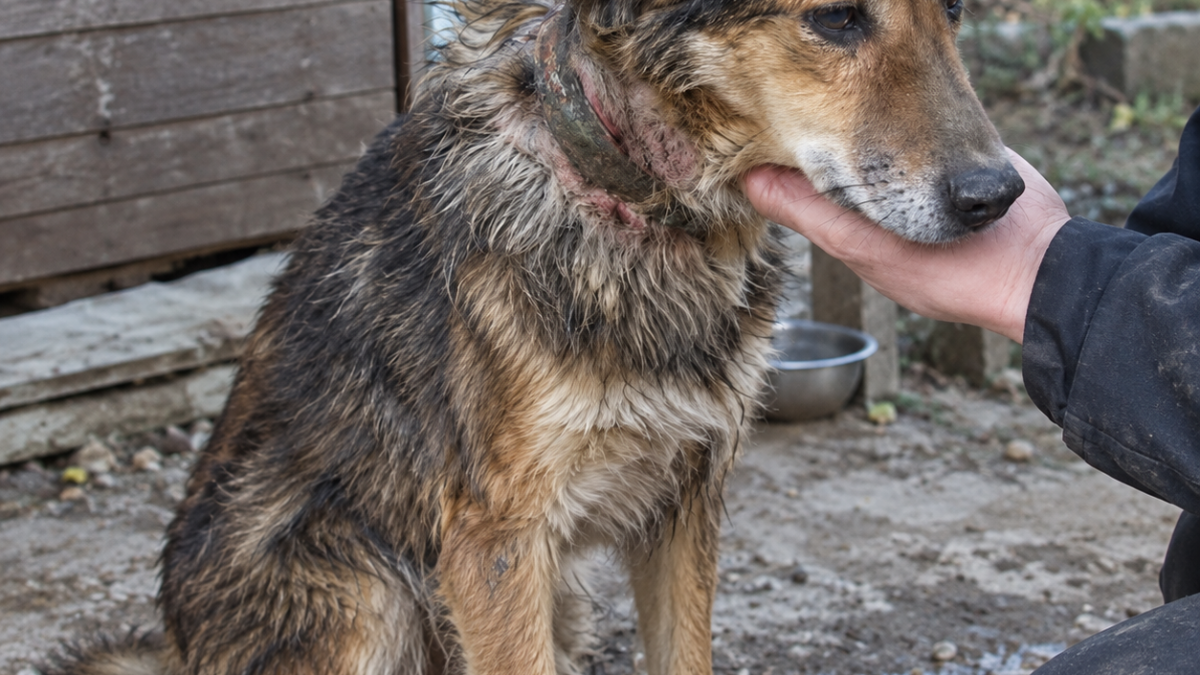
I found her lying inside a recovery kennel with thick bandages wrapped around her neck.
She looked smaller without the mats and filthy fur.
Almost fragile.
When I approached, she opened her eyes.
Her entire body tensed.
“Hey.”
I sat beside the kennel.
“It’s me.”
She stared.
I didn’t put my hand through the bars.
Instead, I slid a small piece of cooked chicken onto the blanket.
Daisy sniffed it.
Then ate.
Another piece.
She ate that too.
“Good girl.”
Her eyes flicked toward me.
Her tail didn’t move.
That was fine.
Trust isn’t a trick you teach in an afternoon.
Sometimes survival takes years to build into an animal.
You don’t undo it with three pieces of chicken.
The nurse brought water in a shallow bowl.
Daisy stared at it.
Then looked at me.
“Go ahead.”
She stood slowly.
Spread her front feet.
Started lowering her head.
Halfway down, she stopped.
Her body braced for pain that wasn’t coming.
She waited.
Then lowered her head another inch.
Nothing happened.
Another inch.
Still nothing.
Her nose reached the water.
Daisy drank.
Three seconds.
Five.
Ten.
Then she suddenly pulled away and looked around.
I realized she was confused.
For years, drinking had hurt.
She had developed an entire posture around avoiding the pressure of that collar.
Now the pain was different.
Surgical pain.
But the tightening was gone.
She tried again.
This time she drank longer.
I put my hand over my mouth.
The nurse beside me whispered, “That’s a big moment.”
I nodded.
It looked like a dog drinking water.
Nothing more.
But for Daisy, it was the first small piece of freedom.
—
The next morning, I called the number on the tag.
Disconnected.
I expected that.
The tag looked years old.
Rachel searched the number online.
Nothing useful.
Then we took Daisy’s name, approximate age, description and location and started going backward.
Animal control records.
Old veterinary clinics.
Lost-dog postings.
Microchip databases.
Daisy had no chip.
At least none we could find.
For almost two days, we hit dead ends.
Then a receptionist at a clinic twenty miles away called me.
“You asked about a brown-and-white female named Daisy?”
“Yes.”
“What breed?”
“Probably a hound mix. Maybe some shepherd.”
“White stripe on her nose?”
“Yes.”
“White front paws?”
“Yes.”
The woman became quiet.
“I think we treated her.”
My heart started racing.
“When?”
“Five years ago.”
I grabbed a pen.
“Owner?”
“I can’t give you private client information over the phone.”
“This is part of an active animal neglect investigation.”
At that point, animal control had officially opened a case because of the severity of Daisy’s injury.
“If Officer Martinez contacts us, we can cooperate.”
“Can you at least tell me whether I’m chasing the right dog?”
The receptionist hesitated.
Then said, “The dog in our file was eleven months old when we first saw her.”
Daisy was estimated to be six now.
Exactly right.
“What kind of collar?”
Another pause.
“Blue with white flowers.”
I closed my eyes.
“We found her wearing it.”
Silence.
“What do you mean?”
“It had grown into her neck.”
The woman whispered something I couldn’t hear.
Then:
“Oh my God.”
—
Officer Elena Martinez arrived at the clinic that afternoon.
She wasn’t theatrical.
No dramatic anger.
No promises.
She photographed the collar pieces.
Photographed Daisy’s wound.
Collected copies of the veterinary records.
Then she asked me to tell her exactly where we’d found Daisy.
I described the property.
Elena stopped writing.
“Say the address again.”
I did.
She looked up.
“I know that property.”
“Why?”
“Animal control has been there before.”
My stomach tightened.
“For Daisy?”
“I don’t know yet.”
She closed her notebook.
“I need to check.”
I wanted to follow her.
Instead, I spent the afternoon sitting beside Daisy.
Her bandage needed changing twice a day.
The first change was terrible.
The technician approached with scissors.
Daisy saw the metal and panicked.
She backed into the corner.
Her breathing became rapid.
“Stop,” I said.
The technician stopped.
I entered the kennel.
Daisy looked at me.
“I’m not going to lie to you,” I whispered. “This probably won’t feel good.”
She trembled.
“But we’re staying.”
I sat beside her until she stopped trying to make herself invisible.
Then Dr. Harris gave a mild sedative.
We removed the dressing.
The wound underneath was horrifying.
A deep red groove almost completely encircled her neck.
Parts had been sutured.
Other areas were intentionally left open to drain.
Rachel turned away.
I didn’t blame her.
I wanted to.
Instead, I watched Daisy.
She watched me.
So I stayed.
When the new bandage was finished, Daisy was exhausted.
I offered chicken.
She ate it from my fingers.
The first time.
Her lips barely touched my skin.
I smiled.
“There you are.”
For one second, her tail moved.
Not a wag.
Just a small lift.
But I saw it.
And I held onto it all day.
—
Officer Martinez called that evening.
“The property belongs to a man named Calvin Rusk.”
“Is he Daisy’s owner?”
“Possibly.”
“What does possibly mean?”
“Veterinary records list Calvin Rusk and his former girlfriend, Megan Shaw.”
“Where’s Megan?”
“Different state.”
“And Calvin?”
“Still owns the house where Daisy was found.”
Anger climbed my throat.
“So he left her there?”
“We’re investigating.”
“Elena.”
“Emma.”
“That collar didn’t grow into her in a week.”
“I know.”
“Someone watched this happen.”
“I know.”
“Then arrest him.”
“That isn’t how this works.”
I hated that answer.
She knew it.
“If I do this wrong, his attorney gets everything thrown out.”
I sat back.
“What do you need?”
“Evidence.”
“There’s a collar inside her neck.”
“That proves neglect occurred. It doesn’t automatically prove who was legally responsible for her during the entire period.”
I closed my eyes.
“What did you mean when you said animal control had been there before?”
A pause.
“We had a complaint eighteen months ago.”
“About Daisy?”
“Anonymous caller reported a thin dog in the backyard without reliable water.”
“And?”
“An officer visited.”
My hands tightened.
“What happened?”
“No dog was visible.”
“Did they go inside?”
“No warrant.”
“Did they contact Calvin?”
“Yes.”
“What did he say?”
“That his dog had died two years earlier.”
I stood so fast the chair tipped over.
“He told you she was dead?”
“Yes.”
I looked through the clinic glass.
Daisy was asleep.
“He hid her.”
“We don’t know that.”
“He said she was dead while she was living behind his house.”
“That is something we’re looking at.”
“Why would he do that?”
“I intend to ask him.”
—
We got part of the answer from Megan Shaw.
Officer Martinez located her two days later.
Megan called me afterward with permission from Elena.
“I heard you’re the one who found Daisy.”
“One of us.”
Megan was already crying.
“Is she alive?”
“Yes.”
“Oh, thank God.”
The relief in her voice sounded real.
That made me angry in a different way.
“You thought she was dead?”
“Yes.”
“Why?”
“Calvin told me she died.”
Same lie.
“When?”
“Almost three years ago.”
I looked toward Daisy’s kennel.
“What happened when you lived together?”
Megan took a breath.
“We got Daisy as a puppy.”
“Who chose the flowered collar?”
“I did.”
Her voice broke.
“I bought it at a little pet store near my mother’s house.”
I stared at the plastic evidence bag on Dr. Harris’s counter.
“What size?”
“Small.”
“Did you ever replace it?”
“Of course.”
I froze.
“What?”
“I bought larger collars as she grew.”
My heart hammered.
“Then why was she wearing the puppy collar when we found her?”
Megan was silent.
“I don’t understand.”
“When did you leave Calvin?”
“Four years ago.”
“Did Daisy stay with him?”
“Yes.”
“Why?”
Another long silence.
“Because I couldn’t take her.”
“What does that mean?”
“My apartment didn’t allow dogs.”
She began speaking faster.
“I know how that sounds. I know. But Calvin loved her. At least I thought he did. Daisy slept in our bed. He took her hiking. He used to cook eggs for her on Sundays.”
“Did you visit?”
“For almost a year.”
“And?”
“She looked fine.”
“What collar was she wearing?”
“I don’t remember.”
“Try.”
“I—”
“Megan, please.”
She cried quietly.
“I think a red one.”
Not the flowered puppy collar.
“Then somebody put the old collar back on her.”
“Oh God.”
I heard her begin sobbing.
“Why would he do that?”
I didn’t know.
But I intended to find out.
—
Daisy spent twelve days at the clinic.
During those twelve days, she changed in tiny ways.
On day three, she stopped pressing herself against the wall when I entered.
On day four, she accepted food before I sat down.
On day five, she sniffed Rachel’s hand.
Day six was worse.
Healing isn’t a straight line.
A metal bowl dropped in the hallway.
Daisy panicked.
She tried to crawl behind the kennel bed, tore part of her bandage and shook for nearly twenty minutes.
I sat on the floor.
Didn’t touch her.
Eventually, she crawled toward me.
Her shoulder touched my knee.
That was all.
But she chose the contact.
The next morning, I arrived at seven.
Daisy stood when she saw me.
Then something happened.
Her tail wagged.
Once.
Then twice.
I laughed.
“You did that on purpose.”
Another wag.
Rachel walked in.
“What?”
“She wagged.”
“No.”
“She did.”
“Daisy?”
Rachel crouched.
Daisy looked at her.
Nothing.
I laughed harder.
Rachel pointed at me.
“You’re her person now.”
“No.”
“Yes.”
“Don’t say that.”
“Why?”
Because I knew what happened when rescuers started believing that.
You stopped thinking like a foster.
You started imagining where the bed would go in your house.
I already had two dogs.
An elderly beagle named Hank and a mutt named Pepper.
I wasn’t adopting a third.
Absolutely not.
Daisy wagged at me again.
“Stop that.”
Rachel grinned.
“You’re doomed.”
—
The wound culture came back.
Two bacterial infections.
Both treatable.
Daisy responded well to antibiotics.
Her fever disappeared.
She started eating full meals.
Dr. Harris removed some of the sutures.
Then, during one dressing change, he paused.
“What?”
He smiled.
“Look.”
I leaned closer.
Healthy pink tissue was beginning to fill part of the groove around Daisy’s neck.
Healing.
Real healing.
Not scar tissue trapping a collar.
New skin.
Daisy stood patiently while he worked.
She still trembled occasionally.
But she no longer tried to escape.
Dr. Harris rubbed her shoulder.
“You’re tougher than you look.”
Daisy turned and licked his wrist.
He stared at her.
Then looked at me.
“Did she just forgive me?”
“She probably likes your chicken.”
“I choose to believe it’s my personality.”
—
Officer Martinez interviewed Calvin Rusk the following Monday.
I wasn’t there.
I wish I had been.
Later, Elena told me enough.
At first, Calvin denied Daisy was his.
Then she showed him the old veterinary records.
He changed his story.
Said Daisy had run away years earlier.
Elena showed him Megan’s messages documenting that Daisy was still at the property after their breakup.
Calvin said Megan had taken her.
Elena showed him photographs from an old social-media account.
There was Daisy in Calvin’s backyard.
Two years after Megan left.
Then Elena showed him the collar.
That was when his attitude changed.
He laughed.
Actually laughed.
“It’s a collar.”
Elena told him what it had done.
He said, “Dogs get sores.”
She showed him the surgical photographs.
Apparently, Calvin looked away.
Then he asked if he needed a lawyer.
Elena answered that he could have one.
What finally tied everything together wasn’t Calvin’s confession.
He never really gave one.
It was his neighbor.
Mrs. Alvarez.
Seventy-three years old.
The woman who had been leaving Daisy food near the fence.
She had seen Daisy in that yard for years.
At first, Calvin fed her.
Then less regularly.
After Calvin began spending most of his time at his new girlfriend’s home, Daisy was often alone for days.
Mrs. Alvarez started tossing food over the fence.
She also left water.
Three times, she confronted Calvin.
Three times, he told her to mind her own business.
Once, she mentioned Daisy’s neck.
Calvin told her:
“She’s always scratching herself. It’s fine.”
It wasn’t fine.
Mrs. Alvarez had photographs.
She took them because she didn’t trust him.
The earliest was almost two years old.
Daisy stood near the fence.
The collar was already visibly too tight.
Six months later, another photograph showed swelling beneath it.
Eight months later, Daisy’s fur had begun growing over the edges.
Then there was a short video.
Mrs. Alvarez filmed through a gap in the fence.
Daisy tried to drink from a bucket.
She spread her legs.
Lowered her head.
Stopped.
Whimpered.
Lifted her head.
Tried again.
Exactly what we had seen.
The video was dated nine months before we rescued her.
Calvin had been told.
The condition had been visible.
He had lied to animal control about Daisy being dead.
And he had continued leaving her behind the house.
That was enough.
—
When Elena told me Calvin had been charged, I expected to feel happy.
I didn’t.
I felt empty.
“What happens now?”
“That’s up to the court.”
“He’ll go to jail?”
“Possibly, but don’t assume.”
I hated how calm she always was.
“Then what’s the point?”
She looked at me.
“The point is that Daisy is safe.”
“That isn’t enough.”
“It has to be the first thing.”
I looked away.
Elena softened.
“Emma.”
“What?”
“You want him to understand what she suffered.”
“Yes.”
“He may never understand.”
That angered me.
“So he just gets to walk around not caring?”
“Maybe.”
“Great.”
“But justice isn’t the same as making somebody feel remorse.”
I knew she was right.
I didn’t want her to be.
“Then what is it?”
“Documenting what happened. Protecting the animal. Preventing him from doing it again. Making the court see the facts.”
She nodded toward Daisy.
“And letting her life become about more than him.”
I looked through the glass.
Daisy was asleep on her side.
Her head rested flat against the blanket.
Flat.
For years, she hadn’t been able to sleep like that.
The collar had forced her neck into a painful angle.
Now she was stretched out.
Free.
Maybe Elena was right.
—
Daisy came home with me on day thirteen.
Foster only.
I said that at least six times.
Rachel helped load her into my SUV.
“Foster.”
“Yes.”
“Temporary.”
“Of course.”
“Until she heals.”
“Absolutely.”
“You’re not adopting her.”
“No.”
Daisy climbed into the back seat.
Then immediately leaned her head between the front seats and rested it against my shoulder.
Rachel burst out laughing.
“Temporary.”
“Go away.”
At my house, Hank sniffed Daisy for approximately twelve seconds, decided she wasn’t interesting, and returned to his bed.
Pepper was more enthusiastic.
Too enthusiastic.
She bounced.
Daisy recoiled.
Pepper froze.
I held my breath.
Then Pepper did something beautiful.
She lowered herself onto the floor.
Turned her head away.
Waited.
Daisy sniffed her.
Pepper’s tail tapped once.
Daisy moved closer.
That was the beginning.
Animals sometimes understand boundaries faster than humans.
Within a week, Daisy and Pepper were sharing the rug.
Within two, Daisy followed her into the backyard.
Within three, they slept touching.
Hank continued pretending none of this concerned him.
—
The hardest thing for Daisy was the leash.
We didn’t understand why at first.
The moment anything touched her neck, she shut down.
Of course.
So we stopped.
No collar.
No neck lead.
Dr. Harris recommended a padded harness that distributed pressure across her chest.
Even that frightened her.
The first time I held it up, Daisy disappeared beneath the kitchen table.
I put the harness on the floor.
Walked away.
For three days, it remained there.
Pepper stepped on it.
Hank slept partly on top of it.
Daisy watched.
On day four, she sniffed it.
Day five, she touched it with one paw.
Day seven, I placed a treat through the opening.
She stretched her neck just far enough to reach it.
The moment the fabric brushed her fur, she pulled back.
We stopped.
The next day, we tried again.
Two weeks later, Daisy let me slide it over her shoulders.
I didn’t buckle it.
Next day, one buckle.
Then two.
When she finally wore the harness for an entire minute, I gave her so much chicken that Rachel accused me of ruining her diet.
The first walk happened almost six weeks after rescue.
We went only from the front door to the mailbox.
Maybe forty feet.
Daisy stopped every few steps.
Cars frightened her.
A trash can frightened her.
A man across the street frightened her.
But she kept moving.
At the mailbox, she sniffed the grass.
Then lifted her face toward the wind.
I watched her ears move.
There was something different in her eyes.
Curiosity.
Fear was still there.
But curiosity had finally made room beside it.
We walked home.
Daisy reached the porch.
Turned around.
And looked toward the mailbox again.
“You want another one?”
She wagged.
So we did it again.
—
Three months after surgery, Dr. Harris declared the wound fully closed.
The scar remained.
It always would.
A pale, uneven ring disappeared beneath the new fur.
But Daisy could move her neck normally.
She could drink.
Run.
Roll on her back.
Sleep with her head hanging off the couch in positions that looked medically impossible.
The first time I saw her scratching beneath her chin with a back paw, I nearly cried.
Such a ridiculous thing.
A dog scratching.
But she had probably been unable to do it for years.
Daisy discovered toys late.
Pepper brought her a tennis ball.
Daisy stared at it.
Pepper dropped it.
Daisy sniffed.
Pepper picked it up.
Dropped it again.
Eventually Daisy placed one paw on the ball.
It rolled.
She jumped backward.
Pepper chased it.
Daisy chased Pepper.
Within ten minutes, they were tearing across my yard like puppies.
I stood on the porch laughing so hard my sides hurt.
Hank looked disgusted with all of us.
—
The court case took seven months.
Calvin’s attorney argued that Daisy had been a difficult dog.
That she escaped.
That neighbors had fed her without permission.
That Calvin’s work schedule kept him away.
That the collar injury worsened because Daisy would not allow handling.
Then the prosecutor played Mrs. Alvarez’s video.
Daisy trying to drink.
Lowering her head.
Whimpering.
Trying again.
The courtroom became completely silent.
Calvin looked down.
Then the prosecutor displayed photographs showing the progression of the injury.
Month by month.
The tightening collar.
The swelling.
The scar tissue.
The infection.
The final surgical images.
I had seen them before.
Still, my hands shook.
Rachel sat beside me.
She reached over and squeezed them.
Then came the veterinary testimony.
Dr. Harris explained that a responsible owner would have noticed the problem long before the collar became embedded.
He explained the stages.
Redness.
Hair loss.
Pressure injury.
Broken skin.
Infection.
Tissue growing over the material.
“This condition required prolonged neglect,” he said.
Calvin’s lawyer asked:
“Could the dog have concealed the injury beneath her fur?”
Dr. Harris answered:
“Not the functional symptoms.”
“What do you mean?”
“She could not comfortably lower her head.”
“Could arthritis cause that?”
“Not in the pattern we observed.”
“Could she have been difficult to examine?”
“Yes.”
“So my client may not have understood the severity.”
Dr. Harris looked at him.
“You didn’t need a veterinary degree to understand that she was in pain.”
Nobody moved.
—
Then Mrs. Alvarez testified.
She was the strongest person in the room.
Calvin’s attorney tried to portray her as an interfering neighbor.
“Didn’t you repeatedly enter Mr. Rusk’s property without permission?”
“No.”
“You fed his dog.”
“Yes.”
“Without permission.”
“Yes.”
“Why?”
“Because she was hungry.”
“You don’t know when Mr. Rusk fed her.”
“I know when he wasn’t home.”
“How?”
“I live next door.”
“You monitored him?”
“I looked out my kitchen window.”
A few people smiled.
The lawyer continued.
“You disliked Mr. Rusk.”
Mrs. Alvarez considered that.
“Eventually.”
“Why?”
“Because of Daisy.”
“So you were biased.”
“Yes.”
The attorney blinked.
Mrs. Alvarez leaned toward the microphone.
“I am biased against watching an animal suffer.”
Even the judge looked down to hide a reaction.
Then came the most important question.
The prosecutor asked:
“Did you ever tell Mr. Rusk that Daisy’s collar appeared too tight?”
“Yes.”
“How many times?”
“Twice directly.”
“What did he say?”
“The first time, he told me Daisy scratched herself.”
“And the second?”
Mrs. Alvarez looked across the courtroom at Calvin.
“He said, ‘If it bothers her enough, she’ll stop pulling on it.’”
My stomach turned.
The prosecutor let the silence sit.
That sentence destroyed every argument about ignorance.
Calvin knew.
Maybe not exactly how deep the collar had gone.
Maybe not how dangerous the infection was.
But he knew it hurt.
And he left it there.
—
Calvin accepted a plea before the final phase of trial.
The charges resulted in probation, fines, mandatory animal-welfare education, restitution for part of Daisy’s medical care and a court order prohibiting him from owning or possessing companion animals for several years.
I wanted more.
I admit that.
I wanted him to lose something equal to what Daisy had lost.
Years.
Comfort.
Safety.
The ability to move without pain.
But courts don’t work that way.
And maybe they shouldn’t.
When the judge asked whether I wanted to make a victim-impact statement on behalf of the rescue, I almost declined.
Then I looked at the photographs.
Not the surgical ones.
The new ones.
Daisy in my backyard.
Daisy sleeping beside Pepper.
Daisy with her head hanging upside down from the couch.
Daisy running.
I stood.
Calvin looked at me.
For the first time, I looked directly at him.
“I spent months thinking I wanted you to understand her pain.”
His attorney shifted.
I continued.
“But I realized something.”
The courtroom was silent.
“If you could watch her suffer long enough for a collar to disappear into her neck, then I can’t force you to understand anything.”
Calvin’s jaw tightened.
“So I’m not here to ask you to feel guilty.”
I looked at the judge.
“I’m asking the court to make sure another animal never depends on him while he is unwilling to care for it.”
Then I turned back toward Calvin.
“And I want you to know one other thing.”
Rachel later told me she stopped breathing.
“Daisy survived you.”
Calvin looked away.
“She drinks without pain now.”
My voice shook.
“She runs.”
I swallowed.
“She plays.”
I thought about the frightened dog pressed against the fence.
“She learned that a hand reaching toward her doesn’t always mean something bad is about to happen.”
Calvin’s face remained blank.
It didn’t matter.
“She doesn’t sleep outside anymore.”
Now I was crying.
“She sleeps on my couch, usually upside down, taking up more space than should be physically possible.”
A few people laughed softly.
“And when I come home, she runs to the door.”
I wiped my face.
“So whatever you thought she was worth when you left her behind—that isn’t what she was worth.”
I sat down.
That was the only revenge I ever needed.
Not seeing Calvin suffer.
Watching Daisy become happy.
—
After court, Mrs. Alvarez waited outside.
She held a small paper bag.
“For Daisy.”
Inside was a stuffed rabbit.
One ear was already loose.
“I bought it before the hearing.”
I hugged her.
“You kept her alive.”
She shook her head.
“No.”
“You fed her.”
“Not enough.”
“You gave her water.”
“I should’ve done more.”
“Mrs. Alvarez.”
Her eyes filled.
“I saw that collar getting worse.”
“You reported it.”
“Too late.”
I knew that feeling.
Rescue teaches you to torture yourself with imaginary timelines.
If only I’d gone yesterday.
If only somebody had called sooner.
If only.
I took her hands.
“Daisy survived because you kept feeding her.”
She looked at me.
“You don’t know that.”
“No.”
I nodded.
“But I know she was starving when we found her even with your food.”
Mrs. Alvarez lowered her eyes.
“So imagine what would have happened without it.”
She started crying.
I hugged her again.
“Come see her.”
“When?”
“Today.”
She looked frightened.
“Will she remember me?”
I smiled.
“Let’s find out.”
—
Daisy was in the backyard when Mrs. Alvarez arrived.
Pepper was chasing something invisible through the grass.
Hank was asleep in the sun.
Mrs. Alvarez stepped through the gate.
Daisy froze.
Her ears lifted.
Then her nose moved.
Mrs. Alvarez didn’t call her.
Didn’t approach.
She simply stood.
Daisy took one step.
Then another.
Her tail began moving.
Mrs. Alvarez covered her mouth.
“Oh.”
Daisy walked faster.
Then ran.
Mrs. Alvarez dropped to her knees.
Daisy pressed her whole body against her.
The old woman buried her face in Daisy’s shoulder.
“You remember me.”
Daisy licked her cheek.
Mrs. Alvarez sobbed.
“I am so sorry.”
Daisy wagged harder.
“I should’ve gotten you out.”
Another lick.
I stood a few feet away.
People often ask whether animals forgive.
I don’t know if that’s the right word.
Forgiveness requires an understanding of blame.
Daisy didn’t know Mrs. Alvarez had failed to make the authorities understand sooner.
She knew something simpler.
This was the woman who threw food over the fence.
The woman whose voice sometimes came through the boards.
The woman who left water.
Safety, in Daisy’s old life, had been measured in small things.
Mrs. Alvarez had been one of them.
Daisy remembered.
—
The stuffed rabbit lasted fourteen minutes.
Daisy ripped one ear off.
Pepper stole the body.
Hank somehow ended up sleeping on the detached ear.
Mrs. Alvarez laughed until she cried again.
That afternoon, Daisy lay beside her on the porch.
Mrs. Alvarez stroked her back.
Never her neck.
Even after I told her it was safe.
She couldn’t make herself touch the scar.
So Daisy solved the problem.
She stood.
Turned.
And placed her chin directly on Mrs. Alvarez’s knee.
The scarred side of her neck rested against the woman’s hand.
Mrs. Alvarez froze.
Daisy closed her eyes.
“It’s okay,” I said.
Her fingers trembled.
Then she touched the fur.
Very gently.
Daisy sighed.
Mrs. Alvarez broke down.
I looked away.
Some moments belong to the people inside them.
—
I kept calling Daisy my foster dog for five months.
Everyone else had stopped pretending.
Rachel sent me adoption applications anyway.
“There’s a retired couple with a fenced yard.”
“No.”
“You haven’t read it.”
“They’re wrong.”
“A woman who works from home.”
“No.”
“Emma.”
“She doesn’t like people who work from home.”
Rachel stared at me.
“You work from home three days a week.”
“Exactly. She already has one. Why would she need another?”
Rachel folded her arms.
“Say it.”
“No.”
“Say it.”
“She is a foster.”
“Say the truth.”
I looked at Daisy.
She was sleeping with her head on Pepper’s back.
Hank had somehow acquired the rest of the couch.
“I have two dogs already.”
“You have three dogs.”
“No.”
“Emma.”
Daisy opened one eye.
I sighed.
“Fine.”
Rachel grinned.
“Fine what?”
“I hate you.”
“Fine what?”
“I’m adopting her.”
Rachel screamed.
Daisy jumped.
Pepper barked.
Hank left the room in disgust.
It was chaos.
Perfect chaos.
—
On adoption day, the shelter asked what kind of collar I wanted.
I said none.
The employee looked confused.
“We usually send dogs home with—”
“Harness.”
“Oh.”
“Only harnesses.”
“Of course.”
I knew Daisy could probably wear a collar safely someday.
Her wound was healed.
Dr. Harris said there was no medical reason she couldn’t.
But there was no reason she had to.
I ordered an identification tag that attached directly to her harness.
On the front:
**DAISY**
On the back:
**I’M HOME.**
Maybe it was sentimental.
I didn’t care.
The first time I clipped it onto her harness, Daisy sniffed it.
Then looked at me.
“That’s yours.”
Her tail moved.
“And you’re mine.”
She wagged harder.
Pepper barked from the doorway.
“Yes, she’s yours too.”
—
A year after Daisy’s rescue, her old collar sat inside a sealed evidence bag in a drawer at the rescue office.
I hated it.
Every time I opened that drawer, I saw the faded blue fabric.
The white flowers.
The dark sections where blood and infection had stained it.
One day, I asked Elena whether we still needed it.
“The case is closed.”
“So?”
“So it’s yours if the rescue wants it.”
I almost threw it away.
Then Dr. Harris stopped me.
“Don’t.”
I looked at him.
“Why would I keep this?”
“Education.”
I understood immediately.
We photographed it beside a normal adjustable collar of the same original size.
Then beside Daisy’s surgical images.
Not graphic ones.
Just enough to show what unchecked collar growth could do.
The rescue started an outreach program.
Free collar fittings.
Free microchipping.
Free harnesses for families who needed them.
We taught children how to check that two fingers fit comfortably beneath a collar.
We explained that puppies grow quickly.
That collars must be checked.
That long-haired dogs can hide injuries.
That an animal avoiding food, water or movement is communicating something.
Our first event drew thirty people.
The next drew eighty.
Within two years, we’d fitted or replaced hundreds of collars.
The program was called Daisy’s Promise.
I didn’t choose the name.
Rachel did.
For once, I admitted she had a good idea.
The old flowered collar became something different.
It no longer represented only what had happened to Daisy.
It became a warning that helped prevent it from happening again.
I liked that.
Calvin had allowed the collar to become an instrument of suffering.
Daisy turned it into an instrument of protection.
That felt like justice.
—
Two years after rescue, Daisy came with me to one of our community events.
We didn’t expect her to participate.
Crowds still made her nervous.
I planned to keep her behind our booth with Pepper.
Then a little girl arrived.
Maybe seven.
She stood several feet away.
Her mother said, “Don’t touch without asking.”
The girl nodded.
She looked at Daisy.
“Can I pet her?”
I almost said no.
Then I looked at Daisy.
Her body was relaxed.
“Let her decide.”
The girl crouched.
Didn’t reach.
Daisy watched her.
Then walked forward.
One step.
Two.
The girl held perfectly still.
Daisy sniffed her fingers.
Then pressed her nose into the girl’s palm.
The child smiled.
Not screamed.
Not grabbed.
Just smiled.
Daisy moved closer.
The girl stroked her shoulder.
Then stopped near the neck.
“Is this where she got hurt?”
“Yes.”
“Does it still hurt?”
“No.”
The girl thought for a moment.
“Then why doesn’t she wear a collar?”
“Because she doesn’t need one.”
She nodded solemnly.
Then said something I still remember.
“Good.”
“Why?”
“Because sometimes when something hurts you, you shouldn’t have to prove you’re brave by wearing it again.”
I stared at her.
Her mother laughed nervously.
“She reads a lot.”
I swallowed.
“She should keep doing that.”
Daisy sat beside the girl.
The child continued petting her.
Daisy closed her eyes.
I looked at the scar beneath the fur.
For years, I’d thought healing meant making Daisy normal.
Teaching her to tolerate touch.
Wear equipment.
Walk through crowds.
Act like other dogs.
I had been wrong.
Healing wasn’t turning Daisy back into the dog she might have been before somebody hurt her.
Healing was giving Daisy enough safety to decide who she wanted to become afterward.
—
Daisy never forgot certain things.
Raised voices made her leave the room.
If someone grabbed near her neck too quickly, she ducked.
She hated chains rattling.
She hated being tied outside even for a moment.
So we didn’t tie her outside.
Simple.
People sometimes believe rescued animals must conquer every fear to be “fully healed.”
I don’t.
Daisy didn’t owe anybody proof that the past no longer affected her.
She only needed a life large enough that the past was no longer everything.
And she had that.
She had Pepper.
She had Hank until he died at sixteen, with Daisy sleeping beside him during his final week.
She had Mrs. Alvarez, who visited every Sunday carrying treats she absolutely denied bringing.
She had Dr. Harris, who continued claiming Daisy loved him for his personality.
She had Rachel, who taught her to catch popcorn.
Mostly she had me.
And I had her.
—
Four years after I first saw Daisy hiding against that fence, I woke one morning with something heavy on my chest.
Daisy.
She had climbed halfway onto me during the night.
Her head was resting beneath my chin.
The scar around her neck was pressed directly against my cheek.
I lay completely still.
Sunlight was coming through the curtains.
Pepper snored at the foot of the bed.
Outside, a garbage truck groaned down the street.
Ordinary morning.
Daisy opened her eyes.
She looked at me.
Then sighed and went back to sleep.
I ran my fingers through the fur around her neck.
The scar was still there.
A ridge beneath the skin.
Permanent.
But it no longer defined the way she moved.
It didn’t stop her from lowering her head.
Didn’t stop her from drinking.
Didn’t stop her from running.
Didn’t stop her from trusting this bed enough to sleep deeply.
I thought about the first day.
The dirt.
The weeds.
That corner of the yard.
The way Daisy recoiled when I reached toward her.
The old blue fabric disappearing beneath swollen skin.
Dr. Harris asking:
“How has she lived with this?”
At the time, I thought the answer was toughness.
Now I think it was something else.
Daisy survived because living creatures are astonishingly good at adapting to pain when they have no other choice.
She learned how to drink differently.
Sleep differently.
Move differently.
Trust less.
Expect less.
She built an entire life around suffering because she believed suffering was permanent.
Then one day, strangers arrived.
And for once, the pain stopped getting worse.
Someone noticed.
Someone touched her gently.
Someone removed what was hurting her.
Someone stayed while she healed.
That’s what rescue really was.
Not one dramatic moment.
Not cutting away a collar.
Not carrying a dog out of a yard.
Rescue was everything that happened afterward.
The dressing changes.
The medication hidden in chicken.
Sitting on the floor for an hour because she was afraid of a harness.
Walking forty feet to the mailbox.
Starting over after a frightening day.
Letting her choose.
Waiting.
Again.
Again.
Again.
Until one morning, the dog who once panicked when a hand approached her neck chose to sleep with that scar pressed against my face.
—
Calvin eventually completed his court-ordered restrictions.
I heard he moved.
I never saw him again.
For a long time, I imagined what I would say if I did.
Maybe I would tell him exactly how much Daisy’s surgeries cost.
Tell him how many nights she woke trembling.
Tell him about the first time she drank without pain.
Tell him that she remembered Mrs. Alvarez.
Tell him how long it took before she allowed a harness over her shoulders.
But as the years passed, I stopped rehearsing that conversation.
Calvin became smaller in Daisy’s story.
That’s what surprised me most.
At first, he seemed enormous.
The villain.
The explanation for everything.
Eventually, he became a few ugly pages near the beginning.
Daisy’s story kept going.
His part didn’t.
That was the revenge I hadn’t understood when Elena first told me justice wasn’t about making someone feel remorse.
Calvin had controlled Daisy’s world when that world was one dirty backyard.
Then Daisy got a larger world.
A house.
A yard.
Friends.
Sunday visitors.
Veterinary staff who cheered when she walked into the clinic.
Children who learned from her.
Hundreds of animals protected through Daisy’s Promise.
Calvin became irrelevant.
Daisy didn’t spend her life punishing the person who hurt her.
She spent it becoming impossible to reduce to what he had done.
There is something far more satisfying about that.
—
Mrs. Alvarez died when Daisy was eleven.
Her daughter called me.
“She kept a picture of Daisy beside her chair.”
I didn’t know that.
“There was something else.”
A week later, an envelope arrived.
Inside was a letter.
Mrs. Alvarez had written it months earlier.
**Dear Emma,**
**If you are reading this, I probably didn’t get another Sunday with my girl.**
I cried before reaching the second line.
**I spent years wishing I had climbed that fence and taken Daisy myself. Maybe I should have. Maybe I could have done more. I will never know.**
**But thank you for letting an old woman be part of her good years.**
**The day Daisy ran to me in your backyard was one of the happiest moments of my life.**
**Please give her the soft biscuits, not the hard ones. You always pretend she likes both. She does not.**
I laughed through tears.
There was one last line.
**Tell Daisy I am sorry I couldn’t save her sooner, but I am grateful I stayed long enough to see that somebody did.**
I folded the letter.
Daisy was lying beside me.
“Mrs. Alvarez loved you.”
Her ears moved.
I gave her a soft biscuit.
Not the hard one.
Mrs. Alvarez had been right.
—
Daisy lived to be fourteen.
Far longer than any of us expected when she arrived at the clinic malnourished and infected.
Her final year was slow.
Pepper had died the year before.
After that, Daisy became quieter.
She slept more.
Her hearing faded.
Arthritis made stairs difficult.
So I moved my bedroom downstairs.
Rachel called it excessive.
Then came over and built Daisy a ramp to the porch.
Hypocrite.
One spring morning, Daisy refused breakfast.
I tried chicken.
Nothing.
Soft biscuits.
Nothing.
That frightened me.
Dr. Harris examined her that afternoon.
He had more gray hair by then.
So did I.
He sat beside Daisy on the floor after finishing the exam.
I knew before he spoke.
“Her kidneys are failing.”
I stared at him.
“What can we do?”
“Fluids. Medication. Diet changes.”
“How long?”
He didn’t answer immediately.
“Could be weeks.”
I closed my eyes.
“Months?”
“Maybe.”
I looked at Daisy.
She was resting with her chin on his shoe.
Dr. Harris swallowed.
“She’s had a good run.”
“Don’t.”
“I know.”
“No.”
He nodded.
“Okay.”
For six weeks, Daisy rallied.
She ate.
Walked to the mailbox.
Lay in the sun.
Rachel visited almost every evening.
We didn’t talk about why.
Then one Saturday, Daisy couldn’t stand without help.
I supported her with the harness.
She took three steps.
Stopped.
Looked at me.
I knew.
I hated that I knew.
“Not today.”
She remained still.
“Please.”
Her eyes were tired.
The same eyes I had seen behind that fence fourteen years earlier.
But there was one enormous difference.
Back then, Daisy had looked tired because she expected pain.
Now she was simply tired.
There was no fear.
I sat beside her.
She lowered her head into my lap.
Completely.
Effortlessly.
Something she once couldn’t do.
I cried into her fur.
“Okay.”
Her tail moved.
Once.
“Okay, sweetheart.”
—
Dr. Harris came to the house the next morning.
Rachel arrived first.
Mrs. Alvarez was gone.
Pepper was gone.
Hank was gone.
Years have a way of emptying rooms.
But Daisy was surrounded.
Rachel sat on one side.
I sat on the other.
Dr. Harris brought everything into the living room.
No metal table.
No clinic smells.
No bright lights.
Daisy lay on her favorite blanket near the window.
I had kept her first harness.
The padded one we’d spent weeks teaching her to wear.
It lay beside us.
Not on her.
She didn’t need anything around her body that day.
I stroked her face.
“You know what I remember?”
Her eyes remained on me.
“The first time you drank water without that collar.”
Rachel began crying.
“I remember the tennis ball,” she said.
I laughed.
“She thought it was attacking her.”
“She did.”
Daisy’s tail moved.
Dr. Harris sat quietly.
No one rushed.
I put my fingers beneath Daisy’s chin.
She leaned into them.
“The first time I touched you here, you nearly fell trying to get away from me.”
Her eyes softened.
“Look at you now.”
I bent down and kissed the scar.
The scar that had once horrified me.
The scar I spent years wishing wasn’t there.
Suddenly, I was grateful for it.
Not for what caused it.
Never.
But because I had watched that scar change meaning.
It began as evidence of cruelty.
Then it became evidence of survival.
Eventually, it was simply part of Daisy.
A place I kissed.
A place children touched gently.
A place fur grew across.
A place where pain had once lived but no longer did.
Dr. Harris gave the sedative.
Daisy relaxed.
Her breathing slowed.
Her head became heavy in my lap.
Rachel whispered, “Good girl.”
I looked down at Daisy.
“You don’t have to be brave anymore.”
Her eyes were nearly closed.
“Nothing is hurting you.”
I stroked beneath her chin.
“No collar.”
Her tail moved faintly.
“No fence.”
Another breath.
“No waiting for food.”
I couldn’t see through my tears.
“No being scared when somebody reaches for you.”
I kissed her forehead.
“You’re home.”
Dr. Harris waited until I nodded.
Then he gave the final medication.
Daisy took one slow breath.
Then another.
Then she was still.
My hand remained beneath her chin.
Exactly where she once couldn’t bear to be touched.
—
For months afterward, I kept expecting to hear her nails crossing the kitchen floor.
I still stepped carefully beside the bed because Daisy used to sleep there.
I still bought three dog biscuits before remembering there was no dog waiting at the kitchen doorway.
Grief is full of stupid habits.
Rachel eventually convinced me to attend another Daisy’s Promise event.
I didn’t want to.
It felt wrong without her.
Then a family arrived carrying a six-month-old puppy.
The puppy wore a collar that was already too tight.
Not dangerously.
Not yet.
His owner was embarrassed.
“We didn’t realize how fast he grew.”
I knelt.
“That’s why we’re here.”
I showed their little boy how to check the fit.
“Two fingers.”
He copied me.
“Like this?”
“Exactly.”
His mother chose a larger collar.
They left with a free microchip appointment.
I stood watching them walk away.
And suddenly I understood.
Daisy was still doing what she had done after rescue.
Changing the meaning of what happened to her.
Her old collar had hurt one dog.
Her story had protected hundreds.
Maybe more by then.
That was enough reason to keep telling it.
—
Today, a photograph of Daisy hangs inside our rescue office.
Not the first photograph.
I have that one too.
In it, she is crouched against the fence, terrified, her neck dark with matted fur.
I rarely show it.
The photograph on the wall was taken five years later.
Daisy is running across my backyard.
All four paws are off the ground.
Her ears are flying.
Her mouth is open.
Pepper is behind her.
Mrs. Alvarez is sitting on the porch laughing.
If you look closely, you can see the pale ring around Daisy’s neck where the fur never grew quite the same.
Visitors sometimes ask:
“What happened to her?”
I tell them.
I tell them about the flowered puppy collar.
How it became too small.
How it disappeared into her skin.
How she learned to live around pain.
How somebody knew and did nothing.
How a neighbor kept feeding her.
How rescuers finally came.
How Dr. Harris removed the collar piece by piece.
How Daisy learned to drink normally.
How she learned to wear a harness.
How she learned that hands could be gentle.
How she eventually slept with the scar against my face.
People usually focus on what was done to her.
I understand.
Cruelty is shocking.
But that isn’t the part I want them to remember.
I want them to look at the photograph again.
At the dog running.
Because Daisy’s life was not the collar.
The collar was something that happened to her.
It was never all she was.
Calvin’s neglect lasted years.
Daisy’s second life lasted longer.
He left her behind.
She became beloved.
He let her suffer unseen.
Her story eventually taught hundreds of people how to see suffering sooner.
He reduced her world to one neglected backyard.
Daisy’s world eventually became larger than anything he could have imagined.
That’s the ending I choose to remember.
Not the day we cut away the old blue fabric.
Not the courtroom.
Not even her last morning.
I remember an ordinary afternoon in my yard.
Daisy was maybe eight.
Pepper had stolen her ball.
Mrs. Alvarez was laughing from the porch.
Rachel was yelling that both dogs were destroying her flower bed.
I called Daisy.
She stopped.
Turned toward me.
For a second, sunlight caught the fur around her neck.
You could see the scar.
Then she ran.
Straight toward me.
Head low.
Neck stretched forward.
Nothing pulling against her.
Nothing cutting into her.
Nothing stopping her.
Free.
That’s Daisy.
That’s who she became.
And whenever someone asks me how a dog could have survived so long with something buried in her neck, I no longer give them the answer Dr. Harris gave that first night.
I don’t talk about scar tissue.
Infection.
Tolerance for pain.
I tell them something simpler.
Daisy survived because she had no choice.
But she healed because eventually she did.
She could move away from a hand.
Or move toward it.
She could hide beneath the table.
Or walk to the mailbox.
She could stay alone.
Or lie beside Pepper.
She could remain the frightened dog in the corner of that yard.
Or become the dog who ran across mine.
Nobody made those decisions for her.
We simply gave her enough safety to make them.
And one by one, Daisy chose life.
Not merely survival.
Life.
A soft bed.
A ridiculous stuffed rabbit.
Chicken hidden around medication.
Sunday visits.
A padded harness.
Grass beneath her paws.
A couch she believed belonged entirely to her.
People who touched her only with permission.
Years without pain.
Years without fear being the loudest thing in the room.
Years of hearing the words she should have heard from the beginning.
Good girl.
You’re safe.
Come inside.
I’m here.
You’re home.
And when Daisy finally left this world, there was nothing around her neck.
Nothing holding her.
Nothing hurting her.
Just my hand resting beneath her chin.
Exactly where the scar had once been.
Exactly where she had finally learned it was safe to be touched.
That is the ending she deserved.








