We Searched for Our Dog for 5 Months—Nearly 2 Years Later, I Found Him Waiting Behind Our House
PART 2
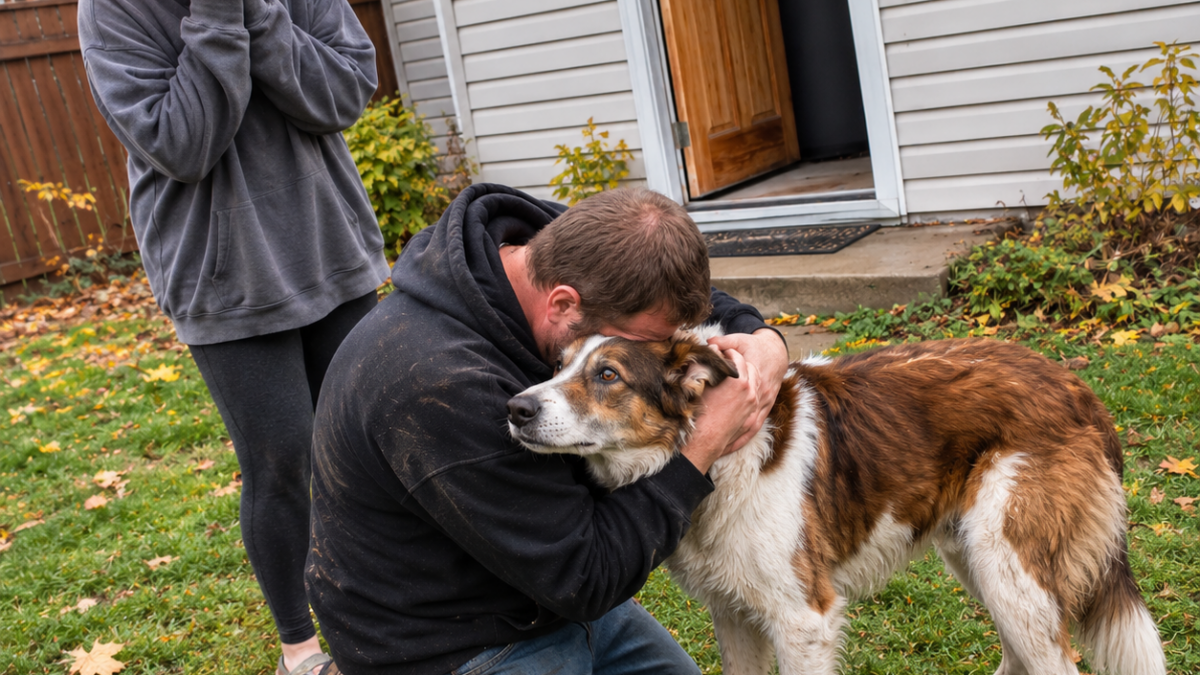
I don’t remember crossing the yard.
One second I was standing by the porch.
The next I was on my knees in wet grass.
“Harvey.”
He tried to crawl toward me.
His front legs pulled.
His back legs shook.
I moved first.
I wrapped my arms around him.
For one terrible second, his body went stiff.
Then he pushed his head beneath my chin.
I made a sound I had never heard come out of myself.
Half laugh.
Half sob.
“Rachel!”
The back door opened.
“What happened?”
“Rachel.”
She saw us.
Everything left her hands.
Coffee mug.
Phone.
Both hit the porch.
She ran barefoot into the yard.
“No.”
I looked at her.
“It’s him.”
“No.”
“It’s him.”
Rachel dropped beside us.
Harvey turned his head.
She put both hands over her mouth.
“Oh my God.”
He licked her wrist.
That was all it took.
Rachel collapsed against him.
“Harvey.”
He was so thin that when we hugged him, we could feel every rib.
His coat smelled like rain, dirt, smoke, and something sour I couldn’t identify.
His nails were worn nearly flat.
There were scars along both forelegs.
A rope burn circled part of his neck beneath the fur.
That was the first thing that stopped the joy.
I touched it carefully.
Harvey flinched.
Rachel saw.
“What is that?”
“I don’t know.”
He tried to stand again.
Failed.
“We need the vet.”
Rachel nodded.
We wrapped him in an old blanket.
I carried him to the truck.
He had weighed eighty-two pounds before he disappeared.
Now he couldn’t have been more than fifty-five.
He rested his head against my chest the entire way.
Rachel sat beside him in the back seat.
One hand never left his neck.
Our veterinarian, Dr. Melissa Shaw, opened the clinic early for us.
She had treated Harvey from puppyhood.
When we carried him in, she stared.
“Daniel?”
“It’s Harvey.”
She looked at me.
Then him.
“No way.”
“We think so.”
“We know.”
Rachel was crying again.
Dr. Shaw scanned him.
The machine beeped.
She looked at the number.
Then at us.
“It’s him.”
I had known.
Still, hearing those words nearly broke me.
Harvey Hart.
Our dog.
Alive.
The clinic staff started gathering in the doorway.
Some of them remembered the missing posters.
One technician whispered, “Oh my God.”
Dr. Shaw became professional immediately.
“He’s severely underweight. Dehydrated. His hindquarters are weak. I want bloodwork, X-rays, parasite testing, full infectious disease screening.”
“Do everything.”
“We will.”
Then she parted the fur around his neck.
Her expression changed.
“What?”
Rachel asked.
Dr. Shaw didn’t answer immediately.
She examined the scar.
Then Harvey’s front legs.
His paws.
His teeth.
“What?”
I asked again.
She looked at me.
“Some of these injuries aren’t consistent with a dog living loose for two years.”
I felt something cold enter my stomach.
“What are they consistent with?”
“Confinement.”
Rachel stared.
“Confinement?”
Dr. Shaw pointed gently.
“This looks like repeated pressure from a collar or tether. He’s got old abrasion scars on both front legs. His canine teeth are worn unusually hard.”
“From what?”
“Chewing metal. Chain. Wire. Something similar.”
The room went silent.
I looked at Harvey.
He was lying on the examination table.
Eyes closed.
“Somebody had him?”
Dr. Shaw said carefully, “I can’t prove that from an exam alone.”
“But you think so.”
“I think Harvey did not spend all twenty-two months wandering freely.”
Rachel turned away.
Her shoulders started shaking.
I stood there looking at the scar around his neck.
For nearly two years, I had imagined everything.
Hit by a car.
Frozen in winter.
Taken in by a family.
Living somewhere warm with children.
I had never allowed myself to imagine this.
A chain.
A fence.
A place he couldn’t leave.
Harvey opened his eyes.
I put my hand beside his muzzle.
He rested his head on it.
“Who did this to you?”
Of course he couldn’t answer.
Not then.
But his body could.
And eventually, it did.
—
Harvey stayed at the clinic for three days.
The first day, he slept almost continuously.
The second, he ate six small meals.
The third, he stood without assistance.
For twelve seconds.
Rachel filmed it.
We cried over a dog standing.
Dr. Shaw didn’t laugh.
She knew.
When we finally brought him home, everything felt surreal.
His old bed was gone.
We’d thrown it away a year after he disappeared because neither of us could stand looking at it.
His bowls were gone too.
His leash.
His collar.
Most of his toys.
Only one thing remained.
A faded blue rubber ball.
Rachel had kept it in the top drawer of the laundry room.
She brought it out.
“Harvey.”
He looked.
Then froze.
Rachel rolled it slowly across the floor.
The ball stopped near his paw.
For five seconds, nothing happened.
Then Harvey lowered his nose.
Sniffed it.
His tail moved.
I sat down hard in the kitchen chair.
“He remembers.”
Rachel covered her face.
Harvey picked up the ball.
Weakly.
Carried it three steps.
Then lay down with it between his paws.
We didn’t need another DNA test.
He was home.
But being home didn’t mean he was okay.
The first week showed us how much had changed.
Harvey panicked when doors closed.
If I shut the bathroom door, he scratched at it.
If Rachel went into the basement, he waited at the top of the stairs whining.
The sound of a chain on our backyard gate made him flatten to the floor.
That happened once.
After that, I wrapped the gate chain in cloth.
He wouldn’t eat if we stood nearby.
He would wait.
Watch.
Only when we moved several feet away would he lower his head.
One evening, Rachel gave him a piece of chicken.
He took it.
Then carried it behind the couch.
He didn’t eat it.
He hid it beneath a blanket.
Rachel found three more pieces there the next morning.
“Why is he doing that?”
I knew.
I didn’t want to say it.
“He’s saving food.”
Her eyes filled.
“Because he thinks it’s going away.”
I nodded.
She sat on the floor beside him.
“It isn’t.”
Harvey looked at her.
“You hear me?”
She pointed toward the kitchen.
“Food stays here.”
His ears moved.
“No one takes it.”
She touched his chest.
“No one takes you.”
That became our promise.
No one takes you.
For two weeks, Harvey barely entered the backyard after sunset.
The storm had taken him from there.
Or at least, that’s where the story had begun.
Then something strange happened.
Every night around eleven, Harvey went to the back door.
Not asking to go outside.
Watching.
He would stand there.
Nose lifted.
Listening.
The first time, I thought he needed to relieve himself.
I opened the door.
He stepped out.
Moved to the edge of the yard.
Then froze.
He stared toward the fields east of our property.
His body went rigid.
“What is it?”
Harvey began trembling.
I called him.
He didn’t move.
Then, somewhere far away, a dog barked.
Harvey turned.
Ran back inside.
Straight beneath the kitchen table.
I crouched.
“Harvey.”
He wouldn’t look at me.
Rachel came downstairs.
“What happened?”
“I don’t know.”
That happened three nights in a row.
Always around the same time.
Always facing east.
On the fourth night, we heard an engine.
Far off.
A truck on the county road.
Harvey growled.
A low sound.
Not fear.
Recognition.
I looked at Rachel.
She looked at me.
“We need to know where he was.”
She whispered.
I had already decided the same thing.
—
I posted Harvey’s return online.
At first, I only wanted to tell people who had helped us search.
The photograph showed him lying on a blanket between Rachel and me.
His ribs still visible.
His eyes tired.
I wrote:
After nearly two years, Harvey found his way home.
The post spread far beyond our town.
Hundreds of comments.
Then thousands.
People remembered him.
Some had shared the original missing poster.
Local news called.
We declined interviews.
Then a message arrived from a woman named Marisol Vega.
She wrote:
I think I saw your dog last year.
I read it three times.
I replied immediately.
Where?
She sent an address.
A rural property outside Mill Creek.
Forty-three miles east of us.
Exactly the direction Harvey watched at night.
My hands started shaking.
I called her.
Marisol answered.
“Mr. Hart?”
“Yes.”
“I wasn’t sure whether to message.”
“Tell me everything.”
She had worked as a home-health aide for an elderly woman who lived near the property.
One summer afternoon, she saw a German Shepherd chained behind a metal workshop.
Thin.
No shelter except a sheet of plywood.
“I asked the man if he was okay.”
“What man?”
“Name’s Roy Baines.”
The name was familiar.
Not personally.
Everybody around our part of Ohio had heard of Baines.
He owned a small scrap yard and equipment repair business.
He also had a reputation.
Fights.
Complaints.
A few arrests years back.
Nothing major enough to close him down.
“What did he say?”
“He said the dog was a stray.”
“Did the dog have a collar?”
“A heavy black one.”
I looked toward Harvey.
“What happened next?”
“I asked whether he’d scanned him for a chip.”
Marisol hesitated.
“And?”
“He told me to mind my business.”
My jaw tightened.
“Did you ever see him again?”
“The dog?”
“Yes.”
“For months.”
“How many?”
“Maybe eight or nine.”
My chest hurt.
“Was he always chained?”
“Every time I saw him.”
Rachel sat beside me.
She had heard enough.
Her face turned white.
“Do you have pictures?”
I asked.
Marisol was silent.
Then:
“One.”
My heart stopped.
She sent it.
The image took three seconds to load.
That was enough.
German Shepherd.
Black saddle.
Tan legs.
White scar above the left eye.
Harvey.
He was tied to a steel post.
A chain ran from his collar to an old axle in the ground.
His ribs showed.
I zoomed in.
Behind him was a metal building.
Red roof.
Blue door.
Rachel made a sound beside me.
“Oh God.”
The photograph was dated eleven months earlier.
Harvey had been alive.
Forty-three miles away.
Chained.
We had stopped searching fourteen months before that.
I closed my eyes.
“Daniel.”
Rachel’s voice.
I looked at her.
“Don’t.”
“What?”
“Don’t blame yourself.”
“I stopped.”
“We both stopped.”
“He was alive.”
“We didn’t know.”
“We stopped.”
Rachel grabbed my face.
“Because we had nowhere left to look.”
I wanted to believe her.
I couldn’t.
Not yet.
I called the county sheriff.
That started everything.
—
Deputy Evan Morris came to our house the next morning.
He photographed Harvey’s injuries.
Took copies of Dr. Shaw’s records.
Looked at Marisol’s photograph.
“Do you know Roy Baines?”
“No.”
“Ever met him?”
“No.”
“Any reason he’d have your dog?”
“None.”
Morris looked at Harvey.
“He may claim he found him.”
“Then why didn’t he scan the chip?”
“That’s one question.”
“Why keep him chained?”
“Another.”
“Can you go there?”
“We can knock.”
“That’s it?”
“For now.”
I hated that answer.
“What do you need?”
“Evidence he knowingly kept stolen property.”
“Harvey isn’t property.”
“Legally, that’s part of the framework.”
I looked away.
Morris continued.
“Animal cruelty is separate.”
“Can you charge him?”
“Depends what we find.”
I pointed toward Harvey’s neck.
“Isn’t that enough?”
“It’s evidence. It’s not proof of who caused it.”
I understood.
I hated understanding.
Morris went to Baines’s property that afternoon.
Baines denied ever owning Harvey.
Then Morris showed him the photograph.
His story changed.
He said a German Shepherd wandered onto his land during the winter nearly two years earlier.
He fed him.
Kept him for security.
“He said the dog was aggressive,” Morris told me later.
“Harvey?”
“I didn’t say I believed him.”
“What happened to him?”
“Baines claims the dog escaped about six months ago.”
Harvey had returned to us only weeks earlier.
“So where was he for six months?”
“No idea.”
“Why didn’t Baines scan the chip?”
“He says he assumed the dog didn’t have one.”
“That’s convenient.”
“Yes.”
“Can you prove anything?”
“Not yet.”
Not yet.
I began to hate those words.
Then Morris added something.
“Baines asked whether you’re planning to pursue this.”
“What did you tell him?”
“That it’s not your decision.”
“What did he say?”
“Nothing.”
But apparently he cared.
Because two nights later, a black pickup stopped across from our house.
It stayed there for seven minutes.
Harvey saw it.
He went insane.
Not barking like normal.
He backed away from the window.
Hackles raised.
Whining.
Then growling.
I stepped outside.
The pickup drove away.
I didn’t see the plate.
Rachel stood behind me.
“Was that him?”
“I don’t know.”
Harvey knew something.
That was enough.
I installed cameras the next day.
—
Dr. Shaw called after reviewing Harvey’s X-rays again.
“There is something I want to show you.”
We drove to the clinic.
She put an image on the screen.
Harvey’s left hind leg.
“See this?”
A small irregularity near the tibia.
“Old fracture.”
Rachel stared.
“When?”
“Hard to date exactly. Maybe a year or more.”
“Was it treated?”
“No.”
I felt heat rise through my chest.
“He broke his leg and someone left it?”
“It healed on its own.”
“Badly?”
“Not catastrophically. But it explains the weakness.”
Then she showed another image.
Small metallic fragments beneath the skin near his shoulder.
“What is that?”
“Could be from fencing. Wire. Scrap metal.”
“Can you remove it?”
“Eventually, if needed.”
Harvey lay beside us.
I looked down.
His story was becoming visible one scar at a time.
“You think someone abused him?”
Dr. Shaw answered carefully.
“I think someone failed him.”
That sentence stayed with me.
Failed him.
Not once.
Repeatedly.
—
A week later, Morris called.
“We found another witness.”
Her name was Tina Collins.
She had worked part-time at Baines Equipment Repair.
She agreed to meet us at the sheriff’s office.
Tina was twenty-two.
Nervous.
She kept twisting a ring around her finger.
“You’re Harvey’s owner?”
“Yes.”
She looked at the photograph on my phone.
“That was him.”
My chest tightened.
“How do you know?”
“Roy called him Tank.”
Tank.
I hated the name instantly.
“How long was he there?”
“Over a year.”
Rachel closed her eyes.
Tina continued.
“He showed up after a storm.”
The words hit like a hammer.
“What storm?”
“Big one. Trees down everywhere.”
“The one in May?”
She nodded.
The night Harvey disappeared.
“What happened?”
“Roy found him near County Road 12.”
“And then?”
“Put him in the truck.”
“Did Harvey have tags?”
Tina hesitated.
“Yes.”
Everything in the room changed.
“What?”
“He had a blue collar.”
Harvey’s collar had been blue.
“With a tag?”
“Yes.”
“What happened to it?”
Tina looked toward Deputy Morris.
“I saw Roy throw it in a toolbox.”
Rachel stood so fast her chair scraped.
“He knew.”
Morris lifted one hand.
“Mrs. Hart.”
“He knew exactly where Harvey belonged.”
Tina started crying.
“I didn’t know at first.”
I looked at her.
“You worked there.”
“Yes.”
“You saw him chained.”
“Yes.”
“You saw the collar.”
“Yes.”
“And you didn’t call anyone?”
Her face crumpled.
“I was seventeen.”
That stopped me.
Seventeen.
A kid.
“Roy scared everybody.”
Morris asked, “What did he use the dog for?”
“Security.”
“Training?”
“No.”
“Breeding?”
Tina shook her head.
“Mostly chained him behind the shop. At night he moved him near the yard entrance.”
“Did he feed him?”
“Usually.”
Usually.
I felt sick.
“Why was Harvey so thin?”
Tina looked away.
“Roy believed hungry dogs guarded better.”
Rachel began crying silently.
I couldn’t.
I was beyond tears.
“Did he hurt him?”
Tina swallowed.
“Sometimes.”
My hands clenched.
“How?”
Morris stepped in.
“Daniel.”
I looked at him.
He knew where my mind had gone.
He shook his head once.
Stay here.
Stay useful.
Tina whispered, “Roy had a cattle prod.”
Rachel stood.
She left the room.
I wanted to follow.
I couldn’t move.
“What else?”
Tina looked miserable.
“If Tank pulled away when Roy moved him, he’d shock him.”
I pictured Harvey flattening when the gate chain rattled.
The fear of metal.
The trembling.
My stomach turned.
“His leg?”
“I don’t know. One winter he started limping. Roy said he’d gotten caught climbing the fence.”
“Did he take him to a veterinarian?”
“No.”
I stared at the table.
Morris asked, “How did the dog get away?”
Tina looked up.
“I think he didn’t.”
“What do you mean?”
“Roy sold him.”
I looked at her.
“To who?”
“A guy from Indiana.”
My heart stopped again.
“You’re sure?”
“He gave Roy cash.”
“When?”
“About seven months ago.”
Six months of missing time.
Now we had part of it.
“What guy?”
Tina shook her head.
“I don’t know his name.”
“Vehicle?”
“White van.”
“Business?”
“I think dog training.”
My skin went cold.
“Training what?”
She whispered, “Protection dogs.”
Harvey had not escaped Baines.
He had been sold.
After already being stolen.
And somehow, months later, he still found his way home.
That wasn’t luck anymore.
That was a journey.
I needed to know all of it.
—
The sheriff found the Indiana buyer through Baines’s financial records.
His name was Curtis Vale.
He operated a private guard-dog training facility outside Fort Wayne.
When contacted, Vale admitted buying a German Shepherd from Baines.
He claimed Baines said the dog was his.
Harvey stayed there for eleven weeks.
Then he disappeared.
“Disappeared how?” I asked Morris.
“Escaped.”
“Really?”
“Vale has video.”
That surprised me.
Security footage showed Harvey in an outdoor kennel.
Thin.
Pacing.
A storm came through overnight.
At 2:13 a.m., lightning struck nearby.
Harvey panicked.
He threw himself against the gate repeatedly.
The latch broke.
He ran.
That had happened five months before he appeared behind our house.
Fort Wayne to our town was roughly 130 miles.
Harvey had traveled 130 miles.
Maybe more.
In winter.
Across roads.
Fields.
Small towns.
Somehow avoiding cars.
Finding water.
Finding food.
Surviving.
Moving west.
Home.
Rachel sat at our kitchen table when I told her.
She stared at Harvey.
“He crossed a state line.”
“Yes.”
“For us.”
I nodded.
She put one hand over her mouth.
Harvey lifted his head from his bed.
He looked at her.
Then at me.
Like he couldn’t understand why we were making such a fuss.
We’d searched for him.
He had searched for us too.
Only longer.
—
The case against Baines grew quickly after Tina’s statement.
A search warrant was issued.
Sheriff’s deputies found the toolbox.
Inside was an old blue collar.
Rust-stained.
No tag.
But beneath other tools, they found several tags from different dogs.
One of them read:
HARVEY
DANIEL & RACHEL HART
and our phone number.
Morris brought it to us in an evidence bag.
Rachel touched the plastic.
Then pulled her hand away.
I stared.
That tag had been on Harvey the night of the storm.
Roy Baines had known his name.
Known ours.
Known our phone number.
While we drove roads.
Posted flyers.
Cried.
Begged strangers to call.
Harvey had been chained forty-three miles away.
Baines never called.
Not once.
He had stolen our dog not by taking him from our yard, but by finding him and deciding our grief didn’t matter.
The search found more.
Three dogs on the property.
One pit bull mix chained beside a shed.
An elderly hound in a pen without clean water.
A young shepherd in a metal enclosure.
All were removed pending investigation.
The cattle prod was found too.
Then investigators discovered photos on Baines’s old phone.
Harvey.
Dozens.
Some from weeks after the storm.
One showed him wearing his original blue collar.
Another showed the collar gone.
A message to a friend read:
Found me a free security system.
Another:
Shepherd’s smart. Mean enough when hungry.
I had to stop reading.
Baines was charged with multiple animal cruelty violations, theft-related offenses, and other counts connected to the dogs.
The local news picked it up.
That should have felt satisfying.
It didn’t.
Because Baines fought everything.
He claimed Harvey was abandoned.
Claimed the tag was unreadable.
Claimed Tina lied.
Claimed we were exploiting a “property dispute” for attention.
Then he did something worse.
He sued us.
Not for the dog.
For defamation.
He said our online posts had destroyed his business reputation.
I laughed when the papers arrived.
Then I saw Rachel’s face.
“This isn’t funny.”
“No.”
“We can’t afford a lawsuit.”
“We’ll fight.”
“With what?”
That was a fair question.
We weren’t rich.
I worked maintenance for a school district.
Rachel managed a pharmacy.
Baines owned property.
Equipment.
Businesses.
He could drag us through court.
For the first time since Harvey came home, I felt afraid in a different way.
Not of losing Harvey.
Of losing everything else.
That night, I sat outside with him.
Harvey had gained fourteen pounds by then.
His coat was growing back.
The scars remained.
He lay beside my chair.
I rubbed his ears.
“You’ve caused a lot of trouble.”
His tail moved.
“I mean it.”
Another wag.
Rachel came outside.
She sat beside me.
“What if we settle?”
I looked at her.
“Meaning?”
“We stop talking publicly.”
“Do you want that?”
“No.”
“Then why?”
“Because I’m tired.”
I understood.
Five months searching.
Two years grieving.
Then joy.
Then anger.
Doctors.
Deputies.
Witnesses.
Lawyers.
Somebody can wear you down even when you’re right.
Especially then.
Rachel leaned against me.
“I just want Harvey.”
I looked at him.
“So do I.”
“Maybe that’s enough.”
Harvey raised his head.
In the distance, a dog barked.
He didn’t tremble anymore.
That mattered.
I said quietly, “It would be enough if this only happened to him.”
Rachel looked at me.
“But there were other dogs.”
I nodded.
The young shepherd from Baines’s property had scars too.
The old hound was heartworm positive.
The pit mix had an untreated ear infection.
Baines had spent years doing versions of the same thing.
Rachel exhaled.
“You’re right.”
I hated when courage arrived after exhaustion.
But it did.
We hired an attorney.
Her name was Nina Patel.
She was forty, direct, and apparently incapable of being intimidated.
She read Baines’s lawsuit.
Then laughed.
“What?”
I asked.
“He sued you for saying he kept your dog after finding him.”
“Yes.”
“He possessed your dog tag.”
“Yes.”
“He admitted finding the dog.”
“Yes.”
“Excellent.”
“Excellent?”
“He’s volunteering for discovery.”
I didn’t understand.
Rachel did.
She smiled for the first time all day.
“Oh.”
Nina nodded.
“If he wants to make truth the central issue, we’re going to make truth the central issue.”
That was the beginning of the end for Roy Baines.
—
Discovery forced Baines to turn over business records.
Emails.
Phone messages.
Financial ledgers.
Customer communications.
He tried withholding some.
The court ordered compliance.
Inside those records was not just Harvey.
There were dogs.
More dogs.
Transactions.
Cash sales.
“Found” animals later sold to private buyers.
A husky taken in during a snowstorm and sold three weeks later.
A Labrador whose microchip had been scanned at a veterinary clinic—then whose owners were never contacted.
Two farm dogs reported missing from a neighboring county that appeared in photographs at Baines’s yard.
Suddenly Harvey wasn’t one case.
He was the door into dozens.
Deputy Morris called me late one afternoon.
“Daniel.”
“Yeah?”
“You might want to sit down.”
I did.
“What happened?”
“They’re reopening several missing-dog complaints.”
“How many?”
“At least nine.”
Rachel overheard.
Her eyes widened.
“Baines?”
“Possibly.”
One dog’s owner had died before learning what happened.
Another family had moved out of state after searching for a year.
A third dog was recovered alive from a buyer in Kentucky.
Every discovery made me angrier.
And strangely calmer.
This wasn’t about revenge anymore.
It was too large for that.
Baines had built a habit around other people’s grief.
Lost dogs became money.
Guard dogs.
Resale.
Security.
He didn’t see families.
He saw opportunity.
Harvey was simply the one who came home.
—
Baines tried to settle the lawsuit.
Quietly.
Nina called us into her office.
“He’ll dismiss his suit if you sign a mutual non-disparagement agreement.”
Rachel looked at me.
“What does that mean?”
“You don’t discuss him publicly. He doesn’t discuss you.”
“What about the criminal case?”
“Separate.”
I asked, “What about the records we found?”
“Those are already with investigators.”
“So we could sign and walk away?”
“Yes.”
Rachel stared at the paper.
I knew she was tempted.
I was too.
Then Nina said, “There’s another condition.”
“What?”
“He wants you to state publicly that you have no evidence he intentionally kept Harvey from you.”
I laughed.
No one else did.
“He had the tag.”
“Yes.”
“He photographed the collar.”
“Yes.”
“He sold him.”
“Yes.”
“And he wants us to say we have no evidence?”
“Yes.”
I pushed the paper away.
“No.”
Rachel looked at me.
I looked back.
She nodded.
“No.”
Nina smiled slightly.
“Good.”
“Were you testing us?”
“No.”
“You look happy.”
“I dislike bad settlements.”
The case moved toward trial.
Then Baines’s own former bookkeeper testified.
Her name was Sheryl Watts.
Sixty-three.
Retired.
Absolutely furious.
She had kept copies of records because Baines often paid cash and asked her to categorize dog sales as “equipment storage.”
“Why?” Nina asked in deposition.
Sheryl replied, “Because he’s an idiot who thought old women don’t understand spreadsheets.”
I liked her immediately.
She produced a handwritten ledger.
Harvey appeared in it.
Found shepherd – May 17.
Chain + feed.
Sold Vale – $900.
Nine hundred dollars.
That’s what nearly two years of our grief had been worth to him.
Nine hundred dollars.
Rachel stared at the line.
I expected her to cry.
She didn’t.
She said, “I hope he enjoyed it.”
That was the first time I heard revenge in her voice.
—
Harvey kept recovering while the human mess grew around him.
That saved us.
He began walking farther.
First to the mailbox.
Then around the block.
Then half a mile.
The first time he ran, it lasted maybe fifteen seconds.
Rachel threw the blue ball.
Harvey chased it.
Not fast.
Not like before.
But he ran.
I stood there laughing.
He returned with the ball.
Dropped it.
Waited.
Rachel threw again.
That was the moment I realized something important.
Harvey didn’t live in court records.
He didn’t live in Baines’s yard anymore.
He lived here.
Grass beneath him.
Ball in his mouth.
Rachel laughing.
Me standing nearby.
That was victory before any judge said a word.
Harvey also developed one strange habit.
Every night before sleeping, he walked through the house.
Kitchen.
Living room.
Hallway.
Bedroom.
Back door.
Front door.
Then he came to our bed.
Like he was checking.
Everyone here?
Everything closed?
Home still here?
Only then would he lie down.
At first, it broke my heart.
Later, it comforted me.
Routine is how animals rebuild certainty.
Maybe people too.
—
The criminal trial began eleven months after Harvey came home.
Baines rejected plea offers.
He insisted he had done nothing wrong.
We sat behind the prosecutor.
Harvey stayed home with Rachel’s sister.
I hated leaving him that morning.
Before we left, I crouched.
“We’ll be back.”
The words caught in my throat.
Because the last time Harvey left us, promises hadn’t protected him.
Rachel heard.
She touched my shoulder.
“He knows.”
Courtrooms make suffering look sterile.
Everything reduced to exhibits.
Dates.
Numbers.
Photographs.
The prosecution began with the storm.
Weather records.
Our missing report.
Flyers dated the morning after Harvey vanished.
Then Baines’s photograph of Harvey wearing the blue collar.
Then the recovered tag.
Then Tina.
She was twenty-three now.
Still nervous.
But she testified.
Baines’s attorney attacked her memory.
“You were seventeen.”
“Yes.”
“You disliked Mr. Baines.”
“I was afraid of him.”
“You never reported abuse.”
“No.”
“So you expect this jury to believe you watched a dog being mistreated and did nothing?”
Tina looked toward me.
Then Rachel.
Then back at the attorney.
“I expect them to believe I was a scared kid who wishes every day she’d done something.”
The courtroom became quiet.
“That doesn’t make what he did okay.”
The attorney moved on.
Dr. Shaw testified.
The scars.
The untreated fracture.
The signs of tethering.
Dental wear.
Then Marisol.
Then Curtis Vale.
Vale admitted buying Harvey.
He insisted he had no idea Harvey belonged to someone else.
The prosecutor asked:
“Did you scan him for a microchip?”
Vale lowered his head.
“No.”
“Why not?”
“I trusted Roy.”
That answer damaged both of them.
Then came Baines’s messages.
Free security system.
Mean enough when hungry.
The ledger.
Found shepherd.
Sold Vale – $900.
Finally, Baines testified.
He shouldn’t have.
His attorney probably knew that.
Baines insisted he couldn’t read Harvey’s tag.
The prosecutor displayed a photograph from his phone.
Harvey’s collar.
The tag visible.
“Mr. Baines, did you take this?”
“Yes.”
“Can you read the word HARVEY?”
Silence.
“Mr. Baines?”
“Yes.”
“And beneath it?”
Baines stared.
The prosecutor enlarged the image.
Our phone number.
“If you could read the dog’s name, why didn’t you call?”
“I didn’t know if it was current.”
“You could have found out.”
“I was busy.”
I heard Rachel inhale sharply.
Busy.
Five months of searching.
Two years of grief.
He was busy.
The prosecutor continued.
“Why did you remove the collar?”
“It was too tight.”
“Why keep the tag?”
“I don’t remember.”
“Why sell the dog?”
“He was mine by then.”
“Because?”
“I fed him.”
The prosecutor paused.
“You believe feeding a lost dog transfers ownership?”
Baines looked angry.
“People abandon animals all the time.”
“Did Daniel and Rachel Hart abandon Harvey?”
“No idea.”
The prosecutor held up one of our flyers.
It had been posted at the Mill Creek Feed & Supply store.
Three miles from Baines’s property.
A clerk testified Baines shopped there weekly.
The flyer remained on the bulletin board for four months.
Baines claimed he never saw it.
Maybe he hadn’t.
But by then it didn’t matter.
The tag was enough.
The photographs were enough.
The sale was enough.
The cruelty evidence was enough.
The jury returned the following afternoon.
Guilty.
Not on every count.
Enough.
The judge revoked Baines’s ability to possess animals during probation and imposed jail time, fines, restitution, and additional restrictions tied to the broader investigation.
His repair business was not ordered closed.
It collapsed anyway.
Customers left.
The property was eventually sold.
People asked whether I felt satisfied.
I didn’t know how to answer.
Baines walked out of the courtroom surrounded by attorneys.
Rachel squeezed my hand.
“Is this it?”
“No.”
“Why doesn’t it feel like it?”
I looked toward the courthouse doors.
“Because nothing gives us those two years back.”
She nodded.
That was the truth.
Justice doesn’t reverse time.
It just stops somebody from pretending what happened didn’t matter.
—
Our civil case ended a month later.
Baines dropped his lawsuit.
The judge ordered him to cover part of our legal costs because of discovery violations.
Nina called that “a professional embarrassment.”
I called it funny.
Then something unexpected happened.
The families of the other missing dogs contacted us.
Nine families.
Five dogs were confirmed to have passed through Baines’s property.
Three were recovered alive.
Two had died.
One dog, a husky named Nova, had spent four years with another family who bought her in good faith.
Her original owners made a painful decision.
They let Nova stay.
They visited once.
That story taught me something ugly and beautiful at the same time.
Not every reunion means taking back what was yours.
Sometimes love means admitting an animal built another life while you were grieving the old one.
Harvey had built no such life.
He had spent his time tethered.
Sold.
Confined.
Escaping.
Traveling.
Coming home.
That made our story different.
Not better.
Just different.
The county created a new policy with local veterinary clinics and shelters encouraging mandatory microchip scanning for found dogs before resale, transfer, or long-term private placement.
It wasn’t a perfect law.
But it helped.
A nonprofit asked whether they could name an emergency reunification fund after Harvey.
We agreed.
The Harvey Homeward Fund paid for microchips, scanners, and transport costs when lost animals were identified far from home.
Rachel cried when the first quarterly report arrived.
Twenty-seven dogs reunited.
Six cats.
One goat.
I stared.
“A goat?”
Rachel laughed.
“Apparently Harvey helps goats now.”
I looked at him sleeping by the fireplace.
“You’ve diversified.”
His tail moved.
—
A year after coming home, Harvey finally slept through a thunderstorm.
That was one of the biggest victories we ever had.
The first storms after his return were awful.
Thunder made him shake.
We turned on fans.
Music.
Closed curtains.
I sat on the floor beside him.
Sometimes all night.
One June evening, clouds gathered.
Lightning flashed.
Harvey lifted his head.
I watched.
Thunder rolled.
His ears moved.
Then he looked at me.
I held out my hand.
“It’s okay.”
Harvey stood.
Walked over.
Lay beside my chair.
The storm passed.
He never went to the door.
Never ran.
Never tried to hide.
Rachel came downstairs after midnight.
“Is he okay?”
I pointed.
Harvey was asleep.
She covered her mouth.
Then sat beside us.
For nearly ten minutes, we watched our dog sleep.
Nobody else would have understood why that felt miraculous.
We did.
—
Harvey aged quickly after what he’d survived.
The vet told us prolonged malnutrition and untreated injuries had probably taken something from him.
He was only seven when he came home.
By nine, he moved like an older dog.
His left leg hurt in winter.
His hips weakened.
His muzzle turned gray.
We didn’t care.
Every year felt stolen back.
On the second anniversary of his return, Rachel baked a dog-safe cake.
I told her that was ridiculous.
She put candles on it.
I told her that was even more ridiculous.
Harvey ate half the cake.
I took photographs.
That evening, I sat outside with him.
The same grass where I had found him.
He lay beside me.
“You know what today is?”
His eyes opened.
“Two years.”
Tail movement.
“You’ve been home longer than you were gone.”
That mattered more than I expected.
For so long, the missing time had been larger.
Now home was larger.
That was how healing happened.
Quietly.
By arithmetic.
One good day.
Then another.
Eventually they outnumbered the bad ones.
—
Three years after Harvey’s return, I received a letter.
No return address.
Inside was one sheet.
Daniel,
You got what you wanted. I lost my business, my property, and my reputation. Hope the dog was worth it.
Roy.
I sat at the kitchen table.
Rachel read it.
She looked angry.
I felt something else.
Clarity.
Baines still didn’t understand.
He thought Harvey had been the price of his downfall.
As though we had chosen between his business and our dog.
I turned the page over.
Blank.
“What are you doing?”
Rachel asked.
“Thinking about answering.”
“Don’t.”
“I won’t mail it.”
I wrote anyway.
Roy,
Harvey was never the reason you lost anything.
The reason was that you found a frightened dog wearing a tag with his name and our phone number, and instead of calling, you chained him up because he was useful to you.
Then you hurt him.
Then you sold him.
Then you lied.
Harvey didn’t ruin your life.
He survived you.
I stopped.
That was enough.
Rachel read it.
“What are you going to do with that?”
I folded it.
Put it in a drawer.
“Nothing.”
“Good.”
Harvey walked into the kitchen.
He leaned against my leg.
I scratched his head.
He had no idea Roy Baines had written.
No idea about court.
No idea about businesses.
No idea about revenge.
He just wanted dinner.
That was healthier.
I followed his example.
—
Harvey’s final year began with snow.
He loved snow before the storm took him.
After returning, he had been suspicious of anything that obscured the ground.
Deep drifts made him nervous.
But that January, something changed.
Rachel opened the back door.
Fresh snow covered the yard.
Harvey stepped out.
Stopped.
Then suddenly pushed his nose into it.
He sneezed.
I laughed.
He did it again.
Then he ran.
Not far.
Not fast.
Maybe fifteen yards.
But for ten seconds, he was four years old again.
The dog before the storm.
Rachel stood beside me.
“Look at him.”
I couldn’t speak.
Harvey rolled once.
Got up slowly.
Returned.
He was breathing hard.
Happy.
That was the last time I ever saw him run.
By spring, his left hind leg deteriorated.
Dr. Shaw adjusted medication.
Physical therapy helped.
Swimming helped.
But age and old injuries always collect their debts.
One afternoon, I found Harvey standing in the doorway unable to move forward.
“Come on.”
He looked at me.
His front legs stepped.
The back didn’t.
I lifted him.
He hated that.
Harvey had always been proud.
At seventy pounds, carrying him wasn’t easy anymore either.
I remembered the morning he came home.
Fifty-five pounds.
All ribs.
I would have carried him across Ohio that day if I’d had to.
I carried him to his bed.
Rachel sat beside us.
“We’re getting close, aren’t we?”
I didn’t answer.
Neither of us wanted to say it.
The veterinarian did two weeks later.
“His pain is becoming harder to control.”
“How long?”
Dr. Shaw sighed.
“There isn’t a calendar for this.”
I hated her for that answer.
Then loved her for telling the truth.
“Watch him.”
“For what?”
“Whether he’s still choosing his life.”
That became our measure.
Did he want breakfast?
Yes.
Blue ball?
Sometimes.
Walk?
Short.
Rachel?
Always.
Me?
I liked to believe yes.
Thunderstorms?
Still no.
But fear wasn’t the same as wanting to leave.
So we stayed.
Then came a Sunday in September.
Harvey didn’t get up.
I called him.
His eyes opened.
Tail moved.
Body didn’t.
Rachel sat on the floor.
“Harvey.”
He tried.
Failed.
I knew.
The horrible thing about loving an animal long enough is that eventually you become the person responsible for recognizing when courage has turned into suffering.
We called Dr. Shaw.
She offered to come to the house.
I thanked her.
Then I went outside.
I sat on the porch.
I cried so hard my chest hurt.
Rachel joined me.
“I can’t do this.”
“Yes, you can.”
“I searched five months.”
“I know.”
“I waited two years.”
“I know.”
“He came back.”
“I know.”
“And now I’m supposed to let him go?”
Rachel took my face in her hands.
“No.”
Her own face was wet.
“You’re supposed to keep the promise we made when he came back.”
No one takes you.
I looked at her.
“This isn’t taking.”
“No.”
She shook her head.
“This is us staying.”
That changed everything.
We moved Harvey’s bed outside.
To the place where I’d found him that October morning.
The grass was warm.
The sky clear.
Rachel brought the blue ball.
She set it beside him.
Harvey smelled it.
Tail moved.
Dr. Shaw arrived around four.
She sat with us first.
No rush.
No clinical voice.
Harvey had been her patient most of his life.
She cried too.
“I remember you as a puppy.”
Harvey licked her fingers.
“Still charming.”
Rachel laughed through tears.
I sat beside his head.
“I need to tell you something.”
Harvey looked at me.
“I stopped looking.”
My voice broke.
Rachel touched my shoulder.
“I did.”
Harvey blinked.
“For almost two years, I’ve hated myself for that.”
I swallowed.
“But you didn’t stop.”
His ears moved slightly.
“You kept going.”
I rubbed the white scar above his eye.
“You found us.”
Rachel leaned against me.
“So I need you to know something.”
I lowered my face close to his.
“You don’t have to find your way home again.”
Harvey’s breathing was slow.
“You’re already here.”
Dr. Shaw gave the sedative.
His body relaxed.
For years, tension had lived inside him.
Even after healing.
A small part always ready to run.
Now it left.
His head became heavy in my hands.
Rachel kissed his forehead.
“Good boy.”
Harvey’s tail moved once.
I whispered:
“No chains.”
Another breath.
“No storms.”
Another.
“No roads.”
His eyes were nearly closed.
“No searching.”
I pressed my forehead to his.
“Just home.”
Harvey died in the same backyard he had disappeared from years before.
But this time he wasn’t afraid.
And this time, we never left him alone.
—
We buried Harvey beneath the maple tree.
The one that had nearly broken during the storm.
It survived too.
Rachel chose the stone.
I chose the words.
HARVEY HART
LOST IN THE STORM
FOUND HIS WAY HOME
Below that:
WE SEARCHED FOR HIM FOR FIVE MONTHS.
HE SEARCHED FOR US UNTIL HE FOUND US.
I thought the story ended there.
It didn’t.
The Harvey Homeward Fund kept growing.
The sheriff’s office donated part of the proceeds from a seized vehicle auction.
Dr. Shaw donated a scanner.
Marisol volunteered.
Tina did too.
That surprised me.
She had carried guilt for years.
Harvey gave her somewhere useful to put it.
She eventually went to school to become a veterinary technician.
The first time she visited Harvey’s grave, she stood there for a long time.
“I should’ve helped him.”
“You were seventeen.”
“I still should have.”
“Yes.”
She looked at me, surprised.
I continued.
“And then you did.”
Tears filled her eyes.
“That doesn’t erase it.”
“No.”
I looked toward the tree.
“Nothing erases anything.”
Then I pointed toward the clinic van where she now worked.
“But you get to decide what happens next.”
She nodded.
That was all.
—
Four years after Harvey’s death, I received a call from the Homeward Fund.
A German Shepherd had been found ninety miles away.
Microchipped.
Owner located.
An elderly man in Michigan.
The dog had been missing seven months.
The transport volunteer couldn’t make the trip.
Could I?
I almost said no.
Then I looked at Rachel.
She knew before I answered.
“Go.”
I drove.
The dog was named Max.
Seven years old.
Nervous.
Large.
He sat in the back of my SUV staring out the window.
For two hours, I talked to him.
“I knew a dog like you.”
Max ignored me.
“He was smarter.”
Max looked at me.
“Sorry.”
When we reached Michigan, a man stood in a driveway.
Seventy, maybe older.
The moment Max saw him, he began barking.
The man covered his face.
I opened the door.
Max jumped out.
Ran.
The man dropped to his knees.
I stood beside the vehicle watching.
Same sound.
That impossible reunion sound.
Crying and barking mixed together.
The man held his dog.
I looked away.
Not because I was sad.
Because for one moment, I could see Harvey crossing our wet backyard again.
Tail hitting the grass.
Once.
Twice.
The old man eventually came to me.
“How do I thank you?”
I shook his hand.
“You don’t.”
“What?”
“Just keep his chip information updated.”
He laughed through tears.
“I will.”
I started to leave.
Then he asked, “Why do you do this?”
I looked at Max.
“At one time, somebody could’ve brought my dog home.”
I paused.
“They didn’t.”
The man went quiet.
“So now I do.”
That became our revenge.
If you want to call it that.
Roy Baines found a lost dog and saw profit.
Harvey’s story created a network dedicated to making sure fewer people could do what he did.
Every scanner purchased.
Every dog transported.
Every reunion.
Every owner who got the phone call we never received.
That was Harvey winning.
Long after Baines was gone from our lives.
Long after the courtroom emptied.
Long after the headlines disappeared.
—
Today, more than ten years have passed since the storm.
Rachel and I still live in the same house.
The fence is newer.
Higher.
Probably unnecessary now.
The maple tree is huge.
Harvey’s stone sits beneath it.
Every October, leaves cover his name.
I clear them.
Rachel says I don’t have to.
I do anyway.
Sometimes people who know the story visit.
They leave tennis balls.
Dog tags.
Small notes.
Once, someone left a blue rubber ball.
Exactly like Harvey’s.
I sat beneath the tree holding it for a long time.
Then I placed it beside the stone.
People still ask how Harvey found his way home from Indiana.
I don’t know.
Nobody does.
Dogs don’t carry maps.
He couldn’t read road signs.
He didn’t know county lines.
Maybe he followed scent when he got close.
Maybe landmarks.
Maybe instinct.
Maybe pure stubbornness.
I stopped needing an explanation.
Some things are more beautiful when you don’t reduce them to mechanics.
He came home.
That’s enough.
And if I could go back to the five months we spent searching, I would tell the version of myself driving dark roads at two in the morning one thing.
Don’t confuse stopping the search with stopping the love.
For years, I punished myself because I stopped looking.
Harvey taught me I had been asking the wrong question.
The story wasn’t:
Why did we stop?
The story was:
How did he keep going?
He survived a storm.
A stranger.
A chain.
An untreated injury.
A sale.
Another kennel.
Another storm.
An escape.
A journey across more than a hundred miles.
Winter roads.
Unknown towns.
Hunger.
Exhaustion.
Then somehow, one night, he reached our yard.
Maybe he had arrived days before we noticed.
Maybe he was too scared to approach.
Maybe he watched the house from the darkness and needed time to believe we were still here.
That thought used to destroy me.
Now it comforts me.
Because eventually he came closer.
Slept on the mat.
Left fur.
Left paw prints.
Then one morning he stayed until daylight.
Maybe he was done running.
Maybe he finally believed home wasn’t another trap.
That morning, when I stepped outside and saw him lying in the grass, Harvey didn’t know what had happened in our lives.
He didn’t know we had mourned him.
Didn’t know we had packed away his things.
Didn’t know how many nights Rachel cried herself to sleep.
Didn’t know how many times I blamed myself for the fence.
Dogs don’t need to know every detail.
He only needed to recognize us.
And we only needed to recognize him.
Roy Baines once wrote that I “got what I wanted.”
He was right about one thing.
I did.
I got Harvey back.
Not for as long as I wanted.
Not without scars.
Not as the same dog who jumped over that fence in a storm.
But I got him back.
I got mornings with him.
Snow.
Blue balls.
Walks.
Storms he eventually slept through.
I got the privilege of watching fear leave his body little by little.
I got the privilege of being there when he no longer had to fight.
And Baines?
He lost his business.
His property.
His reputation.
But those things were not taken from him by us.
He traded them away one choice at a time.
The moment he found a lost dog and saw an opportunity instead of a phone number.
The moment he removed the tag.
The moment he tightened the chain.
The moment he decided hunger made a better guard.
The moment he sold an animal that never belonged to him.
The moment he lied.
Harvey didn’t destroy him.
Harvey simply survived long enough for the truth to catch up.
That is the part of the story I care about now.
Not revenge.
Not punishment.
Survival.
Because Harvey spent almost two years living in a world where other people decided whether he ate, where he slept, how far he could move, and whether he deserved to go home.
Then one night, he broke free.
And after everything human beings had done to him, he still chose to search for humans again.
For us.
Sometimes I stand beneath the maple tree after sunset.
The neighborhood gets quiet.
A truck moves somewhere on the county road.
Wind pushes through the leaves.
And for half a second, I can almost imagine hearing paws in the wet grass.
I know better.
But I don’t rush to correct myself.
I just stand there.
Rachel sometimes comes out.
She’ll slip her hand into mine.
Neither of us says anything.
We don’t need to.
We both remember the gray morning.
The trash bag falling from my hand.
The old scar above Harvey’s eye.
His body trying to stand.
His tail moving against the grass.
Once.
Twice.
And me saying his name after nearly two years.
“Harvey?”
If there’s one moment I could live again, it would be that one.
Not because everything afterward was easy.
It wasn’t.
But because that second contained something I had stopped believing life gave back.
Something lost.
Returned.
A promise restored without anyone knowing it had been made.
We searched for Harvey for five months.
Then we stopped.
Harvey searched for us much longer.
And somehow, against distance, fear, cruelty, winter, hunger, and every reason in the world to give up—
he made it home.
In the end, that was the only revenge that truly mattered.
The man who chained him could not keep him.
The man who sold him could not erase where he belonged.
The miles could not confuse him forever.
The storm could not take him permanently.
Harvey came home.
And for the rest of his life, no one ever took him away again.








