We Found a 100-Gram Newborn Kitten Freezing on Concrete—Weeks Later, She Did Something I’ll Never Forget
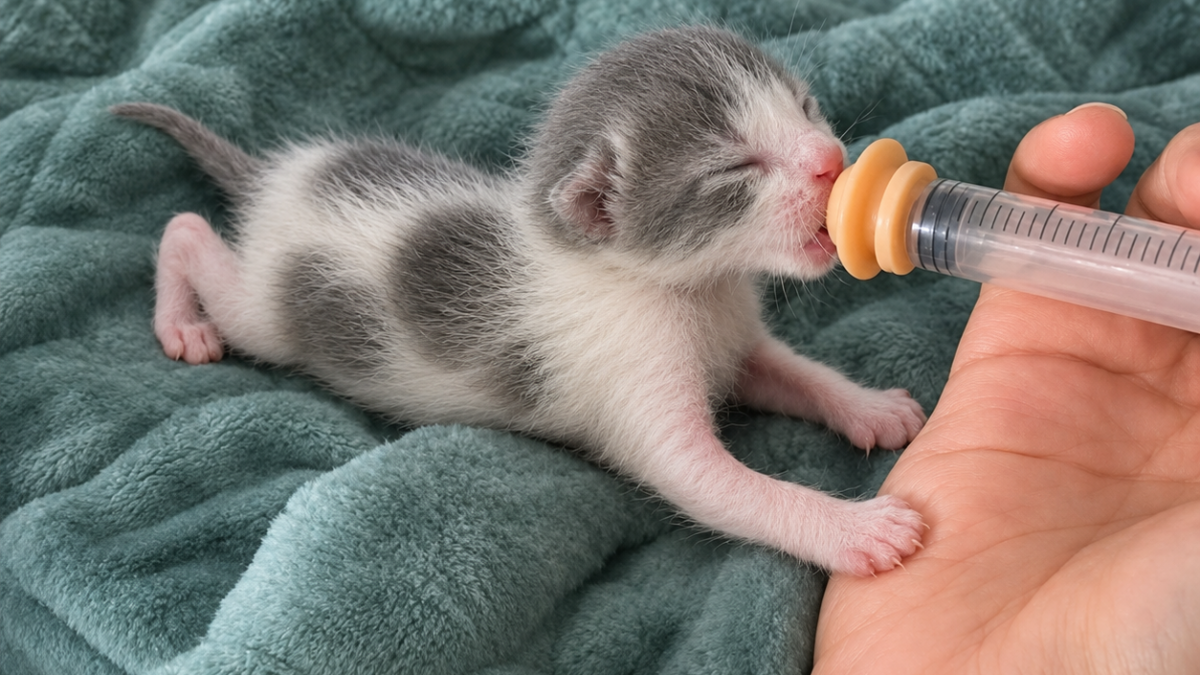
The kitten lying on the concrete was so small that at first I thought we were already too late. Her umbilical cord was still attached, fleas crawled through her dirty fur, and the sound coming from her mouth was barely strong enough to be called a cry. I had rescued fragile animals before, but something about that tiny body made me afraid to even hope.
My name is Rachel, and the morning I found her began like hundreds of ordinary mornings before it.
There was no storm.
No dramatic phone call.
No animal running through traffic.
Just a quiet yard behind an old house, a patch of cold concrete, and a sound so faint that I nearly walked past it.
I had gone out there because someone had mentioned hearing a strange noise near the back fence.
At first, I thought it was a bird.
Then I heard it again.
A thin, broken little squeak.
I followed the sound past a stack of flowerpots and an old plastic chair.
That was when I saw her.
She was lying almost completely still on the concrete.
For one terrible second, I didn’t understand what I was looking at.
She was too small.
Too dirty.
Too fragile.
Her fur was damp and clumped together. Tiny fleas moved along her neck and belly. Her eyes were sealed shut because she was so young that they hadn’t even begun to open.
And hanging from her abdomen was the remains of her umbilical cord.
She couldn’t have been more than a day or two old.
Maybe less.
I crouched slowly.
“Oh, sweetheart.”
Her mouth opened.
A tiny sound came out.
That was all.
No movement toward me.
No attempt to crawl away.
No strength to lift her head.
I touched the concrete beside her.
It was cold.
Much colder than the air.
My stomach tightened.
A newborn kitten cannot regulate her own body temperature. Without her mother, without siblings, without warmth, she had no way to protect herself.
I slipped my hand beneath her body.
She weighed almost nothing.
The moment I lifted her, I felt how cold she was.
Not cool.
Cold.
Her paws were cold.
Her ears were cold.
Even her belly felt frighteningly chilled.
“Get me a towel,” I called.
Someone brought one from inside.
We wrapped her carefully.
The fabric seemed enormous around her.
For several seconds, she didn’t respond.
Then something happened that I will never forget.
She moved.
Only a little.
Her head shifted.
Her tiny front paws flexed.
And then she pressed herself deeper into the warm towel.
It was such a small movement that anyone else might have missed it.
But to me, it felt like an answer.
She was still trying.
I held her against my chest and listened.
There it was again.
That tiny whisper of a cry.
I looked down at her face.
“Okay,” I said. “If you’re still fighting, I’m not giving up either.”
We rushed her to the clinic.
The scale stopped at exactly 100 grams.
One hundred grams.
I stared at the number.
I’d held phones heavier than that.
Coffee cups.
Apples.
Everything about her seemed impossibly small.
One of the veterinary technicians looked at me.
“She’s extremely young.”
“Can she make it?”
The technician didn’t give me false reassurance.
“She’s very fragile.”
I looked at the kitten.
“That wasn’t what I asked.”
The technician softened.
“Yes. She has a chance.”
That was all I needed.
A chance.
The team began cleaning her little by little because she was too weak for anything stressful.
They removed flea after flea from her tiny body.
They checked her temperature.
Her hydration.
Her breathing.
Everything had to be done gently.
Slowly.
Carefully.
I watched from nearby, terrified that even helping her might be too much for her body.
Eventually, we made her a temporary bed in a small cardboard box lined with blankets.
Compared with her, the box looked enormous.
We tucked a warm cloth beneath the bedding and placed a stuffed toy beside her.
The toy was almost twice her size.
I remember looking down at the little nest we’d made and thinking that no animal should begin life like this.
Alone.
Cold.
Covered in fleas.
Without a mother.
Without the warmth of another heartbeat nearby.
We prepared kitten formula.
The first feeding was measured in drops.
Not spoonfuls.
Not mouthfuls.
Drops.
She barely swallowed.
But she swallowed.
And that became our entire world.
One drop.
One breath.
One hour.
One night.
One more chance.
None of us knew yet how many times, over the days ahead, we would think we were losing her.
And none of us knew that the smallest creature in that little cardboard box was about to change every one of us.
**— END OF FACEBOOK OPENING —**
## PART TWO — THE FIRST NIGHT
I named her Willow.
I didn’t do it because she looked like a Willow.
At that point, she barely looked like anything except a tiny bundle of damp fur and bones.
I chose the name because willow trees bend in storms.
They look delicate.
Their branches move with the wind.
But they survive.
I wanted that for her.
Even if she never knew the meaning of the name.
Even if we only had her for a few hours.
“Willow,” I whispered as I tucked the blanket around her.
One of the technicians, Maria, glanced at me.
“We’re naming her already?”
“Yes.”
Maria raised an eyebrow.
“That’s dangerous.”
I knew what she meant.
People who work around rescue animals sometimes protect themselves by waiting.
Waiting to name.
Waiting to hope.
Waiting to become attached.
Because when you lose an animal you’ve named, it hurts differently.
But I couldn’t leave her nameless.
Not after she’d been lying alone on cold concrete.
Not after the world had already treated her like she didn’t belong to anyone.
“She’s Willow,” I said.
Maria looked into the box.
Then smiled faintly.
“All right. Willow.”
That first night was brutal.
Newborn kittens need frequent feeding, warmth, stimulation to eliminate, and constant monitoring.
A healthy mother cat does all of that naturally.
We had to become everything Willow didn’t have.
Her mother.
Her siblings.
Her warmth.
Her schedule.
Her safety.
Every few hours, an alarm went off.
One of us sat up.
Checked the heating source.
Checked her body temperature.
Prepared formula.
Tested it.
Then we tried to feed her.
The word *feed* makes it sound easier than it was.
We couldn’t simply give her a bottle and watch her drink.
She was too weak.
The nipple looked huge beside her mouth.
So we went slowly.
One tiny drop.
Wait.
Another.
Wait.
“Come on, Willow.”
She swallowed.
Then rested.
“That’s it.”
Another drop.
Sometimes she would take several in a row.
Those moments made us ridiculously happy.
“Look at her,” Maria whispered during one feeding. “She’s getting it.”
Then five minutes later Willow would stop.
Her mouth would no longer search for the nipple.
Her head would sag against the blanket.
And fear would rush back into the room.
“Willow?”
I’d rub her gently.
Nothing.
“Come on, baby.”
A tiny paw would move.
I would exhale.
There were nights when exhaustion made everything feel unreal.
The clinic lights seemed too bright.
The clock moved too quickly between feedings and too slowly while we watched her breathe.
At 2:13 in the morning, I sat on the floor beside her box.
I had been awake for what felt like days.
Willow had taken less formula than we wanted.
Maria was cleaning equipment nearby.
“I don’t think she’s getting enough,” I said.
Maria stopped.
“We’re doing what we can.”
“That’s not enough.”
“Rachel.”
“She’s a hundred grams.”
“I know.”
“She has no mother.”
“I know.”
“What if—”
“Don’t.”
I looked up.
Maria had tears in her eyes.
She wiped them away quickly.
“Don’t finish that sentence.”
I looked back at Willow.
Her chest rose.
Fell.
Rose.
Fell.
Barely.
“I’m scared to sleep,” I admitted.
“So am I.”
“What if something happens when nobody’s watching?”
“Then we keep watching.”
We took turns.
At 3:00, Willow drank a little.
At 5:00, almost nothing.
At 7:00, she took several drops and began kneading weakly against the towel.
I stared.
“Maria.”
“What?”
“Look.”
Willow’s front paws pushed gently into the blanket.
Left.
Right.
Left.
Right.
It was a newborn reflex.
Something kittens do against their mother’s belly while nursing.
It was tiny.
Instinctive.
But to us, it felt enormous.
Maria laughed quietly.
“She’s looking for her mama.”
The words hit me harder than I expected.
I looked down at Willow.
“I’m sorry she’s not here, baby.”
Willow continued kneading.
Maria touched my shoulder.
“Maybe we can’t be her mother.”
“No.”
“But we can keep her alive until she doesn’t need one every second.”
That became our goal.
Not forever.
Not adulthood.
Not even next month.
Just the next feeding.
The next weigh-in.
The next sunrise.
By morning, Willow had survived her first full night with us.
That might not sound like much.
But when I placed her on the scale and saw that she had not lost the weight we’d feared she might, I nearly cried.
One hundred grams.
Still tiny.
Still fragile.
But still here.
“Good morning, Willow,” I whispered.
She opened her mouth.
A faint squeak came out.
I smiled.
“Good morning to you too.”
## THE DAYS MEASURED IN GRAMS
Before Willow, I had never understood how much joy a single gram could bring.
Most people don’t think about grams.
Nobody celebrates when a bag of rice weighs one gram more than yesterday.
Nobody calls a friend because a piece of fruit gained two grams.
But when you are trying to keep a newborn kitten alive, numbers become emotional.
One gram means something.
Three grams mean hope.
Five grams feel like victory.
We weighed Willow at the same time every day.
The scale sat on a stainless-steel counter.
We lined it with a soft cloth so she wouldn’t touch the cold surface.
Then we gently placed her in the middle.
She looked impossibly small against the display.
The first morning after her rescue, the number barely changed.
I tried not to show my disappointment.
“That’s okay,” Maria said.
“Is it?”
“She didn’t drop.”
I looked at Willow.
“You’re right.”
I bent closer.
“We’ll take it.”
The next day, she had gained a little.
Not much.
But enough.
I clapped my hands.
Maria laughed.
“You would think she just won an Olympic medal.”
“She did.”
“It’s two grams.”
“Two very important grams.”
Willow slept most of the time.
Newborn kittens do.
But every waking moment became something we analyzed.
Was she moving more strongly?
Was her cry louder?
Was she latching better?
Was she warm enough?
Was her belly too round?
Not round enough?
We worried about everything.
The fleas were finally gone.
That alone made her look different.
Her fur, once dirty and clumped, began to soften.
We cleaned her carefully with warm damp cloths instead of bathing her.
A newborn kitten can become chilled dangerously fast.
So every little cleaning session was followed by warmth.
Her tiny belly became pinker.
Her paws cleaner.
Her ears looked less grimy.
She began to smell like warm milk instead of dirt.
I loved that smell.
One evening, I held her against my chest after feeding her.
She was wrapped in a blanket.
Her head rested beneath my chin.
I could feel the faintest vibration.
At first, I thought she was trembling.
Then I realized.
“Maria.”
“What?”
“Come here.”
Maria walked over.
“What’s wrong?”
“Listen.”
She leaned close.
Willow made the sound again.
A tiny, uneven rumble.
Maria’s face changed.
“She’s purring.”
I laughed.
“Is she?”
“Sounds like it.”
I looked down.
Willow’s eyes were still closed.
She couldn’t see us.
She didn’t know what the room looked like.
She didn’t know there was a clinic.
Or a cardboard box.
Or people setting alarms every few hours because they were terrified she might not survive.
All she knew was warmth.
Milk.
A heartbeat beneath her body.
Maybe that was enough.
“You’re safe,” I whispered.
Her purr continued.
That night, however, we had our first real scare.
At the midnight feeding, Willow wouldn’t drink.
Not one drop.
I adjusted her position.
Tried again.
Nothing.
“Willow?”
Her body felt warm enough.
But she seemed exhausted.
Maria checked her.
“Let’s give her a minute.”
We waited.
Tried again.
Willow turned her head away.
My stomach dropped.
“She needs to eat.”
“I know.”
“What do we do?”
Maria checked her gums and breathing.
“She’s not crashing. She’s tired.”
“What if she keeps refusing?”
“We’ll reassess.”
I hated that answer.
I hated every answer that wasn’t, *She’s going to be fine.*
“Willow,” I whispered. “Please.”
She did not respond.
For twenty minutes, I sat beside the box.
I watched her breathe.
Fear has a way of making time feel cruel.
Every second becomes something you can lose.
Finally, Willow stirred.
Her head lifted slightly.
Her mouth opened.
A small cry.
I reached for the formula.
“Try again?”
Maria nodded.
I touched the nipple to Willow’s lips.
She turned.
Latched.
And drank.
Not much.
But enough to make me close my eyes in relief.
“That’s my girl.”
Maria smiled.
“She scared you.”
“She can never do that again.”
Maria laughed.
“You might want to tell her.”
I looked down.
“Willow, no more drama.”
She kept drinking.
Maria shook her head.
“She’s a cat.”
“Right.”
“Drama is probably guaranteed.”
## THE FIRST WEEK
By the end of the first week, something had changed.
Willow was still tiny.
Still dependent on us for everything.
But she no longer looked like the kitten we’d lifted from the concrete.
Her body had begun filling out.
Her belly looked rounder after feedings.
Her coat was cleaner.
Her cry had grown louder.
That was one of my favorite changes.
The first day, her voice had been nearly silent.
Now, when she was hungry, she announced it.
At 3:00 in the morning, a small but determined squeak came from the box.
I opened one eye.
“Seriously?”
Another squeak.
I sat up.
“You’re the size of a potato and somehow you’ve become the boss of this room.”
Willow squeaked again.
I laughed.
“All right. I’m coming.”
Maria heard me from the other side of the room.
“She’s training you.”
“Apparently.”
I prepared the formula.
The moment Willow smelled it, she began moving.
Her tiny paws pushed into the blanket.
Her head turned side to side.
She latched more eagerly than she had a few days earlier.
I watched her drink.
“Look at you.”
This time, she didn’t stop after a few drops.
She kept going.
Slowly.
Steadily.
When she finished, her belly looked almost comically round.
I held her upright gently against my chest.
“There you go.”
After a moment, she gave the tiniest little burp.
I burst out laughing.
Maria looked over.
“What happened?”
“She burped.”
Maria smiled.
“Congratulations.”
“I’m so proud.”
“Your standards have changed.”
“They really have.”
Every normal kitten behavior became a celebration.
A stronger suck.
A louder cry.
A better poop.
A warm belly.
A few grams gained.
People outside rescue might have found it ridiculous.
We didn’t care.
When an animal has started life on the edge of death, ordinary things become extraordinary.
At the end of that first week, we weighed her again.
The scale climbed.
I stared.
“Are you seeing that?”
Maria leaned closer.
“Yes.”
“She’s gaining.”
“She is.”
I picked Willow up.
“You did it.”
Maria laughed.
“She didn’t exactly understand the assignment.”
“I don’t care.”
I kissed the top of Willow’s head.
“You’re doing it anyway.”
For the first time, I allowed myself to imagine her older.
Not adult.
That still felt too far away.
But maybe with her eyes open.
Maybe walking.
Maybe playing.
Maybe becoming a real little kitten instead of a fragile newborn.
Hope can be dangerous in rescue.
It makes you vulnerable.
But that morning, I let myself feel it.
Willow had survived a week.
Seven days.
Seven nights.
Dozens of feedings.
Hundreds of tiny drops.
And she was stronger than when we’d found her.
That mattered.
## THE MORNING HER EYES OPENED
Willow opened her eyes gradually.
At first, there was only a tiny slit.
I noticed it during a morning feeding.
“Maria.”
Maria didn’t look up.
“What?”
“Come here.”
“You say that every time she sneezes.”
“Just come here.”
Maria walked over.
I held Willow carefully beneath the light.
“Look.”
Maria leaned closer.
Willow’s right eye had opened the smallest amount.
A narrow gray-blue line.
Maria smiled.
“Oh.”
I felt tears rise instantly.
“She can see.”
“Not clearly yet.”
“Don’t ruin this.”
Maria laughed.
“I’m not ruining it. I’m being accurate.”
I looked at Willow.
“Can you see me, baby?”
Her eye remained barely open.
The other stayed closed.
Her expression made her look permanently surprised.
I couldn’t stop smiling.
Over the next couple of days, both eyes opened more fully.
They were that beautiful cloudy blue newborn kittens often have before their adult eye color develops.
Willow began responding to light and movement.
The world was arriving for her.
One morning, I moved my finger slowly beside her box.
Her head followed it.
I gasped.
“She saw that.”
Maria sighed dramatically.
“Here we go.”
“She followed my finger.”
“Yes, Rachel.”
“She saw me.”
“Probably.”
“Willow!”
The kitten blinked.
I laughed.
“You’re looking at me.”
It was absurdly emotional.
For days, Willow had known us only through touch, scent, warmth, and sound.
Now she could begin connecting voices with faces.
Hands with people.
Comfort with something visible.
I wondered what we looked like to her.
Probably enormous.
Tired.
Maybe a little ridiculous.
But when she looked toward my voice, I felt as though something had changed between us.
“Hi,” I whispered.
Willow blinked slowly.
“That’s me.”
Maria shook her head.
“She’s going to think her name is ‘Hi.'”
“Very funny.”
A few days later, Willow did something even bigger.
She sat up.
Not gracefully.
Not for long.
But she did it.
She had been lying beside her stuffed toy after feeding.
The toy was a small plush rabbit, though next to Willow it looked like a giant.
I was cleaning the formula syringe when Maria suddenly whispered, “Rachel.”
I turned.
Willow had pushed herself upright.
Her legs shook.
Her head wobbled.
For three seconds, maybe four, she sat.
Then she leaned sideways against the stuffed rabbit.
I froze.
“Did you see that?”
“Yes.”
“She sat.”
“She did.”
Willow blinked.
Her tiny body remained propped against the toy.
Then she slowly slid down.
I started laughing.
Maria pulled out her phone.
“Try again, baby.”
Willow made no attempt.
She had apparently completed her performance for the day.
“She’s exhausted,” Maria said.
“From sitting for four seconds?”
“When you weigh almost nothing, four seconds is work.”
I picked Willow up.
“You did so good.”
She pressed her face into my palm.
I remembered the first morning.
The cold concrete.
The fleas.
The umbilical cord.
The tiny motion when she’d pushed herself into the towel.
That kitten had barely been able to move.
Now she was trying to sit.
It felt like watching someone climb a mountain one inch at a time.
## WHEN SURVIVAL BECAME LIFE
There is a point in rescue when you realize you are no longer simply trying to prevent death.
You are watching life begin.
That happened with Willow around the third week.
She started crawling with purpose.
At first, she moved like a tiny seal.
Front paws pulling.
Back legs not entirely sure what they were supposed to do.
Then gradually, her movements became coordinated.
She could wobble across the blanket.
Reach the edge of her box.
Turn around.
Find the warmest spot.
One afternoon, I looked away for less than a minute.
When I looked back, Willow had somehow climbed halfway onto the stuffed rabbit.
“How did you get there?”
She stared at me.
“Don’t look innocent.”
Maria walked by.
“What happened?”
“She escaped gravity.”
Maria looked into the box.
“She’s climbing.”
“She’s supposed to be sleeping.”
“Apparently she disagrees.”
Willow tried to move higher onto the toy.
Her back paw slipped.
She tumbled into the blanket.
Then immediately tried again.
I laughed.
“There it is.”
“What?”
Maria smiled.
“The cat.”
She was right.
Until then, Willow had mostly been a patient.
A fragile newborn.
A medical responsibility.
Now her personality was appearing.
She was determined.
Curious.
Impatient.
And surprisingly opinionated for something that still fit comfortably in two hands.
She began protesting when feedings were late.
She disliked being cleaned.
She loved being held after eating.
She hated being put back into her box if she wasn’t ready.
The first time she hissed, we both laughed.
It happened when Maria adjusted the blanket too close to Willow’s face.
Willow opened her mouth.
A tiny breathy sound came out.
Maria froze.
“Did she just hiss at me?”
I nearly dropped the bottle laughing.
“She did.”
Maria pointed at the kitten.
“You weigh less than my sandwich.”
Willow made another tiny hiss.
“She’s threatening you.”
“Apparently.”
I picked her up.
“Don’t bully Maria.”
Willow curled into my hand.
Maria crossed her arms.
“Oh, sure. Now she’s sweet.”
The kitten’s personality grew stronger every day.
And with personality came attachment.
Willow began recognizing our voices.
If I entered the room and spoke, her head turned.
If Maria called her name, she responded.
When she was old enough to move around more confidently, she began trying to climb toward us.
One evening, I sat on the floor and placed her several feet away.
“Come on, Willow.”
She looked at me.
Then took one uncertain step.
Another.
Her legs were still awkward.
Her belly almost brushed the floor.
But she kept moving.
“Come on.”
She reached my knee.
Then began climbing my pants with tiny claws.
“Ow.”
Maria laughed.
“She’s coming.”
“She’s using me as a mountain.”
Willow climbed into my lap.
Turned in a tiny circle.
Then collapsed.
Just like that.
Asleep.
I stared down at her.
Maria took a picture.
I looked up.
“Don’t.”
“Too late.”
“I look terrible.”
“You’ve been awake for three weeks.”
“Exactly.”
Maria smiled.
“Willow doesn’t care.”
I looked down.
The kitten had tucked her head against my stomach.
Her entire body relaxed.
That was the moment something shifted inside me.
We weren’t simply keeping her alive anymore.
She trusted us.
And trust is a heavy thing when it comes from an animal who began life completely helpless.
## THE NIGHT I THOUGHT WE WERE LOSING HER AGAIN
Recovery is rarely a straight line.
That’s something people don’t always understand when they see before-and-after rescue photos.
They see the beginning.
Then the happy ending.
They don’t see the nights in between.
The fear.
The setbacks.
The moments when everything seems to be improving and then suddenly isn’t.
Willow gave us one of those nights.
She was a little over three weeks old.
She had been eating well.
Gaining.
Moving more.
Her eyes were open.
Her body was stronger.
For the first time, I had started sleeping longer without waking in panic.
Then one evening, she refused food again.
Not like before.
This time, something felt wrong.
She turned her head away.
Her energy dropped.
She didn’t crawl toward my hand.
She didn’t complain.
I touched her.
“Willow?”
Nothing.
Maria came over.
“What’s going on?”
“She won’t eat.”
Maria checked her.
Her expression changed slightly.
“What?”
“Let’s check her temperature.”
I watched the numbers.
My heart began pounding.
“Is it bad?”
“She’s a little cool.”
A little.
Those words felt enormous.
We adjusted her warmth carefully.
We monitored her.
Tried feeding again later.
She still wasn’t interested.
I sat beside her box.
“No.”
Maria looked at me.
“Rachel.”
“No. She was doing well.”
“I know.”
“She was sitting. She was crawling.”
“I know.”
“She can’t go backward now.”
“That’s not how this works.”
I hated Maria for being right.
Not really.
But in that moment, I wanted somebody to promise me effort guaranteed survival.
It doesn’t.
Rescue teaches you that cruelly.
You can do everything right and still lose.
You can stay awake.
Spend money.
Make calls.
Follow instructions.
Love with everything you have.
And sometimes the body is simply too fragile.
I looked at Willow.
Her tiny eyes were half closed.
“She can’t die now.”
Maria sat beside me.
“We’re not there.”
“It feels like it.”
“We keep going.”
Those words again.
We keep going.
So we did.
We maintained her warmth.
Offered small amounts.
Watched her breathing.
Checked her carefully.
One hour passed.
Then another.
Near midnight, Willow finally showed interest.
Her head lifted when she smelled the formula.
I held my breath.
“Come on.”
She moved toward it.
Latched.
Took one sip.
Then another.
Maria closed her eyes.
“Thank God.”
I didn’t speak.
I was afraid even words might disturb the moment.
Willow drank slowly.
Not much.
But enough.
Over the next several hours, she improved.
Her temperature normalized.
Her energy returned.
By morning, she was yelling at us for breakfast again.
I stared at her.
“You are unbelievable.”
Willow squeaked.
Maria laughed.
“She’s back.”
I leaned over the box.
“You scared years off my life.”
Willow attacked the bottle nipple.
“Clearly no remorse.”
That setback taught me something.
Hope wasn’t a finish line.
You didn’t reach it once and stay there.
You carried it.
Sometimes carefully.
Sometimes stubbornly.
Sometimes while terrified.
## THE FIRST TOY
At around a month old, Willow discovered toys.
Before that, the stuffed rabbit had been furniture.
A pillow.
Something to lean against.
Then one morning, she noticed its ear.
I watched her stare at it.
The ear moved slightly when the blanket shifted.
Willow froze.
Her pupils widened.
“Oh no.”
Maria looked over.
“What?”
“She’s hunting.”
Maria laughed.
Willow crouched.
Or at least attempted to.
Her hindquarters lifted too high.
Her front legs spread awkwardly.
She wiggled.
Then launched herself.
She traveled perhaps four inches.
Landed on the rabbit.
Rolled sideways.
And immediately bit its ear.
I laughed so loudly that Willow stopped and looked at me.
“Sorry.”
She went back to attacking the toy.
Maria grabbed her phone.
“This is her first hunt.”
“Don’t encourage her.”
Willow kicked the rabbit with both back paws.
“Too late.”
From that day forward, play became part of her life.
Crinkly balls.
Soft mice.
A ribbon dragged gently across the floor.
Everything became fascinating.
Her coordination improved rapidly.
At first, she chased toys like a drunk little bear.
Then she became quicker.
More graceful.
More cat.
She learned to pounce.
To stalk.
To jump.
Not high.
But enthusiastically.
One afternoon, she chased a small ball across the room.
I sat on the floor and watched.
She ran past me.
Turned too sharply.
Slid.
Recovered.
Then sprinted again.
I felt tears in my eyes.
Maria noticed.
“You okay?”
I nodded.
“Yeah.”
“Then why are you crying?”
I looked at Willow.
“Because the first time I saw her, she couldn’t even lift her head.”
Maria’s expression softened.
Willow pounced on the ball.
“It’s hard to believe.”
“I thought she was going to die in my hands.”
“But she didn’t.”
“No.”
Willow caught the ball.
Then carried it halfway toward us before dropping it.
I smiled.
“No, she really didn’t.”
## THE LAP
The moment that stayed with me most happened about a month after we found her.
Willow had just finished her bottle.
By then, she could drink with enthusiasm.
No more single drops counted with fear.
No more begging her to swallow.
She had become demanding.
If the bottle was late, everyone knew.
That afternoon, I sat in a chair with a blanket over my legs.
Willow finished eating.
I wiped a tiny smear of formula from her chin.
“There.”
She looked at me.
“All done.”
I expected her to climb down.
Instead, she put one paw on my wrist.
Then another.
She climbed from the towel onto my lap.
“Where are you going?”
Willow ignored me.
She walked in a small circle.
Once.
Twice.
Then she folded herself into a tiny ball.
And went to sleep.
No hesitation.
No trembling.
No searching.
She simply chose me.
I didn’t move.
Not even when my leg started going numb.
Maria walked into the room.
She stopped.
“Oh.”
“Don’t make noise.”
“She’s asleep.”
“I know.”
Maria smiled.
“You realize you’re trapped.”
“I don’t care.”
Willow’s body was warm through the blanket.
Her breathing was slow.
Steady.
I placed one finger gently against her side.
A month earlier, I had done almost the same thing because I’d been afraid she might stop breathing.
Now I touched her just because I liked feeling her there.
Alive.
Comfortable.
Safe.
I thought about the concrete yard.
The cold beneath her.
The fleas.
The umbilical cord.
The whisper of a cry.
Then I looked down at this tiny kitten sleeping in my lap by choice.
“Look at you,” I whispered.
Maria heard me.
“She’s come a long way.”
“She has.”
Willow stretched one paw.
Then settled deeper.
I smiled.
“You know what’s strange?”
“What?”
“The first day, I was afraid to hold her because she felt so fragile.”
Maria nodded.
“Now?”
“Now I’m afraid to move because I don’t want to wake her.”
Maria laughed quietly.
“That’s progress.”
## THE QUESTION WE DIDN’T WANT TO ASK
As Willow grew stronger, one question became impossible to avoid.
What happened next?
Rescue has a strange rhythm.
You spend weeks fighting to keep an animal alive.
Then, if you’re lucky, you reach the point where survival is no longer the crisis.
And suddenly you have decisions.
Vaccinations.
Socialization.
Long-term placement.
Adoption.
Home.
The word *home* should have made me happy.
Instead, it made my stomach tighten.
One evening, Maria asked the question directly.
“What are we doing with Willow?”
I pretended not to understand.
“What do you mean?”
Maria gave me a look.
“You know exactly what I mean.”
“She’s not ready yet.”
“Not today.”
“Then why are we talking about it?”
“Because someday she will be.”
I looked across the room.
Willow was attacking the stuffed rabbit again.
She had grown enough that the toy no longer looked twice her size.
“You think she should be adopted.”
Maria folded her arms.
“That is generally what happens with rescue kittens.”
I looked away.
Maria smiled.
“Oh.”
“What?”
“Nothing.”
“Maria.”
“You want her.”
“I did not say that.”
“You didn’t have to.”
I looked at Willow.
She stopped playing.
Looked toward my voice.
Then ran across the blanket.
Straight toward me.
Maria raised an eyebrow.
“Very subtle.”
I picked Willow up.
“She’s attached to all of us.”
“Sure.”
“She knows your voice.”
“She knows yours better.”
“That’s not true.”
Maria leaned closer.
“Willow.”
The kitten looked at her.
Then Maria pointed at me.
“Rachel.”
Willow turned immediately.
Maria laughed.
“Case closed.”
I held Willow against my chest.
“This isn’t a joke.”
“I know.”
“I’m at work a lot.”
“You’ve been caring for her every few hours for a month.”
“That’s different.”
“How?”
“Because this was temporary.”
Maria’s expression softened.
“Was it?”
I didn’t answer.
The truth scared me.
I had told myself Willow belonged to the rescue.
To the clinic.
To whoever eventually adopted her.
I had treated my attachment like part of the job.
But she wasn’t part of the job anymore.
She was the sound I listened for.
The first face I wanted to see in the morning.
The tiny body that crawled into my lap whenever she had the choice.
The kitten who had turned sleep deprivation into something I was grateful for because it meant she was still alive.
“I don’t know if I’m the right home,” I said.
Maria sat beside me.
“That’s a better question.”
“What?”
“Not ‘Do you love her?’ That’s obvious.”
I looked down.
“Ask whether you can give her what she needs.”
I nodded.
That was fair.
Love isn’t enough by itself.
Animals need stability.
Medical care.
Food.
Time.
Safety.
Patience.
So I thought about it.
Seriously.
Not emotionally.
I looked at my schedule.
My finances.
My home.
The cost of vaccinations, spaying, emergencies, supplies.
I considered whether Willow would have enough stimulation.
Whether she’d be alone too much.
Whether I was choosing her because I’d saved her or because I could actually give her a good life.
For three days, I said nothing.
Then, on the fourth morning, Willow did what she always did.
She heard my voice.
Ran toward me.
Climbed into my lap.
And started purring.
Maria watched from across the room.
“Well?”
I looked down at Willow.
“I bought a cat tree.”
Maria burst out laughing.
“So that’s a yes?”
“It’s a very expensive yes.”
She hugged me.
I held Willow between us.
“Careful.”
Maria pulled back.
“Sorry.”
Willow blinked.
I kissed the top of her head.
“You’re coming home.”
The kitten purred.
## HER FIRST NIGHT HOME
I had imagined Willow’s first night in my house being emotional.
Peaceful.
Symbolic.
It was mostly chaos.
She inspected everything.
The couch.
The curtains.
The table legs.
The space beneath the refrigerator.
The shoes by the door.
I spent forty minutes blocking places I hadn’t realized a kitten could reach.
“Willow.”
Her head appeared from behind a bookshelf.
“No.”
She disappeared.
“Willow.”
No response.
I got down on my knees.
“Come out.”
A tiny paw reached through the gap and slapped my finger.
I laughed despite myself.
“You are trouble.”
Eventually, she emerged.
I showed her the bed I’d made.
Soft blanket.
Small stuffed rabbit.
Warm corner.
She sniffed it.
Walked away.
“Of course.”
She climbed onto the couch.
Then onto me.
Turned around twice.
And slept on my chest.
I stared at the expensive kitten bed across the room.
“Good investment.”
Willow purred.
Her body had grown considerably from the 100-gram newborn I’d found.
But she was still small.
Still young.
Still learning everything.
That night, I woke twice automatically.
For weeks, my body had been trained to wake for feedings.
At 2:07 a.m., my eyes opened.
I sat up.
Then remembered.
Willow didn’t need formula every few hours anymore.
The emergency schedule was ending.
I looked beside me.
Willow was asleep near my shoulder.
I placed a hand against her side.
Warm.
Strong.
Breathing.
She opened one eye.
“Sorry,” I whispered.
She closed it again.
I lay back down.
For the first time since finding her, I slept without setting an alarm.
## THE CAT SHE BECAME
People often talk about rescue as though the rescued animal should be grateful.
I’ve never liked that idea.
Willow didn’t owe me gratitude.
She hadn’t asked to be born in danger.
She hadn’t chosen cold concrete.
She hadn’t asked fleas to cover her body or for her mother to be absent.
We helped her because she needed help.
That was enough.
But as she grew, she gave something back anyway.
Not gratitude.
Trust.
There is a difference.
Gratitude sounds like debt.
Trust is a gift.
Willow became the kind of cat who knew exactly where she belonged.
She followed me from room to room.
If I worked at the table, she slept nearby.
If I showered, she waited outside the bathroom door.
If I opened a cabinet, she investigated it as though she had been appointed supervisor.
And every time I returned home, she greeted me with a small meow.
Not loud.
Not dramatic.
Just a quick sound the moment she recognized my voice.
“Hi, Willow.”
“Meow.”
“I’m home.”
“Meow.”
It became our ritual.
One evening, I came home exhausted after a difficult day.
I dropped my bag by the door.
Sat on the couch.
And covered my face with my hands.
I didn’t call Willow.
I didn’t need to.
Seconds later, I felt paws on my leg.
Then on my lap.
She climbed up.
Turned around.
Sat against me.
I lowered my hands.
“Hey.”
She looked at me.
Then leaned forward and bumped her forehead against my chin.
I laughed weakly.
“Yeah.”
She purred.
I stroked her head.
“I know.”
Maybe she didn’t understand sadness.
Maybe she simply wanted warmth.
Maybe she had learned that laps were good places to sleep.
It didn’t matter.
She stayed.
And sometimes staying is enough.
## THE TOY ACROSS THE ROOM
Months after we found Willow, I watched her chase a toy across the living room.
It was a ridiculous little fabric mouse.
Nothing special.
I tossed it.
She ran after it.
Fast.
Healthy.
Graceful.
She pounced.
Kicked it.
Carried it in her mouth.
Then dropped it near my feet.
I picked it up.
“You want it again?”
Her body lowered.
Eyes wide.
Tail twitching.
I threw it.
She sprinted.
I laughed.
And then, in the middle of that completely ordinary moment, the past came rushing back.
Cold concrete.
One hundred grams.
Fleas.
An umbilical cord.
A cry barely louder than a whisper.
I stopped moving.
Willow returned with the mouse.
She dropped it.
Looked up.
“Meow.”
I stared at her.
She was beautiful.
Her fur was clean and full.
Her eyes were bright.
Her body was strong.
There was no sign of the fragile newborn who had once fit in my palm.
Willow meowed again.
I wiped my eyes.
“Sorry.”
I picked up the toy.
“You want me to throw it?”
She crouched.
I laughed.
“Okay.”
I threw it.
She raced after it.
That was the moment I finally understood the ending of her rescue story.
It wasn’t the day she opened her eyes.
It wasn’t the day she gained enough weight for us to relax.
It wasn’t the day she stopped needing bottles.
It wasn’t even the day she came home.
The ending was this.
Ordinary life.
A cat chasing a toy.
A bowl that would be filled again tomorrow.
A warm place to sleep.
A lap she could climb into whenever she wanted.
A voice she recognized.
A home where nobody measured her existence hour by hour because survival was no longer uncertain.
That was the victory.
She had earned the right to be ordinary.
## ONE YEAR LATER
A year after I found Willow, I took out the towel we’d first wrapped her in.
I had kept it.
I don’t know why.
Maybe I knew even then that I would want proof of how small she had been.
The towel looked enormous in my hands.
Willow walked into the room.
She was no longer a fragile kitten.
She had grown into a sleek, curious young cat with bright eyes and enough confidence for three animals.
She saw the towel.
Immediately sat on it.
I laughed.
“Do you remember this?”
She began grooming her paw.
“Of course not.”
I sat beside her.
“This is the first thing that kept you warm.”
Willow glanced at me.
Then continued grooming.
“You were very dramatic.”
She stopped.
Looked directly at me.
“Okay. That’s unfair.”
I stroked her back.
“You were fighting for your life.”
She leaned into my hand.
I thought about the people who had helped.
Maria.
The clinic team.
Everyone who had gotten up in the middle of the night.
Everyone who had celebrated grams.
Everyone who had whispered encouragement to a kitten too young to understand any of it.
Nobody had done something cinematic.
There had been no helicopter rescue.
No dramatic chase.
No last-second surgery.
Just repeated acts of care.
Feed.
Warm.
Clean.
Weigh.
Watch.
Repeat.
Sometimes saving a life doesn’t look heroic.
Sometimes it looks like setting an alarm for 2:00 a.m.
Mixing formula when you’re exhausted.
Counting drops.
Washing blankets.
Checking breathing.
And doing it again.
And again.
And again.
Until one day, the animal no longer needs saving.
## THE VISIT
On the anniversary of Willow’s rescue, I brought her back to the clinic.
Maria was working.
When she saw the carrier, she smiled.
“Is that who I think it is?”
I opened the door.
Willow stepped out cautiously.
Maria crouched.
“Willow?”
The cat froze.
Her ears moved.
Then Maria spoke again.
“Hi, baby.”
Willow walked toward her.
Maria covered her mouth.
“She remembers my voice.”
“I think so.”
Willow sniffed Maria’s hand.
Then rubbed her face against it.
Maria started crying.
“Oh, come on.”
I laughed.
“You’re the one who told me not to get attached.”
“I was smarter then.”
Willow climbed into her lap.
Maria looked down.
“She used to fit in one hand.”
“I know.”
“Look at her.”
We both did.
Willow sat confidently in Maria’s lap.
She purred as Maria stroked her head.
For a moment, nobody spoke.
Then Maria said, “Do you remember that first night?”
“Every minute.”
“I thought we were going to lose her.”
“So did I.”
Maria looked down.
“Especially around five in the morning.”
I nodded.
“She was so tired.”
“And then she started kneading the blanket.”
I smiled.
“That was when I thought she might stay.”
Maria looked at me.
“When did you decide to adopt her?”
I laughed.
“Apparently before I knew I had decided.”
“That’s what I thought.”
Willow stretched.
Maria kissed her forehead.
“You gave us hell, you know that?”
Willow purred louder.
“She doesn’t care.”
“No.”
Maria smiled.
“She never did.”
## WHAT I LEARNED FROM 100 GRAMS
Before Willow, one hundred grams meant nothing to me.
It was a number.
A measurement.
Something printed on food packaging.
Now it means a heartbeat.
A body small enough to hold in both hands.
A life that could disappear if nobody noticed.
It means responsibility.
It means how little it takes for something fragile to be lost.
And how much difference warmth can make.
I used to think rescue happened in dramatic moments.
Someone finds an animal.
Someone saves it.
The end.
Willow taught me that the dramatic moment is often only the beginning.
The real rescue happens afterward.
During the quiet hours.
When nobody is watching.
When there’s no applause.
No camera.
No guarantee.
It happens at 3:00 in the morning when a kitten refuses to drink and you try again.
It happens when you celebrate two grams because two grams are better than none.
It happens when your back hurts and your eyes burn and you still prepare another feeding.
It happens when you are scared to love an animal because you might lose her.
And you love her anyway.
## THE SOUND I REMEMBER
People ask what I remember most about the day we found Willow.
They expect me to say the fleas.
Or the cord.
Or how tiny she was.
But the thing I remember most is the sound.
That first cry.
Barely there.
So soft that I almost missed it.
I sometimes wonder what would have happened if the yard had been noisy.
If someone had started a lawn mower.
If a truck had driven past.
If I had been wearing headphones.
If I had walked in the other direction.
There are too many possibilities I don’t like thinking about.
Instead, I focus on what did happen.
We heard her.
We found her.
We lifted her.
She pressed into the warm towel.
And from that moment on, she was no longer alone.
That matters to me.
Maybe more than anything else.
Because life doesn’t always need somebody extraordinary.
Sometimes it just needs somebody paying attention.
## THE FINAL NIGHT FEEDING
I still remember Willow’s last bottle.
At the time, I didn’t know it would be the last.
She had begun transitioning toward solid food.
The bottle was becoming less necessary.
But she still loved it.
That evening, I sat on the couch with her wrapped in a small towel.
She latched eagerly.
Her paws kneaded my hand.
I smiled.
“You’re almost too big for this.”
She kept drinking.
“Do you remember when you couldn’t even finish a few drops?”
She obviously did not.
“You made me beg.”
Willow pushed harder against the bottle.
“I stayed awake all night for you.”
She drank.
“You could at least look grateful.”
She paused.
Stared at me.
Then resumed.
I laughed.
“Fair enough.”
When the bottle was empty, she remained in my arms.
I wiped her mouth.
She climbed higher onto my chest.
Curled beneath my chin.
And purred.
The next day, she preferred her food.
The bottle gradually disappeared.
I washed it.
Dried it.
Placed it in a drawer.
Then stood there staring at it.
It felt ridiculous to cry over a tiny feeding bottle.
But I did.
Because it represented the end of something.
The hardest part.
The most frightening part.
The part where every feeding felt like an agreement between us.
You drink.
I’ll stay.
You keep fighting.
I’ll keep getting up.
Now she didn’t need that agreement anymore.
She was strong enough to eat on her own.
I closed the drawer.
Then heard Willow running down the hallway.
I smiled.
She didn’t need me to keep her alive anymore.
And that was exactly what I’d wanted.
## THE FIRST BIRTHDAY
We chose the day we found Willow as her birthday.
We couldn’t know the exact day she’d been born.
Her umbilical cord and condition told us she was extremely young, but there was no mother to give us an answer.
So the day she entered our lives became the day we celebrated.
On her first birthday, Maria came over.
She brought a toy mouse.
I bought Willow a ridiculous little soft bed shaped like a flower.
She ignored both gifts initially and played with the paper bag.
“Of course,” Maria said.
“I spent money on that bed.”
“You should’ve bought her garbage.”
Willow crawled inside the bag.
I sighed.
“Lesson learned.”
Later, she finally noticed the toy.
She chased it across the room.
Maria laughed.
“Look at her.”
I watched.
A year earlier, she had been lying on concrete.
Now she launched herself into the air after a fabric mouse.
She landed.
Slid.
Turned.
Ran again.
I smiled.
“Do you remember when sitting up was a big deal?”
Maria nodded.
“Four seconds.”
“Maybe three.”
“We still celebrated.”
“We celebrated everything.”
Willow ran toward us.
Jumped into my lap.
Maria looked at me.
“She still does that.”
“Every day.”
Willow began purring.
I stroked her head.
Maria smiled.
“Happy birthday, miracle cat.”
I looked down.
“She wasn’t a miracle.”
Maria raised an eyebrow.
“No?”
I shook my head.
“She was work.”
Maria laughed.
“That’s romantic.”
“I’m serious.”
I looked at Willow.
“Calling it a miracle makes it sound like nobody did anything.”
Maria became quiet.
“The clinic team worked. We woke up. We fed her. We warmed her. She fought. Her body fought.”
I stroked Willow’s back.
“Maybe the miracle was that all those things came together.”
Maria smiled.
“I can live with that.”
## THE PLACE WHERE WE FOUND HER
I went back to that yard eventually.
Not because I wanted to.
Because I needed to.
The concrete looked exactly the same.
That surprised me.
I don’t know why.
Part of me expected the place to have changed because something important had happened there.
But concrete doesn’t remember.
There was the fence.
The plastic chair.
The flowerpots.
Everything ordinary.
I stood where we’d found Willow.
The ground was warm that day.
Sunlight covered it.
I touched the spot with my shoe.
This had been the entire world for a newborn kitten.
Cold.
Hard.
Alone.
I felt anger.
Not at a specific person.
I didn’t know what had happened to Willow’s mother.
Maybe something had frightened her away.
Maybe she had moved her litter and somehow left one kitten behind.
Maybe Willow had been dropped there by someone.
Maybe an accident had separated them.
We never knew.
I refused to invent a villain simply because unanswered questions were uncomfortable.
What mattered was what we knew.
Willow had been there.
Alone.
She had needed help.
And help arrived.
I stood quietly for several minutes.
Then I left.
I didn’t need to stay.
That concrete was where Willow’s story began.
It wasn’t where it belonged anymore.
## THE CAT IN THE WINDOW
Willow has a favorite place now.
The window.
Every morning, sunlight falls across the sill.
She jumps up.
Stretches.
Then watches birds outside.
Sometimes her tail flicks.
Sometimes she chatters at them.
Sometimes she falls asleep with her face in the sun.
The first time I saw her there, I took a photograph.
Then I compared it with a picture from her first day.
In the old image, she looked almost unreal.
So tiny.
Wet fur.
Closed eyes.
A body swallowed by a towel.
In the new one, she looked strong.
Alert.
Comfortable.
If I didn’t know they were the same cat, I might not believe it.
I placed the photographs side by side.
Then I stopped.
There was something about the comparison that bothered me.
The first photo looked tragic.
The second looked triumphant.
But that made the story seem too simple.
Willow wasn’t a sad picture that became a happy picture.
There were thousands of moments between them.
Feedings.
Setbacks.
Warm blankets.
Tears.
Weight checks.
Laughter.
Fear.
Sleep deprivation.
First steps.
First purrs.
First toys.
First naps in my lap.
The transformation wasn’t one big moment.
It was all of them.
## THE MEOW
Willow still has a very specific meow for me.
It is different from the one she uses when she wants food.
Different from the one she makes when a door is closed and she believes this is a personal insult.
The meow she gives when she recognizes me is short.
Soft.
Almost conversational.
One evening, Maria was visiting.
We were sitting in the kitchen.
Willow was asleep in another room.
I went outside briefly to take out the trash.
When I returned, I opened the door.
“Willow?”
From the hallway came that little sound.
Meow.
Then she appeared.
She walked quickly toward me.
Maria smiled.
“That’s the one.”
“What?”
“The recognition meow.”
I laughed.
“You noticed?”
“Of course.”
Willow rubbed against my ankle.
I picked her up.
“Hi.”
She purred.
Maria watched us.
“Do you ever think about the first sound she made?”
“Every time.”
Because that’s the strange thing.
Her first cry had been so weak I nearly missed it.
Now she had a voice.
Not just physically.
Her life had become full of sounds.
Purring.
Meowing.
Running.
Playing.
Knocking things off shelves at completely unnecessary hours.
Her existence was no longer a whisper.
She took up space.
She demanded things.
She belonged.
And I loved that.
## THE NIGHT SHE SLEPT WITHOUT MOVING
There was one night, months after her rescue, when Willow climbed into my lap and became completely still.
For a second, old fear hit me.
It happened before thought.
My hand touched her side.
Breathing.
Warm.
Fine.
I laughed at myself.
“What am I doing?”
Willow didn’t move.
She was deeply asleep.
I realized something then.
The first time she had lain still in front of me, stillness had meant danger.
Cold.
Weakness.
Maybe death.
Now stillness meant trust.
It meant she felt safe enough to surrender completely to sleep.
She didn’t have to conserve energy.
Didn’t have to cry.
Didn’t have to search for warmth.
She just slept.
I placed my hand lightly on her back.
Her purr started.
Soft.
Steady.
I sat there for almost an hour.
And for once, I didn’t worry.
## WHAT HER STORY BECAME
Willow’s story is not really about a newborn kitten being found on concrete.
That’s only where it starts.
It’s about what happens when fragile life is treated as though it matters.
It’s about consistency.
Care.
Patience.
And the fact that sometimes survival is built from very small things.
A towel.
A box.
A bottle.
A few drops of formula.
A warm hand.
A person who gets up one more time.
Then another.
Then another.
It’s also about learning when to stop seeing someone as fragile.
For months, part of me still looked at Willow and saw the newborn.
Even when she was running.
Even when she was climbing.
Even when she had become perfectly capable of causing complete chaos in the house.
I worried too much.
Checked too often.
Overreacted to every skipped bite.
Then one afternoon, Willow climbed onto the highest platform of her cat tree.
I panicked.
“Willow.”
She looked down.
“Come down.”
Maria was visiting.
“Rachel.”
“She’s too high.”
“She’s a cat.”
“She could fall.”
“She’s a cat.”
Willow jumped.
Landed perfectly on the couch.
Then ran away.
Maria stared at me.
“You have to let her be a cat.”
I knew she was right.
Rescue isn’t supposed to turn into permanent fear.
Saving someone means eventually letting them live.
So I tried.
I still worried.
I probably always will.
But I learned to let Willow climb.
Run.
Jump.
Explore.
Be annoying.
Be brave.
Be ordinary.
## THE ENDING I WANTED
If you had asked me on the first day what ending I wanted for Willow, I would have said one thing.
Alive.
That was enough.
Then later, I wanted her stronger.
Then walking.
Then playing.
Then healthy.
Then home.
But the real ending became bigger than survival.
The real ending is this:
Willow wakes me too early because breakfast matters deeply to her.
She attacks invisible enemies under blankets.
She believes every cardboard box belongs to her.
She sits in windows.
She naps in sunlight.
She runs toward familiar voices.
She climbs into laps.
She purrs when someone strokes her head.
She is loved by people who remember when her entire body fit inside one hand.
And she has no idea how close she once came to losing all of it.
I think that’s the part I love most.
Willow doesn’t know she’s a rescue story.
She doesn’t know people once counted every gram she gained.
She doesn’t know we stared at her chest to make sure it kept moving.
She doesn’t know anyone cried when she first sat up.
She doesn’t know the significance of the towel.
Or the box.
Or the bottle.
She doesn’t know that when she runs across the room after a toy, I sometimes see two versions of her at once.
The cat in front of me.
And the newborn on the concrete.
To Willow, this life is simply hers.
As it should be.
## EPILOGUE — THE LITTLE CRY THAT BECAME A PURR
This morning, Willow woke me by stepping directly onto my chest.
I opened my eyes.
She was staring at me.
“Good morning.”
Meow.
I checked the time.
Too early.
“Absolutely not.”
Meow.
“You ate last night.”
She stepped closer to my face.
I laughed.
“You are impossible.”
She began purring.
Eventually, I gave up and got out of bed.
Willow followed me into the kitchen.
She sat beside her bowl.
I prepared breakfast.
While she ate, I leaned against the counter and watched her.
Healthy appetite.
Strong body.
Bright eyes.
The most ordinary scene imaginable.
And somehow, that still feels extraordinary.
After breakfast, she ran into the living room.
Found her favorite toy.
Attacked it.
Then carried it toward me.
“Already?”
She dropped it.
I threw it.
She chased it across the room.
Her paws hit the floor in quick little beats.
She turned.
Pounced.
Caught the toy.
Then came back.
I smiled.
There was a time when she couldn’t walk.
There was a time when she couldn’t see.
There was a time when drinking a few drops of formula exhausted her.
There was a time when her entire life weighed one hundred grams.
Now she ran.
She jumped.
She complained.
She loved.
And she trusted.
A few minutes later, Willow climbed into my lap.
Turned around twice.
Then curled against me.
Exactly the way she had about a month after we found her.
Only now she was bigger.
Heavier.
Warm.
Her breathing was deep and steady.
I stroked her head.
Her eyes closed.
Then the purring started.
I looked down and remembered that first cry.
Barely louder than a whisper.
A sound so small that the world could easily have ignored it.
But someone heard.
And because someone heard, Willow got another hour.
Then another night.
Then another week.
Then an entire life.
I bent down and kissed her head.
“You made it, little girl.”
Willow didn’t move.
She just kept purring.
And I realized something that still brings tears to my eyes.
For weeks, we celebrated every gram she gained because each one meant she was moving farther away from death.
But the greatest victory was never written on the scale.
It was this.
A cat sleeping peacefully in the lap of someone she trusts.
A cat who wakes up expecting breakfast.
A cat who runs when she hears a toy hit the floor.
A cat who recognizes the voices that once whispered encouragement through sleepless nights.
A cat who will never understand how many people once held their breath waiting for hers.
Willow began her life on cold concrete.
She had dirt in her fur.
Fleas on her skin.
An umbilical cord still attached.
No mother beside her.
No warmth except what we gave her.
And a voice so weak it nearly disappeared into the morning.
But that wasn’t where her story ended.
Her story ended in a warm home.
With sunlight.
Toys.
Full bowls.
Soft blankets.
Safe hands.
And a lap she could choose whenever she wanted.
I don’t know why Willow was left alone that day.
I may never know.
But I know what happened next.
She was found.
She was held.
She was fed.
She was fought for.
And eventually, she became strong enough to fight for absolutely nothing more serious than possession of a toy mouse.
Sometimes that is the best kind of ending.
Not revenge.
Not tragedy.
Not a dramatic final confrontation.
Just life winning.
Quietly.
Completely.
One tiny heartbeat at a time.
**THE END**








