We Bought a Puppy for Our Country House—Then He Dug Beneath an Old Shed and Found a Family Someone Had Left to Di3
PART 2
For the next several minutes, none of us moved.
There are moments in life when speaking seems almost disrespectful.
That was one of them.
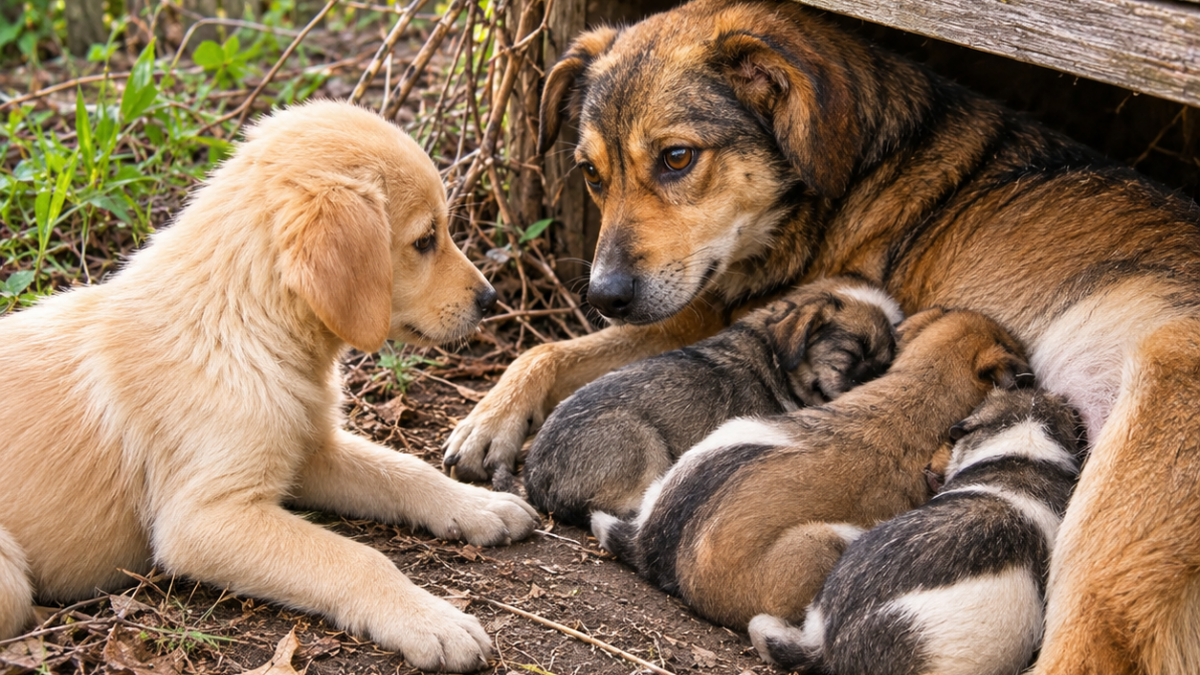
Bax lay partly beneath the shed, his back legs still outside.
The mother dog’s head rested near his front paws.
She was not relaxed exactly.
Her eyes opened every few seconds.
Her breathing was fast.
But she no longer growled.
Emily whispered, “We need help.”
I nodded.
I called the nearest veterinary clinic.
A woman answered.
I explained what we had found.
“How old are the puppies?”
“I don’t know. Very young.”
“Eyes open?”
“I don’t think so.”
“Mother eating?”
“A little.”
“Can she walk?”
“Barely.”
The receptionist put me on hold.
A veterinarian came on the line.
Her name was Dr. Sarah Mitchell.
“Don’t drag the mother out unless you have to,” she said. “If she’s extremely weak and frightened, stress could make things worse.”
“It’s supposed to rain tonight.”
“How protected is the area?”
“Not enough.”
There was a pause.
“I’ll come out.”
“You make house calls?”
“Not normally.”
I looked toward Bax.
“Today isn’t normal.”
“No,” Dr. Mitchell said. “It doesn’t sound like it.”
She arrived forty minutes later carrying a medical bag and a folded stretcher.
The moment she saw the mother, her expression changed.
“How long do you think she’s been here?”
“No idea.”
Dr. Mitchell crouched.
The mother growled.
Bax stood.
“Easy,” I said.
Dr. Mitchell looked at him.
“This is the puppy who found them?”
“Yeah.”
She watched Bax approach the opening.
The mother’s growl stopped.
“Well,” she said, “I guess we know who the trusted professional is.”
Despite everything, Emily laughed.
We spent almost an hour getting the mother out.
Bax stayed beside her.
Whenever she became tense, he would lie down.
Whenever she looked toward the puppies, he would look too.
Eventually, Dr. Mitchell managed to examine her enough to confirm what we already suspected.
“She needs fluids immediately.”
“How bad?”
“Bad.”
“Is she going to die?”
Lily had come outside without us noticing.
She stood behind Emily.
Her face was pale.
Emily turned.
“Honey, go inside.”
“Is she?”
Dr. Mitchell looked at Lily.
“I don’t know yet.”
Lily’s eyes filled.
“But we’re going to help her, right?”
“We’re going to do everything we can.”
That seemed to satisfy her.
Barely.
We moved the puppies first.
The mother panicked.
She tried to stand.
Her legs collapsed.
Bax walked to the box where we had placed them.
He sniffed each puppy.
Then returned to her.
She watched him.
Stopped struggling.
Dr. Mitchell looked at me.
“I’ve been doing this fourteen years.”
“And?”
“I’ve never seen that.”
We lifted the mother onto the stretcher.
Even through the blanket, I could feel how little she weighed.
It felt wrong.
A dog her size should have been much heavier.
At the clinic, bloodwork confirmed severe dehydration, malnutrition, anemia, and infection.
There were sores on her paws.
An old wound near her shoulder.
Bruising around her neck.
Dr. Mitchell showed us the marks.
“This concerns me.”
“What caused it?”
“Restraint.”
“A collar?”
“Possibly. Rope is more likely.”
Emily looked at me.
“Someone tied her up.”
“We can’t know for sure.”
But Dr. Mitchell’s face said she had a strong opinion.
The puppies were in better condition than expected.
That was because their mother had sacrificed herself for them.
“She used everything she had,” Dr. Mitchell explained. “Her body prioritized milk production. She kept feeding them even while she was starving.”
I looked through the glass.
The mother lay beneath a warm blanket.
Bax sat outside the treatment area.
He refused to leave.
“What happens now?”
“We stabilize her. Feed her carefully. Too much food too fast can actually be dangerous.”
“And the puppies?”
“We supplement them if needed.”
Lily touched the glass.
“Does she have a name?”
“No.”
“She needs one.”
“Okay.”
“Daisy.”
I smiled.
“Why Daisy?”
“Because flowers come back after winter.”
Emily looked away.
That was Daisy.
Within hours, the clinic staff started using the name.
“Daisy drank water.”
“Daisy’s temperature is improving.”
“Daisy let us touch her.”
Except she didn’t let everyone touch her.
Men made her nervous.
Sudden movements terrified her.
When anyone held a leash, she tried to crawl backward.
But Bax?
Bax could do anything.
The next morning, Dr. Mitchell allowed us to bring him into the recovery room.
The moment Daisy saw him, she lifted her head.
Bax walked to the crate.
Daisy pressed her nose through the bars.
He licked her.
Then she ate half a bowl of food.
Dr. Mitchell shook her head.
“I may need to put him on payroll.”
It took nine days before Daisy was strong enough to leave the clinic.
The puppies came with her.
We converted our enclosed porch into a recovery area.
I built a low pen.
Emily filled it with blankets.
The kids made signs.
WELCOME HOME, DAISY.
WELCOME PUPPIES.
Bax had his own bed outside the pen.
He ignored it and slept against the gate instead.
For the first few days, Daisy remained cautious around us.
She accepted food.
Allowed Emily to touch her head.
Sometimes she let Lily sit nearby.
But she watched me constantly.
Whenever I stood too quickly, she flinched.
That hurt more than I expected.
One night, I sat outside her pen.
“You know I’m not going to hurt you.”
Daisy watched me.
“I’m not asking you to believe me.”
Bax walked over and put his head in my lap.
I scratched behind his ears.
“Your idiot friend believes me.”
Daisy’s ears moved.
“Maybe ask him.”
She lowered her head.
Progress came slowly.
A hand sniffed without retreating.
A bowl eaten while I was still in the room.
One night, she allowed me to touch her shoulder.
I barely breathed.
Then came the first mystery.
While repairing the old fence behind the shed, I found a piece of blue nylon rope.
It was wrapped around a post.
One end had been cut.
There was brown staining near the knot.
I stared at it.
I knew exactly what I was seeing.
I called Emily.
She came outside.
When she saw the rope, her face changed.
“Oh no.”
I looked toward the porch.
Daisy was lying beside Bax.
“You think that’s what was around her neck?”
“I think somebody tied her here.”
Emily went silent.
The old service lane ran behind our property.
It connected to a county road nearly a mile away.
Someone could have driven in unseen.
The house had been empty before we bought it.
Anyone who knew the area would have known that.
I searched the brush.
Behind the fence, I found an old plastic food bowl.
A torn bag.
A piece of cardboard.
Then tire tracks preserved in a patch of softer ground.
I called the sheriff’s office.
Deputy Aaron Blake arrived that afternoon.
He photographed everything.
“You’ve got any cameras?”
“Front of the house.”
“Nothing back here?”
“No.”
“Previous owner?”
“Moved out of state.”
Aaron looked toward the shed.
“Someone knew this property was empty.”
“You think they dumped her here?”
“Looks that way.”
“Can anything actually be done?”
“If we identify who owned her.”
There was no microchip.
No tag.
No paperwork.
For several days, I thought that would be the end of it.
Then Daisy identified him herself.
It happened on a Thursday afternoon.
I was working from the porch while Emily and the kids were inside.
Daisy had started venturing into the yard.
Bax never went far from her.
A white pickup truck appeared on the road.
It slowed.
Daisy saw it.
The reaction was immediate.
She froze.
Then she screamed.
I don’t know any better word for the sound.
It was not barking.
It was terror.
She ran backward, slammed into the porch railing, and tried to crawl beneath a chair.
Bax rushed to her.
“What happened?”
The truck stopped.
I stood.
The driver looked toward the property.
Then accelerated away.
I caught part of the license plate.
Not all.
Enough.
Aaron traced it.
Curtis Hall.
The name sounded familiar.
Then I remembered.
The previous owner had mentioned him.
“He used to do maintenance here,” I told Aaron.
“Fence repair?”
“Yeah.”
“Grounds?”
“Everything.”
Aaron leaned back.
“So he knew the property.”
“Absolutely.”
“Interesting.”
Curtis lived twenty minutes away and ran a small landscaping and equipment business.
He also kept dogs.
Several.
Animal control had received complaints about barking and poor conditions, but inspections had never resulted in charges.
Aaron started talking to neighbors.
One woman had photographs from the previous summer.
In the background of one picture stood a brown-and-white dog.
Daisy.
Same markings.
Same torn ear.
Same white patch on her chest.
When I showed the picture to Emily, she sat down.
“That’s her.”
“Yes.”
“What did he call her?”
“Bella.”
Emily looked toward Daisy.
“No.”
“What?”
“She’s Daisy now.”
I understood.
Curtis told investigators he had sold the dog.
Couldn’t remember the buyer’s last name.
Didn’t have a phone number.
Had no receipt.
Couldn’t explain why Daisy was terrified of his truck.
Couldn’t explain the rope found on property he had once maintained.
Still, suspicion wasn’t proof.
Then Maria Evans called animal control.
Maria had worked part-time for Curtis.
She had seen Daisy pregnant.
She had seen the puppies born.
And she had been there the morning Curtis loaded them into his truck.
Her statement changed everything.
According to Maria, Daisy’s pregnancy made Curtis furious.
He bred dogs occasionally and sold puppies for cash.
Daisy’s litter was not planned.
The father was a mixed-breed dog.
Curtis told Maria the puppies would be “worthless.”
She offered to contact a rescue.
He refused.
He didn’t want questions about the conditions of his other animals.
One morning, he put Daisy and the puppies in his truck.
Maria saw rope.
She assumed he was taking them to a shelter.
When she asked where he was going, he said:
“There’s an empty property out past Miller Road.”
Our house.
At the time, it was still supposed to be empty.
Except we had purchased it.
Curtis didn’t know.
He tied Daisy to the fence behind the shed.
Put her puppies beneath the building.
And left.
No food.
No real shelter.
No plan to return.
Maria didn’t know exactly where until photographs of Daisy were shared through a local rescue page.
She recognized her immediately.
Emily cried when Aaron told us.
I felt something different.
Anger.
Cold, concentrated anger.
Daisy had not accidentally ended up on our property.
She had not gotten lost.
She had been deliberately taken somewhere isolated and left with three newborn puppies.
Curtis had expected them to disappear quietly.
Daisy had apparently chewed through the rope.
The abrasions on her neck and paws suddenly made sense.
She had freed herself.
But instead of leaving, she crawled beneath the shed.
Because her babies were there.
She stayed.
Starving.
Freezing.
Feeding them with whatever strength remained.
Then Bax found her.
Curtis was charged with animal cruelty and abandonment.
Local news picked up the story.
That was when the threats started.
The first was a note in our mailbox.
STOP LYING.
The second came through a fake social media account.
YOU DON’T KNOW WHAT YOU’RE GETTING INTO.
Aaron told us to save everything.
Then somebody threw a brick through one of the side windows at the country house.
Attached to it with tape were two words:
DROP IT.
The kids were inside.
Lily screamed when the glass broke.
I ran into the room.
Nobody was hurt.
That was all that mattered at first.
Then I saw the brick.
Emily read the note.
Her face went white.
“We’re leaving.”
“Tonight?”
“Yes.”
I didn’t argue.
We packed the kids, Daisy, Bax, and the puppies into the car and returned to the city.
For two weeks, we stayed away.
It felt awful.
The country house had been where we escaped fear.
Now fear had driven us out of it.
Lily asked me one night:
“Why does he get our house?”
“He doesn’t.”
“But we’re not there.”
“We’re being careful.”
“He did something bad.”
“I know.”
“And we’re the ones hiding.”
I didn’t have a good answer.
The next day, I called Aaron.
“What can I legally do?”
“Install cameras.”
“Already ordered.”
“Lights.”
“Doing it.”
“Don’t confront him.”
“I know.”
“And understand something.”
“What?”
“People like this often count on intimidation. He wants you scared enough to stop cooperating.”
I thought of Lily.
“He’s not getting that.”
We returned the following weekend.
I installed six cameras.
Motion lights.
New locks.
A stronger rear gate.
The dogs stayed close.
For several days, nothing happened.
Then the gate was cut.
Not accidentally damaged.
Cut.
Bax almost escaped toward the road.
Daisy started barking before he got there.
Her barking brought me outside.
I saw the broken latch.
Aaron came again.
Another report.
Another photograph.
Still no proof Curtis had done it.
Then he made the mistake himself.
It was a Friday evening.
Emily and the kids were in town buying groceries.
I was alone at the country house with the dogs.
A white pickup stopped outside the gate.
Curtis stepped out.
I recognized him from photographs.
I immediately started recording on my phone and called 911.
He walked toward the property.
“You Daniel?”
“Leave.”
He smiled.
“So you are.”
“Get off my property.”
He opened the gate.
I remained on the porch.
Bax came outside.
Daisy stayed behind me.
The moment she saw Curtis, she crouched.
That alone nearly made me lose control.
Curtis looked at her.
“There she is.”
Daisy shook.
“Don’t come any closer.”
He laughed.
“All this trouble over a mutt.”
“She almost died.”
“Didn’t, though.”
“The puppies almost died.”
He shrugged.
“That dog had no business getting pregnant.”
I stared at him.
“You left them there.”
“I didn’t say that.”
“You just did.”
“No.”
His eyes moved toward Bax.
“That the little dog that found them?”
“Yes.”
Curtis laughed.
“Should’ve buried them deeper.”
Everything inside me went still.
I wanted to cross the yard.
I wanted to hit him.
I wanted to make him afraid.
Instead, I looked above his head.
At the camera.
“Say it again.”
His face changed.
“What?”
I pointed.
“Camera has audio.”
He turned.
For the first time, he looked nervous.
“You can’t use that.”
“We’ll find out.”
Sirens sounded in the distance.
Curtis stepped backward.
Then ran.
He made it to his truck.
Deputies stopped him less than three miles away.
The porch recording didn’t prove every part of the original abandonment.
But it mattered.
Combined with Maria’s testimony, the rope, Daisy’s documented injuries, ownership photographs, Curtis’s access to our property, and his threats, the case became much stronger.
Then investigators searched his property.
What they found turned one cruelty case into something much bigger.
Four dogs lived behind his workshop.
Two were severely underweight.
One had a leg injury that had never been treated.
A female dog was kept in a small dirty kennel.
There were breeding records.
Cash notes.
Advertisements.
Discarded veterinary paperwork.
Curtis had been breeding dogs without proper licenses and cutting costs anywhere he could.
Healthy puppies made money.
Sick dogs cost money.
Unplanned litters caused problems.
Animals were inventory.
That was how he saw them.
Not as lives.
As numbers.
Daisy and her puppies had become unprofitable.
So he disposed of them.
The other dogs were seized.
Within days, rescues across the county offered help.
Dr. Mitchell treated two of them.
When we visited, I saw Bax sitting beside a thin black dog named Shadow.
Shadow was terrified.
Bax did exactly what he had done with Daisy.
He lay down.
Waited.
Eventually Shadow came closer.
Dr. Mitchell watched from the doorway.
“That dog has a gift.”
“I thought he was stupid.”
“He can be both.”
I laughed.
Bax looked offended.
Daisy’s recovery continued.
Physically, she became beautiful.
Her ribs disappeared beneath healthy weight.
Her coat turned glossy.
She learned to play.
The first time she chased a ball, all four of us stood watching like we’d witnessed a miracle.
Emotionally, healing took longer.
White trucks terrified her.
Rope terrified her.
Men in work clothes made her retreat.
If a door slammed, she sometimes disappeared beneath furniture.
We never punished the fear.
We waited.
That was something Bax taught us.
Trust could not be demanded.
It had to be offered.
The puppies grew quickly.
Milo became fearless.
Poppy learned to climb over every barrier we built.
Bean remained the smallest and believed Bax was his father.
Originally, we planned to adopt all three puppies out.
That lasted until they were about six weeks old.
“I think we should keep Bean,” Jake said.
“Why?”
“Because Bax loves him.”
“Bax loves everyone.”
“Exactly. He needs help.”
“That makes no sense.”
Lily wanted Poppy.
Emily pretended to remain neutral.
Then I caught her shopping for three matching dog beds.
“Three?”
She looked guilty.
“One is for Daisy.”
“And the others?”
“Possibilities.”
Dr. Mitchell adopted Milo.
Poppy and Bean stayed with us.
Daisy stayed too.
We went from wanting one dog to owning four.
My friends laughed.
“You’ve lost your mind.”
They were correct.
But every morning, when Daisy came into the kitchen with Bax, Poppy, and Bean, I knew we had made the right decision.
The trial began several months later.
I hated the idea of seeing Curtis.
Emily hated it more.
Maria was terrified.
“She blames herself,” Aaron told me.
“For what?”
“For not stopping him.”
“She didn’t know.”
“Guilt doesn’t always care about facts.”
That stayed with me.
Maria testified first.
She described Curtis’s anger when Daisy became pregnant.
His refusal to call a shelter.
The morning he loaded Daisy and her newborn puppies into his truck.
His comment about the empty property.
Curtis’s attorney attacked her credibility.
Suggested she was a disgruntled former employee.
Suggested she wanted revenge.
Maria’s hands shook.
Then the prosecutor showed photographs from Curtis’s property.
Daisy pregnant behind the workshop.
The same blue rope visible near the fence.
The same white pickup.
The same dog.
Daisy.
The defense became quieter.
Dr. Mitchell testified about the injuries.
“Were the marks around the dog’s neck consistent with restraint?”
“Yes.”
“For how long?”
“I can’t give an exact duration.”
“Could they have resulted from ordinary collar use?”
“Not in my opinion.”
“What about her overall condition?”
“She was severely malnourished and dehydrated.”
“Would that happen overnight?”
“No.”
“How were the puppies?”
“Alive largely because their mother continued nursing them.”
“What did that cost her?”
Dr. Mitchell paused.
“Almost everything.”
I testified next.
I told the jury about Bax.
About the shed.
About hearing the whimper.
About looking under the boards.
I described Daisy trying to stand between us and her puppies.
The prosecutor asked:
“What was your impression?”
“She thought we were dangerous.”
“Did she attack?”
“No.”
“What changed?”
“Bax.”
“Your puppy?”
“Yes.”
“What did he do?”
“He gave her his treat.”
The prosecutor looked surprised even though we’d discussed it before.
“Explain.”
“He carried food to her. Put it down. Backed away. Did it again. Then he lay near the opening until she stopped growling.”
Several jurors smiled.
I did too.
Then I remembered why we were there.
I said:
“She trusted another dog before she trusted people.”
The courtroom went quiet.
The prosecutor played the porch video.
Curtis’s voice filled the room.
“All this trouble over a mutt.”
Then:
“Should’ve buried them deeper.”
His attorney argued it was sarcasm.
A joke.
Anger.
But jokes tell you something about the person making them.
The jury convicted Curtis on multiple animal cruelty counts, abandonment, intimidation-related charges, and trespassing.
Other charges connected to his breeding operation followed separately.
The judge banned him from owning, breeding, selling, or working with animals for years after his release.
He was ordered to pay restitution for veterinary expenses.
His operation was shut down.
Several dogs were permanently removed.
That felt good.
But the part that felt like justice came later.
Curtis’s workshop property went into foreclosure under the weight of unpaid bills, fines, and legal costs.
A local nonprofit animal rescue bought it.
They tore out the dirty kennels.
Built proper runs.
Added heating.
Clean water.
A medical room.
A fenced exercise yard.
The place where Curtis had treated dogs like inventory became a rehabilitation center for neglected animals.
Emily showed me the announcement.
“Look.”
I read it.
Then read it again.
She smiled.
“That’s almost perfect.”
“No.”
“What?”
“It is perfect.”
Curtis tried to use that land to profit from animals.
Now it existed to save them.
That was enough revenge for me.
We still had the old shed.
For months, I wanted to destroy it.
Every time I passed it, I saw Daisy beneath it.
Thin.
Dirty.
Terrified.
Then Lily stopped me one afternoon.
I had a crowbar in my hand.
“What are you doing?”
“Tearing this thing down.”
“Why?”
“It’s falling apart.”
She looked at it.
“Can we fix it?”
“Why would we?”
“Because Bax found Daisy here.”
“That doesn’t make it a good place.”
She thought for a moment.
“Maybe we make it one.”
I stared at her.
Kids can say something in six words that adults spend years trying to understand.
We rebuilt the shed.
New roof.
Solid walls.
Windows.
Insulation.
Safe flooring.
Emily painted it.
The kids decorated a sign.
BAX’S HOUSE.
I objected.
Bax had done nothing to deserve property ownership.
I lost that argument too.
Through Dr. Mitchell, we started helping foster dogs.
At first, just one.
An elderly beagle named Max needed somewhere to stay for five nights.
We took him.
Max was nervous.
Daisy watched him from across the room.
Then one night, I found her lying beside him.
Their backs touched.
Bax slept nearby.
I stood in the doorway for a long time.
Emily came behind me.
“What?”
I pointed.
She leaned against my shoulder.
“The scared dog is comforting another scared dog.”
I nodded.
That moment mattered as much to me as the verdict.
Maybe more.
Curtis had caused pain.
The court punished him.
But healing?
Healing was ours.
The old shed became a place of beginnings.
Over the next few years, dozens of dogs spent time there.
A hound rescued from a roadside ditch.
Two puppies found in a box.
A senior Labrador whose owner died.
A terrified shepherd mix who spent three days hiding beneath a bench.
Bax greeted them all.
He developed a routine.
Approach slowly.
Lie down.
Wait.
Sometimes hours.
Sometimes days.
Eventually, almost every frightened dog came closer.
Dr. Mitchell once watched him work with a badly abused collie.
She whispered:
“He doesn’t ask anything from them.”
“What do you mean?”
“Humans approach frightened animals wanting a result. We want them to stop shaking. Eat. Trust us. Let us pet them.”
She nodded toward Bax.
“He just sits there.”
The collie moved one inch closer.
“He gives them permission not to be ready.”
That described Bax perfectly.
Years passed.
The country house slowly became our real home.
The kids complained about driving back to the city Sunday night.
So did we.
Eventually, I started working remotely most days.
Emily found a job closer to the property.
Then one evening we looked at each other and realized we were maintaining a city home we barely wanted to visit.
We sold it.
The country house was no longer our escape.
It was simply home.
Daisy changed too.
The dog who once hid when I entered a room began waiting beside the kitchen every morning.
She discovered that she loved scrambled eggs.
This became a problem.
She learned how to open the screen door with her nose.
Another problem.
She slept on Emily’s side of the bed.
Apparently my no-dogs-in-bed rule had not survived even in spirit.
Bax and Daisy became inseparable.
Where Bax went, Daisy usually followed.
He remained playful longer than she did.
He still chased leaves at seven.
Still tried to steal socks.
Still believed every visitor came specifically to see him.
Daisy became calmer.
Watchful.
Protective.
She mothered Poppy and Bean long after they were grown.
When Milo visited with Dr. Mitchell, Daisy inspected him from nose to tail.
Every time.
“I’m a veterinarian,” Sarah once told her. “I promise he’s fine.”
Daisy ignored her.
She was the mother.
She would decide.
Maria visited occasionally too.
The first time she came, she almost turned around in the driveway.
“I don’t know if I should be here.”
“Why?”
“What if Daisy remembers me?”
“She probably does.”
Maria looked sick.
“That isn’t comforting.”
“You didn’t hurt her.”
“I didn’t stop him.”
“You didn’t know what he was doing.”
“I knew he was angry.”
“You came forward.”
“After.”
I understood what she was carrying.
So did Emily.
We didn’t argue.
We let her come inside.
Daisy was in the yard.
When she saw Maria, she stopped.
Maria stopped too.
For several seconds, neither moved.
Then Daisy walked over.
Maria’s eyes filled.
“Hi, Bella.”
Daisy’s ears lifted.
The old name.
Maria immediately shook her head.
“Sorry. Daisy.”
Daisy sniffed her hand.
Maria began crying.
“I should’ve done more.”
Daisy sat.
Then placed one paw on Maria’s shoe.
That was it.
Maria laughed through tears.
“I’ll take that.”
Afterward, she began volunteering at the rescue that bought Curtis’s old property.
That felt right too.
A year after the trial, we held a barbecue.
Aaron came.
Dr. Mitchell brought Milo.
Maria came with two foster dogs.
The kids ran around the yard.
Four dogs became seven, then nine, then eleven when another volunteer arrived.
At some point, I gave up counting.
I sat on the porch.
Bax dropped a tennis ball at my feet.
“No.”
He stared.
“No.”
The ball remained.
I kicked it.
He ran.
Emily sat beside me.
“You know what I was thinking?”
“Dangerous start.”
“What if we hadn’t gotten Bax?”
I watched him chase the ball.
I knew what she meant.
If Bax hadn’t been there, we might not have walked behind the shed that morning.
Maybe we would have eventually heard the puppies.
Maybe not.
It had been cold.
Rain was coming.
Daisy was failing.
She might have had another day.
Maybe less.
“I don’t like thinking about it.”
“Neither do I.”
Bax returned.
Dropped the ball.
Daisy was behind him.
She walked to me.
For years she had accepted my affection.
But she rarely initiated it.
That evening, she placed her head on my knee.
I froze.
Emily smiled.
“Don’t move.”
“I’m not.”
I placed my hand gently on Daisy’s head.
She closed her eyes.
There was a time when my hand moving toward her would have made her show her teeth.
Now she slept beneath it.
That is what healing looks like sometimes.
Not forgetting.
Not becoming who you were before.
Becoming someone new who finally knows the danger is over.
The children grew older.
Lily went to college.
Jake followed two years later.
The house became quieter.
The dogs grew older too.
Poppy developed white hair around her muzzle.
Bean, once the smallest puppy, became a giant dog who still tried to sit on Bax.
Milo visited less often because Dr. Mitchell moved twenty minutes farther away, but whenever he came, Daisy recognized him instantly.
Then one autumn, Daisy stopped eating.
At first we thought she was being picky.
Then she refused chicken.
Daisy never refused chicken.
I called Dr. Mitchell.
She came after work.
Examined her.
Did bloodwork.
The next day, we went for imaging.
I knew from Sarah’s face before she spoke.
“It’s cancer.”
Emily closed her eyes.
“Can you treat it?”
“We can manage some symptoms.”
“Can you remove it?”
“No.”
“How long?”
Sarah hesitated.
“Maybe weeks.”
I stared at Daisy.
She lay on the examination blanket.
Bax sat beside her.
He was nearly twelve then.
His own muzzle had turned white.
I touched Daisy’s head.
“She survived everything.”
Sarah’s eyes filled.
“She lived eleven good years after you found her.”
That sentence hurt.
Because it was true.
And because it wasn’t enough.
It is never enough.
We brought the kids home.
Lily arrived that night.
Jake the next morning.
For several days, our family gathered around Daisy the way Daisy had once gathered around her puppies.
She slept in the living room.
Bax refused to leave.
Poppy and Bean stayed nearby.
Milo visited.
Dr. Mitchell brought him herself.
Daisy lifted her head when he entered.
Milo went straight to her.
She licked his face once.
Then rested.
On Daisy’s final morning, the sun came through the windows.
The weather was beautiful.
Almost unfairly beautiful.
I sat beside her.
Emily sat on the other side.
Lily and Jake were on the floor.
Bax rested with his nose against Daisy’s.
I thought about the first morning.
The darkness beneath the shed.
Her shaking legs.
The growl.
Three tiny puppies.
Then Bax pushing a treat toward her.
I whispered:
“You don’t have to protect anybody anymore.”
Daisy opened her eyes.
“Your babies are safe.”
Poppy lifted her head.
Bean moved closer.
“Milo’s safe.”
Bax rested his paw near hers.
“We’re safe.”
My voice broke.
“You did your job.”
Daisy looked at me.
No fear.
That is what I remember most.
No fear.
She had entered our lives terrified of human hands.
She left with four human hands touching her gently and Bax beside her.
Daisy died that afternoon.
Peacefully.
At home.
We buried her beneath one of the old apple trees near the shed.
Her stone read:
DAISY
SHE CAME HERE AFRAID.
SHE LEFT HERE LOVED.
Bax spent hours near her grave.
At first, I worried about him.
He ate.
Walked.
Still greeted foster dogs.
But he changed.
Sometimes I would find him lying beneath the apple tree.
I let him.
Grief belongs to animals too.
A year later, Bax began struggling with his hips.
He couldn’t run far.
Stairs became difficult.
His hearing faded.
But frightened dogs still brought out something young in him.
A rescue puppy arrived one winter after being found beside a highway.
She hid in the corner of the shed.
Bax walked inside.
Slowly.
Painfully.
He lowered himself onto the floor.
And waited.
An hour later, the puppy crawled toward him.
I watched from outside.
Same dog.
Same kindness.
Just older.
Dr. Mitchell came for dinner one evening.
She saw Bax sleeping beside a foster dog.
“You realize,” she said, “this entire place exists because of him.”
“The property?”
“The rescue work. Daisy. The puppies. Maria volunteering. Curtis’s old kennel becoming a rescue. Everything.”
“That seems like a lot to blame on one dog.”
“Credit.”
“Same thing.”
She laughed.
But later, I thought about it.
Bax had done nothing dramatic in the way people think of heroism.
He hadn’t attacked anyone.
Hadn’t pulled a child from a burning building.
Hadn’t performed some impossible physical rescue.
He had noticed.
That was his gift.
He heard what we didn’t.
He refused to walk away.
Then, when he found someone frightened, he didn’t force her.
He offered what he had.
One small treat.
Patience.
Presence.
Sometimes lives change because someone does something enormous.
Sometimes they change because somebody refuses to ignore a quiet whimper.
Bax made it to almost thirteen.
His final winter was difficult.
By spring, I sometimes had to carry him down the porch steps.
He hated that.
He would look at me as if I had insulted his dignity.
“You weigh seventy pounds,” I told him.
His tail moved.
“You could at least help.”
He didn’t.
One evening, I carried him onto the porch.
The sunset turned the yard orange.
Poppy and Bean were asleep nearby.
A foster dog played near the rebuilt shed.
Bax watched.
I sat beside him.
“You remember that?”
His ear moved.
“The shed.”
He rested his head on my leg.
“You wouldn’t stop digging.”
I scratched behind his ears.
“I thought you found mice.”
His tail moved once.
“You found a whole family.”
I swallowed.
“And somehow gave us one too.”
He looked up.
Old eyes.
Cloudy.
But still Bax.
I leaned down.
“You were supposed to be a weekend dog.”
His tail tapped the boards.
“That’s all.”
Another tap.
“Run around. Chase butterflies. Ruin the garden.”
Tap.
“You weren’t supposed to change everything.”
Bax closed his eyes.
I rested my hand on his head.
“But you did.”
Two days later, Bax stopped eating.
Dr. Mitchell came.
We all knew.
Lily and Jake returned again.
Poppy and Bean stayed beside him.
That evening, we carried Bax to the porch one last time.
It was warm.
Crickets sounded in the grass.
The shed was visible in the fading light.
I sat on the floor beside him.
Emily held one paw.
The kids touched his back.
“Good boy,” Lily whispered.
Jake laughed through tears.
“He was never a good boy.”
That made all of us laugh.
Because it was true.
Bax stole food.
Destroyed shoes.
Dug holes.
Ignored commands whenever convenient.
He once ate half a birthday cake.
But good is not the same thing as obedient.
Bax was good where it mattered.
I leaned close.
“You can go find Daisy.”
His breathing slowed.
“You’ve done enough.”
His eyes opened briefly.
I swear he looked toward the yard.
Toward the old shed.
Then he looked at me.
His tail moved once.
Bax died surrounded by the family he had built.
We buried him beside Daisy.
His stone read:
BAX
HE FOUND THEM.
HE SAVED US ALL.
I stood between the graves after everyone left.
The old shed was behind me.
For a moment, I remembered everything.
A puppy digging.
A frightened mother.
Three tiny babies.
Curtis’s truck.
The courtroom.
The rescue center.
Maria crying.
Daisy learning to trust.
All of it.
People still sometimes call what happened revenge.
Maybe it was.
Curtis tried to make Daisy and her puppies disappear.
Instead, his own actions exposed the way he treated animals.
His breeding operation disappeared.
His property became a rescue center.
The dogs he considered worthless became beloved.
Daisy lived eleven more years.
Her puppies grew old surrounded by family.
The abandoned shed became a safe place.
And Bax?
The dog who ruined Curtis’s plan without even knowing there was a plan became the heart of everything that came afterward.
That was better than revenge.
It was consequence.
It was transformation.
It was proof that cruelty doesn’t always get the final word.
Years have passed now.
Poppy and Bean are gone too.
Both lived long lives.
Milo passed away with Dr. Mitchell beside him.
The children have families of their own.
Lily has a dog.
Of course she does.
Jake has two.
I blame Bax.
Emily and I still live at the country house.
We’re older.
The porch has been rebuilt twice.
The apple trees are larger.
The creek still floods every spring.
And the shed remains.
We call it Bax’s House.
The sign the kids painted years ago has faded, but I refuse to replace it.
Dogs still come through.
Some stay a night.
Some a month.
Some arrive shaking.
When they do, I remember Bax.
I sit quietly.
I place food nearby.
I don’t reach too soon.
I don’t demand trust.
I wait.
Sometimes it takes hours.
Sometimes days.
Eventually, most come closer.
Whenever that happens, I think about a little golden puppy pushing his favorite treat through the dirt toward a mother who believed the world had abandoned her.
That single act taught me more about kindness than most people ever have.
One evening last fall, a young woman came to pick up a dog she had adopted through the rescue.
The dog had stayed with us for three weeks.
Terrified when he arrived.
Happy when he left.
She noticed the two old stones beneath the apple tree.
“Who were Daisy and Bax?”
I smiled.
“That is a long story.”
“I have time.”
So I told her.
Not everything.
I didn’t need to.
I told her about the morning Bax started digging.
About Daisy.
The puppies.
The treat.
The rescue.
When I finished, the woman looked toward the shed.
“So Bax saved four dogs.”
“At least.”
She looked at the foster dog beside her.
“Probably more.”
I nodded.
“Probably.”
After she drove away, I remained on the porch.
The yard was quiet.
Exactly the kind of quiet Emily and I had wanted when we bought the place.
Funny.
Back then, I thought peace meant nothing happening.
No traffic.
No noise.
No problems.
I was wrong.
Peace isn’t the absence of trouble.
Sometimes peace is knowing that when trouble came, you didn’t look away.
It’s knowing something suffered here once, but doesn’t suffer here anymore.
It’s seeing a place associated with fear become a place of safety.
It’s remembering the animals you lost without wishing you’d never loved them.
I walked to the apple tree.
First Daisy’s stone.
Then Bax’s.
I touched his name.
“You know,” I said, “I never did fix the flower bed you destroyed.”
Wind moved through the branches.
I smiled.
“Emily still blames you.”
Of course there was no answer.
There didn’t need to be.
I looked toward the old shed.
A small foster puppy stood in the doorway.
She had arrived that morning.
She was scared.
Wouldn’t let us approach.
I went inside the house.
Found a treat.
Returned.
The puppy disappeared backward.
I stopped several feet away.
Then I remembered.
I lowered myself to the ground.
Placed the treat between us.
And backed away.
For ten minutes, nothing happened.
Then a tiny nose appeared.
The puppy sniffed.
One paw.
Then another.
She reached the treat.
Ate it.
Looked at me.
I didn’t move.
Her tail moved once.
I felt my throat tighten.
“Yeah,” I whispered.
“That’s how he did it too.”
The puppy sat.
I looked toward the apple tree.
For just a second, I could almost see Bax there.
Young again.
Golden fur shining.
Tail wagging.
Waiting for the world to catch up with what he had already understood.
Kindness doesn’t need to be loud.
It doesn’t need revenge.
It doesn’t need recognition.
Sometimes it only needs someone willing to notice a faint cry beneath an old shed.
Someone willing to stop.
Someone willing to stay.
And sometimes, if you’re very lucky, that someone has four paws and absolutely no respect for your flower beds.








