They Tied a 10-Year-Old Dog to Our Shelter Fence and Left Without a Word—He Waited for Them Until a Stranger Changed Everything
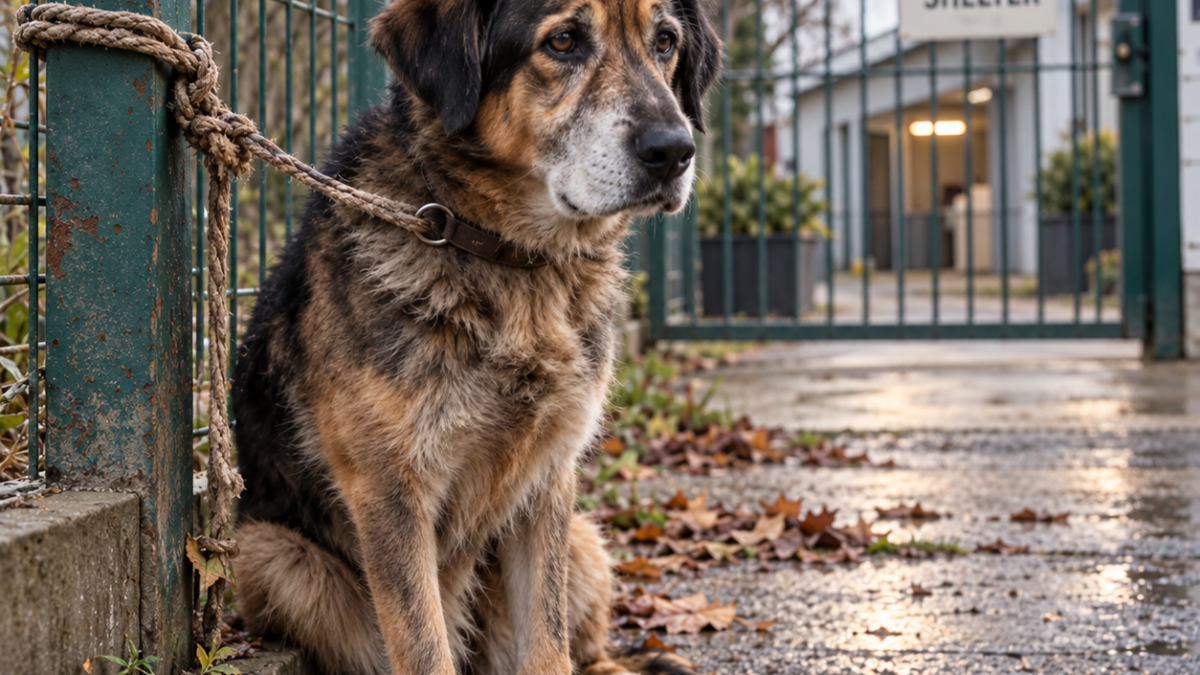
The old dog had been tied to our shelter fence sometime before dawn, and when I found him, he was still staring down the empty road as if the people who abandoned him might turn around at any second.
He didn’t bark when I approached, didn’t struggle against the frayed rope around his collar—he simply lowered his head, like a dog who had already learned that making himself invisible was sometimes safer than asking a human to stay.
But when he finally rested his head on my knee, I had no idea that the people who left him there had made one mistake that would eventually bring the truth right back to our gate.
My name is Megan Turner, and I had been opening the shelter every morning for nearly seven years.
That Tuesday began like hundreds before it.
Cold coffee in one hand.
Keys in the other.
Dogs barking from the indoor kennels as soon as they heard my car pull into the gravel lot.
I was halfway to the entrance when something beside the fence caught my eye.
At first, I thought someone had left a bag.
Then the bag moved.
I stopped.
A small dog sat pressed against the metal bars near the far corner of the property.
He was tan and gray around the muzzle, with floppy ears and the tired posture of an animal much older than he should have looked.
A faded brown collar circled his neck.
A short piece of rope ran from it to the fence.
“Hey, buddy.”
His eyes lifted.
That was all.
No bark.
No tail wag.
No attempt to come toward me.
He just looked past my shoulder.
Toward the road.
I followed his gaze.
Nothing.
No car.
No person.
No note taped to the fence.
No food.
No water.
Just an old dog waiting.
I set my coffee down.
“How long have you been here?”
He turned his head toward the road again.
That hurt more than if he had cried.
I crouched several feet away.
He pulled back immediately.
Not violently.
Just enough to put the fence against his spine.
“All right.”
I lowered my hand.
“You don’t know me.”
His body relaxed by maybe half an inch.
So I sat there.
The morning was cold enough that I could see my breath.
The dog’s paws were damp from dew.
The rope beside him was muddy, and the fur around his neck was flattened where the collar had rubbed for a long time.
I talked to him quietly.
Nothing important.
My name.
The weather.
The fact that breakfast was waiting inside.
Mostly I wanted him to hear a human voice that wasn’t demanding anything.
Five minutes passed.
Then ten.
Finally he stood.
Slowly.
His joints were stiff.
He took one step toward me.
Stopped.
Another.
Then he leaned forward and placed his head against my knee.
I froze.
His eyes closed.
I rested my hand lightly against his cheek.
“You’re okay.”
His body shivered.
That was when I noticed the scars.
A thin one near his shoulder.
Another beneath his ear.
Old marks.
He had lived a life before that fence.
I just didn’t know what kind.
By the time my coworker Rachel arrived, I had untied him.
She stopped beside us.
“Another abandonment?”
“Looks like it.”
“Any note?”
“No.”
“Chip?”
“Not checked yet.”
The dog heard a truck on the highway.
His head snapped up.
He stood so fast that his back legs nearly slipped.
He stared toward the entrance.
The truck passed.
His tail lowered again.
Rachel looked at me.
“Oh, no.”
“He thinks they’re coming back.”
We brought him inside.
He walked reluctantly, turning around three separate times to look through the gate.
The veterinarian estimated his age at ten, maybe eleven.
Arthritis.
Bad teeth.
An old untreated ear infection.
Several healed injuries.
Nothing immediately life-threatening.
But when we placed him in a quiet kennel with blankets and food, he didn’t touch the bowl.
He sat facing the door.
Waiting.
Every time footsteps approached, he stood.
Every time a car entered the lot, his ears rose.
Every time someone walked away, he slowly lowered himself back onto the blanket.
We named him Bruno.
Not because we knew his real name.
Because every animal deserved to be called something while someone tried to figure out who they had been before becoming a shelter number.
That night, I stayed late.
Bruno was still awake.
I sat outside his kennel.
“You know they’re not coming tonight, right?”
His eyes remained on the front hallway.
I opened the kennel and sat beside him.
After a long time, he rested his chin on my leg.
I scratched beneath his collar.
And that was when my fingers touched something the morning exam had missed.
Something small.
Hard.
Wedged deep between the worn leather and the buckle.
I pulled it free.
A tiny metal tag.
Almost completely scratched blank.
Almost.
Under the light, one thing was still readable.
A phone number.
And when I searched it, my stomach dropped.
Because Bruno hadn’t simply been abandoned by strangers.
Someone knew exactly who he was.
PART 2
I stared at the number for several seconds.
Bruno stayed beside me, his head heavy against my thigh.
There are moments in shelter work when you feel two completely opposite emotions at once.
Hope was the first.
If the number still belonged to someone connected to Bruno, we might finally know his name, his medical history, where he had lived, whether there had been some terrible misunderstanding.
Anger came second.
Because if the number belonged to the person who had tied him to our fence, then someone had known exactly what they were doing.
I photographed the tag before touching my phone.
Shelter policy mattered.
Documentation mattered.
Everything mattered when abandonment could become an investigation.
Then I typed the number into our database.
Nothing.
I searched our intake records.
Still nothing.
Rachel came back through the hallway carrying a stack of clean towels.
“You’re still here?”
“Look.”
I handed her the tag.
She squinted.
“Phone number?”
“Yeah.”
“Call it.”
“I was thinking the same thing.”
“Speaker.”
I dialed.
One ring.
Two.
Three.
A man answered.
“Hello?”
I straightened.
“Hi. My name is Megan. I’m calling from Westbrook County Animal Shelter.”
Silence.
Not confusion.
Silence.
“Hello?”
“Yeah.”
“We found an older male dog tied outside our gate this morning. Tan coat, gray muzzle, brown leather collar. There was a tag under the collar with this number.”
Another pause.
Then the man said, “Wrong number.”
The line went dead.
Rachel and I looked at each other.
“That was not a wrong number,” she said.
“No.”
I called again.
Straight to voicemail.
I sent one text.
**This is Westbrook County Animal Shelter. We are trying to identify an elderly dog found tied outside our facility. Please contact us.**
No response.
I took screenshots.
Rachel folded her arms.
“You heard his voice.”
“I heard a man say wrong number.”
“You know what I mean.”
“I do.”
Bruno lifted his head when my phone made a sound.
Another car had entered the lot outside.
He struggled to stand.
I watched him.
Then looked at the tag.
“Tomorrow we check the cameras.”
Our shelter had three exterior security cameras.
One covered the front entrance.
One faced the employee parking area.
The third pointed toward the driveway and most of the fence line.
The problem was distance.
Bruno had been tied near the far corner, partly hidden by a large maple tree.
Still, somebody had arrived in a vehicle.
Vehicles leave patterns.
Headlights.
Times.
Shapes.
Maybe plates.
The next morning, Rachel and I arrived before six.
Bruno was asleep when I walked into the kennel room.
That was progress.
He lifted his head.
I opened his kennel.
“Morning.”
His tail moved once against the blanket.
One small thump.
“Okay. I’ll take that.”
He stood.
Slowly.
I clipped on a leash and took him into the yard before breakfast.
The morning air was cold.
Bruno walked along the fence, sniffing.
When he reached the exact place where I had found him, he stopped.
The fur along his shoulders seemed to tighten.
He looked toward the road.
I stood beside him.
“No one’s leaving you here again.”
He turned toward me.
I don’t know whether words matter to dogs in the way we want them to.
Tone does.
Consistency does.
Behavior definitely does.
I brought him inside.
Then Rachel and I opened the previous night’s security footage.
We started at midnight.
Nothing.
12:30.
Nothing.
1:00.
A raccoon crossed the parking lot.
1:43.
A delivery truck passed on the county road.
2:15.
Nothing.
At 3:18, headlights appeared.
Rachel leaned closer.
“There.”
A dark SUV slowed before the shelter driveway.
It did not pull into the main parking lot.
Instead, it continued twenty yards down the road and stopped near the side fence.
The vehicle’s lights went off.
A person stepped out.
“Can you zoom?”
“Not enough.”
The figure looked male.
Medium height.
Heavy jacket.
Baseball cap.
He opened the rear passenger door.
For a moment nothing happened.
Then Bruno appeared.
Even from the poor video, I recognized the way he walked.
Slow.
Careful.
The man held him by the collar.
Bruno hesitated.
The man pulled.
My stomach tightened.
They reached the fence.
The man crouched.
Tied the rope.
Stood.
Bruno immediately turned toward him.
The man walked away.
Bruno tried to follow.
The rope snapped tight.
He pulled once.
Twice.
Then stopped.
The man never looked back.
He entered the SUV.
Bruno stood facing the vehicle.
The taillights appeared.
The SUV drove away.
Bruno remained standing.
Rachel covered her mouth.
Neither of us spoke for several seconds.
The footage continued.
Bruno stayed at the fence.
Twenty minutes later, he sat down.
At 4:07, rain began lightly.
He shifted closer to the metal bars.
At 4:42, a truck passed.
Bruno stood.
Waited.
Then sat again.
The cruelty was not dramatic.
That made it worse.
No beating.
No shouting.
No violent scene.
Just a man leaving an old dog beside a road and driving home.
We pulled the clearest vehicle frames.
Dark SUV.
Older model.
One rear brake light slightly dimmer than the other.
No readable license plate.
But the camera at the driveway caught the vehicle from another angle as it left.
Rachel froze the image.
A white oval sticker was visible on the lower left rear window.
Inside it, dark lettering.
We enhanced what we could.
Most of it remained blurry.
One word was readable.
**LAKE.**
“Could be a vacation sticker,” Rachel said.
“Could be anything.”
I called Animal Control Officer Daniel Ruiz.
Daniel had handled several abandonment cases with us.
He arrived shortly after eight.
We showed him everything.
The tag.
The calls.
The text.
The footage.
Daniel watched the video twice.
When it ended, he leaned back.
“Save the original file. Don’t export over it.”
“Already copied.”
“Good.”
He photographed the tag.
“What number?”
I gave it to him.
“Registered owner?”
“Not publicly.”
“I’ll run what I can.”
He looked toward the kennel hall.
“How’s the dog?”
“Medically stable.”
“Behavior?”
“Waiting.”
Daniel understood immediately.
He hated abandonment cases.
Not loudly.
Daniel rarely did anything loudly.
But you could see it in his face.
“Any chip?”
“No.”
“Name?”
“We’re calling him Bruno.”
He nodded.
“I’ll see what we can get from the number.”
That afternoon, Bruno ate half his meal.
Only after I sat beside him.
If I stood, he stopped.
If I walked toward the door, his head came up.
So I started eating lunch in his kennel.
Turkey sandwich for me.
Prescription senior food for him.
“Very glamorous,” I told him.
He looked at my sandwich.
“You can’t have this.”
His eyes remained fixed.
“Fine.”
I tore off a tiny piece of plain turkey.
His tail thumped.
“Manipulative.”
By Friday, Daniel called.
“The number belongs to a prepaid account.”
My heart sank.
“But,” he continued, “it has been associated with several online classified listings.”
“What kind?”
“Dogs.”
I stopped.
“Breeder?”
“Not exactly.”
He emailed me screenshots.
A man named Travis Cole had posted multiple dogs for sale over the previous two years.
Adult dogs.
Puppies.
Mixed breeds.
Some listings called them “rehoming.”
Others listed prices.
Several photos showed the same backyard.
Chain-link run.
Blue plastic children’s pool.
Old red shed.
Then I saw Bruno.
Not immediately.
He was younger in the image.
Less gray.
He stood near the shed beside two other dogs.
The listing was eighteen months old.
**Small mixed-breed male. Great watchdog. Knows property. Not house pet.**
My jaw tightened.
Below the post was the same number from Bruno’s collar.
Rachel read over my shoulder.
“That’s him.”
“Yes.”
“So Travis Cole owned him.”
“At least eighteen months ago.”
Daniel had more.
Property records placed a Travis Cole six miles outside town.
The residence had an older black SUV registered there.
Model and general shape matched the shelter footage.
I wanted to drive there.
Of course I did.
Daniel knew that before I said anything.
“Do not go to his house.”
“I didn’t say I would.”
“You have the tone.”
“What tone?”
“The tone people use before doing exactly what I’m telling them not to do.”
“I just want to ask him why.”
“No.”
“Daniel—”
“If this becomes a charge, you are a witness. Stay a witness.”
I looked at Bruno through the office window.
He had fallen asleep in a bed Rachel placed near the front desk.
“Then ask him.”
“I will.”
We did not hear anything for two days.
Those two days changed Bruno more than I expected.
A young volunteer named Eli discovered that Bruno liked scrambled eggs.
Rachel discovered that he hated squeaky toys.
I discovered that he had probably once been trained to shake hands.
I held out my palm jokingly.
“Shake?”
Bruno stared.
Then slowly placed one paw in my hand.
I looked at Rachel.
“Did you see that?”
“Again.”
“Shake.”
Paw.
Rachel smiled.
“Well, somebody taught him something once.”
That hurt too.
People like to imagine abandonment belongs only to animals who were never loved.
It doesn’t.
Sometimes somebody teaches a dog to sit.
Feeds him.
Names him.
Lets him sleep near the porch.
Then years pass.
The dog gets slower.
Medical bills appear.
Life changes.
And the person who once taught him “shake” decides the relationship has expired.
Bruno knew “sit.”
“Wait.”
“Outside.”
“Bed.”
And one word that nearly broke me.
I discovered it accidentally.
A volunteer opened the kennel door and said, “Come on, buddy. Time to go home.”
The second she said **home**, Bruno jumped up.
Not slowly.
Not painfully.
Instantly.
He pulled toward the shelter entrance.
He searched every person in the lobby.
His tail moved fast.
For the first time, he looked young.
The volunteer realized what had happened.
“Oh, God.”
I crouched beside him.
“Bruno.”
He looked at me.
Then at the door.
I put both hands against his cheeks.
“Not yet.”
His tail stopped.
That night I cried in my car.
I had been doing shelter work long enough to know you cannot carry every story home.
If you do, the work will eat you alive.
But Bruno had gotten under something.
Maybe because of the way he waited.
Maybe because he never seemed angry.
He had every reason to distrust people.
Instead, he kept expecting the next one to be the person who came back.
Daniel visited the following morning.
His expression told me he had news.
“You talked to Cole?”
“Yes.”
“And?”
“He admits Bruno was his dog.”
Rachel stopped sorting medication behind the desk.
“He admits it?”
“Yes.”
“Then why did he tell me wrong number?”
Daniel looked at me.
“He says he panicked.”
“About what?”
“He claims he gave the dog to another man several weeks ago.”
“What man?”
“He won’t give a full name.”
“How convenient.”
“He says the man’s first name is Kevin.”
“Last name?”
“Doesn’t know.”
“You give a ten-year-old dog to someone whose last name you don’t know?”
Daniel spread his hands.
“That’s his statement.”
“What about the SUV?”
“He owns one matching the footage.”
“So arrest him.”
“Megan.”
“I know. Evidence.”
“Yes.”
“Can you prove he was driving?”
“Not yet.”
“Can you prove Bruno never went to Kevin?”
“Not yet.”
I hated those words.
Not yet.
Daniel continued.
“Cole made another mistake, though.”
“What?”
“He said Bruno had been gone for three weeks.”
“So?”
I pulled the tag photograph onto my computer.
Daniel pointed.
“The phone number on the tag. That prepaid number was activated nine days before Bruno was found.”
I stared at him.
Rachel stopped moving.
“Wait.”
I looked again.
“If Bruno had been gone three weeks…”
“He could not have been wearing a tag with a number that didn’t exist until nine days ago.”
Daniel nodded.
“So someone put that tag on him after Cole claims he gave him away.”
“Exactly.”
“Could Kevin have done that?”
“Possible.”
“But the number belongs to Cole.”
“Associated with him, yes.”
I smiled without humor.
“He’s lying.”
“He has provided a statement contradicted by objective evidence.”
Daniel was very good at sounding like a report.
“You mean lying.”
“I mean what I said.”
The investigation continued.
Meanwhile, Bruno became a shelter favorite.
Not because he performed.
He didn’t.
He wasn’t the kind of dog visitors rushed toward.
Young dogs bounced against kennel doors.
Puppies tumbled over one another.
Beautiful shepherds stood tall and alert.
Bruno mostly sat.
He watched.
People passed him.
Some smiled.
Some said, “Aw, poor old guy.”
Then moved on.
That is the brutal thing about senior dogs in shelters.
Everyone feels sorry for them.
Far fewer people choose them.
A week passed.
Then two.
Bruno learned our routine.
Breakfast at seven.
Medication at eight.
Yard time.
Nap.
Lunch.
Another walk.
He stopped jumping up every time a vehicle entered.
But certain engines still did it.
Dark SUVs were the worst.
If one pulled into the lot, he went immediately to the gate.
Each time, I followed.
Each time, the driver was someone else.
Each time, Bruno came back with me.
One afternoon, I found him standing in front of the shelter door after a family left.
He stared through the glass.
“They weren’t yours.”
He looked at me.
“You’re going to get one.”
Tail thump.
“I promise.”
That was a dangerous promise.
Senior dogs can wait months.
Some wait longer.
Then, on a rainy Saturday afternoon, a woman named Linda Barrett walked in.
She was fifty-nine.
Gray beginning at her temples.
Blue raincoat.
Tired eyes.
She stood at the front desk holding a printed page from our adoption website.
“I’m here to see Rosie.”
Rosie was a two-year-old spaniel mix.
Friendly.
Young.
Photogenic.
Exactly the kind of dog people came asking for.
“Absolutely.”
I took Linda through the kennel room.
As we passed Bruno, she slowed.
He was curled on his bed.
She stopped completely.
“What’s his story?”
I had heard that question a hundred times.
“His name is Bruno.”
“How old?”
“About ten.”
She looked at him.
Bruno lifted his head.
“That’s old for adoption, isn’t it?”
“It can be harder.”
“What happened?”
I hesitated.
There was an active investigation, so I kept it simple.
“He was left tied outside our fence.”
Linda’s face changed.
“By his owner?”
“We believe he had an owner before.”
“How long did he wait?”
“Outside?”
“Yes.”
“Several hours.”
“No.”
She looked at me.
“How long has he been waiting here?”
“Three weeks.”
Linda stood quietly.
Bruno watched her.
She crouched.
He did not come forward.
“Can I meet him?”
“You came for Rosie.”
“I know.”
“Rosie is wonderful.”
“I’m sure she is.”
Linda kept looking at Bruno.
“But can I meet him too?”
We took him into the quiet meeting room.
Bruno entered slowly.
Linda sat on the floor.
She did not call him.
Did not slap her knees.
Did not say, “Come here, boy,” over and over.
She simply waited.
I noticed immediately.
So did Bruno.
He walked along the wall.
Sniffed the table.
Checked the door.
Then approached her from the side.
Linda held her hand low.
Bruno sniffed.
He stepped back.
She didn’t chase him.
After several minutes, he returned.
This time he sat beside her.
Linda looked at me.
“Does he like being petted?”
“Usually under the chin.”
She tried.
Bruno closed his eyes.
Ten minutes later, he put his head on her knee.
The exact thing he had done with me beside the fence.
Linda’s eyes filled.
“Oh.”
Just that.
Oh.
She stroked the gray fur on his face.
“What kind of life did you have, old man?”
Bruno sighed.
Linda stayed nearly an hour.
Then she stood.
“I need to think.”
My heart sank, though I didn’t show it.
“Of course.”
“I don’t adopt impulsively.”
“That’s good.”
“I have another dog.”
“What kind?”
“Fourteen-year-old beagle. Molly.”
“Senior.”
“Yes.”
“Bruno has arthritis.”
“So does Molly.”
“He needs dental work.”
Linda nodded.
“Molly has three teeth.”
I smiled.
“Bruno may have more after his procedure.”
“Show-off.”
She left.
Bruno watched the door.
I sat beside him.
“Don’t start.”
He looked at me.
“She said she needs to think.”
Tail thump.
“She may not come back.”
The words tasted wrong.
I had become trained not to promise.
Bruno had heard enough promises.
The next morning, Linda returned.
She brought veterinary records.
Photos of her house.
A letter from her landlord even though she owned the house outright because she had misunderstood our checklist and decided to be thorough.
And Molly.
Molly was an ancient beagle with white eyelashes and the personality of a retired judge.
The introduction was uneventful.
Which was perfect.
They sniffed.
Molly ignored Bruno.
Bruno followed her.
Molly turned and stared at him.
Bruno stopped.
Linda laughed.
“She has rules.”
“Apparently.”
They walked together.
No tension.
No excitement.
Just two old dogs moving at the same speed.
Inside the meeting room, Linda sat across from me.
“I lost my husband last year.”
“I’m sorry.”
“We had Molly together thirteen years.”
She looked through the glass at Bruno.
“After David died, everybody kept telling me I should get a puppy.”
I waited.
“I don’t want a puppy.”
“Okay.”
“I don’t want twelve or fourteen years promised to me like life works that way.”
Her voice tightened.
“David was supposed to have more years too.”
I said nothing.
Linda took a breath.
“I think old dogs make sense to me now.”
She smiled faintly.
“You love them knowing time is already visible.”
I looked at Bruno.
“You still want him?”
“Yes.”
There was no hesitation.
“Yes, I do.”
Adoption could not happen immediately.
Bruno still needed dental treatment.
And because of the abandonment investigation, Daniel needed to confirm that the protective hold could be released.
Linda didn’t complain.
“I’ll wait.”
The word made me look at her.
Bruno had been waiting for weeks.
Now someone was willing to wait for him.
She visited every day.
Sometimes twenty minutes.
Sometimes two hours.
She brought Molly.
The old dogs developed a strange friendship.
Molly claimed every bed first.
Bruno accepted whatever remained.
One afternoon, Linda sat beside me outside.
“Does he still watch the road?”
“Less.”
“Does he miss them?”
I thought carefully.
“I think he remembers a routine that disappeared.”
“That’s not the same as missing.”
“No.”
“Maybe that’s what grief is sometimes.”
I looked at her.
She was watching Molly asleep in the sun.
“Maybe.”
Daniel called that evening.
“You can finalize the adoption once his medical clearance is done.”
“What changed?”
“Cole withdrew his ownership claim.”
I sat up.
“He what?”
“He says he doesn’t want the dog.”
The anger came instantly.
“He didn’t want him when he tied him outside either.”
“We are still pursuing the abandonment complaint.”
“Why withdraw now?”
Daniel was silent for a second.
“Because we got better video.”
My heart kicked.
“What video?”
A county transportation camera sat at an intersection about half a mile from our shelter.
Daniel had requested footage from the night Bruno was abandoned.
The dark SUV appeared at 3:12 a.m.
The camera angle caught the front license plate.
Travis Cole.
“That’s enough?”
“Enough to establish the vehicle.”
“What about driver?”
“Not by itself.”
“But?”
“Neighbor’s doorbell camera.”
“What neighbor?”
“His.”
I smiled slowly.
Daniel continued.
“Camera across the street recorded Cole leaving his driveway at 2:49 a.m. with Bruno visible in the rear seat.”
I stood.
“Seriously?”
“And returning at 3:41 a.m. without him.”
That was it.
Not perfect courtroom cinema.
Better.
A timeline.
His own vehicle.
His dog.
Leaving home together.
Returning without Bruno.
And the shelter video in between.
“He still says Kevin?”
“No.”
“What does he say now?”
“That he intended to surrender Bruno but believed the shelter was closed and didn’t want to wait.”
I laughed.
“By tying him outside at three in the morning?”
“He claims he planned to call later.”
“He told me wrong number.”
“I know.”
“He left no note.”
“I know.”
“No medical records.”
“I know.”
“No water.”
Daniel’s voice softened.
“Megan, I know.”
I sat again.
“What happens?”
“Citation and charges will be submitted based on the evidence and local abandonment statutes. The prosecutor decides final disposition.”
I wanted something bigger.
I wanted him to understand.
To feel Bruno waiting in cold dew while every passing engine sounded like hope.
The justice system doesn’t work like emotion.
Neither should it.
Evidence.
Procedure.
Consequences.
That had to be enough.
Bruno’s dental surgery happened the following Tuesday.
Eight teeth came out.
When he woke from anesthesia, he was confused.
I sat beside him.
His tongue hung sideways.
“You look ridiculous.”
His eyes opened.
Tail thump.
Linda arrived thirty minutes later.
Bruno smelled her before he fully saw her.
He tried to stand.
“Easy,” she whispered.
She knelt beside him.
“I’m here.”
Those two words mattered.
I’m here.
Not I’ll come back.
Not maybe tomorrow.
I’m here.
Three days later, adoption day arrived.
We took the usual photograph.
Linda beside Bruno.
Molly sitting in front looking annoyed.
Bruno wore a blue bandana.
I hated adoption photos with giant signs, so we kept it simple.
Then came the leash transfer.
That part always got me.
I removed our shelter slip lead.
Linda clipped on his new collar and leash.
A dark green collar with a brass tag.
**BRUNO BARRETT**
Underneath:
**HOME.**
I read it twice.
“You put ‘home’ on his tag?”
Linda nodded.
“In case he forgets.”
I turned away.
“Megan?”
“Something in my eye.”
“Inside?”
“Very aggressive shelter dust.”
Linda hugged me.
Then Bruno did something I will remember forever.
He walked toward the front door.
Stopped.
Turned around.
Came back to me.
He pressed his forehead against my leg.
I crouched.
“You’re supposed to leave.”
His tail moved.
“You’re really terrible at abandonment.”
Linda laughed through tears.
I held his face.
“Listen to me, old man.”
His eyes stayed on mine.
“This is the car you want to get into.”
I pointed toward Linda.
“She’s the one.”
Bruno turned.
Linda waited.
He walked to her.
Outside, Molly climbed into the back seat first.
Bruno hesitated at the car door.
His entire body became still.
I realized.
The last vehicle ride he remembered may have ended at our fence.
Linda realized too.
She did not pull.
She opened the rear door wider.
Then sat sideways on the seat.
“You can take your time.”
Bruno sniffed the doorway.
Looked at me.
Looked at Linda.
Molly sighed from inside as if the entire process bored her.
Then Bruno placed one paw on the floorboard.
Another.
And climbed in.
Linda closed the door gently.
Bruno stood with his face near the window.
For a split second, panic hit me.
Would he think he was being taken away again?
Then Molly lay down.
Bruno looked at her.
And slowly, he lay beside her.
Linda drove away.
I stood in the parking lot until the car disappeared.
Rachel came outside.
“You okay?”
“No.”
“Good adoption?”
“The best ones hurt.”
She put an arm around me.
“That means you did it right.”
Linda sent a photo twenty-seven minutes later.
Bruno standing in her front doorway.
He would not enter.
He remained with all four paws on the porch.
The open door was inches away.
Linda sat inside on the floor.
Molly was already in her bed.
The message said:
**He doesn’t seem to believe he’s allowed inside. I’m waiting.**
An hour later, another photo.
One front paw across the threshold.
Then:
**Progress.**
Then another.
Bruno inside.
Standing on the rug.
Then:
**We made it.**
I cried again.
Apparently I had become useless.
That first week was difficult.
Linda reported everything honestly.
Bruno paced at night.
If she left the room, he followed.
If she closed the bathroom door, he scratched at it.
He would not sleep deeply.
Car engines outside made him run to the window.
He refused the dog bed.
Instead, he slept beside the front door.
Waiting.
Even in a home, part of him remained beside our fence.
Linda never punished him.
She put a blanket near the door.
Three nights later, she moved the blanket six inches closer to the living room.
Then six inches more.
Over two weeks, the blanket traveled across the floor.
Eventually it reached beside the couch.
Bruno followed.
One night Linda fell asleep watching television.
When she woke, Bruno’s head was on her foot.
He had left the door.
That photograph is still one of my favorites.
Then something happened that threatened all of it.
Travis Cole came to the shelter.
It was five weeks after Bruno’s adoption.
I was at the front desk.
A man entered wearing work boots, jeans, and a faded baseball cap.
I recognized him from the investigation photo.
My body went cold.
“Can I help you?”
“You Megan?”
“Yes.”
“Where’s my dog?”
I stared.
“Bruno was legally released for adoption after your ownership claim was withdrawn.”
His jaw tightened.
“I didn’t withdraw anything.”
“Yes, you did.”
“My lawyer told me the county said I had to.”
“That is between you and the county.”
“I want the dog back.”
“No.”
His face changed.
I pressed the silent alert beneath the counter.
Rachel saw me from the hallway.
She disappeared toward the office.
Cole stepped closer.
“He’s my property.”
“He has been legally adopted.”
“I had him ten years.”
The sentence made something inside me snap.
I kept my voice level.
“Then you had ten years to walk through that door with him instead of tying him to a fence at three in the morning.”
His eyes hardened.
“You don’t know what happened.”
“I watched what happened.”
“You people think you’re heroes.”
“No.”
“You took a dog I paid for.”
“You left him.”
“I couldn’t afford his teeth. His joints. All that old-dog crap.”
There it was.
Not an accident.
Not Kevin.
Not confusion.
Expense.
Old dog crap.
Cole continued.
“I figured you people would deal with it.”
“Then why didn’t you surrender him during business hours?”
“Because you’d ask questions.”
Exactly.
He realized too late.
The front door opened behind him.
Officer Daniel Ruiz entered.
Cole turned.
Daniel’s expression was almost bored.
“Travis.”
“This is ridiculous.”
“Come outside.”
“I’m just trying to get my dog.”
“He isn’t your dog.”
“He was.”
Daniel looked at me.
“You okay?”
“Yes.”
Cole pointed at me.
“She stole him.”
Daniel’s voice changed.
“No. You abandoned him.”
Cole swore.
Then walked outside.
He wasn’t arrested in some dramatic scene.
There were no handcuffs in our lobby.
No shouting crowd.
Daniel spoke to him beside the patrol vehicle.
Cole left.
The important thing was that he never reached Bruno.
But Linda needed to know.
I called her immediately.
Her voice went silent when I explained.
“Can he take Bruno?”
“No.”
“Are you certain?”
“Yes. Your adoption is legal.”
“Megan.”
“Yes?”
“I need you to be certain.”
I understood.
“I am.”
She exhaled.
Bruno barked somewhere behind her.
“What’s he doing?”
“Standing in the kitchen because I opened cheese.”
I laughed.
“Sounds traumatic.”
“I’ve created a monster.”
“Good.”
A month later, Daniel told me Cole had entered a plea related to the abandonment charge and associated violations.
He received fines.
Probationary conditions.
And requirements imposed by the court concerning animal ownership and future compliance.
Was it enough?
Emotionally?
No.
Legally?
It was accountability.
But life gave me something better than watching Travis Cole pay a fine.
Linda sent photographs.
Bruno asleep on the couch.
Bruno at a lake.
Bruno wearing a raincoat he clearly hated.
Bruno sharing Molly’s bed despite there being another empty bed two feet away.
Bruno discovering snow.
Bruno stealing toast.
Bruno at the veterinarian with significantly improved health.
His arthritis was controlled.
His mouth healed.
He gained three healthy pounds.
His coat became softer.
His eyes changed most.
That tired, fixed stare disappeared.
He stopped looking past every person toward a road.
He started looking at the person in front of him.
Eight months after adoption, Linda brought him back to visit.
The second I heard her car, I ran outside.
Bruno stepped out.
He looked younger.
Not puppy-young.
Loved-young.
There is a difference.
He saw me.
His tail began moving.
Then he trotted.
Actually trotted.
“Bruno!”
He reached me and pressed into my legs.
I knelt.
“You traitor. You could’ve moved like this when you lived here?”
Linda smiled.
“He saves energy for dramatic moments.”
Molly climbed out slowly behind him.
We took them into the shelter yard.
Bruno sniffed everything.
The fence.
The tree.
The grass.
Then he reached the section where I had found him.
He stopped.
I watched his body.
No panic.
No pulling.
Just stillness.
Linda came beside us.
“Do you think he remembers?”
“Yes.”
“How much?”
“I don’t know.”
Bruno looked down the road.
A black SUV passed.
His ears lifted.
For one second, my heart tightened.
Then Bruno turned away.
He walked toward Linda.
Not toward the road.
Toward Linda.
She smiled.
“Ready?”
Bruno wagged.
They left together.
That was the first time I understood revenge differently.
Travis Cole had left Bruno at our fence because Bruno had become expensive.
Slow.
Old.
Inconvenient.
Cole had reduced ten years of companionship to dental bills and arthritis medication.
Bruno’s revenge was becoming priceless to someone else.
Not because Linda needed him to be useful.
He wasn’t.
He didn’t guard the house well.
He slept through deliveries.
He moved slowly.
He occasionally had accidents.
He needed medication twice a day.
His vet bills continued.
He cost money.
Linda loved him anyway.
That was the point.
A year after Bruno went home, Molly died.
She was fifteen.
Linda called me crying.
“She went in her sleep.”
“I’m sorry.”
“Bruno won’t leave her bed.”
My heart broke for both of them.
For several days Bruno searched.
He checked rooms.
Waited near the hallway.
Sniffed Molly’s blanket.
The same dog who had once been abandoned now had to learn another kind of leaving.
But death is not abandonment.
Love stayed.
Linda kept Molly’s old bed near the fireplace.
Bruno slept in it for months.
Sometimes grief needs a place.
He became Linda’s shadow afterward.
He followed her into the garden.
Lay beside her when she read.
Waited outside the bathroom.
Sat beside her at breakfast.
One evening she sent me a message:
**He used to wait for someone who left him. Now he waits for me because he knows I’m coming back.**
I saved that message.
Two years passed.
Bruno turned gray almost completely around the face.
We celebrated what Linda called his “second birthday”—the anniversary of the day she adopted him.
He got a plain hamburger patty and a ridiculous blue hat.
The hat lasted seven seconds.
The hamburger lasted three.
At the party Linda told me something I had never known.
“When I first walked into the shelter, I wasn’t actually sure I wanted another dog.”
“You came for Rosie.”
“I printed Rosie’s page because I thought I was supposed to want the youngest, easiest dog.”
“And then?”
“I saw Bruno.”
She looked at him asleep beneath the table.
“He looked like David did near the end.”
I waited.
“Not physically.”
Her eyes filled.
“The waiting.”
I understood without asking.
“When my husband was sick, everyone became uncomfortable around him. Friends stopped visiting because they didn’t know what to say. David noticed.”
She stroked Bruno’s ear.
“I promised myself after David died that I would stop walking past things just because they were painful to look at.”
That was why she had stopped at Bruno’s kennel.
Not pity.
Recognition.
Bruno woke.
He placed his head on her foot.
Linda smiled.
“I thought I was taking home a dog nobody wanted.”
She looked at me.
“Turns out I needed him too.”
The third year brought more arthritis.
A heart murmur.
Cloudy eyes.
A thyroid medication added to his routine.
Linda never complained.
Not once.
One afternoon, Travis Cole’s name appeared in the local paper again.
Not because of Bruno.
Because county investigators had responded to another animal complaint involving his property.
This time, because of the prior case, scrutiny came quickly.
Two dogs were found without adequate shelter during extreme heat.
Authorities intervened.
Cole faced new restrictions.
When I told Daniel I had seen the article, he simply said:
“Patterns matter.”
That was the justice Bruno never needed to understand.
His case had created a record.
The next complaint wasn’t treated as an isolated misunderstanding.
Evidence accumulated.
Consequences became harder to avoid.
People sometimes imagine justice as one giant dramatic event.
Often it is paperwork.
A photograph stored correctly.
A report filed.
A number copied.
A video preserved.
One person refusing to say, “It’s probably nothing.”
Bruno’s scratched metal tag had mattered.
The camera had mattered.
The call record had mattered.
The shelter intake had mattered.
And years later, another dog may have benefited because Bruno’s abandonment had not been ignored.
That satisfied me more than anger ever did.
Four years after Bruno’s adoption, Linda called me late one afternoon.
Her voice was different.
I knew before she said it.
“It’s time.”
I sat down.
Bruno had stopped eating.
His heart disease had progressed.
He struggled to stand.
The veterinarian had adjusted medication.
Nothing was enough anymore.
“Do you want me there?”
“Yes.”
No hesitation.
I drove to Linda’s house.
The first thing I noticed was the front door.
Open.
Not because Bruno could leave.
Because it was a warm spring afternoon and sunlight spilled across the floor.
Bruno lay on a thick bed in the living room.
The same dog who once refused to cross that threshold.
He was almost fourteen now, maybe older.
His face was white.
His body thin.
But when I entered, his eyes opened.
“Megan,” Linda whispered.
His tail moved.
Once.
Then again.
I knelt.
“Hey, old man.”
He tried to lift his head.
“Don’t.”
I placed my hand under his chin.
“You already did enough.”
Linda sat beside him.
On a table were photographs.
Bruno at the lake.
Bruno beside Molly.
Bruno sleeping upside down.
Bruno with Linda.
Bruno in the stupid blue hat.
Four years.
Not enough.
Never enough.
But four years he had almost not received.
The veterinarian came to the house.
Linda wanted him home.
Home.
That word.
Bruno lay with his head in her lap.
I sat near his back.
“You remember the shelter?” I whispered.
Linda smiled through tears.
“He better not prefer you.”
“He absolutely prefers me.”
Bruno sighed.
Traitor to both of us.
The vet explained everything softly.
Linda nodded.
Before the final medication, she leaned close to Bruno’s ear.
“You don’t have to wait for me this time.”
I looked down.
She kissed his forehead.
“You can go first.”
Bruno’s eyes closed.
Linda kept talking.
“You were never too old.”
Her voice broke.
“Never too expensive.”
I covered my mouth.
“Never too much.”
Bruno’s breathing slowed.
“You were mine.”
Pause.
“And I was yours.”
His tail moved once against the blanket.
Then stopped.
The room became very quiet.
I had seen animals die before.
Too many.
This one was different.
Maybe because I remembered how I found him.
Cold fence.
Short rope.
Head turned toward the road.
Waiting for someone who had left.
And now, at the end, he wasn’t looking toward any door.
He wasn’t alone.
Two people had hands on him.
He was lying in the center of a home.
His home.
Linda cried into his fur.
I sat with her.
No rush.
No empty comfort.
Some grief should be allowed to occupy the whole room.
Later, I walked outside.
His green collar sat on the table.
The brass tag still read:
**BRUNO BARRETT**
**HOME.**
Linda kept it.
A week later, she came to the shelter.
I expected her to return blankets or donate food.
Instead, she gave us an envelope.
Inside was a check.
A large one.
“Megan.”
I stared at the amount.
“I can’t take this.”
“Yes, you can.”
“What is it for?”
“Senior dogs.”
I looked up.
“Dental work. Medication. Adoption fees. Whatever stops someone from being passed over because they’re expensive.”
“Linda…”
“Call it Bruno’s Fund.”
I started crying.
She smiled sadly.
“He was always costly.”
I laughed through tears.
“Very.”
Bruno’s Fund started small.
Then Linda’s friends donated.
Then shelter supporters.
Then one local veterinarian offered discounted senior bloodwork.
A pharmacy partnered on certain medications.
A pet store ran a fundraiser.
Within two years, dozens of older dogs had received dental procedures, arthritis treatment, diagnostic work and waived adoption fees through a fund named after a dog somebody once abandoned because he cost too much.
That was revenge.
Not cruelty returned for cruelty.
Transformation.
Someone looked at Bruno and saw bills.
Those bills became the reason other senior dogs received care.
Someone tied him outside because he was inconvenient.
His name became the reason people walked deeper into our kennel room instead of stopping at the puppies.
His story began with being discarded.
It ended up helping dogs nobody had even met yet.
A photograph of Bruno hangs near our front desk now.
Not the one from the morning I found him.
I didn’t want that to define him.
The photograph Linda chose shows Bruno standing in her yard in autumn.
Orange leaves around his paws.
Gray face.
Green collar.
Mouth open slightly.
Happy.
Underneath is a small plaque:
**BRUNO’S FUND — FOR THE ONES WHO STILL HAVE LIFE LEFT TO LIVE.**
I read it almost every morning.
Years have passed since that cold Tuesday.
I still open the shelter early.
Still carry coffee.
Still hear dogs start barking before my key reaches the door.
Sometimes something appears beside the fence.
A box of kittens.
An abandoned rabbit.
Once, heartbreakingly, another old dog.
Every time, I remember Bruno.
And every time someone asks me why a ten-year-old dog should receive expensive dental work or diagnostic tests when there are younger animals waiting, I think about Linda.
Four years.
Bruno got four years.
Four summers.
Four Christmases.
Four adoption anniversaries.
Four years of sleeping somewhere warm.
Four years of watching Linda cook.
Four years of walking beside Molly.
Four years of learning that car rides could end at lakes and parks instead of fences.
Four years of knowing what **home** meant.
Nobody gets to decide those years weren’t worth paying for.
Nobody knows how life will change next.
Bruno didn’t know.
Not while he sat against cold metal bars at three in the morning.
Not when the taillights disappeared.
Not when he waited through the dark.
Not when he heard my footsteps and pulled backward because he wasn’t sure whether another human hand would hurt.
Not when he entered his kennel and spent three weeks staring toward the door.
He couldn’t know a woman named Linda would one day walk past every younger dog and stop.
He couldn’t know she would sit on the floor without demanding anything from him.
He couldn’t know she would wait while he learned to cross a doorway.
He couldn’t know she would buy arthritis medication and cook chicken and move his blanket six inches at a time until he stopped sleeping beside the front door.
He couldn’t know she would stay until his final breath.
That’s the part of Bruno’s story I tell adopters now.
Especially when they pause beside an older animal and say:
“I don’t know how many years he has.”
Neither do I.
Nobody does.
But love is not valuable only when the timeline is long.
Sometimes one year is a whole rescue.
Sometimes four years can rewrite ten.
Sometimes the dog everyone thinks has reached the end is actually standing one doorway away from the best chapter of his life.
Bruno never got revenge on Travis Cole.
Bruno didn’t need revenge.
He got something better.
Cole had left him because he believed the old dog’s remaining years were a burden.
Linda spent those same years treating them like a gift.
Cole avoided his medical bills.
Bruno’s name eventually paid medical bills for other dogs.
Cole tried to make Bruno disappear quietly beside a shelter fence.
Years later, Bruno’s photograph became one of the first things people saw when they walked through our doors.
The man who abandoned him became a footnote in the story.
The dog he abandoned became the part everyone remembered.
That is justice I can live with.
Sometimes after closing, when the kennels are quiet, I stop beside Bruno’s photograph.
I remember his head on my knee.
His scratched tag in my fingers.
The way he jumped whenever an engine came close.
The day Linda arrived.
The way he hesitated before entering her car.
The first photograph of one paw crossing her doorway.
And his last afternoon, lying peacefully inside the home he once didn’t believe he was allowed to enter.
People say dogs live in the present.
Maybe that’s why they sometimes survive what we would spend years carrying.
Bruno didn’t spend his new life trying to understand why he had been abandoned.
Once he finally believed Linda was staying, he began living where he was.
Food bowl.
Warm rug.
Molly.
Sunlight.
Linda.
Home.
Perhaps that was his greatest victory.
Someone left him staring backward.
Love taught him to look forward.
And if I learned anything from the old dog tied to our fence that morning, it is this:
Being abandoned is something that happened to you.
It does not have to become who you are.
Bruno was not the dog tied to the fence.
Not forever.
He was the dog who learned to trot again when he saw someone he loved.
The dog who stole toast.
The dog who refused his own expensive bed and slept beside an ancient beagle.
The dog who wore a blue birthday hat for seven miserable seconds.
The dog who followed Linda around the garden.
The dog whose medical bills inspired a fund.
The dog whose name still helps senior animals walk out our front door.
And most of all, he was the dog who once waited for the wrong person to return until the right person finally arrived.
Nobody knows how life will change next.
Bruno certainly didn’t.
That cold morning, he sat beside an old metal fence with a rope tied to his collar, watching an empty road.
Four years later, he closed his eyes inside a warm house while the woman who loved him whispered that he never had to wait again.
And between those two moments was an entire life.
Not a leftover life.
Not borrowed time.
His life.
The years someone else had decided weren’t worth the trouble.
The years Linda treasured.
The years Bruno deserved.
He had spent one terrible morning waiting for someone who drove away.
In the end, he found someone who stayed.
Years have passed since that cold Tuesday morning when I first found Bruno tied to our shelter fence.
I still open the shelter early.
I still arrive with coffee in one hand and keys in the other.
I still hear the dogs start barking before the lock turns, as if they can tell the difference between my footsteps and everybody else’s.
Some things never change.
But the shelter did.
Bruno changed it.
His photograph still hangs beside the front desk.
Linda chose the picture herself.
It wasn’t the photograph we took the morning I found him.
I never wanted that image to become the one that defined him.
In the rescue photo, Bruno looked small.
His back was curved.
His gray face was turned toward the road.
A length of rope hung from his old collar.
Anyone looking at that picture would see abandonment before they saw the dog.
Linda chose something completely different.
It was taken during Bruno’s third fall with her.
He was standing beneath a maple tree in her backyard.
Orange leaves surrounded his paws.
His muzzle had gone almost completely white.
His green collar sat loosely around his neck.
His mouth was slightly open in that relaxed, almost smiling expression dogs sometimes get after a slow walk in cool weather.
He wasn’t looking behind him.
He wasn’t waiting beside a gate.
He was looking directly at Linda.
That was the Bruno she wanted people to remember.
Under the frame is a small brass plaque:
BRUNO’S FUND — FOR THE ONES WHO STILL HAVE LIFE LEFT TO LIVE.
The fund started with Linda’s check.
For the first few months, it paid for small things.
An arthritis prescription for a twelve-year-old shepherd whose owner had died.
Dental work for an elderly terrier named Lucy.
Blood tests for a senior beagle found wandering beside a highway.
Then people began hearing why the fund existed.
A local newspaper wrote a small story.
A veterinary clinic donated part of its senior-dog exam fees.
A pharmacy offered reduced prices on certain long-term medications.
One woman mailed us twenty dollars with a note that said:
My old dog Charlie gave me fourteen years. Please use this for another gray face.
A retired man brought in a jar full of coins.
Children from an elementary school collected money during an animal-care week.
One little girl handed me nine dollars and seventy cents.
She looked up at me very seriously.
“Is that enough to save an old dog?”
I crouched so we were eye level.
“It helps.”
She thought about that.
Then she dug into her pocket and added another quarter.
“What about now?”
I smiled.
“It helps even more.”
That was how Bruno kept going.
Not physically.
Bruno was gone.
I never pretended otherwise.
There are some losses we should not soften with phrases about animals living forever.
I had been with him when his breathing stopped.
Linda had held him.
We knew what death looked like.
But the consequences of his life kept spreading outward.
One winter afternoon, almost two years after Bruno died, a truck pulled into our parking lot.
A man climbed out carrying a dog wrapped in a blanket.
The dog was ancient.
A black Labrador mix with almost no black left around his face.
His name was Chester.
The man told us Chester had belonged to his father, who had recently moved into assisted living after a stroke.
“I can’t keep him,” the man said.
I heard that sentence often.
Sometimes there were real reasons.
Sometimes there weren’t.
I tried not to judge before listening.
“He can barely walk,” the man continued. “And the vet said his teeth are bad. There’s a lump on his side.”
Chester looked up at him.
His tail moved once beneath the blanket.
“How long did your father have him?” I asked.
“Thirteen years.”
“Does your father know you’re bringing him here?”
The man’s face changed.
“He thinks Chester is staying with my sister.”
“Is he?”
“No.”
I closed my eyes for a second.
There are moments when shelter work requires you to swallow the first thing you want to say.
This was one of them.
We took Chester.
Our veterinarian examined him.
Arthritis.
Dental disease.
The lump turned out to be a benign fatty tumor.
His bloodwork was surprisingly good.
He was old.
He was not dying.
But when potential adopters passed his kennel, they saw stiff legs.
Cloudy eyes.
A gray face.
The same things people once saw when they passed Bruno.
Three weeks went by.
Then Linda arrived.
She had started volunteering again after Bruno’s death, though for months she refused to walk into the senior-dog wing.
That day she finally did.
She stopped in front of Chester.
I was several kennels away.
I saw the moment happen.
Chester lifted his head.
Linda sat down outside his gate.
Neither moved for almost a minute.
Then Chester stood.
Slowly.
Painfully.
He walked toward her.
Linda put her fingers against the bars.
Chester pressed his nose to them.
I stayed where I was.
After a while, Linda called without turning around.
“Megan?”
“Yeah?”
“What’s wrong with him?”
“Arthritis. Dental disease. Needs pain management. The lump is benign.”
“How much?”
“For what?”
“All of it.”
I walked toward her.
“Linda.”
She looked up.
“What?”
“You don’t have to do this because of Bruno.”
“I know.”
“You don’t owe the shelter another dog.”
“I know.”
“You don’t owe Bruno anything either.”
Her face softened.
“I know that too.”
Then she looked back at Chester.
“I’m asking how much because I want to know what he needs.”
I told her.
She nodded.
“Use Bruno’s Fund for his dental work.”
“You donated the fund.”
“And?”
“You’re allowed to benefit from it?”
She smiled.
“It’s not my money anymore.”
A week later Chester went home with Linda.
Not because she was trying to replace Bruno.
Nobody replaced Bruno.
Chester was completely different.
Bruno had been quiet.
Chester barked at the toaster.
Bruno hated squeaky toys.
Chester carried one everywhere.
Bruno slept near Linda’s feet.
Chester preferred the bathroom rug.
Bruno had been suspicious of strangers.
Chester believed every person entering the house had specifically come to admire him.
Linda sent me a photograph three months later.
Chester was upside down on the couch.
His tongue hung from the side of his mouth.
The caption read:
Bruno would have found this dog embarrassing.
I laughed for five straight minutes.
That was when I realized Bruno’s story had reached the ending I had always wanted for him.
Not because Linda stopped grieving.
She didn’t.
But grief had opened another door instead of closing every one behind it.
Years later, people still asked about Travis Cole.
Usually after reading the shelter’s old post about Bruno.
“What happened to the man who abandoned him?”
I understood why people asked.
We like stories where the person who causes suffering eventually stands in a room and understands exactly what they did.
We want recognition.
Regret.
Sometimes punishment.
Real life does not always deliver those things neatly.
Travis paid fines.
He faced court restrictions.
His later animal complaint brought increased scrutiny because Bruno’s case already existed in county records.
He eventually moved away.
I don’t know where.
I stopped checking.
That surprised people.
“Aren’t you curious?”
No.
Not anymore.
At first, I had wanted every consequence to follow him.
I had wanted him to understand what Bruno was worth.
Eventually I realized Bruno did not need Travis to understand.
Linda understood.
I understood.
Thousands of strangers who donated five dollars or ten dollars to help senior dogs understood.
The families who adopted old dogs because they saw Bruno’s photograph understood.
Travis had spent one night deciding Bruno was not worth the trouble.
Everybody after him spent years proving how wrong that decision was.
That was enough.
One evening, a young couple came into the shelter.
They were looking for a dog for their first home.
They walked through the kennels twice.
Puppies.
Young shepherd mixes.
A cheerful hound.
Then they stopped in front of a twelve-year-old pit bull mix named Rosie.
Rosie had come to us after her owner died.
She had a heart murmur.
Cloudy vision.
Arthritis.
She was gentle but not particularly exciting.
The woman looked at Bruno’s photograph near the hallway.
Then at Rosie.
“Is that the dog from the fund?”
“Yes.”
“What happened to him?”
I told them.
Not every detail.
Just enough.
The young man looked at Rosie.
“How long do dogs like her usually have?”
I had heard that question many times.
I gave the same answer I eventually learned was the only honest one.
“We don’t know.”
He looked disappointed.
I continued.
“We didn’t know how long Bruno had either.”
The woman glanced at his photograph.
“How long did he get?”
“Four years.”
“Was that considered a lot?”
I thought of Bruno sleeping beside Linda.
Walking around the lake.
Sharing Molly’s bed.
Eating hamburger on his adoption anniversary.
Being loved at the end.
“It was enough to become a life.”
The woman started crying.
Her boyfriend looked uncomfortable.
Rosie walked toward the kennel gate and leaned her shoulder against it.
Two days later, they adopted her.
Nine months afterward, they sent a Christmas card.
Rosie was sitting between them on a couch wearing a red sweater.
On the back, the woman had written:
We stopped counting how much time she might have left. We started counting what we got to do today.
I put that card beside Bruno’s photograph for weeks.
Linda saw it one afternoon.
She read the message.
Then she touched Bruno’s frame.
“He’d like that.”
“You think?”
“No.”
She smiled.
“He hated sweaters.”
I laughed.
That was another thing Bruno’s story taught me.
Sad endings do not erase humor.
Death does not transform every memory into tragedy.
For a while after Bruno died, I remembered mostly his last afternoon.
His weak breathing.
Linda crying.
His tail moving one final time.
Then, slowly, other memories returned.
The time he stole half my sandwich.
The day he refused to walk through a puddle and made me carry him.
The ridiculous birthday hat.
The way Molly could stare him out of any bed she wanted.
The afternoon he fell asleep during a shelter fundraiser while fifty people stood around discussing how inspirational he was.
He snored through his own story.
That was Bruno.
Not an inspirational symbol.
A dog.
A stubborn old dog who liked turkey and hated rain.
That mattered to me.
Because sometimes when rescue stories are repeated long enough, the animal disappears beneath the lesson.
Bruno wasn’t born to teach us anything.
He didn’t owe us meaning.
He deserved his life whether it inspired anyone or not.
The fund was something we chose to build afterward.
The lesson was ours.
Bruno just lived.
And eventually, he lived well.
The shelter fence where I found him is still there.
We replaced part of it after a storm, but the section near the maple tree remains.
For years I disliked walking past that corner.
I could still picture the rope.
The dew on Bruno’s back.
The road reflected in his eyes.
Then something changed.
A bench appeared there.
Linda arranged it with our director without telling me.
Simple wood.
Nothing fancy.
A small metal plate is attached to one side.
It doesn’t mention abandonment.
It doesn’t mention Travis.
It says:
FOR THOSE STILL WAITING. SIT WITH THEM A WHILE.
Volunteers use the bench.
Adopters sit there during meet-and-greets.
Sometimes frightened dogs come outside with staff members and discover they do not have to interact immediately.
They can simply sit.
Exactly the way I sat beside Bruno that first morning.
No reaching.
No pulling.
No demand for affection.
Just presence.
I think that may be Bruno’s clearest legacy.
Stay.
That was what he had wanted from the beginning.
Someone to stay.
One summer morning, I found Linda sitting on that bench alone.
Chester had died the previous month.
Cancer this time.
His illness had been short.
Linda seemed smaller somehow without a leash in her hand.
I sat beside her.
Neither of us spoke for a while.
Finally she said, “I don’t think I can do another one.”
“You don’t have to.”
“I mean another old dog.”
“I know.”
“It hurts too much.”
“Yes.”
She looked toward Bruno’s photograph through the office window.
“Was it worth it?”
I knew she wasn’t asking about Chester alone.
Bruno.
Molly.
David.
Everybody she had loved and lost.
I could have given her some comforting line.
Instead I said, “You tell me.”
She sat quietly.
Then she smiled faintly.
“I suppose that’s my answer.”
We stayed on the bench until the shelter opened.
A few months later, Linda began fostering hospice dogs.
I never predicted that.
Neither did she.
Her first was a thirteen-year-old Chihuahua named Peanut whose heart disease made long-term adoption unlikely.
The veterinarian estimated months.
Peanut lived fourteen.
Months, not years.
Fourteen months of sleeping inside Linda’s bathrobe.
Fourteen months of chicken.
Fourteen months of sunbathing.
Linda cried when he died.
Then said something that has stayed with me ever since.
“I didn’t lose fourteen months.”
She wiped her eyes.
“I got fourteen months.”
That was Bruno again.
Not because she was replacing him.
Because he had changed how she measured time.
Bruno’s Fund eventually expanded beyond our shelter.
A nearby rescue asked whether we could help pay for surgery on a twelve-year-old spaniel.
Then another organization contacted us about a neglected old mastiff.
We couldn’t help everyone.
Money still mattered.
Resources had limits.
But the fund kept growing.
One year, on the anniversary of Bruno’s adoption, we held a senior-dog event.
We expected maybe fifty people.
More than two hundred came.
There were gray muzzles everywhere.
Dogs in wagons.
Dogs with wheelchairs.
Three-legged dogs.
Half-blind dogs.
A terrier who slept through the entire event.
Linda stood beside Bruno’s photograph while people told her their own stories.
An old shepherd adopted at thirteen who lived another eighteen months.
A beagle nobody expected to survive surgery who made it three more years.
A dog named Murphy adopted by a widower.
A dog named Belle who helped a woman through chemotherapy.
Nothing dramatic.
Just lives intersecting.
At the end of the day, Linda found me in the storage room.
She was crying.
“Too much?” I asked.
She shook her head.
“Bruno would’ve hated this.”
I laughed.
“He absolutely would’ve.”
“So many people.”
“He’d be hiding under the table.”
“With a hamburger.”
“Definitely.”
We both laughed until crying became easier.
The shelter closed late that evening.
After everyone left, I walked past Bruno’s photograph.
The building was silent.
His face looked back at me from the autumn yard.
I thought about the question people still asked:
Why did he wait?
Why didn’t Bruno fight the rope?
Why didn’t he bark all night?
Why didn’t he try harder to escape?
There is no answer.
Maybe he trusted the person who left him.
Maybe he had learned obedience so deeply that a tied rope meant stay.
Maybe he was confused.
Maybe his old joints hurt.
Maybe he had spent ten years believing that when his person walked away, that person always eventually returned.
That possibility hurts most.
Because Bruno’s loyalty outlasted someone else’s.
For a long time I thought that made his story tragic.
Now I see it differently.
His ability to trust survived.
Damaged.
Delayed.
But alive.
He trusted me enough to place his head on my knee.
He trusted Linda enough to enter her car.
He trusted her home enough to leave the front door.
He trusted Molly enough to sleep beside her.
He trusted Linda enough to die with his head in her lap.
Someone abused that trust once.
They did not destroy it.
There is something powerful about that.
Not because Bruno forgave anyone.
We have no idea what dogs think about forgiveness.
But cruelty failed to decide the rest of his life.
That is enough.
Years later, I received an envelope with no return address.
Inside was a handwritten note and fifty dollars.
The handwriting was shaky.
The note said:
I abandoned a dog when I was young. I have regretted it for thirty-eight years. I saw Bruno’s story. Please use this for an old dog.
I sat at my desk holding that paper for a long time.
I didn’t know who wrote it.
Maybe the story was true.
Maybe not.
I deposited the money into Bruno’s Fund.
A month later, it helped cover bloodwork for a senior cocker spaniel.
Consequences move strangely through the world.
Sometimes they are punishment.
Sometimes they are regret turned into something useful.
I never told Linda about the letter until years later.
When I finally did, she was quiet.
Then she said, “Bruno still collecting debts?”
I laughed.
“I guess so.”
She looked at his picture.
“Good boy.”
Today, when I walk into the shelter, there are employees who never met Bruno.
New volunteers know his name only because of the plaque.
Some have heard different versions of the story.
I correct them when they get one detail wrong.
“He wasn’t dumped in a box.”
“He didn’t spend days outside.”
“No, Linda didn’t adopt him the same afternoon.”
“Bruno did not bite Travis.”
That last rumor somehow became popular.
I almost wish it were true.
But Bruno never needed a dramatic confrontation.
His story was quieter.
A rope.
A fence.
A woman who sat down.
A dog who finally moved away from the door.
Maybe quiet stories stay longer because they resemble real life.
Most heartbreak doesn’t arrive with music.
Most healing doesn’t either.
It happens in routines.
Medication twice a day.
A blanket moved six inches.
A door left open.
Someone coming home when they said they would.
The last time I visited Linda’s house, Bruno’s green collar was still hanging near the fireplace.
His brass tag had darkened with age.
I picked it up.
BRUNO BARRETT
HOME
Linda saw me holding it.
“I thought about putting it away.”
“Why didn’t you?”
She shrugged.
“That’s where his leash used to hang.”
We stood there quietly.
Then a foster dog came charging through the room with one of Linda’s socks.
A twelve-year-old spaniel named Howard.
Linda shouted.
Howard ran faster.
I started laughing.
She chased him around the couch.
“Megan, help me!”
“No.”
“You work with dogs!”
“I’m off duty.”
Howard disappeared into the hallway with the sock.
Linda stood there, breathless.
Then she started laughing too.
And for one second, the house felt full.
Not because Bruno had somehow returned.
Because life had continued without betraying him.
That is something grief took me years to understand.
Moving forward is not leaving them behind.
Linda could love Chester.
Peanut.
Howard.
It did not reduce Bruno.
I could care deeply about hundreds of shelter dogs afterward.
It did not make Bruno ordinary.
Love does not divide itself like money.
It multiplies strangely.
Bruno’s last years proved that.
One old dog was tied to a fence because somebody believed the remaining cost of loving him was greater than his value.
Then one woman chose him.
One choice became four years.
Those four years became a fund.
That fund became medicine.
Dental procedures.
Adoptions.
Second chances.
A bench.
Foster homes.
Other old dogs sleeping beside other people’s beds.
Travis Cole left one dog.
He could never have imagined how many people would eventually stand behind that dog.
That may be the most satisfying ending I can give you.
Not that Travis suffered.
Not that Bruno became famous.
But that the act meant to make Bruno disappear failed completely.
He became impossible to erase.
His name is on our wall.
His fund is in our records.
His story is told to new volunteers.
His life changed the way our shelter treats senior animals.
And somewhere tonight, an old dog may be sleeping in a warm house because someone saw Bruno’s gray face and stopped before walking past.
Nobody knows how life will change next.
That was true the morning Bruno sat beside our fence.
It was true the afternoon Linda walked into our shelter looking for a young dog.
It was true the day Bruno died.
It is true now.
A terrible moment can become a beginning without ever becoming acceptable.
Bruno’s abandonment was wrong.
Nothing that came later made it right.
But wrong was not allowed to have the final word.
Love was.
Choice was.
Staying was.
And whenever I think about Bruno now, I don’t picture that cold fence first anymore.
I picture Linda’s living room.
Late afternoon sunlight across the rug.
Molly asleep near the fireplace.
Bruno lying beside the couch.
Linda reading.
His green collar catching the light.
No one watching the door.
No one waiting for headlights.
No rope.
No fear.
Just an old dog who finally understood the most important thing a dog can learn about a human.
She was coming back.
Every time she left for groceries.
Every time she went to work.
Every time she stepped into another room.
She came back.
Until the day when Bruno was the one who had to leave first.
And even then, he left with her hands around him.
He did not leave from a fence.
He did not leave in confusion.
He did not leave wondering if anyone wanted him.
He left home.
Loved.
That is the ending I carry.
That is the ending Linda carries.
That is the ending written beneath every dollar spent from Bruno’s Fund.
Someone once decided his remaining life wasn’t worth the trouble.
They were wrong.
Those years mattered.
Every one of them.
The slow mornings.
The medication.
The vet bills.
The stupid birthday hat.
Molly’s attitude.
The lake trips.
The stolen toast.
The naps.
The final afternoon.
All of it mattered.
And somewhere between the fence and Linda’s living room, Bruno finally stopped waiting for the person who abandoned him.
He began waiting for the person who always returned.
There is a difference.
For Bruno, it was everything.








