They Returned Her 48 Hours After Adoption—Then Iris Stopped Believing Anyone Would Stay
# **They Returned Her 48 Hours After Adoption—Then Iris Stopped Believing Anyone Would Stay**
Saturday, Iris left our shelter with her blanket tucked beneath her chin and two people promising she would never sleep behind kennel bars again.
By Monday morning, that same blanket was folded outside her kennel, and Iris had already learned a lesson I wish no dog ever had to learn.
The worst part wasn’t that she came back—it was what she stopped doing afterward.
I had worked at the shelter long enough to understand that not every adoption felt dramatic.
Most of them were quiet.
A signature on a form.
A collar adjusted around a nervous neck.
A few photographs near the front desk.
Then a leash stretching toward the parking lot while someone waved goodbye.
But for us, those departures were victories.
Small ones, maybe.
Still victories.
And Iris had waited fourteen months for hers.
She was a nine-year-old Border Collie with silver beginning to spread around her muzzle and a white patch running from her chest to the bottom of her chin.
She wasn’t the kind of dog people lined up to adopt.
She wasn’t tiny.
She wasn’t young.
She didn’t bounce against the kennel door when strangers walked past.
She didn’t perform tricks for attention.
Iris simply watched.
Her previous owner, Mr. Wallace, had loved her for almost nine years.
Then his health collapsed.
After a bad fall and a long hospital stay, his family moved him into an assisted-living facility that didn’t allow large dogs.
The day Iris arrived, Mr. Wallace’s daughter brought her in.
She cried through almost the entire surrender appointment.
“She waits by his bedroom door every night,” she told me. “Even though he hasn’t been home in six weeks.”
I looked down.
Iris was sitting beside her chair, perfectly still.
But every time the lobby door opened, her ears lifted.
For weeks after that, she did the same thing in the shelter.
Footsteps in the hall?
She stood.
Keys rattling?
She stood.
Front door opening?
She stood.
It was as if some part of her believed Mr. Wallace would eventually come through the door and say the separation had been a terrible misunderstanding.
But he never did.
Months passed.
Younger dogs came and went.
Puppies barely learned their names before families carried them out.
Iris remained.
People would stop at her kennel.
“She’s beautiful.”
Then they’d see her age.
Nine.
They’d ask about her.
We’d explain that she was gentle, house-trained, calm, affectionate, and deeply attached once she trusted someone.
Then came the part that scared people.
“She may struggle with separation at first.”
Most nodded politely.
Then they kept walking.
Iris always watched them leave.
After about a year, she stopped getting up for everyone.
That hurt more than I can explain.
Then, one Saturday afternoon, a couple named Daniel and Claire came into the shelter.
They were in their early forties.
Quiet.
Patient.
Different from most visitors.
Instead of walking from kennel to kennel asking which dog was the youngest, they spent almost twenty minutes standing outside Iris’s enclosure.
Claire finally crouched.
“Hey, sweetheart.”
Iris lifted her head.
Daniel sat on the concrete floor.
He didn’t call her.
He didn’t whistle.
He just waited.
Eventually, Iris stood.
Then she walked forward.
Slowly.
She pressed her nose against the bars.
Claire covered her mouth.
“Oh, my God.”
I smiled.
“She doesn’t do that for everyone.”
They took her into the meet-and-greet yard.
Iris walked beside Daniel without pulling.
Claire sat beneath the tree near the fence, and after several minutes, Iris leaned against her knee.
That was the moment I let myself hope.
We talked for over an hour.
I explained everything.
Her age.
Her history.
Her attachment to Mr. Wallace.
The possibility of anxiety.
The importance of giving her time.
Daniel nodded.
“We understand.”
Claire stroked the white fur beneath Iris’s chin.
“We’re not looking for a perfect dog.”
Before they left, they signed the adoption papers.
We packed Iris’s food, medication, leash, and favorite faded blue blanket.
When we reached the parking lot, Iris hesitated beside their car.
For one second, she looked back at me.
I bent down and kissed the top of her head.
“This is it, old girl,” I whispered. “You finally get to go home.”
Then she climbed inside.
I stood there until their car disappeared.
That night, I went home happier than I had been in weeks.
Sunday morning, the shelter phone rang.
Claire was crying.
“I don’t think we can do this.”
My stomach dropped.
“What happened?”
“She followed us all night. She cried whenever we closed a door. Daniel went into the garage for five minutes and she panicked.”
“She’s been separated from the only home she knew,” I said carefully. “The first few days can be difficult. Give her some time.”
There was silence.
Then Daniel spoke in the background.
“We weren’t expecting this.”
I reminded them that we had discussed exactly this.
They said they understood.
They said they would try.
By Monday morning, they were in our parking lot.
Iris climbed out of their car.
She didn’t pull toward me.
She didn’t wag her tail.
She looked at the shelter entrance, lowered her head, and walked inside.
No one had to lead her to her kennel.
She remembered the way.
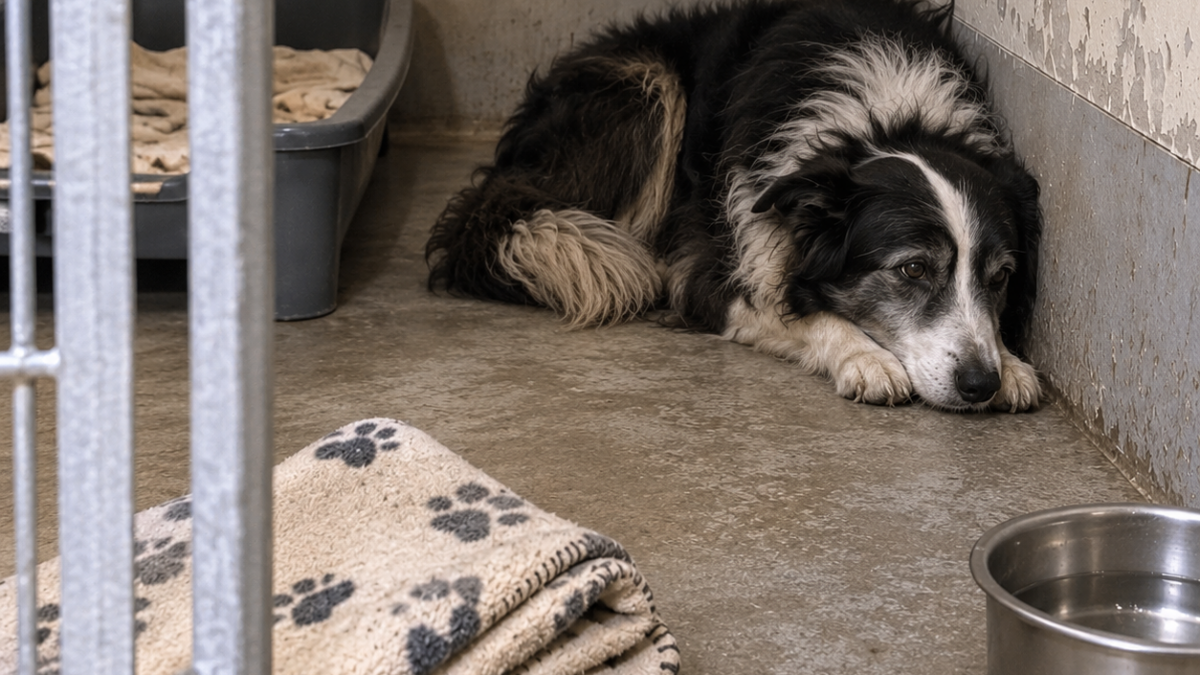
When I opened the gate, Iris stepped inside, turned once, and lay down against the back wall.
Claire placed the blue blanket near the entrance.
Iris didn’t even look at it.
And for the first time since I had known her, footsteps passed through the hallway—
and Iris didn’t stand up.
—
**— END OF FACEBOOK OPENING / PART 1 —**
—
For the next three days, Iris barely moved unless she had to.
She ate because I sat beside her bowl.
She went outside because I clipped on her leash and waited.
She still obeyed.
That was almost worse.
There was no barking.
No growling.
No frantic scratching at the gate.
She simply did what we asked, then returned to the farthest corner of the kennel.
I had seen fearful dogs.
Angry dogs.
Dogs so traumatized they snapped at any hand that came near them.
Iris was different.
She looked resigned.
Like she had finally figured out the pattern.
People came.
People left.
Doors opened.
Doors closed.
And eventually, she would end up exactly where she started.
My coworker Megan noticed it too.
On Wednesday afternoon, she stopped beside me while I was sitting outside Iris’s kennel.
“She didn’t get up for the delivery guy.”
“I know.”
“She always gets up for the delivery guy.”
“I know.”
Megan looked through the bars.
Iris had her head resting on her paws.
“What do we do?”
I hated the answer.
“We wait.”
But waiting was the thing Iris had already done for fourteen months.
That night, after closing, I stayed late.
Technically, I didn’t have to.
The kennels were clean.
Everyone had been fed.
Medications were done.
The building was quiet except for the constant hum of the ventilation system and an occasional bark from the puppy room.
I took Iris’s blue blanket from the shelf where we had placed it.
It still smelled faintly of someone else’s house.
I opened her kennel and sat on the concrete.
I didn’t call her.
I didn’t touch her.
I just sat.
Ten minutes passed.
Then twenty.
Eventually, Iris raised her head.
“You know,” I whispered, “I thought they were the ones too.”
Her ears moved slightly.
“I really did.”
I stared at the floor.
“I’m sorry.”
There was no reason for me to apologize.
I knew that.
But shelter work does something strange to your sense of responsibility.
You know logically that you cannot control every adopter.
You can interview people.
Educate them.
Warn them.
Ask questions.
Check references.
But when an animal you love comes back broken in some new way, logic doesn’t help much.
“I shouldn’t have let myself celebrate so early.”
Iris stood.
For a second, my heart jumped.
Then she walked past me to the water bowl.
She drank.
Turned around.
And instead of returning to the corner, she lay down three feet from me.
I didn’t move.
That was enough.
The following week, we changed her adoption profile.
Not because anything about Iris had changed.
Because I realized we had been describing her incorrectly.
The old profile said:
**Gentle senior Border Collie looking for a peaceful home. House-trained, affectionate, and good on leash.**
All true.
But it made Iris sound easy.
And she wasn’t easy.
Not anymore.
She was worth it.
That was different.
So I rewrote everything.
I wrote that Iris had spent almost nine years with one man.
That she had lost him without understanding why.
That she had waited fourteen months in a shelter.
That she had recently been adopted and returned after less than two days because she cried and followed her new family through the house.
I wrote:
**Iris is not looking for someone who expects gratitude on day one. She is looking for someone willing to earn her trust slowly.**
**She may follow you from room to room.**
**She may panic when you disappear at first.**
**She may need weeks before she believes your home is truly hers.**
Then I added one final sentence.
**Please do not take Iris home because you feel sorry for her. Take her home only if you intend to stay.**
Megan read it over my shoulder.
“That’s going to scare people away.”
“Good.”
She looked at me.
I turned toward her.
“I don’t want twenty people interested in Iris. I want one person who understands her.”
We posted it that night.
For two days, almost nothing happened.
A few shares.
A couple of comments.
Someone wrote, “Poor baby.”
Another person said, “If I didn’t already have three dogs…”
The usual things.
Then, on Friday afternoon, something unexpected happened.
Daniel and Claire posted a review of the shelter.
One star.
Megan found it first.
“You need to see this.”
I came into the office.
On the computer screen was a long paragraph.
They said we had failed to disclose Iris’s “severe behavioral problems.”
They accused us of pressuring them to adopt a traumatized dog.
They claimed Iris had been “unmanageable.”
I read the review twice.
The first time, I felt sick.
The second time, I got angry.
Not because they returned her.
I had worked in rescue long enough to know that bad matches happened.
Returning a dog safely was better than keeping one in a home filled with resentment.
What made me angry was the lie.
We had spent more than an hour explaining Iris’s history.
I personally told them she might cry.
I personally told them she might follow them.
I personally told them she could experience separation anxiety.
And now, because they felt guilty about bringing her back, they were rewriting the story so they wouldn’t have to feel responsible.
Megan folded her arms.
“We can respond.”
“I know.”
“Do you want me to?”
I stared at the screen.
Every emotional part of me wanted to write exactly what had happened.
I wanted to list every warning we had given.
I wanted to mention the signed behavior disclosure.
I wanted to remind them that Iris had lasted less than forty-eight hours in their home.
But shelter work teaches you that anger is expensive.
The animals usually end up paying for it.
“No,” I said.
Megan frowned.
“No?”
“We’ll respond professionally.”
So we did.
Our director wrote:
**We’re sorry this adoption was not successful. Our priority is always the safety and long-term well-being of both animals and adopters. Iris’s known adjustment and separation concerns were discussed during the adoption process and documented in her adoption materials. We appreciate that she was returned safely when the adopters determined they could not meet her needs.**
That was it.
No attack.
No names.
No public fight.
But someone saw the review.
Then they saw Iris’s adoption post.
Then they put the two together.
A local woman named Casey shared Iris’s story in a community group.
Her caption said:
**Imagine waiting more than a year for a home, getting one for a weekend, then being returned because you loved your new people too much.**
By Saturday morning, the post had thousands of shares.
By Sunday, it had reached people three states away.
My inbox filled with messages.
Some were wonderful.
Some were useless.
Some wanted to adopt Iris immediately without reading anything except the emotional headline.
That terrified me.
I didn’t want Iris becoming a viral impulse adoption.
So we became stricter.
Phone screenings first.
Then applications.
Then references.
Then an in-person meeting.
Several people got angry.
One man said, “Why are you making this so difficult? I’m trying to save her.”
I told him, “Iris doesn’t need someone to save her for a weekend.”
He hung up.
Another woman wanted Iris shipped six hundred miles to her home without meeting her first.
We declined.
Someone offered money if we would “reserve” Iris.
We declined that too.
For the first time in fourteen months, everybody seemed to want her.
And I trusted almost none of them.
Then, ten days after Iris came back, a woman named Ellen walked into the shelter.
She was sixty-two.
Short gray hair.
Worn hiking shoes.
No dramatic reaction.
No tears.
No phone held up for photographs.
She walked to Iris’s kennel and stood there for several minutes.
I watched from the hallway.
Iris didn’t move.
Ellen finally sat on the floor outside the gate.
“Hi, Iris.”
No response.
Ellen looked at me.
“Can I sit here for a while?”
“Of course.”
She stayed forty-five minutes.
Then she left.
She didn’t ask to adopt Iris.
The next day, she came back.
Same shoes.
Same quiet voice.
Same place on the floor.
This time, she brought a book.
She read for nearly an hour outside the kennel.
Iris lifted her head twice.
On the third day, Ellen returned again.
I finally asked, “Are you thinking about adopting her?”
She closed the book.
“Yes.”
“Then why haven’t you asked for an application?”
“Because she doesn’t know me yet.”
That answer caught me off guard.
Ellen looked through the bars.
“Everyone keeps deciding what they want from her. I figured maybe somebody should give her a chance to decide too.”
I sat beside her.
“Have you had dogs before?”
“Four.”
“Border Collies?”
“One Border Collie mix. Two Labs. And a mutt who thought he was a sheriff.”
I laughed.
She smiled.
“The Border Collie lived to fifteen.”
“Do you have other pets now?”
“No.”
“Children?”
“Grown. Different states.”
“Do you work?”
“I’m retired.”
“What did you do?”
“Home health nursing.”
That explained something about her patience.
“Do you live alone?”
Her smile changed.
“Yes.”
There was something behind the answer.
I didn’t push.
Ellen eventually told me anyway.
Her husband, Robert, had died eighteen months earlier.
Pancreatic cancer.
Thirty-eight years of marriage.
After he died, their house became painfully quiet.
“I thought about getting a puppy,” she said.
I looked at her.
“And?”
“I realized I don’t have puppy energy.”
I laughed again.
She nodded toward Iris.
“And she looks like she doesn’t have fake-happy energy.”
That might have been the most accurate description of Iris I had ever heard.
For the next week, Ellen came almost every day.
She never tried to force contact.
Sometimes she sat outside the kennel.
Sometimes she joined us for walks.
The first walk was uneventful.
The second time, Iris walked close enough that her shoulder brushed Ellen’s leg.
Ellen didn’t react.
The third time, Iris looked up at her.
“Did you see that?” I whispered.
Ellen kept her eyes forward.
“I did.”
“Why aren’t you looking at her?”
“Because if someone finally looks at you after being scared, you don’t always stare back.”
That sentence stayed with me.
A few days later, we let Ellen sit inside the kennel.
Iris stayed near the back.
Ellen opened her book.
Twenty minutes passed.
Then Iris stood.
She walked toward her.
Stopped.
Walked closer.
Ellen continued reading.
Iris sniffed her shoe.
Then her knee.
Then she turned in a circle and lay down beside her.
Not touching.
Just close.
Ellen’s eyes filled with tears.
She still didn’t reach for her.
I looked away to give her privacy.
After that, things moved slowly.
Exactly the way they needed to.
We arranged several longer visits.
Then a half-day foster visit.
Iris went to Ellen’s house for four hours.
I expected trouble.
Ellen called me afterward.
“She followed me everywhere.”
My stomach tightened.
“And?”
“I let her.”
“She cried?”
“When I went to the bathroom.”
“And?”
“I left the door open.”
I started laughing.
Ellen laughed too.
“She eventually fell asleep in the hallway.”
The second visit lasted eight hours.
The third lasted overnight.
At 6:15 the following morning, my phone rang.
I answered immediately.
“Is everything okay?”
Ellen whispered, “She’s asleep.”
I blinked.
“What?”
“She slept beside my bed.”
I waited.
“I got up at five to make coffee. She followed me into the kitchen. Then I sat down, and she put her head on my foot.”
Ellen’s voice cracked.
“I just thought you should know.”
I closed my eyes.
“That’s good.”
“I know.”
“But Ellen?”
“Yes?”
“Don’t rush because of one good night.”
“I won’t.”
And she didn’t.
That was what made me trust her.
People who want to rescue an animal quickly often want the emotional reward quickly too.
They want the dog to understand.
To be grateful.
To cuddle.
To transform.
Ellen wanted none of that.
She simply kept showing up.
Two weeks later, she submitted the official adoption application.
We approved it.
But something happened the day before Iris was supposed to go home.
Daniel and Claire returned to the shelter.
I was cleaning bowls in the back when Megan found me.
“You’re going to want to come up front.”
“Why?”
She gave me a look.
When I entered the lobby, I recognized them immediately.
Claire smiled awkwardly.
Daniel had his hands in his coat pockets.
“Hi.”
I kept my voice professional.
“Hello.”
Claire glanced toward the kennels.
“We saw the post about Iris.”
I waited.
“She’s gotten really popular.”
“Yes.”
“We’re glad.”
I didn’t answer.
Daniel cleared his throat.
“Actually, we came because we saw another dog on your website.”
My chest tightened.
“A dog named Milo?”
Megan looked at me.
Milo was a ten-month-old Australian Shepherd mix.
Young.
Fluffy.
Bright blue eye.
Exactly the type of dog people imagined would be easy because he looked like a happy advertisement.
In reality, Milo had enough energy to dismantle a kitchen if he got bored.
“Yes,” Claire said brightly. “He seems more like what we were looking for.”
For a moment, I couldn’t speak.
I thought about Iris walking back into her kennel.
I thought about the review.
I thought about the phrase severe behavioral problems.
Then I thought about Milo.
This wasn’t about revenge.
It couldn’t be.
My job was to protect the dog standing next in line.
I pulled out two chairs.
“Before we discuss Milo, we need to discuss the previous adoption.”
Daniel’s expression changed.
“We already returned Iris.”
“I’m aware.”
“We didn’t hurt her.”
“I’m not accusing you of hurting her.”
Claire crossed her arms.
“Then what’s the problem?”
“The problem is that Milo is significantly more demanding than Iris.”
They looked surprised.
“But he’s young,” Claire said.
“Yes.”
“That’s why we thought—”
“He requires several hours of physical and mental stimulation every day. He has mild resource guarding around food. He jumps when excited. He has chewed two leash handles this month. He needs structured training and cannot be left bored for long periods.”
Daniel frowned.
“That sounds worse than the website.”
“The website says he needs an experienced, active home.”
He looked irritated.
“So you’re saying we can’t adopt him?”
“I’m saying I don’t believe Milo is a good match for your household right now.”
Claire stared at me.
“Because we returned Iris.”
“Because you returned a calm, house-trained senior dog after less than two days for behaviors we explicitly told you to expect.”
Her face reddened.
“So we’re being punished.”
“No.”
“It sounds like punishment.”
I kept my voice even.
“If I wanted to punish you, I would be thinking about what feels fair to you. I’m thinking about what’s safe for Milo.”
Daniel stood.
“This is ridiculous.”
“You’re free to disagree.”
“We gave Iris back instead of abandoning her somewhere.”
“And returning her safely was the right decision.”
“Then why hold it against us?”
“Because the reason matters.”
Silence.
I continued.
“You weren’t wrong because you realized Iris wasn’t a good fit. But your expectations didn’t match what you had been told. Until those expectations change, placing a more demanding dog with you would be irresponsible.”
Claire’s eyes narrowed.
“You people make it impossible to adopt.”
Behind me, Megan shifted, but I raised one hand slightly.
“I understand you’re upset.”
Daniel laughed bitterly.
“We’ll go somewhere else.”
“That’s your choice.”
They left.
The front door slammed behind them.
Megan waited three seconds.
Then she whispered, “I have never loved you more.”
I shook my head.
“Don’t.”
“Come on.”
“It wasn’t revenge.”
“I know.”
I looked toward Milo’s kennel.
“That’s why it mattered.”
The following morning, Ellen arrived at 10:00.
No balloons.
No giant sign.
No audience.
She carried a new red leash and a small paper bag.
“What’s in there?” I asked.
“Chicken.”
“Bribery?”
“Relationship building.”
I smiled.
Iris was standing when we reached her kennel.
That alone nearly broke me.
Ellen crouched.
“Ready?”
Iris approached.
Ellen clipped on the leash.
Then I picked up the blue blanket.
For months, that blanket had been part of Iris’s kennel.
For one terrible weekend, it had left.
Then it had come back.
I folded it beneath my arm.
We walked toward the lobby.
Iris paused near the front door.
My heart stopped.
Ellen didn’t pull.
She waited.
Iris looked behind her.
Down the hallway.
Toward the kennel room.
Toward me.
I crouched beside her.
This moment felt painfully familiar.
The last time, I had told Iris she was going home.
I wasn’t going to make that promise again.
Instead, I scratched gently behind her ear.
“You don’t have to understand yet,” I whispered. “Just take one step.”
Iris looked at Ellen.
Then she stepped through the door.
We walked across the parking lot.
Ellen opened the back door of her car.
A thick dog bed covered the seat.
Iris sniffed it.
Then climbed inside.
Ellen fastened her seat belt harness.
Before closing the door, she looked at me.
“I know you’re worried.”
“I am.”
“I’ll call.”
“You don’t have to call every hour.”
“I probably will anyway.”
She did.
The first evening went well.
Then night came.
At 11:40, Ellen called.
I sat up in bed.
“What happened?”
“She’s pacing.”
“Is she panting?”
“A little.”
“Where are you?”
“Bedroom.”
“Where is she?”
“Hallway.”
“Can she see you?”
“Yes.”
“Don’t force her to settle. Keep everything quiet.”
“I put her blanket beside the bed.”
“Good.”
For the next forty minutes, I stayed on the phone.
I could hear Iris’s nails clicking across the floor.
Back and forth.
Back and forth.
Then silence.
Ellen whispered, “She stopped.”
“Where is she?”
“Doorway.”
Another minute passed.
“She’s lying down.”
“Good.”
I heard Ellen exhale.
“She keeps looking at me.”
“Then let her.”
“I’m scared to fall asleep.”
That surprised me.
“Why?”
“What if she wakes up and thinks I left?”
My throat tightened.
“You’re allowed to sleep, Ellen.”
“I know.”
“She needs to learn that people can sleep and still be there in the morning.”
Silence.
Then Ellen said softly, “Maybe I need to learn that too.”
I understood then that Iris wasn’t the only one carrying abandonment into that house.
One had lost a man to illness.
The other had lost a husband to cancer.
Neither had been given a choice.
Maybe that was why Ellen never treated Iris’s fear like an inconvenience.
She recognized it.
The next morning, she sent me a photograph.
Iris was asleep beside the bed.
Her nose rested on the edge of Ellen’s slipper.
The caption said:
**Still here. Both of us.**
I saved that picture.
The first week wasn’t perfect.
Iris followed Ellen constantly.
If Ellen stepped outside to collect the mail, Iris whined at the door.
If she closed the bathroom door, Iris scratched once or twice.
When Ellen took out the trash, Iris paced.
But Ellen followed the plan our behavior consultant had given her.
Seconds became thirty seconds.
Thirty seconds became one minute.
One minute became three.
Ellen never made departures dramatic.
Never punished Iris for being afraid.
Never flooded her by leaving for hours just to “teach her.”
She built trust in tiny pieces.
After two weeks, she could walk to the mailbox without Iris panicking.
After a month, she could leave for ten minutes.
After six weeks, thirty.
Iris slowly learned one of the hardest things any abandoned dog can learn.
Someone leaving the room did not mean they were leaving her life.
Meanwhile, Iris’s story continued circulating online.
People mailed toys.
Beds.
Checks.
One elementary school collected almost nine hundred dollars in her name.
A local pet supply store donated food for senior dogs.
We created something called the Iris Fund to help older shelter animals with veterinary costs.
Within three months, seven senior dogs who had been overlooked for more than six months were adopted.
Then eleven.
Then sixteen.
The story that had begun with Iris being returned started changing lives far beyond her own.
That should have been enough.
But there was one unfinished part.
Mr. Wallace.
I had thought about him often.
When Iris first arrived at the shelter, his daughter had asked us not to send constant updates because seeing Iris without being able to take her back was painful for him.
We respected that.
But now Iris had a home.
A real one.
So I called his daughter.
Her name was Rebecca.
When I told her Iris had been adopted, she started crying.
“Is it a good home?”
“Yes.”
“Are you sure?”
I thought of Ellen sleeping with her bedroom door open.
“Yes.”
Rebecca became quiet.
Then she said, “Dad asks about her every week.”
My chest tightened.
“Does he?”
“He thinks she probably forgot him.”
I closed my eyes.
“No.”
“Would the new owner ever consider letting him see her?”
“I can ask.”
I called Ellen.
I expected hesitation.
Instead, she said, “Of course.”
“You’re sure?”
“He was her person for nine years.”
“He’s in assisted living about forty minutes away.”
“Then tell me when.”
A week later, we arranged the visit.
Ellen drove.
I came too.
Iris seemed calm until we entered the assisted-living building.
Then something changed.
Her ears lifted.
She stopped.
Ellen looked at me.
“What is it?”
“I don’t know.”
We continued down the hall.
Rebecca waited outside a common room.
The moment Iris saw her, her tail moved.
Slowly at first.
Then faster.
Rebecca covered her mouth.
“Oh, sweetheart.”
Iris pulled forward.
Not hard.
But with purpose.
Rebecca knelt and Iris smelled her hands.
Then Rebecca stood.
“He’s inside.”
I had imagined the reunion several times.
None of those imagined versions prepared me.
Mr. Wallace sat near a window in a wheelchair.
He looked much smaller than the photographs Rebecca had shown us.
His hands were thin.
His shoulders rounded.
He was staring outside.
Iris entered the room.
She froze.
For one second, nothing happened.
Then Mr. Wallace turned.
His eyes widened.
“Iris?”
Her entire body changed.
She made a sound I had never heard from her.
Not a bark.
Not a whine.
Something between the two.
Then she ran.
Ellen dropped the leash.
Iris crossed the room and pushed her head straight into Mr. Wallace’s lap.
He bent over her.
His hands disappeared into her fur.
“Oh, my girl.”
Everyone in the room seemed to stop breathing.
Iris’s tail slammed against the wheelchair.
Mr. Wallace was crying.
Rebecca was crying.
I was crying.
Even Ellen had both hands over her mouth.
“I’m sorry,” Mr. Wallace whispered into Iris’s fur. “I’m so sorry.”
Iris pressed closer.
For months, I had wondered whether dogs understood abandonment the way humans did.
Watching her then, I realized maybe the question didn’t matter.
Iris did not ask him why.
She did not punish him.
She did not care how many months had passed.
He was there.
That was enough.
After several minutes, Mr. Wallace finally noticed Ellen.
He wiped his eyes.
“You’re the lady who has her?”
Ellen nodded.
“Yes, sir.”
He looked at Iris.
Then at Ellen.
“Is she good?”
“The best.”
“Does she sleep near you?”
“Every night.”
“Does she still hate thunderstorms?”
Ellen smiled.
“Apparently.”
“She likes cheese.”
“I’ve discovered that.”
“Too much cheese makes her stomach bad.”
“I also discovered that.”
Mr. Wallace laughed.
It was a weak laugh, but a real one.
Then he became serious.
“She gets scared when people leave.”
Ellen glanced at me.
“I know.”
Mr. Wallace lowered his hand onto Iris’s head.
“She used to follow me to the bathroom.”
“She does that.”
“She’ll stop eventually.”
Ellen shook her head.
“She doesn’t have to.”
His eyes filled again.
For almost an hour, they talked.
About Iris.
About her first night as a puppy.
About the time she stole an entire roast from the kitchen counter.
About how she once refused to walk through snow because it touched her stomach.
About Mr. Wallace’s wife, who had died years earlier.
About the life Iris had before the shelter.
Before Ellen.
Before loss had rearranged everything.
When it was time to leave, I worried.
Would Iris panic?
Would seeing Mr. Wallace reopen something we couldn’t close?
Ellen worried too.
But she never said it aloud.
She clipped the leash onto Iris’s collar.
Mr. Wallace kissed Iris’s forehead.
“You go on.”
Iris stayed beside him.
“You go with her.”
She looked at Ellen.
Then back at him.
Mr. Wallace smiled through tears.
“It’s okay.”
Ellen took one step.
Iris followed.
At the doorway, Iris turned around.
Mr. Wallace lifted his hand.
She watched him for a long moment.
Then she walked out with Ellen.
Not dragged.
Not carried.
Not confused.
She chose to follow.
I had to stop in the hallway because I couldn’t see through my tears.
Ellen touched my shoulder.
“She knew.”
“Yeah.”
“She knew he wasn’t throwing her away.”
I nodded.
“And she knew she had somewhere to go.”
That visit became the first of many.
Every other Sunday, Ellen brought Iris to see Mr. Wallace.
Eventually, the facility staff began expecting them.
Other residents sat near the lobby waiting for Iris.
One man kept dog biscuits in his dresser.
A woman with dementia who rarely spoke would smile whenever Iris rested her chin on her knee.
The facility director eventually asked Ellen if she would consider having Iris certified as a therapy dog.
Ellen laughed when she told me.
“I said she already has a full-time job supervising me.”
But six months later, Iris passed the temperament evaluation.
The dog who had once sat at the back of a shelter kennel believing nobody would stay began spending Sunday afternoons walking from room to room, reminding lonely people that they still mattered.
And then, almost a year after Iris’s failed adoption, Daniel and Claire appeared in my life one final time.
Not in person.
Online.
They had posted about us again.
Apparently, after we declined their application for Milo, they had adopted a young Husky mix from a private listing.
Four months later, they were trying to rehome him.
The post said he had “too much energy,” “destroyed household items,” and “could not be left alone.”
Megan showed me the screenshot.
For several seconds, neither of us spoke.
Finally, she said, “You’re thinking it.”
“No.”
“You absolutely are.”
“I’m not.”
“Say it.”
I shook my head.
“Not my circus.”
She laughed.
Then her expression softened.
“Do we contact them?”
That was the difference between revenge and rescue.
Revenge would have meant enjoying their failure.
Rescue meant worrying about the dog anyway.
“Yes,” I said. “Send them the Husky rescue information.”
Megan stared at me.
“You’re serious?”
“The dog didn’t write the review.”
So we sent the information.
No lecture.
No I told you so.
No public comment.
A regional Husky rescue eventually took him.
That could have been the end of it.
But two weeks later, an envelope arrived at the shelter.
No return address.
Inside was a check for five hundred dollars made out to the Iris Fund.
There was also a short handwritten note.
It said:
**We were wrong.**
**We thought loving a dog meant the dog should immediately fit into our life. We didn’t understand that sometimes you have to change your life enough to make room for them.**
**We’re sorry for what we said about Iris and about the shelter.**
**Please use this for a senior dog who needs more patience than we knew how to give.**
There were no names on the note.
There didn’t need to be.
Megan looked at me.
“Well?”
I read it again.
Then I put it in the drawer where we kept thank-you letters.
“Put the check in the Iris Fund.”
“That’s it?”
“That’s it.”
“You’re not going to frame the apology?”
I smiled.
“No.”
She leaned against the desk.
“You know, a year ago you would’ve wanted them destroyed.”
“I did want them destroyed.”
“And now?”
I looked through the office window.
Across the hallway was the kennel Iris had once occupied.
A twelve-year-old Beagle named Peanut was sleeping there now.
Above his gate hung a small sign:
**Senior doesn’t mean finished.**
I shook my head.
“Now I’d rather they learned something.”
That was the closest thing to revenge life ever gave me.
Not humiliation.
Not punishment.
Growth.
They had returned Iris because she was inconvenient.
They had called her broken.
And in the end, Iris became the reason they finally understood what commitment actually meant.
A few months later, Ellen invited several shelter staff members to her house for Iris’s tenth birthday.
When I arrived, I almost laughed.
There was a banner across the porch.
**HAPPY BIRTHDAY, IRIS.**
Ellen had insisted it wasn’t a party.
It was absolutely a party.
There were dog-safe cupcakes.
Three shelter volunteers.
Rebecca.
Mr. Wallace, brought over in the facility van.
And Iris.
She walked around the yard wearing a ridiculous blue bandana covered in tiny yellow stars.
Her muzzle was whiter now.
She moved a little slower.
But she looked different.
Not younger.
Something better.
Certain.
At one point, Ellen went inside to get plates.
I noticed Iris watching the door.
For a split second, the old memory hit me.
The shelter hallway.
The footsteps.
The constant waiting.
But Iris didn’t panic.
She didn’t stand frozen.
She simply watched.
Thirty seconds later, Ellen came back outside.
Iris’s tail thumped once against the grass.
That was all.
She knew.
People could disappear behind doors.
And come back.
Such a simple lesson.
For Iris, it had taken almost two years to believe.
Later that afternoon, I sat beside Mr. Wallace beneath a tree.
Iris was sleeping between his wheelchair and Ellen’s chair.
He watched her quietly.
“You took good care of her,” he told me.
“We tried.”
“No.”
He shook his head.
“You did.”
I didn’t know what to say.
He looked toward Ellen.
“She loves her.”
“Yes.”
“Good.”
Iris opened one eye.
Mr. Wallace smiled.
“She always did like women better.”
I laughed.
From across the yard, Ellen called, “I heard that.”
“So did Iris,” I said.
Mr. Wallace laughed harder than I had ever heard him laugh.
I remember thinking how strange life was.
A year earlier, Iris had returned to our shelter with her blanket.
I had been furious at the people who brought her back.
I had thought the worst thing that could happen to a shelter dog was being chosen and then rejected.
But maybe I was wrong.
Maybe the worst thing would have been staying somewhere she was merely tolerated because people were too ashamed to return her.
Daniel and Claire had failed Iris.
That was true.
But their failure also brought her back to the place where Ellen eventually found her.
That didn’t erase the hurt.
It didn’t make the return harmless.
Pain doesn’t become good simply because something beautiful follows it.
But sometimes the story keeps going long enough for the pain to stop being the final chapter.
Mr. Wallace died the following winter.
Rebecca called me herself.
It was peaceful.
She said Iris had visited him three days earlier.
During that final visit, she had spent nearly the entire afternoon with her head resting in his lap.
When Rebecca told Ellen, she asked whether she wanted to skip the funeral.
Ellen said no.
She brought Iris.
They stood near the back.
When the service ended, Rebecca knelt in front of Iris.
“He loved you so much.”
Iris licked her hand.
Afterward, Ellen and I walked together through the cemetery parking lot.
Iris moved slowly between us.
“Do you think she knows?” Ellen asked.
“About him?”
“Yes.”
I looked down at Iris.
“I don’t know.”
Ellen nodded.
“Maybe she doesn’t need to.”
I thought about that.
Maybe she was right.
Dogs don’t need explanations for every loss.
Sometimes they just need someone beside them when the absence becomes real.
That night, Ellen sent me another photograph.
Iris was curled on her blue blanket beside the fireplace.
The same blanket that had left the shelter with her once.
The same blanket that had come back.
The same blanket I had eventually carried to Ellen’s car.
Her message said:
**She’s sleeping. Rough day. But she’s okay.**
I replied:
**Because you stayed.**
A minute later, Ellen wrote back:
**So did she.**
Years in rescue have taught me that humans love to talk about saving animals.
We say we rescued them.
Gave them another chance.
Changed their lives.
Sometimes that’s true.
But Iris taught me something more uncomfortable.
Love isn’t proven by choosing someone when the moment feels emotional.
It isn’t proven by signing papers.
It isn’t proven by posting the adoption photo.
Love is usually proven afterward.
At 2:00 in the morning when the dog is pacing.
When your carpet gets scratched.
When progress takes weeks instead of days.
When fear looks inconvenient.
When you realize the animal you brought home isn’t there to perform gratitude for you.
They’re there because you promised to become part of their world.
For fourteen months, Iris waited for someone to choose her.
Then someone did.
And less than two days later, they changed their mind.
When she returned, I thought something inside her had been permanently damaged.
Maybe something had.
But damaged doesn’t mean finished.
Months after her tenth birthday, I visited Ellen on my day off.
She was making coffee.
Iris was asleep near the kitchen doorway.
“Watch this,” Ellen whispered.
She walked out the back door.
Iris opened her eyes.
She lifted her head.
For a second, I watched closely.
Old Iris would have jumped up.
Paced.
Whined.
Scratched.
This Iris looked toward the door.
Then lowered her head again.
Ellen came back thirty seconds later carrying a basket of laundry.
Iris didn’t even stand.
I started laughing.
“What?”
Ellen looked at me.
“Nothing.”
“No, what?”
I pointed at Iris.
“She didn’t follow you.”
Ellen looked down.
Then she understood.
Her eyes filled.
“Oh.”
We both stood there like fools, staring at a dog who had done absolutely nothing.
But sometimes doing nothing is the victory.
Iris wasn’t afraid.
She hadn’t been abandoned.
She didn’t need to check.
Ellen was coming back.
She knew that now.
Before I left that afternoon, Iris walked me to the front door.
I crouched and hugged her.
Her fur smelled like Ellen’s house.
Like wood smoke and clean blankets.
Not disinfectant.
Not concrete.
Not the shelter.
Home.
“You waited long enough,” I whispered.
I stood and stepped outside.
Ellen remained in the doorway with Iris beside her.
As I walked toward my car, I turned around.
Years earlier, whenever anyone walked away from Iris, she watched as though she feared they might never return.
This time, she looked at me for only a moment.
Then Ellen went inside.
And Iris turned around and followed her.
No hesitation.
No fear.
No waiting.
That was how I finally knew she understood.
She wasn’t waiting for somebody to choose her anymore.
She already belonged.
And this time—
someone stayed.








