They Paved Over My Family Cemetery for Parking—Desecrating Graves Is a Felony
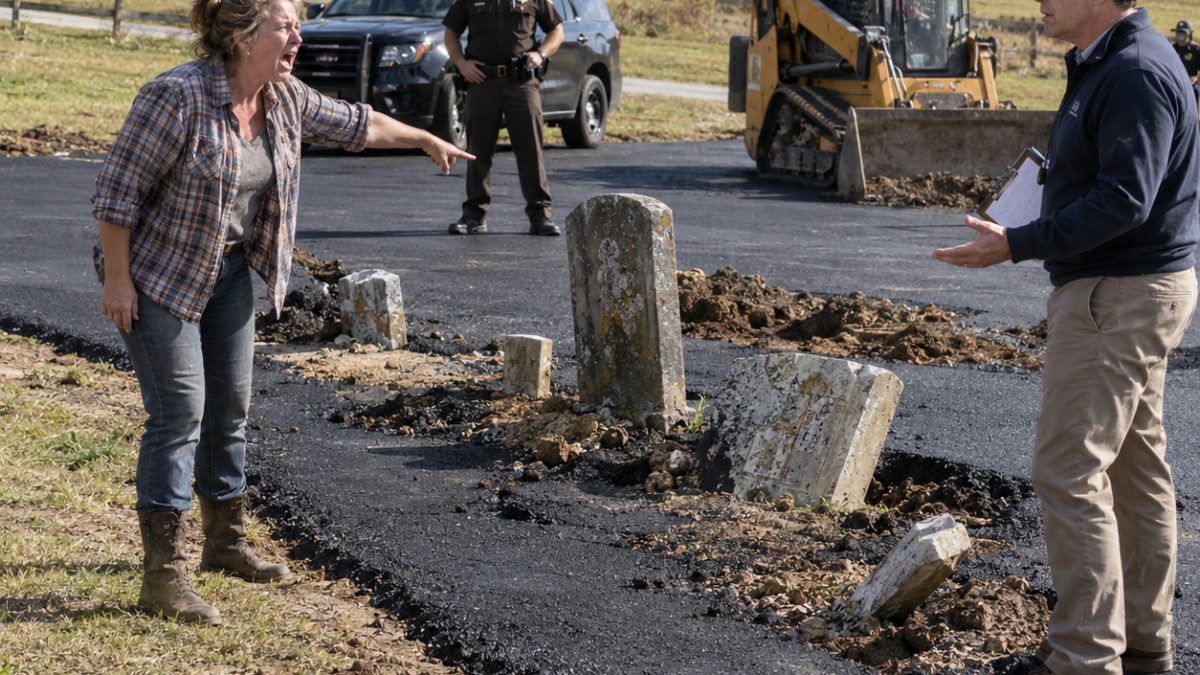
The first thing I noticed was not the bulldozer, the torn earth, or even the shattered pieces of marble half-buried in the mud—it was the empty sky where a two-hundred-year-old oak had stood over my family’s graves.
When I asked the HOA president what she had done, she lifted her clipboard and calmly told me six generations of my family had been cleared away because the clubhouse needed overflow parking.
Then she smiled and said she had paperwork proving every inch of it was legal—and for one terrible second, I wondered whether someone inside the county had helped her do it.
My name is Jack Caldwell.
I was forty-eight years old when my cousin Sarah called me on a Tuesday morning and said something I will never forget.
“Jack, you need to come home.”
I was standing beside my truck when she called.
“What happened?”
There was silence.
Then I heard her crying.
“It’s the cemetery.”
Every Caldwell knew what she meant.
Not a public cemetery.
Not some forgotten churchyard.
Our cemetery.
A one-acre family plot in Oakhaven where members of my family had been buried since the nineteenth century.
My parents were there.
My grandparents.
Their parents.
Veterans.
Farmers.
Children who had died before ever reaching adulthood.
For generations, the cemetery had sat beneath an enormous live oak on land specifically reserved when the surrounding family acreage was sold for development.
I drove two hours without stopping.
When I turned onto Azalea Drive, I saw construction equipment before I saw the cemetery.
Then I saw the oak.
Or rather, where it had been.
Gone.
The ground had been ripped apart.
A yellow bulldozer sat near the edge of the property.
Fresh tire tracks cut through soil my family had protected for more than a century.
Pieces of stone were scattered through the mud.
I got out of my truck.
My legs felt strangely weak.
Near the bulldozer stood a woman wearing a pastel pink tracksuit and holding a clipboard.
I recognized her immediately from Sarah’s description.
Karen Miller.
President of the Oakhaven Homeowners Association.
She watched me approach.
“Can I help you?”
I walked past her.
Something pale was sticking out of the mud.
I bent down.
Marble.
One carved letter remained visible.
E.
I knew that stone.
Eleanor Caldwell.
My great-great-grandmother.
I straightened slowly.
“What have you done?”
Karen barely reacted.
“Oh, this?”
She gestured toward the destruction.
“We’re creating overflow parking for the clubhouse.”
I stared at her.
“This is a cemetery.”
“According to our records, it was abandoned.”
“My parents are buried here.”
That finally changed her expression.
Only slightly.
“Well, nobody has maintained it properly.”
“My family maintains it every year.”
“There were weeds.”
“There were headstones.”
She exhaled impatiently.
“Mr.—”
“Caldwell.”
“Yes. Mr. Caldwell. The association approved this project months ago. This parcel reverted to common property after abandonment.”
“No.”
“We have a permit.”
I looked at the bulldozer.
Then at the broken marble.
Then at the crater where the old oak had stood.
“You bulldozed graves for parking.”
“We cleared an unused parcel for community improvement.”
Unused.
I felt something inside me go completely still.
For twenty-two years in the Army, I had learned one lesson that had probably saved me from doing something stupid in that moment.
Anger is useful only when you control where it goes.
So I took out my phone.
Karen smiled.
“Calling your attorney?”
“No.”
I opened the camera.
I filmed the bulldozer.
The shattered stones.
The destroyed oak.
The exposed survey marker.
Then I filmed Karen standing beside the site.
“What are you doing?”
“Documenting.”
“You don’t have permission to film HOA property.”
“It isn’t HOA property.”
She laughed.
“We’ll see about that.”
I stopped recording.
Then I dialed 911.
Her smile disappeared.
“What are you doing?”
When the dispatcher answered, I kept my eyes on Karen.
“My name is Jack Caldwell. I need to report the destruction of a private cemetery.”
Karen stepped toward me.
“You cannot make criminal accusations against me.”
I continued.
“There are multiple graves. Headstones have been destroyed. Heavy equipment is still on site.”
Karen’s face turned red.
“This was permitted!”
The dispatcher asked whether anyone was in immediate danger.
“No. But I need law enforcement here before anything else gets moved.”
I ended the call.
Karen gripped her clipboard with both hands.
“You’re making a serious mistake.”
I looked again at the fragment bearing Eleanor’s name.
“No, Karen.”
For the first time since I arrived, my voice did not shake.
“I think we’re about to find out who made the serious mistake.”
Ten minutes later, the first sheriff’s cruiser turned onto Azalea Drive.
Karen immediately reached into her folder.
And when I saw the county seal on the permit she pulled out, I realized destroying the cemetery might not be the worst thing she had done.
It might only be the first thing we could prove.
PART 2
The deputy who stepped from the cruiser looked young enough that my first instinct was to wonder whether he had ever dealt with anything remotely like this.
Probably not.
Most deputies expect noise complaints, traffic accidents, domestic disputes, maybe a stolen lawn mower.
They do not expect to arrive at a subdivision clubhouse and discover that the president of a homeowners association may have bulldozed a private cemetery.
Karen reached him first.
“Officer, thank goodness.”
She marched toward him with her folder open.
“This man is trespassing and interfering with a properly permitted HOA improvement.”
The deputy looked at me.
Then at the bulldozer.
Then at the destroyed ground.
“Sir?”
“My name is Jack Caldwell.”
I pointed toward the site.
“That is the Caldwell family cemetery. It has been there since 1888.”
Karen made an exaggerated sound of disbelief.
“It was an abandoned patch of weeds.”
I looked at her.
“My father was buried there ten years ago.”
That silenced her for perhaps two seconds.
Then she lifted the permit.
“The county approved our project.”
The deputy took the document.
He studied it.
I could see uncertainty on his face.
It looked official.
Stamped.
Signed.
Everything Karen wanted him to see.
He handed it back.
“Mr. Caldwell, do you have anything establishing ownership?”
“I have family records, photographs, tax documentation and the original deed history. I can get certified copies.”
Karen crossed her arms.
“Which means he has nothing with him.”
“I have this.”
I walked several yards toward the mud and stopped beside a broken slab.
The deputy followed.
I pointed.
“That was part of a headstone.”
He crouched.
There were several fragments nearby.
One carried the edge of a carved date.
Another had a portion of a surname.
CALD—
The deputy’s expression changed.
He stood quickly.
“Everybody stay where you are.”
Karen laughed.
“You cannot seriously believe those were grave markers.”
The deputy looked at her.
“Ma’am, I’m going to call my supervisor.”
“For rocks?”
“For a potential cemetery destruction.”
Her posture stiffened.
The deputy stepped away and spoke into his radio.
I walked back to my truck and called Sarah.
She answered immediately.
“Jack?”
“I’m here.”
Her voice dropped.
“How bad?”
I looked at the empty place where the oak had stood.
“Worse.”
“Oh God.”
“I need you to start calling everyone.”
“Everyone?”
“Uncle Robert. Aunt Carol. David. Melissa. Every Caldwell you can reach.”
“What do I tell them?”
“The truth.”
I swallowed.
“Tell them somebody bulldozed the cemetery.”
Sarah began crying again.
I forced myself to remain steady.
“We’re going to fix this.”
“How?”
“I don’t know yet.”
And that was the truth.
“But we will.”
My next call went to Ben Carter.
Ben had handled several property matters for me over the years.
He was the kind of attorney who spoke softly, read everything twice and became dangerous only after the other side underestimated him.
He answered with:
“Jack, I’m headed into a meeting.”
“You’re going to miss it.”
“That bad?”
“My family cemetery was bulldozed this morning.”
Silence.
“What?”
“HOA parking expansion.”
Another silence.
Then:
“Start from the beginning.”
I gave him the facts.
When I finished, his voice had changed.
“Do not argue with anyone.”
“I’m not.”
“Do not touch the equipment.”
“I haven’t.”
“Photographs?”
“Video too.”
“Good.”
“Karen claims the county issued a permit.”
“That does not determine ownership.”
“I know.”
“And a grading permit certainly doesn’t give somebody authority to destroy graves.”
“I know.”
“I’ll pull the relevant statutes and property records.”
“Ben.”
“Yes?”
“Find out what happens legally if she knew this was a cemetery.”
He was quiet for a moment.
“I will.”
A second patrol vehicle arrived about fifteen minutes later.
Sergeant Dale Morrison stepped out.
He was older than the first deputy, probably mid-fifties, with gray at his temples and the expression of somebody who had long ago stopped being impressed by loud people.
Karen immediately attempted the same performance.
“I’m Karen Miller, president of the Oakhaven Homeowners Association.”
Morrison looked at her.
“Okay.”
“We have authority over all common property.”
“Okay.”
“This man is interfering with lawful construction.”
Morrison looked at me.
“Mr. Caldwell?”
I handed him my driver’s license.
Then I told him the story without raising my voice.
When I finished, he walked toward the destroyed plot.
He did not hurry.
He inspected the bulldozer.
The uprooted earth.
The stone fragments.
Then he stopped.
Something half-buried in the mud had caught his attention.
He bent down and carefully lifted it.
It was part of a rectangular marble marker.
Three letters remained.
WEL.
I knew immediately.
Maxwell Caldwell.
My grandfather.
Morrison looked at me.
“Was this one of them?”
“Yes.”
Karen stepped forward.
“You don’t know that.”
I looked at her.
“I spent every Memorial Day of my childhood cleaning that stone.”
She said nothing.
Morrison set the piece back exactly where he had found it.
Then he turned toward the bulldozer operator.
“Sir, shut the machine down and do not move it.”
“It’s already shut down.”
“Good. Keep it that way.”
Karen raised her voice.
“You cannot stop a permitted project.”
Morrison faced her.
“I can secure a potential crime scene.”
“This is outrageous.”
“No one touches the site until we establish what happened.”
She waved the permit.
“I have county authorization.”
“And we’ll verify it.”
“You are exceeding your authority.”
Morrison’s eyes narrowed slightly.
“Ma’am, I suggest you stop trying to explain my authority to me.”
That was the first moment I saw fear enter Karen’s face.
Not enough to silence her.
But enough to crack something.
The cemetery remained taped off for the rest of the afternoon.
The bulldozer operator, a subcontractor named Wade Collins, gave a statement.
So did Karen.
So did I.
Before leaving, Morrison approached me.
“I’m not promising you a criminal case.”
“I understand.”
“We need deeds, surveys, burial records, whatever you have.”
“You’ll have them.”
“And don’t enter the disturbed portion until we clear it.”
I nodded.
He hesitated.
Then looked toward the ruined cemetery.
“I’m sorry, Mr. Caldwell.”
That was the first time anyone had said it.
Not legally.
Not strategically.
Simply humanly.
And it nearly broke me.
I sat inside my truck for ten minutes after everyone left.
The rage had carried me through the afternoon.
Once the noise disappeared, grief replaced it.
My father had chosen his own headstone.
Simple gray marble.
No military rank.
No long inscription.
Just his name, dates, and one sentence:
HE KEPT HIS WORD.
My mother had laughed when he picked it.
“Tom, that sounds like something from an old Western.”
Dad had shrugged.
“Could do worse.”
When Mom died four years later, we buried her beside him.
Same stone.
Same simplicity.
Now I didn’t know where either half of that marker was.
I didn’t know what the bulldozer blade had done.
I didn’t know whether graves had been physically disturbed or only the markers and surface.
That uncertainty was worse than any answer.
My phone rang.
Aunt Carol.
At eighty-eight, Carol Caldwell had the voice of a woman who considered age an inconvenience rather than a limitation.
“Jack.”
“Hi, Aunt Carol.”
“Sarah told me.”
“I’m sorry.”
“Why are you apologizing?”
“I should have checked the property more recently.”
“Nonsense.”
“I was there three months ago.”
“And?”
“Everything looked fine.”
“Then this is not your failure.”
I closed my eyes.
“You should see it.”
“I intend to.”
“No.”
“What do you mean, no?”
“The police have it closed.”
“That doesn’t mean I can’t stand beside the tape.”
“Aunt Carol—”
“That cemetery contains my husband.”
I stopped.
Uncle Frank had been buried there in 1999.
“I know.”
“My parents.”
“I know.”
“My grandparents.”
“I know.”
“And that woman called it abandoned?”
“Yes.”
Aunt Carol’s voice changed.
It became almost cheerful.
“Good.”
I blinked.
“Good?”
“She said it was abandoned?”
“Yes.”
“Excellent.”
“Aunt Carol, what are you talking about?”
“I have every cemetery maintenance receipt from 1983 through 2019.”
I sat upright.
“What?”
“Your grandfather made me secretary of the family trust.”
I had forgotten.
“After he died, Robert took over the finances, but I never threw anything away.”
She continued.
“Mowing invoices. Fence repairs. Tree service. Insurance. Grave-marker restoration. Every penny.”
I smiled for the first time all day.
“Can you find them?”
“Find them?”
She sounded offended.
“They’re categorized by decade.”
Of course they were.
The next morning, Ben and I met at the county records building.
The Caldwell cemetery existed because of a decision made nearly fifty years earlier.
In 1978, my grandfather sold most of what remained of the original Caldwell farm to a developer.
Three hundred acres became houses, roads, drainage ponds, sidewalks and eventually Oakhaven.
But one acre was excluded.
The cemetery.
My grandfather had insisted on three things.
First, ownership remained with the Caldwell Family Cemetery Trust.
Second, descendants retained a permanent access easement.
Third, the cemetery could never be incorporated into a homeowners association or subjected to future subdivision covenants.
Ben knew what we needed.
The original deed.
Subdivision plat.
Easement.
Any recorded amendments.
We found them.
Not quickly.
But we found them.
The most important page was a yellowed survey map.
The cemetery appeared as a neat rectangle outlined separately from the subdivision.
Beside it were words that made Ben smile.
CALDWELL FAMILY CEMETERY.
EXCLUDED FROM CONVEYANCE.
PERPETUAL PRIVATE BURIAL GROUND.
Ben tapped the page.
“That’s the case.”
“That easy?”
“No.”
He shook his head.
“Nothing is ever that easy.”
“But this destroys their ownership claim.”
“Yes.”
“What about abandonment?”
“They’re going to argue nonuse, failure to maintain, possibly adverse control.”
“Can they win?”
“Not with a perpetual cemetery trust, active burials within the last decade and Aunt Carol’s maintenance records.”
He paused.
“Especially not if your parents were buried there with documented permission from the trust.”
“They were.”
“Then calling it abandoned is ridiculous.”
We ordered certified copies.
While the clerk stamped them, Ben received an email.
He read it once.
Then again.
“What?”
“The HOA’s attorney.”
“What does he want?”
“They’re seeking a temporary restraining order against you.”
I stared at him.
“For what?”
“Harassment, interference with association property and disruption of a permitted capital improvement.”
I actually laughed.
Ben didn’t.
“They’re also claiming the cemetery reverted to HOA control.”
“Based on what?”
“Meeting minutes from three months ago.”
“They voted to take land they don’t own?”
“Essentially.”
“That’s insane.”
“Legally weak and insane are not mutually exclusive.”
We returned to his office.
The HOA’s filing included several documents.
One immediately caught our attention.
A grading-and-clearing permit.
County seal.
Approval signature.
Project description:
OAKHAVEN CLUBHOUSE OVERFLOW PARKING EXPANSION.
Existing land use:
UNDEVELOPED SCRUB / UNUSED COMMON AREA.
Historical significance:
NONE KNOWN.
Burial site:
NO.
Ben stared at the page.
“Who filled this out?”
The applicant signature answered him.
Karen Miller.
My anger returned.
“She knew.”
“We need to establish that.”
“She knew there were headstones.”
“Knowing personally and proving she knew are different things.”
“I told her today.”
“That proves knowledge after construction.”
“She lives in Oakhaven.”
“Still circumstantial.”
I paced his office.
“People visited that cemetery.”
“Good.”
“We held my father’s burial there.”
“Who attended from the subdivision?”
“I don’t know.”
“Find out.”
Ben circled the permit language.
“If we can prove she knowingly concealed the cemetery to obtain the permit, the entire story changes.”
“How?”
“Civilly? Fraud or misrepresentation issues.”
“And criminally?”
“That’s for the prosecutor.”
He looked at me.
“But the permit may hurt her more than help her.”
That afternoon, the Caldwell family arrived like an invading force.
Not with weapons.
With boxes.
Aunt Carol brought four banker’s boxes of cemetery records.
Uncle Robert, a retired history professor, brought copies of family burial ledgers.
Sarah arrived with a laptop and three external hard drives.
My cousin David brought photographs going back decades.
One photo showed my grandparents standing beneath the oak in 1976.
Another showed Uncle Frank’s funeral.
Another showed my father’s burial ten years earlier.
In the background of that photograph were Oakhaven houses.
No one could credibly claim the cemetery was secret.
Sarah spread documents across my dining table.
“This is ridiculous.”
“What?”
She held up a maintenance invoice.
“Tree service from last year.”
The invoice listed the location.
CALDWELL FAMILY CEMETERY, AZALEA DRIVE.
The contractor who performed the work lived in Oakhaven.
Better yet, he had obtained permission from the HOA gate committee to bring his truck into the subdivision.
Sarah stared at me.
“They approved cemetery maintenance.”
“When?”
“Eleven months ago.”
That mattered.
A lot.
We pulled the HOA email.
SUBJECT: CONTRACTOR ACCESS — CALDWELL CEMETERY TREE MAINTENANCE.
Approved by:
Karen Miller.
For almost a full minute nobody spoke.
Then Uncle Robert said:
“Well.”
Aunt Carol smiled without humor.
“I believe that is what young people call a receipt.”
Ben nearly laughed when I forwarded it.
His response contained four words.
DO NOT LOSE THIS.
The next development came from Detective Morrison.
He asked me to meet him at the sheriff’s office.
When I arrived, he had photographs spread across a conference table.
One showed the bulldozer.
Another showed damaged markers.
A third showed the old cemetery gate thrown into a pile of brush.
Morrison tapped a photograph.
“Do you recognize this?”
It was a brass plaque attached to one gatepost.
CALDWELL FAMILY CEMETERY
EST. 1888
I stared at him.
“Where did you find that?”
“Maintenance area behind the clubhouse.”
My stomach tightened.
Morrison sat back.
“The bulldozer operator says he asked Mrs. Miller about the stones before beginning.”
“What did she tell him?”
“That they were decorative landscape pieces left from an old garden.”
I felt cold.
“He believed that?”
“He says he was told the area had already been cleared legally.”
“And the gate?”
“He removed it.”
“Where are the headstones?”
“We’re working on that.”
Morrison studied me.
“Mr. Caldwell, I need you to understand that people sometimes revise their memories after something goes wrong.”
“I know.”
“So we’re corroborating everything.”
“Good.”
“But the operator gave us one piece of information that appears independently verifiable.”
“What?”
“He says before work began, he photographed the area for his company records.”
My heart started pounding.
“Before?”
“Yes.”
“Showing the headstones?”
Morrison nodded.
“We’re obtaining those images.”
Karen’s defense depended on pretending the cemetery had been invisible.
Now there might be photographs taken by her own contractor immediately before she ordered it destroyed.
Two days later, Ben defeated the HOA’s request for a restraining order.
The judge did not make any final ownership ruling.
He didn’t need to.
The certified deed and plat were enough to show a serious dispute over title.
More importantly, law enforcement had already secured the cemetery as a potential crime scene.
The judge looked over his glasses at the HOA attorney.
“You are asking this court to restrain the record owner of a family cemetery from interfering with construction occurring inside that same cemetery?”
The attorney shifted.
“The association disputes ownership, Your Honor.”
“On what basis?”
“Abandonment.”
“When was the last burial?”
Ben stood.
“Ten years ago, Your Honor.”
The judge turned back.
“Counsel, ten years does not strike this court as ancient history.”
The restraining order was denied.
Outside the courthouse, Karen stood beside her attorney.
It was the first time I had seen her since the destruction.
She wore sunglasses despite the cloudy morning.
As I passed, she said quietly:
“You’re turning this into something it isn’t.”
I stopped.
Ben touched my arm.
I ignored him.
“What is it, Karen?”
“A land dispute.”
“My parents were buried there.”
“You’re being emotional.”
That sentence almost did what the bulldozer hadn’t.
It almost made me lose control.
I stepped closer but kept my voice low.
“Yes.”
I nodded.
“I am emotional.”
Her mouth tightened.
“So is my eighty-eight-year-old aunt whose husband’s marker you destroyed.”
“That was not intentional.”
“So is my uncle, who keeps the burial records.”
Karen looked away.
“So are thirty-seven living descendants who trusted that one acre because a deed promised it would always be protected.”
I leaned slightly closer.
“You keep calling emotion a weakness because you don’t understand what it means to care about something that isn’t yours to control.”
Ben pulled me gently away.
“That’s enough.”
He was right.
Karen wanted an outburst.
I wasn’t giving her one.
We left.
The criminal investigation continued.
The civil case expanded.
And Sarah began digging into something I had initially considered irrelevant.
Karen herself.
Not private secrets.
Public records.
HOA minutes.
Financial disclosures.
Contracts.
Board votes.
She found a pattern.
Karen had become HOA treasurer six years earlier.
President four years earlier.
Once she became president, enforcement activity tripled.
Fines rose sharply.
Appeals decreased.
Several board members resigned.
More interestingly, major spending projects increasingly went to a small group of preferred vendors.
Nothing Sarah found proved theft.
We were careful about that.
But the pattern suggested one thing clearly.
Karen had become accustomed to nobody questioning her decisions.
That explained the cemetery.
Not legally.
Psychologically.
She had spent years issuing orders that people obeyed.
Paint this.
Remove that.
Pay this.
Move that.
Eventually, the distance between governing a subdivision and believing she owned it had disappeared.
We saw the effect when I began knocking on doors.
The first homeowner barely opened his.
When I introduced myself, he whispered:
“You’re the cemetery guy.”
Apparently that was my identity now.
“I’m Jack.”
“Right.”
“I’m trying to understand how the HOA has been operating.”
He glanced toward the street.
“I don’t want trouble.”
“I’m not asking you to join anything.”
“I’ve got kids.”
“I understand.”
“You don’t.”
His voice sharpened.
“She can lien your house.”
That sentence stayed with me.
People weren’t afraid of getting an ugly letter.
They were afraid of losing their homes.
The fourth door belonged to George and Ellen Henderson.
Ellen opened it.
Behind her, George sat in a wheelchair.
I introduced myself.
She immediately knew who I was.
“We saw the news online.”
“There hasn’t been much news yet.”
“Neighborhood groups.”
Of course.
She invited me inside.
Their house was immaculate.
At the front entrance was a wheelchair ramp painted a dull beige color that looked completely wrong against the brick.
George noticed me looking at it.
“Beautiful, isn’t it?”
His sarcasm was obvious.
“HOA requirement?”
“Second HOA requirement.”
He rolled closer.
“The first ramp was cedar.”
“Looked better.”
“Much.”
Ellen brought a folder.
They had been fined because the natural wood color did not match the approved exterior palette.
They painted it.
Then Karen claimed the slope exceeded association standards.
The ramp had been professionally built.
County approved.
ADA compliant according to the contractor.
None of that mattered to the HOA.
Karen ordered replacement through an “approved contractor.”
Price:
$14,800.
George and Ellen refused.
The fines accumulated.
Then came the lien notice.
Ellen’s eyes filled while explaining it.
“We have lived here twenty-three years.”
George looked away.
“She wants us gone.”
“Why?”
“Our lot is one of the largest.”
Ellen shook her head.
“We don’t know that.”
George gave a bitter laugh.
“I know.”
I asked for copies.
Not originals.
Everything.
They hesitated.
Then Ellen nodded.
“If what she did to your cemetery finally stops her…”
She handed me the folder.
“Take whatever you need.”
The next person was a single mother named Rachel.
Her son’s basketball hoop violated a visibility rule.
Then came the Patel family.
Their Diwali lights had been called “excessive seasonal decoration outside approved holiday periods.”
Mr. Patel still had the email.
Mrs. Patel had something better.
Doorbell video.
Karen herself walking onto their front path with a tape measure.
I watched the clip twice.
Karen measured decorative lantern spacing.
Then dictated notes into her phone.
Mrs. Patel looked embarrassed showing it.
“Maybe this seems silly compared with your cemetery.”
“No.”
I shook my head.
“It doesn’t.”
“It’s not the same.”
“No.”
I agreed.
“But it’s the same habit.”
Control.
One household at a time.
By the end of that week, we had nineteen families willing to provide records.
Not everybody wanted to sue.
Not everybody wanted cameras.
Most simply wanted the intimidation to stop.
That became important when the first television reporter contacted us.
My cousin David worked in documentary production.
He had told a colleague what happened.
The colleague told a producer.
Soon a state news affiliate called.
My first instinct was no.
Ben changed my mind.
“Public attention can complicate litigation.”
“That sounds like a reason not to do it.”
“It can also preserve transparency.”
“What do you mean?”
“If officials know every move will be scrutinized, they become very careful.”
I agreed to one interview.
With conditions.
No dramatic reenactments.
No speculation.
No accusations beyond documented facts.
And Aunt Carol had to be treated with respect.
The reporter agreed.
We filmed at my house, not the destroyed cemetery.
I placed old photographs on the dining table.
Aunt Carol arrived wearing a blue dress and carrying a photograph of her husband.
The reporter asked about the cemetery.
Carol answered simply.
“That place is where our family goes to remember who came before us.”
She pointed at a photograph.
“This is Thomas Caldwell.”
A young soldier stared into the camera.
“He served in the First World War.”
The reporter asked whether Thomas was buried in the cemetery.
“No.”
Aunt Carol shook her head.
“He never came home.”
I had forgotten the story.
“He died overseas.”
She touched the photograph.
“My grandmother had his name added to a memorial stone beside the oak because she needed somewhere to bring flowers.”
Her voice trembled.
“That stone is gone now.”
The reporter’s expression changed.
Aunt Carol continued.
“When you destroy a memorial, you don’t kill the person again.”
She looked directly into the camera.
“They can’t be killed again.”
She paused.
“But you hurt the people still alive who carry them.”
That became the heart of the story.
Not Karen.
Not me.
Not even the HOA.
Memory.
The broadcast aired that evening.
The next morning, Oakhaven changed.
Residents who had avoided me started calling.
The regional organization scheduled to use the clubhouse for its annual baking competition announced it would relocate.
That mattered because Karen had repeatedly used the event as justification for the parking expansion.
Suddenly the parking lot had no event.
No parking.
No political support.
Then the State Historic Preservation Office became involved.
A records researcher confirmed that the Caldwell property appeared on multiple historic surveys.
An archaeological consultant inspected the site.
Because graves might have been disturbed, restoration could not begin like normal landscaping.
Every movement had to be careful.
Documented.
Supervised.
I hated that.
I wanted to repair the place immediately.
But Ben reminded me:
“You get one chance to preserve evidence correctly.”
So we waited.
Waiting became its own punishment.
I drove to Oakhaven almost every day.
I stood behind the temporary fence and looked at the torn ground.
One afternoon George Henderson rolled up beside me in his wheelchair.
Ellen had driven him.
He sat silently for a while.
Then said:
“My father’s cemetery got moved when they built an interstate.”
I looked at him.
“Really?”
“Different situation.”
He waved his hand.
“Legal relocation. Notices. Archaeologists. Families invited.”
He looked toward the destroyed plot.
“But I remember my mother crying anyway.”
“I’m sorry.”
George shrugged.
“Places matter.”
“Yes.”
“That’s something people like Karen don’t understand.”
He looked at me.
“To her, everything has a use.”
“What do you mean?”
“Land is useful if cars can park on it.”
He tapped the wheel of his chair.
“Ramps are useful only if they look how she wants.”
He gestured toward the subdivision.
“Houses are useful if they obey.”
He smiled sadly.
“Some people never learn that not everything exists to be optimized.”
That was probably the smartest description of Karen I ever heard.
The breakthrough came eleven days after the cemetery was destroyed.
Detective Morrison called.
“We recovered the markers.”
My knees almost gave out.
“All of them?”
“Most identifiable pieces.”
“Where?”
“Ravine near the maintenance building.”
I closed my eyes.
“Were they intentionally dumped?”
“We’re still documenting.”
“Can I see them?”
“Not yet.”
Morrison continued.
“The contractor’s pre-work photographs also came in.”
“And?”
“There are visible headstones.”
“How many?”
“At least fourteen clearly recognizable markers in the photographs.”
I sat down.
The entire “abandoned scrub land” story had just died.
Then Morrison said:
“There’s something else.”
“What?”
“Wade Collins—the bulldozer operator—gave us a supplemental statement.”
I waited.
“He says he stopped after hitting the first stone.”
My jaw tightened.
“He stopped?”
“Yes.”
“And Karen?”
“He says Mrs. Miller told him to continue.”
For several seconds I couldn’t speak.
Morrison continued carefully.
“Again, Mr. Caldwell, that is a witness statement. Not a conviction.”
“I understand.”
“But there is more.”
“What?”
“Collins photographed the stone before moving it.”
I covered my face.
Not from weakness.
From the force of finally understanding.
This wasn’t a misunderstanding.
Karen had seen the evidence.
Been warned.
And according to the operator, she ordered the work to continue.
Ben called an hour later.
He had discovered another problem for Karen.
The permit application had been submitted under penalty of certification.
She had represented that the area contained no known cemetery, historic site or cultural resource.
Yet our records proved that eleven months earlier she personally approved contractor access for tree maintenance at:
CALDWELL FAMILY CEMETERY.
Ben laid both documents beside each other.
Her approval.
Her permit application.
Same signature.
Same person.
Different claim.
“She can explain that to the authorities,” he said.
The civil case now included claims connected to property damage, trespass and interference with the cemetery trust’s rights.
Ben refused to give me fantasy numbers.
Whenever relatives began talking about millions, he stopped them.
“A lawsuit is not a lottery ticket.”
Good.
I didn’t want a lottery ticket.
I wanted restoration.
Then Sarah found Article Nine.
It was almost midnight.
We were sitting at my dining table surrounded by paper.
She had been reading Oakhaven’s bylaws from beginning to end.
Not searching keywords.
Reading.
She suddenly sat upright.
“Jack.”
I looked over.
“What?”
“You need Ben.”
“At midnight?”
“Yes.”
“What did you find?”
She turned the binder toward me.
ARTICLE IX — CAPITAL IMPROVEMENTS AND PRESIDENTIAL ACCOUNTABILITY.
The language had apparently been adopted two years earlier after an internal fight over a tennis-court proposal.
Any non-budgeted capital improvement exceeding ten thousand dollars required approval from seventy-five percent of voting homeowners.
Failure to obtain that approval meant the officer authorizing the work could be individually responsible, to the extent permitted by law and governing documents, for losses caused by the unauthorized expenditure.
Sarah looked stunned.
“How much was the parking project?”
“About fifty thousand.”
“Was there a referendum?”
“No.”
“You sure?”
“I never heard about one.”
“We need records.”
Ben answered on the fifth ring.
“You better be bleeding.”
“Sarah found something.”
He groaned.
Then she read the clause.
The groan stopped.
“Send me that.”
She emailed it.
We waited.
Two minutes.
Three.
Then Ben called back.
“Who drafted this?”
“Karen pushed it through.”
Sarah smiled.
“You’re kidding.”
“No.”
Ben laughed.
A quiet, dangerous laugh.
“Do not celebrate yet.”
“What does it mean?”
“It means we investigate whether the provision applies exactly the way it appears to.”
“Could it make her personally liable?”
“Potentially for unauthorized project losses, depending on state law, insurance and other documents.”
Not the dramatic promise some people wanted.
But enough.
More important was what the clause did politically.
It frightened homeowners.
Until then, some still believed insurance or HOA reserves would quietly absorb the cost.
Now they realized Karen may have initiated a major capital project without required approval.
And if the clause failed to shield the association completely, homeowners could still face increased premiums, legal costs or assessments.
Suddenly people who had never cared about Karen’s personality cared very much about governance.
An emergency HOA meeting was scheduled.
Karen’s letter described the controversy as:
“Recent misinformation concerning an authorized community improvement initiative.”
Sarah read that sentence aloud.
George Henderson laughed so hard Ellen had to tell him to breathe.
“Authorized?”
He shook his head.
“That woman would call a hurricane unauthorized weather if it messed up her landscaping.”
The clubhouse was full before the meeting began.
I arrived with Ben.
Aunt Carol insisted on attending.
So did Uncle Robert.
The Hendersons were in the front row.
The Patels sat beside them.
Rachel, the mother fined over the basketball hoop, brought three folders.
News cameras waited in the back.
Karen entered through a side door.
The change in her shocked me.
She looked exhausted.
But she still walked to the front with her chin lifted.
Two remaining board members sat beside her.
The treasurer had already resigned.
Karen struck the gavel.
“This meeting will come to order.”
Nobody spoke.
“For the past several weeks,” she began, “our community has been subjected to a campaign of misinformation—”
A man shouted:
“My lien isn’t misinformation.”
Applause.
Karen struck the gavel again.
“Please.”
Another voice:
“Where are the headstones?”
The room erupted.
Karen stood.
“If you will allow me to explain—”
Ellen Henderson rose from her chair.
She was tiny.
Maybe five feet tall.
Her voice nevertheless cut through everything.
“No.”
The room quieted.
Karen stared at her.
Ellen continued.
“We have allowed you to explain for four years.”
George looked up at his wife with obvious pride.
Ellen held one of their HOA letters.
“You explained why my husband’s wheelchair ramp was ugly.”
Another letter.
“You explained why painting it wasn’t enough.”
Another.
“You explained why a retired man should pay fines because his wheelchair ramp was two degrees different from what you preferred.”
Karen opened her mouth.
Ellen raised a hand.
“Tonight you listen.”
Applause exploded.
Karen sat.
George spoke next.
Then Rachel.
Then Mr. Patel.
No one shouted insults.
That made it more powerful.
They used dates.
Amounts.
Copies.
Photographs.
People who had spent years feeling ashamed suddenly realized their experiences were shared.
Fear has a strange property.
It grows in isolation.
In a room full of people telling the same truth, it shrinks very quickly.
Finally Ben stood.
He carried one binder.
Not dramatic stacks.
One binder.
“My name is Benjamin Carter. I represent the Caldwell Family Cemetery Trust and several associated parties.”
Karen’s attorney stood.
“This is not an appropriate forum for litigation.”
Ben nodded.
“I agree.”
He looked around the room.
“So I will not discuss settlement positions, confidential communications or unfiled legal strategy.”
He turned toward Karen.
“I will discuss public records.”
He projected the 1978 plat onto a screen.
The cemetery appeared outlined in red.
“This is the subdivision survey.”
Murmurs.
He enlarged the text.
CALDWELL FAMILY CEMETERY.
EXCLUDED FROM CONVEYANCE.
“This parcel was not conveyed to the developer.”
He displayed the deed.
“It was not transferred to the HOA.”
He showed the access easement.
“And the descendants retained permanent access.”
Karen’s attorney stood.
“We dispute abandonment.”
Ben nodded.
“Then let’s address maintenance.”
Aunt Carol’s records appeared.
Invoices.
Receipts.
Insurance documents.
Tree-service bills.
Then came the email.
Karen Miller approving access for:
CALDWELL FAMILY CEMETERY TREE MAINTENANCE.
The room went dead quiet.
Ben let everyone read it.
Then he displayed the permit application.
Existing land use:
UNDEVELOPED SCRUB / UNUSED COMMON AREA.
Historic or cultural resource:
NO KNOWN RESOURCE.
Cemetery:
NO.
Somebody whispered:
“Oh my God.”
Ben did not raise his voice.
“The significance of these conflicting documents will be determined in the appropriate legal proceedings.”
He turned the page.
“The next issue concerns internal authorization.”
Article Nine appeared.
He read the seventy-five-percent requirement.
Then he asked:
“Was a community referendum held?”
Silence.
Karen stared at him.
A homeowner shouted:
“No!”
Others joined.
“No.”
“No.”
“Never.”
Ben looked toward the board.
“Do you have evidence of the required vote?”
One board member lowered his eyes.
Karen finally spoke.
“The project was urgently necessary.”
“For a bake-off?” Rachel called.
Laughter erupted.
Karen slammed the gavel.
“Enough!”
The sound echoed through the room.
For a few seconds, everyone stopped.
Karen stood.
Her face was pale.
“You people have no idea what it takes to maintain a community like this.”
Nobody responded.
“You complain about rules, but those rules protect your property values.”
Silence.
“You complain about fines, but without enforcement this neighborhood would become chaos.”
George raised his hand.
Karen glared at him.
“What?”
He smiled.
“My wheelchair ramp almost caused the fall of civilization.”
The room burst into laughter.
Even I laughed.
Karen didn’t.
“You think this is funny?”
George’s expression became serious.
“No.”
He shook his head.
“That’s the tragedy.”
Aunt Carol stood next.
I tried to stop her.
She waved me away.
Eighty-eight years old and still impossible.
She walked slowly toward the front.
Someone offered a chair.
She refused.
Karen watched her.
Carol carried one photograph.
Uncle Frank.
“My name is Carol Caldwell.”
Her voice was softer than everyone else’s.
That forced the room to listen.
“My husband is buried in that cemetery.”
Karen looked down.
“My parents are there.”
Carol continued.
“My grandparents.”
She held up the photograph.
“This man was my husband for fifty-three years.”
No one moved.
“He planted the roses by the cemetery gate the year Jack was born.”
Her hands trembled.
“When Frank died, I chose the place beside his grave where I expect my own ashes to be placed someday.”
Karen looked uncomfortable.
Carol stepped closer.
“You called it abandoned.”
Silence.
“You called it scrub land.”
Carol’s voice cracked.
“You stood on a place where people still bring flowers and decided that because it was old, you could erase it.”
Karen whispered:
“I did not know—”
“Yes.”
Aunt Carol’s voice suddenly sharpened.
“You did.”
Ben placed the maintenance-approval email on the table.
Carol pointed to it.
“You signed this.”
Karen stared at the paper.
Carol looked around the room.
“I don’t want her ruined.”
That surprised me.
It surprised everyone.
Aunt Carol continued.
“I’m too old to spend my remaining years enjoying somebody else’s suffering.”
She looked directly at Karen.
“But I do want her stopped.”
Applause began.
Not explosive.
Slow.
Then louder.
Carol returned to her seat.
I kissed the top of her head.
“You okay?”
“No.”
She smiled.
“But I will be.”
Then it was my turn.
I had prepared a speech.
Three pages.
I left them folded in my pocket.
Instead I walked to the front and looked at the people.
“My father taught me to read maps.”
That wasn’t how I expected to begin.
“He taught me when I was eight.”
People listened.
“He would put a compass in my hand, point toward a ridge and ask me to tell him where we were.”
I glanced at Karen.
“I used to hate it.”
A few people smiled.
“He’d say, ‘If you know where you stand, Jack, you can figure out where to go.’”
I looked at the projected map of the cemetery.
“That piece of land tells my family where we stand.”
My throat tightened.
“It tells us where people came from.”
I pointed toward the plat.
“It is one acre.”
“That’s all.”
“One acre in a subdivision covering hundreds.”
“We never asked the HOA for money.”
“We never asked residents to maintain it.”
“We never stopped anyone from walking near it.”
“We simply asked to keep what our grandfather legally kept when he sold everything else.”
I looked toward the Hendersons.
“The issue is bigger now.”
I turned toward the crowd.
“Because I’ve spent two weeks talking to people who were made to feel powerless over things they owned.”
Homes.
Gardens.
Ramps.
Decorations.
Driveways.
I faced Karen.
“You asked me outside the courthouse why I was turning this into something bigger.”
She stared at me.
“I didn’t.”
“You did.”
I pointed toward the residents.
“Every time someone was too afraid to appeal.”
“Every time someone paid a fine because fighting cost more.”
“Every time somebody thought they were the only one.”
I lowered my voice.
“You built this room.”
Nobody applauded immediately.
The silence was stronger.
Then the clubhouse doors opened.
Detective Morrison entered with two officers.
Karen’s attorney stood instantly.
So did Ben.
Morrison walked toward the front.
I stepped aside.
“Mrs. Karen Miller?”
Her face changed.
“Yes?”
“Would you please come with us?”
Her attorney moved toward him.
“Detective, my client is represented.”
“I’m aware.”
He spoke quietly to the attorney.
I couldn’t hear everything.
Only fragments.
Warrant.
Charges.
False filing.
Property destruction.
Cemetery-related offense.
Karen gripped the table.
“You’re arresting me?”
Morrison’s voice remained controlled.
“I’m asking you to stand and follow the officers.”
The room was utterly silent.
No cheering.
Not at first.
Karen looked around.
For years she had probably imagined those people as subjects.
Homeowners to discipline.
Accounts to fine.
Votes to manage.
Now nobody moved to help her.
One board member stared at the floor.
The other quietly removed her HOA badge.
Karen stood.
She looked directly at me.
“This is what you wanted.”
I answered before Ben could stop me.
“No.”
She blinked.
“I wanted my cemetery left alone.”
That was the truth.
Everything afterward had been consequence.
The officers escorted her out.
Only after the doors closed did the room exhale.
Some people applauded.
I didn’t.
Neither did Aunt Carol.
She took my hand.
“Don’t enjoy that part too much.”
“I’m not.”
“Good.”
The HOA meeting continued.
That surprised everybody.
Karen was gone, but Oakhaven still existed.
Bills still needed paying.
Insurance still existed.
Common areas still required maintenance.
The community elected an interim board.
Ellen Henderson initially refused nomination.
George volunteered her anyway.
“You’ll sleep on the couch,” she whispered.
“Worth it.”
She won.
Their first resolution suspended all disputed fines issued under Karen’s discretionary enforcement pending review.
The second created an appeals committee composed mostly of homeowners who had never served on the board.
The third authorized cooperation with the Caldwell trust in restoring the cemetery.
Then someone proposed dissolving the HOA completely.
Ben advised caution.
“Anger is not a governing document.”
People laughed.
He continued.
“If you dissolve something, understand the roads, insurance obligations and common-property issues first.”
That sentence probably prevented a second disaster.
So the HOA survived.
But Karen’s version of it did not.
The criminal case became the prosecutor’s responsibility.
Ben repeatedly reminded me not to talk publicly about evidence beyond what had been filed or officially confirmed.
I listened.
Mostly.
The civil process moved faster.
The association’s insurer opened an investigation.
The board turned over financial records.
The contractor’s photographs became central.
They showed exactly what had existed before the bulldozer started.
Headstones.
Fence.
Gate.
Oak.
Flowers.
The operator’s statement indicated he questioned the stones.
The maintenance approval bearing Karen’s signature showed she had previously recognized the cemetery by name.
The permit application said otherwise.
There was no magic courtroom moment after that.
Real legal cases rarely behave like television.
There were conferences.
Depositions.
Motions.
Insurance letters.
Expert reports.
Restoration estimates.
Arguments about who was responsible for what.
The HOA tried to separate Karen’s individual conduct from official association actions.
Karen’s lawyers tried to argue that board approval protected her.
Then Article Nine became important.
The parking expansion exceeded the capital-improvement threshold.
No seventy-five-percent referendum had occurred.
The insurance carriers cared very much about that.
So did the homeowners.
The project had cost less than the potential restoration by an almost absurd margin.
Creating parking spaces might have cost roughly fifty thousand dollars.
Repairing a historic burial ground after uncontrolled clearing was another category entirely.
Archaeologists had to document the disturbed area.
Stone conservators had to identify marker fragments.
Surveyors had to reconstruct exact plot boundaries.
An arborist evaluated whether any portion of the old oak could be preserved for memorial use.
Ground-penetrating specialists mapped burial locations so restoration teams would not cause additional disturbance.
What Karen had treated as one morning’s bulldozer job became months of careful work.
Some fragments were found in the ravine.
Others remained in the churned soil.
The first piece I was allowed to touch belonged to my father.
Not the entire stone.
Only a corner.
But the letters were unmistakable.
KEPT HIS—
The rest was missing.
I stood inside the temporary conservation tent holding that piece of marble with both hands.
Sarah was beside me.
Neither of us spoke.
Finally she whispered:
“HE KEPT HIS WORD.”
I nodded.
The stone conservator said:
“We found another fragment that may connect.”
He brought it over.
WORD.
The break lines matched imperfectly but clearly.
For some reason, seeing those pieces fit together hurt more than seeing the destruction.
I turned away.
Sarah put her hand on my shoulder.
“You don’t have to stay.”
“Yes.”
I swallowed.
“I do.”
Piece by piece, people put my family back together.
That is the simplest way I can describe the restoration.
Not literally.
The burials themselves were treated according to professional and legal requirements.
But the visible history—the names, dates, stones, ironwork, benches, gate—was reconstructed with a reverence the original destruction had completely lacked.
The community joined in.
The Patel family organized a fundraiser for landscaping not covered by the responsible parties.
Rachel’s son and several teenagers volunteered to remove invasive plants from outside the protected burial area.
George Henderson was a retired woodworker.
He designed two oak benches.
When I reminded him that he was supposed to be retired, he said:
“I’m in a wheelchair, Jack. My hands still work.”
Ellen painted neither bench desert taupe.
She left the wood natural.
When someone jokingly asked if she had HOA approval, Ellen replied:
“I know the president.”
Then pointed to herself.
I laughed harder than I had in months.
Aunt Carol became the unofficial restoration supervisor.
No one appointed her.
Nobody dared stop her.
She sat beneath a temporary canopy with cemetery maps and corrected experts whenever family names were mispronounced.
One graduate archaeology student called Jedediah Caldwell “Jeddy-eye-ah.”
Carol stared at him.
“You keep saying that and I will personally rebury you.”
The poor student nearly dropped his clipboard.
She smiled.
“I’m joking.”
He did not appear convinced.
Those moments mattered.
Grief cannot survive indefinitely at full force.
Eventually laughter finds cracks.
That does not mean the loss mattered less.
It means people survived it.
Karen’s world shrank.
She resigned from every association position she still technically held.
Her remaining allies distanced themselves.
The civil claims placed enormous pressure on her finances.
Her house went on the market.
I heard rumors about her marriage.
I ignored them.
Whatever happened between Karen and her husband was not mine.
I had learned enough by then to understand that justice and cruelty sometimes stand dangerously close together.
I wanted accountability.
I did not need to celebrate every pain in her life.
That distinction became especially important when she requested mediation.
Ben called me.
“She wants to settle.”
“What does she offer?”
He told me.
It included financial compensation.
Contribution toward restoration.
Release of several claims subject to performance.
Written acknowledgement.
Attorney fees.
I listened.
“What about the cemetery title?”
“Untouched.”
“And access?”
“Explicitly reaffirmed.”
“Restoration?”
“Funded.”
“What about the HOA?”
“Separate agreement.”
“And the Henderson lien?”
“Different matter, but the new board is already working on reversing it.”
I leaned back.
“What does Aunt Carol think?”
Ben laughed.
“I’m your attorney, Jack. Not hers.”
“Ask her.”
He did.
Aunt Carol’s answer was exactly what I expected.
“Will the graves be restored?”
“Yes.”
“Will she ever control them again?”
“No.”
“Will the neighbors get their money reviewed?”
“Yes.”
“Then stop wasting years proving how angry we are.”
We settled the civil side.
Not every claim.
Not every party.
But enough.
The agreement prohibited Karen from asserting any future interest in the cemetery.
The HOA formally acknowledged that the Caldwell Family Cemetery had never been association property.
The board recorded a corrective declaration making the boundary and access rights unmistakable for future buyers.
A permanent historic marker was also approved near the public-facing edge.
I initially disliked that idea.
I didn’t want the cemetery turned into an attraction.
Uncle Robert changed my mind.
“History survives when people know it exists.”
So we agreed.
Simple plaque.
No sensational story about Karen.
No triumphal language.
Just facts.
CALDWELL FAMILY CEMETERY
ESTABLISHED 1888
PERPETUALLY PRESERVED FAMILY BURIAL GROUND
That was enough.
The HOA also reviewed enforcement actions from Karen’s presidency.
Many fines were canceled.
Several were refunded.
The Henderson lien was released.
I was there when Ellen handed George the letter.
He read it twice.
Then held it against his chest.
“Eighteen months.”
Ellen wiped her eyes.
“Done.”
George looked at me.
“No.”
He shook his head.
“Not done.”
I frowned.
“What?”
He pointed toward the cemetery.
“We still have a bench to finish.”
The old oak could not be saved.
That loss hurt Aunt Carol almost as much as the stones.
According to family stories, the tree had begun growing around the time of the cemetery’s earliest burials.
No one knew its exact age.
The trunk was enormous.
The restoration team salvaged several sections of usable wood.
George asked for one.
Months later, he called me to his workshop.
Against one wall stood a wooden memorial box.
Beautiful.
Simple.
On its lid he had carved an oak branch.
“What is it?”
“For records.”
He opened it.
Inside were archival sleeves.
Copies of cemetery deeds.
Family lists.
Photographs.
Maps.
A restoration history.
George ran one hand across the polished wood.
“If somebody tries this again in another hundred years, make sure your descendants don’t have to search county computers for three days.”
I laughed.
“You built this from the old oak?”
He nodded.
“Part of it.”
I couldn’t speak.
George looked embarrassed.
“Don’t get emotional.”
“You’re telling me?”
“Fair.”
The criminal case remained unresolved when Karen sold her house.
I did not stand at the gate waiting for her moving truck.
I had imagined that moment many times.
In the worst versions of my anger, I pictured myself standing beside the road as she left, forcing her to look at what she had done.
When the day actually came, I stayed home.
Sarah called.
“She’s leaving.”
“I know.”
“You coming?”
“No.”
“You sure?”
“Yes.”
“Why?”
I looked through my kitchen window.
On the counter sat a photograph of my parents.
“Because I don’t need to.”
That answer surprised even me.
For months I had measured progress by Karen’s losses.
Investigation.
Arrest.
Removal.
Legal bills.
House sale.
Eventually I realized that if I kept doing that, she would remain at the center of the story forever.
She didn’t deserve that.
The center belonged to the cemetery.
To Dad.
Mom.
Aunt Carol.
George.
Ellen.
The Patels.
Sarah.
Everyone who had helped repair something they had not broken.
So Karen left Oakhaven without me watching.
That felt better.
One year after the bulldozer arrived, we held the cemetery rededication.
I arrived before sunrise.
The new oak sapling stood near the location of the original tree.
Not directly over any burial.
Carefully placed.
Maybe twelve feet tall.
Thin trunk.
Young branches.
Nothing like the giant tree we lost.
At first I had hated how small it looked.
Then Aunt Carol corrected me.
“It isn’t supposed to look old.”
“What?”
“It’s new.”
She touched one leaf.
“Give it a chance.”
That applied to more than the tree.
The restored headstones stood in ordered rows.
Some were original.
Some repaired.
Several required replacement stones because too much had been destroyed.
Whenever possible, fragments from original markers were preserved beside or incorporated into the restoration.
My parents’ stone had been reconstructed from multiple pieces.
The crack lines remained faintly visible.
I asked the conservator whether they could be hidden completely.
He said yes.
Then I changed my mind.
“Leave them.”
“Are you sure?”
“Yes.”
My father’s inscription was readable again.
HE KEPT HIS WORD.
But if you stood close enough, you could see where the stone had broken.
That felt right.
Restoration should not always pretend destruction never happened.
Sometimes the scar is part of the truth.
By nine o’clock, relatives began arriving.
Caldwells came from six states.
Children who had never visited the cemetery before walked between graves while parents explained names.
Uncle Robert brought an enormous genealogical chart.
Nobody could understand it.
He spent the entire morning explaining who was related to whom.
The Oakhaven residents came too.
George and Ellen.
The Patels.
Rachel and her son.
People I had met only because Karen had forced all of us into the same fight.
The parking lot project was gone.
The ground where it had been proposed was now landscaped buffer space outside the cemetery boundary.
Aunt Carol wore dark blue.
She carried Uncle Frank’s photograph.
The new gate had been built to resemble the old one.
Above it:
CALDWELL FAMILY CEMETERY
1888
At ten, Uncle Robert spoke.
He talked about our great-great-great-grandfather Jedediah.
About Eleanor.
About the original farm.
About losing most of that land to time and development without losing the one acre that mattered most.
Then George spoke.
That surprised me.
He rolled his chair beside one of the benches he had built.
“I’m not a Caldwell,” he began.
Several people laughed.
“Thank God.”
More laughter.
George smiled.
“But after this year, I think I understand something about family cemeteries.”
He looked around.
“They’re not full of dead people.”
Silence.
“They’re full of stories living people refuse to forget.”
Aunt Carol began crying.
So did I.
George continued.
“And that’s what happened here.”
He pointed toward the restored ground.
“Somebody thought she could erase a place because she did not understand what it meant.”
He looked toward the Oakhaven residents.
“Instead, she forced all of us to understand it.”
The applause lasted a long time.
Then Aunt Carol stepped forward.
She had been given ceremonial scissors to cut a ribbon at the gate.
She looked at them.
Then at me.
“This is ridiculous.”
“It’s ceremonial.”
“I know what ceremonial means.”
“Just cut it.”
“What happens if I refuse?”
“The association may fine you.”
Her eyes narrowed.
I grinned.
For one second she looked furious.
Then she burst out laughing.
Everyone joined her.
She cut the ribbon.
People walked through.
No speeches about victory.
No celebration of Karen’s downfall.
We visited the graves.
I went directly to my parents.
Someone had placed fresh flowers there.
I assumed Sarah.
I knelt.
For several seconds, I said nothing.
Then:
“Sorry it took so long, Dad.”
The words came out before I could stop them.
I touched the repaired stone.
Behind me, someone approached.
Aunt Carol.
She lowered herself carefully onto George’s bench.
“You know what your father would say.”
“I’m afraid to ask.”
“He’d say stop taking credit for things fifty people did.”
I laughed quietly.
“That sounds right.”
We sat together.
Children ran somewhere near the gate.
Nobody shouted at them.
The cemetery was not fragile.
It was respected.
There is a difference.
After a while Aunt Carol said:
“Jack.”
“Yeah?”
“Do you still hate her?”
I knew who she meant.
I thought about it.
“No.”
“Really?”
“I hate what she did.”
“That wasn’t my question.”
I looked toward the oak sapling.
“I don’t think about her enough anymore to hate her.”
Carol smiled.
“There you go.”
We watched sunlight move through the young leaves.
A year earlier, I had thought justice would feel like watching Karen lose everything.
Her office.
Her power.
Her house.
Her reputation.
For a while, it did.
I won’t lie.
There were nights when every bad piece of news about her felt satisfying.
Then the restoration began.
And gradually something shifted.
Every hour I spent thinking about Karen became an hour I wasn’t thinking about the people whose names we were putting back into stone.
Justice stopped looking like punishment.
It started looking like repair.
George getting his lien removed.
Mrs. Patel hanging her Diwali lights without asking whether somebody approved the color.
Rachel’s son shooting baskets in his own driveway.
The new board publishing finances online.
Homeowners attending meetings because they wanted to, not because they were scared.
Aunt Carol sitting beneath a young oak where the old one had stood.
My father’s name restored.
My mother beside him.
That was victory.
Months after the rededication, I received an envelope from Oakhaven.
For half a second my body reacted the old way.
HOA envelope.
Problem.
Then I laughed.
Inside was the new annual community report.
The first page showed budget totals.
No vague categories.
No hidden projects.
On page three was a photograph.
George Henderson cutting wood in his workshop.
Caption:
COMMUNITY VOLUNTEER OF THE YEAR.
I called him.
“You’re famous.”
“Against my will.”
“You look handsome.”
“Ellen chose the picture.”
“That explains it.”
He paused.
“Come by Saturday.”
“Why?”
“Ramp needs refinishing.”
“What color?”
There was silence.
Then:
“If you say desert taupe, I will run you over.”
Saturday I helped him strip every last bit of beige paint from the wheelchair ramp.
We restored the cedar.
Natural.
Warm.
Beautiful.
At one point Ellen came outside carrying lemonade.
She stood on the porch looking at the ramp.
“I forgot how pretty it was.”
George smiled.
“So did I.”
That small job moved me more than I expected.
Karen had not merely destroyed physical things.
She had trained people to surrender pieces of themselves to avoid conflict.
A natural wood ramp.
Holiday decorations.
A basketball hoop.
A garden.
Eventually even a cemetery.
Restoring Oakhaven meant giving those pieces back.
The cemetery trust changed too.
We created redundant digital records.
Updated deeds.
New surveys.
Contact lists.
Emergency procedures.
We registered the site with every appropriate office we could identify.
Not because the original protections had been weak.
They weren’t.
Because paper only protects people when people know where the paper is.
Uncle Robert insisted on historical documentation.
Sarah insisted on cloud backups.
Aunt Carol insisted on physical copies.
I insisted nobody ever bribed a county clerk with twenty dollars.
Sarah stared at me.
“You did what?”
“That detail is not important.”
Aunt Carol laughed for five straight minutes.
Eventually the criminal prosecution moved forward.
I testified when required.
So did family members.
So did Wade Collins.
I will not pretend court was cathartic.
Mostly it was tedious.
Waiting in hallways.
Answering precise questions.
Being told not to discuss certain things.
Watching attorneys argue over words that felt painfully small compared with what had actually happened.
But the process mattered.
Karen was no longer the person deciding what was true.
Evidence decided.
Documents.
Photographs.
Witness testimony.
Records.
The permit application.
The contractor photographs.
The cemetery maintenance approval.
That was the kind of accountability I had wanted from the beginning.
Not a screaming match beside a bulldozer.
A record.
Years later, I still keep one photograph on my desk.
It was taken at the rededication.
Most people would not understand why I chose it.
It does not show the whole cemetery.
It does not show Aunt Carol cutting the ribbon.
It does not show the crowd.
It shows the base of the young oak tree.
Beside it is one repaired piece of Eleanor Caldwell’s original marker.
Behind both, slightly out of focus, you can see George’s cedar bench.
That photograph contains almost everything I learned.
The marker is old.
Broken.
Repaired.
The tree is new.
The bench was built by somebody with no Caldwell blood at all.
Past.
Future.
Community.
That is what Karen never understood.
She thought the cemetery belonged only to dead people.
So it had no value.
She thought age meant uselessness.
Memory meant obstruction.
History meant an inconvenient patch of land blocking progress.
And because she misunderstood those things, she believed a bulldozer could solve the problem.
But a bulldozer cannot erase belonging.
It can break stone.
It can uproot a tree.
It can tear up earth.
What it cannot do is make people stop remembering.
If anything, Karen accomplished the opposite.
Before she destroyed the cemetery, some of my younger cousins had never visited it.
Afterward, they came from across the country.
Before the fight, many Oakhaven residents barely knew the cemetery existed.
Afterward, they protected it.
Before the destruction, our family records lived in scattered boxes.
Afterward, they were cataloged, digitized and preserved.
Before Karen, the people of Oakhaven were neighbors mostly by geography.
Afterward, they knew one another’s stories.
The Hendersons.
The Patels.
Rachel.
Sarah.
George.
Ellen.
People who had been isolated by fear found each other because one woman finally pushed too far.
That is why I no longer describe what happened as revenge.
At first, revenge was exactly what I wanted.
I wanted Karen embarrassed.
Removed.
Punished.
I wanted her to feel the helplessness she had inflicted on everyone else.
I wanted her to understand what it felt like to watch someone with authority decide your rights did not matter.
Some of that happened.
She lost control of the HOA.
She faced criminal charges.
Civil liability followed.
Her house was sold.
The parking project disappeared.
The board she dominated collapsed.
But none of those things became the ending.
The ending was a Saturday morning years later when I drove into Oakhaven and saw George sitting on his natural cedar ramp drinking coffee.
Mr. Patel was hanging lights along his porch.
Rachel’s son was playing basketball.
The cemetery gate stood open.
No parking lot.
No bulldozer.
The oak sapling had grown several feet taller.
I parked and walked inside.
Dad’s marker caught the morning sun.
The repaired line through the marble was still visible.
HE KEPT HIS WORD.
I stood there for a while.
Then I heard someone behind me.
A little girl, maybe nine years old, walking with her father.
They stopped at the historical plaque.
“What’s this place?” she asked.
Her father read it.
“It’s an old family cemetery.”
“Whose family?”
“The Caldwells.”
“Do they still come here?”
Her father looked up and saw me.
I smiled.
“All the time.”
The girl looked at the headstones.
“Why is that tree so small?”
“Because the old one was lost.”
“What happened?”
Her father started to answer.
I shook my head gently.
“Long story.”
She studied the tree.
“Will this one get big?”
“I hope so.”
“How long?”
“A long time.”
She seemed satisfied with that.
Then she and her father continued down the path.
I looked at the oak.
A long time.
That was exactly the point.
Karen had looked at our cemetery and thought only about next month’s event.
More parking spaces.
A smoother clubhouse schedule.
One immediate convenience.
The cemetery had been thinking in centuries.
The difference between those two ways of seeing the world was the entire story.
My great-great-great-grandfather buried Eleanor there in 1888 because he wanted one place where his family could always return.
He could not have imagined subdivisions.
Homeowners associations.
Television cameras.
County permits.
Bulldozers.
But he understood something Karen never did.
Land can carry promises.
And promises can outlive the people who make them.
My grandfather honored that promise when he sold the farm.
My father honored it by maintaining the cemetery.
Aunt Carol honored it by keeping every receipt.
Sarah honored it by finding the records.
George honored it by building benches.
The Patels honored it by helping restore land where none of their own relatives were buried.
Even Detective Morrison and the restoration crews honored it by treating evidence like history rather than debris.
That was how the cemetery survived.
Not because one angry man fought an HOA president.
Because hundreds of people chose not to look away.
That is the part I remember whenever anyone asks whether the fight was worth it.
Yes.
But not because Karen lost.
Because we recovered what mattered.
One acre.
A handful of repaired stones.
A young tree.
Some names.
Some stories.
A promise.
And every spring, when leaves return to that new oak, I stand beneath it and think about the first thing Karen told me when I arrived at the ruined cemetery.
“We needed the space.”
She believed need gave her permission.
She believed authority made her right.
She believed a permit made history disappear.
She believed old graves had less value than new parking spaces.
She was wrong about all of it.
The parking lot was never built.
The cemetery remains.
My parents are still there.
My grandparents are still there.
Eleanor is still there.
Uncle Frank is still there.
Thomas still has his memorial.
And someday, long after everyone who remembers Karen Miller is gone, that oak may finally grow wide enough to shade the stones again.
Children who were not born when the bulldozer came may sit beneath it.
They may read the old names.
They may wonder who repaired the cracked marble.
They may not know about the HOA meeting.
They may never hear about the permit.
They may not care who Karen was.
Good.
That would be the best ending of all.
Because she tried to erase my family’s history.
Instead, history erased her.
And the people she tried to bury beneath paperwork, fines, fear, and fresh asphalt are the ones who remained standing.
The stones were repaired.
The land was protected.
The neighbors found their voices.
The old cemetery became stronger than it had been before.
And the place Karen once dismissed as “unused land” became the one piece of Oakhaven nobody would ever dare call abandoned again.








