They Moved Away and Left Their Dog Behind—Then I Heard Puppies Crying Behind a Locked Shed Door
# **They Moved Away and Left Their Dog Behind—Then I Heard Puppies Crying Behind a Locked Shed Door**
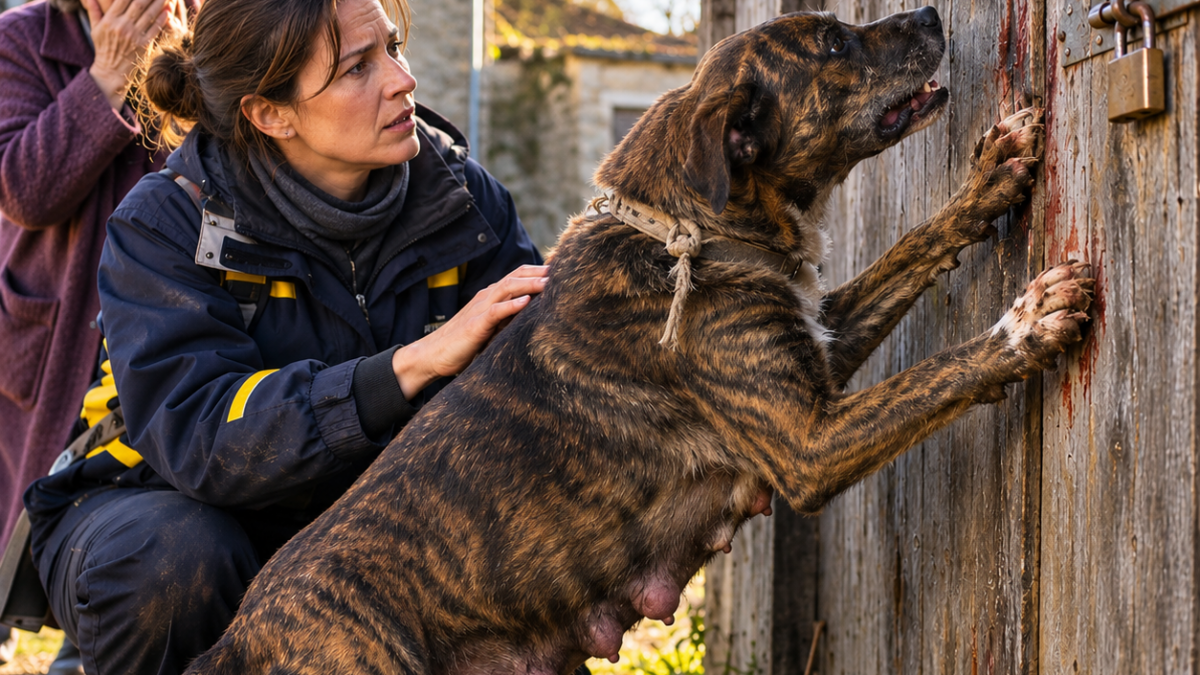
The first time I saw the brindle dog throwing herself against the locked shed door, her paws were already bleeding, two claws had torn loose, and everyone around me kept warning that she was dangerous—but every time she showed her teeth, she backed away from me instead of coming forward, then turned and attacked the wood again as though whatever was behind it mattered more than the pain tearing through her own feet.
The family who had lived there had moved out the previous afternoon, taking their furniture, boxes, appliances, and everything else they apparently considered worth keeping, while leaving the dog tied near the fence with a broken length of rope still hanging from her collar.
But when I noticed her swollen milk glands and heard the first tiny cry coming from behind that newly padlocked door, I stopped wondering why she seemed desperate enough to bite and started wondering how long her babies had been trapped inside without her.
My name is Marion, and I had been delivering mail in a small village in the Allier region for seventeen years.
I knew almost every house on my route.
I knew which dogs barked behind gates, which elderly men waited for the newspaper, and which children raced outside when they heard my van because their parents had ordered something online.
That Tuesday morning, though, I heard a sound I had never heard from a dog before.
At first, I thought she was injured.
She was circling an old shed at the back of an empty property, thin, dusty, and frantic. A torn piece of rope hung from her collar.
When I stopped my van, she spun toward me and growled.
I backed up.
“Easy, girl. I’m not coming closer.”
She stared at me.
Then whined, turned, and went back to the shed.
Scratch.
Scratch.
Scratch.
That was when I saw the red marks on the wood.
Blood.
A window opened next door.
“Careful!” Madame Perrin shouted. “That dog’s been acting crazy since last night!”
“Does she belong here?”
“Yes. The family moved yesterday. Took everything.”
She paused.
“Except her, apparently.”
My stomach tightened.
“You saw them leave her?”
“She was tied by the fence last night. This morning the rope was broken.”
I looked at the dog again.
She had stopped growling.
Her muzzle was pressed against the gap beneath the door.
Then I heard it.
A tiny, sharp cry.
I waited.
It came again.
The dog heard it too.
She reared up and slammed both front paws against the shed.
“Madame Perrin!”
My neighbor hurried into the yard.
We both pressed our ears toward the wood.
Another cry.
Then several.
Madame Perrin covered her mouth.
“Oh no.”
The door was secured with a new padlock.
The property owner lived several miles away. Madame Perrin called him while I contacted a local animal rescue.
A volunteer named Nadia answered.
“You said the female has milk?”
“Yes.”
“And you hear babies?”
“Yes.”
A pause.
“They may be newborns. We need to move fast.”
While we waited, I set down a pot of water.
The dog drank several desperate mouthfuls.
Then immediately returned to the door.
I crouched about six feet away.
“I think I understand.”
She looked at me.
“You don’t want us to take you anywhere.”
Her ears shifted.
“You want us to open that door.”
For the first time, she didn’t bare her teeth.
She just whined.
The property owner arrived before Nadia.
His hands shook as he searched through the keys.
“They returned all the keys yesterday. I had no idea animals were inside.”
“Open it.”
The dog nearly knocked us aside.
Nadia arrived just as the padlock clicked.
“Slowly,” she warned. “She’s protecting her litter. Give her space.”
The door opened.
The dog rushed inside.
The shed smelled of damp wood and dust.
Behind paint cans and old tools sat a laundry basket covered with a wet blanket.
The mother dog buried her muzzle beneath it.
Four tiny puppies squirmed together, eyes still closed, crying as they searched for milk.
“They’re alive,” I whispered.
Nadia moved carefully toward them.
“We need to get them somewhere warm.”
I reached for one corner of the blanket.
Something was caught in a fold.
A fifth puppy.
Much smaller.
Separated from the others.
Still.
Nadia lifted the tiny body in both hands.
She checked the belly.
The mouth.
Then brought it close to her ear.
“Marion, call the clinic.”
My heart dropped.
“Is it alive?”
Nadia didn’t answer immediately.
She looked at me.
“I can’t tell if it’s breathing.”
—
## **[END OF FACEBOOK OPENING — CONTINUE STORY BELOW]**
For a second, everything around me disappeared.
The empty house.
The blood on the shed door.
Madame Perrin crying behind me.
The owner repeating that he had known nothing.
Even the mother dog licking her other four puppies as though she could somehow count them through touch.
All I saw was the tiny body in Nadia’s hands.
“Call,” she said again.
That brought me back.
I dialed the veterinary clinic in the nearest town.
My fingers were shaking badly enough that I entered the wrong number first.
When someone finally answered, I spoke too quickly.
“Five newborn puppies. One isn’t moving. Mother has injuries. They were locked in a shed.”
The receptionist interrupted gently.
“Slow down.”
I forced myself to breathe.
Nadia laid the puppy on a dry towel.
She rubbed the body firmly but carefully.
The puppy’s head looked impossibly small.
Its fur was still soft and sparse enough that I could see pink skin underneath.
The mother suddenly noticed.
She left the basket.
Walked toward Nadia.
Her body stiffened.
Nadia froze.
“Marion, don’t move.”
The dog sniffed the puppy.
Then Nadia’s hands.
A low growl formed in her chest.
Not attack.
Warning.
Fear.
“She needs to see what I’m doing.”
Nadia slowly lowered the towel to the floor.
The mother approached.
Sniffed the tiny puppy.
Licked its face once.
Nothing.
Again.
Still nothing.
Then she looked directly at Nadia.
I will remember that look for the rest of my life.
People love saying animals “ask for help,” and sometimes we project too much into expressions because we need the world to behave like a story.
But I know what I saw.
The dog did not try to take the puppy away.
She stepped back.
One step.
Then sat.
Nadia continued rubbing.
“Come on.”
Madame Perrin whispered:
“Please.”
The puppy’s mouth opened.
Barely.
I leaned closer.
“Did it move?”
Nadia didn’t answer.
She rubbed again.
The chest lifted.
A tiny breath.
Then nothing.
Another.
Nadia’s whole face changed.
“There.”
“What?”
“It’s breathing.”
Madame Perrin burst into tears.
The mother dog immediately leaned forward.
The puppy made the faintest sound.
A squeak.
Nothing more.
But the mother responded instantly.
She licked it.
Nadia picked it up again.
“We still need the clinic now.”
The animal rescue had brought a van.
We moved quickly.
Four puppies in a warm box lined with towels.
The weak fifth puppy wrapped separately against a heating pack.
Mother dog on a blanket in the back.
The problem was getting her into the vehicle.
The moment Nadia approached with a slip lead, the dog backed away.
Teeth.
Growl.
Body low.
Her eyes went from Nadia to the box containing her puppies.
“She thinks we’re taking them.”
“Can we put the box in first?” I asked.
Nadia nodded.
We placed the puppies in the van.
The mother immediately followed to the open doors.
Stopped.
Sniffed.
One puppy cried.
She jumped inside.
No leash required.
Nadia looked at me.
“Sometimes the fastest way to move a mother is to move the babies.”
I climbed into my mail van.
Then stopped.
My route.
Mail.
Packages.
People waiting.
For one absurd second, I actually thought about continuing work.
Routine is powerful.
Madame Perrin saw my hesitation.
“Go.”
“I’m working.”
“Marion.”
“I can’t just disappear.”
She pointed at the rescue van pulling away.
“You absolutely can.”
She was right.
I called my supervisor.
“There’s an emergency.”
“What kind?”
“Dogs.”
Silence.
Then:
“Human emergency?”
“Not exactly.”
Another silence.
I explained.
He sighed.
“Finish later if you can.”
“Thank you.”
“Marion?”
“Yes?”
“Don’t turn this into an adoption.”
“I’m delivering mail, not collecting dogs.”
That sentence aged badly.
At the veterinary clinic, the weak puppy was taken immediately.
The other four were examined with their mother.
That was when we learned how bad her condition really was.
She was severely underweight.
Her paws were torn from clawing the door.
Two nails had been ripped badly enough that the quick was exposed.
The broken rope had rubbed the skin beneath her collar raw.
Her milk glands were full, which meant the puppies had been separated from her long enough for nursing to be interrupted.
The veterinarian, Dr. Fournier, estimated the puppies were less than two weeks old.
“How long could they survive without her?” I asked.
He didn’t give me a clean answer.
“It depends on temperature, hydration, how recently they fed.”
“The shed was cold.”
“I know.”
He looked toward the treatment room.
“They were fortunate you heard them.”
I almost laughed.
Fortunate.
Their family had packed a moving truck, locked five newborn animals inside a shed, tied their mother outside and driven away.
Fortunate felt insulting.
“What kind of person does this?”
Dr. Fournier kept his expression neutral.
“That question is for the investigators.”
Investigators.
Until then, I had been thinking only about rescue.
Door.
Puppies.
Clinic.
Now another part of the story appeared.
Someone had done this.
Not weather.
Not accident.
Not confusion.
A new padlock had been placed on the shed.
The dog had been tied.
The family had left.
That required decisions.
Several of them.
The police and local animal-welfare authorities were contacted.
The property owner came to the clinic too.
His name was Gérard.
He was furious.
“They told me the house was empty.”
“Did you inspect yesterday?” Nadia asked.
“No. They gave me the keys at the agency.”
“Did they say anything about the dog?”
“No.”
“Were pets allowed in the lease?”
“Yes.”
“Did you know she was pregnant?”
Gérard shook his head.
“I barely saw the dog. She was usually outside.”
That sentence stayed with me.
Usually outside.
Dr. Fournier examined the marks around her neck.
“Does she have a name?”
Nobody knew.
Madame Perrin did.
She arrived at the clinic later with my mail bag because apparently she had decided I would not return to work.
“They called her Vega.”
The dog’s ears moved.
Vega.
There.
Something from her old life.
Madame Perrin came closer but stopped at a safe distance.
“Vega?”
The brindle dog looked toward her.
Tail did not move.
But recognition was obvious.
Nadia wrote it down.
“What do you know about the family?”
Madame Perrin became uncomfortable.
“I don’t want trouble.”
“Five puppies were locked in a shed.”
“I know.”
“She was tied outside.”
“I know.”
“We need facts, not gossip.”
Madame Perrin nodded.
The family had moved in eighteen months earlier.
A couple named Stéphane and Élodie.
One teenage son.
Vega lived mostly in the yard.
Sometimes tethered.
Madame Perrin had heard shouting at the dog.
Never seen anyone hit her.
Important distinction.
They had complained when Vega became pregnant because they “didn’t need puppies.”
Did they know when she gave birth?
Madame Perrin believed yes.
She had seen Élodie carrying towels toward the shed three days earlier.
Three days.
My stomach turned.
“When did they move?”
“Yesterday afternoon.”
“So they knew.”
Nadia looked at me.
Maybe.
We still needed evidence.
But the story was becoming darker.
My phone rang.
The veterinary technician.
The fifth puppy.
I stood so fast my chair scraped the floor.
“What?”
She smiled.
“Breathing on its own.”
I pressed one hand over my mouth.
“Is it okay?”
“Not okay. Stable enough to keep trying.”
That was enough.
For now.
They had warmed the puppy gradually.
Given glucose support.
Fluids carefully.
No feeding too aggressively.
The little body had been dangerously cold.
Dr. Fournier warned us:
“The next twelve hours matter.”
Nadia asked:
“Male or female?”
The technician checked.
“Male.”
Madame Perrin said:
“He needs a name.”
Nadia smiled.
“No, he needs oxygen.”
I said:
“Then oxygen first.”
But in my head, I had already called him Petit Cinq.
Number Five.
Terrible name.
Still.
That evening, I finally went home.
I had been awake since six.
My clothes smelled like wet dog, shed dust and clinic disinfectant.
I sat at my kitchen table.
The image I could not stop seeing was not the weak puppy.
It was Vega at the shed.
Bleeding paws.
Teeth showing.
Everyone saying dangerous.
She had been doing the only thing available to her.
Door locked.
Puppies crying.
Hands approaching.
Of course she growled.
Fear is not the same as aggression.
Desperation is not the same as danger.
The next morning, Nadia called before seven.
“Number Five made it through the night.”
“You’re calling him that too?”
“Unfortunately.”
I laughed.
“How’s Vega?”
“Would you like the diplomatic version?”
“No.”
“She hates everyone.”
“Fair.”
“She nurses the puppies if we leave the room quiet, but if anyone enters too quickly, she stands over them.”
“Can I see her?”
Silence.
Then:
“You’re not trained.”
“I deliver mail to dogs every day.”
“That sentence makes me less confident.”
“I’m serious.”
“Come at ten.”
I did.
Vega was in a quiet recovery room with the four stronger puppies.
Number Five remained in neonatal care.
When I entered, she stood.
Growl.
I stopped.
“Hi, Vega.”
Her body remained tense.
I sat on the floor near the door.
No movement toward her.
No eye contact for too long.
Nothing dramatic.
I talked.
About my route.
About Madame Perrin.
About the ridiculous fact that I now knew more about dog milk production than I had twenty-four hours earlier.
Vega listened.
Or ignored me.
After ten minutes, she lay down.
After twenty, one puppy began nursing.
After thirty, her eyes closed.
Nadia whispered from the doorway:
“That’s good.”
“What?”
“She slept with you in the room.”
I looked at Vega.
“That’s trust?”
“That is exhaustion plus slightly less fear.”
Good enough.
Number Five improved slowly.
Two days later, he rejoined the litter under supervision.
That reunion almost destroyed me.
Vega heard his tiny cries before she saw him.
She stood.
Nadia carried him in.
The mother sniffed.
Licked his head.
Then his belly.
Then began licking so frantically that Nadia had to slow her.
The puppy found a teat.
Latched.
Vega lay completely still.
Her eyes stayed on him.
“Does she know he was missing?” I asked.
Nadia smiled sadly.
“She knew one puppy was gone.”
That was enough.
We renamed him Milo because everyone refused to let “Number Five” become permanent.
The others were three females and one male.
Nadia called them Poppy, Iris, Nox and Bean.
I did not ask why Bean.
Some rescue decisions should remain unexplained.
The investigation moved quickly.
Stéphane and Élodie were contacted.
At first they denied intentionally abandoning the animals.
Their version:
Vega had “broken loose.”
The puppies had been placed in the shed temporarily.
They believed the landlord would find them.
Nobody believed that explanation immediately.
But belief is not evidence.
So investigators gathered it.
The new padlock.
Photographs from Gérard showing the property handover time.
Text messages from the tenants confirming they had “cleared everything.”
Statements from Madame Perrin.
Veterinary evidence showing Vega had been tethered recently.
The strongest piece came unexpectedly.
Their teenage son.
He contacted Nadia through social media.
His name was Lucas.
Sixteen.
He wrote:
**Please don’t blame the dog. She tried to get back to them.**
Nadia showed me only after authorities had already received the message.
Lucas said his parents did not want the litter.
They planned to “deal with the puppies later.”
When moving day came, they locked the puppies in the shed because Vega kept trying to stay with them instead of getting into the car.
Then his father tied Vega near the fence.
Lucas asked what would happen to her.
His father allegedly said:
“The landlord can call someone.”
They left.
Lucas had secretly loosened the rope before getting into the car.
Not enough to free Vega immediately.
Enough, perhaps, that she eventually broke it.
I stared at the message.
“He tried.”
Nadia nodded.
“He’s a child.”
“Sixteen.”
“Still dependent on them.”
I thought about Vega pulling against that rope.
The frayed end.
Lucas may have been the reason she reached the shed door.
That mattered.
The legal case would belong to authorities.
I did not need every detail.
But I needed to stop imagining all three members of that family as identical villains.
Humans are rarely arranged that conveniently.
Lucas came to the clinic once.
Without his parents.
His aunt brought him.
Vega recognized him immediately.
The reaction frightened me.
She stood.
Tail moving.
Then cried.
Not bark.
Not growl.
A high, trembling sound.
Lucas dropped to his knees.
“Vega.”
Nadia warned:
“Let her come.”
She did.
Vega crossed the room.
Pressed into him.
Lucas buried his face in her neck.
“I’m sorry.”
He cried.
“I’m so sorry.”
Vega licked his ear.
That destroyed every person watching.
Lucas asked:
“Are the puppies okay?”
Nadia showed him.
Milo was still the smallest.
Lucas touched his back with one finger.
“My dad said they would be fine.”
Nobody answered.
He knew.
Afterward, Lucas gave a formal statement.
That changed the case substantially.
His parents became furious.
They accused the rescue of manipulating him.
They demanded Vega back.
That was the moment my anger became something sharper.
Not because they wanted “their property.”
Because Vega had finally begun recovering.
Her paws were healing.
She had stopped guarding every doorway.
She allowed Nadia to touch the puppies.
She had begun accepting food from my hand.
Then a legal question threatened to drag her backward.
“Can they get her?” I asked.
Nadia remained careful.
“There’s an active neglect investigation.”
“But can they?”
“Not today.”
I hated legal language.
“What about later?”
“It depends on the findings and surrender status.”
“They abandoned her.”
“They dispute that.”
“They tied her outside!”
“We know.”
“They locked puppies inside!”
“We know.”
I stood.
Vega lifted her head.
Nadia lowered her voice.
“Marion, anger is not useful to her right now.”
That annoyed me because it was true.
“What is useful?”
“Consistency.”
So I gave her that.
I visited every day after work.
Same time.
Same chair.
Same calm voice.
Sometimes I brought mail-route stories.
Madame Perrin became a character in Vega’s recovery without being present.
“Today she accused me of bending her magazine.”
Vega chewed a treat.
“She bends it herself.”
Tail movement.
Tiny.
The first time Vega voluntarily crossed the room and rested her head on my knee, I did not touch her immediately.
I wanted to.
God, I wanted to.
But trust is not a reward humans collect the instant it appears.
I waited.
She pushed harder.
Then I stroked the side of her neck.
Not the top of her head.
One slow movement.
Vega exhaled.
That was the beginning.
The puppies grew.
Eyes opened.
Legs became usable in theory before coordination caught up.
Bean walked like furniture falling down stairs.
Poppy screamed whenever separated from milk by more than six inches.
Nox became an escape artist.
Iris slept through everything.
Milo remained smaller.
But strong.
He survived.
When he first opened his eyes, I cried harder than any reasonable adult should cry over eyelids.
Nadia laughed.
“You’re doomed.”
“For what?”
“You know.”
“I’m not adopting five puppies.”
“I didn’t say five.”
“No.”
“What about Vega?”
I stopped.
Nadia smiled.
“I didn’t ask.”
Good.
Because I had no answer.
My life was not designed for a large dog.
I worked long hours.
My yard was fenced but small.
Vega had unknown trauma.
She was protective.
Strong.
Older than she looked.
Probably five or six, Dr. Fournier estimated.
And I had spent seventeen years giving mail to people who made emotional decisions about dogs and then regretted them.
I refused to become one.
So I said:
“No.”
Nadia nodded.
“Okay.”
That was all.
No pressure.
Vega moved into an experienced foster home after the puppies were weaned.
Her foster, Claire—not to be confused with anyone else in my life—lived on a small farm.
No children.
Secure fencing.
Two calm older dogs.
Vega struggled the first week.
She guarded doors.
Paced at night.
Panicked if anyone closed an interior room between her and the rest of the house.
The shed had left something in her.
Door closes.
Babies disappear.
No.
Claire learned to announce movement.
Leave doors open where safe.
Never trap her with bodies.
No sudden grabs.
Vega improved.
I missed her.
That surprised me.
The mail route felt wrong.
I would pass the empty house.
The shed had been cleared by Gérard after investigators documented it.
One day I stopped.
The blood stains were gone.
Rain had washed them.
The padlock was gone too.
Nothing dramatic remained.
Just old wood.
I stood there longer than necessary.
Madame Perrin opened her window.
“You miss her.”
“No.”
“You’re a terrible liar.”
“Go inside.”
“I am inside.”
Right.
The puppies were adopted carefully.
Not immediately.
The rescue insisted on good matches.
Poppy went to a couple with a fenced garden.
Bean went to a veterinary technician.
Nox to a family experienced with high-energy dogs.
Iris to a quiet household with another adult dog.
Milo stayed longest because of early health concerns.
Then Lucas asked if he could adopt him.
Everyone froze.
He was sixteen.
Living with his aunt temporarily because his relationship with his parents had deteriorated after the investigation.
His aunt supported the idea.
Nadia said:
“Not because of guilt.”
Lucas nodded.
“I know.”
“Not as a replacement for Vega.”
“I know.”
“You understand puppies are work?”
“I know.”
Nadia stared.
“Stop saying you know.”
Lucas almost smiled.
“I don’t know. But I’ll learn.”
Better.
The aunt completed the application.
Home check.
Veterinary plan.
Backup care.
Milo went with Lucas.
That felt right.
The smallest puppy, the one who almost did not breathe, became the one part of the litter connected to a boy who had tried, however imperfectly, to help their mother escape.
Life rarely repairs itself symmetrically.
This came close.
The legal case against Stéphane and Élodie moved forward.
I will not pretend the outcome was cinematic.
No judge slammed a fist.
No crowd cheered.
But there were consequences.
Animal abandonment and neglect findings.
Fines.
Restrictions on future animal ownership for a period set through the case.
Responsibility for part of the veterinary costs.
Their landlord pursued separate damages for the property.
None of that felt like enough when I remembered Vega’s torn claws.
Then one afternoon, Nadia said:
“What would enough look like?”
I didn’t answer.
Because I knew.
I wanted them to feel exactly what Vega felt.
Powerless.
Unable to reach what they loved.
Terrified.
That desire frightened me.
I did not like that part of myself.
Nadia said:
“Punishment is not the same thing as repair.”
“I know.”
“Do you?”
I looked at her.
“What is repair?”
She pointed toward the exercise yard.
Vega was there.
Running.
Not beautifully.
She had a weird sideways gait when excited.
Claire, the foster, threw a toy.
Vega chased it.
Tail up.
Body loose.
No door.
No rope.
“That.”
Nadia said.
That.
I understood.
The people who abandoned Vega did not need to become the center of her story forever.
The best revenge was making them smaller.
Not through violence.
Through everything that came after.
Safety.
Food.
Medical care.
Puppies alive.
Trust rebuilt.
A life so full that the locked shed became one chapter instead of the title.
That was when I started considering adoption seriously.
Not because of revenge.
Because every time I visited Vega, she left everyone else and came to me.
Not dramatically.
Sometimes she simply sat near my chair.
Sometimes rested one paw on my shoe.
Once she stole my glove.
That felt intimate.
Still, I did not trust emotion alone.
I talked to Dr. Fournier.
Nadia.
Claire.
My supervisor.
My neighbor.
I made plans.
Dog walker on long route days.
Secure yard improvements.
A quiet room.
Insurance.
Training support.
Veterinary budget.
Backup person if I became ill.
Responsible love is less romantic than people think.
Lots of spreadsheets.
Then I asked Nadia:
“Would she even be happier with me than with Claire?”
Excellent question.
That hurt.
Claire’s farm was peaceful.
Vega liked the other dogs.
She slept well.
Maybe love meant leaving her there.
Claire answered before Nadia did.
“She waits at my gate around the time you usually visit.”
My heart moved.
“She does?”
“Yes.”
“That doesn’t mean—”
“No.”
Claire smiled.
“But it means something.”
We tried weekends.
Vega came to my house Friday evening.
The first entry was difficult.
She froze at the front door.
Of course.
Thresholds.
I opened it wide.
Then walked away.
No pulling.
No coaxing.
Vega sniffed.
One paw inside.
Back.
Again.
Then entered.
That first night, she slept in the hallway.
Not my bedroom.
Not the dog bed.
Hallway.
Positioned where she could see both the front door and the door to the room I was in.
Control.
Information.
Safety.
Fine.
At two in the morning, I got up for water.
Vega stood instantly.
“Kitchen.”
I felt ridiculous announcing myself.
Then remembered why.
She followed.
No panic.
Back to bed.
Second weekend, she slept closer to the bedroom.
Third, in the doorway.
Fourth, on the bed I had placed just inside.
Progress measured in feet.
The empty house on my mail route eventually got new tenants.
A young couple with a baby.
They removed the old shed completely.
Good.
I did not want another family using it.
The first morning I delivered mail there, Vega was in my car because we had a veterinary appointment afterward.
She saw the property.
Stiffened.
I stopped.
Should I continue driving?
Yes.
She did not need exposure forced by symbolism.
I delivered the mail.
Returned.
Vega was calm again.
That was enough.
Three months after the rescue, I signed the adoption paperwork.
Name:
**Vega.**
No change.
She already had a name that belonged to her before the bad ending.
I did not need to rename her to claim a new beginning.
Nadia handed me the leash.
“You sure?”
“No.”
She laughed.
“Good.”
“Why good?”
“People who are sure about everything worry me.”
Fair.
Vega walked to my car.
Stopped.
Looked back at Nadia.
Then Claire.
Both women crouched.
Vega returned.
Touched each one.
Then came back to me.
My throat closed.
“No speeches,” Nadia warned.
“I wasn’t.”
“You were about to.”
Correct.
Vega came home.
For real.
The first months were not easy.
Important.
Because rescue stories become dishonest when adoption is treated like credits rolling.
Vega had separation anxiety.
Not extreme, but real.
Closed doors triggered her.
Being left alone longer than thirty minutes initially caused pacing.
She guarded food for the first few weeks.
She disliked men entering quickly.
The mail bag frightened her.
That one was inconvenient.
My job literally came home on me.
We worked with a behavior professional.
No punishment for growling.
Growl is information.
We respected it.
Built distance.
Used routine.
Gradual departures.
Predictable returns.
Food games.
Rest.
No forcing.
She improved.
Slowly.
Then faster.
Six months after adoption, I could leave for work.
A dog walker came midday.
Vega slept.
No pacing.
No destroyed door.
No blood.
That was victory.
She also became ridiculous.
She loved pears.
Hated bananas.
Stole oven mitts.
Barked at umbrellas.
Refused to walk through puddles despite having once lived outdoors.
She slept upside down with all four legs in impossible directions.
A dangerous dog.
Terrifying.
Madame Perrin became obsessed with her.
Every morning when I delivered mail, Vega sometimes came on my day off.
Madame Perrin would open her gate.
“Where’s my girl?”
“Your girl?”
“I knew her first.”
“You called her crazy.”
“I was misinformed.”
Revisionist history.
Vega loved her.
One afternoon, Lucas came with Milo.
Milo was nearly a year old.
Long legs.
Brindle markings mixed with white.
He looked nothing like the tiny still body in Nadia’s hands.
Vega saw him.
Stopped.
Milo approached too fast.
She corrected him with one sharp growl.
He stopped.
Then moved carefully.
They sniffed.
For a second, I wanted a dramatic recognition.
Mother and son reunited.
Music.
Tears.
Reality was better.
Vega sniffed him.
Accepted him.
Then stole his toy.
Lucas laughed.
“She remembers.”
Maybe.
Maybe not.
What mattered was that both were alive.
Together in sunlight.
No locked door.
Lucas sat beside me.
“My parents hate me.”
I looked at him.
“That’s a big sentence.”
“They say I betrayed them.”
“You told the truth.”
“I know.”
“Truth can still cost something.”
He looked at Vega.
“Was I wrong?”
“No.”
No hesitation.
“You were not wrong to tell people animals were trapped and abandoned.”
He cried quietly.
“I should have done more before we left.”
“You loosened her rope.”
“Not enough.”
“You were sixteen.”
“I could have called someone.”
“Yes.”
He looked at me, shocked by the agreement.
I continued:
“You could have.”
He wiped his face.
“But the question is what you do with knowing that now.”
He looked at Milo.
“I take care of him.”
“Good start.”
That conversation reminded me of my own guilt.
I had driven routes for years.
Seen dogs tied outside.
Seen thin animals.
Seen things I told myself were not technically my business.
Most were probably fine.
Some maybe not.
Vega changed my threshold for noticing.
Not reporting every barking dog.
Not becoming suspicious of everyone.
Just asking one more question when something felt wrong.
Is the dog safe?
Is there water?
Is the tether appropriate?
Has anyone seen the owner?
Small attention.
Not heroic.
Useful.
A year after Vega’s rescue, I delivered a registered letter to Stéphane and Élodie’s new address.
I almost asked my supervisor to reassign it.
Then decided no.
Work was work.
I drove there.
Vega was not with me.
Good.
Stéphane opened the door.
Recognized me.
His face hardened.
“You.”
“Registered mail.”
He stared.
I held out the scanner.
“Sign.”
He signed.
I should have left.
Then he said:
“You people destroyed my family over a dog.”
I stopped.
There it was.
The invitation.
Drama.
Conflict.
Everything inside me wanted to respond.
So I did.
“No.”
He glared.
“You turned my son against me.”
“No.”
“That association filled his head—”
“No.”
He stepped forward.
I did not move.
“You locked newborn puppies in a shed.”
His jaw tightened.
“They were fine.”
“One was barely breathing.”
“He lived.”
“Because people found him.”
“We were coming back.”
I stared.
“When?”
Silence.
There.
I did not need more.
I said:
“Your son did not betray you by telling the truth.”
His face changed.
“You don’t know anything about my family.”
“That is correct.”
I handed him the receipt.
“But I know what I saw.”
Blood on wood.
Torn claws.
Milk-heavy body.
Five puppies.
Locked door.
I turned.
Stéphane called after me:
“How is she?”
I stopped.
That surprised me.
He looked away.
“Vega.”
I thought carefully.
“Safe.”
He nodded once.
That was all.
I left.
No screaming.
No revenge speech.
No humiliation.
But when I got back into my van, I realized something.
He would have to live with the answer.
Safe.
Somewhere else.
Because other people had given her what he did not.
That was enough.
Years passed.
Vega turned gray around the muzzle.
Then more.
Dr. Fournier estimated she was around nine when I adopted her, but age in rescue dogs is sometimes a guess.
She developed arthritis.
Not surprising.
The old injuries in her paws caused occasional sensitivity in cold weather.
I bought rugs.
A ramp.
Joint medication.
Long walks became shorter.
She remained deeply suspicious of bananas.
Some things survive age.
Milo visited every few months.
Lucas became an adult.
He moved into a small apartment with a yard outside Clermont.
Milo went with him.
The relationship with his parents remained complicated.
Not completely broken.
Not repaired.
Life rarely gives perfect reconciliation.
But Lucas kept his dog.
Loved him.
That mattered.
He eventually volunteered with the same rescue that saved Vega.
At first cleaning.
Then transporting.
Nadia told me:
“He’s good with frightened dogs.”
I smiled.
“He knows what fear looks like.”
Vega became a kind of quiet legend in the village.
Not because of newspapers.
There was one article, but I hated it.
**ABANDONED MOTHER DOG BREAKS HER CLAWS TRYING TO REACH PUPPIES.**
True.
Still reduced her to the worst day.
I preferred what people knew later.
Vega who stole Madame Perrin’s gardening gloves.
Vega who waited outside the bakery.
Vega who hated thunder but loved lying under the kitchen table during storms.
Vega who leaned against children but distrusted adults who approached too fast.
Vega.
Not “the abandoned dog.”
That is how rescue succeeds.
When the old label becomes insufficient.
At twelve or thirteen, her hearing began fading.
I learned hand signals.
At fourteen, stairs became difficult.
I moved her bed downstairs.
At some point, without noticing exactly when, the dog who once positioned herself where she could watch every exit began sleeping deeply enough that I could leave the room without waking her.
That may have been the biggest sign of trust.
Not affection.
Sleep.
Vega believed the house would still exist when she opened her eyes.
I thought about that often.
The locked shed taught her one kind of door.
Our home taught another.
One winter, Madame Perrin died.
Eighty-eight.
Peacefully.
Vega waited at her gate on my next route because habit had not received the news.
I stood beside her.
“No one’s coming out.”
Vega looked at the door.
I cried.
Madame Perrin’s daughter later gave me an old casserole pot.
“The one she used to bring Vega water.”
I remembered.
The first day.
Before the shed opened.
Vega drinking quickly.
Then running back to her puppies.
I kept the pot.
Not as a memorial display.
I used it for garden water.
Objects are healthier when they keep working.
Vega grew older.
Eventually Dr. Fournier started the conversation.
Quality of life.
I hated him for being predictable.
He had done this long enough to know.
Food.
Sleep.
Mobility.
Pain.
Interest.
Connection.
Good days.
Bad.
For another year, good won.
Then the balance changed.
Slowly.
She ate breakfast but skipped dinner.
Then ate both.
Then no breakfast.
Arthritis worsened.
Some mornings she could not stand without help.
I used a sling.
She hated it.
Growled the first time.
I stopped.
Talked.
Tried again.
Consent still mattered at the end.
Eventually she understood the sling meant movement, not restraint.
That distinction was important for a dog with rope scars.
She accepted.
One morning, Lucas came with Milo.
Milo was old too now.
Gray.
Slower.
Mother and son.
If you want to call them that.
They lay in the garden several feet apart.
No dramatic closeness.
Vega slept.
Milo slept.
Lucas sat beside me.
“She saved him.”
“Yes.”
“And he helped save me.”
I looked at him.
“How?”
“He gave me someone to take care of when everything with my parents was falling apart.”
Fair.
Vega moved one paw in her sleep.
Lucas smiled.
“She saved a lot of us.”
I disagreed gently.
“She didn’t do that on purpose.”
“No.”
“She was trying to get to her puppies.”
“I know.”
“Sometimes people turn animals into saints because it makes the story cleaner.”
Lucas thought.
“What was she then?”
I looked at Vega.
“A mother.”
That was enough.
The final crisis came in early spring.
Vega stopped eating.
Not picky.
Stopped.
Drank little.
Could barely stand.
Her breathing became shallow when she moved.
Dr. Fournier came to the house.
Bloodwork had already shown kidney decline.
Now the body was failing more generally.
Could we hospitalize?
Yes.
Could fluids help?
Possibly.
Could we gain time?
Maybe.
Good time?
He could not promise.
I sat beside Vega.
She was on the rug near the back door.
Her eyes followed me.
Still.
Always.
I touched her shoulder.
She leaned into my palm.
No teeth.
No warning.
That made me cry harder than anything.
The first morning, she had shown me teeth because she did not know what my hands meant.
Years later, she no longer needed to ask.
She knew.
Safe.
Dr. Fournier said:
“You don’t have to decide this second.”
I looked at Vega.
She tried to stand when I moved.
Failed.
Still tried again.
I remembered the shed.
Scratch.
Scratch.
Scratch.
Body hurting.
Still trying.
“No.”
“What?”
“I don’t want her last act to be trying until she injures herself because she thinks she has to follow me.”
He understood.
“We can do it here.”
“Yes.”
I called Nadia.
Lucas.
No crowd.
Just people who belonged.
Nadia arrived first.
She was older.
So was I.
We sat on the floor.
Vega sniffed her hand.
Tail moved once.
“Do you remember me?” Nadia asked.
I laughed through tears.
“Don’t start.”
“Let me be sentimental.”
Fine.
Lucas came with Milo but left him outside at first.
Vega lifted her head at Lucas’s voice.
He knelt.
“Hey, girl.”
She sniffed him.
Then relaxed.
He cried.
“I’m sorry.”
I touched his arm.
“Not today.”
“I never stopped being sorry.”
“I know.”
“Then when?”
“What?”
“When do I stop?”
I looked at Vega.
“Maybe when sorry has already changed what you do.”
He stared.
“You helped her rope break.”
His face folded.
“You told the truth.”
He cried.
“You gave Milo a life.”
I squeezed his hand.
“Guilt is only useful if it eventually becomes care.”
He nodded.
That was all.
Before the veterinarian prepared the sedative, I did one thing.
I opened every interior door downstairs.
Kitchen.
Hall.
Back room.
Bedroom.
Not because Vega cared about symbolism.
Because I did.
The first image I had of her was a locked shed door.
The last would not be.
The back door remained open too.
Spring air.
Grass.
Birds.
No rope.
No padlock.
No puppies crying.
Nothing she had to reach.
I lay beside her.
“You were terrifying.”
Nadia laughed.
Vega breathed.
“You showed me all your teeth.”
Tail.
Barely.
“And I thought you wanted to bite me.”
I touched the healed paw.
“You were just trying to get back in.”
My voice broke.
“Back to them.”
Vega’s eyes closed halfway.
“You did.”
The first medication relaxed her.
Her muscles softened.
For a dog who spent so much of her life braced for the next closed door, seeing her body release was almost unbearable.
Lucas whispered:
“Milo’s outside.”
I looked at Vega.
“Bring him.”
Milo came in slowly.
Old dog.
Gray.
He approached.
Sniffed Vega.
Then lay down several feet away.
No cinematic embrace.
Just presence.
Better.
Nadia said:
“All five made it.”
I looked at her.
She continued:
“Poppy is still with her family. Iris too. Nox moved with his owners last year. Bean is healthy. Milo…”
Lucas touched his dog.
“All five.”
That was the ending Vega deserved to hear, even if the words meant nothing to her.
Every puppy lived.
Every puppy reached adulthood.
The locked shed failed.
The abandonment failed.
The cold failed.
Fear failed to become her whole life.
That was revenge.
I whispered:
“They all made it.”
Vega exhaled.
Dr. Fournier waited.
I nodded.
The final medication was given.
Vega took one slow breath.
Then another.
Then stopped.
Her head remained in my hand.
The doors remained open.
For a while, nobody spoke.
Then Milo stood.
Sniffed her.
Looked at Lucas.
Walked back outside.
Animals are sometimes better at accepting what has happened because they do not need language to argue with finality.
We humans stayed on the floor.
After cremation, I kept Vega’s ashes for several months.
I did not know what to do.
The obvious place would have been near the old property.
Absolutely not.
That place had already taken enough meaning.
Instead, I chose my garden.
Near the back door.
The door she eventually learned could close without trapping anything she loved.
Lucas came.
Nadia.
Milo.
We buried the ashes beneath a small tree.
No dramatic plaque.
Only a stone:
**VEGA**
Then, beneath:
**SHE KEPT TRYING UNTIL SOMEONE OPENED THE DOOR.**
Nadia said it was sentimental.
I reminded her of every sentimental thing she had ever said.
She stopped.
The rescue later used Vega’s case in training.
Not as “hero mother dog.”
As a behavior example.
Growling near trapped offspring does not automatically equal offensive aggression.
Maternal protection.
Pain.
Fear.
Barrier frustration.
Context matters.
That made me proud.
Not that Vega became educational material.
That fewer frightened dogs might be misread because someone remembered her.
The property owner, Gérard, replaced the old shed with an open-sided storage structure.
No lockable enclosed space.
When I delivered mail there years later, he said:
“I still think about that day.”
“So do I.”
“I should have inspected when they returned the keys.”
“Yes.”
He looked surprised.
I was done protecting everyone from honest answers.
He nodded.
“I know.”
Then:
“I inspect now.”
Good.
That was the pattern.
People changed.
Not everyone.
Not perfectly.
But enough.
Stéphane and Élodie eventually moved again.
I heard through village gossip.
I did not care.
Then one day, years after Vega’s death, I saw Élodie at a supermarket.
She recognized me.
We both stopped.
No dog.
No court.
No witnesses.
She looked older.
So did I.
She said:
“I saw the article when Vega died.”
I waited.
“I didn’t know she lived that long.”
“She did.”
“Was she happy?”
The question irritated me.
Then saddened me.
“Yes.”
Élodie nodded.
She looked at the floor.
“I was afraid you’d say no.”
I said nothing.
“I think about the puppies.”
“Good.”
She flinched.
Harsh.
True.
Then she whispered:
“I’m sorry.”
There are apologies that repair relationships.
This was not one.
Vega was gone.
The puppies had grown.
Lucas had done the brave part.
What was I supposed to do with sorry?
So I said:
“I hope you never do anything like that again.”
“I won’t.”
“That’s what matters.”
I left.
No forgiveness speech.
No cruelty.
No victory.
Just a boundary.
I understood something afterward.
Revenge had become irrelevant.
The life Vega got was already larger than the people who abandoned her.
They could regret forever.
It would not increase one good day she had.
The useful thing was prevention.
Change.
Truth.
Years later, Milo died at fourteen.
Lucas called me.
I drove to his house.
He was thirty by then.
Hard to believe.
Milo lay on a blanket.
Old.
White around the face.
The puppy who once fit in Nadia’s hands.
Lucas said:
“He’s the last one I know about directly.”
“What?”
“I lost contact with some of the other families.”
I understood.
He held Milo’s paw.
“Do you think Vega remembered him when she died?”
“I don’t know.”
Lucas smiled sadly.
“You never give easy answers.”
“No.”
“Still.”
I looked at Milo.
“I know she tried to reach all of them when they needed her.”
That was enough.
After Milo died, Lucas gave me something.
The old piece of rope from Vega’s collar.
I stared.
“Why do you have this?”
“Nadia kept it in the case file. When records were archived, she gave it to me.”
“Why would anyone keep this?”
“I don’t know.”
He held it out.
“Do you want it?”
“No.”
He looked surprised.
“Throw it away.”
“Really?”
“Yes.”
“The plaque—”
“Keep photographs. Keep her collar from later. Keep something from the life she had.”
I touched the frayed rope.
“Not this.”
Lucas nodded.
We cut it into pieces and threw it away.
That felt better than preserving it.
Not every artifact deserves memory.
Some things can end.
The red collar I bought Vega after adoption?
That I kept.
Soft.
Wide.
No pressure marks.
Name tag.
My phone number.
Home.
I still have it.
Sometimes people who hear the story ask what happened to the family who abandoned her.
I tell them briefly.
There were consequences.
Then I change the subject.
Because the real story is not theirs.
It is the brindle dog.
Bleeding paws.
Milk swollen in her body.
Locked door.
Five puppies.
One barely breathing.
Then years.
Garden.
Food.
Sleep.
Trust.
A front door she no longer feared.
That is the part worth carrying.
I also tell people something they do not always like.
The first warning was not her teeth.
The first warning was the situation.
A dog who normally had a home was alone.
A rope broken.
Milk.
Blood.
Obsessive scratching at one door.
Behavior has context.
Had I listened only to the neighbor shouting:
“She’s gone crazy!”
Maybe I would have called someone and stayed in my van.
Maybe help would still have arrived.
Maybe not quickly enough for Milo.
That thought still chills me.
Fear makes people simplify.
Aggressive.
Dangerous.
Crazy.
Bad dog.
Those labels feel safer because they tell us what to do.
Stay away.
Control.
Remove.
Vega taught me to look one step deeper.
What is the dog trying to protect?
What happened before this?
Where is the pain?
What changed?
Sometimes the teeth are not the story.
Sometimes the locked door is.
Years after I retired from mail delivery, I still walked through the village.
Old habits.
Madame Perrin’s house belonged to another family.
Gérard’s property had changed completely.
The shed was gone.
The yard brighter.
Children played there.
One afternoon, I passed and heard scratching from behind a wooden gate.
My body stopped before my brain did.
A dog.
Scratch.
Scratch.
Scratch.
I almost laughed at myself.
Then the gate opened.
A young spaniel ran out carrying a ball.
His owner followed.
“Sorry!”
“No problem.”
The dog dropped the ball.
I threw it once.
He brought it back.
Normal.
No emergency.
Good.
I continued walking.
That is what I wanted Vega’s legacy to become.
Not permanent fear.
Better attention.
Not assuming every scratch hides tragedy.
But knowing enough to check when the pieces do not fit.
When I think of Vega now, I rarely see the shed.
That took years.
At first, it was always the wood.
Blood.
Padlock.
Nadia holding Milo.
Eventually other memories outnumbered it.
Vega sleeping in the hallway.
Vega stealing pears.
Vega refusing bananas.
Vega lying beneath my kitchen table during thunder.
Vega sleeping so deeply she did not hear me leave a room.
That last one may be my favorite.
Trust is sometimes boring.
It looks like an animal unconscious on a rug because nothing in the house needs monitoring.
No puppies behind doors.
No rope tightening.
No humans disappearing.
Just sleep.
After everything, Vega got to be boring.
That may be the most satisfying ending I can give you.
The dog everyone feared would bite became the dog who slept through the mailman.
The mother abandoned outside a locked shed lived long enough to grow old inside a home.
The five newborn puppies everyone might have lost before anyone even knew they existed grew up.
The smallest became a gray-faced old dog beside the boy who once loosened his mother’s rope.
The people responsible faced consequences.
The people who failed to notice learned to notice faster.
And I—who spent years thinking my job was simply to deliver what belonged at each address—learned that sometimes the most important thing on your route is the thing no one asked you to carry.
A bowl of water.
A phone call.
A witness.
A door opened in time.
On the morning Vega died, every door downstairs was open.
That detail still matters to me.
Not because I think she understood symbolism.
She was a dog.
She understood patterns.
And the final pattern of her life was simple:
Doors opened.
People came back.
Hands became safe.
Food stayed.
Home stayed.
No one drove away without her.
That is how she got her revenge.
Not by hurting the people who abandoned her.
By living long enough that abandonment became the smallest part of who she was.
And whenever someone tells me, “Be careful, that dog might bite,” I still respect the warning.
But I also remember Vega.
Then I ask myself one more question before deciding what I’m looking at:
**What is she trying so desperately to tell us?**








