They Left a Puppy to Di3 in a Pit of Black Tar—Then I Saw What Was Hanging From His Neck
part 2
The first rescuer reached me carrying a red emergency bag.
Her name was Mara.
Two others followed with blankets, a plastic transport board, gloves, solvent-safe containers, and a small oxygen kit.
Mara looked into the pit.
Her face changed immediately.
“How long has he been like this?”
“I don’t know.”
“You touch him?”
“Only the tag.”
“Good.”
She crouched.
The puppy’s eyes shifted toward her.
“Hey, baby.”
He made no sound.
That frightened me more than the whimpering had.
Mara touched the material near the edge of the pit with a gloved finger.
“It’s not fresh road tar.”
“What is it?”
“Looks like roofing bitumen or construction waterproofing compound. Could be mixed with old oil.”
“Can you get him out?”
She didn’t answer immediately.
Instead she called the veterinarian who worked with their rescue group.
They spoke for several minutes.
Then Mara looked at the two people behind her.
“We lift the whole section.”
I frowned.
“The whole section of what?”
“Everything around him that will move.”
Trying to pull the puppy directly out of the hardened material could rip away fur and skin.
So instead, they worked around him.
One rescuer used a flat tool to loosen the sticky mass from the soil underneath.
Another supported the puppy’s head.
Mara kept talking to him.
“Good boy.”
He didn’t move.
“You’re doing fine.”
They worked inch by inch.
I stood beside them feeling useless.
Finally Mara looked at me.
“Hold this.”
She gave me an oxygen mask.
“Don’t press it onto his face. Just keep it close.”
I knelt.
“Hey.”
His eyes met mine.
“It’s me again.”
One of his eyelids was starting to droop.
“No. Stay awake.”
Mara glanced at me.
“Keep talking.”
I talked.
I told him about completely meaningless things.
My drive home.
The coffee I’d spilled that morning.
My neighbor’s terrible lawn decorations.
Anything that kept my own voice from shaking.
After almost twenty minutes, the entire section beneath him began to lift.
“Ready?”
Three rescuers raised the makeshift support board.
The puppy came with it.
He didn’t cry.
His entire body was stiff inside the black coating.
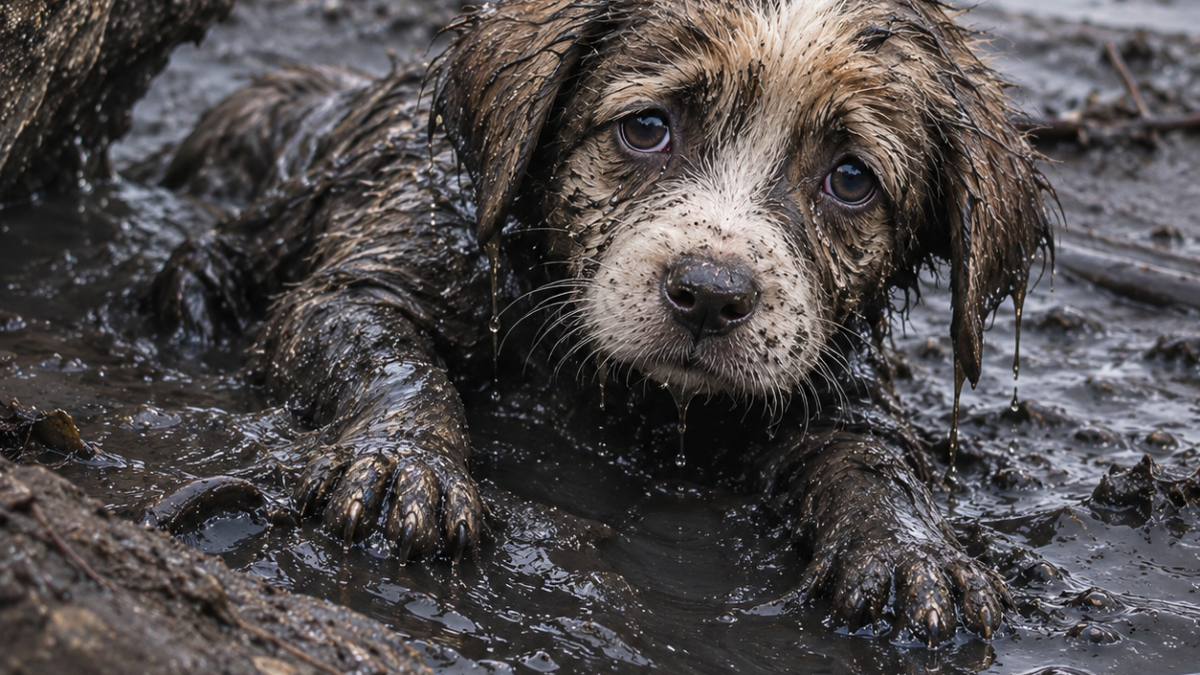
The image was horrifying.
He looked less like an animal than something carved from asphalt.
But his eyes were alive.
That was enough.
They placed him in the back of the rescue van.
Mara climbed in.
I stood outside.
“Can I follow?”
She looked surprised.
“You don’t have to.”
“I know.”
Then she nodded.
“Follow us.”
The veterinary hospital was twelve minutes away.
It felt like an hour.
I don’t remember stopping at traffic lights.
I remember staring at the rescue van ahead of me and thinking one thing over and over.
Don’t let those doors open before we get there.
Because I was terrified they would pull over.
Terrified Mara would step out.
Terrified I’d see that expression people get when there is nothing left to save.
But the van kept moving.
At the clinic, a team was waiting.
They carried the puppy inside without removing him from the support board.
I tried to follow.
A technician stopped me.
“Are you the owner?”
“No.”
“Then please wait here.”
“I found him.”
“I understand. We need room.”
The doors closed.
And for the first time since hearing that whimper, I had nothing to do.
I sat.
Then stood.
Then sat again.
Ten minutes passed.
Twenty.
Thirty.
Mara came out.
“He’s alive.”
I let out a breath.
“How bad?”
“Bad.”
She sat beside me.
“His temperature is low. He’s severely dehydrated. The substance has restricted circulation in a couple of areas. There are skin injuries underneath it.”
“Did he swallow it?”
“They don’t know yet.”
I looked toward the treatment-room doors.
“What happens now?”
“Slow removal.”
“How slow?”
“Hours.”
The substance couldn’t simply be washed away.
Water wouldn’t touch it.
Strong industrial solvents could injure the puppy or poison him.
The veterinary team had to use safer oils, controlled warming, repeated gentle massage, careful clipping, and constant monitoring.
They would soften one small area at a time.
Remove what they could.
Stop when his skin became too irritated.
Then start again.
“What’s his chance?”
Mara didn’t give me a comforting lie.
“I don’t know.”
I looked down at my hands.
They were still black in places from touching the tag.
“The collar.”
“What about it?”
“There’s a tag.”
“We saw.”
“Could you read it?”
“Not yet.”
“I saw part of a number.”
Mara studied me.
“You think someone dumped him.”
“I think someone knew him.”
“Those aren’t necessarily the same thing.”
“No.”
I paused.
“But look at where he was.”
She didn’t disagree.
A puppy could wander.
A puppy could escape.
A puppy could fall into something dangerous.
Accidents happened.
But the site was surrounded by fencing.
The gap I had entered through was narrow.
The pit was hundreds of feet from the road.
And this puppy was tiny.
Maybe ten or eleven weeks old.
It was possible he had wandered there.
But something about the scene didn’t feel right.
Especially that collar.
The tag meant somebody had cared enough to identify him.
Or wanted people to believe they had.
An hour later, a veterinarian named Dr. Lewis came out.
“He made it through the initial stabilization.”
I stood.
“Can I see him?”
“For a minute.”
I followed her inside.
The room smelled like oil and disinfectant.
The puppy lay on a padded table beneath warming blankets.
He looked worse now.
Not because his condition had deteriorated.
Because I could finally see the damage.
Sections of tar had been removed from one side of his face.
Beneath it was raw pink skin.
Much of his fur had come away.
His left ear was swollen.
One front leg remained completely encased.
His eyes opened when I approached.
I almost lost control.
“Hey.”
His tail couldn’t move.
Nothing could.
But his eyes changed.
Dr. Lewis noticed.
“He recognizes you.”
“You think so?”
“He certainly reacted.”
I put one finger near his nose.
He sniffed weakly.
“You told me you were staying.”
His eyes closed again.
Dr. Lewis touched my shoulder.
“He needs rest.”
“What’s his name?”
“We don’t know yet.”
“The tag?”
“One of the staff is cleaning it.”
Ten minutes later, Mara came into the waiting room holding a clear evidence bag.
Inside was the collar.
Blue nylon.
Small buckle.
Metal tag.
The tag read:
**MILO**
Beneath it was a phone number.
I stared at the name.
“Milo.”
Mara nodded.
“Looks like it.”
“Did you call?”
“Not yet.”
“Why?”
“Because we’re turning the information over to animal control.”
I looked up.
“Why animal control?”
“Because of the circumstances.”
That was the first moment I realized they were suspicious too.
An animal-control officer arrived before sunset.
Officer Ramirez was calm, methodical, and clearly unwilling to jump to conclusions.
He photographed the collar.
Photographed the tar residue.
Took my statement.
Then he asked me to describe exactly where I’d found Milo.
“Could he have gotten through the fence?”
“Maybe.”
“Could he have fallen into the pit?”
“I guess.”
“You see footprints?”
“I wasn’t looking.”
“Tire marks?”
“I don’t know.”
He wrote something down.
“Anyone else nearby?”
“No.”
Then he dialed the number on Milo’s tag.
The call went straight to voicemail.
He tried again.
Same result.
He searched the number in county registration records.
The name that came back was **Brian Keller**.
Address: less than three miles from the construction site.
Ramirez looked at me.
“Could be old information.”
“Can you go there?”
“We will.”
“When?”
He gave me a look.
The kind officers probably give civilians who suddenly think they are part of the investigation.
“Tonight.”
I nodded.
Then asked, “Can I come?”
“No.”
That answer was immediate.
I didn’t argue.
Milo mattered more than my curiosity.
By midnight, the veterinary team had removed about thirty percent of the material.
They found chemical irritation along his abdomen.
Several pressure sores.
Small cuts on his paws.
But no broken bones.
His lungs sounded clear.
That was the first genuinely good news.
I went home at one in the morning.
I lasted forty minutes.
Then I drove back.
The receptionist looked at me.
“You know we aren’t going to kick him out if you leave.”
“I know.”
“Then why are you here?”
I looked through the glass door.
“Because I told him I wouldn’t abandon him.”
She didn’t argue after that.
At six thirty, Milo opened his eyes.
A technician offered him water from a syringe.
He swallowed.
Just a few drops.
Everyone in the room acted as if he had won a championship.
“Good boy.”
He swallowed again.
I laughed.
“That’s it.”
His eyes moved toward me.
“Keep proving everybody wrong.”
By the following afternoon, almost half the black coating was gone.
The fur underneath was pale cream.
Exactly as I’d suspected.
He was beautiful.
Or he would be.
At that moment he looked like someone had assembled half a puppy from shaved skin, oily fur, bandages, and stubbornness.
Mara took one photograph.
She showed it to me.
Milo’s eyes looked enormous.
“That’s the picture people should see someday,” she said.
“Not the one from the pit?”
“No.”
“Why?”
“Because I don’t want the worst thing that happened to him to become the only way people know him.”
I never forgot that.
Officer Ramirez called that afternoon.
“We reached the registered owner.”
I stepped away from the treatment area.
“And?”
“Brian Keller says the puppy isn’t his.”
“But the tag has his number.”
“He says he gave the puppy away.”
“When?”
“Six days ago.”
“To who?”
“A man named Jake.”
“Last name?”
“He says he doesn’t know.”
I stared at the wall.
“He gave a ten-week-old puppy to someone whose last name he doesn’t know?”
“That’s his statement.”
“You believe him?”
“Belief isn’t evidence.”
I hated that sentence.
Mostly because I knew he was right.
“What else?”
“He says Milo was part of an accidental litter from his sister’s dog.”
“Does his sister live there?”
“No.”
“Did he give you her information?”
“Yes.”
“Then what happens?”
“We verify.”
“Can he just come take Milo?”
“No.”
That answer helped.
Milo’s condition made him part of an active neglect investigation until authorities determined what had happened.
Brian could claim ownership.
He could provide records.
But nobody was handing Milo over while questions remained.
By the third day, veterinarians had removed most of the tar.
The process had taken nearly twenty hours of direct treatment spread over multiple sessions.
They saved the most difficult area for last.
His right front leg.
The substance had hardened around it in a thick shell.
Circulation was poor.
His paw was swollen.
Dr. Lewis warned me.
“We may find deeper damage.”
I felt sick.
“You mean amputation?”
“I’m saying we have to be prepared for every possibility.”
The procedure took two more hours.
I sat outside.
Again.
Waiting had become the worst part of rescue.
When Dr. Lewis finally came out, she was smiling.
“The leg is viable.”
I stood.
“Really?”
“Yes.”
“He’s keeping it?”
“Looks that way.”
I hugged her.
Then immediately stepped back.
“Sorry.”
She laughed.
“We get worse.”
When I saw Milo that evening, he was wrapped in a clean blanket.
Almost all the black material was gone.
His coat looked ridiculous.
Patchy.
Shaved.
Some areas nearly bald.
But he looked like a puppy again.
For the first time, his ears could lift.
One ear stood halfway up when I entered.
“Hey, Milo.”
His tail moved.
A real movement.
Maybe an inch.
I started crying.
“Don’t do that.”
The tail moved again.
“You’re showing off now.”
Milo tried to lift his head.
I sat beside him.
“No rush.”
He rested his muzzle on my hand.
I stayed there until my fingers went numb.
That same evening, the investigation changed.
Ramirez called again.
“Brian’s sister says the dog was never hers.”
I sat up straighter.
“What?”
“She says Brian bought Milo online about two months ago.”
“So he lied.”
“Yes.”
“Why?”
“We’re trying to determine that.”
“Did he really give Milo to someone named Jake?”
“We haven’t found Jake.”
“Maybe Jake doesn’t exist.”
“Maybe.”
For Ramirez, that was practically a declaration.
Then he said something else.
“We also recovered video.”
“From where?”
“A business near the abandoned site.”
My heart accelerated.
“What does it show?”
“A vehicle entering the access road.”
“When?”
“Approximately forty minutes before you found the puppy.”
“Brian’s vehicle?”
“We’re not ready to say that.”
“Ramirez.”
“I know.”
“Does it look like his?”
A pause.
“Similar.”
That night I could barely sleep.
The next morning, Milo surprised everyone.
He stood.
Not well.
Not for long.
But he stood.
A technician supported his chest.
His back legs shook.
His right front paw touched the floor.
Then lifted.
Then touched again.
“Come on, buddy.”
He took one step.
Then collapsed onto the blanket.
Everyone applauded.
Milo looked offended by the attention.
I laughed harder than I had in days.
“You don’t like people watching you?”
His tail moved.
“Too bad.”
He improved quickly after that.
His appetite returned.
Then his personality.
And once Milo began feeling better, we discovered that the tiny half-dead creature from the tar pit was an absolute menace.
He stole gauze.
He dragged a towel into his water bowl.
He chewed the corner of a cardboard medical-supply box.
He learned that if he stared at the technicians long enough, someone would give him chicken.
He hated medicine unless it arrived hidden inside cheese.
He developed a personal vendetta against the thermometer.
One morning I found Mara trying to retrieve a glove from his mouth.
“He’s healthy,” I said.
“He is a criminal.”
Milo ran behind my legs.
Mara pointed.
“Do not protect him.”
“I saw nothing.”
“You are an accessory.”
For the first time, Milo barked.
One tiny bark.
We both stopped.
He looked startled too.
Then barked again.
Mara sat on the floor.
“Okay. That one was worth losing a glove.”
But his recovery didn’t erase the fear.
Anything sticky frightened him.
If his paw stepped into spilled water, he jumped backward.
The sound of scraping metal made him hide.
And if anyone grabbed his collar suddenly, he froze.
Once, during a bandage change, a technician accidentally tightened her hand around the collar while repositioning him.
Milo screamed.
Not yelped.
Screamed.
The room went silent.
She immediately let go.
Milo crawled under my chair.
His whole body shook.
I sat on the floor.
“No one’s taking you anywhere.”
That was when I stopped thinking of the tar pit only as something that had happened to his body.
It lived inside him now.
Fear does that.
It survives long after wounds close.
We switched him to a soft harness.
Nobody pulled his collar.
Nobody forced him toward anything that frightened him.
Tiny choices became part of his treatment.
Want to walk?
Come forward.
Don’t want to?
We wait.
Want to be touched?
Approach us.
Don’t want to?
We keep our hands away.
Milo slowly learned that humans could listen when he said no.
Meanwhile, Ramirez kept building the case.
The vehicle seen entering the abandoned construction site was a dark gray pickup.
Brian Keller owned a dark gray pickup.
The video quality was poor.
But another camera captured the vehicle less than a mile away.
That camera showed part of the license plate.
Two letters.
Three numbers.
They matched Brian’s truck.
Still, Ramirez remained cautious.
“He could have driven through there for another reason.”
“At six in the morning?”
“People do strange things.”
“He lied about where he got Milo.”
“Yes.”
“He lied about his sister.”
“Yes.”
“He invented a guy named Jake.”
“Possibly.”
“And his truck was there.”
“Yes.”
“So arrest him.”
Ramirez sighed.
“Do you want a fast arrest or a case that holds?”
I hated hearing almost the same thing I’d been told in other situations.
But again, he was right.
“Fine.”
“Good.”
“I’m still angry.”
“You can be angry.”
“Useful.”
“Exactly.”
Then they found the social-media messages.
Brian had purchased Milo from a backyard breeder eight weeks earlier.
The messages established ownership beyond question.
There were photographs of Milo inside Brian’s house.
Milo sleeping beside a sofa.
Milo wearing the same blue collar.
Milo playing with a red rubber ball.
One photograph hurt more than the others.
Brian was holding Milo.
The puppy looked happy.
Tail blurred.
Tongue out.
Trusted.
I stared at the image.
“How do you go from this to leaving him in that pit?”
Ramirez didn’t answer.
The explanation came from Brian’s own messages.
He had bought Milo as a gift for his girlfriend.
She moved out three weeks later.
Brian tried to sell the puppy online.
The advertisements were simple:
**11-week-old puppy. Need gone ASAP. $150.**
Then:
**$75.**
Then:
**Free to good home. Today only.**
Then nothing.
A coworker later told investigators that Brian had complained Milo was “destroying everything” and that he was “done dealing with the stupid dog.”
Another message, sent the night before Milo was found, said:
**If nobody wants him by tomorrow he’s not my problem anymore.**
That message changed everything for me.
Not because it proved exactly how Milo reached the tar.
It didn’t.
But it showed what Milo had become in Brian’s mind.
A problem.
A burden.
Something to get rid of.
Investigators searched Brian’s truck under a warrant.
In the truck bed they found black residue.
Laboratory testing linked it to material collected from the abandoned construction site.
Then they found cream-colored fur stuck beneath a rubber bed liner.
Milo’s fur.
The case stopped looking complicated.
Brian changed his story again.
This time he admitted taking Milo to the construction property.
But he denied putting him in the tar.
He claimed he had intended to “leave him somewhere somebody would find him.”
He said Milo jumped from the truck and ran.
According to Brian, he searched for several minutes, couldn’t find the puppy, then left.
“That doesn’t make sense,” I said.
Ramirez nodded.
“I know.”
“He drove a puppy to an abandoned construction site to abandon him, Milo supposedly jumped out, and he just drove away?”
“That’s what he’s claiming.”
“Even if that’s true, that’s abandonment.”
“Yes.”
“Does he know how close Milo came to dying?”
“He knows.”
“Does he care?”
Ramirez looked at me.
“That’s not something I can prove.”
I could.
At least I thought I could.
Because Brian came to the veterinary hospital.
I was in the lobby when he walked through the front door.
I’d never met him.
But I recognized him from the photograph.
Same beard.
Same narrow face.
Same work jacket.
He walked toward reception.
“I’m here for my dog.”
Every muscle in my body tightened.
The receptionist said, “Name?”
“Milo.”
I stood.
Brian looked at me.
“Who are you?”
I didn’t answer.
The receptionist typed something.
“I’m sorry, sir. Milo is being held under an active animal-control investigation.”
“That’s my dog.”
“You’ll need to contact the assigned officer.”
“This is ridiculous.”
Then his eyes moved to me again.
“You the guy who found him?”
I should have stayed quiet.
Instead I said, “Yes.”
He smiled without warmth.
“You’ve caused me a lot of trouble.”
That sentence almost broke my self-control.
“I caused you trouble?”
“You people are acting like I tried to kill him.”
“Did you?”
His face hardened.
“No.”
“Then how did he end up immobilized in tar at a fenced construction site?”
“I told the cops. He ran.”
“And you left.”
“Not your business.”
I stepped closer.
Then stopped myself.
He wanted anger.
Maybe he even wanted me to touch him.
I thought about Milo screaming when his collar was held.
I thought about those eyes above the black surface.
I took one step backward.
“You’re right.”
Brian looked surprised.
“It’s not my business.”
He smirked.
Then I added, “It’s animal control’s business now.”
The smirk vanished.
He leaned over the counter.
“I want my property.”
The receptionist’s voice stayed calm.
“Milo is not being released.”
“He’s worth money.”
That sentence landed harder than anything else he’d said.
Worth money.
Milo wasn’t even a puppy to him.
Just something he’d paid for.
Something he could sell.
Something he could discard.
Brian pointed at me.
“You don’t get to keep him.”
“I haven’t asked to.”
That was true.
At that point, I hadn’t allowed myself to think about adoption.
My apartment wasn’t ideal.
My schedule was unpredictable.
And Milo needed stability.
But as Brian stood there demanding him like a stolen tool, something inside me hardened.
Brian stepped closer.
“You’re going to regret making this bigger than it is.”
I looked at him.
“No.”
My voice was quieter than his.
“You are.”
The receptionist had already pressed the security button.
Two minutes later, hospital security entered.
Brian left before police arrived.
But the encounter was documented.
Including his threat.
Including his demand for Milo.
Including the fact that he called him “property” and complained about his value.
Three days later, Brian Keller was charged.
Animal abandonment.
Aggravated cruelty based on the prosecution’s theory that his conduct knowingly exposed Milo to extreme suffering and risk of death.
Additional charges connected to false statements during the investigation.
The exact charges changed as the case moved forward.
Some were amended.
Others were consolidated.
But the case had begun.
And Milo was safe.
That should have been the moment I relaxed.
Instead, things became worse.
Brian started talking online.
He claimed the rescue had stolen his puppy.
He claimed the black substance was harmless mud.
He claimed I had staged photographs.
He claimed Milo had “always been dramatic.”
That one made Mara furious.
“He’s a puppy.”
“I know.”
“He was trapped in petroleum sludge.”
“I know.”
“He almost lost a leg.”
“I know.”
She slammed a folder onto the desk.
“And he’s calling the dog dramatic.”
I looked through the glass.
Milo was sleeping upside down with his front legs in the air.
“To be fair, he is dramatic.”
Mara stared at me.
I smiled.
She tried not to.
Then laughed despite herself.
“Fine. But not about that.”
Online comments became ugly.
People who knew nothing about the case picked sides.
Some threatened Brian.
Others accused the rescue of stealing pets.
Someone posted my workplace.
Someone posted the clinic address.
Ramirez called me.
“Do not respond.”
“I’m not.”
“Do not argue.”
“I’m not.”
“Do not post evidence.”
“I know.”
“Do not threaten him.”
“I haven’t.”
He paused.
“Good.”
Then he said, “Let him talk.”
“Why?”
“Because every time he changes his story publicly, he gives us something else to compare with his formal statements.”
I smiled for the first time in that conversation.
“So his mouth is helping you?”
“Potentially.”
“That’s beautiful.”
“Don’t say that publicly.”
“I won’t.”
The investigation gained another witness.
A woman named Elena contacted animal control after seeing Brian’s posts.
She had nearly taken Milo.
A week before the rescue, she had answered Brian’s advertisement.
She went to his house.
Milo ran to her immediately.
“He was sweet,” she told us. “Just a normal puppy.”
She wanted him.
But when she said she needed twenty-four hours to speak with her landlord, Brian became angry.
“He said, ‘Take him now or don’t waste my time.'”
She left.
That night, Brian sent another message.
**Should’ve taken him. I’m done with him.**
Elena saved it.
The prosecution loved that message.
I hated it.
Because once again it showed how close Milo had come to a completely different life.
If Elena’s landlord had answered sooner, maybe Milo never would have reached the construction site.
Maybe one phone call could have changed everything.
But that’s the cruel thing about hindsight.
It creates imaginary doors.
You can spend forever looking through them.
What if I had driven another road?
What if I had kept my window closed?
What if Milo had stopped crying five minutes earlier?
What if the black substance had covered his nose?
I eventually stopped asking.
He was alive.
That had to be enough.
Milo moved from the veterinary hospital into foster care with Mara.
The first night, she sent me a picture.
Milo was asleep on a clean blanket with his head resting against her older Labrador.
I stared at the photograph for a long time.
Then another message came.
**He stole Cooper’s bed.**
A second photograph showed Milo stretched across the large dog’s bed while Cooper sat on the floor looking betrayed.
I laughed.
Within three weeks, Milo gained nearly four pounds.
His skin healed.
Soft cream fur began growing where the tar had stripped it away.
His right ear remained slightly crooked.
Dr. Lewis thought scar tissue might prevent it from ever standing normally.
I loved it.
It made him look curious even when he was sleeping.
His front paw recovered almost completely.
He had a slight stiffness after long walks.
Otherwise, he ran like nothing had happened.
And Milo loved running.
Across Mara’s yard.
Down the hallway.
Around the kitchen island.
Through piles of laundry.
Away from anyone holding nail clippers.
One evening I visited and sat on the floor.
Milo charged across the room and launched himself into my chest.
“Okay!”
He licked my face.
“You remember me now?”
Mara laughed.
“He remembers the chicken you bring.”
“That’s hurtful.”
Milo climbed into my lap.
“He loves me.”
“You smell like food.”
He curled against my stomach.
Within two minutes, he was asleep.
I stopped talking.
Mara looked at me.
“You know what you’re doing, right?”
“What?”
“Falling in love.”
“I’m not adopting him.”
“Didn’t say you were.”
“I can’t.”
“Didn’t say you could.”
“My work schedule—”
“Andrei.”
I looked up.
“What?”
“Nobody asked.”
I frowned.
She smiled.
“That’s why you’re arguing with yourself.”
I looked down at Milo.
He sighed in his sleep.
“I don’t know if I’m right for him.”
“Good.”
“Good?”
“The people who worry about whether they’re good enough usually think harder about what the animal actually needs.”
That didn’t solve anything.
But I thought about it constantly.
Meanwhile, Brian’s case moved slowly.
Court dates.
Motions.
Continuances.
Evidence review.
His attorney argued that no one had seen Brian physically place Milo in the black substance.
That was true.
The prosecution argued that Brian had intentionally abandoned an extremely young dog at a hazardous industrial property, lied about doing so, and left despite knowing Milo could not safely fend for himself.
The cruelty charge was the hardest part.
Intent mattered.
Knowledge mattered.
Circumstances mattered.
Real justice was less emotionally satisfying than television.
It required precision.
It did not care how much I hated what had happened.
But it cared about evidence.
Then investigators found one more piece.
Brian’s phone location history.
It showed him at the abandoned site for more than eighteen minutes.
Not the “two or three minutes” he had claimed.
And during those eighteen minutes, his phone barely moved.
He had parked near the excavation pit.
A forensic map placed the device close enough to the tar area that his explanation became even harder to defend.
Then came the message he sent a friend seven minutes after leaving.
**Problem solved.**
Two words.
That was all.
Problem solved.
When Ramirez showed me, I felt cold.
“He sent that after leaving Milo?”
“Yes.”
“Does the friend know what he meant?”
“The friend says Brian had been complaining about the puppy all week.”
“That’s it.”
“That’s significant.”
“That’s it.”
Ramirez held up a hand.
“Significant isn’t the same as automatic.”
I almost laughed.
“You really know how to ruin a moment.”
“My job is mostly ruining moments.”
At the pretrial hearing, Brian looked different.
Smaller.
Not physically.
Emotionally.
The confidence he’d had in the veterinary lobby was gone.
He avoided looking at me.
I realized then that rage had created a giant version of him in my head.
A monster.
But he wasn’t a monster.
That would almost have been easier.
He was an ordinary man who had made a cruel decision because a living creature had become inconvenient.
That frightened me more.
Because cruelty doesn’t always look monstrous.
Sometimes it looks annoyed.
Sometimes it looks impatient.
Sometimes it looks like someone saying:
**He’s not my problem anymore.**
Milo turned six months old before the case reached its final stage.
By then, he no longer looked like the puppy from the pit.
His coat had grown back.
Cream along his body.
Light brown around the ears.
White chest.
Big paws.
Ridiculous tail.
His crooked ear remained.
His eyes remained the same.
Brown.
Expressive.
Impossible to ignore.
The rescue posted a new photograph of him.
Not the tar.
Not the wounds.
Milo standing in grass.
Mouth open.
Tongue out.
Sunlight on his face.
The caption simply explained that he had recovered and would eventually be available for adoption once the court released legal ownership.
Within two days, dozens of people applied.
I should have been happy.
Instead, I felt sick.
Mara noticed.
“You look terrible.”
“Thanks.”
“You’re welcome.”
We stood outside Milo’s foster pen.
He was chasing a leaf.
“What happens when he gets released?”
“We review applications.”
I nodded.
“Right.”
Mara waited.
“That’s it?”
“What?”
“You don’t have anything else to say?”
“No.”
Milo caught the leaf.
It stuck to his nose.
I laughed.
Then he sneezed.
“Idiot.”
Mara looked at me.
“Ask.”
“No.”
“Andrei.”
“I said no.”
“Then stop looking like somebody’s repossessing your car.”
I rubbed my face.
“What if I applied?”
“There we go.”
“I work long days.”
“You can adjust some of that.”
“My place isn’t huge.”
“He isn’t a Great Dane.”
“I’ve never raised a puppy alone.”
“Nobody is born knowing.”
“What if the trauma becomes worse?”
“Then you work with a behaviorist.”
“What if I’m not enough?”
Mara’s expression softened.
“What if you are?”
I looked at Milo.
He saw me.
Dropped the leaf.
Ran straight across the yard.
No hesitation.
No fear.
Straight to me.
He crashed into my knees.
I knelt.
He placed both front paws on my shoulders.
Mara said quietly, “I think he already answered.”
I filled out an application that evening.
No shortcuts.
No special treatment because I’d found him.
Home visit.
Veterinary references.
Schedule review.
Emergency plan.
Financial ability.
Training commitment.
Everything.
I was approved.
But Milo still couldn’t legally leave foster care until the court resolved ownership.
So I waited.
Again.
Milo’s entire story seemed built around waiting.
Waiting in tar.
Waiting through treatment.
Waiting through investigation.
Waiting through court.
But this time he didn’t wait alone.
I visited almost every day.
We practiced leash walking.
He learned “sit” in three minutes.
“Down” took two days because Milo believed lying down should only happen when personally convenient.
“Stay” was an insult to his philosophy.
“Leave it” was apparently a declaration of war.
He loved socks.
Plastic bottles.
Cardboard.
My shoelaces.
Mara’s garden gloves.
Cooper’s food.
Things that were not food.
One afternoon, he carried a toilet-paper roll through the house like he’d won a trophy.
I chased him.
He ran faster.
Mara stood in the kitchen filming us.
“Don’t encourage him!”
“I’m documenting your parenting.”
“I am not his parent.”
Milo sprinted past with toilet paper trailing behind him.
Mara raised one eyebrow.
“Sure.”
The night before the plea hearing, I couldn’t sleep.
Brian’s attorney had been negotiating with prosecutors.
There was a possibility of a plea agreement.
Part of me hated it.
I wanted a trial.
I wanted every photograph shown.
I wanted strangers in a jury box to look at Milo’s eyes above that tar and understand what he had endured.
I wanted Brian to sit there while Dr. Lewis described the hours spent removing black sludge from a puppy’s skin.
I wanted consequences big enough to match the image in my head.
But the prosecutor explained the reality.
A plea could guarantee conviction.
Guarantee relinquishment of Milo.
Guarantee restrictions on owning animals.
Guarantee restitution.
A trial carried risk.
Evidence could be challenged.
Charges could fail.
Jurors could interpret intent differently.
Justice wasn’t about giving me the most dramatic ending.
It was about protecting Milo.
I knew what choice mattered.
The next morning, I went to court.
Brian accepted a plea.
He admitted abandoning Milo at the construction site.
He admitted leaving the property without ensuring the puppy was safe.
He admitted making false statements during the investigation.
The most serious disputed cruelty allegation was resolved as part of the agreement under charges the prosecution believed could be sustained without risking the entire case.
I had mixed feelings.
Then the judge asked Brian whether he understood that he was permanently relinquishing any claim to Milo.
Brian said yes.
The words hit me harder than the guilty plea.
Permanent.
Relinquishment.
No claim.
Milo was free.
The sentencing came later.
Brian was ordered to pay substantial restitution toward Milo’s veterinary care.
He received probation, community-service requirements, and court-ordered restrictions preventing him from possessing animals during the supervision period, with additional local animal-control sanctions.
He was also required to complete an animal-welfare program.
Some people thought the punishment wasn’t enough.
Part of me agreed.
But then the judge said something I hadn’t expected.
“An animal is not disposable because caring for it becomes inconvenient.”
Brian stared at the table.
The judge continued.
“You acquired a dependent animal. You created an obligation. You did not have the legal or moral authority to solve your inconvenience by abandoning that animal in a hazardous location.”
I looked down.
My hands were shaking.
“You referred to the puppy in messages as a problem.”
The judge paused.
“The puppy was not the problem.”
Silence.
“The conduct was.”
For the first time, I felt something inside me loosen.
Not disappear.
Just loosen.
After court, Ramirez met me in the hallway.
“It’s over.”
“Mostly.”
“You don’t sound happy.”
“I thought I’d feel different.”
“People usually do.”
“What am I supposed to feel?”
He shrugged.
“Whatever shows up.”
I laughed.
“That’s very professional.”
“I’ve had training.”
Then he handed me a document.
“Legal release.”
I read it.
Milo was no longer evidence.
No longer subject to an ownership dispute.
No longer Brian Keller’s property.
“What happens now?”
Ramirez smiled.
“I believe that’s between you and the rescue.”
I drove to Mara’s house.
Milo saw my car through the window.
He started barking before I reached the door.
Mara opened it.
Milo squeezed past her.
He ran down the steps.
Straight to me.
I knelt.
He jumped into my arms.
“Hey.”
His tail hammered against my side.
“Guess what.”
He licked my chin.
“You’re unemployed.”
Mara laughed.
I held up the release.
“He’s free.”
She looked at the paper.
Then at Milo.
Her face changed.
“Really?”
“Really.”
She knelt beside us.
Milo attacked her with kisses too.
“Little monster.”
I hugged him tighter.
“He’s my little monster now.”
Mara looked at me.
“You ready?”
“No.”
“Perfect.”
“That’s not reassuring.”
“It shouldn’t be.”
Milo moved into my house that evening.
I had bought everything.
Bed.
Crate.
Food.
Bowls.
Harness.
Leashes.
Toys.
Chews.
Treats.
Baby gates.
A ridiculous amount of equipment.
Milo ignored the expensive bed and slept on my sweatshirt.
At two in the morning, he woke me.
At two fifteen, he needed to go outside.
At two thirty, he wanted to play.
At three, he vomited after trying to eat part of a toy.
At four, he fell asleep.
At six, he woke up ready for life.
I looked at him.
“You are the worst decision I’ve ever made.”
His tail wagged.
“I’m kidding.”
He jumped on the bed.
“Mostly.”
The first month wasn’t easy.
Milo panicked during rain because wet pavement smelled different.
He refused to cross freshly repaired asphalt.
If he saw black sealant in a parking lot, he stopped.
Sometimes his entire body trembled.
I never dragged him.
We turned around.
Tried another route.
A behaviorist helped me build positive associations.
Distance.
Food.
Choice.
Patience.
One step toward dark pavement.
Treat.
Two steps.
Retreat.
Try again tomorrow.
Months passed.
Eventually Milo could walk past a newly paved driveway.
Then across one.
Then stop in the middle and look at me.
The first time he did that, I nearly cried.
“You’re okay.”
He wagged his tail.
Then tried to eat a cigarette butt.
Progress is not always elegant.
His fur grew completely back except for a small thin patch near his right shoulder.
The crooked ear remained.
I hoped it always would.
It reminded me not of what had happened to him.
But how much he had healed.
The restitution payments arrived slowly.
Not nearly enough to cover every expense.
The rescue didn’t care.
People donated after hearing Milo’s story.
The extra funds went into an emergency-treatment account for other animals.
Mara named it the **Milo Fund**.
I complained.
“That’s embarrassing.”
“You’re not Milo.”
“I know.”
“So why are you embarrassed?”
“I don’t know.”
The first animal helped by the fund was a stray cat with a fractured pelvis.
Then an elderly dog needing dental surgery.
Then three puppies with parvovirus.
Milo had almost died because someone considered him a problem.
Now his story was paying for other animals to live.
That felt like better revenge than anything I could have imagined.
Brian eventually finished his court requirements.
I did not follow his life.
At first, I wanted to.
I wanted to know whether he struggled.
Whether people judged him.
Whether he lost friends.
Whether he regretted what he had done.
Then I realized something.
Every minute I spent wondering about Brian was a minute I was giving him space inside Milo’s story.
He had already taken enough.
So I stopped.
The most satisfying consequence wasn’t watching Brian suffer.
It was watching him become irrelevant.
Milo stopped belonging to that chapter.
A year after the rescue, I drove past the abandoned construction site.
Milo was in the passenger seat wearing a safety harness.
I hadn’t planned to stop.
But something made me pull over.
I sat there.
The concrete wall was still standing.
The broken fence had been replaced.
County officials had finally ordered the hazardous pits cleaned.
The black pool was gone.
I looked at Milo.
He was watching birds through the windshield.
“Do you know where we are?”
His ears moved.
I opened the door.
“Want to get out?”
He jumped down.
We walked toward the fence.
I stayed far enough away that he could choose whether to continue.
Milo sniffed the grass.
He seemed normal.
Then the wind shifted.
His head lifted.
He stared toward the old excavation area.
His tail dropped.
I froze.
“Okay.”
I crouched.
“We can leave.”
Milo looked at me.
I loosened the leash completely.
“No reason to prove anything.”
For several seconds, he didn’t move.
Then he took one step toward me.
I smiled.
“Good choice.”
But instead of walking back to the car, Milo turned toward the fence.
One step.
Then another.
He sniffed.
Stopped.
Looked at me.
I didn’t encourage him.
Didn’t pull.
Didn’t speak.
This was his decision.
Milo walked until we were near the place where I had first heard him.
The actual pit had been filled with gravel.
Nothing remained.
No black tar.
No support boards.
No rescue van.
Just weeds and stone.
Milo sniffed the ground.
Then something remarkable happened.
He lifted his leg.
And peed.
I stared.
Then started laughing.
“You serious?”
Milo scratched the ground dramatically with his back paws.
Dirt flew everywhere.
I laughed so hard I had to bend over.
“You came back for revenge?”
He barked.
I laughed harder.
People talk about closure as though it has to be solemn.
Sometimes closure is a dog peeing on the place that almost killed him.
We walked back toward the car.
Milo’s tail was high.
Halfway there, I heard something.
A tiny cry.
I stopped.
For one terrifying second, I thought memory had invented it.
Then it came again.
Milo heard it too.
His ears shot forward.
The sound came from behind a stack of abandoned pipes.
We walked closer.
“Milo, stay.”
He ignored the instruction until I repeated it.
I moved around the pipes.
A cardboard box sat in the weeds.
Inside were three kittens.
Maybe four weeks old.
Thin.
Cold.
Alive.
I stood there speechless.
“You’ve got to be kidding me.”
Milo whined behind me.
I looked at him.
One year earlier, a sound had pulled me toward him.
Now he had heard the sound with me.
I called Mara.
She answered.
“What did you break?”
“Nothing.”
“What did Milo eat?”
“Nothing.”
“Then why are you calling?”
“I found three kittens.”
Silence.
“Where?”
I told her.
Another pause.
“You went back there?”
“Yes.”
“With Milo?”
“Yes.”
“And he found kittens?”
“We both did.”
Mara sighed.
“Of course he did.”
The kittens went to the rescue.
All survived.
One was adopted by Dr. Lewis.
Another by a veterinary technician.
The third went home with Mara’s mother.
The Milo Fund paid for their initial care.
I kept thinking about the strange symmetry.
A place where one animal had been discarded became a place where three others were found.
But this time, nobody walked past.
Milo didn’t understand any of that.
He just liked visiting the kittens and trying to lick them until they became angry.
Time moved.
Milo grew.
Puppy legs became adult legs.
His chest widened.
His face matured.
But his personality remained ridiculous.
He hated vacuum cleaners.
Loved watermelon.
Slept with one paw over his nose.
Barked at statues.
Feared umbrellas for reasons unrelated to the tar.
Loved children.
Distrusted men wearing heavy work boots until they sat down and let him approach.
Every year on the anniversary of his rescue, Mara sent me the original photograph.
I asked her to stop.
She refused.
“Why do you keep sending that?”
“So you remember.”
“I remember.”
“Not what happened.”
“Then what?”
She sent a second photograph.
Milo asleep on my couch.
“How far he came.”
That I could accept.
Three years after I found him, Milo became part of a humane-education program.
Not because I planned it.
A local school asked the rescue to talk to students about responsible pet ownership.
Mara brought Milo.
I went with them.
The children sat on the floor.
Milo loved them instantly.
One little girl raised her hand.
“Was he mad at people after they hurt him?”
The question stopped me.
I thought about it.
“I don’t know if dogs think about anger the way we do.”
“Was he scared?”
“Very.”
“Is he still scared?”
“Sometimes.”
She looked confused.
“But he’s happy.”
“Yes.”
“Can you be scared and happy?”
I smiled.
“Absolutely.”
She thought about it.
Then Milo put his head in her lap.
The girl stroked his crooked ear.
“Then he’s brave.”
That sentence stayed with me.
Bravery isn’t not being afraid.
Milo had taught me that before a child put it into words.
Bravery is being afraid of black pavement and taking one step anyway.
It’s hearing metal scrape and not hiding forever.
It’s trusting a hand after a hand once failed you.
It’s sleeping deeply enough to dream after learning the world can be dangerous.
Years passed.
The construction site was eventually purchased.
The concrete walls came down.
The old pits were filled.
A small commercial development replaced them.
I drove past one afternoon and almost didn’t recognize the place.
There was a grocery store.
A pharmacy.
A coffee shop.
People pushed carts across a clean parking lot.
No one knew what had been there.
I parked.
Milo was older now.
White had started appearing around his muzzle.
He stepped out slowly.
We walked across the parking lot.
Near the far edge was a landscaped patch of grass.
I tried to calculate where the old pit had been.
Probably somewhere beneath the new pavement.
Milo sniffed a tree.
He had no interest in history.
I bought coffee.
The barista leaned out the drive-up window area and saw him.
“Can I give your dog a treat?”
“Absolutely.”
She handed me a biscuit.
Milo sat automatically.
His tail wagged.
“What’s his name?”
“Milo.”
“He’s cute.”
“Don’t tell him.”
She laughed.
I gave him the biscuit.
Standing there, I thought about the first time I had seen his mouth.
Barely above black tar.
Too weak to move.
Now he was demanding a second cookie from a stranger.
That was justice.
Not dramatic justice.
Not revenge with explosions or screaming.
Something better.
A completely ordinary life.
Breakfast.
Walks.
Vet appointments.
Destroyed socks.
Coffee-shop treats.
Sleeping on the wrong side of my bed.
Being alive long enough for tragedy to become history.
Milo turned eight.
Then nine.
His front leg developed arthritis earlier than expected, probably partly because of the circulation damage he’d suffered as a puppy.
We managed it.
Medication.
Weight control.
Shorter walks.
Swimming.
He hated swimming at first.
Then discovered floating toys.
After that, getting him out of the water became the problem.
His crooked ear turned almost white.
His eyes remained brown.
Still expressive.
Still the first thing people noticed.
One evening Mara came over with Cooper’s old collar.
Cooper had died the previous month.
Fifteen years old.
A very good dog.
Milo had known him since the first night after leaving the hospital.
Mara sat on my porch.
Milo rested his head on her knee.
“He looked for Cooper today,” she said.
I didn’t know what to say.
She rubbed Milo’s ear.
“Remember when this idiot stole his bed?”
“I remember.”
“Cooper never got it back.”
“He lacked commitment.”
She laughed through tears.
Milo looked between us.
“Animals really get us, don’t they?” she said.
“Sometimes better than we deserve.”
She looked at him.
“Especially this one.”
A few weeks later, the rescue board officially renamed its emergency medical account.
Not just informally.
**The Milo Second Chance Fund.**
I attended the small ceremony.
They displayed before-and-after photographs.
I hated the first picture.
I always would.
The black pool.
The terrified eyes.
Only his nose above the surface.
Then came the second photograph.
Milo standing in my yard.
Cream coat bright.
Crooked ear.
Tongue out.
Underneath were photographs of dozens of animals the fund had helped.
Cats.
Dogs.
A rabbit.
One injured goat.
Milo’s suffering had become something he never asked for.
But his survival had become something larger than him.
People donated because they remembered his eyes.
That money saved animals whose names Brian Keller would never know.
Sometimes I thought about the message Brian had sent after abandoning Milo.
**Problem solved.**
The irony almost made me laugh.
Brian thought leaving Milo behind had solved his problem.
Instead, it exposed what he’d done.
Created a criminal case.
Cost him restitution.
Restricted his ability to own animals.
Inspired donations.
Funded treatment.
Educated children.
And gave me my best friend.
If that wasn’t revenge, I didn’t know what was.
But I never told Milo any of that.
To Milo, life was simpler.
Breakfast mattered.
Walks mattered.
Whether I remembered cheese mattered.
Squirrels mattered far too much.
And me?
Apparently I mattered too.
I knew because even as he aged, he still followed me from room to room.
If I worked at my desk, he slept beneath it.
If I cooked, he lay in the kitchen doorway.
If I showered, he waited outside like I might vanish down the drain.
Whenever I returned home, whether I’d been gone eight hours or eight minutes, Milo greeted me as if I had returned from war.
On his tenth birthday, I drove him to Mara’s house.
She had made him a dog-safe cake.
Dr. Lewis came.
Ramirez came too.
He had retired by then.
“I can’t believe this is the same dog,” Ramirez said.
Milo was wearing a ridiculous blue birthday bandana.
“Same dog.”
Ramirez scratched beneath his chin.
“Still causing trouble?”
“Professionally.”
Milo tried to steal a piece of cake from the table.
Ramirez laughed.
“Evidence supports that.”
We took a photograph.
Milo in the middle.
Me on one side.
Mara on the other.
Dr. Lewis.
Ramirez.
The people connected by one weak whimper beside an abandoned construction site.
I looked around and realized none of us would have known each other without him.
Cruelty had started the story.
But it had failed to control what came after.
That mattered.
When Milo was eleven, he slowed down.
Not dramatically.
At first.
A shorter walk.
A longer nap.
Hesitation before climbing stairs.
Then one morning he didn’t finish breakfast.
For Milo, refusing food was an emergency.
I called Dr. Lewis.
Tests followed.
Then more tests.
She found a mass.
My stomach dropped.
“Is it cancer?”
“We need imaging.”
The imaging confirmed what I was afraid to hear.
A tumor near his spleen.
At his age, surgery carried risk.
Doing nothing carried a different risk.
I sat on the clinic floor with Milo’s head in my lap.
It felt horribly familiar.
Different room.
Different year.
Same helpless waiting.
Dr. Lewis sat beside us.
“When I met him, he was barely alive.”
“I know.”
“And he surprised us.”
“I know.”
“He’s still Milo.”
I looked at his gray muzzle.
“What would you do?”
She didn’t hide behind professional language.
“If he were mine, and his cardiac workup looks good, I’d operate.”
So we did.
The night before surgery, Milo slept beside me.
I didn’t.
I kept my hand on his side.
Breathing.
Counting.
Like I had years earlier.
In.
Out.
In.
Out.
“You already did this once,” I whispered.
He opened one eye.
“Don’t make me ask twice.”
The surgery succeeded.
The tumor was malignant but localized.
Milo recovered slower than he had as a puppy.
But he recovered.
When he walked out of the hospital, Mara was waiting.
Milo saw her.
His tail began wagging.
She knelt and cried into his neck.
“You’re ridiculous.”
He licked her.
“Absolutely ridiculous.”
He gave us almost two more good years.
Two summers.
Two birthdays.
More walks.
More stolen food.
More sleeping in sunlight.
More ordinary mornings.
And then, when Milo was nearly thirteen, his body began telling us it was tired.
His arthritis worsened.
His hearing faded.
His eyes became cloudy.
He still ate.
Still loved me.
Still wagged when Mara visited.
But long walks became short walks.
Short walks became trips to the yard.
One evening, he stopped at the front steps.
He looked up.
Then at me.
I understood.
I sat beside him.
“Can’t do it?”
His tail tapped once.
I lifted him.
He had once been so small I could have carried him with one arm.
Now he was old enough to lean against my chest without fear.
I carried him inside.
That night, I thought about the promise I’d made beside the tar pit.
You’re not dying here.
I had kept that promise.
But promises change with time.
You cannot promise someone they will never die.
You can only promise they will not face it abandoned.
A month later, Dr. Lewis came to my house.
Mara came too.
The morning was warm.
Milo lay on his favorite blanket in the yard.
Sunlight touched his face.
I had cooked him chicken.
He ate almost all of it.
Of course he did.
Mara laughed through tears.
“Still greedy.”
“Consistent to the end.”
Milo rested his head on my leg.
Dr. Lewis sat beside us.
“No rush.”
I looked at her.
“I’m not ready.”
“I know.”
Milo breathed slowly.
I stroked his crooked ear.
“Are you?”
He looked at me.
Brown eyes.
Older.
Cloudier.
But still those eyes.
The same eyes above the black tar.
The same eyes that had asked a stranger not to walk past.
I bent over him.
“Remember me?”
His tail moved once.
I laughed and cried at the same time.
“Yeah. I know.”
I pressed my forehead against his.
“You did good.”
His breathing remained calm.
“You did really, really good.”
Mara put her hand on my shoulder.
I whispered the last thing Milo ever heard from me.
“I’m here.”
Because that was where everything had started.
Not with revenge.
Not with court.
Not with Brian.
Not even with rescue.
It started with one frightened animal hearing someone say:
**I’m here.**
And this time, when Milo closed his eyes, there was no black tar around him.
No cold construction site.
No collar pulled tight.
No abandonment.
There was grass underneath him.
Sunlight.
A blanket that smelled like home.
Mara beside us.
Dr. Lewis protecting him from pain.
And my hand on his chest.
His breathing slowed.
Then stopped.
I stayed there for a long time.
Nobody rushed me.
Eventually I looked at his face.
He looked peaceful.
I thought I would remember the pit.
Instead I remembered the toilet paper.
The stolen bed.
The first bark.
The crooked ear.
The schoolgirl calling him brave.
The day he peed beside the old construction site.
The coffee-shop biscuit.
Ten years of socks disappearing.
Thirteen years of life that nobody had expected him to have.
A week later, the Milo Second Chance Fund received hundreds of donations.
I had not asked for them.
People simply remembered him.
The rescue posted one photograph.
Milo standing in my yard when he was young.
No picture of the tar.
Under it were six words:
**He was found. He was loved.**
That was enough.
The fund still exists.
Every time it pays for an injured animal’s care, I get an email.
I don’t always open them immediately.
Sometimes it hurts.
But eventually I do.
A dog hit by a car.
A kitten with an infected eye.
A senior animal whose family couldn’t afford emergency surgery.
Different stories.
Same second chance.
On my desk, I keep Milo’s old blue tag.
The original one.
The tag I wiped clean while he was still trapped.
**MILO**
The phone number underneath has faded.
It doesn’t matter.
That number belonged to a life that abandoned him.
His name belonged to everything after.
Sometimes people tell me I rescued Milo.
I always correct them.
I found him.
A team rescued him.
Veterinarians saved him.
Investigators protected him.
A judge freed him from the person who treated him as disposable.
A community helped him heal.
And Milo did the hardest part.
He chose to trust again.
That’s why, whenever someone asks what the most satisfying part of Brian’s punishment was, my answer probably disappoints them.
It wasn’t the guilty plea.
It wasn’t the restitution.
It wasn’t the restrictions.
It wasn’t seeing him finally forced to admit he had abandoned Milo.
It was living long enough for him to become irrelevant.
Brian had left a puppy in a place where he believed that puppy would disappear.
Instead, Milo became impossible to erase.
His veterinary bills helped change how local cruelty cases were documented.
His rescue created an emergency medical fund.
His story taught children about responsibility.
His survival helped save animals he never met.
And the man who once decided Milo wasn’t worth the trouble had to live with one simple fact:
The puppy he threw away mattered to thousands of people.
Milo never knew any of that.
He didn’t need to.
His revenge was much simpler.
He lived.
He ran.
He stole.
He played.
He trusted.
He grew old.
And after someone left him alone to die in black tar, Milo spent nearly thirteen years proving that his life had never been worthless.
That is the ending I choose to remember.
Not the pit.
Not the black sludge.
Not the man who left him.
I remember two frightened brown eyes looking up at me when almost the entire rest of his body had disappeared.
I remember crouching beside him and saying:
“You’re not dying here.”
And I remember carrying an old dog up my front steps nearly thirteen years later, realizing that somehow, against every possibility, he had kept his side of the promise too.
He didn’t die there.
He came home.








