They Gave Up Their 11-Year-Old Dog and Asked for the Unthinkable—Then My Daughter Sat Beside Him
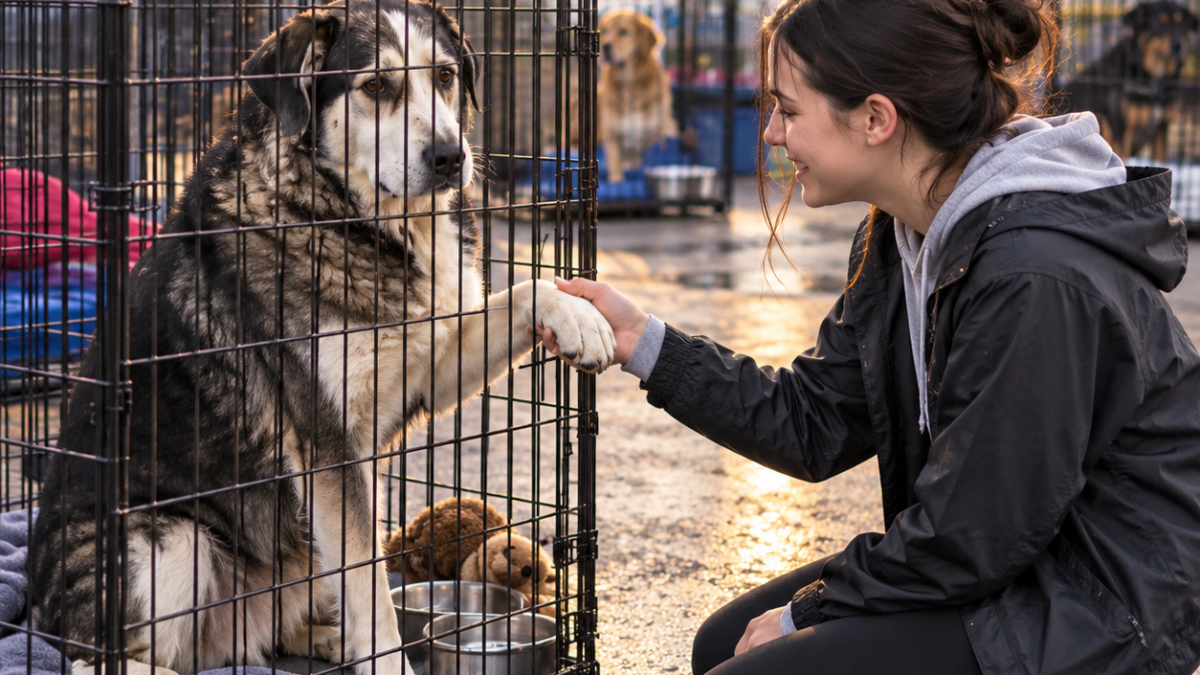
Bruno had spent eleven years believing the same hands would always be there when he woke up. Then, in the final season of his life, those hands disappeared—and the people he trusted reportedly decided it would be easier if he disappeared too. I didn’t know any of that when my daughter stopped walking, stared across a crowded adoption event, and whispered a question that changed the rest of our afternoon.
My name is Amber, and that Saturday was supposed to be ordinary.
My daughter and I had gone out for a walk after lunch. The air was cool, the sidewalks were busy, and she was talking nonstop about a drawing she wanted to finish when we got home. Halfway down the block, we heard barking.
A rescue group had set up an adoption event outside a neighborhood pet store.
There were folding tables, bright bandanas, water bowls, volunteers, and dogs of every size trying to catch someone’s attention. A young shepherd mix bounced against the front of his pen. Two puppies wrestled beneath a sign while a couple laughed and crouched beside them. Another dog rolled onto his back the second someone reached down.
My daughter grabbed my hand.
“Can we go see them?”
“For five minutes,” I said. “We’re not bringing anybody home.”
She smiled like she hadn’t heard the second sentence.
We moved slowly from one dog to the next. She knelt, offered her hand, and listened carefully when volunteers told her their names. I stood behind her, already preparing the speech about how adopting a dog was a serious decision and not something we did because we happened to walk past an event.
Then I noticed the old dog at the far end.
He wasn’t barking.
He wasn’t pawing at the gate.
He wasn’t trying to compete with the younger dogs.
He was simply sitting on a blanket with his shoulders slightly hunched, his muzzle almost completely gray, watching people pass.
Every few seconds, his eyes followed someone.
And every few seconds, that person kept walking.
There was something about the way he looked after them that made me uncomfortable. It wasn’t the excited stare of a dog hoping for a treat. It looked more like waiting. Like he still believed one familiar face might appear in the crowd.
A volunteer crouched beside him and scratched behind his ear.
“That’s Bruno,” she said when she saw me looking.
“How old is he?”
“Eleven.”
I glanced at my daughter. She was petting another dog.
“What happened to him?”
The volunteer’s expression changed.
“He had a family for most of his life.”
Most of his life.
The phrase landed harder than I expected.
She told me Bruno had been surrendered after more than a decade in the same home. The details were messy, and she chose her words carefully, but the part I understood was enough: the family no longer wanted him. There had even been talk of euthanasia.
I looked back at Bruno.
Eleven years.
Eleven birthdays, winters, car rides, bowls set down in the same kitchen, footsteps he knew by sound, doors he expected to open.
Then one day, none of it belonged to him anymore.
A man approached with his teenage son. They paused near Bruno, read the information card, and looked at him for a moment.
“Eleven?” the man said.
The boy nodded toward the puppies. “Let’s look over there.”
They walked away.
Bruno’s head followed them, then slowly lowered.
I felt my throat tighten.
I told myself not to make a story out of one expression. Dogs live in the moment, I thought. Maybe he was tired. Maybe I was projecting human heartbreak onto an animal who simply wanted to nap.
Then my daughter walked past me.
She didn’t go toward the puppies.
She went straight to Bruno.
She lowered herself onto the pavement beside his blanket and held out one small hand without touching him.
Bruno stared at her.
For several seconds, neither of them moved.
Then the old dog leaned forward until his gray muzzle rested against her palm.
My daughter looked up at me.
Her face had changed.
“Mom,” she said softly, “why is nobody sitting with him?”
I opened my mouth to answer.
But before I could, she wrapped both arms gently around Bruno’s neck, and the volunteer beside me suddenly covered her mouth.
That was the moment I realized our five-minute stop was no longer going to end the way I had planned.
PART 2
“Mom?”
My daughter was still sitting beside Bruno.
One arm rested loosely across his shoulders. The other hand moved slowly over the white hairs around his muzzle.
She wasn’t squeezing him.
She wasn’t trying to make him play.
She was simply there.
And Bruno, who had barely reacted to anyone else walking past, had shifted his whole body until his side touched her knee.
The volunteer beside me cleared her throat.
“His name really is Bruno,” she said. “That’s the name he came in with. We didn’t change it.”
I nodded.
My daughter looked up.
“Can I stay with him a little longer?”
I glanced at my watch.
Five minutes had already become nearly twenty.
“Ten more minutes.”
She smiled.
Bruno lifted his head at the sound of her voice.
That tiny movement bothered me more than I wanted to admit.
I had grown up with dogs. I understood how quickly people could assign human meaning to ordinary animal behavior. I didn’t want to convince myself that some cosmic connection was happening on a sidewalk.
But I also knew what I was seeing.
This dog wanted to be near my daughter.
And my daughter had no intention of leaving him alone.
I crouched beside the volunteer.
“What do you know about him?”
She looked toward Bruno before answering.
“He was surrendered three days ago.”
“Three days?”
She nodded.
“He lived with the same family almost his entire life.”
“Why did they give him up?”
She hesitated.
That hesitation told me the answer wasn’t going to be simple.
“They said they couldn’t manage him anymore.”
“Manage what?”
“His age. Some accidents in the house. Arthritis. Vet expenses.”
I looked at Bruno.
He was thin, but not frighteningly thin. His nails were a little too long. There was stiffness in his back legs when he shifted position.
Nothing about him looked unmanageable.
He looked old.
There was a difference.
I lowered my voice.
“And you said something about euthanasia?”
The volunteer’s face tightened.
“I probably shouldn’t have said that much.”
“Was it true?”
She watched me for several seconds.
Then she said, “When he was surrendered, one of the options discussed was humane euthanasia if placement couldn’t be found.”
The words felt clinical.
Polite.
Clean.
But Bruno was sitting ten feet away.
Nothing about it felt clean.
“Was he sick?”
“He needs a full senior workup. But our vet examined him. No terminal diagnosis. No severe aggression. No immediate medical reason.”
I looked back at my daughter.
She was whispering something into Bruno’s ear.
“What’s she saying?” the volunteer asked.
“I have no idea.”
My daughter apparently heard me.
“I’m telling him he has pretty eyes.”
The volunteer laughed, but her eyes filled with tears.
Bruno’s eyes were cloudy around the edges.
Brown in the center.
Tired.
But yes.
They were beautiful.
I stood.
This was exactly the moment when a reasonable adult should have said goodbye.
We had not planned for a dog.
There was no bed at home.
No food.
No leash.
No senior-dog medication budget.
I had work.
My daughter had school.
Our backyard fence needed one repair near the side gate.
Adoption was supposed to be deliberate.
Thoughtful.
Prepared.
Not an emotional decision made on a sidewalk because an old dog rested his head against your child’s hand.
I knew all of that.
So I called my daughter over.
She came reluctantly.
Bruno tried to follow.
His front feet pushed beneath him, but his back end rose more slowly.
When he realized she had moved away, he stood completely.
It was the first time I had seen him stand.
He took three stiff steps.
Then stopped at the edge of the blanket.
My daughter looked at me.
I looked at Bruno.
“Mom.”
“No.”
“I didn’t ask anything.”
“You were about to.”
She glanced back.
Bruno remained standing.
Watching us.
“Can we at least ask?”
“Ask what?”
“What it takes.”
I closed my eyes.
That child knew exactly how to negotiate with me.
The volunteer pretended not to hear.
I sighed.
“Fine. We can ask questions. Asking questions is not adopting a dog.”
My daughter nodded much too enthusiastically.
The volunteer smiled.
“I can get you an application.”
I pointed at her.
“Application is still not adoption.”
“Absolutely.”
She was smiling even wider now.
Twenty minutes later, I was sitting at a folding table filling out my address.
My daughter sat on the ground beside Bruno.
Every few moments, I stopped writing and looked over at them.
He had lowered himself again.
This time his head rested in her lap.
A woman carrying a small terrier walked past and said, “Oh, what a sweet old guy.”
Bruno’s ears moved.
The woman kept going.
He didn’t lift his head.
That was when the volunteer, whose name I learned was Rachel, pulled a chair beside me.
“I want to be very honest with you,” she said.
“Please.”
“Senior dogs can be expensive.”
“I know.”
“He may need arthritis medication. Dental work. Blood panels. We haven’t had time to complete everything.”
“I understand.”
“And emotionally…”
She paused.
“What?”
“Sometimes dogs who lose a home after that many years shut down for a while.”
“How long?”
“No way to know.”
“Days?”
“Maybe.”
“Weeks?”
“Yes.”
“Months?”
She nodded.
I looked toward Bruno.
My daughter had taken off her sweater and folded it beneath his chin even though he already had a blanket.
Rachel continued.
“He may pace at night. He may wait by the door. He may not eat normally. He may seem distant. That doesn’t necessarily mean he doesn’t like you.”
“It means he’s waiting for them.”
Rachel said nothing.
She didn’t need to.
I put the pen down.
That was the first moment I became angry.
Not dramatic, shouting anger.
Something quieter.
The kind that settles behind your ribs.
I tried to imagine taking a dog home as a puppy, teaching him where to sleep, watching his muzzle slowly turn gray, letting eleven years accumulate around him—and then one day handing his leash to a stranger.
I knew people’s circumstances changed.
Illness happened.
Housing disappeared.
Families broke apart.
Sometimes surrendering an animal could be an act of love when keeping them was no longer possible.
I wasn’t naïve enough to condemn every person who ever had to give up a pet.
But Bruno’s situation felt different.
Maybe it was the mention of euthanasia.
Maybe it was the way he kept watching cars.
Maybe it was the surrender information Rachel wouldn’t fully discuss.
Whatever the reason, I felt angry for a dog I had known less than an hour.
My daughter walked over.
“Mom?”
“What?”
“He’s thirsty.”
Rachel pointed toward a bowl.
My daughter carried it to Bruno.
He drank while she held it.
When he finished, he licked the water from her fingers.
Then she asked the question I had been trying not to hear.
“Can he come home with us?”
I looked at her.
Then at Bruno.
Then back at the half-completed adoption application.
“We’re not rescuing him because we feel sorry for him,” I said.
Her eyebrows pulled together.
“Why not?”
“Because feeling sorry for someone lasts until the feeling goes away. A dog doesn’t stop needing you when the emotion wears off.”
She became serious.
“If he comes home, he comes home for real?”
“Yes.”
“Even when he’s old?”
“Especially when he’s old.”
“Even if he pees inside?”
“Yes.”
“Even if he gets sick?”
“Yes.”
“Even if he doesn’t play?”
“Yes.”
She looked over her shoulder at Bruno.
Then back at me.
“I still want him.”
I believed her.
The application process took another hour.
There were references.
Questions.
A conversation with the adoption coordinator.
A phone call to our landlord, because although our lease allowed dogs, the rescue required confirmation.
I called my sister and asked her to drive to my house and inspect the loose fence board before we brought Bruno outside.
She laughed.
“You went for a walk.”
“I know.”
“And now you have a dog.”
“I do not have a dog yet.”
“What’s his name?”
“Bruno.”
“You have a dog.”
I hung up on her.
My daughter was delighted.
Bruno was not.
Not exactly.
When Rachel clipped a leash onto his collar and began walking him toward us, he froze.
His body went rigid.
His head turned toward the parking lot.
Then toward the rescue van.
Then back toward Rachel.
She knelt.
“It’s okay, buddy.”
Bruno backed up.
My daughter immediately stopped bouncing.
“What’s wrong?”
Rachel kept her voice gentle.
“He doesn’t know what’s happening.”
The old dog’s breathing became fast.
He wasn’t growling.
He wasn’t snapping.
He simply refused to move.
I suddenly understood.
The last time someone had put a leash on Bruno and taken him somewhere unfamiliar, his family had not returned.
Now strangers were doing it again.
I knelt several feet away.
“Bruno.”
His eyes moved toward me.
I didn’t reach.
My daughter sat beside me.
“We’re not leaving you,” she whispered.
He couldn’t understand the sentence.
But he heard her voice.
After nearly a minute, he took one step.
Then another.
We walked to my car slowly.
Bruno stopped at the open door.
Rachel had to help me lift him into the back seat because his hips were too stiff to jump.
My daughter climbed beside him.
Before I closed the door, Rachel touched my arm.
“Amber.”
I turned.
“If tonight is hard, call us.”
“It’ll be okay.”
“I mean it. He may cry. He may not settle. He may refuse food.”
I nodded.
“And one more thing.”
“What?”
“Don’t take it personally if he spends the first few days waiting for somebody else.”
My smile disappeared.
“I won’t.”
But I did.
Not because I was offended.
Because I knew exactly who he would be waiting for.
The entire drive home, Bruno sat facing the rear window.
My daughter talked to him.
She told him about our house.
The backyard.
Her room.
The squirrel that stole strawberries from our garden.
She promised him he could sleep wherever he wanted.
Bruno barely reacted.
He stared backward.
Every red light, he lifted his nose.
Every time a vehicle came close behind us, his ears rose.
He was looking for a car he recognized.
I drove with both hands tight around the steering wheel.
When we arrived home, my sister was waiting outside.
She took one look through the back window.
“Oh, Amber.”
“I know.”
“He’s beautiful.”
My daughter opened the door carefully.
Bruno wouldn’t get out.
We waited.
Five minutes.
Then ten.
I eventually sat on the driveway.
My sister leaned against her car.
My daughter sat beside me.
Nobody pulled him.
Nobody forced him.
Finally, Bruno moved.
I supported his chest and hips as he climbed down.
His paws touched the driveway.
He immediately turned toward the street.
A pickup truck passed.
Bruno took two steps after it.
The leash tightened.
He stared until it disappeared.
My sister looked at me.
I saw the question in her face.
Was he trying to go home?
I didn’t answer.
Inside, everyone wanted to meet him.
My mother came over.
My brother stopped by with a dog bed.
My sister brought food and bowls.
My daughter arranged three blankets in the living room and announced that Bruno could choose whichever one he liked.
It should have felt like a celebration.
For us, it did.
For Bruno, it was terrifying.
He moved from room to room carefully, sniffing every corner.
Not exploring.
Searching.
Whenever someone opened the front door, his head snapped up.
That evening, I placed his food near the kitchen wall.
Chicken.
Rice.
A little kibble.
He smelled it.
Then walked away.
“Maybe he doesn’t like chicken,” my daughter said.
“Every dog likes chicken.”
“Maybe he’s different.”
Maybe.
At nine o’clock, everyone went home.
The house became quiet.
My daughter put on pajamas, brushed her teeth, then dragged a blanket into the living room.
“What are you doing?”
“Sleeping with Bruno.”
“No.”
“Why?”
“Because you have a bed.”
“So does he.”
“Exactly.”
“But what if he gets scared?”
I looked at Bruno.
He was lying near the front door.
Not in the expensive orthopedic bed my brother had brought.
Not on one of the blankets.
On the hardwood floor.
Facing the door.
Waiting.
I let my daughter stay for twenty minutes.
She lay near him, reading quietly.
Bruno did not sleep.
At ten, I sent her to bed.
Then I turned off the lights and sat on the couch.
Bruno remained at the door.
Around midnight, he stood.
He paced to the kitchen.
Back to the door.
To the hallway.
Back again.
At 1:13 a.m., he began to whine.
It was so soft I almost missed it.
One thin sound.
Then another.
I knelt beside him.
“Bruno.”
He walked away from me.
I stayed where I was.
Five minutes later, he returned to the door.
At two in the morning, a car stopped across the street.
Bruno stood so fast his rear legs slipped beneath him.
He scrambled up.
His tail moved once.
Just once.
I had not seen it move all day.
He stared through the narrow window beside the door.
A man got out of the car across the street, walked into a neighboring house, and disappeared.
Bruno’s tail stopped.
He lowered himself to the floor.
That nearly broke me.
I sat beside him until sunrise.
He never rested his head on me.
He never asked for affection.
But around four-thirty, his front paw slid across the floor and touched my bare foot.
I didn’t move.
It stayed there for almost an hour.
The next morning, my daughter found us both asleep against the wall.
She crouched in front of Bruno.
“Good morning, brother.”
His eyes opened.
For a second, his tail tapped the floor.
My daughter gasped.
“Mom!”
“I saw.”
“He wagged!”
“I saw.”
She celebrated like he had won a championship.
Bruno looked confused.
That became our first week.
Tiny victories surrounded by long periods of sadness.
He drank.
He ate when nobody watched him.
He learned where the backyard door was.
He tolerated his new bed but preferred the floor near the entrance.
Every passing car still mattered.
Every knock at the door brought him running.
Every male voice outside made his ears rise.
My daughter never seemed discouraged.
She came home from school, dropped her backpack, and sat beside him.
“Hi, brother.”
Sometimes he lifted his head.
Sometimes he didn’t.
She talked anyway.
She told him about spelling tests.
Lunch.
A classmate who had stolen her favorite purple marker and then insisted it had always been hers.
Bruno became the keeper of every elementary-school injustice.
One afternoon, I heard my daughter say, “You don’t have to be happy yet.”
I stopped in the hallway.
Bruno lay beside her.
She stroked his ear.
“You can miss them.”
I had never said that to her.
I don’t know where she got it.
Maybe children understand certain things adults complicate.
“You can miss them,” she repeated. “But we’re still here.”
Bruno closed his eyes.
That night, he slept beside her bedroom door instead of the front door.
It felt enormous.
Three days later came the setback.
I was making dinner when a dark SUV slowed in front of our house.
Bruno saw it through the window.
He exploded to his feet.
For an eleven-year-old dog with arthritis, I had never seen him move that quickly.
He barked.
Not angrily.
Desperately.
He ran to the door.
The SUV stopped.
Bruno scratched the wood.
My daughter came running.
“What happened?”
I looked outside.
A delivery driver stepped from the vehicle carrying a package.
Bruno began whining.
The driver approached.
Bruno’s whole body shook.
When I opened the door just enough to accept the box, he tried to squeeze through.
I caught his collar.
“Bruno. No.”
The driver looked down.
“Hey, old guy.”
Bruno stared at his face.
The driver was a stranger.
Something in Bruno collapsed.
He stopped pulling.
He walked back into the living room.
He wouldn’t eat dinner.
That night he returned to the front door.
My daughter brought her pillow and lay several feet away.
She didn’t try to touch him.
I stood in the hallway watching.
“Mom?”
“Yes?”
“Do you think he thinks they’re coming back?”
I could have lied.
Instead I said, “I think part of him does.”
She was silent.
Then she asked, “Are they?”
“No.”
“How do you know?”
I swallowed.
“Because Bruno belongs with us now.”
She looked at him.
“That wasn’t what I asked.”
Children can find the center of a question faster than adults.
“No,” I said. “I don’t think they’re coming back.”
Her eyes filled.
“Then somebody should tell him.”
“I wish we could.”
She crawled closer to Bruno.
“I’ll tell him until he understands.”
The next morning we went to the veterinarian.
Bruno needed blood work, X-rays, a dental evaluation, and medication for arthritis.
The veterinarian, Dr. Morgan, examined him carefully.
“He’s actually in decent condition for his age,” she said.
My daughter brightened.
“So he’s not dying?”
Dr. Morgan smiled.
“We’re all technically doing that, but no. I don’t see anything today that tells me Bruno is at the end of his life.”
I laughed despite myself.
“How much time does he have?”
“No veterinarian can promise that. Maybe a year. Maybe several. What I can tell you is that he has quality of life left.”
My daughter reached for Bruno’s face.
“He has lots.”
Dr. Morgan checked his teeth.
“Those need work.”
“We’ll do it.”
“His hips are arthritic.”
“We’ll manage it.”
“He should lose about four pounds.”
My daughter frowned.
Bruno looked offended.
Dr. Morgan laughed.
“And we’ll monitor his kidneys.”
I asked the question quietly.
“Is there any medical reason somebody would have needed to euthanize him?”
Dr. Morgan stopped.
“Based on today’s examination?”
“Yes.”
“No.”
The word was immediate.
Certain.
Something hot moved through me.
I looked at Bruno.
He was leaning against my daughter’s legs.
“No terminal disease?”
“Not that I’m seeing.”
“Untreatable pain?”
“No.”
“Dangerous behavior?”
“He hasn’t shown me any.”
My daughter looked between us.
“Why are you asking?”
I touched her shoulder.
“We’ll talk later.”
But Dr. Morgan understood.
Her voice became softer.
“Sometimes families reach a point where they feel overwhelmed by an older pet. That doesn’t automatically make them cruel. But age alone is not a disease.”
Age alone is not a disease.
I carried those words home with me.
Over the next month, Bruno changed in increments so small we almost missed them.
One morning, I realized he had stopped sleeping at the front door.
Another day, I heard a strange thumping from my daughter’s room.
I found Bruno lying beside her bed, wagging his tail against the wall while she read.
Then came the tennis ball.
It was old, faded, and had somehow rolled beneath the couch years earlier.
I was vacuuming when I knocked it loose.
Bruno saw it.
He froze.
I rolled it gently.
The ball traveled six feet across the floor.
Bruno stared.
My daughter crouched.
“Go get it.”
Nothing.
I shrugged.
“Maybe he doesn’t play fetch.”
Then Bruno took one step.
Another.
He reached the ball.
Sniffed it.
Picked it up.
My daughter screamed.
Bruno dropped it immediately.
“Sorry!” she whispered.
We laughed.
She rolled it again.
This time his tail moved before his feet did.
He chased it.
Slowly.
Awkwardly.
But he chased it.
For the next five minutes, an eleven-year-old dog who had spent weeks waiting beside doors remembered that balls could still roll and humans could still throw them.
My daughter laughed so hard she fell onto the carpet.
Bruno walked over and licked her face.
That was the first time I saw pure joy in him.
Not relief.
Not cautious affection.
Joy.
I took one photograph.
Bruno standing over the tennis ball.
My daughter on the floor laughing.
His gray face turned toward her.
I sent it to Rachel.
Her response came almost immediately.
**I knew she was his person.**
I stared at the message.
Then sent back:
**I think he’s hers too.**
The rescue asked permission to share the photo on its social media page.
I almost said no.
I had become protective of Bruno.
He had already been passed from one life into another. I didn’t want strangers debating him.
But the rescue was trying to encourage people to consider senior dogs.
So I agreed.
They posted one picture.
No address.
No school information.
No identifying details about my daughter.
Just Bruno.
The caption said that an eleven-year-old dog who had been overlooked at an adoption event had found a family after a child chose to sit beside him.
Within two days, thousands of people had reacted.
Messages arrived from people who had adopted senior dogs.
People posted pictures of gray muzzles sleeping under blankets.
One woman wrote that her twelve-year-old rescue had lived another four happy years.
A man said the best dog he had ever known came to him at age ten.
My daughter asked me to read every comment aloud.
Bruno slept through most of them.
For the first time, being noticed didn’t seem important to him.
He already had the person whose attention mattered.
Then, six days after the post went up, Rachel called me.
Her tone was wrong.
“Amber, do you have a minute?”
I stepped onto the back porch.
Bruno was in the yard with my daughter.
“What happened?”
“We received a phone call.”
“About Bruno?”
“Yes.”
I waited.
Rachel exhaled.
“From his former family.”
My hand tightened around the phone.
“What do they want?”
“They saw the post.”
“And?”
“They’re upset.”
“About what?”
“That people are assuming they abandoned him.”
I looked through the screen door.
My daughter tossed the tennis ball.
Bruno trotted after it.
“They did surrender him.”
“Yes.”
“They wanted him euthanized.”
There was a pause.
“That subject was discussed.”
“Rachel.”
“I know.”
“What do they want?”
Another pause.
Then she said it.
“They’re asking for Bruno back.”
For several seconds, I honestly believed I had misheard her.
“Back?”
“Yes.”
I laughed once.
There was nothing humorous in it.
“No.”
“Amber—”
“No.”
“They cannot just decide after a month that they want him because a photograph got attention.”
“I agree.”
“Then why are we having this conversation?”
“Because they’re claiming the surrender was misunderstood.”
I turned away from the window.
“What does that mean?”
“They say they believed they were arranging temporary placement.”
“Was it temporary?”
“No.”
“Did they sign surrender paperwork?”
“Yes.”
“Then there is no misunderstanding.”
“That is our position.”
“Our position?”
Rachel went quiet.
The anger in my chest sharpened.
“What aren’t you telling me?”
“They threatened legal action.”
I sat down on the porch step.
Bruno saw me through the glass.
He abandoned the ball and came to the door.
My daughter opened it.
He walked outside and placed his head under my hand.
I looked down at him.
A month earlier, he would have been waiting for those people.
Now they wanted him back.
“Can they take him?”
“No one is coming to your house and removing Bruno.”
“That wasn’t my question.”
“The rescue’s attorney believes your adoption is valid.”
“Believes?”
“Amber, I’m trying to be accurate.”
I closed my eyes.
“What happens next?”
“We’re pulling his complete intake records. I want to verify every signature and every conversation.”
“Do they know where I live?”
“No.”
“Keep it that way.”
“We will.”
I hung up.
My daughter stood behind me.
“Who was that?”
“Nobody you need to worry about.”
She looked at Bruno.
Then at me.
“Was it about him?”
Sometimes I hated how well she knew my face.
“Yes.”
“Is he sick?”
“No.”
“Then what?”
I wanted to protect her.
But Bruno was her dog as much as mine.
“His old family saw his picture.”
Her face changed instantly.
“Do they want to see him?”
“They say they want him back.”
She wrapped both arms around Bruno.
“No.”
The word came out hard.
“Sweetheart.”
“They left him.”
“I know.”
“They made him sad.”
“I know.”
“They can’t have him.”
I knelt.
“Look at me.”
She did.
“Nobody is taking Bruno tonight. Nobody is coming through that door. We’re going to handle this the right way.”
Her chin trembled.
“What if a judge says he has to go?”
I wished she hadn’t thought of that.
“We have paperwork. We adopted him legally.”
“But what if?”
I looked at Bruno.
He licked the side of her hand.
Then I made a promise I intended to keep.
“Then I will stand in front of whoever I have to stand in front of and tell them what happened.”
She pressed her forehead against Bruno’s.
“He’s my brother.”
“I know.”
That night Bruno slept beside her bed.
I barely slept at all.
The next morning Rachel called again.
This time the rescue director, a woman named Marlene, was on the line.
“We found the original surrender packet,” Marlene said.
“And?”
“The ownership transfer is unequivocal.”
My shoulders loosened slightly.
“There’s no temporary language?”
“None.”
“What about euthanasia?”
Marlene paused.
“There is a section on the intake form asking what the owner authorizes if placement cannot be arranged.”
I already knew what was coming.
“What did they check?”
“Euthanasia.”
I stared at the kitchen wall.
Not because Bruno was terminal.
Not because he was suffering beyond treatment.
If no one wanted him, they had authorized his death.
“Do you have that in writing?”
“Yes.”
“Signed?”
“Yes.”
“By them?”
“Yes.”
I felt something inside me become very calm.
“Send it to your attorney.”
“We already did.”
“Good.”
“There’s more.”
Of course there was.
“What?”
“They also wrote that he had become difficult to manage because of age-related behavior.”
“What behavior?”
“Indoor accidents, anxiety, stiffness, occasional nighttime pacing.”
I almost laughed.
Bruno had not had a single accident in my house.
Not one.
He had paced because he was frightened.
He was stiff because he was eleven.
“Anything about aggression?”
“One note says he had become ‘unpredictable.’”
My eyes narrowed.
“He has never even growled at us.”
“That matches our observations.”
“Then why write it?”
“I can’t answer that.”
I could.
Because “old” sounded selfish.
“Unpredictable” sounded responsible.
The former family’s attorney sent the rescue a demand letter two days later.
They claimed Bruno had been surrendered during a period of emotional distress.
They claimed the family had misunderstood the permanence of the agreement.
They claimed publicity surrounding Bruno had presented them unfairly.
And they wanted him returned.
The letter did not say they missed him.
That detail stayed with me.
It talked about reputational harm.
Misunderstanding.
Public perception.
Ownership.
Not love.
I read it three times.
Then I called Marlene.
“They’re not getting him.”
“That’s our position.”
“I want to know what happens if they sue.”
“We defend the adoption.”
“And me?”
“You have a signed contract conveying ownership from the rescue to you.”
I looked at Bruno sleeping in sunlight near the couch.
“All right.”
“Amber?”
“Yes?”
“Do not contact them.”
“I wasn’t planning to.”
“And if they somehow contact you directly, save everything.”
That warning became relevant the next morning.
At 7:42 a.m., an unfamiliar number texted me.
**This is about Bruno. We need to talk.**
I did not answer.
A minute later:
**You don’t know the whole story.**
Then:
**We raised him from a puppy.**
I stared at the message.
My daughter was eating cereal across the table.
Bruno sat beside her hoping something would fall.
Another message appeared.
**That rescue had no right to make us look like monsters.**
There it was.
Not: *Is Bruno okay?*
Not: *Is he happy?*
Not: *Does he still like chicken?*
The first concern was how they looked.
I took screenshots.
Sent them to Marlene.
Then blocked the number.
That afternoon another number called.
I let voicemail take it.
A man’s voice said, “Amber, my name is Douglas. Bruno was our dog. There’s information you weren’t given. I’m asking you to do the decent thing and contact me before this becomes something bigger.”
The decent thing.
I replayed those words twice.
Bruno was lying at my feet.
I looked down.
“The decent thing?”
His ears moved.
I scratched his neck.
“You picked the wrong house for that argument, buddy.”
I sent the voicemail to the rescue.
For the next week, nothing happened.
I began to believe the attorney’s letter had ended it.
Bruno continued changing.
He started waiting at the front window every weekday at three-fifteen.
But he wasn’t waiting for his former family anymore.
He was waiting for the school bus.
The first time I realized it, I watched him stand ten minutes before my daughter normally arrived.
A bus turned onto our street.
His tail began beating against the wall.
The brakes hissed outside.
Children stepped down.
Bruno’s whole body came alive.
My daughter appeared at the end of the driveway.
He barked once.
She ran.
I opened the door.
Bruno trotted onto the porch.
She dropped her backpack and knelt.
“There’s my brother!”
He pushed his gray face against her chest.
I stood in the doorway crying like an idiot.
He had learned to wait again.
But this time, the person he waited for always came back.
That became their ritual.
Every school day.
Same window.
Same bus.
Same little girl running toward him.
Then one Thursday, there was no bus.
A teacher-training day.
My daughter was home.
At three-fifteen, Bruno still went to the window.
He waited.
My daughter looked at me.
“He thinks I’m coming.”
“You’re standing right here.”
She walked beside him.
“Bruno.”
He looked at her.
His expression was almost comically confused.
She laughed.
“I beat the bus today.”
His tail wagged.
And for a while, everything felt normal.
Until someone knocked on the door.
Bruno barked.
I glanced through the window.
A man stood on my porch.
Mid-fifties.
Baseball cap.
Gray jacket.
Beside him was a woman around the same age.
I didn’t recognize either of them.
Then the man looked down at Bruno through the glass.
His face changed.
“Bruno.”
The dog froze.
Every hair on my arms rose.
Bruno knew that voice.
His ears lifted.
His body went rigid.
The woman pressed a hand to her mouth.
“Oh my God.”
My daughter came down the hallway.
“Who is it?”
I moved in front of Bruno.
“Go to your room.”
“But—”
“Now.”
She looked at my face and obeyed.
The man knocked again.
“Amber?”
I did not open the door.
“Who are you?”
“You know who we are.”
Bruno took one step forward.
His tail did not wag.
He simply stared.
The woman crouched outside.
“Bruno. Baby.”
He backed away.
It was small.
One step.
But I saw it.
So did they.
The woman’s face crumpled.
“Please open the door.”
“No.”
“We just want to see him.”
“You were told not to contact me.”
“We’re not here to hurt anybody.”
“You need to leave.”
The man’s voice hardened.
“That is our dog.”
“No. He isn’t.”
“We raised him for eleven years.”
“And then you signed him away.”
“You don’t understand what happened.”
“I understand the paperwork.”
“You heard one side.”
“I heard you signed authorization allowing him to be euthanized if he wasn’t placed.”
Silence.
The woman looked at the man.
He stepped closer to the door.
“That was not what we wanted.”
“You checked the box.”
“We were told that was standard.”
“Leave my property.”
“You think you’re some kind of hero because you took an old dog?”
I felt my pulse in my throat.
“No. I think I’m the person asking you to leave.”
“We loved him.”
I looked down at Bruno.
He had moved behind my legs.
That answered more than anything the man could say.
“You need to go.”
The man pointed through the glass.
“He knows us.”
“Yes.”
“He remembers us.”
“Yes.”
“Then open the door.”
“No.”
He struck the door with the flat of his palm.
Bruno flinched.
That was the end of the conversation.
I pulled out my phone.
“I am calling the police.”
The woman grabbed his arm.
“Doug. Stop.”
He looked at her.
Then at me.
Then at Bruno.
“You’re making a mistake.”
“No. I’m protecting my dog.”
I called.
They left before the officer arrived.
My daughter came running from her room as soon as their car disappeared.
She dropped to the floor beside Bruno.
He was shaking.
Not violently.
But enough.
“Was that them?”
I nodded.
She wrapped her arms around him.
He leaned into her.
“Did he want to go?”
Her question destroyed me.
“No.”
“How do you know?”
“Because he could have gone to the door.”
She looked toward it.
Bruno had done the opposite.
He had moved behind me.
She whispered, “Good.”
I sat beside them.
“But sweetheart, even if part of him had wanted to see them, that wouldn’t mean he loves us less.”
“I know.”
“He had eleven years with them.”
“I know.”
“He’s allowed to remember.”
She stroked his ear.
“But he stayed with us.”
“Yes.”
This time I didn’t need to convince myself.
“He stayed with us.”
The police officer documented the incident.
No arrest.
No dramatic scene.
Just a report.
That report mattered later.
Because two days afterward, the former family filed a civil claim seeking Bruno’s return.
When I received the notice, my hands shook.
Marlene put me in contact with the rescue’s attorney, Rebecca Lane.
She read everything.
Surrender form.
Adoption contract.
Veterinary records.
Messages.
Voicemail.
Police report.
Then she called me.
“This is not a strong ownership claim.”
I exhaled.
“Can they still drag this out?”
“They can try.”
“What do I need to do?”
“Keep Bruno safe. Don’t engage them. And write down everything you remember from the day you adopted him.”
“Why?”
“Because facts matter when people start rewriting history.”
That sentence became the center of everything that happened next.
Facts matter when people start rewriting history.
So I wrote.
I wrote about the adoption event.
The blanket.
The people passing him.
The volunteer saying he had spent most of his life with one family.
My daughter sitting beside him.
The first night at our front door.
The car that made him believe somebody had returned.
The pacing.
The food he wouldn’t eat.
The tennis ball.
The school bus.
Everything.
Rebecca also requested Bruno’s prior veterinary records.
That was where the story changed again.
The records did not show a terminally ill dog.
They showed routine vaccinations.
Arthritis.
A dental recommendation.
Occasional urinary issues that had been investigated.
Normal aging.
But there was one entry from six months before Bruno was surrendered.
The veterinarian had recommended blood work and pain medication.
The family declined both.
Three months later, they declined dental treatment.
Then, weeks before the surrender, they called asking about euthanasia.
The clinic had reportedly told them Bruno did not appear to meet their criteria for non-medically indicated euthanasia without further examination.
They never brought him in.
Instead, they surrendered him.
I read the timeline twice.
My anger returned.
But Rebecca warned me.
“Do not turn this into a public war.”
“I wasn’t going to.”
“Good.”
“They nearly killed him because he got inconvenient.”
“We can establish what the documents show. We cannot establish what was in their minds.”
She was right.
I hated that she was right.
But if this was going to be about facts, we needed to stay with facts.
Then we learned something else.
An adult son from Bruno’s former family had contacted the rescue.
His name was Ethan.
He was twenty-three and lived in another state.
He had seen Bruno’s adoption photo online.
Unlike his parents, he wasn’t demanding the post be removed.
He wanted to know if Bruno was alive.
Marlene asked whether I would allow her to confirm that Bruno was safe.
I said yes.
A day later Ethan sent a message through the rescue.
Marlene read it to me over the phone.
“He says Bruno slept in his room when he was a kid.”
I closed my eyes.
“He says Bruno was there when he started kindergarten.”
That meant Ethan had grown up with him.
“He says he left for college, then moved away. He knew Bruno was getting older, but he didn’t know his parents had surrendered him until he saw the post.”
“What does he want?”
“To apologize.”
“He doesn’t owe me an apology.”
“He says he thinks he owes Bruno one.”
I looked across the room.
Bruno was asleep beside my daughter while she did homework.
“What did he say about the euthanasia?”
Marlene hesitated.
“He says his father had complained about Bruno having accidents and needing more medical care. Ethan told them he would take Bruno if necessary.”
My eyes opened.
“What?”
“He says he offered.”
“When?”
“About two months before Bruno was surrendered.”
“Why didn’t he?”
“He says they told him everything was fine.”
I stood.
“So Bruno had somewhere to go.”
“According to Ethan, yes.”
“He had family willing to take him.”
“That’s what he says.”
My anger was no longer quiet.
“Then why was he sitting at an adoption event?”
“I don’t know.”
“Why was euthanasia even discussed?”
“I don’t know.”
“Why are these people now claiming they were desperate to keep him?”
“I don’t know.”
But somebody did.
Ethan.
He agreed to provide a statement.
That changed the legal dispute.
Not because he owned Bruno.
He didn’t.
But because his account directly challenged the idea that surrender had been the family’s only option.
I didn’t meet Ethan until the hearing.
The case never reached a full trial.
Instead, the court scheduled an early evidentiary hearing and settlement conference because the dispute involved possession of an animal and the judge wanted to resolve it quickly.
I hated every word of that sentence.
“Possession of an animal.”
As if Bruno were a lawn mower.
A chair.
A box in a storage unit.
The morning of the hearing, my daughter wanted to come.
I said no.
“Why?”
“Because this is adult business.”
“He’s my dog too.”
“I know.”
“What if they say something that isn’t true?”
“Then I’ll answer.”
“What if they make you give him back?”
My chest tightened.
“They won’t.”
“You don’t know.”
No.
I didn’t.
So I crouched.
“What do you want me to tell the judge?”
She thought about it.
Then she said, “Tell her Bruno waits for my bus.”
I almost cried.
“That’s what you want me to say?”
“Yes.”
“Why?”
“Because he knows where home is now.”
I kissed her forehead.
“I’ll tell her.”
Bruno stayed with my sister.
Before I left, he followed me to the door.
That was unusual.
Normally, if my daughter was home, I became secondary.
I knelt.
“I’m coming back.”
His ears moved.
I touched his gray muzzle.
“I promise.”
Then I understood the weight of those words.
How many times had Bruno heard them before?
I didn’t know.
So I said it again.
“I am coming back.”
The courthouse was smaller than I expected.
No grand marble stairs.
No dramatic crowd.
Just fluorescent lighting, security bins, hard benches, and people carrying folders.
Rebecca met me outside the courtroom.
Marlene was already there.
Rachel came too.
Then I saw them.
Douglas and his wife, Karen.
The people who had been on my porch.
Karen looked at me, then immediately looked away.
Douglas stared.
His attorney whispered something.
They sat on the opposite side of the hall.
For twenty minutes, nobody spoke.
Then the elevator opened.
A young man stepped out carrying a backpack.
Tall.
Dark hair.
Nervous.
He looked around.
Karen stood.
“Ethan?”
Her face went white.
Douglas rose too.
“What are you doing here?”
The young man stopped.
“I was asked to give a statement.”
“You don’t know what you’re talking about.”
Ethan’s jaw tightened.
“I know exactly what I’m talking about.”
Karen moved toward him.
“Please don’t do this here.”
“Where is Bruno?”
The question wasn’t directed at them.
It was directed at Marlene.
“He’s safe.”
Ethan nodded.
His eyes filled.
“Is he happy?”
I answered before I could stop myself.
“Yes.”
He looked at me.
“You’re Amber?”
“Yes.”
“Thank you.”
Douglas stepped between us.
“This is ridiculous.”
Ethan looked at his father.
“You told me Bruno was fine.”
“He was.”
“You told me you had it handled.”
“We did.”
“You killed his chance to come live with me.”
“He’s not dead.”
“No thanks to you.”
The hallway went silent.
Rebecca touched my elbow.
“Don’t get involved.”
I didn’t.
But I listened.
Douglas lowered his voice.
“You live six hundred miles away. You work ten-hour shifts. You couldn’t take care of him.”
“You never let me try.”
“He was our dog.”
“Then why did you give him away?”
Karen started crying.
“Please.”
Ethan looked at her.
“I would have taken him.”
She whispered, “I know.”
Douglas turned.
“What?”
Karen covered her face.
“I knew.”
Even his attorney looked at him.
Ethan stared at his mother.
“You knew?”
“I saw your message.”
“What message?”
“The one where you said you’d drive down.”
Ethan’s face emptied.
“And you still surrendered him?”
Karen was crying harder.
“Your father said Bruno needed more than you could give him.”
Douglas snapped, “Enough.”
But it was too late.
The door opened.
A clerk called the case.
We went inside.
The judge was a woman in her sixties named Judge Elena Morris.
She reviewed the paperwork silently for several minutes.
Nobody moved.
Finally she looked at Douglas’s attorney.
“Your clients signed an unconditional surrender of ownership?”
“Yes, Your Honor, but—”
“The document says permanent surrender.”
“Yes.”
“It also states that the rescue may place, transfer, provide medical care for, or euthanize the animal at its discretion.”
“Yes.”
“And your clients initialed each page?”
“Yes.”
“What exactly is the legal basis for claiming this was temporary?”
The attorney began talking about emotional distress, misunderstanding, and alleged misrepresentations by intake staff.
Then Rebecca stood.
She produced the intake notes.
The rescue had documented the conversation.
Permanent surrender had been explained.
Twice.
The family had been given alternatives.
They signed anyway.
Judge Morris looked toward Douglas.
“Did you read this document before signing it?”
He shifted.
“Not every word.”
“Did anyone prevent you from reading it?”
“No.”
“Did anyone tell you Bruno would automatically be returned to you?”
“No.”
“Did anyone tell you the surrender was temporary?”
Douglas looked at his attorney.
The judge repeated the question.
“No.”
Karen stared at the floor.
Then came the veterinary records.
Then Ethan’s statement.
Then the messages to me.
Then the police report showing they had come to my home after being told not to contact me.
Their case weakened piece by piece.
But the hardest moment came when the judge asked why they wanted Bruno back.
Karen answered first.
“Because he was ours for eleven years.”
The judge nodded.
“That tells me the duration of your prior ownership. I’m asking why you seek his return now.”
Karen struggled.
“We love him.”
Judge Morris looked at Douglas.
He said, “The rescue put our family on the internet and made us look terrible.”
There it was.
Rebecca didn’t smile.
Neither did I.
But I saw the judge’s expression change slightly.
Douglas continued.
“People who know us saw it. Our neighbors saw it. My coworkers saw it. My own son thinks we abandoned the dog.”
The judge interrupted.
“Did you surrender the dog?”
“Yes, but—”
“Then describing him as surrendered is factually accurate.”
“They implied nobody wanted him.”
“Was he adopted at the event?”
“Yes.”
“Before Ms. Carter’s family, had another adopter selected him?”
Douglas said nothing.
Judge Morris looked down at the file.
Then she looked at me.
“Ms. Carter.”
I stood.
“Yes, Your Honor.”
“How long has Bruno been in your home?”
“Almost three months.”
“How is he doing?”
“Better.”
“Be specific.”
I swallowed.
“When he first came home, he slept beside the front door.”
“Why?”
“I can’t know exactly what he was thinking.”
“Fair.”
“But every car made him stand. Every knock made him run to the door. He barely ate when we watched him. He paced at night.”
“And now?”
I thought of my daughter.
“Now he waits for a school bus.”
The judge looked at me.
I continued.
“My daughter comes home at the same time every afternoon. Bruno goes to the window before the bus arrives. When he hears it, he gets excited. He waits for her.”
My voice shook.
“He used to wait because he thought somebody from his old life might come back. Now he waits because he knows somebody will.”
Nobody spoke.
Even Douglas looked down.
The judge asked, “Are you prepared for the costs associated with a senior dog?”
“Yes.”
“Medical treatment?”
“Yes.”
“Age-related decline?”
“Yes.”
“End-of-life care when that day eventually comes?”
My eyes burned.
“Yes.”
“Regardless of whether that happens in six months or several years?”
“Yes.”
The judge nodded.
Then she asked Rebecca one final question.
“Is the rescue seeking return of the animal from Ms. Carter?”
“No, Your Honor. The rescue supports the adoption.”
Judge Morris closed the file.
Her ruling was short.
Painfully short for something that had consumed weeks of our lives.
The surrender contract was valid.
The rescue obtained lawful ownership.
The rescue lawfully transferred ownership to me.
Douglas and Karen had no present ownership interest in Bruno.
Their petition was denied.
Bruno was staying with us.
I didn’t realize I had been holding my breath until Rebecca touched my shoulder.
“It’s over.”
Across the aisle, Karen began crying.
Douglas’s attorney leaned toward him.
Ethan simply closed his eyes.
I should have felt triumphant.
Part of me had imagined this moment.
I had imagined looking across the courtroom and feeling satisfaction.
Revenge.
Justice.
Whatever name you give the feeling when someone who hurt a creature you love finally hears the word **no**.
But sitting there, I didn’t feel powerful.
I felt tired.
Because Bruno had loved those people.
Whatever they had done at the end, eleven years of his life had happened in their home.
There were probably Christmas mornings.
Walks.
Scraps beneath the dinner table.
Nights when a frightened child named Ethan buried his face in Bruno’s fur.
A history doesn’t become imaginary just because its ending is ugly.
As we left the courtroom, Ethan approached me.
“Can I ask you something?”
Rebecca remained nearby.
“Sure.”
“Would you ever let me see him?”
I hesitated.
He immediately lifted his hands.
“If you don’t want to, I understand. I’m not trying to take him. I swear.”
I studied his face.
“What would happen if he saw you?”
“I don’t know.”
“That’s what scares me.”
He nodded.
“I get it.”
“He’s finally settled.”
“I know.”
“He spent weeks looking for your family.”
Ethan’s eyes filled.
“I know.”
“And I’m not putting him through that again because people feel guilty.”
“I know.”
There was no defensiveness in him.
That mattered.
He pulled out his phone.
“Can I show you one thing?”
He held up a photograph.
A much younger Bruno lay on a twin bed beside a little boy.
The boy couldn’t have been more than eight.
Both were asleep.
Bruno’s muzzle was dark.
His ears were younger.
His body strong.
The child’s arm was wrapped around his neck.
“That was me,” Ethan said.
I looked at the photograph for a long time.
“He slept in my room almost every night until I left for college.”
I handed the phone back.
“I’m sorry.”
“So am I.”
“Why didn’t you take him when you moved out?”
“My apartment didn’t allow dogs then. Later I moved someplace that did. When Mom told me he was having problems, I said I’d take him.”
He swallowed.
“I thought I had time.”
Those words hurt because I understood them.
People always think they have time.
One more visit.
One more phone call.
One more year.
One more chance.
Then suddenly there isn’t one.
“I’m not promising anything,” I said.
“I understand.”
“But give Marlene your number.”
He nodded.
“Thank you.”
As I turned away, he called my name.
“Amber?”
I looked back.
“Does he still spin around before he lies down?”
I smiled.
“Twice.”
Ethan laughed through tears.
“He’s done that since he was a puppy.”
That was when I knew I would eventually let him see Bruno.
Not that day.
But someday.
Douglas and Karen walked past without speaking.
The legal fight was over.
There was no dramatic punishment.
No one went to jail.
Nobody lost a house.
There was no giant financial judgment.
But they lost the one thing they had suddenly tried to reclaim.
The right to decide Bruno’s future.
And they lost it because months earlier, when Bruno was old, inconvenient, anxious, and expensive, they had signed his life away.
That was the consequence.
They could not discard him when he needed them and then retrieve him after somebody else made him happy.
Bruno was no longer theirs to abandon.
When I arrived home, my daughter was waiting on the porch.
She saw my face and ran toward me.
“Well?”
I pretended to look serious.
Her smile disappeared.
Then I said, “Your brother has a court order.”
She blinked.
“What?”
“He’s staying.”
She screamed.
The front door flew open behind her.
My sister stepped out.
Bruno came with her.
He spotted me.
Then did something he had never done before.
He ran.
Not fast by young-dog standards.
But for Bruno?
He ran.
His ears bounced.
His gray muzzle lifted.
His old back legs pushed as hard as they could.
I dropped my bag.
He reached me and shoved his head against my stomach.
I buried both hands in his fur.
“I told you I’d come back.”
His tail beat against my legs.
My daughter threw her arms around both of us.
My sister stood on the porch crying.
That was our victory.
Not what happened in the courtroom.
This.
An old dog running toward the person who had promised to return.
A few weeks later, Ethan visited.
We chose a park.
Neutral ground.
I brought Bruno early and walked him until he was relaxed.
My daughter came too.
Ethan arrived alone.
The moment Bruno saw him, he stopped.
Ethan stopped too.
Neither moved.
Then Ethan crouched.
“Hey, B.”
Bruno’s ears rose.
His head tilted.
Ethan started crying before Bruno took the first step.
“Hey, buddy.”
Bruno walked forward.
Slowly.
He sniffed Ethan’s hands.
Then his jacket.
Then his face.
And suddenly his tail started wagging.
Ethan dropped to both knees.
Bruno pushed against him.
The sound that came from Ethan didn’t sound like crying at first.
It sounded like someone trying not to break.
“I’m sorry.”
He buried his face in Bruno’s neck.
“I’m so sorry.”
My daughter looked at me.
“Does Bruno remember him?”
“Yes.”
“Is he going to leave?”
“No.”
She took my hand.
For ten minutes, Ethan sat on the grass with Bruno.
He told us stories.
Bruno stealing a hamburger from a picnic table.
Bruno barking at a Halloween skeleton every single year.
Bruno sitting outside the bathroom when Ethan was sick.
Bruno refusing to leave his bedroom the week Ethan’s grandfather died.
“He always knew when somebody was sad,” Ethan said.
My daughter smiled.
“He still does.”
Then she showed Ethan Bruno’s tennis ball.
“He plays now.”
Ethan laughed.
“He used to destroy those in ten minutes.”
“Not anymore.”
“He’s old.”
My daughter’s expression sharpened.
“So?”
Ethan immediately raised his hands.
“I didn’t mean it like that.”
She relaxed.
I tried not to laugh.
Bruno had acquired a very small, very serious attorney.
When it was time to leave, I became nervous.
Would Bruno try to follow Ethan?
Would he panic?
Would we reopen the wound we had spent months helping him close?
Ethan seemed to understand.
He hugged Bruno once.
Then stood.
“You stay with your girls, okay?”
Bruno looked at him.
Ethan walked backward several steps.
Bruno stayed beside my daughter.
Another few steps.
Bruno still stayed.
Ethan wiped his eyes.
“Good boy.”
Then he turned and walked away.
Bruno watched him go.
For a moment, I saw the old expression.
The waiting.
The question.
My daughter crouched.
“Bruno.”
He looked at her.
She held up the ball.
“Home?”
Bruno turned away from Ethan.
He followed her to the car.
That was the moment I knew his heart had finally figured out something his mind could never understand in words.
Remembering one home didn’t mean he had to lose another.
Loving someone from his past didn’t mean he had to return to the place where his story had broken.
He could carry both.
Dogs are better at that than people.
Months passed.
Winter arrived.
Bruno discovered snow.
Or rediscovered it.
The first storm left four inches in our yard.
I opened the door expecting him to step outside, do his business, and hurry back to his warm bed.
Instead, he buried his nose in the snow.
My daughter threw a handful into the air.
Bruno jumped.
Actually jumped.
Maybe two inches.
But we counted it.
He chased her around the yard until both of them were exhausted.
Then he slept for three hours.
Dr. Morgan scolded me gently at his next appointment.
“He’s eleven, Amber.”
“I didn’t make him run.”
“You let him?”
“Try telling him no.”
She examined his hips.
“He’s doing well.”
“How well?”
“His weight is down. Medication is helping. Blood work looks stable.”
My daughter leaned toward me.
“I told you.”
Dr. Morgan smiled.
“You did.”
Bruno’s twelfth birthday came in March.
We didn’t know his exact birth date, so we used the date on his old veterinary record.
My daughter insisted on a party.
“No balloons,” I said.
“They scare him.”
“No chocolate.”
“I know.”
“No twelve children running through the house.”
She looked offended.
“I wasn’t going to invite twelve.”
“How many?”
“Eleven.”
We compromised at four.
Bruno wore a blue bandana.
He ate a small dog-safe birthday cake.
He received six toys despite needing none.
My daughter made him a card.
On the front she drew Bruno with enormous ears.
Inside she wrote:
**You were old when I met you, but you were never too old for me.**
I kept that card.
I still have it.
Later that evening, after everyone left, Bruno climbed onto the couch.
That alone was remarkable because for months he had waited for permission.
He rested his head in my lap.
My daughter curled against his side.
I looked down at his gray face and remembered the dog on the sidewalk.
Same eyes.
Same ears.
Same white muzzle.
But everything else had changed.
He no longer monitored every door.
He no longer woke at every passing vehicle.
He no longer ate as if the bowl might disappear.
He snored.
Loudly.
He stole toast.
He had learned exactly which cabinet held his treats.
He knew the school bus schedule better than I did.
And every evening at eight-thirty, he stood in the hallway until my daughter followed him upstairs.
Apparently, bedtime was now his responsibility.
People sometimes asked whether I was angry at his previous family.
For a long time, the answer was yes.
Part of me wanted them to see every photograph.
Bruno running.
Bruno sleeping upside down.
Bruno waiting for the bus.
Bruno wearing his ridiculous birthday bandana.
I wanted them to understand what they had nearly erased.
But anger changes when you live beside the thing that survived it.
Eventually, revenge stopped mattering.
Bruno did not wake up thinking about people who had failed him.
He woke up thinking about breakfast.
He thought about my daughter’s backpack.
He thought about the tennis ball beneath the coffee table.
He thought about the neighbor who carried biscuits in his coat.
He thought about sunlight on the rug.
Dogs don’t waste much time building monuments to betrayal.
They notice who is there.
So I tried to do the same.
Nearly a year after the adoption, I received one final letter.
It came through Rebecca.
Karen had written it.
She was not asking for Bruno back.
She apologized for coming to my house.
She admitted that surrendering him had been a decision made partly from frustration and fear over the cost of caring for an aging dog.
She wrote that Douglas had wanted a younger dog.
That sentence made me stop.
They had eventually gotten one.
A puppy.
Apparently, the puppy was part of why Bruno’s accidents, stiffness, and anxiety had become intolerable in their home.
Karen wrote that seeing Bruno’s adoption photo had forced her to confront what they had done.
She said she had spent weeks telling herself the rescue had manipulated the story.
Then Ethan showed her photographs of Bruno with us.
She realized something.
Bruno had not been too old to be happy.
He had simply needed someone willing to let him be old.
I read that sentence several times.
At the end, she wrote:
**I don’t expect forgiveness. I only hope he knows we once loved him, even though we failed him when he needed that love most.**
I folded the letter.
My daughter asked, “What is it?”
“Something from Bruno’s old family.”
“Are they trying to get him again?”
“No.”
She looked relieved.
“What do they want?”
“I think they wanted to say sorry.”
“To Bruno?”
“Yes.”
“Can he read it?”
I laughed.
“No.”
“Then you should tell him.”
So that night, while Bruno lay in his bed, I sat beside him.
It felt ridiculous.
And necessary.
I scratched behind his ear.
“Your old family says they’re sorry.”
Bruno sighed.
“They say they loved you.”
His eyes remained closed.
“They also say they failed you.”
His paw twitched in his sleep.
I smiled.
“You don’t care, do you?”
His tail tapped once against the bed.
Maybe he heard my voice.
Maybe he was dreaming.
Maybe I had interrupted a very important imaginary dinner.
I folded the letter again.
“You know what? That’s probably healthier.”
I never answered Karen.
Not because I wanted revenge.
Because the apology wasn’t mine to accept.
The one who deserved it was asleep in front of me.
And Bruno had already moved on.
Two years after we found him, his age finally began catching up with him.
He slowed.
Stairs became difficult.
We added rugs so he wouldn’t slip.
My daughter, taller now, still called him her brother.
She helped lift his back end into the car.
She sat on the floor during vet appointments.
When his hearing weakened, she began touching the floor before approaching so he could feel the vibration.
His world grew smaller.
But it never became empty.
At thirteen, Bruno no longer ran to meet the school bus.
He waited inside.
At thirteen and a half, he stopped playing fetch for more than one or two throws.
By fourteen, he needed help getting up some mornings.
I knew what was coming.
So did Dr. Morgan.
The difference between Bruno’s first family and ours was not that we could stop him from aging.
Nobody can.
The difference was that we had decided aging would not make him disposable.
One evening, my daughter sat beside him on the porch.
Bruno’s head rested across her legs.
She looked at me.
“Mom?”
“Yes?”
“How do we know when?”
I knew exactly what she meant.
“When he stops enjoying more than he hurts.”
“How will we know?”
“We’ll watch.”
“What if we make a mistake?”
“We love him enough to ask the question honestly.”
She began crying.
“I don’t want him to think we’re getting rid of him.”
I sat beside her.
“He won’t.”
“How do you know?”
“Because we won’t leave him.”
That promise became important months later.
But Bruno surprised us.
Again.
He stabilized.
Spring came.
Then summer.
He spent warm evenings in the yard beside my daughter.
He still loved food.
Still barked at the mail carrier.
Still insisted that every grocery bag be inspected.
He had more time.
Not unlimited time.
But enough.
Enough for another Christmas.
Enough for another birthday.
Enough for hundreds of mornings when he woke surrounded by people who had no intention of replacing him because his face was gray.
On the third anniversary of his adoption, the rescue held another event at the same location where we had found him.
Rachel invited us.
“Bring Bruno if he’s feeling up to it.”
I wasn’t sure.
He tired easily.
Crowds could overwhelm him.
But the weather was mild, and my daughter desperately wanted to go.
So we brought him for thirty minutes.
The street looked almost exactly the same.
Folding tables.
Water bowls.
Dogs in bandanas.
Families stopping.
Children pointing.
Three years earlier, Bruno had sat at the edge of that event while people passed him.
Now he arrived in a wagon.
Yes.
A wagon.
My daughter had decorated it with a blanket and a water bowl.
Bruno sat upright like royalty.
Rachel saw him and burst into tears.
“No way.”
She crouched.
“Bruno?”
His tail moved.
She hugged him.
“You old man.”
My daughter corrected her immediately.
“Distinguished.”
Rachel laughed.
“Sorry. Distinguished gentleman.”
People began asking about him.
How old?
Fourteen.
When had we adopted him?
At eleven.
Was he really the dog from the rescue post?
Yes.
A woman stared.
“You adopted an eleven-year-old dog?”
My daughter answered before I could.
“Why wouldn’t we?”
The woman looked surprised.
“I just mean… you knew you might not have very long.”
My daughter looked down at Bruno.
Then she said something I have never forgotten.
“We didn’t know how long he had.”
She stroked his gray head.
“We just knew he shouldn’t spend it alone.”
The woman’s eyes filled.
So did mine.
Across the event sat another senior dog.
Smaller than Bruno.
White around the muzzle.
Quiet.
People were walking past.
My daughter saw him.
Of course she did.
She looked at me.
“Don’t.”
“I didn’t say anything.”
“You’re thinking it.”
She smiled.
Then walked over.
I watched her sit beside that dog exactly the way she had once sat beside Bruno.
A young couple noticed.
They approached.
My daughter began telling them what she knew.
The dog’s age.
Temperament.
How senior dogs could still play.
How arthritis medication helped.
How old dogs weren’t automatically dying.
I covered my mouth.
Rachel stood beside me.
“She’s dangerous.”
“I know.”
“Give her ten years and she’ll own a rescue.”
“Please don’t say that where she can hear you.”
Rachel laughed.
Then she became quiet.
“You know, Amber, there’s something I never told you.”
“What?”
“The morning of that first adoption event, I almost didn’t bring Bruno.”
I turned.
“Why?”
“He had shut down.”
She looked toward him.
“He wouldn’t come out of the kennel at first. We had younger dogs. Easier dogs. Dogs we knew people would want.”
My throat tightened.
“So why did you?”
“One of our volunteers said, ‘If we leave him behind because we think nobody will choose him, how are we different from everyone else who already decided for him?’”
I looked at Bruno.
He was watching my daughter.
As always.
“One decision,” Rachel said.
“What?”
“One volunteer decided to put him in the van.”
She nodded toward my daughter.
“One kid decided to sit down.”
Then toward me.
“One mother decided five minutes could become forever.”
I laughed.
“Forever is a big word.”
“Not to a dog.”
She was right.
For Bruno, forever was never about years.
It was about whether you were still there tomorrow.
That winter, his health declined.
Not suddenly.
Quietly.
He slept more.
Ate less.
One morning, he struggled to stand and looked at me with an exhaustion I had never seen before.
Dr. Morgan examined him.
The arthritis had progressed.
His kidneys were declining.
There were medications we could adjust.
Foods we could try.
Fluids.
Comfort measures.
But for the first time, she used the phrase I had feared.
“We’re entering the final chapter.”
My daughter sat beside Bruno on the floor.
“How long?”
“I can’t tell you.”
“Is he hurting?”
“Some.”
“Can you stop it?”
“We can help.”
“Completely?”
Dr. Morgan didn’t lie.
“No.”
My daughter nodded.
Tears rolled down her face, but she didn’t look away.
“What do we do?”
“We give him good days.”
So we did.
We stopped measuring Bruno’s life in months.
We measured it in mornings when he ate breakfast.
Afternoons when he wanted to sit outside.
Evenings when his tail moved when my daughter came home.
We made a list of his favorite things.
Chicken.
Sunlight.
Car rides with the window cracked.
Tennis balls, even if he could no longer chase them.
My daughter.
Mostly my daughter.
Ethan visited again.
He sat with Bruno for two hours.
This time there was no drama.
No guilt.
Just an adult man telling an old dog stories from a childhood they had shared.
Before leaving, Ethan kissed Bruno’s head.
“You were the best part of that house.”
Bruno licked his chin.
Ethan laughed and cried at the same time.
Several weeks later, on a Sunday morning, Bruno refused breakfast.
That had never happened.
Not after he settled with us.
Not chicken.
Not eggs.
Not even the piece of bacon my daughter tried to sneak him.
He drank a little water.
Then lay down.
By afternoon, he couldn’t stand without help.
I called Dr. Morgan.
My daughter heard my voice.
She came into the kitchen.
“Is it time?”
I couldn’t speak.
I nodded.
She folded in half.
I held her.
For a long time, neither of us moved.
Then she wiped her face.
“He stays home.”
“What?”
“I don’t want him scared in the clinic.”
Dr. Morgan had already offered that possibility.
So the next morning she came to us.
Bruno lay on his favorite blanket near the living room window.
Sunlight warmed his back.
My daughter sat beside him.
I sat on the other side.
My sister came.
My mother came.
Ethan joined by video call for a few minutes and said goodbye.
There was one person I considered contacting.
Karen.
Then I looked at Bruno.
This was not a public event.
It was not a courtroom.
It was not a moment for old arguments.
This was his family saying goodbye.
The family he had chosen at the end.
I kept the room quiet.
My daughter held Bruno’s face.
“Hey, brother.”
His eyes opened.
His tail moved once.
Exactly once.
The same way it had moved that first night when he heard a car outside.
Only this time he wasn’t waiting for somebody who had left.
Everybody he needed was already there.
My daughter leaned close.
“You don’t have to wait anymore.”
My heart broke.
She kissed his forehead.
“We’re all here.”
Dr. Morgan gave him something to make him sleepy.
His breathing relaxed.
His head became heavy in my daughter’s lap.
I stroked his shoulder.
“You’re home, Bruno.”
His eyes closed.
“You’re home.”
Those were the last words I said before his breathing stopped.
For several minutes, nobody moved.
Then my daughter whispered, “He knew, right?”
I looked at her.
“Knew what?”
“That we weren’t leaving him.”
I held her hand against Bruno’s fur.
“Yes.”
I had never been more certain of anything.
“Yes. He knew.”
The house felt enormous without him.
At three-fifteen the next afternoon, the school bus stopped outside.
For three years, I had watched Bruno rise and go to the window.
This time the window was empty.
My daughter came through the door.
She looked toward his spot automatically.
Then stopped.
I crossed the room.
She dropped her backpack and cried against me.
“I thought he’d be there.”
“I know.”
That may have been the hardest moment after losing him.
Not the goodbye.
The missing routine.
The silence where love had built a habit.
For weeks, I still stepped around the place where his water bowl had been.
My daughter still woke expecting to see him outside her bedroom door.
I still thought I heard his nails on the floor.
Grief does that.
It keeps the shape of someone long after they’re gone.
A month later, a package arrived from the rescue.
Inside was a framed photograph from Bruno’s twelfth birthday.
His gray face.
Blue bandana.
My daughter beside him.
Underneath was a small plaque.
It did not say “rescue dog.”
It did not say “senior.”
It did not mention abandonment.
It simply said:
**BRUNO — FAMILY.**
My daughter placed it beside her bed.
That should have been the end of Bruno’s story.
But it wasn’t.
Because two months later, Rachel called.
“I have a problem.”
I laughed for the first time in days.
“No.”
“You don’t even know what I’m going to say.”
“I know exactly what you’re going to say.”
“There’s a dog.”
“Rachel.”
“She’s twelve.”
“No.”
“Nobody has asked about her.”
“Absolutely not.”
“She’s been here four months.”
“You are a terrible person.”
“She likes children.”
“I’m hanging up.”
“And tennis balls.”
I ended the call.
My daughter looked up from the couch.
“Who was that?”
“Nobody.”
She narrowed her eyes.
“Rachel?”
“No.”
“Mom.”
I lasted six seconds.
“There’s an old dog.”
She stood.
“How old?”
“Twelve.”
Her face changed.
“Does she have anybody?”
“Not yet.”
“When can we meet her?”
“We’re not adopting another dog.”
She walked toward the coat rack.
“You said that last time.”
I stared at her.
Then at Bruno’s photograph.
Somewhere in my head, I could hear Rachel laughing.
An hour later, we were standing inside the rescue.
The dog was smaller than Bruno.
A black Lab mix with white around her eyes.
She didn’t come to the kennel door.
She stayed on her bed.
My daughter sat on the floor outside.
She did not call.
Did not reach through the bars.
Did not force anything.
She simply sat.
I watched the same patience that had once saved Bruno appear again.
Five minutes passed.
Then ten.
The old dog stood.
She walked toward my daughter.
Slowly.
Her nose touched the bars.
My daughter offered her hand.
I closed my eyes.
“Oh, no.”
Rachel stood beside me.
“What?”
“I know how this story ends.”
She smiled.
“No.”
I looked at her.
“You don’t.”
The old dog placed her chin in my daughter’s palm.
Rachel nodded toward them.
“You only know how it begins.”
She was right.
Bruno’s life with us had taught me something I wish more people understood.
A senior dog is not a shorter version of a young dog.
You don’t adopt eleven years of age.
You adopt that morning.
That meal.
That walk.
That nap in the patch of sunlight.
You adopt the tail wag when your child comes through the door.
You adopt the trust that arrives after betrayal.
You adopt the privilege of being there when they discover that one ending did not mean there could never be another beginning.
People once walked past Bruno because they saw the number eleven and imagined loss.
My daughter looked at the same dog and saw loneliness.
Then she sat down.
That was all.
She did not erase his first eleven years.
She could not undo the day his old life ended.
She could not make him young.
She could not promise forever in the way humans usually mean it.
She only gave him what he had been asking strangers for that afternoon.
Someone who would stop.
Someone who would stay.
Bruno came into our lives believing he had already been discarded once too often to trust again.
He left this world almost three years later with his head in my daughter’s lap, surrounded by people who would have given anything for one more morning with him.
Sometimes I still think about the adoption event.
The puppies jumping.
People laughing.
Families moving from kennel to kennel.
And Bruno sitting at the end.
Quiet.
Gray.
Watching strangers pass him by.
If my daughter had walked five feet farther, our lives would have continued.
We would have gone home.
She would have finished her drawing.
I would have made dinner.
And Bruno would have watched another person leave.
Instead, she stopped.
That was the great revenge in Bruno’s story, although he never knew there had been anything to avenge.
The people who once decided his old age made him expendable did not get to write his ending.
They did not get to decide that eleven years meant his best days were finished.
They did not get to reclaim him when the world finally saw his worth.
And they did not get the final chapter.
Bruno did.
His final chapter was written in tennis balls rolling across our living-room floor.
In school buses stopping at three-fifteen.
In a little girl shouting, “There’s my brother!”
In snow beneath old paws.
In birthday cake.
In medicine hidden inside cheese.
In soft beds.
In laughter.
In the sound of his tail against the wall.
In a courtroom where the answer was finally **no, you cannot take him back.**
And, most importantly, in one last quiet morning when the little girl who had chosen him sat beside him again.
Just like she had the first day.
Only this time, Bruno wasn’t watching strangers walk away.
He wasn’t waiting for an old family to return.
He wasn’t wondering whether anyone wanted him.
He already knew.
He was wanted.
He was loved.
He was her brother.
He was my dog.
He was our family.
And after spending eleven years believing home was a place that could suddenly disappear, Bruno finally learned the truth we had been trying to show him from the moment he stepped through our door.
Home wasn’t the house where he had spent the most years.
Home was the place where, even when he became old, expensive, slow, frightened, and gray, nobody left him behind.
And when his final day came, neither did we.








