They Dumped This Old Dog on a Lonely Road—Traffic Cameras Showed Him Waiting 4 Days for the Car to Come Back
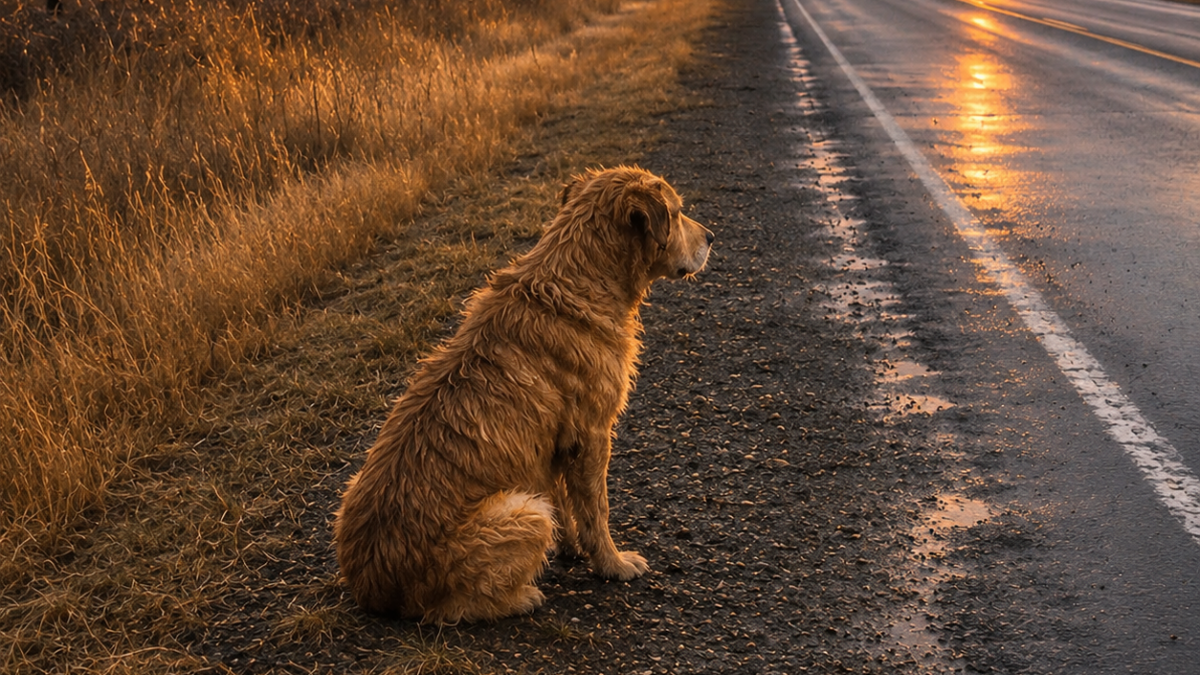
PART 2
I named him Buddy before we even reached the shelter.
It wasn’t official.
Animals coming into county care received intake numbers first, not names.
But I hated calling him “the roadside dog.”
He had already spent four days being treated like something disposable.
He deserved better than a number.
So while he lay curled on a blanket in the passenger seat, I said, “You’re Buddy until somebody tells me different.”
One ear lifted.
“That’s not legally binding.”
Nothing.
“Good talk.”
At the shelter, our veterinary technician, Melissa Grant, met us at the intake room.
The second she saw him, her expression changed.
“How long outside?”
“At least four days.”
“In this weather?”
“Yeah.”
She touched his gums.
Checked his eyes.
Ran her hands over his ribs.
“He’s dehydrated. Underweight. Nails are long. Arthritis in the hips, probably.”
She paused near his neck.
“No collar?”
“None.”
“Any chip?”
We scanned him.
The machine beeped.
I looked at Melissa.
“Well.”
“That helps.”
It should have.
Microchips usually make a bad day simpler.
You call the registered owner.
Sometimes the dog was stolen.
Sometimes a gate blew open.
Sometimes a sitter lost him.
Sometimes there are tears before you’ve even finished saying where the animal was found.
Melissa entered the number.
A name appeared.
Jasper.
The dog beside us lifted his head.
Melissa looked at him.
“Jasper?”
His tail tapped once.
I felt something twist inside my chest.
So that was his name.
Jasper.
Registered owner:
Margaret Whitmore.
Address:
2217 Willow Bend Drive.
Phone number disconnected.
Registration date almost eleven years earlier.
“Eleven?”
Melissa whispered.
“He’s old.”
I looked at Jasper.
“Older than I guessed.”
The address was twenty-eight miles away.
Not close enough for Jasper to have simply wandered to Miller Creek Road.
Not at his age.
Not with those hips.
Somebody had driven him.
That mattered.
Melissa started fluids.
“We’ll run bloodwork.”
“Any sign of injury?”
“Not obvious. He’s cold, weak, dehydrated. Maybe parasites. We’ll know more later.”
I crouched beside him.
“Jasper.”
His eyes opened.
“You’ve got a name.”
Tail tap.
Melissa smiled.
“He likes you.”
“He has poor judgment.”
I left him there and went upstairs.
The traffic department had already responded.
There was coverage.
Not perfect.
But enough.
I sat at my desk with our supervisor, Maria Torres.
I’ve known Maria for nine years.
She has the useful ability to remain calm while everybody else is becoming furious.
“You ready?” she asked.
“No.”
She clicked play.
The timestamp showed Monday.
5:46 p.m.
Dusk.
Miller Creek Road.
For several seconds, nothing happened.
Then headlights appeared.
A dark blue SUV entered frame.
It slowed.
Pulled onto the shoulder.
Stopped almost exactly where I’d found Jasper.
My stomach tightened.
Passenger door opened.
Jasper jumped out.
His tail was wagging.
That’s the part that got me first.
He wasn’t afraid.
He wasn’t resisting.
He thought they had arrived somewhere together.
A person stayed mostly hidden inside the vehicle.
An arm reached out.
Something was thrown into the grass.
Jasper ran toward it.
Probably food.
Maybe a treat.
The passenger door closed.
The SUV pulled away.
Jasper turned.
He watched it.
Then ran after it.
For maybe thirty yards.
The vehicle accelerated.
Jasper stopped.
He returned to the exact place where the SUV had been parked.
Sat.
Maria paused the video.
Neither of us spoke.
Then she continued.
7:08 p.m.
Jasper still there.
10:41 p.m.
Still there.
Rain began.
He moved beneath a tree for eleven minutes.
Then returned to the shoulder.
Tuesday morning.
6:17.
He stood when a white pickup approached.
Tail moving.
The truck passed.
He sat again.
9:52.
Another vehicle.
Head up.
Then down.
2:06 p.m.
Ray’s delivery truck appeared for the first time.
It slowed.
Didn’t stop.
Jasper watched.
Wednesday.
Thursday.
Night temperatures dropped into the forties.
Jasper curled into the grass.
Every few hours, he stood.
Stretched.
Walked a small circle.
Returned.
He never traveled more than about sixty feet from the spot.
Friday morning.
My truck appeared.
The footage showed me getting out.
Sitting in the rain.
Eventually carrying him away.
Maria stopped the video.
I stared at the black screen.
“He waited.”
“Yes.”
“For four days.”
“Yes.”
“He thought they were coming back.”
Maria looked at me.
“Probably.”
I leaned back.
“Can we read the plate?”
“Traffic already enhanced it.”
She handed me a printed image.
Kentucky plate.
Clear enough.
Registered to:
Darren Whitmore.
Same last name as Margaret.
I looked at Maria.
“Son?”
“We’re about to find out.”
—
Willow Bend Drive was a quiet suburban street lined with ranch houses, mailboxes, and Bradford pear trees.
2217 had a SOLD sign in the yard.
Nobody answered.
The windows were empty.
A neighbor across the street watched me for about two minutes before curiosity won.
She crossed over wearing gardening gloves.
“Can I help you?”
“County animal protection.”
Her eyes immediately widened.
“Oh.”
“Do you know Margaret Whitmore?”
Her face softened.
“Margaret? Of course.”
“Does she live here?”
“Not anymore.”
“Where is she?”
“Silver Oaks.”
“Assisted living?”
“Yes.”
“How long?”
“Maybe six months.”
“Do you know Darren Whitmore?”
Her expression changed.
That interested me.
“Her son.”
“Do you know where he lives?”
“Louisville, I think.”
“Did Margaret have a dog?”
The woman stared at me.
“Jasper.”
I said nothing.
She pulled off one glove.
“What happened?”
“Why do you ask?”
“Because Darren told everybody Jasper went to a rescue.”
My stomach dropped.
“When?”
“After Margaret moved.”
“Did Margaret want that?”
“She couldn’t take him to Silver Oaks at first.”
“At first?”
“They allow pets in some units, but Margaret went into rehab after surgery. She wasn’t ready to care for him.”
“What surgery?”
“Hip replacement.”
I glanced at the empty house.
“So Darren had Jasper.”
“Yes.”
“For how long?”
“Maybe four months.”
“Did you ever see the dog after Margaret left?”
“A few times.”
“How did he look?”
She hesitated.
“Sad.”
That wasn’t evidence.
“What does that mean?”
“Darren would come every few days. Jasper stayed here.”
“Alone?”
“Mostly.”
“Was someone feeding him?”
“I assumed Darren.”
“Did Margaret know?”
“I don’t know.”
She crossed her arms.
“Is Jasper okay?”
“He’s alive.”
Her eyes filled.
“Oh, thank God.”
“You thought something happened?”
“Darren told us a rescue had found him a farm placement.”
Farm.
People love that word when they don’t want questions.
I thanked her and drove to Silver Oaks.
—
Margaret Whitmore was seventy-eight.
She sat near a window overlooking a courtyard garden, reading a mystery novel with reading glasses low on her nose.
When I introduced myself, she looked worried immediately.
“Animal protection?”
“Yes, ma’am.”
“Is this about Jasper?”
I stopped.
“Yes.”
Her whole face changed.
“Is he all right?”
I sat down.
“Before we talk, can I ask what you were told?”
She closed the book.
“My son found him a home.”
“What kind of home?”
“A retired couple with acreage.”
“When?”
“About two months ago.”
Two months.
Jasper had been abandoned four days earlier.
Somebody had been lying to her for weeks.
“Have you spoken to them?”
“No.”
“Seen photographs?”
“I asked.”
“What did Darren say?”
“That they were private people.”
Of course.
Margaret’s hands tightened around the book.
“Why are you asking me this?”
I had delivered bad news to animal owners before.
There is no training that makes it easy.
“Jasper was found Monday evening.”
She blinked.
“Found?”
“On Miller Creek Road.”
“I don’t know where that is.”
“About thirty miles from your old house.”
Her face went still.
“Was he lost?”
I looked at her.
She understood before I answered.
“No.”
“No what?”
“We have video.”
Her mouth opened slightly.
I continued carefully.
“A vehicle stopped. Jasper was let out. The vehicle left.”
Margaret stared through me.
“No.”
“I know this is difficult.”
“Darren wouldn’t.”
I didn’t answer.
She looked at me.
“Was it Darren?”
I couldn’t lie.
“The vehicle is registered to him.”
Her eyes closed.
For a long time, neither of us spoke.
Then she asked:
“How long was Jasper there?”
I almost wished she hadn’t.
“Four days.”
Margaret put one hand over her mouth.
“He waited?”
“Yes.”
A sound escaped her.
Not quite a sob.
“He always waits.”
I leaned forward.
“What do you mean?”
“When my husband died, Jasper waited beside the garage door every evening at five.”
Her voice broke.
“That’s when Robert used to come home.”
I looked away.
Margaret wiped her face.
“He waited for almost six months.”
That dog had done this before.
Not because he was foolish.
Because waiting was how Jasper understood love.
“Where is he?”
“County shelter.”
“Can I see him?”
“Yes.”
She tried to stand immediately.
Pain stopped her.
I reached out.
“Easy.”
“I want to see my dog.”
“You will.”
“Today.”
I nodded.
“Today.”
—
We brought Jasper into a private visitation room.
Margaret sat in a wheelchair.
She was nervous.
So was I.
Dogs remember.
But six months is a long time, especially after stress.
Melissa opened the door.
Jasper entered slowly.
His hips were stiff.
His head low.
Then he smelled something.
He stopped.
Margaret whispered:
“Jasper?”
His head snapped up.
For half a second, nobody moved.
Then his entire body changed.
Tail.
Ears.
Eyes.
He ran.
Not well.
Not gracefully.
But he ran.
Margaret opened her arms.
Jasper hit her knees and nearly climbed into the wheelchair.
She wrapped herself around him.
“Oh, baby.”
Jasper made a sound that silenced everyone in the room.
A deep whining cry.
He licked her hands.
Her face.
Her neck.
Margaret buried her face in his fur.
“I didn’t leave you.”
My throat closed.
“I didn’t.”
Jasper’s tail struck the wheelchair repeatedly.
“I thought you were safe.”
Melissa turned away.
I did too.
Some reunions feel too private to watch.
Margaret held him for twenty minutes.
Then she looked at me.
“Can he live here?”
“I don’t know.”
“I’ll make it work.”
“We’ll ask.”
Silver Oaks permitted pets in long-term residential units but required residents to demonstrate they could provide care or arrange assistance.
Margaret’s physical therapist believed she’d eventually be able to manage short walks with a walker.
A local volunteer service could help.
The director agreed to review it.
For the first time, I had hope this story might end quickly.
Then Darren Whitmore arrived at the shelter.
—
He walked into our lobby wearing a charcoal suit and carrying an attorney’s business card.
Mid-fifties.
Neat gray hair.
Expensive watch.
Controlled expression.
“I understand you have my mother’s dog.”
I stood.
“We have Jasper.”
“Good. I’ll take him.”
“No.”
He blinked.
“Excuse me?”
“Jasper is under an investigative hold.”
“For what?”
“Abandonment.”
His jaw tightened.
“I did not abandon that dog.”
“We have video.”
“Then you have incomplete video.”
“Explain the complete version.”
Darren looked around.
“Not here.”
“My office.”
We sat.
Maria joined us.
Darren crossed one leg over the other.
“Jasper became impossible after my mother moved.”
“Impossible how?”
“Destructive.”
“Did he bite anyone?”
“No.”
“Attack anyone?”
“No.”
“Destroy property?”
“He scratched doors. Barked. Urinated inside.”
“An eleven-year-old dog separated from his owner.”
Darren’s expression hardened.
“I have a job.”
“I didn’t ask.”
“And a family.”
“Neither did Jasper.”
Maria gave me a warning look.
I leaned back.
Darren continued.
“I contacted rescues.”
“Which ones?”
“I don’t remember.”
“We’ll need names.”
His eyes narrowed.
“I was told there was nowhere for him.”
“So you drove him to Miller Creek Road.”
“I drove him to a rural area where dogs are routinely picked up.”
“No.”
He stopped.
“No?”
“You stopped beside an empty road.”
“He had food.”
“For one meal.”
“I assumed someone would find him.”
“Eventually.”
Darren’s voice rose.
“What was I supposed to do?”
That question has always fascinated me.
People ask it after they’ve chosen the one option nobody decent would choose.
I answered quietly.
“Anything else.”
His face reddened.
“You don’t know my circumstances.”
“No.”
I leaned forward.
“But I know Jasper’s.”
Silence.
Maria took over.
“Mr. Whitmore, did your mother authorize you to abandon Jasper?”
“I didn’t abandon him.”
“Did she authorize you to leave him beside Miller Creek Road?”
“No.”
“Did you tell her you had done that?”
“No.”
“What did you tell her?”
Darren hesitated.
“That I’d placed him.”
“With a retired couple?”
His expression changed.
So Margaret had told us the same story he’d invented.
“Yes.”
“Why lie?”
“To protect her.”
Maria’s voice stayed calm.
“From what?”
“Guilt.”
I stared at him.
“You left her dog on a road so she wouldn’t feel guilty?”
“Don’t twist this.”
“I’m not.”
Darren stood.
“This conversation is over.”
Maria remained seated.
“That’s your choice.”
He turned toward the door.
Then stopped.
“I want the dog returned.”
“No.”
“He belongs to my mother’s estate.”
“Your mother is alive.”
He looked at Maria.
“She gave me power of attorney.”
“Power of attorney is not ownership.”
Something flickered across his face.
He hadn’t expected that.
“We’ll discuss this through counsel.”
“Fine.”
He left.
I watched through the window as he reached the parking lot.
Then I saw Jasper through the glass door of the kennel corridor.
He had heard Darren’s voice.
The old dog was standing.
Not wagging.
Not excited.
Just watching.
When Darren passed the window, Jasper stepped backward.
That mattered.
—
The first rescue Darren had contacted called us before we found them.
Her name was Angela Ross.
She ran a senior-dog nonprofit two counties over.
“I remember him.”
“Darren Whitmore?”
“Yes.”
“When did he call?”
She checked her notes.
“Monday.”
I looked at Maria.
“The day Jasper was abandoned.”
“What did he ask?”
“He wanted immediate surrender.”
“What did you tell him?”
“We were full.”
“Anything else?”
Angela hesitated.
“He got angry.”
“How angry?”
“He said, ‘If somebody doesn’t take this dog today, I’m going to leave him somewhere.’”
My stomach tightened.
“Did you document that?”
“I document everything.”
“Recorded?”
“No. Notes.”
“Would you provide them?”
“Yes.”
Another rescue had received a voicemail.
This one was worse.
Darren said:
“I don’t care where he goes. He’s old, he smells, and I am done rearranging my life around a dog my mother can’t even keep.”
Then:
“If you can’t take him, I’ll make it somebody else’s problem.”
That voicemail became evidence.
So did the traffic footage.
So did Margaret’s statement.
The county attorney agreed to pursue abandonment and neglect charges.
Darren hired a lawyer.
Then he made his biggest mistake.
He went public.
—
A local reporter somehow obtained the traffic-camera footage through an open-records request after the initial investigation was filed.
The story aired on a Thursday.
The title:
OLD DOG WAITS FOUR DAYS AFTER BEING LEFT ON COUNTY ROAD.
They blurred Darren’s plate.
They didn’t name him initially.
The video showed Jasper getting out.
Tail wagging.
The SUV leaving.
Jasper running after it.
Then returning.
Waiting.
Rain.
Night.
Cars.
Waiting.
The story spread online.
Hundreds of thousands of views.
Then millions.
People became furious.
I hated parts of that.
Internet anger has no brakes.
People wanted a villain before the investigation finished.
But the footage didn’t need exaggeration.
It was bad enough.
Darren released a statement through his attorney.
He claimed:
“The animal was left in an area known for rescue pickup after repeated unsuccessful attempts to secure placement.”
That sentence lasted twelve hours.
Then Angela released her notes.
The second rescue provided the voicemail to investigators.
The reporter learned Margaret had never been told.
Darren’s story collapsed.
He called our office.
“You did this.”
I knew his voice immediately.
“No.”
“You gave them information.”
“No.”
“You’ve destroyed my reputation.”
“No.”
“Don’t play games with me.”
I looked through my office window.
Jasper was outside with a volunteer.
For the first time since rescue, he was trotting.
Slowly.
Tail up.
“You left a dog beside a road.”
Darren said nothing.
“The camera did the rest.”
“You think you’re some hero?”
“No.”
“Then what do you want?”
That question surprised me.
“What?”
“What do you want from me?”
I looked at Jasper.
“I want you to stop pretending this happened to you.”
Silence.
I continued.
“It happened to him.”
Darren hung up.
—
Margaret revoked Darren’s authority over Jasper.
Then, with an elder-law attorney present, she reviewed the broader power of attorney she’d granted after surgery.
She didn’t revoke everything immediately.
That wasn’t my business.
But their relationship changed.
Darren had done more than abandon a dog.
He had made decisions for his mother because he decided his inconvenience mattered more than her wishes.
Margaret understood that.
“I trusted him,” she told me.
We were sitting in the Silver Oaks courtyard while Jasper slept near her wheelchair.
“I know.”
“He kept saying I needed to simplify my life.”
She scratched Jasper’s ear.
“I didn’t realize he meant removing everything he didn’t want to manage.”
Jasper sighed.
Margaret smiled sadly.
“Robert would’ve hated this.”
“Your husband?”
“Yes.”
“He loved Jasper?”
“He bought him.”
She laughed.
“I told him we were too old for a puppy.”
“How old were you?”
“Sixty-seven.”
“That isn’t too old.”
“For a hound mix who ate the sofa, it was.”
Jasper lifted his head.
“You ate a sofa?”
Margaret nodded.
“Half of one.”
I looked at him.
“You’ve been hiding a criminal record.”
His tail moved.
Margaret laughed.
It was the first time I’d heard her laugh.
That mattered.
—
Getting Jasper approved at Silver Oaks took almost a month.
There were forms.
Evaluations.
A veterinary care plan.
Walking assistance.
Emergency contacts.
A volunteer named Sophie agreed to walk him twice a day.
Margaret’s granddaughter, Lily, who lived forty minutes away, promised weekends.
Margaret paid for professional grooming and medication.
The facility finally approved him.
The day Jasper moved in, I carried a new orthopedic dog bed into Margaret’s apartment.
She had already bought three bowls.
“Why three?”
“One for water.”
“Okay.”
“One for food.”
“Right.”
“One for treats.”
“That’s not how bowls work.”
“It is now.”
Jasper inspected the apartment.
Bedroom.
Bathroom.
Kitchenette.
Balcony.
Then Margaret sat in her recliner.
Jasper walked directly to her.
Turned twice.
Lay at her feet.
That was it.
No confusion.
No anxiety.
No waiting by a road.
Home had become wherever Margaret was.
I stood near the door.
She looked at me.
“You’re leaving?”
“Eventually.”
Jasper lifted his head.
Margaret smiled.
“He thinks you’re staying.”
“He has abandonment issues.”
The joke came out before I could stop it.
Margaret’s face changed.
“Sorry.”
“No.”
She reached down.
Touched Jasper.
“He does.”
I sat.
We stayed another hour.
—
The criminal hearing was scheduled for January.
Darren’s attorney wanted a plea deal.
No admission of intentional cruelty.
Small fine.
Community service.
Case closed.
The prosecutor asked Margaret how she felt.
She surprised everyone.
“No.”
Darren’s attorney said, “Mrs. Whitmore, your son is trying to avoid dragging you through court.”
Margaret looked directly at him.
“I’ve been dragged through enough things I didn’t choose.”
The room went quiet.
She continued.
“He lied to me.”
“That’s a family matter.”
“He abandoned my dog.”
“Yes, but—”
“And then he told me Jasper was happy.”
Her voice shook.
“I spent two months imagining him running around some farm while he was sitting beside a road waiting for someone who wasn’t coming back.”
Nobody interrupted.
Margaret straightened.
“If Darren wants this over, he can say what he did.”
No one had expected the quiet woman in the wheelchair to become the hardest person in the room.
Darren eventually pleaded no contest to the abandonment charge.
The court imposed fines.
Restitution for Jasper’s veterinary care.
Mandatory animal-welfare education.
A prohibition on taking ownership or custody of animals for a set period.
The legal punishment wasn’t enormous.
People online complained.
They wanted jail.
Something dramatic.
I understood.
But the judge said something I remember.
“Mr. Whitmore, the court cannot sentence you according to the emotional reaction of the internet. It can sentence you according to law.”
Darren looked relieved.
Then the judge continued.
“But nothing in the law requires this court to pretend your actions were reasonable.”
Darren’s face changed.
The judge referenced the footage.
“You left an elderly dependent animal on a rural road with one piece of food and drove away.”
Pause.
“The fact that somebody eventually found him does not make your decision less reckless.”
Then:
“You were not solving a problem. You were transferring the suffering to whoever arrived next.”
That line stayed with me.
Because that was exactly what abandonment is.
Not removing responsibility.
Handing pain to someone else.
—
Darren approached me outside the courthouse.
I was alone.
Margaret had left through another entrance.
He walked toward me fast.
“You happy?”
“No.”
He laughed bitterly.
“Right.”
“You asked.”
“My mother barely speaks to me.”
I said nothing.
“My business clients saw the story.”
Still nothing.
“My daughter is ashamed of me.”
His anger cracked.
For the first time, I saw something underneath it.
Not remorse exactly.
Loss.
“You people got what you wanted.”
There it was again.
“You people.”
As if some organized army had conspired to ruin him.
I looked at him.
“Do you know what Jasper did after you drove away?”
His jaw tightened.
“I’ve seen the video.”
“No.”
I stepped closer.
“You watched footage.”
He looked at me.
“He sat there.”
I pointed toward the road beyond the courthouse.
“He watched every car.”
Darren’s face became still.
“Every engine made him think maybe you came back.”
“I know.”
“Do you?”
His eyes dropped.
“For four days.”
I continued.
“Rain. Cold. No shelter.”
His jaw worked.
“He could’ve walked away.”
Darren said nothing.
“He didn’t.”
I lowered my voice.
“Because he trusted you more than you deserved.”
That landed.
He looked away.
“You want me to feel guilty.”
“No.”
I shook my head.
“I stopped caring what you feel.”
He looked back.
“What do you want, then?”
“I want Jasper to never wait for you again.”
I walked away.
That was the last private conversation we ever had.
—
People kept calling Jasper a hero.
That always bothered me.
He didn’t rescue anyone.
He didn’t perform some extraordinary act.
He waited.
There was nothing heroic about what happened to him.
The extraordinary part came afterward.
Silver Oaks changed because of Jasper.
Residents who had withdrawn started visiting Margaret’s apartment.
A man named Henry brought Jasper pieces of toast.
A retired teacher named Louise read novels aloud while Jasper slept beside her chair.
A woman with Parkinson’s asked to help brush him because the repetitive movement calmed her hands.
The facility director eventually created a small resident-pet support program.
Volunteers helped elderly residents keep their animals rather than surrendering them during temporary illness.
It began because of one old dog who had almost lost everything when his owner needed surgery.
Margaret loved that.
“See?” she told Jasper. “You finally became useful.”
Jasper looked offended.
“He’s always been useful,” I said.
She smiled.
“I know.”
The story brought donations.
Too many dog beds.
Mountains of treats.
Checks.
Margaret refused money for herself.
Instead, she asked our department to establish an emergency fund for senior animals whose owners entered hospitals or rehabilitation.
We called it the Jasper Bridge Fund.
Temporary foster care.
Boarding.
Medication.
Dog walkers.
Anything that could keep an animal safe until the owner returned.
The first dog we helped was a twelve-year-old beagle named Ruthie whose owner needed heart surgery.
Without the fund, the family had planned to surrender her.
Instead, Ruthie stayed with a foster for six weeks.
Then went home.
I sent Margaret a photograph.
She stared at it.
“That dog looks miserable.”
“She’s happy.”
“She looks like somebody stole her pension.”
“That may just be a beagle.”
Margaret laughed.
Jasper slept at her feet.
That was the kind of revenge I could live with.
Darren had treated an old dog as an inconvenience created by his mother’s medical crisis.
The result was a program preventing other families from doing the same thing.
He had tried to erase responsibility.
Jasper’s story multiplied it.
—
A year passed.
Jasper turned twelve.
His arthritis worsened.
Margaret’s mobility improved.
She graduated from wheelchair to walker.
Every morning, she and Sophie took Jasper around the courtyard.
Slowly.
Two old bodies with bad hips.
Margaret called it their athletic program.
I visited about once a month.
Every time, Jasper greeted me at the door.
Not the frantic greeting he gave Margaret.
Something quieter.
Recognition.
One afternoon Margaret said:
“He remembers you carried him away.”
“I don’t know.”
“I do.”
“How?”
“He looks at you differently.”
Jasper put his head against my knee.
Margaret smiled.
“He knows you’re the one who stopped the waiting.”
I didn’t know what to say to that.
So I scratched his ears.
—
Then Darren came to Silver Oaks.
Margaret hadn’t invited him.
He stood in the lobby with flowers.
The facility called her.
She almost refused.
Then changed her mind.
I only know what happened because Margaret told me later.
Darren entered.
Jasper was asleep.
He woke when he heard the voice.
He stood.
Darren stopped.
For a second, they stared at each other.
Jasper did not growl.
Did not bark.
He simply moved closer to Margaret.
Sat beside her walker.
Darren’s eyes filled.
“Does he hate me?”
Margaret said:
“No.”
Darren looked relieved.
Then she added:
“He doesn’t trust you.”
That was worse.
Darren put the flowers down.
“I came to apologize.”
Margaret waited.
“I was overwhelmed.”
Still nothing.
“I had the house sale. Your rehab. My work. Laura’s surgery.”
Margaret said quietly:
“And Jasper.”
Darren nodded.
“And Jasper.”
“You could have asked for help.”
“I did.”
“You could have waited.”
“I didn’t want to.”
There it was.
Not couldn’t.
Didn’t want to.
Darren swallowed.
“I convinced myself somebody would pick him up.”
Margaret looked at him.
“Did that make driving away easier?”
“No.”
“Good.”
He wiped his eyes.
“I thought if I looked back, I wouldn’t do it.”
Margaret’s face tightened.
“So you didn’t.”
“No.”
Jasper rested his head against her knee.
Darren whispered:
“I’m sorry.”
Margaret looked down at her dog.
Then back at her son.
“I believe you.”
His face changed with hope.
“But I don’t forgive you yet.”
The hope disappeared.
“Mom—”
“Forgiveness isn’t something you ask for because guilt is uncomfortable.”
Darren stared.
Margaret continued.
“You rebuild trust.”
She nodded toward Jasper.
“He understands that.”
Darren looked at the dog.
“Can I touch him?”
Margaret said:
“Ask him.”
Darren crouched.
Held out his hand.
Jasper sniffed.
Then turned his head away.
Darren closed his eyes.
Margaret told me later that part hurt her.
I think it needed to.
He visited again three weeks later.
Then again.
Never alone with Jasper.
Never responsible for him.
He brought treats.
For months, Jasper refused to take them directly from his hand.
Then one afternoon he did.
One biscuit.
Darren cried.
Margaret didn’t mention forgiveness.
Neither did he.
That was healthier.
—
Two years after I found Jasper beside Miller Creek Road, Ray Collins—the truck driver who first called—came to Silver Oaks.
He had never met Jasper up close.
Margaret arranged it.
Ray walked in carrying a ridiculous bag of jerky treats.
Jasper sniffed him.
Ray knelt.
“Hey, buddy.”
Tail movement.
“You probably don’t remember me.”
I said, “He saw your truck four times.”
Ray looked at me.
“Don’t.”
“What?”
“I still feel bad I didn’t stop Tuesday.”
“You called.”
“Friday.”
“You fed him Thursday.”
“Should’ve stopped Tuesday.”
I understood.
Rescue stories create strange guilt in people who arrived before the rescue but after the harm.
Margaret reached over.
“You eventually told someone.”
Ray nodded.
“Yeah.”
She smiled.
“Then Jasper had more than one person come back for him.”
Ray wiped his face.
We pretended not to notice.
—
Jasper’s thirteenth year was harder.
Kidney disease.
Arthritis.
Hearing loss.
He still followed Margaret everywhere.
Bedroom to kitchen.
Kitchen to balcony.
Balcony to hallway.
If she took too long in physical therapy, he waited near the apartment door.
That word again.
Waited.
But this waiting was different.
He knew she returned.
There is a world of difference between waiting with fear and waiting with trust.
One afternoon I visited and found Margaret sitting on the courtyard bench.
Jasper was asleep beside her.
She said:
“Do you know what I hate?”
“What?”
“That video.”
I sat.
“You don’t watch it anymore, do you?”
“No.”
“Good.”
“Everybody thinks it’s beautiful.”
“The video?”
“They call his loyalty beautiful.”
I understood.
Margaret looked at Jasper.
“It isn’t beautiful that he waited four days.”
“No.”
“It makes me angry.”
“Me too.”
“They say, ‘Look how loyal he was.’”
Her voice shook.
“He shouldn’t have needed to be.”
I nodded.
She wiped one eye.
“Loyalty is beautiful when somebody deserves it.”
That may have been the smartest thing anyone said about Jasper.
—
The final winter came quietly.
Jasper stopped climbing onto Margaret’s little couch.
Then stopped making full loops around the courtyard.
His appetite decreased.
The veterinarian adjusted medication.
For a while, he rallied.
Then one February morning Margaret called me.
“Caleb?”
I knew from her voice.
“I’ll come.”
Jasper was lying on his bed near the balcony door.
Sunlight fell across his face.
Margaret sat beside him on the floor.
Getting down there had probably taken ten minutes.
She didn’t care.
The veterinarian had already examined him.
Kidney failure.
Advanced.
We could hospitalize.
Maybe buy days.
Margaret said no.
“He spent enough time waiting in places he didn’t understand.”
The vet nodded.
We scheduled an in-home goodbye for that afternoon.
I stayed.
Margaret talked.
Not to me.
To Jasper.
She told him about Robert.
The sofa he ate.
The Thanksgiving turkey he stole at age two.
The time he fell into a pond.
The way he used to wait at the garage door at five after Robert died.
Then she laughed.
“You were always waiting for somebody.”
Jasper’s tail moved faintly.
Margaret put her hand on his head.
“I wish I’d taught you better.”
I looked away.
“No.”
Her voice broke.
“You should’ve known people come back.”
She swallowed.
“Most people.”
The veterinarian arrived at three.
Sophie came.
Lily came.
Ray unexpectedly came too.
Melissa from the shelter.
Maria.
Jasper had collected people without trying.
Darren arrived last.
He stood at the doorway.
Margaret looked at him.
Then nodded.
He entered.
Jasper opened his eyes.
Darren crouched a few feet away.
“Hey.”
Jasper watched him.
Darren didn’t move closer.
After a moment, Jasper lifted his head.
Barely.
Darren extended a hand.
Jasper sniffed.
Then placed his chin on Darren’s fingers.
Darren broke.
“I am so sorry.”
Margaret closed her eyes.
Jasper stayed there.
Not forgiveness.
Not judgment.
Just an old dog too tired to carry human meanings anymore.
The veterinarian gave the sedative.
Jasper relaxed.
Margaret held his face.
“No roads.”
Her voice shook.
“No rain.”
Another breath.
“No waiting.”
Jasper’s eyes closed halfway.
“You hear me?”
Tail movement.
“We’re all here.”
I had heard words like that before in this work.
They always hurt.
Margaret lowered her forehead to Jasper’s.
“You don’t have to wait for anyone anymore.”
His breathing slowed.
Darren covered his mouth.
Margaret whispered:
“Good boy.”
One final breath.
Then stillness.
No traffic.
No engines passing.
No empty road.
Only people who stayed.
—
We buried Jasper on property behind Silver Oaks.
The facility had a small memorial garden for residents’ pets.
Margaret chose the stone.
JASPER WHITMORE
2011–2024
BENEATH IT:
HE WAITED WHERE HE WAS LEFT
UNTIL SOMEONE CAME BACK FOR HIM.
I suggested another line.
Margaret shook her head.
“No.”
“What?”
“That isn’t the ending.”
She thought for a moment.
Then told the engraver what she wanted underneath:
HE NEVER HAD TO WAIT ALONE AGAIN.
That was better.
—
Darren paid for the stone.
Nobody asked him to.
He also made a large donation to the Jasper Bridge Fund.
Anonymous.
We knew anyway.
Margaret never publicly announced that she forgave him.
Families aren’t courtroom verdicts.
Things remain complicated.
But he visited her.
He drove her to appointments.
He volunteered with our temporary foster network twice a month.
His first assignment was transporting an elderly Labrador whose owner had broken a hip.
When I handed him the leash, he looked at me.
“You did that on purpose.”
“Yes.”
He almost smiled.
The Labrador climbed into his SUV.
Darren stood there.
Same kind of vehicle.
Different ending.
“Where am I taking him?”
“To a foster home.”
“For how long?”
“Six weeks.”
“And then?”
“You bring him back to his owner.”
Darren looked at me.
“Back.”
“Yes.”
I held his eyes.
“That’s the important part.”
He nodded.
“I know.”
Maybe he did.
—
The Jasper Bridge Fund grew beyond anything we expected.
Within five years, it had kept more than four hundred pets with owners who were temporarily unable to care for them.
Dogs stayed in foster homes while people recovered from surgery.
Cats received medication while elderly owners were hospitalized.
One parrot lived with a volunteer for three months and apparently insulted everyone involved.
People laughed when I told that story.
I liked that.
Jasper’s legacy did not need to remain sad.
The traffic footage still exists.
I haven’t watched it in years.
I don’t need to.
I remember every frame.
The SUV stopping.
Jasper jumping out.
Tail wagging.
The food thrown.
The vehicle leaving.
Jasper running.
Stopping.
Returning.
Sitting.
Waiting.
For a long time, that footage made me furious because it showed how easy cruelty can look.
No shouting.
No hitting.
No dramatic violence.
Just a door opening.
A treat tossed.
A car leaving.
Sometimes cruelty is quiet.
Sometimes the person causing it convinces himself it isn’t cruelty at all.
That’s what makes it dangerous.
Darren told himself somebody would find Jasper.
That sentence allowed him to drive away.
Somebody will help.
Somebody will stop.
Somebody will deal with it.
Then everybody becomes nobody.
Until somebody decides not to keep driving.
Ray called.
I went.
Melissa treated him.
Margaret reclaimed him.
Volunteers walked him.
People donated.
One abandoned dog became hundreds of animals who were not abandoned.
That’s the part I choose to remember now.
People sometimes ask whether Darren got what he deserved.
They want a dramatic answer.
They want me to say his life was ruined.
It wasn’t.
He paid fines.
He lost trust.
He lost part of his relationship with his mother for a while.
His name was connected publicly to something shameful.
But eventually life continued.
That’s how real consequences often work.
There isn’t always a spectacular collapse.
Sometimes the hardest consequence is having to wake up knowing exactly who you were in one terrible moment.
And then deciding whether you’re going to remain that person.
Darren didn’t remain exactly that person.
I’m glad.
I don’t say that for him.
I say it because punishment that changes nothing is smaller than accountability that changes behavior.
He spent years helping transport animals back to the people they belonged to.
I never forgot why he started.
Neither did he.
Once, about six years after Jasper died, Darren and I were loading a senior shepherd into his vehicle.
He stopped.
“Caleb.”
“Yeah?”
“I’ve been thinking about that road.”
I didn’t answer.
“I remember looking in the mirror.”
My hands went still.
“You did?”
“Yes.”
“What did you see?”
“Jasper.”
My chest tightened.
“He was running after me.”
Darren swallowed.
“I almost stopped.”
That hurt more than if he’d said he never looked.
“Why didn’t you?”
“I was afraid if I stopped, I’d have to take him back.”
We stood there.
A breeze moved through the parking lot.
The shepherd inside his vehicle whined.
Darren looked down.
“That was the worst decision I’ve ever made.”
I believed him.
He asked:
“Do you think he ever understood?”
“Understood what?”
“That I was sorry.”
I thought of Jasper placing his chin on Darren’s hand on his final day.
“I don’t know.”
Darren nodded.
“That seems fair.”
I closed the rear door.
Then I said:
“I don’t think Jasper spent much time asking why.”
Darren looked at me.
“Dogs usually care more about what happens next.”
He stared at the vehicle.
“What happens next?”
“You drive this dog to Mrs. Peterson’s house.”
He almost laughed.
“Right.”
“And you bring him back in six weeks.”
Darren nodded.
“Back.”
I watched him drive away.
This time I knew the dog inside would return home.
That mattered.
—
I’m still with animal protection.
I’m older.
Slower.
More cynical in some ways.
Less cynical in others.
Every October, I drive Miller Creek Road.
I don’t plan it.
My truck simply ends up there.
The old fence is still standing.
The shoulder looks exactly the same.
Cars pass.
Nobody knows.
I pull over sometimes.
Stand where Jasper sat.
Four days.
People hear that number and think the miracle is that he survived.
For me, that was never the miracle.
The miracle was what he still believed.
After the first night, he stayed.
After the second, he stayed.
Rain came.
He stayed.
Cold came.
He stayed.
Cars passed.
He stayed.
Every engine could have been the one.
Every set of headlights could have been familiar.
He kept giving the person who abandoned him one more chance to return.
That isn’t something I romanticize anymore.
Margaret was right.
Loyalty is beautiful only when it’s deserved.
But Jasper’s loyalty taught us something anyway.
Not about dogs.
About people.
If somebody trusts you enough to wait for you, you have a responsibility to come back.
If you cannot come back, you make sure somebody safe does.
You don’t throw food onto the shoulder.
You don’t drive away.
You don’t tell yourself that suffering becomes less real because you can no longer see it in the rearview mirror.
Jasper could not choose what happened to him that Monday evening.
But we could choose everything after.
We chose treatment.
Investigation.
Truth.
Home.
We chose not to let the last image of Jasper’s life be a dog sitting beside an empty road.
His last years were warm.
He slept beside Margaret.
He got too many treats.
He gained weight.
He barked at the mail cart.
He learned which Silver Oaks residents carried snacks.
He hated bath day.
He loved sunshine.
And when his body finally failed, he left this world surrounded by people.
Nobody drove away.
That is the ending I keep.
Not the SUV.
Not the rain.
Not the four days.
The room full of people who stayed.
Because the most satisfying revenge against abandonment was never what happened to the person who left Jasper.
It was what happened to Jasper afterward.
He was loved.
Completely.
Publicly.
Stubbornly.
For the rest of his life.
And the dog somebody once treated like a problem became the reason hundreds of other animals were never left behind.
The cameras showed exactly how Jasper was abandoned.
But they never captured the most important part of his story.
They couldn’t.
Because the most important part happened after the camera stopped recording.
Someone finally came.
And this time—
we stayed.








