PART 2: They Chained Him Beside an Abandoned Shed and Drove Away—Weeks Later, He Was Still Watching the Road for Them
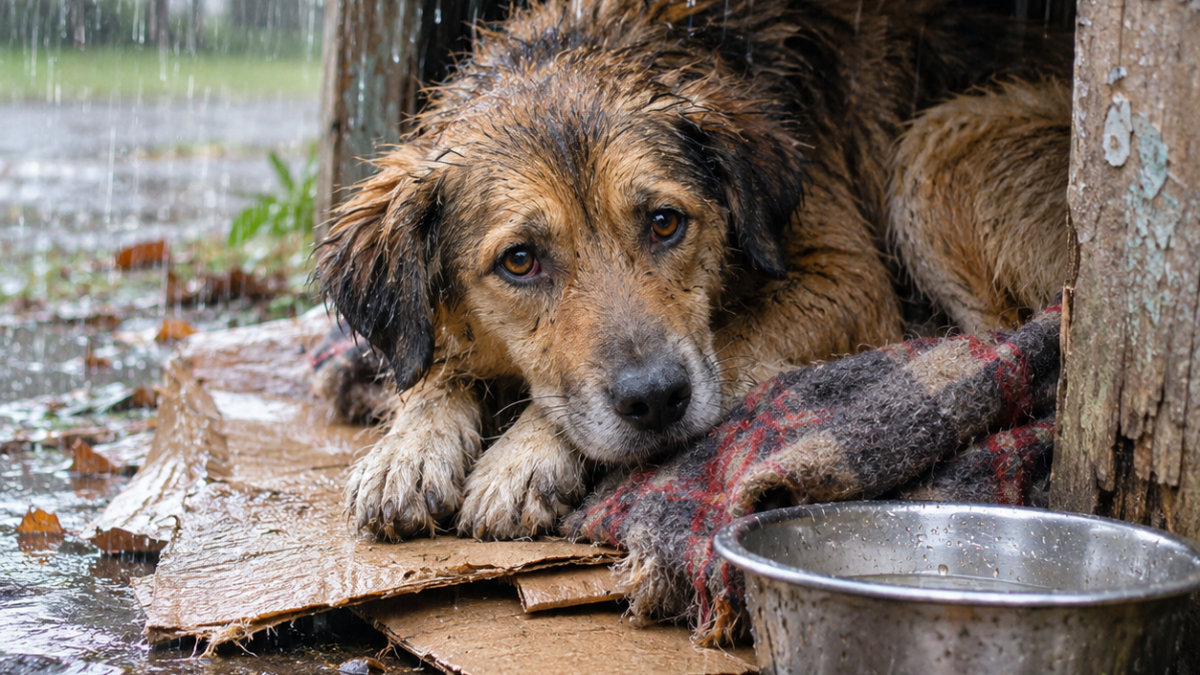
PART 2
Bim was standing.
Barely.
His legs trembled so violently that I could see the muscles jumping beneath his skin, but somehow he had crossed almost the entire room.
He stood with his nose pressed against the bottom of the door.
The nurse beside me whispered, “He’s been there for nearly fifteen minutes.”
“Why didn’t you move him?”
“We tried.”
She looked at Bim.
“He kept coming back.”
I entered slowly.
“Bim?”
His ears lifted.
He turned.
And then something happened that made every person in that room go quiet.
His tail moved.
Once.
It was not a real wag.
Not yet.
More like his body had remembered something his heart had forgotten.
I crouched.
Bim looked toward the corridor again.
Then back at me.
“Were you waiting for somebody?”
His tail moved again.
I walked closer.
This time, he did not retreat.
I placed my hand under his chin.
“You don’t have to stand.”
He leaned against me.
Almost his entire weight.
The veterinarian came in behind us.
“He needs to lie down.”
“I know.”
We guided him back to his blanket.
Bim kept looking at the door.
That pattern continued for days.
Every time footsteps approached, he raised his head.
Every time a car stopped outside, he listened.
If a male voice spoke in the reception area, he became especially alert.
At first, I convinced myself it meant nothing.
Dogs responded to sounds.
That was all.
But one afternoon, a delivery driver came through the clinic.
He was a large man wearing heavy work boots.
The second Bim heard those boots in the hall, he struggled upright.
His whole expression changed.
Hope.
There is no other word for it.
The driver walked past the doorway.
Bim stared.
Then slowly lowered himself back onto the blanket.
I watched the hope leave his face.
That was worse than seeing the chain.
Physical wounds tell you where pain lives.
This was different.
Bim carried his pain somewhere none of us could bandage.
During the first week, we fed him small meals several times a day.
The veterinarian warned me against allowing him to eat too much too quickly.
Bim disagreed with this medical strategy.
The first time he smelled cooked chicken, he tried to climb halfway into the bowl.
“Slow down.”
I lifted it.
He stared at me.
Then at the food.
Then at me again.
“You’re not starving anymore.”
He didn’t believe me.
Not yet.
I offered a few pieces from my hand.
Bim hesitated.
Then ate.
He swallowed without chewing.
“Easy.”
Another piece.
Then another.
By the fourth piece, he slowed down.
By the sixth, he chewed.
I smiled.
“There you go.”
The next morning, he ate from my hand again.
Soon he allowed one of the nurses to feed him too.
His wounds began healing.
The swelling around his neck decreased.
His eyes became brighter.
The first time he took five unsupported steps, three members of the clinic staff applauded.
Bim immediately sat down, startled by the noise.
Everyone laughed.
I crouched beside him.
“Congratulations. You scared yourself by succeeding.”
He licked my fingers.
That was the first time.
It lasted less than a second.
But I remembered it.
People often imagine rescue as one dramatic moment.
A chain being cut.
A cage opening.
An animal carried into safety.
That is only the beginning.
The real rescue happens afterward.
Breakfast after breakfast.
Bandage after bandage.
Night after night when nobody leaves.
Animals like Bim do not wake up one morning healed.
They test the world.
They wait.
They remember.
Then very slowly, if you are lucky, they begin to believe what you keep showing them.
Food returns.
Water remains.
Hands can be gentle.
Doors can open without somebody disappearing forever.
After ten days, Bim was strong enough to leave the clinic.
I had arranged a temporary foster space at our rescue.
When I clipped the leash to his collar, he froze.
His body lowered.
I stopped immediately.
“Okay.”
The old chain had taught him that anything attached to his neck meant imprisonment.
I sat beside him.
The leash lay loose on the floor.
I didn’t pull.
For almost twenty minutes, we went nowhere.
A nurse walked past.
“You leaving today or next Thursday?”
“Depends on management.”
She looked at Bim.
“Management seems difficult.”
“Extremely.”
Eventually Bim took one step.
I praised him quietly.
Another.
By the time we reached the parking lot, thirty minutes had passed.
I opened my vehicle.
Bim stared at it.
Then he looked behind us.
Toward the road.
Always the road.
“Come on.”
He climbed in.
The rescue property was quieter than the clinic.
I gave Bim a small room of his own connected to a fenced outdoor run.
For the first two days, he stayed near the entrance.
He did not explore.
He did not play.
He did not bark at the other dogs.
Every morning, when I arrived, he was sitting near the gate.
Looking outward.
One of our volunteers, Elena, noticed it.
“He’s waiting.”
“I know.”
“For them?”
“I think so.”
She stared at him.
“After what they did?”
I sighed.
“Dogs don’t understand betrayal the way we do.”
“They understand being left.”
“Yes.”
“But he still wants them back.”
I watched Bim.
“That’s the terrible part.”
A week later, I posted his story online.
Not for attention.
We needed information.
We still didn’t know everything about him.
Who exactly owned him?
How long had he been chained?
Had he received veterinary care?
Was he vaccinated?
Had he lived on that property his whole life?
I posted several photographs.
One from the day of rescue.
One showing the broken chain.
One of Bim standing at the clinic.
The response was immediate.
Hundreds of comments.
Then thousands.
People were furious.
Others offered food.
Blankets.
Money for medical bills.
A woman offered to adopt him that same day.
A family from two hours away asked if they could visit.
But buried among all those messages was one that made my stomach tighten.
**I know that dog.**
I opened the profile.
The message came from a man named Daniel.
I replied privately.
“Can you tell me how?”
His answer came quickly.
**He belonged to my cousin.**
I sat up straighter.
“Name?”
**Mihai.**
“Where does Mihai live?”
There was a long pause.
Then:
**He moved away last month.**
My hands became cold.
“Did he own the house near the old shed?”
**Yes.**
I called Daniel.
He answered on the fourth ring.
“Hello?”
“This is the person caring for the dog.”
Silence.
Then, “I figured.”
“What can you tell me?”
He exhaled.
“I don’t want trouble.”
“A dog nearly died.”
“I know.”
“Then help me.”
Another silence.
“Mihai and his girlfriend moved.”
“I know that.”
“They couldn’t take the dog.”
“Why?”
“The landlord at the new place doesn’t allow animals.”
My grip tightened around the phone.
“So they tied him to a post and left?”
“They said somebody from the village would feed him.”
“Who?”
“I don’t know.”
“Who was responsible for him?”
“I don’t know.”
“That is not a plan.”
“I told him.”
“What did he say?”
Daniel hesitated.
Then quietly:
“He said it was just a dog.”
I closed my eyes.
Those four words stayed with me.
Just a dog.
I looked through the office window.
Bim was asleep outside.
His front paws twitched as he dreamed.
Just a dog.
“Did Mihai know the property would be empty?”
“Yes.”
“Did he know the chain was short?”
“I guess.”
“Did he come back?”
“No.”
“Did he ask about Bim?”
Another pause.
“Not that I know.”
I wrote everything down.
Names.
Dates.
Phone numbers.
“Daniel, local authorities may contact you.”
“I really don’t want—”
“You called me because some part of you knows what happened was wrong.”
Silence.
Finally:
“Yeah.”
“Then tell them the truth.”
The next morning, I contacted the appropriate authorities and provided what we had gathered.
Photographs.
Veterinary documentation.
Witness statements.
The location.
The cut chain.
Information from neighbors.
Daniel’s name.
I did not know what would happen.
Investigations are rarely as dramatic as people imagine.
There is paperwork.
Waiting.
Phone calls.
More waiting.
Questions repeated five different ways.
I tried not to build expectations.
My priority was Bim.
And Bim was improving.
Two weeks after leaving the clinic, he discovered toys.
Not all toys.
Only one.
A yellow tennis ball.
Elena rolled it across the yard.
Bim watched it.
The ball stopped.
He looked at Elena.
She rolled it again.
Bim took three steps.
Stopped.
The third time, he followed it.
Then he picked it up.
For approximately four seconds.
He dropped it immediately.
Elena cheered.
Bim jumped.
I laughed.
“Stop celebrating everything.”
“He picked up a ball!”
“He has survived worse.”
“That means we celebrate harder.”
The next day, he picked it up again.
Within a week, Bim had learned a strange version of fetch.
We threw the ball.
He chased it.
Then he carried it somewhere else.
Returning it was apparently beneath him.
“He understands half the game,” I said.
Elena shook her head.
“He understands the important half.”
“What’s that?”
“He gets to run.”
She was right.
Watching Bim run was almost painful.
The first time I met him, his back legs could not support his weight.
Now he crossed the yard with his ears bouncing and his tail held higher.
His ribs were still visible.
But less.
His coat began to shine.
And then, just as I started to believe the worst part of his story was behind us, I received another call.
“Is this the rescue with Bim?”
“Yes.”
“My name is Mihai.”
Every muscle in my body tightened.
I stood.
“Why are you calling?”
“That’s my dog.”
I said nothing.
“I saw the post.”
Still nothing.
“I want him back.”
I almost laughed.
Not because anything was funny.
Because sometimes anger has nowhere else to go.
“You want him back.”
“Yes.”
“You left him chained beside an empty property.”
“We didn’t abandon him.”
“What would you call it?”
“Someone was supposed to feed him.”
“Who?”
Silence.
I continued.
“Give me a name.”
“That’s not important.”
“It is very important.”
“My neighbor knew.”
“Which neighbor?”
Another silence.
“Mihai.”
“Listen. Things were complicated.”
“They were more complicated for the dog.”
“You don’t know everything.”
“Then tell me.”
“My girlfriend and I had to move quickly.”
“And Bim?”
“We couldn’t take him.”
“So you tied him there.”
“Temporarily.”
“For weeks.”
“We thought somebody would take care of him.”
“Who?”
“People around there.”
“People around there are not an animal care plan.”
His voice hardened.
“I’m his owner.”
I looked outside.
Bim had noticed me through the glass.
He stood.
His tail moved.
I lowered my voice.
“He was starving.”
“I didn’t know.”
“He was dehydrated.”
“I didn’t know.”
“The collar had cut into his neck.”
“I said I didn’t know.”
“That is the problem.”
He became angry.
“You people put everything online and make someone look like a monster.”
“Nobody made you leave him there.”
“You don’t know what I was dealing with.”
“And Bim didn’t know why the only people he trusted disappeared.”
He stopped talking.
For a moment, I heard only breathing.
Then he said something that erased the last trace of sympathy I might have had.
“I paid for him. He belongs to me.”
I stared at the phone.
“That will be decided through the proper process.”
“You can’t keep my property.”
I ended the call before anger made me say something useless.
My hands were shaking.
Elena entered the office.
“What happened?”
“The owner called.”
Her face changed.
“What does he want?”
“Bim.”
She looked through the window.
“No.”
“I know.”
“No, I mean absolutely not.”
“I know.”
“He left him to die.”
“We still follow the process.”
Elena swore.
Normally, I would have corrected her.
That day I let it go.
The next several weeks were some of the most stressful I had experienced in rescue work.
Mihai began calling repeatedly.
At first, he was demanding.
Then apologetic.
Then angry again.
He claimed he had intended to return.
He claimed neighbors had promised to help.
He claimed he was struggling financially.
He claimed the chain was necessary because Bim wandered.
Each explanation contradicted part of the last.
Meanwhile, witness accounts became clearer.
One neighbor had seen furniture being loaded into a van.
Another remembered Bim barking as the vehicles left.
The elderly woman who eventually called us had seen him the following morning.
Still chained.
She had assumed the owners would return that evening.
They did not.
She left water.
Three days later, someone else left bread.
A week later, Bim had become noticeably thinner.
Nobody could identify a person who had been formally asked to care for him.
Nobody had a key to the house.
Nobody had food supplied by the owners.
Nobody had received money for his care.
Nobody had been told when the owners would return.
The story of a temporary arrangement slowly collapsed.
Still, I knew something difficult.
No matter how angry I was, Bim was not evidence.
He was a living animal.
I refused to turn his recovery into a spectacle.
We limited visitors.
No reporters inside his space.
No crowds.
No strangers touching him just because they had seen his photographs online.
He needed stability.
One afternoon, however, the situation came to us.
I heard shouting near the front gate.
Elena entered at a run.
“He’s here.”
“Who?”
She didn’t need to answer.
A man stood outside the fence.
Mid-thirties.
Dark jacket.
Angry face.
Mihai.
My stomach dropped.
Bim was in the exercise yard on the far side of the building.
“Keep him back there.”
Elena nodded.
I walked outside.
“Mihai?”
“You know who I am.”
“Yes.”
“I came for my dog.”
“You were told not to come without arranging it.”
“I don’t need an appointment to collect my own dog.”
“This is not how this works.”
“I want to see him.”
“No.”
His expression hardened.
“You’re hiding him from me.”
“I’m protecting him.”
“From me?”
“Yes.”
That stopped him.
He stepped closer to the gate.
“You think I abused my dog?”
“I think he was found severely underweight, dehydrated, injured, chained to an abandoned property.”
“I never hit him.”
I stared at him.
“That isn’t the only form of cruelty.”
He looked away.
“I loved that dog.”
The words made me angrier than I expected.
“Then why did he spend weeks staring at the road waiting for you?”
His face changed.
Only slightly.
But I saw it.
“Who told you that?”
“Everybody who watched him.”
He swallowed.
For the first time, his anger weakened.
“We had problems.”
“Bim had problems too.”
“My girlfriend was pregnant. We had to leave the house. The landlord wouldn’t let us bring him.”
“I understand emergencies.”
“You don’t.”
“I understand that emergencies require decisions. You made yours.”
“I thought somebody would feed him.”
“You hoped somebody would solve the problem after you drove away.”
His jaw tightened.
“I want to see him.”
I should have refused.
Part of me wanted to.
But another part wondered whether Bim needed the answer we could never give him.
Would he recognize Mihai?
Would seeing him reopen everything?
Would it help?
I called our veterinarian.
Then the case officer.
We discussed it.
Eventually, under controlled conditions, a supervised visual meeting was permitted.
No touching.
No taking Bim.
A barrier between them.
If Bim showed distress, it ended immediately.
I hated the idea.
But I agreed.
Two days later, Mihai returned.
He looked different.
Less angry.
More nervous.
We brought Bim into the enclosed yard behind a second fence.
I stood beside him.
At first Bim was distracted by the grass.
Then Mihai stepped into view.
“Bim.”
The dog froze.
Every hair on my arms lifted.
“Bim.”
His ears moved forward.
Mihai crouched.
“Come here, boy.”
Bim stared at him.
For one second, I saw something old return to his face.
Recognition.
Mihai smiled.
“There you are.”
Bim took one step.
My heart sank.
Another.
Mihai reached toward the fence.
“That’s my boy.”
Bim stopped.
He lowered his head.
Then his whole body began to tremble.
Not excitement.
Fear.
He stepped backward.
Mihai’s smile disappeared.
“Bim?”
The dog moved behind my legs.
I did not touch him.
I wanted the choice to be his.
Mihai stood.
“Come on.”
Bim pressed against me.
“Bim.”
Nothing.
Mihai’s voice sharpened.
“Come here.”
Bim flinched.
That was enough.
I stepped between them.
“We’re done.”
“No.”
“We’re done.”
“He knows me.”
“Yes.”
“Then give me five minutes.”
“No.”
“He was always nervous.”
I turned.
Bim was trembling so hard his tags clicked against his collar.
“That is your five minutes.”
Mihai stared at the dog.
Something complicated crossed his face.
Anger.
Embarrassment.
Maybe guilt.
“Bim.”
The dog did not look at him.
Mihai swallowed.
“I fed you for years.”
Bim pressed his nose against my hand.
I felt my anger shift into something quieter.
Almost pity.
Not for what Mihai might lose legally.
For what he had already lost without understanding it.
Trust.
You can buy food.
You can buy collars.
You can pay adoption fees.
You can sign paperwork.
But trust has to be built one ordinary day at a time.
And once destroyed, it is not yours merely because it used to be.
Mihai stepped back.
“I want this documented.”
“It is.”
He left.
Bim did not watch him go.
That was the first time I had ever seen someone connected to his past leave without Bim staring after them.
Instead, he looked up at me.
I crouched.
“You okay?”
He pushed his forehead into my chest.
I wrapped my arms around him.
That moment spread through our small team.
Not online.
Not publicly.
Among us.
Elena cried when I told her.
The veterinarian simply nodded.
“He answered.”
“What?”
“The question you’ve been asking since you found him.”
I knew what she meant.
Was he still waiting for them?
Maybe part of him had been.
Until that day.
The legal process continued.
I will not pretend justice arrived like something from a movie.
There was no dramatic courtroom packed with people.
No judge delivering a speech.
No handcuffs in front of cameras.
Real accountability was quieter.
Documents.
Veterinary reports.
Witness statements.
Photographs.
Phone records.
A formal finding that Bim had been abandoned without adequate care.
Financial penalties followed.
Restrictions were placed on Mihai’s ability to keep another animal for a period of time under the local process.
He was also ordered to cover part of the veterinary and care costs associated with Bim’s condition.
Mihai argued.
Appealed what he could.
Complained that people had exaggerated.
But the photographs did not exaggerate.
The empty bowls did not exaggerate.
The wound around Bim’s neck did not exaggerate.
The veterinary records did not exaggerate.
Neither did the rusty chain we had kept.
When the final decision arrived, Elena brought the envelope into my office.
“That’s it.”
I read it.
Then placed it on the desk.
She stared at me.
“That’s all you’re going to do?”
“What do you want me to do?”
“I don’t know. Celebrate?”
I looked outside.
Bim was asleep in the sun.
“No.”
“Why?”
“Because none of this gives him those weeks back.”
Elena sat opposite me.
“You wanted them punished.”
“I wanted them held responsible.”
“They were.”
“Yes.”
“So why do you look sad?”
I watched Bim sleeping.
“Because the best ending would have been them never leaving him there.”
She didn’t answer.
There are victories that still contain grief.
This was one.
The case was resolved.
Bim was legally free for adoption.
That should have been the happiest day.
Instead, it terrified me.
Applications had accumulated.
Dozens.
People had followed his story.
Some were wonderful.
A retired couple with a fenced yard.
A family with an older dog.
A woman who worked from home.
Several looked almost perfect.
Our job was to find the best home.
I knew that.
Then why did every application irritate me?
One family lived too far away.
Another had stairs.
Another seemed too busy.
One man used the phrase “guard dog,” and I ended the conversation immediately.
Elena watched me reject applications.
Finally, she said, “You know what you’re doing, right?”
“Screening.”
“No.”
“Yes.”
“You’re looking for reasons not to let him go.”
“That is literally part of screening.”
“You rejected a woman because her kitchen floor was slippery.”
“Bim has weak back legs.”
“She said she’d buy rugs.”
“People say things.”
Elena crossed her arms.
“You’re impossible.”
“I’m thorough.”
“You love him.”
I stopped.
“No.”
She stared at me.
I sighed.
“Fine.”
“Fine what?”
“I care about him.”
“You drive here on your days off.”
“Someone has to check him.”
“There are six volunteers.”
“They’re unreliable.”
“I’m one of them.”
“Exactly.”
She threw a pen at me.
Bim looked through the window.
I pointed.
“You disturbed him.”
Elena laughed.
“You are going to adopt that dog.”
“I am not.”
Two weeks later, I took Bim home.
Temporarily.
That was the word I used.
Temporary.
We needed to understand how he behaved in a home environment before placing him.
Very professional.
Very sensible.
Absolutely nothing emotional about it.
The first evening, Bim stood in my living room looking suspicious of everything.
The television.
The couch.
The refrigerator.
The clock.
He followed me into the kitchen.
When I returned to the living room, he followed.
When I went upstairs, he stood at the bottom and whined.
“You can come.”
He stared at the stairs.
Then at me.
I walked down again.
He followed me back to the living room.
“That solves nothing.”
I put a dog bed beside the couch.
Bim sniffed it.
Then lay on the floor.
“Of course.”
I sat down.
He watched me.
Five minutes passed.
Ten.
Then he stood.
Walked slowly across the room.
And lay beside my feet.
I looked down.
“You’re supposed to be testing the bed.”
His tail tapped the floor.
“Very temporary.”
The next morning, I woke before my alarm.
Something was outside my bedroom door.
I opened it.
Bim was lying in the hallway.
Waiting.
He stood when he saw me.
His tail wagged.
Not one movement.
Not two.
A real wag.
I smiled before I could stop myself.
“Good morning.”
He followed me downstairs.
I opened the back door.
Bim stepped into the yard.
Cold morning air filled the house.
He sniffed the grass.
Then he looked toward the front of the property.
Toward the road.
My smile faded.
Still checking.
Still remembering.
I called him.
“Bim.”
He turned immediately.
“Breakfast.”
He ran back inside.
That mattered.
The first week became two.
Two became three.
Every evening, I told myself I was evaluating him.
Every evening, Bim slept beside my couch.
He learned where the food was kept.
He learned the sound of the coffee machine.
He learned that the upstairs bathroom door sometimes made a terrible squeak and should be treated with suspicion.
He learned not to fear the washing machine.
Mostly.
He remained unconvinced by the vacuum cleaner.
One Saturday morning, I opened the front gate to bring in groceries.
Bim stood behind me.
A vehicle passed on the road.
He stared.
I watched him.
He did not move.
Another car.
His ears lifted.
Then dropped.
I carried the groceries inside.
“Come on.”
Bim followed.
No hesitation.
I realized something later that afternoon.
He had stopped sitting by the front window.
At the rescue, he used to watch roads constantly.
At my house, during his first week, he watched the gate.
Then less.
Then not at all.
He had begun sleeping deeply.
The kind of sleep where legs twitch and paws move because a dog is dreaming.
That sleep only comes when the body stops expecting danger.
The adoption applications were still on my desk.
I stopped reading them.
Elena noticed.
She said nothing.
That was worse.
Eventually, the veterinarian confronted me.
“Are you adopting him?”
“No.”
She looked at Bim, who was sitting with his body pressed against my leg.
“Interesting.”
“What?”
“Nothing.”
I hated when people did that.
A month after Bim came home with me, I received a letter related to the closed case.
Mihai had made the final required payment toward Bim’s treatment expenses.
There was also a short handwritten note.
I almost threw it away.
Instead, I read it.
**I know you think I’m a terrible person. Maybe I was. I should have done things differently. Tell Bim I’m sorry.**
I read it twice.
Then I looked at Bim.
He was lying in a patch of sunlight.
“Your old owner says he’s sorry.”
Bim yawned.
“That’s approximately the response I expected.”
I sat beside him.
My anger had changed by then.
At the beginning, I wanted Mihai to understand exactly what he had done.
I wanted him to feel shame.
Loss.
Regret.
Maybe he did.
Maybe he didn’t.
But eventually, I understood something.
Revenge was never going to heal Bim.
Consequences mattered.
Accountability mattered.
But Bim did not need Mihai to suffer.
Bim needed breakfast.
A warm place.
Medical care.
Walks.
Toys.
People who came back.
Every day.
That was the revenge life gave him.
He survived long enough to discover he had been wrong about one thing.
The people who abandoned him were not the whole world.
One morning in early spring, almost five months after I cut the chain, Bim and I returned to the village.
I had avoided the place.
Part of me worried it would overwhelm him.
But the elderly woman who first noticed his condition wanted to see him.
Her name was Ana.
She had been asking for updates.
She was eighty-one and lived two houses away from the abandoned property.
When we arrived, she stood by her gate.
The second she saw Bim, her hands flew to her face.
“Is that him?”
Bim looked at her.
Ana began crying.
“Oh, look at you.”
He approached cautiously.
She crouched as far as her knees allowed.
“I’m sorry.”
I frowned.
“For what?”
She looked at Bim.
“I should have called sooner.”
“You called.”
“I watched him for days.”
“You thought the owners would return.”
“I should have known.”
I touched her shoulder.
“Blame belongs to the people who left him.”
Bim sniffed Ana’s hand.
Then licked it.
She laughed through tears.
“I used to leave water.”
“I know.”
“And bread.”
“The veterinarian has asked me to tell everyone bread is not a complete dog diet.”
Ana laughed harder.
“Of course.”
We walked down the road.
I had not planned to approach the old shed.
Bim made the decision.
He stopped.
The property stood ahead.
The wooden doghouse was still there.
The metal post too.
I had assumed somebody would remove them.
Nobody had.
Bim stared.
His body became still.
“Bim.”
No response.
I shortened the leash slightly but did not pull.
“We can leave.”
He took one step toward the property.
Then another.
My stomach tightened.
We entered the yard.
Bim moved slowly.
He sniffed the ground.
The doghouse.
The mud had dried long ago.
Grass had begun growing around the post.
Bim approached it.
I watched his expression.
Dogs do not narrate memories for us.
We do not know exactly what they remember or how.
But his body remembered.
His tail lowered.
His shoulders tightened.
He sniffed the metal.
Then stepped back.
I knelt.
“Hey.”
He looked at me.
“You’re not staying here.”
His ears lifted.
“I promise.”
Bim walked toward me.
I expected him to press against my legs.
Instead, he walked past.
Toward the road.
He stood there.
Looking down the same stretch of pavement he had watched for weeks.
My heart tightened.
A truck passed.
Then a car.
Bim watched.
I waited.
Finally, he turned around.
He looked at me.
Then walked back.
Not toward the shed.
Toward me.
I crouched.
He reached me and pushed his head against my chest.
That was the moment I stopped pretending.
“You win.”
His tail moved.
“I’m adopting you.”
Bim licked my chin.
“That’s disgusting.”
He did it again.
Ana laughed behind us.
“I think he agrees.”
I looked toward the old post.
Months earlier, I had cut Bim’s chain there.
Standing in that same yard, I realized the chain had not been the only thing holding him.
Hope had held him too.
The wrong kind.
Hope that people who had abandoned him would return.
Hope that if he stared at the road long enough, the old life would come back.
But now he had turned away from that road himself.
I did not rescue him from that.
He did.
We completed the adoption paperwork the following Monday.
Elena arrived with cake.
“Why is there cake?”
“You adopted Bim.”
“I signed paperwork.”
“That is adoption.”
“I don’t need cake.”
“Bim does.”
“Bim cannot eat cake.”
“I got him a dog-safe one.”
I stared at her.
“You planned this.”
“For months.”
The veterinarian came too.
So did two clinic nurses.
Ana’s granddaughter drove her into town.
Several volunteers showed up.
I looked around.
“This is ridiculous.”
Elena held up the paperwork.
“Name of adopter?”
I sighed.
She smiled.
“Say it.”
“Me.”
“Full sentence.”
“I adopted Bim.”
Everyone cheered.
Bim jumped.
I glared at them.
“You scared the dog.”
They laughed.
Bim recovered quickly.
He had become good at that.
That evening, we went home.
No photographers.
No celebration.
No dramatic music.
Just Bim and me.
I opened the front door.
He walked inside.
Dropped his tennis ball in the hallway.
Drank water.
Then went to his bed.
His bed.
Not temporary.
Not foster.
His.
I sat beside him.
“You know, technically, nothing changed today.”
His tail moved.
“You already lived here.”
Another wag.
“But apparently humans need paperwork to understand things dogs already know.”
Bim rested his head on my knee.
That became our life.
Ordinary.
Beautifully ordinary.
Morning walks.
Breakfast.
Work at the rescue.
Bim came with me often.
He became surprisingly good with frightened dogs.
Not because he played with everyone.
He didn’t.
He simply understood distance.
When a scared dog hid in a corner, Bim did not rush toward them.
He lay down.
Waited.
Sometimes for twenty minutes.
Sometimes an hour.
One afternoon, we received a young female dog who had been found beneath an abandoned truck.
She shook whenever anyone approached.
Bim entered the room.
He looked at her.
Then lay several feet away.
No movement.
No pressure.
The female stared.
Eventually, she moved forward.
One step.
Then another.
Bim looked away.
She sniffed his paw.
He remained still.
Elena whispered, “He’s doing what you did with him.”
I shook my head.
“No.”
“What?”
“He’s doing it better.”
Months became years.
The mark around Bim’s neck faded but never disappeared completely.
A thin line remained beneath his fur.
Most people never noticed.
I always did.
Not because I wanted to remember what had happened.
Because scars are strange.
They are evidence of injury.
But also evidence that the body stayed alive long enough to heal.
Two years after his adoption, our rescue held a small community event.
Bim came with me.
He wore a blue bandana Elena insisted on buying.
I hated it.
Bim seemed indifferent.
People recognized him.
“Is that Bim?”
“Yes.”
“The chained dog?”
I stopped correcting them.
That was how people knew him.
But to me he was no longer the chained dog.
He was the dog who stole my pillow.
The dog who hated vacuum cleaners.
The dog who carried tennis balls into the bathroom.
The dog who snored.
His past was part of him.
Not all of him.
Near the end of the event, I noticed a man standing at the edge of the crowd.
Mihai.
My body tightened automatically.
He did not approach.
He simply watched.
Bim had not seen him yet.
I considered leaving.
Then Mihai raised one hand.
Not a wave.
A request.
I walked over alone.
“What are you doing here?”
“I saw the announcement.”
“You shouldn’t cause trouble.”
“I’m not.”
He looked older.
Not dramatically.
Just tired.
“I wanted to see him.”
“You already did.”
“I know.”
We stood in silence.
Then Bim noticed me across the grass.
He started toward us.
Mihai froze.
Bim came closer.
He saw the man.
Stopped.
For several seconds, no one moved.
Mihai whispered, “Hey, Bim.”
The dog stared.
Then looked at me.
I did nothing.
His choice.
Bim walked forward.
Mihai’s eyes filled.
He lowered his hand.
Bim approached close enough to sniff it.
My heart hammered.
Then Bim stepped away.
He came to my side.
Sat.
And leaned against my leg.
Mihai closed his eyes.
It lasted only a second.
When he opened them, he nodded.
“I understand.”
I said nothing.
He looked at Bim.
“You look good.”
Bim’s tail moved once.
Not for him.
At that exact moment Elena called my name from behind us.
Bim turned toward her.
Mihai smiled sadly.
“He used to wait at the gate when I came home.”
I looked at him.
“I know.”
“I really did love him.”
I believed him.
That was complicated.
People can love and still fail terribly.
Love without responsibility can still destroy.
“I know,” I said.
Mihai looked at me, surprised.
“I don’t think you hated him.”
“Then what do you think?”
“I think you chose what was easiest when he needed you to choose what was right.”
He lowered his head.
“That’s fair.”
Bim stood.
I turned to leave.
Mihai spoke behind me.
“Thank you.”
I stopped.
“For what?”
“For not giving him back.”
I stared at him.
He swallowed.
“I was angry then.”
“I remember.”
“I would have taken him because I thought he belonged to me.”
He looked at Bim.
“But I wasn’t what he needed.”
I did not forgive him.
Forgiveness is not a requirement for moving forward.
But I nodded.
Then I walked away.
Bim came with me.
He never looked back.
If someone had asked me years earlier what revenge looked like, I might have imagined punishment.
Money.
Court orders.
Public shame.
Consequences.
Those things happened.
They mattered.
But the most powerful revenge was much quieter.
Bim became happy.
He stopped waiting.
He grew strong.
He learned to sleep without listening for footsteps.
He learned that a leash could mean a walk instead of imprisonment.
He learned that a human hand could reach toward him without causing pain.
He learned that when I drove away from the rescue office, he was usually sitting beside me.
And when I did leave him somewhere safe, I always came back.
Every single time.
One November morning, exactly three years after the rescue, I woke to rain.
Cold, steady rain.
The kind that instantly took me back to the shed.
Bim was older.
Gray had started appearing around his muzzle.
He stood beside the front door waiting for his walk.
“You’re insane.”
Tail wag.
“It’s raining.”
Another wag.
“You hated rain.”
He stared.
“Apparently trauma has not improved your decision-making.”
I put on my jacket.
We walked.
The road was nearly empty.
Water ran along the curbs.
Bim moved slowly, stopping to investigate every interesting smell.
At one point, a car passed.
He looked up.
Years earlier, any car would have held his attention until it disappeared.
That morning, he watched for perhaps one second.
Then returned to sniffing a tree.
I laughed.
“What?”
Bim ignored me.
I stood in the rain looking at him.
That was when I realized I could no longer remember the last time I had seen him wait for someone who wasn’t coming.
The habit had vanished so gradually that I missed its ending.
Maybe healing often works that way.
We notice wounds immediately.
We rarely notice the exact moment they stop hurting.
Years continued.
Bim slowed down.
So did I.
His face became white around the muzzle.
The vet estimated he was probably ten or eleven when arthritis began affecting his hips.
Medication helped.
We changed our routines.
Shorter walks.
Softer beds.
Rugs on slippery floors.
A ramp for the car.
Elena laughed when she saw it.
“You built him a ramp?”
“I bought it.”
“That’s worse.”
“He has arthritis.”
“You once refused to buy him a coat.”
“The coat was ridiculous.”
“It had ducks on it.”
“Exactly.”
Bim wagged his tail.
“Do not encourage her.”
He lived several more good years.
Good does not mean perfect.
There were vet visits.
Stomach problems.
An ear infection he treated as a personal betrayal.
One torn tennis ball after another.
But mostly there were ordinary days.
And ordinary days were the gift.
When Bim became seriously ill, it happened quietly.
He started leaving breakfast unfinished.
Then he stopped wanting long walks.
Blood tests showed what we feared.
His kidneys were failing.
At his age, aggressive treatment could buy time.
But not much.
I asked the same question I had learned to ask years earlier.
“What gives him the best days?”
The veterinarian looked at me.
“Comfort.”
So that became our goal.
Good food.
Warm blankets.
Pain control.
Slow mornings.
Sunlight.
Friends.
Ana had died the previous year.
Her granddaughter came to visit Bim anyway.
She knelt beside him.
“My grandmother talked about you until the end.”
Bim licked her hand.
“She always said calling for you was the best thing she ever did.”
I looked away.
Because maybe it was.
One afternoon, I took Bim back to the old village.
Not to the shed.
The shed had been torn down years earlier.
A new family owned the property now.
The metal post was gone.
The doghouse gone.
Everything looked different.
Bim stood beside me on the road.
He sniffed the air.
Did he remember?
I don’t know.
Maybe.
Maybe not.
We walked past the place.
Bim did not stop.
That felt right.
Some places do not deserve to remain sacred simply because something terrible happened there.
We continued toward a field.
Bim found a patch of sunlight and lay down.
I sat beside him.
“You know, when I first met you, I thought the big moment was cutting the chain.”
His eyes were half closed.
“I thought that made you free.”
I stroked his head.
“I was wrong.”
Physical freedom took one second.
I had cut metal.
The rest had taken years.
Bim had freed himself from waiting.
From fear.
From the belief that love always disappeared.
That work was harder.
And nobody could do it for him.
I kissed the top of his head.
“You did pretty well.”
His tail tapped the grass.
That evening, he ate chicken.
Always chicken.
Three weeks later, Bim could no longer stand without help.
The veterinarian came to my house.
I had promised Bim years earlier that when the end came, it would not happen in fear.
Elena arrived.
The clinic nurse who had cared for him during those first nights came too.
She was older now.
So was I.
Bim lay on his favorite blanket.
Not chained.
Not wet.
Not hungry.
His head rested on my leg.
The veterinarian explained what would happen.
I nodded.
I had explained this moment to adopters before.
Knowing the words did not make them easier.
I ran my fingers along Bim’s neck.
The old scar was still there.
Thin.
Almost invisible.
I could feel it.
“Remember this?”
Bim breathed slowly.
“I hated that chain.”
His eyes opened.
I smiled through tears.
“You probably did too.”
Elena sat beside us.
“Tell him.”
“What?”
“You know.”
I did know.
I bent down.
“Bim.”
His ear moved.
“You don’t have to watch the road.”
My voice broke.
“Nobody is leaving you.”
The veterinarian looked away.
“I’m right here.”
Bim exhaled.
“And this time, you don’t have to wait for anyone to come back.”
I placed my forehead against his.
“Because everyone who loves you is already here.”
The first medication made him sleepy.
His body relaxed.
For years, Bim had slept lightly.
Listening.
Waiting.
That final evening, he slept deeply in my arms.
The veterinarian gave the last injection.
I kept one hand on his chest.
His breathing slowed.
Then stopped.
No chain.
No rain.
No empty bowl.
No road.
Just home.
I remained on the floor long after the veterinarian told me he was gone.
Elena cried openly.
I could not.
Not yet.
My hand stayed in Bim’s fur.
Finally, I whispered:
“You waited long enough.”
That night, the house was unbearable.
His bowl remained beside the kitchen cabinet.
A tennis ball sat under the table.
His leash hung by the door.
For years, every object had meant Bim was somewhere nearby.
Now each one meant he wasn’t.
Grief is cruel like that.
It turns evidence of love into evidence of absence.
I did not move his bed.
Not for weeks.
Then one morning, I found myself standing by the front window.
A car passed.
For some reason, I thought of the first photograph anyone had ever taken of Bim.
Thin.
Wet.
Chained.
Looking toward the road.
Waiting.
I realized his story had begun with waiting.
But it had not ended there.
That mattered.
Months after his death, our rescue received another call.
Different village.
Different dog.
Same kind of cruelty.
A young dog had been found behind an empty building.
I nearly sent another volunteer.
Then I looked at Bim’s old leash.
I picked it up.
Not because the new dog was Bim.
No animal replaces another.
But love leaves instructions.
Bim had taught me what to do.
Go.
Bring water.
Bring food.
Move slowly.
Do not mistake fear for aggression.
Do not force trust.
Come back tomorrow.
And the day after that.
Until the animal understands.
I drove out.
The new dog was hiding beneath broken boards.
I sat several feet away.
He growled.
I waited.
Rain began falling lightly.
I almost laughed.
“Of course.”
The dog watched me.
I placed food on the ground.
Then moved back.
“You don’t know me.”
His ears moved.
“That’s okay.”
He stared.
I remembered Bim’s nose touching my palm for the first time.
“I knew a dog once who waited a very long time for the wrong people.”
The new dog could not understand the words.
That didn’t matter.
“He taught me something.”
I sat in the rain.
“If somebody deserves your trust, they won’t demand it.”
The dog looked at the food.
Then at me.
“So take your time.”
I waited.
Eventually, he moved.
One step.
Then another.
And as I watched him begin the same terrifying journey Bim had once taken, I finally understood what Bim’s life had become.
Not a tragedy.
Not even a rescue story.
A chain.
Not the rusty kind.
A different kind.
One act of kindness connected to the next.
Ana noticed Bim.
She called me.
I cut the chain.
The clinic kept him alive.
Volunteers taught him safety.
Bim taught frightened dogs patience.
And years later, he taught me how to sit in the rain beside another animal who did not yet know the world could be kind.
That is what survived him.
People still remember the photographs.
They remember the ribs.
The empty bowl.
The collar wound.
The old shed.
Some remember the legal case.
Some remember the man who came back and discovered that ownership and love were not the same thing.
But when I think of Bim, those are not the images I see first.
I see him running after a yellow tennis ball.
I see him asleep upside down beside my couch.
I see his gray muzzle in morning sunlight.
I see him walking past the place where he had once been chained without stopping.
And above all, I remember the moment he finally stopped watching the road.
For weeks after his owners left, Bim believed loyalty meant waiting.
He believed if he stayed where they had put him, if he watched long enough, if he survived one more cold night, they might return.
They never did.
But somebody else came.
Then came again.
And again.
Until one day, Bim no longer had to wonder whether he had been forgotten.
That was his real victory.
Not that the people who abandoned him were punished.
Not that thousands of strangers became angry on his behalf.
Not even that the chain was cut.
His victory was that he lived long enough to discover a completely different meaning of love.
Love was not the person who tied him to a post and expected somebody else to care.
Love was the elderly woman who noticed when he could no longer stand.
Love was the veterinarian who stayed late.
The nurse who hand-fed him.
The volunteers who sat quietly nearby.
The people who documented the truth when it would have been easier to forget.
And eventually, love was a front door he could walk through every evening without wondering whether it would be locked behind him forever.
Bim spent the beginning of his story waiting for people who never returned.
He spent the rest of it surrounded by people who always did.
And if there was any revenge in the life he built afterward, it was this:
The people who abandoned him became only a small, painful chapter in his story.
They did not get to become the ending.
Bim chose that for himself.
He survived them.
He healed beyond them.
He stopped looking back.
And when his final day came, the dog who had once been left alone beside an empty road closed his eyes knowing that, this time, nobody had left him behind.








