They Adopted the Younger Dog and Left His 10-Year-Old Best Friend Behind—Then He Refused to Forget Her
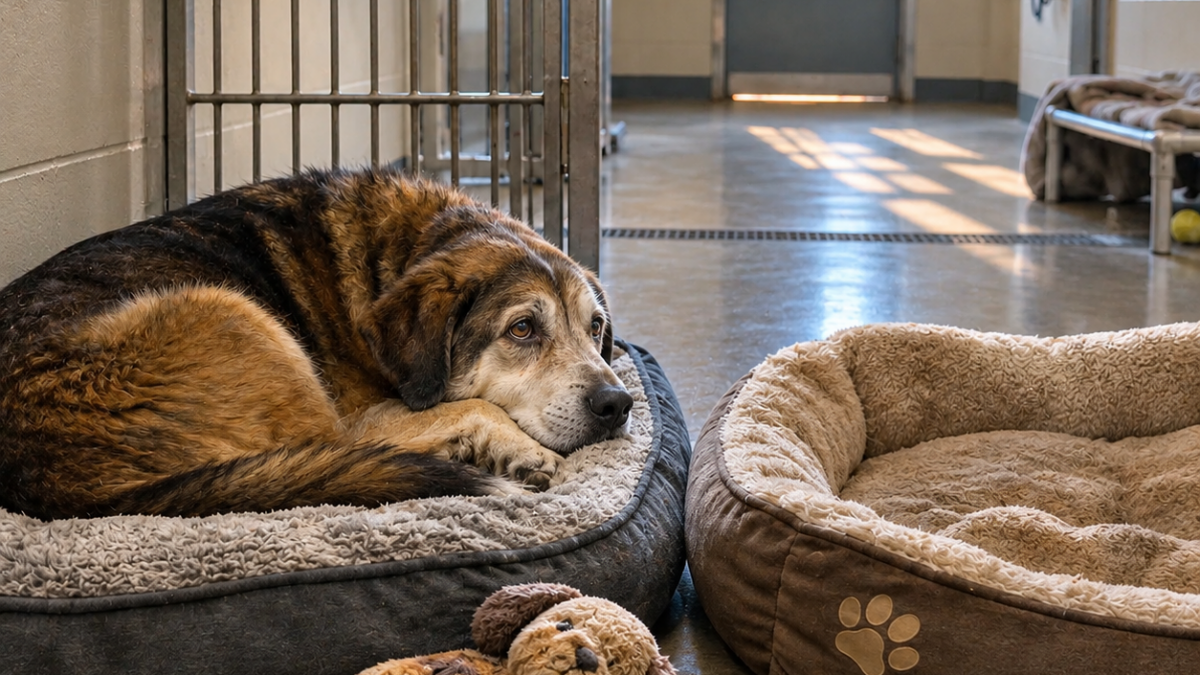
# **They Adopted the Younger Dog and Left His 10-Year-Old Best Friend Behind—Then He Refused to Forget Her**
They arrived at our shelter with two leashes, two blankets, and nearly a lifetime of memories tied between them.
Six weeks later, only one leash went out through our front door—and the dog left behind stared after it as if someone had just carried away half of her world.
I had worked in rescue long enough to think I understood heartbreak, but what Maya did after that door closed taught me there are some losses even animals refuse to accept quietly.
My name is Claire, and I had been working at a shelter outside Angers for almost eleven years when Maya and Paco came to us.
They arrived on the same morning.
Same car.
Same owner.
Same frightened expression.
Maya was ten years old, a shepherd mix with a graying muzzle and the slow, careful movements of a dog whose hips had started reminding her that she wasn’t young anymore.
Paco was four.
Smaller.
Faster.
Black-and-tan fur, bright eyes, endless curiosity.
Their owner, Madame Lefèvre, had suffered a serious stroke.
Her daughter tried keeping the dogs for several weeks, but she lived in a small apartment, worked long shifts, and already had two cats.
Eventually, she called us.
When she brought Maya and Paco in, she cried through most of the paperwork.
“They’ve never been apart,” she told me.
“How long have they lived together?” I asked.
“Since Paco was eight weeks old.”
I looked down.
Paco was pressed against Maya’s shoulder.
Maya leaned slightly into him.
“They sleep together?”
“Usually.”
“Eat together?”
“Always.”
“If one goes to the veterinarian?”
“The other waits by the door.”
That should have told us everything.
The first few days at the shelter were difficult.
Maya barely touched her food unless Paco’s bowl was beside hers.
We gave them two beds.
Every morning, we found them on one.
Paco would curl against Maya’s stomach, and Maya would sleep with one paw stretched over his back.
When volunteers took Paco outside, Maya stood against the kennel gate until he returned.
She didn’t bark.
She didn’t scratch.
She simply waited.
The moment Paco reappeared, her whole body relaxed.
We listed them as a bonded pair.
That made adoption harder.
One dog is a commitment.
Two dogs make people hesitate.
And when one of those dogs is ten years old, most families suddenly become very practical.
Six weeks passed.
Then the Martin family walked in.
A mother, father, and two children.
They wanted a dog who could run with the kids, play in the yard, go hiking, and handle a busy household.
Paco fit that picture immediately.
He chased a tennis ball for their eight-year-old son, Lucas.
He rolled onto his back when twelve-year-old Emma scratched his stomach.
Within fifteen minutes, both children were in love.
But to their credit, the family also spent time with Maya.
Emma sat beside her.
Mrs. Martin stroked her gray muzzle.
They even walked both dogs together.
For a few minutes, I let myself believe they might take them both.
Then we sat down to discuss the adoption.
Mr. Martin leaned forward.
“We’ve decided on Paco.”
My stomach sank.
“And Maya?”
His eyes moved toward the kennel area.
“She’s lovely.”
That phrase.
I had heard it too many times.
**She’s lovely, but…**
“We only planned on one dog,” he continued.
I explained again that Maya and Paco had lived together almost Paco’s entire life.
Mrs. Martin looked uncomfortable.
“Will she be okay?”
I answered carefully.
“She may adjust.”
“That means yes?”
“It means I can’t promise you she won’t grieve.”
Silence.
The children were already holding Paco’s new collar.
Mr. Martin glanced at them.
“We can’t take every dog.”
He wasn’t wrong.
That somehow made it harder.
The paperwork was signed.
We clipped Paco’s leash to his collar.
The moment Maya heard the metal clasp, she stood.
Paco walked into the hallway.
Maya followed.
Nobody called her.
To Maya, there was nothing unusual happening.
For years, when Paco went somewhere, she went too.
She followed us toward reception.
Then toward the front entrance.
I put my hand gently on her chest.
“No, sweetheart.”
Paco crossed the doorway with the Martin children.
Maya tried to follow.
The door closed.
She stopped.
For nearly five minutes, she stared through the glass.
No barking.
No whining.
No pulling.
Just waiting.
That night, Maya ignored her own blanket.
She walked to Paco’s empty bed, circled twice, and lay down on it.
The next morning, there were still two blankets inside the kennel.
But only one dog.
And every time footsteps echoed down our hallway, Maya lifted her head—
hoping one of them belonged to Paco.
—
## **— END OF FACEBOOK OPENING / PART 1 —**
—
The first night after Paco left, Maya barely slept.
I know because I was there until almost eleven.
One of our younger dogs had undergone surgery that afternoon, and I had volunteered to stay late to monitor him.
Every twenty or thirty minutes, I walked past Maya’s kennel.
Each time, she was awake.
Sometimes she was sitting at the gate.
Sometimes she was curled on Paco’s blanket.
Once, I found her standing beside his empty water bowl.
We had removed his food bowl but forgotten the second water dish.
She sniffed it.
Then looked toward the hallway.
“Maya.”
Her ears moved.
I opened the gate.
She didn’t come toward me.
I sat on the floor.
After eleven years in rescue, you learn when touching an animal helps and when it only makes the human feel useful.
Maya didn’t need petting.
She needed Paco.
And I couldn’t give him back.
So I sat.
After several minutes, she lowered herself onto his blanket.
I rested my hand on the concrete between us.
“I’m sorry.”
She closed her eyes.
The next morning, she refused breakfast.
At lunch, she ate three bites.
That evening, nothing.
Our veterinarian, Dr. Moreau, examined her.
Physically, nothing dramatic had changed.
Her arthritis.
Mild dental disease.
A little overweight.
All things we already knew.
“What about stress?” I asked.
He looked toward Maya.
“Of course.”
“Can it make her stop eating?”
“Yes.”
“For how long?”
He gave me the answer veterinarians always give when you want certainty.
“It depends.”
I hated that phrase.
***
Three days later, Mrs. Martin called.
At first, I assumed she wanted an update on Maya.
I was wrong.
“We’re having a little problem with Paco.”
I sat down.
“What kind of problem?”
“He won’t settle.”
“That’s common during the first few days.”
“No, I mean he really won’t settle.”
She explained.
Paco followed them constantly.
Room to room.
If a door closed between him and a family member, he scratched.
At night, instead of sleeping in the expensive new bed they had bought him, he paced between the hallway and front door.
“He keeps crying,” she said.
“When?”
“Mostly at night.”
“Anything else?”
“He won’t eat unless someone sits near him.”
My eyes closed.
“And when one person leaves the house?”
“He runs to the window.”
“What about when you walk him?”
“He keeps turning around.”
I knew exactly what Paco was doing.
Searching.
“Mrs. Martin, he has lost Maya.”
She became quiet.
“I know.”
“Do you?”
The words came out sharper than I intended.
I softened my voice.
“Sorry.”
“We understood they were close.”
“They were more than close.”
“We couldn’t adopt two dogs.”
“I know.”
She sounded defensive now.
“Are you saying we made a mistake?”
I could have said yes.
Part of me wanted to.
But rescue work cannot be about winning arguments.
It has to be about fixing what can still be fixed.
“I’m saying Paco may need time.”
“How much?”
“I don’t know.”
She sighed.
“We have two children. Nobody is sleeping.”
“Give him routine. Keep departures calm. Don’t punish the whining.”
“Should we crate him?”
“Was he crate trained?”
“No.”
“Then don’t suddenly lock him in one all night.”
Silence.
Then she asked, “How’s Maya?”
I looked through the office window.
Maya was lying on Paco’s blanket.
“She misses him.”
“How badly?”
I hated the question.
“Enough that we’re watching her food intake closely.”
Another silence.
Mrs. Martin whispered, “Oh.”
That was all.
***
By the end of the first week, Maya had lost almost three pounds.
For a ten-year-old dog, that frightened me.
Dr. Moreau adjusted her medication because her stomach had become irritated.
We mixed chicken into her food.
Rice.
Wet food.
Warm broth.
Some days she ate.
Some days she didn’t.
But every time the shelter entrance opened, she listened.
I began taking her into reception during quiet hours.
Maybe being around people would help.
It didn’t.
She positioned herself where she could see the door.
One afternoon, a small black-and-tan dog came in for a vaccination clinic.
Maya stood so quickly that her back legs nearly slipped.
Her tail lifted.
For one second, she looked five years younger.
Then the dog turned.
Not Paco.
Maya’s tail dropped.
She walked back to her blanket.
I had to leave the room.
***
The Martins called again on day ten.
This time, Mr. Martin was on the phone.
His name was Julien.
He sounded tired.
“We need help.”
“What happened?”
“Paco chewed the trim around our front door.”
“That can happen with anxiety.”
“He destroyed Emma’s backpack.”
“That sounds more like general stress or boredom.”
“He peed inside.”
“Once?”
“Twice.”
“Had he been taken out?”
“Yes.”
I could hear frustration building in his voice.
“We were told he was house-trained.”
“He was.”
“Then why is he doing this?”
“Because his entire life changed eleven days ago.”
“So this is normal?”
“No. It’s not desirable. But it isn’t proof you were given a defective dog.”
He became quiet.
I immediately regretted the word.
Not because it was wrong.
Because I knew how it sounded.
“I didn’t say defective.”
“No, but you sound as though you think we hid something.”
“We were told he was social.”
“He is.”
“With separation issues?”
“With Maya.”
“You didn’t say he would fall apart without her.”
I gripped the telephone.
“Yes, we did.”
Silence.
“We told you they were bonded.”
“That could mean anything.”
“It meant exactly what it sounds like.”
His voice hardened.
“So now this is our fault?”
I closed my eyes.
“No.”
But the honest answer was more complicated.
“You adopted a dog who had never lived without Maya. We discussed that. None of us knew exactly how he would react.”
Julien exhaled.
“We can’t live like this for months.”
I looked at Maya.
Then an idea formed.
“What if you brought him here for a visit?”
“What?”
“Not to return him.”
I said it quickly.
“A reunion.”
“With Maya?”
“Yes.”
“What would that accomplish?”
“I don’t know.”
That was true.
“It may help them. It may make things harder. But right now both dogs are struggling.”
He didn’t like it.
I could tell.
But Mrs. Martin called me an hour later.
“We’ll come Saturday.”
***
I don’t think I will ever forget that Saturday.
We put Maya in our fenced exercise yard.
She had eaten half her breakfast.
That counted as a good day.
I was standing near the gate when a car pulled into the parking lot.
Maya heard it.
Nothing happened at first.
Then a dog barked inside the car.
Maya froze.
Her ears shot up.
Another bark.
Her entire body changed.
She ran.
Actually ran.
For the first time since Paco had left.
She reached the yard gate before I did.
The Martins stepped out.
Paco was in the back seat.
The moment the door opened, he exploded forward.
Julien barely held the leash.
“Easy!”
Paco saw Maya.
The sound he made was unlike an ordinary bark.
High.
Broken.
Desperate.
Maya answered.
Then Paco pulled so hard that Julien finally ran with him toward the enclosure.
I opened the gate.
Paco rushed inside.
They collided.
Maya nearly fell.
Paco circled her.
Sniffing.
Whining.
Licking her face.
Maya leaned into him so hard she had to widen her stance to stay upright.
Then the two dogs did something that silenced every person watching.
They pressed their foreheads together.
No jumping.
No wild barking.
Just stillness.
Emma started crying.
Her younger brother Lucas whispered, “He missed her.”
Nobody answered.
Because there was nothing to add.
Paco followed Maya across the yard.
She drank.
He drank.
She lay down.
He lay beside her.
Within fifteen minutes, both dogs were asleep.
Paco had apparently not slept deeply since leaving the shelter.
Now he slept with his back against Maya’s.
Mrs. Martin sat on a bench staring at them.
“I didn’t know.”
I stood beside her.
“We tried to tell you.”
She nodded.
“I know.”
There was no defensiveness this time.
That should have been the turning point.
It wasn’t.
When their visit ended, Julien clipped Paco’s leash on.
Maya stood.
Again.
Exactly like adoption day.
The moment almost became unbearable.
Paco resisted.
Julien pulled gently.
“Come on.”
Paco looked at Maya.
Then at the gate.
Maya followed.
Mrs. Martin whispered, “Oh God.”
Emma said, “Can’t Maya come?”
Her father’s expression tightened.
“Emma.”
“Why not?”
“We talked about this.”
“But look at them.”
“We adopted one dog.”
“You adopted half of something.”
The sentence came from a twelve-year-old.
And every adult in the yard felt it.
Julien looked embarrassed.
“That’s enough.”
Emma turned toward Maya.
Tears were running down her face.
“Sorry.”
They took Paco home.
Maya stood at the fence until their car disappeared.
That evening, she refused dinner again.
***
I was angry.
Not professionally frustrated.
Angry.
At Julien.
At the situation.
At myself.
At the shelter.
At a world where a four-year-old dog was considered desirable and a ten-year-old dog could become invisible simply because time had touched her face.
Sandrine, our shelter director, found me scrubbing food bowls harder than necessary.
“You’re going to break those.”
“I hope so.”
“Claire.”
“They saw it.”
“I know.”
“They saw exactly what separating them is doing.”
“I know.”
“And still left her.”
Sandrine dried her hands.
“What do you want them to do?”
“Take Maya.”
“They didn’t agree to two dogs.”
“Then maybe they shouldn’t have taken Paco.”
She gave me a long look.
I hated when she did that.
“What?”
“You know shelters separate bonded animals sometimes.”
“Not like this.”
“Sometimes exactly like this.”
I put down the bowl.
“And that makes it right?”
“No.”
“Then what are you saying?”
“I’m saying being angry at the Martins won’t get Maya a home.”
I looked away.
“Maybe we made the wrong call approving Paco’s adoption.”
“Maybe.”
That surprised me.
Sandrine continued.
“We were afraid neither would be adopted if we insisted on a pair.”
There it was.
The ugly truth.
We had made a practical decision too.
The Martins weren’t the only people who had chosen the easier half.
We had allowed it.
The realization sat heavily in my stomach.
“What do we do?”
Sandrine looked toward Maya’s kennel.
“We fix what we can.”
***
The next day, we changed Maya’s profile.
Not dramatically.
No attack on Paco’s adopters.
No guilt campaign.
We told the truth.
**MAYA, AGE 10**
**Gentle. Loyal. Quiet.**
**Recently separated from the dog she had lived with for nearly four years.**
**She is grieving.**
Then I added:
**Maya does not need someone who wants an old dog because they feel sorry for her. She needs someone willing to show her that losing one home does not mean she has lost every future one.**
We included a photograph of her sleeping on Paco’s old blanket.
The post spread faster than expected.
A local animal welfare page shared it.
Then another.
Comments appeared.
**How could anyone take one and leave the other?**
**This breaks my heart.**
**I would take her if I lived closer.**
Some comments became cruel toward the unknown family.
We deleted those.
I didn’t want vengeance from strangers.
I wanted a solution.
For three days, nothing serious came.
Then an application appeared.
A widow named Madeleine.
Seventy-one.
Fenced yard.
No other pets.
Retired teacher.
Excellent veterinary reference.
She drove more than an hour to meet Maya.
I liked her immediately.
She sat on the ground despite her bad knees.
Maya approached.
Sniffed her hands.
Accepted a piece of cheese.
Madeleine smiled.
“I think old girls deserve each other.”
For the first time in weeks, I felt hopeful.
We arranged another meeting.
Then another.
Maya seemed comfortable.
Not joyful.
But safe.
Madeleine understood.
“I don’t need her to adore me immediately.”
Exactly the right answer.
We scheduled a home trial.
The night before Maya was supposed to leave, Mrs. Martin called.
This time she was crying.
“Paco got out.”
I stood.
“What?”
“Julien opened the gate to take the trash out. Paco pushed past him.”
“Where are you?”
“Home.”
“How long ago?”
“Twenty minutes.”
“Is he wearing identification?”
“Yes.”
“Have you called the police, animal control, local shelters?”
“Julien is driving around.”
“Send me your address.”
“We already contacted the shelter closest to us.”
“Send it anyway.”
I knew what everyone feared.
Roads.
Cars.
Darkness.
A terrified dog moving without direction.
But Paco did have a direction.
We just didn’t know it yet.
Two hours later, a woman called the number on his tag.
She had found him almost three miles from the Martins’ house.
He was standing outside a small grocery store.
Not near our shelter.
Not remotely.
But something about the location caught Mrs. Martin’s attention.
It was on the route they had taken the day they brought Paco to visit Maya.
He had not reached the shelter.
He probably never could have.
But he had gone in the same general direction.
Was that proof he was trying to find Maya?
No.
I won’t invent thoughts for a dog.
But the possibility shook all of us.
Julien picked him up.
Paco was unharmed.
The next morning, I received another call.
“Claire,” Julien said.
His voice sounded different.
“I think we need to talk.”
***
They came without the children.
I expected them to surrender Paco.
I had prepared myself.
Instead, Julien sat across from me and placed both hands on the table.
“I was wrong.”
I didn’t answer.
He continued.
“I thought you were exaggerating.”
Mrs. Martin looked exhausted.
“Paco is unhappy.”
“So is Maya.”
“I know.”
That answer no longer sounded defensive.
Julien rubbed his face.
“I didn’t want two dogs.”
I appreciated that he didn’t pretend otherwise.
“Our plan was one young dog. Something active. Something easy with the children.”
I almost laughed at the word easy.
Dogs are never products ordered from a catalog.
He continued.
“Maya is ten.”
“Yes.”
“She has medical expenses.”
“Yes.”
“Probably more later.”
“Yes.”
“She may only live a few years.”
“Possibly.”
He looked toward his wife.
Then back at me.
“I kept thinking, why should we take on all of that?”
I waited.
“And then last night, when Paco was missing…”
His voice broke slightly.
“I realized we already did.”
I frowned.
“What do you mean?”
“We took responsibility for him.”
“Yes.”
“And everything that matters to him.”
Silence.
Mrs. Martin began crying.
“He keeps looking for her.”
Julien stared at the table.
“So I need to ask you something.”
My heart started beating faster.
“Is Maya still available?”
I should have felt triumphant.
I didn’t.
I felt cautious.
“Yes.”
“We’d like to adopt her.”
I didn’t say yes.
That surprised them.
Julien looked up.
“I thought this was what you wanted.”
“It is.”
“Then what’s the problem?”
“Maya is not an accessory for Paco.”
His face tightened.
I continued.
“If you adopt her, you adopt Maya.”
“I understand.”
“No. I need you to really understand.”
I listed everything.
Arthritis.
Possible future mobility issues.
Senior bloodwork.
Medication.
Dental care.
Her slower pace.
Her need for quiet.
The possibility that she could live one year.
Or five.
The possibility Paco could someday live without her again.
Mrs. Martin listened.
Julien did too.
Then I said the hardest part.
“You cannot take her because Paco is inconvenient without her.”
His expression changed.
“I’m not.”
“Then why?”
He looked through the glass toward Maya.
For a while, he didn’t answer.
Finally:
“Because we separated a family.”
That was the first answer I believed.
***
We did not send Maya home with them that day.
They hated that.
Especially Julien.
Good.
Not because I wanted revenge.
Because promises made in guilt can disappear when guilt fades.
We required two family meetings.
A home visit.
An agreement about medical costs.
A conversation with our veterinarian.
And most importantly—
the children had to understand Maya was not coming home as a playmate.
She might not run.
Might not fetch.
Might not want constant attention.
When Emma returned, she walked straight to Maya.
She sat beside her.
“I told Dad.”
“Told him what?” I asked.
“That Paco didn’t need a better dog.”
She stroked Maya’s neck.
“He needed his dog.”
Julien heard.
He didn’t correct her.
Three days later, we took Maya to their home for a trial visit.
Paco heard our van.
He started barking before we reached the gate.
When Maya stepped out, he almost pulled Mrs. Martin off her feet.
We released both dogs into the fenced yard.
Paco ran circles around Maya.
Maya stood watching him.
Then she did something I had not seen since before Paco left.
She played.
Not for long.
Her hips wouldn’t allow it.
But she lowered her front legs.
Tail up.
A play bow.
Paco responded.
They chased each other around the apple tree.
Maya lasted maybe thirty seconds.
Then she stopped, panting.
Paco immediately stopped too.
He walked beside her toward the house.
Inside, there were two beds.
Two bowls.
Two leashes hanging near the door.
I noticed something else.
The children had moved Paco’s bed.
It now sat beside Maya’s.
Emma caught me looking.
“They’ll probably sleep on one anyway.”
I smiled.
She was right.
***
The first night, Maya slept for nine hours.
Straight.
No waiting at a kennel gate.
No lifting her head at every set of footsteps.
No empty blanket beside her.
Mrs. Martin sent me a photograph at 6:14 the next morning.
Paco was curled against Maya.
Maya’s paw rested over his back.
Exactly the way they had slept at the shelter.
Under the photograph, she wrote:
**We should have listened.**
I stared at those words for a long time.
Then I replied:
**Just keep listening now.**
The adoption became official a week later.
There was no dramatic ceremony.
No balloons.
No big announcement.
I clipped Maya’s old leash to her collar.
Paco waited near the door with the family.
Maya walked toward him.
This time, when the front door closed—
both dogs were on the same side.
That should have been the end.
It wasn’t.
Because the internet had not forgotten Maya.
And neither had Julien’s pride.
Before adopting Maya, he had posted a one-star review of our shelter.
I had not known about it until Sandrine showed me.
It had been written after Paco’s first difficult week.
**Shelter failed to disclose serious behavioral problems. Adopted a supposedly social, trained dog who cannot be left alone, destroys property, and is extremely anxious. Staff blamed our family rather than helping.**
I read it twice.
Then looked at Sandrine.
“He posted this?”
“Apparently.”
“When?”
“Eight days after adoption.”
“Before the reunion?”
“Yes.”
I felt heat rise through my face.
“Delete it.”
“We can’t.”
“I mean respond.”
“We already did.”
She showed me.
Our reply was calm.
Professional.
Painfully polite.
**We’re sorry the transition has been difficult. Paco’s lifelong bond with another dog in our care, along with the risks associated with separating them, were discussed before adoption. We remain available to support the family.**
No names.
No accusations.
No public shaming.
But Maya’s adoption story had now become widely shared.
People began connecting pieces.
Some guessed the Martins were the family.
A few were correct.
Then the comments started.
Harsh ones.
Julien called.
“You need to take that post down.”
“What post?”
“The one about Maya.”
“It doesn’t mention you.”
“People know.”
“We did not identify you.”
“You made us look terrible.”
“We described Maya’s situation.”
“You know exactly what you were doing.”
I felt anger rise.
Then something else.
Disappointment.
“Julien, Maya is in your house right now.”
Silence.
“Is she?”
“Yes.”
“And Paco?”
“Beside her.”
“Are they okay?”
Another pause.
“Yes.”
“Then why are we having this conversation?”
“Because people are attacking my family.”
“That isn’t acceptable.”
I meant it.
“We’ll remove abusive comments.”
“You should delete the whole story.”
“No.”
He went silent.
“Maya’s story matters.”
“So our privacy doesn’t?”
“We didn’t name you.”
“My daughter’s friends figured it out.”
That changed things.
“Emma?”
“Yes.”
My anger cooled immediately.
“Is she being bullied?”
“Someone sent her screenshots.”
I closed my eyes.
Children should not pay for adult decisions.
“We’ll lock the comments.”
He sounded surprised.
“You will?”
“Yes.”
“Even after everything?”
“This isn’t revenge.”
Silence.
Then I added:
“And neither is Maya.”
Julien said nothing.
We locked the comments.
Two days later, he deleted his review.
A week later, he posted something else.
This time, he used his real name.
He wrote:
**We adopted Paco believing love and a good home would be enough. We were warned that he was deeply bonded to Maya, but we thought the dogs would adjust. We were wrong.**
**Paco struggled. Maya struggled. The shelter tried to tell us.**
**Maya now lives with us too. The difference in both dogs was immediate.**
**I’m writing this because I criticized the shelter before I was willing to admit our decision caused part of the problem.**
**If a shelter tells you two animals are bonded, listen.**
I read the post twice.
Then handed my phone to Sandrine.
“Well?”
She smiled.
“Better than revenge.”
I nodded.
It was.
Because humiliation teaches people to defend themselves.
Accountability sometimes teaches them to change.
***
Maya changed too.
Within two months, she regained the weight she had lost.
Her coat improved.
Her stomach settled.
She still had arthritis.
No miracle fixed that.
But she walked every morning with Mrs. Martin.
Short walk.
Then Paco took a longer one with Julien or the children.
They learned to adjust their life around two different dogs instead of forcing both dogs into one routine.
Emma became Maya’s person.
That surprised everyone.
Paco loved everybody.
Maya was selective.
But every afternoon around four, she waited near the staircase for Emma to come home from school.
The first time Mrs. Martin sent me a video, I nearly cried.
Emma opened the door.
Paco ran to her.
Maya stood slowly.
Her tail began wagging.
Emma ignored Paco for one second and knelt in front of Maya.
“Hi, old lady.”
Maya pressed her head into Emma’s chest.
That girl had understood something many adults never do.
Being slower doesn’t make love smaller.
***
Three months later, we received a letter.
Not email.
A real envelope.
Handwritten.
It came from Madame Lefèvre—the dogs’ former owner.
Her daughter had apparently shown her the shelter’s Facebook post.
She was now living in a rehabilitation residence near Nantes.
Her handwriting was shaky.
The letter read:
**Dear Claire,**
**My daughter tells me Maya and Paco are together again.**
**I cannot explain what that means to me.**
**When I gave them up, I knew I was losing my home. I did not realize they might lose each other too. If I had understood, I would have begged you not to separate them.**
My eyes blurred.
She continued:
**Maya helped raise Paco.**
**When he came to me as a puppy, he cried every night. Maya slept beside him.**
**When he was frightened of the vacuum cleaner, he hid behind Maya.**
**When Maya had surgery at eight, Paco refused to leave the door until she came home.**
**I know shelters cannot always keep animals together. I know life is not perfect.**
**But thank you for putting them back where they belong.**
At the bottom:
**If the family agrees, I would like one photograph.**
I called Mrs. Martin.
She said yes immediately.
Then Emma had a better idea.
“Why don’t we take them to see her?”
There were logistics.
Permission.
Travel.
Madame Lefèvre’s health.
But three weeks later, we made it happen.
I went too.
So did Sandrine.
The Martins drove separately with Maya and Paco.
Madame Lefèvre was sitting near a window when we arrived.
She looked smaller than I remembered.
Stroke rehabilitation had changed her speech.
Her right hand remained curled.
But when Paco entered the room, her entire face changed.
He recognized her first.
He pulled forward.
Maya followed.
Madame Lefèvre whispered:
“My babies.”
Paco jumped against her knees.
Maya moved more slowly.
When she reached the chair, Madame Lefèvre lowered her left hand.
Maya pressed her gray muzzle beneath it.
No one spoke.
There are moments when language only gets in the way.
Madame Lefèvre cried.
Emma cried.
Mrs. Martin cried.
I cried.
Julien stared out the window pretending he was interested in the parking lot.
Eventually Madame Lefèvre looked at him.
“You have both?”
Her speech was slow.
“Yes,” Julien said.
“Together?”
“Yes.”
She nodded.
“Good.”
One word.
But he understood the judgment inside it.
He knelt beside her.
“I’m sorry we separated them.”
Madame Lefèvre studied him.
Then she looked at Paco.
Then Maya.
Finally:
“You fixed it.”
Julien lowered his head.
“We did.”
She shook her head slightly.
“No.”
She pointed toward Maya.
“They fixed you.”
Emma laughed through her tears.
So did I.
Julien did not argue.
***
A year passed.
Then another.
Maya turned twelve.
Paco turned six.
Their life became ordinary.
That was the best part.
Ordinary mornings.
Ordinary bowls.
Ordinary walks.
Ordinary arguments over who had stolen whose bed.
The Martins stopped sending updates every week.
I considered that success.
Animals who are truly home eventually stop being news.
Then, one winter morning, Mrs. Martin called.
The tone of her voice told me before the words did.
“Maya isn’t well.”
My chest tightened.
“What happened?”
“She collapsed getting up.”
The veterinarian found a mass near her spleen.
At twelve, surgery was possible.
But risky.
More tests followed.
The news was not good.
Cancer.
Aggressive.
Possibly already spreading.
The family had choices.
None were easy.
Julien called me that night.
“I don’t know what to do.”
“Listen to the vet.”
“I did.”
“And?”
“He says surgery might give her more time.”
“Might.”
“Yes.”
“But she could die during it.”
“Yes.”
His voice cracked.
“How do you decide?”
“You don’t decide how much time you want.”
He became quiet.
“You decide what Maya can comfortably endure.”
“I hate that answer.”
“So do I.”
They sought a second opinion.
Same conclusion.
Eventually they chose palliative care.
Pain control.
Comfort.
No major surgery.
Emma struggled the most.
She was fourteen now.
Old enough to understand exactly what was happening.
One afternoon she came to the shelter alone with her mother.
She sat across from me.
“I don’t want Paco to lose her.”
Neither did I.
“But he will,” I said.
Her eyes filled.
“That’s horrible.”
“Yes.”
“Why did we even take her if she was just going to die?”
Mrs. Martin started to speak.
I raised a hand gently.
Emma needed the question answered.
“Do you wish you hadn’t taken her?”
“No.”
“Then that’s why.”
She stared down.
I continued.
“You didn’t adopt Maya to stop death.”
“Then what was the point?”
“To make sure she had a life before it came.”
Emma began crying.
Her mother put an arm around her.
“And Paco?”
I looked toward the kennels.
“Paco had two more years with her because your family changed its mind.”
That mattered.
Two years.
Hundreds of mornings.
Hundreds of nights.
Walks.
Meals.
Naps.
Two Christmases.
Two summers.
Two years in which neither dog woke behind shelter bars wondering where the other had gone.
“That doesn’t make goodbye easy,” I said.
“It makes everything before goodbye worth something.”
***
Maya declined slowly.
Some days were almost normal.
Others were not.
The family created a mattress area downstairs because stairs became difficult.
Paco stopped sleeping in the children’s rooms.
He slept beside Maya.
Always.
If she went outside, he went.
If she refused breakfast, he stayed near her bowl.
One evening in early spring, Emma sent me a photograph.
Two blankets.
Side by side.
Maya on one.
Paco on the other.
Their paws touched between them.
I saved it.
The next morning, Maya stopped eating.
By afternoon, she could no longer stand without help.
The veterinarian came to the house.
The Martins asked whether I wanted to come.
I almost said no.
It felt private.
Then Emma said, “You were there when they got separated.”
I understood.
So I went.
Maya lay in the living room.
Paco was beside her.
The old blanket from the shelter was under her.
Yes.
They had kept it.
The one Paco had slept on.
The one Maya had claimed after he left.
Julien sat on the floor.
Mrs. Martin held Maya’s head.
Lucas, now ten, stood near the window.
Emma sat beside Paco.
The veterinarian explained everything.
Again.
Even though everyone already knew.
When it was time, Emma asked a question.
“Can Paco stay?”
The veterinarian nodded.
“If he wants.”
Paco wanted.
He remained pressed against Maya’s back.
Mrs. Martin whispered, “Good girl.”
Julien covered his face.
I put one hand on Maya’s shoulder.
“You don’t have to wait anymore.”
The medication entered the catheter.
Maya’s breathing slowed.
Then stopped.
Paco did not react immediately.
He stayed beside her.
After a minute, he lifted his head.
Sniffed her face.
Her ears.
Her paws.
Then he stood.
Walked around her once.
Lay down again.
Emma sobbed into her mother’s shoulder.
The veterinarian gave Paco time.
That was important.
He needed to know Maya had not disappeared through another door.
This goodbye was different.
Painful.
But not confusing.
Eventually Paco stood and walked toward Emma.
She wrapped both arms around him.
This time, when Maya left—
Paco was not abandoned.
He had a family around him.
***
The next few weeks were difficult.
Paco searched for Maya.
Not constantly.
But enough.
He checked her bed.
Waited near the back door.
On walks, he sometimes turned around.
Mrs. Martin called me.
“It’s happening again.”
“I know.”
“Should we get another dog?”
“No.”
She sounded surprised.
“No?”
“Not yet.”
“But he’s lonely.”
“Maybe.”
“Wouldn’t another dog help?”
“Another dog isn’t Maya.”
Silence.
“Let him grieve.”
That was perhaps the most important lesson their family had learned.
You cannot replace a relationship by filling the empty space quickly.
So they waited.
Paco slept on Maya’s blanket for almost a month.
Then one evening, he climbed onto his own bed.
Emma noticed first.
She cried.
But she let him.
***
Several months after Maya’s death, Julien came to the shelter alone.
He carried a cardboard box.
“What’s that?”
“Donation.”
Inside were medications Maya had never finished.
Unused pads.
A support harness.
Senior dog food.
Blankets.
Then he placed an envelope on my desk.
“What is this?”
“Read it later.”
“Julien.”
“Please.”
After he left, I opened it.
Inside was a check.
A large one.
And a letter.
**When we first came to your shelter, I believed choosing a dog was about finding one that fit the life we already had.**
**Young. Active. Easy.**
**I thought taking Paco was a normal decision and leaving Maya was unfortunate but practical.**
**Then Paco taught us that love doesn’t always fit neatly into the plan you made before you met it.**
He continued:
**I criticized the shelter because admitting we had been warned would have meant admitting I had ignored something important.**
**Maya gave our family two years we did not deserve to expect from her.**
**She taught my children patience.**
**She taught me that old does not mean less valuable.**
**And she taught Paco that leaving the shelter did not have to mean losing her.**
At the bottom:
**Please use this money for bonded animals and senior dogs.**
**Make it harder for families like mine to choose only the easy half.**
I cried.
Then I showed Sandrine.
We created a fund.
We called it **The Maya & Paco Promise**.
Its purpose was simple.
When bonded animals came in, the fund helped cover adoption fees, medical expenses, food support, and whatever else made families hesitate about taking both.
Not every bonded pair could remain together.
Reality is complicated.
But money would no longer be the first reason we gave up trying.
Within the first year, the fund helped seven pairs.
Two elderly Beagles.
A cat and dog who had lived together for eleven years.
Two little terrier brothers.
A pair of senior Labradors surrendered after their owner died.
Every time both animals left through the same door, I thought of Maya.
***
A year after her death, the Martins came back to the shelter.
All four of them.
Paco too.
He was seven now.
Gray beginning around his mouth.
Emma was fifteen.
Lucas eleven.
They were not looking to adopt.
At least that was what Julien told me.
“We’re just visiting.”
“Of course.”
I did not believe him.
In kennel twenty-three were two dogs.
Bella and Max.
Mother and son.
Bella was eleven.
Max was five.
They had been with us almost two months.
I said nothing.
Emma spotted them.
“Why are they together?”
“Because they came together.”
“How long?”
“Eleven years for Bella. Five for Max.”
Julien looked at me.
“Don’t.”
“I didn’t say anything.”
“You’re thinking.”
“Thinking is still legal.”
He sighed.
They spent half an hour with the dogs.
Paco met them in the yard.
He liked Max.
Bella ignored everyone until Emma sat down.
Then she approached.
I saw Julien watching.
He knew exactly what was happening.
“No,” he said.
His wife laughed.
“You’re talking to yourself.”
“We came to visit.”
“Yes.”
“We already have a dog.”
“Yes.”
“Three dogs is insane.”
“Probably.”
Emma looked at him.
“Dad.”
“No.”
“Dad.”
“No.”
Lucas joined.
“Dad.”
Julien pointed at me.
“This is your fault.”
I raised both hands.
“I have said nothing.”
Mrs. Martin crouched beside Bella.
“We’re not making a decision today.”
“Good.”
Julien looked relieved.
Then she added:
“We’ll come back Saturday.”
His face fell.
I laughed.
They adopted Bella and Max three weeks later.
Both.
Together.
Julien signed the papers.
Then looked at me.
“Happy?”
“Very.”
“This is revenge, isn’t it?”
I smiled.
“No.”
I handed him two leashes.
“This is consequences.”
He laughed.
***
Paco accepted the newcomers slowly.
Max wanted to play too much.
Bella wanted to sleep.
Paco, somewhere in the middle, learned to negotiate both.
The first photograph Emma sent me showed three dogs under the same apple tree.
Paco in the center.
Bella asleep on one side.
Max sprawled on the other.
The caption read:
**Apparently Dad has three dogs now.**
I replied:
**Life is cruel.**
Julien sent back:
**I hate all of you.**
Five minutes later, another photograph arrived.
Julien was on the couch.
All three dogs were on top of him.
He was smiling.
***
Years have passed since Maya and Paco first came through our shelter doors.
I still remember that first morning clearly.
Two leashes.
Two blankets.
Two dogs leaning into each other because everything familiar had disappeared except the body beside them.
I remember the day Paco left.
The sound of the front door.
Maya standing still.
The empty blanket.
I spent a long time wishing we could erase that day.
Now I don’t.
Not because separating them was right.
It wasn’t.
But because what followed changed people.
It changed our shelter.
It changed the Martins.
It changed me.
Before Maya, I thought bonded-pair policies were mostly logistical.
A preference.
Something we tried to honor when possible.
After Maya, I understood that sometimes the relationship between two animals is not a convenience.
It is part of who they are.
That doesn’t mean no bonded animals can ever survive separation.
Some can.
Some adapt beautifully.
But humans have a dangerous habit of calling something “fine” because accepting the truth would make our choices harder.
Maya forced us to stop doing that.
Her grief was impossible to ignore.
So was Paco’s.
And in the end, even Julien—the man most determined to believe one dog should be enough—became the person writing checks so other families would not make the same choice he had.
That was the revenge people often ask me about when they hear the story.
They expect me to say the family was punished.
That Paco destroyed their house.
That strangers humiliated them online.
That we refused to let them adopt again.
But that is not the revenge I remember.
The real revenge was much better.
Julien had wanted one young, easy dog.
Years later, he was paying veterinary bills for three.
He had wanted a dog who would fit neatly into his existing life.
Instead, dogs rearranged the life itself.
He had once looked at Maya and seen age, medical expenses, limits and inconvenience.
By the time Bella came along, he looked at an eleven-year-old dog and asked:
“What medication does she take?”
That is what Maya did to him.
She changed what he saw.
There are worse punishments.
There are also better victories.
***
On what would have been Maya’s fourteenth birthday, the Martins visited the shelter.
They brought a small wooden plaque.
Emma had designed it.
We hung it beside the bonded-pair kennels.
It read:
**SOME LOVE STORIES COME WITH TWO LEASHES.**
Below that:
**In memory of Maya.**
I stood looking at it for a long time.
Paco sat beside me.
His muzzle was much grayer now.
I scratched his head.
“You caused a lot of trouble.”
His tail moved.
“You know that?”
Nothing.
“You could have just been normal.”
Paco leaned against my leg.
I laughed.
“No. I suppose that was never the plan.”
Emma came over.
“Do you think he still remembers her?”
I looked at Paco.
“Yes.”
She smiled sadly.
“How do you know?”
“I don’t.”
That surprised her.
I continued.
“But remembering doesn’t always look like waiting at a door.”
She looked toward the plaque.
“I still think about her every day.”
“So do I.”
“But I don’t cry every day anymore.”
“Exactly.”
Paco stood.
Walked toward Max.
Then Bella.
His family.
His life had continued.
Not because Maya stopped mattering.
Because she had mattered enough to become part of what came next.
***
Madame Lefèvre died the following year.
Her daughter called us.
She had kept the photograph from that reunion beside her bed.
Maya and Paco together.
The Martins sent flowers.
Emma wrote a note.
**Thank you for loving them first.**
I thought that was perfect.
Nobody owns the entire story of an animal.
We are chapters.
Madame Lefèvre had been theirs for years.
The shelter had been a painful chapter.
The Martins became another.
Maya’s chapter ended before Paco’s.
Paco’s continued.
That is life.
We do not get to keep every person or animal we love beside us forever.
But we can choose what we do while they are here.
***
One evening, long after closing time, I walked through the shelter alone.
Kennels were quiet.
Lights dimmed.
I passed the enclosure Maya and Paco had once shared.
Two new dogs were sleeping there.
A bonded pair of elderly Spaniels.
Both twelve.
Their owner had gone into assisted living.
The smaller dog was asleep on one blanket.
The larger dog had started on another.
But sometime during the night, one had moved.
Now they were pressed together on the same bed.
I stopped.
For a moment, I was back years earlier.
Maya and Paco.
Two blankets.
One pile of dogs.
I looked at the paperwork attached to the gate.
A family was coming the next morning.
They had specifically asked for both.
The Maya & Paco Promise would cover six months of senior medication.
I smiled.
“Good.”
The older Spaniel opened one eye.
I switched off the hallway light.
The next afternoon, I watched that family leave.
Two dogs.
Two leashes.
Same door.
Neither looked back.
I stood in reception with Sandrine.
She bumped my shoulder.
“You’re crying.”
“No.”
“Yes.”
“Dust.”
“Inside the building?”
“A lot of dust.”
She laughed.
Outside, the family loaded both dogs into the back seat.
One child climbed between them.
The car pulled away.
I thought about Maya on the day Paco left.
I thought about her standing at that same door, waiting for it to reopen.
Then I thought about the final day of her adoption.
Paco beside her.
The door closing behind them.
Together.
That is the image I prefer now.
Not the empty blanket.
Not the waiting.
Not the mistake.
The correction.
Because sometimes we hurt animals without intending to.
Sometimes we make decisions because they are practical.
Cheaper.
Simpler.
Easier.
And sometimes the ones who cannot speak force us to look at what those decisions cost.
Maya never shouted.
She never accused anyone.
She simply lay on Paco’s blanket and waited.
That silence changed an entire family.
Then a shelter.
Then dogs she never met.
When people ask me what lesson I took from her, I tell them this:
Love is not always the ability to hold on forever.
Sometimes it is recognizing what belongs together before you become the reason it is broken apart.
Maya and Paco arrived at our shelter with two leashes.
For six painful weeks, we forgot what those two leashes meant.
Then one left without the other.
And Maya taught us the price.
But that was not how their story ended.
Months later, two leashes went through the door again.
This time Maya was on one.
Paco was on the other.
And when the door closed behind them—
there were no empty blankets left inside.








