PART 2: They Abandoned Their 12-Year-Old Dog Because He Couldn’t Walk—He Stayed in the Parking Lot Waiting for Them Anyway
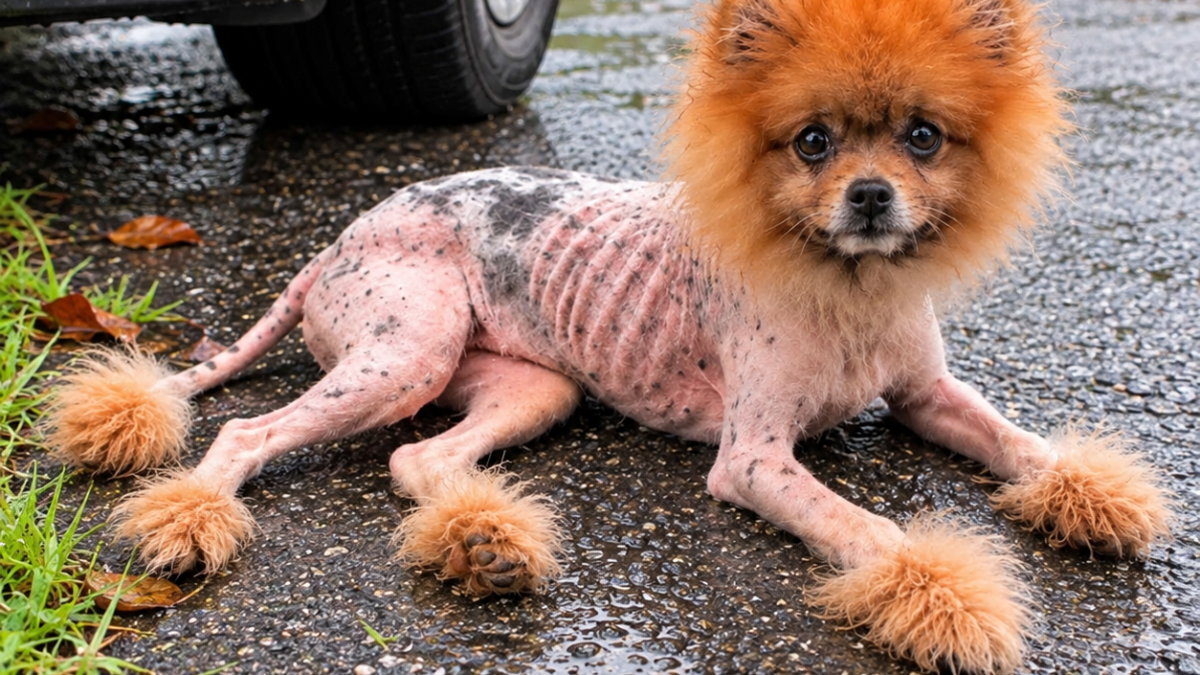
PART 2
It happened on an ordinary Tuesday morning.
There was no dramatic breakthrough.
No miracle.
No moment when Punch suddenly pushed himself onto four steady legs and crossed the room while music played somewhere in the background.
I was sitting on the kitchen floor with him after another rehabilitation session.
His rear support sling lay beside us.
My knees hurt.
My back hurt.
Punch was tired.
For nearly a year, I had measured progress in inches.
How long could he hold himself upright?
Could he put more weight on his left rear leg?
Would his toes curl properly?
Could he shift his hips without collapsing?
That morning the answers were not good.
He had managed only a few seconds before his legs folded.
I had lowered him gently onto his blanket.
“I’m sorry,” I whispered.
Punch looked at me.
I wiped my eyes before the tears could fall.
“I thought I could fix this.”
His head tilted slightly.
“I really thought I could.”
Then Punch did something he had not done during those first terrible weeks after his rescue.
He crawled toward me.
Not toward the door.
Not toward the window.
Toward me.
He pushed with his front legs until his chest touched my thigh.
Then he rested his chin in my lap.
I froze.
Punch sighed.
It was a deep, relaxed sound.
His eyes closed.
And suddenly I understood.
I had been trying so desperately to give Punch his old life back that I had nearly missed the new life growing right in front of me.
He might never walk normally.
But he was eating again.
He was sleeping through the night.
He barked when breakfast was late.
He wagged when I came home.
He had favorite blankets.
Favorite treats.
Favorite places to nap.
And somewhere along the way, the dog who once stared at every passing car had stopped waiting for the people who abandoned him.
He had started waiting for me.
I placed my hand on his head.
“Oh, Punch.”
His tail tapped the floor.
Once.
Twice.
Three times.
That little sound nearly destroyed me.
Because I remembered the parking lot.
The way he had lifted his head at every approaching vehicle.
The way disappointment settled over his face each time the wrong people stepped out.
For months I had believed the greatest victory would be seeing him stand.
I was wrong.
The greatest victory was realizing he had finally stopped looking backward.
I bent down until my forehead touched his.
“You don’t have to walk for me,” I whispered. “Do you understand?”
His tail moved again.
“You don’t have to prove anything.”
I cried then.
Not loudly.
Not dramatically.
I simply sat on the kitchen floor with an old dog who could not use his back legs and finally let go of the version of his recovery I had been chasing.
From that day forward, our goal changed.
We would continue rehabilitation because movement helped his circulation, muscle tone, comfort, and dignity.
But I stopped treating walking as the price Punch had to pay for a good life.
If his legs came back, wonderful.
If they didn’t, we would build him a world that worked without them.
That turned out to be one of the best decisions I ever made.
The first challenge was mobility.
Punch had a support harness, but using it for every movement was exhausting for both of us.
His veterinarian recommended trying a properly fitted wheelchair.
I had looked at dog wheelchairs before.
I had even ordered one months earlier.
Punch hated it.
The first time I placed him in the frame, he froze.
His front legs locked.
His eyes widened.
He refused to move.
“Come on,” I encouraged.
Nothing.
I held chicken six feet ahead.
Nothing.
I moved it three feet closer.
Punch stared at the chicken.
Then at me.
His expression clearly said I could bring the chicken to him if I wanted him to have it.
The therapist laughed.
“He’s smart.”
“He’s manipulative.”
Punch blinked.
The therapist smiled.
“Same thing sometimes.”
We tried again.
One step.
That was all.
His front paws moved forward.
The wheelchair rolled an inch.
Punch immediately stopped.
I celebrated as if he had completed a marathon.
“Yes!”
Punch looked offended.
The next day he managed three steps.
Then six.
Then across the room.
The real breakthrough came when one of the clinic cats walked past the rehabilitation area.
Punch saw it.
The cat saw Punch.
The cat ran.
Punch forgot he hated the wheelchair.
He took off.
“Punch!”
The therapist grabbed the back of the frame before he reached the doorway.
I burst out laughing.
Punch twisted his head around.
His ears were up.
His eyes were bright.
There he was.
Not a patient.
Not an abandoned senior.
Not a spinal case.
A dog.
A stubborn old dog who had just discovered that wheels could help him chase cats.
On the drive home, I kept glancing at him in the mirror.
“You’ve been lying to me.”
Punch stared out the window.
“You knew how to use that chair.”
No response.
“You just needed proper motivation.”
His tail moved once.
Within weeks, the wheelchair became part of our routine.
I called it his chariot.
Punch preferred that word.
At least I imagined he did.
We started going outside for longer periods.
At first, only the backyard.
He rolled cautiously across the patio.
Grass was harder.
The wheels caught.
He backed up.
Tried again.
Then learned to angle himself around obstacles.
One afternoon he discovered speed.
A squirrel was responsible again.
Apparently small animals had become Punch’s personal rehabilitation team.
The squirrel ran along the fence.
Punch launched after it.
His front legs pumped.
The wheels bounced across the grass.
“Punch!”
He ignored me.
The squirrel escaped into a tree.
Punch stopped underneath it, panting proudly.
I stood behind him with my hands on my hips.
“You are twelve years old.”
Punch stared upward.
“You have spinal problems.”
Still staring.
“You’re supposed to be fragile.”
He barked.
One sharp bark.
I laughed so hard my neighbor came outside to see what had happened.
From then on, Punch wanted adventures.
We started with the neighborhood.
Then quiet parks.
Then a paved trail near the river.
People noticed him.
Children asked about his wheels.
Adults smiled.
Other dog owners stopped to talk.
At first, I hated explaining the parking lot.
It made me angry all over again.
So eventually I changed the story.
When people asked, “What happened to him?”
I said, “He got old. His spine stopped cooperating. So we gave him wheels.”
That was enough.
Punch did not need to be introduced by the worst thing humans had done to him.
He had already spent too much time belonging to that story.
Then something unexpected happened.
A photograph of Punch in his wheelchair began circulating online.
I hadn’t posted it for attention.
A volunteer from the rehabilitation center had shared it with permission because she wanted people to see that disabled senior dogs could still enjoy life.
In the photograph, Punch was standing in his cart at the edge of a grassy field.
His ears were lifted.
His mouth was open.
He looked happier than he had ever looked beside that parking lot.
People responded.
Many told stories about elderly pets.
Others asked about mobility devices.
Some offered donations toward Punch’s veterinary expenses.
Most were kind.
Then a message arrived.
It came through the rescue page.
At first I thought it was another supporter.
Then I read the first sentence.
We believe that is our dog.
My hands went cold.
I read it twice.
Then a third time.
The message continued.
They identified Punch by an old marking on his chest and a scar near his shoulder.
They knew his approximate age.
They knew details nobody would know from the photograph.
It was them.
The family.
For almost a year, I had imagined what I would say if I ever spoke to the people who had left Punch in that parking lot.
In my imagination, I was eloquent.
Controlled.
Devastating.
In reality, I stared at the message until my coffee went cold.
Then another message arrived.
We would like to discuss getting him back.
I laughed.
Not because anything was funny.
It was the kind of laugh that escapes when your brain cannot decide whether to scream.
“Getting him back?”
Punch was sleeping beside the couch.
I looked at him.
His wheelchair rested near the door.
His medication organizer was on the counter.
His orthopedic bed sat in the corner.
A water-resistant pad covered his favorite sleeping area.
The family who had reportedly decided he was no longer entertaining enough wanted him back.
Now.
After somebody else had carried him away.
Fed him.
Treated him.
Lifted him thousands of times.
Paid for examinations.
Paid for rehabilitation.
Bought harnesses.
Cleaned accidents.
Learned his medications.
Massaged his legs.
Stayed awake when he cried.
Taught him how to use a wheelchair.
Waited nearly a year for his heart to stop breaking.
Now they wanted him back.
I took screenshots.
Then I called Mara, the rescue coordinator who had helped me document Punch’s case.
She answered on the second ring.
“You sound strange.”
“I got a message.”
“What kind?”
“From Punch’s former family.”
Silence.
Then, “What do they want?”
“Guess.”
“No.”
“Yes.”
“They want him?”
“They want to ‘discuss getting him back.’”
Mara exhaled slowly.
“Do not respond yet.”
“I wasn’t planning to.”
“That tone says you were planning something.”
“I had a few sentences in mind.”
“I’m sure you did.”
“Very educational sentences.”
“Do not send educational sentences.”
I paced the kitchen.
Punch opened one eye.
“They abandoned him.”
“I know.”
“He nearly stopped eating.”
“I know.”
“He spent months looking at cars.”
“I know.”
“And now because they saw one happy photograph—”
“Stop.”
I did.
Mara continued.
“We do this correctly.”
I hated how reasonable she sounded.
“What does correctly mean?”
“It means we collect every record.”
“We have records.”
“All of them.”
“Okay.”
“Intake report. Witness statements. Veterinary records. Your foster documentation. Rehabilitation expenses. Ownership surrender or abandonment documentation. Everything.”
“They can’t legally just take him, can they?”
“I’m not answering until I review the file.”
That scared me more than I wanted to admit.
“He’s not going back.”
Mara’s voice softened.
“I know what he means to you.”
“No. Listen to me. He is not going back.”
“We will protect him through the process.”
That was not the promise I wanted.
But it was the promise she could make.
I hung up and sat beside Punch.
He lifted his head.
For one horrible second, I wondered whether he would recognize them.
Of course he would.
Dogs remember voices.
Scents.
People.
Would he want them?
That thought hurt in a way I was embarrassed to admit.
Love is not always logical.
Punch had adored them once.
Maybe part of him always would.
I stroked his face.
“What would you do if they walked in here?”
Punch licked my wrist.
I wanted to believe that was the answer.
The family sent another message that afternoon.
This one was longer.
They claimed the situation had been misunderstood.
They said Punch’s health had become overwhelming.
They said there had been family problems.
Financial problems.
Stress.
They insisted they had never intended for him to suffer.
And then came the sentence that changed my anger into something colder.
We didn’t expect strangers to turn this into a public spectacle.
I read it twice.
There it was.
Not: We have spent a year wondering whether Punch survived.
Not: Is he comfortable?
Not: Is he still in pain?
Not: We are sorry.
A public spectacle.
That seemed to be what hurt them.
I forwarded everything to Mara.
Her reply came quickly.
Do not engage.
So I didn’t.
The next week became strangely tense.
I continued Punch’s routine.
Breakfast.
Medication.
Stretching.
Wheelchair.
Outside time.
Nap.
Dinner.
But every time my phone vibrated, my stomach tightened.
The family began contacting the rescue directly.
They asserted that Punch had not been intentionally abandoned.
They said a relative was supposed to retrieve him.
They claimed there had been confusion.
They wanted records showing who currently possessed him.
Mara handled it.
I tried not to think about it.
Then she called.
“We need to talk.”
I sat down.
Punch was beside me chewing a soft dental treat.
“Tell me.”
“The documentation is strong.”
“How strong?”
“Strong enough that I’m not concerned about them simply taking possession.”
I closed my eyes.
“But?”
“They may ask for a formal review.”
“Why?”
“Because technically they’re disputing the abandonment circumstances.”
“They left him in a parking lot.”
“We know what witnesses reported.”
“They never came looking for him.”
“That matters.”
“They never contacted shelters.”
“That matters.”
“They didn’t pay a dollar toward his care.”
“That matters too.”
“Then what are we talking about?”
“We’re talking about making sure everything is documented in a way that ends this cleanly.”
I hated the phrase.
Ends this cleanly.
Nothing about Punch’s first year with me had been clean.
But Mara was right.
If we wanted them gone permanently, emotion would not do it.
Evidence would.
So once again, I built a file.
Photographs from the parking lot.
The initial veterinary assessment.
Notes about Punch refusing food.
His diagnosis.
Rehabilitation records.
Receipts.
Wheelchair fitting documents.
Videos showing his progress.
Witness information.
The dates mattered.
The silence from his former family mattered.
A year of care mattered.
Punch’s life had left a paper trail.
And that paper trail told a simple story.
When he needed the most help, somebody else had provided it.
A meeting was scheduled.
Not a dramatic courtroom trial.
An administrative review involving the rescue, local animal control, and documentation concerning Punch’s abandonment and current custody.
I did not want to attend.
Mara told me I should.
“You’re his primary caregiver.”
“I’m afraid I’m going to say something inappropriate.”
“That is why you will answer only the question asked.”
“What if they lie?”
“Then the records answer.”
“What if they say they loved him?”
Mara paused.
“They may have.”
That made me angry.
“People who love a dog don’t leave him beside a parking lot.”
“People can love badly.”
I said nothing.
She continued.
“Our job isn’t to determine whether they ever felt love. Our job is to determine whether Punch goes somewhere safe.”
I looked at him sleeping nearby.
“That’s here.”
“Yes.”
The morning of the meeting, I nearly turned around twice.
My hands shook on the steering wheel.
I had left Punch at home with my sister.
I didn’t want him anywhere near the people connected to his past.
When I entered the building, Mara was already there.
She handed me coffee.
“I don’t want this.”
“It’s not for enjoyment.”
“I mean the coffee.”
“Oh.”
She took it back.
“Sorry.”
I almost laughed.
Then the door at the end of the hallway opened.
A man and a woman walked in.
I recognized them only from identification attached to the case.
My stomach tightened.
They looked ordinary.
That bothered me.
Some childish part of me had expected people capable of abandoning an old disabled dog to look different from everyone else.
They didn’t.
The woman saw me.
Her eyes moved over my face.
“You have Punch?”
Mara stepped between us slightly.
“We’ll speak inside.”
The woman ignored her.
“How is he?”
I had prepared myself for accusations.
Not that question.
“He’s alive.”
Her face tightened.
“I know.”
“He uses a wheelchair.”
“We saw.”
“He needs daily assistance.”
She nodded.
“He sleeps well now.”
The woman looked down.
The man beside her spoke.
“We made a mistake.”
Something inside me snapped.
“A mistake is buying the wrong dog food.”
Mara touched my arm.
I stopped.
The man’s jaw tightened.
“We were dealing with things you know nothing about.”
“You’re right.”
I could hear my own pulse.
“I know what Punch was dealing with.”
That ended the hallway conversation.
Inside, the process was calmer than I felt.
Dates were reviewed.
Statements were read.
The family explained their position.
According to them, Punch’s decline had happened during a difficult period.
His incontinence, limited mobility, and need for assistance had overwhelmed the household.
They said they had intended for another person to take him.
They said the arrangement failed.
They said leaving him where he had been found was temporary.
The animal control officer asked a straightforward question.
“How long was he supposed to remain there?”
The man hesitated.
The woman answered.
“A short time.”
“How long?”
“I don’t remember.”
“Minutes?”
No answer.
“Hours?”
The woman looked at the table.
The officer continued.
“Did you return?”
“We couldn’t.”
“Did you contact animal control?”
“No.”
“A shelter?”
“No.”
“A rescue?”
“No.”
“A veterinarian?”
“We had already spoken to one before.”
“After leaving him?”
“No.”
“Did you report him missing?”
Silence.
That silence said more than anything I could have screamed.
Then came the veterinary records.
Punch’s spinal problems had not begun suddenly.
He had experienced progressive weakness.
Mobility decline.
Signs that required management.
Whether his family had money or not was relevant to what treatment might have been realistic.
It did not explain leaving him helpless.
The man became defensive.
“We didn’t know he would stop eating.”
I looked at him.
For the first time, I wanted him to look directly at me.
He finally did.
“He stopped because he was waiting for you.”
The room became still.
Mara did not stop me.
So I continued.
“For weeks he reacted to every car.”
The woman’s eyes filled.
“He thought you were coming back.”
She whispered, “Please.”
“No. You asked how he is.”
My voice shook.
“I’m telling you.”
The officer let me continue.
“He wouldn’t eat properly. He barely slept. And every time somebody approached the house, he raised his head.”
The woman wiped her eyes.
“He loved you.”
I swallowed hard.
“That was the worst part.”
The man stared at the table.
I had imagined revenge a thousand ways.
I had imagined shouting.
Humiliating them.
Making them feel some fraction of what Punch felt.
But sitting there, none of that seemed useful.
I wanted them to understand one thing.
“He didn’t hate you.”
The woman began crying.
“He waited for you.”
Nobody spoke.
Then I added quietly, “Until he finally learned he didn’t have to.”
That was enough.
The review concluded later that afternoon.
The existing rescue placement remained intact.
Punch was not returned.
The abandonment documentation stood.
Future claims to him were rejected through the rescue’s process.
And because of the condition in which Punch had been left and the circumstances documented by witnesses and animal control, additional restrictions and penalties were addressed separately by local authorities.
There was no cinematic punishment.
No handcuffs.
No cheering crowd.
No dramatic judge pounding a gavel.
Just an official decision.
Punch was staying with me.
That was all I needed.
When I walked into my house that evening, Punch was waiting near the living room.
My sister had placed him in his wheelchair.
The moment he saw me, his front paws began moving.
He rolled toward me so quickly one wheel clipped the edge of the rug.
“Careful!”
He didn’t care.
I dropped my bag and knelt.
Punch pushed himself against me.
His wheelchair frame bumped my leg.
I wrapped my arms around his neck.
“You’re staying.”
His tail whipped behind him.
“You hear me?”
He licked my face.
“You’re staying.”
My sister stood in the hallway.
“Well?”
I looked at her.
“He’s mine.”
She smiled.
“Pretty sure he decided that months ago.”
I laughed through tears.
That night Punch slept beside my bed.
I lay awake for a long time.
I had expected the official decision to feel like revenge.
It didn’t.
It felt like relief.
The people who abandoned him had lost the right to decide his future.
But their loss was not what made me happy.
Punch’s security did.
That distinction mattered.
The next morning, I took him to the park.
It was cold.
The grass was wet.
Punch rolled along the paved trail wearing a blue fleece jacket.
I brought him to a spot near a pond.
Geese stood along the water.
Punch stared at them.
“Don’t even think about it.”
His ears lifted.
“Those are bigger than squirrels.”
Punch leaned forward.
“Absolutely not.”
He started rolling.
I grabbed the back of his wheelchair.
A man sitting on a bench laughed.
“Determined little guy.”
“You have no idea.”
Punch barked.
The geese ignored him.
I stood there holding the wheelchair and suddenly remembered the first time I lifted him from the parking lot.
He had looked over my shoulder toward the road.
Waiting.
Always waiting.
That morning at the pond, Punch never looked behind him once.
Spring came again.
Punch turned thirteen—or at least that was our best estimate.
I decided he needed a birthday.
Because nobody knew the exact date, I chose the anniversary of the day I found him.
Mara objected.
“That was not his birthday.”
“It was the beginning of his new life.”
“That sentence is disgustingly sentimental.”
“You’re coming.”
“Yes.”
I invited the rehabilitation staff.
My sister.
Two neighbors.
The volunteer who had taken the photograph that eventually caused all the trouble.
I bought Punch a ridiculous birthday hat.
He hated it.
I put it on him anyway.
He stared at me with betrayal.
“You survived abandonment and spinal disease.”
He continued staring.
“You can survive fifteen seconds in a hat.”
Mara took a picture.
Punch refused to look at the camera.
We removed the hat.
Immediately his mood improved.
His birthday meal was chicken, pumpkin, and a small dog-safe cake.
When I placed it in front of him, everyone sang.
Punch ignored us.
He ate.
“Beautiful speech,” Mara said.
“He’s overwhelmed.”
“He’s inhaling frosting.”
“Same thing.”
Afterward we took him outside.
I fitted him into his wheelchair.
The backyard gate opened.
Punch shot through it.
People laughed.
For a dog who could not use his back legs properly, he had become remarkably hard to catch.
He rolled circles around the patio.
Chased a ball.
Barked at a bird.
Demanded attention from every guest.
At one point I stood beneath the porch and simply watched.
The parking lot felt like another lifetime.
A year earlier I had spent every day wondering whether Punch would walk.
Now I understood that I had been asking the wrong question.
The real question had been whether he would want to live.
The answer was yes.
Absolutely yes.
Punch wanted breakfast.
He wanted sunshine.
He wanted car rides.
He wanted chicken.
He wanted to chase things he could never catch.
He wanted to be scratched behind his ears.
He wanted to fall asleep where he could hear me moving around the house.
He wanted tomorrow.
That was more important than walking.
As Punch grew older, his needs increased.
I learned how to express his bladder when necessary.
How to inspect his skin for pressure sores.
How to keep his paws protected.
How to maintain his wheelchair.
How to lift him without hurting my back.
How to recognize discomfort before it became pain.
There were difficult days.
Some mornings he was stiff.
Cold weather made him slower.
Occasionally his appetite dipped.
Every new symptom frightened me.
I became the kind of person who photographed bowel movements for the veterinarian.
There is no dignity in medical caregiving.
Only love.
Punch tolerated all of it.
Most of the time.
He hated nail trims.
The first time I attempted one at home, he screamed before the clippers touched his nail.
I dropped them.
“Punch!”
He looked at me calmly.
“You are unbelievable.”
He wagged.
“You weren’t hurt.”
Another wag.
“You lied.”
Punch rested his chin on his paws.
After that, professionals trimmed his nails.
I knew my limits.
By thirteen and a half, Punch had become something of a neighborhood celebrity.
People recognized his wheelchair.
Children waved from porches.
One little boy named Tyler waited for us every Saturday morning.
Tyler was seven.
He had braces on both legs because of a neuromuscular condition.
The first time he saw Punch, he pointed.
“That dog has wheels.”
His mother looked embarrassed.
“Tyler.”
“It’s okay,” I said.
I brought Punch closer.
Tyler crouched.
“Why?”
“His back legs don’t work very well.”
“Mine don’t either.”
His mother’s expression changed.
Punch rolled toward Tyler.
The boy held out his hand.
Punch licked it.
Tyler laughed.
From then on, he called Punch “Wheel Buddy.”
Whenever our schedules matched, Tyler walked beside us.
Sometimes slowly.
Sometimes with a small walker.
Punch adjusted naturally.
If Tyler stopped, Punch stopped.
If Tyler moved, Punch moved.
One Saturday Tyler looked at me.
“Does Punch know he’s disabled?”
I thought about it.
“I don’t think Punch cares.”
Tyler considered that.
“Good.”
Then he looked down at his own legs.
“I don’t care all the time either.”
His mother turned away for a moment.
I pretended not to notice her wiping her eyes.
Punch had become good at that.
Not fixing people.
Just existing in a way that made them reconsider what was possible.
I never turned him into a symbol.
He was not inspiring every minute.
Sometimes he was annoying.
He barked when delivery drivers arrived.
He stole socks.
He knocked over his water bowl with the wheelchair.
He once rolled through a muddy patch, entered my kitchen before I could stop him, and left twin wheel tracks across the entire floor.
I stared at the mess.
Punch stared at me.
“You did this.”
Tail wag.
“You are not inspirational right now.”
Tail wag.
“You’re a criminal.”
Bark.
Those moments mattered because they meant Punch was not living as a tragedy.
He was just living.
Almost two years after I found him, I received a letter.
There was no return address I recognized.
Inside was a handwritten note from the woman who had once been part of Punch’s family.
I nearly threw it away.
Then I read it.
She did not ask for him back.
She did not challenge the decision.
She wrote that seeing Punch healthy had forced her to confront how badly they had failed him.
She said there had been arguments in the family about what to do with him.
She said everyone had kept telling themselves someone else would solve the problem.
Eventually, leaving him had become the solution.
She wrote:
I know saying we were overwhelmed does not excuse what we did.
I stopped reading for a moment.
Punch was sleeping nearby.
I continued.
She said she thought about the meeting often.
Especially what I had said about Punch waiting.
She said she had not understood until then that he could experience abandonment so deeply.
At the end she wrote:
I am not asking you to forgive us. I only want you to know I am grateful he survived long enough to find you.
I sat with the letter for a long time.
Part of me remained angry.
Maybe part of me always would.
But anger had changed.
It was no longer hot.
It no longer demanded action.
I folded the letter and placed it in Punch’s records.
I never replied.
Not because I wanted to punish her.
Because there was nothing left to say.
Punch was asleep.
Safe.
Loved.
That was the answer.
The following summer, his veterinarian gave us news I had been expecting but dreading.
Punch’s spine had continued degenerating.
His front legs were taking more of the workload.
He had developed arthritis in his shoulders.
The wheelchair still helped, but we needed shorter outings.
More rest.
More pain management.
I nodded through the entire appointment.
Then cried in the parking lot afterward.
Funny.
The first parking lot had been where Punch’s old life ended.
Now parking lots outside veterinary clinics had become places where I learned how fiercely I wanted to keep him.
I sat in my car.
Punch rested on a cushion in the passenger area.
“I’m not ready.”
He looked at me.
“I know you’re old.”
His eyes softened.
“But I’m not ready.”
He placed his chin down.
I reached over.
“I’m going to need you to be unreasonable about this.”
Tail tap.
“That’s my boy.”
We adjusted.
The long park walks became short ones.
When Punch tired, I put him in a stroller designed for large senior dogs.
Yes.
Punch had a wheelchair and a stroller.
He owned more mobility equipment than I did.
In the stroller, he rode like royalty.
His front paws rested on the edge.
His nose worked constantly.
People smiled.
One man called him “the mayor.”
The name stuck.
“Morning, Mayor Punch,” neighbors called.
Punch accepted the title.
At home, we added rugs to make transfers easier.
Ramps replaced small steps.
His bed moved closer to my room.
I stopped caring what my house looked like.
It became Punch’s house.
Foam pads.
Washable blankets.
Harnesses.
Medication bottles.
Mobility gear.
You could tell an old dog lived there before you ever saw him.
I loved that.
One evening, during a thunderstorm, Punch became restless.
He had never liked thunder.
I lifted him from his bed and placed him beside me on the couch.
The rain hammered the windows.
Punch trembled.
I wrapped a blanket around him.
“You’re okay.”
Thunder cracked.
He pushed his face against my chest.
I held him.
For a moment I imagined him old and frightened somewhere without anyone.
The thought made my arms tighten around him.
“Never again.”
Punch breathed against my shirt.
“Never again, okay?”
The storm continued.
Eventually his trembling stopped.
He fell asleep.
I stayed there for almost three hours because moving would have disturbed him.
My leg went numb.
I didn’t care.
People sometimes asked whether caring for Punch was difficult.
Of course it was.
Love does not turn physical work into something easy.
My back hurt.
My schedule revolved around him.
Travel required planning.
Vet bills were significant.
There were accidents.
Laundry.
Interrupted nights.
Fear.
But difficulty was not the same thing as burden.
Punch had been treated as if needing help made him disposable.
I refused that idea.
Dependence does not erase worth.
Age does not erase worth.
Disability does not erase worth.
A dog does not owe us entertainment in exchange for staying in the family.
Punch had spent most of his life giving.
Now he needed somebody else to do the giving.
That was not tragedy.
That was the agreement.
At fourteen, Punch slowed again.
His face became nearly white around the muzzle.
His hearing faded.
Sometimes I had to touch the floor so he could feel the vibration when calling him.
His eyesight dimmed.
But his nose remained excellent.
Open chicken anywhere in the house and Punch appeared spiritually if not physically.
One Sunday, Mara visited.
She brought roasted chicken.
Punch woke from a dead sleep.
His nose lifted.
Mara laughed.
“He can’t hear me knocking, but he can detect poultry from another county.”
“Selective aging.”
We sat on the floor with him.
Mara scratched beneath his chin.
“Remember when you thought you failed because he couldn’t walk?”
“I try not to.”
“You were unbearable.”
“Thank you.”
“You bought every mobility device on the internet.”
“I was motivated.”
“You owned three slings.”
“They had different functions.”
“You owned five.”
“Details.”
She smiled.
Punch was lying between us.
“You know,” she said, “I thought he might last six months when we first saw him.”
I stared.
“You never told me that.”
“Would it have helped?”
“No.”
“Exactly.”
I looked down at him.
Two years had become more than two.
Every extra season felt borrowed.
But maybe all time is borrowed.
We simply notice it more with old dogs.
That autumn, Tyler came to visit.
He was older now.
Taller.
Using forearm crutches instead of the walker he had used when he first met Punch.
Punch was too tired for his wheelchair that day.
He lay on a blanket beneath the porch.
Tyler sat beside him.
“Hey, Wheel Buddy.”
Punch lifted his head slowly.
Tyler stroked him.
“You’re really old.”
“Tyler,” his mother said.
“What? He is.”
I laughed.
“He knows.”
Tyler lowered his voice.
“I got faster.”
He tapped one crutch.
Punch sniffed it.
“I can go across the whole school without stopping now.”
Punch licked his hand.
Tyler smiled.
“You helped.”
His mother’s eyes filled.
I looked away.
Punch had never needed to walk again to leave footprints everywhere.
Winter was harder.
There were more veterinary appointments.
More medications.
Some nights he paced restlessly even though his legs could not carry him.
I would reposition him.
Massage his shoulders.
Offer water.
Take him outside.
Bring him back.
Sometimes he settled only if my hand rested against his chest.
So that was how we slept.
Me beside his bed.
One hand touching him.
I thought often about his first nights after rescue.
Back then, he could not sleep because he was waiting for someone who would never return.
Now he struggled because age was catching him.
But when his eyes opened, I was there.
Every single time.
That mattered to me more than I can explain.
Then came one surprisingly warm February morning.
Punch woke earlier than usual.
He ate his whole breakfast.
Every bite.
Then he barked at the door.
I stared.
“You want out?”
Bark.
It had been weeks since he had asked so clearly.
I took him outside in the stroller.
The sun was bright.
I brought the wheelchair too, though I doubted he would use it.
At the park, Punch became alert.
His head lifted.
His nose worked.
I looked at the chair.
“Want to try?”
His ears moved.
So I fitted him carefully.
Checked every strap.
Made sure nothing rubbed.
Then lowered his front paws to the path.
Punch stood.
For several seconds he did nothing.
Then he moved.
One step.
Roll.
Another step.
Roll.
Slowly.
Very slowly.
I walked beside him.
People passed.
A cyclist rang a bell.
Birds moved through bare branches.
Punch continued.
Twenty feet.
Thirty.
He stopped.
I crouched.
“That enough?”
He looked toward the pond.
Of course.
We went farther.
When we finally reached the water, I sat on a bench and removed him from the chair.
Punch lay beside me.
His head rested on my shoe.
Geese floated across the pond.
He watched them.
“You remember trying to attack those?”
His tail moved faintly.
“You would have lost.”
Another tail movement.
I smiled.
“You disagree?”
Punch closed his eyes.
We stayed there almost an hour.
I did not know it then, but that would be his last trip to the pond.
In the months that followed, Punch’s decline accelerated.
There is no fair way to write that.
People want recovery stories to rise forever.
They don’t.
Bodies age.
Disease progresses.
Even the best second chances still end someday.
Punch began losing interest in food.
At first only breakfast.
Then some dinners.
He slept more deeply.
His breathing changed.
Our veterinarian adjusted medication.
For a while, it helped.
Then one morning Punch refused chicken.
Chicken.
I knew.
I called the clinic.
The veterinarian examined him that afternoon.
She knew too.
She sat beside us on the floor.
“We can make some changes.”
I looked at her.
“For how long?”
She didn’t answer immediately.
That was the answer.
Punch rested his head against my leg.
“Is he suffering?”
“Not significantly right now.”
“Will he?”
She spoke gently.
“His body is getting tired.”
I hated those words.
Not because they were wrong.
Because they were true.
“What do I watch for?”
She gave me the list.
Pain that could not be controlled.
Difficulty breathing.
Complete refusal of food and water.
Persistent distress.
Loss of interest in everything he loved.
I memorized every one.
Then we went home.
For the next nine days, I gave Punch whatever he wanted.
Chicken.
Eggs.
Small pieces of hamburger approved by the vet.
Sunlight on the patio.
Long naps.
Visitors he loved.
Tyler came.
Mara came.
My sister came.
Nobody said goodbye.
Not out loud.
On the ninth evening, Punch refused dinner.
Then water.
He seemed restless.
I lay beside him.
His breathing was shallow.
At 2:00 a.m., he tried to lift his head and couldn’t.
I knew.
I pressed my forehead against his.
“You don’t have to do this for me.”
His eyes found mine.
It was almost the same sentence I had spoken years earlier.
You don’t have to prove anything.
I cried into his fur.
“You already did everything.”
His tail did not move.
But his eyes stayed on me.
“You taught me.”
I could barely speak.
“You taught me, okay?”
Punch breathed slowly.
“You taught me that walking wasn’t the point.”
Another breath.
“That being wanted was.”
At sunrise, I called the veterinarian.
She came to the house.
I had decided long before that if possible, Punch would not leave this world frightened on a stainless-steel table.
He would be home.
On his blanket.
With me.
The veterinarian sat quietly beside us.
She examined him.
Then looked at me.
“It’s time.”
I nodded.
My whole body shook.
Punch lay with his head in my lap.
I held one of his front paws.
I thought about that parking lot.
How his family had driven away.
How he had waited.
How he had believed someone should come back.
I bent close to his ear.
“Listen to me.”
His eyes opened slightly.
“I am not leaving.”
My voice broke.
“I’m right here.”
The veterinarian administered the sedative.
Punch relaxed.
His breathing slowed.
I kept talking.
“You’re home.”
His body softened.
“You’re safe.”
I kissed his forehead.
“You’re loved.”
One more breath.
“You don’t have to wait for anybody ever again.”
Punch died with his head in my lap.
He was not alone.
Afterward, I stayed on the floor for a long time.
The wheelchair stood near the wall.
His stroller was by the door.
A half-empty bottle of medication sat on the counter.
His water bowl remained where it always had.
Everything looked ready for a dog who no longer needed any of it.
That was unbearable.
For weeks, I heard him everywhere.
The scrape of wheels that wasn’t there.
The sound of a water bowl shifting.
A bark at the door.
At 6:30 every morning, I woke expecting to prepare his medication.
Then remembered.
Grief is strange.
You can spend years lifting an animal.
Cleaning him.
Feeding him.
Rearranging your life around him.
You think those tasks are work.
Then they disappear.
And you would give anything to do them one more time.
I kept Punch’s wheelchair.
At first I could not look at it.
Then one day Mara called.
A senior dog had come into the rescue.
Spinal injury.
Owner deceased.
The dog needed mobility support.
“Do you still have Punch’s chair?”
I stared at it.
“Yes.”
“No pressure.”
I walked over.
Ran my hand across the frame.
There were scratches on one wheel from the day Punch chased the rehabilitation clinic cat.
Mud stains that had never completely disappeared.
A worn spot where I had adjusted the strap hundreds of times.
I smiled through tears.
“When do you need it?”
The wheelchair went to another dog.
Then another.
Eventually the rescue created a small mobility equipment lending program.
Harnesses.
Slings.
Wheelchairs.
Strollers.
Washable pads.
Equipment families could borrow while caring for aging or disabled animals.
We named it Punch’s Wheels.
I almost objected.
Mara ignored me.
The first time I saw another old dog moving in Punch’s wheelchair, I cried.
Then I laughed.
Because the dog immediately tried to chase a squirrel.
“Of course,” I whispered.
Years later, people still ask me about Punch.
Some remember the photograph of him in his wheelchair.
Others remember the story about the parking lot.
They ask whether I ever forgave the family who left him.
I never know how to answer.
Forgiveness was never the important part.
I did not spend Punch’s remaining years thinking about them.
And eventually, neither did he.
That was enough.
They had left him because his body no longer worked the way it once had.
But Punch’s happiest years came afterward.
They believed the dog who could no longer run had nothing left to give.
They were wrong.
Punch gave me more than any young, healthy dog ever could have taught me.
He taught me that dependence is not failure.
That aging is not a betrayal.
That disability does not end joy.
That an animal does not need to entertain us to deserve a home.
And that loyalty should matter most when it becomes inconvenient.
People sometimes describe Punch’s story as revenge.
Maybe it was.
But not the kind involving punishment.
His revenge was waking every morning in a house where nobody wished he were younger.
Nobody wished he were easier.
Nobody wished he could walk.
His revenge was having a wheelchair instead of being left behind.
Chicken instead of hunger.
Hands lifting him instead of hands letting go.
His revenge was becoming so deeply loved that one woman reorganized her entire life around a dog somebody else had decided was too much trouble.
And the final revenge was the simplest one.
He forgot to wait for them.
I knew exactly when it happened.
That Tuesday morning on the kitchen floor.
Nearly a year after his rescue.
Punch crawled across the room, put his head in my lap, and closed his eyes.
He was not listening for their car.
He was not watching the door.
He was not wondering why they had disappeared.
He had come to me because I was home.
That was the moment Punch stopped being the abandoned dog in the parking lot.
He became my dog.
And for the rest of his life, whenever I left the house, I always told him the same thing.
“I’m coming back.”
Then I made sure I did.
Every time.
Because Punch had already spent enough of one lifetime waiting for people who didn’t.
He deserved to spend the rest knowing that when someone loved him, they stayed.
And he did.
Right until his final morning, Punch never had to wonder again whether the person he trusted would disappear.
When his body finally gave out, I was exactly where I had promised to be.
Beside him.
My hand on his chest.
His head in my lap.
No parking lot.
No waiting.
No abandonment.
Just home.
The house became unbearably quiet after Punch died.
For years, silence had never really existed in my home.
Even when Punch was sleeping, there had always been some small evidence that he was there.
The soft scrape of his front paws against a blanket.
The metallic click of his wheelchair when I moved it away from the hallway.
The faint rattle of medication bottles every morning.
His water bowl shifting across the kitchen floor.
The short, demanding bark he used whenever he believed I had misunderstood the importance of dinner.
Now there was nothing.
The first morning without him, I woke at 6:18.
I didn’t use an alarm anymore.
Punch had trained my body better than any clock.
I opened my eyes, looked at the ceiling, and immediately thought:
Medication.
For half a second, everything was normal.
I pushed the blanket away.
Then I saw the empty bed beside mine.
I stopped moving.
His blue fleece blanket was still there.
I had folded it the night before because I could not bring myself to wash it.
One corner was flattened where his head had rested.
I sat on the edge of my bed.
“Punch?”
The name escaped before I could stop it.
No answer came.
That was the moment I understood that losing him was not going to happen once.
It was going to happen hundreds of times.
Every morning.
Every meal.
Every time I opened a package of chicken.
Every time I heard wheels rattling somewhere outside.
Every time I walked past the park.
Every time I reached automatically for a leash that no longer had a dog attached to it.
Grief was going to introduce his absence to me again and again.
I walked into the kitchen.
Two bowls sat against the wall.
I had removed the food the night before, but I had not been able to pick the bowls up.
His name was printed across one in fading black letters.
PUNCH.
I touched it.
My throat closed.
“You really left me a mess, old man.”
My voice cracked.
For years, Punch had depended on me for almost everything.
I lifted him.
Turned him.
Cleaned him.
Helped him outside.
Supported his body when he was tired.
Checked his skin.
Measured medicine.
Scheduled appointments.
Lifted him into the car.
Lifted him out.
Adjusted his wheelchair.
Washed blankets.
Cleaned floors.
Got up at midnight.
Got up at three.
Cancelled plans.
Changed plans.
Built my entire life around the needs of a senior dog who could no longer use his hind legs.
There had been days when I was exhausted.
There had been nights when I sat on the bathroom floor while the washing machine ran another load of bedding and wondered how long my back could keep doing this.
There were mornings when I wished I could sleep one extra hour.
Just one.
And now I would have given anything to be tired again.
People talk about caregiving as sacrifice.
They rarely talk about what happens when the person or animal you cared for is gone and suddenly all those burdens become privileges you cannot get back.
I would have carried Punch forever if forever had been offered.
It wasn’t.
Mara came over that afternoon.
She did not knock.
She used the spare key because she knew I probably would not answer.
She found me sitting on the living room floor beside Punch’s wheelchair.
I had been there for almost an hour.
She lowered herself beside me.
Neither of us spoke.
Eventually she rested her shoulder against mine.
“I keep thinking I should put it away,” I said.
“You don’t have to.”
“But every time I look at it—”
“I know.”
The wheelchair stood exactly where I had left it after Punch’s last trip.
One strap was still adjusted to the width of his chest.
A scratch ran along the left frame from the time he had taken a corner too sharply outside the rehabilitation clinic.
Mud remained in the tread of one wheel.
I could have cleaned it.
I didn’t want to.
Those marks were evidence that Punch had lived.
Not merely survived.
Lived.
He had worn those wheels down chasing squirrels he had absolutely no chance of catching.
He had rolled through puddles.
Bumped furniture.
Knocked over a flowerpot.
Nearly dragged me toward a flock of geese.
He had turned medical equipment into freedom.
Mara touched the frame.
“I remember the first day you brought this home.”
I laughed quietly.
“He hated it.”
“He hated you.”
“He looked at me like I’d betrayed him.”
“You bribed him with chicken for forty-five minutes.”
“And he still wouldn’t move.”
“Then that cat walked past.”
I smiled.
“That stupid cat.”
“Best physical therapist he ever had.”
We both laughed.
Then I started crying.
The change happened so quickly Mara didn’t say anything.
She simply wrapped one arm around me.
“I miss him.”
“I know.”
“No, I really miss him.”
“I know.”
“I keep thinking I hear him.”
“I know.”
“I keep looking at the door.”
That sentence stopped me.
Because suddenly I saw Punch again.
Not the Punch in the wheelchair.
Not the old dog asleep on my bed.
The dog in the parking lot.
Watching cars.
Looking toward every door.
Waiting.
For years I had thought the most painful part of his story was that he had waited for people who never returned.
Now I understood something else.
Waiting is what love teaches us to do when someone matters.
The cruelty was not that Punch had waited.
The cruelty was that no one came.
I looked at Mara.
“I used to hate that he waited for them.”
She nodded.
“And now?”
“I finally understand why.”
She squeezed my hand.
That evening I carried Punch’s bowls into a cabinet.
I could not throw them away.
I folded his blankets.
I placed his medications in a box to return to the clinic if they could be used or disposed of safely.
But I left the wheelchair where it was.
For three weeks.
Then Mara called.
I almost didn’t answer.
I had begun avoiding rescue calls because I knew what they could contain.
Another old dog.
Another abandonment.
Another impossible decision.
I was not ready.
But Mara called twice.
Then a third time.
I answered.
“What?”
“Bad time?”
“Probably.”
“I can call later.”
“You already called three times.”
“Fair.”
I heard papers moving in the background.
Then she became quiet.
“We got a dog yesterday.”
My eyes closed.
“Mara.”
“I know.”
“I can’t foster.”
“I’m not asking you to.”
“Good.”
“He’s eleven. Maybe twelve.”
I said nothing.
“His owner died. Family couldn’t keep him.”
“Mara.”
“Listen.”
I stood and walked toward the window.
“He has a spinal injury.”
My chest tightened.
“No.”
“He needs rear support.”
“No.”
“We’re trying to fit him.”
“No.”
“I just wanted to ask whether you still had—”
“No.”
Silence.
Mara did not push.
Finally she said, “Okay.”
I hung up.
Then I looked across the living room.
Punch’s wheelchair stood against the wall.
I stared at it for nearly a minute.
“No,” I whispered again.
The wheelchair had been Punch’s.
Every scratch belonged to him.
Every adjustment.
Every mile.
Giving it away felt like giving away a piece of his body.
I walked past it.
Then stopped.
I remembered the first time Punch had used it outside.
His expression when he realized he could move without waiting for my hands to lift him.
The way his ears rose.
The sudden purpose in his front legs.
Freedom.
I turned around.
The wheelchair was not Punch.
It had never been Punch.
It was something that had helped him reach more of the life he still wanted.
And somewhere, another old dog was lying still because nobody yet knew how to help him move.
I called Mara back.
She answered immediately.
“You still need it?”
“Yes.”
“You sure?”
“No.”
That made her laugh softly.
“When can you bring it?”
“Tomorrow.”
I paused.
“Actually, no.”
“What?”
“I’ll bring it now.”
The new dog’s name was Walter.
He was a sandy-colored mixed breed with a gray muzzle and worried eyes.
He did not look like Punch.
I was grateful for that.
I don’t think I could have handled resemblance.
Walter lay on a padded mat in the rescue’s rehabilitation room.
His hind legs rested uselessly behind him.
When I entered carrying Punch’s wheelchair, he lifted his head.
For one second I almost turned around.
Mara saw it.
“You don’t have to stay.”
“I know.”
I put the wheelchair down.
A rehabilitation volunteer adjusted the frame.
Punch had been slightly longer through the torso, so several changes were necessary.
Every movement of the wrench felt strangely personal.
The volunteer looked at me.
“You okay?”
“No.”
“Want me to stop?”
“No.”
We fitted Walter carefully.
He froze exactly the way Punch had.
Front legs stiff.
Eyes wide.
I felt a laugh rise in my chest.
“Oh, I know that face.”
Walter glanced at me.
The volunteer crouched in front of him with a treat.
“Come on, buddy.”
Nothing.
Another treat.
Nothing.
Mara whispered, “Déjà vu.”
I wiped my eyes.
“Find a cat.”
She laughed.
Walter finally took one step.
The wheels rolled forward.
He stopped.
Everyone praised him.
Then another step.
And another.
By the time he crossed the room, I was crying so hard I could barely see.
But this time the tears felt different.
There was grief in them.
And something else.
Continuation.
Punch was gone.
But one of the things that had given him freedom was moving again.
That evening Mara sent me a video.
Walter was outside.
He rolled across a patch of grass in Punch’s wheelchair, slowly at first, then faster.
At the end of the clip, a squirrel darted across the yard.
Walter tried to chase it.
I laughed out loud in my empty kitchen.
“Of course you did.”
For the first time since Punch died, the silence in the house didn’t feel quite as cruel.
The wheelchair passed from Walter to another dog months later.
Then another.
Eventually it became clear that one chair was not enough.
Senior dogs came into rescue constantly.
Paralyzed dogs.
Dogs recovering from surgery.
Dogs whose owners loved them but could not afford specialized equipment immediately.
Dogs who did not need to die just because walking had become complicated.
Mara called one evening.
“I have an idea.”
“That’s usually dangerous.”
“We need more equipment.”
“I know.”
“Wheelchairs. Slings. Harnesses. Strollers.”
“Agreed.”
“Temporary loans.”
I sat forward.
“For families?”
“And fosters. Anyone working with a rescue-approved veterinarian.”
I understood immediately.
Many families did not abandon disabled dogs because they stopped loving them.
Some were terrified.
Confused.
Overwhelmed.
They did not know what equipment existed.
They saw a dog whose legs had stopped working and believed the only choices were suffering or euthanasia.
What if there were another choice waiting in a storage room?
A properly fitted cart.
A support sling.
Advice.
A demonstration.
Time.
“How much money?”
Mara laughed.
“There she is.”
We started small.
A local veterinarian donated two older mobility carts.
A rehabilitation center gave us several support harnesses.
A family whose dog had recently died donated an orthopedic stroller.
Volunteers raised money for adjustable wheelchairs in different sizes.
Someone donated washable pads.
Another person sent protective boots.
I contributed Punch’s unused supplies.
We stored everything in a room behind the rescue office.
On the door, Mara taped a piece of paper.
PUNCH’S WHEELS.
I stared at it.
“No.”
“Yes.”
“That is terrible.”
“It is perfect.”
“He had more than wheels.”
“I know.”
“Then why name it that?”
“Because nobody forgets it.”
I tried to object.
Then I imagined Punch racing across my backyard, wheels bouncing over uneven grass.
I smiled.
“Fine.”
The paper sign eventually became a real one.
Punch’s Wheels Mobility Lending Program.
The first family who borrowed equipment brought in a ten-year-old Labrador named Rosie.
Rosie’s owner was an elderly man named Mr. Hanley.
His hands shook while he filled out the form.
“I thought I was going to have to put her down.”
Mara looked at him.
“Is she in uncontrolled pain?”
“No.”
“Is she eating?”
“Yes.”
“Interested in you?”
“She cries when I leave the room.”
“Then let’s see what she can do.”
We fitted Rosie with a support harness first.
Mr. Hanley practiced lifting her hindquarters.
“You don’t have to carry all of her,” I told him. “Just give her enough help to place her feet.”
He tried.
Rosie stood.
Mr. Hanley’s mouth fell open.
“She hasn’t stood like that in two weeks.”
Rosie took three assisted steps.
The old man covered his face.
I looked away because I was crying too.
He lowered his hands.
“I thought she was done.”
I swallowed.
“Sometimes the old version of life is done.”
He looked at me.
“That doesn’t mean life is.”
Punch had taught me that.
A few weeks later Mr. Hanley sent us a photograph.
Rosie was standing in a borrowed wheelchair beside his porch.
The caption simply read:
WE WALKED TO THE MAILBOX.
I printed it.
I put it beside Punch’s photograph in the equipment room.
Soon there were more.
A Dachshund recovering after disc surgery.
A Shepherd mix with degenerative myelopathy.
A senior Beagle whose back legs were failing.
A young dog injured in an accident.
Every photograph went on the wall.
Not success stories in the usual sense.
Not every dog recovered.
Some used the equipment for years.
Some for months.
Some only for their final weeks.
But they moved.
They went outside.
They sniffed grass.
They sat beside people they loved.
They experienced more life.
That mattered.
On the first anniversary of Punch’s death, I went back to the parking lot.
I had avoided it for years.
There was no reason to go.
Nothing good had happened there.
But that morning I woke with the strange certainty that I needed to see it.
The parking lot looked smaller than I remembered.
Cars came and went.
A grocery cart rattled across the pavement.
Someone loaded bags into an SUV.
A teenager pushed headphones into his ears.
Ordinary life.
I parked near the strip of grass where Punch had once waited.
For a while I stayed inside my car.
Then I got out.
I stood exactly where I believed I had first seen him.
The place held no sign of what had happened.
No plaque.
No mark.
No evidence that an old dog had once lain there watching every car because he believed loyalty worked both ways.
I closed my eyes.
I could see him.
Thin.
Confused.
Trying to push himself up.
Looking past me.
For years, I had wanted to erase that image.
Standing there, I realized I no longer needed to.
That Punch was real.
His suffering mattered.
But he was not the whole dog.
I spoke aloud even though people nearby probably thought I was strange.
“You got out.”
A car passed.
“You hear me, old man?”
My voice trembled.
“You got out.”
I smiled through tears.
“You never had to sleep here again.”
I thought about everything that had happened after I lifted him.
The first bowl of food he finally finished.
The first full night he slept.
The first time he leaned against me instead of watching the door.
The first wheelchair step.
The first squirrel chase.
Tyler calling him Wheel Buddy.
His ridiculous birthday hat.
His final trip to the pond.
His head in my lap.
He had spent a few terrible hours in that parking lot.
Then years being loved.
That was the scale I wanted to remember.
Not abandonment against rescue.
Pain against revenge.
But hours against years.
The bad ending someone else had chosen for him had failed.
Punch got another one.
Before leaving, I placed my hand against the hood of my car.
“I came back.”
The words surprised me.
They were the same words I had promised him every time I left home.
I’m coming back.
And I had.
Every time I could.
That was enough.
Several months later, another message from Punch’s former family arrived.
This time it was from the woman who had written after the administrative review.
She had somehow learned about Punch’s Wheels.
Her message was short.
I saw the program named after him. I am sorry he is gone. I don’t expect a reply. I just wanted to say that what you built for other dogs is more than we ever gave him.
I stared at the screen.
Years earlier, those words might have satisfied something angry inside me.
They didn’t anymore.
I did not need her guilt.
Punch had never needed revenge.
The most important consequence had already happened.
They lost the privilege of knowing him at the end.
They missed the dog who learned to race on wheels.
They missed the way he barked at geese.
They missed his birthday.
They missed the little boy who called him Wheel Buddy.
They missed his gray muzzle becoming almost white.
They missed the days when he slept with complete trust because he finally knew no one was leaving.
They missed the best version of Punch.
Not because I stole him.
Because they walked away before he became that dog.
I did not answer the message.
Instead, I drove to the rescue.
Punch’s Wheels had just received a new adjustable cart.
A volunteer was assembling it.
On the wall hung fourteen photographs.
Fourteen dogs.
Fourteen families who had been given more time or more options because Punch once needed the same thing.
I touched his photograph.
He was standing beside the pond.
Blue fleece jacket.
Wheelchair.
Mouth open.
Eyes bright.
Nothing in the photograph suggested sadness.
Mara came up behind me.
“You ever think about what would have happened if you hadn’t gone to that parking lot?”
“Too often.”
“I don’t.”
I turned.
“Why?”
“Because you did.”
Simple.
Annoyingly simple.
She pointed at the wall.
“And now all of that happened.”
I looked at the photographs.
Punch never had puppies.
He never fathered another dog.
He left no biological descendants.
But somehow his life kept reproducing itself in acts of care.
One wheelchair became several.
One rescue became a lending program.
One old dog taught strangers not to give up when legs stopped working.
That was legacy.
Not fame.
Not millions of followers.
Not some perfect ending where tragedy becomes useful enough to justify itself.
Nothing justified what happened to Punch.
His suffering did not need a purpose.
But once he survived it, we were free to make something good from what we learned.
There is a difference.
Years have passed now.
I still have Punch’s food bowl.
It sits on a shelf in my laundry room.
His first support sling is folded beside it.
The original wheelchair no longer belongs to one dog.
It has been repaired several times.
The tires were replaced.
One strap changed.
The frame bears more scratches now than it did when Punch used it.
Eventually it will wear out completely.
I am okay with that.
Things built to help animals move should not remain perfect.
They should be worn down.
Mud-stained.
Scratched.
Used.
Sometimes Tyler still visits.
He is older now.
Much taller.
The little boy with braces has become a teenager who volunteers with the mobility program.
The first afternoon he came to help, I almost cried when I saw him adjusting a harness around an elderly dog.
“You remember Punch?” I asked.
He looked offended.
“Obviously.”
“He would have liked this.”
Tyler smiled.
“He would have tried to steal the treats.”
“That too.”
On the wall, Tyler found an old photograph of himself sitting beside Punch on the porch.
He stared at it.
“I was tiny.”
“So was your patience.”
He laughed.
Then became serious.
“You know what I remember most?”
“What?”
“Everyone acted sad when they saw him.”
I nodded.
“But he wasn’t sad.”
That stopped me.
Tyler continued.
“Not when I knew him.”
He pointed at the picture.
“He was annoying.”
I burst out laughing.
“Yes.”
“He kept licking my hands.”
“Yes.”
“And he tried to run over my foot.”
“Yes.”
“He wasn’t a sad dog.”
I looked at Punch’s face in the photograph.
Tyler was right.
That may be the best description of his ending anyone has ever given me.
Punch had been abandoned.
Punch had been heartbroken.
Punch had been disabled.
But Punch was not, in the end, a sad dog.
He was bossy.
Stubborn.
Funny.
Manipulative when food was involved.
Terrible with geese.
Overconfident around squirrels.
Suspicious of nail clippers.
Fond of chicken.
Patient with children.
Completely convinced that my schedule existed for his convenience.
He became himself again.
That was the miracle.
Not walking.
Not surviving a certain number of years.
Not even finding me.
The miracle was that abandonment did not remain his personality.
Someone left him.
But he did not become only the dog who had been left.
I sometimes think back to the family reportedly saying he was no longer active, cheerful, or entertaining.
Those words used to fill me with rage.
Now they simply make me sad for what they misunderstood.
Punch’s value had never been his ability to entertain anyone.
Love is not a performance contract.
Dogs grow old.
Their bodies fail.
They become inconvenient.
They cost money.
They wake you at night.
They need medicine.
They need lifting.
They have accidents.
They stop being the puppy you brought home.
So do people.
That is precisely when loyalty stops being a sentimental word and becomes a decision.
Punch had made that decision about his family long before they made it about him.
He loved them when he could walk.
He loved them when he couldn’t.
He loved them when they were kind.
He loved them enough to stay in a parking lot because his heart could not imagine they had actually chosen to leave him.
Eventually, though, Punch learned something I wish he had never needed to learn.
Family is not always the person you keep waiting for.
Sometimes family is the person who comes back.
The person who lifts you.
The person who changes the bedding again.
The person who says, “We’ll figure it out.”
The person who buys the ridiculous wheelchair.
The person who sits awake during the thunderstorm.
The person who knows your legs may never work and stops demanding that they do.
The person whose love gets quieter as your world gets smaller.
On Punch’s final morning, I had been terrified that letting him go meant I was abandoning him too.
For a few minutes after the veterinarian said, “It’s time,” I could barely breathe.
Every part of me screamed to keep trying.
One more medicine.
One more appointment.
One more day.
But Punch had taught me the difference between love and possession.
Love does not always mean keeping.
Sometimes it means refusing to make someone suffer because you are afraid of your own empty house.
So I stayed.
I put his head in my lap.
I held him as his breathing slowed.
And I did for him what someone should have done years earlier when his body first began failing.
I stayed through the inconvenient part.
I stayed through the frightening part.
I stayed through the helpless part.
I stayed until he no longer needed me.
That was the promise.
Not that I could save him from death.
No one could.
The promise was that I would never make him face it wondering why I had disappeared.
He died knowing where I was.
He died knowing the smell of home.
He died feeling the same hand that had lifted him from the parking lot.
And that is why, when people ask me whether Punch ever got justice, I no longer think about the administrative hearing.
I do not think about ownership disputes.
Penalties.
Restrictions.
Arguments.
I think about his final breath.
Because the people who abandoned Punch taught him that love could vanish when he became difficult.
The rest of his life taught him the opposite.
That was justice.
When his legs failed, I stayed.
When rehabilitation failed, I stayed.
When the wheelchair became necessary, I stayed.
When he got old, I stayed.
When he became more work, I stayed.
When there was nothing left to fix, I stayed.
And when staying could no longer keep him alive, I stayed long enough to let him leave without fear.
That was the revenge too.
Not that the people from his past suffered.
I stopped caring whether they did.
The revenge was that their decision did not define the rest of his life.
They saw a useless old dog.
I saw Punch.
They saw a body that could no longer entertain them.
I saw a dog who could still love, complain, chase squirrels, make friends, comfort a child, steal chicken, hate birthday hats, and turn a wheelchair into a racing machine.
They left him beside a parking lot.
He ended his life at home.
They walked away because his legs failed.
He spent his final years traveling farther than anyone expected.
They believed his best days were behind him.
They never got to see how wrong they were.
And maybe the part I love most is this:
Punch eventually stopped caring whether they were wrong.
He did not spend his second life trying to prove anything.
Dogs are wiser than that.
He simply lived.
One meal.
One nap.
One ride.
One park visit.
One squirrel at a time.
That is the ending I choose to remember.
Not the abandoned dog staring at a parking lot entrance.
The old dog at the pond.
His wheelchair beside him.
His head resting on my shoe.
Warm sunlight across his gray face.
Geese floating safely beyond his reach.
My hand resting on his shoulder.
Punch closing his eyes because he knew that when he opened them again, I would still be there.
And I was.
Every time.
Right until the end.








