The Stray Dog Let Me Save Four Puppies—Then She Dragged Me Back Into the Flooded Greenhouse for the One I’d Missed
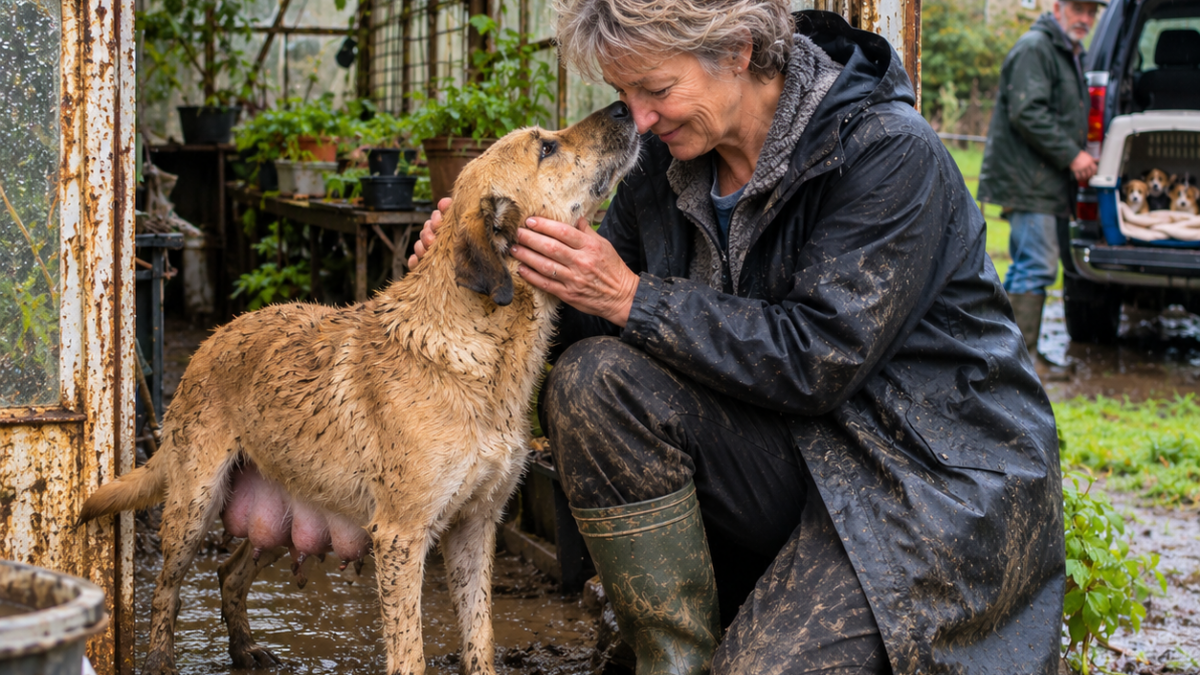
The exhausted stray had finally watched me carry four newborn puppies out of my flooded greenhouse, but when I tried to lead her toward safety, she grabbed my raincoat sleeve and dragged me back toward the rising water.
I was sixty-three, soaked to the knees, standing inside the abandoned greenhouse my late husband had loved, and I honestly believed I had already done everything possible to save her family.
Then she began clawing beneath a collapsed cabinet, and the weak sound I heard from the darkness made me realize she had never been refusing rescue—she had been begging me not to leave someone behind.
My name is Hélène Garnier, and I live in a small village outside Saumur, in a low stone house overlooking what used to be my husband André’s vegetable garden.
For thirty years, that garden had been his kingdom.
Tomatoes.
Lettuce.
Beans.
Flowers he gave to neighbors while pretending he had grown too many by accident.
André died four years ago.
After that, the greenhouse stayed mostly locked.
People told me it was a shame.
I told them I was too old to maintain it.
That wasn’t entirely true.
What I couldn’t stand was finishing a job out there and coming back into a house where nobody asked how it had gone.
A week before the flood, I noticed a tan female dog moving through the brush behind the garden.
She was thin enough that her ribs showed.
Dark ears.
Long legs.
No collar.
Whenever I came within twenty feet, she disappeared.
I left water near the gate.
The next morning, the bowl was empty.
Then I left food.
That disappeared too.
I asked neighbors if anyone recognized her.
Nobody did.
Then the rain started.
By Sunday night, it had been falling for hours.
At seven Monday morning, my neighbor Lucien pounded on my door.
“The drainage ditch is blocked,” he said. “If we don’t clear it, the water’s coming toward the houses.”
I pulled on André’s old rubber boots.
They were two sizes too large.
Lucien grabbed a metal bar.
We went outside expecting branches and mud.
Instead, we found half the garden underwater.
While Lucien worked on the drainage grate, I saw something tan slip beneath the warped greenhouse door.
“The dog!”
Inside, she stood between me and the back wall.
When I moved closer, she showed her teeth.
I stopped.
“Okay. I’m not touching you.”
Then I saw why she was guarding the room.
Her belly hung low.
Her teats were swollen.
Near her hind leg, dried blood marked the fur.
Behind her, on André’s old potting bench, a plastic crate was wedged between overturned flowerpots.
Something moved under a piece of burlap.
A tiny blind nose appeared.
Then another.
Puppies.
Four of them.
So young their eyes had not opened.
The floodwater was still several inches below the bench, but rising.
“Lucien!” I shouted. “Bring towels! And the carrier from your truck!”
The mother watched every move I made.
I spoke softly while Lucien positioned the carrier near the greenhouse door.
When I reached for the first puppy, the dog moved forward.
I froze.
She sniffed my hand.
Then the puppy.
And stepped back.
That was permission.
One by one, I carried them out.
First.
Second.
Third.
Fourth.
Lucien wrapped them in dry towels and moved them to his truck on higher ground.
When the last puppy was safe, I nearly cried from relief.
“Now the mother,” Lucien called.
I fashioned a wide loop from an old strap and returned.
“Come on, sweetheart. Your babies are outside.”
She approached me.
For one second, I thought she understood.
Then she turned away.
She disappeared behind an old wooden cabinet that had collapsed against the back wall.
I followed.
She returned.
Grabbed my raincoat sleeve.
Pulled.
“Hey!”
She released me, ran back to the cabinet, scratched beneath it, then returned and grabbed my sleeve again.
Once.
Twice.
Three times.
“Hélène!” Lucien shouted. “We need to go!”
“I know!”
But the dog refused to move toward the exit.
Then I noticed something beneath the fallen cabinet.
A strip of burlap.
The same fabric that had lined the puppies’ crate.
I dropped to my knees in the muddy water.
“Lucien! Flashlight!”
He pushed one through the gap.
I aimed it beneath the collapsed boards.
At first, I saw only mud.
Then two tiny marks.
Paw prints.
And from somewhere behind the cabinet came a sound so weak I almost mistook it for the wind.
A puppy crying.
My stomach dropped.
There hadn’t been four.
There were five.
And while we had been congratulating ourselves for saving the litter, the last one was trapped beneath a collapsing board as the floodwater crept toward its face.
[END OF FACEBOOK OPENING]
[FULL STORY CONTINUATION]
“Lucien!”
“I heard it.”
He was already forcing himself back through the greenhouse door.
The water had risen above my ankles and was pouring through a gap in the warped frame.
The mother dog circled behind me, whining.
Not barking.
Not threatening anymore.
Just making that low, broken sound animals make when fear has burned through everything else.
Lucien crouched beside the cabinet.
“That thing weighs a ton.”
“It doesn’t.”
“Hélène, it’s solid oak.”
“It was André’s seed cabinet.”
“That does not make it lighter.”
Another weak cry came from underneath.
The dog scratched at the mud.
Lucien shoved the flashlight between two broken planks.
“There.”
I leaned closer.
I could barely see the puppy.
Only part of its back.
A tiny pale body wedged in a pocket beneath the cabinet where one broken leg had kept the whole thing from crushing flat against the ground.
The water was already touching its belly.
“How did it get there?” Lucien asked.
I looked at the torn burlap.
“The mother probably moved them during the night.”
“Why leave one?”
“She didn’t.”
I pointed to the cabinet.
A shelf had collapsed, probably when the wind slammed something against the greenhouse.
The fifth puppy had fallen behind the crate or crawled through a gap.
The mother had known.
That was why she had stayed inside.
That was why she refused to follow the others.
Lucien wedged his metal bar beneath one side.
“On three.”
I grabbed the edge.
He looked at me.
“No.”
“I’m helping.”
“You’re sixty-three.”
“And you’re sixty-eight.”
“Exactly. We need at least one intelligent person.”
“Too late.”
He muttered something I will not repeat.
“One.”
We pushed.
“Two.”
The wood shifted.
The mother barked sharply.
“Three!”
Lucien forced the iron bar downward.
The cabinet lifted less than two inches.
Enough to hear the puppy scream.
My heart nearly stopped.
“Hold it!”
“I am holding it!”
I shoved my arm into the gap.
Mud.
Splintered wood.
Something warm.
I stretched farther.
“Hélène, don’t—”
“I have it.”
My fingers closed around the tiny body.
The puppy was slick with mud and cold water.
I dragged it toward me.
For one awful second, a piece of burlap caught around one hind leg.
The cabinet shifted.
Lucien groaned.
“Hélène!”
“I know!”
I tore at the cloth.
It ripped.
The puppy slid free.
“Got him!”
Lucien let the cabinet fall.
It crashed into the water behind us.
The mother dog rushed forward.
I curled my body around the puppy because I didn’t know what she would do.
She pressed her nose against my hands.
The puppy did not cry.
That terrified me more than screaming would have.
“He’s cold.”
“Truck. Now.”
We moved.
The mother followed.
This time, she did not resist.
Outside, the rain had weakened, but the ditch still overflowed across the path.
Lucien ran ahead.
I carried the puppy inside my coat.
The mother stayed against my leg so closely that I nearly stepped on her twice.
When we reached the truck, the other four puppies were wriggling inside the carrier.
The mother jumped up with her front paws against the door.
Lucien opened it.
She climbed inside.
I placed the fifth puppy beside her.
Immediately, she began licking him.
Hard.
Fast.
Desperate.
“Come on,” I whispered. “Come on, little one.”
The puppy’s mouth opened.
Nothing.
The mother licked his face.
His chest.
His belly.
Then came the faintest sound.
A squeak.
I almost collapsed against the truck.
Lucien looked at me.
“Veterinarian.”
“Yes.”
We didn’t even return to my house.
I climbed into the passenger seat wearing André’s oversized boots, soaked jeans, and a raincoat with a torn sleeve.
The mother dog lay in the back beside the carrier.
One paw stretched across the fifth puppy.
Every few seconds I turned around.
“He’s breathing.”
Lucien kept his eyes on the road.
“I know.”
“How do you know?”
“Because you’ve told me fourteen times.”
“I’m going to tell you fifteen.”
“He’s breathing?”
“Yes.”
“Good.”
The veterinary clinic was twenty minutes away on a normal day.
That morning it took thirty-five.
Flooded roads.
Branches.
A detour.
Every red light felt personal.
When we arrived, I carried the carrier while Lucien tried to lead the mother.
She refused to move until she saw the puppies go through the clinic door.
Then she followed.
A young veterinarian named Dr. Rémi Leduc met us in the treatment room.
“How old?”
“I don’t know.”
“Mother stray?”
“I think so.”
“Any idea when she delivered?”
“No.”
He examined the smallest puppy first.
Temperature dangerously low.
Weak suck reflex.
Possible aspiration from floodwater.
He handed the puppy to a technician, who wrapped him in warmed towels and placed him in an incubator.
The mother dog tried to follow.
I held my breath.
Dr. Leduc crouched.
“Easy.”
She stood between him and the incubator.
“She protected them from me too,” I said.
“That’s good.”
“Good?”
“For a mother this exhausted, yes. It means she still has enough strength to care.”
He examined her next.
She was underweight.
Dehydrated.
Mild infection beginning in one mammary gland.
Small cuts on her paws.
No microchip.
No tattoo.
No collar line.
Nothing that told us where she came from.
“How long has she been wandering?” he asked.
“At least a week.”
“She gave birth recently, obviously.”
“Obviously.”
He smiled.
“Sorry.”
“I’m wet, cold, and one of my dead husband’s boots is filling with water. I’m allowed to be unpleasant.”
“Completely.”
Lucien laughed from the doorway.
Traitor.
Dr. Leduc estimated the puppies were less than a week old.
All four from the crate were cold but stable.
The fifth worried him.
“We need to keep them here.”
“The mother too?”
“Yes.”
I looked at her.
She had moved beside the incubator and was staring through the clear plastic.
“Will he survive?”
The veterinarian did not answer immediately.
I hated that pause.
“He has a chance.”
That was all.
A chance.
Not a promise.
I sat in the waiting room for three hours.
Lucien eventually went home to check the flooding.
I refused.
At noon, a technician brought me coffee.
At one, Dr. Leduc appeared.
“The little male is warmer.”
I stood.
“And?”
“He tried to nurse.”
I put my hand on the chair.
“Is that good?”
“It’s very good.”
I laughed.
Then cried.
Completely without dignity.
Dr. Leduc pretended not to notice.
By late afternoon, the association Animaux Loire had agreed to handle the legal stray procedure and help with the veterinary costs.
A woman named Sarah arrived to photograph the mother and puppies for their found-animal record.
“What are we calling her?” she asked.
“I don’t know.”
“You found her.”
“I found five of them.”
“You found six.”
I looked through the treatment-room window.
The mother dog was lying on her side while four puppies nursed.
The fifth had been placed beside her under supervision.
She kept licking him between feeds.
Sarah smiled.
“She needs a temporary name.”
I thought about André’s greenhouse.
The garden.
The water.
The way she had taken my sleeve and refused to let me leave.
“Rose.”
Sarah glanced at me.
“Why Rose?”
“André planted roses everywhere.”
“Your husband?”
“Yes.”
“Rose it is.”
The fifth puppy became Petit.
Not permanently.
Just because everyone at the clinic started calling him “the little one,” and the name stuck.
I went home that evening without them.
For the first time since André died, the empty house felt unbearable for a reason that had nothing to do with him.
I kept hearing Rose’s nails against the greenhouse floor.
I kept feeling her teeth on my sleeve.
I went downstairs twice during the night and looked out toward the dark garden.
At three in the morning, I turned on the outside light.
Nothing.
Of course.
They were safe at the clinic.
Still, I left the light on.
The next morning, the floodwater had begun to recede.
The greenhouse was a disaster.
Broken glass.
Mud.
Collapsed shelving.
André’s old seed cabinet half submerged.
For years, I had resisted changing anything in there.
Now the storm had done it for me.
Lucien came through the gate carrying a shovel.
“You planning to stare at this all day?”
“Yes.”
“Good. I’ll do the work.”
I took the second shovel.
“Shut up.”
We cleaned for four hours.
At one point, I found the plastic crate where Rose had given birth.
Beneath the wet burlap was a torn piece of cardboard.
I almost threw it away.
Then I noticed writing.
Not much survived.
Blue marker.
Part of a word.
**…RÊT**
And below it, a number.
12.
Lucien looked over my shoulder.
“What is that?”
“I don’t know.”
“Feed bag?”
“Maybe.”
We found another piece near the back wall.
Same cardboard.
This one had a printed logo.
A green paw.
And part of a business name.
**ÉLEVAGE DU…**
Breeding.
I stared at it.
“What?”
Lucien shrugged.
“Could have been an old box.”
“André never used boxes from a breeder.”
“You remember every box André ever brought home?”
“No.”
“Then don’t build a crime out of wet cardboard.”
He was right.
Still, I put the pieces aside.
Two days later, the clinic called.
Rose and the puppies could leave.
“Leave where?” I asked.
Dr. Leduc paused.
“Foster care.”
“Yes. Where?”
“The association is trying to find someone experienced with nursing mothers.”
I looked through my kitchen window toward the greenhouse.
The garden was still muddy.
My house had a tiled utility room with a separate door.
I had time.
Too much time.
“I can take them.”
Silence.
“Hélène.”
“What?”
“Six dogs.”
“Five are the size of potatoes.”
“That will change.”
“I understand biology.”
“Do you?”
“I raised a husband.”
He laughed.
“That argument is medically irrelevant.”
Sarah from the association came to inspect my home.
She walked through the utility room.
Garden.
Fence.
Kitchen.
Then looked at me.
“You’ve never fostered before?”
“No.”
“Owned dogs?”
“When I was a child.”
“That was fifty years ago.”
“Thank you for the arithmetic.”
She smiled.
“Why do you want to do this?”
I started to say because I had found them.
That wasn’t enough.
Then I said:
“Because Rose asked me to finish.”
Sarah studied me.
Maybe she thought that sounded ridiculous.
I didn’t care.
The next afternoon, Rose came home.
The puppies traveled in a warmed crate.
Rose entered the utility room first.
She inspected every corner.
Then watched while I placed the puppies in a low whelping box lined with blankets.
Four settled immediately.
Petit cried.
Rose climbed in.
He stopped.
I sat on the floor.
“There.”
She looked at me.
“Everyone accounted for.”
Her eyes stayed on mine.
I held up both hands.
“Five. I know.”
For the first week, my life became feeding schedules, cleaning, medication, weighing puppies, washing blankets, and checking Rose’s temperature because Dr. Leduc warned me about mastitis.
I had not been that tired in years.
I had also not slept that well in years.
Not long.
But deeply.
Because every hour mattered.
Rose remained cautious.
She allowed me near the puppies.
That did not mean she trusted me completely.
If Lucien came in too fast, she stood.
If a truck backfired, she moved over the litter.
If I carried a puppy farther than she liked, she followed.
Petit gained weight slower than the others.
Every morning, I put him on the kitchen scale.
Day one.
310 grams.
Day three.
332.
Day five.
365.
When he crossed 400, I called Lucien.
“It happened.”
“What?”
“Four hundred.”
“Four hundred what?”
“Grams.”
Long silence.
“Hélène.”
“Yes?”
“You called me at six-fifteen in the morning because a puppy weighs four hundred grams?”
“Yes.”
“I’m hanging up.”
“You don’t care.”
“I care after coffee.”
He hung up.
I smiled for ten minutes.
Then something else happened.
A woman named Chantal knocked on my door.
She lived two villages away.
“I saw the association post.”
She held up her phone.
Rose’s photograph.
“Have you seen her before?”
“Yes.”
My pulse changed.
“Where?”
“Near the industrial road.”
“When?”
“About two weeks before the flood.”
“What was she doing?”
“Following a van.”
My skin prickled.
“What kind?”
“White.”
Of course every suspicious van in France is white.
“Anything on the side?”
“Green logo.”
I thought of the cardboard.
A green paw.
“Words?”
She frowned.
“Something about dogs.”
“Breeding?”
“Maybe.”
I went inside and brought out the cardboard.
Chantal looked at the partial logo.
“That.”
“You’re sure?”
“I think so.”
She took a photograph.
Twenty minutes later, she called.
“I found it.”
A dog breeding operation outside Doué-la-Fontaine.
**Élevage du Clos Vert.**
The logo matched.
My stomach tightened.
I searched the name.
The website showed puppies.
French Bulldogs.
Cocker Spaniels.
Mixed-breed “family companions.”
No tan dog like Rose.
I called Sarah.
She told me not to contact the business.
People had begun to say that to me often.
“Why not?”
“Because we don’t know if there’s any connection.”
“She may have come from there.”
“May.”
“The cardboard—”
“Could have blown into your greenhouse.”
“And the van?”
“Could be unrelated.”
“You sound like Lucien.”
“I’ll try not to be offended.”
She asked Chantal for a written statement.
The association contacted local animal-control authorities.
Nothing happened immediately.
That irritated me.
Then another clue arrived.
A man named Pascal came to buy eggs from Lucien and saw Rose through my fence.
He stared.
“That dog looks like Naya.”
I walked closer.
“Who?”
“A dog that belonged to a breeder.”
My pulse hammered.
“Clos Vert?”
He looked surprised.
“Yes.”
“What do you know?”
“Not much.”
“Try.”
Pascal delivered animal feed.
He had been to the property several times.
Naya had lived in an outdoor run.
“Breeding dog?”
“I think.”
“How old?”
“Five? Six?”
“Pregnant?”
“She was last time I saw her.”
“When?”
“About three weeks before the storm.”
My throat tightened.
“What happened to her?”
“No idea.”
“Did you ask?”
Pascal shrugged.
“They had lots of dogs.”
“Did she look like Rose?”
He studied her from the gate.
Same tan coat.
Dark ears.
White mark beneath the chin.
“Very much.”
Rose watched him.
Then backed away.
Pascal did not approach.
Good man.
I called Sarah again.
This time her voice changed.
“That’s more useful.”
“Can we go there?”
“No.”
“Can authorities?”
“They can inquire.”
“How long?”
“Hélène.”
“How long?”
“I don’t know.”
I hated those words.
Rose did not care about investigations.
Her world was five puppies.
Mine was becoming the same.
At three weeks, their eyes opened.
At four, they began walking like drunk potatoes.
At five, they became criminals.
Petit was no longer the weakest.
He was the loudest.
One morning, I found him outside the whelping box eating the corner of a newspaper.
“How?”
He ignored me.
Rose watched from her bed.
“This is your fault.”
She sighed.
I started naming the others for convenience.
Lune.
Milo.
Poppy.
André.
I regretted that last one immediately.
It happened accidentally.
The puppy had knocked over a flowerpot and looked pleased.
I said:
“Wonderful, André.”
Then froze.
The name stayed.
For the first time in four years, saying my husband’s name did not end in silence.
A puppy sneezed.
That helped.
Then the investigation moved.
Sarah called one afternoon.
“Authorities visited Clos Vert.”
I sat down.
“And?”
“They deny Rose was theirs.”
“Of course.”
“They say the dog named Naya died after complications from pregnancy.”
My hand tightened around the phone.
“When?”
“They haven’t provided the veterinary record yet.”
“Because there isn’t one.”
“We don’t know.”
“What about Pascal?”
“His statement helps.”
“And Chantal?”
“Yes.”
“Then?”
“They’re checking records.”
Two days later, the breeding operation’s owner called me.
Not Sarah.
Me.
I had no idea how he got my number.
“Mrs. Garnier?”
“Yes.”
“My name is Bernard Leclerc.”
I knew immediately.
Clos Vert.
“I think you have a dog that belongs to me.”
I looked toward the utility room.
Rose was asleep with her puppies.
“Do I?”
“Tan female. Dark ears.”
“What’s her name?”
“Naya.”
Rose’s head lifted.
I froze.
“Naya.”
She stood.
Walked toward me.
Not fast.
But she responded.
Bernard heard my breath change.
“That’s her.”
“Why did you tell authorities she was dead?”
Silence.
Then:
“There’s confusion.”
“Convenient.”
“She escaped.”
“When?”
“Around the time she gave birth.”
“She gave birth in my flooded greenhouse.”
“I’m glad she survived.”
I almost laughed.
“Are you?”
“Of course.”
“Then why report her dead?”
“I didn’t personally handle the paperwork.”
“What paperwork?”
He hesitated.
I had caught something.
“Hélène, this doesn’t need to become ugly.”
That sentence made me furious.
“It already became ugly when she nearly drowned protecting five puppies.”
“I had nothing to do with that.”
“Then explain.”
“She was difficult.”
“What does that mean?”
“She wasn’t suitable anymore.”
“For breeding?”
He went quiet.
I could hear an office in the background.
Keyboard.
Voices.
Then he said:
“She had complications during her previous litter.”
“So?”
“We intended to retire her.”
“Retire.”
“Yes.”
“Where?”
He did not answer.
I understood.
“You dumped her.”
“No.”
“You put a pregnant dog in a van and left her somewhere.”
“You have no proof.”
There it was.
Not denial.
A challenge.
“Do not contact me again.”
“Hélène—”
I hung up.
My hands were shaking.
Sarah was furious when I told her.
“Save the call log.”
“I did.”
“Write down everything.”
“I did.”
“Did he threaten you?”
“No.”
“Ask for money?”
“No.”
“Demand the dog back?”
“Yes.”
“That matters.”
“Why?”
“Because he’s now claiming ownership after telling inspectors Naya died.”
That contradiction became the crack.
Authorities requested veterinary records.
No record of death.
They requested breeding records.
Naya appeared.
Three previous litters.
Microchip number.
That was the part none of us understood.
Rose had been scanned.
No chip.
Then Dr. Leduc checked again.
This time he found a scar.
Tiny.
Low on the side of her neck.
Someone had removed the microchip.
The room went silent.
“Can that happen accidentally?” I asked.
“No.”
“Could a chip migrate?”
“Yes.”
“Could it migrate out of the body?”
“Not like this.”
He touched the scar.
“This looks deliberate.”
My stomach turned.
Rose stood beside me.
Trusting.
Alive.
Someone had cut identification out of her body.
The investigation escalated.
Not because of my anger.
Because records now conflicted.
If Naya was dead, why had Bernard called claiming Rose?
If she had escaped, why remove the chip?
If she had been retired, where was the transfer record?
Then Chantal remembered something else.
A white van parked near the abandoned market road the evening Rose first appeared.
She had photographs from her phone because she had been documenting flooding damage near the ditch.
In the background—
the van.
Green paw logo.
License plate partly visible.
Authorities matched it to Clos Vert.
Bernard changed his story.
Naya had supposedly escaped during transport to a foster home.
Which foster home?
He could not provide a name.
Then an employee talked.
A young kennel worker named Thomas.
Twenty-two.
He had been frightened to speak because he needed the job.
But once inspectors began interviewing staff separately, his story came out.
Naya had become pregnant again unexpectedly.
Bernard had not wanted the veterinary expense.
She was thin.
The previous litter had been difficult.
Thomas said he heard Bernard tell another worker:
“She’s done. Get her off the property.”
The worker refused.
Bernard took Naya himself.
Pregnant.
In the van.
Thomas assumed she was going to a rescue.
Two days later, Bernard told staff Naya had died.
The timing matched Chantal’s photo.
That was enough for a formal animal-welfare case.
I wanted Bernard destroyed.
I will admit that.
I wanted his business closed immediately.
I wanted every dog removed.
I wanted him to look at Rose’s five puppies and understand what almost happened.
Anger can feel clean when grief does not.
Sarah reminded me:
“Let the evidence do the work.”
“I hate patient people.”
“I know.”
Inspectors documented other problems at Clos Vert.
Overcrowded runs.
Incomplete health records.
Dogs bred more frequently than recommended.
Unregistered transfers.
One dog with untreated ear infections.
Another with dental disease.
Nothing cinematic.
No dungeon.
No hundred starving animals.
That almost made it worse.
Neglect had been normalized.
Not dramatic enough to shock the people inside it anymore.
The facility’s breeding authorization was suspended pending corrective measures and legal proceedings.
Several dogs were placed temporarily with approved rescues.
Bernard publicly claimed the investigation was harassment started by “an emotional widow who stole one of his dogs.”
That was me.
I laughed when Sarah showed me.
Then saw the comments.
Some believed him.
People wrote that I wanted attention.
That Rose should be returned.
That I was “destroying a small business.”
One woman wrote:
**Breeders can’t save every dog. Sometimes hard choices happen.**
I stared at that sentence.
Hard choices.
I knew hard choices.
André’s chemotherapy.
Stopping treatment.
Selling his workshop tools.
Signing the form that said I understood he might die at home.
Hard choices are not the same as convenient cruelty.
Bernard’s mistake was accusing me publicly.
Because once he did, local reporters became interested.
A journalist named Claire Moreau called.
I almost refused.
Sarah advised caution.
“Talk only about what you personally know.”
So I did.
I told Claire about finding Rose.
The flood.
The puppies.
The fifth trapped behind the cabinet.
I showed her veterinary records.
I did not accuse Bernard of anything not documented.
I said:
“I don’t know what happened before Rose reached my greenhouse. Authorities are determining that.”
Then Claire asked:
“Why are you involved?”
I looked at Rose.
She was nursing the puppies for what would soon be one of the last times.
“Because she asked me not to leave.”
The article appeared two days later.
No sensational headline.
Just facts.
Then the photograph.
Rose standing beside me.
Five puppies in a basket.
André’s greenhouse behind us.
The story spread.
Donations poured into Animaux Loire.
Not to me.
I refused.
The association used the money to support the dogs removed temporarily from Clos Vert.
Bernard’s lawyer sent a letter demanding a correction.
There was nothing to correct.
He threatened defamation.
The newspaper stood by its reporting.
Then came the worst confrontation.
Bernard arrived at my house.
Late afternoon.
I was in the garden.
Rose barked.
Not wildly.
A warning.
I looked toward the gate.
Bernard stood outside.
“Leave.”
“We need to talk.”
“No.”
“Those puppies are mine.”
My entire body went cold.
“No.”
“They came from my dog.”
“You said your dog died.”
“That was administrative confusion.”
“You said she escaped.”
“She did.”
“You said during transport to foster care.”
“Yes.”
“Without a foster.”
His jaw tightened.
“You think you’re clever.”
“I’m old. It looks similar.”
He gripped the gate.
“I’ve lost half my clients because of you.”
“Because of me?”
“You gave interviews.”
“I told the truth.”
“You don’t know the truth.”
“Then tell it.”
He looked toward Rose.
She stood behind me.
Not hiding.
Not advancing.
Just watching him.
Bernard’s expression changed.
“Naya.”
Rose stiffened.
He called again.
“Naya.”
She did not move.
He reached through the gate.
Rose backed up.
That was all I needed.
“Take your hand out.”
“She knows me.”
“Yes.”
“That proves ownership.”
“No.”
“She’s my dog.”
I stepped closer.
“She was your responsibility.”
His face reddened.
“You don’t understand breeding.”
“I understand five newborn animals nearly drowning.”
“They’re alive.”
My hands curled.
“That is not your defense.”
He lowered his voice.
“I could make this difficult.”
“You already have.”
“The puppies have value.”
There it was.
Not Rose.
Not survival.
Value.
“How much?”
He stared at me.
“You heard me.”
“You came here because you think you can sell them.”
“They’re from known lines.”
“Known lines?”
“Yes.”
I almost laughed.
“They were born in a plastic crate during a flood.”
“That doesn’t change genetics.”
“No.”
I looked at Rose.
“But it tells me everything about what matters to you.”
He pointed at me.
“You have no right to give them away.”
“Animaux Loire handles the placements.”
“I’ll stop it.”
“You can try.”
He smiled.
“I will.”
Then he made his mistake.
He looked at Rose and said:
“I should have finished it properly the first time.”
Silence.
The world became very small.
“What?”
His face changed.
He realized.
Too late.
I touched the pocket of my coat.
My phone had been recording since the moment I saw him at the gate.
Sarah had told me to record any unexpected contact where lawful and safe.
Bernard looked at my hand.
“You recorded me.”
“I recorded my own garden.”
“You manipulative—”
Rose barked.
Bernard stopped.
I said quietly:
“Leave.”
He did.
The recording went to investigators.
His lawyer later argued the phrase was ambiguous.
Maybe he meant completing a transfer.
Maybe paperwork.
Maybe something else.
But combined with the witness statements, removed microchip, false death claim, van evidence, and his ownership demand, it mattered.
The case did not end overnight.
Nothing real does.
By then, the puppies were eight weeks old.
They had personalities.
Lune was fearless.
Milo stole socks.
Poppy climbed everything.
André dug holes.
Petit—
the one we almost missed—
followed Rose everywhere.
He remained smaller than the others.
But healthy.
Completely healthy.
Dr. Leduc held him during the final litter examination.
“This one?”
“Yes.”
“He was the trapped puppy?”
“Yes.”
Petit bit his stethoscope.
Dr. Leduc laughed.
“Near-death experience created no humility.”
“Apparently not.”
The puppies became available for adoption under the association.
That terrified me.
I had spent two months saving them.
Now people wanted to take them away.
Sarah noticed.
“This is the part where fosters become irrational.”
“I’m not irrational.”
“You asked whether one applicant had adequate retirement savings.”
“He looked irresponsible.”
“He was thirty-two.”
“Exactly.”
The first adoption was Poppy.
A young couple with a fenced yard.
Two home visits.
Veterinary references.
They came three times.
Poppy adored them.
Rose watched when they carried her toward the gate.
My heart broke.
Rose followed.
I held my breath.
Would she panic?
Would she think I was taking another baby?
Poppy’s adopter crouched.
Rose sniffed her.
Then licked Poppy’s face.
Poppy left.
Rose stood at the gate for less than a minute.
Then walked back to the remaining puppies.
Motherhood also means letting go.
I realized I had not learned that part yet.
Milo went next.
Then Lune.
André was adopted by Lucien’s daughter.
That was suspiciously convenient.
“You arranged this,” I accused him.
“I did not.”
“You have complained about dogs for thirty years.”
“I complained about yours.”
“I didn’t have one.”
“Exactly. Very peaceful.”
His daughter took André home.
Lucien visited him twice the first week.
I said nothing.
Petit remained.
Not because nobody wanted him.
Because I kept rejecting everyone.
Sarah finally sat across from me.
“Hélène.”
“No.”
“You don’t know what I’m going to say.”
“Yes.”
“You cannot fail every applicant because they are not you.”
“I don’t want five dogs.”
“You have one mother and one puppy.”
“I don’t have Rose.”
Sarah raised an eyebrow.
“She lives in your kitchen.”
“Temporarily.”
“For ten weeks.”
“Temporary can be long.”
“She sleeps beside your bed.”
“That is geography.”
“You bought her a personalized bowl.”
“It was on sale.”
Sarah stared at me.
I looked away.
Rose was supposed to become adoptable once the puppies were weaned and her health stabilized.
I knew that.
I had known from the beginning.
Then Sarah asked:
“Do you want to adopt Rose?”
The question frightened me.
Not because I didn’t know.
Because I did.
“What if I die?”
“You’re sixty-three.”
“That is not immortality.”
“No.”
“I have no children.”
“Lucien’s daughter?”
“She has André.”
“Your niece?”
“Strasbourg.”
“Then we create a backup plan.”
I stared at Rose.
She was asleep beneath André’s old gardening table.
The greenhouse had been cleaned.
Not restored.
Not yet.
But usable.
Rose liked it there.
“Would she choose me?”
Sarah laughed softly.
“She dragged you into floodwater by your sleeve.”
“That was about Petit.”
“She sleeps against your bedroom door.”
“Security.”
“She follows you into the garden.”
“Food.”
“Hélène.”
I looked down.
“I’m afraid.”
“Of?”
“Needing something again.”
Sarah stopped smiling.
There it was.
André’s death had taught me a terrible lesson.
Anything you love becomes something life can take.
For four years, I had responded intelligently.
I loved less.
Needed less.
Expected less.
The garden died.
The greenhouse closed.
Nobody could take from me what I refused to rebuild.
Then Rose arrived pregnant in a storm and ruined the strategy.
“I don’t want to lose her.”
Sarah said:
“You will someday.”
I hated her.
She continued:
“Or she’ll lose you.”
“Helpful.”
“That isn’t a reason not to choose the years between.”
I looked through the window.
Rose had awakened.
She was watching me.
Always watching.
Waiting for whatever came next.
I signed the adoption papers three days later.
Rose became mine.
Petit did too.
I blamed Sarah.
She accepted responsibility.
The court proceedings against Bernard concluded months later.
His breeding authorization was revoked.
He received fines and a suspended sentence related to animal abandonment and record violations.
Several dogs were permanently rehomed after ownership and welfare determinations.
He was prohibited from operating a breeding establishment for a defined period and required to comply with animal-ownership restrictions.
No dramatic handcuffs.
No cheering crowd.
But Clos Vert closed.
The sign came down.
The green-paw vans disappeared.
Thomas, the young employee who testified, found work at a veterinary boarding facility.
Pascal still delivered feed.
Chantal told everybody she had solved the case.
She had not.
I never corrected her.
Bernard appealed parts of the administrative decision.
He lost.
The most satisfying consequence came from something smaller.
A local family who had bought a puppy from Clos Vert years earlier contacted Animaux Loire.
Then another.
People began asking better questions.
Health records.
Breeding frequency.
Living conditions.
Where adult breeding dogs went when they were “retired.”
Bernard had built a business partly on nobody asking what happened after the puppies were sold.
Rose made people ask.
That was enough.
I did not celebrate his collapse.
Not exactly.
I celebrated what replaced it.
The association used donations to create a foster network for pregnant strays and nursing mothers.
They called the program **Rose’s Shelter**.
I objected.
“I hate sentimental names.”
Sarah ignored me.
The program paid for emergency veterinary care, whelping supplies, transport, and temporary housing.
The first year, they helped eleven mothers.
Forty-three puppies.
One litter of kittens because apparently rules are meaningless.
My old greenhouse became part of the network.
That was the surprise.
It happened slowly.
After the flood, I repaired one window.
Then another.
Lucien replaced the damaged door.
His daughter painted the frame.
I installed washable flooring in one section.
Sarah brought donated crates.
Dr. Leduc suggested a heat lamp.
Before I knew it, André’s greenhouse was alive again.
Not with tomatoes.
With animals.
The first foster after Rose was a Beagle mix named Suzanne with seven puppies.
Seven.
I called Sarah.
“I’m resigning.”
“You’re retired.”
“From this.”
“You volunteered.”
“I resign from volunteering.”
One puppy urinated on my boot.
Sarah laughed so hard she had to sit down.
The greenhouse filled with sound.
Whining.
Scratching.
Bowls.
People.
Neighbors came to help.
Children brought old towels.
Lucien built shelves.
I planted flowers again outside the entrance.
André’s roses returned first.
I did not plan that.
Or perhaps I did.
Rose became excellent with frightened mothers.
She never entered their spaces without permission.
She would sit outside a pen.
Quiet.
Waiting.
Sometimes another dog relaxed simply because she was there.
Petit grew into a long-legged, ridiculous animal with one ear that never stood correctly.
He adored Lucien.
Traitor.
At one year, Petit weighed twenty-seven kilos and still attempted to sit in my lap.
“You were once four hundred grams.”
He did not care.
Every November, when heavy rain started, Rose became restless.
The first year, she paced toward the greenhouse.
I thought she feared it.
Instead, she checked every corner.
Under shelves.
Behind crates.
Beneath the old workbench.
She searched.
I understood.
Five.
She had counted five.
She would probably count forever.
So I walked with her.
“Empty.”
She checked.
“Empty.”
Another corner.
“Empty.”
When she finished, she relaxed.
The second year, she did it again.
By the third, only once.
Memory does not always disappear.
Sometimes it simply stops controlling the body.
Petit never knew why storms mattered.
He loved rain.
Of course he did.
He would run into the garden, return covered in mud, and shake himself beside my clean laundry.
Rose looked embarrassed by him.
I blamed Bernard genetically.
At seventy, Lucien finally admitted he liked the dogs.
I wrote down the date.
He threatened to burn the notebook.
Life became full in a way I had forgotten.
Not easy.
Full.
There is a difference.
André’s absence remained.
Sometimes I still turned toward the greenhouse expecting him to be there.
Once, while repairing a hinge, I said:
“Pass me the screwdriver.”
Nobody answered.
Then Petit picked up a gardening glove and ran away with it.
I laughed until I cried.
Grief changed shape.
It stopped being a locked room.
It became weather.
Some days clear.
Some days heavy.
Always part of the landscape.
Rose aged faster than I wanted.
She had probably been around six when I found her.
Years of breeding and poor nutrition had left marks.
At nine, arthritis appeared.
At ten, her hearing declined.
Petit stayed close to her.
Exactly as she had stayed close to him.
One summer evening, I found them asleep in the greenhouse.
Rose on André’s old blanket.
Petit curled against her belly though he was far too large.
I took a photograph.
It remains my favorite.
Then came the day Sarah called about another flood warning.
“Hélène, the river is expected to rise overnight.”
I looked toward the greenhouse.
We had evacuation procedures now.
Crates.
Transport list.
Backup foster homes.
I had learned.
“No animals there tonight.”
“Good.”
“Do you think I’m an amateur?”
“Yes.”
“Rude.”
We moved two foster dogs to Lucien’s barn.
Rose and Petit stayed inside my house.
Rain hammered the roof all night.
At two in the morning, Rose began whining.
I came downstairs.
She stood by the garden door.
“No.”
She scratched once.
“No.”
Petit appeared behind her.
Rose looked at me.
Then toward the greenhouse.
I understood.
She needed to check.
I put on my coat.
“You are a terrible influence.”
We walked only to the covered porch.
No farther.
From there she could see the greenhouse.
Dark.
Empty.
Safe.
Rose stared.
Then looked at me.
I said:
“Everyone’s out.”
She stood there another minute.
Then turned back inside.
That was trust.
Not believing danger would never happen again.
Believing somebody else was finally counting too.
Two years later, Rose developed cancer.
I found the lump beneath her front leg.
The veterinarian biopsied it.
Malignant.
We tried surgery.
It bought time.
Good time.
Almost a year.
Then it returned.
Spread.
No cure.
I knew before Dr. Leduc finished explaining.
He had more gray hair now.
So did I.
“What do we do?”
“Keep her comfortable.”
“How long?”
“Hélène.”
“I hate that voice.”
“I know.”
“Weeks?”
“Maybe months.”
Petit stood beside Rose in the exam room.
He kept licking her ear.
On the drive home, I cried.
Rose did not.
Dogs are unfairly practical.
The final months were gentle.
Short walks.
Chicken.
Sunlight.
No more foster mothers in the greenhouse because I wanted the space quiet.
Sarah objected.
Then saw Rose.
She understood.
People visited.
Lucien brought biscuits.
Chantal brought a ridiculous pink blanket.
Pascal brought dried meat.
Thomas, the former kennel worker from Clos Vert, came once.
Rose watched him from her bed.
He sat several feet away.
“I remember her,” he said.
“So does she.”
His eyes filled.
“I should have done something sooner.”
“You were twenty-two.”
“I knew.”
“You were afraid.”
“That’s not an excuse.”
“No.”
I had learned this lesson before.
“But guilt is only useful if it changes what you do next.”
Thomas worked with rescue dogs now.
That counted.
Rose eventually walked over to him.
Slowly.
She sniffed his hand.
He did not touch her.
She rested her chin on his knee.
He cried.
I pretended to inspect a flowerpot.
By October, Rose stopped climbing the two steps into the greenhouse.
Petit waited for her at the bottom.
I built a ramp.
Of course I did.
André would have overengineered it.
I did too.
Lucien mocked the railing.
Then used it himself.
The last storm came in November.
Almost exactly eleven years after André died.
Rain struck the windows.
Wind moved through the trees.
At midnight, Rose stood from her bed.
Barely.
Petit woke instantly.
She went to the back door.
I opened it.
She looked toward the greenhouse.
I put on my coat.
“Only the porch.”
We stepped outside.
The old building glowed faintly because I had left a lamp inside.
I had started doing that during storms.
Not for Rose.
For myself.
Rose stared at the light.
Petit pressed against her.
She looked toward me.
Then sat.
I sat beside her on the porch.
Rain beyond the roof.
Mud below.
No flood this time.
No trapped puppies.
No urgency.
I remembered her teeth on my sleeve.
Her pulling.
Her refusal.
“You were right,” I whispered.
Her ears moved.
“I wasn’t finished.”
Petit rested his head on her back.
We stayed until she became tired.
Then I helped her inside.
The next morning, Rose would not eat.
By afternoon, she could no longer stand without pain.
I called Dr. Leduc.
Sarah came.
Lucien came.
His daughter brought André—the puppy, now an older dog himself.
For one final hour, three of Rose’s surviving puppies were there.
Lune’s family lived too far away.
Milo’s owners sent a video.
Poppy arrived with gray beginning around her muzzle.
Petit stayed closest.
Rose lay on the pink blanket Chantal had brought.
I sat beside her.
“You made a ridiculous amount of work for me.”
Her tail moved faintly.
“You broke into my greenhouse.”
Another movement.
“You had five puppies in André’s seed room.”
Sarah laughed through tears.
I continued.
“You dragged me into floodwater.”
Rose looked at me.
I put my forehead against hers.
“And somehow that was still easier than what you did afterward.”
Dr. Leduc prepared the medication.
My hands shook.
I had done this with André.
Different.
But not entirely.
Love asks for courage at the beginning.
And again at the end.
Petit whined.
Rose lifted her head.
He came closer.
She licked his face.
Once.
Slowly.
The same puppy she had refused to leave beneath that cabinet.
Now grown.
Safe.
Loved.
I whispered:
“You counted correctly.”
My voice broke.
“All five.”
Rose relaxed.
Dr. Leduc gave the first injection.
Her breathing slowed.
I kept one hand on her chest.
The second followed.
No struggle.
No fear.
Her last breath left beneath my fingers.
Petit placed his head beside hers.
Nobody moved him.
We gave the dogs time.
Later, I buried Rose’s ashes beneath one of André’s oldest rosebushes.
Not in the greenhouse.
She had spent enough of her life guarding that place.
Petit sat beside me.
When I finished, he pawed at the soil.
“Do not dig up your mother.”
He stopped.
I laughed and cried at the same time.
The greenhouse reopened three months later.
I thought I wouldn’t be able to do it.
Then Sarah called about a pregnant stray found near a highway.
I said no.
She brought the dog anyway.
“I hate you.”
“I know.”
The dog was black.
Young.
Terrified.
She stood at the entrance and refused to step inside.
I sat on the floor.
Did not reach.
Did not call.
Petit lay several feet away.
The dog watched him.
Then me.
Ten minutes.
Twenty.
Finally, one paw crossed the threshold.
Then another.
I looked toward the old seed bench.
For a moment, I could see Rose again.
Not as she died.
As she was that first morning.
Thin.
Mud-covered.
Exhausted.
Standing between me and five lives.
I had believed I was rescuing her.
That was only partly true.
Rose rescued something too.
A greenhouse.
A garden.
A house.
A woman who had confused surviving grief with being finished with life.
Today, the greenhouse has a new sign above the door.
I fought the name.
Lost.
It reads:
**ROSE HOUSE**
**Emergency Foster Care for Mothers and Litters**
Beneath it is a smaller plaque.
I chose those words myself.
**COUNT AGAIN BEFORE YOU LEAVE.**
People assume it is an instruction for volunteers.
Make sure every puppy is present.
Every kitten.
Every animal.
It is.
But it means something else to me.
For years after André died, I looked at what remained of my life and counted incorrectly.
One husband gone.
One empty greenhouse.
One silent house.
One woman getting older.
I thought the arithmetic was finished.
Rose taught me otherwise.
There were neighbors.
Friends.
Animals.
Work worth doing.
People who showed up.
Lives still arriving unexpectedly in floodwater.
And sometimes, when you are exhausted and certain you have done everything possible, something grabs your sleeve and pulls you back toward the place you were ready to abandon.
You can resist.
Or you can follow.
The morning Rose found me, I believed I had saved four puppies.
Then she forced me to count again.
There were five.
Years later, I finally understood she had been asking me to do the same thing with my own life.
I had been counting only what I had lost.
Rose made me notice what was still there.
[END OF STORY]








