The Golden Retriever Had Been Abandoned Three Times—Then He Wrapped His Paws Around My Leg and Refused to Let Me Leave
[TITLE]
The Golden Retriever Had Been Abandoned Three Times—Then He Wrapped His Paws Around My Leg and Refused to Let Me Leave
[FACEBOOK OPENING — 700–800 WORDS]
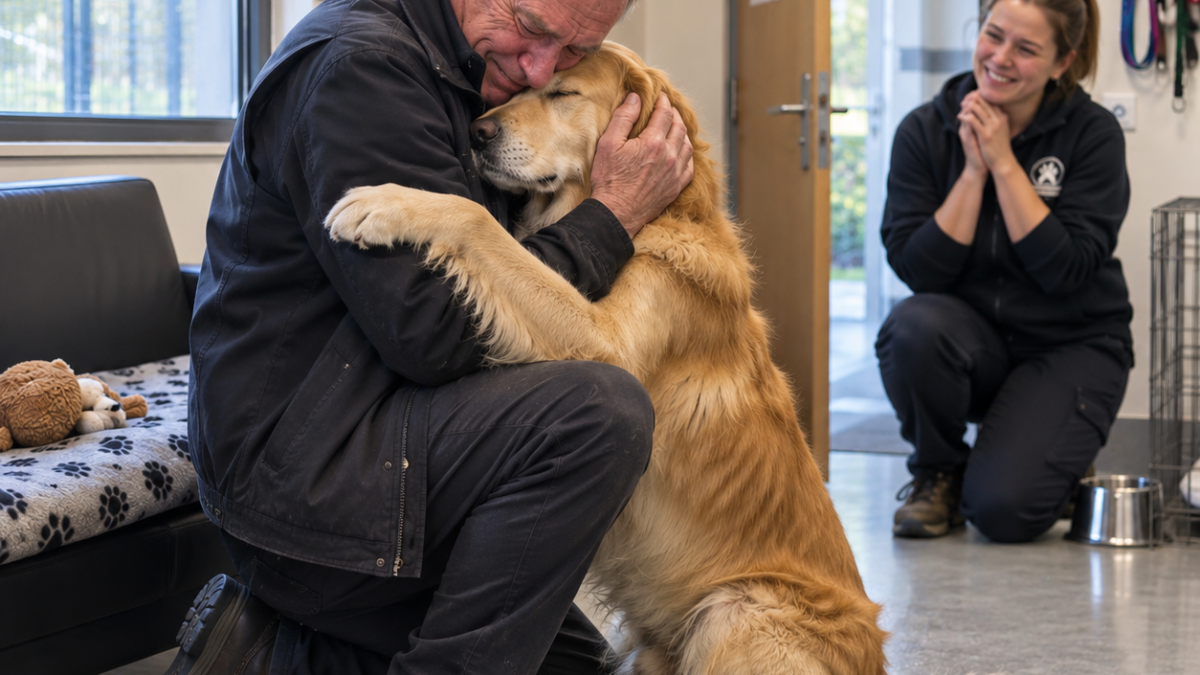
The moment I turned toward the door, the terrified Golden Retriever who had ignored me for nearly an hour suddenly crossed the room, wrapped both front paws around my right leg, and held on so tightly that I was afraid moving even one step would break something inside him.
On the card attached to his kennel, three words had been bothering me since I first saw him—“Abandoned three times”—and now the dog who had learned that people always disappeared was looking up at me as though he had somehow decided I was different.
I had walked into that shelter only because I could no longer stand the silence in my own house, but before I walked back out, I was going to be asked whether I could make a promise I wasn’t sure a sixty-three-year-old widower had the right to make.
My name is Michel Colin. I’m sixty-three, and until retirement I spent forty-two years as a civil engineer specializing in bridges.
My job was to calculate loads, inspect supports, and figure out where something might fail before people trusted it with their lives.
I was very good at helping other people get safely from one side to another.
After I retired, I discovered I had no idea how to cross my own days.
My wife, Marguerite, had died seven years earlier. Work had kept the worst of the emptiness contained. Meetings, construction sites, reports, deadlines—there had always been somewhere I needed to be.
Then my final project ended.
My coworkers gave me a retirement dinner, a watch, and a beautiful book about famous bridges.
The following Monday, I woke at seven out of habit and made two cups of coffee.
I stood in the kitchen staring at the second one.
For one absurd second, I had forgotten Marguerite was dead.
That frightened me more than remembering.
The months after that blurred together. I knew the hedges needed trimming. I knew which drawers needed organizing. I knew the roof over the garden shed needed repair.
I simply couldn’t make myself care.
On November 7, after spending half the morning looking through an old photo album and accidentally speaking to Marguerite’s picture out loud, I grabbed my keys and drove with no destination.
Rain drifted through the Breton air.
Then I passed a faded sign.
**L’HORIZON ANIMAL SHELTER.**
Marguerite and I had talked about getting a dog after I retired.
We had always said, “Later.”
Later, I had learned, is a dangerous word.
I turned into the parking lot.
A young volunteer named Émilie met me at reception.
“Are you looking for a particular dog?”
“No.”
I hesitated.
“I’m not even sure I’m looking for a dog.”
She smiled gently.
“Then just look.”
Most of the dogs made their case immediately.
Barking.
Jumping.
Dragging toys to the bars.
Then, near the end of the corridor, I saw a Golden Retriever lying with his back to everyone.
He didn’t move when I stopped.
His coat was dull. His ribs showed faintly beneath the fur.
The card read:
**CHARLIE. MALE. APPROXIMATELY SIX YEARS OLD. THREE ABANDONMENTS. FEARFUL. NEEDS A PATIENT HOME.**
Three abandonments.
I crouched.
“Hello, Charlie.”
Nothing.
“I’m not very talkative these days either.”
Still nothing.
I stayed for another minute, then stood and walked away.
Behind me, claws scraped against concrete.
I turned.
Charlie was standing at the gate.
Watching me.
Émilie stopped beside me.
“That’s unusual.”
“What?”
“He normally doesn’t come forward for strangers.”
She offered to let us use a quiet meeting room.
Charlie immediately chose the farthest corner.
I sat on the bench and left him alone.
After several minutes, I started talking.
Not baby talk.
Not promises.
I told him about Marguerite.
About retirement.
About the garden near Saint-Brieuc.
About waking up every morning and wondering why the day seemed so long.
Charlie slowly turned his head toward me.
That was all.
Yet somehow, for the first time in months, speaking did not feel like talking into an empty room.
Nearly an hour passed.
Finally, I checked my watch.
“I should go, old boy.”
I stood.
I reached the door.
Then Charlie moved.
Fast.
He pressed against my right leg, wrapped both front paws around it, and buried his muzzle against my pants.
I froze.
Émilie covered her mouth.
Charlie tightened his grip.
I looked down at him.
“No,” I whispered.
His eyes were wide.
Not aggressive.
Terrified.
As if he knew exactly what doors meant.
My throat closed.
“I want him.”
Émilie blinked.
“I want to adopt Charlie.”
She stepped closer.
“Michel, there’s something I need to explain before you leave today.”
Charlie was still holding my leg when she told me about the mandatory seven-day waiting period.
And as I looked down at a dog who had already been left behind three times, I realized that in less than ten minutes, I was going to have to do exactly what he feared most.
I was going to walk out without him.
[END OF FACEBOOK OPENING]
[FULL STORY CONTINUATION]
For a few seconds, I thought I had misunderstood Émilie.
“Seven days?”
“Yes.”
“You mean I sign something today and then come back next week?”
“In France, adopters receive a certificate of commitment and knowledge. There’s a mandatory seven-day reflection period before the adoption can be finalized.”
I looked down.
Charlie still had both front paws around my leg.
“That rule was written by someone who never met this dog.”
Émilie gave me a sympathetic smile.
“It exists to stop impulsive adoptions.”
“I am sixty-three years old. I calculated bridge load distributions for four decades. I am not especially impulsive.”
“You drove into an animal shelter without planning to adopt and decided you wanted Charlie less than two hours later.”
I opened my mouth.
Then closed it.
“That is inconveniently accurate.”
She almost laughed.
Charlie did not.
When I shifted my foot, his grip tightened.
I crouched awkwardly beside him.
“Listen, Charlie.”
His brown eyes stayed on mine.
“This is going to sound like every promise a dog has probably heard before.”
Émilie looked away.
“I’m leaving.”
His ears dropped.
“But I’m coming back.”
He pressed his muzzle into my chest.
I put both hands around his head.
“I don’t know if dogs understand contracts, but apparently humans need seven days to prove they’re not idiots.”
Émilie laughed despite herself.
I didn’t.
“I’ll be back.”
I meant it.
That frightened me.
Promises had always been easy when Marguerite was alive because I assumed there would be time to keep them.
After she died, promises became dangerous.
They created futures.
And futures could disappear.
Charlie finally let go when Émilie gently offered him a piece of chicken.
I stood.
He followed me to the door.
Not all the way.
Halfway.
Then he stopped.
I looked back.
He was standing in the center of the room, body rigid, eyes fixed on me.
I nearly stayed.
Émilie touched my arm.
“Go.”
I looked at her.
“If you keep stretching it out, it’ll be harder.”
“For him?”
“For both of you.”
I walked out.
I heard nothing behind me.
No barking.
No whining.
Somehow that was worse.
In the parking lot, I sat behind the wheel for nearly twenty minutes.
Rain ran down the windshield.
My hands stayed on the steering wheel.
Eventually I said aloud:
“What have you done, Michel?”
Marguerite would have laughed.
Not cruelly.
She had a way of laughing whenever I made a decision after pretending for months that I was incapable of making one.
I could almost hear her.
**Well, apparently you’ve got a dog now.**
“No,” I said to the empty car.
“Apparently I may have a dog in seven days.”
I drove home.
The house looked exactly the same.
That irritated me.
I don’t know why.
Some part of me expected the rooms to recognize that something had happened.
Instead, my coat still hung alone by the door.
The second coffee cup from that morning sat in the dishwasher.
The living room clock clicked.
I put the certificate on the kitchen table.
Then I spent three hours reading everything Émilie had given me.
Food.
Exercise.
Veterinary care.
Adjustment periods.
Separation anxiety.
Behavioral support.
Financial responsibility.
Emergency planning.
One paragraph stopped me.
**Adoption should be considered for the lifetime of the animal.**
Lifetime.
I leaned back.
Charlie was around six.
Golden Retrievers often lived into their early teens.
Maybe I had seven years with him.
Maybe more.
Maybe less.
And then another thought came.
What if he had seven years with me?
At sixty-three, I was healthy enough.
Blood pressure controlled.
No serious disease.
But I had spent my professional life calculating failure points.
I could not stop doing it because the object under consideration now had fur.
What happened if I had a stroke at seventy?
What if I died?
Would Charlie go back to another shelter?
Would the card say:
**Four abandonments.**
I pushed the papers away.
“No.”
The word sounded too loud.
This was why older people should not make emotional decisions.
Maybe that was what I had done.
I had confused recognition with destiny.
I had seen a frightened animal and projected myself onto him.
That was not necessarily love.
It might simply be loneliness wearing a convincing disguise.
At ten that night, I picked up my phone.
I searched the shelter’s number.
My thumb hovered over it.
I could call.
Say I had reconsidered.
That was what the reflection period was for.
Better now than after adoption.
Better before Charlie got attached.
I actually pressed the call button.
Then remembered reception would be closed.
The phone rang once before I ended the call.
I sat in darkness.
“Coward.”
I wasn’t sure whether I meant Charlie or myself.
The next morning, Émilie called.
My stomach dropped.
“Is Charlie okay?”
“Yes.”
“Then why are you calling?”
“You called us last night.”
I stared at the table.
“I made a mistake.”
“You don’t sound sure which mistake.”
Young people can be intolerably perceptive.
I said, “I need to ask you something.”
“Okay.”
“If I adopt Charlie and something happens to me, what happens to him?”
There was a pause.
Then her voice changed.
Not softer.
More serious.
“That’s a good question.”
“I’m not trying to escape responsibility.”
“I didn’t say you were.”
“I’m sixty-three.”
“My father is sixty-eight.”
“That does not help.”
She laughed.
Then explained that the shelter encouraged older adopters to identify a backup caregiver.
“Family?”
“Family or trusted friend.”
“I don’t have children.”
“Brothers? Sisters?”
“One sister in Nantes. She has two cats who hate humanity.”
“Friends?”
I thought.
There was Alain.
Former colleague.
Sixty-one.
Divorced.
Had owned Labradors his whole life.
He might say no.
That was his right.
“Maybe.”
“Ask.”
“What if he says no?”
“Then ask someone else.”
I stared at Marguerite’s empty chair.
“Émilie?”
“Yes?”
“Can I visit Charlie during the seven days?”
“Of course.”
I exhaled.
“I’ll be there at two.”
She laughed.
“You really are retired.”
“I’ll be there at one-thirty.”
I visited every day.
That was how the seven-day waiting period stopped feeling like punishment and began feeling like preparation.
The second day, Charlie refused to approach me for nearly twenty minutes.
I understood.
I had left.
Promises meant very little after the door closed.
So I sat on the floor.
No persuasion.
Eventually he came halfway across the room.
Stopped.
Lay down.
The third day, he allowed me to touch his shoulder.
The fourth, we walked in the shelter yard.
He panicked when a man in a baseball cap approached.
Charlie dropped flat to the ground.
I stopped too.
Émilie said, “Don’t pull.”
“I wasn’t going to.”
“Good.”
The man passed.
Charlie watched him until he disappeared.
Then stood.
I filed that away.
Men in caps.
Doorways.
Being left.
Fast gestures.
On the fifth day, I asked Émilie:
“What happened to him?”
She knew exactly what I meant.
“Before the shelter?”
“The three abandonments.”
Her expression changed.
“You’ve read the summary.”
“Three words are not a summary.”
“No.”
“I’m adopting him. I need to know.”
“You need to know what affects his care.”
“And the rest?”
“Some history belongs to the people involved.”
I frowned.
“That sounds suspiciously bureaucratic.”
“It is.”
I sighed.
She took pity on me.
“What I can tell you is that Charlie originally came from a breeder. His first family surrendered him when they moved overseas.”
“How old?”
“Just under two.”
“So abandonment one.”
“Yes.”
“Second?”
“He was adopted by an older man. That lasted almost three years.”
“Why did he return him?”
“He died.”
I stopped.
“That counts as abandonment?”
“Not morally.”
“Then why write three?”
“The dog experiences absence. The label isn’t a judgment.”
I felt embarrassed.
“And the third?”
Émilie became quieter.
“A couple adopted him after that.”
“What happened?”
“They returned him eight months later.”
“Why?”
“Separation anxiety. Destructive behavior. He started panicking whenever they left.”
“Did they work with anyone?”
“Yes.”
“For how long?”
“Not long enough.”
There was something in her tone.
“What aren’t you saying?”
She looked toward the kennels.
“The husband became angry with him.”
My stomach tightened.
“How angry?”
“There was never a proven abuse case.”
“That is not an answer.”
“No.”
She hesitated.
“When Charlie came back, he was frightened of raised male voices and sudden movements.”
I looked down at my hands.
“Did the man hit him?”
“We don’t know.”
“Charlie knows.”
“Yes.”
That night, I called Alain.
He answered on the fourth ring.
“Michel? Somebody die?”
“What kind of greeting is that?”
“You haven’t called me after dinner since 2009.”
“That is not true.”
“It is. I checked emotionally.”
I almost hung up.
Then said, “I’m adopting a dog.”
Silence.
Then:
“You?”
“Yes.”
“The man who once described dog hair as ‘an uncontrolled surface contaminant’?”
“I was younger.”
“You were fifty-eight.”
“Alain.”
He laughed.
“What dog?”
I told him.
Not everything.
Enough.
Then I asked:
“If I die, will you take him?”
There was a long pause.
Not joking now.
“You planning something?”
“No.”
“Sick?”
“No.”
“Then stop talking like a condemned prisoner.”
“Answer the question.”
He sighed.
“What kind of dog?”
“Golden Retriever.”
“Age?”
“Six.”
“Health?”
“Apparently good.”
“Behavior?”
“Separation anxiety.”
“How bad?”
I looked at the scratches I had noticed around Charlie’s old kennel door.
“Potentially very bad.”
Another pause.
Then:
“Yes.”
I closed my eyes.
“You don’t even know him.”
“I knew Marguerite.”
My throat tightened.
“What does that have to do with anything?”
“She spent fifteen years telling you to get a dog.”
“Seven.”
“Felt like fifteen.”
Despite myself, I laughed.
Alain continued.
“If you actually adopt one, I assume the universe has decided to interfere. I won’t argue.”
“Thank you.”
“But if you die before me, I’m naming him Pont Neuf.”
“His name is Charlie.”
“I’ll respect his identity.”
That solved one failure point.
Not all of them.
But one.
Day six, Charlie walked into the meeting room and came directly to me.
No hesitation.
He stopped inches away.
I waited.
He leaned his shoulder against my knee.
I put one hand on his back.
“You realize this creates expectations.”
His tail moved once.
Émilie stood in the doorway.
“He knows.”
“No, he doesn’t.”
“Maybe you don’t.”
I looked at her.
“You enjoy this too much.”
“Occupational hazard.”
Then came day seven.
I woke before five.
Not from anxiety.
From purpose.
That was new.
I made one cup of coffee.
Stopped.
Then made another.
I stared at it.
Old habit.
This time, instead of feeling embarrassed, I poured the second into a thermos.
I drove to the shelter.
Émilie was waiting with paperwork.
Charlie was not in reception.
“Where is he?”
“Calm down.”
“I am calm.”
“You’re holding your car keys like a weapon.”
I put them down.
We reviewed everything.
Veterinary records.
Identification.
Insurance.
Food.
Training support.
The shelter’s post-adoption contact.
Then Émilie said:
“One last question.”
I hated the phrase.
“What?”
“Why Charlie?”
I looked through the glass doors toward the kennel corridor.
“I don’t know.”
She waited.
“That is not the correct answer, is it?”
“There isn’t one.”
I thought about it.
“Because he grabbed my leg.”
“That’s why you noticed him.”
“Yes.”
“Why are you taking him home?”
That was harder.
I looked at the certificate.
“At first I thought he needed someone who wouldn’t leave.”
Émilie nodded.
“And now?”
“Now I think that is too simple.”
She waited.
“I can’t promise I’ll never leave.”
Her expression changed slightly.
“I could die. I could get sick. Life can break promises without asking permission.”
I swallowed.
“But I can promise I won’t choose to disappear when things get difficult.”
Émilie smiled.
“That’s better.”
“Am I being graded?”
“Constantly.”
She signed the final page.
Then went to get Charlie.
He appeared at the end of the hallway wearing a blue harness.
For one second, he stopped.
Then he saw me.
He ran.
Not dramatically.
Not like a movie.
More like a dog whose paws moved faster than his brain.
The leash slipped through Émilie’s hand.
Charlie reached me.
And wrapped both paws around my leg.
Again.
Émilie laughed.
“Well.”
I bent down.
“This time I’m allowed to take you with me.”
His tail hit the floor.
I signed the last paper.
Then we walked through the front door together.
I had imagined the drive home would feel triumphant.
It didn’t.
Charlie threw up on the passenger-side floor within twelve minutes.
That was my first lesson in adoption.
Emotion and vomit can coexist.
I pulled over.
He looked mortified.
“It’s fine.”
He flattened his ears.
“I’ve worked on bridge foundations that smelled worse.”
That was a lie.
But he didn’t know.
At home, I opened the front door.
Charlie froze.
I had spent six days preparing.
Food bowls.
A bed in the living room.
Another in my bedroom because Émilie told me not to assume where he would sleep.
A basket of toys.
Baby gates.
A long line for the garden.
A ridiculous quantity of treats.
Charlie stood on the threshold.
Would not move.
I remembered what the shelter had taught me.
Don’t pull.
I stepped inside.
Sat on the floor.
Waited.
Five minutes.
Ten.
Charlie sniffed the frame.
Then one paw crossed.
Then the other.
He entered.
He inspected the hallway.
Kitchen.
Living room.
He reached the staircase and stopped.
Marguerite’s photograph hung on the wall beside it.
Charlie sniffed the bottom of the frame.
“Don’t eat her.”
He looked at me.
“That would be a poor beginning.”
He continued.
The garden surprised him.
He stood beneath the apple tree Marguerite had planted twenty years earlier.
Rain dotted his back.
He sniffed the grass for so long that my knees hurt from standing.
Then he urinated on her favorite rosebush.
I looked at the sky.
“Marguerite, this was your idea.”
Charlie wagged his tail.
That first afternoon went better than expected.
Then I went to the bathroom.
I closed the door.
Three seconds later, scratching.
Then whining.
I opened it.
Charlie stood outside trembling.
“It was thirty seconds.”
He pressed against me.
I understood immediately.
This was not going to be easy.
That night, he refused his bed.
He lay across my bedroom doorway.
Every time I moved, his eyes opened.
At two in the morning, I went downstairs for water.
Charlie followed so closely I nearly tripped over him.
At three, I tried closing him out of the bedroom because I had read something online about boundaries.
He panicked.
Not whining.
Panic.
Scratching.
Throwing his body against the door.
I opened it instantly.
Charlie rushed inside and crouched low.
I sat on the floor.
“I’m sorry.”
His breathing came too fast.
“I’m sorry.”
He leaned into me.
I stayed there until he slept.
The next morning, I called Émilie.
“I’ve broken him.”
“No.”
“I closed a door.”
“That may be a trigger.”
“He almost tore it apart.”
“Michel, it was his first night.”
“What do I do?”
“First, stop reading random training advice at three in the morning.”
“How did you know?”
“Because everyone does it.”
She connected me with a behavior consultant named Sophie.
Sophie visited two days later.
She watched Charlie follow me from room to room.
“If you take one step, he takes one.”
“Yes.”
“You leave the room?”
“He panics.”
“You pick up keys?”
“He gets agitated.”
“You put on a coat?”
“He blocks the door.”
She nodded.
“Classic separation distress.”
“Can it be fixed?”
“Managed and improved.”
“That is a suspicious answer.”
“It is an honest one.”
She explained that I could not cure Charlie by forcing him to experience being alone.
No “let him cry.”
No closing a door for an hour until he gave up.
We would build tolerance in seconds.
Touch the doorknob.
Reward calm.
Open the door.
Close it.
One step outside.
Return.
Three seconds.
Five.
Ten.
I stared at her.
“This could take months.”
“Yes.”
“I thought dogs liked retired people because we had time.”
“You have time.”
“That was not meant literally.”
Sophie smiled.
Charlie leaned against my leg.
We began.
The first week, success meant I could walk to the mailbox.
The second, I could stand outside for thirty seconds.
By the third, Charlie could tolerate two minutes.
Then we had a setback.
A bad one.
I left for four minutes.
When I came back, blood was on the doorframe.
Charlie had torn a nail trying to follow.
I sat on the kitchen floor while the veterinarian bandaged him.
Everything inside me said:
You are too old for this.
You are not equipped.
This dog needs someone better.
That thought terrified me because I realized exactly how every abandonment begins.
Not with cruelty.
Sometimes with exhaustion.
With disappointment.
With the sentence:
**I can’t do this.**
On the drive home from the clinic, Charlie lay in the back seat.
I stopped outside the shelter.
I did not plan to.
My hands simply turned the wheel.
I parked.
Charlie stood.
He recognized the building.
His entire body changed.
He backed away from the car door.
I froze.
He started shaking.
That answered something I had not asked.
I sat beside him in the back seat.
“No.”
He pressed against the opposite door.
“No, Charlie.”
I reached toward him.
He flinched.
That hurt more than anything.
“I’m not bringing you back.”
His breathing remained fast.
“I needed help.”
I picked up my phone.
Called Émilie.
She answered.
“Michel?”
“I’m outside.”
“With Charlie?”
“Yes.”
Silence.
“Are you returning him?”
“No.”
I said it too quickly.
Then again.
“No.”
Charlie watched me.
“I need someone to tell me I’m not failing because this is difficult.”
Émilie’s voice softened.
“You’re not failing because it’s difficult.”
“What if I can’t fix him?”
“You don’t need to fix him.”
“He hurt himself.”
“Then the plan changes.”
“What if it never gets better?”
“Then you build a life around what he can do.”
I looked at Charlie.
“That sounds enormous.”
“It is.”
I closed my eyes.
“Why does everybody make adoption sound heartwarming?”
“Because nobody clicks on ‘middle-aged man spends six months practicing leaving through a door.’”
I laughed.
Charlie’s ears lifted.
Émilie continued.
“Michel, look at him.”
“I am.”
“Is he safe?”
“Yes.”
“Fed?”
“Yes.”
“Loved?”
That word stopped me.
“I think so.”
“Then drive home.”
I did.
That evening, I removed the damaged trim around the front door.
My engineer brain took over.
If the structure failed under load, reduce the load.
I installed an interior gate farther from the door.
I placed a camera in the hallway.
I changed the training plan.
I hired a dog sitter for appointments.
I stopped measuring progress by whether Charlie could become a normal dog.
I measured whether he was less afraid than last week.
That changed everything.
So did Charlie.
He learned the sound of my morning routine.
I learned that he hated vacuum cleaners but adored the hair dryer.
He learned my neighbor Madame Le Goff gave illegal biscuits.
I learned that if I said Marguerite’s name while looking at photographs, Charlie came and rested his head on my knee.
The house changed.
Not physically.
The silence changed.
There were nails on the floor.
A water bowl being moved.
Sighs.
Sneezes.
Occasionally, a stolen sock.
I started waking before the alarm.
Not because I had to.
Because Charlie would be sitting beside the bed at 6:40, staring at me.
“Retirement is supposed to involve sleeping.”
His tail would move.
“Union rules?”
Another tail thump.
We walked.
Rain.
Wind.
Cold.
The coast near Saint-Brieuc became part of our routine.
At first Charlie stayed close enough that the leash remained slack but never loose.
As months passed, he began sniffing farther away.
That may sound small.
It wasn’t.
Fear makes the world tiny.
Confidence enlarges it.
Six months after adoption, I could leave him for twenty-three minutes.
Twenty-three.
I knew exactly.
My old colleagues found this hilarious.
At lunch, Alain asked:
“You designed a bridge that carries forty thousand vehicles a day, and you’re celebrating twenty-three minutes?”
“Yes.”
“Retirement has destroyed you.”
“Completely.”
He met Charlie that afternoon.
Charlie did not like him.
Alain wore a cap.
I had forgotten.
Charlie backed behind me.
Alain immediately removed it.
Set it on the table.
Sat sideways.
No eye contact.
No reaching.
I looked at him.
“You’ve done this.”
“Three Labradors.”
“Why didn’t you tell me you had useful knowledge?”
“You never asked.”
Twenty minutes later, Charlie sniffed his shoe.
An hour later, accepted cheese.
Three visits later, leaned against his leg.
Alain looked unbearably pleased.
“I’m the backup father.”
“You are the emergency contact.”
“Same thing.”
Life became manageable.
Then the past knocked on my front door.
Literally.
It was a Saturday morning in June.
Charlie was in the garden.
I opened the door and found a man in his late forties standing outside.
Tall.
Heavyset.
Baseball cap.
Charlie saw him through the hallway.
He froze.
Then backed away.
The reaction was immediate enough that I noticed before the man spoke.
“Is that Charlie?”
My hand remained on the door.
“Who are you?”
“Laurent Besson.”
The name meant nothing.
“I think you have my dog.”
Charlie had retreated all the way to the living room.
My stomach tightened.
“Your dog?”
“I adopted him from L’Horizon last year.”
The third adopter.
The man Émilie had not named.
I looked at the cap.
Charlie was trembling.
I stepped outside and closed the door behind me.
“You returned him.”
Laurent’s expression hardened.
“My wife returned him.”
“That distinction seems important to you.”
“We separated.”
“I’m sorry.”
“Charlie should never have been surrendered.”
I stared at him.
“You had eight months.”
“You don’t know what happened.”
“That sentence is becoming very popular in my life.”
He frowned.
“I want him back.”
“No.”
He seemed genuinely surprised.
“You can’t just say no.”
“I just did.”
“He knows me.”
“Yes.”
I thought of Charlie backing away.
“That appears to be part of the problem.”
Laurent stepped closer.
“I paid the adoption fee. His chip was transferred to us.”
“And transferred again when I adopted him.”
“My ex-wife had no right to surrender him.”
That changed things.
Not emotionally.
Legally.
“If you believe that, contact the shelter.”
“I did.”
“And?”
“They told me to speak to you.”
That sounded wrong.
Émilie would never do that.
“Who told you?”
He hesitated.
“Someone at reception.”
“What name?”
“I don’t remember.”
I did not believe him.
“Leave.”
“I’m not leaving without talking about this.”
“Charlie is afraid of you.”
His face changed.
“Charlie is afraid of everyone.”
“Not anymore.”
That landed.
Laurent’s jaw tightened.
“You think you saved him?”
“No.”
“Then don’t act superior.”
“I’m not.”
“You have no idea what he did to our house.”
There it was.
“What did he do?”
“Doors. Furniture. Carpet. We couldn’t leave for ten minutes.”
“I know.”
“You know?”
“Yes.”
“And you still kept him?”
The question came out with genuine disbelief.
I stared at him.
“That is usually what adoption means.”
His face reddened.
“You’re judging me.”
“I’m describing a fact.”
He stepped closer.
“I want to see him.”
“No.”
“I’m not asking.”
The engineer in me had spent decades calculating worst-case loads.
I knew escalation when I saw it.
I did not raise my voice.
“If you cross my gate, I call the police.”
He laughed.
“You’re going to call police because a man wants his dog?”
“No. Because a man I told to leave my property refuses.”
We stared at each other.
Then Charlie barked from inside.
One bark.
Sharp.
Laurent turned toward the sound.
“Charlie!”
The dog went silent.
I saw anger in myself then.
Real anger.
“Do not call him.”
Laurent looked back.
“What?”
“You heard me.”
“He’s my—”
“No.”
I stepped between him and the door.
“Whatever argument you think you have belongs with the shelter, a lawyer, or the authorities. Not with Charlie.”
He smiled without humor.
“This isn’t over.”
“I assumed.”
He left.
I immediately called Émilie.
She swore.
That was how worried I knew she was.
“He came to your house?”
“Yes.”
“We never gave him your address.”
“Then how did he get it?”
Silence.
“Émilie?”
“I don’t know.”
That frightened me more than Laurent.
I checked Charlie’s adoption paperwork.
My home address was protected inside the shelter’s system but existed on the ownership transfer.
Only authorized people should have had access.
We reported the contact.
Then the story became more complicated.
Laurent had indeed been Charlie’s third adopter.
He and his wife, Sabine, had adopted Charlie after the older man’s death.
According to the shelter file, both names were on the adoption agreement.
Eight months later, Sabine returned Charlie.
She told the shelter Laurent had left the family home and she could no longer manage Charlie’s behavior.
Laurent had not signed the surrender.
The shelter had contacted him twice.
No response.
Eventually, under the terms of the adoption agreement and abandonment process, they accepted Charlie back.
That should have ended the matter.
But Laurent claimed he never received the calls.
Then he produced screenshots.
Messages sent to an old number.
A disconnected number.
Émilie looked sick when she showed me.
“We followed the contact information in the file.”
“So legally?”
“Our director is reviewing it.”
“Can he take Charlie?”
“No one is taking Charlie today.”
“That is not the answer.”
“No.”
I hated when people did that.
The director, Monsieur Hervé, met with me the next morning.
He was calm.
Too calm.
“We believe your adoption is valid.”
“Believe?”
“Yes.”
“Not know?”
“Michel, legal ownership and contractual surrender questions can become complicated.”
I stared at him.
“If you tell me to return that dog while you sort paperwork, I will become extremely unpleasant.”
“We are not telling you that.”
“Good.”
He explained Laurent had contacted a lawyer.
Not a lawsuit yet.
A demand.
He wanted Charlie returned.
Why now?
That was the question.
He had been absent for nearly a year.
Charlie had been in the shelter for months.
Then with me for more than six.
Why suddenly care?
The answer came from Sabine.
She contacted the shelter after hearing Laurent had appeared at my home.
She agreed to speak with me in the presence of Émilie and the shelter director.
She was forty-two.
Tired eyes.
Nervous hands.
She looked at Charlie’s photograph on my phone and started crying.
“I’m sorry.”
I didn’t know what to say.
She wiped her face.
“I should have told them everything.”
“What everything?”
She looked toward Hervé.
“I told the shelter Charlie had separation anxiety.”
“Yes,” he said.
“I didn’t tell you why it got worse.”
My stomach tightened.
“Laurent?”
She nodded.
“He hated the scratching.”
“What did he do?”
“He shouted.”
“How often?”
She looked down.
“A lot.”
“Did he hit Charlie?”
“No.”
The answer came fast.
Then:
“Not that I saw.”
I waited.
Sabine pressed both hands together.
“One night Charlie destroyed part of the kitchen door. Laurent grabbed him by the collar and dragged him across the floor.”
Émilie inhaled sharply.
Sabine continued.
“I stopped him.”
“Then?”
“He started keeping Charlie in the garage whenever we left.”
“Was the garage safe?”
“Yes. But Charlie panicked worse.”
I thought about closed doors.
Charlie clawing.
Fear of male voices.
Baseball caps.
“What about the cap?”
Sabine looked confused.
“Laurent always wears one.”
Of course.
“Why did Laurent leave?”
Her face hardened.
“Our marriage ended.”
I did not ask why.
She volunteered it.
“He met someone else.”
Laurent moved out.
Charlie stayed.
Sabine lasted six weeks alone with two children, a full-time job, and a dog who could not tolerate being left.
She called the shelter.
“I told Laurent I was returning Charlie.”
“What did he say?”
“Nothing.”
“You spoke to him?”
“Text.”
“Do you still have it?”
She looked at me.
“Yes.”
That changed the room.
The message read:
**I can’t manage Charlie anymore. I’m taking him back to L’Horizon Friday unless you want him.**
Laurent’s reply:
**Do whatever you need to do. I’m done with the situation.**
Hervé read it twice.
“Can you send this to us?”
“Yes.”
There was another message.
Three days after Charlie was returned, Sabine wrote:
**They took him back.**
Laurent replied with a thumbs-up.
That was it.
No outrage.
No demand.
No claim that his dog had been stolen.
Émilie looked at me.
I understood.
Laurent’s new story had just collapsed.
But one question remained.
Why now?
Sabine knew that too.
“He and his new partner bought a house.”
I waited.
“They have a large garden. She wants a Golden Retriever.”
I stared at her.
Sabine’s expression twisted.
“I think he saw Charlie’s adoption update on the shelter page.”
My anger became cold.
“So he doesn’t want Charlie because he regrets losing him.”
“I don’t know.”
“But you have an opinion.”
“Yes.”
She hesitated.
“Charlie was expensive. Golden Retrievers from breeders are expensive.”
For a moment, no one spoke.
Could it really be that stupid?
Not love.
Not regret.
Convenience.
A dog already trained.
Already paid for.
Already known.
Then Sabine said something worse.
“Laurent used to talk about Charlie being beautiful enough for advertisements.”
“What?”
“He knew someone who filmed pet-food commercials.”
Émilie frowned.
“That sounds thin.”
“It probably is.”
Sabine shook her head.
“But he liked having a Golden Retriever. He just didn’t like having Charlie’s problems.”
That sentence stayed with me.
He liked the idea of the dog.
Not the needs of the dog.
I knew that feeling more than I wanted to admit.
Hadn’t I imagined retirement as a clean picture too?
Walks by the sea.
A dog in the garden.
Companionship.
I had not imagined blood on a doorframe at four minutes.
The difference was what happened after the picture broke.
Laurent had left.
I had stayed.
The legal threat ended quickly after the messages were provided.
Laurent’s lawyer withdrew the demand.
I expected that to be the end.
It wasn’t.
Two weeks later, someone posted online accusing L’Horizon of “stealing dogs from owners and rehoming them for money.”
No names.
But details matched Charlie.
Then comments appeared under the shelter’s adoption posts.
People asked whether Charlie had been “illegally taken.”
Someone posted my first name.
Then my town.
Not my address.
But close enough.
Hervé reported it.
The shelter responded once with a factual statement.
Records showed the former co-adopter had been notified of the surrender and had expressly declined to take custody.
No more.
Laurent denied making the posts.
Maybe he didn’t.
His new partner may have.
A friend.
Someone else.
It hardly mattered until my front gate was found open one morning.
I knew I had latched it.
Charlie was inside.
Thank God.
But I stopped assuming coincidence.
I installed a new lock.
A camera.
Motion lights.
Alain came over.
“You need to report it.”
“I have no proof.”
“You don’t need proof to report a concern.”
“I sound paranoid.”
“You designed bridges.”
“That is not a medical defense.”
He stared at me.
“Michel.”
I sighed.
“I’ll report it.”
The gendarmerie took the information.
No accusation.
No dramatic investigation.
Just a record.
Three days later, the camera captured a man approaching the gate at 11:42 p.m.
Not Laurent.
A younger man.
He tried the latch.
The lock held.
He walked away.
Police identified him from the vehicle parked nearby.
Laurent’s nephew.
Twenty-four years old.
When questioned, he claimed he was “checking the property” because Laurent believed Charlie was being mistreated.
That claim lasted until police asked why he came near midnight without contacting me or the shelter.
Then he said Laurent had asked him to “see whether the dog was outside.”
Laurent denied telling him to enter.
His nephew produced the messages.
That was the moment the balance shifted completely.
Laurent had written:
**Check if the old guy leaves him outside at night. If you can get a photo of Charlie looking neglected, we can use it.**
Then:
**Don’t knock. He’ll know.**
No instruction to steal the dog.
No direct threat.
But enough to show exactly what was happening.
Laurent wasn’t trying to recover Charlie because he loved him.
He was trying to manufacture a reason to challenge my adoption.
And he had recruited someone else to do it.
This time, his actions had consequences beyond an embarrassing lawyer letter.
The harassment complaint became formal.
The nephew received a warning and later admitted what he had done.
Laurent was instructed not to contact me or approach my property.
The shelter’s lawyer sent a detailed response documenting the surrender, messages, adoption transfer, and subsequent harassment.
Laurent stopped.
Completely.
No more posts.
No visits.
No calls.
His online accusations quietly disappeared.
That should have felt like revenge.
It didn’t.
The moment that satisfied me came months later.
Charlie and I were walking near the coast.
His recall had improved enough that he could use a long line without clinging to my leg every time someone passed.
A man in a baseball cap approached.
Charlie noticed.
His body stiffened.
I stopped.
Didn’t shorten the leash.
Didn’t reassure excessively.
Just waited.
The man walked past.
Charlie watched him.
Then looked at me.
I said, “Ready?”
Charlie turned away from the man and continued toward the sea.
That was victory.
Not Laurent losing an argument.
Charlie no longer living inside it.
A year after I adopted him, the shelter invited us to an anniversary event.
I hate events.
Émilie threatened to come to my house if I refused.
“You know that sounds like harassment.”
“I learned from professionals.”
So we went.
Charlie entered the shelter hallway cautiously.
I felt him slow.
The barking.
Metal doors.
Smells.
Memories.
He stopped outside his old kennel.
It was occupied by a black Labrador now.
Charlie sniffed the gate.
Then turned toward me.
No panic.
No attempt to hide.
Émilie crouched.
“Look at you.”
Charlie recognized her immediately.
He pushed his head against her shoulder.
She cried.
I pretended not to see.
Then a family entered the hallway.
Mother.
Father.
Teenage daughter.
Young son.
They were meeting a frightened dog named Nala.
Nala stayed at the back of her kennel.
The father crouched.
Called her repeatedly.
She would not move.
I heard Émilie say:
“Don’t call her. Sit.”
He sat.
The boy looked bored.
The mother whispered, “How long?”
“As long as she needs.”
I smiled.
Charlie leaned against my leg.
Not wrapped around it.
Just leaning.
There is a difference between choosing contact and fearing separation.
We stayed for two hours.
On the way out, I passed Charlie’s old kennel card framed on a wall.
**THREE ABANDONMENTS.**
Underneath, someone had added:
**ADOPTED — NOVEMBER 14.**
I stared at it.
Émilie came beside me.
“I thought you’d like that.”
“I don’t.”
Her face fell.
I pointed to the phrase.
“Three abandonments.”
“What about it?”
“That’s not his identity.”
She looked at the card.
“No.”
“It’s what happened to him.”
“Yes.”
“Not who he is.”
Émilie smiled.
“What would you write?”
I looked at Charlie.
He was greeting a volunteer.
Tail loose.
Eyes soft.
“Patient.”
“About you or him?”
“Both.”
She laughed.
The next week, they replaced the card.
No dramatic statement.
Just a photograph of Charlie on the beach.
Under it:
**CHARLIE — FOUND HIS HOME AT SIX YEARS OLD.**
That one I liked.
My life changed too.
I did not become a different man.
I still organized tools by size.
I still complained when Alain arrived seven minutes late.
I still found most social gatherings exhausting.
But mornings had structure again.
Not imposed by employment.
Chosen.
Charlie and I walked at seven.
Breakfast at eight.
Training after lunch.
Afternoon nap—his, supposedly, though retirement had made me flexible.
I repaired the garden.
Not because it desperately needed repair.
Because Charlie liked lying near me while I worked.
I trimmed the hedges.
Repainted the shed.
Fixed the gate.
I even planted another rosebush where Charlie had killed Marguerite’s.
I told her photograph:
“This one has a protective barrier.”
Charlie urinated on the barrier.
I gave up.
Two years passed.
Charlie became capable of being alone for nearly two hours.
The first time, I drove to a café.
Ordered coffee.
Sat there staring at the camera feed on my phone.
Charlie slept.
I almost felt offended.
After everything.
The waiter asked:
“Everything okay?”
“My dog is ignoring my absence.”
He backed away slowly.
I realized I had become one of those people.
I did not care.
At seventy minutes, Charlie raised his head.
Looked toward the hallway.
Then went back to sleep.
I stayed for ninety.
When I came home, he met me at the door.
Happy.
Not panicked.
No desperate paws around my leg.
I sat on the floor anyway.
“You know I came back.”
His tail thumped.
That sentence became important.
Not because Charlie needed it forever.
Because I did.
I had spent seven years after Marguerite’s death treating permanence as something I had once possessed and lost.
Charlie taught me that permanence is mostly a fantasy.
Everyone leaves somehow.
Death.
Distance.
Change.
What matters is not promising the impossible.
It is what you choose while you are still there.
Charlie aged.
At nine, his muzzle whitened.
At ten, arthritis appeared in his hips.
At eleven, he slowed on steep paths.
So did I.
We adjusted.
Shorter walks.
More stops.
A ramp into the car.
Medication hidden in cheese.
Alain mocked the ramp until his own knee surgery.
Then he borrowed it.
Charlie adored him by then.
Cap or no cap.
One Sunday, Alain arrived wearing his old blue baseball hat.
Charlie walked straight to him.
Alain froze.
“He didn’t react.”
“No.”
“He used to hate this.”
“I remember.”
Alain removed the cap anyway.
Then looked at Charlie.
“Sorry, old boy. Habit.”
Charlie licked his hand.
I felt something behind my eyes.
Alain noticed.
“Don’t.”
“I’m not doing anything.”
“You’re about to become emotional.”
“I’m sixty-seven. My tear ducts are unreliable.”
“Convenient.”
Four years after the adoption, I had a health scare.
Nothing dramatic.
A mild cardiac arrhythmia discovered during a routine examination.
My doctor ordered tests.
Charlie stayed with Alain for one night while I was in hospital.
I was more frightened about that than the heart monitor.
When Alain picked him up, Charlie hesitated.
I crouched.
“I’m coming back.”
The old fear flickered in his eyes.
Then he followed Alain.
I spent the night staring at the ceiling.
At 9:20 p.m., Alain sent a photograph.
Charlie asleep on his couch.
The traitor.
I laughed so loudly a nurse checked on me.
The tests were reassuring.
Medication.
Follow-up.
No major structural problem.
Naturally, I appreciated the terminology.
When I returned, Charlie greeted me at Alain’s door.
Tail wagging.
He did not wrap around my leg.
That made me happier than if he had.
He had learned I could leave and return.
More importantly, he had learned that if I ever failed to return, the world would not end.
Alain existed.
Émilie existed.
The shelter existed.
A network.
I had spent my entire career designing redundancy into structures.
Why had it taken a dog to teach me to build it into a life?
At twelve, Charlie developed a mass near his spleen.
The veterinarian showed me the scan.
I knew from her face before she explained.
Surgery was possible.
Risky.
Further tests showed no obvious spread.
I had to decide.
I hated deciding.
I asked every technical question I could invent.
Probability of survival.
Recovery time.
Pain.
Expected benefit.
Quality of life.
Finally, the veterinarian said:
“Michel.”
“Yes?”
“You’re trying to turn this into engineering.”
“I know.”
“There isn’t a calculation that makes the decision painless.”
I looked at Charlie.
He was asleep beneath the table.
“What would you do?”
“I can’t decide for you.”
“I hate professionals.”
She smiled sadly.
We chose surgery.
Charlie made it.
For six months, he did well.
Then the cancer returned.
This time there was no meaningful operation.
The veterinarian explained palliative care.
Weeks.
Maybe a few months.
I drove home with Charlie asleep in the back.
I passed L’Horizon.
For a moment, I considered stopping.
Not because I was returning him.
Because the beginning and ending had suddenly connected in my mind.
I kept driving.
At home, I put Marguerite’s photograph on the kitchen table.
“I’m going to lose him.”
The house remained quiet.
But not empty.
Charlie came into the kitchen.
He rested his head on my knee.
I laughed through tears.
“You have terrible timing.”
We had nine weeks.
Some were good.
He still ate.
Still wanted the beach.
Still stole Alain’s cheese.
Others were harder.
Breathing.
Fatigue.
Pain medication.
I stopped pretending every day had to become a memory.
That is exhausting.
Some days were just days.
Charlie slept.
I read.
Rain hit the windows.
That was enough.
Émilie visited.
She sat on the floor beside him.
“You really chose well.”
I said, “He did.”
She looked at me.
“What?”
“He chose me first.”
Charlie opened one eye.
Émilie smiled.
“He grabbed your leg.”
“That was binding arbitration.”
The last week came quietly.
Charlie stopped wanting the beach.
Then the garden.
Then breakfast.
On a Thursday morning, he tried to stand and his back legs failed.
He looked frightened.
That was the moment.
Not because he was dying.
Because fear had returned.
I had promised not to let difficulty make me disappear.
That promise included this.
I called the veterinarian.
Then Alain.
Then Émilie.
The veterinarian came to the house that afternoon.
I had Charlie on his bed beside the living room window.
Marguerite’s photograph stood on the shelf above him.
Alain sat in one chair.
Émilie on the floor.
I sat beside Charlie.
The veterinarian explained the procedure.
I barely heard.
Charlie’s breathing was slow.
I put my hand under his chin.
“Do you remember the first day?”
His eyes moved toward me.
“You made this very complicated.”
Tail movement.
Tiny.
“I was supposed to look.”
Another movement.
“Then you grabbed me.”
Émilie began crying.
I continued.
“You were terrified I would leave.”
I swallowed.
“And I was terrified I would stay.”
That was the truth I had never said aloud.
Staying meant attaching myself to something mortal.
After Marguerite, I had avoided that without realizing it.
Charlie’s eyes softened.
“I’m glad I stayed.”
The veterinarian gave the first injection.
His body relaxed.
I lowered my forehead to his.
“You don’t have to hold on now.”
My voice broke.
“I’m not going anywhere.”
His breath slowed.
“You can let go first.”
The second injection followed.
Charlie exhaled.
Then nothing.
I kept my hand against his chest until the veterinarian quietly said:
“He’s gone.”
Alain stood and left the room.
Émilie covered her face.
I stayed.
For once, Charlie had left first.
And I was still there.
That mattered.
The house became silent again.
But it was not the same silence as before Charlie.
The old silence had felt like proof that my life was over.
This one hurt because life had happened inside it.
His bowls.
His worn bed.
Marks near the back door.
Hair under furniture I would probably find until death.
I cried.
I slept badly.
I walked without him.
But I did not stop moving.
Three weeks later, I went back to L’Horizon.
Émilie saw me enter and immediately came around the desk.
“I’m so sorry.”
“I know.”
She hugged me.
I allowed it.
Growth.
We sat.
After a while, she asked:
“Do you want his kennel card?”
I thought about it.
“No.”
“You sure?”
“Yes.”
I looked toward the hallway.
“Is there a dog that needs walking?”
Émilie stared at me.
“Michel.”
“I am not adopting.”
She smiled.
“I said nothing.”
“I know that smile.”
She brought me a nervous mixed-breed dog named Rose.
Four years old.
Not abandoned three times.
Only once.
I sat outside her kennel.
She stayed in the back.
I waited.
Twenty minutes.
Thirty.
Eventually, Rose came forward.
Not all the way.
Enough.
Émilie walked past.
“Seems familiar.”
“Go away.”
I began volunteering every Tuesday.
Then Thursday.
Not because I was replacing Charlie.
You cannot replace an individual life.
I went because I knew how to sit with an animal who had stopped expecting anything.
I was good at silence.
Charlie had taught me what to do with it.
A year later, the shelter renovated the old meeting room.
The bench where I first sat with Charlie was thrown out.
Émilie asked if I wanted it.
“No.”
“Really?”
“I have enough furniture.”
“You kept his leash.”
“That is different.”
“You sound like a hoarder with categories.”
I ignored her.
They replaced the bench with two chairs and a low table.
On the wall, Hervé hung photographs of adopted animals.
Charlie was one.
The picture showed him on the Breton coast.
Golden fur blowing in the wind.
Old.
Happy.
Underneath:
**CHARLIE — ABANDONED THREE TIMES. CHOSEN FOR GOOD.**
I stared at it.
Then took out a pen.
Émilie said, “Michel.”
I crossed out the first sentence.
She gasped.
“You can’t vandalize the shelter.”
“I donate.”
“That is not a permit.”
I rewrote it.
**CHARLIE — SIX YEARS OLD WHEN HE FOUND MICHEL.**
Then:
**THEY STAYED.**
Émilie looked at it.
Her eyes filled.
“You’re impossible.”
“I worked in infrastructure.”
“That explains nothing.”
Maybe it did.
Bridges had taught me that the strongest structures are not the ones that never move.
They flex.
They absorb stress.
They distribute weight.
They survive because they are designed with the expectation that forces will act upon them.
I had spent most of my adult life understanding that about steel and concrete.
Charlie taught me it was true of trust too.
Trust was not believing someone could never leave.
That would be foolish.
People leave.
Dogs leave.
Bodies fail.
Circumstances change.
Trust was knowing that while someone had the choice, they would keep coming back.
Years later, I still volunteer at L’Horizon.
I am seventy now.
Alain says I walk like an old bridge inspector.
I tell him he looks worse.
We remain friends.
Émilie is now assistant director.
This worries me because she was twenty-seven when we met and appears to have become responsible without my permission.
Sometimes new volunteers hear Charlie’s story.
They ask whether I ever adopted another dog.
No.
Not yet.
Maybe someday.
Maybe not.
Charlie was not a gateway product.
He was Charlie.
That is enough.
One November afternoon, exactly seven years after I first walked into the shelter, a man came in.
Around my age when I met Charlie.
Maybe sixty-five.
He stood in reception looking embarrassed.
Émilie asked:
“Are you looking for a dog?”
He said:
“I don’t know.”
I nearly laughed.
He walked down the corridor.
Stopped at a kennel.
Inside was an old Labrador named Oscar.
Oscar had been returned after his owner went into assisted living.
He lay with his back to the hallway.
The man crouched.
Said something I couldn’t hear.
Oscar did not move.
The man waited.
I stayed out of it.
Ten minutes later, Oscar turned his head.
The man smiled.
Émilie caught my eye from across the hall.
I shook my head.
Do not interfere.
She mouthed:
**I know.**
Eventually the man stood to leave.
Oscar came to the gate.
Not dramatic.
No paws around a leg.
Just one quiet step toward him.
The man stopped.
He looked at me.
“You work here?”
“Volunteer.”
He nodded toward Oscar.
“Does that mean something?”
I thought about Charlie.
About the seven-day wait.
The damaged door.
Laurent.
The beach.
The final afternoon.
“No.”
The man looked disappointed.
Then I added:
“Not yet.”
He smiled.
I walked away before I ruined anything.
At the end of the corridor, Charlie’s photograph still hangs.
The shelter eventually replaced my handwritten vandalism with a proper plaque.
It says:
**CHARLIE — SIX YEARS OLD WHEN HE FOUND MICHEL.**
**THEY STAYED.**
Every time I pass it, I touch the edge of the frame.
Not for luck.
Just habit.
Sometimes I remember that first meeting so clearly I can feel his paws around my leg.
The weight.
The fear.
The impossible request in his eyes.
Back then I thought Charlie was asking me to promise I would never disappear.
I know better now.
No honest person can promise that.
What he needed was smaller.
Harder.
He needed me to come back the next day.
Then the day after that.
Then after every difficult night.
After the scratched door.
After the bloody nail.
After the doubts.
After the moment I parked outside the shelter because I thought I was not enough.
He needed me to choose him again whenever leaving would have been easier.
And in return, Charlie did the same thing for me.
On mornings when I wanted to stay in bed, he got me up.
When I stopped speaking to the empty house, he gave me someone to talk to.
When grief convinced me that loving something again was simply agreeing to another future loss, he ignored the philosophy and brought me his leash.
For years I thought I had adopted a dog who was afraid of being abandoned.
The truth was more embarrassing.
There were two of us in that meeting room who no longer trusted anything to stay.
Charlie was simply brave enough to cross the room first.
[END OF STORY]








