The Flood Was Rising Around Her 4 Puppies—But This Mother Dog Wouldn’t Stop Crying Until We Found Them All
PART 2
“No!”
I plunged my arm back into the water.
Nothing.
The current pulled at my jacket, my legs, the rope around my waist.
Somewhere behind me, Daniel shouted, “Come back!”
I ignored him.
The mother dog was barking so hard her voice had turned hoarse.
She wasn’t looking at me anymore.
She was looking at the water.
At the place where her puppy had vanished.
I reached once.
Twice.
My hand hit the pole.
A branch.
Plastic.
Then something brushed my wrist.
I grabbed.
Fur.
This time I did not let go.
I pulled upward with both hands.
A tiny brown puppy broke through the surface.
His body was limp.
His mouth hung open.
For a second, everything around me became quiet even though the rain was still hammering the floodwater.
“Daniel!”
He was already moving toward us, rope around his own waist now.
I tucked the puppy against my chest and pushed toward him.
“Take him!”
Daniel caught the puppy.
“He’s not breathing.”
My stomach dropped.
“Get him to higher ground.”
“What about you?”
“There are still three here.”
Daniel stared at me for half a second.
Then he turned.
He knew arguing would waste time.
The mother watched him carry her puppy away.
She tried to follow.
The blue platform shifted again.
One of the puppies beside her squealed.
I reached the pole.
“Don’t move.”
She looked at me.
Rainwater ran down her face.
Her body shook violently.
“You kept them alive this long.”
I put one hand against the wooden pole.
“Give me another minute.”
The first puppy I’d rescued was still inside my jacket.
I could feel him moving weakly against my chest.
One safe.
One maybe not.
Two still with their mother.
I had never wanted four numbers to matter so much.
—
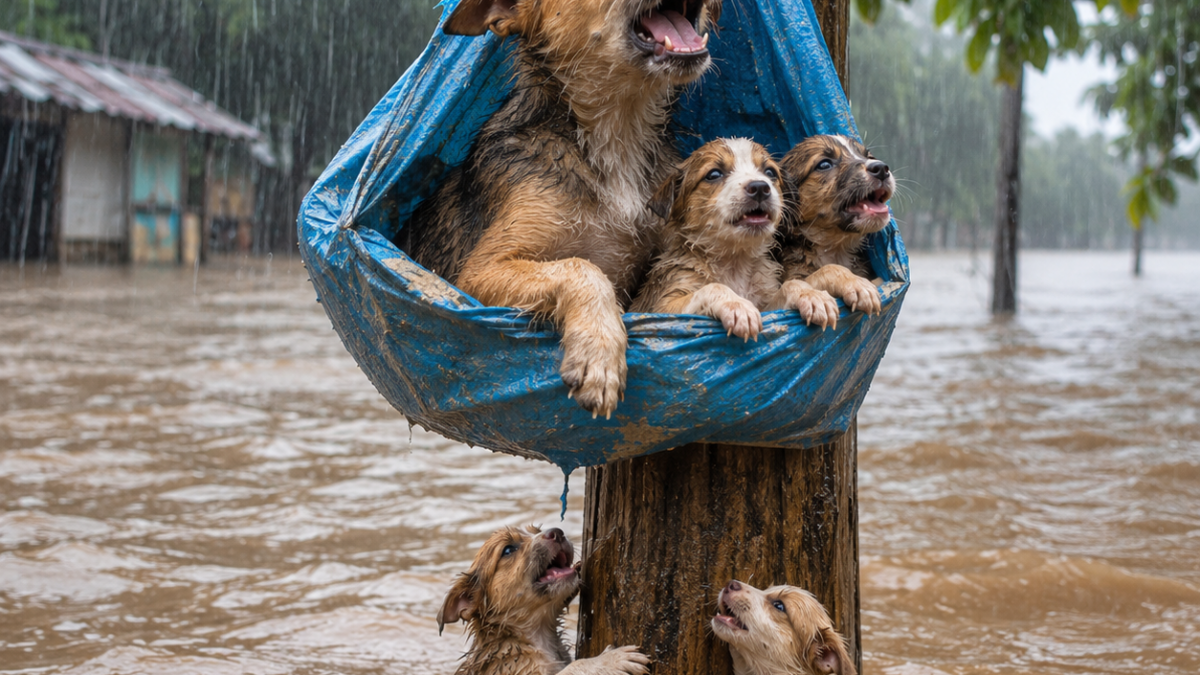
The makeshift platform was worse up close.
Someone had taken a large blue plastic feed sack, tied its corners with rope, and wrapped it around two crosspieces on the pole.
It had probably started above the water.
Now the flood had risen almost to its surface.
The mother stood with only half her body supported.
Her rear legs were in the water.
Two puppies were wedged between her front legs.
They looked no more than a few weeks old.
Old enough to crawl.
Not old enough to swim against a flood.
I reached for the first.
The mother pulled her body over him.
I stopped.
“I’m not taking him away.”
Her eyes stayed fixed on me.
I slowly opened my jacket enough for her to see the first puppy.
He made a tiny whining sound.
Her ears lifted.
“See?”
I moved him closer.
She stretched her nose toward him.
Sniffed.
Licked his wet head.
Then looked back at the two beside her.
“I understand.”
I put the rescued puppy back inside my jacket.
Then reached again.
This time, the mother did not cover the closest one.
She watched my hand.
I lifted a small black-and-white puppy.
He screamed.
It was the best sound I had heard all morning.
“Good.”
I tucked him inside the other side of my jacket.
Two safe with me.
The mother immediately turned to the final puppy.
A tan female.
She was shaking so badly her teeth clicked.
I reached.
The mother licked her face once.
Then stepped aside.
That small movement broke me.
She had finally decided I could carry what she had been carrying alone.
I took the puppy.
Now three puppies were against my body.
The mother was the only one left on the platform.
“Your turn.”
She didn’t move.
Of course she didn’t.
She looked toward the bank.
Toward where Daniel had carried the submerged puppy.
Her ears went forward.
Then she barked.
One sharp bark.
She wanted him back.
“You’re going to him.”
I clipped a second line onto her harness area as best I could.
She didn’t have a real harness, only a faded collar.
I ran the rescue sling underneath her chest.
The water surged again.
The blue sack tore at one corner.
“Now!”
Daniel had returned.
He was standing waist-deep several yards behind me.
“Puppy’s on the bank!” he shouted. “Volunteer’s working on him!”
“Breathing?”
Daniel’s face told me before his answer.
“Not yet.”
The mother heard the urgency in our voices.
She barked again.
I pulled her toward me.
The platform tore completely.
The blue plastic disappeared into the flood.
For a second the mother dropped.
Her head went under.
I caught the sling.
Daniel pulled the rope.
She came back up coughing.
“Go!”
We moved toward shore.
The current fought every step.
The mother kicked instinctively, trying to swim.
I kept one arm beneath her chest.
Three puppies pressed against my body.
Behind us, the wooden pole shook beneath debris.
Then disappeared almost completely beneath the water.
Thirty seconds later would have been too late.
Maybe less.
—
We reached the bank.
I didn’t even climb fully out before asking:
“Where is he?”
A woman named Rosa, one of the local volunteers, was kneeling beneath a plastic rain cover.
The submerged puppy lay on a towel.
She was rubbing him firmly.
Daniel dropped beside her.
“Anything?”
“Tiny heartbeat.”
“Breathing?”
“No.”
The mother dog heard the puppy.
Or smelled him.
Or simply knew.
She pulled against me.
I released the sling.
She stumbled forward.
Her legs barely supported her.
When she reached the towel, Rosa put out one hand.
“Slow.”
The mother lowered her nose to the puppy.
She licked his face.
Nothing.
Again.
Nothing.
Then she made a sound I had never heard from a dog before.
Not a bark.
Not a whine.
Something low and broken.
She nudged him.
Rosa continued working.
“Come on, baby.”
Daniel rubbed the puppy’s chest.
I stood frozen.
The three puppies inside my jacket moved and whimpered.
The mother looked at them.
Then back at the motionless one.
She nudged him again.
Suddenly the puppy coughed.
Once.
Nothing.
Then again.
A thin stream of muddy water came from his nose.
Rosa turned him carefully.
The puppy took a breath.
A horrible, wet, tiny breath.
Then another.
The mother lunged forward.
Rosa laughed and cried at the same time.
“He’s breathing.”
I dropped to my knees.
“Again.”
The puppy inhaled.
Weak.
But real.
Daniel covered his face with one hand.
“Four.”
I looked at him.
“What?”
“All four.”
I finally understood.
Four puppies.
One mother.
Five lives.
All still here.
—
The mother collapsed beside them.
Not because she’d stopped caring.
Because her body had finally reached the point where caring could no longer hold it upright.
We spread blankets on the driest ground we could find.
The puppies went into a warmed carrier.
The mother fought weakly when we moved them.
I let her watch.
“One.”
First puppy.
“Two.”
Black-and-white.
“Three.”
Tan female.
Then the submerged puppy.
“Four.”
I placed him closest to the carrier door.
The mother sniffed each one.
Only then did she allow us to lift her.
She weighed less than she should have.
Not severely starved.
But thin enough that nursing four puppies through bad weather had clearly taken something from her.
We put her inside a larger transport crate with the babies.
Immediately she curled around them.
The puppy who had nearly drowned pressed his face against her chest.
She licked him.
Again.
Again.
Again.
As though she could erase the water.
Daniel closed the carrier.
The mother looked up at me.
For the first time, she stopped barking.
—
The drive to the veterinary clinic should have taken twenty-five minutes.
Flooded roads turned it into forty.
Every minute mattered.
The submerged puppy’s breathing sounded wet.
I kept my hand through the carrier door.
The mother rested one paw against my wrist.
Not affection.
Not yet.
Just contact.
Maybe reassurance for both of us.
Daniel drove.
Rosa followed in another vehicle.
At one point, traffic stopped because a fallen tree blocked half the road.
Daniel hit the steering wheel.
“Come on.”
I looked at the puppy.
His chest rose.
Fell.
Rose again.
“Just keep going.”
The mother began licking him.
“That’s right.”
Daniel glanced in the mirror.
“You talking to her or me?”
“Both.”
—
Dr. Lauren Park met us at the clinic entrance.
She took one look at the carrier.
“Which one was submerged?”
I pointed.
“The brown male.”
“How long underwater?”
“Seconds. Maybe twenty. Maybe more.”
“Breathing spontaneously now?”
“Yes. Wet.”
“Okay.”
A technician lifted him.
The mother stood immediately.
“No separation if you can avoid it,” I said.
Dr. Park nodded.
“Bring Mom and litter into treatment.”
They placed the mother on a heated blanket.
The three stronger puppies remained beside her.
The fourth went to oxygen.
The mother cried.
I crouched beside her.
“He’s right there.”
She tried to stand.
Her legs shook.
“Don’t.”
She ignored me.
A technician placed the oxygen enclosure where she could see it.
The puppy lay inside.
The mother stared.
Only then did she lie back down.
Dr. Park examined her while watching the puppies.
“She’s exhausted.”
“Anything serious?”
“Dehydration. Some abrasions. Mild anemia, maybe. We’ll run bloodwork. Her temperature’s low.”
“From the flood?”
“Flood, exposure, nursing, probably all of it.”
“Puppies?”
“The three who stayed above water are cold but responsive.”
“And the other one?”
Dr. Park’s expression became careful.
“He’s the concern.”
I hated that phrase.
“What are you worried about?”
“Aspiration. Fluid in the lungs. Hypothermia. Shock.”
“Can he survive?”
“Yes.”
Not possibly.
Yes.
Then she added:
“But I’m not promising he will.”
Fair.
I took the first part anyway.
—
We needed names for the charts.
“Mother?” the technician asked.
I looked at the dog.
Brown-and-white.
Large ears.
Eyes still fixed on the oxygen enclosure.
“Mara.”
Daniel looked at me.
“Why Mara?”
“I don’t know.”
“You usually have some reason.”
“Not everything needs one.”
The technician wrote it down.
Mara.
For the puppies:
The first one I’d pulled from the pole became Pip.
The black-and-white puppy became Teddy.
The tan female became Wren.
And the little brown male who had disappeared under the floodwater became Clover.
Daniel stared.
“Clover? He’s a boy.”
“So?”
“Nothing.”
“He needs luck.”
“Fair.”
Clover.
The puppy who had been underwater long enough that I still felt panic when I looked at him.
—
We later learned who had tied the blue plastic sack to the pole.
The same man who had called us.
His name was Mr. Hale.
Seventy-one years old.
He lived in a small house on slightly higher ground near the vegetable plots.
He came to the clinic that afternoon.
Wet clothes.
Mud on his boots.
Hands shaking.
“Are they alive?”
“All five.”
His shoulders dropped.
He sat in the nearest chair.
For several seconds, he couldn’t speak.
Then he covered his face.
“I couldn’t get them.”
“You helped.”
He shook his head.
“I got two up.”
He explained what happened.
Just before dawn, he’d heard barking.
He followed the sound and found Mara in the drainage area.
At that point, the water was lower.
Mara had already moved two puppies against the wooden pole.
The other two were on a patch of mud nearby.
Mr. Hale couldn’t enter the current safely.
He had a bad heart and walked with a cane.
So he found an old blue feed sack.
Using a length of rope and a garden rake, he managed to secure the sack around the pole.
Mara climbed onto it.
He used the rake to push two puppies toward her.
Then the water rose too fast.
The other two became trapped lower down.
“I tried.”
His voice broke.
“I couldn’t reach.”
“You called.”
“I should’ve called sooner.”
“You were there before anyone else.”
He looked toward the treatment room.
“She wouldn’t stop barking.”
“No.”
“I’ve heard dogs bark my whole life.”
He shook his head.
“That wasn’t normal.”
I knew exactly what he meant.
—
Mara’s bloodwork came back better than I feared.
Dehydrated.
Anemic.
Low protein.
Parasites.
An old skin infection on her belly.
But no major organ failure.
“She can recover,” Dr. Park said.
I breathed for what felt like the first time all day.
“And Clover?”
She looked toward the oxygen enclosure.
“He’s holding his temperature.”
“Good.”
“His breathing is still rough.”
“Not good.”
“No.”
“Pneumonia?”
“Too early to say.”
“Could happen?”
“Yes.”
I sat down.
I hated learning how many things could go wrong after a rescue supposedly succeeded.
Getting them out of the flood wasn’t the end.
It was the beginning of another fight.
—
That evening Mara ate.
A small meal.
Slowly.
She stopped after almost every bite to look toward Clover.
I moved her bowl closer to the oxygen unit.
She ate better.
“Of course.”
Dr. Park smiled.
“She’s not subtle.”
Mara finished half the food.
Then pushed the bowl away with her nose.
“She needs more calories.”
“She’ll get there.”
Dr. Park crouched.
“Mothers do this sometimes when they’re stressed. Puppies first. Everything else later.”
I looked at Mara’s tired body.
“She almost drowned doing that.”
“Yes.”
“Somebody needs to tell her she counts too.”
Dr. Park looked at me.
“I think that’s your job now.”
—
Clover worsened overnight.
At 2:13 a.m., my phone rang.
I answered before the second ring.
Dr. Park.
My stomach dropped.
“He’s developed increased respiratory effort.”
“What does that mean?”
“We’re concerned about aspiration pneumonia.”
“Can I come?”
“You can.”
I was already dressing.
Daniel met me at the clinic.
He didn’t ask why I called.
He knew.
Clover was inside oxygen.
Tiny chest moving too fast.
Mara lay outside the enclosure.
She wasn’t sleeping.
Her head rested on the floor, but her eyes stayed on him.
I sat beside her.
She immediately moved her front paw onto my shoe.
I froze.
Then left it there.
Daniel sat on my other side.
For almost an hour none of us spoke.
Finally he whispered:
“You know we did everything we could.”
“Don’t say that yet.”
“I’m not saying it’s over.”
“Then don’t say anything that sounds like it.”
He nodded.
Fair.
—
Dr. Park started antibiotics.
Oxygen.
Nebulization.
Careful fluids.
Warming.
Then waiting.
Again.
Rescue is full of waiting.
You act urgently.
Then wait.
Make a decision.
Wait.
Administer treatment.
Wait.
You become desperate for movement because movement feels like control.
But biology doesn’t care how impatient you are.
Clover had to decide, cell by cell, breath by breath, whether his body could keep going.
Mara couldn’t do it for him.
Neither could I.
That was the hardest part.
—
Around four in the morning, Mara stood.
I thought she needed water.
Instead, she walked toward the oxygen enclosure.
Pressed her nose against the clear panel.
Clover was lying with his back toward her.
Mara whined.
One soft sound.
Clover’s ear moved.
Mara whined again.
His head lifted slightly.
I covered my mouth.
“Daniel.”
“I saw.”
Clover turned toward the sound.
The movement cost him.
But he did it.
Mara lay down beside the enclosure.
Clover rested again.
That moment proved nothing medically.
It didn’t change his oxygen saturation.
It didn’t cure infection.
But everyone in that room needed it.
Including me.
—
Clover survived the night.
Then the next.
His lungs sounded slightly better on day three.
By day five, he needed less oxygen.
On day six, Dr. Park opened the enclosure and placed him beside Mara for ten supervised minutes.
Mara nearly knocked the technician over trying to reach him.
“Easy.”
Clover crawled toward her.
Mara licked him so aggressively that he squealed.
Daniel laughed.
“He almost dies and she immediately starts washing his face.”
“Motherhood.”
Clover found his way to her belly and nursed.
Weakly.
But independently.
Mara lowered her head around him.
Her eyes closed.
That was when I finally allowed myself to believe he might come home.
—
Pip, Teddy, and Wren had meanwhile decided hospitals were boring.
Pip climbed over everyone.
Teddy screamed whenever he was hungry.
Wren had discovered the edge of the blanket and kept attempting to crawl into nowhere.
Mara handled all three while still watching Clover.
She was exhausted.
We supplemented the puppies so her body could recover.
At first, she resisted.
If I lifted Pip, she stood.
If Daniel held Teddy, she watched every finger.
But she remembered me.
Maybe from the water.
Maybe from the clinic.
Maybe simply because I kept returning puppies.
By the fourth day, she let me feed them without standing.
By the seventh, she slept through part of a bottle feeding.
That was progress no blood test could measure.
—
After ten days, Clover came out of oxygen permanently.
Dr. Park listened to his lungs.
“Still not perfect.”
“But?”
“Better.”
“Can I say he made it?”
“Not yet.”
I groaned.
She smiled.
“You really hate uncertainty.”
“Deeply.”
“Give me forty-eight hours.”
Forty-eight hours later, she called me into the examination room.
Clover was standing badly on four tiny legs.
Mara beside him.
“He’s going to be okay.”
I stared at her.
“Say that again.”
“Clover is going to be okay.”
“Definitely?”
She laughed.
“As definitely as medicine allows me to say it.”
I sat down on the floor.
Mara walked toward me.
Put her nose against my cheek.
Then immediately returned to Clover.
Priorities.
—
Mara and the puppies came to foster with me.
Temporary.
That was the plan.
Daniel didn’t believe me.
“You’re keeping one.”
“No.”
“Mara?”
“No.”
“Clover?”
“No.”
“Both?”
“Stop.”
He smiled.
“I’ve seen this before.”
“This is rescue. They get adopted.”
“Sure.”
I ignored him.
—
My laundry room became a nursery.
Then the dining room.
Then half the living room.
Four puppies expand faster than physics should allow.
Mara entered the house carefully.
Every doorway made her pause.
Every new sound made her look at the puppies.
The first rainstorm changed everything.
It started at midnight.
Heavy rain against the windows.
Mara woke instantly.
I heard her claws on the floor.
By the time I reached the living room, she was gathering puppies.
Pip first.
She picked him up by the scruff and tried to carry him behind the couch.
“Mara.”
She ignored me.
Teddy next.
Then Wren.
Clover began crying.
Mara became frantic.
Thunder rolled.
She picked Clover up.
Her whole body shook.
I understood.
Rain did not mean weather to her.
Rain meant water rising.
A platform disappearing.
Babies slipping.
I sat on the floor.
“Mara.”
She paced.
I didn’t block her.
“Look.”
I pointed toward the windows.
“Dry.”
Useless word.
She couldn’t understand.
So I did something else.
I brought every puppy into the large bed.
One.
Pip.
Two.
Teddy.
Three.
Wren.
Four.
Clover.
Then I sat beside them.
Mara counted.
Sniffed each.
Thunder.
She tensed.
I stayed.
Minutes passed.
The floor remained dry.
No current.
No pole.
No dirty water.
Eventually Mara lay down.
Not relaxed.
But present.
I slept on the floor beside them that night.
At dawn, the storm ended.
All four puppies were exactly where she’d left them.
Another piece of evidence.
Rain did not always take things.
—
The next storm was easier.
Mara still gathered the puppies.
But she didn’t panic as badly.
By the fourth storm, she stood.
Checked the room.
Then came to me.
That broke something open in my chest.
Fear still arrived.
But now it brought her toward help.
Not toward a desperate attempt to handle everything alone.
That was trust.
—
The puppies opened their worlds quickly.
Pip was fearless.
Too fearless.
He climbed stairs before he understood stairs.
Teddy loved food with religious intensity.
Wren watched before doing anything.
Clover remained smaller.
Not sick anymore.
Just slightly behind.
He followed Mara everywhere.
If she moved rooms, Clover moved.
If she slept, he tried to sleep touching her.
Maybe that was because of what happened.
Maybe simply personality.
We don’t need every bond to become a symbol.
But I’ll admit I noticed.
—
Mara gained weight.
Her coat improved.
Muscle returned.
She began playing.
The first time happened with a tennis ball.
Daniel rolled one across the floor.
Mara watched it.
Nothing.
He rolled it again.
She followed with her eyes.
Third time, she stood.
Chased it three steps.
Stopped.
Looked embarrassed.
Daniel laughed.
“You know you’re allowed.”
He rolled it again.
Mara ran after it.
Actually ran.
She picked it up.
Then refused to return it.
“Good.”
Daniel reached.
Mara turned away.
“Excellent. We created a thief.”
The mother dog who had used every ounce of energy to keep four puppies alive now had enough energy to steal toys.
I loved it.
—
We searched for an owner.
No microchip.
No collar when Mr. Hale found her.
Local posts.
Photos.
Door-to-door questions.
Nobody claimed her.
A woman in the area remembered seeing a pregnant brown-and-white stray several times near the vegetable plots.
Another resident had put food out occasionally.
That was all we could establish.
No evidence that anyone deliberately abandoned Mara in the flood.
No owner to prosecute.
No villain to confront.
At first, part of me felt unsatisfied.
That sounds terrible.
But after rescue work, anger wants a destination.
You see a suffering animal and imagine there must be one person responsible.
Sometimes there is.
Sometimes there isn’t.
Sometimes poverty, weather, stray populations, bad infrastructure, and human indifference overlap until there is no single face to blame.
Inventing one would have made the story cleaner.
It would not have made it truer.
So I stopped looking for someone to hate.
We had four puppies to raise.
That was enough work.
—
Mr. Hale visited often.
The first time he saw Mara again, he stopped at the doorway.
She saw him.
Her ears lifted.
He crouched.
“Remember me?”
Mara approached slowly.
Sniffed his hands.
Then wagged.
The old man’s face collapsed.
He sat on the floor because his legs seemed to stop working.
“You’re okay.”
Mara licked his cheek.
He cried.
No hiding it.
“I thought I left you there.”
“You didn’t,” I said.
“I couldn’t get those bottom two.”
“You kept three lives above water long enough for us to arrive.”
He shook his head.
“I only tied a bag.”
“That bag bought us time.”
He looked at Mara.
She leaned against him.
Sometimes people dismiss small acts because somebody else finishes the rescue.
But a phone call can save a life.
A rope.
A plastic sack.
Five extra minutes.
Survival often belongs to a chain of people, not one hero.
—
The county cleaned the drainage area after the flood.
Debris removed.
Blocked culverts cleared.
Residents organized a flood-response group.
Our rescue helped create a simple plan for animals in low-lying areas.
Raised emergency platforms.
Contact numbers posted.
Temporary carriers stored at two community centers.
Nothing dramatic.
No ribbon-cutting.
But the next rainy season, people knew who to call earlier.
We named the effort High Ground.
Mr. Hale hated the name.
“Sounds like a landscaping company.”
Daniel laughed.
“He’s right.”
I didn’t care.
High Ground stayed.
—
The first animal helped through High Ground was an elderly hound chained in a yard before another storm.
Not abandoned.
His owner was hospitalized.
A neighbor called.
We moved the dog before water arrived.
No dramatic rescue.
No viral photograph.
Exactly what we wanted.
Then three outdoor cats.
Then two goats.
Then a family with six puppies living near a drainage ditch.
They were moved the afternoon before heavy rain.
Every time I thought about them sleeping dry, I remembered Mara barking from the pole.
Prevention isn’t as emotional as rescue.
It is better.
—
At eight weeks, adoption applications began.
I hated it.
Again.
Daniel loved watching me hate it.
“You said temporary.”
“Don’t start.”
Pip’s family came first.
A young couple with a fenced yard and an older dog.
Pip approached them immediately.
Of course.
No loyalty.
The older dog tolerated him.
Mara watched.
The couple sat on the floor.
They didn’t grab.
Didn’t overwhelm.
Mara eventually approached the woman.
Sniffed.
Then walked away.
Approval, apparently.
Pip left two weeks later.
Mara followed the carrier to the door.
She whined.
My chest hurt.
But she didn’t panic.
That mattered.
That night Pip’s family sent a photograph.
He was asleep upside down on their sofa.
Safe.
Dry.
Loved.
—
Teddy went next.
His adopter was a retired schoolteacher named Angela.
She had owned dogs for thirty years.
Teddy climbed into her lap and immediately fell asleep.
“That’s manipulative,” I said.
Angela smiled.
“I don’t mind.”
Mara sniffed her.
Angela waited.
Mara eventually put her chin on Angela’s knee.
That sealed it.
Teddy went home.
His first update showed him carrying a slipper almost as large as himself.
Perfect.
—
Wren was the hardest to place because she was shy.
Applications wanted the cute tan puppy.
Then some families became disappointed when she hid.
I rejected them quickly.
If someone needed a puppy to perform affection during a twenty-minute meeting, they weren’t right for Wren.
Then a quiet family came.
Two adults.
One fourteen-year-old boy named Caleb.
Caleb sat on the floor.
Wren stayed beneath a chair.
He didn’t reach.
Didn’t call.
Didn’t stare.
Thirty minutes passed.
Wren came out.
Sniffed his shoe.
Caleb kept looking at his phone.
Wren climbed into his lap.
He looked at me.
“Can I pet her now?”
“Yes.”
Good kid.
Wren had her family.
—
That left Clover.
And Mara.
Daniel walked into my house one morning.
Saw Clover asleep across Mara’s back.
Then saw the adoption applications untouched on my table.
“You’re keeping them.”
“No.”
“You haven’t opened the folder.”
“I’ve been busy.”
“For two weeks?”
“Yes.”
“Mara?”
I said nothing.
“Clover?”
Nothing.
He grinned.
“Both.”
“Go home.”
“This is my favorite part.”
“Leave.”
Mara wagged at him.
Traitor.
—
I tried.
I genuinely tried.
A good family applied for Clover.
Experienced.
Fenced yard.
Work-from-home schedule.
Perfect veterinary references.
They came to meet him.
Clover liked them.
Mara tolerated them.
I told myself this was how rescue worked.
Then the man picked Clover up.
Clover squeaked.
Mara stood instantly.
Not aggressive.
But alert.
The man lowered him.
Clover ran to Mara.
Pressed against her front legs.
Mara licked his head.
The couple looked at each other.
The woman asked:
“Are they bonded?”
“Maybe.”
I hated the word because it answered too much.
They stayed another hour.
Clover played.
Mara relaxed.
Then Clover fell asleep with his head on her paw.
The woman smiled.
“I think we’re applying for the wrong dog.”
I sighed.
“I’m sorry.”
“Don’t be.”
They later adopted another puppy from us.
Clover stayed.
—
Mara also had an applicant.
A family with older children.
Excellent home.
When they visited, Mara was friendly.
She walked with them.
Accepted treats.
Everything looked promising.
Then they prepared to leave.
Mara walked back to me.
Sat against my legs.
Clover came beside her.
Daniel, who had somehow arranged to be present for my humiliation, folded his arms.
I refused to look at him.
The woman smiled.
“She’s already home.”
I opened my mouth.
Nothing useful came out.
Mara leaned harder against me.
Clover sat on my shoe.
Daniel whispered:
“Temporary.”
I hated him.
—
I signed both papers.
Mara.
Clover.
Officially mine.
Daniel brought a blue plastic dog toy shaped like a sack.
“This is inappropriate.”
He laughed.
Mara took it.
Shook it violently.
Then ran away with it.
Daniel pointed.
“Symbolic revenge.”
I tried not to laugh.
Failed.
—
Months passed.
Mara learned normal life.
Not rescue life.
Normal.
Morning walks.
Breakfast.
Naps.
Barking at delivery trucks.
Stealing Clover’s toys.
Waiting at the refrigerator when chicken appeared.
She stopped gathering Clover every time it rained.
One night, thunder shook the windows.
Mara lifted her head from the couch.
Looked at Clover.
Clover was asleep.
She looked at me.
Then put her head back down.
I nearly cried.
No counting.
No carrying.
No panic.
The house was dry.
Her baby was safe.
She knew.
—
Clover grew into a strong dog.
You would never have guessed he’d once been pulled unconscious from muddy water.
His lungs healed completely.
Dr. Park listened at his one-year visit.
“Clear.”
“Completely?”
“Completely.”
“Any long-term problems?”
“Not that I can find.”
Clover tried to steal a treat.
Dr. Park pushed his nose away.
“Behavioral issues, however…”
“Severe.”
She gave him the treat.
Enabling.
—
We held a first-birthday reunion for the four puppies.
Pip arrived first.
Huge.
Teddy had become stocky and enthusiastic.
Wren was still cautious until she saw Clover.
Then she exploded.
Four dogs ran across the fenced field.
Mara stood still.
Watching.
For a second, something about her posture looked familiar.
The flood.
The pole.
Counting.
I held my breath.
Then Mara ran.
She chased them.
Pip turned.
Clover crashed into Teddy.
Wren flew past.
Mara barked.
But it wasn’t the desperate bark from the flood.
It was bright.
Playful.
Joyful.
Daniel stood beside me.
“Listen.”
I knew.
Same dog.
Different sound.
Mara ran until she was tired.
Then lay in the grass.
All four grown puppies eventually collapsed around her.
Not neatly.
Pip on his back.
Teddy chewing a stick.
Wren pressed against Mara.
Clover beside me.
I took one photograph.
Five lives.
Dry grass.
No current.
No pole.
That photograph became my favorite.
—
People kept asking about revenge.
When Mara’s rescue story spread locally, comments filled with anger.
“Who left them there?”
“Find the owner.”
“Someone should pay.”
I understood.
I had felt it too.
But we never found evidence that Mara had been deliberately placed in the flood.
She had likely been a stray mother sheltering near the vegetable plots when the storm came.
The blue sack wasn’t cruelty.
It was an old man improvising because he couldn’t reach her.
There was no villain waiting for punishment.
At first that seemed to make the ending less satisfying.
Then I realized revenge didn’t need a person.
The flood tried to reduce Mara’s world to one wooden pole.
Her world became acres.
The current almost took Clover.
He grew into a dog who loved running beside a creek.
Rain once made Mara gather her babies in terror.
Years later she slept through storms.
The place that nearly killed them inspired a program that moved animals before later floods arrived.
If you need to call that revenge, fine.
It was better than hurting anyone.
Everything that tried to make their world smaller failed.
Their lives got bigger.
—
Clover was terrified of water for his first year.
Understandably.
He avoided puddles.
Refused baths.
Walked around wet grass.
Then one summer afternoon, we visited a quiet park with a shallow creek.
I didn’t intend to take him near it.
He chose.
Clover stopped at the edge.
Mara beside him.
Water moved gently over stones.
Nothing like the flood.
Still, Clover stiffened.
I almost turned us away.
Then Mara stepped in.
One paw.
Then another.
She drank.
Clover watched.
Mara walked farther.
Water reached her ankles.
Clover whined.
She looked back.
He took one step.
Then another.
His paw touched water.
He jumped backward.
I laughed softly.
“That’s enough.”
But Clover returned.
He touched the water again.
This time he stayed.
Mara stood beside him.
Five minutes later, Clover was splashing.
Ten minutes later, he was chasing floating leaves.
I sat on a rock.
Emotion overwhelmed me so suddenly I had to look away.
The puppy I’d pulled from floodwater without a breath in his body was now annoyed that a leaf escaped downstream.
Mara walked past and splashed my legs.
“Really?”
She wagged.
Daniel, who had joined us, laughed.
“There. That’s the revenge you wanted.”
Maybe he was right.
—
On the anniversary of the rescue, High Ground organized a community clinic.
Microchips.
Vaccinations.
Emergency tags.
Flood-preparation information.
Mr. Hale attended.
He arrived with a cane.
Mara recognized him.
Immediately.
She ran toward him.
Not slowly this time.
Mr. Hale crouched as much as his knees allowed.
Mara leaned into him.
He laughed.
“You remember the old fool.”
I said, “She remembers the man with the blue sack.”
He shook his head.
“Ugliest thing I ever built.”
“Worked.”
“Barely.”
“Barely is enough when it buys twenty minutes.”
Mr. Hale looked toward Clover.
“Which one?”
I pointed.
“That one.”
Clover was playing with Pip.
“The one underwater?”
“Yes.”
Mr. Hale stared.
Then smiled.
“Wouldn’t know it.”
Exactly.
That’s what healing can do.
Not erase history.
Make it impossible to see from across a field.
—
The second major flood came almost three years later.
Weather alerts started two days early.
High Ground activated.
Volunteers checked the low-lying properties.
Animals moved.
Carriers distributed.
Mr. Hale called me.
“Water’s coming up.”
“We know.”
“Vegetable plots?”
“Empty.”
“The drainage pole?”
“Removed after the last work.”
He was quiet.
“What about strays?”
“Teams checked.”
Another pause.
“Good.”
That night rain hammered my roof.
Mara slept beside the couch.
Clover at her feet.
My phone rang constantly.
Reports.
Updates.
Road closures.
But no frantic call about a dog on a pole.
No puppies trapped in current.
At 3:00 a.m., I walked into the living room.
Mara was asleep.
Thunder shook the windows.
She didn’t move.
Clover snored.
I stood there in the dark listening to the rain.
Three years earlier, the same sound had meant panic.
Now it meant a roof.
That may have been the most satisfying night of my life.
—
By morning, High Ground had moved fourteen animals before water reached them.
Three dogs.
Six cats.
Two goats.
A rabbit.
Two chickens.
Nobody cared that chickens made the count less dramatic.
Lives are lives.
No one drowned.
No frantic rescue.
No video of somebody risking themselves in current.
The local paper called it a success.
I called it what rescue should look like when we get lucky enough to learn.
Boring.
Prepared.
Early.
Safe.
—
Years passed.
Pip became a running partner for his adopter.
Teddy became an overweight couch enthusiast until Angela put him on a diet he considered criminal.
Wren followed Caleb through high school and college.
Clover stayed with Mara and me.
Every year, we attempted a reunion.
Every year, the photograph became harder.
Four dogs looking in four directions.
Mara trying to leave.
Humans yelling names.
Treats everywhere.
Perfect.
—
Mara became the emotional center of my house.
Not because she was endlessly nurturing.
Once her puppies grew up, she appeared very happy to retire from motherhood.
When foster puppies visited, she tolerated them.
Sometimes.
Clover adored everyone.
Mara preferred adults and peace.
I respected that.
Survivors do not owe the world a career in helping others heal.
Sometimes recovery means becoming selfish enough to enjoy your own bed.
Mara did that beautifully.
—
She also became obsessed with dry towels.
That started after baths.
If a towel appeared on the floor, Mara claimed it.
Fresh laundry?
Hers.
Beach towel?
Hers.
Once Daniel put his jacket down.
Mara slept on it.
He complained.
I reminded him she had survived a flood.
He said I used that excuse for everything.
Correct.
—
Clover grew larger than Mara.
Still slept beside her.
Still let her clean his ears.
At six years old, he could have easily walked away.
He didn’t.
Some bonds change shape without disappearing.
One evening, I watched Mara grooming the side of his face.
Clover closed his eyes.
For a second I saw the tiny wet puppy on the clinic towel.
Then the image disappeared beneath the adult dog in front of me.
I was grateful.
—
Mr. Hale died when Mara was about eight.
His daughter called.
He had kept the photograph from the first reunion beside his chair.
I didn’t know that.
At the memorial, she gave me a small piece of blue plastic.
I stared.
“What is this?”
“He kept part of the sack.”
My chest tightened.
“I thought it washed away.”
“Apparently part tore off and caught in a fence. He found it after the flood.”
She smiled sadly.
“He said it was the best bad idea he ever had.”
I laughed through tears.
I took the plastic home.
For weeks I didn’t know what to do with it.
Eventually I put it inside a small frame beside a photograph of Mara and the four puppies on dry grass.
The label read:
IT DIDN’T HAVE TO BE PERFECT.
IT ONLY HAD TO HOLD LONG ENOUGH.
That was for Mr. Hale.
Because rescue often celebrates the person who arrives at the dramatic moment.
But before me, there had been an old man with a cane, a feed sack, a rope, and enough concern to try.
The five lives began with him hearing a dog cry and refusing to ignore it.
—
Mara aged slowly.
White appeared around her muzzle.
Clover remained embarrassingly energetic.
He adjusted anyway.
Our walks shortened.
Clover would run ahead, then return.
Mara moved at her own pace.
No one rushed her.
I thought about the flood sometimes.
How every second had mattered.
Now there was no hurry.
That felt like wealth.
Time with no emergency attached.
—
At ten, Mara developed arthritis.
Medication helped.
We added a ramp beside the porch.
She refused it.
Of course.
For weeks, she used the steps.
Then one cold morning, she looked at the ramp.
Looked at me.
Used it.
I pretended not to notice.
Dignity matters.
—
Clover began slowing too.
His lungs had never caused problems after puppyhood.
But age arrived normally.
Gray hair.
Longer naps.
Less enthusiasm for hot weather.
He still loved water.
That amused me endlessly.
He would walk directly into the creek.
Mara usually remained on the bank by then.
One afternoon Clover stood in shallow water, looking back at her.
Mara put one paw in.
Then another.
Stood for a moment.
Clover walked back toward her.
They touched noses.
I nearly lost it.
Daniel was with me.
He saw my face.
“Don’t.”
“I’m fine.”
“You’re seventy percent tears.”
“Shut up.”
—
The puppies’ families eventually became friends.
Not rescue contacts.
Friends.
Angela brought Teddy for holidays.
Caleb sent videos of Wren.
Pip’s family invited us to a birthday party once.
Clover ate half a cake.
Not his.
The incident remains controversial.
Mara slept through most of it.
Retirement.
—
When Mara was around twelve, she developed a heart murmur.
Nothing catastrophic at first.
Medication.
Monitoring.
Shorter walks.
She still ate.
Still wanted towels.
Still leaned against my legs during storms.
But one thing changed.
She began checking Clover more often.
Not from panic.
Something quieter.
Maybe age.
Maybe habit returning.
One night she got up from bed and walked across the room just to sniff him.
Clover opened one eye.
Mara returned to sleep.
I understood.
Mothers never completely retire.
—
Pip died first among the puppies.
Cancer.
He was almost twelve.
His family had given him a beautiful life.
Still, the call hurt.
We let Mara and Clover smell Pip’s blanket afterward.
Clover lingered.
Mara sniffed once.
Then sat down.
I didn’t claim she understood death.
I didn’t need to turn every behavior into a human story.
But that night she slept pressed against Clover.
Maybe coincidence.
Maybe not.
—
Teddy lived another year.
Wren longer.
The four puppies had become old dogs.
That fact alone felt extraordinary.
When people heard the flood story, they imagined fragile puppies.
I had photographs of gray muzzles.
Arthritis medicine.
Senior diets.
Old dogs asleep on orthopedic beds.
Those were my favorite updates.
Old age can be an achievement.
For animals once minutes from death, it absolutely is.
—
Mara’s heart condition progressed.
At first we adjusted medication.
Then again.
She became tired after short walks.
Clover adapted.
If Mara stopped, he stopped.
If Mara turned home, he followed.
The puppy she once nearly died protecting was now the old dog waiting for her.
There is no fair way to describe what that did to me.
—
One spring morning Mara refused breakfast.
That scared me.
Mara loved breakfast.
I offered chicken.
She took one piece.
Then lay down.
The veterinarian found fluid around her lungs.
Heart failure.
Treatable for a time.
Not curable.
I sat on the clinic floor beside her.
Clover lay on the other side.
“How long?”
The veterinarian answered carefully.
“Could be weeks. Could be months.”
“Comfort?”
“Yes.”
That was the only word that mattered.
—
We brought Mara home.
Medication helped for a while.
She had good days.
Walked to the end of the street.
Sat in sunlight.
Stole a towel from the laundry room.
Excellent.
Then bad days began appearing between the good ones.
More sleep.
Less food.
Harder breathing.
The veterinarian made house visits.
I didn’t want Mara spending her last days traveling to clinics unless necessary.
She had spent enough of her life being carried away from water.
Home was the destination now.
—
We organized one last reunion with Wren and Teddy, the two siblings still alive besides Clover.
No party.
No decorations.
Just a quiet afternoon.
Mara lay beneath a tree.
Clover beside her.
Wren approached carefully.
Teddy, old and overweight despite Angela’s best efforts, waddled closer.
Mara sniffed each one.
Then lay back down.
The three old puppies settled around her.
I took one photograph.
No one looked at the camera.
Good.
That was not what the afternoon was for.
—
I remembered the first morning.
Four tiny bodies.
Water.
Barking.
A pole.
Now three of the surviving siblings were gray-faced seniors beside their mother.
Pip existed in photographs and stories.
The flood had almost reduced their time to minutes.
Instead, they got years.
So many years.
Meals.
Walks.
Sickness.
Birthdays.
Stolen food.
Vet visits.
Ordinary mornings.
The full inconvenient privilege of being alive.
—
Mara’s final day came during rain.
Of course it did.
Not a flood.
Just gentle spring rain.
She couldn’t stand that morning.
Clover lay beside her.
I helped Mara onto a blanket near the glass door where she could see the yard.
Rain ran down the window.
Years earlier, rain had made her frantic.
Now she watched without fear.
That alone felt like a complete life.
The veterinarian arrived around noon.
Daniel came too.
Older.
Quieter.
He sat near Mara.
“Hey, mama.”
Her tail moved once.
He smiled.
“Still like me.”
Barely.
—
I brought the framed piece of blue plastic from the shelf.
Not because Mara cared.
I did.
I placed it nearby.
Daniel saw.
“Mr. Hale.”
“Yeah.”
He touched the frame.
“Crazy morning.”
“Worst.”
“Best too.”
I understood.
Some days hold both.
—
Before the veterinarian began, I sat beside Mara.
Clover put his head on her front leg.
The same puppy who had once disappeared beneath muddy water.
His muzzle was white now.
Mara licked his forehead.
Slowly.
Once.
I couldn’t breathe.
“You remember him?”
Of course I didn’t expect an answer.
I touched her cheek.
“You got all four.”
My voice broke.
“Pip had a whole life.”
Mara’s eyes stayed on me.
“Teddy had a whole life.”
Rain against the window.
“Wren had a whole life.”
Clover shifted closer.
“And this idiot never left.”
Daniel laughed through tears.
Clover ignored him.
I rested my forehead against Mara’s.
“You did your job.”
That sentence felt wrong immediately.
She had been more than a mother.
So I corrected myself.
“No.”
I swallowed.
“You lived your life.”
Better.
—
The veterinarian waited.
Mara’s breathing was tired.
Not panicked.
I put one hand on her chest.
“Nothing’s rising.”
Rain continued.
“The floor is dry.”
Clover’s body touched hers.
“Your baby is safe.”
My voice disappeared for a second.
“Everybody’s safe.”
Mara closed her eyes.
I nodded to the veterinarian.
She fell asleep with rain outside, Clover beside her, and my hand where she could feel it.
No flood.
No pole.
No desperate barking.
No babies slipping away.
Just home.
—
Clover searched for her.
For days.
Her bed.
The hallway.
The yard.
He slept beside her blanket.
I slept on the couch near him.
Grief does not become smaller because you’re grateful.
Gratitude and devastation can exist in the same room.
I was grateful Mara had lived twelve years with us.
I still wanted one more morning.
That’s love’s unreasonable mathematics.
Enough is never enough.
—
We scattered part of Mara’s ashes near the creek.
Not the flood ditch.
Never the flood ditch.
The quiet creek where Clover had learned water could mean play.
Clover walked into the shallows.
Stood there.
I scattered the ashes near the bank beneath a tree.
Daniel said nothing.
Neither did I.
Some endings don’t need speeches.
—
The High Ground program continued.
By then it had helped hundreds of animals during storms.
Emergency crates.
Transportation.
Microchips.
Raised shelters.
Volunteer call lists.
The original flood photograph hung in the office.
Not Mara struggling.
I refused that.
Instead, we used the reunion photo.
Mara with all four young adult puppies on dry grass.
Underneath were two lines:
SHE CRIED UNTIL SOMEONE HEARD HER.
WE DECIDED THE NEXT ANIMAL SHOULDN’T HAVE TO CRY THAT LONG.
That was her legacy.
—
Clover lived another two years.
Old.
Spoiled.
Loved.
He still walked into shallow water.
Slower.
One summer afternoon, he stood in the creek exactly where he had learned to play years earlier.
I watched him.
The current moved gently around his ankles.
He looked at me.
Then lay down in the water.
“You’re ridiculous.”
His tail moved.
I sat on the bank.
For a moment, I could see both versions of him.
The tiny puppy beneath muddy water.
The old dog choosing water because it felt good.
If that isn’t revenge against fate, I don’t know what is.
—
When Clover died at fourteen, Dr. Park had long since retired.
She still came to see him.
She stood beside his bed.
“You were supposed to be my scary case for one week.”
Clover licked her hand.
She laughed.
“You became old.”
I said, “Best diagnosis he ever got.”
Old.
A puppy pulled from floodwater had become old.
Perfect.
—
After Clover was gone, I kept Mr. Hale’s framed blue plastic on the shelf.
Beside it, the reunion photograph.
People who visited sometimes asked about it.
I told them.
Not the dramatic version.
The full version.
An old man heard barking.
He tied a plastic sack to a pole.
A rescue team entered floodwater.
A puppy stopped breathing.
A mother refused to leave anyone behind.
A veterinarian kept breathing going when nature almost stopped it.
Four families eventually grew around four puppies.
A community learned.
Years passed.
Dogs became old.
That’s the story.
Not five minutes of rescue.
A lifetime after.
—
People still ask who the hero was.
Mara?
Mr. Hale?
Daniel?
Rosa?
The veterinary team?
I don’t like the question.
Stories become less true when we force one person into the center.
Mr. Hale bought time.
Mara kept the puppies together.
Daniel held the rope.
Rosa got Clover breathing.
Dr. Park kept him alive afterward.
Families gave the puppies decades they almost didn’t have.
Volunteers built High Ground.
Everyone carried something.
That’s usually how rescue works.
One person rarely saves a life alone.
We hand it forward.
—
And people still ask about revenge.
They want somebody punished.
A cruel owner.
A person who tied them there.
But the truth was different.
The person who tied the blue sack was trying to save them.
We found no evidence Mara was deliberately abandoned in that flood.
The enemy was water.
Bad timing.
Exposure.
A vulnerable stray family in the wrong place during the worst storm of the year.
You can’t prosecute a storm.
So Mara took her revenge another way.
The flood tried to separate her from her puppies.
They grew up visiting each other.
The flood made water terrifying.
Clover learned to play in creeks.
The flood trapped Mara on a tiny piece of plastic.
She spent years sleeping wherever she wanted.
The flood gave her minutes.
She turned those minutes into more than a decade.
The flood made her scream for help.
Her story later helped create a system that rescued animals before they needed to scream.
That was enough for me.
More than enough.
—
Sometimes the most satisfying revenge is not watching the thing that hurt you suffer.
It’s living so completely that the worst day of your life becomes only one chapter.
Mara did that.
For years, people who met her had no idea she was “the flood dog.”
She was simply Mara.
The dog who stole towels.
The dog who hated carrots.
The dog who slept sideways across the couch.
The dog who became impatient when dinner was six minutes late.
The dog who raised four puppies and then very clearly retired from raising anything else.
Normal.
That was the victory.
—
If I could go back to that first morning, I wouldn’t tell myself everything would be fine.
Because I didn’t know.
Clover could have died.
The platform could have broken earlier.
The rope could have slipped.
Mara could have been swept away.
Pretending certainty would cheapen what happened.
Instead, I’d tell myself:
Get one.
Then the next.
Then the next.
Don’t stop counting.
That’s what Mara taught us.
She never thought in terms of the whole impossible rescue.
She saw one puppy slipping.
Then another.
She barked.
She stretched.
She kept going.
When we took one, she showed us the next.
When we had three, she still knew one was missing.
Only when all four were together did she stop.
Maybe survival works that way more often than we admit.
Not “Can I fix my entire life?”
Just:
Who is still missing?
What is the next thing?
Can I make it one more minute?
—
I still hear her bark sometimes when rain gets heavy.
Not literally.
Memory.
That desperate sound across the flooded fields.
For years, I thought the saddest part was how helpless she sounded.
Now I hear something else.
Persistence.
She didn’t bark once.
She kept barking.
Again.
Again.
Again.
Until somebody heard.
There is courage in that.
Not silent endurance.
Noise.
Refusing to disappear quietly.
—
Mr. Hale once told me he almost stayed inside that morning.
The rain was terrible.
His knee hurt.
He thought the barking might stop.
Then it didn’t.
So he went outside.
That sentence has stayed with me.
The barking might stop.
Sometimes it stops because the problem goes away.
Sometimes it stops because the one crying no longer can.
Mr. Hale didn’t wait to find out.
He went.
I’m glad he did.
—
That became one of the rules I taught new volunteers.
If something feels wrong, look.
You don’t have to know how to fix it.
You don’t need perfect equipment.
You don’t need to become a hero.
Look.
Call.
Stay.
Hand the problem to the next person if necessary.
Mr. Hale couldn’t enter the flood.
He didn’t need to.
He built a terrible little platform and made a phone call.
That was enough to start the chain.
—
Years later, High Ground volunteers found a mother cat and kittens near rising water.
They moved them the evening before a storm.
The next morning the spot was underwater.
One volunteer sent me a picture of the cats asleep in a foster bathroom.
Caption:
No dramatic rescue this time.
I stared at it for a long time.
Then replied:
Perfect.
That’s what Mara’s story became.
Not more dramatic rescues.
Fewer.
—
I keep one photograph above my desk.
Not the flood.
Not Clover in oxygen.
Not Mara’s last day.
The reunion.
Five dogs in grass.
Mara in the middle.
Pip looking away.
Teddy with his mouth open.
Wren half behind Mara.
Clover closest to the camera.
Nobody knows what to do.
Everyone alive.
Under the photograph, I eventually added a sentence.
THE WATER ROSE.
SO DID THEY.
Maybe it’s sentimental.
I don’t care.
It’s true.
—
The flood took a road.
Fences.
Vegetable beds.
Tools.
Furniture from nearby homes.
It almost took five lives.
Almost.
That’s the word I care about.
Almost is where every later year lived.
Almost didn’t get them.
Almost didn’t get Clover.
Almost didn’t get Mara.
Instead, there were birthdays.
Old age.
Creeks.
Towels.
Reunions.
Arthritis.
Heart medicine.
Families.
Grief that only existed because love had lasted long enough to create it.
—
And when I remember Mara now, I don’t picture her trapped against the pole.
I picture the moment after the first reunion.
Everyone else had started leaving.
The field was quiet.
Mara stayed in the grass.
Clover beside her.
The sun was low.
She rolled onto her back.
Four paws in the air.
Completely vulnerable.
Completely relaxed.
A dog who had once refused to lie down while one baby was still in danger was now sleeping in an open field with no idea where the other three puppies were.
Because she knew.
They were safe.
She didn’t need to see them.
Didn’t need to count.
Didn’t need to bark.
Didn’t need to hold the whole world together by herself.
Somebody else was watching now.
And at last, Mara could rest.








