The Dog Who Spent Years at the End of a Chain Still Tried to Follow the Family Who Abandoned Him
PART 2
I followed Dr. Rachel Bennett into the radiology room while Marin remained with one of our technicians.
“What do you mean, something you don’t like?” I asked.
Rachel pulled off one glove and tossed it into the trash.
“I’m not saying anything until I see the images.”
That was Rachel’s way.
She had worked emergency medicine before moving into rescue veterinary care, and she had learned not to frighten people with guesses.
But after twelve years of working beside her, I also knew her face.
Something had worried her.
Through the small window in the door, I could see Marin standing on a clean white towel.
Without the heaviest mats, he looked smaller than he had outside.
Much smaller.
The coat had created the illusion of a sturdy dog.
Underneath it was a narrow body with prominent ribs and thin muscles.
His blue eyes followed every person who crossed the room.
When the technician stepped away, Marin immediately searched for the dirty metal food bowl we had brought with him.
We had washed it, although the stains around the bottom refused to disappear.
“You really love that ugly thing, don’t you?” I murmured.
His tail moved once.
Barely.
But it moved.
Rachel returned twenty minutes later carrying the images on a tablet.
She shut the consultation room door behind us.
There were four shadows inside Marin’s chest.
Four.
For several seconds I stared at them without understanding what I was seeing.
Rachel enlarged the image.
“These are masses.”
I swallowed.
“Tumors?”
“Most likely.”
“How bad?”
“I don’t know yet.”
“Can we operate?”
“Maybe.”
That word hit me harder than no.
Maybe meant there was hope.
Maybe also meant there was a chance we were already too late.
Rachel pointed at the largest mass.
“This one concerns me most. We need blood work, ultrasound, possibly CT imaging, and we need samples before we make decisions.”
I stared through the glass at Marin.
He had curled up beside his bowl.
“They told me he’d always been healthy.”
Rachel looked at me.
“Healthy dogs don’t look like this.”
I knew what she meant.
His body was a record nobody could erase.
The skin infections.
The pressure sores.
The worn teeth.
The muscle loss.
The chain marks.
Years of untreated problems hidden beneath a coat nobody had bothered to touch.
And now four tumors.
I stepped into the hallway because I suddenly needed air.
My partner, Luis, followed me.
“What did they find?”
“Four masses.”
He closed his eyes.
“Damn.”
I leaned against the wall.
“He gets free today, and this is what he gets?”
Luis shook his head.
“No. This is what was already happening to him. Today is the first day somebody is doing something about it.”
I looked back through the window.
Marin raised his head.
He could see me.
And even though I had known him for only a few hours, he stood.
That was the moment I made him a promise.
I walked back into the room and crouched beside him.
“You hear me, blue eyes?”
His nose touched my wrist.
“We’re not quitting.”
His tail moved once more.
“You didn’t quit on yourself. So we’re not quitting on you.”
I had no idea then how expensive that promise would become.
Or how ugly the fight surrounding Marin was about to get.
Because by the following morning, the people who had kept him chained outside were no longer claiming they had done nothing wrong.
They were claiming Marin had never belonged to them at all.
And someone else was suddenly demanding him back.
—
My phone rang at 7:12 the next morning.
I was standing in my kitchen, halfway through pouring coffee.
It was our shelter director, Denise Parker.
“You need to come in.”
“What happened?”
“We received a call.”
“About Marin?”
“Yes.”
I set down the coffee.
“From who?”
“His original owner.”
That made no sense.
“The family who gave him away?”
“Apparently.”
“What do they want?”
There was a pause.
“Him.”
I almost laughed because the alternative was throwing the mug across the room.
“You’re joking.”
“I wish I were.”
Thirty minutes later, I walked into Denise’s office carrying the veterinary report.
She already had the phone records open.
The caller was a woman named Allison Reed.
She said Marin had originally belonged to her family.
According to her, they had temporarily placed him with her husband’s parents because of housing problems.
Temporarily.
That was not what the elderly couple had told us.
They had described Marin as a dog that had been given to them permanently after he became too large for Allison’s household.
Now Allison had a different story.
“She says she never surrendered ownership,” Denise told me.
“She left him chained outside for years.”
“She says she didn’t know.”
“How do you not know?”
Denise gave me a tired look.
“You know how these cases work.”
I did.
The minute consequences appeared, everybody became uninformed.
Nobody knew.
Nobody noticed.
Nobody understood.
The dog simply deteriorated by magic.
“Can she take him?” I asked.
“No. Not while the cruelty investigation is open.”
“Good.”
“But she’s threatening legal action.”
I looked at the veterinary report in my hand.
“Let her.”
Denise leaned back.
“Mara.”
“No. I’m serious. Let her take us to court. I want somebody to explain under oath how a dog becomes covered in years of mats while everyone who claims to love him somehow sees nothing.”
Denise studied me.
“You’re angry.”
“Yes.”
“Stay useful.”
That irritated me because she was right.
Anger can start a rescue.
Evidence finishes one.
So we started collecting evidence.
Photographs of the yard.
The chain.
The shelter.
Marin’s worn path through the dirt.
His teeth.
The mats.
His skin.
The veterinary findings.
The old food bowl.
Every detail mattered.
The county animal control officer assigned to the case was a quiet man named Paul Harris.
Paul had spent eighteen years investigating cruelty complaints.
When I met him at the property that afternoon, he didn’t say much.
He walked the perimeter.
Measured the chain.
Photographed the shelter.
Checked the empty water container.
Then he crouched beside the metal post Marin had been attached to.
There were marks around it where the chain had rubbed through layers of rust.
Paul looked at me.
“Years.”
“You can tell?”
“That didn’t happen in a month.”
The old man stood near the porch watching us.
His name was Harold Reed.
“Are you going to arrest me?” he asked.
Paul stood.
“I’m gathering information.”
“We fed him.”
Paul glanced toward the shelter.
“Food isn’t the only legal requirement.”
“He had shelter.”
“That structure?”
Harold’s jaw tightened.
“He slept in it.”
“Could he turn around comfortably inside?”
Harold didn’t answer.
Paul pointed toward the house.
“Did the dog ever come inside?”
“No.”
“During snowstorms?”
“No.”
“Extreme heat?”
“No.”
“He was always chained?”
Harold looked at me before answering.
“He ran off if he wasn’t.”
Paul nodded.
“So instead of fencing the property, exercising him, training him, or using a safe enclosure, you kept him continuously tethered?”
“We’re old.”
There it was.
Not cruelty, according to Harold.
Inconvenience.
I stepped forward before I could stop myself.
“So was he.”
Harold looked at me.
I immediately regretted speaking because Paul gave me the look Denise had given me that morning.
Stay useful.
Harold’s wife, Eleanor, appeared in the doorway.
“We didn’t hurt that dog.”
I turned toward her.
“His teeth are worn down from chewing the chain.”
“He did that himself.”
The sentence made something inside me go cold.
I had heard variations of it before.
He injured himself.
She stopped eating herself.
The wound got infected by itself.
The animal always became both victim and culprit.
Paul’s voice remained calm.
“When was Marin last examined by a veterinarian?”
Eleanor hesitated.
“He was healthy.”
“That wasn’t my question.”
“I don’t remember.”
“A year?”
Silence.
“Two years?”
Harold stared at the ground.
“Five?”
Nothing.
Paul wrote something in his notebook.
“Do you have veterinary records?”
“No.”
“Grooming records?”
“No.”
“Vaccination records?”
“No.”
“Purchase records for parasite prevention?”
Harold snapped, “We told you we fed him.”
Paul closed the notebook.
“And you have told me very little else.”
On the drive back to the clinic, I kept thinking about Marin standing beside their car after we freed him.
That image hurt worse now.
He had wanted to follow them.
He had wanted the people who failed him.
Dogs do that sometimes.
People like to romanticize loyalty, but loyalty can be heartbreaking when the animal gives it to someone who has done nothing to earn it.
Marin had not stayed because they deserved devotion.
He stayed because they were the only world he knew.
—
His CT scan was scheduled for Thursday.
Until then, we focused on his skin.
Removing the coat took nearly three hours.
We could not simply shave everything at once because some mats were fused painfully close to inflamed skin.
Rachel sedated him lightly while we worked.
The pile of fur on the floor grew.
Dark gray.
Brown.
Almost black in places.
Mixed with dirt and debris.
When the final heavy section came away from his back legs, one of our technicians began crying.
She turned away quickly.
Nobody teased her.
We all understood.
Marin’s body looked almost naked beneath the short remaining fur.
There were scars I had never seen.
Small ones.
Larger ones.
A thickened patch around his neck where the collar had rubbed.
I placed a warm blanket over him.
When he woke, he seemed confused by the sensation.
He stood.
Shook himself.
Then froze.
The movement was different.
Lighter.
He shook again.
His entire body seemed startled by its own freedom.
I laughed before I could stop myself.
“There you are.”
He looked at me.
I scratched gently behind his ear.
For the first time, Marin leaned into my hand.
Just slightly.
But he leaned.
That evening I took him into our fenced courtyard.
No chain.
No leash.
No tether.
Just a secure yard.
He stood beside me for almost a full minute.
Then he walked toward the grass.
He sniffed.
Took three more steps.
Stopped.
Looked back at me.
I stayed still.
“It’s okay.”
He walked farther.
A gust of wind moved across the yard.
Marin raised his nose.
His eyes closed.
And he simply stood there smelling the world.
Cars passing.
Wet leaves.
Somebody grilling dinner three houses away.
Rain somewhere in the distance.
Ordinary smells.
But for him, perhaps they were proof that the world extended farther than a ten-foot chain.
Luis came through the gate carrying Marin’s bowl.
The dog immediately trotted toward him.
“Look what I’ve got.”
We had bought three new bowls.
Marin ignored all of them.
He wanted the old one.
Luis set it down.
Marin picked it up carefully and carried it beneath a bench.
I sat beside him.
“You know you can own more than one thing now.”
He placed a paw over the bowl.
I laughed.
“Fine. Keep it.”
His tail thumped against the grass.
Twice.
That was progress.
—
The CT results came the next morning.
Four tumors were confirmed.
Two appeared operable.
One was questionable.
The fourth was positioned dangerously close to major vessels.
Rachel called in a surgical specialist named Dr. Evan Cole.
He studied Marin’s scans for nearly an hour.
Finally he said, “I would stage this before we operate.”
“Meaning?”
“We need to know whether we’re dealing with cancer and whether it has spread.”
“How long?”
“If the pathology lab prioritizes it, maybe forty-eight hours.”
Maybe.
Again.
I was beginning to hate that word.
The samples were collected that afternoon.
Then came the waiting.
Marin didn’t understand waiting.
He was too busy discovering beds.
The first time we gave him a thick orthopedic bed, he walked around it three times.
Then lay on the floor beside it.
We lifted him gently onto the cushion.
He immediately stood.
Stepped off.
Lay on the floor again.
“Apparently luxury is suspicious,” Luis said.
It took four days before Marin finally climbed onto the bed by himself.
I found him there early Monday morning with his chin resting on the edge.
His bowl was beside him.
Of course.
“You figured it out.”
One blue eye opened.
“You like soft things.”
The eye closed.
I snapped one picture.
Not for social media.
Not for fundraising.
For me.
A dog sleeping.
That was all.
But sometimes rescue changes your definition of extraordinary.
—
The pathology report arrived that afternoon.
Three tumors appeared benign.
The fourth did not.
Rachel sat beside me when she explained.
“It’s malignant.”
I stared at the floor.
“What kind?”
“A soft tissue sarcoma.”
“Has it spread?”
“We don’t see obvious distant metastasis.”
“So surgery?”
“Yes.”
“Can Evan remove it?”
“He believes so.”
“Then do it.”
Rachel rested her hand on the report.
“Mara, because of the location, there are risks.”
“I know.”
“Bleeding. Complications. Recurrence.”
“I know.”
“And even if everything goes perfectly, we cannot promise how much time this gives him.”
I finally looked at her.
“He spent years with people deciding he wasn’t worth the inconvenience.”
Rachel said nothing.
“I’m not making that decision for him.”
She nodded.
“All right.”
The surgery was scheduled for Friday.
That should have been the hardest thing we dealt with that week.
It wasn’t.
Because Wednesday morning, Allison Reed arrived at our clinic with an attorney.
She wanted Marin.
Immediately.
I was coming from the treatment area when I heard voices in the lobby.
“I am his legal owner.”
Allison was in her late thirties, wearing a navy coat and holding a folder against her chest.
The man beside her introduced himself as Robert Kline, attorney.
Denise stood behind the reception desk.
“Marin is currently being held as evidence in an active animal welfare investigation.”
Allison’s face tightened.
“I never abused him.”
Denise remained calm.
“We did not say you did.”
“You’re keeping my dog.”
“The county issued the hold.”
Allison saw me.
“You.”
I stopped.
“You took him.”
“I helped remove him from the property.”
“My parents are elderly.”
“Your husband’s parents.”
She blinked.
“Yes.”
“And they say you gave Marin to them permanently.”
“That’s not true.”
“Then why did he stay there for years?”
Allison’s attorney stepped between us verbally.
“I would advise everyone not to speculate.”
I looked at Allison.
“How often did you visit him?”
Her mouth opened.
Closed.
“How often?”
“That’s irrelevant.”
It was the wrong answer.
And judging from the expression on her attorney’s face, he knew it.
I walked closer.
“He had four tumors in his chest.”
Allison went still.
I continued.
“One is malignant.”
Her face changed.
For the first time, the anger disappeared.
“What?”
“He needs surgery.”
She stared at me.
“Nobody told me.”
“You said you were his owner.”
The lobby became silent.
“If he was your dog,” I asked, “how did you not know?”
Her attorney said, “That’s enough.”
But Allison kept looking at me.
“He looked fine the last time I saw him.”
“When was that?”
No answer.
“When did you last touch him?”
Nothing.
“When did you last brush him?”
Nothing.
“Take him to a veterinarian?”
Still nothing.
Denise said my name quietly.
“Mara.”
I stopped.
Allison’s eyes were wet now, but I could not tell whether the tears came from guilt, anger, or humiliation.
“I loved that dog,” she whispered.
I believed her.
That was the disturbing part.
I believed she had loved him once.
But love that exists only when convenient does not keep an animal alive.
Her attorney gathered his papers.
“We’ll address this through the county.”
“Do that,” Denise replied.
They left.
Through the clinic window, I watched Allison get into her car.
For a second she sat behind the wheel without moving.
Part of me wanted her to feel terrible.
I wanted every person who had failed Marin to experience one minute of the helplessness he had endured.
But revenge is easy in imagination.
Justice is slower.
Less dramatic.
And much more useful.
So we documented everything.
And waited for court.
—
Friday morning arrived gray and cold.
Marin was scheduled for surgery at 8:00.
I reached the clinic at 6:15.
He was awake.
When I opened his kennel, he picked up his bowl.
“No.”
He stared at me.
“You cannot take that into surgery.”
He tightened his grip.
I sighed.
“We are actually arguing about this today?”
His tail moved.
“All right. Bring it to pre-op.”
He walked beside me carrying the ridiculous bowl.
Luis laughed when he saw us.
“Emotional support cookware?”
“Apparently.”
We placed it beside his bed while the nurses prepared him.
Before they took him through the surgical doors, I crouched.
Marin pressed his forehead against my chest.
I froze.
He had never done that before.
Slowly, I wrapped my arms around him.
“You come back.”
His breathing was warm against my neck.
“You hear me?”
Rachel stood behind us.
“He’ll be watched every second.”
I kissed the top of his head.
“You have places you haven’t smelled yet.”
Then they took him away.
The surgery lasted four hours and seventeen minutes.
I know because I watched every minute.
At 12:23, Dr. Cole finally came through the door.
He removed his surgical cap.
My legs felt weak.
“Well?”
“We got it.”
I stared at him.
“All of it?”
“The margins look good.”
“What about the other tumors?”
“We removed two. The fourth is small and appears benign, so we decided not to create unnecessary trauma.”
“He’s okay?”
“He lost some blood, but he’s stable.”
I hugged him.
I didn’t ask permission.
Later I apologized.
He laughed.
“You rescue people are intense.”
“You have no idea.”
When Marin woke, he was groggy.
His chest was bandaged.
His eyes struggled to focus.
I sat beside him.
“Hey.”
One blue eye found me.
Then the other.
His head shifted weakly.
He was searching.
I knew what he wanted.
I placed the old bowl where he could see it.
His eyes closed.
He slept.
—
The legal hearing took place three weeks later.
By then Marin could walk comfortably.
His skin had improved.
Short new fur covered many of the bare patches.
He had gained six pounds.
He had also discovered roasted chicken, fleece blankets, and the fact that Luis could be manipulated into sharing half his lunch simply by staring at him.
The county charged Harold and Eleanor with multiple violations relating to prolonged inadequate care and unlawful continuous tethering under applicable local ordinances.
The case against Allison was more complicated.
She had not physically kept Marin chained.
But ownership records showed something important.
She had renewed his microchip registration twice during the years he lived at Harold’s property.
That meant she had continued identifying herself as Marin’s owner.
Which made her claim that she had no responsibility much harder to defend.
The hearing room was small.
Harold sat beside Eleanor.
Allison sat behind them with her attorney.
I was there as a witness.
Paul Harris presented the evidence.
Photographs appeared on the monitor.
The chain.
The shelter.
The yard.
The mats.
Then Marin.
The image taken before we touched him filled the screen.
I heard Eleanor inhale sharply.
Perhaps she had never seen him from the outside.
That happens more than people realize.
Neglect becomes normal when you look at it every day.
The hearing officer asked Harold, “Did you believe this animal was receiving adequate care?”
Harold shifted in his chair.
“He ate every day.”
“Did you groom him?”
“No.”
“Seek veterinary treatment?”
“No.”
“Provide exercise?”
“He had the yard.”
“While tethered?”
“Yes.”
The officer looked at the photograph again.
“Do you consider the length of that chain to constitute adequate exercise?”
Harold did not answer.
Eleanor began crying.
“I couldn’t manage him.”
The officer looked at her.
“Then why didn’t you ask for help?”
Nobody spoke.
That question hung in the room.
Why didn’t you ask for help?
There were rescues.
Shelters.
Veterinarians.
Neighbors.
Family members.
Animal control.
Countless options.
Nobody had demanded perfection.
Only action.
Allison testified next.
Her attorney tried to establish that Marin had been permanently transferred to Harold and Eleanor.
Then Paul produced the microchip records.
Two renewals.
Both paid with Allison’s credit card.
The hearing officer looked at her.
“If Marin was no longer your dog, why did you repeatedly renew registration identifying yourself as his owner?”
Allison stared at the document.
“I forgot.”
“You forgot twice?”
“I just wanted the information current.”
“Why?”
“In case he got lost.”
That answer destroyed the argument better than anything I could have said.
If she cared whether Marin became lost, she knew he still existed.
She knew where he lived.
She had simply chosen not to look closely at how.
The hearing officer leaned forward.
“When did you last physically see Marin before his removal?”
Allison whispered, “About eighteen months earlier.”
“And what condition was his coat in?”
“It was long.”
“Matted?”
“I don’t know.”
“Was he chained?”
“Yes.”
“Did you ask how often he was released?”
“No.”
“Did you ask about veterinary care?”
“No.”
“Why not?”
Allison began to cry.
“I thought they were taking care of him.”
The officer nodded slowly.
“That belief does not appear to have been verified.”
When it was my turn, I described the removal.
The odor.
The mats.
The worn teeth.
The bowl.
Then I described what happened when the chain came off.
The officer asked, “What did Marin do?”
“He ran.”
“For how long?”
“Maybe thirty seconds.”
“And then?”
I looked toward Harold.
“He went to their car.”
Harold lowered his eyes.
“He stood beside it waiting to leave with them.”
Eleanor covered her mouth.
The hearing officer was quiet.
I continued.
“He did not hate them.”
That surprised everyone.
Maybe because they expected anger from me.
I had plenty.
But this mattered more.
“He didn’t understand that they had failed him. He still trusted them enough to follow them.”
My voice shook.
“That is why animals like Marin need laws to protect them. They cannot decide that the people they love no longer deserve control over their lives.”
Nobody spoke for several seconds.
The ruling came that afternoon.
Marin would not be returned.
Permanent ownership was transferred to the rescue pending adoption.
Harold and Eleanor were prohibited from acquiring another dog during the court-ordered period and assessed penalties, veterinary reimbursement obligations, and compliance requirements.
Allison relinquished any ownership claim as part of a separate agreement.
There was no dramatic prison sentence.
No shouting judge.
No cinematic revenge.
What happened was quieter.
And better.
They lost the right to decide Marin’s future.
For the first time, his future belonged to people required to put his welfare first.
Outside the courthouse, Allison approached me.
I expected an argument.
Instead she handed me an envelope.
“What’s this?”
“Some of his records.”
I opened it.
Inside were puppy photographs.
Marin at perhaps ten weeks old.
Marin sleeping on a couch.
Marin wearing a red bandanna.
Marin in the arms of a young boy.
In every picture, he was clean.
Loved.
Inside a house.
I looked at Allison.
“What happened?”
She wiped her face.
“We had twins.”
I waited.
“My husband lost his job. We moved. Marin got bigger. He knocked things over. He barked. My in-laws had property.”
Her voice cracked.
“At first I visited.”
“And then?”
“Less.”
I stared at the puppy photograph.
“He waited beside their car when we freed him.”
Allison closed her eyes.
“I know.”
“You know?”
“Eleanor told me.”
I wanted to hurt her with words.
I wanted to tell her every horrible detail again.
Then she said something that stopped me.
“I kept telling myself he was fine because if he was fine, then I wasn’t the person who abandoned him.”
There it was.
Not an excuse.
The truth.
People sometimes protect themselves from guilt by refusing to inspect the consequences of their decisions.
I handed the envelope back.
“Keep these.”
She shook her head.
“No.”
“He may have a new family someday.”
“That’s why I brought them.”
I looked at her.
“They should know he was loved once.”
I almost said love would have gone back for him.
But I didn’t.
Instead I took the envelope.
“They’ll know he was a puppy once.”
That was the most generous sentence I had.
Allison nodded.
Before leaving, she asked, “Is he going to live?”
“We think so.”
Her face crumpled.
“Tell him I’m sorry.”
I looked toward the courthouse doors.
“He doesn’t need an apology he can’t understand.”
She swallowed.
“What does he need?”
“Nothing from you now.”
She nodded once.
Then walked away.
—
Marin’s surgical pathology came back with clean margins.
Rachel carried the report into the recovery room like she had won the lottery.
“Where is my favorite difficult patient?”
Marin was lying beside my desk.
He raised his head.
“Cancer removed,” she announced.
I stood so quickly my chair hit the wall.
“Clean?”
“Clean.”
I hugged her.
Again.
She laughed.
“Your boundaries are terrible.”
“Are we celebrating or filing an HR complaint?”
“Celebrating.”
Luis appeared from the hallway.
“What happened?”
“Clean margins!”
He shouted so loudly Marin jumped.
“Sorry, buddy!”
Within ten minutes half the staff had gathered around him.
Somebody brought chicken.
Somebody else brought a new blue blanket.
Marin accepted the chicken.
Ignored the blanket.
Then picked up his old food bowl and carried it beneath my desk.
Of course.
That night I stayed late.
The clinic became quiet after seven.
Rain tapped against the windows.
Marin slept beside my chair.
I looked at the photograph from the day we found him.
Then at the dog lying beside me now.
They hardly looked like the same animal.
His coat was coming back.
His body was stronger.
His eyes were brighter.
But healing is not a straight line.
Sometimes he still panicked if a leash tightened unexpectedly.
Sometimes metal sounds made him freeze.
For the first month, he refused to enter any narrow outdoor shelter.
He would sleep beneath tables.
Behind chairs.
Beside doors.
Anywhere except inside something that resembled the box he had been chained beside.
We never forced him.
Trust cannot be dragged into existence.
You wait.
You repeat kindness.
And eventually the animal decides to risk believing you.
—
We began accepting adoption applications six weeks later.
There were sixty-three in four days.
His story had spread locally through rescue networks and news coverage from the court case.
Everybody wanted the blue-eyed dog.
That worried me.
People often fall in love with a story before they understand the animal inside it.
Marin was not a symbol.
He was a dog.
A stubborn one.
He hated vacuum cleaners.
He stole oven mitts.
He guarded his old food bowl if strangers moved too quickly toward it.
He needed continued veterinary monitoring.
He was uncomfortable around chaotic groups.
And despite everything, he had a ridiculous habit of leaning his entire body against anyone who scratched the right side of his neck.
We rejected dozens of applications.
Not because the people were bad.
Because they were wrong for him.
Then I opened one from a man named Thomas Avery.
Fifty-eight.
Widowed.
Worked from home repairing antique clocks.
Owned a small house with a fenced backyard.
No other pets.
No children in the home.
Veterinary references from a dog he had cared for for fourteen years.
His previous dog, Murphy, had died of kidney disease eight months earlier.
There was one sentence on the application that made me stop.
Under *Why are you interested in Marin?* Thomas had written:
**I don’t need him to become a different dog. I have enough time to learn who he already is.**
I read it twice.
Then I called him.
Thomas arrived the next afternoon wearing work boots and an old canvas jacket.
He did not kneel dramatically.
Did not reach for Marin.
Did not baby-talk him.
He sat sideways on the floor six feet away.
Marin stared.
Thomas stared at the wall.
Five minutes passed.
Ten.
Finally Marin approached.
He sniffed Thomas’s boot.
Thomas remained still.
Marin sniffed his sleeve.
Then walked away.
Thomas smiled.
“Good meeting.”
I laughed.
“That’s it?”
“He said hello.”
“You got that from two sniffs?”
“He didn’t leave the room.”
Fair point.
He returned three more times.
During the fourth visit, Marin rested his chin on Thomas’s knee.
Thomas’s eyes filled with tears.
He didn’t touch him immediately.
He waited.
Marin pushed harder.
Then Thomas placed one hand gently on his shoulder.
“Well,” he whispered, “I suppose that settles something.”
I watched from the doorway.
And something uncomfortable moved through my chest.
Because I knew what was coming.
I had spent weeks telling myself Marin was not mine.
I worked in rescue.
Dogs came through.
Dogs healed.
Dogs left.
That was the job.
But Marin had started sleeping beside my desk.
He followed me to the break room.
He knew the sound of my car.
When I arrived each morning, his tail hit the kennel wall before I entered the room.
I loved him.
There was no useful reason to pretend otherwise.
Luis found me later sitting beside Marin.
“You’re going to cry when he goes.”
“No.”
“You cried when someone replaced the coffee machine.”
“The new machine was terrible.”
“You’re going to cry.”
I looked down.
Marin had his paw across my shoe.
“Probably.”
Luis sat beside me.
“You could adopt him.”
I had thought about it.
Of course I had.
But my apartment was small.
My schedule was unpredictable.
I fostered emergency animals regularly.
Thomas could give Marin something I could not.
Consistency.
A quiet house.
A yard.
One person with time.
Love is not always keeping.
Sometimes love is choosing the place where someone else will thrive.
I hated that lesson.
But I knew it was true.
—
The home visit confirmed what I already suspected.
Thomas’s house was perfect.
Not fancy.
Perfect.
The backyard was enclosed with a six-foot wooden fence.
There was grass.
A maple tree.
A covered porch.
Inside, Thomas had placed a dog bed near his workbench.
Not hidden away.
Right beside him.
I pointed at it.
“You already bought that?”
Thomas looked embarrassed.
“I can return it.”
“No.”
He smiled.
On the kitchen floor were two stainless-steel bowls.
I stared at them.
Thomas noticed.
“Wrong kind?”
“No.”
I thought about Marin’s battered bowl.
“He has his own.”
“Bring it.”
“It’s disgusting.”
“Then he’ll feel at home.”
I laughed.
That was when I knew.
—
Adoption day arrived on a bright Saturday in March.
Thomas signed the final documents.
Marin wore a blue collar.
His coat had grown back in soft waves.
Most of the scars were hidden now.
His eyes were still the same impossible blue.
Luis carried Marin’s bed to Thomas’s truck.
I carried the old bowl.
When I placed it in the back seat, Thomas said, “That important?”
“More than you know.”
Marin stood beside me.
I knelt.
This was the part I hated.
“Okay, blue eyes.”
His tail moved.
“You’re going home.”
He licked my chin.
I laughed and immediately started crying.
Luis, naturally, witnessed everything.
“I knew it.”
“Shut up, Luis.”
Thomas waited several feet away.
He understood.
I held Marin’s face gently.
“Your world used to be the length of a chain.”
He looked at me.
“But look at you now.”
He leaned into my chest.
“You have a whole house.”
My voice broke.
“A yard.”
Marin licked my cheek.
“A man who already loves you.”
Thomas looked away to give me privacy.
“And no one is ever chaining you outside again.”
I kissed his head.
“You understand me?”
Obviously he didn’t.
But maybe some promises are worth saying anyway.
Thomas opened the truck door.
Marin walked toward it.
Then stopped.
He looked back at me.
My heart cracked.
“Go.”
He stayed.
“Marin.”
I pointed toward Thomas.
“Go home.”
Thomas crouched beside the truck.
Marin looked between us.
Then walked toward him.
Thomas helped him into the back seat.
Marin immediately found his battered bowl.
He lay beside it.
Thomas closed the door.
I stood in the parking lot as the truck disappeared.
Luis put an arm around my shoulder.
“He’s okay.”
“I know.”
“That’s the goal.”
“I know.”
“You’re still crying.”
“Stop talking.”
—
Thomas sent me a picture that evening.
Marin was asleep on the new bed beside his workbench.
The old bowl sat inches from his nose.
The message underneath said:
**He finally used the bed. I think I passed probation.**
I laughed so hard I cried again.
Over the next several months, the pictures continued.
Marin asleep beneath the maple tree.
Marin standing in the kitchen waiting for chicken.
Marin riding in the back seat with his head near the window.
Marin stretched across Thomas’s couch as though he had made up for years of forbidden furniture in a single afternoon.
Then came the picture that mattered most.
A simple photograph.
Marin standing in the backyard.
No collar attached to a chain.
No shelter behind him.
No worn circle of dirt beneath his feet.
Nothing holding him.
Thomas had opened the back door.
Marin could choose where to go.
And he was standing in sunlight.
I saved that picture.
—
Six months after the adoption, we held a small fundraiser at the clinic.
Thomas brought Marin.
The moment he entered the lobby, Marin saw me.
He ran.
Not in circles this time.
Straight toward me.
I dropped to my knees.
He hit me hard enough to knock me backward.
I wrapped both arms around him.
“You remember me?”
His entire rear end was moving.
Thomas laughed.
“I would say yes.”
Marin kissed my face until I could barely breathe.
When he finally calmed down, I noticed something hanging from Thomas’s hand.
The old food bowl.
“You brought it?”
“He sleeps with it.”
I shook my head.
“Still?”
Thomas smiled.
“Every night.”
I ran my fingers along the dented rim.
That bowl had once been the only thing Marin possessed.
His entire kingdom had consisted of a dirty shelter, a chain, and this piece of metal.
Now the bowl sat in a house where he had beds in three rooms.
Thomas had even installed a small dog door leading into the fenced yard.
Marin could go outside whenever he wanted.
The first week, Thomas told me, Marin had repeatedly walked through the dog door, circled the yard, and returned inside.
Out.
In.
Out.
In.
As if checking whether the freedom would still be there each time.
Eventually he stopped checking.
That detail stayed with me.
Because that is what safety does.
At first you test it.
Again and again.
You wait for the old pain to return.
Then one day you realize nobody is pulling you backward.
—
A year after Marin’s rescue, Rachel performed another full scan.
I drove to the clinic even though Marin was no longer my responsibility.
Thomas understood why.
We waited together.
Marin sat between us.
His old bowl was not there because Thomas had finally convinced him that veterinary appointments did not require luggage.
Rachel entered holding the results.
I stood.
Thomas did too.
She smiled.
“No recurrence.”
I covered my mouth.
Thomas closed his eyes.
“No new masses?”
“No.”
“Nothing?”
“Nothing concerning.”
Thomas bent and hugged Marin.
I turned away because I was crying again.
Rachel touched my shoulder.
“He’s doing very well.”
“How long?”
She knew what I meant.
How long did he have?
Nobody could answer that exactly.
But this time her answer felt different.
“He has today.”
I looked at Marin.
He was pawing Thomas because he wanted the treat in his pocket.
Rachel smiled.
“And based on everything I’m seeing, I expect he has quite a few tomorrows too.”
—
People sometimes asked me whether the case had a happy ending.
I never knew how to answer that simply.
A happy ending would have been Marin never spending years on that chain.
A happy ending would have been somebody noticing his mats before they became armor.
It would have been someone treating the sores.
Finding the tumors sooner.
Opening a door.
Building a fence.
Taking him for a walk.
Admitting they could no longer care for him and asking for help.
We could not give Marin those years back.
Justice cannot return time.
Medicine cannot erase memory.
Rescue cannot make suffering unhappen.
But we could decide what happened next.
The people responsible for his neglect lost their control over his future.
The cancer was removed.
The chain disappeared.
And Marin learned that food bowls could stay full.
Beds could stay soft.
Hands could touch without hurting.
Doors could open without somebody forcing him back outside.
Most importantly, he learned that family did not mean following whoever happened to own the chain.
Family meant Thomas sitting beside him during thunderstorms.
Family meant chicken hidden inside medicine.
Family meant yearly scans and morning walks.
Family meant a man leaving a lamp on beside his workbench because he had noticed Marin slept more peacefully with a little light.
Family meant staying when staying required effort.
Two years after the rescue, Thomas invited several of us to his house for Marin’s adoption anniversary.
It was nothing elaborate.
Pizza.
Cake for the humans.
A ridiculous dog-safe treat Rachel brought.
Marin had gained confidence without losing his gentleness.
His coat was thick and clean.
His body was strong.
He wandered among us accepting scratches as though he had always lived that way.
At sunset I stepped onto the porch.
Marin followed.
He stood beside me looking across the yard.
There was no chain.
No circle worn into the soil.
No filthy shelter.
Just grass moving in the evening breeze.
Thomas opened the back door.
“Dinner, Marin.”
Marin looked toward him.
Then at me.
I scratched behind his ear.
“Go.”
He trotted toward the house.
Halfway there, he stopped.
For one second he turned his head.
His blue eyes caught the fading sunlight.
Then he disappeared through the open door.
Thomas left it open behind him.
I stood there smiling.
The first day I met Marin, his entire world ended wherever his chain ran out.
He could walk only a few steps before metal reminded him where he belonged.
For years, people had made that circle smaller and smaller until he seemed to believe nothing existed beyond it.
But they were wrong.
There had always been something beyond the chain.
Grass he had never touched.
Rooms where he would be welcome.
Hands that would care for him.
A man willing to sit patiently on a floor until Marin decided to come closer.
Doctors willing to fight for his life.
People willing to stand in a courtroom and say neglect was not the same thing as love.
And thousands of ordinary mornings Marin had almost never been allowed to see.
That night, before I left, I found his old metal bowl near the kitchen wall.
It was dented.
Scratched.
Still ugly.
Thomas had bought better ones, but he had never thrown it away.
Neither would I have.
Because once, that bowl was the only thing Marin believed belonged to him.
Now it sat inside a warm house where almost everything did.
His bed.
His toys.
His yard.
His place beside Thomas’s workbench.
His place on the couch.
His place beside a man who called him family and meant it.
I touched the rim of the bowl one last time.
From the living room, Thomas laughed.
“Marin, get down from there.”
I looked through the doorway.
Marin was stretched across the couch, completely ignoring him.
Thomas noticed me watching.
“He knows I’m bluffing.”
Marin rolled onto his back.
I laughed.
“You’re finished.”
“I know.”
Thomas sat beside him anyway.
Marin placed his head across Thomas’s leg.
And that was how I left them.
Not with a dramatic rescue.
Not with a courtroom.
Not with a chain falling into the dirt.
Just a dog asleep beside the person who had promised he would never have to wonder again whether he was wanted.
Years earlier, Marin had chewed at metal until his teeth wore down because he wanted a way out.
In the end, he never had to break the chain himself.
Someone finally saw him.
Someone finally opened it.
And when Marin was given the choice to stay or go, nobody ever had to chain him again.
He stayed because he was home.
[FACEBOOK CAPTION — 700–800 WORDS]
The Dog Who Spent Years at the End of a Chain Still Tried to Follow the Family Who Abandoned Him
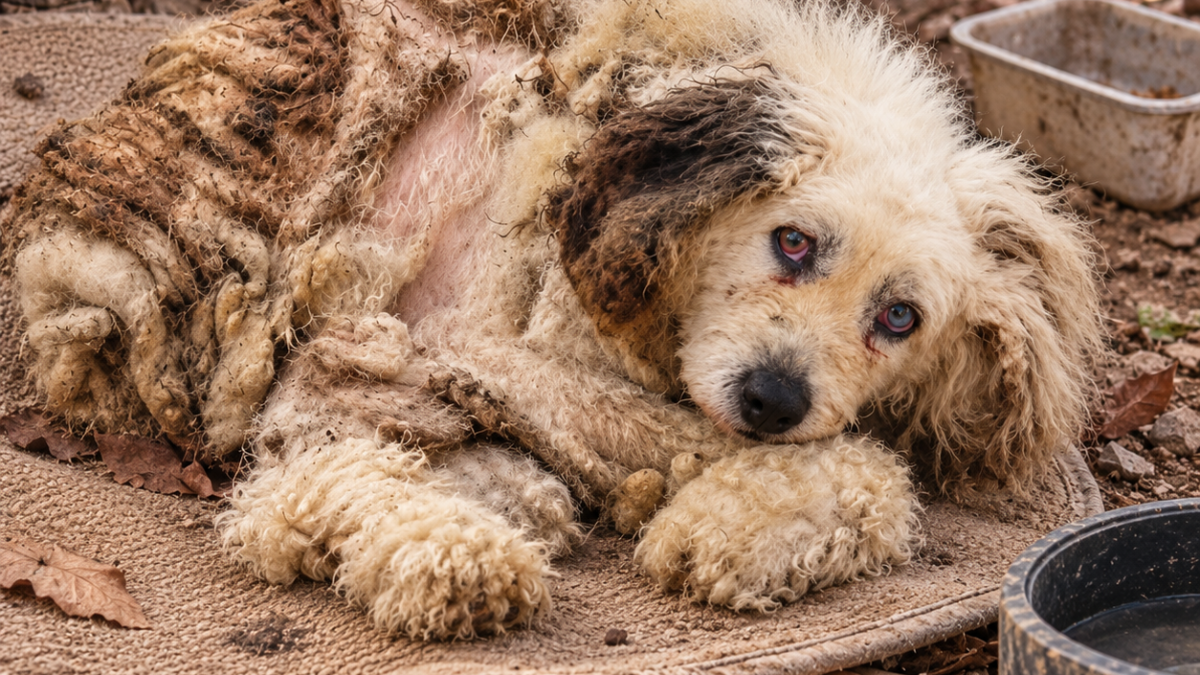
The little dog beside the broken shelter was still breathing, but when he looked at me, I saw nothing in his eyes that looked like hope.
A rusted chain ran from his collar into the frozen mud, and his coat had become so filthy and matted that I could barely tell where the fur ended and the dirt began.
What happened after we unclipped that chain would expose something none of us were prepared to find.
I had smelled the yard before I reached the gate.
Wet earth. Rotting food. Animal waste.
And underneath all of it, the heavy sour smell of fur that had been wet, dirty, and neglected for far too long.
“Is that him?” I asked.
The elderly man standing beside me nodded toward a small wooden shelter at the back of the property.
“There.”
At first I thought the dark shape beside it was an old blanket.
Then the shape lifted its head.
My stomach dropped.
The dog was chained beside the shelter, staring in our direction without barking. His eyes were an extraordinary blue, but there was no excitement in them. No curiosity. No warning.
Just exhaustion.
I had been involved in animal rescue long enough to recognize fear.
This was different.
This looked like a dog who had stopped believing that anything he did could change what happened next.
I crouched several feet away.
“Hey, buddy.”
His ears moved slightly.
That was all.
The chain between us was so short that his entire world could be measured in a few steps. Bare ground had been worn into a circle around the shelter where he had paced the same path again and again.
A dirty metal bowl sat near his front paws.
When I shifted closer, he immediately pulled the bowl toward himself.
Not aggressively.
Protectively.
As if that dented bowl was the only possession he trusted would still be there tomorrow.
The man behind me sighed.
“He always carries that thing into the doghouse.”
I turned.
“How long has he been chained here?”
The man looked away.
“A while.”
“How long?”
His wife answered from the porch.
“Years.”
I felt my hand tighten around the rescue lead.
Years.
Later, I would learn that Marin had once belonged to another family. They had loved him while he was small enough to hold easily, while he was convenient, while caring for him required very little sacrifice.
Then he grew.
Suddenly he was too large.
Too demanding.
Too much trouble.
So they gave him away.
The elderly couple who took him may have believed they were helping, but whatever their intentions had once been, the life in front of me was the result.
No regular walks.
No grooming.
No proper medical care.
Rain.
Snow.
Summer heat.
And a chain.
Year after year.
His coat had matted until it resembled armor. Thick ropes of hair were packed with mud and waste. Some mats were pulled so tightly against his skin that every movement had to hurt.
I noticed something else when he turned his head.
His teeth.
Several were worn unusually flat.
“What happened to those?” I asked.
Nobody answered.
I looked down at the chain.
Then I understood.
He had been chewing it.
Trying to escape.
For how long, I couldn’t imagine.
I moved slowly toward him and held out my hand.
Marin stared at it.
Then at me.
“You don’t have to trust me yet,” I whispered. “Just let me get you out of here.”
My partner knelt beside the attachment point.
The metal clip resisted at first.
Then—
Click.
The chain dropped.
For several seconds Marin didn’t move.
He looked behind himself.
Then forward.
Then behind himself again.
He took one careful step.
Nothing pulled him backward.
Another step.
Still nothing.
And suddenly the dog who had barely reacted to our arrival began running.
He made a wide circle across the yard.
Then another.
His matted coat bounced awkwardly around his body, and for the first time I saw something flicker behind those blue eyes.
Life.
“Look at him,” my partner whispered.
I was smiling until Marin abruptly stopped.
He turned.
Then he walked past us toward the elderly man’s car.
Marin stood beside the passenger door and waited.
My smile disappeared.
After everything that had happened to him, he still thought he belonged with the people who had kept him here.
He still believed family meant following them.
I clipped our rescue lead gently to his collar.
“No,” I whispered. “You’re coming with us.”
At the clinic, we began removing the first heavy sections of his coat.
Underneath them were sores.
Inflamed skin.
Old wounds.
Places where the mats had pulled against his body for so long that the skin beneath them had become raw.
Marin stood quietly while we worked.
Too quietly.
Then our veterinarian placed her stethoscope against his chest.
Her expression changed.
She listened again.
Longer this time.
Then she looked at me.
“I want imaging.”
Something in her voice made my stomach tighten.
“Why?”
She didn’t answer immediately.
Instead she rested one hand against Marin’s newly exposed shoulder.
“There’s something here I don’t like.”
And less than an hour after Marin’s chain finally hit the ground, we discovered that the years outside had hidden something far more dangerous than any of us could see.
[END OF FACEBOOK CAPTION]
[FIRST COMMENT / FULL STORY CONTINUATION]
I followed Dr. Rachel Bennett into the radiology room while Marin remained with one of our technicians.
“What do you mean, something you don’t like?” I asked.
Rachel pulled off one glove and tossed it into the trash.
“I’m not saying anything until I see the images.”
That was Rachel’s way.
She had worked emergency medicine before moving into rescue veterinary care, and she had learned not to frighten people with guesses.
But after twelve years of working beside her, I also knew her face.
Something had worried her.
Through the small window in the door, I could see Marin standing on a clean white towel.
Without the heaviest mats, he looked smaller than he had outside.
Much smaller.
The coat had created the illusion of a sturdy dog.
Underneath it was a narrow body with prominent ribs and thin muscles.
His blue eyes followed every person who crossed the room.
When the technician stepped away, Marin immediately searched for the dirty metal food bowl we had brought with him.
We had washed it, although the stains around the bottom refused to disappear.
“You really love that ugly thing, don’t you?” I murmured.
His tail moved once.
Barely.
But it moved.
Rachel returned twenty minutes later carrying the images on a tablet.
She shut the consultation room door behind us.
There were four shadows inside Marin’s chest.
Four.
For several seconds I stared at them without understanding what I was seeing.
Rachel enlarged the image.
“These are masses.”
I swallowed.
“Tumors?”
“Most likely.”
“How bad?”
“I don’t know yet.”
“Can we operate?”
“Maybe.”
That word hit me harder than no.
Maybe meant there was hope.
Maybe also meant there was a chance we were already too late.
Rachel pointed at the largest mass.
“This one concerns me most. We need blood work, ultrasound, possibly CT imaging, and we need samples before we make decisions.”
I stared through the glass at Marin.
He had curled up beside his bowl.
“They told me he’d always been healthy.”
Rachel looked at me.
“Healthy dogs don’t look like this.”
I knew what she meant.
His body was a record nobody could erase.
The skin infections.
The pressure sores.
The worn teeth.
The muscle loss.
The chain marks.
Years of untreated problems hidden beneath a coat nobody had bothered to touch.
And now four tumors.
I stepped into the hallway because I suddenly needed air.
My partner, Luis, followed me.
“What did they find?”
“Four masses.”
He closed his eyes.
“Damn.”
I leaned against the wall.
“He gets free today, and this is what he gets?”
Luis shook his head.
“No. This is what was already happening to him. Today is the first day somebody is doing something about it.”
I looked back through the window.
Marin raised his head.
He could see me.
And even though I had known him for only a few hours, he stood.
That was the moment I made him a promise.
I walked back into the room and crouched beside him.
“You hear me, blue eyes?”
His nose touched my wrist.
“We’re not quitting.”
His tail moved once more.
“You didn’t quit on yourself. So we’re not quitting on you.”
I had no idea then how expensive that promise would become.
Or how ugly the fight surrounding Marin was about to get.
Because by the following morning, the people who had kept him chained outside were no longer claiming they had done nothing wrong.
They were claiming Marin had never belonged to them at all.
And someone else was suddenly demanding him back.
My phone rang at 7:12 the next morning.
I was standing in my kitchen, halfway through pouring coffee.
It was our shelter director, Denise Parker.
“You need to come in.”
“What happened?”
“We received a call.”
“About Marin?”
“Yes.”
I set down the coffee.
“From who?”
“His original owner.”
That made no sense.
“The family who gave him away?”
“Apparently.”
“What do they want?”
There was a pause.
“Him.”
I almost laughed because the alternative was throwing the mug across the room.
“You’re joking.”
“I wish I were.”
Thirty minutes later, I walked into Denise’s office carrying the veterinary report.
She already had the phone records open.
The caller was a woman named Allison Reed.
She said Marin had originally belonged to her family.
According to her, they had temporarily placed him with her husband’s parents because of housing problems.
Temporarily.
That was not what the elderly couple had told us.
They had described Marin as a dog that had been given to them permanently after he became too large for Allison’s household.
Now Allison had a different story.
“She says she never surrendered ownership,” Denise told me.
“She left him chained outside for years.”
“She says she didn’t know.”
“How do you not know?”
Denise gave me a tired look.
“You know how these cases work.”
I did.
The minute consequences appeared, everybody became uninformed.
Nobody knew.
Nobody noticed.
Nobody understood.
The dog simply deteriorated by magic.
“Can she take him?” I asked.
“No. Not while the cruelty investigation is open.”
“Good.”
“But she’s threatening legal action.”
I looked at the veterinary report in my hand.
“Let her.”
Denise leaned back.
“Mara.”
“No. I’m serious. Let her take us to court. I want somebody to explain under oath how a dog becomes covered in years of mats while everyone who claims to love him somehow sees nothing.”
Denise studied me.
“You’re angry.”
“Yes.”
“Stay useful.”
That irritated me because she was right.
Anger can start a rescue.
Evidence finishes one.
So we started collecting evidence.
Photographs of the yard.
The chain.
The shelter.
Marin’s worn path through the dirt.
His teeth.
The mats.
His skin.
The veterinary findings.
The old food bowl.
Every detail mattered.
The county animal control officer assigned to the case was a quiet man named Paul Harris.
Paul had spent eighteen years investigating cruelty complaints.
When I met him at the property that afternoon, he didn’t say much.
He walked the perimeter.
Measured the chain.
Photographed the shelter.
Checked the empty water container.
Then he crouched beside the metal post Marin had been attached to.
There were marks around it where the chain had rubbed through layers of rust.
Paul touched one of the polished grooves.
“Metal doesn’t lie,” he said.
I looked at him.
“What do you mean?”
“This wasn’t occasional tethering.”
He pointed toward the arc carved into the dirt.
“The chain traveled the same path thousands of times.”
He measured from the post to the shelter.
Nine feet, eight inches.
That had been Marin’s world.
Less than ten feet in any direction.
Paul walked toward the wooden structure and shined a flashlight inside.
A few strands of filthy fur clung to the rough boards.
There was no bedding.
No blanket.
No raised floor.
The wood at the entrance had been chewed repeatedly.
“He chewed this too,” Paul said.
I crouched beside him.
Deep tooth marks scarred the lower frame.
“He was trying to get out of the shelter?”
“Or trying to cope.”
Paul photographed them.
Behind us, Harold Reed shifted impatiently.
“You’re making this look worse than it was.”
Paul stood.
“I’m photographing what is here.”
“He liked being outside.”
I turned before I could stop myself.
“Did he tell you that?”
Harold’s face hardened.
Paul glanced at me.
Stay useful.
I stepped back.
Harold crossed his arms.
“We’re old. We did our best.”
Paul looked at him.
“When did your best last include a veterinarian?”
No answer.
“A groomer?”
Nothing.
“Vaccinations?”
Silence.
“Flea prevention?”
Harold’s jaw moved.
“We fed him.”
Paul nodded slowly.
“I heard you the first time.”
Eleanor appeared on the porch.
She wore slippers despite the cold.
“We never beat him.”
Paul faced her.
“Neglect does not require hitting.”
She looked offended.
“He had food.”
“Did he have clean water every day?”
“Yes.”
Paul pointed toward the green plastic bucket we had photographed the day before.
The bottom contained a layer of dark ice, leaves, and algae.
“That water?”
Eleanor stared at it.
“It freezes in winter.”
Paul waited.
She realized what she had said.
“So you knew it froze.”
Her shoulders sagged.
I watched her face.
For the first time, I saw something other than defensiveness.
Shame.
But shame arrived years too late for Marin.
Before we left, Paul spoke to a neighbor named Mrs. Caldwell.
She lived two houses away.
The moment she heard why we were there, her expression changed.
“That dog.”
“You knew him?” Paul asked.
“I heard him.”
“When?”
“At night mostly.”
“Barking?”
She shook her head.
“Metal.”
I felt a chill unrelated to the weather.
“What kind of metal?”
She looked toward the empty post.
“That chain dragging.”
Mrs. Caldwell said that during storms she sometimes heard Marin pacing around the shelter.
Clink.
Scrape.
Clink.
Scrape.
Over and over.
One winter night, when temperatures fell below freezing, she had brought over an old blanket.
Harold refused it.
“He told me the dog would tear it apart.”
“Did you ever report your concerns?” Paul asked.
Her face changed.
“No.”
“Why?”
“I thought maybe I was overreacting.”
She looked at the shelter.
“I wish I had.”
That sentence followed me all the way back to the clinic.
I thought maybe I was overreacting.
How many animals lived inside that sentence?
How many children?
How many elderly people?
How many neighbors?
Sometimes terrible things continue not because nobody notices.
People notice.
They simply doubt their right to interfere.
Marin’s CT scan was scheduled for Thursday.
Until then, we focused on his skin.
Removing the coat took nearly three hours.
We could not simply shave everything at once because some mats were fused painfully close to inflamed skin.
Rachel sedated him lightly while we worked.
The pile of fur on the floor grew.
Dark gray.
Brown.
Almost black in places.
Mixed with dirt and debris.
When the final heavy section came away from his back legs, one of our technicians, Kayla, stopped moving.
She stared at what had been hidden underneath.
Then she quietly pulled off her mask and stepped away.
I followed her into the hallway.
She covered her mouth.
“I’m sorry.”
“You don’t have to apologize.”
“I’ve seen bad cases.”
“So have I.”
She wiped her eyes.
“There are places where the mats were cutting into him.”
“I know.”
“How could they not smell him?”
I had no answer.
Kayla stared at the treatment-room door.
“My dog wakes me up at two in the morning because she wants to steal my pillow.”
Despite everything, I smiled.
“She sounds terrible.”
“She is.”
Kayla laughed through tears.
“Last night I was annoyed at her.”
Then she looked back toward Marin.
“I’m never going to complain again.”
I put a hand on her shoulder.
“You will.”
She looked at me.
“And that’s okay. Loving an animal doesn’t mean you never get tired or frustrated.”
I nodded toward the treatment room.
“It means frustration doesn’t become abandonment.”
She wiped her face and went back inside.
When Marin’s last heavy mat was removed, he weighed nearly four pounds less than the number recorded at intake.
Four pounds of what we had thought was dog had been dirt, feces, debris, and dead hair.
The sight of him afterward was heartbreaking.
His legs looked too thin.
His body seemed fragile.
But when he woke fully, something strange happened.
He stood.
Shook himself.
Then froze.
He shook again.
His entire body seemed surprised by the movement.
Nothing pulled at his skin.
Nothing heavy swung from his sides.
He took two steps.
Then three.
I laughed.
“There you are.”
He looked at me.
I scratched gently behind his ear.
For the first time, Marin leaned into my hand.
Just slightly.
But he leaned.
That evening I took him into our fenced courtyard.
No chain.
No tether.
Just open grass enclosed safely by a six-foot fence.
He stood beside the door.
For almost a minute, he would not move.
I realized why.
Nobody had told him how far he was allowed to go.
His life had always come with an invisible border.
I took three steps onto the grass.
“Come on.”
Marin followed.
I went farther.
He followed again.
Then I stopped.
He looked at me.
I pointed toward the yard.
“You don’t need me to give you permission.”
He stayed where he was.
So I sat on the grass.
We waited.
Eventually Marin lowered his nose.
He sniffed one patch of grass.
Then another.
A gust of wind moved through the courtyard.
He raised his face.
His eyes closed.
Cars passed somewhere beyond the fence.
A child laughed from the sidewalk.
A delivery truck backed up.
Someone nearby was cooking meat.
Marin inhaled all of it.
Then he walked ten feet away from me.
Stopped.
Looked back.
I did nothing.
He took another step.
Then another.
Twenty feet.
Thirty.
Still nothing pulled him backward.
Suddenly he ran.
Not fast.
His weak muscles could not manage that yet.
But he ran.
He crossed the grass, turned awkwardly, and came back toward me.
Then he ran away again.
Luis appeared at the door.
“Is he—”
“Don’t move.”
We stood watching.
Marin made another lap.
Then another.
After years of tracing the same small circle around a metal post, his body was learning a new shape.
That night, something happened that I never forgot.
I had finished my shift and was about to leave when I heard scratching from Marin’s kennel.
He was awake.
His bowl was pressed against the door.
“You okay?”
I opened the kennel.
Instead of walking out, Marin grabbed the bowl.
He carried it past me.
Down the hall.
Into the recovery room.
Then he set it beside a folded blanket and lay down.
Luis watched from the nurse’s station.
“What’s he doing?”
I looked at Marin.
“I think he’s moving.”
Luis smiled.
“With his only piece of furniture?”
I laughed.
But the humor faded quickly.
That was exactly what Marin was doing.
All his life, his world could disappear without warning.
First family.
Second family.
Warm house.
Human attention.
Freedom.
The one thing that had always remained was that battered bowl.
So wherever he slept, the bowl came with him.
Possession had become safety.
We stopped trying to replace it.
We sanitized it.
Smoothed one sharp edge.
And let him keep it.
The CT results arrived the next morning.
Four tumors were confirmed.
Two appeared operable.
One was questionable.
The fourth was positioned dangerously close to major vessels.
Rachel called in a surgical specialist named Dr. Evan Cole.
He studied Marin’s scans for nearly an hour.
Finally he said, “I would stage this before we operate.”
“Meaning?”
“We need to know whether we’re dealing with cancer and whether it has spread.”
“How long?”
“If the pathology lab prioritizes it, maybe forty-eight hours.”
Maybe.
Again.
I was beginning to hate that word.
The samples were collected that afternoon.
Then came the waiting.
Marin didn’t understand waiting.
He was too busy discovering beds.
The first time we gave him a thick orthopedic bed, he walked around it three times.
Then lay on the floor beside it.
We lifted him gently onto the cushion.
He immediately stood.
Stepped off.
Lay on the floor again.
“Apparently luxury is suspicious,” Luis said.
It took four days before Marin finally climbed onto the bed by himself.
I found him there early Monday morning with his chin resting on the edge.
His bowl was beside him.
Of course.
“You figured it out.”
One blue eye opened.
“You like soft things.”
The eye closed.
I snapped one picture.
Not for social media.
Not for fundraising.
For me.
A dog sleeping.
That was all.
But sometimes rescue changes your definition of extraordinary.
The pathology report arrived that afternoon.
Three tumors appeared benign.
The fourth did not.
Rachel sat beside me when she explained.
“It’s malignant.”
I stared at the floor.
“What kind?”
“A soft tissue sarcoma.”
“Has it spread?”
“We don’t see obvious distant metastasis.”
“So surgery?”
“Yes.”
“Can Evan remove it?”
“He believes so.”
“Then do it.”
Rachel rested her hand on the report.
“Mara, because of the location, there are risks.”
“I know.”
“Bleeding. Complications. Recurrence.”
“I know.”
“And even if everything goes perfectly, we cannot promise how much time this gives him.”
I finally looked at her.
“He spent years with people deciding he wasn’t worth the inconvenience.”
Rachel said nothing.
“I’m not making that decision for him.”
She nodded.
“All right.”
The surgery was scheduled for Friday.
That should have been the hardest thing we dealt with that week.
It wasn’t.
Because Wednesday morning, Allison Reed arrived at our clinic with an attorney.
She wanted Marin.
Immediately.
I was coming from the treatment area when I heard voices in the lobby.
“I am his legal owner.”
Allison was in her late thirties, wearing a navy coat and holding a folder against her chest.
The man beside her introduced himself as Robert Kline, attorney.
Denise stood behind the reception desk.
“Marin is currently being held as evidence in an active animal welfare investigation.”
Allison’s face tightened.
“I never abused him.”
Denise remained calm.
“We did not say you did.”
“You’re keeping my dog.”
“The county issued the hold.”
Allison saw me.
“You.”
I stopped.
“You took him.”
“I helped remove him from the property.”
“My parents are elderly.”
“Your husband’s parents.”
She blinked.
“Yes.”
“And they say you gave Marin to them permanently.”
“That’s not true.”
“Then why did he stay there for years?”
Allison’s attorney stepped forward.
“I would advise everyone not to speculate.”
I looked at Allison.
“How often did you visit him?”
Her mouth opened.
Closed.
“How often?”
“That’s irrelevant.”
It was the wrong answer.
And judging from the expression on her attorney’s face, he knew it.
I walked closer.
“He had four tumors in his chest.”
Allison went still.
“One is malignant.”
Her face changed.
For the first time, the anger disappeared.
“What?”
“He needs surgery.”
She stared at me.
“Nobody told me.”
“You said you were his owner.”
The lobby became silent.
“If he was your dog,” I asked, “how did you not know?”
Her attorney said, “That’s enough.”
But Allison kept looking at me.
“He looked fine the last time I saw him.”
“When was that?”
No answer.
“When did you last touch him?”
Nothing.
“When did you last brush him?”
Nothing.
“Take him to a veterinarian?”
Still nothing.
Denise said my name quietly.
“Mara.”
I stopped.
Allison’s eyes were wet now, but I could not tell whether the tears came from guilt, anger, or humiliation.
“I loved that dog,” she whispered.
I believed her.
That was the disturbing part.
I believed she had loved him once.
But love that exists only while convenient does not keep an animal alive.
Her attorney gathered his papers.
“We’ll address this through the county.”
“Do that,” Denise replied.
As Allison turned toward the door, Marin appeared briefly through the glass partition behind the reception area.
He was being walked from treatment to recovery.
Allison froze.
“Marin.”
He heard the voice.
His head turned.
For one second, I wondered what he would do.
His ears lifted.
Allison moved toward the glass.
“Baby.”
Marin stared at her.
Then he looked toward Kayla, the technician holding his leash.
He pressed himself against Kayla’s leg.
Allison’s face collapsed.
I had expected satisfaction.
Some ugly part of me had imagined enjoying that moment.
I didn’t.
It was simply sad.
A woman stood ten feet from a dog she claimed to love, and the years between them had become wider than the room.
Kayla guided Marin away.
Allison whispered, “He remembers me.”
Nobody answered.
Maybe he did.
Memory and trust are not the same thing.
That night, I searched the rescue’s intake archives.
I wanted to understand exactly how Marin had disappeared between families without anyone intervening.
There were no previous complaints attached to his microchip.
No grooming records.
No veterinary history for nearly six years.
Then I found one old vaccination record.
Marin at fourteen months.
Weight: thirty-seven pounds.
Condition: healthy.
Owner: Allison Reed.
There was a tiny photograph attached.
I opened it.
I hardly recognized him.
Clean white-and-gray fur.
Bright blue eyes.
A red collar.
His mouth open in what looked almost like a grin.
The record included one note from the veterinarian:
Friendly, energetic dog. Owner advised daily exercise and regular brushing due to coat type.
I read that line three times.
Daily exercise.
Regular brushing.
Simple things.
Ordinary things.
Things that would later disappear completely.
I printed the record and placed it in our evidence folder.
Not because being loved once excused what happened later.
Because it proved something important.
Marin had not always been difficult.
He had not always been sick.
Neglect had happened gradually.
One missed grooming.
One skipped walk.
One winter outside.
One month without veterinary care.
Then another.
And another.
People imagine cruelty arriving as one dramatic decision.
Often it arrives as a thousand small decisions nobody corrects.
Friday morning arrived gray and cold.
Marin was scheduled for surgery at 8:00.
I reached the clinic at 6:15.
He was awake.
When I opened his kennel, he picked up his bowl.
“No.”
He stared at me.
“You cannot take that into surgery.”
He tightened his grip.
I sighed.
“We are actually arguing about this today?”
His tail moved.
“All right. Bring it to pre-op.”
He walked beside me carrying the ridiculous bowl.
Luis laughed when he saw us.
“Emotional support cookware?”
“Apparently.”
We placed it beside his bed while the nurses prepared him.
Rachel checked his heart.
Dr. Cole reviewed the surgical plan.
Blood was cross-matched in case he needed a transfusion.
The room became increasingly clinical.
Numbers.
Dosages.
Monitors.
Consent forms.
Risk percentages.
But Marin knew none of that.
He only knew there were people touching him.
And for the first time since we rescued him, he became frightened.
When the nurse reached for his leg to place the IV catheter, Marin pulled back.
Not aggressively.
He simply tried to make himself smaller.
I sat on the floor.
“Hey.”
His eyes found mine.
“You’re okay.”
He came toward me.
The nurse waited.
Marin pressed his shoulder against my knee.
I rubbed his chest.
“We need to let them help you.”
His breathing slowed.
The catheter went in.
He didn’t fight.
Before they took him through the surgical doors, I crouched.
Marin pressed his forehead against my chest.
I froze.
He had never done that before.
Slowly, I wrapped my arms around him.
“You come back.”
His breathing was warm against my neck.
“You hear me?”
Rachel stood behind us.
“He’ll be watched every second.”
I kissed the top of his head.
“You have places you haven’t smelled yet.”
Then they took him away.
The surgery lasted four hours and seventeen minutes.
I know because I watched every minute.
At 8:34, Rachel sent word that the first mass had been removed.
At 9:21, the second.
At 10:03, they began working near the malignant tumor.
At 10:47, nobody came out with an update.
At 11:02, still nothing.
By 11:20, my imagination had created every possible disaster.
I walked the hallway.
Sat down.
Stood up again.
Luis finally grabbed my shoulders.
“You need to stop.”
“I can’t.”
“You’re going to wear through the floor.”
“That would make two of us.”
He knew immediately what I meant.
Marin’s circle of dirt.
Luis’s expression softened.
“He’s not out there anymore.”
I looked toward the surgical doors.
“I know.”
“He has a whole team in there.”
“I know.”
“He’s not fighting alone.”
That finally made me sit.
At 12:23, Dr. Cole came through the door.
He removed his surgical cap.
My legs felt weak.
“Well?”
“We got it.”
I stared at him.
“All of it?”
“The margins look good.”
“What about the bleeding?”
“Controlled.”
“His heart?”
“Stable.”
“He’s okay?”
“He lost some blood, but yes.”
I hugged him.
I didn’t ask permission.
Later I apologized.
He laughed.
“You rescue people are intense.”
“You have no idea.”
When Marin woke, he was groggy.
His chest was bandaged.
His eyes struggled to focus.
I sat beside him.
“Hey.”
One blue eye found me.
Then the other.
His head shifted weakly.
He was searching.
I knew what he wanted.
I placed the old bowl where he could see it.
His nose touched the rim.
Then his eyes closed.
He slept.
That first night after surgery was difficult.
At 1:17 in the morning, Marin’s blood pressure dropped.
Rachel called me even though I had gone home only two hours earlier.
I drove back wearing sweatpants and two different socks.
When I arrived, Rachel was adjusting fluids.
“He’s stable again.”
“What happened?”
“Could be anesthesia. Could be blood loss. We’re watching him.”
Marin lay beneath a warming blanket.
I sat beside him.
For the next three hours, I listened to the monitor.
Beep.
Beep.
Beep.
Every sound became a promise.
At 3:42, Marin lifted his head.
I leaned forward.
“What?”
He looked toward the floor.
His bowl had been moved during the emergency.
“Oh.”
I picked it up and placed it beside him.
His head lowered again.
Rachel watched me.
“You know that thing belongs in a museum now.”
“No.”
“Why?”
“He’d break into the museum.”
She laughed quietly.
At dawn, Marin’s blood pressure was normal.
By afternoon, he ate three bites of chicken.
The next day, five.
On Sunday morning, he stood.
His legs trembled.
I held the support sling beneath his chest.
He took one step.
Then another.
Four steps later, he stopped.
I expected him to lie down.
Instead, he turned toward the door.
“You want outside?”
His tail moved.
We took him into the courtyard.
The morning was cold.
Marin stood in the grass for less than a minute.
Then he lifted his face toward the sun.
I started crying.
Luis noticed.
“Seriously?”
“Shut up.”
“He’s standing.”
“I know.”
“That’s generally what dogs do.”
“You are a terrible person.”
Marin looked between us.
Then, very slowly, his tail began wagging.
The legal hearing took place three weeks later.
By then Marin could walk comfortably.
His skin had improved.
Short new fur covered many of the bare patches.
He had gained six pounds.
He had also discovered roasted chicken, fleece blankets, and the fact that Luis could be manipulated into sharing half his lunch simply by staring at him.
The county’s evidence file had grown thick.
Photographs.
Veterinary records.
Neighbor statements.
Microchip records.
The original adoption documents.
Weather records showing several periods of extreme cold during the years Marin remained tethered outside.
The hearing room was small.
Harold sat beside Eleanor.
Allison sat behind them with her attorney.
I was there as a witness.
Paul Harris presented the evidence.
Photographs appeared on the monitor.
The chain.
The shelter.
The yard.
The mats.
Then Marin.
The image taken before we touched him filled the screen.
I heard Eleanor inhale sharply.
Perhaps she had never seen him from the outside.
That happens more than people realize.
Neglect becomes normal when you look at it every day.
The hearing officer asked Harold, “Did you believe this animal was receiving adequate care?”
Harold shifted in his chair.
“He ate every day.”
“Did you groom him?”
“No.”
“Seek veterinary treatment?”
“No.”
“Provide exercise?”
“He had the yard.”
“While tethered?”
“Yes.”
The officer looked at the photograph again.
“Do you consider the length of that chain to constitute adequate exercise?”
Harold did not answer.
Eleanor began crying.
“I couldn’t manage him.”
The officer looked at her.
“Then why didn’t you ask for help?”
Nobody spoke.
That question hung in the room.
Why didn’t you ask for help?
There were rescues.
Shelters.
Veterinarians.
Neighbors.
Family members.
Animal control.
Countless options.
Nobody had demanded perfection.
Only action.
Paul then called Mrs. Caldwell.
She appeared nervous.
Her hands shook when she took the seat.
“Did you hear Marin at night?” Paul asked.
“Yes.”
“What did you hear?”
“The chain.”
She swallowed.
“Especially when the weather was bad.”
“What would happen?”
“He would pace.”
“For how long?”
“Sometimes hours.”
Harold looked at her.
“You never said anything.”
Mrs. Caldwell turned toward him.
“I brought you a blanket.”
“That’s not what I mean.”
“I asked whether he could come into your garage during the freeze.”
Harold looked away.
The hearing officer interrupted.
“What was Mr. Reed’s response?”
Mrs. Caldwell hesitated.
“He said the dog smelled too bad to bring inside.”
Nobody moved.
I felt something cold move through me.
That sentence changed the room.
Because it destroyed the last believable claim of ignorance.
They knew Marin smelled.
They knew his coat was filthy.
They knew the weather was dangerous.
They simply decided the inconvenience mattered more.
Allison testified next.
Her attorney tried to establish that Marin had been permanently transferred to Harold and Eleanor.
Then Paul produced the microchip records.
Two renewals.
Both paid with Allison’s credit card.
The hearing officer looked at her.
“If Marin was no longer your dog, why did you repeatedly renew registration identifying yourself as his owner?”
Allison stared at the document.
“I forgot.”
“You forgot twice?”
“I just wanted the information current.”
“Why?”
“In case he got lost.”
That answer destroyed the argument better than anything I could have said.
If she cared whether Marin became lost, she knew he still existed.
She knew where he lived.
She had simply chosen not to look closely at how.
Paul then produced the vaccination record I had found.
A photograph of young Marin appeared beside the current intake image.
The contrast was brutal.
Healthy dog.
Neglected dog.
Same blue eyes.
The hearing officer looked at Allison.
“When this photograph was taken, where did Marin live?”
“With me.”
“Inside?”
“Yes.”
“Was he house-trained?”
“Yes.”
“Was he aggressive?”
“No.”
“Destructive?”
“Sometimes.”
“How?”
“He chewed things when he was bored.”
The hearing officer paused.
“Did your veterinarian recommend exercise?”
Allison stared at the document.
“Yes.”
“And when he became difficult to manage?”
“We sent him to my in-laws.”
“Did you provide money for veterinary care?”
“No.”
“Grooming?”
“No.”
“Food?”
“Sometimes.”
“When did you last physically see Marin before his removal?”
Allison whispered, “About eighteen months earlier.”
“And what condition was his coat in?”
“It was long.”
“Matted?”
“I don’t know.”
“Was he chained?”
“Yes.”
“Did you ask how often he was released?”
“No.”
“Did you ask about veterinary care?”
“No.”
“Why not?”
Allison began to cry.
“I thought they were taking care of him.”
The officer nodded slowly.
“That belief does not appear to have been verified.”
When it was my turn, I described the removal.
The odor.
The mats.
The worn teeth.
The bowl.
Then I described what happened when the chain came off.
The officer asked, “What did Marin do?”
“He ran.”
“For how long?”
“Maybe thirty seconds.”
“And then?”
I looked toward Harold.
“He went to their car.”
Harold lowered his eyes.
“He stood beside it waiting to leave with them.”
Eleanor covered her mouth.
The hearing officer was quiet.
I continued.
“He did not hate them.”
That surprised everyone.
Maybe because they expected anger from me.
I had plenty.
But this mattered more.
“He didn’t understand that they had failed him. He still trusted them enough to follow them.”
My voice shook.
“That is why animals like Marin need people willing to intervene. They cannot understand ownership disputes. They cannot gather medical records. They cannot call a veterinarian. They cannot decide that the people they love no longer deserve control over their lives.”
Nobody spoke for several seconds.
Then Harold said something from across the room.
“He was my dog too.”
Everyone turned.
His attorney touched his arm, but Harold continued.
“I fed him every morning.”
I looked at him.
His face was red.
“I talked to him.”
Eleanor began crying harder.
Harold looked toward the photograph.
“I know you all think I hated him.”
His voice cracked.
“I didn’t.”
For the first time, my anger shifted.
Not disappeared.
Shifted.
Because I believed him too.
And that was what made the case complicated.
Cruelty does not always come from hatred.
Sometimes it comes from selfishness.
Denial.
Laziness.
Pride.
People can feel affection for an animal while still failing it catastrophically.
The hearing officer spoke quietly.
“Mr. Reed, affection is not the issue before this court. Care is.”
Harold lowered his head.
That sentence ended the argument.
The ruling came that afternoon.
Marin would not be returned.
Permanent ownership was transferred to the rescue pending adoption.
Harold and Eleanor were prohibited from acquiring another dog during the court-ordered period and assessed penalties, veterinary reimbursement obligations, and compliance requirements.
Allison relinquished any ownership claim as part of a separate agreement.
There was no dramatic prison sentence.
No shouting judge.
No cinematic revenge.
What happened was quieter.
And better.
They lost the right to decide Marin’s future.
For the first time, his future belonged to people required to put his welfare first.
Outside the courthouse, Allison approached me.
I expected an argument.
Instead she handed me an envelope.
“What’s this?”
“Some of his records.”
I opened it.
Inside were puppy photographs.
Marin at perhaps ten weeks old.
Marin sleeping on a couch.
Marin wearing a red bandanna.
Marin in the arms of a young boy.
In every picture, he was clean.
Loved.
Inside a house.
One photograph showed him asleep beneath a Christmas tree.
Another showed him riding in the back seat of a car, nose pressed to the glass.
I looked at Allison.
“What happened?”
She wiped her face.
“We had twins.”
I waited.
“My husband lost his job. We moved. Marin got bigger. He knocked things over. He barked. My in-laws had property.”
Her voice cracked.
“At first I visited.”
“And then?”
“Less.”
“Why?”
She looked toward the parking lot.
“Because every time I visited, I felt guilty.”
I said nothing.
“At first he was inside their house sometimes.”
She wiped her cheek.
“Then they said he tracked mud in. Then Eleanor said she couldn’t handle the hair. Then Harold put up the shelter.”
“When did the chain start?”
“I don’t know.”
“You saw it.”
“Yes.”
“And left.”
“Yes.”
Her answer was barely audible.
“Why?”
She closed her eyes.
“Because if I admitted it was wrong, I would have had to do something.”
There it was.
Not ignorance.
Avoidance.
I thought about all the times people say they had no choice when what they really mean is every available choice required sacrifice.
I looked at the puppy photograph again.
“He waited beside their car when we freed him.”
Allison’s face crumpled.
“I know.”
“You know?”
“Eleanor told me.”
I wanted to hurt her with words.
I wanted to tell her every horrible detail again.
Then she said something that stopped me.
“I kept telling myself he was fine because if he was fine, then I wasn’t the person who abandoned him.”
The parking lot seemed suddenly very quiet.
“That doesn’t make what happened smaller,” I said.
“I know.”
“It doesn’t make the tumors disappear.”
“I know.”
“It doesn’t give him those years back.”
“I know.”
Her voice broke on the last word.
I handed the envelope back.
“Keep these.”
She shook her head.
“No.”
“He may have a new family someday.”
“That’s why I brought them.”
I looked at her.
“They should know he was loved once.”
I almost said love would have gone back for him.
But I didn’t.
Instead I took the envelope.
“They’ll know he was a puppy once.”
That was the most generous sentence I had.
Allison nodded.
Before leaving, she asked, “Is he going to live?”
“We think so.”
Her face crumpled.
“Tell him I’m sorry.”
I looked toward the courthouse doors.
“He doesn’t need an apology he can’t understand.”
She swallowed.
“What does he need?”
“Nothing from you now.”
She nodded once.
Then walked away.
Marin’s surgical pathology came back with clean margins.
Rachel carried the report into the recovery room like she had won the lottery.
“Where is my favorite difficult patient?”
Marin was lying beside my desk.
He raised his head.
“Cancer removed,” she announced.
I stood so quickly my chair hit the wall.
“Clean?”
“Clean.”
“Completely?”
“As far as the pathology can tell, yes.”
I hugged her.
Again.
She laughed.
“Your boundaries are terrible.”
“Are we celebrating or filing an HR complaint?”
“Celebrating.”
Luis appeared from the hallway.
“What happened?”
“Clean margins!”
He shouted so loudly Marin jumped.
“Sorry, buddy!”
Within ten minutes half the staff had gathered around him.
Somebody brought chicken.
Somebody else brought a new blue blanket.
Marin accepted the chicken.
Ignored the blanket.
Then picked up his old food bowl and carried it beneath my desk.
Of course.
That night I stayed late.
The clinic became quiet after seven.
Rain tapped against the windows.
Marin slept beside my chair.
I looked at the photograph from the day we found him.
Then at the dog lying beside me now.
They hardly looked like the same animal.
His coat was coming back.
His body was stronger.
His eyes were brighter.
But healing is not a straight line.
Sometimes he still panicked if a leash tightened unexpectedly.
Sometimes metal sounds made him freeze.
One afternoon, a maintenance worker dropped a length of chain outside the storage room.
The sound echoed through the hallway.
Marin hit the floor.
Flat.
His legs tucked beneath him.
His eyes went wide.
I ran toward him.
“Marin.”
He wouldn’t move.
The chain rattled again.
His body started shaking.
I looked at the worker.
“Please stop.”
He immediately stepped back.
I sat on the floor several feet from Marin.
I didn’t touch him.
For almost ten minutes, we stayed there.
His breathing slowly changed.
Finally he crawled toward me.
Not walked.
Crawled.
He pressed himself against my legs.
I put one hand on his shoulder.
“You’re not there.”
His eyes stayed fixed on the storage-room door.
“You’re here.”
I don’t know whether he understood the words.
But eventually his muscles relaxed.
The next day, we began working gently on the sound.
Not chains.
Never that.
We used soft metal objects at a distance.
Keys.
A bowl.
A leash clasp.
Sound.
Treat.
Sound.
Treat.
Over weeks, the panic faded.
Not vanished.
Faded.
That distinction mattered.
We were not erasing his past.
We were teaching his body that the present was different.
For the first month, he also refused to enter any narrow outdoor shelter.
He would sleep beneath tables.
Behind chairs.
Beside doors.
Anywhere except inside something resembling the box he had been chained beside.
We never forced him.
Trust cannot be dragged into existence.
You wait.
You repeat kindness.
And eventually the animal decides to risk believing you.
The breakthrough came on a rainy Tuesday.
I had taken Marin home as an overnight foster because the clinic kennels were full.
My apartment was small.
I expected him to be nervous.
Instead he walked inside, surveyed the living room, and immediately stole one of my socks.
“Seriously?”
He carried it under the dining table.
“Marin.”
His tail wagged.
“That is theft.”
He placed one paw over the sock.
I stared at him.
He stared at me.
For the first time, I saw mischief in his eyes.
Not survival.
Not caution.
Mischief.
I laughed so hard I had to sit down.
That night, I put his bed beside my couch.
He ignored it.
Of course.
At midnight, he was still lying on the floor.
At 2:00 a.m., I woke to a strange weight against my leg.
Marin had climbed onto the couch.
Slowly.
Quietly.
He lay curled at the far end, as though afraid I might notice and send him away.
I stayed perfectly still.
At 2:17, he moved closer.
At 2:31, his head rested against my ankle.
By morning, half his body was on top of me.
I opened my eyes.
He was staring at me.
“Good morning.”
His tail thumped against the couch.
Then I remembered Allison’s photograph.
Marin asleep beneath a Christmas tree.
For years, he had known couches.
Warm rooms.
Human voices.
Then all of it had disappeared.
Maybe that was why this mattered so much.
He wasn’t discovering comfort for the first time.
Somewhere inside him, he was remembering it.
We began accepting adoption applications six weeks later.
There were sixty-three in four days.
His story had spread locally through rescue networks and news coverage from the court case.
Everybody wanted the blue-eyed dog.
That worried me.
People often fall in love with a story before they understand the animal inside it.
Marin was not a symbol.
He was a dog.
A stubborn one.
He hated vacuum cleaners.
He stole oven mitts.
He guarded his old food bowl if strangers moved too quickly toward it.
He needed continued veterinary monitoring.
He was uncomfortable around chaotic groups.
And despite everything, he had a ridiculous habit of leaning his entire body against anyone who scratched the right side of his neck.
We rejected dozens of applications.
Not because the people were bad.
Because they were wrong for him.
One family had three young dogs already.
Too chaotic.
Another planned to keep him primarily outdoors.
Immediate no.
One woman wanted him because his blue eyes would “look incredible on Instagram.”
Denise closed that application before finishing the sentence.
Then I opened one from a man named Thomas Avery.
Fifty-eight.
Widowed.
Worked from home repairing antique clocks.
Owned a small house with a fenced backyard.
No other pets.
No children in the home.
Veterinary references from a dog he had cared for for fourteen years.
His previous dog, Murphy, had died of kidney disease eight months earlier.
There was one sentence on the application that made me stop.
Under Why are you interested in Marin? Thomas had written:
I don’t need him to become a different dog. I have enough time to learn who he already is.
I read it twice.
Then I called him.
Thomas arrived the next afternoon wearing work boots and an old canvas jacket.
He did not kneel dramatically.
Did not reach for Marin.
Did not baby-talk him.
He sat sideways on the floor six feet away.
Marin stared.
Thomas stared at the wall.
Five minutes passed.
Ten.
Finally Marin approached.
He sniffed Thomas’s boot.
Thomas remained still.
Marin sniffed his sleeve.
Then walked away.
Thomas smiled.
“Good meeting.”
I laughed.
“That’s it?”
“He said hello.”
“You got that from two sniffs?”
“He didn’t leave the room.”
Fair point.
Before Thomas left, I asked why he had chosen Marin.
He hesitated.
“My wife died three years ago.”
“I’m sorry.”
“She loved difficult dogs.”
I smiled.
“Marin isn’t difficult.”
“No.”
Thomas looked through the glass at him.
“He’s careful.”
That word stayed with me.
Careful.
Not damaged.
Not broken.
Not difficult.
Careful.
Thomas understood something many applicants did not.
Behavior was communication.
Marin was not withholding affection.
He was checking whether affection was safe.
Thomas returned three more times.
During the second visit, he brought no treats.
“I thought you wanted him to like you,” I said.
“I do.”
“Food helps.”
“I don’t want every good thing between us to come from my pocket.”
I stared at him.
“That’s annoyingly sensible.”
He smiled.
During the third visit, Marin sat beside him.
No touching.
Just beside him.
Thomas spent forty minutes reading a newspaper while Marin listened to the pages turn.
During the fourth visit, Marin rested his chin on Thomas’s knee.
Thomas’s eyes filled with tears.
He didn’t touch him immediately.
He waited.
Marin pushed harder.
Then Thomas placed one hand gently on his shoulder.
“Well,” he whispered, “I suppose that settles something.”
I watched from the doorway.
And something uncomfortable moved through my chest.
Because I knew what was coming.
I had spent weeks telling myself Marin was not mine.
I worked in rescue.
Dogs came through.
Dogs healed.
Dogs left.
That was the job.
But Marin had started sleeping beside my desk.
He followed me to the break room.
He knew the sound of my car.
When I arrived each morning, his tail hit the kennel wall before I entered the room.
I loved him.
There was no useful reason to pretend otherwise.
Luis found me later sitting beside Marin.
“You’re going to cry when he goes.”
“No.”
“You cried when someone replaced the coffee machine.”
“The new machine was terrible.”
“You’re going to cry.”
I looked down.
Marin had his paw across my shoe.
“Probably.”
Luis sat beside me.
“You could adopt him.”
I had thought about it.
Of course I had.
But my apartment was small.
My schedule was unpredictable.
I fostered emergency animals regularly.
Thomas could give Marin something I could not.
Consistency.
A quiet house.
A yard.
One person with time.
Love is not always keeping.
Sometimes love is choosing the place where someone else will thrive.
I hated that lesson.
But I knew it was true.
The home visit confirmed what I already suspected.
Thomas’s house was perfect.
Not fancy.
Perfect.
The backyard was enclosed with a six-foot wooden fence.
There was grass.
A maple tree.
A covered porch.
Inside, Thomas had placed a dog bed near his workbench.
Not hidden away.
Right beside him.
I pointed at it.
“You already bought that?”
Thomas looked embarrassed.
“I can return it.”
“No.”
He smiled.
His workshop fascinated me.
Dozens of clocks covered the walls.
Tall clocks.
Small clocks.
Brass clocks.
Wooden clocks.
Every few seconds another tick answered from somewhere else in the room.
“What if the noise bothers him?” I asked.
“Then I move the clocks.”
I looked at him.
“All of them?”
“Yes.”
There must have been forty.
“Thomas, this is your business.”
He shrugged.
“Then I work in the garage.”
That answer mattered.
Not because Marin would necessarily need it.
Because Thomas’s first instinct was adaptation.
Not removal.
On the kitchen floor were two stainless-steel bowls.
I stared at them.
Thomas noticed.
“Wrong kind?”
“No.”
I thought about Marin’s battered bowl.
“He has his own.”
“Bring it.”
“It’s disgusting.”
“Then he’ll feel at home.”
I laughed.
That was when I knew.
We scheduled a trial weekend before finalizing the adoption.
I drove Marin to Thomas’s house on Friday afternoon.
Marin hesitated at the front door.
Thomas opened it and stepped aside.
No pulling.
No calling.
No pressure.
After almost a minute, Marin walked inside.
He explored the living room.
Kitchen.
Hallway.
Then he found the workshop.
The clocks were ticking.
Marin froze.
My heart jumped.
Thomas watched him.
Marin tilted his head.
Tick.
Tick.
Tick.
Then he walked toward a grandfather clock and sniffed the base.
Thomas smiled.
“I guess they can stay.”
For the first hour, Marin followed me.
Everywhere.
When I moved toward the door, he stood.
When I sat, he lay beside my chair.
Thomas noticed.
“He thinks he’s leaving with you.”
“Probably.”
“What should I do?”
“Nothing.”
Thomas nodded.
I stayed for two hours.
Then came the hard part.
I clipped Marin’s leash on and walked him into the backyard.
Thomas came with us.
I handed him the leash.
Marin immediately looked at me.
My throat tightened.
I stepped toward the gate.
Marin tried to follow.
Thomas did not restrain him sharply.
He simply walked with him.
I crouched.
“You stay.”
Marin stared at me.
Thomas whispered, “Take your time.”
I rubbed Marin’s ears.
“You’re safe.”
Then I left.
I made it to my car before crying.
Luis called twenty minutes later.
“You leave him?”
“Yes.”
“How bad?”
“I hate you.”
“So pretty bad.”
I drove home.
At 7:14, Thomas sent a photograph.
Marin was lying beneath the workbench.
At 8:03, another.
He had eaten dinner.
At 9:22, another.
Marin was asleep.
His old bowl beside him.
Then Thomas sent one final message.
He checked the front door three times. I sat with him each time. He’s sleeping now. I’ll stay downstairs tonight.
I stared at the screen.
That man was going to get my dog.
Not my dog.
Marin.
I had to keep reminding myself.
Sunday afternoon, I returned.
Thomas opened the front door.
Marin came running.
He almost knocked me over.
I dropped to my knees.
“Hey! Hey!”
His whole body shook with excitement.
Thomas stood in the hallway smiling.
I buried my face in Marin’s neck.
Then I noticed something.
He smelled faintly like cedar.
Not dirt.
Not infection.
Not antiseptic.
Cedar.
Thomas’s house.
He already smelled like home.
“How did he do?” I asked.
Thomas handed me a page.
It contained notes.
Meal times.
Bathroom breaks.
How long Marin slept.
What noises bothered him.
Which treats he preferred.
At 2:10 a.m. Saturday, Marin had paced near the door.
Thomas took him outside.
Marin circled the yard, returned inside, and slept beside Thomas’s chair.
“You wrote everything down.”
“I figured you’d ask.”
I looked at him.
“Thomas.”
“Yes?”
“Do you want to adopt him?”
His eyes immediately filled.
“I thought that was why I was doing all this.”
“I need you to say it.”
He looked down at Marin.
“Yes.”
His voice shook.
“I want him.”
Marin leaned against his leg.
Thomas placed his hand on his back.
“And I’m pretty sure I need him too.”
Adoption day arrived on a bright Saturday in March.
Thomas signed the final documents.
Marin wore a blue collar.
His coat had grown back in soft waves.
Most of the scars were hidden now.
His eyes were still the same impossible blue.
Luis carried Marin’s bed to Thomas’s truck.
I carried the old bowl.
When I placed it in the back seat, Thomas said, “That important?”
“More than you know.”
Marin stood beside me.
I knelt.
This was the part I hated.
“Okay, blue eyes.”
His tail moved.
“You’re going home.”
He licked my chin.
I laughed and immediately started crying.
Luis, naturally, witnessed everything.
“I knew it.”
“Shut up, Luis.”
Thomas waited several feet away.
He understood.
I held Marin’s face gently.
“Your world used to be the length of a chain.”
He looked at me.
“But look at you now.”
He leaned into my chest.
“You have a whole house.”
My voice broke.
“A yard.”
Marin licked my cheek.
“A man who already loves you.”
Thomas looked away to give me privacy.
“And no one is ever chaining you outside again.”
I kissed his head.
“You understand me?”
Obviously he didn’t.
But maybe some promises are worth saying anyway.
Thomas opened the truck door.
Marin walked toward it.
Then stopped.
He looked back at me.
My heart cracked.
“Go.”
He stayed.
“Marin.”
I pointed toward Thomas.
“Go home.”
Thomas crouched beside the truck.
Marin looked between us.
Then walked toward him.
Thomas helped him into the back seat.
Marin immediately found his battered bowl.
He lay beside it.
Thomas closed the door.
I stood in the parking lot as the truck disappeared.
Luis put an arm around my shoulder.
“He’s okay.”
“I know.”
“That’s the goal.”
“I know.”
“You’re still crying.”
“Stop talking.”
Thomas sent me a picture that evening.
Marin was asleep on the new bed beside his workbench.
The old bowl sat inches from his nose.
The message underneath said:
He finally used the bed. I think I passed probation.
I laughed so hard I cried again.
Over the next several months, the pictures continued.
Marin asleep beneath the maple tree.
Marin standing in the kitchen waiting for chicken.
Marin riding in the back seat with his head near the window.
Marin stretched across Thomas’s couch as though he had made up for years of forbidden furniture in a single afternoon.
There were setbacks too.
One morning, Thomas called me.
“He won’t come inside.”
“What happened?”
“A utility worker came into the yard.”
“Did he carry anything?”
“A metal cable.”
I closed my eyes.
“Where is Marin?”
“Under the porch.”
“Don’t drag him out.”
“I won’t.”
“Sit near him. Don’t block his escape.”
Thomas did exactly that.
For forty-five minutes, he sat on the grass.
Eventually Marin crawled out.
He went straight to Thomas.
A week later, another utility worker arrived.
Thomas asked him to leave the equipment outside the fence.
Marin watched from the porch.
No panic.
A month after that, Marin slept through the sound of a truck unloading pipes across the street.
Healing.
Not a straight line.
But movement.
Then came the picture that mattered most.
A simple photograph.
Marin standing in the backyard.
No collar attached to a chain.
No shelter behind him.
No worn circle of dirt beneath his feet.
Nothing holding him.
Thomas had opened the back door.
Marin could choose where to go.
And he was standing in sunlight.
I saved that picture.
Six months after the adoption, we held a small fundraiser at the clinic.
Thomas brought Marin.
The moment he entered the lobby, Marin saw me.
He ran.
Not in circles this time.
Straight toward me.
I dropped to my knees.
He hit me hard enough to knock me backward.
I wrapped both arms around him.
“You remember me?”
His entire rear end was moving.
Thomas laughed.
“I would say yes.”
Marin kissed my face until I could barely breathe.
When he finally calmed down, I noticed something hanging from Thomas’s hand.
The old food bowl.
“You brought it?”
“He sleeps with it.”
I shook my head.
“Still?”
Thomas smiled.
“Every night.”
I ran my fingers along the dented rim.
That bowl had once been the only thing Marin possessed.
His entire kingdom had consisted of a dirty shelter, a chain, and this piece of metal.
Now the bowl sat in a house where he had beds in three rooms.
Thomas had even installed a small dog door leading into the fenced yard.
Marin could go outside whenever he wanted.
The first week, Thomas told me, Marin had repeatedly walked through the dog door, circled the yard, and returned inside.
Out.
In.
Out.
In.
As if checking whether the freedom would still be there each time.
Eventually he stopped checking.
That detail stayed with me.
Because that is what safety does.
At first you test it.
Again and again.
You wait for the old pain to return.
Then one day you realize nobody is pulling you backward.
A year after Marin’s rescue, Rachel performed another full scan.
I drove to the clinic even though Marin was no longer my responsibility.
Thomas understood why.
We waited together.
Marin sat between us.
His old bowl was not there because Thomas had finally convinced him that veterinary appointments did not require luggage.
Rachel entered holding the results.
I stood.
Thomas did too.
She smiled.
“No recurrence.”
I covered my mouth.
Thomas closed his eyes.
“No new masses?”
“No.”
“Nothing?”
“Nothing concerning.”
Thomas bent and hugged Marin.
I turned away because I was crying again.
Rachel touched my shoulder.
“He’s doing very well.”
“How long?”
She knew what I meant.
How long did he have?
Nobody could answer that exactly.
But this time her answer felt different.
“He has today.”
I looked at Marin.
He was pawing Thomas because he wanted the treat in his pocket.
Rachel smiled.
“And based on everything I’m seeing, I expect he has quite a few tomorrows too.”
People sometimes asked me whether the case had a happy ending.
I never knew how to answer that simply.
A happy ending would have been Marin never spending years on that chain.
A happy ending would have been somebody noticing his mats before they became armor.
It would have been someone treating the sores.
Finding the tumors sooner.
Opening a door.
Building a fence.
Taking him for a walk.
Admitting they could no longer care for him and asking for help.
We could not give Marin those years back.
Justice cannot return time.
Medicine cannot erase memory.
Rescue cannot make suffering unhappen.
But we could decide what happened next.
The people responsible for his neglect lost their control over his future.
The cancer was removed.
The chain disappeared.
And Marin learned that food bowls could stay full.
Beds could stay soft.
Hands could touch without hurting.
Doors could open without somebody forcing him back outside.
Most importantly, he learned that family did not mean following whoever happened to own the chain.
Family meant Thomas sitting beside him during thunderstorms.
Family meant chicken hidden inside medicine.
Family meant yearly scans and morning walks.
Family meant a man leaving a lamp on beside his workbench because he had noticed Marin slept more peacefully with a little light.
Family meant staying when staying required effort.
Two years after the rescue, Thomas invited several of us to his house for Marin’s adoption anniversary.
It was nothing elaborate.
Pizza.
Cake for the humans.
A ridiculous dog-safe treat Rachel brought.
Marin had gained confidence without losing his gentleness.
His coat was thick and clean.
His body was strong.
He wandered among us accepting scratches as though he had always lived that way.
At one point Luis dropped a spoon.
The metal struck the patio.
Marin looked toward it.
My whole body tensed.
Two years earlier, a sound like that would have sent him to the floor.
Marin stared at the spoon for two seconds.
Then went back to Thomas, who was holding chicken.
Luis looked at me.
I looked at him.
Neither of us said anything.
We didn’t need to.
That tiny moment felt larger than every court document we had filed.
At sunset I stepped onto the porch.
Marin followed.
He stood beside me looking across the yard.
There was no chain.
No circle worn into the soil.
No filthy shelter.
Just grass moving in the evening breeze.
Thomas opened the back door.
“Dinner, Marin.”
Marin looked toward him.
Then at me.
I scratched behind his ear.
“Go.”
He trotted toward the house.
Halfway there, he stopped.
For one second he turned his head.
His blue eyes caught the fading sunlight.
Then he disappeared through the open door.
Thomas left it open behind him.
I stood there smiling.
The first day I met Marin, his entire world ended wherever his chain ran out.
He could walk only a few steps before metal reminded him where he belonged.
For years, people had made that circle smaller and smaller until he seemed to believe nothing existed beyond it.
But they were wrong.
There had always been something beyond the chain.
Grass he had never touched.
Rooms where he would be welcome.
Hands that would care for him.
A man willing to sit patiently on a floor until Marin decided to come closer.
Doctors willing to fight for his life.
People willing to stand in a courtroom and say neglect was not the same thing as love.
And thousands of ordinary mornings Marin had almost never been allowed to see.
That night, before I left, I found his old metal bowl near the kitchen wall.
It was dented.
Scratched.
Still ugly.
Thomas had bought better ones, but he had never thrown it away.
Neither would I have.
Because once, that bowl was the only thing Marin believed belonged to him.
Now it sat inside a warm house where almost everything did.
His bed.
His toys.
His yard.
His place beside Thomas’s workbench.
His place on the couch.
His place beside a man who called him family and meant it.
I touched the rim of the bowl one last time.
From the living room, Thomas laughed.
“Marin, get down from there.”
I looked through the doorway.
Marin was stretched across the couch, completely ignoring him.
Thomas noticed me watching.
“He knows I’m bluffing.”
Marin rolled onto his back.
I laughed.
“You’re finished.”
“I know.”
Thomas sat beside him anyway.
Marin placed his head across Thomas’s leg.
And that was how I left them.
Not with a dramatic rescue.
Not with a courtroom.
Not with a chain falling into the dirt.
Just a dog asleep beside the person who had promised he would never have to wonder again whether he was wanted.
Years earlier, Marin had chewed at metal until his teeth wore down because he wanted a way out.
In the end, he never had to break the chain himself.
Someone finally saw him.
Someone finally opened it.
And when Marin was finally given the choice to stay or go, nobody ever had to chain him again.
He stayed because he was home.








