The Blind Pit Bull Wouldn’t Leave His Corner—Until We Saw What the Black Lab Did Every Night
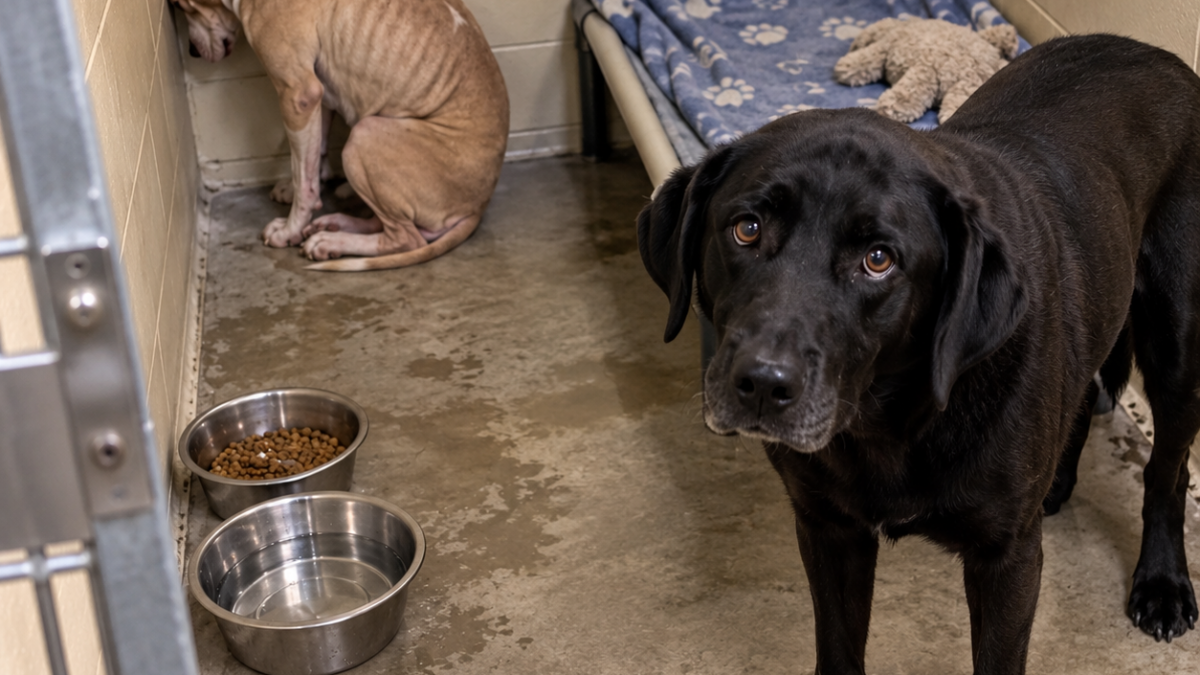
PART 2
The timestamp in the corner of the screen read 11:48 p.m.
Benji had already moved the food.
But he didn’t return to his bed.
He stood beside the blind dog.
The pit bull’s body was curled tightly against the wall, nose resting near his paws.
Benji lowered his head and touched the side of his muzzle.
Once.
Then he waited.
Nothing happened.
Benji touched him again.
The blind dog lifted his head.
Benji stepped backward.
The pit bull followed the sound.
One step.
Benji stopped.
Another step.
Benji waited again.
My throat tightened.
“He’s guiding him,” I whispered.
Margaret shook her head slowly.
“Not exactly.”
I looked at her.
She pointed toward the screen.
“Watch.”
Benji did not walk all the way to the bowl.
He moved perhaps two feet, stopped, and allowed the blind dog to locate him.
Then Benji moved again.
He wasn’t dragging him.
He wasn’t pushing him.
He wasn’t even staying close enough for the other dog to simply lean against him.
He was creating a trail.
Sound.
Scent.
Contact.
Pause.
Then another small piece of information.
The blind dog eventually reached the food.
Benji sat several feet away.
Only after the pit bull began eating did Benji lie down.
Margaret reached for the mouse.
“Let’s go back another night.”
We did.
10:56 p.m.
Benji moved the water bowl.
He approached the blind dog.
Touched his nose.
Waited.
The pit bull refused to move.
Benji lay down beside him.
Twenty minutes passed in fast-forward.
Then Benji stood again.
He nudged the bowl slightly closer.
Returned.
Touched him.
Waited.
This time the pit bull crawled forward.
“Again,” I said.
We opened another recording.
Then another.
And another.
My eyes started burning.
Benji had been doing it almost every night.
Not occasionally.
Not by accident.
Every night.
When we had gone home and the shelter had fallen quiet, Benji had been taking care of him.
He moved food.
He moved water.
Sometimes he lay beside him.
Sometimes he walked slowly around the enclosure while the blind dog followed the clicking of his nails.
Once, when the pit bull became disoriented and bumped against the fence, Benji immediately doubled back and stood beside him until his breathing settled.
Another night, the blind dog woke suddenly and began turning in a tight circle.
Benji got up from his blanket.
He approached.
No barking.
No excitement.
Just one quiet touch of his nose.
The pit bull stopped turning.
Benji lay beside him.
A minute later, so did the blind dog.
Margaret sat back in her chair.
“I’ve worked around dogs for twenty-three years,” she said.
“So have I, almost.”
“No, Ellie. You’ve worked around dogs for six.”
“Feels like twenty-three.”
She almost smiled.
Then she looked back at the screen.
“I’ve seen dogs comfort each other. I’ve seen bonded pairs. I’ve seen mothers care for puppies that weren’t theirs. But this…”
She trailed off.
I knew why.
It wasn’t that Benji had performed some miraculous human-like act.
We were careful not to romanticize animals until we stopped seeing what they actually were.
But behavior mattered.
Patterns mattered.
And this pattern was unmistakable.
Benji had learned something about his kennel mate.
The other dog struggled to locate essential things.
So Benji altered his own behavior.
Repeatedly.
Even when no person was there to reward him.
Margaret whispered, “He’s teaching him how to find what he can’t see.”
That sentence followed me home.
I heard it while brushing my teeth.
I thought about it lying in bed.
I thought about the blind dog shrinking from my hand.
For days I had believed patience meant waiting until he trusted me.
But perhaps trust had already begun.
Just not with me.
It had begun with Benji.
The next morning, I entered the kennel area carrying two breakfasts.
“Morning, boys.”
Benji bounced once, tail swinging.
The blind dog lifted his head.
That was new.
Usually my voice barely caused a reaction.
Benji walked toward me.
I scratched his neck.
“Apparently you have a night job.”
His tail thumped.
Behind him, the blind dog’s nose worked.
I set both bowls down.
Then I sat on the floor.
No reading.
No reaching.
No plan.
Benji finished half his breakfast, then walked toward his kennel mate.
The blind dog stood.
Benji came toward me again.
The pit bull followed.
Four steps.
Five.
Six.
He stopped about four feet away.
My heart pounded.
I kept my hands flat on my knees.
“Hi,” I said.
His ears moved.
Benji sat beside me.
The pit bull stayed where he was.
For almost five minutes, nothing happened.
Then Benji stretched out on the floor.
The blind dog took another step.
His nose brushed Benji’s shoulder.
He lowered himself beside him.
Not beside me.
But closer to me than he had ever chosen to be.
I wanted to celebrate.
Instead, I whispered, “Good choice.”
I think that was the day I stopped trying to rescue him.
That sounds strange.
Of course we were rescuing him.
We were providing veterinary care, food, shelter, medicine and safety.
But emotionally, I had been approaching him as though I needed to fix him.
I needed him to eat from my hand.
I needed him to accept touch.
I needed progress I could recognize.
Benji wanted none of those things.
Benji seemed to want only one thing.
For the other dog to know he wasn’t alone.
So I copied him.
I stopped asking for results.
I started offering information.
Every time I entered, I announced myself.
“Ellie coming in.”
Before placing food, I tapped the bowl lightly.
Before changing his blanket, I let him smell the fresh one.
Before moving anything, I spoke.
“Water bowl moving to your left.”
“Blanket behind you.”
“Door opening.”
The consistency mattered.
Within days, the pit bull stopped flinching every time the latch clicked.
Within a week, he began lifting his head when I said his name.
Except he didn’t have one yet.
His paperwork simply read:
MALE PIT BULL MIX — STRAY — VISUALLY IMPAIRED.
I hated it.
A dog could survive without a name.
But somehow, after watching him fight his way back into the world, “Male Pit Bull Mix” felt unbearable.
One afternoon Benji was chewing a rubber toy while his friend rested beside him.
I sat cross-legged outside the enclosure.
“What do you think?” I asked Margaret. “He needs a name.”
Margaret was doing paperwork.
“He’ll ignore whatever you choose.”
“That’s supportive.”
“I’m a supportive person.”
I tried several names.
Cooper.
Finn.
Henry.
Theo.
The dog did nothing.
Then I said, “Milo?”
His ears twitched.
I stopped.
“Milo.”
His head turned toward me.
Margaret looked up from her clipboard.
“There.”
I smiled.
“Milo it is.”
Benji thumped his tail once.
“Motion carried,” Margaret said.
So Milo became Milo.
And slowly, almost imperceptibly, Milo began becoming more than the frightened body in the corner.
His veterinary examination gave us part of his story.
His blindness appeared permanent.
The veterinarian believed he had very limited light perception, perhaps none.
There were old scars on his legs and chest.
He was underweight.
His paw pads showed wear consistent with spending long periods on rough outdoor surfaces.
None of that told us exactly what had happened.
Dogs cannot testify.
Bodies can suggest.
They cannot explain.
But some things were obvious.
Milo had learned that sudden touch was dangerous.
He had learned to protect food.
He had learned stillness.
The first time Dr. Shaw examined him, she stopped after less than a minute.
“He’s shutting down.”
Milo had frozen completely.
Not relaxed.
Frozen.
His respiration became shallow.
His muscles locked.
Dr. Shaw removed her hands.
“We’re finished for today.”
“But you barely examined him,” I said.
“That’s enough.”
She sat several feet away.
“People think a quiet animal is cooperating. Sometimes quiet means the exact opposite.”
That stayed with me too.
So we changed everything.
Benji accompanied him to the examination room.
We placed a textured mat beneath Milo’s feet so he could recognize that space.
We let him sniff equipment before it touched him.
We broke examinations into short sessions.
And Benji remained nearby.
Sometimes Milo pressed his shoulder against him.
Sometimes Benji simply slept.
It made a difference.
After the third appointment, Dr. Shaw managed a full physical exam.
After the fourth, Milo accepted a gentle touch beneath his chin without retreating.
After the sixth, he ate a treat from my open palm.
I cried in the supply closet afterward.
Margaret found me there.
“You realize he ate chicken,” she said.
“I know.”
“He didn’t graduate from college.”
“I know.”
“You are crying over deli meat.”
“Yes.”
She handed me a tissue.
“Carry on.”
The shelter was not glamorous.
People imagine rescue work as endless reunions and happy adoptions.
It isn’t.
It is laundry.
It is disinfectant.
It is medication charts.
It is answering phones while three dogs bark and someone is standing at the front desk insisting their landlord changed the rules.
It is cleaning vomit.
It is fundraising.
It is falling in love with animals you cannot keep.
And occasionally, it is standing beside a frightened blind dog while he takes food from your hand for the first time.
Those moments pay for the others.
Milo’s next breakthrough came because of a blue rubber ball.
Benji loved that ball.
He carried it everywhere.
One morning he dropped it near Milo.
Milo ignored it.
Benji picked it up and dropped it again.
Thump.
Milo’s ears turned.
Benji nudged the ball.
It rolled.
Milo tracked the sound.
He leaned forward.
The ball stopped against his paw.
He jerked back.
Then slowly lowered his nose.
Sniff.
Pause.
Sniff again.
He picked it up.
I laughed aloud.
Milo startled.
“Sorry,” I whispered.
But he didn’t retreat.
He stood there holding the ball.
Benji stared at him.
Milo dropped it.
Benji grabbed it.
A minute later he dropped it again.
This became their game.
The rules belonged entirely to them.
Benji rolled.
Milo found.
Milo carried.
Benji waited.
There was no frantic tugging.
No competition.
Just repetition.
Sound.
Discovery.
Reward.
One afternoon, something remarkable happened.
Benji was lying down.
Milo located the ball by himself.
He picked it up.
Then, slowly, he walked toward where Benji was resting.
He dropped the ball against Benji’s front paw.
Benji lifted his head.
Milo waited.
Benji stood.
Game on.
I was watching from the doorway.
“Margaret.”
She came over.
“What?”
I pointed.
Milo picked up the ball again.
His tail was moving.
Not tucked.
Not still.
Moving.
Margaret folded her arms.
“Well, look at that.”
“He started it.”
“I see.”
“He started playing.”
“I can see that too.”
“He started it.”
Margaret looked at me.
“You’re going to cry again, aren’t you?”
“Probably.”
She disappeared into the office and came back with the tissue box.
But recovery never travels in a straight line.
Two days later, Milo had one of his worst setbacks.
A maintenance worker dropped a metal bucket in the hallway.
The crash echoed through the building.
Milo panicked.
He bolted.
Because he could not see the walls, he struck one, spun around, hit the gate, and collapsed into the corner.
Benji immediately ran to him.
Milo growled.
It was the first time I had heard him growl.
Everyone froze.
Benji stopped.
He did not approach.
For several minutes, Milo trembled.
I sat outside the kennel.
“Milo, it’s Ellie.”
His breathing remained fast.
“You’re in your room.”
Benji lay down about five feet away.
“Milo, the gate is in front of you. Benji is to your right.”
I kept talking.
No commands.
Just information.
“You’re safe.”
Ten minutes.
Fifteen.
Then Milo stood.
He took one uncertain step.
Benji’s tail tapped the floor.
Milo followed the sound.
Another step.
Tap.
Another.
Tap.
Until his shoulder touched Benji.
His body softened.
The next morning, he was cautious again.
Progress had not disappeared.
It had simply been frightened.
That distinction became important.
We stopped saying, “He’s back to where he started.”
He wasn’t.
Healing remembered.
Even after fear returned, Milo recovered faster.
And each time he recovered, he seemed to gain another piece of himself.
Three weeks after we named him, he walked the full length of the shelter hallway.
Benji went first.
I walked behind them.
The first doorway made Milo hesitate.
Benji stopped.
Milo stretched his nose forward.
The second doorway was easier.
By the third, Milo barely paused.
When we reached the small outdoor yard, sunlight warmed the concrete.
Milo froze.
Wind moved across his face.
Leaves rustled.
Cars passed beyond the fence.
A bird called from the maple tree.
It was probably overwhelming.
I expected him to retreat.
Instead, he lifted his nose.
For almost a full minute, he simply smelled the air.
Then he stepped into the grass.
His front paw rose unusually high before touching down.
Another step.
Another.
Benji circled him once.
Milo began walking.
He found the fence.
Followed it.
Found a bench.
Investigated the legs.
Found a tree.
Stopped.
Smelled.
Then something happened I never expected.
He ran.
Only three or four strides.
Awkward.
Crooked.
Benji immediately moved beside him.
Milo ran again.
His tail rose.
I covered my mouth.
Not because a blind dog running was miraculous.
Blind dogs adapt beautifully every day.
But this particular dog had once been afraid to cross six feet of kennel floor.
Now he was running toward sounds he did not recognize.
Trust had changed the size of his world.
Unfortunately, someone from Milo’s past was about to try to make that world small again.
The call came on a Thursday afternoon.
Margaret answered.
I was filling medication cups nearby.
“Pine Ridge Animal Shelter,” she said.
A pause.
“Yes.”
Another pause.
Her expression changed.
“What name did you say?”
I glanced up.
She reached for a pen.
“Can you describe the dog?”
Silence.
“Color?”
She wrote.
“Eyes?”
Another note.
“Any identifying scars?”
Her jaw tightened.
“I understand.”
She listened.
Then:
“No. You cannot come pick him up.”
My hands stopped moving.
Margaret’s voice became flat.
“He was brought to us as a stray. He received medical care at our expense. You’re claiming ownership after nearly a month, and the condition documented at intake raises serious concerns.”
The person on the other end apparently became angry.
Margaret moved the receiver slightly away from her ear.
“No. Yelling does not change the answer.”
I stood.
She held up one finger.
“Animal Control will contact you.”
Then she hung up.
“Who was that?”
Margaret stared at the phone.
“A man claiming Milo belongs to him.”
My stomach dropped.
“What?”
“He saw a shelter photo.”
Milo had appeared in a small online post two days earlier.
Nothing dramatic.
Just an adoption update saying a blind dog was learning to navigate the world with help from a canine friend.
The photograph showed Milo and Benji lying together.
“Does he have proof?” I asked.
“He knew about a scar beneath Milo’s left shoulder.”
I felt sick.
“Could he get him back?”
Margaret was already dialing.
“Not without questions being answered.”
Animal Control arrived that evening.
Officer Dana Ruiz had handled neglect cases for years.
She reviewed Milo’s intake photographs.
His weight.
His nails.
The scar patterns.
The veterinary report.
She asked where he had been found.
The original caller had discovered Milo wandering near an industrial road almost eleven miles outside town.
No collar.
No tag.
No microchip.
The man claiming ownership identified himself as Russell Kane.
Officer Ruiz wrote the name down.
“Known to us,” she said.
Those three words chilled me.
“For what?”
“I can’t discuss an open file.”
“Is Milo in danger?”
“At this shelter? No.”
“Could Kane legally take him?”
“Right now, nobody is taking him anywhere.”
She closed the folder.
“We’ll determine ownership and whether abandonment or neglect occurred.”
That night, I stayed late.
I knew it was irrational.
The doors were locked.
The cameras were running.
Milo was protected.
Still, I sat near the kennel.
Benji slept beside him.
Milo was awake.
“Somebody says they own you,” I whispered.
His ears shifted.
“I don’t know what happened before you got here.”
I looked at the old scars on his legs.
“But I know what happens now.”
Benji lifted his head.
“You two are a lot of trouble.”
His tail thumped.
“Especially you.”
For three days, Kane called repeatedly.
He insisted Milo had escaped.
He said the dog had always been thin.
He said blindness made Milo clumsy and explained the injuries.
He accused the shelter of stealing him.
On the fourth day, he arrived in person.
I recognized his voice before I saw his face.
He stood at the front desk wearing a work jacket and muddy boots.
“I came for my dog.”
Margaret remained behind the counter.
“Mr. Kane, Officer Ruiz told you the matter is under investigation.”
“I don’t care.”
“You should.”
“He’s my property.”
My stomach tightened.
Property.
Technically, the law often treated animals as property.
But hearing the word used that way made my skin crawl.
Kane pointed toward the kennel corridor.
“I know he’s back there.”
“You are not permitted in the animal area.”
“I raised that dog.”
Milo heard his voice.
The reaction was immediate.
He had been standing near Benji.
His body dropped.
His tail vanished between his legs.
Then he began backing away.
I stared at him.
Benji moved between Milo and the hallway.
Not aggressively.
He simply stood there.
Kane continued arguing.
Milo pressed into the corner.
For nearly a month, we had been working to help him stop doing exactly that.
The voice from the lobby had undone his posture in seconds.
Margaret saw it too.
Her expression hardened.
“Mr. Kane, you need to leave.”
“I want to see him.”
“No.”
“He knows me.”
From the kennel came a small metallic sound.
Milo’s water bowl shifted because his hind leg had struck it while he tried to make himself smaller.
Kane smiled.
“See? He heard me.”
I wanted to say something I would regret.
Instead, I walked toward the lobby door.
“You need to go.”
He looked at me.
“Who are you?”
“Someone who has been sitting beside your dog every day.”
“My dog.”
“No argument from me about the legal claim. Animal Control handles that.”
He stepped closer to the counter.
“I fed him. I kept him alive for six years.”
Behind me, Milo began panting.
Benji remained pressed against him.
I looked Kane in the eye.
“Then you should want investigators to understand exactly how he arrived here.”
His face changed.
Just slightly.
It was enough.
Margaret picked up the phone.
“I’m calling Officer Ruiz.”
Kane cursed under his breath.
Then he pointed at us.
“This isn’t over.”
He left.
The front door slammed.
Milo startled.
I ran back.
“Ellie,” Margaret warned.
“I know.”
No reaching.
No grabbing.
I sat down instead.
“Milo. It’s Ellie.”
He trembled.
Benji touched his muzzle.
I kept talking.
“You’re at the shelter.”
Benji nudged him again.
“That voice is gone.”
Milo’s breathing slowed.
“You’re here.”
A minute later, his body leaned into Benji.
I swallowed hard.
“You’re not going back.”
At that moment, it was a promise I did not legally have the power to make.
But I meant it anyway.
The investigation moved quickly after that.
Officer Ruiz obtained records.
Neighbors gave statements.
One person reported seeing a pale dog repeatedly confined in a small outdoor run behind Kane’s property.
Another remembered the dog bumping into fencing and said she had once offered to help pay for veterinary treatment.
Kane refused.
A former employee told investigators that Milo had been kept primarily as a deterrent on the property despite losing his vision.
The most important evidence came from Dr. Shaw.
Her written evaluation did not speculate.
It documented.
Low body weight.
Untreated skin irritation.
Overgrown nails.
Old pressure sores.
Dental disease.
Scarring.
No microchip.
No current vaccination records provided by the claimant.
Dr. Shaw could not say exactly how every condition occurred.
She could say they were inconsistent with adequate recent care.
Officer Ruiz returned to the shelter after interviewing Kane.
“He signed a surrender.”
Margaret stared at her.
“What?”
“He signed ownership over.”
I almost laughed from relief.
“Why?”
Ruiz looked at me.
“Because otherwise this becomes a more complicated legal fight for him, and signing does not automatically end the investigation.”
“So Milo is ours?”
“The shelter has legal custody.”
My knees felt weak.
“And Benji?”
Margaret raised one eyebrow.
“Benji was already ours.”
I walked straight to their kennel.
“Milo.”
He lifted his head.
I sat down.
“You won.”
Of course he had no idea what I meant.
He walked toward me anyway.
That was the first time.
No Benji leading him.
No food in my hand.
No bowl being moved.
Milo crossed the enclosure because he heard my voice.
He stopped in front of me.
I didn’t touch him.
His nose moved across the air.
Then he leaned forward and pressed his forehead against my knee.
Everything inside me broke open.
I placed one hand very gently against the side of his neck.
He stayed.
“You’re not going back,” I whispered again.
This time, it was true.
The case against Kane did not turn into some dramatic courtroom spectacle.
Real accountability rarely looks like television.
There were interviews.
Documents.
Photographs.
Veterinary records.
Statements.
Eventually, Kane faced animal-neglect citations and restrictions related to future ownership under a local disposition agreement.
The details mattered less to me than one fact:
He would not get Milo.
I thought I would feel triumphant.
Instead, I felt tired.
Anger had carried me through the investigation.
Once it was over, what remained was sadness.
Somebody had been responsible for Milo before us.
Somebody had seen his world becoming darker.
Somebody had watched him become frightened.
And somewhere along the way, Milo had learned that disappearing into a corner was safer than asking for help.
No penalty could return those years.
But we could decide what came next.
And Benji had apparently already decided.
The two dogs became inseparable.
If Benji went to the yard first, Milo waited near the gate until he heard his friend.
If Milo went to the medical room, Benji stood at the kennel door staring down the hallway.
When Benji slept, Milo often curled against his back.
When Milo misplaced his ball, Benji searched.
When Benji became overexcited, Milo sometimes did something that made us laugh.
He would sit down.
Completely still.
Benji would bounce around him.
Milo would remain seated.
Eventually Benji would calm down and lie beside him.
“You realize,” I told Benji once, “he is training you too.”
The Labrador sneezed.
By then, Milo had become comfortable enough to walk outside with a harness.
We introduced a verbal navigation system.
“Step.”
“Left.”
“Right.”
“Careful.”
“Door.”
He learned astonishingly quickly.
Blindness was not the tragedy I had once unconsciously assumed it was.
Fear had been the prison.
Once fear loosened its grip, Milo adapted.
He mapped spaces using scent.
He remembered distances.
He listened to echoes.
He used changes in flooring texture.
We placed mats near doors and bowls.
A runner marked the path from his sleeping area.
Small bells on the yard gate helped him orient.
Within weeks he could move around the kennel without touching Benji at all.
But he still chose to sleep beside him.
There is a difference between needing someone and loving their company.
Milo was learning it.
Then came the adoption inquiry.
A woman named Claire Holloway called late one afternoon.
“I’m asking about Milo.”
I immediately went into my protective speech.
“He’s blind, and he has a bonded relationship with another dog, so there are considerations—”
“I know.”
“You saw the post?”
“My daughter showed me.”
“How old is your daughter?”
“Twenty-seven.”
I laughed.
“Sorry. I hear ‘daughter’ and imagine a child.”
“She’ll appreciate that.”
Claire continued.
“My husband and I lost our Lab last year. The house has been too quiet ever since.”
“I’m sorry.”
“Thank you. We weren’t planning to adopt yet.”
I knew what was coming.
“But?”
“But then we saw Milo.”
I looked toward the enclosure.
Benji was asleep.
Milo was lying with his chin across Benji’s back.
“There’s something important you should understand,” I said.
“Benji.”
“Yes.”
“We wondered about him.”
I sat straighter.
“What do you mean?”
“We wondered whether they could be adopted together.”
For a few seconds, I thought I had misunderstood.
“You’re asking about both?”
“We’d like to meet them both.”
I covered the receiver.
“Margaret.”
She looked up.
“What?”
I mouthed, “Both.”
Her eyebrows rose.
The Holloways came Saturday.
Claire walked in first.
Her husband, David, followed carrying a bag of dog treats he had apparently spent far too much time researching.
Their adult daughter, Erin, came too.
We met in the quiet visitation room.
I brought Benji first.
He greeted them as though they were relatives arriving for Thanksgiving.
Tail swinging.
Body wiggling.
David laughed.
“Well, subtle.”
Then I brought Milo.
I announced the room.
“Milo, new room.”
His pace slowed.
Benji approached him.
Milo touched Benji’s shoulder.
Claire remained seated.
Nobody reached for him.
I had explained that beforehand.
Let him decide.
Milo began exploring.
Wall.
Chair leg.
Rug.
Benji.
Table.
David’s shoe.
David froze.
Milo sniffed.
Then moved on.
Erin smiled.
“He acts like he’s taking inventory.”
“He is,” I said.
After about ten minutes, Milo approached Claire.
She kept her hands in her lap.
He sniffed her shoes.
Her jeans.
Then her fingers.
Claire whispered, “Hello, Milo.”
His ears shifted.
Benji came over and sat beside her.
Milo remained.
Claire glanced at me.
“Can I touch him?”
“Offer the back of your hand first.”
She did.
Milo sniffed.
He nudged her knuckles.
Claire gently stroked the side of his neck.
He stayed.
David looked down quickly.
I recognized the maneuver.
Pretending not to cry.
We discussed everything.
Blind-dog safety.
Stairs.
Furniture.
Pool hazards.
Consistent layouts.
Verbal cues.
Veterinary follow-up.
Adjustment time.
The fact that Milo might regress temporarily after leaving the shelter.
Then I addressed the biggest concern.
“Benji helps him enormously, but we don’t want Milo permanently dependent on Benji for every movement.”
Claire nodded.
“So we keep encouraging independence.”
“Yes. Benji is support, not a substitute for Milo learning the house.”
David looked toward the two dogs.
Benji had stretched out on the rug.
Milo was lying against his front legs.
“And if they never sleep separately?”
“That’s their business.”
He smiled.
They stayed almost two hours.
Before leaving, Claire stood near the door.
“I think we came here assuming we were considering Milo.”
I waited.
She looked at her husband.
David nodded.
Claire smiled.
“But I don’t think Milo comes in singular form.”
I laughed.
“No. I don’t think he does.”
The adoption process took another week.
Home check.
Fencing inspection.
Veterinary references.
Paperwork.
We were not going to rush because the story felt beautiful.
Beautiful stories still require responsible placements.
Their house was ideal.
Single story.
Fenced yard.
Few interior obstacles.
Quiet neighborhood.
They even placed textured runners near the back door before Milo arrived.
The morning they came to take the dogs home, I felt sick.
That is the strange cruelty of rescue work.
Success hurts.
You work toward goodbye.
Benji recognized Claire immediately.
He ran toward her.
Milo followed more carefully.
I knelt near him.
“Milo.”
He stopped.
Turned his head.
I touched the side of his neck.
“You have a house now.”
His nose brushed my wrist.
I swallowed.
“An actual house.”
Benji returned and touched Milo’s muzzle.
Milo stepped forward.
We walked outside.
Claire opened the rear door of their SUV.
A ramp had been placed against it.
Benji went up first.
Milo followed the sound.
Halfway up, he stopped.
Benji turned around.
Milo stretched forward.
Their noses touched.
Then Milo continued.
I closed the door.
Claire hugged me.
“Thank you.”
“Don’t make me regret this.”
“I won’t.”
“I know where you live.”
“You did the home inspection.”
“Exactly.”
She laughed.
I didn’t.
Not much.
The vehicle started.
I stood beside Margaret.
The SUV pulled away.
For a moment I could see Benji through the rear window.
Then the car turned.
Gone.
I cried so hard Margaret finally said, “Ellie, people are going to think they died.”
“I hate adoption day.”
“You love adoption day.”
“I hate loving adoption day.”
She handed me a tissue.
Again.
The shelter seemed unnaturally quiet afterward.
I went into their enclosure.
Two empty beds.
Two bowls.
One blue rubber ball had been forgotten beneath the cot.
I picked it up.
“Oh no.”
Margaret appeared at the door.
“What?”
“They forgot the ball.”
She looked at me.
“Ellie.”
“He loves this ball.”
“They own other balls.”
“Not this ball.”
“Do not drive across town because a Labrador forgot a rubber ball.”
Twenty minutes later, I was driving across town because a Labrador had forgotten a rubber ball.
Claire opened the door laughing.
“I knew you’d come.”
“You knew?”
“You texted me, ‘Emergency.’”
“This is an emergency.”
Behind her, Benji appeared.
His tail exploded.
Then Milo came down the hallway.
Not following closely.
Walking independently.
He paused at the sound of my voice.
“Milo?”
He came toward me.
I crouched.
He pressed his head against my chest.
That nearly destroyed me.
Claire took the ball.
“You want to see something?”
We entered the living room.
The furniture was spaced widely.
Textured mats marked important transitions.
Milo moved with caution but not fear.
Claire pointed.
“He already found the water twice.”
“By himself?”
“Benji showed him the first time. The second time Milo went alone.”
David appeared from the kitchen.
“He also discovered the couch.”
“That’s advanced orientation.”
“He believes it belongs to him.”
“That is correct.”
Erin was sitting on the floor.
Benji brought her the ball.
She rolled it.
It bounced against a chair.
Milo turned toward the sound.
He located it.
Picked it up.
Then walked in the opposite direction.
Everyone waited.
He turned.
Reoriented.
Walked directly toward Benji.
Dropped the ball.
Claire looked at me.
“He’s okay.”
I nodded.
“I know.”
That was the hardest lesson.
Knowing someone is okay without you.
A week later, Claire sent photographs.
Milo asleep beside Benji.
Milo standing in the yard.
Milo lying on a rug in sunlight.
The next message said:
HE WALKED FROM THE BEDROOM TO THE WATER BOWL ALONE THIS MORNING.
I stared at it longer than necessary.
Then:
BENJI WAS OUTSIDE. MILO DIDN’T EVEN LOOK FOR HIM FIRST.
I typed back:
THAT’S HUGE.
Claire responded:
WE THINK BENJI TAUGHT HIM SOMETHING BIGGER THAN WHERE THE BOWL IS.
I knew exactly what she meant.
A month passed.
Then two.
Milo gained weight.
His coat improved.
His body changed from sharp angles to muscle.
His scars remained, but they became less noticeable beneath healthier fur.
More importantly, his posture changed.
His head stayed higher.
His tail moved freely.
He explored.
He initiated play.
He sought affection.
And sometimes he chose solitude.
That last change moved me more than almost anything else.
A frightened dog hiding alone and a secure dog resting alone are not the same.
Fear isolates.
Confidence chooses.
One afternoon Claire sent a video.
Benji was lying beneath a tree.
Milo walked across the yard.
He stopped.
Listened.
Benji didn’t move.
Milo sniffed the air.
Then, instead of going toward him, Milo turned left.
He walked across the patio.
Found the doorway.
Located his water bowl.
Drank.
Then returned outside.
Benji had not helped.
Benji had not needed to.
I watched the clip five times.
At the shelter, I showed Margaret.
She smiled.
“He doesn’t need a guide anymore.”
I shook my head.
“He still needs Benji.”
“Different kind of need.”
Exactly.
Months later, the neglect case involving Kane finally closed.
Officer Ruiz stopped by the shelter.
“I thought you’d want to know.”
Kane had accepted the disposition.
Fines.
Mandatory animal-care education.
A prohibition on owning certain animals during a court-monitored period.
Additional welfare checks related to animals associated with the property.
It wasn’t the dramatic punishment some people would have demanded.
But enforcement had teeth.
Milo was permanently out of his control.
And records now existed.
Paperwork.
Documentation.
A history that could no longer disappear.
I thought back to the day Kane stood in our lobby saying:
He’s my property.
He had been wrong in the only way that mattered to me.
Ownership might appear on paper.
Trust doesn’t.
Care doesn’t.
Love doesn’t.
Those have to be earned.
And the dog Kane claimed had once collapsed at the sound of his voice now lived miles away in a home where nobody needed to force him into a corner.
That was enough revenge for me.
Not suffering.
Freedom.
Several months after the adoption, the Holloways invited Margaret and me to visit.
When we arrived, Benji barked from inside.
Milo joined him.
Claire opened the door.
Benji launched himself toward me.
“Still subtle.”
He almost knocked me backward.
Then Milo appeared.
He stopped several feet away.
My chest tightened.
“Milo.”
His head turned.
For one terrible second, I wondered if he had forgotten me.
Then his tail began moving.
Slowly at first.
Then faster.
He walked toward me.
Not cautiously.
Not following Benji.
Straight toward my voice.
I knelt.
He pressed into me.
I wrapped my arms around him.
“You remember.”
Claire smiled.
“Oh, he remembers.”
Milo pulled away after a few seconds and walked toward Margaret.
She bent down.
“Hello, trouble.”
Milo nudged her hand.
We sat in the backyard.
The transformation was almost impossible to reconcile with the animal who had arrived at the shelter.
Milo crossed the patio confidently.
He knew every edge.
Every doorway.
Every piece of furniture.
A small wind chime hung beside the back door, giving him an auditory landmark.
Textured stones bordered the garden.
Benji wandered around sniffing.
At one point Milo began walking toward him.
Halfway there, Benji changed direction.
Milo stopped.
He listened.
Then continued on his own path instead.
Claire sat beside me.
“The first few weeks, he checked for Benji constantly.”
“I expected that.”
“Now he checks because he wants to know where his friend is, not because he’s afraid to move without him.”
I watched Milo find a patch of sunlight and lie down.
Benji eventually joined him.
“How does Benji handle Milo being independent?”
Claire laughed.
“Terribly.”
“What?”
“He follows Milo everywhere now.”
As if on cue, Milo stood.
Benji stood.
Milo walked toward the water bowl.
Benji followed.
Milo walked toward the porch.
Benji followed.
I laughed.
“The student became the teacher.”
“Maybe.”
Claire grew quiet.
“Or maybe Benji spent so long making sure Milo wasn’t alone that now Milo makes sure Benji isn’t either.”
That sentence stayed with me.
Because relationships change.
The person—or dog—who carries you through one season may someday lean on you through another.
Support is not debt.
It moves.
That afternoon, David brought out the blue ball.
The same one I had driven across town to deliver.
“It’s survived,” he said.
“Barely.”
The ball was scratched, chewed and faded.
David rolled it.
Benji chased it.
Milo waited.
Benji returned.
Then Milo took the ball.
He walked several feet.
Dropped it.
Benji grabbed it.
They repeated the game.
It looked almost exactly like those early days at the shelter.
Except everything was different.
Milo’s body wasn’t curled inward.
No concrete kennel wall pressed behind him.
No metal bowls scraped across a floor because he was too frightened to search for them.
There was grass beneath his paws.
Sun on his back.
A family sitting nearby.
A friend beside him.
I thought about our security-camera footage.
The dark shelter.
The empty hallway.
Benji getting up when everyone else had gone home.
He couldn’t have known anyone would ever watch.
There was no treat waiting.
No command.
No applause.
He simply noticed another animal struggling.
And responded.
Sometimes people ask whether Benji “saved” Milo.
I understand why they say it.
But I don’t think that is quite right.
Milo saved himself too.
Benji didn’t make him eat.
He moved the food within reach.
Benji didn’t force him to walk.
He gave him something safe to follow.
Benji didn’t become his eyes.
He helped Milo trust his own nose, ears, feet and memory.
He didn’t teach Milo dependence.
He taught him possibility.
That difference matters.
Because real help should not make someone smaller.
It should give them enough safety to discover how large they can become.
Six months after Milo left the shelter, Claire sent me another video.
This one made me laugh before it made me cry.
Benji was standing uncertainly at the edge of the porch during a thunderstorm.
Apparently, he hated thunder.
Milo walked up beside him.
Benji remained frozen.
Milo touched his muzzle against Benji’s cheek.
Then Milo turned and walked toward the bedroom.
Benji followed.
Claire’s message beneath the video read:
LOOK WHO IS GUIDING WHOM NOW.
I watched it again.
Milo stopped halfway down the hallway.
Benji caught up.
They continued together.
There it was.
The whole story in ten seconds.
No hero.
No victim.
Just two friends.
One had once known the way.
Now the other did.
When I think about Milo today, I do not picture the frightened dog pressed against the shelter wall.
I remember him, of course.
I remember his ribs.
His cloudy eyes.
His refusal to move.
But that is no longer the image that defines him.
I picture the backyard.
Milo walking first.
Benji following.
I picture two dogs disappearing through the doorway of a house that belongs to both of them.
And I think about the first night we discovered the truth.
11:47 p.m.
Empty shelter.
Lights low.
No people.
No audience.
A black Labrador waking from his bed.
Walking toward a metal food bowl.
Lowering his muzzle.
Scrape.
Pause.
Scrape.
Pause.
Then pushing it toward an animal who could not see.
Benji moved the water next.
Then he approached Milo.
One gentle touch.
And he waited.
Nobody praised him.
Nobody said, “Good boy.”
Nobody offered a treat.
Nobody even knew.
He simply understood that the dog beside him needed something.
So he helped.
That was the part I could never forget.
Not because it proved dogs are angels.
They aren’t.
Dogs are dogs.
They can be messy, selfish, impatient, fearful, stubborn and complicated.
Benji certainly was.
He once stole an entire sandwich from Margaret’s desk and hid half of it beneath his blanket.
But kindness does not become less meaningful because the creature showing it is imperfect.
Maybe it becomes more meaningful.
Years of shelter work taught me that dramatic rescues are only part of saving lives.
Sometimes rescue is medication.
Sometimes it is surgery.
Sometimes it is an officer removing an animal from danger.
Sometimes it is a volunteer sitting quietly outside a kennel for an hour.
And sometimes it is one dog moving a bowl six feet across a concrete floor.
Milo never needed someone to become his entire world.
He needed someone to convince him the world was safe enough to explore.
Benji did that first.
Then we tried to follow his example.
We stopped pulling.
Stopped demanding.
Stopped measuring recovery according to our schedule.
We showed Milo the next safe step.
And waited.
Eventually he took it.
Then another.
Then another.
Until one day the dog who had once refused to leave a corner walked through an unfamiliar doorway and into a home.
Later, he walked through that home without Benji.
Later still, he became the one Benji followed.
That may be my favorite part.
Because the strongest ending was never Milo becoming dependent on the dog who helped him.
It was Milo becoming confident enough to return the favor.
A year after the day Milo arrived, Claire sent us a photograph.
No dramatic pose.
No perfect lighting.
Just Milo and Benji asleep on the living-room rug.
Milo was stretched on his side.
Benji’s head rested across Milo’s shoulder.
The blue ball sat near their paws.
Behind them was a wide window filled with afternoon sunlight.
Claire had written only one sentence:
They found their way home.
I printed the photograph.
It still hangs near the shelter office.
New volunteers sometimes ask about it.
“Who are those dogs?”
I always smile.
“That’s Milo and Benji.”
Then I tell them the story.
Not because I want them to believe every frightened dog needs another dog.
That would be irresponsible.
Not because I want them to assume animals think exactly like humans.
They don’t.
I tell them because Milo taught our entire shelter something about patience.
And Benji taught us something about helping.
One rainy morning, a blind pit bull entered our building believing the safest place in the world was the smallest corner he could find.
Months later, he walked into a home with his head raised.
The legal case closed.
The scars healed as much as scars can.
The fear faded.
And the man who had once demanded Milo back eventually became nothing more than a name in an old case file.
That was the most satisfying justice of all.
Milo did not spend his life being defined by what had happened to him.
He outgrew it.
He built new routines.
New memories.
New trust.
Kane had once claimed ownership over Milo.
But in the end, he did not get Milo’s future.
Milo did.
And nobody could take that from him.
I still volunteer at the shelter.
I still sit with frightened dogs.
I still read aloud sometimes.
I still talk about the weather to animals who probably care more about my tone than anything I am saying.
But now, when a dog refuses my hand, I remember Milo.
I don’t think:
How do I make you trust me?
I think:
What can I do that gives you the choice to trust me?
Those are different questions.
One asks for surrender.
The other offers safety.
And whenever a new volunteer becomes discouraged because an animal has not responded after a day, or a week, I take them to the office.
I point toward the photograph.
“See those two?”
They nod.
“The pale one didn’t move from a corner when he arrived.”
“What changed?”
I could tell them about medicine.
Training.
Routine.
The investigation.
The adoption.
All of it mattered.
But I usually begin somewhere else.
“At night,” I say, “the black Lab used to move his food bowl.”
Sometimes they laugh because it sounds too simple.
Then I tell them the rest.
How Benji moved the water.
How he touched Milo’s muzzle.
How he waited.
How he did it again the next night.
And the next.
Until a frightened blind dog finally decided to take one step.
That first step changed everything.
Not because it was big.
Because it belonged to Milo.
The night cameras did not show us a miracle.
They showed us patience happening when nobody was watching.
And maybe that is why the footage affected me so deeply.
Most kindness will never be recorded.
Most important things are not.
Somewhere, somebody is sitting beside a frightened animal without touching it.
Somebody is leaving food outside for a stray that still will not approach.
Somebody is driving an elderly dog to another veterinary appointment.
Somebody is fostering an animal that wakes up terrified at 2 a.m.
Somebody is cleaning a kennel.
Somebody is waiting.
No audience.
No applause.
No guarantee it will work.
Just the decision to remain kind.
Benji happened to have a camera above him.
That is the only reason we know.
The last time I visited Milo and Benji, they walked into the backyard together.
Benji started ahead.
Old habit.
Milo followed for three steps.
Then he turned toward another sound.
A squirrel, perhaps.
Leaves moved near the fence.
Milo changed direction.
Benji stopped.
For a moment he seemed confused.
Then he turned.
And followed Milo.
I stood on the porch smiling.
Claire noticed.
“What?”
“Nothing.”
But it wasn’t nothing.
I remembered the first recording.
Benji leading.
Milo uncertain.
Step.
Pause.
Step.
Pause.
Now Milo crossed the yard confidently.
Benji trotted behind him.
They reached the fence together.
Milo sniffed the grass.
Benji stood beside him.
Neither dog seemed aware that I was watching.
That made it perfect.
Because the most important part of their story had always happened when nobody was performing for us.
Milo found something interesting beneath a bush.
Benji joined him.
Then they ran toward the other side of the yard.
Two dogs.
One blind.
One black Lab.
No corner.
No cage.
No fear.
Just open grass.
When they reached the porch again, Milo arrived first.
Benji came right behind him.
I bent down.
Milo nudged my hand.
Benji leaned against my leg.
“You two figured it out,” I whispered.
Maybe that was all any of us had done.
Milo learned that blindness did not make him helpless.
Benji learned that helping a friend sometimes meant waiting rather than leading.
I learned that rescue is not about controlling the ending.
It is about creating enough safety for a new ending to become possible.
When it was time for me to leave, Milo followed me to the front hallway.
I knelt beside him.
“You know,” I said, “when you first arrived, I thought I was going to teach you how to trust people.”
He sniffed my face.
“I was very confident about that.”
Benji sat nearby.
“Turns out I barely knew what I was doing.”
Milo pushed his head beneath my hand.
I scratched behind his ears.
“You had a better teacher.”
Benji wagged.
“Yes, I mean you.”
I stood.
Claire opened the door.
Before I stepped outside, Milo turned away.
There had been a time when I might have felt sad.
Now I smiled.
He didn’t need to keep track of me.
He knew I would leave.
He knew his family would remain.
He knew where the kitchen was.
Where the water was.
Where the bed was.
Where Benji was.
He knew where he belonged.
I walked outside.
Behind me, the door closed.
Through the window, I watched Milo cross the room.
Benji followed him.
Then Milo stopped.
Benji came alongside.
They disappeared down the hallway together.
I stood there for another second.
And suddenly I remembered something Margaret had said while we were watching those first recordings.
He’s teaching him how to find what he can’t see.
At the time, I thought she meant the bowl.
Later, I thought she meant the kennel.
Then the hallway.
Then the yard.
But perhaps Benji had been teaching Milo to find something much larger.
Safety.
Choice.
Confidence.
Home.
And Milo eventually taught Benji something too.
You can help someone become independent without losing your place in their life.
Sometimes love means leading.
Sometimes it means following.
Sometimes it means standing still long enough for the other person—or dog—to find you.
Milo and Benji still live with the Holloways.
They sleep together most nights.
They play with the same battered blue ball.
During thunderstorms, Milo often walks beside Benji until he settles.
In unfamiliar places, Benji still instinctively slows down so Milo can orient himself.
Neither dog does everything for the other.
That is precisely why their bond works.
They help where help is needed.
Then they allow the other to try.
Every once in a while, Claire sends me a photograph.
I save all of them.
There is one from last winter that I especially love.
Snow covered the backyard.
Milo stood several feet ahead.
His nose was raised toward the cold air.
Benji was behind him.
Following.
I looked at that picture for a long time.
Then I placed it beside the original intake photograph.
In the first picture, Milo was curled against a wall.
In the second, there was no wall anywhere near him.
Only open space.
That is the difference a safe life can make.
The world did not become easier because Milo could suddenly see.
He never regained his sight.
He simply stopped believing darkness meant danger was everywhere.
That was enough.
And if anyone asks me which moment I remember most clearly, I still return to that ordinary night in the shelter.
Not the confrontation with the man who tried to reclaim him.
Not the investigation.
Not the adoption.
Not even the first time Milo ran through the grass.
I remember a grainy security recording.
11:47 p.m.
A dark room.
A sleeping shelter.
A black Labrador standing up.
A blind pit bull curled against the wall.
Benji crossing the kennel.
Lowering his head.
Moving one metal bowl.
Then another.
Walking back.
Touching Milo’s muzzle.
Waiting.
Milo eventually rising.
One uncertain step.
Then another.
Then another.
That was where his new life began.
Not with a dramatic rescue.
Not with applause.
Not with somebody forcing him forward.
With one friend making the distance a little easier.
Then waiting long enough for Milo to cross it himself.
And that is how I will always remember them.
Benji walking ahead when Milo needed a path.
Milo walking ahead when Benji needed courage.
Two dogs who entered each other’s lives at exactly the right time.
Two animals who were never supposed to stay in that shelter forever.
Two friends who eventually stopped searching for a safe corner because they had found something better.
They had found each other.
And together, they found home.
A few weeks after Milo and Benji went home together, Claire sent me another video.
I was standing behind the front desk at the shelter when my phone buzzed.
The message said only:
“You need to see this.”
I opened the video.
Benji was lying beneath a maple tree in the Holloways’ backyard, stretched comfortably across the grass.
Milo stood several yards away.
At first, I assumed he was going to walk toward Benji.
That was what he had always done.
He would listen for him, find his scent, then move carefully in his direction.
But this time Milo stopped.
He lifted his nose into the wind.
His ears turned toward the house.
Then he changed direction.
Completely on his own.
He walked across the patio.
Found the back door.
Followed the textured mat Claire had placed beneath his paws.
Then disappeared inside.
The camera shifted.
A few seconds later, Milo reached his water bowl.
He drank.
Benji never moved from beneath the tree.
Milo had found everything himself.
I watched the video twice.
Then a third time.
Margaret came around the desk.
“What are you staring at?”
I handed her the phone.
She watched silently.
When the video ended, she smiled.
“He doesn’t need Benji to show him anymore.”
I nodded.
“No.”
Then I looked again at the frozen image on the screen.
“But I think he needed Benji long enough to learn he could do it himself.”
That was the part that stayed with me.
Benji had never turned Milo into a dog who depended on him for every step.
He had done almost the opposite.
He had given Milo enough security to begin trusting his own senses.
His hearing.
His nose.
His memory.
His feet.
His instincts.
That was what made their friendship so extraordinary.
Benji had helped without taking Milo’s independence away.
And Milo was becoming stronger because of it.
A few months later, Officer Ruiz visited the shelter again.
The investigation involving Russell Kane had finally reached its conclusion.
There would be fines.
There would be restrictions.
There would be an official record of what had happened.
Most importantly, Milo would never be returned to him.
When Ruiz finished explaining everything, she asked me, “Is that enough?”
I thought about it.
There had been a time when I wanted some dramatic punishment.
I wanted Kane to experience the fear Milo had experienced.
I wanted him to understand what it meant to be trapped, ignored and powerless.
But standing there months later, I realized something.
The best revenge had already happened.
Milo was happy.
The person who had once reduced him to a frightened animal hiding against a wall no longer controlled anything about his life.
He did not control where Milo slept.
He did not control when Milo ate.
He did not control who touched him.
He did not control where he walked.
He did not own his future.
Milo did.
“I think it’s enough,” I told Ruiz.
Because sometimes justice is not watching someone else suffer.
Sometimes it is watching the one they hurt become whole again.
Nearly a year after Milo first arrived at the shelter, Claire invited Margaret and me over.
I had seen photographs.
I had watched videos.
But seeing Milo in person was different.
The door opened.
Benji came charging toward us immediately.
His tail swung so hard his entire body moved with it.
I laughed.
“Still no dignity, huh?”
Benji leaned against my legs.
Then I heard softer footsteps from inside the house.
Milo appeared.
He stopped.
His ears moved.
My throat tightened.
“Milo?”
His head turned toward me.
For one second, nothing happened.
Then his tail started moving.
Slowly.
Then faster.
He walked straight toward my voice.
No Benji in front of him.
No hand guiding him.
No food bowl drawing him forward.
Just Milo.
I crouched.
He pressed his forehead against my chest.
I closed my eyes and wrapped my arms around him.
“You remember me.”
Claire smiled from the doorway.
“He always remembers the people who made him feel safe.”
I had to look away for a moment.
Later, we sat in the backyard.
Milo moved around as though he had lived there forever.
He knew where the porch ended.
He knew where the tree roots were.
He knew where the water sat.
He knew the location of the door by the small wind chime hanging beside it.
He was still blind.
That had not changed.
But blindness no longer defined every movement he made.
Fear had once made his world tiny.
Trust had made it large again.
At one point Benji wandered toward the fence.
Milo started after him.
Then a sound from the opposite side of the yard caught Milo’s attention.
He stopped.
Turned.
And went the other way.
Benji noticed.
He immediately turned around.
Then something happened that made all of us laugh.
Benji began following Milo.
Claire looked at me.
“That happens all the time now.”
“What does?”
“Benji follows him.”
I watched them cross the yard.
Milo first.
Benji behind.
For so long, I had pictured Benji as the guide.
But now Milo was leading too.
That evening, dark clouds gathered in the distance.
A low rumble of thunder rolled across the neighborhood.
Benji froze.
His ears flattened.
Claire sighed.
“He hates storms.”
Another rumble.
Benji backed toward the porch.
Then Milo approached him.
He touched Benji’s face with his muzzle.
Exactly the way Benji had once touched him in the shelter.
Then Milo turned and walked toward the house.
Benji followed.
Nobody said anything.
We didn’t need to.
I could see the old security footage in my mind.
Benji moving food.
Benji moving water.
Benji touching Milo.
Benji waiting.
And now, months later, Milo was doing the same thing.
Not because someone had trained him.
Not because he was told.
He simply recognized fear in his friend.
And he stayed close.
Before leaving, I knelt beside Milo one last time.
“You came a long way, buddy.”
He nudged my hand.
Benji sat beside him.
I looked at both of them.
For so long, I had thought this story was about a blind dog being rescued by another dog.
But I had been wrong.
It was about two animals taking turns carrying each other through the parts of life they found difficult.
Benji gave Milo courage when the world felt dangerous.
Milo gave Benji comfort when thunder made him afraid.
Neither one became the other’s entire world.
They simply made the world easier to face.
That night, after I returned home, Claire sent me a final photograph.
Milo and Benji were asleep together in the living room.
The old blue rubber ball lay between them.
Milo’s head rested against Benji’s side.
Benji’s paw rested across Milo’s front leg.
Under the picture Claire had written:
“They found their way home.”
I stared at that sentence for a long time.
Then I thought about Milo’s first morning at the shelter.
The cold floor.
The untouched food.
The frightened body pressed into the smallest corner he could find.
And I thought about the security recording.
11:47 p.m.
Nobody watching.
Nobody praising.
A black Labrador quietly pushing a metal bowl across the floor.
Then moving the water.
Then touching a frightened dog’s muzzle.
Then waiting.
One small act.
Then another.
Then another.
Until eventually Milo took a step.
And then one more.
And eventually those steps carried him all the way into a home.
That is the image I keep with me.
Not Milo hiding.
Milo walking.
Sometimes beside Benji.
Sometimes behind him.
And now, more often than anyone expected, walking ahead.
Because Benji never taught Milo how to depend on him.
He taught Milo something far more important.
He taught him that the world could be safe enough to explore.
And once Milo finally believed that, nothing could force him back into that corner again.








