The 11-Year-Old Shelter Dog Had Hidden for Weeks—Then He Heard My Voice and Came Out for the First Time
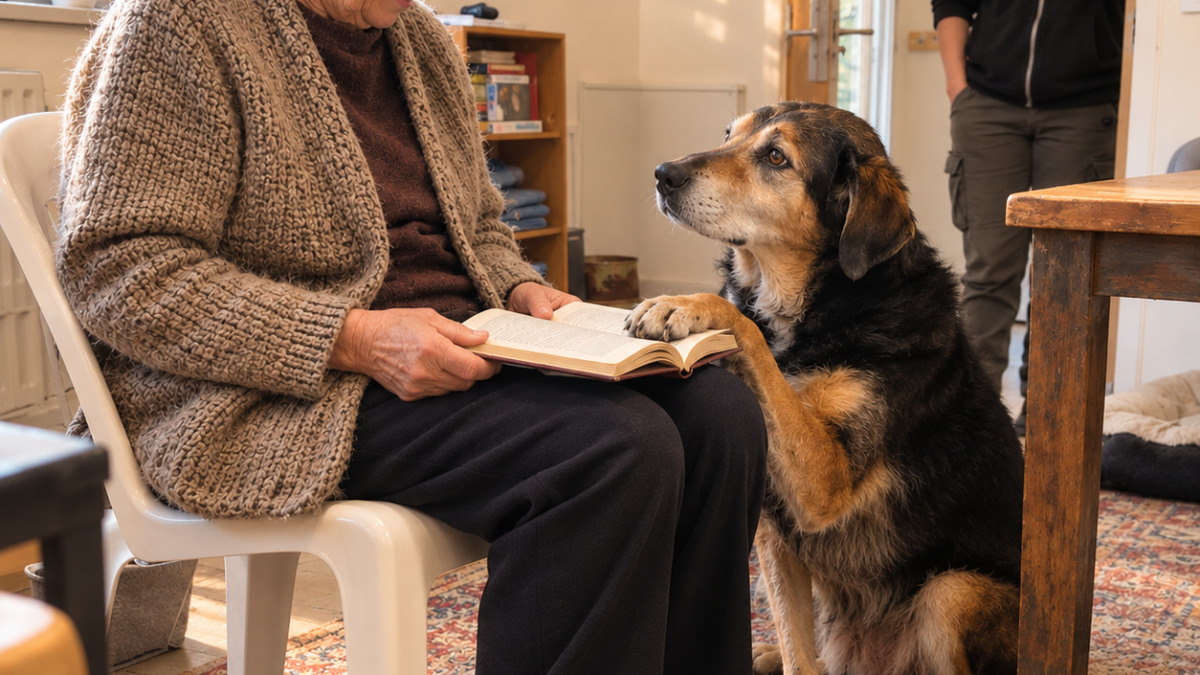
“Keep reading, ma’am—whatever you do, don’t stop,” the volunteer whispered, because an eleven-year-old dog who had spent weeks hiding under a table had just crawled into the open after hearing only three pages of my book.
I was sixty-nine, widowed, and had come to that shelter outside Angers to donate one quiet hour of my week, not to become important to an animal that barely trusted anyone.
But when I finally closed the book and Nestor walked over, placed one gray paw across the cover, and stared at me until the volunteer asked whether we had met before, I realized there was something about my voice that this dog already knew.
My name is Madeleine Moreau, and I live alone on the second floor of an old apartment building in Angers.
My husband, Bernard, died three years ago.
Our children live far away. They call, especially on Sundays, and I always tell them I’m fine.
Then the call ends.
And the apartment becomes silent again.
After Bernard died, I started leaving the radio on while I made coffee. I didn’t care what was playing. News, traffic, cooking shows—it didn’t matter.
I simply wanted another human voice in the room.
For years, I had volunteered for an audio library, recording books for people who could no longer read because of illness or vision loss.
I loved it.
I would sit behind a microphone with a glass of water beside me, mark difficult passages in pencil, and read for an hour or two.
I almost never met the people who listened.
After Bernard died, I stopped recording.
Reading aloud inside an empty room suddenly felt too much like speaking to someone who wasn’t there.
Then an old colleague called.
“Madeleine, a shelter near Angers has started reading sessions for anxious dogs.”
I laughed.
“You want me to read novels to dogs?”
“You read for strangers for twenty years.”
“They were people.”
“So?”
I had no sensible answer.
The following Saturday, I arrived at the shelter carrying an old paperback in my bag.
A volunteer named Sophie led me to a small room in the back.
Two plastic chairs.
A worn rug.
A water bowl.
And beneath a table, almost invisible in the shadows, a black-and-tan dog.
“That’s Nestor,” Sophie said. “Eleven years old.”
His muzzle was gray. A small scar crossed the fur above his left eye.
“Is he sick?”
“Physically, he’s doing fairly well for his age. Emotionally… not so much.”
She explained that after a family upheaval, Nestor had been surrendered because his owner could no longer care for him.
Since arriving, he ate only when the building was quiet.
He tolerated examinations.
Then he returned to hiding.
Visitors rarely noticed him.
And at eleven, being invisible in a shelter can be dangerous.
I sat down.
Opened my book.
And began reading.
Nestor did nothing.
I continued.
A page.
Then another.
Halfway through the third, I heard claws scrape against tile.
Nestor had lifted his head.
I kept reading.
He crawled out from under the table.
Not happily.
No wagging tail.
No excitement.
He simply sat there and listened.
Sophie had gone completely still.
I reached the end of the page and stopped.
Nestor stood.
Walked toward me.
Then placed one paw on my closed book.
Sophie whispered, “Keep reading.”
I opened it again.
Nestor immediately lowered himself beside my shoes.
We stayed that way for forty minutes.
I returned two days later.
This time, Nestor was outside with another volunteer.
He didn’t notice me until I said:
“Hello, Nestor.”
His head snapped around.
He crossed the yard and stopped against my legs.
That was when Sophie started watching me strangely.
Over the next several visits, we tested something without meaning to.
If I offered Nestor a treat silently, he hesitated.
If I said his name, he came.
If I spoke from another room, he woke.
It wasn’t my coat.
My perfume.
My face.
It was my voice.
Sophie asked permission to post a short video of one reading session to help show potential adopters that Nestor could still connect with someone.
I agreed.
Two days later, she called me.
“Madeleine, you need to come here.”
“What happened?”
“A woman saw the video.”
“Nestor’s former owner?”
“No. Her daughter.”
My stomach tightened.
“And?”
Sophie hesitated.
“She says she recognizes you.”
“I’ve never met her.”
“Not your face.”
A pause.
“Your voice.”
That afternoon, I returned to the shelter.
A woman in her fifties was waiting in the reading room with a scratched black audio player in her hands.
Nestor lay behind my chair.
“My name is Claire,” she said. “This belonged to my mother. She listened to it every day.”
She placed the device on the table.
“When I heard your video, I went straight home and found this.”
Her hands were shaking as she pressed PLAY.
And before the first sentence had even finished, Nestor stood up.
[END OF FACEBOOK OPENING]
[FULL STORY CONTINUATION]
The voice coming from that little black player was mine.
Not similar.
Not someone who sounded like me.
Mine.
Older than the voice I heard in my own head now, perhaps by five or six years, but unmistakable.
I was reading a novel.
I recognized the cadence before I recognized the book.
A slight pause after long sentences.
The way I dropped my voice before dialogue.
A habit of slowing down when a paragraph became emotional because I had always imagined someone listening alone.
Nestor’s entire body changed.
He stepped away from my chair.
His ears lifted.
Then he moved toward the device.
Claire covered her mouth.
I stopped breathing.
The recording continued.
Nestor placed his nose against the little speaker.
Then he turned toward me.
Back to the machine.
Back to me.
He started whining.
Not loudly.
One thin, trembling sound.
“Oh,” Claire whispered.
Nestor came to me.
He pressed his head against my knee.
I put my hand on his neck.
“What is this?”
Claire sat down.
For several seconds she couldn’t answer.
Sophie quietly closed the door.
Finally Claire said:
“My mother’s name is Jeanne Lefèvre.”
I knew nothing about the name.
“She began losing her vision eight years ago. Macular degeneration.”
I looked at the player.
Claire nodded.
“She used the audio library constantly.”
Something inside me shifted.
“Was that one of my recordings?”
“Yes.”
“How do you know?”
Claire reached into her bag and removed an old plastic case.
A white label had been stuck to the front.
The title.
Recording number.
And beneath it:
Reader: Madeleine Moreau.
I stared at my own name.
Nestor was still leaning against me.
Claire continued.
“My mother listened to you almost every evening.”
I looked down at him.
“Nestor too?”
A sad smile appeared.
“He didn’t have much choice.”
She told me Jeanne had lived alone after her husband died.
Nestor had been with her since he was a puppy.
As Jeanne’s sight worsened, her world became smaller.
She stopped driving.
Stopped reading printed books.
Eventually stopped going outside alone except along familiar streets.
But every night after dinner, she sat in the same armchair, placed the audio player beside her, and listened.
Nestor slept at her feet.
“For years?” I asked.
“Years.”
My hand froze against his fur.
Claire nodded toward the player.
“That particular recording was one of her favorites.”
I remembered making it.
Not the date.
Not much about the story.
But I remembered the room.
Bernard had still been alive.
He used to bring me tea while I recorded and complain that I made fictional characters sound more interesting than he did.
Nestor suddenly nudged my knee.
Claire began crying.
“I’m sorry.”
“For what?”
“This is ridiculous.”
“No.”
She wiped her face.
“My mother used to say that Nestor knew when your voice started because he would leave the kitchen and lie down beside her chair.”
I looked at Sophie.
She looked as stunned as I felt.
That explained why Nestor had come out from under the table.
My voice wasn’t new.
It belonged to evenings.
Home.
Jeanne.
Safety.
Maybe warmth.
Maybe a room where nothing bad happened after the story began.
I whispered, “Where is your mother now?”
Claire’s face changed.
That was the first moment I understood this story had another wound inside it.
“She’s alive.”
I exhaled.
“But?”
“She had a stroke five months ago.”
Nestor’s head lifted at Claire’s voice.
“She survived, but she lost strength on her left side. Her sight is worse. She’s in a rehabilitation residence outside Angers.”
“And Nestor?”
Claire looked down.
“I thought he was with my brother.”
I heard Sophie inhale.
Claire continued.
“My mother couldn’t take Nestor into rehab. I live in Paris four days a week for work, and my apartment here is too small. My brother Marc said he would keep him temporarily.”
“Did he?”
“For nine days.”
The room became completely still.
“What happened?”
“I didn’t know until three days ago.”
She placed both hands around the audio player.
“Marc told me Nestor was staying with a friend outside Cholet.”
Sophie’s expression hardened.
“He surrendered him here?”
Claire nodded.
“Without telling you?”
“Yes.”
“Without telling your mother?”
Claire’s eyes filled again.
“Yes.”
I looked at Nestor.
Eleven years old.
Removed from his home.
His person vanished.
Then the son who was supposed to keep him safe dropped him at a shelter.
Weeks under a table.
Weeks of voices he didn’t know.
Then one afternoon, he heard mine.
Not because I was special.
Because I sounded like home.
I felt suddenly sick.
“What does Jeanne think happened?”
Claire looked at me.
“She thinks Nestor is still with Marc.”
I closed my eyes.
“Oh.”
“I asked my brother for pictures. He kept saying Nestor was restless or outside or sleeping.”
“Why didn’t you insist?”
“I did.”
Her voice sharpened.
“Then my mother had complications. I was dealing with doctors. Work. Her apartment. Insurance. I trusted my brother to handle one thing.”
She laughed bitterly.
“One dog.”
I knew that laugh.
The kind people use when anger is the only thing preventing collapse.
Sophie asked quietly:
“Does Marc know you found Nestor?”
“No.”
“Are you going to tell him?”
Claire looked at the dog.
“Yes.”
I expected her to leave immediately.
She didn’t.
Instead she asked:
“Would you come with me to see my mother?”
I stared at her.
“Me?”
“She knows your voice.”
“That doesn’t mean she knows me.”
“She’s listened to you for years.”
“I’m a stranger.”
Claire smiled through tears.
“So was Nestor.”
That silenced me.
But I was not ready to say yes.
And if I’m honest, the reason had almost nothing to do with Jeanne.
I was frightened of what this was becoming.
I had come to the shelter because my apartment was quiet.
I had returned because Nestor listened.
That was simple.
Useful.
Contained.
Now there was a mother.
A daughter.
A brother who had lied.
A history.
And a dog leaning against my leg as though my voice connected two halves of a life I had never known existed.
I pulled my hand away from Nestor.
He looked up.
The guilt was immediate.
“I need to think.”
Claire nodded.
“Of course.”
Sophie walked me to reception.
Before I left, she said:
“You don’t have to fix this.”
“I know.”
“You look like you think you do.”
“I don’t.”
“You do.”
I sighed.
“I came here to read.”
“I know.”
“I am very good at reading.”
“You are.”
“This is not reading.”
“No.”
I looked through the glass at Nestor.
He had returned to the door of the reading room.
Watching.
I said, “I’ll come tomorrow.”
Sophie smiled.
“That is how this started.”
That night, I took the old microphone out of the closet.
I hadn’t used it since Bernard died.
Dust covered the case.
I put it on the table and sat there for almost an hour.
Then I found one of my old scripts.
I began reading.
The first sentence came out badly.
My throat tightened.
I stopped.
Tried again.
Better.
By the third page, something strange happened.
I stopped hearing the empty apartment.
I imagined Jeanne.
A woman I had never met.
Sitting in a chair years earlier.
Nestor at her feet.
Bernard in the next room.
Four lives that had somehow occupied the same hour without knowing one another.
I recorded twenty minutes.
Then shut it off.
The next morning, I called Claire.
“I’ll go.”
The rehabilitation residence was in a converted manor outside the city.
Jeanne’s room overlooked a courtyard with bare trees.
Claire warned me before we entered.
“My mother’s speech is slower now.”
“That’s fine.”
“She tires.”
“I can leave.”
“And she does not know about Nestor.”
I stopped.
“You’re telling her today?”
“Yes.”
I looked at the audio player in Claire’s hand.
“Are you sure?”
“No.”
That answer made me trust her.
Jeanne was eighty-two.
Small.
White hair cut short.
One hand rested curled against her lap.
Her eyes did not follow us precisely when we entered.
Claire kissed her cheek.
“Mom, I brought someone.”
Jeanne turned toward the sound.
“Who?”
I stood near the door.
Claire looked at me.
I didn’t know what to say.
So I said the most ordinary thing possible.
“Good afternoon, Jeanne.”
Her face changed.
Not dramatically.
Just a stillness.
Then:
“Again.”
I swallowed.
“Good afternoon.”
Jeanne’s mouth opened.
“Oh.”
Claire started crying instantly.
Jeanne turned her head.
“Claire?”
“Yes.”
“That’s her.”
I looked at Claire.
Jeanne smiled.
“The book lady.”
I laughed before I could stop myself.
“Yes.”
Her smile widened.
“You’re real.”
“Usually.”
She laughed.
That helped.
We talked for ten minutes.
About the audio library.
Books.
Whether I still recorded.
I told her I had stopped.
She frowned.
“Why?”
“My husband died.”
Her expression softened.
“I’m sorry.”
“Thank you.”
She reached toward the bedside table.
Claire helped place the old player in her hand.
“I wore this one out,” Jeanne said.
“I can see that.”
“You read too slowly in chapter twelve.”
I stared.
Claire burst out laughing.
“I’m sorry?”
“Too slow.”
“I thought it was dramatic.”
“It was annoying.”
For the first time since Bernard died, I argued about narration with someone who had actually listened.
It felt wonderful.
Then Jeanne said:
“Nestor liked your voice.”
The room changed.
Claire looked at me.
I looked at her.
Jeanne continued.
“He always came when you started.”
I sat down.
“Jeanne…”
“Yes?”
Claire took her mother’s hand.
“There’s something I need to tell you about Nestor.”
Jeanne became very still.
“What happened?”
“He’s safe.”
“Why did you say that first?”
Claire closed her eyes.
Smart woman.
“She knew.”
Not the facts.
But danger.
“Is he hurt?”
“No.”
“Dead?”
“No.”
“Then where is he?”
Claire’s voice shook.
“At a shelter.”
Jeanne pulled her hand away.
“No.”
“Mom—”
“No.”
“Marc brought him there.”
Silence.
Jeanne stared toward the window.
“Marc said Nestor was at Guillaume’s house.”
“I know.”
“He sent me a picture.”
“An old picture.”
Jeanne’s breathing changed.
“Why?”
“I don’t know yet.”
“You don’t know?”
“I haven’t confronted him.”
“Why not?”
“Because I wanted to tell you first.”
Jeanne’s good hand closed around the blanket.
“How long?”
Claire hesitated.
“Almost two months.”
Jeanne turned her face away.
Nobody spoke.
I felt like an intruder.
I stood.
“I should go.”
“No.”
Jeanne’s voice was quiet.
“Please.”
I sat again.
She asked:
“Have you seen him?”
“Yes.”
“Is he frightened?”
I did not lie.
“Yes.”
Her face crumpled.
“Does he eat?”
“Some.”
“Does he hide?”
“Yes.”
Claire lowered her head.
Jeanne covered her mouth.
“I told Marc.”
Her voice broke.
“I told him Nestor doesn’t do well when everything changes at once.”
I moved my chair closer.
“He came out for me.”
Jeanne froze.
“What?”
“The first time I read.”
I told her.
Under the table.
Three pages.
His paw on the book.
The way he followed my voice.
Jeanne cried.
Not loudly.
She reached blindly toward me.
I gave her my hand.
“He remembers,” she whispered.
“Yes.”
“He remembers our evenings.”
“I think so.”
Claire wiped her cheeks.
Then Jeanne asked:
“Can I see him?”
The answer should have been simple.
It wasn’t.
The residence did allow animal visits under certain conditions.
Vaccinations.
Behavioral clearance.
Advance scheduling.
Nestor had been withdrawn but not aggressive.
Sophie thought it could be done.
The veterinarian approved.
Two days later, we brought him.
I went because Claire asked.
Also because Nestor refused to walk past the residence entrance until he heard me speak.
I felt ridiculous.
“Come on, Nestor.”
His ears lifted.
He looked at me.
Then followed.
Jeanne waited in a small family room.
When we entered, Nestor stopped.
He did not immediately recognize her.
Five months had changed her.
Different chair.
Different smell.
Medical equipment.
Then Jeanne said:
“Nestor?”
The leash slipped through Sophie’s hand.
He ran.
For an old dog who had spent weeks hiding, he moved like something inside him had suddenly remembered being young.
He reached Jeanne and pushed his head into her lap.
She folded over him.
“Oh, my boy.”
Nestor made a sound that I still cannot describe.
Half whine.
Half groan.
He climbed his front paws onto her knees.
Claire knelt beside them.
Jeanne touched his ears.
His scar.
His gray muzzle.
“Where were you?”
The question was not for him.
Claire looked away.
Jeanne said it again.
“Where were you?”
Nestor licked her wrist.
She started sobbing.
I moved toward the door.
Jeanne called:
“Madeleine.”
I turned.
“Read.”
“What?”
“Please.”
I understood.
I took the book from my bag.
Sat down.
Opened it.
And read.
Jeanne closed her eyes.
Nestor lay across her feet.
Claire sat beside her mother.
For twenty minutes, the room looked like something that had existed years before.
Not exactly.
Nothing returns exactly.
But close enough to hurt.
Afterward, Jeanne asked for her phone.
Claire handed it over.
“Call Marc.”
“Mom.”
“Now.”
Claire hesitated.
Then dialed.
Put the phone on speaker.
Marc answered on the third ring.
“Hi, Mom.”
Jeanne’s voice changed.
Not weak.
Not uncertain.
Cold.
“Where is Nestor?”
Silence.
Then:
“At Guillaume’s.”
Nestor lifted his head at the sound of Marc’s voice.
Jeanne looked down at him.
“No.”
Another silence.
“Mom—”
“He’s beside me.”
Nothing.
Claire’s eyes closed.
Marc said:
“What?”
“Nestor is beside me.”
“Claire.”
That one word contained the entire accusation.
Claire leaned toward the phone.
“Don’t.”
Marc’s voice hardened.
“You had no right to upset her.”
Jeanne’s hand tightened in Nestor’s fur.
“Upset me?”
“Mom, you’re recovering.”
“You told me my dog was safe.”
“He is safe.”
“In a shelter.”
“It’s a good shelter.”
Sophie’s expression changed.
I almost admired the audacity.
Jeanne said:
“You said Guillaume had him.”
“I was trying to keep you from worrying.”
“You lied.”
“I made a decision.”
“For whom?”
“For everybody.”
There it was.
Not apology.
Authority.
Marc began explaining.
His apartment was small.
His wife worked nights.
Their youngest child had asthma.
Nestor whined when left alone.
Had accidents.
Wouldn’t settle.
“I tried, Mom.”
“For nine days.”
“How do you know?”
“Claire.”
He made her name sound like betrayal.
Jeanne answered:
“You promised me.”
“I couldn’t do it.”
“You could have told me.”
“And then what? You’d have left rehab?”
“No.”
“You say that now.”
“I would have found another solution.”
“There wasn’t one.”
Nestor’s head rested on Jeanne’s knee.
She stroked him.
Then said quietly:
“There is always another solution before a lie.”
Marc went silent.
I had heard words like that before.
They sound simple because the difficult part happened before them.
Claire said:
“Did you sign the surrender form?”
“Yes.”
“As owner?”
“No.”
“What did you sign?”
“A family authorization.”
Sophie looked at me.
Then at Claire.
Her expression had changed.
“What authorization?” Claire asked.
Marc exhaled.
“Can we not do this on the phone?”
Jeanne’s eyes narrowed.
“Do what?”
“Talk about paperwork.”
“What paperwork?”
Marc did not answer.
Claire sat straighter.
“Marc.”
“Mom gave me authority while she was in the hospital.”
Jeanne went still.
“I gave you authority to pay bills.”
“It covered more than that.”
“How much more?”
“Administrative decisions.”
Claire’s face drained.
“Did you use Mom’s power of attorney to surrender Nestor?”
“Stop making it sound criminal.”
No one had used that word.
Marc had.
Claire stared at the phone.
Then asked:
“What else did you use it for?”
The silence on the line lasted too long.
Jeanne’s fingers stopped moving.
“Marc?”
“Nothing.”
Claire stood.
“What else?”
“I’ve been handling the apartment.”
“What does that mean?”
“Insurance. Utilities. The realtor.”
Jeanne’s face changed.
“What realtor?”
Marc did not answer.
Jeanne said it again.
“What realtor?”
“Mom, the apartment isn’t practical anymore.”
Claire covered her mouth.
I watched the story change shape again.
The dog was no longer the only thing Marc had decided his mother could live without.
“You put my apartment up for sale?”
“Not formally.”
“What does that mean?”
“We had it evaluated.”
“We?”
“My wife and I.”
Jeanne’s voice became almost frighteningly calm.
“You took strangers through my home?”
“It had to happen eventually.”
“No.”
“Mom—”
“No.”
The word cracked through the room.
Nestor flinched.
Jeanne immediately softened her hand on him.
Then, more quietly:
“You keep telling me what has to happen as if I stopped being alive when I had a stroke.”
Nobody spoke.
Marc finally said:
“You don’t understand how much I’ve been doing.”
“I understand enough.”
“No, you don’t.”
His voice broke.
And there it was.
The human being underneath the decisions.
“I was driving to the hospital every day. Paying everything. Talking to doctors. Dealing with your landlord. Claire was in Paris. Nestor was tearing up my apartment. My marriage was falling apart.”
Claire flinched.
Marc continued.
“I was drowning.”
Jeanne closed her eyes.
For one second, I thought she might forgive everything.
Instead she said:
“You should have told me you were drowning.”
Silence.
“You did not have to pull me under to prove it.”
Marc hung up.
The room remained still.
Claire looked at her mother.
“I’m sorry.”
Jeanne shook her head.
“Not yours.”
“It should have been.”
“You had work.”
“I should have checked.”
“You trusted your brother.”
Jeanne’s mouth tightened.
“So did I.”
The next week became a storm of paperwork.
The shelter’s surrender records.
The power of attorney.
The apartment valuation.
Bank access.
Medical consent forms.
Nothing was as dramatic as it first sounded.
Marc had not sold the apartment.
He had not emptied Jeanne’s accounts.
He had not forged a signature.
But he had stretched temporary authority farther than Jeanne intended.
He had used it to make choices because choices were easier when the person most affected did not know they were being made.
The shelter’s legal advisor reviewed Nestor’s surrender.
Because Marc had represented himself as authorized under Jeanne’s documents, the surrender had been accepted.
Once Jeanne formally contested it, the shelter froze any adoption process.
That included me.
Not that I had applied.
Not yet.
Still, hearing it hurt.
Nestor belonged to Jeanne.
Of course he did.
But Jeanne could not take him back full-time.
Her residence was rehabilitation, not permanent assisted living, and dogs could visit but not live there.
Claire could not keep him.
Marc was no longer an option.
So Nestor remained at the shelter.
And I kept reading.
Every Tuesday.
Thursday.
Saturday.
Sometimes Jeanne joined by video call.
I would prop the phone on the table.
Nestor heard her voice.
He would walk over.
Jeanne would say:
“Hello, my boy.”
Then:
“Read, Madeleine.”
Eventually Sophie stopped pretending I was merely volunteering.
“You’re attached.”
“No.”
“You bring him homemade chicken.”
“That is nutritional support.”
“You bought him a blanket.”
“The shelter ones are ugly.”
“You know his medication schedule.”
“I am organized.”
“You argued with a prospective adopter.”
“She called him ‘too old-looking.’”
“You told her she was too shallow-looking.”
“She was.”
Sophie laughed.
Then asked:
“Why won’t you foster him?”
I looked at Nestor.
He was asleep beside my chair.
“My apartment is upstairs.”
“He manages stairs.”
“For now.”
“You’re home most days.”
“I’ve never owned a dog.”
“You know more about him than half our volunteers.”
“He belongs to Jeanne.”
“She knows that.”
“That isn’t an answer.”
“No.”
Sophie sat across from me.
“What are you afraid of?”
I hated that question because I knew.
“If I take him home, he will become mine.”
“Maybe.”
“And then?”
“Then you’ll love him.”
“That is not reassuring.”
“No.”
I looked down at my book.
“Bernard died.”
“I know.”
“I spent three years making sure nothing else in my life could hurt that much.”
Sophie’s face softened.
“That sounds exhausting.”
“It’s very efficient.”
“Is it?”
I glanced around the room.
At the dog.
The blanket.
My book.
“No.”
That evening, Claire called.
“Mom wants to talk to you.”
Jeanne came on the line.
“I hear you’re being difficult.”
“I hear you raised two children. You should recognize the condition.”
She laughed.
Then said:
“Take Nestor home.”
I stopped.
“No.”
“Why?”
“He’s yours.”
“Yes.”
“You want him.”
“Yes.”
“You miss him.”
“Every day.”
“Then—”
“And I cannot care for him.”
The sentence hurt because she said it without self-pity.
Just fact.
“I can visit him,” Jeanne continued. “I can pay for his care. I can love him. But I cannot walk him four times a day or carry him down stairs if his hips fail.”
I looked toward my window.
Rain streaked the glass.
“Nestor deserves a home.”
“He had one.”
“He can have another.”
“That sounds easy when you say it.”
“It isn’t.”
Then Jeanne said something I did not expect.
“I know what it is to lose a husband.”
I went quiet.
“Claire’s father died twelve years ago.”
“I’m sorry.”
“So am I.”
She paused.
“The first year, I stopped buying fresh bread.”
I frowned.
“What?”
“He always ate too much bread. I got angry every time I saw a baguette.”
Despite myself, I smiled.
“Eventually I bought one.”
“Why?”
“Because grief was already taking my husband. I decided it was not also getting bread.”
I laughed.
Then cried.
Jeanne waited.
Finally:
“Bernard would have liked Nestor.”
I looked at the dog lying beneath the table.
“Yes.”
“How do you know?”
“He liked anyone who listened while he complained.”
“Then Nestor is ideal.”
I wiped my face.
“Jeanne.”
“Yes?”
“What if you regret it?”
“I already regret many things.”
“That isn’t an answer.”
“No.”
She became serious.
“I will regret not living with him again.”
“But I will not regret knowing where he sleeps.”
That ended the argument.
I agreed to foster.
Only temporarily.
Everyone pretended to believe me.
The first night, Nestor refused the expensive bed I had bought.
He slept beside the bookcase.
Of course.
I left the radio off.
For the first time in three years, the apartment did not need borrowed voices.
There was breathing.
Nails against wood.
A water bowl shifting.
At ten-thirty, I opened my book.
Nestor lifted his head.
“You cannot possibly need this every night.”
His tail moved once.
I read.
He came closer.
When I stopped, he placed one paw on the book.
I laughed.
“You are manipulative.”
Another tail movement.
We developed a routine.
Morning walk.
Breakfast.
Nap.
Afternoon walk.
Jeanne call twice a week.
Reading at night.
Nestor learned the elevator was less frightening than the stairs.
I learned he hated umbrellas.
He learned my neighbor Madame Perrin dropped cheese.
I learned she did it intentionally.
The foster period stretched.
Two weeks.
Then a month.
Meanwhile, Marc’s situation became uglier.
Not criminal.
Personal.
Jeanne revoked his financial authority.
Claire became the primary contact for medical and administrative decisions, with Jeanne retaining control wherever she legally could.
The apartment was removed from informal sale discussions.
Marc was furious.
He blamed Claire.
Then the shelter.
Then me.
That surprised me.
I had spoken to him once.
He called on a Monday evening.
“Mrs. Moreau?”
“Yes.”
“This is Marc Lefèvre.”
I almost hung up.
Instead:
“What do you want?”
“I understand you have Nestor.”
“He’s fostering with me.”
“You’ve made yourself part of my family’s business.”
“No.”
“You went with Claire to see my mother.”
“She invited me.”
“You’re influencing her.”
I laughed.
“I read novels.”
“You encouraged her to revoke my authority.”
“I did not discuss her legal arrangements.”
“She talks about you constantly.”
“I’m charming.”
He did not laugh.
“This isn’t funny.”
“No.”
“My mother is vulnerable.”
“That may be true.”
“You don’t know her.”
“You’re right.”
“You don’t know what she was like before the stroke.”
“Also true.”
“You don’t know how stubborn she is.”
“I have met her.”
That slipped out.
He almost laughed.
Then he said:
“Nestor cannot stay with you permanently.”
My hand tightened around the phone.
“Why?”
“He belongs to Mom.”
“Jeanne is discussing permanent placement.”
“With you?”
“Yes.”
“She has no idea what she’s agreeing to.”
That angered me.
“She sounds very clear when she insults my reading speed.”
“This is exactly what I mean. Everyone thinks because she can joke, she’s fine.”
“I did not say she was fine.”
“You’re helping Claire push me out.”
“No.”
“You’re benefiting from it.”
That stopped me.
“How?”
“You get the dog.”
I stared at Nestor.
He was asleep on the rug.
“You think I engineered your mother’s stroke to obtain an eleven-year-old dog?”
“You know what I mean.”
“No, Marc. I truly don’t.”
His voice hardened.
“You people like simple villains.”
“I don’t.”
“Then stop pretending I dumped Nestor because I didn’t care.”
I didn’t answer.
He continued.
“I kept him nine days.”
“Yes.”
“He screamed whenever I left.”
“I know.”
“He urinated inside.”
“I know.”
“He scratched through my bedroom door.”
I looked at the faint scratches on my own front door from Nestor’s first foster week.
“Yes.”
“My son stopped sleeping.”
I stayed quiet.
“My wife was threatening to take the kids and leave.”
There it was.
The part nobody had heard.
“I called rescues.”
“Did you?”
“Three.”
“And?”
“No space.”
“Then L’Horizon?”
“Yes.”
“Why lie to Jeanne?”
Silence.
“Marc?”
“Because she would have told me to keep trying.”
“Maybe.”
“You don’t understand.”
“No.”
I surprised him.
“I don’t.”
He went quiet.
I continued.
“I understand being overwhelmed.”
Nothing.
“I understand making a decision someone hates.”
Still nothing.
“What I don’t understand is deciding they are too fragile for the truth.”
He exhaled.
“My mother had just had a stroke.”
“And?”
“You think telling her Nestor was in a shelter would help recovery?”
“I think discovering you lied certainly didn’t.”
His voice went cold.
“You enjoy this.”
“No.”
“Being the good one.”
The accusation hit harder than it should have.
Because part of me did enjoy being trusted.
By Nestor.
By Jeanne.
By Claire.
After years of feeling unnecessary, being needed had become intoxicating.
I hated that Marc had found the weak place.
“I’m not good,” I said.
He was silent.
“I’m lonely.”
The words surprised both of us.
“Nestor helps.”
I looked down.
“But that doesn’t make him mine by moral superiority.”
Marc’s tone softened slightly.
“Then don’t act like I’m a monster.”
“I won’t.”
“Good.”
“But you lied.”
His breathing changed.
“And consequences are not the same thing as being called a monster.”
He hung up.
I sat for a long time afterward.
Nestor woke.
Came over.
Placed his chin on my knee.
I did not read that night.
I thought.
Marc had done something wrong.
Several things.
But he had also been drowning.
And unlike a story, real life did not improve when I flattened him into a villain.
The next week, Jeanne requested a family meeting.
Claire.
Marc.
A social worker.
A legal adviser.
And, inexplicably, me.
“I’m not family.”
Jeanne replied:
“Neither is my lawyer.”
That was difficult to argue with.
We met at the rehabilitation residence.
Nestor was not there.
Jeanne insisted.
“This is about people learning to talk without using the dog as a weapon.”
I admired her.
Marc arrived late.
He looked exhausted.
Claire did not greet him.
The meeting began badly.
Marc accused Claire of disappearing to Paris.
Claire accused Marc of treating their mother like property.
Marc reminded her he had handled the hospital.
Claire reminded him nobody asked him to sell anything.
Voices rose.
Jeanne sat silently.
Then she picked up a metal spoon from her tea tray and struck it against her glass.
Once.
Everyone stopped.
“Excellent,” she said. “I raised children who are now fifty-three and fifty-six and still require table discipline.”
Claire looked embarrassed.
Marc looked angry.
Jeanne continued.
“Marc.”
“What?”
“You lied to me.”
“Yes.”
It was the first time I heard him admit it without explanation.
“You surrendered Nestor.”
“Yes.”
“You started preparing my apartment for sale without asking.”
“I had it valued.”
“Without asking.”
“Yes.”
“You thought I could not make decisions.”
“I thought you would make unsafe ones.”
Jeanne nodded.
“Different sentence. Same problem.”
Then she turned to Claire.
“You.”
Claire straightened.
“You were absent.”
Her face fell.
“I know.”
“You called. That is not the same thing.”
“I know.”
“You let Marc do everything and then arrived furious when you disliked how he did it.”
Marc looked toward his sister.
Claire lowered her eyes.
“Yes.”
Jeanne looked at both.
“I have two children. One tried to control everything. One avoided enough that control became possible.”
Nobody spoke.
Then Jeanne said:
“I love you both.”
Marc looked up.
“That does not mean I trust you both equally today.”
His face tightened.
“There will be no punishment performance.”
Jeanne’s voice remained calm.
“No one is getting publicly shamed. No one is being cut out of a will because of a dog.”
Claire almost smiled.
“But.”
Jeanne turned toward Marc.
“You will not handle my finances.”
He nodded slowly.
“You will not sign anything for me unless I specifically authorize that document.”
Another nod.
“And you will repay the shelter for the fees they absorbed when you surrendered Nestor under authority you knew I had not discussed with you.”
Marc looked surprised.
“What?”
“That is the consequence.”
“The shelter waived the fee.”
“Then you will donate it.”
“To them?”
“Yes.”
“Mom—”
“Would you prefer I choose the amount?”
He closed his eyes.
Claire coughed to hide a laugh.
Jeanne pointed toward her.
“You will contribute too.”
Claire stopped smiling.
“For what?”
“For leaving your brother to carry everything until he broke.”
“That’s not the same.”
“No.”
Jeanne folded her hands.
“Different mistakes can have different sizes and still both be mistakes.”
I loved this woman.
Claire nodded.
“Okay.”
Marc looked toward me.
I could see it in his face.
He expected triumph.
I gave him none.
This was not my victory.
Jeanne’s final decision regarding Nestor came last.
“He will live with Madeleine if she agrees.”
My stomach tightened.
Marc looked at me.
Claire smiled.
Jeanne continued:
“He remains mine in my heart. That cannot be transferred.”
I looked down.
“But legally, once adoption is completed, Madeleine will be responsible.”
I swallowed.
“Jeanne—”
“No.”
She smiled.
“You read slowly when nervous.”
“I do not.”
“You do.”
Marc laughed.
The first time I heard him laugh.
It changed his face.
Jeanne looked toward him.
“You may visit Nestor.”
I turned.
Marc froze.
“What?”
“If Madeleine allows it.”
I stared at her.
Jeanne shrugged.
“You wanted consequences, not execution.”
That sentence stayed with me.
I did allow one visit.
Weeks later.
At my apartment.
Claire came too.
Marc arrived without his wife or children.
Nestor heard his voice in the hallway.
He stood.
Not frightened.
Not excited.
Alert.
When Marc entered, Nestor stared at him.
Marc crouched.
“Hey, old man.”
Nestor approached slowly.
Sniffed his hands.
Then stepped closer.
Marc began crying.
I was not prepared for that.
“I’m sorry.”
Nestor licked his fingers.
Marc laughed through tears.
“You’re supposed to hold a grudge.”
Nestor did not.
Dogs can be infuriatingly uninterested in human justice.
Marc looked at me.
“He likes you better.”
“That is not a competition.”
“It feels like one.”
“I know.”
He sat on the floor.
Nestor leaned against him.
For twenty minutes, no one discussed lies.
Or paperwork.
Or the shelter.
When Marc left, he turned to me.
“Thank you.”
“Don’t make it dramatic.”
“I’m trying not to.”
“Good.”
He looked back at Nestor.
“My mother was right.”
“About?”
“I didn’t want the dog.”
I said nothing.
“I wanted not to be the son who failed.”
That was more honest than anything else he had said.
“I thought if I kept solving things, nobody could accuse me of failing.”
He gave a bitter laugh.
“So I solved Mom’s life until it didn’t belong to her.”
I did not absolve him.
He wasn’t asking.
“I hope you do better.”
“So do I.”
That was enough.
Nestor’s adoption became official three months after I first read to him.
There was still paperwork.
Veterinary checks.
A home visit.
Planning.
At sixty-nine, I had to identify someone who could care for him if something happened to me.
My daughter Isabelle immediately said yes.
Then added:
“Mom, you realize I’ve been trying to get you to adopt a dog for two years.”
“I did not adopt a dog because you told me.”
“No. You adopted one because he liked your audiobook voice.”
“That is different.”
“It is much stranger.”
My son Paul offered to pay half the veterinary costs.
I refused.
He paid anyway.
Children become very controlling once they believe they are helping.
I did not mention that to Jeanne.
The day Nestor officially became mine, I brought the same book I had read during our first meeting.
Sophie clipped on his leash.
“Ready?”
“No.”
“Good.”
“That doesn’t make sense.”
“People who say they’re ready usually haven’t understood the responsibility.”
I looked at Nestor.
“Comforting.”
Before we left, I sat in the reading room.
Opened the book.
Read three pages.
Then closed it.
Nestor placed his paw on the cover.
Again.
Sophie started crying.
“Oh, stop.”
“I’m not doing anything.”
“You’re crying.”
“Allergies.”
“In February?”
“Shelter dust.”
I stood.
Nestor followed.
This time, when I reached the door, he did not hesitate.
My apartment changed gradually.
A dog bed near the radiator.
Another beside my chair.
A basket of toys Nestor mostly ignored.
A water bowl I kicked twice a day for the first week.
I stopped leaving the radio on.
That was one of the first things Claire noticed.
She visited with Jeanne six weeks later after the rehabilitation center approved a short outing.
Jeanne sat in my living room.
Nestor lay across her feet.
I made coffee.
Jeanne tilted her head.
“No radio?”
“No.”
“Why?”
I looked at Nestor.
“I already have someone listening.”
Jeanne smiled.
Then she said:
“Read.”
“You are very demanding in other people’s homes.”
“Yes.”
I read.
Nestor settled.
Jeanne closed her eyes.
Claire sat beside her.
For half an hour, five lives became quiet in the same room.
Bernard was absent.
Jeanne’s husband was absent.
But absence no longer owned everything.
Months passed.
Jeanne regained enough strength to move from rehabilitation into a small assisted-living apartment where she could manage more independently.
Nestor could visit.
Not live there.
That was okay.
We visited twice a month.
I brought books.
Jeanne brought criticism.
“Too fast.”
“You said I was too slow.”
“Now you overcorrect.”
“I regret meeting you.”
“No, you don’t.”
She was right.
Marc began visiting his mother again.
Slowly.
At first, she refused to let him handle anything practical.
He came anyway.
Coffee.
Conversation.
No paperwork.
That was harder for him than managing bills.
He had to be present without being useful.
Eventually, trust returned in pieces.
Not authority.
Trust.
Claire reduced her Paris schedule and came home more often.
Not because Jeanne ordered it.
Because guilt had become action.
The apartment Jeanne once lived in was eventually sold.
Her decision.
Her realtor.
Her signature.
Marc attended the closing only because she invited him.
Afterward, he said:
“You fought me for six months and then sold it anyway.”
Jeanne replied:
“I wasn’t fighting the sale.”
“What were you fighting?”
“You deciding it for me.”
Marc nodded.
“I know.”
That was progress.
Part of the sale proceeds went into Jeanne’s care.
Part remained in savings.
And a small amount—without telling us—went to the shelter.
Sophie called me.
“Your friend made a donation.”
“What friend?”
“Jeanne.”
“How much?”
“I’m not telling you.”
“Why?”
“Because she wrote instructions.”
“What instructions?”
Sophie laughed.
“She said, ‘Madeleine will interfere.’”
I called Jeanne.
“You are impossible.”
“Yes.”
“What did you donate?”
“None of your business.”
“It literally involved the shelter where I volunteer.”
“You read books. You are not the finance minister.”
Eventually I learned the donation established a small senior-dog support fund.
Medication.
Dental work.
Foster supplies.
Whatever made older dogs harder to place.
They named it Nestor’s Listening Fund.
I objected.
Nobody cared.
The reading program grew too.
Our original little experiment became weekly sessions.
Retired teachers.
Students.
People recovering from illness.
One teenager who barely spoke to humans but could read entire chapters to frightened dogs.
I returned to the audio library.
That surprised me most.
The first new recording was terrible.
My voice shook.
I stopped five times.
Then I thought of Jeanne.
Nestor.
Bernard bringing tea.
I continued.
Eventually, I began recording regularly again.
Sophie sometimes played the recordings in the shelter’s quiet rooms when volunteers couldn’t be there.
One afternoon, she sent me a video.
A frightened terrier was lying under a chair.
My voice played softly from a speaker.
After several minutes, the terrier crawled out.
I cried.
Then called Sophie.
“This is emotional manipulation.”
“Effective emotional manipulation.”
“Stop filming animals listening to me.”
“No.”
“Why do I continue speaking to you?”
“Because Nestor introduced us.”
Fair.
Two years passed.
Nestor became thirteen.
Age arrived slowly.
Stiffness.
Longer naps.
A cloudy eye.
His hearing weakened.
Ironically, he still recognized my voice even when he stopped hearing quieter sounds.
If I entered a room silently, he might sleep.
If I said:
“Nestor?”
His head lifted.
Every time.
Jeanne’s health declined too.
Her stroke had taken more from her than she admitted.
One winter, she developed pneumonia.
Claire called me from the hospital.
“Mom keeps asking for Nestor.”
Dogs were not allowed on the ward.
We tried video.
Jeanne could barely see the screen.
Then Sophie suggested something.
“Record him.”
“What?”
“His sounds.”
That seemed ridiculous.
But we recorded Nestor breathing.
Walking.
His collar tags.
A small grunt he made when lying down.
I took the recording to Jeanne.
Then I read.
Nestor’s breathing played softly beside the bed.
My voice filled the room.
Jeanne smiled.
“There.”
“What?”
“Home.”
I swallowed.
She recovered.
Not completely.
But enough to return to assisted living.
We brought Nestor the next day.
He slept beside her chair for almost four hours.
Marc sat nearby.
Claire too.
No arguments.
Age eventually makes some conflicts look expensive.
Then came the call I had dreaded.
Not about Jeanne.
Nestor.
He collapsed during our morning walk.
One moment he was sniffing a lamppost.
The next his back legs folded.
I dropped beside him.
“Nestor.”
His eyes stayed open.
I called the veterinarian.
Heart.
That was the first concern.
Tests showed an advanced cardiac condition we had not known about.
Medication could help.
Maybe months.
Possibly longer.
No guarantees.
I brought him home.
Sat on the floor.
Opened our book.
Couldn’t read.
My throat closed.
Nestor put his paw on the cover.
I laughed through tears.
“You are unbelievably demanding.”
I read.
He slept.
Jeanne took the news badly.
“Bring him.”
“Not today.”
“Madeleine.”
“He needs rest.”
“I am eighty-four.”
“And?”
“I no longer accept ‘later’ comfortably.”
That shut me up.
We visited two days later.
Nestor moved slowly.
Jeanne sat low enough to reach him.
She put both hands around his face.
“You’re old.”
Nestor sneezed.
“So am I.”
I sat nearby.
Claire looked out the window.
Marc stood near the wall.
Jeanne said:
“Read.”
Of course.
I opened the book.
The same book.
By then the spine was cracked.
Pages loose.
Ink faded.
I read three pages.
Then four.
Then ten.
Nobody stopped me.
Nestor fell asleep with his head on Jeanne’s shoe.
That became our final full visit.
Six weeks later, he stopped eating.
The veterinarian came to my apartment.
I had already called Claire.
She brought Jeanne.
Marc came too.
Sophie arrived last.
My children joined by video because they could not reach Angers in time.
The living room felt too full.
And somehow exactly full enough.
Nestor lay on his blanket near my chair.
The little black audio player sat on the table.
Claire had brought it.
Jeanne touched it.
“Play the old one.”
I looked at her.
“Why?”
“Because he heard you there before he knew you.”
I pressed play.
My younger voice entered the room.
Nestor’s ear moved.
Barely.
Then Jeanne said:
“No.”
“What?”
“Read yourself.”
I understood.
I turned off the machine.
Opened the book.
My hands shook.
The veterinarian waited.
I began.
The first sentence broke.
I started again.
Nestor looked at me.
So I kept reading.
Not because the story mattered.
Because the sound did.
Because for years my voice had meant Jeanne’s living room.
Then a shelter.
Then my apartment.
Safety had moved, but the voice stayed.
Halfway down the third page, Nestor lifted one paw.
It landed on the edge of the book.
Exactly as it had the first day.
I stopped.
Jeanne whispered:
“Don’t.”
I looked at her.
“Keep reading.”
The veterinarian gave the first injection.
I read.
Nestor relaxed.
His breathing slowed.
Claire took Marc’s hand.
He did not pull away.
Sophie cried openly.
I kept reading.
The second injection went in.
Nestor’s paw slipped from the book onto my wrist.
I read one more sentence.
Then another.
His chest stopped moving before I finished the page.
The room became silent.
This time, I did not turn on the radio.
I closed the book.
Placed my hand over Nestor’s paw.
And sat there.
Jeanne said quietly:
“He heard you.”
I nodded.
“I know.”
We had Nestor cremated.
Jeanne wanted some of his ashes.
So did I.
We divided them.
Not because he had belonged partly to each of us.
Love is not a pie.
Because he had lived in more than one home.
Jeanne kept hers beside the old audio player.
I kept mine beside Bernard’s photograph.
Marc paid for the cremation.
Nobody asked him to.
That mattered.
Months passed.
The apartment became quiet again.
Different quiet.
I knew by then that silence was not always emptiness.
Sometimes it was simply the space left after something mattered.
I continued reading at the shelter.
The first session without Nestor was terrible.
I sat in the same room.
New dog.
Different table.
My hands shook.
The dog, a small white mixed breed named Lulu, stayed behind a chair.
I opened the book.
Read.
Nothing.
Good.
I did not need another miracle.
I read another page.
Lulu moved slightly.
That was enough.
A year after Nestor died, Jeanne asked me to visit.
Her health had worsened.
She was in bed.
Claire sat nearby.
Marc arrived while I was there.
He brought flowers.
Jeanne looked at them.
“Waste of money.”
“They cost twelve euros.”
“Exactly.”
Some people remain themselves until the end.
Jeanne pointed toward the audio player.
“Madeleine.”
I knew.
I sat.
Read.
Halfway through, she said:
“Do you remember when you first came?”
“Yes.”
“You looked terrified.”
“I was not.”
“You were.”
“Of Nestor?”
“Of needing him.”
I closed the book.
She smiled.
“That dog was smarter than you.”
“Most people appear to believe that.”
She became serious.
“Thank you.”
“For what?”
“For bringing my evenings back when I couldn’t.”
I looked at Claire.
She was crying.
Marc stared down.
I said:
“You gave them to me first.”
Jeanne frowned.
“What?”
“For years you listened.”
“So?”
“So I thought I was reading into empty rooms.”
She understood.
“Oh.”
I looked at the old player.
“You were there.”
Jeanne smiled.
“Of course.”
That was one of our final conversations.
She died peacefully two months later.
Claire called me in the morning.
I sat beside Nestor’s ashes.
Cried.
Then opened the old book.
Not to read.
Just to hold it.
At Jeanne’s funeral, Marc spoke.
I expected him to mention her strength.
Her stubbornness.
Family.
He did.
Then he said:
“My mother taught me very late that caring for someone does not mean deciding what they are allowed to lose.”
I looked at Claire.
She reached for his hand.
That was his consequence in the end.
Not humiliation.
Not punishment.
He had to become someone who understood exactly what he had done.
And then live differently.
He did.
Years later, he became a volunteer driver for the same residence where Jeanne had lived, taking residents to medical appointments and family visits.
Claire told me he was terrible at small talk.
I believed her.
He also donated regularly to Nestor’s fund.
Always anonymously.
Claire ruined the anonymity by telling me.
I never told Marc I knew.
At seventy-three, I still live in the same apartment.
My children still call on Sundays.
I still read at the shelter.
I also record books again.
My voice is older now.
Slower.
Apparently still too slow in chapter twelve.
The shelter expanded the reading room.
There are proper chairs now.
Bookshelves.
Soft lighting.
And on one wall, a photograph of Nestor.
Black-and-tan coat.
Gray ears.
One scar over his left eye.
He is lying beside my chair with one paw resting on an open book.
The plaque underneath does not mention abandonment.
Or grief.
Or age.
It says:
NESTOR
SOMETIMES HOME IS A VOICE YOU RECOGNIZE.
I complained that it was sentimental.
Sophie ignored me.
She is very successful now and therefore much harder to control.
Last winter, a new volunteer came.
A widower named Georges.
Seventy-one.
He sat stiffly in the reading room holding a detective novel.
“I feel ridiculous,” he told me.
“Good.”
He looked offended.
“I felt ridiculous too.”
“What am I supposed to do?”
“Read.”
“To the dog?”
“No, to the lamp.”
He stared at me.
“Yes, to the dog.”
The dog was a frightened shepherd mix named Alma.
She stayed in the corner.
Georges began.
Too loud.
I corrected him.
“Slower.”
He lowered his voice.
Five minutes.
Ten.
Alma remained where she was.
Georges glanced at me.
“This isn’t working.”
“That is not the same as nothing happening.”
He frowned.
I pointed toward Alma.
Her ears had relaxed.
Barely.
“Keep reading.”
He did.
Eventually, Alma lowered her head.
Not toward him.
Just down.
Trust begins in tiny movements.
People miss them because they want dramatic ones.
I no longer do.
When the session ended, Georges stood.
Alma did not follow.
No paw on a book.
No miracle.
He looked disappointed.
“Should I come back?”
“Yes.”
“Why?”
“Because you said you would.”
He nodded.
The following week, he returned.
And the week after that.
Three months later, Alma was sleeping beside his chair.
Six months later, he adopted her.
Sophie looked at me across reception.
I said:
“Do not.”
“I said nothing.”
“You have the face.”
She laughed.
Maybe that is how Nestor’s story continues.
Not through one extraordinary coincidence.
Through repetition.
A voice.
A chair.
A person who comes back.
A dog who slowly stops hiding.
I used to think the remarkable part was that Nestor recognized me.
Now I don’t.
Of course he did.
For years, my recorded voice had filled the room where he felt safest.
He had listened beside Jeanne while she lost her sight.
He had heard me before meals.
Before sleep.
Through winter evenings.
Through lonely ones.
When his world disappeared, he remembered the sound.
Then one afternoon in a shelter, that sound returned.
He followed it out from beneath a table.
What still amazes me is what happened after.
I followed him too.
Out of my apartment’s silence.
Back to the microphone.
Into Jeanne’s life.
Into Claire’s family.
Toward a version of myself I thought had ended with Bernard.
The first day I met Nestor, I believed I was donating one hour.
I thought I was the person with something to give.
I was wrong.
Nestor had spent weeks hiding because too many familiar things had vanished at once.
I had spent three years doing essentially the same thing.
My hiding place was simply larger.
An apartment.
A radio.
A life arranged so nothing could hurt me because almost nothing was allowed close enough.
Then an old dog heard my voice.
He crawled out.
Walked toward me.
And put his paw on my book.
He had no idea what he was asking.
Neither did I.
But I opened the book again.
And I kept reading.
[END OF STORY]








