Terrified Lulu Begged a Stranger for Help—Doctors Gave Her Weeks, but 13 Years Later She Proved Them Wrong
PART 2
“Lulu is in severe liver failure.”
For several seconds, I didn’t say anything.
I heard the words.
I understood each one individually.
But together, they refused to make sense.
“She was walking this morning.”
“Barely,” Dr. Harris said gently.
“But she walked.”
“Yes.”
“So we treat it.”
“We will.”
Something in his voice stopped me.
“What aren’t you saying?”
He turned the monitor toward me.
The ultrasound image looked like gray clouds to my untrained eyes.
Dr. Harris pointed toward several irregular areas.
“Her liver is severely damaged. Some of the tissue appears chronically changed. This wasn’t caused by something that happened yesterday.”
“How long?”
“I can’t tell you exactly.”
“Weeks?”
“Possibly longer.”
“Months?”
“Possibly.”
I looked through the small window in the consultation-room door.
Lulu lay beneath a blanket.
A technician was adjusting her IV line.
She had spent who knew how long hiding from people while her own body slowly failed.
“What causes this?”
“There are many possibilities. Infection. Chronic disease. Toxin exposure. Certain medications. Severe malnutrition can complicate liver function. Sometimes we never identify one cause.”
“What do we do?”
“We support her.”
“That’s not what I asked.”
Dr. Harris didn’t become defensive.
I appreciated that later.
At the time, I hated how calm he was.
“What do we do to fix her?”
He leaned forward.
“We stabilize her. We manage the abdominal fluid. We provide nutrition carefully. We treat any infection we identify. We use medications to support liver function and reduce toxin buildup. We monitor her kidneys, clotting times, electrolytes, neurological status.”
“And then?”
“We see whether her liver responds.”
“And if it doesn’t?”
Silence.
I knew the answer before he gave it.
“Then our goal becomes keeping her comfortable.”
I stared at him.
“You’re telling me she might die.”
“I’m telling you her condition is critical.”
“She walked to somebody’s door.”
He nodded.
“She asked for help.”
“I know.”
“She finally asked.”
My voice broke on the last word.
Dr. Harris looked down for a moment.
Then he said something I have never forgotten.
“Then let’s make sure asking mattered.”
That became our promise.
Not that Lulu would survive.
We couldn’t promise that.
Not that medicine would somehow erase whatever had happened to her.
We couldn’t promise that either.
We promised only that from that moment forward, she would not face anything alone.
The first night was difficult.
Lulu refused food.
She drank only tiny amounts.
Her abdominal fluid began accumulating again.
Her gums were pale.
Her blood proteins were frighteningly low.
Every few hours someone called me with an update.
At 1:13 in the morning, the phone rang.
I answered before the second ring.
“Is she alive?”
The technician paused.
“Yes.”
I sat upright in bed.
“What happened?”
“She became restless. We were worried she might be developing hepatic encephalopathy.”
I had never heard the phrase.
“What is that?”
“When the liver can’t remove toxins properly, they can affect the brain. Dogs may become confused, disoriented, weak, or have seizures.”
“Did she have a seizure?”
“No.”
“Is she conscious?”
“Yes. She’s resting now.”
“Can I come?”
There was another pause.
“Technically visiting hours—”
“Please.”
“Come.”
I was at the clinic twenty minutes later.
Lulu lay in an oxygen-supported recovery kennel.
When I approached, she lifted her eyes.
That was all.
I sat on the floor.
The clinic lights were dimmed.
Machines hummed quietly around us.
“You scared me.”
Her eyes remained on mine.
“I know you don’t know me.”
Nothing.
“And I know humans haven’t exactly given you many reasons to trust them.”
One ear moved.
“But you walked to that door.”
I put my hand flat on the floor outside the kennel.
“You did your part.”
I swallowed.
“Now let us do ours.”
I stayed until dawn.
The next day, Lulu ate three bites of boiled chicken.
Three.
Maya celebrated as though she had finished an entire Thanksgiving dinner.
“She ate!”
“How much?”
“Three pieces.”
“That’s it?”
“You weren’t here yesterday. Three pieces is a banquet.”
She was right.
With critically ill animals, your definition of victory changes quickly.
A spoonful of food becomes progress.
Standing for ten seconds becomes a milestone.
A normal bowel movement becomes something five grown adults discuss enthusiastically in a hospital hallway.
By the fourth day, Lulu could walk from her kennel to the treatment-room door.
She moved slowly.
Her belly remained distended.
Her legs looked too thin to carry her.
But she walked.
When I knelt near her, she stopped six feet away.
I didn’t move.
She looked at me.
Then at Dr. Harris.
Then toward the exit.
“She still wants to leave,” I said.
“Most patients do.”
“No. I mean she wants to disappear.”
Dr. Harris studied her.
“Maybe.”
I put a piece of chicken on the floor.
Lulu watched my hand.
I backed away.
She approached.
Ate the chicken.
Then retreated.
That became our routine.
No reaching.
No forcing.
No cornering.
Food placed down.
Human steps backward.
Lulu choosing whether to close the distance.
Her body might have been failing.
But fear still governed her decisions.
That told me somebody had taught her to be afraid.
We didn’t know who.
At that point, we knew almost nothing about her history.
No microchip.
No collar.
No missing-dog report matching her description.
Local shelters had no record.
Rescue groups shared her photograph privately, hoping someone would recognize her.
Nobody did.
It was as though Lulu had appeared from nowhere.
Maya named her on the third day.
“Why Lulu?”
“She needs something soft.”
That was the entire reason.
Some names are chosen because of meaning.
Some because of history.
Lulu got hers because after everything hard in her life, Maya thought she deserved one gentle sound.
By the end of the first week, her medical results had not improved enough.
Her liver enzymes remained dangerously elevated.
Her albumin was low.
Her blood clotting was abnormal.
The fluid returned even after drainage.
Dr. Harris changed medications.
They adjusted her diet.
They tested for infections and diseases that might explain the failure.
Some results were negative.
Others were inconclusive.
Nothing offered us the easy answer we desperately wanted.
On day nine, Dr. Harris asked me to sit down.
I hated when veterinarians asked me to sit down.
“She isn’t responding the way we hoped.”
My chest tightened.
“What does that mean?”
“It means we have to be realistic.”
“No.”
He didn’t argue.
“We have to discuss quality of life.”
“No.”
“Listen to me.”
“You said we would give her a chance.”
“We are.”
“It’s been nine days.”
“And during those nine days, her liver values remain severely abnormal. Her abdominal fluid keeps returning. Her appetite is inconsistent. Her body is using everything it has just to maintain basic function.”
“She walked yesterday.”
“Yes.”
“She ate.”
“Yes.”
“She looked at me.”
“Yes.”
I leaned forward.
“Then she’s still here.”
Dr. Harris sat silently.
I knew he wasn’t trying to give up on her.
Doctors who care about animals sometimes have to say things rescuers hate hearing.
Love cannot become an excuse for prolonged suffering.
I knew that.
But Lulu still responded to us.
She still chose food.
She still walked outside.
She still raised her head when Maya entered.
She was sick.
She was frightened.
But she had not stopped participating in life.
Dr. Harris finally said, “I’m not recommending euthanasia today.”
I exhaled.
“But we need to decide what signs would tell us she has reached that point.”
So we made a list.
Uncontrolled pain.
Persistent inability to eat.
Repeated seizures.
Severe respiratory distress.
Complete inability to stand.
Signs that she was suffering more than she was living.
I hated the list.
I also kept it.
Because loving Lulu meant promising not only to fight for her life.
It meant promising not to make her suffer just because we were afraid to lose her.
The next challenge was finding her a foster home.
A hospital is necessary when an animal is critically ill.
It is rarely where a frightened dog learns what safety feels like.
Lulu needed quiet.
A soft bed.
A predictable routine.
Someone home often enough to monitor her.
No young children.
Preferably no other animals initially.
And a person willing to accept that Lulu might die.
That final requirement changed everything.
People offered sympathy.
People donated food.
People sent blankets.
But when we asked for a hospice foster, the messages stopped.
I understood.
Opening your home to an animal you may lose in days is difficult.
Still, every evening when I watched Lulu settle back into a clinic kennel, I felt we were failing her.
“She asked for a home,” Maya said one night.
“We’re trying.”
“I know.”
“She finally trusted people enough to stop running, and she’s sleeping in a hospital.”
I looked through the glass.
Lulu had curled herself against the back wall.
“What about you?”
Maya shook her head.
“My landlord.”
“What about me?”
She looked at me.
“You have Max.”
Max was my eleven-year-old German Shepherd.
Gentle with people.
Not always gentle with unfamiliar dogs.
“And Lulu is terrified.”
Exactly.
My house wasn’t the right place.
At least that was what I told myself.
We posted again.
URGENT MEDICAL FOSTER NEEDED.
No one qualified responded.
Three more days passed.
Then something happened that changed my relationship with Lulu.
I arrived at the clinic carrying chicken.
She was standing outside her kennel with a technician.
When she saw me, she stopped.
I put the container down.
Usually she waited until I moved away.
This time, she took one step toward me.
Then another.
I froze.
Lulu came close enough to smell my knee.
I didn’t reach for her.
She sniffed my hand.
Then she did something so small that nobody else in the room understood why I started crying.
She leaned against my leg.
Only for two seconds.
Maybe three.
Then she moved away.
But she had touched me voluntarily.
Maya laughed through tears.
“There goes your foster excuse.”
“I have Max.”
“We can introduce them carefully.”
“My house has stairs.”
“We can use the downstairs room.”
“I work.”
“So do half our fosters.”
“She needs medical monitoring.”
“You already spend every free minute here.”
I looked at Lulu.
She was eating chicken.
“You planned this.”
“Absolutely.”
The introduction with Max happened the following afternoon in the clinic parking lot.
Two handlers.
Two leashes.
Large open space.
No pressure.
Max saw Lulu.
Lulu saw Max.
Max sniffed.
Lulu froze.
We walked parallel at a distance.
Five minutes.
Ten.
Then Max did what old Max usually did when something wasn’t interesting enough to justify effort.
He lay down.
Lulu stared at him.
Max yawned.
Lulu moved closer.
Sniffed him.
Max continued not caring.
Maya whispered, “Congratulations. Your dog has weaponized boredom.”
That was how Lulu came home with me.
Temporarily.
I said the word repeatedly.
Temporarily.
The rescue supplied medications, prescription food, puppy pads, blankets, supplements, and enough written medical instructions to operate a small hospital.
Dr. Harris stood beside my car.
“Call if anything changes.”
“I will.”
“Anything.”
“I know.”
“And remember, she may decline quickly.”
“I know.”
He looked at me carefully.
“You say that like you don’t believe me.”
“I believe you.”
I opened the back door.
Lulu stood beside the car.
She would not get in.
The moment she saw the interior, she backed away.
Her tail tucked hard beneath her.
“Okay.”
I sat on the pavement.
“We’re not forcing it.”
Max was already inside the car looking offended by the delay.
Maya brought a blanket.
We placed it on the seat.
Lulu approached again.
Stopped.
Then Max leaned his head over the seat and looked at her.
I swear something passed between them.
Maybe nothing mystical.
Maybe simply one dog observing another.
Lulu stepped forward.
I lifted her gently.
Her entire body trembled.
But she didn’t fight.
During the twenty-minute drive home, she stayed curled against the far door.
When we arrived, I opened both rear doors so she never felt trapped.
Max jumped out.
Lulu watched him walk toward the house.
Then she followed.
That first evening, she refused the dog bed.
She refused the blanket.
She refused the couch.
She chose the tile floor beside the back door.
So I moved everything away and let her choose the tile.
Safety sometimes means giving an animal something soft.
Other times it means respecting the uncomfortable place she selected because choosing it herself matters more.
Max slept across the room.
At midnight, I woke on the couch and saw Lulu standing above me.
She stared.
“Hi.”
She stepped backward.
I closed my eyes again.
A few minutes later, I felt something beside my hand.
Her nose.
Just once.
Then she returned to the door.
The second week at my house began with vomiting.
I panicked.
Lulu refused breakfast.
Then water.
Her abdomen looked larger.
I called Dr. Harris.
“Bring her.”
We were at the clinic within thirty minutes.
Ultrasound confirmed more fluid accumulation.
They drained it again.
Her bloodwork had worsened.
Dr. Harris looked exhausted.
“So this is it?”
“I didn’t say that.”
“You’re thinking it.”
“I’m thinking her liver is extremely compromised.”
“She was better yesterday.”
“She may have good days and bad days.”
“How many good days?”
“I can’t tell you.”
“How much time?”
“I can’t tell you that either.”
I hated uncertainty.
When you rescue an animal from a broken leg, there is often a plan.
Surgery.
Rest.
Rehabilitation.
Healing.
Lulu gave us no straight line.
Every improvement arrived beside a new setback.
Every celebration carried a warning.
Every morning began with me checking whether she was still breathing.
A week passed.
Then another.
Lulu remained alive.
Not dramatically better.
But alive.
She began eating more consistently.
Her abdomen filled more slowly.
She gained less than a pound, but Dr. Harris considered that meaningful because she was no longer losing weight.
More importantly, she started showing personality.
The first discovery was bread.
Lulu loved bread.
Not chicken.
Not steak.
Bread.
If I opened a bread bag anywhere in the house, the dog who supposedly had no energy appeared in the kitchen.
The first time she did it, I laughed.
“You can hear plastic from two rooms away, but not me calling your name?”
She looked at me.
Max looked at the bread.
Both dogs received tiny pieces.
The second discovery was sunlight.
Every morning around nine, a rectangle of light moved across the living-room floor.
Lulu found it.
From that day forward, it belonged to her.
Max attempted to lie there once.
Lulu stood three feet away staring at him.
No growl.
No bark.
Just judgment.
Max moved.
Maya witnessed this.
“She evicted a German Shepherd with eye contact.”
“She’s recovering.”
“That’s not recovery. That’s management.”
The third discovery was my old blue blanket.
Lulu had ignored every expensive dog bed we offered.
One afternoon, I dropped a worn fleece blanket on the floor while doing laundry.
She immediately walked onto it, circled twice, and lay down.
“That’s mine.”
Lulu closed her eyes.
“It was mine.”
Nothing.
“Fine.”
The blanket became hers.
During week four, she wagged her tail at me.
Not the nervous half movement we had sometimes seen.
A full wag.
I had returned from the grocery store.
Lulu was standing beside Max.
When I entered, Max barked.
Lulu’s tail started moving.
I stopped in the doorway.
“Do that again.”
She didn’t.
“I saw it.”
Max barked again.
Lulu wagged.
I dropped the grocery bags.
“You’re happy to see me.”
She immediately became suspicious of my enthusiasm and walked away.
I laughed for five minutes.
But her medical results remained terrible.
That was the cruel contradiction.
Lulu looked better.
Her eyes became brighter.
She stood longer.
Her coat improved.
She trusted us.
Yet every blood panel reminded us that the liver beneath all those visible changes was still profoundly damaged.
At the five-week appointment, Dr. Harris compared her newest results with the first.
“Some values are marginally improved.”
“MARGINAL?”
“Don’t make me regret telling you.”
“Improvement is improvement.”
“Yes.”
“So she’s recovering.”
“I didn’t say that.”
“You said improved.”
“I said some values are marginally improved. Others remain severely abnormal.”
“But she’s eating.”
“Yes.”
“She’s gaining weight.”
“A little.”
“Her fluid is slower.”
“Yes.”
“She runs after Max.”
“For approximately six seconds.”
“That counts.”
Dr. Harris tried not to smile.
“You are an exhausting foster.”
“You love me.”
“I tolerate you because Lulu likes you.”
I crouched beside her.
She leaned against my knee.
Six weeks after we found her, something happened that nobody had predicted.
The fluid stopped returning.
Not completely overnight.
But enough that we noticed.
Seven days passed without drainage.
Then ten.
Lulu’s abdomen looked smaller.
Her breathing became easier.
Her appetite increased.
She gained two pounds.
Dr. Harris repeated bloodwork.
He called me that afternoon.
“I want to rerun it.”
My happiness vanished.
“Why?”
“I want to confirm the numbers.”
“Good or bad?”
“Just come tomorrow.”
I barely slept.
The next morning, they drew more blood.
We waited.
Lulu sat beside me wearing the red bandana Maya had given her.
She had started accepting gentle petting along her shoulders.
Not her head.
Not yet.
But shoulders were progress.
Dr. Harris entered holding papers.
“You’re smiling,” I said.
“I am not.”
“You’re terrible at lying.”
He sat.
“Her liver values are still abnormal.”
My heart dropped.
“But significantly improved.”
I stared.
“How significantly?”
“Enough that I’m no longer comfortable describing her condition as immediately terminal.”
I heard Maya gasp.
“What does that mean?”
“It means we were wrong about how little time she might have.”
“Wrong how?”
“We thought we might be measuring her life in weeks.”
“And now?”
“I can’t give you a timeline.”
“Months?”
“Possibly.”
“Years?”
He hesitated.
“Possibly.”
I covered my face.
Maya started crying.
Dr. Harris looked toward Lulu.
“We still don’t know how much permanent damage remains. She will need ongoing monitoring. She may always require dietary management and medication.”
I lowered my hands.
“But she’s staying.”
“She’s fighting.”
“No.”
I looked at Lulu.
“She’s staying.”
The photographs from those six weeks barely looked like the same dog.
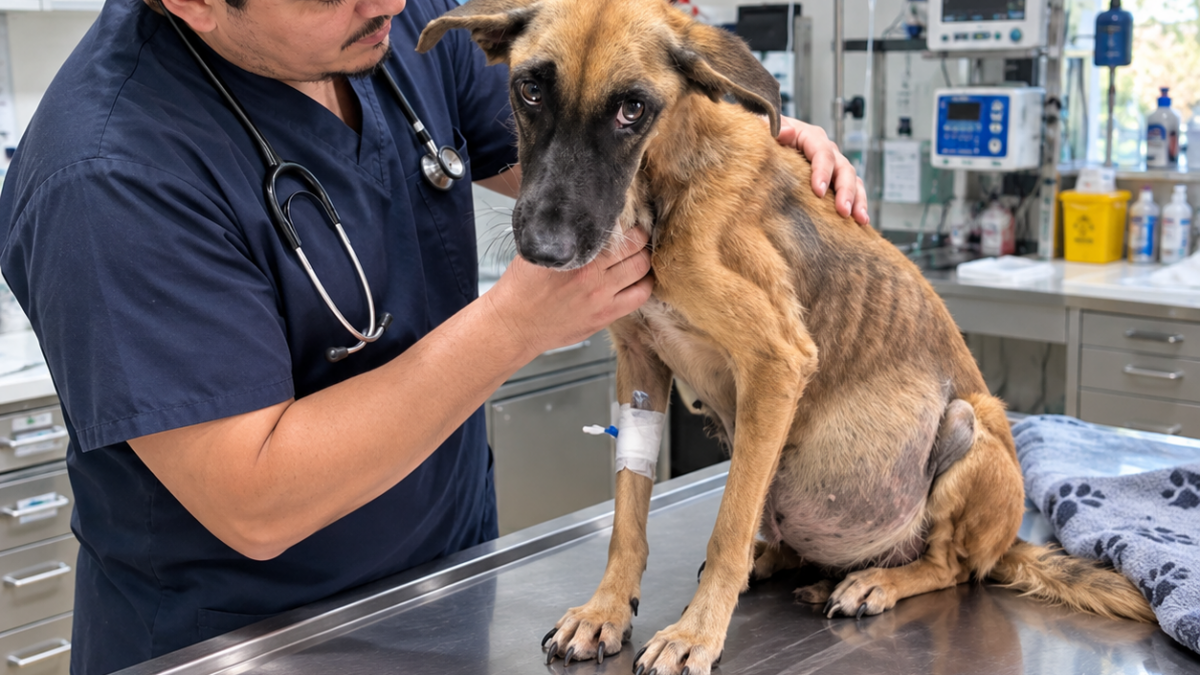
In the first, Lulu stood on trembling legs, ribs visible beneath dull fur, her abdomen enormous.
In the newest, her waist had begun to take shape.
Her coat shone.
Her head was higher.
And something had appeared in her eyes that hadn’t been there before.
Expectation.
Lulu expected breakfast.
Lulu expected her blanket.
Lulu expected Max to move when she wanted the sunny spot.
Lulu expected me to return after leaving.
Those expectations meant more to me than any photograph.
Hope is not always dramatic.
Sometimes hope is a dog learning that dinner happens every night.
But just when we thought Lulu’s story had become only about healing, her past finally found us.
It happened because of the red bandana photograph.
The rescue posted it online with a short update.
No dramatic claims.
Just Lulu standing in the yard.
Two days later, a message arrived.
I KNOW THAT DOG.
The sender was a woman named Rachel Monroe.
Maya called me immediately.
“Don’t get excited.”
“Why would you start a phone call like that?”
“Because we get false identifications constantly.”
“What did she say?”
“She thinks Lulu belonged to her former neighbor.”
“Where?”
“A neighborhood about eleven miles from where Lulu first appeared.”
“That’s close.”
“I know.”
“What else?”
“Rachel says the dog’s original name may have been Lucy.”
My stomach tightened.
“Photo?”
“She has one.”
Maya sent it.
The photograph was almost three years old.
A younger brown-and-white dog stood behind a chain-link fence.
Thin, but not emaciated.
Same white marking over the chest.
Same small notch in the right ear.
I enlarged it.
“That’s her.”
“Probably.”
“No. Look at the ear.”
“I saw it.”
“Who owned her?”
“Man named Wade Mercer.”
“Can we contact him?”
“Not yet.”
“Why?”
“Because we do this properly.”
I had heard that sentence from rescue people enough times to hate it.
Rachel agreed to speak with our animal-control investigator.
Her story was ugly, but not spectacular.
Sometimes cruelty isn’t dramatic.
Sometimes it is simply daily indifference.
Wade Mercer had rented the house next to Rachel for roughly two years.
Lucy—Lulu—lived almost entirely outside.
No shelter at first.
Then a plastic doghouse appeared after Rachel complained.
She was frequently tied in the yard.
Rachel occasionally slipped food through the fence because the dog looked thin.
“She was scared of him,” Rachel told the investigator.
“How do you know?”
“When his truck came home, she hid.”
“Did you ever see him strike her?”
“No.”
“Did you report concerns?”
“Twice.”
“What happened?”
“Someone came out. He showed them food and water. She wasn’t as thin then.”
“Did she receive veterinary care?”
“I never saw him take her anywhere.”
The investigator asked whether Lulu had escaped before.
Rachel nodded.
“Several times.”
“Did Mercer search for her?”
“Sometimes.”
“What happened when he moved?”
Rachel became quiet.
“I thought he took Lucy.”
“You didn’t see her leave with him?”
“No.”
“When was the last time you saw her?”
“About four months before she appeared at that apartment building.”
Four months.
Where had Lulu been during those missing months?
We didn’t know.
Mercer had moved out of county.
Investigators located him.
He initially claimed he had given Lucy to someone else.
“Who?”
He couldn’t remember the surname.
“Phone number?”
Lost.
“Address?”
Didn’t know.
“When?”
He gave a month that contradicted Rachel’s timeline.
There was no clear evidence that he had caused Lulu’s liver disease.
No evidence he had dumped her at the place where she appeared.
No proof that every injury and every medical problem came from him.
The law deals in proof.
Anger does not.
I understood that.
I still wanted to meet him.
Maya refused.
“You are not confronting him.”
“I want to ask what happened.”
“No.”
“He had her.”
“He says he rehomed her.”
“He can’t name the person.”
“That doesn’t mean you get to become Batman.”
“I’m not becoming Batman.”
“You have the emotional regulation of Batman right now.”
That ended the argument because I laughed despite myself.
Animal control continued investigating.
Veterinary records were requested.
There were none under Lulu’s old name at clinics near Mercer’s former address.
Records from a municipal citation showed that two years earlier he had been warned about inadequate shelter.
Another complaint mentioned prolonged tethering.
Neither established a criminal case for Lulu’s current condition.
I hated that too.
I wanted someone to pay.
I wanted a villain.
I wanted a courtroom.
I wanted a judge to look at photographs of Lulu and say, “You did this.”
Real life refused to become that convenient.
Then Rachel found something.
She was cleaning old photographs from her phone when she discovered a video.
It was twenty-seven seconds long.
The date was eleven months before Lulu came to us.
The camera pointed across Rachel’s yard.
Rain fell heavily.
Lulu—then Lucy—was chained outside.
No visible water.
No overhead cover.
She stood beside a plastic doghouse flooded around the entrance.
Rachel had filmed it because she intended to attach it to another complaint.
The video itself did not explain the liver failure.
But it established something important.
A documented pattern of inadequate care.
Rachel found two more videos.
One showed Lulu limping.
Another showed her extremely thin.
Animal control reopened the old complaint history and coordinated with officials where Mercer currently lived.
That was when they discovered he had another dog.
A female hound named Belle.
Belle lived outside.
She was thin.
Her water bucket contained algae.
Her shelter had no bedding despite cold nighttime temperatures.
And she had a large untreated mass along her mammary chain.
This time, investigators had a living animal in present danger.
They acted.
Belle was removed under local animal-welfare authority pending proceedings.
Mercer was cited and later charged under applicable neglect statutes.
When Maya told me, I expected satisfaction.
Instead, I thought about Belle.
“How bad is she?”
“She needs surgery.”
“Cancer?”
“They don’t know yet.”
“Where is she?”
“County veterinary hospital.”
“Can we help?”
Maya laughed softly.
“That was fast.”
“What?”
“Your revenge lasted about four seconds before you started asking about the next dog.”
I looked at Lulu sleeping beside Max.
Maybe she was right.
I had imagined revenge as Mercer losing something.
Instead, the only thing that mattered was Belle gaining something.
Treatment.
Food.
Warmth.
A chance.
The court eventually prohibited Mercer from owning animals for a period set under the local judgment, required veterinary-cost restitution, and imposed additional conditions.
It wasn’t the dramatic punishment my anger had once imagined.
But Belle never returned to that yard.
That mattered.
And Lulu’s story helped investigators take Rachel’s old complaints seriously enough to look again.
That mattered too.
Lulu never had to see Mercer.
I was grateful for that.
Her recovery continued.
Month three.
Month four.
Month five.
The supposedly temporary foster arrangement became increasingly ridiculous.
One evening, Maya visited carrying adoption papers.
I looked at them.
“What are those?”
“You know exactly what they are.”
“We said temporary.”
“We also said Lulu might have two weeks.”
“That was medically reasonable.”
“And now she’s stealing toast off your counter.”
“She is nutritionally motivated.”
“She sleeps in your bedroom.”
“She gets cold.”
“Her prescription food is delivered here automatically.”
“That is efficient planning.”
Maya placed the papers on the table.
“Sam.”
“I’m fostering.”
Lulu walked into the room carrying my slipper.
Maya pointed at her.
“She has your shoe.”
“She steals everyone’s shoes.”
“She has never been to my house.”
Lulu lay down beside my chair.
Max rested across from her.
I picked up the papers.
“What if somebody else would be better?”
Maya’s expression changed.
“Better how?”
“More experienced with liver disease.”
“You know her medication schedule from memory.”
“A bigger yard.”
“She doesn’t use half of this one.”
“Someone home more.”
“You rearranged your work schedule.”
I stared at Lulu.
“What if she relapses?”
“Then whoever loves her deals with it.”
“What if she dies?”
Maya’s voice softened.
“Then whoever loves her loses her.”
That was the real reason I hadn’t signed.
As long as Lulu was technically a foster, some foolish part of me could pretend I was helping temporarily.
Signing my name meant admitting she was mine.
Which meant admitting someday she would leave me.
Not through adoption.
Through death.
And after six weeks spent preparing myself to lose her every morning, I had become afraid to claim the future we had somehow been given.
Lulu stood.
She approached me.
Months earlier, she had flinched whenever I moved my hand near her head.
Now she pushed her nose beneath my palm.
I rubbed behind her ears.
She closed her eyes.
I signed.
Maya took a photograph of the papers.
“Congratulations.”
“Don’t post anything embarrassing.”
“I’m posting that you cried.”
“I did not cry.”
“You’re crying now.”
“I have allergies.”
“In January?”
“Seasonal.”
Lulu officially became my dog.
Her name stayed Lulu.
I considered Lucy.
But Lucy belonged to a chapter of her life when she waited behind fences and hid from trucks.
Lulu was the dog who walked to a stranger’s door.
Lulu was the dog who stopped running.
Her first anniversary with me arrived in early spring.
Dr. Harris ran a full liver panel and ultrasound.
I sat in the same consultation room where he had once told me her time might be painfully short.
He entered with the results.
“Well?”
“Her liver is still abnormal.”
“You enjoy starting sentences like that.”
“But stable.”
“How stable?”
“Stable enough that if you continue her diet, medication, monitoring, and follow-up imaging, I’m comfortable spacing routine checks farther apart.”
I stared.
“That sounds almost normal.”
“It is not normal.”
“It sounds normal adjacent.”
“Sam.”
“How long does she have?”
He sighed.
“You’re still asking me that?”
“Yes.”
“I don’t know.”
“A year?”
“She already proved we’re terrible at predicting her.”
“Two?”
“I don’t know.”
“Five?”
“Stop negotiating.”
I laughed.
Then Dr. Harris smiled.
“I will tell you this.”
“What?”
“When she arrived, I did not expect to be having this conversation a year later.”
I looked down at Lulu.
She was sniffing beneath his chair for treats.
“What changed?”
“Maybe part of the liver injury was more reversible than the imaging suggested. Maybe nutritional rehabilitation helped more than expected. Maybe removing whatever environmental factor contributed allowed her body to recover.”
“So you don’t know.”
“No.”
He watched Lulu.
“Medicine hates admitting that.”
“What about you?”
“I’m getting used to it.”
We took Lulu to the beach that summer.
It was her first trip.
Max had died two months earlier.
Old age.
Quietly.
At home.
Lulu had slept beside his bed the final night.
Afterward, she searched for him for nearly a week.
She checked the living room.
The yard.
The hallway.
His favorite corner.
Grief changes animals too.
I decided both of us needed somewhere new.
The beach was three hours away.
During the drive, Lulu rested with her head near the open window.
No shaking.
No panic.
When we reached the ocean, she stopped dead.
A wave rolled toward her.
Lulu backed away.
Another wave came.
She barked at it.
The ocean remained unimpressed.
She barked again.
I laughed until my stomach hurt.
For twenty minutes, Lulu conducted an unsuccessful argument with the Atlantic.
Then a wave touched her paws.
She jumped backward and looked at me as though I had personally arranged the attack.
“You survived liver failure.”
She glared at the water.
“You can survive three inches of ocean.”
She refused.
We compromised by walking along dry sand.
That evening, Lulu fell asleep beside me on the motel bed.
I looked through photographs on my phone.
There was the dog outside the clinic.
The swollen belly.
The narrow face.
The frightened eyes.
Then the newest image.
Lulu standing on a beach at sunset, ears lifted in the wind.
Same dog.
Different life.
I finally understood why transformation photographs matter.
Not because suffering makes a beautiful “before” picture.
It doesn’t.
Not because recovery erases trauma.
It doesn’t.
They matter because sometimes your memory lies to you.
You look at the healthy dog sleeping beside you and begin to forget how impossible that moment once seemed.
Photographs prove that impossible things occasionally happen one tiny decision at a time.
Someone opens a door.
Someone makes a phone call.
Someone searches one more street.
A veterinarian runs one more test.
A technician works one more night.
A foster says yes.
A frightened dog chooses not to run.
Two years after Lulu came into my life, Belle’s adopter contacted me.
Belle had survived surgery.
Her tumor had been removed.
She lived with an older couple on a small farm.
Not a breeding farm.
Not a chain.
A real home.
She slept indoors.
She had orthopedic beds in three rooms despite using only one.
Her adopter sent a photograph.
Belle was lying upside down on a couch.
I showed Lulu.
“Your revenge.”
She sniffed the phone.
That word had changed meaning for me.
I had wanted punishment.
Punishment had its place.
Accountability mattered.
Laws mattered.
Removing animals from neglect mattered.
But Lulu’s real revenge was simpler.
The man who had once treated her like something disposable no longer had any power over her life.
He didn’t decide where she slept.
He didn’t decide whether she ate.
He didn’t decide whether she received medical care.
He didn’t decide whether somebody touched her gently.
He didn’t decide whether she lived.
Lulu did.
And every person who helped her did.
Her revenge was breakfast at seven.
Her revenge was stealing my blanket.
Her revenge was barking at ocean waves.
Her revenge was Belle leaving that yard.
Her revenge was growing old.
Growing old.
That phrase would have sounded impossible the day Dr. Harris told me we might have weeks.
But Lulu did exactly that.
At nine, her muzzle began graying.
At ten, she developed arthritis in her hips.
I bought ramps.
She ignored them and continued trying to jump onto furniture until I blocked access.
At eleven, her hearing declined slightly.
Bread bags still worked perfectly.
At twelve, she slept more.
Her liver remained stable enough to astonish every new veterinarian who read her history.
Whenever a substitute doctor reviewed the chart, I could predict the reaction.
“She presented with values this high?”
“Yes.”
“And massive ascites?”
“Yes.”
“And this was how many years ago?”
“Seven.”
Then they would look at Lulu.
Usually she was searching their pockets for food.
One doctor laughed.
“This dog has no respect for prognosis.”
“That is her primary personality trait.”
Rachel visited us once.
She had carried guilt for years because she believed she should have done more when Lulu lived next door.
When Lulu saw her, she hesitated.
Rachel stayed still.
“Hi, Lucy.”
Lulu’s ears lifted.
That old name.
For several seconds, she stared.
Then she walked forward.
Rachel cried before Lulu even reached her.
“I’m sorry.”
She knelt.
“I’m so sorry I couldn’t get you out.”
Lulu sniffed her face.
Then licked her.
Rachel covered her mouth.
I looked away.
Later, while Lulu slept between us on the porch, Rachel said, “I used to hear her crying at night.”
I didn’t know what to say.
“I called.”
“I know.”
“Twice.”
“I know.”
“It wasn’t enough.”
I looked at her.
“You documented what you could. Those videos helped Belle.”
“But not Lulu.”
“Lulu is here.”
“She suffered first.”
“Yes.”
I refused to lie to make either of us comfortable.
She had suffered.
We couldn’t rewrite that.
“But suffering because someone else failed her doesn’t mean you failed every time you couldn’t fix it.”
Rachel looked toward the yard.
“I wish I had stolen her.”
I laughed.
“What?”
“I used to think about cutting the chain.”
“Probably don’t tell animal control.”
She smiled through tears.
“I really did.”
Then she grew serious.
“Thank you for finding her.”
“I didn’t.”
“What?”
“She found us.”
That was the truth.
Lulu started everything.
Terrified.
Sick.
Barely able to stand.
She still walked to a human door.
People often praised me for saving her.
I never liked that version.
It made me sound like the active one and Lulu like something simply waiting to be rescued.
That wasn’t what happened.
Lulu made the first move.
She approached humanity again after humanity had given her every reason not to.
Yes, she ran.
Fear won for a moment.
Then we found her.
And eventually love won the longer fight.
When Lulu was thirteen, Dr. Harris retired.
At his final week in practice, I brought her to visit.
He walked into the lobby.
Lulu recognized him immediately.
Her tail wagged.
He stopped.
“Well, look who refused to die.”
“Very professional greeting.”
He knelt.
Lulu walked to him.
Years earlier, Dr. Harris had been one of the first humans she allowed to touch her because she was too weak to resist.
Now she pushed her head into his hands voluntarily.
He scratched beneath her chin.
“You gave me a lot of sleepless nights.”
Lulu wagged harder.
“You cost this clinic a fortune in overtime.”
More wagging.
“And your foster father was unbearable.”
“Excuse me.”
Dr. Harris laughed.
Then his eyes filled.
“I didn’t think I would see you become an old lady.”
Neither did I.
Lulu licked his wrist.
Dr. Harris looked at me.
“Remember that first conversation?”
“Every word.”
“I told you her time might be short.”
“You were spectacularly wrong.”
“Yes.”
“I’ve waited thirteen years to hear you admit that.”
He smiled.
“I’m happy I was.”
We took a photograph together.
Dr. Harris in the middle.
Lulu sitting between us.
Gray muzzle.
Bright eyes.
Red bandana.
That photograph eventually became my favorite.
Not the beach.
Not the adoption picture.
Not the transformation comparison.
That one.
Because it contained two men who had once believed Lulu might not survive a month.
And Lulu sitting between them thirteen years later.
Eventually, age began asking questions medicine could not avoid forever.
Lulu’s arthritis worsened.
Her kidneys weakened.
Her liver, after years of improbable stability, began declining again.
This time I recognized the signs.
Sleeping longer.
Eating less.
Standing more slowly.
Drinking differently.
We adjusted medication.
Changed food.
Added pain control.
I installed rugs across every slippery floor.
For months, she remained comfortable.
Then one winter morning, she refused bread.
That terrified me more than any laboratory number ever had.
I opened the bag.
Nothing.
“Lulu.”
She looked at me from her bed.
I tore off a tiny piece.
Her nose moved.
She turned her head away.
I called the clinic.
The new veterinarian, Dr. Nguyen, examined her.
Blood tests.
Ultrasound.
Kidneys worse.
Liver worse.
Age finally doing what disease had failed to do thirteen years earlier.
I sat beside Lulu.
“Can we fix it?”
Dr. Nguyen’s eyes told me.
“Can we make her comfortable?”
“Yes.”
“How long?”
“We may be talking days.”
I almost laughed.
Not because anything was funny.
Because I had heard that sentence before.
Thirteen years earlier, a veterinarian had told me the same thing.
Days.
Maybe weeks.
Lulu had answered with more than a decade.
But this time she was tired.
I could see it.
So could Dr. Nguyen.
I brought her home.
Maya came that evening.
She had more gray hair now.
So did I.
She sat beside Lulu’s bed.
“Remember when you said you weren’t keeping her?”
“Shut up.”
“You were very convincing.”
“I hate you.”
“No, you don’t.”
Lulu opened one eye.
Maya touched her paw.
“We were supposed to get six weeks.”
My throat tightened.
“We got thirteen years.”
“Greedy.”
“Very.”
Rachel visited the next day.
Belle’s family sent photographs.
Dr. Harris called from retirement.
Everyone who had been part of Lulu’s life seemed to understand that we were approaching the last page.
I slept beside her on the floor.
Around three in the morning, Lulu stood.
Unsteadily.
“Need outside?”
She walked toward the back door.
I opened it.
Snow covered the yard.
A thin layer.
She stepped carefully onto it.
For years, Lulu had hated cold weather.
That night, she walked into the center of the yard.
Then stopped.
The sky was clear.
She lifted her nose.
The same way she had done the first time she realized my backyard was hers.
I stood beside her wearing slippers and no coat.
“You know you’re ridiculous.”
She looked at me.
Then she walked back inside.
In the morning, she ate half a piece of bread.
I laughed and cried at the same time.
“Still negotiating.”
Her tail moved once.
That afternoon, she struggled to stand.
Her legs slipped.
I helped her.
She looked confused.
Then tired.
The list from thirteen years earlier came back to me.
Uncontrolled pain.
Unable to eat.
Unable to stand.
Suffering more than living.
I had kept the paper.
It was folded inside her medical folder.
Yellowed at the edges.
I read it.
Then I called Dr. Nguyen.
She came to the house.
Lulu was on her blue blanket.
The same old blanket had been replaced several times, but every replacement had been blue.
Tradition.
Maya sat beside me.
Dr. Nguyen explained everything.
I barely heard her.
I looked at Lulu.
“You walked to somebody’s door once because you needed help.”
Her eyes stayed on mine.
“This is my turn.”
I stroked her head.
She had once been terrified of hands above her face.
Now she leaned into mine.
“You don’t have to carry this part either.”
The first medication made her sleepy.
Her body relaxed.
For the first time in several days, her breathing looked easy.
I lay beside her.
Maya held one paw.
I whispered the same words I had spoken on the clinic floor thirteen years earlier.
“You did your part.”
Lulu exhaled.
“Now let us do ours.”
She died with her head against my chest.
No street.
No fear.
No hunger.
No running.
Home.
For several weeks, I couldn’t move her blue blanket.
It remained beside the window.
Sometimes I walked into the room and expected to see her.
Sometimes I opened bread and waited for her nails against the floor.
Grief is strange.
It turns ordinary sounds into absences.
A month after Lulu died, an envelope arrived from Dr. Harris.
Inside was the photograph of the three of us from his retirement week.
On the back, he had written:
SHE ASKED FOR HELP.
YOU ANSWERED.
THEN SHE TAUGHT ALL OF US WHAT “TOO LATE” REALLY MEANS.
I framed it.
But Lulu’s story still had one more consequence.
The rescue had created a medical fund years earlier using donations that originally came in during Lulu’s treatment.
After she stabilized, people continued contributing.
Maya had quietly renamed it the Lulu Fund.
It paid emergency costs for abandoned animals with critical illnesses when no owner could be found.
By the time Lulu died, the fund had helped eighty-three animals.
Dog number eighty-four arrived three weeks later.
A tiny black mixed-breed female.
Terrified of humans.
Severely malnourished.
Found behind an abandoned warehouse.
The clinic called Maya.
Maya called me.
“No.”
“You haven’t heard the question.”
“I know the question.”
“She needs somewhere quiet after discharge.”
“No.”
“Temporary.”
“Absolutely not.”
“She’s afraid of men.”
“No.”
“She likes bread.”
Silence.
Maya was evil.
I drove to the clinic.
The dog was inside a kennel.
When I entered, she pressed herself against the back wall.
I sat on the floor.
I did not reach toward her.
I placed a piece of bread near the door.
Then backed away.
For several minutes, nothing happened.
Finally, she stepped forward.
One paw.
Then another.
I watched her eat.
Maya stood in the hallway.
“Temporary,” I said.
“Of course.”
I pointed at her.
“I mean it.”
“Absolutely.”
The little dog looked at me.
Then at the bread.
Then took one cautious step closer.
I thought about Lulu outside that stranger’s door.
Weak.
Starving.
Wounded.
Terrified.
Still willing to ask.
People sometimes call Lulu’s survival a miracle.
Maybe.
But miracles can be a dangerous word.
They make rescue sound magical.
It wasn’t.
Lulu’s life after that doorstep was built from hundreds of ordinary human choices.
Stop the car.
Answer the phone.
Search another block.
Pay for another test.
Clean another kennel.
Offer another meal.
Give another medication.
Wait another hour without forcing trust.
Document neglect.
Make the report.
Show up in court.
Take the sick dog home.
Open the door.
Those choices do not feel miraculous while you are making them.
Most feel inconvenient.
Expensive.
Exhausting.
Small.
Then years pass.
And one day you realize all those small choices added up to an entire lifetime.
The last photograph I have of Lulu was taken two days before she died.
She was lying on the porch wrapped in a blanket.
Her face was gray.
Her eyes were tired.
But sunlight covered her.
I almost deleted the photograph because I preferred the healthy ones.
The beach.
The red bandana.
The adoption day.
Lulu stealing bread.
Lulu sleeping beside Max.
Lulu sitting between Dr. Harris and me.
Then I understood something.
Her final picture did not erase the transformation.
It completed it.
The first photograph showed a dog whose body looked broken and whose eyes were terrified of every person around her.
The last showed an old dog lying peacefully outside her own home while the person holding the camera was someone she trusted completely.
That distance—from fear to trust—was Lulu’s real transformation.
Not gaining weight.
Not losing the swollen abdomen.
Not better blood tests.
Trust.
The frightened dog who ran away from the first person who tried to help her eventually spent thirteen years walking toward people she loved.
That was her victory.
And maybe that was her revenge too.
Someone once taught Lulu that humans meant fear.
She spent the rest of her life proving that lesson did not get to be permanent.
She outlived the prognosis.
She outlived the neglect.
She outlived the chain in Rachel’s old videos.
She outlived the frightened dog she had once been.
She helped save Belle without ever knowing it.
Her medical fund helped more than eighty animals.
And after she was gone, another terrified dog ate bread from the floor beside me because Lulu had already taught me how to wait.
The little black dog stayed temporarily.
For six weeks.
Then eight.
Her name became Hope.
You can probably guess how that story ended.
Years later, people still ask me about Lulu.
They remember the transformation photographs.
They remember the swollen belly.
They remember hearing that veterinarians once believed her liver damage could be irreversible.
They ask me what treatment saved her.
I tell them the medical answer first.
Fluid management.
Careful nutrition.
Liver-supportive medication.
Monitoring.
Time.
Veterinary care.
But then I tell them there was another part.
Lulu stopped having to survive every minute alone.
Food arrived regularly.
Water was clean.
No one chased her.
No one tied her outside.
No hand struck her.
No door closed her out.
When she was afraid, we waited.
When she moved away, we gave her space.
When she came closer, we let it be her decision.
Her body finally had the chance to spend energy healing instead of merely enduring.
I cannot prove how much that mattered medically.
I know how much it mattered to Lulu.
Near the end of her life, she had one habit that always made me smile.
Whenever someone knocked on the front door, Lulu walked toward it.
She didn’t hide.
She didn’t run.
She wanted to see who had come.
Sometimes I would stand behind her and remember the first story I heard about her.
A dying dog appeared at a stranger’s door.
Someone moved toward her.
Fear took over.
She ran.
That was Lulu then.
But Lulu at thirteen stood confidently inside her own house waiting for me to open the door.
The world outside was no longer something she had to escape.
It was simply somewhere visitors came from.
On the anniversary of her death, I took Hope for a walk.
Without planning to, I drove toward the neighborhood where Lulu had first appeared.
The apartment building was still there.
The stranger who originally called us had moved years ago.
I parked across the street.
Hope looked at me from the passenger seat.
“Come on.”
We walked to the sidewalk.
I found the doorway.
Nothing marked it.
No plaque.
No photograph.
No memorial.
Just an ordinary door.
I stood there trying to imagine Lulu all those years earlier.
Ribs showing.
Belly swollen.
Every breath difficult.
Somehow getting herself to this exact place.
Why this door?
Why that day?
Why finally ask for help?
I’ll never know.
Maybe she smelled food.
Maybe she heard voices.
Maybe she simply couldn’t go farther.
Hope pulled gently at the leash.
I looked down.
She was watching me.
I touched the doorframe.
“Good choice, Lulu.”
Then Hope and I walked away.
Not because Lulu’s story had been forgotten.
Because it had become larger than that doorway.
The rescue later placed a photograph of her inside the clinic.
Not the sick photograph.
Maya insisted on that.
It showed Lulu standing on the beach with the wind lifting her ears.
Beneath it were only four words:
SHE STOPPED RUNNING HERE.
Every time a frightened animal arrived, staff members passed that photograph.
Every time a terrible prognosis came with uncertainty, someone remembered Lulu.
Nobody used her story to promise impossible outcomes.
Not every critically ill dog survives.
Not every liver recovers.
Not every rescue gets thirteen extra years.
That isn’t the lesson.
The lesson is that before Lulu, we could not know which story she would become.
A tragedy?
A hospice case?
A medical miracle?
A beloved old dog?
We didn’t know.
So we gave her the chance to tell us herself.
That is all rescue can promise.
A chance.
Lulu took hers and turned six expected weeks into thirteen years.
She turned a clinic kennel into a home.
She turned fear into trust.
She turned my temporary foster agreement into the best decision I ever made.
She turned old evidence of neglect into help for another dog.
She turned her own medical donations into treatment for dozens more.
And she turned the weakest walk of her life—the walk to a stranger’s door—into the first step toward everything that came after.
I still keep one piece of bread on the kitchen counter more often than I should.
Old habits.
Sometimes I tear off a corner before remembering there is no gray-muzzled dog waiting behind me anymore.
Now Hope usually appears instead.
I give it to her.
Then I look toward Lulu’s photograph.
Thirteen years.
That was what she did with the answer to one frightened request for help.
Thirteen years of meals.
Thirteen years of beds.
Thirteen years of grass beneath her feet.
Thirteen years of people learning her quirks.
Thirteen years of being expected home.
For a dog who once had nowhere safe to stop running, maybe being expected home was the greatest victory of all.
Lulu came to us starving.
She left this world loved.
She came frightened of human hands.
She left with my hand resting against her face.
She came carrying pain alone.
She left surrounded by people who would have carried anything for her.
And the dog doctors once feared might have only weeks remaining lived long enough for her muzzle to turn completely white.
That will always be my favorite part.
She got to grow old.
The people who failed her could not take that away.
The illness that nearly killed her could not take it away.
Fear could not take it away.
Lulu got the ordinary ending that once seemed impossible.
An old dog.
A soft blanket.
A familiar home.
A person beside her.
And no reason left to run.








