Someone Took Joey’s Feet and Left Him in the Street—But He Still Wagged His Tail When I Reached for Him
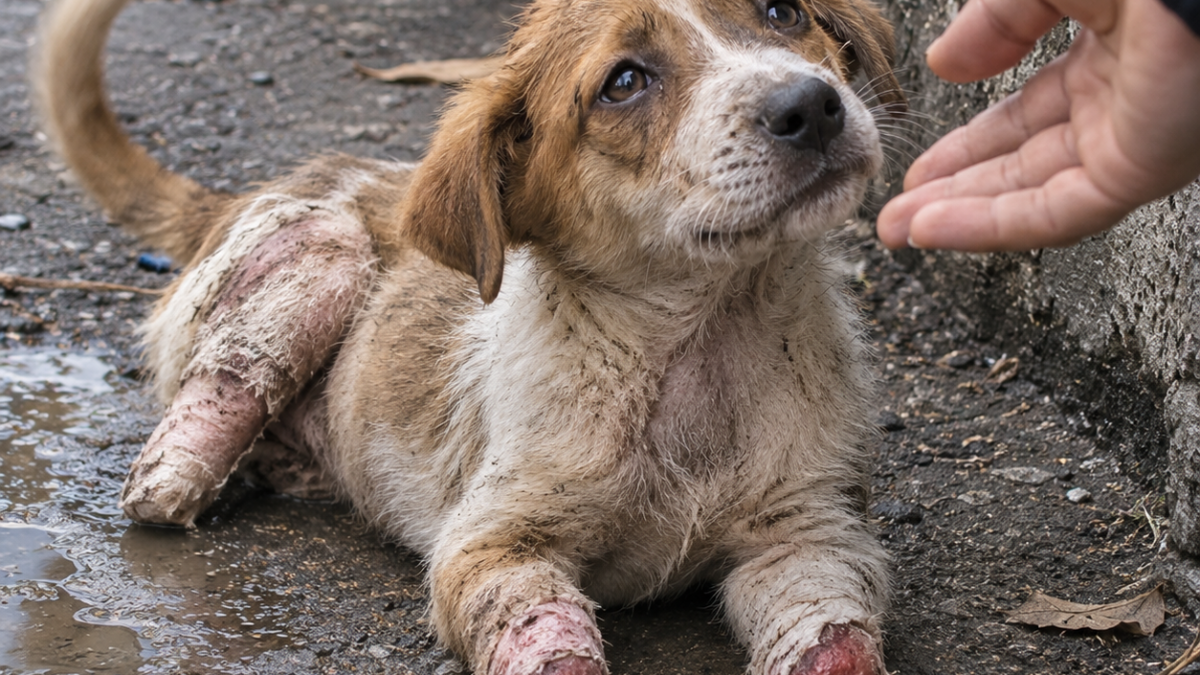
part 2
I barely slept.
Not because Joey was restless.
Because he wasn’t.
That frightened me.
Most rescued dogs I had brought home temporarily over the years spent the first night pacing, whining, sniffing doors, or watching every sound.
This dog slept like something inside him had finally given up the responsibility of staying alert.
Every hour or so, I got up and checked him.
The first time, his eyes opened.
I sat beside him.
“I’m still here.”
His tail moved beneath the blanket.
The second time, he didn’t wake.
I watched his chest rise.
Fall.
Rise.
Fall.
Only then did I go back to bed.
At six in the morning, I heard nails tapping the floor.
Then remembered he didn’t have normal paws.
I rushed into the living room.
He had pushed himself halfway off the blanket.
“Hey. Where are you going?”
He looked toward the kitchen.
Of course.
“Breakfast.”
His tail started.
“At least your priorities work.”
I carried him outside first.
That was when I understood how much daily life was going to change.
The grass was damp.
He tried to balance.
His front limbs slipped.
I caught him before he fell.
His body tensed for half a second.
Then relaxed in my hands.
“Sorry.”
I supported him while he relieved himself.
When we went back inside, Daisy was waiting behind the gate.
She was an eight-year-old mixed breed with the emotional discipline of an overprotective grandmother.
Moose was three, eighty pounds, and convinced every living creature existed to become his best friend.
I let Daisy approach first.
She sniffed the newcomer carefully.
He stayed still.
Then she sniffed his scarred legs.
Her posture changed.
Gentler.
Almost cautious.
The little dog leaned forward and touched noses with her.
Daisy walked away.
Approval granted.
Moose came next.
“Slow.”
Moose ignored me.
He bounced forward.
The new dog startled.
I caught Moose’s harness.
“No.”
Moose immediately sat.
His tail battered the floor.
The new dog stared.
Then, unbelievably, his tail started wagging too.
“You’re either the bravest dog I’ve ever met or you have terrible judgment.”
By eight, I was carrying him into the veterinary hospital.
The receptionist looked down.
Her smile disappeared.
“What happened?”
“I don’t know.”
A technician came immediately.
Then another.
“How long have you had him?”
“Since last night.”
“Was he hit by a vehicle?”
“I found him like this.”
The technician gently lifted one damaged limb.
Her expression hardened.
“These aren’t fresh injuries.”
“I figured.”
“How old?”
“I don’t know.”
“No name?”
I shook my head.
She looked at the dog.
He licked her wrist.
“You poor thing.”
The doctor arrived several minutes later.
Dr. Karen Lewis.
She was probably in her late forties, calm in a way that made me feel calmer too.
She examined every scar.
Every joint.
Every limb.
The dog tolerated everything.
Occasionally his muscles tightened.
But the tail kept moving whenever someone spoke gently.
Dr. Lewis finally sat back.
“Somebody has done a lot to this dog.”
I swallowed.
“Can you tell what happened?”
“Not exactly.”
She pointed carefully.
“The lower portions of several limbs are absent. The wounds are old enough to have scarred over, but the tissue isn’t shaped like a veterinary surgical amputation.”
“What does that mean?”
“It means whatever happened probably wasn’t performed as a proper medical procedure.”
I looked at him.
He was licking crumbs from the examination table.
“Was it an accident?”
“Multiple limbs?”
She didn’t answer the question directly.
“Trauma can cause catastrophic injuries. Untreated infection can too. But I want radiographs before I speculate.”
Blood tests.
X-rays.
Skin evaluation.
Pain assessment.
The list grew.
“Do all of it.”
Dr. Lewis looked at me.
“Do you own him?”
“No.”
“Then who is financially responsible?”
“I am.”
“You may want to contact a rescue organization.”
“I will.”
“These diagnostics won’t be inexpensive.”
“I understand.”
I didn’t.
Not really.
But I’d already looked into his eyes while he woke up three times just to see whether I’d disappeared.
Money was suddenly a secondary problem.
They scanned him for a microchip.
The machine beeped.
Everyone stopped.
“He has one,” the technician said.
My stomach tightened.
“An owner?”
“Potentially.”
I should have felt relieved.
Instead, something cold settled in my chest.
A dog with a microchip meant a history.
A home.
A person.
Maybe an explanation.
Maybe something worse.
The clinic called the registry.
The contact information was still active.
Registered owner:
**Marcus Hale.**
Dr. Lewis looked at me.
“We’re required to document this.”
“Of course.”
The technician called the number.
No answer.
She left a voicemail.
I stared at the dog.
“So your name probably isn’t whatever I was going to call you.”
He licked his nose.
I had spent the entire drive thinking he looked like a Joey.
I don’t know why.
He just did.
“Until somebody tells me otherwise, you’re Joey.”
His ears lifted.
“Joey.”
Tail wag.
“Good enough.”
The radiographs came back an hour later.
Dr. Lewis displayed them on a screen.
Even without medical training, I could see the irregular endings of the bones.
“The tissue has healed,” she explained. “But not optimally.”
“How much pain is he in?”
“Hard to quantify. Dogs compensate remarkably well.”
“That’s not an answer.”
“No.”
She turned toward Joey.
“He probably has discomfort every day.”
My stomach twisted.
“But?”
“But his shoulders, hips, spine, and remaining joint structures are better than I feared.”
“What can we do?”
Her finger traced one image.
“He may be a candidate for prosthetic support.”
I looked at her.
“Feet?”
“Custom prosthetic devices. Not normal feet, obviously. But something that could protect the ends of the limbs, redistribute pressure, and improve mobility.”
“Would he walk?”
“Possibly.”
That word filled the room.
Possibly.
“What do we need?”
“First, we treat what he has now.”
Joey had skin infections in two areas.
Old scar tissue.
Pressure sores.
Mild anemia.
Intestinal parasites.
He was underweight.
And he needed pain management.
The missing limbs were dramatic.
But Dr. Lewis reminded me that his whole body had suffered.
“One problem at a time.”
I nodded.
“One problem at a time.”
Then the receptionist came into the room.
“Dr. Lewis?”
Something in her voice changed the air.
“The registered owner called back.”
I stood.
“What did he say?”
The receptionist looked at me.
“He says the dog ran away.”
“When?”
“Almost four months ago.”
I stared.
“Four months?”
“He claims he’s been looking for him.”
“Did he report him missing?”
She didn’t know.
Dr. Lewis stepped between emotion and procedure.
“We need animal control involved.”
“Why?”
“Because of the injuries.”
That made sense.
If Joey had disappeared four months earlier and been injured after that, his owner might be innocent.
If he disappeared already injured, that was different.
If he never disappeared at all…
I stopped myself.
No conclusions.
Not yet.
An animal control officer arrived before noon.
Officer Elena Brooks.
She photographed Joey.
Recorded the microchip number.
Took my statement.
Asked exactly where I had found him.
“Did you see anyone nearby?”
“No.”
“Vehicle leaving?”
“No.”
“Any collar?”
“No.”
“What condition was he in?”
I described everything.
Then she asked Dr. Lewis questions.
Medical questions.
Timeline questions.
Could these injuries be four months old?
Yes.
Could they be older?
Yes.
Could a dog with these limbs survive four months on the street?
Possible, but difficult.
Could he travel long distances?
Again, possible.
But unlikely without help.
Brooks wrote everything down.
Then she said the part I didn’t want to hear.
“If the registered owner establishes lawful ownership, we can’t simply give the dog to someone else.”
I looked at Joey.
His head was resting on my thigh.
“So he could go back?”
“We don’t know enough yet.”
“He was found like this.”
“I understand.”
“You saw his legs.”
“I did.”
“Then how can—”
Dr. Lewis touched my arm.
“Let her investigate.”
Brooks nodded.
“That’s exactly what I’m going to do.”
I hated the answer.
But I understood it.
That afternoon, Joey came home with medication, special food, bandages, and instructions that covered two pages.
My “one night” guest now had his own bed.
His own bowls.
His own medications.
And a scheduled rehabilitation consultation.
Daisy accepted him almost immediately.
Moose needed supervision because his idea of affection involved throwing his entire body at whoever he loved.
Joey wasn’t afraid of either of them.
He seemed fascinated.
That first evening, Daisy walked into the living room and lay down beside his bed.
Not touching.
Just close.
Joey opened his eyes.
Saw her.
Then went back to sleep.
Moose eventually curled up on the other side.
I stood in the doorway.
Three dogs.
One I hadn’t planned to bring home.
Two already acting like he belonged.
“This is getting out of control.”
Moose thumped his tail.
Joey’s tail joined him.
“Nobody asked you.”
The rehabilitation specialist met Joey a week later.
Her name was Nina Park.
She watched him move across a padded mat.
He pushed forward with remarkable determination.
His damaged limbs made contact with the floor in ways that created uneven pressure.
His spine compensated.
His shoulders twisted.
But he kept going.
Nina crouched.
“He’s incredibly motivated.”
“He likes people.”
“I can see that.”
Joey reached her.
Tail wagging.
She smiled.
“Hi, handsome.”
He leaned into her.
Nina examined the ends of each affected limb.
“We may be able to build prosthetic sockets.”
“What would that involve?”
“Molds. Test fittings. Gradual wear.”
“Will it hurt?”
“It shouldn’t.”
Shouldn’t.
That word would come back to haunt me.
For the next several weeks, Joey healed.
His infections cleared.
He gained weight.
His coat became softer.
And his personality emerged.
Joey loved blankets.
Not beds.
Blankets.
If I bought a new dog bed, he ignored it until I added an absurd number of blankets.
Then it became acceptable.
He loved chicken.
Hated carrots.
Stole socks.
Liked riding in the car as long as he could see me.
He had an obsession with Daisy’s ears.
He would lick them.
Daisy tolerated this with the patience of a saint.
Moose tried to imitate him and got growled at.
Joey also had a strange habit.
If I stood up and left the room, he watched.
Every time.
If I walked too far away, he tried to follow.
Even when it hurt.
So I started talking to him.
“Bathroom.”
He would relax.
“Kitchen.”
Relax.
“Mail.”
He would stare at the door.
“I’m coming back.”
Eventually those words mattered.
I’m coming back.
Maybe whoever had owned him before had taught him the opposite.
Officer Brooks called twelve days after the rescue.
“Marcus Hale reported Joey missing three months and twenty-two days ago.”
“So he did report him.”
“Yes.”
My heart sank.
“Then he’s getting him back.”
“Not so fast.”
I straightened.
“What did you find?”
“The missing report was filed after a neighbor contacted animal control about a dog crying on Hale’s property.”
I went silent.
Brooks continued.
“When officers visited, Hale said the dog had escaped the previous evening.”
“The previous evening.”
“Correct.”
“And the neighbor?”
“Says they hadn’t seen Joey outside for several days before that.”
I looked toward the living room.
Joey was asleep beside Daisy.
“What else?”
“Do you remember me asking whether he had a collar?”
“Yes.”
“Marcus says Joey was wearing a red collar when he disappeared.”
“He wasn’t.”
“Not conclusive.”
“No.”
“We’re collecting veterinary history.”
“Does he have any?”
“That’s one of the problems.”
My chest tightened.
“What problem?”
“Hale hasn’t provided records showing treatment for these injuries.”
I closed my eyes.
“Maybe another vet.”
“Maybe.”
“Do you believe that?”
Brooks paused.
“I don’t work on belief.”
I almost laughed.
Of course.
Evidence.
Always evidence.
The next stage of Joey’s rehabilitation gave me something else to think about.
His prosthetic molds arrived.
Small custom shells.
Soft liners.
Adjustable straps.
The first time Nina showed them to me, I felt hope so strong it almost scared me.
“These are his feet?”
“Think of them as protective extensions.”
Joey sniffed one.
Then tried to bite it.
Nina laughed.
“Excellent start.”
We began with one.
A few minutes.
Remove it.
Check skin.
Repeat.
Joey hated the process initially.
Not the device itself.
The handling.
Anything that required someone to hold his damaged limb too firmly made his breathing change.
So we slowed down.
Treat.
Touch.
Release.
Treat.
Touch.
Release.
Eventually he let Nina position the prosthetic.
She secured it.
Joey froze.
“Okay,” she whispered.
He looked at me.
“You got this.”
He shifted his weight.
The prosthetic touched the floor.
Then something happened that made everyone smile.
His body rose slightly higher.
More balanced.
He took one step.
Stopped.
Another.
His tail started moving.
Nina’s eyes filled.
“Good boy.”
Three steps.
Four.
Joey looked almost confused.
For the first time since I had found him, he had something beneath that limb that resembled a foot.
He walked toward me.
I knelt.
He reached me and pushed his head into my chest.
I cried into his fur.
“I’m sorry.”
Nina laughed softly.
“For what?”
“I don’t know.”
Joey wagged.
The first fitting went beautifully.
So did the second.
We added another device.
Then gradually worked toward supporting the remaining damaged limbs.
Videos from therapy showed Joey learning a new way to move.
Slowly.
Awkwardly.
But with unmistakable pride.
At home, I cleared rugs.
Moved furniture.
Created wide paths.
Daisy and Moose seemed to understand he was learning.
Moose, surprisingly, became careful around him.
If Joey practiced walking across the living room, Moose lay down.
Daisy often walked beside him.
I started imagining the future.
Joey walking normally enough to explore the yard.
Short hikes.
Maybe the beach.
Maybe a dog park when he was ready.
I made the mistake of imagining too much.
Because three weeks later, Joey began licking one of his limbs obsessively.
I removed the prosthetic.
The skin was red.
Inflamed.
Nina adjusted the liner.
We rested him for several days.
Tried again.
Another limb became irritated.
Then another.
Dr. Lewis examined him.
“His scar tissue is very sensitive.”
“Can we change the material?”
“We can.”
We did.
Softer liners.
Different pressure distribution.
Shorter sessions.
The irritation returned.
Then Joey cried.
It happened during a rehab session.
A small sound.
Almost nothing.
But I knew him by then.
Joey didn’t complain.
Not when medication stung.
Not when we cleaned his skin.
Not when he fell.
He just kept trying.
So when he made that sound, everyone stopped.
Nina removed the prosthetic.
The tissue beneath was angry red.
Joey immediately licked my hand.
As though he was apologizing.
I felt sick.
“No.”
I held his face.
“You didn’t do anything.”
He wagged.
That somehow made it worse.
Dr. Lewis was blunt.
“We have to stop.”
“For how long?”
“At minimum until the inflammation resolves.”
“And then?”
She glanced at Nina.
“Maybe we reconsider whether prosthetics are right for him.”
I stared.
“But he was walking.”
“Yes.”
“He was doing well.”
“Mobility isn’t a success if the device creates pain.”
I knew that.
I hated hearing it.
That night, I removed every prosthetic from the bag and placed them in a closet.
Joey watched me.
“I’m sorry.”
He dragged himself toward me.
Tail wagging.
I sat on the floor.
“I thought I was helping.”
He leaned against my chest.
The worst part about caring for an animal is that they cannot tell you when your hope is hurting them.
You have to notice.
And you have to be willing to abandon the future you imagined if it isn’t the future they need.
The prosthetics stayed in the closet.
For a week, Joey rested.
Then two.
His skin healed.
But without the devices, his old mobility problems returned.
He tired quickly.
His shoulders became sore.
Longer walks were impossible.
Nina called.
“I want to try something else.”
“What?”
“A wheelchair.”
I had seen dog wheelchairs.
Mostly for dogs with paralyzed back legs.
Joey’s situation was different.
Multiple limbs were affected.
His body needed broad support.
“We’ve tried a few configurations at the clinic,” Nina explained. “Most won’t work.”
“That’s encouraging.”
“I’m not finished.”
“Sorry.”
“There’s a manufacturer that builds custom quad-support carts.”
“Four wheels?”
“Possibly.”
“What would it do?”
“Support his torso and let him use whatever movement is comfortable without putting the same pressure on those scarred limb ends.”
I looked at Joey.
He was sleeping with his head on Daisy.
“Will it hurt?”
“No device gets a guarantee.”
I appreciated that she didn’t say shouldn’t this time.
“We’ll fit it carefully.”
“Okay.”
The first wheelchair was a disaster.
Too wide.
Joey leaned.
One wheel caught the edge of a doorway.
He panicked.
I pulled him out immediately.
“Nope.”
Nina nodded.
“Nope.”
Second cart.
Too high.
His body looked suspended rather than supported.
Rejected.
Third.
Better.
But the chest strap rubbed an old scar.
Rejected.
Fourth.
Joey could move.
But turning was nearly impossible.
He bumped into walls.
He became frustrated.
One afternoon, after ten minutes, he simply stopped.
Head down.
Tail still.
I knelt.
“You done?”
He looked at me.
“We’re done.”
Nina removed the cart.
For the first time, I wondered whether we were asking too much.
Maybe the kindest thing was to build his life around limited mobility.
Soft beds.
Carrying him outside.
Short supported walks.
No wheels.
No prosthetics.
No grand transformation.
Just comfort.
Then Nina called one Friday.
“One more.”
I laughed tiredly.
“You said that last time.”
“I know.”
“What’s different?”
“Lower center of gravity. Better torso sling. Smaller front casters. Separate rear alignment.”
I had no idea what half of that meant.
“Why do you think it’ll work?”
“I don’t.”
Honest.
“But I think it’s our best design.”
We went Saturday morning.
Joey entered the rehabilitation room like he owned the building.
Everyone knew him.
“Joey!”
Tail wag.
“Hi, handsome.”
More wagging.
Nina brought out the new cart.
It didn’t look dramatic.
Aluminum frame.
Four wheels.
Soft support sling.
Straps.
I stared at it.
“That’s the miracle?”
“Don’t insult my miracle before he tries it.”
We positioned Joey.
Slowly.
No pressure on the damaged ends.
Chest supported.
Pelvis supported.
His limbs able to move naturally within their range.
Nina stepped away.
Joey stood still.
I crouched ten feet in front of him.
“Joey.”
His ears lifted.
“Come here.”
Nothing.
I held up chicken.
His tail moved.
“Bribery,” Nina said.
“Science.”
Joey leaned forward.
The wheels moved.
He froze.
Looked down.
Then forward.
Another shift.
The cart rolled.
His eyes widened.
“Come on.”
He moved again.
Then again.
The wheels followed.
Joey wasn’t dragging his body.
He wasn’t balancing on painful scar tissue.
The cart carried the weight he couldn’t.
He began moving faster.
Nina stepped backward.
“Easy.”
Joey ignored her.
He came straight toward me.
I moved farther away.
“Come on!”
His tail was going crazy now.
He accelerated.
Actually accelerated.
The cart rolled smoothly across the floor.
Joey reached me hard enough that the front bar touched my knees.
I grabbed his face.
“Look at you.”
He licked me.
Everyone in the room was crying.
Then Joey turned.
Not perfectly.
But he turned.
He went toward Nina.
Then back toward me.
Then to the technician holding treats.
Within five minutes, he had understood something extraordinary.
This machine didn’t trap him.
It freed him.
When we took him outside, Daisy and Moose were waiting with my friend.
Joey saw them.
His whole body changed.
He moved.
Fast.
Moose jumped backward in surprise.
Then began bouncing beside him.
Daisy trotted alongside.
Joey rolled across the grass.
Wind in his ears.
Tail flying.
For the first time, I saw him move at the speed of his personality.
I stood there with both hands over my mouth.
Nina touched my shoulder.
“That’s the one.”
I couldn’t speak.
Joey turned in a wide circle.
Came back.
Then headed toward the dogs again.
He looked happy.
Not brave.
Not inspirational.
Happy.
That distinction mattered.
I didn’t want Joey to spend the rest of his life being admired for surviving suffering.
I wanted him to be allowed to become ridiculous.
To chase leaves.
To bother Daisy.
To steal Moose’s toys.
To demand dinner.
To be a dog.
The wheelchair came home with us that afternoon.
Within a week, Joey learned every room.
Within two, he learned how to reverse when he trapped himself against furniture.
Within three, he learned that running the front wheel over my foot made me react.
He found this fascinating.
“Stop.”
Wheel on foot.
“Joey.”
Tail wag.
He did it again.
“You are evil.”
His face said otherwise.
The mobility breakthrough should have been the happiest point of the story.
Then Officer Brooks called.
“We found someone who knew Joey before he disappeared.”
My stomach tightened.
“Who?”
“A former neighbor of Marcus Hale.”
“What did they say?”
“Can you come to the office?”
That phrase never means anything good.
I went.
Brooks had a folder on the table.
Photographs.
Statements.
Screenshots.
She opened the first image.
Joey.
Healthy.
Younger.
Four paws intact.
Standing beside a blue plastic kiddie pool.
I stared.
“That’s him.”
“Microchip and markings match.”
Another photograph.
Joey beside a porch.
All four paws.
Another.
Joey wearing a red collar.
Then a later photograph.
No red collar.
Body thinner.
One leg wrapped in what looked like a homemade bandage.
My stomach turned.
“When?”
“Six months before you found him.”
“What happened?”
“The neighbor says Joey injured one foot.”
“How?”
“Marcus told people he caught it in a piece of equipment.”
“Did he take him to a vet?”
“We haven’t found records.”
Brooks showed me another screenshot.
A text exchange between Marcus and the neighbor.
**Neighbor:** That leg looks bad. He needs a vet.
**Marcus:** Vet wants too much.
Another.
**Neighbor:** He’s crying all night.
**Marcus:** He’ll get over it.
My jaw tightened.
Brooks continued.
“Several weeks later, the neighbor stopped seeing Joey outside.”
I looked at her.
“Several limbs were missing when I found him.”
“Yes.”
“So what happened inside that house?”
“We’re working on that.”
She slid over another page.
A statement from Marcus’s former girlfriend.
She had moved out months before Joey disappeared.
According to her, Marcus had become increasingly angry about veterinary costs.
Joey’s first injury worsened.
Infection spread.
Marcus attempted to treat him himself.
The exact sequence was unclear.
But there had been no licensed medical care.
The former girlfriend said she saw Joey afterward.
Multiple limbs bandaged.
Bleeding had stopped.
The dog was alive.
Marcus told her he had “handled it.”
I stopped reading.
“What does that mean?”
Brooks’ face remained controlled.
“We don’t have to describe methods to establish neglect and unlawful treatment.”
“Did he do this to Joey?”
“The medical opinion is that these amputations were not performed professionally.”
I stood.
Walked to the window.
Then back.
“So he let one injury get bad.”
“Possibly.”
“Then instead of going to a vet…”
I couldn’t finish.
Brooks closed the folder.
“We’re submitting the evidence to the prosecutor.”
“Why did he report Joey missing?”
“That is the question.”
“To protect himself?”
“Maybe.”
“What changed?”
“There’s more.”
Of course there was.
The neighbor had a security camera.
Old footage was automatically deleted after several months.
But one clip had been saved because the neighbor originally thought it showed a burglary attempt.
The timestamp was the night before Marcus reported Joey missing.
The video showed Marcus’s van leaving his driveway at 11:38 p.m.
Twenty-seven minutes later, it returned.
No one could see Joey.
But another camera at a gas station near the street where I’d found him captured the van.
Same night.
Same window of time.
Marcus had told animal control Joey escaped from his fenced yard around six the next morning.
The timeline didn’t fit.
Then police recovered cloud backups from Marcus’s phone under warrant.
One message to a friend had been sent at 12:16 a.m.
**Finally got rid of the dog problem.**
I sat down.
For a while, neither Brooks nor I spoke.
“Dog problem.”
“I know.”
“He called Joey a problem.”
Brooks nodded.
I looked at the photographs again.
Joey with four paws.
Joey by the pool.
Joey healthy.
Someone had once known him before pain became his identity.
And the same person who had been responsible for protecting him had apparently watched his condition worsen, failed to obtain proper care, then discarded him.
“Can you arrest him?”
“The prosecutor is reviewing charges.”
“That’s not what I asked.”
“No.”
Brooks leaned forward.
“Listen to me.”
I looked at her.
“I know you’re angry.”
“That word feels small.”
“I know.”
“He came toward me wagging his tail.”
Brooks said nothing.
“He should hate people.”
“But he doesn’t.”
“That’s what makes this worse.”
“No.”
She surprised me.
“That’s what makes Joey better than what happened to him.”
I looked away.
Brooks continued.
“Do not contact Marcus.”
“I wasn’t planning—”
“Do not.”
I nodded.
“Do not post his name.”
“I won’t.”
“Do not go to his house.”
“I’m not an idiot.”
“Angry people become temporary idiots.”
Despite everything, I almost smiled.
“Fine.”
“Let us build the case.”
I thought about Joey learning to run in his wheelchair.
“What if he comes for Joey?”
“He won’t get him.”
“How do you know?”
“Because ownership is being held pending the cruelty investigation.”
“That’s not the same as never.”
“No.”
She looked directly at me.
“But we’re working toward never.”
That became my goal.
Not prison.
Not humiliation.
Not revenge.
Never.
Joey would never go back.
I returned home.
He heard the door.
His wheelchair wasn’t on.
He pushed himself out of the living room anyway.
“Hey.”
Tail wag.
I sat on the floor.
Joey reached me.
I buried my face in his neck.
He smelled like shampoo and grass.
Not fear.
Not streets.
Home.
“I’m sorry.”
He licked my ear.
“I know you don’t know what I’m talking about.”
More licking.
“I’m going to make sure he never touches you again.”
The next week, Marcus Hale came to my house.
I wish I could say I was surprised.
I wasn’t.
I had worried it would happen since the first day animal control mentioned ownership.
The doorbell rang at 7:20 in the evening.
Daisy barked.
Moose joined her.
Joey lifted his head.
I looked through the camera.
Marcus.
I recognized him from the photograph Officer Brooks had shown me.
I didn’t open the door.
I spoke through the camera.
“What do you want?”
“Give me my dog.”
My hands went cold.
“No.”
“He belongs to me.”
“Contact animal control.”
“I already did.”
“Then you know he’s being held.”
“You’re keeping him in your house.”
“With authorization.”
“You stole him.”
I almost laughed.
“You reported him missing.”
“Exactly.”
“After your van was recorded near where he was abandoned.”
Silence.
I shouldn’t have said that.
Brooks had told me not to discuss evidence.
Marcus stepped closer to the camera.
“You don’t know what happened.”
“Then explain it to the investigators.”
“Open the door.”
“No.”
“I want to see him.”
Behind me, something moved.
Joey.
He had pushed himself into the hallway.
Marcus heard the sound.
“Joey!”
The reaction was immediate.
Joey froze.
Not curious.
Not excited.
Frozen.
His tail disappeared between his legs.
He lowered himself.
Then began backing away.
My anger became ice.
Marcus called again.
“Come here, Joey.”
Joey turned.
Dragged himself toward the bedroom.
I stepped in front of the camera.
“You need to leave.”
“He’s my dog.”
“Leave.”
“Open this door.”
Moose was barking now.
Daisy stood between Joey and the entrance.
Marcus hit the door with his palm.
“Give me my property!”
Property.
That word.
I called 911.
Marcus heard me.
“You calling the cops?”
“Yes.”
“You people are insane.”
“Leave.”
“I spent money on that dog.”
I stared at the camera.
“And then didn’t spend money when he needed a veterinarian.”
Silence.
That landed.
His voice changed.
“You have no idea what veterinary bills cost.”
Something inside me almost snapped.
I thought about the prosthetics.
The hospital visits.
Medication.
Wheelchair fittings.
Every bill.
Every hour.
Every sleepless night.
“No,” I said quietly. “I know exactly what they cost.”
He had no answer.
Police arrived six minutes later.
Marcus left before they reached the porch but was stopped two streets away.
He wasn’t arrested that night.
But there was now a documented incident.
A threat.
Trespass notice.
And a recording of him demanding Joey back.
The most important evidence, however, wasn’t Marcus.
It was Joey.
The security camera inside the hallway had captured his reaction when Marcus called his name.
Brooks watched the video.
“Behavior alone won’t prove abuse.”
“I know.”
“But it matters.”
I nodded.
The criminal case moved forward.
Slowly.
Painfully slowly.
A forensic veterinarian reviewed Joey’s records.
She documented the condition of the limb ends.
The scarring.
The lack of surgical shaping.
Evidence of previous infection.
Chronic pressure damage.
Her opinion was careful.
Professional.
She could not say exactly how every injury happened.
She could say what almost certainly did not happen.
These were not the results of proper veterinary amputations followed by appropriate aftercare.
Marcus’s financial records showed no major veterinary payments during the relevant period.
No clinic had records of treating Joey’s limb injuries.
His former girlfriend provided messages.
The neighbor testified about crying.
The gas station camera showed the van.
Cloud data showed the message.
**Finally got rid of the dog problem.**
And Marcus had told police Joey escaped the following morning.
One lie.
Then another.
Then another.
While the legal case grew, Joey grew stronger.
The wheelchair became an extension of him.
He learned to wait by the door while I clipped him in.
The moment the final strap was secure, he knew.
Outside.
He ran.
He chased Moose.
Daisy trotted behind.
At the park, children asked questions.
“What happened to his legs?”
At first, I didn’t know what to say.
Then I learned.
“He had a very hard life before he came home.”
“Does it hurt?”
“Not when he’s in his wheels.”
“Is he sad?”
I looked at Joey.
He was trying to steal a sandwich from someone’s picnic bag.
“No.”
That became my favorite answer.
No.
He wasn’t sad.
He had pain sometimes.
Frustration.
Fear.
Bad memories.
But Joey was not a sad dog.
People made the mistake of looking at his body and deciding his life must be tragic.
Joey disagreed.
His life contained chicken.
Blankets.
Two dog siblings.
Car rides.
A yard.
A wheelchair that turned him into a menace.
He had no interest in being a symbol.
He wanted snacks.
That summer, we went to a lake.
I worried the terrain would be difficult.
We found a wide flat path.
Joey rolled beside Daisy and Moose.
At the water, I lifted him out of the cart and supported him with a flotation harness.
He paddled.
At first uncertain.
Then happily.
Moose splashed him.
Joey snapped at the water.
Daisy stood on shore refusing to participate in the nonsense.
I laughed until my stomach hurt.
That night, Joey slept between the other two dogs.
All three exhausted.
I took a photograph.
Not for court.
Not for evidence.
Not for rescue publicity.
For me.
Three dogs.
One blanket.
No street.
No scars visible unless you knew where to look.
I realized the best photographs of Joey were the ones where his disability wasn’t the first thing you noticed.
He was simply home.
Three months after I found him, the rescue organization helping with his rehabilitation asked whether I wanted to become his permanent foster pending legal resolution.
I signed immediately.
Six months later, the prosecutor called.
Marcus had been formally charged with multiple animal cruelty-related offenses and abandonment.
Some counts were felonies under the applicable statute.
Others were misdemeanors tied to failure to provide care and making false statements.
I didn’t celebrate.
Not yet.
Charges were accusations.
Evidence still had to survive court.
Marcus hired an attorney.
The attorney argued Joey’s original injury had been accidental.
Possible.
The attorney argued infection had caused subsequent tissue loss.
Possible.
The attorney argued Marcus had performed emergency care because he couldn’t afford a veterinarian.
That made my blood boil.
Emergency care.
As if the phrase could sanitize what Joey’s body showed.
Then the attorney argued Joey eventually escaped.
That was where the story cracked.
The van.
The gas station.
The message.
The timing.
The court ordered Marcus to relinquish temporary possession rights pending trial.
That meant Joey stayed with me.
After the hearing, I sat in my car and cried.
Not because the case was over.
Because for the first time, there was a legal document saying Marcus could not take him.
I drove home.
Joey was waiting.
Wheelchair parked beside the door.
Daisy beside him.
Moose behind him.
I knelt.
“Guess what?”
Tail wag.
“You’re staying.”
More wagging.
“At least for now.”
He rolled into me after I attached the cart.
“Personal space.”
He had none.
The prosecutor warned me the case could take a year.
It took eleven months.
During those eleven months, life refused to become only about the case.
Joey had a birthday.
We didn’t know the exact date.
So I used the day I found him.
“Found Day.”
Mara, one of the rescue volunteers, brought a dog-safe cake.
Nina came.
Dr. Lewis came.
Officer Brooks stopped by after her shift.
Joey wore a blue bandana.
He hated hats, so I spared him.
We sang.
Joey barked at the cake.
Then tried to eat Moose’s portion too.
Brooks laughed.
“This is the victim from my case?”
“Unfortunately.”
Joey ran over her boot with the wheelchair.
She looked down.
“Assaulting an officer.”
I pointed.
“Arrest him.”
Joey wagged.
Everyone laughed.
For one evening, no one talked about Marcus.
That mattered.
The case was something that happened around Joey.
It was not Joey.
The prosecutor asked whether I would testify.
“Of course.”
“You’ll be asked what you saw when you found him.”
“I can do that.”
“They may challenge your interpretation.”
“I won’t interpret.”
“Good.”
“I’ll describe.”
Exactly.
Street.
Scars.
Missing feet.
Wagging tail.
His weight.
His condition.
The way he came toward me.
The trial began on a Monday.
Marcus sat beside his attorney wearing a suit.
I had never seen him dressed that way.
He looked ordinary.
That’s what disturbed me.
We like villains to look like villains.
It makes life easier.
But cruelty often wears clean clothes.
Answers emails.
Buys groceries.
Waves to neighbors.
Then makes one selfish decision after another until another living creature carries the damage.
The prosecutor showed photographs of Joey before.
Four paws.
Healthy.
Then later.
Bandaged.
Thin.
Then the photographs from the day after I found him.
Scarred limbs.
Underweight body.
Pressure wounds.
The courtroom became very quiet.
Dr. Lewis testified.
The forensic veterinarian testified.
Nina testified about rehabilitation.
The prosecutor did not show videos of Joey struggling for emotional effect.
She didn’t need to.
The medical facts were enough.
Then the neighbor testified.
He described hearing Joey cry.
He had knocked once.
Marcus told him the dog had “hurt himself.”
He suggested a veterinarian.
Marcus became angry.
The former girlfriend testified.
She cried.
She had seen Joey after the first major injury.
She had begged Marcus to surrender the dog if he couldn’t afford treatment.
He refused.
“Why?” the prosecutor asked.
She looked at Marcus.
“He said no one was taking his dog.”
The words made my stomach turn.
Ownership.
Not responsibility.
Control.
Then the message appeared on the courtroom screen.
**Vet wants too much.**
Another.
**He’ll get over it.**
Another.
**Finally got rid of the dog problem.**
Marcus’s attorney objected to the interpretation.
The judge allowed the messages but reminded the jury to consider context.
Context.
The word almost made me laugh.
The context was sitting at home with Daisy and Moose, probably sleeping on six blankets.
I testified on day four.
The prosecutor asked me to describe the moment I saw Joey.
I did.
“What did he do when you approached?”
“He came toward me.”
“How?”
“Slowly. Awkwardly.”
“Was he aggressive?”
“No.”
“Fearful?”
“Not toward me.”
“What did he do?”
I swallowed.
“He wagged his tail.”
The prosecutor paused.
“Despite his physical condition?”
“Yes.”
Marcus looked down.
His attorney stood.
“You are not a veterinarian, correct?”
“Correct.”
“You did not witness how Joey lost portions of his limbs.”
“No.”
“You did not see Mr. Hale injure him.”
“No.”
“You cannot tell this jury whether an accident caused the original injury.”
“No.”
“You can’t tell them whether infection caused tissue loss.”
“No.”
“You can’t tell them whether my client tried to help.”
I looked at him.
“I can tell you what I found.”
“That wasn’t my question.”
“No.”
He paced.
“You became emotionally attached to this dog.”
“Yes.”
“You want to keep him.”
“Yes.”
“So you benefit if Mr. Hale loses ownership.”
“Yes.”
The prosecutor looked uneasy.
The attorney continued.
“You have a personal interest in the outcome.”
I thought about it.
“Yes.”
He smiled slightly.
“Nothing further.”
Before he sat, I said, “But I didn’t create the photographs.”
He stopped.
The judge looked at me.
I continued only because no one stopped me.
“I didn’t create the medical records. I didn’t send the messages. I didn’t drive his van.”
“Objection.”
“Sustained.”
The judge told the jury to disregard my volunteered comments.
I apologized.
Outside the courtroom, the prosecutor looked at me.
“Don’t do that.”
“I know.”
“Seriously.”
“I know.”
Then she almost smiled.
“But…”
“No.”
I laughed for the first time all day.
The defense’s central argument was that Marcus had been poor, overwhelmed, and dealing with an injured dog without resources.
The prosecutor didn’t attack poverty.
She attacked choices.
Animal-control assistance had existed.
Low-cost veterinary services existed.
Rescue surrender existed.
His former girlfriend had offered help.
The neighbor had suggested help.
Marcus had refused.
Then lied.
Then drove.
Then messaged a friend that the problem was gone.
The distinction mattered.
Being unable to afford ideal care was not the same as deliberately refusing every alternative.
The jury deliberated for most of a day.
I sat in the hallway with Officer Brooks.
My hands wouldn’t stop moving.
She handed me coffee.
“I can’t drink this.”
“You’ve had three.”
“That’s why I can’t drink this.”
She took it back.
I showed her a photograph on my phone.
Joey in his wheelchair.
Daisy beside him.
Moose upside down in the grass.
“He’s happier than I am.”
“Most dogs are.”
“What if they acquit?”
Brooks was quiet.
“Then Joey still has his current life while the ownership court resolves the remaining issues.”
“That’s not enough.”
“No.”
She looked at me.
“But don’t confuse the verdict with whether what happened mattered.”
I hated reasonable people.
The courtroom doors opened.
We were called inside.
I stared at the table.
Not Marcus.
The table.
The clerk read the first verdict.
Guilty.
I stopped breathing.
Second.
Guilty.
Another.
Guilty.
One lesser count.
Not guilty.
Another.
Guilty.
My eyes filled.
Marcus didn’t look at me.
The sentencing hearing came several weeks later.
By then, the legal ownership issue had been resolved.
Marcus permanently relinquished any claim to Joey.
The prosecutor called me.
“It’s final.”
I sat on my kitchen floor.
“Say it again.”
“He has no ownership rights.”
“Ever?”
“Correct.”
I covered my face.
Joey rolled toward me.
One wheel bumped my knee.
“You’re mine.”
Tail wag.
“No.”
I corrected myself.
“That’s not right.”
I held his face.
“You’re yours.”
He licked me.
“But you live here.”
That afternoon, I signed the adoption paperwork.
Officially.
No temporary foster language.
No pending case.
No ownership dispute.
**Adopter: me.**
**Animal: Joey.**
I stared at the paper.
The rescue coordinator smiled.
“Do you want a photograph?”
“Yes.”
Joey was in his wheelchair.
I knelt beside him.
He turned his face away exactly when the picture was taken.
“Perfect.”
We tried again.
This time he licked my nose.
The third photograph was worse.
I kept all three.
At sentencing, the judge spoke directly to Marcus.
She didn’t shout.
That made it more powerful.
“You have repeatedly characterized your decisions as the product of financial hardship.”
Marcus stared forward.
“The court recognizes that veterinary care can be expensive.”
She paused.
“But inability to afford one option does not grant a person permission to inflict suffering or abandon an animal without seeking lawful alternatives.”
Silence.
“You were offered help.”
Another pause.
“You rejected it.”
She referenced the messages.
The lies.
The van.
The medical evidence.
Then she said:
“The animal survived despite your decisions, not because of them.”
That sentence stayed with me.
Marcus received a sentence that included incarceration on the most serious count, probation afterward, restitution toward documented veterinary and rehabilitation costs, mandatory counseling and animal-welfare education, and a long-term prohibition on owning or possessing animals under the terms imposed by the court and local authorities.
It wasn’t the fantasy punishment anger imagines.
No dramatic collapse.
No confession.
No apology.
Marcus remained mostly expressionless.
As deputies prepared to escort him away, he finally looked toward me.
For a second, our eyes met.
I expected hatred.
Maybe I wanted it.
Instead, he looked tired.
Then he said something quietly to his attorney.
I couldn’t hear.
That was it.
No revenge speech.
No final confrontation.
Outside the courthouse, Brooks found me.
“How do you feel?”
“Like I should feel more.”
“More what?”
“Happy.”
She nodded.
“Go home.”
“That’s your advice?”
“Yes.”
“Very profound.”
“Go home to Joey.”
So I did.
The moment I opened the door, Daisy barked.
Moose ran.
Joey was in the living room.
I attached his wheelchair.
He launched himself toward me.
Front wheel over my shoe.
I laughed.
“There you are.”
He circled.
Bumped Moose.
Daisy followed.
Three dogs filling the room.
That was the moment the verdict finally felt real.
Marcus was somewhere else.
Joey was here.
The next year was the best year of his life.
Maybe mine too.
We learned what the wheelchair could do.
Smooth trails.
Grass.
Wood floors.
Sidewalks.
Packed sand.
We also learned what it hated.
Deep mud.
Loose gravel.
Stairs.
Laundry baskets left in hallways.
I became an expert in carrying a dog and a four-wheeled cart at the same time.
Joey became famous at our local park.
Not internet famous.
Better.
Neighborhood famous.
People knew him.
“Joey!”
Tail wag.
Children ran up.
He loved attention.
One little boy who used a wheelchair himself met Joey one Saturday.
He was maybe seven.
He stared at the cart.
“He’s like me.”
His mother looked nervous.
I smiled.
“Looks that way.”
The boy moved closer.
“Does he race?”
I looked at Joey.
“Unfortunately.”
The boy laughed.
They rolled side by side for twenty yards.
Joey cheated by cutting across the grass.
The boy shouted.
“He cheated!”
“Joey has no morals.”
His mother laughed so hard she cried.
After that, we sometimes visited a rehabilitation center with permission from Joey’s veterinarian and a therapy-dog evaluator.
He wasn’t a formal therapy dog at first.
Too enthusiastic.
Too likely to steal snacks.
But people loved him.
Especially patients learning to use new mobility devices.
Joey didn’t understand inspiration.
He understood attention.
That was enough.
A teenager recovering from a spinal injury once asked me, “Does he know he’s disabled?”
I looked at Joey.
He was chewing a therapy resistance band he had stolen.
“I don’t think he cares.”
The teenager laughed.
Then became quiet.
“Must be nice.”
I thought about that later.
Humans compare ourselves to who we were.
To who we thought we’d become.
Dogs live closer to the present.
Joey didn’t wake thinking about the feet he used to have.
He woke thinking about breakfast.
Maybe that wasn’t wisdom.
Maybe it was simply being a dog.
But I learned from it anyway.
At home, he built relationships with Daisy and Moose that changed over time.
Daisy became his protector.
If Joey tipped slightly in his cart, she stood beside him until I fixed it.
If another dog approached too quickly on a walk, Daisy stepped between them.
Moose became his idiot brother.
They played tug.
Moose learned to stay low so Joey could reach.
Joey learned to ram the wheelchair gently into Moose when he wanted the toy.
Moose learned absolutely nothing from this and continued falling for it.
At night, all three slept near one another.
Sometimes I sat in the doorway and watched.
I remembered the first night.
Joey opening his eyes.
Checking.
Someone still there?
Years later, he stopped checking.
That was one of the greatest signs of recovery.
He slept deeply.
Trust is sleep.
People talk about trust as eye contact and affection.
I think trust is an animal letting consciousness go because they believe the room will still be safe when they wake.
Joey trusted.
Then Daisy got sick.
She was almost eleven.
Cancer.
Aggressive.
We tried surgery.
Then medication.
For three months, she did well.
Then she didn’t.
Joey stayed beside her.
No wheelchair inside the bedroom.
I placed him on a blanket near her bed.
He crawled closer.
Daisy rested her head against his shoulder.
They stayed like that.
When we finally said goodbye to Daisy, Joey searched the house for two days.
Living room.
Kitchen.
Her bed.
Door.
He waited.
The third day, he stopped near the empty bed and whined.
I sat on the floor.
“I know.”
He pressed his head into me.
Moose lay beside us.
Grief changed the house.
For weeks, it felt too quiet even with two dogs.
I kept Daisy’s collar.
Joey kept trying to sleep where she had slept.
Eventually, I moved his favorite blanket there.
He claimed the spot.
That felt right.
Life continued.
That’s what life does, even when it feels insulting.
Joey turned seven.
Then eight.
We didn’t know his exact age, but Dr. Lewis estimated.
His wheelchair changed twice as his body changed.
New straps.
Better frame.
Lighter wheels.
A company heard about him through the rehabilitation center and offered to donate an upgraded cart.
I accepted on one condition.
“Don’t make him a sad advertisement.”
The representative laughed.
“What do you mean?”
“No before picture where he looks destroyed beside a heroic product photo.”
“Fair.”
“I want him stealing a sandwich.”
That became the photo.
Joey in his cart.
Head turned toward a picnic table.
Clearly planning a crime.
The company used it with the caption:
**Mobility should lead to mischief.**
Perfect.
Donations began coming to the rescue organization.
Not huge amounts.
Enough.
Nina suggested creating a small mobility fund for animals whose families or rescues couldn’t afford custom carts.
We named it Joey’s Wheels.
I hated the name because it sounded corny.
Everyone else loved it.
I lost.
The first recipient was a dachshund named Penny.
Spinal injury.
Her family couldn’t afford the full cart.
The fund covered it.
I attended her fitting.
The moment Penny realized she could move, she ran directly into a chair.
Her family cried.
I laughed.
“That’s a good sign.”
Then a senior shepherd.
Then a three-legged dog needing specialized support.
Then a cat with hind-limb paralysis.
Joey didn’t know.
He was busy stealing treats at the clinic.
But the dog somebody had decided wasn’t worth veterinary care was now helping other animals receive mobility equipment.
That felt like revenge I could live with.
Not suffering returned for suffering.
Something stolen from cruelty and turned into help.
Officer Brooks visited us occasionally.
One afternoon, she arrived in plain clothes.
Joey recognized her immediately.
Tail wag.
She scratched his head.
“I’ve got news.”
I stiffened.
“Marcus?”
“Yes.”
I hated how quickly the old feeling returned.
“What?”
“He completed his incarceration and is on supervision.”
I nodded.
“Okay.”
“Part of the animal-possession restriction remains active.”
“Good.”
“There’s something else.”
I waited.
“He attempted to adopt a dog through a rescue in another county.”
My anger rose.
“What?”
“Application denied.”
“Because of the record?”
“Yes.”
I looked at Joey.
He was licking Brooks’ hand.
“Does he know why?”
“Oh, yes.”
I felt something cold and satisfying settle into place.
Years earlier, Marcus had refused help because he wanted control over Joey.
Now a permanent record of what he had done stood between him and another vulnerable animal.
That mattered.
Brooks watched me.
“You’re smiling.”
“No.”
“You are.”
“Maybe.”
“Don’t enjoy it too much.”
“I’ll enjoy exactly the correct amount.”
She laughed.
Joey ran over her foot.
“Still assaulting law enforcement.”
“Serial offender.”
The years softened the sharpest parts of my anger.
Not because what Marcus did became less terrible.
Because Joey’s life became bigger.
There was only so much room in the story.
The more birthdays, road trips, naps, ruined blankets, broken wheelchair clips, vet visits, friendships, and ordinary mornings Joey collected, the less space Marcus occupied.
That became the best revenge of all.
Irrelevance.
The man who had once controlled Joey’s entire world became someone Joey no longer needed to know existed.
Joey aged.
Slowly at first.
Gray appeared around his muzzle.
His shoulders developed arthritis from years of compensation.
We adjusted pain medication.
Changed the wheelchair support.
Reduced longer outings.
But Joey remained Joey.
At ten, he still raced Moose.
At eleven, he still stole food.
At twelve, he began sleeping more.
Moose died that winter.
Heart failure.
Sudden.
One morning he was there.
By evening, he wasn’t.
Joey was now the last of the original three.
I worried about him.
He searched less than he had for Daisy.
Maybe age.
Maybe understanding.
Maybe dogs don’t grieve in neat patterns.
He simply became quieter.
So I became louder.
More walks.
More car rides.
More visitors.
More time in the sun.
A neighbor adopted a young dog named Poppy.
Poppy adored Joey.
She would run circles around his wheelchair.
Joey pretended to be annoyed.
Then chased her.
His world expanded again.
At thirteen, Joey’s mobility changed.
Even with the cart, his endurance decreased.
Nina had retired, but her former colleague adjusted everything.
Lighter harness.
More torso support.
Shorter sessions.
“Are we asking too much?” I asked.
The therapist watched Joey.
“No.”
“How do you know?”
“Because when he’s done, he stops.”
That was true.
Joey had finally learned he didn’t have to keep trying just because a human wanted him to.
If he was tired, he stopped.
If the cart became uncomfortable, he looked at me.
If he didn’t want to move, he didn’t.
That trust took years.
I respected it.
Some days, we used the wheelchair.
Some days, I carried him outside.
Some days, he lay in the grass while Poppy chased bugs nearby.
People still saw him and said:
“Poor thing.”
I started correcting them.
“He’s not poor anything.”
Sometimes the person looked embarrassed.
I softened.
“He’s old.”
Then I would point.
“See that expression?”
Joey was usually staring at food.
“That’s entitlement.”
They laughed.
He deserved to be seen as more than what happened to his legs.
One autumn afternoon, I found the old prosthetics while cleaning a closet.
The devices we had tried years ago.
I sat on the floor.
Joey was sleeping nearby.
I picked up one.
Tiny.
Heavy in my hand.
For a second, I remembered the hope.
The first steps.
Then the red skin.
Pain.
Failure.
At the time, I had thought we had lost something.
Now I saw it differently.
The prosthetics failed.
Joey didn’t.
Failure isn’t always a wrong turn.
Sometimes it eliminates the road that isn’t yours.
The wheelchair became possible because we stopped insisting on another solution.
I put the prosthetics in a box.
Not trash.
History.
Then I looked at Joey’s current cart.
Scratched frame.
Worn wheels.
Stickers from children at the rehabilitation center.
One said:
**GO JOEY GO**
Another:
**FAST BOY**
A third:
**NO FEET, NO PROBLEM**
I had objected to that one at first.
Then Joey ran over my foot again.
I accepted it.
At fourteen, bloodwork showed kidney disease.
Not severe.
Then more severe.
We adjusted diet.
Added fluids.
Medication.
Monitoring.
I knew this road.
Daisy.
Moose.
Age eventually collects every debt.
The unfair part was that Joey had already paid too many.
“He’s had enough,” I told Dr. Lewis, who had come out of retirement for occasional consultation.
She looked at me.
“That’s not how life calculates time.”
“I know.”
“He doesn’t know he’s owed years.”
“I do.”
She touched my arm.
“Then make the years he has good.”
So I did.
Chicken returned more often.
He had spent his entire life being medically managed.
At fourteen, I became more generous.
One extra treat.
Then another.
“He’s manipulating you,” my friend said.
“Yes.”
Joey stared.
“He’s earned it.”
His last summer was warm.
We took him to the lake again.
Not to swim.
He sat in his cart near the shore.
Wind moved his fur.
He watched children.
Dogs.
Water.
I took a photograph.
Gray muzzle.
Old eyes.
Scarred limbs supported by the frame.
He looked peaceful.
Not triumphant.
Not heroic.
Just peaceful.
That was enough.
On the anniversary of the day I found him, we had one more Found Day.
Fourteen candles were too many and probably inaccurate.
So I used one.
Joey got chicken.
Poppy visited.
Officer Brooks came.
Dr. Lewis came.
Nina came with her husband.
The rescue coordinator brought a printed list of animals Joey’s Wheels had helped.
Forty-three.
Forty-three animals had received some form of mobility support.
I stared at the number.
“Forty-three?”
Nina smiled.
“Forty-three.”
I looked at Joey.
He was trying to eat wrapping paper.
“Legacy.”
Brooks laughed.
“Very dignified.”
I read the names.
Penny.
Max.
Luna.
Benny.
Shadow.
Coco.
Forty-three.
Marcus had once refused veterinary care because Joey cost too much.
Joey’s story had now paid forward thousands of dollars in assistance.
I felt no urge to tell Marcus.
That surprised me.
Years earlier, I would have wanted him to know.
Wanted him to see what Joey became.
Wanted him humiliated by it.
Now I understood that Joey’s life didn’t require Marcus as an audience.
The victory was complete even if the person who caused the suffering never saw it.
That was freedom.
Several months later, Joey stopped wanting the wheelchair.
I knew immediately.
I brought it out.
His ears didn’t lift.
I positioned the harness.
He turned his head away.
“Not today?”
No response.
I tried the next day.
Same.
I called the therapist.
She examined him.
No new injury.
No pressure problem.
Just age.
Fatigue.
“He may be telling you he’s done with this stage.”
I hated the sentence.
“Done with the wheelchair?”
“Maybe.”
“But he loves it.”
“He did.”
Did.
Past tense.
I took Joey home.
Placed him in the yard on a thick blanket.
Poppy came over.
She ran.
Joey watched.
Tail moved.
He didn’t need to chase.
He seemed content just seeing her.
I sat beside him.
“Okay.”
I touched his head.
“No more wheels if you don’t want them.”
His tail tapped once.
The wheelchair remained by the back door for weeks.
I couldn’t put it away.
It looked like Joey.
Like freedom.
Like years of movement.
Eventually I moved it to the garage.
Joey’s world became smaller.
Bedroom.
Living room.
Yard.
Carried between them.
The strange thing was that he didn’t seem sad.
I was the one mourning every reduction.
Dogs don’t count what they lose the way we do.
Joey still had what he cared about.
Food.
Warmth.
People.
Touch.
Sunlight.
He rested.
That winter, he began waking at night.
Sometimes disoriented.
I would find him trying to move off his bed.
I slept on the couch nearby.
Just like the first night.
He opened his eyes.
Saw me.
Relaxed.
Full circle.
The first night he had checked whether I was still there because he didn’t trust anyone to stay.
Now he checked because age made the world confusing.
The answer remained the same.
“I’m here.”
One morning, Joey refused breakfast.
That had happened before.
The next day, he ate.
This time he didn’t.
Chicken.
Nothing.
Favorite treat.
Nothing.
Water.
A little.
I called Dr. Lewis.
She came that afternoon.
Listened.
Examined.
Bloodwork confirmed what we already suspected.
Kidneys failing.
Other systems beginning to follow.
“What can we do?”
She looked at me.
“For how long?”
I hated that question.
“Comfortably.”
She was silent.
“Days. Maybe a little more.”
I sat beside Joey.
His head rested on my thigh.
“I don’t want him to suffer.”
“I know.”
“He’s suffered enough.”
“I know.”
That night, I carried him outside.
Cold air.
Clear sky.
I wrapped him in a blanket.
We sat on the porch.
The street was quiet.
Not the same street where I found him.
A different life.
I thought about that first moment.
Scarred dog.
Missing feet.
Dragging himself toward me.
Tail wagging.
I wondered what kind of courage it takes to keep welcoming the world after the world has hurt you.
Maybe courage wasn’t the right word.
Maybe Joey simply refused to let cruelty make every future decision.
That was more powerful.
I whispered:
“You know what the worst thing about you is?”
His ear moved.
“You made me think I can save everybody.”
No response.
“Turns out I can’t.”
I stroked his head.
“But I got you.”
His tail moved beneath the blanket.
Tiny.
Enough.
The next morning, he ate three pieces of chicken.
I nearly canceled everything.
Dr. Lewis warned me.
“A good hour isn’t always recovery.”
I knew.
I hated knowing.
By afternoon, Joey struggled to settle comfortably.
He panted.
Then stopped.
Then panted again.
His eyes looked tired.
I had seen that look in Daisy.
Moose.
Animals tell you.
Not in words.
But they tell you.
I called.
Dr. Lewis came to the house.
Nina came too.
Brooks asked if she should.
I said yes.
Poppy’s owner brought her over.
Joey was on his favorite pile of blankets.
Poppy approached slowly.
Sniffed him.
Then lay nearby.
I sat against the couch.
Joey’s head rested in my lap.
Dr. Lewis explained what would happen.
I had heard it before.
Didn’t matter.
Every time is the first time when it’s your animal.
“Ready?” she asked.
“No.”
She waited.
I laughed through tears.
“That’s not helpful.”
“We don’t have to rush.”
Joey looked up at me.
Old eyes.
Same eyes.
“I’m sorry.”
His tail moved.
“I don’t mean for today.”
I swallowed.
“I mean for all of it.”
Nina started crying.
Brooks looked away.
“I wish I’d found you sooner.”
Joey breathed.
“I wish I’d stopped whatever happened.”
Another breath.
“I wish you’d had your feet.”
My voice broke.
Then I realized something.
“But you didn’t need them to get here.”
I leaned down.
“You came to me anyway.”
His eyes stayed on mine.
The sedative went in.
His body relaxed.
No tension.
No struggle.
I held him.
“Remember the first night?”
His eyelids lowered.
“You kept checking if I was still there.”
I kissed his forehead.
“I’m still here.”
The final medication was ready.
I nodded.
Joey’s breathing slowed.
One breath.
Another.
Then a long exhale.
His body softened completely in my arms.
Dr. Lewis listened.
For several seconds, the room was silent.
Then she looked at me.
“He’s gone.”
I shook my head.
Not disagreement.
Reflex.
I buried my face in Joey’s fur.
He smelled like home.
Not the street.
Not the hospital.
Not antiseptic.
Home.
I stayed there a long time.
Nobody moved me.
Eventually Poppy stood.
She approached.
Sniffed Joey’s face.
Then his body.
She stepped away and lay down.
I don’t know what she understood.
Maybe everything she needed to.
Brooks sat beside me.
“You know what I remember most?”
I didn’t answer.
“The first video you sent me after the wheelchair fitting.”
I looked up.
“Why?”
“He ran straight at you.”
I laughed weakly.
“He hit me.”
“I know.”
“He was terrible at steering.”
“He got better.”
“He intentionally ran over my feet later.”
Brooks smiled.
“I know.”
We laughed.
Then cried harder.
Grief does that.
It lets humor in through cracks.
After Joey died, I couldn’t move the wheelchair.
It stayed in the garage.
Weeks.
Months.
Then Joey’s Wheels contacted me.
A rescue had taken in a dog close to Joey’s size.
Multiple mobility problems.
They wondered whether Joey’s old cart might be adaptable.
I stared at the message.
My first reaction was no.
That cart was Joey’s.
Scratches.
Stickers.
Worn handles.
History.
Then I imagined it sitting in the garage forever.
A machine designed to move.
Not moving.
I called Nina.
“Can it be refitted?”
“Possibly.”
“Would you change the frame?”
“Some.”
“The stickers?”
She paused.
“We can keep the stickers.”
I laughed.
“Okay.”
The dog was named Archie.
I attended the fitting.
He was younger than Joey had been.
Brown.
Nervous.
When the therapist placed him in the adapted cart, Archie froze.
I knew that posture.
I crouched.
Not too close.
“Hey.”
He looked at me.
A treat.
One step.
The wheels moved.
Archie stopped.
Another treat.
Another step.
Then another.
Five minutes later, Archie rolled across the room.
His foster mother cried.
I stood behind her with my hands in my pockets.
On the side of the frame, faded but still visible, was the sticker:
**GO JOEY GO**
Archie rolled past.
I touched the sticker.
“Keep going.”
That was when I finally understood what Joey had left.
Not a tragic story.
Not a legal case.
Not even a wheelchair fund.
Permission.
Permission to stop measuring a life by what is missing.
Feet.
Years.
Money.
Perfect bodies.
Perfect outcomes.
Joey had no normal feet.
He still ran.
He had scars.
He still wanted touch.
He had every reason to distrust people.
He still wagged at me.
He lost prosthetics because they caused pain.
We thought that was failure.
It wasn’t.
We tried wheelchair after wheelchair.
Wrong fit.
Wrong straps.
Wrong balance.
Then one worked.
He lost Daisy.
He kept loving Moose.
Lost Moose.
Kept loving me.
Lost his ability to use the cart.
Still enjoyed the sun.
Lost strength.
Still ate chicken until almost the end.
Joey never had an easy life.
But after I found him, he had a good one.
Those are not the same thing.
Years later, I received one final update about Marcus.
Officer Brooks was retired by then.
She called anyway.
“You don’t have to tell me if you don’t want.”
“Tell you what?”
“He tried again.”
“Adopt?”
“Yes.”
“Denied?”
“Yes.”
I sat quietly.
There had been a time when that news would have made my entire day.
Now I mostly felt relief for the dog he didn’t get.
Brooks said, “You okay?”
“Yeah.”
“No victory speech?”
“No.”
“Growth.”
I smiled.
“Don’t ruin it.”
After the call, I walked to the shelf where Joey’s photograph stood.
Not the street picture.
Never that one.
The photograph was from the lake.
Joey in the wheelchair.
Wind in his ears.
Mouth open.
Daisy and Moose behind him.
He looked like he was laughing.
Beside the frame was his old ID tag.
The one the rescue had made after the adoption.
**JOEY**
My phone number underneath.
His real home.
I touched it.
Marcus had been part of Joey’s suffering.
But he had become almost irrelevant to Joey’s life.
That was the most satisfying revenge I ever got.
Marcus made Joey small.
Our family made his world big.
Marcus left him on pavement.
Joey went to lakes.
Parks.
Schools.
Rehabilitation centers.
Birthday parties.
Marcus denied him proper care.
Joey’s name later helped pay for mobility equipment for dozens of animals.
Marcus treated him like damaged property.
Children knew him as the fast dog with wheels.
Marcus believed getting rid of Joey would solve a problem.
Joey became a reason strangers chose to stop and help.
Cruelty didn’t get the last word.
Neither did the courtroom.
Joey did.
And Joey’s final word wasn’t anger.
It was trust.
Sometimes people still ask me how I managed to pick him up that first evening.
They imagine he must have been terrified.
He should have been.
But when I crouched beside him, Joey came toward me.
Slowly.
Painfully.
Tail wagging.
That image used to break my heart.
Now it comforts me.
Because it tells me that whoever hurt Joey never succeeded in changing the deepest part of him.
They damaged his body.
They took his feet.
They left scars.
They abandoned him.
But they could not make him stop believing a hand might be gentle.
And one day, finally, it was.
I picked him up.
Carried him home.
Told myself it was only for one night.
Fourteen years later, I was still there when he closed his eyes for the last time.
That is the part I want people to remember.
Not how Joey was found.
How he lived afterward.
With a mom.
A dad.
Two dog siblings who became his family.
A warm bed.
A ridiculous number of blankets.
A wheelchair that turned him into a menace.
People who came home to him.
People who stayed.
The first night, Joey kept waking to make sure I hadn’t disappeared.
By the end of his life, he slept so deeply beside me that sometimes I had to touch his chest just to reassure myself he was breathing.
He stopped being the dog who waited for someone to leave.
He became the dog who knew we would always come back.
And for a dog who had been abandoned after losing so much, I cannot imagine a better ending than that.
They took Joey’s feet.
But they never took away his ability to move toward love.
And once he found it, we never made him leave again.








