Someone Taped This Tiny Cat’s Mouth Shut and Left Her to Di3—But What She Helped Me Uncover Was Even More Shocking
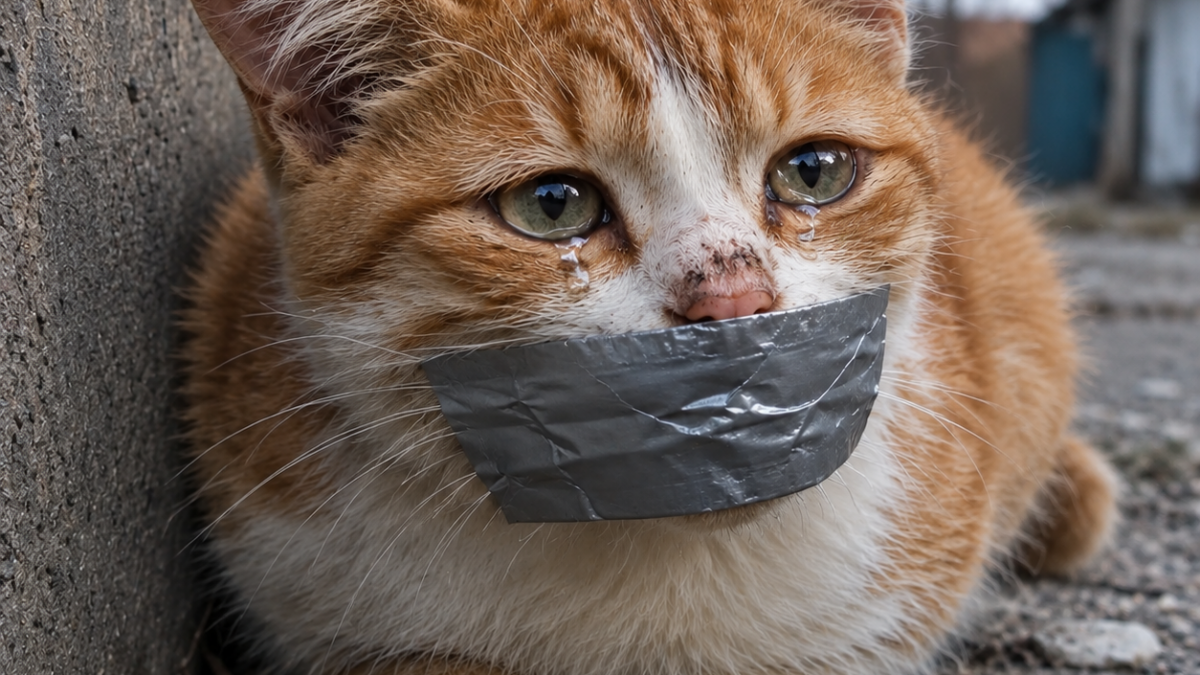
PART 2
A few minutes later, Dr. Harris allowed me into the treatment room.
The kitten was curled on a heated blanket.
Without the tape covering her face, she looked even smaller.
The fur around her mouth was wet from cleaning solution. The skin underneath was red and irritated.
Her eyes followed me as I approached.
“Hey.”
Her ears moved.
I held one finger near the edge of the blanket.
She sniffed it.
Then she touched her nose to my hand.
Dr. Harris watched quietly.
“That’s encouraging.”
“She trusts people?”
“Maybe.”
She paused.
“Or she’s too tired to run.”
That answer hurt more than I expected.
Dr. Harris told me the kitten would need to stay overnight.
They wanted to give her fluids and watch her breathing.
I agreed immediately.
Then she asked, “Is she yours?”
“No.”
“Any idea who she belongs to?”
“I found her outside.”
“Collar?”
“No.”
“Microchip?”
They had already checked.
Nothing.
No identification.
No obvious way to know where she had come from.
Before I left, I stopped beside the cage.
The kitten raised her head.
Her mouth opened.
A rough little sound came out.
It wasn’t much.
But it was a meow.
The technician beside me smiled.
“Well, look at that.”
I crouched.
“There you are.”
The kitten blinked.
“Found your voice.”
I went home that night without my jacket.
I didn’t care.
I barely slept.
Every time I closed my eyes, I saw the tape.
I imagined someone holding her still.
I imagined her struggling.
I imagined how frightening it must have been to realize she could no longer cry out.
By morning, my anger had changed.
It had become determination.
I wanted to know who had done it.
Dr. Harris called before eight.
“She made it through the night.”
I closed my eyes.
“Thank God.”
“She drank a little water on her own. Her temperature is stable. I’m more optimistic.”
“Can I come?”
“Absolutely.”
When I arrived, the kitten was sitting up.
Her fur had been cleaned, and for the first time I saw how beautiful she was.
Soft gray.
White chest.
White paws.
Large green eyes.
A veterinary assistant had placed a tiny folded towel beneath her.
“What are you calling her?” the assistant asked.
“I’m not sure she’s mine.”
The assistant smiled.
“She seems to disagree.”
The kitten had already moved toward the cage door.
She pushed one paw through the bars.
I touched it.
Dr. Harris walked in carrying a chart.
“She needs a name for the paperwork.”
I looked at the kitten.
“Any suggestions?”
Dr. Harris glanced toward the window.
“She spent half the night staring at the moon.”
“Luna?”
Her ears twitched.
I smiled.
“Luna.”
That was it.
The name stayed.
Dr. Harris reviewed the bloodwork.
Luna was malnourished but not in organ failure.
She had no broken bones.
No obvious internal bleeding.
That felt almost miraculous.
Then Dr. Harris returned to the older adhesive marks.
“I took photographs before we cleaned her.”
“What are you thinking?”
“That somebody may have restrained her this way before.”
“You think she escaped?”
“Possibly.”
I looked at Luna.
“Why would anyone do that?”
“I don’t know.”
Dr. Harris closed the chart.
“But I think you should make a police report.”
I had already decided to.
Officer Daniel Moore arrived at the clinic that afternoon.
He was in his forties, calm, with the tired expression of someone who had seen too many people do things that made no sense.
He looked at the photographs.
Then the tape.
Then Luna.
“Where exactly did you find her?”
I gave him the street.
“The old Carson warehouse?”
“I don’t know what it’s called.”
“That’s the one.”
“You know it?”
“The city’s been trying to get that property redeveloped for years.”
“Any cameras nearby?”
“Maybe.”
He wrote down the address.
“There’s a mechanic shop across from it. Gas station farther down.”
“Can you check?”
He looked at me.
“You really want to find whoever did this.”
“Yes.”
“So do I.”
The next morning, Luna was strong enough to leave.
I told everyone I was only fostering her.
No one believed me.
Dr. Harris gave me medication, feeding instructions, and a carrier.
“Keep things quiet.”
“I will.”
“She may hide.”
“I expected that.”
“She may also react strongly to certain sounds.”
I nodded.
I had no idea how right she was.
The moment I brought Luna into my apartment, she disappeared behind the couch.
I placed water, food, a litter box, and a soft bed nearby.
Then I left her alone.
Hours passed.
I could hear occasional movement.
I didn’t reach behind the couch.
I didn’t try to pull her out.
Just before midnight, I heard a faint scratch from the hallway.
Luna stood in my bedroom doorway.
“Hey.”
She watched me.
I held out a hand.
Slowly, she entered.
One step.
Then another.
She stopped beside the bed.
For a moment she looked as if she might run.
Then she jumped.
She landed near my feet.
Curled into the blanket.
And closed her eyes.
I didn’t move for almost an hour.
By the fourth night, she was sleeping beside my hip.
But there were things that terrified her.
One afternoon, I opened a cardboard package.
I pulled a strip of packing tape.
The sound filled the room.
Luna vanished.
Not ran.
Vanished.
I found her under the bed, pressed against the wall.
Her pupils were huge.
“Oh.”
I lowered myself to the floor.
“It’s okay.”
She didn’t move.
That was the first time I understood that surviving the injury was only part of recovery.
She also panicked when anyone moved too quickly toward her face.
Loud knocks made her freeze.
Plastic pet carriers terrified her.
Even the sound of a drawer being slammed could send her into hiding.
Every reaction told me something about what she had experienced.
I just didn’t know exactly what.
A week after I found her, Officer Moore called.
“We found camera footage.”
I stood so fast I nearly dropped my coffee.
“What does it show?”
“Not enough yet.”
The mechanic shop across from the warehouse had an old security camera pointed toward the street.
At 7:43 p.m. the night I found Luna, a dark SUV pulled over near the warehouse.
The driver got out.
Tall.
Heavy coat.
Cap or hood.
The camera was too far away to capture the face.
The person walked toward the fence carrying something.
Five minutes later, he returned.
Alone.
“Was it Luna?”
“We can’t confirm.”
“Did you see a carrier?”
“Not clearly.”
“What about the license plate?”
“Blurry.”
I gripped the phone.
“So we have nothing.”
“We have a vehicle.”
“That’s something?”
“It can be.”
Two days later, Moore asked me to come to the station.
He placed several printed images on the table.
The first showed the SUV.
The second showed the driver walking toward the warehouse.
Then he slid over another image.
Same vehicle.
Different night.
“What am I looking at?”
“Four nights before you found Luna.”
The driver was carrying a plastic pet carrier.
I leaned closer.
“What’s inside?”
“We can’t see.”
“Did he leave with it?”
Moore slid over another image.
The man was returning to the SUV.
The carrier looked empty.
I felt sick.
“That wasn’t Luna?”
“We don’t know.”
“How many times did this vehicle come here?”
“At least three in two weeks.”
I leaned back.
“Three?”
“Yes.”
“What happened to the other animals?”
“We don’t know if there were other animals.”
“But you think there were.”
Moore didn’t answer immediately.
“Possibly.”
He pointed to the SUV.
“There’s damage along the passenger-side door.”
A long white scrape.
“We’re checking repair shops.”
That sounded simple.
It wasn’t.
Real investigations weren’t like television.
There was no dramatic computer screen that solved everything in ten seconds.
There were phone calls.
Paperwork.
Records.
Waiting.
Lots of waiting.
I hated it.
So I started asking questions myself.
Not in a dangerous way.
At least that’s what I told myself.
I returned to the neighborhood in daylight.
I spoke with people who lived nearby.
Most knew nothing.
Then an elderly woman named Mrs. Alvarez opened her door.
She was holding a bowl of cat food.
“Are you the woman who found the gray kitten?”
I froze.
“How do you know?”
“Dr. Harris called me.”
“You know her?”
She invited me inside.
Her kitchen wall was covered in photographs of cats.
Orange cats.
Black cats.
Tabbies.
Gray cats.
Under each photograph was a handwritten name.
Mrs. Alvarez pointed to one.
A gray kitten with a white chest.
My heart jumped.
“That’s Luna.”
She smiled sadly.
“I called her Misty.”
“You know her?”
“I’ve been feeding the cats around that warehouse for years.”
I stared at the photograph.
Luna looked healthier there.
Fuller.
Curious.
“When did she disappear?”
“Three weeks ago.”
Three weeks.
That matched Dr. Harris’s estimate of how long she had been underfed.
“Were there other disappearances?”
Mrs. Alvarez’s expression changed.
She turned to the wall.
“Peanut.”
An orange male.
“Missing two months.”
Then another.
“Shadow.”
Black cat.
“Last month.”
Then a small calico.
“Bella.”
She touched the photograph.
“Gone.”
I felt cold again.
“All from the same place?”
“Yes.”
“Did anyone complain about the cats?”
She looked toward the window.
“A man named Caleb.”
“Who’s Caleb?”
“Works for Pierce Development.”
I had never heard of the company.
Mrs. Alvarez explained.
Pierce Urban Development had purchased the warehouse six months earlier.
They planned to convert the property into expensive apartments and retail space.
The project had been announced with glossy drawings and promises about “revitalizing the neighborhood.”
The stray-cat colony didn’t fit the image.
“Caleb told me to stop feeding them,” Mrs. Alvarez said.
“When?”
“A month ago.”
“What exactly did he say?”
She thought.
“He said the cats made the property look filthy. Said investors were coming.”
“Did he threaten them?”
“He told me if I kept feeding them, he’d deal with them himself.”
My pulse quickened.
“Did you tell police?”
“No.”
“Why?”
“Because they’re stray cats.”
She gave me a sad smile.
“People don’t always think they matter.”
I called Officer Moore immediately.
He came to Mrs. Alvarez’s house later that afternoon.
He listened.
Took notes.
Looked at the photographs.
Then he said the thing I did not want to hear.
“This is useful, but it’s not proof.”
“Caleb threatened them.”
“He complained about them.”
“He said he would deal with them.”
“Still not enough to prove he taped Luna’s mouth.”
I knew he was right.
I hated that he was right.
The name of the company stayed in my head.
Pierce Urban Development.
That night I searched it.
The owner was Mason Pierce.
Thirty-eight years old.
Polished.
Successful.
There were photographs of him cutting ribbons.
Shaking hands.
Standing beside city officials.
One article called him “a visionary developer committed to neighborhood renewal.”
Another praised his charity donations.
I stared at his smiling face.
Nothing about him looked dangerous.
But I had learned something from Luna.
Danger did not always look dangerous.
Two days later, I took Luna to Dr. Harris for a follow-up exam.
On the drive home, I made a mistake.
I passed the warehouse.
The moment we turned onto that street, Luna woke inside her carrier.
She began moving.
“Hey.”
Her breathing changed.
Then she cried.
A sharp, frightened sound.
I looked over.
She was pushing herself toward the far side of the carrier.
Away from the warehouse.
“Luna?”
She clawed at the door.
Her body shook.
I drove past quickly.
Two blocks later, she began calming down.
I told myself it might be coincidence.
The next day, I approached the area from another direction.
Same reaction.
The second Luna saw the warehouse, she panicked.
That ended my doubts.
Something there terrified her.
Officer Moore listened when I called.
“A cat’s reaction isn’t evidence.”
“I know.”
“But it matters.”
“I know.”
“What are you doing about the SUV?”
“We found a possible match.”
My heart jumped.
“What?”
“One of the vehicles registered to Pierce Urban Development.”
I sat down.
“Then it’s them.”
“Slow down.”
“The company that wanted the cats gone owns the SUV seen dumping animals.”
“The company owns six similar SUVs.”
“Who had that one?”
“We’re checking.”
“Ask Pierce.”
“We did.”
“And?”
“He says multiple employees use them.”
Of course.
A day later, they found the exact SUV.
The white scrape along the passenger door matched.
A repair shop confirmed fixing it.
The customer listed on the receipt was Caleb Dunn.
I immediately recognized the name.
Mrs. Alvarez recognized his photograph too.
“That’s him.”
Caleb was thirty-two.
Site supervisor.
Worked directly under Pierce.
Officer Moore interviewed him.
Caleb admitted driving the SUV to the warehouse.
That was expected.
He managed the site.
He denied hurting any animals.
“What about the carrier?” Moore asked.
Caleb claimed he had trapped stray cats and relocated them.
“Where?”
He gave vague answers.
Different streets.
Parks.
“Any shelter records?”
No.
“Who authorized the relocation?”
Again, vague.
Still not enough.
Then Luna gave us another clue.
I had ordered supplies online.
The box arrived sealed with industrial gray tape.
When I tore a strip open, Luna froze.
I immediately stopped.
She stared at the box.
The tape had a small blue logo printed repeatedly on the inner edge.
Horizon Industrial Supply.
Something clicked.
Dr. Harris had taken photographs of the tape removed from Luna.
I called her.
“Can you zoom in on the inside edge?”
She did.
Blue markings.
Faded but visible.
Officer Moore contacted Horizon.
They sold that tape in bulk.
One of their largest local clients was Pierce Urban Development.
Again, it was not proof by itself.
But another piece had fallen into place.
Police obtained a search warrant for a maintenance storage unit used by Caleb’s crew.
Inside they found industrial tape.
Pet carriers.
Animal traps.
Work gloves.
Cleaning supplies.
And a notebook.
The notebook contained dates.
Letters.
Locations.
At first, it seemed meaningless.
Then Mrs. Alvarez saw it.
“M.”
She touched the page.
“Misty.”
Luna.
“P.”
Peanut.
“S.”
Shadow.
“B.”
Bella.
Officer Moore’s face changed.
This was no longer coincidence.
Caleb was arrested.
The news reached me late that night.
I was sitting on the couch with Luna asleep against my leg.
“We got him,” Moore said.
“What exactly did you find?”
“Enough to charge him with several counts.”
“What about the missing cats?”
“We’re still searching.”
“What about Pierce?”
“No direct evidence yet.”
I felt disappointed.
Then Moore added, “But we found something else.”
“What?”
“Photographs.”
My stomach tightened.
“Of what?”
“The feeding area. Mrs. Alvarez’s house.”
Pause.
“And your apartment building.”
I stopped breathing.
“My building?”
“Yes.”
“Why?”
“We don’t know.”
“When were they taken?”
“Within the last week.”
Luna raised her head because I had gone completely still.
“Caleb knows where I live?”
“It appears so.”
“Is he in custody?”
“Yes.”
“Then I’m safe.”
Moore didn’t answer.
“What?”
“One photograph was taken after Caleb had already been questioned by us.”
“So?”
“His phone records put him somewhere else at the time.”
The meaning came slowly.
“Someone else took it.”
“That’s what we think.”
My mind immediately went to Mason Pierce.
Moore must have known.
“Don’t assume.”
“He owns the company.”
“That doesn’t prove he’s involved.”
“Someone photographed my home.”
“And that’s why you need to be careful.”
The following morning, I opened my apartment door and found an envelope on the floor.
No name.
No stamp.
Inside was a photograph.
Me.
Carrying Luna into the veterinary clinic.
Someone had taken it from across the street.
At the bottom, printed in black marker:
YOU SHOULD HAVE KEPT WALKING.
For several seconds, I couldn’t move.
Then my hands started shaking.
I locked the door.
Called Officer Moore.
Police arrived quickly.
The building’s security camera showed a person in a cap and face covering passing my apartment after two in the morning.
No usable face.
No identifiable car.
Officer Moore took the photograph.
“You’re not staying here tonight.”
“I’m not leaving Luna.”
“She comes with you.”
I didn’t want to stay with friends.
If someone was willing to photograph me, I didn’t want to put other people at risk.
Dr. Harris heard what happened and offered me the unused apartment above the clinic.
It was small.
One bedroom.
A couch.
A tiny kitchen.
It felt like a fortress.
Luna adapted within hours.
I didn’t.
Every noise at night woke me.
Footsteps outside.
A car door.
A branch touching the window.
I suddenly understood why Luna froze at sounds other people ignored.
Fear changed the meaning of ordinary things.
Three days later, Officer Moore called again.
“Caleb wants to talk.”
“What did he say?”
“He changed his story.”
My pulse quickened.
Caleb admitted trapping the cats.
He admitted using the tape on Luna.
For several seconds, I could hear nothing except the blood pounding in my ears.
“Why?”
“He says Luna scratched him during an earlier attempt to trap her.”
“So he taped her mouth?”
“He claims he wanted to stop her biting.”
“She wasn’t even big enough to hurt him.”
“I know.”
“Did he admit dumping her?”
“Yes.”
I sat down.
Finally.
A confession.
But it didn’t feel satisfying.
It felt sickening.
“Did Pierce tell him to do it?”
“Not specifically.”
That answer mattered.
Caleb claimed Mason Pierce had ordered him to remove the cats from the property.
The first instructions had sounded normal.
Trap them.
Get rid of them.
But when animals returned, Pierce became angry.
According to Caleb, Pierce told him:
“Do whatever you have to do. I don’t want those animals around when investors arrive.”
Pierce denied saying it.
Then Caleb gave investigators something more important.
A hidden room.
Inside the warehouse.
Police obtained another warrant.
The search happened that afternoon.
Behind a plywood wall in the rear of the building, investigators found several carriers.
Traps.
Bowls.
Cleaning products.
And two living cats.
One orange.
One black.
Mrs. Alvarez identified them immediately.
Peanut.
Shadow.
Both were weak.
Both survived.
When I told Mrs. Alvarez, she dropped into a kitchen chair.
“They’re alive?”
“Yes.”
Her hands covered her face.
“Both?”
“Both.”
She cried.
Then she asked one question.
“Bella?”
I didn’t have an answer.
The story reached local news.
That changed everything.
Suddenly, the polished developer who had ignored the investigation needed to speak publicly.
Pierce Urban Development released a statement blaming Caleb.
They called him a rogue employee.
Said the company had never authorized cruelty.
Promised cooperation.
Mason Pierce appeared on television.
Suit.
Perfect hair.
Concerned expression.
He said he was “deeply disturbed.”
I watched from the apartment above the clinic.
Luna lay beside me.
I wanted to throw something at the screen.
Dr. Harris sat across from me.
“You don’t believe him.”
“No.”
“Because?”
“Company vehicle. Company property. Company supplies.”
“That could still happen without him knowing.”
“I know.”
That was the problem.
I didn’t want assumptions.
I wanted evidence.
Pierce’s public image survived the first news cycle.
Caleb’s didn’t.
His face appeared everywhere.
People called him a monster.
Pierce positioned himself as another victim of Caleb’s behavior.
Then police learned that Caleb could not have left the threatening photograph at my apartment.
Location records.
Witnesses.
Receipts.
He had been fifty miles away.
Someone else had tried to scare me.
Officer Moore returned to the warehouse-camera question.
Pierce claimed the construction cameras had never been activated.
That was a lie.
The system had been uploading footage to a cloud account.
Investigators obtained a warrant.
And there he was.
Mason Pierce.
At the warehouse.
After hours.
With Caleb.
Several times.
One recording included audio.
Caleb stood near the back entrance.
“These cats keep coming back.”
Pierce replied, “Then stop letting them come back.”
Caleb said something about complaints.
Pierce pointed toward the rear of the property.
“I don’t care how you handle it. Just handle it.”
It was damaging.
But still not a direct instruction to hurt Luna.
Then an office employee named Hannah Brooks contacted police.
She had seen the news.
She had emails.
Hannah worked as an administrative coordinator for Pierce Development.
She had begun saving copies of messages months earlier because she believed Pierce was falsifying project reports.
One email was between Caleb and Pierce.
Caleb:
Animal issue worse. Need approval for traps and supplies.
Pierce:
Approved. I want the property clear before inspection.
Another:
Gray one keeps getting loose. Lots of noise.
Pierce replied:
Then make sure it can’t make noise or draw attention.
I read that sentence later.
Make sure it can’t make noise.
Luna had been found unable to meow.
Pierce’s attorney claimed he meant the animals should be removed before investors arrived.
Maybe.
But then Hannah gave police more.
Expense reports.
Orders.
Messages.
Pierce had known exactly what Caleb was doing with the cats.
Maybe not every detail.
But enough.
He had chosen not to ask questions because the result benefited him.
Then investigators discovered why Pierce had been so desperate.
The development project had serious problems.
Environmental contamination.
Old chemicals.
Illegal dumping.
A rodent infestation.
Permit issues.
He had told investors the site was clean and ready.
It wasn’t.
Every delay cost money.
The stray-cat colony was one more visible sign that the property had not been properly cleared.
Caleb wasn’t the only person Pierce had used to make problems disappear.
The photographs of my apartment were connected to another contractor.
Eric Sloan.
Phone records placed Eric near my building the night the note appeared.
When police questioned him, he eventually admitted Pierce had paid him to “make sure the woman with the cat backed off.”
That was me.
The woman with the cat.
I almost laughed when Officer Moore told me.
Then I realized what it meant.
Pierce had known about me.
He had watched the story developing.
And instead of stopping, admitting what happened, and helping investigators, he had tried to frighten me.
That decision destroyed him.
Police arrested Mason Pierce on a cold morning almost six weeks after I found Luna.
There was no dramatic chase.
No screaming.
No heroic tackle.
He walked out of his office beside his attorney.
Reporters crowded the sidewalk.
The confident smile was gone.
I watched from home.
By then, police had told me I could safely return to my apartment.
Luna sat on my lap.
When Pierce appeared on screen, she stretched.
Yawned.
Then turned away.
I laughed.
“You don’t care at all, do you?”
She purred.
Maybe that was better.
The legal process took months.
Caleb pleaded guilty.
He admitted trapping several cats.
He admitted taping Luna’s muzzle.
He admitted abandoning her.
His attorney argued that Pierce had pressured him.
Maybe he had.
The judge made something clear.
Pressure did not remove responsibility.
No job order forced Caleb to choose cruelty.
At his sentencing, I was allowed to speak.
I almost refused.
Public speaking terrified me.
Then I looked at Luna sleeping beside me the night before.
I remembered finding her.
The wall.
The tape.
The sound she couldn’t make.
So I went.
Caleb sat beside his attorney.
He looked smaller than he had in photographs.
I stood.
My hands trembled.
My voice didn’t.
“When I found Luna, she couldn’t cry for help.
“You made sure of that.
“She was so weak I could lift her with one arm.
“For weeks after I brought her home, ordinary sounds terrified her.
“The sound of tape made her hide.
“If someone moved too quickly toward her face, she flinched.
“You may think what happened lasted a few minutes.
“It didn’t.
“It came home with her.
“It followed her into her sleep.
“It followed her every time she heard a noise that reminded her of you.
“But there’s something else you should know.
“She survived.
“She learned to trust again.
“She learned to play.
“She learned that hands can reach toward her gently.
“She learned that not every carrier leads somewhere frightening.
“She learned that a closed door can mean safety.
“And she got her voice back.”
I stopped.
Caleb stared at the table.
“You tried to silence a tiny animal.
“Now thousands of people know her story.
“I hope you remember that.”
When I returned to my seat, Officer Moore whispered, “You did good.”
I shook my head.
“I told the truth.”
“That’s usually enough.”
Caleb received jail time.
Probation.
Mandatory counseling.
Restrictions preventing him from owning or working with animals.
Some people online said it wasn’t enough.
Others said it was too much.
I stopped reading comments.
Justice was happening in a courtroom.
I didn’t need strangers turning Luna into an argument.
Pierce’s case was more complicated.
The animal-related charges were harder to connect directly to him.
But intimidation, false statements, environmental violations, conspiracy, and illegal disposal practices were another matter.
His company began collapsing before the trial ended.
Investors withdrew.
Projects were canceled.
Banks became nervous.
The city froze permits.
Former employees started talking.
Once one person told the truth, others followed.
Hannah wasn’t the only employee who had saved messages.
A project manager had copies of altered environmental reports.
An accountant produced questionable expense records.
A contractor admitted being paid to remove waste at night.
Pierce had spent years building a polished image.
It took months for everything underneath to appear.
People kept asking me if watching him fall felt good.
At first, yes.
Then not really.
Revenge is exciting in stories.
In real life, it gets exhausting.
I realized I didn’t want to spend years thinking about Mason Pierce.
I wanted to think about Luna.
Her recovery became my real ending.
Four months after I found her, I was wrapping a birthday gift for my sister.
I wasn’t thinking.
I pulled tape from the dispenser.
Riiiip.
The sound filled the room.
Luna froze.
So did I.
Her pupils widened.
Months earlier, she would have disappeared under the bed.
Instead, she stared at me.
I placed the tape down.
“It’s okay.”
She took one step.
Then another.
I didn’t move.
Luna approached the table.
Sniffed the tape dispenser.
Then walked directly to me.
She climbed onto my lap.
And began purring.
Tears filled my eyes.
“That’s my girl.”
She rubbed her face against my hand.
That moment mattered more than the arrest.
Because punishment told me the people responsible had lost something.
Healing showed me Luna had gotten something back.
Her sense of safety.
Her trust.
Her life.
Mrs. Alvarez called a week later.
Peanut and Shadow were healthy enough for adoption.
A retired couple wanted both.
“Together?”
“Together.”
I smiled.
“What about Bella?”
Mrs. Alvarez’s expression fell.
Still missing.
That was the one part that hurt.
Real stories don’t always give you every answer.
Not immediately.
We did what we could.
The remaining warehouse cats were humanely trapped.
Each received veterinary care.
Most were spayed or neutered.
Some were adopted.
Others went to managed colonies.
The redevelopment project was transferred to another company.
This time, the city required independent environmental inspections.
An animal-rescue group helped oversee the relocation.
The cats were no longer treated like garbage that needed to disappear before investors arrived.
They were living things.
That should not have required a scandal to understand.
But apparently it had.
Pierce eventually accepted a plea agreement.
There was incarceration.
Financial penalties.
Environmental cleanup costs.
Business restrictions.
Restitution.
He lost control of Pierce Urban Development.
The company name disappeared.
His face disappeared from advertisements.
His “visionary developer” awards suddenly looked embarrassing.
A year earlier, he had worried about a few stray cats making his property look bad.
In the end, Luna’s photograph appeared beside his name in nearly every article about his downfall.
That irony did feel satisfying.
He had wanted her silent.
Instead, she became the most visible part of his story.
The new development company redesigned part of the old warehouse site.
They included a small community garden.
A veterinary outreach group asked to establish a feeding and rescue station nearby.
Mrs. Alvarez volunteered.
I helped when I could.
On opening day, I arrived expecting a simple ceremony.
Then I saw a plaque.
LUNA’S CORNER
Dedicated to the animals whose voices deserve to be heard.
I stopped walking.
Dr. Harris stood beside me.
“You didn’t know?”
“No.”
Mrs. Alvarez smiled.
“We wanted it to be a surprise.”
I cried.
Of course I did.
Officer Moore came too.
He looked at the plaque.
“Not bad for a cat who didn’t have a voice.”
I smiled.
“She has one now.”
Luna stayed home.
Crowds still made her nervous.
She didn’t need a ceremony.
She already had what mattered.
A warm apartment.
Food.
A safe bed.
Someone waiting for her.
That evening, I opened the door.
She came running.
Meow.
Loud.
Demanding.
“What?”
Meow.
“You ate two hours ago.”
Meow.
I laughed.
“You’ve become very opinionated.”
She followed me into the kitchen.
Sometimes I stood there listening to her complain and thought about the night I found her.
A cat who couldn’t make a sound.
Now she announced every inconvenience like a tiny lawyer.
Dinner late.
Door closed.
Water bowl not full enough.
Wrong blanket.
Sunlight in the wrong place.
Every meow made me smile.
Months passed.
Then Officer Moore called unexpectedly.
“I thought you’d want to know something.”
My stomach tightened.
“Good or bad?”
“Good.”
That helped.
“What?”
“During the final warehouse cleanup, they found more records.”
“What records?”
“Old animal-control intake forms.”
I sat down.
“Bella?”
“Yes.”
I stopped breathing.
“What happened?”
“Caleb apparently dropped her at a county facility under the wrong description months before we found Luna.”
“Is she alive?”
“Yes.”
I covered my mouth.
“She was adopted.”
I started laughing and crying at the same time.
“Where?”
“Forty miles away.”
“Can we contact the family?”
“Already did.”
Bella’s new owner was named Claire.
She had renamed the cat Rosie.
Two weeks later, Mrs. Alvarez and I visited.
Claire opened the door.
A calico cat appeared behind her.
Mrs. Alvarez froze.
“Oh, baby.”
Rosie stopped.
She stared.
For a second, nobody moved.
Then Rosie walked forward.
Mrs. Alvarez crouched.
The cat sniffed her hand.
Then rubbed her face against her fingers.
Mrs. Alvarez cried.
Claire cried.
I cried.
It became one of those rooms where everybody cried and nobody apologized for it.
Claire had no idea about Rosie’s history.
“She sleeps on my pillow every night.”
Mrs. Alvarez smiled through tears.
“She always liked pillows.”
We told Claire everything.
She looked horrified.
“I’m glad I didn’t know.”
I understood.
Sometimes starting over means not carrying every detail of what happened before.
Before we left, Mrs. Alvarez asked, “Could I visit sometimes?”
Claire answered immediately.
“Of course.”
That gave us the last piece we had been missing.
All four cats from Mrs. Alvarez’s wall had survived.
Peanut.
Shadow.
Bella.
Luna.
Different homes.
Different lives.
Safe.
The story should have ended there.
In many ways, it did.
But life kept going.
Luna grew.
The tiny kitten turned into a beautiful adult cat.
Her coat became thick and glossy.
She gained weight.
Her face filled out.
The skin around her mouth healed.
There was only a small patch where the fur grew slightly differently.
Most people never noticed.
I always did.
Not because it made her less beautiful.
Because it reminded me of how far she had come.
Some fears disappeared completely.
Others faded slowly.
Tape became manageable.
Carriers remained difficult.
Loud male voices sometimes made her hide.
But she learned that my apartment was safe.
She learned my routines.
She waited beside the door when I returned from work.
She slept on the right side of my bed.
She claimed one kitchen chair as hers.
If anyone sat there, she stared until they moved.
My friends joked that I had adopted Luna.
That wasn’t accurate.
Luna had adopted my apartment and allowed me to remain.
Dr. Harris said the same thing.
One Saturday, I took Luna for her annual exam.
She sat on the table looking deeply offended.
Dr. Harris laughed.
“Do you remember when she wouldn’t even lift her head?”
“I try not to.”
“I do.”
“Why?”
“Because look at her.”
Luna swatted gently at the stethoscope.
Dr. Harris smiled.
“That right there.”
“What?”
“Attitude.”
“You think attitude is medical progress?”
“Absolutely.”
The clinic had framed one photograph from Luna’s first night.
Not the upsetting photographs.
A later one.
She was wrapped in a clean towel.
Exhausted.
But awake.
Beside it was a newer picture.
Healthy.
Bright-eyed.
The difference was almost unbelievable.
People who came into the clinic sometimes asked about her.
Dr. Harris told the story carefully.
Never graphic.
Never sensational.
Just enough.
One woman heard it while waiting with her old dog.
She later donated supplies to the rescue program at Luna’s Corner.
Another family adopted a frightened cat after learning what patience had done for Luna.
Her story kept moving.
That surprised me.
I used to think saving an animal was one action.
You find them.
You rescue them.
Done.
It wasn’t like that.
Saving Luna created a chain.
Dr. Harris noticed the older marks.
Officer Moore checked cameras.
Mrs. Alvarez identified the missing cats.
The SUV connected Caleb.
The investigation uncovered Pierce.
The warehouse search found Peanut and Shadow.
Company records exposed the environmental crimes.
Hannah spoke.
Other employees spoke.
The remaining cats got help.
Bella was found.
Luna’s Corner was created.
One stop on one cold night changed dozens of lives.
That realization humbled me.
Because I almost didn’t stop.
I think about that sometimes.
What if I had been looking at my phone?
What if I had crossed the street?
What if I had decided the gray shape was trash?
What if I had been tired enough to keep walking?
Those questions can become dangerous.
So I don’t stay with them long.
The truth is simpler.
I stopped.
That is enough.
Several years later, I received a letter.
Not personally.
It was forwarded through Officer Moore.
Caleb had written it from a rehabilitation program after his release.
He apologized.
The letter was not perfect.
There were explanations.
Childhood.
Anger.
Money.
Pressure from Pierce.
Fear of losing his job.
For several pages, Caleb explained himself.
Then near the end, he finally wrote something that mattered.
None of that gave me the right to hurt her.
I read that sentence twice.
He said he had seen photographs of Luna online.
Healthy.
Safe.
He wrote that he understood I did not owe him forgiveness.
He said he hoped I would give Dr. Harris a donation enclosed with the letter for animal care.
I sat with the letter for a long time.
People expected me to hate him forever.
Part of me did.
But hatred is heavy.
I had spent enough years carrying someone else’s cruelty.
I did not write back.
I gave the donation to the clinic.
Then I put the letter away.
Not as forgiveness.
Not exactly.
More like proof that sometimes consequences reach people.
Whether they truly change is something only time answers.
Mason Pierce never wrote.
I did not expect him to.
His case ended differently.
He continued insisting people had misunderstood him.
He blamed employees.
City officials.
The media.
Investors.
Everyone.
That made letting go easier.
He could live with his excuses.
I didn’t have to.
The most satisfying revenge was not seeing him embarrassed.
It was seeing the world continue without him.
The warehouse changed.
The cats were safe.
The garden grew.
Children played where abandoned cars had once been parked.
Volunteers came every weekend.
The building that had represented fear became useful.
Pierce wanted to control that property.
In the end, the place became something completely different from what he intended.
I liked that.
One October evening, exactly five years after I found Luna, I decided to walk the same route home.
The air felt almost identical.
Cold.
Dry leaves scratching along the sidewalk.
Early darkness.
I stopped near the spot where she had been.
The rusted fence was gone.
The broken concrete had been repaired.
A young tree grew beside the path.
I stood there longer than I expected.
A woman walking a dog passed me.
“You okay?”
I smiled.
“Yeah.”
She continued.
I looked toward Luna’s Corner.
The plaque caught the light.
I remembered the gray shape beside the wall.
The fear in those green eyes.
The way she held my shirt.
Then my phone buzzed.
A message from my neighbor.
Your cat is yelling at the door again.
I laughed.
Perfect.
When I got home, Luna was waiting.
She complained loudly.
“You have food.”
Meow.
“Water.”
Meow.
“A warm bed.”
Longer meow.
“You’re impossible.”
She pushed her head against my leg.
I picked her up.
Years earlier, touching her face would have terrified her.
Now she pressed her cheek against mine.
I carried her to the couch.
That night, snow began falling unexpectedly.
Luna sat at the window.
A delivery driver dropped a package outside.
I heard tape being pulled.
Riiip.
Years earlier, that sound had sent Luna into hiding.
Her ears moved.
She glanced toward the door.
Then yawned.
She rested her head against my arm.
That was the moment I realized she had finally won.
Not legally.
Not publicly.
Inside herself.
The sound no longer owned her.
The memory no longer controlled every reaction.
Fear had become a thing that happened in the past.
I stroked her back.
“You won.”
She looked at me.
Meow.
“Yes, you.”
She closed her eyes.
For a long time, I watched snow fall.
People often asked whether Luna remembered what happened.
I didn’t know.
Animals don’t tell stories the way we do.
Maybe she remembered sounds.
Smells.
Hands.
Places.
Maybe memory lived in her body more than in thoughts.
But I knew she remembered safety.
She remembered my voice.
My apartment.
The sound of the food cabinet.
The blanket near the heater.
The exact time I returned from work.
She remembered which friends were allowed to touch her and which ones needed to earn permission.
Most importantly, she learned that memory could change.
Hands could once mean fear.
Then hands became warmth.
Carriers once meant terror.
Eventually, they meant visits to Dr. Harris and then home.
Tape once meant pain.
Then tape became nothing more than a sound.
That was healing.
Not forgetting.
Learning that the present was different.
One afternoon, a school invited me to speak about animal welfare.
I almost declined.
I was not a professional.
Dr. Harris convinced me.
“Tell them Luna’s story.”
So I did.
I brought photographs.
Not the painful ones.
I showed Luna before and after.
A child raised his hand.
“Why did the bad man do it?”
I paused.
Adults like complicated explanations.
Money.
Pressure.
Development.
Reputation.
Convenience.
But children ask simpler questions.
“I think he forgot that being smaller doesn’t make someone less important.”
The boy frowned.
“That’s stupid.”
I smiled.
“Yes.”
Another child asked, “Was Luna brave?”
I thought about it.
“She was terrified.”
“So she wasn’t brave?”
“That’s not what brave means.”
They waited.
“Being brave doesn’t mean you aren’t scared. It means fear didn’t get the final word.”
That answer surprised me.
I hadn’t planned it.
But it was true.
Luna had been terrified.
She survived anyway.
Mrs. Alvarez continued volunteering at Luna’s Corner into her seventies.
Eventually her knees made it difficult to carry food.
Younger volunteers took over.
She became the person who sat in a chair and knew every cat’s name.
One day I visited.
She was holding a tiny orange kitten.
“Another one?”
“Found behind a restaurant.”
“Are you keeping him?”
“No.”
The kitten climbed onto her shoulder.
She sighed.
“Probably.”
We laughed.
On her kitchen wall, the photographs changed.
Peanut and Shadow appeared in pictures from their new home.
Bella—now Rosie—was shown asleep on Claire’s pillow.
And Luna.
Luna had the largest photograph.
I teased Mrs. Alvarez.
“Favorite?”
“No.”
“You made hers twice as big.”
“She caused the most trouble.”
“That sounds like favorite.”
Mrs. Alvarez smiled.
“Maybe.”
Officer Moore retired several years later.
At his retirement dinner, I attended with Dr. Harris.
During his speech, he talked about cases he remembered.
He did not mention names.
But he said:
“Sometimes the case that looks smallest at first opens the biggest door.”
I knew exactly what he meant.
Afterward, he came to our table.
“How’s the criminal?”
“Which one?”
He pointed toward my phone.
The wallpaper was Luna.
“Oh. That criminal.”
“She stole half my pillow last night.”
“Dangerous.”
“Very.”
He smiled.
“I still have that first photo of her in the evidence file.”
“I wish I could forget it.”
“Me too.”
He looked serious.
“But sometimes I’m glad I can’t.”
“Why?”
“It reminds me why small things matter.”
That stayed with me.
Small things.
A kitten.
A strip of tape.
A blurry SUV.
A woman feeding strays.
One email.
One employee deciding to speak.
None seemed enormous alone.
Together, they changed everything.
Years passed.
Luna grew older.
Gray appeared around her face.
That felt unfair.
In my mind, she was still the tiny kitten wrapped in my jacket.
Then one morning, she had difficulty jumping onto the couch.
I took her to Dr. Harris.
“Arthritis.”
I laughed.
“Already?”
“She’s not a kitten anymore.”
“She is to me.”
“Every owner says that.”
We started supplements.
Later, medication.
I bought small pet stairs for the bed.
Luna ignored them for a week.
Then started using them as if she had invented them.
She still yelled for breakfast.
Still owned the chair.
Still hated closed doors.
But she slept more.
I found myself watching her.
Noticing every small change.
Because loving an animal teaches you something difficult.
Time never stops just because you finally found safety.
The good years matter because they are not endless.
On Luna’s tenth birthday, Dr. Harris came to my apartment.
Mrs. Alvarez came.
Officer Moore came with his wife.
Claire sent a photograph of Rosie.
The retired couple who had Peanut and Shadow sent one too.
I made a ridiculous little sign.
TEN YEARS LOUD.
Luna refused to pose.
Every photograph showed her looking irritated.
Perfect.
We laughed.
At one point, I looked around the room.
All these people.
All connected because of one cat.
Dr. Harris noticed.
“You’re thinking about that night.”
“Yeah.”
“She did okay.”
I looked at Luna.
“She did more than okay.”
Luna eventually fell asleep in the middle of the party.
Her head rested on my jacket.
The same jacket.
I still had it.
The fabric had faded.
There were small holes from the claws she dug into it years earlier.
Everyone had told me to throw it away.
I never did.
I couldn’t.
That jacket was the first safe thing she had been wrapped in after someone tried to silence her.
Sometimes Luna still slept on it.
Maybe she remembered.
Maybe not.
I did.
The hardest day came several years later.
Luna stopped eating.
At first, I thought she was being picky.
Then she stopped drinking normally.
Dr. Harris examined her.
Bloodwork.
Ultrasound.
More tests.
Kidney disease.
Common in older cats.
Manageable for a while.
Not curable forever.
I sat in the exam room.
Luna was on my lap.
“How long?”
Dr. Harris didn’t answer immediately.
“Could be a year.”
“Could be less?”
“Yes.”
I looked down.
Luna was purring.
Of course she was.
The animal who had once made no sound at all now chose that moment to purr.
We treated her.
Fluids.
Special food.
Medication.
She had good months.
Wonderful months.
Summer sun in the window.
Quiet evenings.
Slow mornings.
She still complained.
Less loudly.
But enough.
Then one winter, the good days became fewer.
I knew.
Dr. Harris knew.
I kept waiting for some clear sign.
A dramatic moment.
There wasn’t one.
Just small changes.
Longer sleep.
Less interest in food.
Difficulty walking.
One morning, Luna climbed onto my chest and stayed there.
Her body felt light again.
Too light.
Exactly like the first night.
I cried.
“I remember this.”
She looked at me.
Her green eyes were still beautiful.
“I promised I wouldn’t leave you.”
I called Dr. Harris.
She came to my apartment.
No clinic.
No carrier.
No bright room.
Luna stayed on the couch.
On my jacket.
Mrs. Alvarez came too.
Officer Moore stopped by quietly.
Everyone said goodbye.
Then it was only Dr. Harris and me.
I held Luna.
“You know something?”
She blinked.
“You were loud enough.”
My voice broke.
“So loud.”
She purred faintly.
I put my forehead against hers.
“You changed everything.”
Dr. Harris waited.
I whispered, “Okay.”
Luna left peacefully.
No fear.
No struggle.
Safe.
The room felt impossibly quiet afterward.
For years, I had complained jokingly about her noise.
Her demanding meows.
Her scratching.
Her insistence on being heard.
Then suddenly there was silence.
I hated it.
The first morning without her was unbearable.
No meow outside the bedroom.
No cat sitting beside the food cabinet.
No gray body in the chair.
I walked around the apartment like someone had removed all the furniture even though nothing had moved.
Grief is strange.
It makes empty spaces feel physical.
I kept the bowl for weeks.
I couldn’t move it.
Eventually, I did.
Not because I was done grieving.
Because grief changes shape.
Luna was cremated.
I placed her ashes in a simple wooden box.
On the front, I had one sentence engraved:
SHE FOUND HER VOICE.
The jacket stayed beside it.
Months later, Luna’s Corner added a second plaque.
I did not ask them to.
Mrs. Alvarez had arranged it.
It read:
LUNA
FOUND SILENT.
LIVED LOUD.
LOVED ALWAYS.
I cried when I saw it.
Again.
Apparently Luna had planned to keep making me cry forever.
A year after her death, I began fostering.
I wasn’t ready for another permanent cat.
At least that’s what I said.
The first foster was an older black cat named Henry.
He hid for three days.
I knew what to do.
Wait.
Quiet voice.
No grabbing.
Food nearby.
Let him choose.
On the fourth night, Henry walked into my bedroom.
I laughed.
“Of course.”
He jumped onto Luna’s side of the bed.
I cried again.
Henry stayed for two months.
Then a family adopted him.
The second foster was a kitten.
The third was a terrified calico.
Then came a gray cat.
I almost said no.
She looked too much like Luna.
Dr. Harris asked, “Are you sure?”
“No.”
“Good answer.”
The gray cat’s name was Olive.
She had one white paw.
Nothing else about her was like Luna.
Different personality.
Different voice.
Different habits.
That helped.
Olive was adopted three weeks later.
I realized something important.
Loving another animal did not replace Luna.
Love doesn’t work like a chair where only one person can sit.
Luna had made the space bigger.
That became her final gift.
Today, years after that cold October night, I still sometimes walk past the place where I found her.
The warehouse is gone.
Luna’s Corner remains.
The tree planted nearby has grown tall.
Children play in the garden.
Volunteers care for the colony.
The neighborhood changed.
So did I.
If someone asked me what the story is really about, I could say animal cruelty.
Or corruption.
Or justice.
Or rescue.
All of those are true.
But none is the whole truth.
The story is about noticing.
A tiny movement beside a wall.
A frightened animal.
Something easy to ignore.
The people who hurt Luna counted on people not noticing.
Pierce counted on inspectors not noticing.
Caleb counted on no one caring about stray cats.
The contractor who threatened me counted on fear making me quiet.
Everything depended on silence.
Then people noticed.
Dr. Harris noticed the old adhesive marks.
Mrs. Alvarez noticed cats disappearing.
Officer Moore noticed patterns in camera footage.
Hannah noticed lies in company records.
Employees noticed falsified reports.
And eventually everyone noticed Luna.
The kitten someone tried to make silent became the reason nobody could ignore what was happening.
There is justice in that.
Not perfect justice.
Real justice.
The kind made from paperwork, evidence, witnesses, courage, and people refusing to look away.
Sometimes visitors at Luna’s Corner ask me whether I think she knew what she started.
I always smile.
No.
Luna didn’t care about investigations.
Or newspaper stories.
Or company scandals.
Or plaques.
She cared about warm blankets.
Food.
Sunlight.
My bed.
And getting breakfast exactly when she demanded it.
That’s probably better.
She didn’t need to be a symbol.
She got to be a cat.
After everything that had been taken from her, she got an ordinary life.
That may have been the greatest victory.
Not being remembered as the kitten with tape around her mouth.
Being remembered by me as the cat who knocked a glass off the table because I ignored her.
The cat who slept on my keyboard.
The cat who hated one particular blue pillow for reasons known only to her.
The cat who sat in the bathtub after I showered.
The cat who somehow knew when I was sad and appeared without being called.
The cat who yelled.
God, she yelled.
That’s the part I choose.
Because cruelty should never own the whole story.
The person who hurt someone does not get to define the rest of that life.
Caleb was part of Luna’s story.
Pierce was part of it.
But they were not the ending.
The ending was Luna asleep in sunlight.
Luna purring.
Luna eating.
Luna trusting.
Luna growing old.
Luna safe enough to become demanding and ridiculous and completely ordinary.
That is the ending they never expected.
They had left a tiny cat beside a wall believing she would vanish.
Instead, she survived long enough to expose them.
Then she lived long enough to forget they mattered.
And if there is a more satisfying revenge than that, I have never seen it.








