Skiper Ran After His Family’s Car Until the Chain Jerked Him Back—What Happened Next Changed His Life Forever
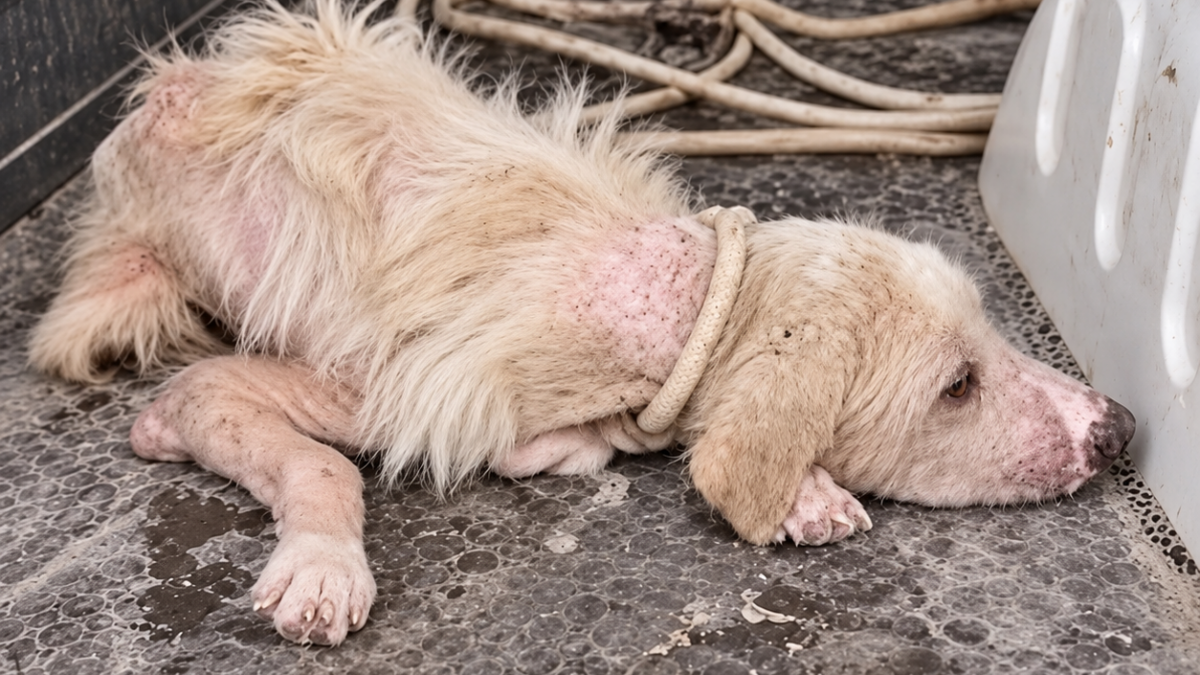
PART 2
I carried Skiper into the clinic myself.
The veterinary technicians had prepared a treatment room before we arrived, but the moment I set him on the padded table, he tried to flatten himself against it.
He wasn’t resisting us.
That would almost have been easier.
Anger meant energy.
Fear meant he still believed fighting might change something.
Skiper had moved beyond both.
He seemed convinced that whatever happened next was simply something he would have to endure.
Dr. Maya Patel entered quietly and stopped beside him.
She had treated hundreds of neglected animals during her career, but I saw her expression change when she looked at Skiper.
“How long?” she asked.
“At least several days completely alone,” I said. “Probably neglected much longer.”
Maya gently ran her hand over his shoulder.
Skiper flinched.
She stopped.
“Okay,” she whispered. “We’ll go slow.”
Bloodwork confirmed what his body had already told us.
He was severely underweight and dehydrated.
He had a skin infection, parasites, anemia and nutritional deficiencies. Some of the hair loss appeared related to chronic malnutrition and untreated skin disease rather than one sudden event.
His paws were cracked.
There were pressure sores where he had spent too much time lying on hard ground.
The skin beneath his collar was raw.
Yet the result that frightened us most wasn’t visible from across the room.
His organs were under stress.
“We can’t just feed him everything he wants,” Maya explained.
“I know.”
“If we move too quickly, refeeding can create another crisis.”
I looked at Skiper lying beneath a blanket.
After everything he had endured, even saving him had to be done carefully.
“How bad is it?”
Maya didn’t answer immediately.
That told me enough.
“He has a chance.”
A chance.
Not a promise.
I sat beside him after everyone else left the room.
For a long time, he kept his face turned toward the wall.
I didn’t touch him.
I didn’t call his name repeatedly.
I just sat there.
“You don’t know me,” I said eventually. “And right now that’s probably the safest thing you can believe.”
One ear moved.
“That family taught you something terrible about people. I can’t erase that tonight.”
He remained still.
“But I can be here tomorrow.”
That became my promise to him.
Not that everything would be fine.
Not that he would forget.
Not that every human being was good.
Just that when Skiper opened his eyes tomorrow, somebody would still be there.
The next morning, I arrived before my shift.
He was awake.
His head lifted when I entered.
Only an inch.
But I noticed.
“Good morning.”
I placed his measured breakfast beside him.
He sniffed it cautiously.
Then he ate.
Slowly at first.
Then faster.
When the bowl was empty, he looked up.
That was the first time I saw something besides fear in his eyes.
Expectation.
He wanted to know whether more good things could happen.
So I sat down.
For twenty minutes, neither of us moved.
On the third morning, I did the same.
On the fourth, he watched the door before I entered.
On the fifth, his tail moved once against the blanket when he heard my voice.
It wasn’t a wag.
Not really.
But I saw it.
“So that’s still in there,” I whispered.
He looked away as if embarrassed to have revealed it.
I laughed for the first time since finding him.
“Don’t worry. I won’t tell anybody.”
Of course I told everybody.
The entire shelter celebrated that tiny tail movement like Skiper had won a championship.
But while his recovery began inside the clinic, the investigation was beginning outside it.
The adoption document we’d found contained the names of the couple who had taken Skiper home as a puppy.
Daniel and Rebecca Mercer.
The rescue organization listed on the form had closed years earlier, but the microchip number still matched Skiper.
There was no dispute about who he was.
More important, there was no dispute about who had accepted responsibility for him.
Animal Control Officer Ben Carter returned to the abandoned house with an investigator.
They photographed the chain.
The empty bowls.
The yard.
The condition of the shelter Skiper had been expected to use—a cracked plastic doghouse with no bedding inside.
They spoke with neighbors.
Mrs. Alvarez gave a statement.
Another neighbor had security-camera footage showing the Mercers loading furniture into a rental truck six days before Skiper was discovered.
That footage became difficult for me to watch.
Ben showed it to me only because I had become involved in Skiper’s case and might later need to document his condition.
The video showed people carrying boxes from the house.
A couch.
Lamps.
Televisions.
Suitcases.
Everything they believed was worth taking.
At one point, Skiper appeared at the edge of the recording.
He was already chained.
He stood near the fence watching them.
His tail moved when Daniel Mercer walked through the yard.
Daniel didn’t stop.
He carried a box past Skiper and disappeared into the house.
A few minutes later, Rebecca came out carrying two bags.
Skiper moved toward her as far as his chain allowed.
She didn’t look at him.
That image stayed with me.
A dog watching his entire life being loaded into a truck while still believing he was part of it.
Around five that afternoon, the truck pulled away.
The family car followed.
Skiper ran after them.
He reached the end of the chain.
His body jerked backward.
The vehicles disappeared from the frame.
For several seconds, Skiper remained standing there, staring at the gate.
Then he sat down.
I closed the laptop.
“I’ve seen enough.”
Ben nodded.
His jaw was tight.
“They didn’t forget him.”
“No.”
“They didn’t make a mistake.”
“No.”
“They left him.”
I looked through the clinic window toward the recovery room.
“Yes.”
Ben closed the file.
“We found them.”
My eyes returned to him.
“Where?”
“Across town.”
For a second, I thought I’d misunderstood.
“The family?”
“They signed a lease eleven days ago. New place. About twenty minutes from here.”
I stared at him.
They weren’t missing.
They weren’t hospitalized.
They hadn’t vanished because of some catastrophe that might explain why Skiper had been left behind.
They had moved.
They packed their belongings.
They drove twenty minutes away.
And they left their dog attached to a post.
“Have you spoken to them?”
“Not yet.”
“Why?”
“We wanted the evidence documented first.”
He hesitated.
“There’s something else.”
I knew immediately I wasn’t going to like it.
“What?”
“The landlord at their new address says they asked whether pets were allowed.”
My stomach tightened.
“And?”
“He told them yes.”
I waited.
Ben looked directly at me.
“They told him they didn’t have any.”
I turned away.
There are moments in rescue work when anger arrives hot and immediate.
You see an animal injured deliberately and your first instinct is simple: How could anyone do this?
But this felt different.
This was cold.
Skiper hadn’t been left behind because they had nowhere to take him.
He hadn’t been left because the new apartment prohibited dogs.
They had simply decided that their old dog wasn’t part of their new life.
The next morning, Ben and another officer visited the Mercers.
Later, he told me how the conversation went.
Daniel opened the door.
When Ben asked about Skiper, he initially claimed the dog had run away.
Ben showed him a still image from the security footage.
The chain was clearly visible.
Daniel changed his story.
He said they intended to return.
Six days after moving?
He said things had been hectic.
Rebecca told officers Skiper had become “too difficult.”
Too difficult.
Those words traveled back to the shelter with Ben, and when he repeated them, I looked at the dog sleeping beneath a clean blanket.
Skiper, who had never tried to bite us.
Skiper, who barely dared lift his head.
Skiper, who had learned to ask for nothing.
“What exactly did she say was difficult?”
“Skin problems. Accidents. He smelled bad. Cost too much.”
I laughed once, but there was no humor in it.
“They’re describing the symptoms of the neglect they caused.”
Ben nodded.
“They’re going to be cited. The prosecutor will review the case for cruelty and abandonment charges.”
I wanted to feel satisfied.
I didn’t.
Not yet.
Because consequences for the Mercers wouldn’t matter if Skiper didn’t survive long enough to experience the life they had nearly stolen from him.
That afternoon his condition suddenly worsened.
He refused food.
His gums looked pale.
When he tried to stand, he collapsed.
Maya called me from across the shelter.
“Claire!”
I ran.
Skiper was lying on his side.
His breathing had changed.
The room became a blur of hands and equipment.
“Blood pressure’s dropping.”
“Start fluids.”
“Careful with the rate.”
“Temperature?”
“Low.”
I stood against the wall because there was nothing useful I could do.
That helplessness felt unbearable.
I had carried him out of the yard.
I had promised him I would still be there when he opened his eyes.
But promises don’t control biology.
Neglect had been working against him for months, perhaps years.
We had simply arrived in time to see the bill come due.
Maya stabilized him enough to transfer him into intensive monitoring.
I sat outside the kennel for most of the night.
At two in the morning, I rested my head against the wall.
“You’re allowed to be tired,” I whispered.
Skiper’s eyes were closed.
“You’re allowed to be angry too.”
Nothing.
“But you don’t get to think nobody wants you anymore.”
His ear moved.
I smiled through tears.
“I know you heard that.”
Around four, his eyes opened.
He looked directly at me.
I slid my hand through the kennel bars but stopped several inches from his paw.
Skiper stared at my fingers.
Then slowly, carefully, he moved one paw forward.
It touched my hand.
That was all.
No dramatic music.
No miracle.
Just the paw of a dog who had every reason to stop trusting people resting against the hand of someone who had promised to stay.
I cried so quietly I hoped nobody noticed.
Maya noticed.
She didn’t say anything.
By morning, Skiper was stable.
Over the next several days, his appetite returned.
Then something else returned.
Curiosity.
He began watching people move through the clinic.
He started lifting his head when other dogs barked.
One afternoon, a young beagle named Tucker passed his kennel and stopped.
Tucker wagged his tail.
Skiper stared.
Tucker wagged harder.
Skiper stood.
His legs were still thin, but they held him.
The dogs touched noses through the kennel door.
Skiper’s tail made one uncertain movement.
Then another.
Tucker bounced backward in invitation.
For the first time, Skiper looked confused in a way that made me smile.
He had forgotten what play looked like.
“Go ahead,” I told him.
We didn’t let him run yet.
His body wasn’t ready.
But that afternoon marked another turning point.
He began wanting things.
Not merely food.
Not merely water.
He wanted to follow Tucker.
He wanted to smell the grass outside.
He wanted to know what was behind the next door.
Wanting is important when you’ve spent a long time surviving.
Survival asks only, How do I make it through today?
Healing eventually asks something very different.
What might tomorrow contain?
Weeks passed.
Skiper gained four pounds.
Then seven.
Then eleven.
His skin infection began clearing.
The raw patches faded.
A soft layer of new fur appeared along his shoulders.
His eyes changed too.
People often talk about “sad eyes” in dogs as though it is just projection.
Maybe sometimes it is.
But I watched the difference happen.
When Skiper first arrived, he monitored every movement.
His eyes asked one question.
What are you going to do to me?
A month later, when I entered his room, those same eyes asked something else.
What are we doing today?
The first time he initiated affection, I nearly missed it.
I was sitting beside him while filling out medication notes.
Skiper approached from behind.
Something touched my elbow.
I assumed it was his nose.
Then I felt pressure against my shoulder.
He had leaned his body against me.
I froze.
He froze too.
For several seconds, neither of us moved.
Then I carefully lowered my hand to his chest.
“You sure?”
Skiper stayed.
I scratched gently.
His eyes closed.
That simple trust felt more precious than anything he could have given me.
Because he wasn’t trusting from innocence anymore.
He knew exactly what people were capable of.
He chose to trust anyway.
The investigation moved just as steadily.
The Mercers were formally charged with animal abandonment and cruelty under applicable local statutes.
I was asked to provide photographs, veterinary records and a statement describing Skiper’s condition when he arrived.
Maya documented his medical findings.
Mrs. Alvarez agreed to testify about the days she had heard him crying.
The neighbor supplied the security footage.
Then something unexpected happened.
The Mercers hired an attorney.
Their attorney contacted animal control and began arguing that Skiper’s condition had existed before the move, that they had intended to arrange care, and that financial hardship had prevented them from obtaining veterinary treatment.
I understood financial hardship.
Our shelter worked with families who couldn’t afford food or medical care every week.
We had pet food banks.
Emergency grants.
Low-cost clinics.
Temporary foster programs.
People asked for help because they wanted to keep their animals safe.
Poverty wasn’t the evidence against the Mercers.
The chain was.
The empty bowls were.
The six days without returning were.
The security footage was.
The lie to their new landlord that they had no pet was.
I wasn’t interested in punishing someone for struggling.
I was interested in the choice to drive away while Skiper watched from the end of a chain.
Their attorney then requested that custody of Skiper be preserved until the case was resolved.
When Ben told me, I stared at him.
“What does that mean?”
“They’re challenging permanent surrender.”
“They want him back?”
“That’s what the filing suggests.”
For the first time since Skiper’s rescue, my anger frightened me.
I walked out of the office before answering.
Skiper was outside in a small fenced rehabilitation yard.
His body was stronger now.
He trotted toward me when I entered.
His tail wagged.
A real wag.
I crouched.
He pressed his forehead into my chest.
“No,” I whispered.
Skiper licked my chin.
“No one is putting you on that chain again.”
The custody challenge didn’t mean the Mercers would actually get him.
But it delayed adoption.
That mattered because by then people had begun hearing about Skiper.
One of our volunteers posted a photograph showing his recovery.
It wasn’t sensational.
No chain.
No graphic images.
Just two pictures side by side.
The first showed Skiper during his first week with us, thin and uncertain.
The second showed him sitting outside six weeks later with new fur appearing across his back.
The post traveled farther than anyone expected.
Messages arrived from across the country.
Some people wanted to donate.
Others shared stories of animals they had rescued.
Adoption inquiries began appearing.
Dozens at first.
Then hundreds.
I should have been thrilled.
Instead, every application reminded me that legally Skiper was still waiting.
Again.
Waiting because of the same people who had already taken years from him.
One afternoon, I was sitting inside his kennel when Ben arrived holding an envelope.
“You’re going to want this.”
“What is it?”
“The judge denied their temporary custody request.”
I stood.
“Meaning?”
“Skiper remains in protective custody with us while the criminal case moves forward. And based on the condition documented at seizure, they’re not getting physical possession of him.”
I exhaled.
Skiper looked between us.
Ben crouched.
“Buddy, you have no idea how many people are arguing over you.”
Skiper approached him.
Months earlier, he would have backed away.
Now he sniffed Ben’s hand and accepted a scratch beneath the chin.
Ben smiled.
“Look at you.”
The court process continued.
The Mercers eventually appeared at a hearing where the prosecution presented the most basic timeline.
They moved on a Thursday.
Skiper remained chained.
No caregiver came Friday.
None Saturday.
None Sunday.
None Monday.
None Tuesday.
He was found Wednesday morning.
Six days.
The defense argued they had planned to return.
Then the prosecutor played the security footage.
I sat in the back of the courtroom.
Watching it there felt different.
On a large monitor, everyone could see Skiper standing at the edge of the yard as boxes were loaded.
They saw Daniel walk past him.
They saw Rebecca pass him.
They saw the moving truck pull away.
They saw Skiper run.
They saw the chain snap tight.
And they saw him sit at the gate after his family disappeared.
The courtroom became silent.
The prosecutor let the video continue for several seconds.
Then she paused it.
The frame showed an empty driveway.
Skiper was still facing the gate.
She turned toward Daniel Mercer.
“When exactly did you intend to return?”
His attorney objected to the phrasing.
The judge handled it.
But the image remained on the screen.
Skiper waiting.
That picture said what none of us could say better.
At the end of the hearing, the case moved forward.
The Mercers ultimately accepted a plea agreement rather than take the strongest evidence to trial.
They were ordered to pay restitution for a significant portion of Skiper’s veterinary treatment and care.
They received fines, probation requirements and restrictions that prevented them from simply acquiring another animal during the court-ordered period.
There were also mandatory conditions connected to responsible animal care.
Some people later told me the punishment should have been harsher.
Others thought criminal cases over animals went too far.
I wasn’t interested in turning Skiper into an argument.
For me, the most important consequence came in a separate ruling.
The Mercers permanently surrendered every claim to him.
The document arrived at the shelter on a Friday afternoon.
Ben handed it to me.
I read the sentence twice.
Then a third time.
LEGAL CUSTODY TRANSFERRED.
I walked straight to Skiper’s room.
He was sleeping with his head hanging halfway off his bed in the ridiculous position he had recently decided was comfortable.
“Hey.”
His eyes opened.
His tail thumped.
I sat beside him.
“You’re free.”
He climbed up and stretched.
“You don’t understand what that means, do you?”
Skiper yawned.
“No. Probably not.”
He placed one paw on my leg.
I laughed.
“But I do.”
I held his face gently between my hands.
“No chain. No backyard. No one gets to come back six months from now and say you belong to them.”
His tail moved faster.
“You belong to yourself now, buddy.”
Then came the hardest decision.
Finding his family.
With hundreds of applications, it would have been easy to choose the first nice person with a fenced yard.
But Skiper needed more than kindness.
He needed predictability.
Patience.
People who understood that recovery didn’t erase history.
He sometimes panicked when doors slammed.
He disliked being left alone outside, even for minutes.
If someone walked away while holding his leash and another person remained behind, Skiper occasionally tried to follow both.
Abandonment had taught him to monitor departures.
We needed a family who wouldn’t interpret those behaviors as disobedience.
We narrowed the applications.
Twenty.
Then eight.
Then three.
One belonged to a couple named Mark and Emily Dawson.
They lived outside town on a modest property with a large fenced yard.
They had two dogs.
Boone, a calm older Labrador mix.
And Rosie, an energetic shepherd who believed every visitor existed specifically to throw tennis balls for her.
Their application wasn’t the most polished.
It wasn’t filled with promises that Skiper would have the “perfect life.”
Instead, Emily had written something I kept thinking about.
“We don’t expect him to be grateful. He doesn’t owe us an easy transition. If he needs six months to believe this is home, he gets six months. If he needs longer, he gets longer.”
I called them.
Emily answered.
“Is this about Skiper?”
“Yes.”
She went silent.
Then I heard her call across the room.
“Mark!”
A man’s voice shouted back.
“What?”
“It’s the shelter!”
Something crashed.
“Did he just drop something?” I asked.
Emily laughed.
“Coffee.”
That was my first introduction to them.
Their first meeting with Skiper happened on neutral ground.
I warned them before they arrived.
“Don’t crowd him. Let him choose.”
Emily nodded.
“We’ll follow his lead.”
They sat on a bench.
Skiper entered with me.
He noticed them immediately.
His body became cautious.
Not terrified.
Just watchful.
Mark looked away intentionally so Skiper wouldn’t feel pressured.
Emily sat sideways.
Boone was brought in a few minutes later.
Boone sniffed the grass.
Skiper watched him.
The older dog approached without excitement.
They touched noses.
Boone turned away.
Skiper followed.
Then Rosie came in.
Rosie had never approached anything calmly in her life.
She bounced once, remembered there were humans asking her to behave, sat for approximately two seconds, then bounced again.
Skiper stared.
Rosie dropped into a play bow.
His tail lifted.
She hopped sideways.
Skiper took one step.
Then another.
Rosie ran five feet away and looked back.
Skiper followed.
Within minutes, the two were circling the yard.
Not running hard.
Skiper still tired more quickly than a healthy dog his age.
But he was playing.
Emily had tears on her face.
She wiped them away before I could say anything.
“I promised myself I wasn’t going to cry.”
“You lasted seven minutes.”
“That’s good for me.”
Mark remained quiet.
He watched Skiper carefully.
When Skiper eventually returned to the bench, he approached Mark first.
Mark lowered his hand.
Skiper sniffed it.
Then walked away.
Mark smiled.
“I’ll take it.”
The second meeting went better.
During the third, Skiper allowed Emily to rub his chest.
By the fourth, he greeted Boone like an old friend and immediately looked for Rosie.
We scheduled a home visit.
Their house wasn’t enormous.
That made me like it more.
There were blankets on the couch.
Dog toys beneath the kitchen table.
A water bowl in the bedroom.
Scratch marks on the back door.
Signs of animals actually living there rather than merely being displayed as part of a perfect home.
The backyard was securely fenced.
Shade covered one side.
A covered porch provided shelter.
Most importantly, when I asked where Skiper would stay while they were away, Mark looked confused.
“Inside.”
“What about at night?”
“Inside.”
“Bad weather?”
“Inside.”
“Good weather?”
He smiled.
“Also inside, unless he wants to be out.”
Emily pointed toward the bedroom.
“We already bought another dog bed.”
“Another?”
“There are currently five.”
“You have two dogs.”
“We have poor self-control.”
I laughed.
Then I saw something near the porch.
A metal tie-out cable still inside its unopened packaging.
My stomach tightened.
Emily noticed my expression.
“Oh, that’s not for Skiper.”
“What’s it for?”
“We bought it months ago for camping and never used it.”
She picked it up.
“I can throw it away.”
I shook my head.
“You don’t have to.”
But she looked at Skiper, then at the cable.
“Yes,” she said quietly. “I do.”
She carried it straight to the trash.
Maybe that action shouldn’t have mattered.
It did.
Adoption day arrived three weeks later.
By then, Skiper barely resembled the dog I had carried from the backyard.
His ribs were no longer visible.
His coat had grown thick across most of his body.
His skin was healthy.
His eyes were bright.
He had discovered toys, especially one ridiculous stuffed duck that made a honking noise whenever he bit its stomach.
He carried that duck everywhere.
When Emily and Mark arrived, Rosie and Boone were waiting in their vehicle.
We completed the paperwork.
I explained medications, diet, follow-up appointments and behavioral recommendations.
Then there was nothing left to explain.
The moment I had worked toward for months had arrived.
And I hated it.
I knelt beside Skiper.
He licked my face.
“You’re supposed to make this easier.”
His tail wagged.
“You’re failing badly.”
Emily stood a few feet away.
“We can give you time.”
I shook my head.
“If I take more time, I’m going to hide him in my office.”
I pressed my forehead against Skiper’s.
The first day I met him, he couldn’t tolerate my arms around him.
Now he leaned into me.
“You know what happens next?”
His ears lifted.
“You go home.”
That word caught in my throat.
Home.
His first home had taught him the word could mean a chain and an empty bowl.
I wanted him to learn another definition.
“A real one this time.”
I handed the leash to Emily.
Skiper followed her toward the door.
Halfway there, he stopped.
He looked back at me.
There are moments when you know you’re projecting human meaning onto an animal.
Then there are moments when you simply don’t care.
Skiper looked at me for several seconds.
I smiled.
“Go.”
His tail moved.
Emily waited.
I pointed toward the door.
“Go be a dog.”
He turned.
Then he walked outside.
I made it approximately twelve seconds before crying.
Ben found me standing in the lobby.
“You okay?”
“No.”
“Good adoption?”
“The worst.”
He laughed.
“You know what I mean.”
“I do.”
Skiper’s first night in his new home was quiet.
Emily sent me a photo.
He was sleeping on a rug beside Boone.
The stuffed duck was beneath his paw.
The next morning, she sent another.
Skiper was standing in the kitchen between Boone and Rosie waiting for breakfast.
Three bowls were visible.
All full.
I stared at that picture longer than I expected.
Three bowls.
Something so ordinary.
Something Skiper had nearly died without.
A week passed.
Then two.
He learned the sound of Mark’s truck arriving after work.
Emily told me that when the engine turned into the driveway, Skiper ran to the front window beside Rosie.
By the time Mark opened the door, all three dogs were waiting.
“He loses his mind,” Mark said during one follow-up call.
“In a good way?”
“In the best way.”
There were difficult moments too.
One afternoon, Mark worked in the yard while Skiper played nearby.
Mark went inside for a tool.
He was gone less than a minute.
When he returned, Skiper was pacing frantically near the door.
He wasn’t chained.
He could have explored the whole yard.
But all he cared about was the fact that a person had disappeared through a doorway.
Mark sat with him on the porch.
The next day, they practiced again.
Mark stepped inside for ten seconds.
Returned.
Twenty seconds.
Returned.
A minute.
Returned.
Again and again.
Teaching Skiper one simple lesson.
People can leave and come back.
People can disappear through a doorway without disappearing from your life.
The first time Emily and Mark had to leave Skiper home for several hours, they arranged for Emily’s sister to stay with the dogs.
Eventually, they practiced short absences.
Skiper learned.
Slowly.
One morning, three months after his adoption, Emily called me.
“You need to hear this.”
There was laughing in her voice.
“What happened?”
“He stole Mark’s breakfast.”
I paused.
“Skiper?”
“Whole piece of toast.”
I started laughing.
“That’s incredible.”
“Mark doesn’t think so.”
In the background, I heard Mark.
“He looked me in the eyes while he did it!”
Emily laughed harder.
I closed my eyes.
The dog who once believed he didn’t deserve water now believed he deserved Mark’s toast.
That was progress.
Months later, I visited.
I hadn’t wanted to go too soon.
Skiper needed to understand that the Dawson house was his home, not another temporary stop before returning to the shelter.
When I finally pulled into their driveway, Rosie announced my arrival with enough barking to wake the county.
Boone appeared behind her.
Then Skiper came through the door.
He stopped.
For half a second, he stared.
I wondered whether he remembered me.
Then he ran.
Not cautiously.
Not with the slow uncertainty I’d seen during recovery.
He ran full speed across the yard.
I barely had time to crouch before he hit me.
“Skiper!”
He pushed his head beneath my chin.
His tail struck my side.
I laughed and cried while trying to stay upright.
“Yes, I remember you too.”
Emily stood on the porch smiling.
“He absolutely remembers.”
Skiper raced away, grabbed the stuffed duck—which somehow still existed despite extensive surgical repairs—and brought it back.
He dropped it at my feet.
“Is this a gift?”
He grabbed it again.
“Apparently not.”
Rosie stole it.
Skiper chased her.
Boone followed at a dignified distance.
I watched them run across the grass.
For a moment, the memory of that first backyard returned so vividly I could almost see both versions of him at once.
The skeletal dog crawling toward water.
The healthy dog racing after Rosie.
Same animal.
Different world.
We sat on the porch while the dogs played.
Emily handed me a folder.
“What is this?”
“Something we thought you’d want.”
Inside were printed photographs.
Skiper sleeping upside down on the couch.
Skiper hiking beside Mark.
Skiper wearing a raincoat and looking deeply offended.
Skiper curled against Boone.
Skiper and Rosie standing shoulder to shoulder at the window.
One photograph stopped me.
Skiper was lying in a patch of sunlight.
His coat was full and thick.
His head rested on Mark’s boot.
The expression in his eyes was peaceful.
I touched the picture.
“This one.”
“We thought you’d like it.”
I smiled.
“I do.”
Emily leaned against the railing.
“We still get messages sometimes from people who recognize him.”
“I know.”
“Some ask whether he’s happy.”
I looked across the yard.
Skiper had managed to steal the duck back from Rosie and was running victory laps around the picnic table.
“Tell them no.”
Emily laughed.
“Clearly miserable.”
“Terrible life.”
Skiper stopped running and rolled onto his back.
Rosie pounced beside him.
Boone wandered over and stood above both of them like an exhausted parent questioning every decision that had led to this moment.
I laughed.
Then Emily became serious.
“Do you ever think about the people who left him?”
I looked at Skiper.
“Less than I used to.”
“Does that surprise you?”
“A little.”
For months, I had imagined justice as something that would happen in a courtroom.
A fine.
A conviction.
A signed surrender.
Restrictions.
Consequences.
Those things mattered.
They mattered because abandonment should have consequences.
They mattered because Skiper couldn’t speak for himself.
But sitting on that porch, I realized the most satisfying answer to what had been done to him wasn’t written in a court order.
It was running across the yard.
The Mercers had decided Skiper had no value.
They left him like broken furniture.
They expected his story to end behind an empty house where nobody would notice he was gone until it was too late.
They were wrong.
He survived.
People noticed.
People cared.
And the dog they discarded became more loved than he had ever been in the years they owned him.
That was a kind of justice no judge could order.
A year after Skiper’s rescue, our shelter held a small fundraising event.
We didn’t plan to make him the center of it.
But Emily asked whether she could bring him.
When Skiper arrived, several volunteers who had cared for him during those first terrible weeks immediately recognized him.
Maya came outside.
She stopped when she saw him.
“Oh my God.”
Skiper approached her.
Maya crouched.
“Do you remember me?”
He sniffed her.
Then licked her face.
She laughed.
“I’ll take that as yes.”
She ran her hands through the thick fur along his neck.
“Look at this coat.”
I stood beside her.
“Hard to believe, isn’t it?”
Maya glanced at me.
“I remember wondering whether he’d make it through that first week.”
“So do I.”
Skiper walked through the shelter greeting people.
The same dog who had once pressed himself into the floor to avoid human hands now leaned against strangers for scratches.
Not recklessly.
He had boundaries.
He still decided who he trusted.
I liked that.
Trust didn’t mean forgetting.
It meant gaining the confidence to choose.
During the event, a little boy dropped a cracker.
Skiper looked at it.
Then looked at Mark.
Mark said, “Leave it.”
Skiper looked back at the cracker.
You could practically see the moral struggle happening.
Eventually he stepped away.
Everyone applauded.
Mark shook his head.
“Do not encourage him. He already believes he’s a celebrity.”
Emily laughed.
“He is.”
Later, while the crowd moved through the building, I found Mark standing near Skiper’s original recovery kennel.
He was staring inside.
“This where he stayed?”
“Yes.”
Mark was quiet.
“I’ve seen the photos.”
I nodded.
“But standing here is different.”
“It is.”
He looked toward Skiper, who was lying several yards away beside Emily.
“I get angry sometimes.”
“At them?”
“Yes.”
“So did I.”
“What do you do with it?”
I thought about that.
“Use it.”
“How?”
“You make sure the next dog doesn’t wait six days.”
He looked at me.
“That simple?”
“No.”
I smiled.
“But that’s where you start.”
Mark and Emily eventually began volunteering with our emergency foster program.
It wasn’t something I suggested.
They simply decided that giving Skiper a home had shown them how easily animals could fall through gaps when families faced crises—or when people failed them completely.
They fostered their first dog the following spring.
A frightened terrier named Peanut whose elderly owner had been hospitalized unexpectedly.
The difference mattered.
Peanut wasn’t abandoned.
His owner asked for help.
For three weeks, Peanut stayed with the Dawsons.
Then his owner recovered enough to take him home.
Skiper seemed offended when Peanut left with someone else.
“He thinks we’re collecting dogs,” Emily told me.
“Don’t let him handle your budget.”
“He already controls the grocery list.”
Years passed.
Skiper’s scars became harder to see.
Some remained beneath his fur.
A small bare patch under his collar never filled in completely.
He still disliked chains.
During a camping trip, someone nearby clipped a metal tether to a picnic table.
The sound made Skiper freeze.
Emily immediately walked him away.
They never forced him to confront what frightened him just to prove he was “over it.”
Healing isn’t a performance.
Nobody owed us evidence that Skiper had forgotten.
He hadn’t.
He simply learned that memory didn’t control every day that followed.
On the second anniversary of his rescue, Mrs. Alvarez came to visit him.
She hadn’t seen him since the morning we carried him from the yard.
When she stepped from her car, Skiper watched from beside Emily.
Mrs. Alvarez began crying before she reached the porch.
“That’s him?”
I smiled.
“That’s him.”
She covered her mouth.
Skiper approached cautiously.
She knelt.
“Oh, sweetheart.”
He sniffed her hands.
Mrs. Alvarez looked at me.
“I thought he was going to die.”
“So did we.”
She stroked his cheek.
“I should have looked sooner.”
I shook my head.
“You called when you understood what was happening.”
“But I heard him.”
“You saved him.”
She looked down.
“I just made a phone call.”
“Sometimes that’s what saving looks like.”
Skiper leaned against her.
Mrs. Alvarez cried harder.
For a long time, she held him.
I thought about all the tiny decisions that stood between Skiper and death.
A neighbor deciding the crying wasn’t normal.
A phone call.
An officer taking the complaint seriously.
A veterinarian staying late.
Technicians measuring food.
Volunteers washing blankets.
A prosecutor reviewing evidence.
A judge signing an order.
Hundreds of small human choices repairing the damage created by one terrible human choice.
People like dramatic rescues because they want a single moment when everything changes.
Sometimes there is one.
The chain hitting the dirt was one for Skiper.
But most rescue happens afterward.
The quiet days.
The meals.
The medicine.
The patience.
The person who keeps showing up.
That was what saved him.
Not one heroic moment.
Consistency.
The exact thing he had never received before.
Several years after his adoption, I received a message from Emily late one evening.
For a moment, seeing her name at that hour frightened me.
Skiper was older now.
Not elderly, but no longer young.
I opened the message.
There was a video.
I pressed play.
Mark was standing at the edge of a field.
Rosie was beside him.
Boone had passed away the previous winter after a long, comfortable old age. His absence had been hard on all of them, especially Skiper.
But in the video, Skiper was running.
His thick coat moved in the wind.
Rosie chased him.
Mark called his name.
Skiper turned.
Then he ran back.
No leash.
No chain.
Nothing connecting him to anyone except his own decision to return.
The video ended with Skiper reaching Mark and leaning against his legs.
Emily had written one sentence beneath it.
“He always comes back because now he knows we do too.”
I watched the video again.
Then again.
The first time Skiper ran after people he loved, a chain stopped him.
Years later, he could run anywhere he wanted.
And he chose home.
That was the ending I wanted for him.
Not revenge in the way people usually imagine it.
No cruelty returned for cruelty.
No suffering handed back.
The people who abandoned Skiper faced the consequences the law allowed.
Their names were attached to a case they could no longer pretend hadn’t happened.
They paid toward the care required to repair some of the damage they caused.
They lost every legal claim to the dog they had treated as disposable.
For a court-ordered period, they lost the privilege of simply replacing him with another animal.
Those consequences mattered.
But Skiper’s real revenge was much quieter.
He lived.
He grew strong.
His fur returned.
His eyes changed.
He learned to sleep deeply because nobody was going to disappear while he rested.
He learned the sound of a food container opening and came running because hunger was no longer something he had to fear.
He learned that a hand reaching toward him could scratch behind his ears instead of striking or dragging him.
He learned that doors could close and open again.
He learned that trucks could leave the driveway and return in the evening.
He learned that an empty yard didn’t mean an empty life.
He learned to steal toast.
He learned to chase Rosie.
He learned to mourn Boone.
He learned to trust Emily.
He learned to wait at the window for Mark.
Most of all, he learned that home wasn’t the place where someone owned you.
Home was the place where someone noticed when you were missing.
Where your bowl was filled before you had to ask.
Where your bed remained in the same corner every night.
Where your name was spoken with affection.
Where people came back.
Sometimes I still think about the puppy photograph we found in that plastic folder on the day we rescued him.
Skiper looked so hopeful in it.
He had no idea what was ahead.
For a long time, looking at that photograph made me angry.
Now it makes me think about something else.
Hope can survive longer than we expect.
Even after neglect.
Even after hunger.
Even after betrayal.
Sometimes it becomes almost invisible.
A single tail movement against a blanket.
A paw touching a hand through kennel bars.
A dog leaning against your shoulder for the first time.
But if someone protects that tiny piece long enough, it can grow again.
The last time I visited Skiper, he met me at the gate.
His muzzle had started turning gray.
He still carried a toy when he became excited, although the original stuffed duck had finally been retired after one surgery too many.
Emily had framed one of Skiper’s adoption photographs and placed it in the hallway.
Beside it was the picture taken months later—the one of him lying in sunlight with his head against Mark’s boot.
Before I left, Skiper followed me to my car.
I crouched beside him.
“You know,” I said, “you scared me pretty badly that first week.”
His tail moved.
“I didn’t think we’d get this much time.”
He pushed his nose into my hand.
I rubbed the gray fur around his face.
Across the yard, Mark called him.
“Skiper!”
His ears lifted.
For a moment, he looked at me.
Then toward Mark.
I smiled.
“Go home.”
Skiper turned and ran.
I stood beside my car watching him cross the yard.
Rosie met him halfway.
They raced toward the porch together.
Mark opened the door.
Emily was waiting inside.
Skiper disappeared into the house without looking back.
And this time, watching him leave me didn’t hurt.
Because I knew exactly where he was going.
Years earlier, I’d found him chained behind an empty house, staring at a gate and waiting for a family that had already decided not to return.
That dog had believed love meant waiting forever for people who had forgotten him.
The dog running through the Dawson doorway knew better.
He knew love as warm blankets.
Full bowls.
Ridiculous toys.
Brothers and sisters.
Veterinary appointments.
Car rides.
Walks.
Hands that were gentle.
Voices that came home every evening.
And a door that always opened for him.
The Mercers left Skiper at the end of a chain because they believed walking away would make him someone else’s problem.
Instead, their abandonment became the last decision they would ever make for him.
Everything after that belonged to Skiper.
His recovery.
His family.
His freedom.
His second chance.
His life.
And if there was one moment that summed up everything he had survived, it wasn’t the courtroom hearing or the signed surrender document.
It wasn’t even the day the chain fell into the dirt.
It was something much simpler.
A gray-muzzled dog running across a sunlit yard toward the people who loved him, with nothing around his neck but a soft collar and nothing behind him he needed to fear.
For the first time in his life, Skiper wasn’t running because someone had abandoned him.
He was running because someone was waiting for him at home.
The first night Skiper spent with Mark and Emily, I barely slept.
I knew he was safe.
I knew their house had been checked, their yard was secure, their references were excellent, and they had spent weeks getting to know him.
None of that stopped me from waking up at two in the morning and looking at my phone.
There was already a message from Emily.
For one terrible second, I thought something had gone wrong.
Then I opened the photo.
Skiper was asleep on the living-room rug.
Boone, their older Labrador mix, was stretched beside him.
Rosie, their shepherd, was curled against the couch.
Skiper’s stuffed duck rested under one paw.
His body wasn’t tense.
His eyes weren’t half-open.
He wasn’t listening for footsteps.
He was simply sleeping.
Emily had written:
“He finally stopped watching the door.”
I stared at those words for a long time.
Most people would have seen an ordinary dog sleeping on a rug.
I saw something else.
I saw a dog who had once spent an entire night staring toward a gate, waiting for a family that had already driven away.
That was the hardest part about Skiper’s recovery.
His body healed faster than his understanding of what had happened to him.
Food could put weight back on his ribs.
Medication could heal his skin.
Time could grow fur over the places neglect had left bare.
But there was no medicine for the memory of a car disappearing down the road while a chain held him back.
For weeks after his adoption, Mark and Emily learned just how deeply that moment had stayed with him.
The first warning came three days after he arrived.
Mark was working in the backyard while Skiper followed him.
Rosie was chasing a ball.
Boone was sleeping beneath the porch.
Everything was calm.
Then Mark went inside to get a screwdriver.
He was gone for less than a minute.
When he returned, Skiper was pressed against the back door.
Panting.
Pacing.
Whining.
Mark called me immediately.
“I think I scared him.”
“What happened?”
“I just went inside.”
I closed my eyes.
Of course.
The last time people walked through a door and left Skiper behind, they never returned.
“Don’t punish the behavior,” I said.
“I wouldn’t.”
“Don’t make a big dramatic reunion either. Just show him the pattern.”
“What pattern?”
“You leave.”
I paused.
“And you come back.”
So Mark started practicing.
Ten seconds inside.
Then back outside.
Twenty seconds.
Back outside.
One minute.
Back outside.
Every time Mark returned, he behaved as though nothing unusual had happened.
No excited voice.
No apology.
No overwhelming affection.
Just the quiet message Skiper needed most.
I’m back.
The next day, Emily did the same.
A week later, Skiper could remain in the yard for several minutes without panicking when one of them stepped inside.
Then came the car.
The first time Mark started his truck while Skiper stood near the porch, Skiper froze.
Emily told me the sound changed him instantly.
His tail dropped.
His ears went back.
Then he ran toward the driveway.
Mark shut the engine off before moving.
Skiper stood beside the truck, trembling.
Emily sat on the grass with him.
She didn’t touch him at first.
She just stayed near.
Eventually, Skiper leaned against her.
That evening, she called me.
“He remembers.”
“Yes.”
“I thought maybe after everything…”
“He remembers.”
There was silence.
“Will he always?”
“Maybe.”
I hated saying it, but Skiper didn’t need people lying for him anymore.
“He doesn’t have to forget to heal.”
So they began with the truck too.
Start the engine.
Turn it off.
Sit beside Skiper.
The next day, back out of the driveway.
Return.
Then drive to the end of the street.
Come back.
Then around the block.
Return.
Every time the truck disappeared, Skiper waited.
Every time it came back, something inside him changed.
Not dramatically.
Not all at once.
Trust rebuilt itself the same way it had returned at the shelter.
One repetition at a time.
One promise kept.
One door reopened.
One vehicle returning to the driveway.
Three weeks after the adoption, Emily sent me a video.
Mark’s truck turned onto their road.
Skiper was standing at the living-room window beside Rosie.
The moment he recognized the engine, his tail started moving.
By the time Mark parked, Skiper was racing toward the door.
Emily opened it.
Skiper ran outside.
Mark stepped from the truck.
Skiper jumped against him.
Not because he was afraid Mark had disappeared.
Because he was happy Mark had returned.
I watched that video four times.
That was when I first understood what Skiper’s real recovery would look like.
Not forgetting the past.
Changing what the same sights and sounds meant.
A truck leaving had once meant abandonment.
Now it could mean Mark was going to work.
A closed door had once meant isolation.
Now it could mean Emily was in the next room.
An empty food bowl had once meant hunger.
Now it meant breakfast was finished and dinner would come later.
That distinction mattered.
And slowly, Skiper learned it.
His personality emerged in pieces.
At the shelter, we had known him as gentle.
Quiet.
Cautious.
At home, apparently, he was a thief.
His first major crime involved toast.
Mark had left a plate on the coffee table.
Skiper was lying six feet away.
According to Emily, he appeared asleep.
Mark stepped into the kitchen.
When he returned, the toast was gone.
Skiper was still lying in exactly the same position.
Mark stared at him.
Skiper stared back.
“Where’s my toast?”
Skiper blinked.
Emily started laughing.
Mark looked beneath the table.
Nothing.
Then Skiper licked a crumb from his nose.
Case closed.
When Emily told me, I laughed harder than I had in months.
“The dog who was afraid to eat around people stole breakfast?”
“Apparently he’s feeling very secure.”
“That’s not a behavioral problem. That’s a victory.”
“Mark disagrees.”
From somewhere behind her, Mark yelled:
“He looked directly at me!”
That became one of my favorite Skiper stories.
Because hunger had once defined his life.
Now he had enough confidence to steal toast.
That mattered to me.
So did the day he discovered the couch.
Emily had bought three dog beds.
Skiper ignored all of them.
For the first two weeks, he slept on the rug.
Then one rainy afternoon, Rosie jumped onto the couch.
Skiper watched.
Rosie curled up.
Skiper looked at Emily.
Then at the couch.
Emily patted the cushion.
“You’re allowed.”
Skiper didn’t move.
She tried again.
“Come on.”
He approached slowly.
Placed one paw on the cushion.
Then another.
Then jumped up.
For several minutes, he sat stiffly beside Rosie as though waiting for someone to tell him he’d made a mistake.
Nobody did.
Eventually, he lay down.
By evening, he had taken over half the couch.
By the following week, Mark was complaining that Skiper kicked in his sleep.
“He went from chained in a yard to evicting me from my own furniture,” he told me.
“That sounds like rehabilitation.”
It wasn’t all easy.
Some wounds surfaced unexpectedly.
Metal chains remained one of them.
During a camping trip that summer, a family at the neighboring site attached a dog to a metal tether.
The chain scraped across gravel.
Skiper froze.
Emily noticed immediately.
His breathing changed.
His body lowered.
He began backing away.
She didn’t force him to stay.
She didn’t call him dramatic.
She didn’t drag him closer so he could “face his fear.”
She simply turned around and walked him in the opposite direction.
That evening she messaged me.
“Was leaving the right thing?”
“Yes.”
“Should we work on it?”
“Maybe eventually.”
I thought about it.
“But healing isn’t proving you can tolerate everything that once hurt you.”
That lesson wasn’t only for Skiper.
Sometimes the people who love a traumatized animal become obsessed with making them “normal.”
They want measurable progress.
A before-and-after transformation.
A clean ending.
But Skiper had already survived more than anyone had the right to ask him to overcome.
If the sound of a chain always bothered him, that didn’t mean he had failed.
It meant he remembered.
And memory was allowed.
Six months after his adoption, I visited the Dawsons.
Skiper came through the back door at a run.
He stopped when he saw me.
For one second, I wasn’t sure whether he remembered.
Then his whole body moved.
Not just his tail.
His entire body.
He slammed into my knees hard enough to make me lose my balance.
“Skiper!”
He pushed his face into my chest.
I laughed.
“You remember me.”
Emily leaned against the porch railing.
“Oh, he remembers.”
Skiper raced away.
Returned with his stuffed duck.
Dropped it.
Picked it up before I could touch it.
Ran again.
Rosie chased him.
Boone watched from the shade with the exhausted expression of a much older brother who had accepted that peace was no longer part of his life.
I stood there watching them.
For a moment, I could see two dogs.
The Skiper racing across the grass.
And the Skiper I had lifted from the dirt months earlier.
One strong.
One skeletal.
One running because he wanted to.
One unable to stand.
Same dog.
Different world.
Emily handed me a folder.
“We made something for you.”
Inside were photographs.
Skiper asleep upside down.
Skiper covered in mud.
Skiper sitting beside Boone.
Skiper staring through the window during a thunderstorm.
Skiper wearing a yellow raincoat and looking deeply offended.
Then I reached one photograph that made me stop.
Mark was sitting on the porch.
Skiper was lying beside him.
His head rested on Mark’s boot.
Nothing dramatic was happening.
That was exactly why I loved it.
Peace looked ordinary.
Safety looked ordinary.
Love, when it was real, became ordinary.
I touched the picture.
“This one.”
Emily smiled.
“I knew you’d pick that.”
A few months later, the court case formally ended.
The Mercers’ legal surrender became permanent.
Restitution had been ordered.
Restrictions had been placed on their ability to acquire animals during the court-mandated period.
Their names were attached to a case they had once tried to explain away.
For a long time, I’d imagined that hearing those consequences would give me a feeling of triumph.
It didn’t.
Not exactly.
I wasn’t disappointed.
Accountability mattered.
The evidence mattered.
The ruling mattered.
But by then, the Mercers had become less important to me.
That surprised me.
For months, I had been furious.
I had imagined the moment they would be forced to look at what they’d done.
But Skiper had moved on faster than I had.
He wasn’t thinking about court documents.
He was thinking about dinner.
Rosie.
Walks.
The couch.
Mark’s toast.
The future had become larger than the past.
That was his victory.
Not seeing someone else suffer.
No revenge could have improved the years behind him.
But a good life could change the meaning of the years ahead.
A year after we found him, we invited Skiper back to the shelter for a fundraiser.
I worried the building might trigger bad memories.
Instead, he walked through the front doors with his tail up.
Maya came running from the treatment area.
She stopped several feet away.
“That’s Skiper?”
I laughed.
“Apparently.”
He barely resembled the dog she’d treated.
His coat was thick.
His body was healthy.
His eyes were bright.
Maya crouched.
“Do you remember me?”
Skiper sniffed her face.
Then licked her chin.
She burst out laughing.
“I’ll take that as a yes.”
Volunteers gathered.
People who had spoon-fed him.
Washed his blankets.
Sat beside him when he wouldn’t accept touch.
Carried him outside when his legs were too weak.
Some cried.
Skiper thought this was excellent because crying humans tended to pet him.
He went from person to person collecting affection.
At one point, I stood near the kennel where he had spent his first weeks.
Mark joined me.
“This one?”
“Yes.”
He looked inside.
“I saw pictures.”
I nodded.
“It’s different in person.”
“It is.”
Skiper was lying in the hallway beside Emily.
Mark watched him.
“I still get angry.”
“At the Mercers?”
“Yes.”
“So do I sometimes.”
“How do you stop?”
I thought about the question.
“I don’t think you stop.”
He looked at me.
“You redirect it.”
“Where?”
I pointed down the hall.
“Toward the next one.”
That was how the Dawsons became foster volunteers.
Their first foster dog was Peanut, a terrier whose elderly owner had been hospitalized.
Peanut’s situation mattered because it was everything Skiper’s wasn’t.
Peanut’s person hadn’t abandoned him.
She had asked for help.
For three weeks, Peanut stayed with the Dawsons.
When his owner recovered, she came to collect him.
Skiper watched Peanut leave.
According to Emily, he seemed deeply offended.
“He thought we were keeping him.”
“Maybe he thinks this is how your house works.”
“What?”
“Dogs arrive and never leave.”
Emily laughed.
“That’s not financially sustainable.”
Skiper disagreed.
He became the unofficial foster ambassador.
Frightened dogs followed him.
Energetic dogs chased Rosie.
Older dogs slept beside Boone.
And Skiper, once the dog nobody came back for, became part of the household that temporarily waited for other dogs’ people to return.
I loved that symmetry.
Years passed.
Boone grew old.
His legs weakened.
His muzzle became white.
Skiper slowed down around him.
Rosie still tried to play, but Skiper seemed to understand that Boone needed quiet.
One winter morning, Emily called me.
Her voice told me before her words did.
Boone was gone.
He had passed peacefully at home with Mark and Emily beside him.
Skiper searched for him.
For several days, he checked Boone’s bed.
He waited near the porch.
He sniffed the places Boone used to sleep.
That grief changed him.
Animals understand absence differently than we do, but they understand it.
Emily worried that Boone’s disappearance would trigger Skiper’s old fear.
Maybe everyone leaves.
But something remarkable happened.
Skiper grieved.
Then he remained.
He didn’t panic when Mark went to work.
He didn’t become frantic when Emily closed a door.
He was sad.
But he no longer interpreted every loss as proof that he would be abandoned too.
That was how I knew his trust had become deeper than habit.
He had learned that love could end without betrayal.
Boone hadn’t left him.
Boone had simply reached the end of a long life.
Months later, Emily sent me another video.
Mark was standing in a field.
Rosie was beside him.
Skiper was farther away.
No leash.
No tether.
No fence visible.
Mark called:
“Skiper!”
Skiper turned.
Then ran.
His ears bounced.
His coat moved in the wind.
He crossed the field at full speed and reached Mark.
Mark bent down.
Skiper pressed against him.
The video lasted only a few seconds.
Emily’s message underneath was one sentence.
“He always comes back now because he knows we do too.”
I watched it again.
And again.
The first time I’d ever seen Skiper run after someone he loved, it had been on security footage.
The moving truck was leaving.
The family car followed.
Skiper ran toward the gate.
The chain reached its limit.
His body jerked backward.
Then the vehicles disappeared.
That image had stayed with me for years.
But now there was another image.
Skiper running freely across a field.
No chain stopping him.
No car disappearing.
No panic.
He could go anywhere.
And he chose to return.
That was the ending I wanted.
Not because it erased the first one.
Because it answered it.
On the second anniversary of Skiper’s rescue, Mrs. Alvarez came to see him.
She hadn’t seen him since the morning she called animal control.
When Skiper came onto the porch, she covered her mouth.
“That’s him?”
“Yes.”
She started crying.
“I thought he was going to die.”
“So did we.”
She crouched.
Skiper approached.
He sniffed her.
Then leaned into her hands.
Mrs. Alvarez looked at me.
“I should have called sooner.”
“No.”
“I heard him for days.”
“You didn’t know.”
“But—”
“You called.”
She looked at Skiper.
“I just made a phone call.”
I shook my head.
“That phone call gave him everything after it.”
She cried harder.
Sometimes people imagine rescue as a dramatic act.
Breaking down a door.
Running into danger.
Carrying an animal from a burning building.
But Skiper taught me something different.
Sometimes rescue is noticing.
Sometimes it’s refusing to ignore a sound.
Sometimes it’s one phone call.
And sometimes the most important person in the story is the one who decides, “This isn’t normal. Someone needs to know.”
Years later, Skiper’s muzzle began turning gray.
He wasn’t old yet.
But time was moving.
The first time I noticed the gray fur, I felt something tighten in my chest.
We had almost lost him before he ever had a chance to grow old.
Gray hair was a gift.
Aging was a gift.
Normal problems were gifts.
Stiff joints.
Slower mornings.
Extra naps.
All the ordinary things he had nearly been denied.
The last time I visited, Skiper met me at the gate.
He still remembered me.
He still brought a toy.
It wasn’t the duck anymore.
The duck had finally been retired after what Emily described as “an unacceptable number of surgeries.”
This time he carried a faded blue ball.
I knelt.
“Hey, old man.”
His tail wagged.
“Don’t tell Mark I called you that.”
Skiper pressed his head into my chest.
I rubbed the gray fur around his muzzle.
For a moment, I remembered the first day.
His body in my arms.
The chain hitting the dirt.
The empty bowls.
His eyes watching my hands.
Then Mark called from the porch.
“Skiper!”
Skiper lifted his head.
He looked at me.
Then at Mark.
I smiled.
“Go.”
He hesitated for half a second.
Years earlier, I would have wondered whether that hesitation meant fear.
Now I knew better.
He was simply deciding where the next interesting thing was happening.
“Go home,” I said.
Skiper turned.
He ran across the yard.
Rosie met him halfway.
They moved toward the porch together.
Mark opened the door.
Emily was inside.
Skiper crossed the threshold.
The door closed behind him.
And for the first time, watching Skiper disappear through a doorway didn’t make me afraid.
Because I knew what was on the other side.
A full water bowl.
A warm bed.
Dinner at the usual time.
A family that noticed when he wasn’t in the room.
People who left and came back.
People who had taught him that love didn’t require waiting beside a chain.
The Mercers had abandoned Skiper because they had decided he was inconvenient.
Too expensive.
Too damaged.
Too difficult.
They had loaded their furniture into a truck and driven away from the one living thing in that yard still waiting for them to turn around.
They believed that was where their responsibility ended.
They were wrong.
The law eventually made them answer for part of what they had done.
But the most satisfying consequence had nothing to do with courtrooms.
They lost him.
Not the starving dog tied beside an empty bowl.
The dog he eventually became.
The healthy dog.
The playful dog.
The dog who stole toast.
The dog who slept on couches.
The dog who comforted foster animals.
The dog who loved Boone and Rosie.
The dog who waited at the window for Mark’s truck because he knew the truck would return.
The dog who grew old enough for gray fur.
They threw away a life they never bothered to discover.
And another family received the privilege of discovering it instead.
Sometimes people ask me whether I think Skiper forgave his first family.
I don’t know.
I don’t think dogs experience forgiveness the way we discuss it.
But I know this.
He stopped waiting for them.
And maybe that was more important.
The yard behind that empty house stopped being the center of his story.
The chain stopped being the final image.
The abandonment stopped being the ending.
For years, Skiper had believed loyalty meant staying where someone put you.
Waiting.
Hoping.
Enduring.
His second family taught him something better.
Love wasn’t measured by how long you could suffer for someone.
Love was shown by who came back.
Who filled the bowl.
Who opened the door.
Who stayed when healing was inconvenient.
Who sat beside you when fear made no sense to anyone else.
Who gave you enough safety to become difficult, funny, stubborn and completely yourself.
The first time Skiper chased his family, a chain stopped him.
The last time I watched him run, nothing did.
And that is how I choose to remember him.
Not as the dog lying in the dirt.
Not as the skeleton beneath patchy fur.
Not as the animal watching a car disappear.
I remember a gray-muzzled dog crossing a sunny yard toward an open door.
No chain behind him.
No fear in front of him.
Only home.
And people waiting on the other side.








