She Survived Six Days Locked Inside an Abandoned Refrigerator—When I Opened the Door, I Promised She’d Never Lose the Sky Again
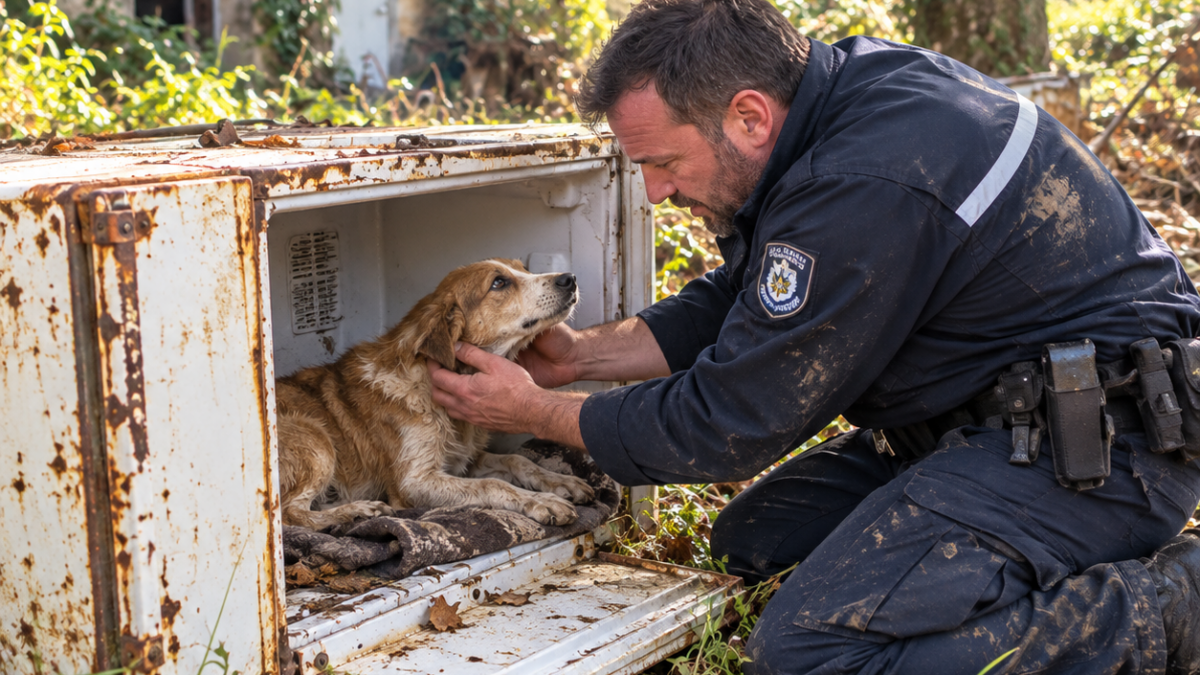
For six days, someone had kept a little dog locked inside an abandoned refrigerator beneath a maple tree, and by the time I heard her scratching, she barely had enough strength left to make a sound.
When I finally ripped the door open, she lifted her head just once, looked past me toward the daylight, and collapsed before she could crawl out.
I thought the scratches covering those plastic walls were only evidence of how desperately she had tried to escape—but they were about to lead me to the person who had put her there.
My name is Julien Morel. I was forty-three years old and serving with a small rural gendarmerie unit about twenty miles outside Limoges when I was sent to an abandoned farm on a hot September morning.
The bank had repossessed the property several days earlier.
Neighbors had reported people moving around the outbuildings after dark, probably searching for copper wire or anything else they could sell.
It should have been routine.
The front gate hung crooked from one hinge.
Official notices overflowed from the mailbox.
Dead tomato vines sagged against wooden stakes in the garden.
Near the fence, a child’s red bicycle was disappearing beneath tall grass, one tire completely flat.
I’ve never liked abandoned houses.
They don’t feel empty.
They feel interrupted.
A coffee cup on a counter.
Curtains still hanging.
A chair facing a window.
Signs of ordinary life left behind as if everyone expected to return after lunch and simply never did.
The farmhouse itself was locked.
The barn wasn’t.
Someone had forced its padlock, but there wasn’t much left inside besides broken tools, empty shelves, and mouse droppings.
I photographed the damage, radioed it in, and started walking the perimeter.
That’s when I heard it.
Scratch.
Silence.
Scratch.
I stopped.
Dry insects buzzed in the weeds.
My radio hissed against my shoulder.
Then—
Scratch.
Much weaker this time.
I followed the sound toward a maple tree at the rear of the property.
Several old appliances had been dumped beneath it.
A rusted washing machine.
Two dryers.
And an old cream-colored refrigerator lying slightly on its side.
An orange extension cord had been wrapped around the refrigerator handles.
Not accidentally.
Wrapped.
Knotted.
Tightened.
At first, I thought an animal had crawled behind it.
Then something bumped the inside of the door.
My stomach tightened.
“Hello?”
Ridiculous thing to say.
But I said it anyway.
Nothing.
Then the scratching returned.
Three faint strokes.
I pulled out my knife and sawed through the orange cable.
The cord snapped.
I grabbed the refrigerator handle.
The door didn’t move.
Years of heat had practically fused the rubber seal to the metal frame.
I planted one boot against the casing and pulled.
Nothing.
From inside came a tiny thump.
“Hold on.”
That time, I knew exactly who I was talking to.
I pulled harder.
Still sealed.
So I drove my shoulder into the door.
Once.
Twice.
On the third hit, the old gasket tore loose.
The door opened.
Hot, rotten air hit me so hard I turned my face away.
Then I looked inside.
A dog lay where the vegetable drawers should have been.
Small.
Tan and white.
Maybe thirty pounds at a healthy weight.
That morning, she looked like half of one.
Her ribs stood out in sharp lines beneath her coat.
Her eyes were half closed.
Her tongue was dry and pale.
The inside walls were covered in scratches.
Hundreds of them.
Some high.
Most low.
And near the bottom of the door, several were dark with dried blood.
“Oh, God.”
Her ear moved.
That was all.
I crouched and reached toward her.
She flinched.
Even half-dead, she was still afraid of my hand.
“I won’t hurt you.”
She tried to lift her head.
Couldn’t.
So I took off my uniform jacket, slid it beneath her body, and lifted her carefully.
She weighed almost nothing.
The moment I carried her into the sunlight, she opened her eyes wider.
Not at me.
At the sky.
Blue above the maple branches.
She stared at it for perhaps three seconds.
Then her head dropped against my chest.
I reached for my radio.
“Central, this is Morel. I need an emergency veterinarian notified immediately.”
I looked back at the refrigerator.
At the scratches.
At the orange cord.
And at one small bloody paw print near the inside edge of the door.
Whoever had shut her inside hadn’t simply abandoned her.
They had expected that refrigerator to become her coffin.
And as I carried her toward my patrol vehicle, I made a promise I had no idea how difficult it would be to keep.
“Stay with me, little girl.”
I tightened my arms around her.
“You made it out. Now I’m going to find out who put you in there.”
PART 2
She stopped breathing before I reached the patrol car.
Not completely.
Not at first.
Her chest gave one shallow rise against my forearm.
Then another.
Then nothing I could see.
“Come on.”
I laid her on the back seat.
My hands were already shaking.
I pressed two fingers against the inside of her thigh, trying to find a pulse the way our emergency animal-response training had shown us.
There.
Weak.
Fast.
Too fast.
Her chest moved again.
A tiny breath.
I grabbed my radio.
“Central, update. Animal is critical. Tell the veterinarian I’m coming directly.”
The dispatcher, Sandrine, answered immediately.
“Claire Martin is expecting you. Fifteen minutes if the road is clear.”
Fifteen minutes sounded like an hour.
I wet a clean cloth with bottled water.
Not too much.
Everything I’d been taught about severe dehydration came back to me.
Don’t force water into an animal that can barely swallow.
Don’t pour.
Don’t flood the mouth.
Moisten the gums.
Cool gradually.
Watch breathing.
I dabbed her tongue.
Her eyes opened.
Brown.
Cloudy with exhaustion but conscious.
“That’s it.”
She swallowed once.
I started driving.
I don’t remember much of that road.
I remember every red light.
Every slow tractor.
Every curve.
Every time I looked into the mirror and thought her chest had stopped moving.
At one intersection, I reached backward without taking my eyes from the road and touched her paw.
It was hot.
The pads were torn.
One claw had split almost to the base.
“Keep scratching,” I whispered.
I don’t know why.
Maybe because scratching was the reason I’d found her.
“Just keep fighting.”
Claire was waiting in the clinic parking lot with a veterinary technician named Amélie.
They had a stretcher ready.
I barely stopped the car before both rear doors opened.
“What do we know?” Claire asked.
“Found inside a sealed refrigerator. Unknown duration. No food or water visible. Extremely dehydrated. Possible heat exposure. Paw injuries.”
“Any vomiting?”
“Not with me.”
“Seizures?”
“No.”
Claire touched the dog’s gums.
Her face tightened.
“Inside. Now.”
I followed until the treatment-room doors closed in front of me.
Then I stood in the hallway.
My uniform shirt was dirty.
Blood from one of the dog’s paws marked my sleeve.
There was fur stuck against my chest where I’d carried her.
I could still smell that refrigerator.
Hot plastic.
Rust.
Old food.
Fear.
Maybe fear doesn’t have a smell.
But if you’ve spent enough years entering bad places, your memory assigns one.
I walked outside.
Then back inside.
Then outside again.
Marc Delorme arrived twenty minutes later.
Marc had worked beside me for almost a decade. He was six years older, built like a cabinet, and had the unfortunate habit of becoming funnier as situations became worse.
He looked at my shirt.
“You finally lost a fight with a terrier?”
“Not now.”
His face changed immediately.
“What happened?”
I told him.
The jokes disappeared.
“Alive?”
“Barely.”
He looked toward the treatment room.
“How long was she inside?”
“No idea.”
“Who owns the farm?”
“The bank does now. Previous family moved out.”
“When?”
“Six days ago.”
Marc’s eyes met mine.
Neither of us said it.
Six days.
The door opened.
Claire stepped out.
She removed her gloves slowly.
That scared me more than if she’d rushed.
“Well?”
“She is alive.”
My shoulders dropped.
“But she’s not safe yet,” Claire continued. “Severe dehydration. Hyperthermia. Kidney values are concerning. There are pressure sores on her hips, wounds on all four paws, and early muscle breakdown.”
“How long?”
She knew what I meant.
“How long could she have been inside?”
Claire glanced toward the room.
“I can’t give you an exact answer from her condition.”
“Could it have been six days?”
“Yes.”
I stared at her.
Claire added quietly, “With unusual luck.”
“Six days with no water?”
“There may have been condensation. Moisture. She may have licked the walls. Dogs survive things they shouldn’t sometimes.”
Marc rubbed a hand over his jaw.
“How close?”
Claire looked at him.
“To dying?”
“Yes.”
“Hours.”
That word entered me like cold water.
Hours.
If the neighbor hadn’t called about the suspected thieves…
If the patrol assignment had gone to someone else…
If I’d checked the barn and left…
If a truck had passed when she scratched…
Hours.
“Can we see her?” I asked.
“For a minute.”
The dog lay beneath a light sheet with an IV line in one front leg.
Her eyes were closed.
A fan circulated cool air nearby.
Bandages covered her paws.
She looked even smaller against the stainless-steel table.
“What are you calling her?” Amélie asked.
“We’re not.”
“You need something for the chart.”
Marc looked at me.
I looked through the clinic window.
Blue sky.
A strip of cloud.
“She looked at the sky when I pulled her out.”
Amélie waited.
I shrugged.
“Call her Skye.”
Claire wrote it down.
“Skye it is.”
I didn’t know then how much that name would come to matter.
Marc and I returned to the farm that afternoon.
This time we treated the refrigerator as a crime scene.
Photographs first.
Exterior.
Orange cable.
Knot.
Door seal.
Interior.
Scratch patterns.
Blood.
Hair.
We called an evidence technician from Limoges.
The refrigerator lay beneath the maple exactly as I’d found it except for the cut cable and open door.
From the outside, it looked like trash.
That was the horror of it.
Somebody could drive past and see nothing but junk.
Inside was an entire record of survival.
The scratches started near the floor.
Long white lines gouged into yellowed plastic.
Several ran upward, where Skye must have reared on her hind legs and clawed at the door.
Others crossed each other in frantic arcs.
Near the bottom, the marks were shallower.
Weaker.
Later.
Claire would eventually explain that progression better than any photograph could.
“She probably started with panic,” she said. “Hard scratching. Pushing. Jumping.”
“And later?”
“Energy conservation wasn’t a decision. Her body simply couldn’t keep doing it.”
So the scratches changed.
Desperation becoming exhaustion.
Then silence.
Then one more scratch when she heard me outside.
We found blood beneath two broken plastic ridges.
A tuft of tan fur stuck near the door gasket.
Marc examined the orange extension cord.
“Someone didn’t just close this.”
“No.”
“They tied it.”
“Yes.”
He photographed the knot.
It was a crude double wrap secured with two half hitches.
Not sophisticated.
Intentional enough.
The refrigerator’s original latch had been removed decades earlier, probably for child safety. Without the orange cable, the door would have pushed open.
Whoever put Skye inside had specifically created a way to keep it shut.
That distinction would matter later.
We began checking the property.
The former owners were Pascal and Émilie Renaud.
Pascal was forty-six.
Émilie forty-two.
They had a twelve-year-old son, Lucas.
The farm had belonged to Pascal’s father.
Debt had swallowed it slowly.
First equipment.
Then livestock.
Then land parcels.
Finally the house itself.
Court records showed repossession had been completed the previous week.
The family officially vacated six days before I found Skye.
Exactly six days.
There were no registered dogs listed on the paperwork.
But paperwork doesn’t always tell the truth.
We spoke with the nearest neighbor, Monsieur Vallon, seventy-one, who lived half a kilometer away.
“Dog?” he said. “Yes, they had one.”
“What kind?”
“Small brown thing. White chest.”
My stomach tightened.
“How long?”
“Couple years.”
“Name?”
He thought.
“Lily. Lucy. Something like that.”
“Did you see the dog when the family left?”
“No.”
“When did you last see her?”
He leaned against his gate.
“Maybe the day before.”
“Where?”
“In the yard.”
“Anything unusual?”
He hesitated.
“Pascal was angry.”
“About what?”
“When wasn’t he angry by then?”
“Be specific.”
The old man sighed.
“The bank. The bailiff. Everybody. He blamed everyone except himself.”
“Did you hear anything involving the dog?”
“I heard shouting.”
“What words?”
“Can’t remember exactly.”
“Try.”
He looked toward the abandoned farm.
“He yelled at the boy to get the dog away from him.”
“Anything else?”
“Something about not taking useless mouths with them.”
Marc and I exchanged a look.
“Did you see who left the property?”
“Pascal drove the van. Wife and boy followed in her car.”
“Dog?”
“Didn’t notice one.”
That wasn’t enough.
But it was a start.
The next morning, Skye was still alive.
Her kidney values had stabilized slightly.
She had urinated, which Claire described as “the first thing today that’s made me happy.”
She still wouldn’t eat.
She would barely lift her head.
But when I entered the treatment room, one ear moved.
“You know me?”
Her eyes opened.
I sat beside her kennel.
“I’ve had witnesses more cooperative than you.”
No response.
“Most of them smelled better too.”
Her tail moved.
Once.
Barely.
It could have been involuntary.
I chose to believe otherwise.
Claire caught me watching.
“You’re attached.”
“I’m investigating.”
“You’ve visited three times in twenty-four hours.”
“Evidence.”
“Of course.”
I looked at Skye’s bandaged paws.
“Can she recover?”
Claire leaned against the counter.
“If her kidneys hold, yes. The paw wounds will heal. Muscle loss can be reversed. Psychologically… we’ll see.”
“Meaning?”
“Dogs can develop confinement fear after something like this. Crates. Closed rooms. Cars. Even refrigerators opening in a kitchen might trigger a response.”
I stared at her.
Claire continued.
“Don’t decide what she’ll be before she shows us.”
That sentence stayed with me.
Don’t decide what she’ll be before she shows us.
Maybe humans could use that advice too.
Pascal Renaud denied owning a dog.
Marc and I found him two days later in a rented apartment outside Limoges.
His wife opened the door.
She looked exhausted.
Not surprised.
That mattered.
“Is Pascal here?”
“Yes.”
He came into the hallway wearing work clothes.
“What now?”
“We’re investigating an animal found at your former property.”
His eyes changed.
Just slightly.
“What animal?”
“A dog.”
“Not ours.”
I had not shown him a photograph.
Not yet.
“You don’t own a dog?”
“No.”
“Never did?”
“My son had one for a while.”
“What happened to it?”
“Ran away.”
“When?”
“Months ago.”
Émilie looked at him.
That tiny movement said more than her words.
“Months?” she asked.
Pascal turned.
“Yeah.”
She went pale.
I looked at her.
“When did you last see the dog, Madame Renaud?”
Pascal answered first.
“She doesn’t remember.”
“I asked her.”
His jaw tightened.
Émilie swallowed.
“The day we moved.”
Silence.
Pascal turned fully toward her.
“What are you doing?”
Her voice dropped.
“She was there.”
“You’re confused.”
“No.”
He laughed.
Not because anything was funny.
Because people sometimes laugh when reality stops cooperating.
“Our whole life was in boxes. She doesn’t remember.”
Émilie looked at me.
“She was there that morning.”
“What was her name?”
“Mila.”
Mila.
Not Lily.
Not Lucy.
Skye had already had a name.
Pascal stepped forward.
“That’s enough.”
Marc moved subtly between him and his wife.
Nobody threatened anyone.
Nobody needed to.
“Where was Mila when you left?” I asked.
Émilie’s eyes filled.
“I don’t know.”
Pascal swore under his breath.
She continued.
“Lucas was crying because Pascal said we couldn’t take her to the apartment.”
“Why not?”
“Landlord didn’t allow animals.”
“So what was supposed to happen?”
“A friend was going to take her.”
“Which friend?”
She looked at Pascal.
He said nothing.
“What friend, Madame Renaud?”
“I thought Pascal had arranged it.”
“Name?”
“I don’t know.”
Pascal folded his arms.
“This is ridiculous.”
I took out a photograph.
Not the worst one.
Just Skye—Mila—lying in the clinic after treatment.
I held it where both could see.
Émilie covered her mouth.
“Oh, my God.”
Pascal barely looked.
I watched him.
“Recognize her?”
“No.”
His wife stared at him.
“Pascal.”
“Lots of dogs look alike.”
“She has the white mark on her nose.”
He turned on her.
“Stop.”
“That’s Mila.”
“Stop talking.”
The conversation ended there.
Not because we wanted it to.
Because Pascal requested a lawyer.
That was his right.
We left.
In the stairwell, Marc said, “He knows.”
“Yes.”
“Wife knows something too.”
“Yes.”
“You think she did it?”
“I think she’s afraid.”
“Of him?”
“Or of what she didn’t stop.”
Those aren’t always the same fear.
The first breakthrough came from Lucas.
Children complicate investigations.
You protect them.
You don’t pressure them.
You don’t turn their loyalty into a weapon against a parent.
A trained interviewer spoke with him in the presence of appropriate child-protection personnel.
Marc and I watched remotely.
Lucas sat in a blue room with a box of tissues and a pitcher of water.
He looked younger than twelve.
The interviewer asked about Mila.
His face changed immediately.
“She slept in my room.”
“Where?”
“On the rug.”
“What did she like?”
“Cheese.”
“Anything else?”
“The pond. But she hated deep water.”
“Did she have toys?”
“A blue rope. Dad threw it away because she chewed it.”
Slow questions.
Safe questions.
Then:
“What happened when you moved?”
Lucas stared at his hands.
“Dad said she couldn’t come.”
“What did you think would happen?”
“He said Monsieur Caron would take her.”
“Who is Monsieur Caron?”
“Dad’s friend from the garage.”
“Did Monsieur Caron come?”
Lucas shook his head.
“What happened to Mila?”
“I don’t know.”
The interviewer waited.
Lucas’s breathing changed.
Then he whispered, “I heard her.”
Every person behind the glass stopped moving.
“When?”
“The night before we left.”
“What did you hear?”
“Scratching.”
My stomach dropped.
“Where?”
“I don’t know.”
“Inside the house?”
“No.”
“Outside?”
He nodded.
“What did you do?”
“I went downstairs.”
“Then what?”
“Dad was in the kitchen.”
“Did you ask about Mila?”
“Yes.”
“What did he say?”
Lucas started crying.
“He said she was gone.”
The interviewer gave him time.
“What did you say?”
“I told him I could hear her.”
“What happened?”
“He grabbed my arm.”
“Did he hurt you?”
Lucas shook his head quickly.
“No. Just… hard.”
“What did he say?”
The boy wiped his face with his sleeve.
“He said if I went outside, he’d leave me there too.”
Behind the glass, Marc’s hand curled into a fist.
I didn’t look at him.
The interviewer continued gently.
“Did you go outside?”
“No.”
“Did you hear Mila again?”
“Yes.”
“For how long?”
“I don’t know.”
“Did you tell your mother?”
“Yes.”
“What did she do?”
Lucas looked down.
“She cried.”
That one word changed the direction of the case.
Émilie came to the station the next morning without Pascal.
She brought a lawyer.
And a bag.
Inside the bag was a blue rope toy.
Chewed at both ends.
Mila’s.
“I took it from the trash before we moved,” she said.
Her hands shook.
“I couldn’t let him throw everything away.”
I placed a recorder on the table after confirming consent and procedure.
“Tell me what happened.”
She stared at the toy.
“Pascal wasn’t always like this.”
I’ve heard that sentence many times.
It can be true.
It can also be the sentence people use when they need the present to make sense.
“He lost the farm,” she continued. “His father built half those barns. His grandfather planted the orchard. Pascal believed losing the place meant he had failed all of them.”
“Did he become violent?”
She hesitated.
“With me, mostly yelling.”
“With Lucas?”
“No.”
“With Mila?”
Her eyes closed.
“Yes.”
“How?”
“He kicked her once.”
“Once?”
“I only saw it once.”
“Other things?”
“He’d lock her outside. Forget food. Shout at her.”
“Why?”
“She followed Lucas everywhere. Pascal said she was another responsibility we couldn’t afford.”
“What happened the day before you moved?”
Émilie took a long breath.
“I packed the car. Lucas was in his room. Pascal said he was taking Mila to Étienne Caron’s house.”
“Did you see him leave with her?”
“Yes.”
“How?”
“In the van.”
“What time?”
“Late afternoon.”
“When did he return?”
“Maybe forty minutes later.”
“With Mila?”
“No.”
“What did he say?”
“That Étienne had taken her.”
“But Lucas heard scratching that night.”
Tears spilled down Émilie’s face.
“Yes.”
“You heard it too?”
She nodded.
“Where did you think it was coming from?”
“The back of the property.”
“Did you go look?”
“No.”
“Why?”
Her voice became almost inaudible.
“Because I knew.”
“You knew what?”
“I knew Pascal had lied.”
“That isn’t the same as knowing where Mila was.”
“I knew he’d done something.”
“Why didn’t you go outside?”
She gripped the blue rope.
“Because I was afraid.”
“Of Pascal?”
“Yes.”
“What did he say?”
“He told me to leave it.”
“Those words?”
“‘Leave it. It’s handled.’”
Marc sat beside me.
Still.
Completely still.
Émilie continued.
“Lucas kept saying he heard Mila. Pascal turned the television up.”
That sentence was harder to hear than almost anything else.
“He turned the television up?”
“Yes.”
“So you wouldn’t hear the scratching?”
She nodded.
“What happened the next morning?”
“We left.”
“And Mila was still there?”
She began crying harder.
“Yes.”
“How do you know?”
“Because when we were putting the last bags in the car, I heard her.”
I waited.
“What did you hear?”
“One bark.”
The room felt airless.
“Why are you telling us now?”
She looked directly at me.
“Because I saw the photograph.”
Her voice broke.
“I thought she was dead.”
Étienne Caron confirmed immediately that Pascal had never brought Mila to him.
“He asked me weeks earlier if I wanted a dog,” Étienne said. “I said maybe, but I had to ask my wife. He never brought it up again.”
“Did you receive a call the day the Renauds moved?”
“No.”
Phone records supported him.
Pascal had lied about the friend.
We pulled cell-site data.
Pascal’s phone had remained at the farm the entire evening.
Nobody had driven Mila anywhere.
Bank documents established the timeline.
The Renauds surrendered access to the property on a Thursday morning.
I found Mila the following Wednesday.
Six days.
Six days sealed inside a refrigerator.
Claire was reluctant to say she had definitively been trapped for the entire period based solely on physical condition.
Science doesn’t bend because a story becomes emotionally convenient.
But Lucas heard scratching the night before they left.
Émilie heard one bark the next morning.
Nobody legally occupied the property afterward.
The orange cord showed no evidence of recent tampering after it was tied.
The dog’s dehydration and muscle injury were compatible with prolonged confinement.
The timeline became strong.
Then we found Pascal’s fingerprint.
Not on the outside.
On the inner edge of the refrigerator door where someone would naturally brace the door while manipulating the seal or positioning an animal.
His lawyer argued he’d owned the property for years.
Of course his fingerprints could be on an old appliance.
True.
But we also found fiber transfer.
Orange synthetic fibers on his work gloves, recovered under warrant.
Consistent with the extension cord.
Again, not magical proof alone.
Together, facts accumulate.
That is what good cases are.
Not one television-style revelation.
A wall built brick by brick.
Then came the photograph.
A neighbor’s motion-activated trail camera pointed toward a patch of woodland at the edge of his land.
The camera had been installed to catch wild boar.
Instead, at 6:18 p.m. the evening before the family left, it captured part of Pascal’s property in the background.
One frame showed Pascal walking toward the maple tree.
Beside him was Mila.
No leash.
Tail low.
Following.
The next image, ninety seconds later, showed Pascal walking back alone.
It wasn’t a perfect angle.
The refrigerator itself was hidden by weeds.
But Mila went toward that part of the property.
She didn’t return.
That photograph would later silence an entire courtroom.
Mila stayed at the clinic for nine days.
On day three, she ate voluntarily.
Three bites of boiled chicken.
Amélie called me like someone announcing a birth.
“She’s eating.”
“Good.”
“That’s all you have?”
“What do you want?”
“Some enthusiasm.”
“I am enthusiastic.”
“You sound like you’re reviewing paperwork.”
I looked around the station.
Marc raised his eyebrows.
I lowered my voice.
“Tell her I’m proud.”
Amélie laughed.
“You can tell her yourself.”
So I went after shift.
Mila had been moved from intensive care to a larger kennel.
The door was open because Claire had noticed something.
“She panics when it’s shut.”
Of course she did.
So they created a small gated space instead.
Open above.
Open view.
No solid walls around her.
When I entered, she stood for the first time.
Her legs trembled.
But she stood.
“Look at you.”
She took one step.
Then another.
Stopped.
Looked toward the exit.
I crouched.
She came halfway.
Stopped again.
I didn’t call her.
I waited.
Eventually she crossed the distance.
Then rested her chin on my knee.
No dramatic music.
No magical healing.
Just weight.
Trust beginning one ounce at a time.
I scratched beneath her jaw.
Claire stood behind me.
“She remembers you.”
“Or I smell like patrol-car upholstery.”
“Julien.”
“Yes?”
“Who’s taking her when she’s discharged?”
I looked up.
“Animal rescue.”
“They’re full.”
“Foster?”
“Also full.”
“Then find somebody.”
Claire smiled.
I knew that smile.
“No.”
“I didn’t say anything.”
“You’re thinking it.”
“You have a fenced yard.”
“No.”
“You live alone.”
“That is not an argument.”
“You work predictable enough shifts.”
“No.”
“You’ve visited every day.”
“Evidence.”
She crossed her arms.
“Still investigating?”
“Yes.”
Mila leaned harder against my knee.
Claire looked down at her.
Then back at me.
“Strong evidence.”
I told myself it was temporary.
Everyone tells themselves that.
The paperwork said fourteen-day emergency foster.
Fourteen days.
I bought one dog bed.
One leash.
Two bowls.
Basic food.
Nothing sentimental.
Marc came with me.
“You need toys.”
“She has a rope.”
“Old rope. Trauma rope.”
“Trauma rope?”
“You don’t know what that rope represents.”
“It’s a dog toy.”
He dropped three toys into the cart.
“One ball.”
“Fine.”
“One squeaker.”
“Fine.”
“One stuffed fox.”
“That’s ridiculous.”
“You’re buying it.”
“I am not.”
Mila slept with the stuffed fox her first night in my house.
Marc made sure everyone knew.
My house sat on the edge of a village with a small fenced garden behind it.
I opened the car door when we arrived.
Mila didn’t move.
The car was an enclosure.
Maybe leaving one enclosure for another frightened her.
So I sat on the driveway.
Ten minutes.
Fifteen.
Eventually she jumped down.
Then froze.
Above us stretched a September sky so blue it almost looked artificial.
Mila lifted her head.
I watched her watch it.
She stood there for nearly a minute.
No leash pulling.
No sniffing.
Just sky.
Then she walked into the yard.
For the first several days, she refused to enter rooms unless doors were propped completely open.
If a door moved behind her, even in the wind, she’d flatten herself to the floor.
The refrigerator was worse.
The first time I opened mine while she was in the kitchen, she screamed.
Not barked.
Screamed.
She scrambled backward so violently she knocked a chair over and urinated against the wall.
I closed the refrigerator immediately.
“Mila.”
She pressed herself into the corner.
I sat on the floor.
Didn’t touch her.
Didn’t move closer.
“It’s open.”
She shook.
The refrigerator door stayed open for an hour that night.
I ate warm cheese because I refused to close it while she was watching.
The next day, I opened it for two seconds while she stood outside the kitchen.
Then three.
Then five.
Weeks later, she could remain in the room.
Months later, she stopped caring.
Trauma doesn’t always vanish.
Sometimes the brain simply learns enough new endings that the old one stops controlling every moment.
Outside was easier.
Mila loved outside.
Not running.
Not at first.
She liked lying in grass.
Face lifted.
Eyes half closed.
Watching birds.
Watching clouds.
Watching airplanes.
Anything above her.
I bought a doghouse for the garden.
She refused to enter it.
I returned it.
Marc laughed for five full minutes.
“You bought a formerly confined dog a small wooden box?”
“It had excellent reviews.”
“You investigate crimes for a living.”
“Go home.”
Instead I built a covered platform.
Three wooden posts.
A roof.
No walls.
Mila loved it.
She could lie in shade and still see every direction.
Marc called it “the palace.”
Eventually the name stuck.
Pascal was arrested six weeks after Mila’s rescue.
By then, local newspapers had picked up the case.
We released very little because the investigation was active.
But somebody leaked the basic facts.
Dog.
Refrigerator.
Six days.
Survival.
People became furious.
Threats appeared online.
I hated that.
Accountability is not a license for mobs.
We increased attention around Pascal’s address because anger easily becomes stupidity.
One evening, somebody threw red paint at his apartment door.
Another person left a dead rat on his windshield.
That wasn’t justice.
That was theater.
The case would be handled in court.
I wanted the evidence to hurt him more than paint ever could.
And there was another reason.
Lucas.
Whatever Pascal had done, Lucas was still his son.
A twelve-year-old child shouldn’t have to watch strangers fantasize publicly about killing his father.
People forget collateral damage when outrage becomes entertainment.
Our job was not revenge in the violent sense.
Our job was to make sure Pascal could never rewrite what happened.
He had already started trying.
Through his lawyer, he offered a new explanation.
Mila had become aggressive.
She had bitten him.
He had placed her temporarily in the refrigerator while preparing transport.
Then “someone else” must have tied it shut.
The claim was extraordinary.
So we investigated it properly.
No bite treatment.
No medical record.
No photograph.
No message to his wife.
No report.
No witness.
Émilie said Mila had never bitten Pascal.
Lucas said the same.
Neighbors described her as timid.
Claire examined her teeth and behavior.
Nothing proved a dog could never bite, of course.
Any dog can.
But Pascal’s explanation created new problems for him.
He had previously claimed Mila ran away months earlier.
Now he admitted placing her inside the refrigerator.
That contradiction became devastating.
His lawyer tried another version.
He had shut Mila inside for “a few minutes,” intending to return.
An emergency phone call distracted him.
He forgot.
Then the family moved.
A horrible accident.
No intent.
Phone records showed no emergency call.
Worse for him, Lucas’s statement described Pascal telling him not to go outside.
Émilie described Pascal telling her, “Leave it. It’s handled.”
And there was the orange cable.
You don’t accidentally wrap a cable twice around refrigerator handles, tie two half hitches, and forget why.
The knot became one of the simplest and strongest pieces of evidence.
Not because it required laboratory analysis.
Because everybody understood knots.
Three months after the rescue, Mila discovered snow.
Only a light dusting.
Barely enough to cover the garden.
She stepped outside, sniffed it, then looked back at me as if I had personally caused the ground to malfunction.
“Go.”
She touched one paw to the snow.
Lifted it.
Touched again.
Then suddenly something inside her switched on.
She ran.
Not cautiously.
Not like an injured dog.
She exploded across the yard.
Around the maple I had planted years earlier.
Past the woodpile.
Under the open shelter.
Back to me.
Around again.
Tail high.
Mouth open.
For thirty seconds, I saw the dog she might have been before the refrigerator.
Then I realized that was the wrong thought.
She wasn’t returning to some untouched version of herself.
This was her.
Now.
Scars included.
She was creating something new.
I stood in snow laughing like an idiot.
Marc arrived ten minutes later carrying paperwork.
Mila ran toward him and nearly knocked him down.
“What happened to the traumatized little dog?”
“She has selective recovery.”
“She ate my sandwich last week.”
“Therapeutic.”
“She stole it from my desk.”
“Confidence building.”
He scratched her ears.
“You’re corrupting law enforcement.”
Mila sneezed in his face.
The court hearing began the following spring.
Mila was healthy by then.
Not perfectly.
Healthy.
Thirty-one pounds.
Muscle restored.
Paw wounds healed.
One claw grew crooked.
Her coat had become glossy tan with clean white markings across her chest and muzzle.
She slept beside my bed.
Not on it.
That was the rule.
Usually.
The prosecution didn’t need her in court.
I was glad.
She had already endured enough for human beings.
Claire testified first.
She explained dehydration.
Heat stress.
Renal injury.
Muscle breakdown.
Paw damage.
The scratches.
The likely sequence of physical decline.
Pascal’s attorney asked:
“Doctor, can you state with absolute scientific certainty that this dog was inside the appliance for exactly six days?”
“No.”
I saw Pascal glance at his lawyer.
Claire continued.
“I can state that her condition was consistent with prolonged confinement without normal access to food, water, ventilation, exercise, or waste elimination.”
“Could that be two days?”
“Possibly.”
“Three?”
“Possibly.”
“So six is speculation.”
“The duration is established by other evidence. My job is to explain what happened to her body.”
His attorney changed direction.
“Dogs can survive several days without food, correct?”
“With water, yes.”
“And without water?”
“Sometimes longer than expected.”
“So the fact that this dog survived does not establish cruelty.”
Claire looked at him.
“No. The cable tied around the door does a fairly good job of establishing that.”
The judge warned everyone after several people in the gallery reacted.
Marc leaned toward me.
“I like her.”
“You’ve known Claire eight years.”
“I like her professionally.”
Lucas’s recorded interview was handled with protections appropriate for his age.
Émilie testified in person.
That was difficult.
She admitted she heard Mila.
Admitted she didn’t open the refrigerator.
Admitted she left the next morning.
Pascal’s lawyer attacked her.
“You are divorcing my client, correct?”
“Yes.”
“You want custody of Lucas?”
“Yes.”
“So damaging Pascal benefits you.”
Émilie stared at him.
“No.”
“Losing custody would harm him.”
“Yes.”
“Then you have a motive to lie.”
She took a breath.
“I already told you the worst truth about myself.”
The lawyer paused.
She continued.
“I heard Mila scratching and didn’t save her.”
Her voice shook, but she didn’t look away.
“If I wanted to make myself look good, I would never admit that.”
The courtroom became completely silent.
“I was afraid of Pascal. But Mila was more afraid, and I still left.”
She wiped one tear.
“I have to live with that. I won’t lie about him to make myself better, and I won’t lie for him anymore either.”
Even Pascal looked down.
Then the trail-camera photograph was shown.
6:18 p.m.
Pascal walking toward the maple tree.
Mila beside him.
The next image:
Pascal returning alone.
Then the orange extension cord.
Then photographs of the knot.
Then his gloves.
Then his contradictory interviews.
Dog ran away months earlier.
Dog became aggressive.
Dog was put inside temporarily.
Someone else must have tied it.
He forgot.
Story after story.
Each one replacing the last when evidence closed another exit.
Finally it was my turn.
I described arriving at the property.
The burglary investigation.
The sound.
The appliances beneath the tree.
The cord.
The door.
The smell.
The scratches.
The dog.
“What happened when you opened the refrigerator?” the prosecutor asked.
“I found Mila lying at the bottom.”
“Was she able to stand?”
“No.”
“Walk?”
“No.”
“What did she do?”
“She tried to raise her head.”
“Anything else?”
I looked at the judge.
“She looked up.”
“At you?”
“No.”
“Where?”
“At the sky.”
The prosecutor let that sit.
“How long?”
“A few seconds.”
“And then?”
“She collapsed against me.”
Pascal’s lawyer stood for cross-examination.
“Officer Morel, you are now keeping this dog at your residence?”
“Fostering her.”
Marc coughed somewhere behind me.
The attorney looked at him.
Then back at me.
“So you’ve developed an emotional attachment.”
“Yes.”
“You want Pascal Renaud convicted.”
“I want the evidence evaluated.”
“That isn’t what I asked.”
“Yes. I want accountability if the court finds the evidence proves his responsibility.”
“You’re angry with him.”
“I was.”
“Was?”
“I learned early in my career that anger is bad evidence.”
He studied me.
“But you dislike him.”
“I don’t need to like or dislike him to describe an orange cord.”
A few people reacted again.
The judge gave us all a look.
I continued more carefully.
“My feelings don’t change what I found.”
The attorney moved to the scratches.
“You cannot know when each scratch was made.”
“No.”
“Some may have existed before the dog was placed inside.”
“Possible.”
“Then describing them as evidence of her struggle could be misleading.”
“Some contained her blood and fresh keratin consistent with her damaged claws.”
His expression changed slightly.
That was why evidence mattered.
Not emotion.
Not outrage.
Blood.
Keratin.
Fibers.
Time stamps.
Witnesses.
Words people had spoken before they knew those words would matter.
The prosecutor’s final presentation was simple.
No theatrics.
She placed a photograph of the closed refrigerator beside a photograph of Mila after recovery.
Then she held up the cut section of orange cable in an evidence bag.
“An accident does not require a knot,” she said.
That was the sentence people remembered.
Pascal was convicted.
The court found that he had intentionally confined Mila under conditions capable of causing extreme suffering and death, and had abandoned her while leaving the property.
He received a custodial sentence, part of which was suspended under conditions, financial penalties, restitution for veterinary care, and a long prohibition on owning or keeping animals.
The court also ordered psychological and behavioral follow-up conditions associated with his sentence.
Some readers of the local paper said the punishment was too light.
Others said too severe.
I had learned not to measure justice by whether strangers felt emotionally satisfied for one afternoon.
For me, the judgment mattered because of something Pascal could no longer do.
He could no longer say Mila ran away.
He could no longer say she wasn’t his.
He could no longer call it an accident nobody could prove.
A court had examined the evidence.
The truth had been recorded.
There are kinds of revenge that destroy the person seeking them.
And there is another kind.
You take the thing someone tried to hide.
You document it.
You preserve it.
You put dates beside it.
You put witnesses under oath.
You make the lie smaller and smaller until there is nowhere left for it to stand.
Pascal left the courtroom without looking at me.
Émilie did.
She approached slowly.
“Can I ask something?”
“Yes.”
“How is Mila?”
“Good.”
“Really?”
“Yes.”
“Does she still hate closed doors?”
“Less.”
She nodded.
“Lucas asks about her.”
I waited.
“He wants to know if she’s happy.”
That question hurt more than I expected.
“Yes.”
Émilie’s eyes filled.
“Can you tell him?”
“If appropriate arrangements are made.”
Weeks later, through professionals handling the family’s situation, Lucas was allowed to see Mila.
We met in a quiet enclosed field beside the rescue center.
I brought Mila on a long leash.
Lucas stood at the far end with his mother.
The moment Mila saw him, she stopped.
Her ears lifted.
Lucas didn’t move.
Neither did I.
“Mila?”
His voice cracked.
Her tail rose.
Once.
Twice.
Then she ran.
I dropped the long line.
She covered the field faster than I’d seen her move in months.
Lucas fell to his knees.
Mila hit him in the chest hard enough to knock him backward.
He wrapped both arms around her.
And that dog—
The dog who panicked when doors closed.
The dog who had once been too weak to lift her head.
The dog who had scratched until her nails broke—
climbed into that boy’s lap and made a sound I had never heard from her before.
Not a bark.
Not a whine.
Something between both.
Lucas buried his face in her neck.
“I’m sorry.”
Mila licked his ear.
“I’m sorry, I’m sorry, I’m sorry.”
Émilie turned away, crying.
I stayed several yards back.
That moment wasn’t mine.
After a while Lucas looked toward me.
“Does she have to go?”
I knew what he meant.
Not today.
Forever.
I sat beside him.
“Your mom told me your housing situation still doesn’t allow dogs.”
He nodded.
“And Mila needs stability.”
Another nod.
“But you can see her sometimes if everyone involved agrees.”
He looked at Mila.
“She likes you.”
“I think she mostly likes my refrigerator because food comes out of it now.”
He actually smiled.
Then his expression became serious.
“Will you keep her?”
I opened my mouth.
Nothing came out.
From behind me, Marc said, “He already has.”
I turned.
“When did you get here?”
“Long enough to hear a grown man avoid an obvious answer.”
Lucas looked at me.
“Well?”
Mila rested one paw on my boot.
That was it.
Fourteen-day emergency foster.
Seven months later.
I looked down at her.
“Yes.”
Lucas hugged her again.
“Good.”
That evening I signed the adoption papers.
Name:
Mila Morel.
I kept “Mila.”
Skye had been the name we gave a dying dog when we didn’t know who she was.
Mila was the name a little boy had whispered to her when she slept beside his bed.
She deserved to keep both histories.
So on her veterinary records, Claire wrote:
MILA “SKYE” MOREL.
Marc read it.
“Pretentious.”
“You named a dog Juniper.”
“That was different.”
“How?”
“It was an excellent name.”
I made one change to my house after adopting Mila officially.
I removed the covered platform.
Not because she disliked it.
Because I had a better idea.
A friend who was a carpenter helped me build a large open deck behind the house.
No roof.
No walls.
Wide wooden steps.
A low railing.
Enough room for a dog bed, two chairs, and eventually far too many flowerpots.
The first evening it was finished, I carried Mila’s bed outside.
She climbed onto the deck.
Sniffed every corner.
Then lay down.
Above us, the sky faded from blue to orange.
Then pink.
Then dark purple.
She watched the whole thing.
I sat beside her.
For almost an hour, neither of us moved.
When stars began appearing, she put her head on my shoe.
I thought about the refrigerator.
Four metal walls.
A plastic floor.
A sealed door.
No window.
No sky.
People sometimes asked why I built such a large deck for one small dog.
I never gave them the real answer.
The real answer sounded ridiculous.
I had promised her the sky.
So I gave her as much of it as my property could hold.
Mila changed our brigade.
Not dramatically at first.
She simply came with me occasionally on administrative days.
Then Sandrine bought a water bowl for the station.
Marc bought treats and hid them in his bottom desk drawer while insisting they belonged to “any operational canine that might visit.”
We had no operational canine.
Mila knew exactly which drawer.
Whenever Marc entered the station, she walked to it.
“Corruption,” he muttered, handing her a treat.
Later Claire gave our officers training on confined-animal rescue.
Old refrigerators.
Freezers.
Sheds.
Abandoned vehicles.
Wells.
Storm drains.
Agricultural equipment.
We learned something disturbing.
Animals being intentionally or accidentally trapped in discarded appliances was rare, but not unheard of.
We started asking municipalities to enforce safe disposal measures more aggressively.
Doors removed.
Locks disabled.
Appliances secured before collection.
A scrapyard owner near Limoges began offering free pickup after hearing about Mila.
One refrigerator became twenty.
Twenty became hundreds.
Nobody called the program Mila’s Law.
There was no law.
No grand political campaign.
Just people doing a few things differently because they had seen what one closed door could do.
That suited me better.
A year after the rescue, Mila returned to the farm.
Not inside the property.
The bank had sold it to a young couple.
They restored the house.
Cleared the scrap.
Removed the rusted appliances.
Planted new vegetables.
I had avoided the road for months.
One Sunday, I drove past with Mila.
She was sitting in the rear seat with a harness.
When we reached the old property, she stood.
Her body stiffened.
I slowed.
Then stopped farther down the road.
“Want to go?”
She stared toward the farm.
I could have driven away.
Maybe I should have.
But she sniffed the open window.
Tail low.
Curious.
I parked.
We walked along the public verge.
Not onto the property.
When we reached a point opposite the maple tree, Mila stopped.
The refrigerator was gone.
Only grass remained beneath the branches.
Her ears moved.
She sniffed.
Then looked up.
Blue sky.
Clouds.
Wind moving maple leaves.
She sat down.
I sat beside her.
After perhaps two minutes, a tennis ball rolled from the new owners’ yard.
A little girl ran after it.
She stopped when she saw us.
“Can I pet your dog?”
I looked at Mila.
Mila looked at her.
“Let her come to you.”
The girl crouched.
Mila walked over.
Sniffed her hand.
Then accepted one gentle stroke across the shoulder.
The girl’s father appeared behind her.
“Sorry.”
“No problem.”
He recognized me.
Then Mila.
His expression changed.
“Is that…?”
“Yes.”
He looked toward the maple tree.
“We heard what happened.”
I nodded.
“We removed everything from that corner.”
“I saw.”
He hesitated.
“We planted flowers there.”
I hadn’t noticed.
Beyond the grass was a patch of yellow and white blossoms.
Not a memorial.
They hadn’t made it one.
Just flowers.
I liked that.
Mila stole the little girl’s tennis ball.
The girl laughed.
And for the first time, the farm held a sound I was happy to remember.
Years passed.
Mila became famous only inside a very small circle.
My brigade.
Claire’s clinic.
The rescue association.
Neighbors.
Lucas.
He visited when circumstances allowed.
As he got older, he came alone by bicycle.
Mila always knew him.
At sixteen, he began volunteering at an animal shelter.
At eighteen, he told me he wanted to become a veterinary nurse.
“You sure?” I asked.
“Yeah.”
“Terrible hours.”
“I know.”
“Animals bite.”
“I know.”
“People are worse.”
He smiled.
“I know.”
I looked down at Mila.
Her muzzle had started turning white.
“Then you’re qualified.”
He knelt and kissed her head.
Émilie rebuilt her life too.
I saw her occasionally.
She never forgave herself entirely.
Maybe some failures shouldn’t disappear completely.
But guilt can either paralyze you or instruct you.
She chose the second.
She began volunteering with a domestic-abuse support organization.
One afternoon she told me something I never forgot.
“I used to think being afraid excused doing nothing.”
I said nothing.
“Then I thought being ashamed meant I deserved to suffer forever.”
She looked toward Lucas and Mila in the garden.
“Neither was true.”
“What do you think now?”
“That fear explains some choices. It doesn’t erase their consequences.”
She paused.
“And shame is only useful if it changes what you do next.”
That was probably the bravest thing she ever said to me.
Pascal eventually completed his sentence.
I heard about him only through administrative channels.
He moved away from the region.
The animal prohibition remained in force for years.
He appealed parts of the judgment.
Some were modified.
The core conviction stood.
I didn’t follow his life.
That surprises people.
They expect hatred to create permanent interest.
It didn’t.
Once Mila was safe, Pascal became paperwork.
A file number.
A closed case.
He had already taken six days from her.
I wasn’t going to give him years of mine.
That was the final revenge.
He became irrelevant.
Mila did not.
When Mila was about eleven—maybe twelve; nobody ever knew her exact birthday—Claire found a mass near her spleen.
I knew from Claire’s face before she spoke.
“What?”
“We need imaging.”
“Just say it.”
“It may be cancer.”
Everything in the clinic became distant.
Mila stood beside me wagging because Amélie had a treat.
The same dog who had survived six days without food now believed veterinary clinics existed largely for snacks.
Tests confirmed it.
Hemangiosarcoma.
Aggressive.
Ugly.
The kind of diagnosis that forces decisions before you’re ready to understand the question.
Surgery might buy time.
Maybe months.
Possibly longer.
Maybe only weeks.
Mila was otherwise still active.
Still eating.
Still walking.
Still stealing socks.
So we chose surgery.
She survived it.
Of course she did.
When I picked her up, Claire said, “You know this isn’t a cure.”
“I know.”
“How much time do you want me to tell you?”
“Don’t.”
She nodded.
We didn’t count months.
We counted good days.
Walk to the river.
Good day.
Chicken stolen from Marc’s plate.
Excellent day.
Nap on the deck in sunlight.
Good day.
Lucas visiting from veterinary school and getting tackled despite Mila’s age.
Very good day.
She slowed.
Then rallied.
Slowed again.
Winter came.
She still loved snow.
Not running anymore.
Walking carefully through it.
Leaving small paw prints.
One January morning, she refused breakfast.
By noon, she ate.
I convinced myself that meant something.
The next morning she refused again.
Then water.
Then the stairs.
Claire came to my house.
No clinic.
Not for this.
Mila lay on the deck.
I had covered her with a blanket.
The sky above us was astonishingly clear.
Blue from horizon to horizon.
Marc arrived.
Sandrine.
Amélie.
Lucas drove three hours from school.
Émilie came too but stayed near the gate until I invited her closer.
Mila greeted everyone with her eyes.
Her tail moved only for Lucas.
He knelt beside her.
“Hey, girl.”
She lifted her head.
He pressed his forehead gently to hers.
“You saved me too, you know.”
I looked away.
Nobody needed to ask what he meant.
Mila had given him somewhere to put the guilt from childhood.
Not erase it.
Transform it.
Claire examined her quietly.
Then met my eyes.
I knew.
“Pain?”
“Yes.”
“Can you control it?”
“For a little while.”
“How long?”
She didn’t answer.
She didn’t need to.
I sat beside Mila.
For years, I’d imagined this moment and believed I would know what to say.
I didn’t.
The grand speeches disappeared.
What came out was simple.
“You don’t have to scratch anymore.”
Her ear moved.
I put my hand on her chest.
“You hear me?”
Her eyes opened.
Brown.
Old now.
Still hers.
“No more closed doors.”
Lucas started crying.
So did Émilie.
I bent closer.
“You get the whole sky.”
Claire administered the sedative.
Mila relaxed slowly.
Her breathing became easier.
Her head rested in my lap.
Above us, a plane crossed high overhead leaving a white line across the blue.
Mila’s eyes moved toward it.
Maybe coincidence.
Maybe not.
I didn’t care.
I followed her gaze.
“You always did like looking up.”
Her breathing slowed.
One breath.
Another.
A long pause.
One more.
Then nothing.
Claire checked.
Waited.
Then placed her hand on my shoulder.
“She went peacefully.”
I nodded.
I couldn’t speak.
Lucas reached out and touched Mila’s paw.
The same paw that once had a split claw from scratching plastic.
The nail had grown crooked for the rest of her life.
He held it between his fingers.
And suddenly I remembered the first bloody mark inside that refrigerator.
One tiny paw print.
Evidence that a dying dog had kept trying.
I had spent my career believing evidence existed to tell us what had happened.
Mila taught me evidence could tell you something else too.
How hard someone fought to remain here.
We buried her on my property.
Not beneath the deck.
She loved that place too much to turn it into somewhere I couldn’t sit.
We chose the maple tree.
My maple.
The one she’d raced around in snow.
Marc dug the grave with me.
Lucas helped.
Nobody talked much.
Beneath the tree, we placed her blue rope.
The stuffed fox had disintegrated years earlier from abuse and washing.
Marc still found a piece of its fabric in a drawer and added it.
“You hated that toy,” I said.
“I hated paying for it.”
“I paid for it.”
“Exactly.”
I laughed.
Then cried again.
On the stone, I wrote only:
MILA
SHE FOUND THE SKY.
No dates.
The exact beginning of her life was unknown anyway.
And I didn’t want the stone to measure her by time.
Six days in darkness had once nearly defined her entire story.
They didn’t.
What defined her were the years after.
The deck.
Snow.
Lucas.
Chicken.
Open car windows.
Grass.
Treats hidden in Marc’s desk.
The little girl with the tennis ball.
The hundreds of evenings she spent staring upward.
Weeks after she died, I finally cleaned her bowls.
That was harder than the burial.
Grief isn’t reasonable.
You can stand beside a grave and function.
Then lose your breath because of a stainless-steel water bowl beside the sink.
I left the deck untouched.
For months, I still opened the back door expecting paws behind me.
Sometimes I thought I heard scratching.
That sound.
Scratch.
Silence.
Scratch.
Memory can be cruel.
Then one evening, I was sitting outside when Lucas visited.
He had finished his veterinary nursing qualification.
He carried an envelope.
“What is it?”
“Open it.”
Inside was a photograph.
Mila on the deck.
I didn’t remember him taking it.
She was lying on her side in sunlight.
Head raised.
Blue sky filling most of the frame.
On the back, Lucas had written:
She spent six days without a window.
Then you gave her years without a ceiling.
I read it twice.
Then handed it back because I couldn’t see properly.
“You keep it,” he said.
I shook my head.
“No.”
“Why?”
“Because you’re going to make me cry.”
“That ship sailed.”
I laughed.
He sat beside me.
After a while he asked:
“Do you regret not giving her back to me?”
The question surprised me.
“Do you?”
He thought.
“When I was twelve? Yes.”
“And now?”
“No.”
“Why?”
“Because I loved her.”
“That usually argues for keeping a dog.”
He smiled.
“I wasn’t ready to keep anybody safe.”
I looked at him.
He continued.
“You were.”
For years, I had wondered whether taking Mila permanently had deprived Lucas of something that belonged to him.
Maybe both things were true.
Maybe he lost her.
Maybe he also gained the freedom to love her without being responsible for fixing what adults had broken.
Life rarely gives us perfectly clean choices.
Sometimes we just choose the safest place available and try to make it big enough for everyone who needs it.
The old refrigerator was kept as evidence until all appeals ended.
After that, the prosecutor’s office authorized disposal.
Someone asked whether I wanted part of it.
I said no.
I didn’t want the door.
I didn’t want a piece of metal.
I didn’t want those scratches hanging on a station wall.
Mila had spent enough time inside that box.
So it was destroyed.
Crushed at a licensed recycling facility.
The orange cable remained in evidence storage until the file’s retention period expired.
That went too.
People sometimes preserve objects because they confuse remembering pain with honoring survival.
I didn’t need the refrigerator.
I had the photograph.
Mila under open sky.
That was evidence enough.
Today, years after I first heard that faint scratching beneath the maple tree, our brigade still teaches new officers the case.
Not Mila’s name.
Usually just the facts.
Listen carefully during property searches.
Check discarded appliances.
Never assume an abandoned building is empty.
Document restraints before cutting them when safety allows.
Remember heat inside metal enclosures can rise rapidly.
Look behind, beneath, and inside.
But when I teach that session myself, I always add one thing that’s not in the official manual.
“Silence doesn’t always mean there’s nothing there.”
Young officers look at me.
I continue.
“Sometimes it means whatever is inside has almost stopped trying.”
Then I tell them to listen one more time.
That is Mila’s real legacy.
Not the conviction.
Not the newspapers.
Not even the disposal changes.
Listen again.
That morning, I could have heard the first scratch and blamed a rat.
I could have heard the second and decided it came from behind the appliances.
I could have gone back to the barn.
Finished the report.
Driven away.
Instead I waited.
Scratch.
Silence.
Scratch.
I opened the door.
Everything good that followed came from that tiny decision.
Mila survived because she fought.
But survival sometimes also requires someone outside the box to hear you.
Whenever I think about her now, I don’t picture the refrigerator anymore.
I picture an old tan-and-white dog lying on a wooden deck.
Gray around the muzzle.
One crooked claw.
Sunlight on her fur.
Blue stretching endlessly above her.
No cables.
No walls.
No door anyone else could close.
Only sky.
The first time I carried her into daylight, I whispered that she had made it out.
At the time, I was talking about a refrigerator.
Years later, I understood I was talking about much more.
Because six terrible days were not her life.
They were only the place where her real story nearly ended.
Instead, they became the place where it began again.