She Survived a Hurricane Alone and Came to My Door—Then One Tiny Tail Wag Changed Everything
# She Survived a Hurricane Alone and Came to My Door—Then One Tiny Tail Wag Changed Everything
The hurricane had already torn roofs from houses and ripped trees out of the ground when a soaked dog appeared in my yard without making a sound. She stood outside my door with her tail pinned beneath her belly, so thin I could count her ribs, and looked at me as if one wrong move would send her running back into the storm. I thought she needed shelter for one night, but there was something in the way she held my gaze that made me hesitate before I closed that door behind us.
My name is Hannah, and I was twenty-seven when the hurricane came through our stretch of the coast.
I’d grown up around storms.
People who live near the water learn not to panic every time the weather report shows a spinning red shape over the ocean.
You buy batteries.
Fill containers with water.
Move patio furniture inside.
Charge your phone.
Then you wait.
But this storm was different.
By the night it arrived, the wind sounded less like weather and more like something alive trying to tear the house apart.
Branches slammed against the roof.
Rain hammered the windows.
The power disappeared shortly after midnight.
I spent most of the night on the living room floor beside my dog, Cooper, listening to the house creak around us.
Cooper was a five-year-old mixed breed with enough confidence for both of us on ordinary days.
That night, even he stayed pressed against my leg.
By dawn, the worst had moved inland.
The rain hadn’t completely stopped, but the wind had weakened enough that I finally opened the back door to assess the damage.
My fence leaned at an angle.
Half the branches from the old oak tree were scattered across the yard.
Someone’s trash can had landed against my porch.
The flower beds were gone.
I was standing there in old sweatpants and rubber boots when I noticed movement near the far side of the yard.
At first, I thought it was debris shifting in the wind.
Then it moved again.
A dog.
She stepped between two broken fence panels.
Slowly.
Carefully.
Every few feet, she stopped and looked behind her.
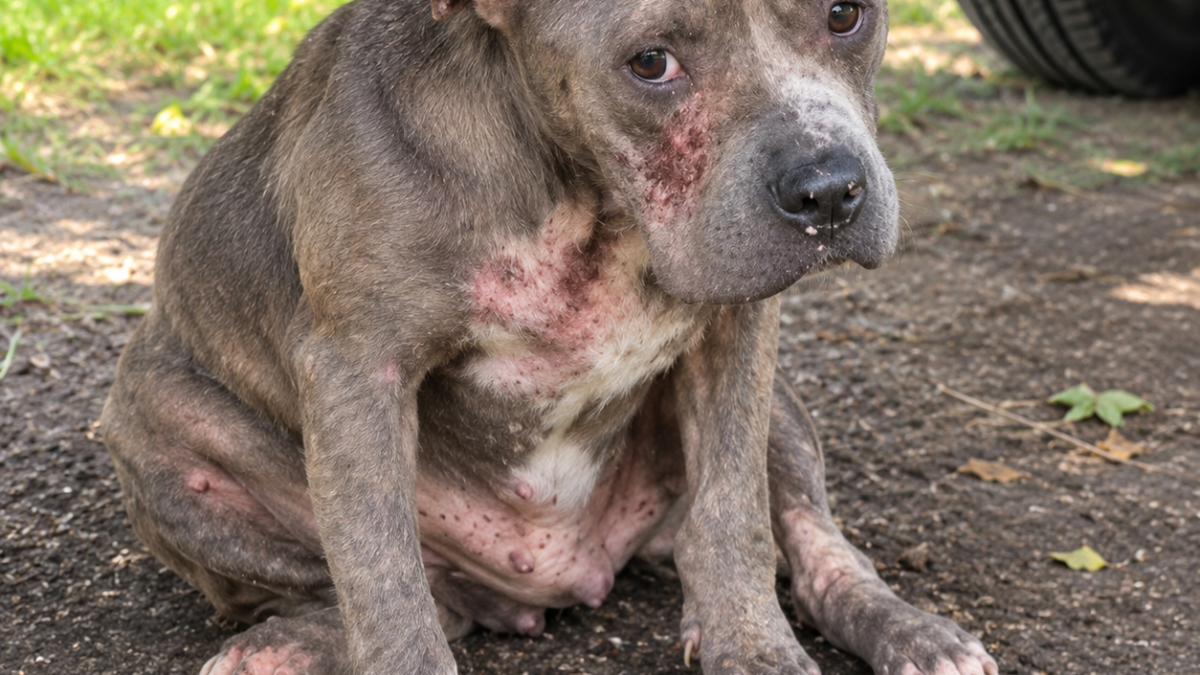
Her coat was soaked and filthy.
Her body was frighteningly thin.
Patches of fur were missing along her neck, shoulders, and back, leaving raw, irritated skin exposed beneath.
Her tail was tucked so tightly under her belly that I could barely see it.
“Hey,” I called softly.
She froze.
I immediately regretted speaking.
Her entire body dropped lower.
Not all the way to the ground.
Just enough to tell me she expected something bad.
“It’s okay.”
I crouched near the doorway.
“I’m not coming closer.”
She stared at me.
Rain dripped from her ears.
Cooper appeared behind my leg.
The stranger noticed him and took one step backward.
“Cooper, stay.”
He did.
The dog looked toward the broken fence.
Then at me.
Then toward the porch.
I thought she might leave.
Instead, she took another step toward the house.
I could see her ribs clearly now.
Her legs trembled.
There was mud dried between her toes and something dark along one side of her face that I couldn’t tell was dirt or an old scab.
“Oh, sweetheart.”
Her ears flattened.
I stopped talking.
For almost a full minute, nobody moved.
Then the dog walked onto my porch.
One step.
Pause.
Another.
Pause.
She never barked.
Never whined.
Never scratched at the door.
She simply stood there looking at me.
It was the strangest thing.
There was no demand in her eyes.
No expectation.
She looked like an animal who had already learned not to expect anything from people.
I backed slowly into the kitchen and grabbed a bowl.
Water first.
Then a little food.
When I placed them near the doorway, she stared at the bowl but wouldn’t approach while I was standing there.
So I sat on the floor.
Cooper settled beside me.
The stranger waited.
Thirty seconds.
A minute.
Then she took one step.
Her nose reached the water.
She drank.
Not greedily.
Not the way I expected.
Just a few careful laps, stopping constantly to look at me.
Then she smelled the food.
Her body changed.
Her focus sharpened.
But she still hesitated.
“You can have it,” I whispered.
She looked directly into my eyes.
For reasons I still can’t explain, that moment hurt.
Because hunger was fighting fear.
And for a dog to be that thin and still be more afraid of a person than desperate for food, I knew life had taught her some terrible lessons.
I slid the bowl a little closer.
Then I leaned back.
The dog stepped forward.
She ate one bite.
Stopped.
Looked at me.
Nothing happened.
Another bite.
Then another.
Within a minute, the bowl was empty.
She licked it twice.
Then stood perfectly still.
The wind pushed rain across the porch behind her.
I looked at the broken yard.
At her raw skin.
At her shaking legs.
Then at the warm kitchen behind me.
“Okay,” I said quietly.
“Come inside.”
She didn’t move.
I backed away from the door.
Cooper followed.
The dog watched us.
For a long moment, I thought she wouldn’t do it.
Then she lifted one paw.
Placed it across the threshold.
And stepped into my house.
I had no idea that the smallest step Sandy took that morning would change both of our lives.
**— END OF FACEBOOK OPENING —**
# PART TWO — THE DOG WHO WALKED OUT OF THE STORM
## Chapter 1: The Kitchen Floor
The moment the dog crossed into my kitchen, she froze.
It was as if the invisible line at the doorway had been easier to cross than the room itself.
Her paws stayed planted on the tile.
Her head lowered.
Her eyes moved constantly.
Table.
Chairs.
Counter.
Me.
Cooper.
Back door.
Front hall.
Every exit.
Every possible threat.
I stayed where I was.
“You’re okay.”
Her ears twitched.
That was the first time I realized how sensitive she was to voices.
Even a gentle sentence made her brace.
So I stopped talking.
Cooper, thankfully, understood the atmosphere better than I expected.
He was usually enthusiastic with new dogs.
Too enthusiastic.
But that morning he simply lay down near the wall.
He watched her without approaching.
The stranger looked at him.
Cooper yawned.
She looked at me.
I sat on the floor.
Then we waited.
Outside, the storm continued moving away.
Water ran from the gutters.
Somewhere down the street, a branch cracked and fell.
The dog flinched so hard that her legs almost slipped out from beneath her.
“It’s okay.”
I whispered it this time.
She stared at the back door.
For a second, I thought she would bolt.
Then Cooper shifted.
The dog looked at him.
He was still lying down.
Nothing was chasing her.
Nobody was yelling.
After several minutes, she took two steps toward the wall.
Then she lowered herself to the floor.
Not comfortably.
She didn’t curl up.
She remained ready to run.
Her head stayed raised.
Her eyes stayed open.
I grabbed an old towel.
The instant I lifted it, she recoiled.
I stopped.
“Okay.”
I set it on the floor several feet away.
Then I went back to my spot.
She watched the towel.
Eventually, I pushed it toward her with my foot.
She sniffed it.
Didn’t use it.
But she didn’t run.
That counted as progress.
The power was still out.
Cell service came and went.
I couldn’t take her to the veterinarian yet because roads were flooded and local officials were asking people to stay home unless there was a medical emergency.
So for that first day, all I could offer was shelter.
Water.
Small meals.
Quiet.
I didn’t know her name.
Didn’t know her age.
Didn’t know where she’d come from.
I didn’t even know whether somebody was searching for her.
The only thing I knew for certain was that she had survived something.
And she was exhausted.
By noon, she finally slept.
Not deeply.
Every sound woke her.
But she lowered her head onto the tile.
Ten minutes later, I moved the towel beside her.
This time she didn’t react.
By evening, half her body was lying on it.
I smiled.
“Progress.”
One eye opened.
I laughed quietly.
“Sorry.”
I kept forgetting she was listening to everything.
When darkness came, I set up a small sleeping space in the laundry room with the door open.
A bed.
Blankets.
Water.
Food.
I didn’t want to confine her.
But I also didn’t want to overwhelm her.
Cooper slept in his usual place beside my bedroom door.
I expected the stranger to stay downstairs.
Around two in the morning, I woke to a faint sound.
Tap.
Tap.
Tap.
I sat up.
Nothing.
Then again.
Tap.
I walked into the hallway.
She was standing at the bottom of the stairs.
Looking up.
I sat on the top step.
“Hi.”
She didn’t move.
I waited.
Eventually she lay down at the bottom.
I stayed there.
Neither of us knew what the rules were yet.
So we invented them quietly.
She could stay.
I wouldn’t force anything.
And if she needed to know where I was, she could look.
That was our first night.
## Chapter 2: Sandy
The next morning, the sky finally cleared.
Not beautifully.
The clouds were gray and heavy, but the wind was gone.
The neighborhood looked like it had been shaken by giant hands.
Fences leaned.
Roof shingles covered lawns.
Trees lay across streets.
People walked outside slowly, stunned.
I called the veterinary clinic as soon as I got a signal.
They were open for emergencies.
I explained the dog.
Thin.
Raw skin.
Possible infection.
Unknown medical history.
The receptionist said, “Bring her in.”
That was easier said than done.
The dog still didn’t trust me enough to let me put a leash around her neck.
I found an old slip lead from Cooper’s puppy days.
I placed it on the floor.
She sniffed it.
Backed away.
I picked it up.
She flinched.
“Right.”
I sat down.
We spent twenty minutes doing nothing.
Then I placed a piece of chicken near the leash.
She approached.
Ate it.
Another piece.
Closer.
Eventually she stood near enough that I could gently move the loop toward her neck.
Her body stiffened.
I stopped.
“Not yet.”
I put it down again.
Another ten minutes.
Another piece of food.
Finally, she allowed the lead around her neck.
But when I stood, she dropped flat to the floor.
My chest tightened.
“I’m not pulling you.”
I sat again.
The lead remained loose.
She looked at me.
I took one step.
She didn’t move.
Another.
She crawled forward slightly.
“Good girl.”
Her ears moved.
We made it to the car in almost fifteen minutes.
At the clinic, she tried to hide behind my legs.
That surprised me.
She didn’t trust me completely.
But apparently I was already safer than the room.
A technician crouched sideways instead of facing her directly.
“Hi, sweetheart.”
The dog stared.
“Do we have a name?”
I looked down.
“No.”
The technician smiled.
“We can just call her Girl for now.”
But something about that felt wrong.
This dog had survived a hurricane.
She had crossed who knew how much distance.
She had walked into a stranger’s yard and stood at a door without making a sound.
She deserved something more than Girl.
I looked at the dried sand and dirt still caught in her coat despite my gentle cleaning.
“Sandy.”
The technician looked up.
“Sandy?”
I nodded.
“Sandy.”
The dog’s ears twitched.
I said it again.
“Sandy.”
She looked at me.
The technician smiled.
“Looks like she approves.”
So that became her name.
## Chapter 3: What the Storm Had Left Behind
The examination took time.
Sandy was terrified of being touched.
The veterinarian, Dr. Alvarez, moved slowly.
He let her smell his hand.
Then touched her shoulder.
She flinched.
But she didn’t snap.
She didn’t growl.
She simply endured.
That word bothered me.
Endured.
Like she’d gotten too good at it.
The scale showed how underweight she was.
Dr. Alvarez ran his hands gently along her ribs.
“She’s severely underfed.”
“How long?”
“Difficult to say.”
He examined the raw skin.
There were inflamed patches.
Scabs.
Hair loss.
Areas where she had clearly been scratching.
“She has a skin infection.”
“From the storm?”
“Maybe worsened by exposure. But some of this appears to have been developing before yesterday.”
I looked at him.
“Before the hurricane?”
“Yes.”
My stomach turned.
“So she was already in bad shape.”
He nodded.
“Likely.”
They took blood.
Checked for parasites.
Cleaned several areas of her skin.
Sandy trembled through everything.
At one point, a metal tray fell in another room.
The crash echoed down the hallway.
Sandy collapsed against my legs.
Not toward the door.
Toward me.
I looked down.
Her body shook violently.
Without thinking, I placed my hand gently on her neck.
“It’s okay.”
She didn’t move away.
That was the first time I touched her without seeing fear.
Dr. Alvarez noticed.
“She trusts you.”
I shook my head.
“Not really.”
“More than she did yesterday?”
I looked down at her.
“Yes.”
“Then that’s how it starts.”
The tests showed dehydration.
Malnutrition.
Skin infection.
Parasites.
Nothing immediately catastrophic.
No broken bones.
No major internal injuries.
That felt like a miracle after what the coast looked like outside.
“Can she come home with me?”
Dr. Alvarez nodded.
“She needs rest more than anything.”
“Medication?”
“Yes.”
He explained the plan.
Soft meals in smaller portions.
Medicated baths.
Medication for the infection.
Parasite treatment.
Plenty of water.
Quiet.
“How long before she’s better?”
Dr. Alvarez smiled slightly.
“Physically?”
I knew what he meant.
“And emotionally?”
He looked at Sandy.
“That part is up to her.”
## Chapter 4: The Bath
The first medicated bath was a disaster.
Not because Sandy fought.
I almost wished she had.
Instead, she shut down.
The moment she realized I was guiding her toward the bathroom, her legs stopped working.
She dropped to the floor.
“Sandy.”
Nothing.
I sat beside her.
The medicated shampoo was on the counter.
The tub had only a little warm water.
I’d prepared towels.
Everything was calm.
But Sandy didn’t know that.
She saw a room.
A person.
Water.
Containment.
And her body decided danger.
I almost gave up.
Then I called the clinic.
A technician talked me through it.
“Don’t rush her.”
“I don’t want to traumatize her.”
“Then give her time.”
I put the phone on speaker.
Sat on the bathroom floor.
Sandy remained outside the doorway.
I tossed one piece of chicken into the room.
She stared.
Another.
Closer.
Another.
Twenty-five minutes later, she stood inside.
The bath itself took almost an hour.
Not because washing her required that long.
Because everything happened in stages.
Paw in.
Pause.
Warm water.
Pause.
Touch shoulder.
Pause.
Sandy shook.
I whispered.
“You’re okay.”
Her eyes stayed on me.
When I finally rinsed the medicated shampoo away, the water beneath her looked brown.
Mud.
Dirt.
Old skin.
Storm residue.
Maybe pieces of the life she’d been living before she reached my door.
I wrapped her in a towel.
This time, she didn’t flinch.
She leaned against me.
Just slightly.
But enough.
I sat on the floor holding her.
Cooper watched from the hallway.
Sandy’s eyes slowly closed.
I looked at the patches of raw pink skin beneath her damp coat.
“Nobody’s hurting you here.”
She couldn’t understand the words.
But I hoped she understood my hands.
## Chapter 5: Searching for Someone Who Might Be Searching for Her
For the first several days, I told myself Sandy was temporary.
I posted her picture in local lost-pet groups when cell service became reliable.
I contacted shelters.
Called animal control.
Asked the clinic to scan her for a microchip.
Nothing.
No chip.
No matching missing report.
No owner.
I scrolled through hundreds of posts.
Dogs missing after the storm.
Cats found in garages.
Pets separated during evacuations.
Families begging strangers to look beneath damaged houses.
Every time I saw a sandy-colored dog, my heart jumped.
Then I’d compare markings.
Not her.
I wanted somebody to be looking for Sandy.
I really did.
Because the idea that she’d been abandoned before the hurricane was harder to accept.
Maybe she’d escaped.
Maybe her family had evacuated and lost her.
Maybe somebody was searching desperately.
For days, nobody came forward.
A week passed.
Still nobody.
Part of me was relieved.
That embarrassed me.
I didn’t want to lose her.
But another part of me kept thinking:
Someone should have missed you.
Someone should have known you were gone.
One evening, I sat on the couch scrolling through another list.
Sandy lay on her blanket several feet away.
Cooper was asleep beside me.
“I don’t know where you came from,” I said.
Her ears moved.
“But someone should’ve looked.”
Sandy lifted her head.
“Maybe they did.”
I wanted to believe that.
Maybe somewhere, a family had been displaced.
Maybe records were lost.
Maybe they had bigger problems.
We would never know for certain.
And eventually I realized something.
Sandy didn’t need me to solve her past before I could protect her future.
## Chapter 6: The First Full Meal
At first, Sandy ate cautiously.
That surprised everyone.
A dog as thin as she was should have been frantic.
But she wasn’t.
She approached bowls like they might disappear if she moved too quickly.
One bite.
Look around.
Another bite.
Pause.
It reminded me of someone eating in a place where food had never truly belonged to them.
Dr. Alvarez told me not to overfeed.
Her body needed time.
So I followed the schedule.
Small meals.
Soft food.
Medication.
Water.
At night, Sandy slept in the laundry room with the door open.
By the third night, she moved the blanket closer to the hallway.
By the fourth, she slept near the foot of the stairs.
By the fifth, she was outside my bedroom.
I woke in the morning and found her curled beside Cooper.
Not touching.
But close.
I stood quietly.
Cooper opened one eye.
Sandy slept.
That was the first time I saw her completely relaxed.
No ears twitching.
No body ready to run.
Just sleep.
I backed away without waking her.
That morning, she ate her entire breakfast without stopping.
Then she licked the bowl.
I smiled.
“Want more?”
Her tail moved.
Barely.
One tiny side-to-side motion.
I froze.
“Sandy.”
She stopped.
I laughed.
“Did you just wag?”
Her ears came forward.
I crouched.
“Do it again.”
Nothing.
Of course.
Dogs refuse to perform when moments matter.
But I had seen it.
One little wag.
It was almost nothing.
To me, it felt like thunder.
## Chapter 7: The Sound of a Door
Sandy’s biggest trigger was doors slamming.
I learned that on day six.
A gust of wind caught the back door while I was carrying laundry.
Bang.
Sandy disappeared.
One second she was in the kitchen.
The next she was under the dining table, pressed into the corner.
“Sandy.”
She shook.
I knelt several feet away.
“I’m sorry.”
Her eyes were huge.
Cooper walked toward her.
I stopped him.
“Give her room.”
He sat.
Sandy stayed under the table for almost forty minutes.
I didn’t try to drag her out.
I sat on the floor.
Worked on my phone.
Pretended not to watch her.
Eventually, a nose appeared.
Then her head.
Then one paw.
“Hi.”
She froze.
I looked away.
A minute later, she crawled toward me.
I held out my hand.
She sniffed.
Then she pressed her forehead into my palm.
That was the first time Sandy asked me for comfort.
Not accidentally.
Not because there was nowhere else to go.
She chose my hand.
I swallowed.
“It’s okay.”
From then on, every slammed cabinet, dropped object, or sudden voice reminded me that physical recovery was only half the story.
The hurricane had frightened her.
But not every fear came from the hurricane.
Some had been there longer.
## Chapter 8: The Seventh Day
By the end of the first week, Sandy looked different.
Not dramatically.
She was still thin.
Still patchy.
Still healing.
But there was more light in her eyes.
Her appetite improved.
Her skin looked less angry.
And she had begun following Cooper.
That was the real breakthrough.
Cooper loved toys.
Especially one ridiculous blue rope that had been repaired so many times it looked like a cleaning rag.
One morning, he brought it into the living room.
Sandy watched.
He shook it.
Dropped it.
Picked it up.
Sandy’s ears lifted.
I sat on the couch pretending not to stare.
Cooper carried the rope toward her.
Sandy backed away.
He dropped it.
Waited.
Sandy sniffed.
Cooper grabbed one end.
Sandy watched.
Then, slowly, she opened her mouth and took the other.
I stopped breathing.
Cooper pulled.
Very gently.
Sandy resisted.
Her tail moved.
Once.
Twice.
Then faster.
“Oh my God.”
The words escaped before I could stop them.
Sandy let go and looked at me.
I covered my mouth.
“Sorry.”
Cooper picked up the rope again.
Sandy grabbed it.
This time, she pulled.
Not hard.
But playfully.
Her front feet slid across the rug.
Her tail wagged.
Actually wagged.
Not a nervous flick.
A full, loose, happy wag.
I started crying.
Cooper sneezed.
Sandy pulled harder.
The rope tore.
Both dogs stumbled backward.
For half a second, Sandy froze.
Then Cooper pounced on the broken half.
And Sandy did something I hadn’t heard once since she arrived.
She barked.
One sharp little bark.
Then another.
I laughed through tears.
“There you are.”
That was the first day I saw Sandy become a dog instead of a survivor.
## Chapter 9: The First Time She Asked to Play
Three days later, Sandy brought me a toy.
I was in the kitchen washing dishes.
Something bumped my ankle.
I looked down.
Blue rope.
I turned.
Sandy stood behind me.
Tail moving.
“You brought this?”
Her tail sped up.
I picked it up.
She backed away.
Front legs lowered.
Rear end up.
Play bow.
I stared.
“Are you kidding me?”
Cooper came running.
Within seconds, both dogs were circling the kitchen.
I threw the rope.
Sandy chased it.
Not far.
She tired easily.
But she ran.
A dog that had stood trembling at my door less than two weeks earlier now sprinted after a toy across my living room.
I watched her feet hit the floor.
Watched her ears bounce.
Watched her mouth open into what looked almost like a smile.
The storm had not won.
Whatever came before the storm had not won.
Fear had not won.
Not completely.
## Chapter 10: Foster
The rescue organization I had contacted during my search for Sandy offered to place her into an official foster program.
That would cover some medical expenses and help screen eventual adopters.
I agreed.
Officially, Sandy became my foster dog.
I repeated that phrase constantly.
“My foster dog.”
At the clinic:
“My foster dog is doing better.”
To neighbors:
“She’s a foster.”
To my sister:
“I’m just fostering her.”
My sister laughed every time.
“You don’t believe that.”
“I absolutely believe it.”
“Hannah.”
“What?”
“You bought her a bed.”
“Foster dogs need beds.”
“With her name embroidered on it?”
I looked at the bed.
That had been excessive.
“It was on sale.”
My sister stared.
“You also bought matching bowls.”
“They came in a set.”
“And a pink collar.”
“Safety.”
“With daisies?”
“Visibility.”
She laughed.
“You’re doomed.”
I wasn’t.
I told myself that.
I had Cooper already.
Two dogs meant twice the food.
Twice the vet bills.
Travel became harder.
My house wasn’t huge.
Sandy deserved the best possible family.
And I was only temporary.
Temporary.
I repeated it every time Sandy followed me into the bathroom.
Every time she slept beside Cooper.
Every time she met me at the bedroom door in the morning.
Temporary.
## Chapter 11: The Adoption Application
The first serious adoption inquiry came three weeks after the storm.
A couple saw Sandy’s profile.
They had a fenced yard.
Experience with dogs.
Good references.
On paper, they were excellent.
The rescue coordinator called me.
“Hannah, we may have a potential home.”
My stomach dropped.
“Oh.”
Silence.
Then the coordinator laughed.
“That’s usually not the reaction foster parents give.”
“No, I’m happy.”
“You sound devastated.”
“I’m not.”
“Hannah.”
I sat down.
Sandy was asleep at my feet.
Cooper lay beside her.
Their backs were touching.
“When would they meet her?”
“Saturday.”
“Okay.”
“They sound wonderful.”
“Okay.”
“You can say no if there’s a genuine concern.”
“I know.”
“But you can’t say no because you’ll miss her.”
I closed my eyes.
“I know.”
Saturday came too quickly.
The couple arrived.
They were kind.
Patient.
They sat on the floor and let Sandy approach.
She sniffed them.
Accepted treats.
Allowed the woman to touch her shoulder.
Everything went well.
Too well.
I hated myself for thinking that.
They asked thoughtful questions.
“What scares her?”
“Sudden loud noises.”
“How is she around other dogs?”
“Great with Cooper.”
“Does she have separation anxiety?”
“Some. It’s improving.”
“What does she love?”
I looked at Sandy.
“Routine.”
The couple smiled.
“And toys.”
Sandy looked toward the toy basket.
“And Cooper.”
The woman looked at both dogs.
“They’re close.”
“Yes.”
After they left, Sandy stood at the window.
Then she turned.
Looked at me.
And walked toward the couch.
She climbed beside Cooper.
Placed her head on his back.
I sat across from them.
My chest hurt.
“This is ridiculous.”
Cooper opened one eye.
“Don’t look at me like that.”
Sandy sighed.
Temporary.
I repeated the word.
It sounded stupid now.
## Chapter 12: The Storm Inside Me
That night, another thunderstorm rolled in.
Nothing like the hurricane.
Just rain.
A few cracks of thunder.
But Sandy panicked.
The first rumble sent her beneath my desk.
The second made her tremble.
I sat beside her.
Cooper squeezed under too.
Three bodies crammed beneath furniture designed for one chair.
I laughed despite myself.
“This is ridiculous.”
Thunder cracked.
Sandy crawled into my lap.
She weighed more now.
Not much more.
But enough to make my legs ache.
I wrapped my arms around her.
“It’s okay.”
She buried her head against me.
Cooper leaned against her other side.
We stayed that way.
The storm lasted less than an hour.
By the end, Sandy had stopped shaking.
But I hadn’t.
Because I suddenly understood what adoption would mean.
Someone else would sit with her during storms.
Someone else would learn that she preferred the bedroom door open.
Someone else would know she liked her food slightly warmed.
Someone else would see her wag first thing in the morning.
Someone else would be home.
I wanted that for her.
I did.
The problem was that I wanted to be the someone.
## Chapter 13: The Call
The rescue coordinator called the next morning.
“The couple would like to proceed.”
I stared at the wall.
Sandy was in the yard with Cooper.
They were chasing each other around the oak branches I still hadn’t fully cleared.
“Hannah?”
“I’m here.”
“They loved her.”
“I know.”
“They’re approved.”
I swallowed.
“Okay.”
“We could schedule the transition.”
Silence.
“Hannah?”
“I can’t.”
The words came out before I had decided to say them.
The coordinator paused.
“Can’t what?”
I looked through the window.
Sandy ran toward Cooper.
Her tail was high.
Wagging.
“I can’t let her go.”
A longer pause.
Then:
“Are you asking to adopt your foster?”
I laughed and started crying at the same time.
“I think I am.”
“You think?”
I wiped my face.
“No.”
I watched Sandy stop at the back door.
She saw me through the glass.
Her tail began moving harder.
“No. I know.”
The coordinator laughed.
“Foster fail.”
“I hate that phrase.”
“Everyone does until it happens to them.”
I covered my mouth.
“Is the couple going to be angry?”
“They’ll be disappointed. But we’ll help them find another dog.”
“I feel terrible.”
“You gave Sandy a home.”
I looked at her.
Standing outside the same door where she had once trembled during a hurricane.
Only now she was waiting because she knew I would open it.
“No,” I whispered.
“I think she gave me one.”
## Chapter 14: Home for Good
The paperwork wasn’t dramatic.
Signatures.
Fees.
Medical records.
Contact information.
But I cried through almost all of it.
The coordinator slid the adoption form toward me.
“Congratulations.”
I looked at the line.
Owner.
Hannah Miller.
Sandy.
I signed.
That was it.
No music.
No grand announcement.
Just ink.
But when I drove home, everything felt different.
Sandy sat in the back beside Cooper.
She didn’t know anything had changed legally.
She didn’t understand ownership.
Paperwork.
Foster programs.
Adoption.
To her, the important things had already changed.
She knew the route home.
When I turned onto our street, she stood.
At the driveway, her tail started wagging.
When I opened the back door, she jumped out.
Ran toward the porch.
Stopped at the door.
Looked back at me.
I stood there holding her adoption folder.
The memory hit me so hard that I couldn’t move.
The first morning.
Rain.
Mud.
Raw skin.
Tail tucked.
A dog standing outside this same door, too frightened to ask for anything.
Now she stood there impatiently.
Tail wagging.
Waiting to be let into her house.
I laughed.
“All right.”
I opened the door.
“Go home.”
Sandy ran inside.
## Chapter 15: The Bed
Her embroidered bed became unnecessary almost immediately.
Sandy preferred three places.
The couch.
My bed.
Cooper.
But every morning, she started in her own bed beside mine.
I don’t know why that mattered so much to me.
Maybe because of the contrast.
The hurricane had taken away every sense of safety.
Now Sandy woke in the same place.
Dry.
Warm.
Fed.
Protected.
One morning, about six weeks after she arrived, I woke before my alarm.
The room was gray with early light.
I looked down.
Sandy was awake.
She saw me.
And her tail started thumping against the bed.
Thump.
Thump.
Thump.
I smiled.
“Good morning.”
Faster.
Cooper lifted his head.
Sandy stood.
Stretched.
Then came toward me.
I sat on the edge of the bed.
She pressed her head into my chest.
That was our morning routine.
No fear.
No hesitation.
No waiting to see whether the day would be dangerous.
She woke happy.
That felt like the greatest victory of all.
## Chapter 16: The Last Piece of the Storm
Months later, workers finally repaired the damaged section of my fence.
Sandy hated the noise.
Hammers.
Power tools.
Boards dropping.
The first day, she hid.
But not as completely as before.
She came to me.
I sat with her.
Cooper joined us.
Eventually, curiosity won.
Sandy watched the workers through the window.
One of them noticed.
“That your dog?”
I smiled.
“Yes.”
“Pretty girl.”
Sandy stepped backward.
The man didn’t approach.
“She came from the storm,” I said.
He looked at her again.
“Really?”
“Walked into my yard the morning after.”
“Damn.”
He smiled.
“Smart dog.”
I looked at Sandy.
“Very.”
When the fence was finished, the worker opened the gate to show me the repair.
Sandy stood several feet away.
That broken opening was close to where she’d first entered my yard.
I remembered her silhouette.
Wet.
Thin.
Terrified.
Now the fence was whole.
Sandy walked toward it.
Sniffed the fresh wood.
Then turned away.
She ran toward Cooper instead.
I realized then that the entrance no longer mattered.
The storm no longer owned that place.
## Chapter 17: The Photograph
I kept one photograph from Sandy’s first day.
I almost deleted it.
She looked terrible.
Thin.
Raw skin.
Eyes exhausted.
Tail tucked beneath her.
For a while, the picture made me angry.
Then one afternoon I took another.
Sandy stood in the yard.
Her coat had grown in.
Healthy.
Shiny.
She held the blue rope in her mouth.
Cooper was behind her.
Her tail was high.
I placed the pictures side by side.
I cried.
Not because the first image was sad.
Because the second one existed.
That is the part rescue teaches you.
You don’t erase what happened.
You build something beside it.
Something so good that eventually the bad beginning stops being the whole story.
## Chapter 18: The Woman at the Grocery Store
One afternoon, a woman stopped me outside the grocery store.
“Excuse me.”
I turned.
She pointed toward Sandy, who was walking beside me.
“Is that the hurricane dog?”
I blinked.
Some local rescue volunteers had shared her story after the adoption.
“Yes.”
The woman smiled.
“I thought so.”
She crouched a little, but didn’t reach.
“Hi, Sandy.”
Sandy looked at her.
Then at me.
Her tail moved.
The woman stood.
“I remember seeing the first picture.”
I nodded.
“She looks incredible.”
“Thank you.”
The woman became emotional.
“My family lost our house in that storm.”
“I’m sorry.”
“We’re rebuilding.”
She looked at Sandy.
“It’s strange.”
“What?”
“Seeing her makes me feel better.”
I didn’t know what to say.
She smiled.
“If she can look like that after what happened…”
Her voice trailed off.
I understood.
Sometimes survival becomes contagious.
Not literally.
Emotionally.
You see another living thing begin again.
And suddenly beginning again feels possible.
## Chapter 19: What Revenge Looked Like
There were times, especially early on, when I wanted to know exactly who had left Sandy.
Was she deliberately abandoned?
Was she lost?
Had somebody evacuated without her?
Had neglect started long before the storm?
I wanted a person to blame.
Anger is easier when it has a face.
But Sandy’s story never gave me one.
No owner returned.
No chip revealed a name.
No witness appeared with a perfect explanation.
Eventually, I had to accept that some questions would remain unanswered.
At first, that frustrated me.
I wanted justice.
I wanted someone to see what Sandy had become and understand what they’d nearly lost.
But Sandy didn’t care.
She never woke up angry.
She woke up wagging.
She didn’t spend afternoons staring toward the road waiting for revenge.
She chased Cooper.
Stole toys.
Slept in the sun.
Begged for chicken.
Learned the sound of my car.
Learned that storms ended.
Learned that doors opened again.
That became the only revenge worth wanting.
Whatever had abandoned Sandy to fear did not get the rest of her life.
The storm got one night.
Fear got a few weeks.
Healing got everything after.
## Chapter 20: The Anniversary
One year after the hurricane, the weather was clear.
Warm.
Almost offensively beautiful.
I woke early.
Sandy was in her bed.
The moment I moved, her tail began thumping.
“Do you know what today is?”
She stretched.
Cooper yawned.
“Exactly one year ago, you walked into this yard.”
Sandy jumped onto the bed.
“Technically, you weren’t invited.”
She licked my face.
“Fine. You’re forgiven.”
I took both dogs outside.
The yard had changed.
Fence repaired.
Tree trimmed.
Flower beds replanted.
Roof fixed.
No debris.
No broken branches.
The coast still carried scars, but it had rebuilt.
So had Sandy.
I stood near the place where she’d entered.
She was sniffing the grass.
“Come here.”
Sandy ran toward me.
Ran.
That word still mattered.
She reached me.
I crouched.
“You scared me that day.”
Tail wag.
“I had no idea what I was doing.”
She pushed against my hands.
“I said one night.”
She licked my chin.
“One night.”
I laughed.
Cooper brought the rope.
Sandy grabbed the other end.
They ran.
I watched them.
Then I sat on the porch.
The same porch where she’d once stood trembling.
For several minutes, I simply listened.
Birds.
Cars.
Dog tags jingling.
No hurricane.
No wind tearing at the house.
No frightened silence.
Sandy barked at Cooper.
He barked back.
I smiled.
The dog who wouldn’t make a sound at my door had found her voice.
## Chapter 21: The Night the Storm Came Back
The real test came later that summer.
A tropical storm formed offshore.
Not a hurricane.
But strong enough to bring wind and heavy rain.
The weather alert appeared on my phone.
I looked at Sandy.
She was asleep.
I wondered how much she would remember.
That evening, rain began.
At the first thunderclap, Sandy lifted her head.
The second sent her toward me.
I sat on the couch.
“Come here.”
She climbed up.
Cooper joined from the other side.
Rain hit the windows.
Wind moved through the trees.
Sandy trembled.
Less than before.
But enough.
I stroked her head.
“You’re home.”
Another crack of thunder.
Sandy pressed closer.
“Listen to me.”
I knew she couldn’t understand the sentence.
I said it anyway.
“The roof is staying.”
I stroked her ear.
“The door is staying.”
Her breathing slowed.
“Your bed is staying.”
Cooper put his head across her paws.
“And we’re staying.”
Sandy looked up.
Then something happened.
Her tail moved.
Not much.
One small wag against the couch.
I laughed.
“Good girl.”
The storm lasted three hours.
Sandy stayed beside us.
She didn’t hide.
Didn’t panic.
Didn’t try to escape.
At some point, she fell asleep.
Outside, thunder rolled.
Inside, she slept.
That was the night I knew she had truly learned what home meant.
Not a place where storms never happen.
A place where you don’t face them alone.
## Chapter 22: Cooper
I often say I rescued Sandy.
That isn’t completely true.
Cooper did a lot of the work.
He taught her things I couldn’t.
That bowls came back every day.
That toys weren’t traps.
That people entering the kitchen sometimes meant snacks.
That sleeping deeply was safe.
That the vacuum cleaner was evil but survivable.
That squirrels must be monitored at all times.
And most importantly, that being a dog could be fun.
One afternoon, I watched them wrestle in the yard.
Sandy was stronger now.
Healthy weight.
Beautiful coat.
No infection.
She chased Cooper around the tree.
He turned.
She dodged.
They collided.
Rolled.
Jumped up.
Started again.
I remembered the first morning when Sandy had backed away simply because she saw him.
Now she stole his bed.
His toys.
His spot beside me.
And occasionally his dignity.
I laughed.
“You created a monster.”
Cooper looked at me.
Sandy tackled him.
“That’s on you.”
## Chapter 23: The Door
The front door became important in a way I never expected.
At first, Sandy feared it.
She hesitated when entering.
Startled when it closed.
Watched anyone walking through it.
Months later, the door meant something completely different.
It meant I was home.
I began noticing the pattern.
My car pulled into the driveway.
Sandy heard it.
By the time I reached the porch, she was behind the door.
Tail hitting the wall.
I opened it.
She exploded into motion.
Every single time.
Sometimes I’d only been gone twenty minutes.
Sandy reacted as though I had returned from war.
“Hi.”
Tail.
“Yes, I missed you too.”
Jump.
“No jumping.”
Jump.
“Sandy.”
Face lick.
“Okay.”
It became our ritual.
One evening, standing in that doorway, I remembered the first time we’d looked at each other.
She had been outside.
I had been inside.
A threshold between us.
Now the same door opened and Sandy never hesitated.
She knew which side belonged to her.
Both.
Inside.
Outside.
Yard.
House.
Porch.
All of it was home.
## Chapter 24: The Best Morning
People often expect the emotional climax of a rescue story to be dramatic.
The first vet visit.
A surgery.
A miraculous recovery.
For me, Sandy’s greatest moment happened on an ordinary Tuesday.
No anniversary.
No storm.
No visitors.
I woke at 6:14.
Sunlight came through the curtains.
Sandy was asleep in her bed.
Cooper snored in the hallway.
I got up.
Sandy opened her eyes.
Her tail started wagging.
Before she was fully awake.
That detail stopped me.
Her body woke happy before her mind seemed to catch up.
Tail first.
Then stretch.
Then eyes.
Then she stood and came toward me.
I sat on the floor.
Sandy leaned into my chest.
I held her.
And I thought about the dog who had stood outside my door one year earlier.
Tail tucked so tightly beneath her that it almost disappeared.
Fear in every movement.
Now happiness had become automatic.
Her body expected good things.
Food.
Walks.
Cooper.
Me.
That was healing.
Not forgetting the past.
Changing what you expect from the future.
## Chapter 25: If I Could Speak to the Dog at the Door
Sometimes I imagine going back to that morning.
The rain.
The wrecked yard.
The broken fence.
Sandy standing on my porch.
If I could kneel beside that version of her without frightening her, I would tell her something.
Not everything.
I wouldn’t tell her about the baths.
She hated those.
I wouldn’t mention the medication.
Or the vet.
Or the thunderstorm under the desk.
I would tell her about the mornings.
“You don’t know me yet,” I would say.
“You don’t know Cooper.”
“You don’t know this house.”
Sandy would probably stare.
“But one day, you’re going to wake up here and wag your tail before you even stand.”
I would tell her she would have a bed.
Actually several.
Although she would ignore them whenever the couch was available.
I would tell her she would learn how to play tug.
That Cooper would become her best friend.
That she would steal my pillows.
That her fur would grow back.
That her skin would heal.
That people would call her beautiful.
I would tell her the sound of thunder would eventually mean:
*Find Hannah.*
Not:
*Run.*
And then I would tell her the most important thing.
“You can step inside.”
Because that one step changed everything.
## EPILOGUE — THE DOG THE HURRICANE COULDN’T KEEP
Sandy is asleep beside me while I write this.
She is older now.
Not old.
Just older than the frightened dog who walked through my yard after the hurricane.
Her coat is full and soft.
No ribs visible.
No raw skin.
No infection.
Her tail is resting across Cooper’s paw.
Every few minutes, it moves in her sleep.
I wonder what she dreams about.
I hope she doesn’t dream about the storm.
I hope she dreams about running.
Toys.
Food.
Sunlight.
Maybe squirrels.
Probably squirrels.
I still don’t know everything about Sandy’s life before that morning.
Maybe I never will.
There are pieces of her past that belong only to her.
But I know what happened afterward.
A frightened dog came to my door.
She didn’t bark.
Didn’t scratch.
Didn’t demand.
She simply stood there.
And looked at me.
Sometimes I think about how easy it would have been to miss her.
If I’d stayed inside another ten minutes.
If she’d turned away.
If I’d opened the door too quickly and frightened her.
If Cooper had barked.
Small moments can redirect entire lives.
That morning, Sandy took one step into my kitchen.
Then another.
Years later, she still takes those same steps every morning.
Bedroom to kitchen.
Kitchen to yard.
Yard back to me.
Only now there is no fear in them.
The hurricane took roofs.
Fences.
Trees.
Power lines.
Homes.
It left entire neighborhoods scattered across roads and lawns.
And somewhere in all of that destruction, it pushed one terrified dog into my yard.
For a long time, I thought Sandy was something good I managed to save from the storm.
Now I understand the truth is more complicated.
I was twenty-seven.
Living alone.
Going through routines.
Working.
Coming home.
Taking Cooper for walks.
Repeating the same days.
I wasn’t unhappy.
But my life was smaller than I realized.
Then Sandy arrived.
Suddenly patience mattered differently.
Trust mattered differently.
Home mattered differently.
She taught me that fear can live inside a body long after danger passes.
She taught me that healing rarely announces itself.
Sometimes healing is just eating a little more than yesterday.
Sleeping ten minutes longer.
Letting a hand touch your head.
Taking one step closer instead of one step away.
Picking up a toy.
Wagging once.
Then twice.
And eventually waking up already expecting love.
People sometimes ask why I kept her.
I could say it was because she’d bonded with Cooper.
Because she trusted me.
Because I worried another move would be difficult.
All of those things are true.
But the simplest answer is this:
By the time I realized Sandy was supposed to leave, she had already become part of the definition of home.
Her bowl belonged in my kitchen.
Her bed belonged beside mine.
Her hair belonged on the couch no matter how often I vacuumed.
Her bark belonged in the yard.
Her tail belonged thumping against the bedroom wall every morning.
And she belonged with us.
So the foster placement ended.
The adoption paperwork was signed.
And the dog who once stood outside my door became the dog who waits behind it when I come home.
There was no dramatic revenge against whoever failed her.
No confrontation.
No punishment I could deliver.
And in the end, Sandy didn’t need one.
Her revenge was softer than that.
And better.
She survived.
She healed.
She learned to play.
She learned to trust.
She learned that food comes back tomorrow.
That doors reopen.
That thunderstorms pass.
That hands can comfort instead of hurt.
That another dog can become family.
That a stranger can become her person.
And that a house she entered during the worst night of her life could become the safest place she had ever known.
The storm once made Sandy tuck her tail so tightly beneath her that it disappeared.
Now every morning, before I even say her name, that same tail is already wagging.
That’s how I know who won.
Not the hurricane.
Not fear.
Not abandonment.
Sandy did.
And she didn’t have to destroy anything to get her revenge.
She simply built a life so full of safety, play, food, warmth, friendship, and love that the storm became only the first chapter.
Not the ending.
Sandy walked into my yard as though she was asking for one night.
She stayed for the rest of her life.
And every morning when I wake to the sound of her tail thumping against the side of her bed, I remember the silent dog standing in the rain.
Then I look at the happy one in front of me.
And I think the same thing every time.
**You made it home.**
**THE END**








