She Gave Birth to 4 Kittens Inside a Garbage Bin—When I Reached In, What Their Mother Did Broke Me
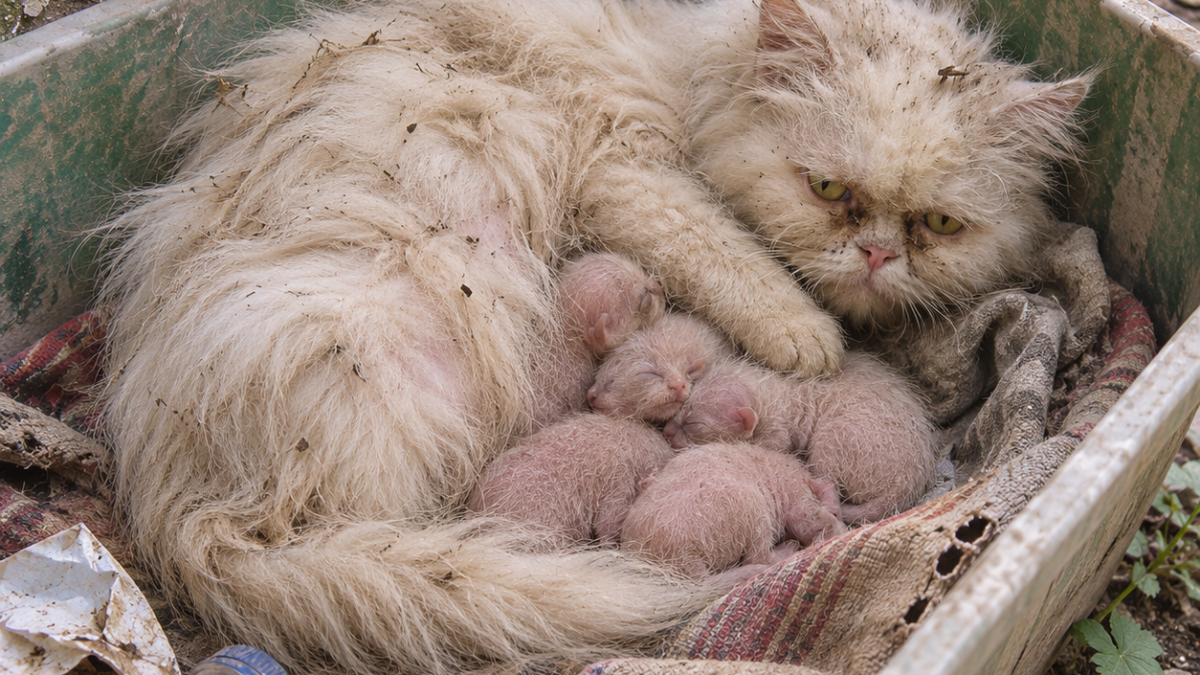
PART 2
I stayed still until my arm started aching.
The mother cat kept her nose close to my fingers.
Her breathing was fast.
Her pupils were wide.
But she didn’t strike.
That mattered.
Megan, the volunteer who had come with the carrier, crouched behind me.
“Can you touch her?”
“Not yet.”
“Can we move the kittens?”
“Definitely not yet.”
She looked inside the bin.
“Flies are getting worse.”
“I know.”
The sun was climbing higher, and the heat inside the metal container was rising with it.
Garbage that had smelled unpleasant when I arrived now seemed to breathe rot into the air.
We couldn’t spend all day negotiating.
But rushing a frightened mother with newborn kittens could turn a rescue into a disaster.
I looked at the cat again.
“I’m going to call you Pearl.”
Megan raised an eyebrow.
“Pearl?”
“She was probably white once.”
The cat stared at me.
“Don’t worry. Temporary name.”
Megan smiled.
“That’s what everyone says.”
I ignored her.
Pearl sniffed my hand once more.
Then, unexpectedly, she lowered her head.
Not completely.
But enough that I could move my fingers closer to the nearest kitten.
I stopped again.
Pearl watched.
I touched the kitten’s back with one finger.
She flinched.
But didn’t cover him.
“Good girl.”
I slid both hands beneath the tiny body.
The kitten squeaked.
Pearl’s head shot up.
I immediately lowered him.
“See?”
She sniffed him.
Licked his head.
I didn’t try again for another minute.
Then I lifted him only two inches.
Pearl stood.
I held him where she could see.
“Still here.”
I placed him on the clean blanket inside the carrier, directly beside the open door.
Pearl could see him.
Hear him.
Smell him.
The kitten squeaked again.
Pearl leaned toward the carrier.
Then looked back at the other three.
One down.
Three to go.
The second was easier.
The third made more noise.
Pearl stood between me and him for several seconds.
I waited.
Eventually she moved.
Then came the smallest kitten.
The one with the black patch over one ear.
The moment I touched her, I knew something was different.
She was colder.
Far colder than her siblings.
And much quieter.
I lifted her.
No squeak.
Pearl stretched toward her.
I brought the kitten close to her face.
Pearl licked once.
Twice.
The kitten barely moved.
“Megan.”
She heard my voice change.
“What?”
“This one’s cold.”
“How cold?”
“Too cold.”
Megan opened another towel.
I wrapped the kitten carefully and held her against my chest.
Pearl panicked.
She stood on her hind legs, front paws against the carrier.
“No, no.”
I lowered the towel so she could see.
“She stays with us.”
Pearl smelled the blanket.
Then tried to pull the kitten toward herself.
I understood.
Her baby.
Her responsibility.
But this time Pearl needed to let somebody else help.
I placed the kitten beside the others temporarily while Megan prepared a warmed carrier.
Pearl immediately climbed halfway inside.
That solved our next problem.
Instead of forcing her into the crate, we let her follow the kittens.
One baby.
Then another.
Then another.
Pearl climbed in.
I placed the smallest last, wrapped in the warm towel against Pearl’s belly.
Pearl curled around all four.
Megan slowly closed the carrier door.
For one second, Pearl stiffened.
Then she looked down at the kittens.
Her body relaxed.
“Let’s go.”
The veterinary clinic was less than fifteen minutes away.
It felt like an hour.
I held the carrier on my lap while Megan drove.
Every bump in the road made me look down.
The smallest kitten remained tucked against her mother, almost motionless.
Pearl licked her every few seconds.
“Come on,” I whispered.
Pearl looked up.
“I know. I’m talking to her.”
The kitten’s tiny side moved.
Breathing.
Still breathing.
Megan drove faster.
“Call them.”
I did.
“We’re bringing in a nursing mother and four newborn kittens. One is severely cold and barely responsive.”
The receptionist’s voice changed instantly.
“How far out?”
“Seven minutes.”
“We’ll be ready.”
Pearl began pawing at the carrier door.
“It’s okay.”
She continued.
“You’re going somewhere better.”
Her eyes followed mine.
There are moments when you realize words are useless and still can’t stop using them.
Maybe we speak because silence feels too much like surrender.
So I talked to Pearl all the way to the clinic.
I told her the kittens had names coming.
I told her nobody was going to put her back in the bin.
I told her food would show up again.
I told her things I couldn’t possibly prove yet.
Promises are dangerous in rescue.
I knew that.
Still, some promises need to be made before you know exactly how you’ll keep them.
Dr. Emily Carter met us at the side entrance.
She barely glanced at me before focusing on the towel.
“Smallest first.”
I handed the kitten over.
Pearl cried.
A rough, desperate sound.
She slammed one paw against the carrier door.
“Keep her where she can see,” I said.
The technician nodded.
They placed Pearl and the other three kittens in a larger hospital enclosure while Dr. Carter took the smallest to a warming station less than six feet away.
Pearl pushed against the front.
Her eyes never left the bundle.
I crouched beside her.
“She’s right there.”
Pearl ignored me.
The kitten’s temperature was frighteningly low.
Dr. Carter spoke while working.
“Warming first. We don’t feed a severely hypothermic neonate until the temperature comes up.”
“Why?”
“Digestion doesn’t work normally when they’re this cold. Feeding too soon can make things worse.”
“Can she make it?”
Dr. Carter didn’t look up.
“Possibly.”
I hated that word immediately.
Not no.
Not yes.
Possibly.
The word that asks you to hope without letting you rest.
“What can I do?”
“Right now? Keep Mom calm.”
I looked at Pearl.
Her body was tense.
Three kittens pressed against her belly.
She wasn’t calm.
But she stayed.
That was enough.
Pearl was examined while the smallest kitten warmed.
Under all the dirt, there was more damage than I’d realized.
She was significantly underweight.
Her gums were pale.
She was dehydrated.
Fleas moved through her coat.
Her skin was irritated beneath the mats around her hindquarters.
One mammary gland was slightly inflamed.
Her milk production was lower than it should have been for four newborn kittens.
There was a small wound over one shoulder.
Older.
Partly healed.
“Any sign she gave birth here?” I asked.
Dr. Carter nodded.
“Very recently. Based on the kittens, probably within the last day or two.”
“In a garbage bin.”
“Yes.”
“Could that cause infection?”
“It increases the risk. For her and the kittens.”
She listened to Pearl’s heart.
Pearl tolerated it only because she could still see the babies.
“Will she be okay?”
“I think so.”
“You sound more confident than you did about the kitten.”
“I am.”
That should have comforted me.
It didn’t.
Because my eyes kept going to the warming unit.
Then the technician scanned Pearl for a microchip.
The device beeped.
We all stopped.
“She has one.”
That changed everything.
Pearl wasn’t simply an unknown stray.
At some point, somebody had chipped her.
Somebody had filled out paperwork.
Somebody had given her a name.
The technician typed the number into the database.
A record appeared.
Snow.
Owner: Melissa Grant.
Address: less than three miles away.
Phone number: disconnected.
I looked at the white cat.
“Snow?”
Her ear moved.
I said it again.
“Snow.”
This time she lifted her head.
Megan stared at me.
“She knows it.”
So Pearl disappeared.
Snow returned.
A name she had carried before the garbage.
A small piece of her past.
For some reason, that hurt more than if the scanner had found nothing.
A nameless stray surviving outside was terrible.
A cat who had once belonged somewhere, who had been named and chipped and known, giving birth among trash felt different.
Someone had known she existed.
And somehow she’d still ended up there.
The smallest kitten’s temperature began rising after an hour.
Slowly.
She still wasn’t out of danger.
But her heart rate improved.
Her breathing became less shallow.
Dr. Carter brought her back near Snow before attempting the first supported feeding.
Snow stood immediately.
The kitten squeaked.
A tiny sound.
Almost nothing.
Snow became frantic.
She pushed her face toward the towel.
Dr. Carter lowered it.
Snow started licking.
Head.
Back.
Paws.
She licked as though she could make up for every second they’d been separated.
Then the kitten moved.
Not much.
But enough to press toward Snow’s belly.
Dr. Carter helped position her.
The kitten latched for only a few seconds.
Lost it.
Tried again.
Snow lay perfectly still.
No longer fighting us.
Her body seemed to understand before her fear did.
The hands that had taken the kitten had brought her back warmer.
Alive.
Maybe that was the first piece of proof.
We named the kittens after they survived the first two days.
The gray-and-white male became Jasper.
The dark tabby became Theo.
The mostly white female became Ivy.
And the smallest, with the black patch over one ear, became Dot.
Megan chose it.
“She looks like somebody put one drop of black paint on her.”
“Dot?”
“Exactly.”
Dot was so small the name fit too well.
Snow didn’t care what we called them.
She cared that all four were still there.
Every time a technician moved one for examination, Snow watched.
Every time the kitten returned, Snow sniffed the entire body.
Face.
Neck.
Back.
Paws.
She counted them in her own way.
Only after the fourth was back would she rest.
The first night at the clinic, I went home at midnight.
I lasted forty minutes.
Then turned around.
Megan called while I was driving.
“Where are you?”
“On the road.”
“Going home?”
Silence.
She sighed.
“You turned around.”
“Yes.”
“You’re impossible.”
“Snow doesn’t know anyone.”
“She knows the entire veterinary team now.”
“Not like she knows me.”
“She has known you for one day.”
“Exactly.”
Megan laughed.
“That’s not an argument.”
“It is to me.”
I returned to the clinic.
Snow was awake.
Jasper and Theo were nursing.
Ivy slept beneath Snow’s front leg.
Dot was in a warmed box beside the enclosure.
Snow saw me.
Her tail tip moved.
Once.
I sat on the floor.
“There you are.”
Snow lowered her head.
For the first time, her eyes closed while I was close.
Not fully.
Then opened.
Closed again.
Eventually she slept.
I stayed for hours.
No miracle happened.
No sudden transformation.
A tired cat slept because somebody else was awake.
That was enough.
Dot’s first setback came the next morning.
Her glucose dropped.
She stopped nursing.
Dr. Carter called me into the treatment room.
“She’s struggling again.”
My stomach tightened.
“What do you need?”
“Time. Warmth. Supplemental feeding if she stabilizes.”
“She was better.”
“She still is better than when she arrived. But newborns can crash quickly.”
Snow could hear Dot crying.
Her own breathing became fast.
I sat beside her enclosure.
“You know what we do now?”
Snow looked at me.
“We wait.”
I hated waiting.
Snow hated it more.
But we waited.
Thirty minutes.
Then an hour.
Finally, Dr. Carter brought Dot back in a towel.
“Temperature’s better.”
Snow stood.
Dot squeaked.
A real squeak this time.
Snow’s body softened.
I nearly cried from the sound of one irritated kitten.
That is the strange thing about rescue.
Things that would annoy you under ordinary circumstances become music when survival is uncertain.
Dot needed supplemental bottle feeding.
The first time I picked her up with the bottle, Snow panicked.
She shoved her body toward my hands.
I stopped.
“Okay.”
Dr. Carter said quietly, “Let her smell everything.”
I placed the bottle near Snow’s nose.
She sniffed.
Then Dot.
Then my fingers.
I lifted Dot only a few inches.
Snow stood.
I kept Dot directly in front of her.
“You can watch.”
I fed the kitten.
Tiny amounts.
Slowly.
Dot swallowed.
Snow’s eyes followed every movement.
When the feeding was finished, I returned Dot immediately.
Snow grabbed her by the scruff and pulled her closer.
I didn’t object.
Mother’s rules.
Two hours later, we repeated it.
Then again.
By the sixth feeding, Snow stayed lying down.
By the tenth, she closed her eyes while I held Dot.
Trust wasn’t one big moment.
It was a pattern.
I took the kitten.
I brought her back.
Took her.
Brought her back.
Again.
Again.
Again.
Until Snow’s body learned what her mind couldn’t yet believe.
Not every hand takes something forever.
Snow’s appetite returned violently.
The clinic gave her small meals because she had been underfed long enough that overeating could cause problems.
Snow strongly disagreed with medical science.
The first bowl disappeared in less than a minute.
Then she searched the mat.
Under the bowl.
Around the edges.
“That’s it for now.”
Snow stared at me.
“You’ll get more.”
She looked down.
Then back at me.
“I mean it.”
She licked the empty bowl.
My chest hurt.
Hunger doesn’t disappear when food arrives.
The body remembers scarcity.
The brain remembers too.
Snow did not believe another meal would come simply because I said so.
So I stopped asking her to believe words.
I brought the next meal exactly when promised.
Then the next.
Then the next.
Small bowls.
Same place.
Same times.
No competition.
No garbage.
No flies.
No need to protect food from anyone.
Eventually the routine became its own language.
Animal control began trying to contact Melissa Grant.
The first number was disconnected.
The address on Snow’s chip belonged to a new tenant.
A neighbor remembered Melissa.
“She moved maybe four months ago.”
“Did she have a white cat?” the officer asked.
“Yes.”
“What happened to the cat?”
The woman hesitated.
“I thought she took her.”
Another neighbor told a different story.
Snow had been outside for weeks before Melissa moved.
Pregnant.
Thin.
Sometimes sleeping beneath cars.
Sometimes sitting near the apartment door.
The neighbor had left food occasionally.
“Why didn’t you call somebody?”
The woman looked ashamed.
“I thought she belonged to Melissa.”
“She did.”
“I thought she’d come back for her.”
That sentence followed me home.
I thought she’d come back.
How many animals suffer inside the space between what somebody assumes and what somebody checks?
Two days later, the neighbor produced screenshots.
Messages from Melissa in the building’s group chat.
Anyone want the white cat?
New place doesn’t allow pets.
Another message two days later:
If nobody takes her, she’ll figure it out outside.
I stared at the words.
She’ll figure it out.
Snow had figured it out.
She had found food where she could.
Water where she could.
A garbage bin that offered walls around her newborns.
A scrap of cloth to make a nest.
She had figured out how to keep four kittens alive while her own body shrank.
But surviving abandonment did not make abandonment acceptable.
There is a cruel habit people have of calling survivors “resourceful” as though resourcefulness excuses what forced them to become that way.
Snow was resourceful.
She should never have needed to be.
Melissa eventually answered animal control.
She said Snow had run away.
The timeline didn’t match.
Then she said Snow had “chosen to stay outside.”
Cats don’t make housing decisions the way people describe them when trying to avoid guilt.
The officer asked whether Melissa had made any effort to locate her.
No shelter reports.
No lost-pet posts.
No flyers.
No updated microchip information.
Nothing.
Then the messages were mentioned.
Melissa became quiet.
“I was overwhelmed.”
Maybe.
“I couldn’t take her.”
That was probably true too.
“Why didn’t you surrender her?”
No answer.
That was the point.
There had been options.
Not easy ones.
But options.
Shelters.
Rescues.
Friends.
Temporary foster.
Owner surrender.
Instead, she had chosen the one option requiring the least immediate effort from herself and the greatest risk to Snow.
Outside.
Figure it out.
Snow never heard any of this.
That mattered to me.
Her recovery room didn’t need our anger.
It needed calm.
She had enough fear already.
So when I entered the clinic after speaking with animal control, I put my phone away.
Snow looked at me.
I sat.
“Not your problem.”
Her tail moved once.
“Not anymore.”
Jasper climbed over Ivy.
Theo screamed because somebody else had a better position.
Dot slept beneath Snow’s chin.
Family chaos.
Better than rage.
On the fourth day, Dot gained weight.
Only twelve grams.
Dr. Carter showed me the chart.
“She gained.”
“How much?”
“Twelve grams.”
“Is that good?”
“It means she went the right direction.”
I looked at Dot.
She was nursing.
“That counts.”
The next day she gained sixteen.
Then twenty.
Her body stopped feeling frighteningly cold.
Her cry became louder.
She began shoving Jasper away from Snow’s belly.
I laughed the first time she did it.
“That is extremely rude.”
Dot shoved harder.
Dr. Carter smiled.
“I like rude neonatal kittens.”
“So do I.”
Snow’s condition improved more slowly.
The kittens took enormous amounts of energy from her.
She needed calories for herself and milk for four babies.
Her body had spent weeks losing weight.
We couldn’t reverse it overnight.
The fleas were treated.
The skin irritation began healing.
Her shoulder wound closed.
The inflammation around one mammary gland improved with treatment.
Her hydration normalized.
But she remained thin.
Some days she looked better.
Other days the bones seemed just as obvious.
Recovery can be emotionally cruel because the first improvements give you the illusion that the rest will happen quickly.
Then the body reminds you it has its own pace.
I learned not to stare at her ribs every day.
Weekly photos showed progress better than daily anxiety.
On day five, Snow went outside into the clinic courtyard.
A technician carried the kittens in a warming carrier nearby so Snow could see them.
We put a soft harness on her.
I expected her to freeze.
Instead, she stepped through the door and stopped.
Grass.
Clean air.
Sunlight.
No dumpster.
No concrete walls.
Snow lifted her nose.
Her whiskers moved.
She took one step.
Then another.
The grass touched her paws.
She looked down as though surprised.
Then suddenly dropped onto one shoulder.
I panicked.
“Snow!”
Dr. Carter grabbed my arm.
“Wait.”
Snow rolled.
Once.
Then again.
Her dirty white body twisting through clean green grass.
She rubbed her back.
Kicked one hind leg.
Rolled onto her side.
I laughed.
She stopped.
Looked at me.
Then rolled again.
Dr. Carter smiled.
“She remembers how to be a cat.”
That sentence stayed with me.
Because up to that point, Snow had been mother first.
Survivor second.
Patient third.
Now for thirty seconds, she was just a cat rolling in grass.
No responsibility.
No fear.
No need to monitor four babies.
A small thing.
A huge thing.
Snow and the kittens came into foster care with me after a week.
Technically, the plan was temporary.
Megan reminded me repeatedly.
“Temporary.”
“I know.”
“Say it.”
“Temporary.”
“You have that look.”
“What look?”
“The one people get right before they adopt their foster.”
“I’m not adopting five cats.”
“I didn’t say five.”
I stared.
She smiled.
“Interesting.”
I ignored her.
My spare room became a nursery.
Fresh blankets.
Washable pads.
A heated area.
Litter tray for Snow.
Water.
Food.
A box with low sides so Snow could climb in easily.
The first night, Snow explored every corner.
Then returned to the kittens.
Counted.
One.
Two.
Three.
Four.
She did it again ten minutes later.
And again.
I eventually realized checking was not simply maternal behavior.
It was fear.
The babies had been the only stable thing in a world that had become unpredictable.
Everything else had disappeared.
Home.
Food.
Owner.
Safety.
The kittens remained.
So Snow watched them like someone who believed loss happened when she looked away.
At 1:40 a.m., I found her awake.
Standing over them.
Nothing was wrong.
The room was warm.
The kittens were sleeping.
Snow simply wouldn’t rest.
I sat beside the box.
“You can sleep.”
She stared.
“I’ll watch.”
Nothing.
I lay down on the floor next to the nesting box.
My back immediately regretted it.
“This is ridiculous.”
Snow watched me.
I closed my eyes.
Ten minutes later, I felt whiskers against my hand.
Snow.
She sniffed.
Then lay down inside the box.
Not fully asleep.
But closer.
At some point I drifted off.
When I woke around three, Snow was sleeping.
Deeply.
Dot’s face tucked beneath her chin.
I didn’t move.
My back hurt.
My neck hurt.
I was freezing.
Completely worth it.
Snow’s food anxiety was intense.
Every meal disappeared instantly.
Then she searched.
Under the bowl.
Behind it.
Around the room.
Once she tried to pull a used food pouch from the trash.
I took it gently.
“No.”
She tensed.
I released the pouch immediately.
That was important.
Possession conflict could destroy trust.
Instead, I traded it for fresh food.
Snow abandoned the pouch.
A week later she stopped searching the trash.
Two weeks later she stopped licking empty bowls for minutes afterward.
A month later, something happened that almost made me cry.
She left three bites.
Just three.
She walked away from the bowl.
Drank water.
Checked the kittens.
Then sat in the window.
The food remained.
Ten minutes later, she returned and finished it.
I took a picture of the three abandoned bites before she came back.
Megan saw it.
“You photographed kibble?”
“Yes.”
“Why?”
“She believes it will still be there.”
Megan’s face changed.
“Oh.”
Exactly.
Safety sometimes looks like unfinished dinner.
The kittens began opening their eyes.
Jasper first.
One blue-gray slit.
Then both.
Theo next.
Ivy.
Dot last.
For days, Dot seemed determined to remain blind to the world.
Then one morning I picked her up and saw one eye slightly open.
“Hello.”
Dot squeaked.
Snow immediately looked over.
“She can see.”
Snow came closer.
I held Dot near her.
The kitten’s tiny eye opened a little wider.
The first thing she saw clearly might have been her mother’s face.
I hope it was.
As the kittens became mobile, Snow’s job became much harder.
Jasper escaped the nesting box first.
He climbed over the side and fell face-first onto the blanket.
Snow stood.
Grabbed him.
Put him back.
Five minutes later, he did it again.
Snow returned him.
Again.
By the fourth attempt, Snow stared at me.
“Your son.”
Her eyes narrowed.
“I agree. He’s a problem.”
Theo began climbing soon after.
Ivy preferred sitting on siblings.
Dot tried everything two days later than everyone else, then performed it twice as aggressively.
Snow’s quiet nursery became chaos.
This was excellent.
Exhausting.
But excellent.
Healthy kittens are inconvenient.
That’s a privilege.
The investigation into Melissa continued, but it never became some huge criminal trial.
There were citations.
A formal abandonment finding.
Fines.
And, most importantly, legal surrender.
Melissa could not reclaim Snow.
When the paperwork was finalized, the animal-control officer called.
“She signed surrender.”
I sat down.
“All of them?”
“Snow and any claim to the litter.”
My shoulders dropped.
That was the sentence I had been waiting for.
Not punishment.
Protection.
Snow could no longer be pulled back into the life that had failed her.
The kittens were legally free for adoption when old enough.
I looked through the glass door at the foster room.
Snow was nursing.
Jasper upside down.
Theo shoving Ivy.
Dot asleep on Snow’s paw.
“You’re safe,” I whispered.
Snow had no idea what a signed document meant.
Good.
Paper was our job.
Living was hers.
Melissa’s fines didn’t satisfy the angry part of me.
I’ll admit that.
I wanted something bigger.
A dramatic consequence.
A courtroom speech.
A moment where somebody forced her to stand beside the dumpster and look at what she’d done.
But life rarely arranges itself for emotional satisfaction.
And as weeks passed, I began to understand something.
Punishment wasn’t the most important outcome.
Snow’s future was.
The kittens’ future was.
Preventing the situation from repeating was.
Everything else was secondary.
Anger can start useful work.
It shouldn’t become the house you live in afterward.
Snow had lived in enough bad places.
I didn’t want my anger to become another one around her.
Snow’s white fur returned slowly.
We didn’t bathe her immediately.
Too stressful.
Instead, warm damp cloths.
Brushing.
More brushing.
Gentle grooming while she ate.
The mats came out.
Dirt disappeared.
Flea debris vanished.
Underneath was a beautiful cat.
Mostly white.
Gray tail.
Gray patch near one ear.
Green eyes that seemed brighter as her face filled out.
One afternoon Megan walked in and stopped.
“Is that the same cat?”
Snow looked at her.
“Technically,” I said.
“She’s beautiful.”
“She was always beautiful.”
Megan nodded.
“Fair.”
Snow stood.
Walked toward her.
Sniffed Megan’s fingers.
Then allowed one chin scratch.
Megan looked shocked.
“She likes me.”
“Don’t ruin it.”
Snow’s relationship with touch was complicated.
She would rub against my legs.
Sleep nearby.
Follow me into the room.
But picking her up was different.
The first time I tried, her entire body stiffened.
I put her down immediately.
“No problem.”
I stopped trying.
That became important.
Affection is not proof if it requires overriding fear.
Snow didn’t owe me tolerance.
Weeks later, she climbed onto the couch herself.
I was reading.
She stopped two feet away.
I kept reading.
Five minutes.
Ten.
Snow moved closer.
Then closer.
Finally she curled beside my thigh.
I did nothing.
Another five minutes.
Then her head pushed beneath my hand.
Invitation.
I touched her forehead.
Snow closed her eyes.
That tiny gesture mattered more than if she’d allowed me to carry her on the first day.
Because this time the choice belonged to her.
The kittens transitioned to solid food.
Jasper loved it.
Theo climbed into the plate.
Ivy tried to eat from Snow’s bowl.
Dot sat directly in wet food.
I stared.
“You nearly died.”
Dot licked her paw.
“And this is what survival looks like?”
She stepped into the food with the other paw.
Megan laughed so hard she had to leave the room.
Snow watched from the box.
She looked exhausted.
“Parenting is beautiful.”
Snow turned away.
Dot remained smaller than her siblings.
Not dangerously.
But enough that I weighed her constantly.
Every morning.
Sometimes twice.
Dr. Carter finally said:
“You need to stop.”
“Stop what?”
“Weighing her every time she sneezes.”
“I don’t weigh her when she sneezes.”
Her expression said she didn’t believe me.
“She follows her growth curve.”
“I know.”
“Her heart sounds normal.”
“I know.”
“She’s eating.”
“I know.”
“She’s attacking my stethoscope.”
Dot bit it.
“See?”
Dr. Carter pulled it away.
“Healthy.”
I smiled.
“Healthy.”
That word felt like a luxury.
Adoption applications began when the kittens were old enough.
This was the point where fostering becomes emotionally dishonest.
You tell yourself you’re preparing them to leave.
Then they become specific.
Jasper liked sleeping on towels.
Theo screamed when doors closed.
Ivy sat quietly and watched everything before joining.
Dot climbed people like furniture.
They weren’t “four kittens” anymore.
They were individuals.
And suddenly adoption forms felt personal.
Jasper’s family came first.
A couple in their thirties.
Quiet home.
One older cat.
They sat on the floor and waited.
They didn’t grab.
Didn’t chase.
Jasper approached them.
The man held out one finger.
Jasper sniffed.
Then climbed onto his leg.
Snow watched.
Her body tightened.
I noticed.
The woman did too.
She lowered her hands.
“We can go slower.”
I liked her immediately.
Snow eventually approached.
Sniffed the couple.
Then returned to her bed.
No panic.
No shielding.
Progress.
Jasper left two weeks later.
Snow followed the carrier to the door.
My stomach twisted.
I remembered the garbage bin.
The way she’d wrapped herself around them.
I wanted to tell her this was different.
No one was throwing him away.
No one was taking him somewhere unsafe.
Instead, I crouched.
“You did your job.”
Snow watched the door.
For the next hour, she searched.
Then settled with the remaining three.
That night, Jasper’s family sent a photo.
He was asleep on a couch beside their older cat.
I showed Snow.
She sniffed my phone.
Then rubbed against my hand.
Good enough.
Theo went next.
His adopter had another young cat and no sense of fear about chaos.
Perfect.
Theo left the carrier before it was fully open and immediately stole a toy.
The update photo arrived three hours later.
Theo asleep upside down.
I smiled.
Snow searched less this time.
Maybe because she was learning departure didn’t always mean danger.
Ivy’s adopter was a teenage girl named Sophie.
She came with her mother.
Sophie sat on the floor and barely moved for twenty minutes.
Ivy watched.
Then approached.
Sophie didn’t reach.
Ivy climbed into her lap on her own.
Snow was nearby.
She saw everything.
I wanted to adopt Sophie too.
Instead, Ivy went home with her.
Later I received a photograph of Ivy sleeping beside Sophie’s homework.
Apparently education would now be supervised.
Then there was Dot.
Tiny Dot.
The kitten who had started all my worst fears.
Excellent applications arrived.
I found faults.
One family had stairs.
Another had a dog.
One worked full-time.
Another worked from home but traveled twice a year.
Megan watched me reject a veterinarian.
“You’re keeping Dot.”
“No.”
“You rejected a veterinarian.”
“She travels.”
“Her husband doesn’t.”
“Still.”
“You’re keeping Dot.”
“I am evaluating.”
“You haven’t evaluated one application positively.”
“They’re all flawed.”
“All humans are flawed.”
“Exactly.”
Megan took the application folder away.
“You’re emotionally compromised.”
“That’s not an official diagnosis.”
“It should be.”
Dot climbed my pants.
Reached my lap.
Curled up.
Megan pointed.
“Case closed.”
Snow also received an application.
A woman named Carla.
Experienced with shy cats.
Quiet home.
No children.
No other pets.
Financially stable.
Patient.
Everything we could want.
Carla visited three times.
Snow liked her.
Took treats.
Allowed chin scratches.
Sat nearby.
On the third visit, Carla said:
“I think she could settle with me.”
I nodded.
“She probably could.”
The sentence hurt.
This was the job.
Rescue meant letting go.
Carla was kind.
Snow deserved a calm home.
I told myself all of that.
Then Snow stood.
Walked away from Carla.
Crossed the room.
Jumped onto the couch.
Curled against me.
Carla smiled.
“I think I came too late.”
“No.”
It came out too fast.
Megan laughed from the doorway.
I glared at her.
Carla scratched Snow gently.
“She already picked.”
“I foster.”
“Of course.”
Snow started purring.
Traitor.
Carla eventually adopted another adult cat through the rescue.
Snow stayed.
Dot stayed.
My foster record became embarrassing.
I signed Snow’s adoption paperwork first.
Then Dot’s.
The rescue coordinator slid the papers across the desk.
“Still temporary?”
I stared.
“Do your job.”
She laughed.
“I am.”
I signed.
Snow became mine.
Dot became mine.
Or, more accurately, my house became theirs.
That distinction became clearer every year.
The first year passed quickly.
Snow gained healthy weight.
Her ribs disappeared beneath muscle and fur.
Her coat became so white that photographs from the dumpster seemed impossible.
Dot grew into a long-legged cat who still had the black patch over one ear.
Their relationship changed.
Snow stopped counting constantly.
Dot could leave the room without Snow following.
One afternoon Dot slept upstairs for three hours.
Snow remained on the couch.
I realized she hadn’t checked once.
Trust had become absence.
No panic.
No search.
No need to monitor.
That was freedom too.
The four kittens reunited at one year old.
Cat reunion.
Terrible idea.
Wonderful anyway.
Jasper hissed at Theo.
Theo ignored everyone.
Ivy hid behind a chair.
Dot behaved like the house belonged to her.
It did.
Snow sat above them on the couch with the exhausted expression of someone hosting adult children during a holiday.
Eventually Jasper approached her.
Snow sniffed.
Then licked his forehead.
Jasper recoiled as if publicly humiliated.
Megan laughed.
“Still his mother.”
For the first time, all four grown kittens were in one place and Snow did not stand over them.
She slept.
I watched her eyes close.
That was one of the most beautiful things I ever saw.
The mother who once believed she could not look away had finally learned she could.
Snow’s Pantry began almost accidentally.
After Snow’s story spread through the rescue community, donations arrived.
Kitten formula.
Canned food.
Blankets.
Heating pads.
Carriers.
Someone asked where to put everything.
I pointed at a storage shelf.
Megan labeled it:
SNOW’S PANTRY.
The joke stayed.
Soon the rescue made it official.
A small fund paid for emergency supplies for pregnant cats, nursing mothers, and orphaned litters.
Under the name, we added one sentence:
For mothers who should never have to raise babies in garbage.
I cried when I saw it.
Megan cried too.
She blamed allergies.
There were no flowers nearby.
I let her lie.
The first family helped by the fund was a black cat with three kittens found beneath a porch.
Then a tabby mother with six.
Then an orange cat surrendered when her elderly owner entered the hospital.
Each time money paid for formula or food, I thought about Melissa’s message.
She’ll figure it out.
Snow had.
And now other cats didn’t have to figure everything out alone.
That became the revenge I actually liked.
Not somebody else’s pain.
A system becoming slightly kinder because Snow had survived something cruel.
Snow surprised us again when she was about nine.
A litter of orphaned three-week-old kittens came into foster.
No mother.
Loud.
Hungry.
I kept them separated.
Snow heard them.
She sat outside the door for an hour.
Then two.
Finally, under supervision, I let her in.
One kitten screamed.
Snow froze.
Approached.
Sniffed.
The kitten crawled toward her.
Snow looked at me with visible irritation.
“I know.”
She lay down.
Within minutes, three kittens had pressed against her belly.
No milk.
They didn’t care.
They wanted warmth.
Snow began grooming them.
I sat on the floor.
Tears everywhere.
“You already did this.”
Snow ignored me.
Apparently she had not retired.
For years, she became our unofficial foster aunt.
She didn’t accept every litter.
She wasn’t a machine.
But frightened kittens often calmed near her.
Maybe because she moved slowly.
Maybe because her body knew what panic looked like.
Maybe because animals understand things we oversimplify when we try to explain them.
Dot contributed differently.
Dot taught crime.
Curtain climbing.
Cabinet opening.
Pen knocking.
Sock theft.
Snow provided emotional stability.
Dot provided bad decisions.
The combination produced balanced kittens.
Mostly.
Snow aged beautifully.
At eleven, the gray patch near her ear lightened.
At twelve, she developed arthritis.
We bought pet steps for the couch.
She ignored them.
For three months.
Then one morning I saw her use them when she thought I wasn’t watching.
“Finally.”
Snow froze.
Then jumped the last step as if she’d intended to.
Pride remains strong in old cats.
Jasper developed kidney disease in his teens.
His family managed it carefully.
Theo lost several teeth and still stole bread.
Ivy followed Sophie through high school and into college.
Dot remained with Snow.
Every birthday, photos arrived.
I kept them in an album.
The first page showed the dumpster.
The second, the clinic.
Then foster care.
Adoption days.
Couches.
Windowsills.
Christmas trees.
Sunlight.
Birthdays.
Ordinary life.
The album became proof that the first image was only a beginning.
Not an identity.
The apartment complex behind the dumpster was renovated years later.
The old garbage area disappeared.
New enclosed bins.
Motion lights.
Cameras.
A property manager contacted the rescue.
They wanted to put up a sign about reporting abandoned animals.
They asked for a photograph of Snow.
I sent one of her lying in sunlight.
Not the garbage.
“Why not the rescue photo?” they asked.
“Because that’s not who she is.”
They understood.
The sign showed a healthy white cat with green eyes.
Good.
Melissa wrote once more years later.
An apology through the rescue.
She said she had been young.
Overwhelmed.
Financially unstable.
Moving somewhere pets weren’t allowed.
She admitted she’d convinced herself Snow would survive because “cats always manage.”
Then one sentence stopped me.
I understand now that surviving something does not make what happened acceptable.
I read it twice.
Megan asked what I thought.
“I think she understands more than she did.”
“Do you forgive her?”
I looked at Snow asleep beside Dot.
“That isn’t mine to decide.”
“Will you answer?”
“No.”
“Why?”
“Because remorse is her work.”
I closed the message.
“Our work is here.”
Snow woke.
Demanded food.
Excellent timing.
Jasper died first.
Fourteen years old.
His family called.
I cried.
The tiny gray-and-white kitten had become an old cat.
That alone was a victory.
His family brought his blanket for Snow and Dot to smell.
Snow sniffed it.
Then sat quietly.
I could not know what she understood.
I didn’t invent meaning.
That night she slept closer to Dot.
Maybe coincidence.
Maybe not.
It didn’t matter.
Theo died the following year.
Loved.
Safe.
Still stealing bread until nearly the end.
Ivy lived longer.
Sophie sent photographs of her gray-faced, dignified, sleeping beside old textbooks and new work documents.
The kitten who had once lived beside rotten food had spent her life supervising a human through school and adulthood.
That mattered.
Dot became the last kitten.
Not a kitten anymore.
An old cat.
Her black ear patch remained.
Snow was older still.
Their relationship reversed slowly.
Dot waited when Snow moved.
If Snow paused at the couch steps, Dot stopped.
If Snow slept, Dot curled near her.
The tiny baby who had once needed Snow’s body for warmth became the one who stayed close when her mother grew weak.
One afternoon Snow struggled with the steps.
Before I could help, Dot jumped down.
Sat beside her.
Waited.
Snow tried again.
Made it.
Dot followed.
I cried.
They ignored me.
Cats rarely respect symbolism when humans need them to.
Snow’s kidneys began failing when she was old.
At first, manageable.
Diet.
Fluids.
Medication.
Regular bloodwork.
She still enjoyed food.
Still sat in sunlight.
Still groomed Dot.
Still complained when breakfast was late.
Then one morning she didn’t finish.
I noticed immediately.
Snow leaving food had once represented healing.
Now it meant something else.
We adjusted medication.
Good days returned.
Then faded.
The veterinarian explained what I already knew.
“We can support her. We can’t reverse this.”
“How long?”
“Hard to say.”
I hated that answer as much as I had hated “possibly” when Dot was newborn.
Time remains vague when you most want numbers.
Snow’s last months were gentle.
No unnecessary procedures.
Favorite foods.
Warm beds.
Sun.
Dot.
Me.
Megan visited often.
Snow still allowed her chin scratches.
“Remember when she wouldn’t let us move one kitten?”
Megan smiled.
“Yes.”
“Remember when you said Pearl?”
“It was a good name.”
“No.”
Snow opened one eye.
“See? She agrees.”
One morning, Snow refused chicken.
That was when I knew.
Food had once been everything.
Hunger had driven her to eat while still covering her babies.
Later, safety had taught her food would return.
Now her body no longer wanted even her favorite thing.
The veterinarian came to the house that afternoon.
I wanted Snow home.
On the couch.
On her blanket.
Dot beside her.
No clinic lights.
No unfamiliar smells.
Megan sat nearby.
No one spoke much.
Snow rested against my thigh.
I touched the gray patch near her ear.
The same place I had seen beneath garbage years earlier.
I remembered the first time my hand entered the bin.
How Snow curled around four babies.
How carefully she watched my fingers.
How long it took before she let me lift one.
Now my hand rested on her face.
Snow leaned into it.
No hesitation.
That nearly broke me.
“You did it,” I whispered.
Snow’s eyes stayed half closed.
“Jasper had a home.”
My voice shook.
“Theo had a home.”
Megan looked down.
“Ivy had a home.”
Dot moved closer.
“And Dot never left you.”
Snow’s ear moved slightly.
“They all grew old.”
That sentence destroyed me.
“They all got old, Snow.”
The four newborn kittens whose eyes hadn’t even opened.
The ones surrounded by garbage and flies.
The smallest one cold enough that we didn’t know if she’d survive the hour.
All of them got old.
Snow had done what every mother tries to do.
She got them through the beginning.
Then other people carried the responsibility forward.
That was how it was supposed to work.
I rested my forehead against hers.
“You don’t have to guard anyone anymore.”
Dot pressed against her side.
“You don’t have to watch the door.”
Snow’s breathing slowed.
“You don’t have to check the nest.”
I started crying.
“You can sleep.”
The veterinarian waited.
No rush.
No demand.
That felt right.
On the first day, I’d learned that Snow needed time before giving me her babies.
On the last day, she deserved the same thing.
Time before letting go.
When I finally nodded, the veterinarian gave the medication.
Snow relaxed.
Completely.
Her head became heavier beneath my hand.
I stroked her cheek.
The same kind of touch she’d once feared.
Now she trusted it enough to fall asleep inside it.
Her breathing slowed.
Then stopped.
Dot remained pressed against her.
I stayed there long after.
The house felt wrong afterward.
Snow’s bowl.
Her steps.
White fur on the couch.
Her favorite window.
Dot searched.
Bedroom.
Hallway.
Kitchen.
Couch.
For several nights she slept in Snow’s spot.
I sat with her.
There was nothing to fix.
Grief is sometimes simply love with no current task.
We let it exist.
Snow’s ashes remained near the window where she had spent so many afternoons.
At the rescue, Snow’s Pantry continued.
We added a photograph.
Not the dumpster.
The reunion.
Snow in the middle.
Jasper.
Theo.
Ivy.
Dot.
Nobody looking properly at the camera.
Perfect.
Underneath, the plaque read:
SHE GAVE THEM LIFE IN THE WORST PLACE.
THEN SHE LIVED LONG ENOUGH TO SEE THEM SAFE.
That was all.
No mention of Melissa.
No mention of abandonment.
No photograph of suffering.
The person who failed Snow did not deserve permanent space beside the life Snow built afterward.
Dot lived nearly two years longer.
She slowed.
Became less criminal.
Not completely.
At fourteen, she still stole socks occasionally.
I celebrated every theft.
Old age turns misbehavior into reassurance.
When Dot died, I placed her ashes beside Snow’s.
The smallest kitten.
The one Snow refused to stop protecting.
Together again, at least in the way that mattered to me.
People still ask me about the garbage bin.
They ask how bad it smelled.
How many flies.
Whether Snow tried to bite.
Whether Dot was really that cold.
I answer if the details matter.
But I always try to move the story forward.
Because suffering attracts attention too easily.
People stare at “before.”
Bones.
Dirt.
Fear.
Garbage.
Then they call the clean photograph a miracle and move on.
The middle is where life actually happens.
Meals.
Medication.
Bottle feeding.
Trust.
Waiting.
Cleaning.
Adoption applications.
Vet bills.
Setbacks.
Sleep.
Routine.
Years.
That’s where Snow’s life was built.
Not in one rescue moment.
In thousands of ordinary ones.
If you ask me what revenge looked like, I can answer now.
It wasn’t Melissa suffering.
Her fines came and went.
Her embarrassment faded.
Whatever regret she felt belonged to her.
Snow’s revenge was larger.
Someone decided she could “figure it out” outside.
Snow became the reason other mothers received help before they had to.
Someone left her without a clean place to give birth.
Snow’s Pantry filled shelves with clean blankets.
Someone left her hungry.
Food bought in her name fed mothers she never met.
Someone left four newborn kittens surrounded by garbage.
All four grew old enough to develop personalities, habits, diseases of age, favorite beds, and people who grieved them when they died.
Someone acted as though Snow was disposable.
Snow became unforgettable.
That’s enough revenge for me.
I visited the old garbage area once after renovation.
The dumpster was gone.
The wall painted.
Clean concrete.
New enclosed trash system.
Nothing dramatic.
I stood there for five minutes.
The place seemed smaller than memory.
That’s what suffering does.
It enlarges rooms.
Roads.
Bins.
Hospital corridors.
Years later, when the pain no longer fills them, they shrink back to their real size.
A garbage bin had once contained Snow’s entire world.
Later, her world contained windows.
Couches.
Foster kittens.
Vet appointments.
Birthday photos.
People.
Food.
Sunlight.
Years.
The dumpster never stood a chance against all of that.
The first image of Snow still visits me sometimes.
Dirty white fur.
Green eyes.
Body wrapped around four newborns.
My hand moving toward them.
Her paw coming down.
Stop.
At first I thought she was refusing rescue.
Now I understand more.
Snow wasn’t saying no forever.
She was asking a question.
Can I trust what happens after you touch them?
That’s the question frightened animals ask us constantly.
Sometimes without sound.
Can I trust what comes next?
The answer cannot be spoken.
It has to be demonstrated.
Pick up the kitten.
Bring it back.
Offer food.
Return with more.
Move slowly.
Stop when fear says stop.
Come back tomorrow.
Then again.
Then again.
Trust is not something you ask an animal to give.
It’s something you make safe enough for them to risk.
If I could return to the first afternoon, I wouldn’t tell Snow that everything would be okay.
Because I didn’t know that.
Dot might not have survived.
Snow could have developed serious complications.
One of the kittens could have faded.
Hope that ignores uncertainty is dishonest.
Instead, I’d put my hand flat inside the bin again.
I’d let her smell me.
I’d tell her:
“You don’t have to believe me.
You don’t have to stop being afraid.
You don’t have to understand what a carrier is.
You don’t need to know what a veterinarian does.
You only need to watch what I do next.”
Then I’d pick up Jasper.
Bring him back.
Theo.
Back.
Ivy.
Back.
Dot.
Back.
Again.
Again.
Until Snow’s body loosened.
Until she understood.
These hands return what they take.
That lesson became the center of everything.
Snow eventually learned people could return kittens.
Then food.
Then safety.
Then affection.
The world stopped being a place where every loss was permanent.
And once that happened, she could rest.
Really rest.
That was her greatest transformation.
Not white fur.
Not weight gain.
Not adoption.
Sleep.
The ability to close her eyes while someone else stayed awake.
The ability to let Dot leave the room.
The ability to eat later.
The ability to sit in sunlight without guarding anything.
That is what safety looks like after a life shaped by scarcity.
Not excitement.
Not gratitude.
Unremarkable peace.
I remember one afternoon near the end of Snow’s life.
Before her kidneys became severe.
She was asleep on the windowsill.
Dot was downstairs.
I was reading.
A delivery truck slammed a door outside.
Years earlier, Snow would have jumped.
Looked for the kittens.
Searched the room.
That afternoon?
One ear moved.
Nothing else.
She stayed asleep.
I put down my book and watched her.
It sounds ridiculous.
A cat sleeping through a noise.
But I nearly cried.
Because I could see the entire distance between the dumpster and that window in one unmoving ear.
She didn’t need to check.
Nobody was disappearing.
Home was still home.
Maybe that’s why I refuse to call Snow’s story sad.
It began sadly.
Absolutely.
There is no way to romanticize a mother giving birth beside garbage because a person decided she’d “figure it out.”
But beginning and ending are different things.
Snow’s life was not a tragedy.
It contained tragedy.
Then it contained recovery.
Then boredom.
Then misbehavior.
Then middle age.
Then arthritis.
Then kidney disease.
Then grief.
A whole life.
That’s what she deserved.
Not to become an inspirational photograph frozen forever in the worst day she experienced.
A whole life.
Messy.
Ordinary.
Loved.
And if I have to choose one memory above all the others, it isn’t the dramatic rescue.
It isn’t Dot warming beneath towels.
It isn’t the microchip.
It isn’t Melissa’s message.
It isn’t even the adoption.
It’s a morning years later.
Snow was on the couch.
Dot had gone upstairs.
Breakfast was half finished.
Sunlight crossed the floor.
Snow looked at the food.
Then at the doorway.
Then stretched.
Closed her eyes.
And slept.
She left food behind.
She let her daughter out of sight.
She stopped watching.
Three things she had once believed were impossible.
Nothing happened.
Nobody took the bowl.
Nobody took Dot.
Nobody hurt her.
She woke later.
Finished breakfast.
Found her daughter.
Went back to sleep.
That’s the ending I wanted for her.
Not a dramatic victory.
A life so safe it became boring.
Because for animals who have lived through chaos, boredom is one of the greatest gifts we can give.
Snow entered my life surrounded by things people had thrown away.
Plastic.
Food containers.
Boxes.
Old cloth.
Broken objects.
She had been treated almost the same way.
Something inconvenient.
Something that could be left beside the trash and forgotten.
But Snow was not trash.
Jasper wasn’t.
Theo wasn’t.
Ivy wasn’t.
Dot wasn’t.
And the most satisfying part is that nobody who mattered ever confused that again.
They got names.
Medical records.
Homes.
Families.
Birthdays.
Old age.
Memories.
Grief.
All the things that prove a life took up space in the world.
The last photograph I keep on my desk isn’t the dumpster.
It’s Snow in sunlight.
Old.
White fur glowing.
Eyes almost closed.
One front paw stretched toward the camera.
Dot is visible in the background, out of focus.
Nothing dramatic.
No one would know the story by looking at it.
That’s why I love it.
She finally got to exist without her suffering needing to explain her.
Just Snow.
A cat.
Warm.
Safe.
Home.
And absolutely nothing left she needed to defend.








