PART 2: She Crossed the Flood Six Times to Save Her Puppies—Then She Turned Back for One More
PART 2
The first step nearly knocked me down.
Floodwater looks different from the bank.
From dry ground, you see a river.
Once you’re inside it, you feel everything hidden beneath the surface.
Branches.
Stones.
Wire.
Holes where the earth used to be.
The water struck my thighs and shoved sideways so hard that the rope snapped tight around my waist.
“Slow!” Thierry shouted.
I ignored him.
The dog was maybe twenty yards away.
Twenty yards had never looked so far.
She was still holding the puppy.
I could see that much.
But she was no longer swimming in any real sense.
Her front legs made weak movements under the surface while the current carried her downstream.
“Pull some slack!” I shouted.
Thierry gave me another few feet.
I leaned into the current.
My bare foot struck something hard.
Pain shot through my ankle.
I almost fell.
The rope caught me.
For one terrifying second, I went under to my chest and lost sight of the dog.
When I found her again, she was closer.
Too close to a half-submerged section of fence.
If the current pushed her into that wire, I knew she might become trapped.
“Come on, girl,” I shouted. “Stay with me.”
I have no idea whether she heard me.
But her eyes opened.
She looked straight at me.
I will remember that look until I die.
There wasn’t fear in it.
Not the way I expected.
There was something closer to desperation mixed with a strange kind of trust.
As if she had reached the final edge of what she could do and had decided, for reasons I still don’t understand, that maybe this stranger walking into the flood could finish what she had started.
I reached her just before the fence.
My left hand grabbed the loose skin behind her shoulders.
She didn’t fight.
She didn’t even try to climb on me.
She simply kept her jaws around the puppy.
“I’ve got you.”
The current hit us.
Hard.
My feet disappeared from beneath me.
I went sideways.
Water filled one ear.
The rope snapped tight again.
Behind me, Thierry and Malik shouted at the same time.
“Pull!”
“No, wait!”
I wrapped my right arm around the dog’s chest.
Her body felt frighteningly light.
All bone beneath wet fur.
The puppy was pressed between her muzzle and my shoulder.
“Don’t let go of him,” I said.
I don’t know why I said it.
She had already proven she wouldn’t.
Thierry and Malik began hauling the rope.
Every few feet, my knees struck rocks or debris.
The mother went limp in my arm.
That scared me more than anything.
“Come on, sweetheart.”
No response.
“Come on.”
Her jaws remained closed around the puppy.
The rest of her body seemed finished.
Then Claire reached us from the bank.
Another man who had stopped his truck helped her grab my arm.
Together they dragged us onto the mud.
The second my body touched solid ground, I rolled onto my back and sucked air.
Someone was shouting.
Someone else was crying.
I heard motorcycles idling.
I heard water roaring through the trees.
But all I could see was the dog.
She lay on her side.
Still holding the puppy.
Claire knelt beside her.
“Easy, mama.”
She reached toward the puppy.
The dog’s eye opened.
Not both.
Just one.
Claire stopped.
“I’m not taking him away,” she whispered. “I’m helping.”
The dog watched her.
Then something extraordinary happened.
Her jaw relaxed.
Claire lifted the puppy free.
The moment the little body left her mouth, the mother tried to raise her head.
She couldn’t.
But her eyes followed him.
Malik had wrapped the other six puppies in blankets inside an open transport crate.
Claire placed number seven beside them.
The smallest cream-colored pup immediately crawled over him.
Then another puppy pressed against his back.
Within seconds, all seven were touching.
The mother saw them.
Only then did her head drop onto the mud.
“She’s crashing,” Claire said.
The playfulness had vanished from her voice.
“Gérard, move.”
I moved.
Claire checked the dog’s gums.
Too pale.
Her breathing came shallow and fast.
One of her rear paws was bleeding.
She had cuts along her belly.
Her skin felt cold despite the mild air.
Thierry pulled our emergency blanket from a pannier.
We wrapped her.
“Ambulance?” Malik asked.
“For the dog?” Thierry said.
“I’m calling the vet.”
The emergency dispatcher had already told Claire that human rescue crews were tied up farther south where a car had been swept from a low bridge.
So we did what we knew how to do.
We loaded the mother and seven puppies into Thierry’s old van.
Claire climbed into the back with them.
I reached for my boots.
That was when I looked down and saw blood running from my foot.
A piece of metal had sliced the side of my heel.
Thierry stared.
“You’re going to a hospital.”
“After the dog.”
“Gérard.”
“After the dog.”
He looked at my face.
Then at the van.
“Fine. But if your foot falls off, I’m keeping the motorcycle.”
Ten minutes later, we were racing toward the veterinary clinic outside Cahors.
I sat in the back beside Claire.
The mother lay on three blankets.
The puppies were inside the crate against her belly.
Every bump made her eyes open.
She kept checking them.
“She’s counting them,” Claire said quietly.
I looked at her.
“What?”
“Watch.”
Claire touched the first puppy.
The mother’s eyes followed her hand.
Second.
Third.
Fourth.
Every one.
When Claire reached the seventh, the dog’s breathing slowed slightly.
I swallowed.
“You think she knows?”
Claire looked at me as if I had asked whether rain was wet.
“She crossed that water seven times.”
I looked down at the dog.
“Yeah,” I said. “She knows.”
At the clinic, three people met us at the door.
Dr. Morel was a compact woman in her early forties who had treated half the animals our group had carried in over the years.
One look at us and she said, “What happened?”
“Flood rescue,” Claire said.
“Mother and seven pups.”
“How long submerged?”
“No idea.”
Dr. Morel pointed.
“Mother here. Puppies there. Gérard, sit down before you bleed over my whole floor.”
“I’m fine.”
“You are making a puddle.”
I looked down.
She was right.
For the next hour, the clinic became controlled chaos.
The puppies were weighed, dried, warmed, and examined.
Two had low body temperatures.
One had inhaled water.
The smallest female’s blood sugar was dangerously low.
The seventh puppy—the one from the shed—barely responded when touched.
The mother was worse.
Severe exhaustion.
Dehydration.
Hypothermia.
Multiple cuts.
An infected area along one mammary gland.
Raw skin around her neck.
And a deep abrasion encircling the fur just below it.
Dr. Morel stared at that mark longer than anything else.
“What?” I asked.
She parted the wet fur.
There it was.
A thick, angry line running almost all the way around the dog’s neck.
“Chain,” she said.
Claire’s head lifted.
“You’re sure?”
“Very.”
Dr. Morel examined the wound again.
“Not from today. This has been there a while.”
The room seemed suddenly quieter.
I remembered the shed.
The collapsed fence.
The floating boards.
The dog dragging herself from the water again and again.
“She was chained there?”
“We don’t know that.”
Claire’s voice was careful.
But I saw the same thought in her face.
Dr. Morel scanned the mother for a microchip.
The machine beeped.
All three of us looked at the screen.
“She has one,” Dr. Morel said.
That should have been good news.
A microchip meant a name.
A registered owner.
Some explanation.
Maybe she’d been missing.
Maybe someone was searching desperately for her.
Maybe the neck injury had another story.
I wanted that to be true.
Dr. Morel entered the number.
The database loaded.
Her expression changed.
“What?”
She didn’t answer immediately.
Then she turned the monitor slightly toward us.
The registered name on the chip was Belle.
The owner was a man named Luc Vannier.
The address matched the flooded property.
I felt my jaw tighten.
Claire read the screen twice.
“He lives there?”
“According to this.”
“Then where is he?”
Dr. Morel picked up the phone.
We found out thirty-seven minutes later.
Luc Vannier wasn’t missing.
He wasn’t injured.
He wasn’t trapped by the flood.
He had evacuated the previous afternoon.
And according to the local municipal evacuation log, when officials had asked whether any animals remained on the property, he had said no.
I stared at Claire.
She stared back.
“Maybe he thought they escaped,” Malik said.
Nobody replied.
I wanted there to be an explanation.
I really did.
Because anger is easy.
Anger arrives before facts.
And I had spent enough years learning that the story you imagine in the first ten minutes is often different from the truth.
So I said nothing.
Not then.
Instead, I sat beside Belle’s kennel while Dr. Morel stitched the cut on my foot.
“Yes,” she said, “this would be easier if you sat in an actual exam room.”
“I’m good here.”
“You’re impossible.”
“That has been mentioned.”
Belle was under warming blankets with an IV running into her leg.
Her seven puppies slept in a temperature-controlled box nearby.
The seventh puppy had started breathing more steadily.
That was enough to keep all of us standing.
For the next three hours, we waited.
At one point I must have fallen asleep in the chair.
When I opened my eyes, Belle was awake.
She was staring at the puppy box.
Her front paw moved weakly against the blanket.
I stood.
“Easy.”
Her eyes moved to me.
I crouched beside the kennel.
“They’re here.”
She blinked.
“All seven.”
Her breathing slowed.
That was when I made the mistake of touching her head.
I expected her to flinch.
Instead, she leaned the smallest fraction of her weight into my hand.
It nearly broke me.
I had owned dogs most of my adult life.
The last one, Vasco, had died two years earlier.
Old age.
Cancer.
I had told everyone I was done after him.
No more dogs.
No more watching them grow old.
No more empty food bowl after fourteen years.
No more finding one hair under the couch three months after you had buried the animal it belonged to.
I had meant it.
Then this half-drowned mother pressed her head into my palm, and something in me shifted.
The clinic door slammed.
A man’s voice came from reception.
“Where’s my dog?”
Belle’s head jerked up.
Every muscle in her body stiffened.
Dr. Morel stepped into the hall.
“Sir, you can’t come back here.”
“I own her.”
The voice came closer.
“I was told some bikers took her.”
Claire stood immediately.
So did I.
Luc Vannier appeared in the doorway.
He was perhaps forty-five.
Clean jacket.
Dry shoes.
Phone in one hand.
No mud on him.
No sign that he had spent the morning searching floodwater for anything.
His eyes landed on Belle.
“There she is.”
Belle tried to push backward inside the kennel.
The IV line pulled taut.
Dr. Morel stepped between them.
“Don’t approach her.”
“That’s my dog.”
“She is under emergency veterinary care.”
“And those are my puppies.”
Something about the way he said puppies made Claire turn slowly toward him.
Not babies.
Not animals he had feared dead.
Possessions.
“My property,” he repeated.
I had been angry before.
Now I felt something colder.
I asked, “You evacuated yesterday?”
Luc looked at me.
“Who are you?”
“The man who pulled your dog out of the river.”
“She shouldn’t have been in the river.”
“No,” I said. “She shouldn’t.”
His face hardened.
“I don’t know what you’re implying.”
I pointed to Belle’s neck.
“She has a chain wound.”
He glanced at it.
“She stays on a line sometimes. She’s a farm dog.”
“Beside a flood zone?”
“The water wasn’t supposed to rise that high.”
Claire stepped forward.
“You told the evacuation team there were no animals left.”
Luc’s eyes moved to her.
“Who told you that?”
“So it’s true?”
“I had other things happening.”
“Seven puppies,” Claire said. “You had seven puppies on that property.”
His mouth tightened.
“I thought she could handle herself.”
For several seconds nobody spoke.
Even now, years later, I remember the exact feeling that moved through me.
Not rage.
Disgust.
Claire whispered, “She handled herself seven times.”
Luc frowned.
“What?”
“She carried six puppies through floodwater before we arrived. Then went back for the seventh.”
Something flickered across his expression.
But it wasn’t shame.
He looked toward the puppy box.
“All seven survived?”
Dr. Morel stared at him.
“For now.”
His next question told me almost everything I needed to know.
“When can I take them?”
I stepped toward him.
Thierry grabbed the back of my shirt.
“Gérard.”
Luc looked at my bandaged foot and wet jeans.
Then at Thierry’s hand.
“What, are you going to hit me?”
“No.”
My voice surprised even me.
“I’m going to make sure everyone who needs to know exactly what happened here knows.”
He laughed once.
“You don’t even know what happened.”
“You’re right.”
I pointed toward the door.
“So we’re going to find out.”
Dr. Morel contacted the local animal protection authorities before Luc left the building.
Until ownership and welfare questions were resolved, Belle and the puppies stayed under veterinary supervision.
Luc threatened lawyers.
He threatened the clinic.
He threatened us.
Then he left.
Belle didn’t relax until the sound of his car disappeared.
That mattered.
It wasn’t proof.
But it mattered.
By evening, the seventh puppy’s temperature had stabilized.
The smallest female had eaten.
Belle was strong enough to nurse them for several minutes before falling asleep.
I should have gone home.
Instead, I drove back toward the flooded property with Thierry and Claire.
The water had dropped maybe six inches.
Enough to expose more of the yard.
Not enough to make it safe.
We remained on the roadside.
Claire photographed everything.
The burlap sack where we had found the puppies.
The broken fencing.
The shed.
And then Thierry spotted something wrapped around a tree twenty feet from the building.
A length of chain.
Part of it had been dragged into the water.
The other end was attached to a heavy metal stake driven into the ground.
On the broken end, one link had split open.
Claire zoomed in with her camera.
“That’s how she got loose.”
The hair on my arms rose.
Belle hadn’t simply been left at the property.
She had been restrained there.
The water had risen.
Somehow, either the force of the flood or Belle’s own struggle had broken that link.
Then she had saved her puppies.
One at a time.
We didn’t touch the chain.
Authorities needed to see it where it was.
The next morning, they did.
An animal welfare investigator named Sophie Carrel met us by the road.
She photographed the site, documented the chain and eventually entered the property once the water was considered safe enough.
What she found inside that half-flooded shed changed the case.
There were two plastic dog crates.
Empty feed bags.
Old medicine bottles.
A stack of vaccination records.
And, high enough on a shelf to escape the water, a notebook.
Luc had been breeding Belle.
Not once.
Several times.
The notebook contained dates, litter sizes, buyer first names, deposits and prices.
Claire looked at me when Sophie carried it out in an evidence bag.
“He knew exactly what those puppies were worth.”
I shook my head.
“No.”
I looked toward the flooded yard.
“He knew exactly what he thought they were worth.”
There is a difference.
The next few days brought more information.
Neighbors spoke.
One had seen Belle chained frequently.
Another said she had given birth in the shed less than three weeks before the flood.
A third told investigators that Luc had transported two adult dogs away when he evacuated.
He had room in his vehicle.
He had taken two animals.
Belle and the litter stayed behind.
When investigators asked why, his explanation changed.
First, he said Belle had escaped before he left.
Then he said he couldn’t find her.
Then he said the road was already unsafe.
But the evacuation records showed he had left several hours before that stretch became impassable.
Finally, he said he believed the shed would remain dry.
That answer haunted me.
Because it reduced everything Belle had endured to a gamble someone else had made.
He had looked at a nursing mother and seven helpless lives and decided the water probably wouldn’t get that high.
Belle had paid for that decision with blood.
Still, justice moves differently than anger.
Anger is immediate.
Justice asks for photographs.
Statements.
Veterinary records.
Ownership papers.
Timelines.
Witnesses.
It felt unbearably slow.
Luc continued insisting the dogs should be returned.
Then he made another mistake.
He came to the clinic again.
This time I wasn’t there.
Claire was.
Belle had been moved to a larger recovery room where she could stay with the puppies.
When Luc entered the hallway, Belle recognized his voice.
She stopped nursing.
Stood despite still being weak.
Then positioned herself between him and the puppies.
Claire told me later that the change was instant.
No barking.
No lunging.
Belle simply stood over her babies.
Luc tried to walk closer.
Belle growled.
It was the first sound anyone at the clinic had heard her make.
Dr. Morel told him to leave.
He refused.
Authorities were called.
He left before they arrived.
After that, temporary protective custody was formally extended.
The puppies gained weight.
Belle’s cuts began healing.
And I visited every day.
I told people it was because I had been part of the rescue.
That was partly true.
The fuller truth was embarrassing.
I missed her.
On the fifth day, I entered the recovery room carrying a bag of old towels.
Belle lifted her head.
Her tail moved once.
Just once.
Against the blanket.
I froze.
Claire saw it.
“Oh, no.”
I frowned.
“What?”
“You’re finished.”
“Finished with what?”
“She wagged at you.”
“So?”
Claire smiled.
“You said you’d never have another dog.”
“I’m not having another dog.”
Belle’s tail moved again.
Claire folded her arms.
“Of course not.”
“I’m helping.”
“Sure.”
“Temporary.”
“Absolutely.”
I pointed at her.
“You’re annoying.”
“I know.”
By the end of the first week, all seven puppies were expected to survive.
The seventh puppy—the one Belle had nearly died carrying—was still smaller and weaker than most of his siblings, but he had begun crawling over everyone else to reach the best nursing spot.
Thierry named him Seven.
Dr. Morel hated the name.
The name stayed.
The smallest female became Peanut.
The spotted one became Patch.
Claire insisted those were temporary names.
None of them remained temporary.
Belle’s recovery was slower.
Her blood tests showed she had been underfed even before the flood.
That explained the sharp hips and visible ribs.
She had also suffered repeated pregnancies.
Dr. Morel estimated she was only around four years old.
Four.
When I first saw her dragging herself from the river, I thought she looked old.
She wasn’t old.
She was exhausted.
There’s a difference between age and wear.
A body can be young and still carry years of hardship.
Two weeks after the rescue, Belle was released from the clinic into foster care.
There was one problem.
She needed a quiet home.
No unfamiliar dogs.
Someone available to monitor her.
Preferably someone she already trusted.
Everyone looked at me.
“No.”
Claire raised an eyebrow.
“No.”
Thierry smiled.
I pointed at both of them.
“Absolutely not.”
Belle was lying beside my chair with her chin on my boot.
I looked down.
She looked up.
I sighed.
“She can stay until the case is finished.”
Claire said, “Of course.”
That afternoon, Belle rode home in my van.
For the first fifteen minutes, she stood.
She wouldn’t lie down.
Every turn made her adjust her feet as if she expected the floor to shift beneath her.
Then we crossed a small bridge.
Below us was a narrow river.
Belle saw the water.
She began shaking.
Not subtly.
Her entire body trembled.
I pulled over.
“Hey.”
She kept staring through the windshield.
I moved slowly into the back.
“It’s okay.”
Her breathing accelerated.
I sat on the floor beside her.
I didn’t touch her.
“You don’t have to cross anything.”
Her eyes stayed fixed on the river.
“We’re not getting out.”
She finally looked at me.
“You already did enough.”
I waited.
Eventually, she sat.
Then lay down.
We remained on the roadside for nearly twenty minutes before I drove again.
That evening, I showed Belle my house.
Kitchen.
Living room.
Back door.
Fenced yard.
Bedroom she wasn’t supposed to enter.
She entered it immediately.
“No.”
She looked at me.
“Living room.”
She sat.
I pointed.
“Living room.”
She remained seated.
Five minutes later, I was moving a dog bed into my bedroom.
Some battles are not worth fighting.
For three nights, Belle barely slept.
Every sound brought her upright.
Rain against the windows was worst.
The first time it rained after she arrived, she ran from room to room searching.
Behind the couch.
Under the kitchen table.
Beside the back door.
She whined softly.
I found her standing in the hallway at two in the morning.
“Belle.”
She looked at me.
I realized what she was doing.
Counting.
Searching.
The puppies were still at the clinic with foster volunteers because they needed medical monitoring.
Belle could no longer see them.
I sat on the floor.
“They’re safe.”
She paced.
“All seven.”
She came closer.
“Every one.”
Her nose touched my hand.
I had asked Dr. Morel for a blanket the puppies had slept on.
I brought it from a cupboard.
Belle smelled it for nearly a minute.
Then she lay down with her chin across the fabric.
For the first time since arriving, she slept for more than two hours without waking.
I slept beside her on the floor.
A week later, the animal welfare organization arranged a supervised reunion.
The puppies were old enough to tumble.
Belle entered the room slowly.
Seven saw her first.
He launched himself forward on legs that still didn’t entirely agree with each other.
The others followed.
Within seconds, Belle disappeared beneath seven wiggling bodies.
Claire cried.
Malik pretended he wasn’t crying.
Thierry openly sobbed and blamed allergies.
I stood against the wall.
Belle licked every puppy.
One.
Two.
Three.
Four.
Five.
Six.
Seven.
Then she looked at me.
I don’t pretend dogs think in sentences.
I don’t believe every movement has some magical human meaning.
But I know what I saw.
Relief.
Pure relief.
All seven.
Still alive.
The legal case took months.
That was the part I hated.
Luc hired a lawyer.
He argued that the flood had been unpredictable.
He argued that Belle had adequate shelter.
He argued that he had intended to return.
He argued that the broken chain proved she had been capable of moving.
That one almost made me leave the room when I heard it.
Capable of moving.
As if breaking a chain while water rose around seven newborn puppies was evidence that the situation had been acceptable.
His lawyer also attacked us.
He said we were thrill-seeking bikers who had interfered with private property.
He suggested the story of seven river crossings couldn’t be proven.
Technically, he was right about one thing.
We had not witnessed the first six crossings.
We had seen Belle arrive with the sixth puppy.
The five before that were already waiting on the bank.
Could there have been some other explanation?
Of course.
Maybe someone had carried them there before us.
Maybe the flood had somehow moved them together.
Maybe miracles prefer complicated explanations.
Then a new witness came forward.
An elderly woman named Madeleine lived on the opposite hillside.
Her kitchen window overlooked part of Luc’s property.
On the morning of the flood, she had stood there with binoculars watching the water rise.
She had seen Belle.
Not every crossing.
But four of them.
“I thought I was losing my mind,” she told Sophie.
“The dog kept disappearing toward that shed and coming back carrying something.”
Madeleine had even taken two photographs with an old digital camera.
They weren’t clear.
But they were enough.
In one, Belle was chest-deep in brown water with a pale puppy in her mouth.
In the second, taken several minutes later, she was heading back toward the shed.
Again.
The story wasn’t ours anymore.
It was evidence.
Then investigators recovered something even more damaging from Luc’s phone records.
A neighbor had texted him on the afternoon of the evacuation.
The message asked:
“What about Belle and the pups?”
Luc’s reply had been short.
“She has the shed. Water won’t reach it.”
The neighbor answered:
“Forecast says it could.”
Luc replied:
“I’m already gone.”
That was the moment the case changed.
Because accidents happen.
Forecasts are wrong.
People make mistakes.
But that exchange showed something specific.
He knew Belle and the puppies remained there.
He knew someone was worried about the water.
And he chose not to return.
When Claire showed me the information, I read the message twice.
Then I put the paper down.
“I wanted there to be another explanation.”
“I know.”
“Something.”
Claire nodded.
“Me too.”
I looked at Belle sleeping on my kitchen floor.
Her paws twitched.
She still dreamed violently sometimes.
She would run while lying down.
Then wake suddenly and search the room.
“I keep thinking about how far she pushed herself because he wouldn’t turn his car around.”
Claire’s expression hardened.
“That’s why we finish this.”
That became our revenge.
Not fists.
Not threats.
Not dragging Luc into the river and asking how he liked it.
Believe me, there were moments when those thoughts would have been easy.
But easy revenge disappears quickly.
We wanted something that lasted.
We wanted records.
We wanted witnesses.
We wanted every animal legally removed from his control.
We wanted the breeding stopped.
So our motorcycle group did something nobody would have expected from looking at us.
We organized paperwork.
Thierry collected photographs.
Claire built a timeline.
Malik contacted people who had purchased puppies from Luc in previous years.
I wrote down everything I remembered from the rescue.
The exact position of the shed.
The current.
The chain.
Belle’s condition.
The seventh puppy.
The way Belle had reacted when Luc entered the clinic.
Dr. Morel prepared medical documentation.
Others found old advertisements offering Belle’s puppies for sale.
One buyer remembered being told that Belle was an “excellent producer.”
I hated those words.
Excellent producer.
Not Belle.
Not a mother.
Not the dog who had carried her babies through water until her muscles failed.
A producer.
The hearing happened nearly five months after the flood.
Belle had changed by then.
Her ribs were no longer visible.
Her coat had become thick and golden-white.
The chain wound had healed, though a thin line remained where the fur grew differently.
She had discovered couches.
She had also discovered that I could be manipulated by staring silently at the refrigerator.
And she had stopped shaking every time it rained.
Mostly.
The night before the hearing, a storm moved through.
Nothing dangerous.
Just ordinary autumn rain.
At three in the morning, I woke to find Belle beside my bed.
She wasn’t panicking.
She simply stood there.
I reached down.
She rested her head beneath my hand.
“We finish tomorrow,” I whispered.
Her tail touched the floor once.
I don’t know whether the court expected our group.
There were eleven motorcycles outside the building that morning.
Nobody planned it that way.
We simply arrived.
Luc entered through the main doors and saw us.
He stopped.
Thierry nodded politely.
Luc looked away.
Inside, there were no dramatic courtroom speeches.
Real hearings rarely work that way.
There were documents.
Questions.
Statements.
Photographs.
Veterinary reports.
Luc’s lawyer emphasized the exceptional flooding.
The prosecutor emphasized the decision to leave a restrained nursing dog and seven puppies behind after receiving a direct warning.
Dr. Morel testified about Belle’s condition.
Sophie described the property.
Madeleine described watching Belle cross the flood.
Then I was called.
I told the truth.
Nothing more.
Nothing less.
“When did you first see the dog?”
“When she came out of the water carrying a black puppy.”
“What did she do?”
“She placed him beside five others.”
“And then?”
“We heard another puppy across the water.”
“What did Belle do?”
“She went back.”
“Was she physically strong at that point?”
“No.”
“How would you describe her condition?”
I looked at the judge.
“She had nothing left.”
Luc’s lawyer stood.
“Yet she successfully entered the water.”
“She entered it.”
“And retrieved the puppy.”
“Yes.”
“So she was physically capable.”
I stared at him.
“The fact that she was willing to die doesn’t mean she was physically capable.”
The room went quiet.
The lawyer paused.
He tried again.
“But she did survive.”
“Because we pulled her out.”
“You cannot know she would have died.”
“No.”
I kept my voice calm.
“But I know her eyes were closing. I know her legs stopped working. I know I carried her out. I know the veterinarian treated her for hypothermia, dehydration and exhaustion.”
He glanced at his notes.
“You appear emotionally attached to this dog.”
“Yes.”
“So your testimony may be influenced by that attachment.”
“My attachment happened after the rescue.”
I pointed toward the evidence photographs.
“Those pictures were taken before she knew my name.”
He stopped questioning me soon after.
The decision wasn’t delivered that day.
We waited another two weeks.
Then Sophie called.
I was in my garage changing the oil on my motorcycle.
“Gérard?”
“Yeah?”
“It’s done.”
My hand stopped.
“What does done mean?”
“Luc has lost legal ownership of Belle and the litter.”
I sat down on the concrete floor.
Sophie continued.
“He’s been prohibited from breeding dogs or keeping animals for the period ordered by the court. There are fines, veterinary restitution, and additional penalties connected to the neglect findings.”
I closed my eyes.
“And the puppies?”
“Free for adoption once the final paperwork clears.”
“And Belle?”
A pause.
Then Sophie laughed.
“I think you know the answer to that one.”
“No.”
“You don’t?”
“No.”
“Then perhaps look down.”
Belle was standing beside me.
Her nose was touching my shoulder.
I started laughing.
I couldn’t help it.
Five months earlier, I had walked into floodwater for a dog I didn’t know.
Now the law said she no longer belonged to the man who had left her behind.
For the first time in her life, maybe, nobody could force her back onto that chain.
That should have been enough.
But Luc wasn’t finished.
Three days after the decision, someone cut the padlock on the temporary foster enclosure where two of the puppies were staying.
Nothing was stolen.
The puppies were inside the foster family’s house that night.
But the gate had been opened.
The lock lay in the grass.
Police were called.
There was no immediate proof of who had done it.
Then Claire received a message from an unknown number.
“You people wanted trouble. Don’t cry when you get it.”
She sent it directly to investigators.
That evening, I wanted to ride to Luc’s house.
I won’t lie about that.
I put on my jacket.
Picked up my keys.
Belle watched me from the hallway.
Then Thierry called.
“Where are you going?”
“Out.”
“Don’t.”
“I didn’t tell you where.”
“You didn’t have to.”
I said nothing.
Thierry lowered his voice.
“This is what he wants.”
“He threatens Claire and I’m supposed to sit here?”
“No. You’re supposed to be smarter than him.”
I looked at Belle.
Thierry continued.
“You punch him, suddenly he’s the victim and you’re the dangerous biker. You want revenge? Let him make mistakes. Document every one.”
I hated that he was right.
I threw my keys onto the table.
Belle walked over and placed one paw on my boot.
“Fine,” I muttered.
The next mistake came quickly.
The anonymous number was traced to a prepaid phone purchased with a bank card belonging to Luc’s cousin.
That alone didn’t prove Luc had sent the message.
But security footage from a fuel station showed Luc purchasing the phone with him.
Then a camera at a nearby house had captured a van matching Luc’s parked close to the foster property on the night the lock was cut.
The evidence wasn’t perfect.
But it was enough for authorities to take the intimidation complaint seriously and issue formal restrictions on contact.
After that, the threats stopped.
The victory wasn’t dramatic.
No one clapped.
No one rode away from an explosion.
Luc simply disappeared from our lives.
And that was better.
Because we had not become him to defeat him.
The puppies grew.
That was the real ending of his power over them.
Seven became a broad-chested brown dog with one white toe and absolutely no understanding of personal space.
He was adopted by a paramedic and his husband who lived outside Toulouse.
Peanut went to a retired schoolteacher.
Patch joined a family with two older rescue dogs.
The cream puppy became Sophie—not after the investigator, although Claire insisted that was exactly why.
The black puppy Belle had carried ashore just before we arrived was adopted by Madeleine, the elderly woman who had photographed the river crossings from her kitchen.
That felt right.
Madeleine named him Hero.
I tried to convince her the name belonged to Belle.
She shook her head.
“Belle already knows what she is.”
The remaining puppies found homes through the rescue network after careful screening.
We insisted on it.
Nobody wanted another chain.
Nobody wanted another shed.
Nobody wanted another human being looking at those lives and seeing only money.
One by one, the puppies left.
Belle attended every adoption.
That wasn’t necessary.
I made it necessary.
Maybe for her.
Maybe for me.
Each time, she sniffed the family.
Checked the puppy.
Then watched them leave.
The first adoption was hard.
After the car disappeared, Belle stood at the gate for nearly twenty minutes.
That night she paced.
The second was easier.
By the seventh, she watched Seven climb into the paramedic’s car, then turned and walked back toward me.
I crouched.
“That’s all of them.”
She pressed her head against my chest.
“All seven.”
The adoption coordinator approached with a clipboard.
“Now we have one more.”
I looked around.
“What?”
She handed me the paper.
Belle sat beside my leg.
“No.”
Claire burst out laughing.
Thierry said, “Here we go again.”
The coordinator pointed to the form.
“Foster placement expires today.”
“I can extend it.”
“You’ve already extended it three times.”
“Then make it four.”
Claire said, “Gérard.”
I looked at Belle.
She looked back.
I remembered the river.
The rope.
The seventh puppy.
Her head sinking.
The first time she slept beside my bed.
The first tail wag.
The storms.
The courtroom.
I took the pen.
“Where do I sign?”
Everyone cheered.
I hated them all for approximately ten seconds.
Belle became mine legally that afternoon.
But ownership is the wrong word.
If anything, I had the strong suspicion she had claimed me months earlier.
Her life afterward was not suddenly perfect.
Rescue stories rarely end at the moment of rescue.
Belle was afraid of chains.
We discovered that when someone dropped one near a motorcycle repair shop and she tried to run.
She hated being tied.
So I never tied her unless safety absolutely required it.
She disliked closed sheds.
She would not enter one for almost a year.
And deep rushing water remained impossible.
The first summer after the flood, I took her hiking beside a calm lake.
She walked happily until the trail crossed a little wooden footbridge.
Water moved beneath it.
Belle stopped.
I walked ahead.
“Come on.”
She stayed.
I returned.
We stood together.
People passed.
A couple looked annoyed.
I didn’t care.
Twenty minutes later, Belle put one paw on the bridge.
Then another.
Halfway across, she froze.
I crouched beside her.
“No hurry.”
She looked at the water.
Then at me.
We crossed together.
On the other side, she exploded into a run.
Not away.
Just running.
Circling through the grass.
Tail high.
Mouth open.
For the first time, I saw what Belle looked like when she was simply happy.
I laughed so hard my ribs hurt.
Two years after the flood, our motorcycle group returned to the same stretch of road near Cahors.
The shed was gone.
The property had changed hands.
The new owners had cleared the debris and planted young trees.
The river was low.
Quiet.
Ordinary.
Belle climbed out of my van.
I wondered whether she would recognize the place.
For several minutes, she sniffed along the roadside.
Then she reached the strip of ground where we had found the six puppies huddled together.
She stopped.
I stopped too.
Claire stood ten feet away.
Nobody spoke.
Belle stared toward the water.
Her ears moved.
I felt suddenly afraid that bringing her there had been a mistake.
Then she turned away from the river.
Walked back to me.
And sat on my foot.
Claire smiled.
“She chose this side.”
I looked down at Belle.
“Yeah.”
I rubbed the scar under her neck.
“She did.”
Every year after that, our group organized a flood-season supply ride.
Blankets.
Pet carriers.
Food.
First-aid kits.
Long rescue leads.
Life jackets for dogs.
Portable warming pads.
And rope.
Always rope.
We called it Belle’s Run.
Not because we wanted to turn one dog into some legend.
But because she reminded us of something important.
Animals don’t get to choose the emergencies people leave them in.
They don’t understand evacuation plans.
Insurance.
Property boundaries.
Court arguments.
They understand where their babies are.
They understand pain.
Fear.
Safety.
And sometimes they understand love with a purity that embarrasses the rest of us.
Belle lived with me for many years after the flood.
She slept on my bed despite the original rule.
She stole pieces of cheese whenever I turned my back.
She barked at the vacuum cleaner as if it had personally insulted her family.
She adored Madeleine.
She remembered Seven when he visited.
Actually, she remembered every one of her puppies.
Whenever one came to visit, Belle sniffed them carefully from nose to tail.
Then she would lick their faces.
One.
Two.
Three times.
As if counting had become part of her forever.
The last time all seven were together happened on the fifth anniversary of the rescue.
It wasn’t planned.
Someone suggested a reunion.
One by one, cars arrived at my house.
Seven jumped out first.
Then Patch.
Peanut.
Hero.
The others.
Seven adult dogs charging around my yard like idiots.
Belle stood on the porch.
For a moment, she looked confused.
Then Hero ran to her.
She smelled him.
Her tail began wagging.
Another arrived.
Then another.
Within seconds, Belle was surrounded.
I sat on the step.
Claire counted aloud.
“One.”
Peanut pushed past Seven.
“Two.”
Patch jumped on Thierry.
“Three.”
By six, everyone was laughing.
Then Seven ran around the house carrying one of my gardening gloves.
“Seven,” Claire said.
Belle stood in the center of them.
Older now.
White around the muzzle.
A little stiff in the hips.
Safe.
Every puppy she had once carried through brown floodwater was standing on dry grass around her.
I turned away because my eyes were burning.
Thierry slapped my shoulder.
“Allergies?”
“Shut up.”
That evening, after everyone left, Belle was exhausted.
She climbed onto the couch.
I sat beside her.
Rain began tapping softly against the windows.
Years earlier, that sound would have sent her pacing through the house.
Now she only opened one eye.
I listened carefully.
No shaking.
No searching.
No frantic trips to the door.
I touched the scar on her neck.
“You hear that?”
Belle sighed.
“Just rain.”
Her eye closed.
I thought about the man who had left her.
For years, part of me had believed the court ruling was our revenge.
The fines.
The ban.
The loss of the dogs.
The humiliation of having his own messages read back in a hearing.
But sitting there beside Belle, I finally understood something.
That wasn’t the real revenge.
The real revenge was this.
She survived long enough to learn that a door could mean home instead of confinement.
She learned that a hand reaching toward her could bring affection instead of a chain.
She learned that rain could hit a roof without water rising around her puppies.
She watched all seven of those puppies grow into healthy dogs.
Luc had treated her as replaceable.
Life proved him wrong.
He had seen seven puppies as money.
They became family.
He had left Belle beside a flood because returning for her had seemed inconvenient.
And she went on to become the reason hundreds of animals received food, blankets and emergency supplies through the annual ride that carried her name.
That was justice no court could order.
Belle eventually grew old.
Really old this time.
Not worn down.
Not starved.
Old.
There is a beautiful difference.
Her face turned white.
She stopped jumping into my van and waited for me to lift her.
Our walks shortened.
She preferred sunny patches near the kitchen door.
But even at thirteen, if one of her grown puppies visited, something young returned to her eyes.
She checked them.
Always.
All these years later, people still ask me why I entered that water.
Sometimes they expect a noble answer.
I don’t have one.
I wasn’t thinking about courage.
I wasn’t thinking about becoming part of a story.
I was scared.
The current was stronger than I expected.
My foot was bleeding.
And for several seconds, I genuinely believed all three of us might be swept away.
I went because I could see Belle’s head sinking.
That was it.
She had done everything she could.
Six crossings alone.
Then a seventh.
At some point, someone else had to carry part of the weight.
The final night of Belle’s life came quietly.
No flood.
No emergency clinic.
No sirens.
She had been slowing for months.
Dr. Morel had warned me that her heart was weakening.
I knew.
I just didn’t want to know.
Belle was lying on her favorite blanket beside my bed.
Rain had fallen earlier that afternoon, but the clouds had cleared.
The window was open.
I could hear crickets outside.
I sat on the floor beside her.
Her breathing was shallow.
I rested my hand against her chest.
“Hey, girl.”
Her eyes opened.
Still those same eyes.
Older.
Softer.
But the same.
I swallowed.
“You remember that river?”
Her tail moved once.
Maybe coincidence.
I choose not to care.
“You scared the hell out of me.”
Another tiny movement.
I laughed through tears.
“Seven times.”
I leaned closer.
“All seven made it.”
Her eyes stayed on me.
“Hero’s okay.”
I stroked her face.
“Peanut’s okay.”
Another breath.
“Patch.”
Another.
“Seven.”
I named every one.
Slowly.
The way I had watched her count them at the clinic.
When I finished, Belle exhaled.
Her body relaxed.
I put my forehead against hers.
“You don’t have to go back for anyone.”
My voice broke.
“They’re all safe.”
Belle died with my hand under her head.
For a long time, I remained on that floor.
I had thought losing Vasco years earlier had been the reason I would never own another dog.
The truth was simpler.
Love charges a price.
Eventually, if you’re lucky enough to have the animal for a lifetime, you pay it.
I buried Belle on a hill behind my house where the ground stays dry.
Claire came.
Thierry.
Malik.
Madeleine.
Dr. Morel.
All seven of Belle’s grown puppies came with their families.
Nobody planned a ceremony.
We didn’t need one.
Seven lay beside the grave.
Hero sat against Madeleine’s legs.
Claire placed Belle’s old collar on the wooden box before we covered it.
Not a chain.
A soft red collar.
The one she had worn after she came home with me.
Thierry brought a small metal tag.
On one side was her name.
BELLE.
On the other, he had engraved seven short marks.
One for each crossing.
I stood there looking at them.
Then I shook my head.
“Eight.”
Thierry frowned.
“What?”
“Put eight.”
“Why?”
I looked around at the dogs.
At my friends.
At the motorcycles parked beyond the fence.
At the boxes of emergency supplies stacked in my garage for the next Belle’s Run.
“Because she crossed one more.”
Claire understood first.
She touched my shoulder.
Thierry looked toward the grave.
Then he nodded.
The eighth mark was added later.
The first seven were for her puppies.
The last was for herself.
Not the river.
The life after it.
The crossing from neglect to safety.
From fear to trust.
From somebody’s property to somebody’s family.
The following spring, I rode again with Belle’s old tag attached inside my motorcycle jacket.
We delivered supplies to three villages after heavy rain.
At the last stop, a young volunteer asked me why our vans had BELLE’S RUN printed on small removable signs.
I told him the short version.
A mother dog.
Seven puppies.
A flood.
A rope.
He shook his head.
“She really went back seven times?”
“Yes.”
“For every puppy?”
“Yes.”
He looked at me for a moment.
“That’s incredible.”
I looked toward the river in the distance.
“No.”
I thought about Belle asleep beside seven grown dogs on that final reunion day.
“It was love.”
And sometimes love looks gentle.
Sometimes it looks like a mother cleaning her puppy’s face.
Sometimes it looks like an old dog sleeping beside your bed.
And sometimes love is exhausted, bleeding, half-drowned and still turning back toward the water because one small voice is crying on the other side.
Belle crossed six times before we saw her.
Then she turned around for the seventh.
I entered the water because I thought I was helping save her.
It took me years to understand that she had already taught me the thing that mattered most.
When someone you love is still out there, you don’t count how many times you’ve crossed.
You turn back.
And when you finally have nothing left to give, you hope someone else sees you struggling, ties a rope around their waist, and comes far enough into the water to help carry you home.
She had already crossed the flood six times to save her puppies when I saw her stumble onto the muddy bank.
Her legs were shaking so badly she could barely stand, but when one last cry came from the half-submerged shed across the water, she turned around.
What happened on that seventh crossing changed the way I understood courage forever.
My name is Gérard. I was fifty-eight years old then, a broad-shouldered biker with a shaved head, a thick gray beard, tattooed arms, and the kind of face that made strangers assume I was trouble before I ever opened my mouth.
That morning, I was riding with four friends outside Cahors after delivering blankets, bottled water, food, and medicine to families affected by severe flooding.
We weren’t an official rescue organization.
We were just people with motorcycles, vans, and enough stubbornness to show up when someone needed help.
Claire was the first to see the dog.
She raised one fist, the signal for everyone to stop.
At first I thought she’d spotted an injured deer beside the road.
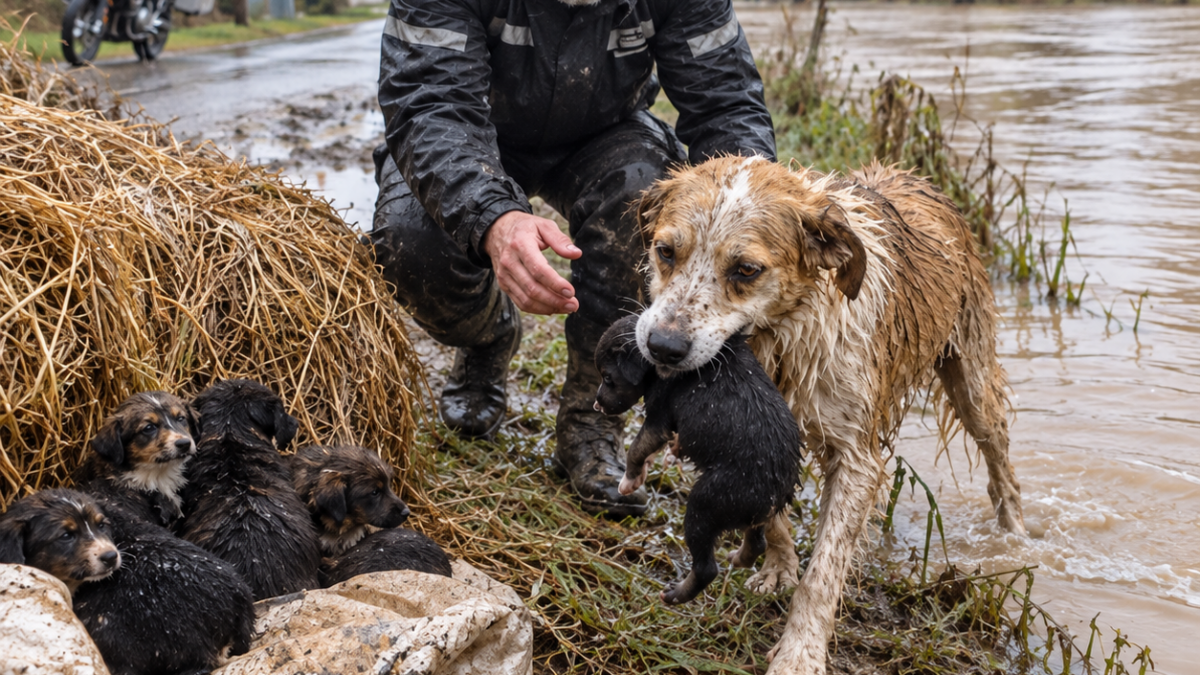
Then I saw the mother dog climbing out of the brown floodwater.
She was yellow and white, painfully thin, completely soaked, and carrying a tiny black puppy in her mouth.
She took three unsteady steps onto a strip of mud.
Her front legs buckled.
Somehow, she kept the puppy from hitting the ground.
She lowered him beside a soaked burlap sack and touched his body with her nose.
That’s when we noticed the others.
Five puppies were already huddled together.
One brown with a white chin.
One cream-colored.
One spotted.
One dark puppy with a pale paw.
And a tiny female almost half the size of the rest.
Six puppies altogether.
All wet.
All trembling.
But alive.
Claire crouched near them.
“She brought them across one at a time,” she whispered.
I stared at the mother.
Her chest heaved.
Her tongue hung from one side of her mouth.
She looked finished.
Then we heard it.
A weak whimper came from across the floodwater.
Barely audible beneath the roar of the current.
The mother heard it immediately.
Her head snapped up.
Across the water stood a half-submerged garden shed surrounded by floating boards and tangled fencing.
Another cry came from there.
The dog tried to stand.
“No,” I said.
Her legs folded again.
Thierry ran toward his motorcycle to grab a rope.
Claire called emergency services.
Malik pulled blankets from a saddlebag.
But the dog didn’t wait.
She looked once toward the six puppies behind her.
Then she entered the flood again.
The current struck her sideways almost immediately.
Her head disappeared.
Claire gasped.
Then the dog’s nose broke the surface again.
She kept swimming.
Every stroke was weaker than the one before it.
“She’s going for another puppy,” Claire said.
I pulled off my vest.
Then my boots.
Thierry grabbed my arm.
“Gérard, don’t do something stupid.”
I pointed at the dog.
“Watching her drown would be stupid.”
He tied the rope around my waist.
The other end went around a thick tree beside the road.
By then, the mother had reached the floating boards near the shed.
She dragged herself halfway onto one.
For a second, she disappeared behind the debris.
Then her head lifted.
There was a puppy in her mouth.
The seventh.
Even exhausted, she held him gently.
She turned toward us.
That’s when the current hit her again.
Hard.
Her body rolled sideways.
The puppy stayed above water.
But the mother’s eyes started closing.
Her front paws stopped moving properly.
Her muzzle sank lower.
I stepped into the flood.
The cold shocked me.
Then the force of the water nearly knocked me over.
Floodwater looks manageable from the bank.
Inside it, everything changes.
The current pulls at your legs.
Branches strike you.
The ground disappears without warning.
I moved slowly, leaning against the water.
“Come on, girl!” I shouted.
She couldn’t have been more than fifteen yards away.
But the current kept pushing her downstream.
My foot hit something sharp.
Pain shot through my heel.
I ignored it.
A section of wire fencing was sticking out of the water ahead of her.
If she reached it, she could become trapped.
I shouted again.
Her eyes opened.
For one second, she looked directly at me.
I’ll never forget that look.
She wasn’t asking me to save her.
She seemed to be asking me to save the puppy.
I reached her just before the current pushed her into the fence.
I grabbed the loose skin behind her shoulders.
She didn’t struggle.
She kept the puppy locked gently between her jaws.
“I’ve got you,” I said.
Then my feet slipped.
The current knocked us sideways.
The rope snapped tight.
Water came up to my chest.
Behind me, Thierry and Malik started pulling.
I wrapped one arm around the mother.
Her body felt frighteningly light.
She was all ribs, wet fur, and exhaustion.
The puppy remained above water.
“Don’t let go,” I told her.
As if she ever would.
They pulled us toward shore.
Every few feet, my knees hit stones.
The dog went limp against me.
That terrified me more than anything.
“Stay with me.”
No response.
Then hands grabbed my shoulders.
Claire and another man dragged us onto the mud.
I rolled onto my back, coughing.
But the mother still had the puppy.
Claire knelt beside her.
“Easy, mama.”
She reached toward the pup.
The dog’s eye opened.
Claire stopped.
“I’m helping,” she whispered.
The mother stared at her.
Then, slowly, she relaxed her jaw.
Claire lifted the puppy away.
The mother tried to raise her head.
She couldn’t.
But her eyes followed that tiny body until Claire placed him beside the other six.
Only then did the dog let her head fall to the ground.
“She’s crashing,” Claire said.
Within minutes, we had the mother wrapped in blankets and the seven puppies packed together in a transport crate.
The emergency crews were dealing with human rescues farther downstream, so we drove them ourselves to a veterinary clinic.
I sat in the back beside the dog.
Every time the van turned, she opened her eyes and looked toward the puppy crate.
Claire noticed it too.
“She’s checking them.”
The mother watched every movement.
I touched the first puppy.
Her eyes followed.
Second.
Third.
All the way to number seven.
Only then did her breathing slow.
At the clinic, the veterinarian worked fast.
Two puppies were dangerously cold.
The smallest female had low blood sugar.
The seventh had inhaled water.
The mother was severely dehydrated and exhausted.
She had cuts across her belly, torn pads, and a deep raw mark around her neck.
The veterinarian parted the wet fur.
“Chain injury,” she said.
Claire looked at me.
Neither of us spoke.
The dog had a microchip.
Her name was Belle.
The registered owner was a man named Luc Vannier.
The address matched the flooded property.
At first, I was relieved.
Maybe there was an explanation.
Maybe Luc had been injured.
Maybe he’d been evacuated unexpectedly.
Maybe he’d been desperately looking for Belle.
Then the authorities checked.
Luc had evacuated the day before.
When officials asked whether any animals remained on the property, he’d said no.
Thirty-seven minutes after we learned that, Luc arrived at the clinic.
“Where’s my dog?”
Belle heard his voice.
Her entire body stiffened.
She tried to push herself backward inside the kennel.
Luc entered the treatment area.
“There she is. Those puppies are mine too.”
The veterinarian stepped between him and Belle.
“She’s receiving emergency treatment.”
“When can I take them?”
Not “Are they alive?”
Not “Is she going to survive?”
When can I take them?
Claire stared at him.
“You left seven newborn puppies in a flood zone.”
Luc shrugged.
“The water wasn’t supposed to rise that high.”
I felt something cold move through me.
“You told rescuers there were no animals there.”
His expression changed.
“I thought she’d be fine.”
Claire pointed at Belle.
“She crossed floodwater seven times because you thought she’d be fine.”
Luc looked irritated rather than ashamed.
“They’re my dogs.”
I stepped toward him.
Thierry caught the back of my shirt.
I didn’t hit Luc.
That became important later.
Because the revenge I wanted in that moment would have lasted ten seconds.
What happened instead lasted much longer.
Animal welfare investigators opened a case.
They returned to the flooded property.
Near the shed, they found a broken chain still attached to a metal stake.
Belle hadn’t simply been left loose.
She had been chained.
The flood rose around her.
Somehow, the chain broke.
Then she began moving her puppies one by one.
Investigators also found breeding records.
Belle had produced several litters.
There were names, deposits, sale prices.
To Luc, she hadn’t just been a dog.
She was income.
Neighbors started talking.
One had warned Luc by text before he evacuated.
“What about Belle and the pups?”
Luc’s reply was later recovered.
“She has the shed. Water won’t reach it.”
The neighbor answered:
“Forecast says it could.”
Luc responded:
“I’m already gone.”
That message changed everything.
Over the next several months, Belle recovered in my home while the case moved forward.
At first, she was afraid of rain.
The first storm after she came home, she paced from room to room looking for puppies that weren’t there.
I sat on the floor and showed her a blanket carrying their scent.
“They’re safe,” I told her.
“All seven.”
She finally lay down.
Weeks later, I took her to see them.
The puppies rushed toward her.
Belle sniffed every one.
One.
Two.
Three.
Four.
Five.
Six.
Seven.
Then she looked at me.
I had told everyone she was only staying with me temporarily.
Nobody believed me.
Neither did Belle.
At the hearing months later, Luc’s lawyer argued that the flood had been unpredictable.
He said Belle had survived, which proved she had been capable of escaping.
When I testified, he asked:
“So the dog was physically capable of entering the water?”
“She entered it.”
“And she survived?”
“Because we pulled her out.”
“You cannot prove she would have died.”
I looked directly at him.
“The fact that she was willing to die for her puppies doesn’t mean she was capable of surviving that river.”
The room went silent.
Two weeks later, the ruling came.
Luc lost ownership of Belle and all seven puppies.
Restrictions were placed on his ability to breed or keep animals.
He was ordered to pay veterinary costs and penalties.
That was the justice I had wanted.
But the part that mattered came afterward.
Every puppy found a safe home.
The seventh puppy grew into a strong brown dog named Seven.
The black puppy Belle carried ashore before we arrived went to the elderly woman who had witnessed several of Belle’s crossings from her window.
Belle stayed with me.
Permanently.
Years later, all seven puppies came back for a reunion.
They were adults by then.
Big, healthy, loud, ridiculous dogs racing across my yard.
Belle stood on the porch, older and gray around the muzzle.
One by one, they ran to her.
She sniffed each one carefully.
One.
Two.
Three.
Four.
Five.
Six.
Seven.
That evening, after everyone left, rain tapped against my windows.
Once, that sound had terrified her.
This time, Belle barely opened her eyes.
I sat beside her and stroked the thin scar around her neck.
I had once believed Luc losing his dogs was the revenge.
It wasn’t.
The real revenge was that Belle survived long enough to discover what he had never given her.
Safety.
A home.
A soft bed.
People who came back for her.
And seven puppies who grew old enough to return and stand beside the mother who had refused to leave even one of them behind.
Belle crossed that flood seven times for her babies.
But I think the greatest crossing came afterward.
She crossed from fear into trust.
From being used into being loved.
From belonging to someone who left her behind…
to belonging exactly where she was meant to be.








