She Bit Three People and Outsmarted Every Trap—Then She Carried Four Newborn Kittens Through a Deadly Blizzard to Our ER Door
For three years, I secretly fed a feral calico that had bitten three people, outsmarted a professional trapper for eleven straight days, and never let me come within forty feet of her.
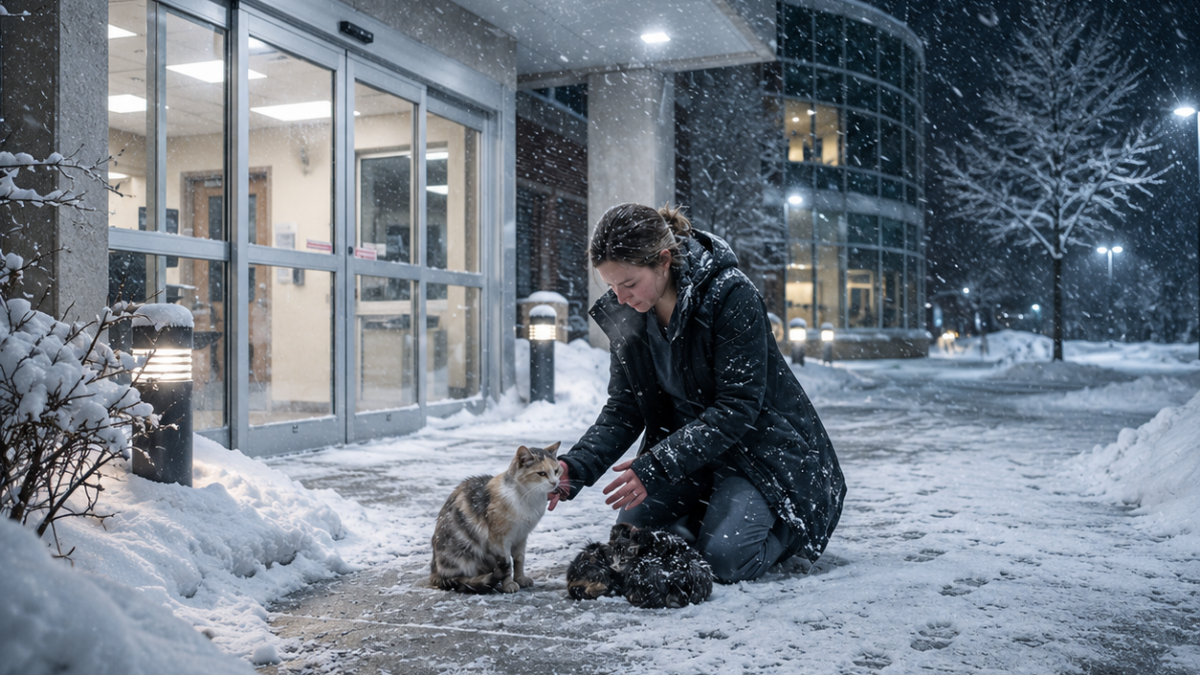
Then, at 2:15 in the morning during the worst lake-effect blizzard I can remember, an ER nurse found that same cat sitting in front of our ambulance entrance with four newborn kittens pressed against her chest.
What the nurse did next should have ended with another bite report, but instead it exposed something about that terrified little mother none of us at the hospital had ever understood.
My name is Gary Pelto, and in January 2025 I had worked maintenance at UP Health System in Marquette, Michigan, for nineteen years. By then, almost everybody on campus knew the cat.
She was a little dilute calico, maybe seven pounds in a good season, with pale gray, washed-out orange, and white fur and a torn left ear. She lived somewhere around the north service corridor, probably behind the outdoor HVAC units where the warm exhaust kept the worst of the winter from reaching the ground.
People called her vicious.
I never did.
I had seen vicious animals. What I saw in her was fear.
Three different attempts to catch her had ended with three people getting bitten. After the third incident, the hospital classified her as a nuisance animal and brought in a professional trapper. He spent eleven days setting cage traps around the property.
She beat him every day.
He tried four different baits. Twice, she stole the food without triggering the door. I remember him staring at an empty trap one morning and saying, “Twenty-three years doing this, Gary, and I’m getting humiliated by a cat that doesn’t weigh as much as my work boots.”
I laughed, but I was relieved every time she escaped.
I wasn’t supposed to feed her.
I did anyway.
Every shift, I left a little piece of my lunch near the HVAC units—roast beef, turkey, whatever I had. She never touched it while I stood there. I could walk fifty yards away, turn around, and find the food gone.
That was our relationship.
Forty feet of distance and a stolen piece of sandwich.
Then, during the first week of January, I noticed her belly and the way she moved.
She was nursing.
I didn’t tell anybody. I just started bringing more food.
On January 17, the lake-effect snow came down so hard it erased the parking lot lines before dark. The blizzard warning started at six that evening. By midnight, winds were running more than thirty miles an hour, and the temperature with wind chill had dropped far below zero.
I wasn’t working that night.
At home, I kept thinking about the north service corridor.
About the cat.
About kittens I had never seen.
I told myself the HVAC vents were warm. I told myself she had survived three winters already. I told myself a feral cat understood weather better than I did.
None of it helped.
What I learned the next morning was that, around 2:15 a.m., ER nurse Adrienne Kowalski stepped through the ambulance bay doors for a short break.
She looked down.
The cat was sitting directly in front of the entrance.
Snow covered her back. Ice clung around her whiskers and eyes. Her coat was soaked flat against a body that looked frighteningly thin.
And tucked beneath her chest were four tiny kittens.
Adrienne recognized her immediately.
Everybody had heard the warnings.
“Don’t corner that cat.”
“Don’t grab her.”
“She bites.”
Adrienne crouched anyway.
There were only three nurses, one attending physician, and two patients in the emergency department that night. The sheltered ambulance bay was still around eleven below zero, and outside it the wind was far worse. Adrienne later told me she could hear the kittens making tiny, thin sounds beneath the wind, the kind of cries that barely seemed strong enough to exist.
She knew exactly what touching their mother could mean. Hospital employees had already needed preventive treatment after the earlier bites because nobody knew the cat’s rabies status. Another bite would mean paperwork, medical treatment, and a lot of questions about why she had ignored a warning everyone on campus knew.
Still, she stayed.
The mother didn’t run.
She didn’t hiss.
She didn’t flatten her ears.
She just sat there in the light with four shivering kittens gathered against her and watched a human being come closer than she had allowed anyone to come in three years.
Adrienne slowly removed one glove.
Then she reached out her bare hand.
The cat looked at her.
And for the first time, she did not move away.
PART 2
Adrienne later told me that for a few seconds, neither of them moved.
She kept her hand low.
Palm open.
No sudden motion.
The little calico stared at her through wet fur and melting ice.
Adrienne had heard every story about that cat.
She knew about the maintenance worker who had been bitten while trying to close a trap door.
She knew about the facilities manager who had ended up needing preventive medical treatment after another capture attempt went wrong.
She knew that the professional trapper had spent eleven days trying to outsmart an animal that seemed capable of studying every cage before she entered it.
Every sensible part of Adrienne’s brain was probably telling her not to reach any farther.
But she looked at the four kittens.
Their bodies were pressed together under their mother’s chest.
Then she looked at the mother.
Adrienne told me later, “Gary, I have seen people come through those ER doors after terrible accidents. I’ve seen fear. I’ve seen exhaustion. I’ve seen people who had absolutely nothing left. That cat had the same look.”
She described it as the most exhausted expression she had ever seen on anything alive.
The cat didn’t look angry.
She looked finished.
Adrienne moved another inch closer.
Still nothing.
Then another.
The cat’s eyes stayed on her hand.
Adrienne touched the side of her neck.
No hiss.
No bite.
No claws.
She slid one hand beneath the cat’s chest and the other beneath her hindquarters.
And then she did something that everybody on our campus would have told her was impossible.
She picked her up.
The cat went completely limp.
Not unconscious.
Not helpless in the way a sick animal goes limp.
She simply stopped resisting.
Three years of running.
Three years of staying forty feet away.
Three years of traps, people, boots, vehicles, doors, voices, and hands she had learned not to trust.
And on that one night, in minus-degree cold with four kittens behind her, she let a stranger hold her.
Adrienne told me later that the moment frightened her more than a bite would have.
“She just surrendered,” she said.
That word stayed with me.
Surrendered.
But I don’t think that’s really what she did.
I think she made a decision.
There’s a difference.
She had spent years deciding people were dangerous.
That night, she decided the cold was worse.
Or maybe she decided that whatever happened to her didn’t matter anymore as long as the kittens got inside.
Another nurse came through the ambulance doors with a warmed blanket.
Adrienne handed over the kittens one at a time.
Three females.
One male.
All tiny.
All alive.
Then she carried their mother inside.
They took them to an empty supply room beside the emergency department corridor because that was the quietest warm space available.
They spread warmed hospital blankets across the floor and made a nest.
Someone brought a heat lamp from neonatal supplies.
Someone else found towels.
The mother cat stayed close to the kittens.
Nobody tried to force her into a carrier.
Nobody crowded her.
At 2:40 a.m., Adrienne called the Upper Peninsula Animal Welfare Shelter’s emergency number.
Then she went back to work.
That detail means something to me.
It would be easy to tell the story as if the entire hospital stopped because a cat appeared at the door.
It didn’t.
People still came in sick.
Phones rang.
Monitors beeped.
Nurses worked.
A doctor moved between patients.
The storm kept hitting the windows.
Life continued.
But in a little supply room beside the ER, four kittens who might have frozen outside were lying on warm blankets beneath a heat lamp.
And beside them was a mother nobody had been able to touch.
At about 3:15, Adrienne got another short break.
She went back.
The mother was still wet.
Still trembling.
Still exhausted.
But all four kittens were nursing.
Adrienne sat down on the floor.
She leaned against the wall.
She didn’t touch the cat.
She didn’t try to pet her.
She just sat.
Four minutes.
That was all.
Later, one of Adrienne’s coworkers told somebody that she had been crying.
Adrienne never volunteered that part herself.
When I asked her about it weeks later, she shook her head.
“People exaggerate.”
“You were crying.”
“I’d been working all night.”
“That’s not a denial.”
She looked at me.
Then she said something I’ve never forgotten.
“I didn’t go into that room because I needed to sit with a cat. I went in because it had been a long shift, and sometimes you need to sit somewhere something is going right.”
That was Adrienne.
She never wanted credit.
The cat didn’t care about credit either.
By morning, I still knew none of this.
I woke before six.
The storm was still hammering Marquette.
My driveway had nearly disappeared.
Snow had climbed halfway up the side of my garage door.
The wind made the windows tremble.
The first thing I thought about was the cat behind the HVAC units.
I remember standing in my kitchen with coffee in my hand and feeling guilty.
I had known she had kittens.
I had seen that she was nursing.
I had increased the food.
But I had not found them.
I had not brought her inside.
I had not called anybody.
I had done the easy thing.
I had convinced myself she knew how to survive.
At sixty-one years old, you get very good at explaining to yourself why you don’t need to interfere.
She’s feral.
She doesn’t want help.
She survived last winter.
She knows where the vents are.
She bites.
Somebody else will handle it.
Those were all true.
And none of them made me feel better.
I got dressed for work even though I wasn’t scheduled yet and started clearing my truck.
My phone rang before I finished.
It was a maintenance coworker.
“Gary.”
“Yeah?”
“You hear about your cat?”
I stopped shoveling.
“My what?”
“The calico.”
Something dropped inside me.
“What happened?”
“She’s in the ER.”
I almost laughed because the sentence made no sense.
“What do you mean she’s in the ER?”
“She showed up at the ambulance bay.”
“With kittens.”
The shovel slipped out of my hand.
“What?”
“Four of them.”
I didn’t ask anything else.
I threw the shovel into the truck bed, backed through snow I probably should have cleared first, and drove toward the hospital.
The roads were awful.
Visibility came and went.
Snow moved sideways beneath the headlights.
I remember gripping the steering wheel and thinking the same thing over and over.
She crossed that?
I still didn’t understand how much she had crossed.
Not yet.
When I reached the hospital, the shelter team had already been contacted and arrangements were being made for the mother and kittens to be examined.
Adrienne was finishing part of her shift.
She looked exhausted.
I found her near the nurses’ station.
“Where is she?”
Adrienne looked at me.
“You’re Gary?”
“Yeah.”
Her expression changed.
“Oh.”
“What?”
“You’re the sandwich guy.”
I stared.
“The what?”
She gave me a tired smile.
“Somebody said there was a maintenance guy feeding her.”
“I wasn’t supposed to.”
“I’m not reporting you.”
“Good.”
Then I said, “Where is she?”
Adrienne took me to the supply room.
She stopped before opening the door.
“Don’t walk straight toward her.”
“I know.”
“She’s calm, but I don’t know how long that lasts.”
“I know.”
“She let me pick her up.”
I looked at Adrienne.
I actually thought she was joking.
“You picked her up?”
“With my hands.”
“No gloves?”
“No.”
“That cat?”
“That cat.”
I stared through the narrow window.
The little calico was lying on the blankets.
Four kittens pressed against her belly.
Her eyes were half closed.
My throat tightened.
That animal had never allowed me within forty feet.
I had spent three years dropping pieces of roast beef and walking away.
Now she was inside.
Under fluorescent lights.
Surrounded by human smells.
Nursing kittens.
I opened the door only far enough to stand near the wall.
The cat’s eyes opened.
Her head lifted.
She saw me.
I don’t know if she recognized me.
For a long time, I told myself she probably didn’t.
Cats survive by smell and routine, and I had never been close enough to touch her.
But I had been feeding her for years.
She knew my boots.
My schedule.
Maybe my voice.
Maybe the smell of roast beef on my gloves.
When I stepped into that room, her ears moved forward.
Not back.
Forward.
I stopped.
“Hey.”
Her eyes stayed on me.
I had spoken to her outside before.
Usually from forty feet away.
“You really made a mess of things, didn’t you?”
Adrienne whispered, “That’s how you talk to her?”
“She knows I mean well.”
The cat blinked.
I stayed near the wall.
A shelter worker arrived not long afterward, and the family was transferred for veterinary examination.
I watched the carrier door close.
The mother immediately became tense again.
That mattered.
Her one moment with Adrienne had not transformed her into a friendly house cat.
She hadn’t suddenly forgotten three years of fear.
She had made one exception.
That was all.
An extraordinary exception.
But still an exception.
The next part of the story came from the veterinary report.
She weighed four pounds fourteen ounces.
Four pounds.
Fourteen ounces.
When I heard that number, I thought somebody had made a mistake.
“She’s bigger than that.”
The shelter worker shook her head.
“No.”
“For her frame?”
“She should probably be somewhere around eight or nine pounds.”
I stared.
She was nearly half the weight she should have been.
I had been feeding her.
Not enough, apparently.
That guilt hit me immediately.
The veterinarian tried to stop it.
“This didn’t happen because one person failed to leave enough sandwiches.”
I said nothing.
“She has been nursing in a northern Michigan winter. She has chronic nutritional deficiency, dehydration, muscle loss, and an infected wound. She’s been burning more calories than she could replace.”
I looked through the enclosure.
The mother stayed pressed toward the back.
“What wound?”
Her right hind leg had a puncture injury.
Likely another animal.
The veterinarian estimated it had been infected for twelve to fourteen days.
So while I had been seeing her near the HVAC units, thinking she looked thinner because she was nursing, she had also been fighting an infection.
Her ear tips showed frostbite.
So did the tip of her tail.
She was chronically dehydrated.
Her body had been consuming itself to keep producing milk.
Then somebody weighed the kittens.
Three girls.
One boy.
Five to seven ounces each.
Small.
Cold.
But alive.
And their stomachs were not empty.
That stopped me.
“What does that mean?”
The shelter worker looked at me.
“She fed them.”
“Before she came?”
“Looks that way.”
I stared at the mother.
Before crossing the hospital property in a blizzard, she had nursed her babies.
She had already been starving.
She weighed less than five pounds.
She had an infected leg.
Frostbite.
Little body fat.
And she fed them first.
Then we learned how far she had gone.
One of the shelter coordinators pulled up a satellite map of the hospital campus.
The suspected nesting area behind the HVAC units was on the north side.
The ambulance entrance was on the south side.
About 210 yards.
I looked at the screen.
“That’s not that far.”
The coordinator looked at me.
“For you?”
I understood.
Twenty-seven inches of snow.
Thirty-four-mile-per-hour winds.
A wind chill that had fallen to around thirty-eight below zero in open exposure.
A five-pound cat.
An infected hind leg.
And four kittens.
Then the coordinator said, “She probably didn’t move them together.”
I frowned.
“What do you mean?”
“She carried them.”
“One at a time?”
“That’s the most likely explanation.”
I looked at the map again.
Two hundred ten yards out.
Then two hundred ten back.
Another kitten.
Out.
Back.
Out.
Back.
Out again.
Four trips carrying kittens.
Four return trips through the storm.
Eight crossings.
The coordinator did the calculation.
One thousand six hundred eighty yards.
Just under a mile.
I sat down.
Nobody said anything for a while.
I pictured her.
Not the tough cat everybody complained about.
Not the animal that bit maintenance workers.
Not the little thief who stole roast beef after I walked away.
I pictured a four-pound mother disappearing into blowing snow with one kitten in her mouth.
Putting it somewhere near the ambulance entrance.
Turning around.
Going back.
Into the wind.
Through twenty-seven inches of snow.
Finding the nest again.
Picking up another baby.
Coming back.
Then doing it again.
And again.
There were tracks in places, but the storm had erased most of them.
We would never know the exact route.
We would never know how many times she stopped.
How many times she collapsed.
How many times she nearly turned back.
But the math was there.
Four kittens.
One mother.
One at a time.
I said, “Why the ambulance bay?”
Nobody answered immediately.
Then Adrienne, who had come by to check on them before leaving, said, “Because the doors are always open.”
I looked at her.
“She didn’t know it was a hospital,” Adrienne said. “She knew there was light.”
That made sense.
The ambulance bay was active at every hour.
People came and went.
Doors opened.
Lights stayed on.
There was warmth.
For three years, that cat had studied us from a distance.
She knew our routines better than we knew hers.
She knew which dumpsters had food.
Which service corridors stayed warm.
Which maintenance workers walked which routes.
Maybe she knew my shift schedule.
And somewhere during that terrible night, she must have understood something simple.
There was one place where the door kept opening.
The tragedy was that the same thing that offered safety was the thing she feared most.
People.
If she had been alone, I don’t think she would have gone.
I believe that because I watched her for three years.
She would tolerate hunger.
She would tolerate cold.
She would sleep behind machinery.
She would steal food from traps designed to catch her.
She would fight if someone got too close.
She would stay forty feet away from the man who fed her almost every day.
She was willing to live with all of that.
But now four other lives depended on her.
And suddenly, fear had competition.
That was the part that changed the way I saw her.
People like to say courage means not being afraid.
That cat taught me the opposite.
She was terrified of us.
We had proof.
Three years of proof.
Three bites.
Eleven days avoiding a trapper.
Forty feet of distance.
She did not trust people.
She did not like people.
She did not secretly want to be cuddled.
She feared us enough to shape her entire life around avoiding us.
And she came anyway.
Not because her fear disappeared.
Because something mattered more.
Within a week, the kittens were strong enough to move into foster care.
That was good news.
It didn’t feel entirely good.
The mother watched when they were separated.
The shelter staff handled it carefully, but there was no way to explain to a feral cat that her babies were safe.
She knew they were gone.
That was all.
The first foster placement took two of the kittens together.
The others followed as they became ready.
By the end of February, every kitten had been adopted.
Two went to a family in Negaunee.
One went to a graduate student at Michigan Tech in Houghton.
The fourth went to a retired couple in Munising.
I asked about all of them.
Probably too often.
“They’re fine, Gary.”
“What does fine mean?”
“It means healthy.”
“Eating?”
“Yes.”
“Warm?”
“Yes.”
“Together?”
“Some are.”
“Anybody got kids?”
“Gary.”
“What?”
“They’re fine.”
I nodded.
Then called again the next week.
The mother was different.
She needed more time.
A lot more.
People around the hospital started talking about her as if the blizzard had magically changed her personality.
It hadn’t.
I went to the shelter during her first week there.
She was in the feral housing area.
When I approached her enclosure, she moved as far back as she could.
Her body became low.
Her eyes went hard.
The old expression returned.
Stay away.
I stopped several feet from the door.
A shelter worker said, “Don’t take it personally.”
“I don’t.”
“She’s under a lot of stress.”
“I know.”
“She’s not the cat from the ambulance bay right now.”
I looked at her.
“She is.”
The worker turned toward me.
“She’s exactly the same cat.”
That one moment with Adrienne had not erased anything.
If anything, I think it had cost her.
For one night, she had forced herself to do the thing she feared most.
Now she was safe enough to be afraid again.
There is something important in that.
Sometimes people expect rescue to look grateful.
An animal gets food, warmth, medical care, and suddenly everybody wants the animal to understand.
To soften.
To accept hands.
To purr.
To prove the rescue worked.
Bay didn’t do that.
She survived.
That was enough.
I didn’t call her Bay yet.
At that point, she didn’t really have a name I used.
The hospital had various names for her.
“The calico.”
“The HVAC cat.”
“That mean little thing.”
“Gary’s cat.”
She wasn’t mine.
Not yet.
The first Saturday I visited the shelter, I brought lunch.
Roast beef.
Habit.
I sat in a folding chair outside her enclosure.
She stayed at the back.
I didn’t look directly at her.
Didn’t talk.
Didn’t reach through the bars.
I ate half the sandwich.
Then I tore off a little piece of roast beef and placed it near the front of the enclosure.
She didn’t move.
I waited.
Five minutes.
Ten.
A shelter employee walked by.
“You planning to stay all day?”
“Maybe.”
“Comfortable chair?”
“No.”
“Want another one?”
“No.”
She walked away.
I kept eating.
The cat watched me.
Eventually, she stood.
One step.
Stopped.
Another.
Stopped again.
Her head stayed low.
I looked at the opposite wall.
She came forward.
Closer than she ever had outside.
The piece of roast beef was near the enclosure entrance.
She smelled it.
Then looked at me.
I didn’t move.
She took it.
And ate while I was still sitting there.
I almost smiled.
Almost.
I didn’t want to scare her by changing expression.
When she finished, she backed away.
That was all.
I went home feeling like somebody had handed me a trophy.
The next Saturday, I did the same thing.
Roast beef sandwich.
Folding chair.
No talking.
No staring.
She stayed back for less time.
I placed the meat near the front.
She came forward.
Ate.
Watched me.
Returned to the back.
The third week, she was waiting when I arrived.
Not at the front.
But not completely hidden either.
I sat.
Opened the sandwich.
Her nose moved.
“You remember this.”
Her ears twitched.
I regretted speaking.
She didn’t retreat.
So I said nothing else.
By then, the infected wound on her hind leg was healing.
Her frostbitten ear tips had begun to scar.
She was gaining weight slowly.
The kittens were safe.
There was no emergency anymore.
And without the emergency, she had no reason to trust me.
That was the real test.
Not whether she could be picked up while half-frozen and exhausted.
Whether she could choose to come closer when she was strong enough to walk away.
By week five, I heard one of the shelter workers say, “Gary’s here.”
Before I reached her enclosure, the calico came forward.
I heard her claws lightly touch the floor.
I stopped.
She was at the front.
Waiting.
I looked down at my boots.
Then at the sandwich in my hand.
“Well.”
Her eyes stayed on me.
“Now I know what this relationship is based on.”
Roast beef.
Fair enough.
I sat.
She stayed near the front.
That was the first time I really studied her face up close.
The torn left ear.
The scar tissue forming around the frostbitten edges.
The narrow face beneath the patchy winter coat.
She was not a pretty cat in the way people usually mean it.
No glossy coat.
No round kitten eyes.
No soft expression.
Everything about her face said she had been outdoors too long.
She looked like survival had carved itself into her.
I liked her immediately.
Maybe I already had.
By the sixth week, I started thinking about adoption.
I told nobody.
Then I told everybody.
Mostly because apparently I cannot keep my mouth shut once I make up my mind.
One shelter worker laughed.
“You know she’s not going to turn into a lap cat.”
“I don’t want a lap cat.”
“You say that now.”
“I own a recliner. I don’t need another thing in my lap.”
“She may hide.”
“Fine.”
“She may never enjoy being touched.”
“Fine.”
“She may not sleep near you.”
“Fine.”
“She may always be partly feral.”
I looked through the enclosure.
“Also fine.”
The worker studied me.
“What exactly do you expect from her?”
“Nothing.”
She raised an eyebrow.
“I mean it.”
That sounded noble.
It wasn’t.
It was practical.
I had spent three years giving food to a cat who wouldn’t let me within forty feet.
My expectations were already very low.
Then came the seventh week.
I sat in the folding chair.
Roast beef on a napkin.
She approached.
Ate.
But she didn’t retreat.
She stayed at the front.
I looked at her.
She looked at me.
I slowly extended two fingers.
Stopped.
She could move away.
She didn’t.
I moved one inch closer.
Still nothing.
Another.
My fingers touched the top of her head.
Three seconds.
Maybe less.
Her fur was softer than I expected.
Then she stepped backward.
I dropped my hand immediately.
No second attempt.
No “come here.”
No reaching after her.
I sat back.
She stayed five feet away.
I finished my sandwich.
That night, I kept thinking about those three seconds.
It seems ridiculous when I say it.
I had been alive sixty-one years.
I had worked nineteen years at the hospital.
I had repaired boilers, electrical systems, doors, equipment, plumbing, and enough broken machinery to fill a warehouse.
I had raised a family.
Buried people I loved.
Gotten through good years and bad ones.
And somehow the thing I could not stop thinking about was three seconds with my fingers on the head of a seven-pound cat.
Maybe because I understood what they cost her.
Nobody celebrates forty feet.
People celebrate the final touch.
The adoption.
The photograph.
The happy ending.
But Bay’s story was built out of distances.
Forty feet.
Then thirty.
Then the front of an enclosure.
Then six feet.
Then three seconds.
Every inch mattered.
On March 8, 2025, I adopted her.
That was when she became Bay.
People asked why.
I could have named her Blizzard.
Storm.
Calico.
Lucky.
Anything.
I called her Bay because that was where she had finally asked for help.
The ambulance bay.
The place at a hospital where somebody arrives when something has gone wrong and there is nowhere else to go.
Bay.
It fit.
I brought her home to Harvey, just south of Marquette.
I prepared a room.
Food.
Water.
A litter box.
Blankets.
A hiding space.
I did more research about feral cats in a week than I had done about most major purchases in my life.
The shelter reminded me not to rush her.
“I know.”
“Don’t force contact.”
“I know.”
“Keep things quiet.”
“I know.”
“Let her choose distance.”
“I know.”
One worker smiled.
“You’re nervous.”
“No.”
“You are.”
“I’m sixty-one. I don’t get nervous over cats.”
Bay hissed from inside the carrier.
The worker looked at me.
“Clearly.”
The drive home was quiet.
Bay stayed pressed against the back of the carrier.
I did not play music.
Did not talk much.
At one point, I said, “This is probably a bad idea.”
She stared through the door.
“For both of us.”
She kept staring.
“We’ll figure it out.”
When I brought the carrier into the house, I opened it.
Then backed away.
Bay did not come out.
Five minutes.
Ten.
Twenty.
I went to the kitchen.
Made coffee.
Came back.
Still inside.
I sat on the floor against the opposite wall.
Didn’t look directly at her.
Eventually, one paw appeared.
Then her head.
She studied the room.
Stepped out.
Immediately disappeared behind the toilet in the bathroom.
That became her place.
Not the bed I had bought.
Not the soft blanket.
Not the expensive little enclosed cat cave somebody at the shelter recommended.
Behind the toilet.
A narrow warm space between porcelain, wall, and cabinet.
I stood in the doorway.
“You know I spent money on actual cat furniture.”
Two eyes stared from the darkness.
“Fine.”
I left.
The first night, she did not come into the living room.
The second night either.
I heard her moving after midnight.
Food disappeared.
The litter box was used.
Water level changed.
But if I walked toward the hallway, she vanished.
I knew better than to chase her.
On the fourth day, I came home from work and found her sitting inside the bathroom doorway.
I stopped in the hall.
She immediately tensed.
I backed up.
“Sorry.”
She stayed.
I went into the kitchen.
That became another tiny victory.
The first week, she explored mostly when I slept.
I would wake and find evidence.
A chair moved slightly.
Food crumbs near the kitchen.
One window blind disturbed.
A paw print on a dusty shelf I had been meaning to clean.
She was learning the house without me.
That was okay.
The second week, she began appearing in the hallway while I was awake.
Never close.
Always with an escape route.
I pretended not to notice.
That part was harder than it sounds.
When a terrified animal chooses to come three feet closer, every instinct tells you to reward it.
Speak softly.
Offer a hand.
Give a treat.
But sometimes the reward is leaving her alone.
So I learned to be still.
One evening, I sat in my recliner eating dinner.
Roast beef.
Yes.
I heard a small sound.
Bay stood at the edge of the living room.
Maybe twelve feet away.
She looked at me.
I looked at my plate.
Then back at her.
I tore off a piece of meat.
My hand stopped halfway down.
If I walked toward her, she would leave.
So I put the roast beef on a napkin on the floor.
About halfway between us.
Then returned to my chair.
Bay watched.
I finished dinner.
She did not touch the meat.
I went to bed.
The next morning, the napkin was empty.
I said nothing.
The next evening, I did it again.
Another little piece.
Same place.
Bay appeared.
Sat farther away.
Waited.
I left the room.
When I came back, the napkin was empty.
That became our arrangement.
Neither of us discussed it.
Weeks passed.
She gained weight.
Her hind leg healed completely.
The damaged ear tips healed with scarred, flattened edges.
At her later checkup, she reached seven pounds two ounces.
Not quite the eight or nine pounds we had been told might be ideal for her frame, but far better than four pounds fourteen ounces.
She was stronger.
Her coat improved.
She moved differently.
Not like an animal spending every calorie on survival.
There was still one lingering problem.
When the humidity dropped, she sometimes made a faint wheezing sound.
The veterinarian believed the irritation was connected to her prolonged exposure to severe cold.
The first time I heard it at home, I panicked.
I called.
“It’s Bay.”
“What happened?”
“She’s breathing weird.”
“Is she distressed?”
“I don’t know.”
“Is her mouth open?”
“No.”
“Gums normal?”
“I’m not putting my hand in her mouth.”
The person on the phone laughed.
“Good choice.”
After we talked through it, I calmed down.
Bay stared at me from behind the toilet.
“You’re expensive.”
She blinked.
“And dramatic.”
Another blink.
“I used to have peace.”
She turned away.
I had to admit she was getting better at winning arguments.
People at work kept asking whether she had become friendly.
I never knew how to answer.
Friendly compared with what?
She didn’t bite me.
Good.
She also didn’t sit on my lap.
Didn’t sleep on my bed.
Didn’t rub against my legs.
Didn’t greet strangers.
Didn’t like being held.
Actually, she still wouldn’t allow me to pick her up.
I never tried.
That confused people.
“You’ve had her months and never held her?”
“No.”
“How do you know she won’t let you?”
“Because she doesn’t want me close enough.”
“You should get her used to it.”
Why?
That was always my question.
Why?
So I could say I had a normal cat?
So visitors could pet her?
So I could take a picture?
Bay had already been held once.
By Adrienne.
That moment belonged to them.
It happened in a blizzard, after Bay had carried four kittens across an exposed parking lot until her body had almost nothing left.
She had let go of control because she had no other option.
I was never going to demand that experience again just because I wanted affection.
If she came closer, good.
If she didn’t, also good.
Around the same time, I received updates about the kittens.
All four were thriving.
I tried not to ask too many questions.
Failed.
The pair in Negaunee had settled in together.
The graduate student in Houghton apparently had a kitten that believed laptop keyboards were beds.
The retired couple in Munising had theirs sleeping near a window.
Warm homes.
Food.
No blizzards.
No parking lots.
No infected legs.
That was what Bay had walked for.
Sometimes I wished I could explain it to her.
Your babies made it.
Every one.
They are warm.
They eat every day.
Nobody is chasing them.
They sleep inside.
You did it.
Of course, there is no way to tell a cat something like that.
Maybe some things don’t need words.
The hospital staff’s attitude toward Bay changed after the storm.
That was one of the strangest parts.
Before January 17, she had been the nuisance cat.
The biter.
The trap problem.
The animal maintenance complained about.
Afterward, people stopped telling the bite stories first.
They told the blizzard story.
“Did you hear what she did?”
“She carried four kittens.”
“One at a time.”
“Across the whole property.”
“Did you know how cold it was?”
“Adrienne picked her up.”
“The cat let her?”
The same facts that once made Bay sound dangerous now made what she did more remarkable.
That mattered to me.
If she had always been affectionate, approaching an ER door would still have been extraordinary.
But Bay had spent three years proving exactly how much she feared human beings.
That fear was not a rumor.
It had consequences.
Three people had been bitten.
A trapper with twenty-three years of experience couldn’t catch her.
I couldn’t get within forty feet.
And then came the worst night of the winter.
That was why her choice meant so much.
She did not become fearless.
She acted while terrified.
A reporter eventually asked me about her.
I did not want to talk at first.
I’m not interesting.
I fix things.
I eat sandwiches.
I go home.
But they wanted to understand who Bay had been before the storm.
So I explained.
“She’s not friendly.”
The reporter looked surprised.
“She lives with you.”
“That doesn’t make her friendly.”
“Does she purr?”
“Not for me.”
“Sit on your lap?”
“No.”
“Sleep on the bed?”
“No.”
“Let you hold her?”
“Absolutely not.”
The reporter laughed.
I didn’t.
“I’m serious.”
“All right.”
“She’s not going to be on some calendar looking cute in a basket.”
The reporter wrote something down.
I continued.
“Most people would walk past her in a shelter.”
That sounded harsh.
But I believed it.
Shelters are full of animals competing for attention.
Kittens stretch paws through bars.
Friendly cats rub against doors.
Some purr when you look at them.
Bay sat at the back.
Scars.
Torn ear.
Suspicious eyes.
No performance.
No attempt to charm anybody.
She would have been easy to overlook.
Then the reporter asked, “So what makes her special?”
I looked across the room.
Bay was sitting about six feet away.
That had become her usual distance in the evenings.
Six feet.
Not forty.
Six.
I said, “On the worst night of the winter, she did something I don’t think I could do.”
The reporter waited.
“She spent three years learning that people were dangerous, and then she walked almost a mile through a blizzard to ask one for help.”
I paused.
“Not for herself.”
My throat tightened.
“If she had been alone, I think she would’ve stayed behind those HVAC units until she froze.”
I looked at Bay.
“But she had kittens.”
The reporter asked, “You think she knew they would die?”
“I think she knew they were cold.”
That was enough.
“She fed them first. Then she carried them one by one.”
I shook my head.
“I’ve been alive sixty-one years, and I don’t think I’ve ever been that brave.”
The reporter stopped writing.
I added, “I don’t think I’ve ever had to be.”
That was the truth.
And I hoped I never found out whether I could.
There is a temptation when telling an animal story to make the animal human.
To say Bay “planned” everything.
To say she “understood hospitals.”
To say she knew Adrienne was a nurse and would save her.
I don’t believe that.
Bay was a cat.
A frightened, underfed, injured cat.
She knew cold.
She knew hunger.
She knew her kittens.
She knew the building had warm vents.
She knew light came from doors.
She knew people moved through the ambulance entrance all night.
Maybe that was all she knew.
It was enough.
People also asked whether I was angry that the hospital had tried to trap her.
No.
Not really.
Three people had been bitten.
The hospital had responsibilities.
You cannot have an unpredictable animal living indefinitely around a medical campus where patients, workers, ambulances, delivery crews, and visitors move through every day.
The trapper was not cruel.
He was doing his job.
The workers who got bitten were not villains.
They were trying to solve a problem.
That is another thing the simple version of the story gets wrong.
There was no evil person Bay needed revenge against.
There was fear on both sides.
Humans feared getting bitten.
Bay feared getting caught.
Everyone behaved according to what they understood.
Then the blizzard forced Bay to make a choice that none of us expected.
If there was any kind of payback in her story, it was not punishment.
It was this:
The cat everybody knew for biting people became the animal everybody remembered for protecting her kittens.
The nuisance became the story people told with tears in their eyes.
The animal nobody could approach chose the hospital door herself.
Nobody defeated Bay.
She changed the meaning of her own story.
And she did it without becoming anything other than what she had always been.
A survivor.
The first few months at home taught me patience I didn’t know I lacked.
There were setbacks.
One afternoon, I dropped a metal pan in the kitchen.
The sound was loud.
Bay vanished.
For almost two days, she returned to spending nearly all her time behind the toilet.
I felt terrible.
“It was a pan.”
She stared at me.
“I’m sorry.”
No response.
“I did not throw it at you.”
Nothing.
I left roast beef.
The napkin stayed full for an hour.
Then two.
I went to bed.
Empty by morning.
Progress resumed.
Another time, a repairman came into the house.
Bay heard unfamiliar boots and disappeared before the man reached the living room.
He asked, “Thought you had a cat.”
“I do.”
“Where?”
“No idea.”
“Does she hide?”
“From you? Absolutely.”
He laughed.
I didn’t bother explaining.
There were evenings when Bay would enter the living room and sit six feet from my recliner.
Not five.
Not four.
Six.
She faced me.
Sometimes stayed an hour.
Sometimes two.
Then returned to the bathroom.
At first, I thought six feet was temporary.
I figured one evening it would become five.
Then four.
Then maybe she would sit beside the chair.
Months passed.
Six feet remained six feet.
And one night I realized something.
I was waiting for her to improve according to my definition.
That wasn’t fair.
Forty feet had become six.
Why wasn’t six enough?
She had already crossed thirty-four feet of fear.
I didn’t need the last six.
After that, I stopped measuring.
Mostly.
I still noticed.
But I stopped expecting.
Dinner became our quiet routine.
I sat in the recliner.
Bay sat on the floor.
When I finished eating, I placed a little piece of roast beef on a napkin halfway between us.
Never directly beside her.
Never close to my chair.
Halfway.
She never ate it while I watched.
Not once.
At least not in the beginning.
I would eventually go to the kitchen.
Or brush my teeth.
Or turn off the television.
The next morning, the meat was gone.
Napkin sometimes moved an inch or two.
Neither of us acknowledged it.
It suited us.
One evening, a heavy snow began falling outside.
Not a blizzard.
Just ordinary Upper Peninsula snow.
I noticed Bay watching the window.
Her body stiffened.
I muted the television.
Snow moved through the porch light.
Bay stayed where she was.
Six feet away.
I wondered what snow meant to her.
Animals do not narrate their trauma to us.
They don’t explain triggers.
They don’t say, “This sound reminds me of the night I almost died.”
We guess.
Sometimes we guess wrong.
I did not call her.
Did not close the curtain.
Did not move.
After several minutes, Bay lowered herself to the floor.
Not lying comfortably.
But not running.
I let out a breath I had not realized I was holding.
The next morning, the roast beef was gone.
Life with Bay became like that.
Tiny moments nobody else would understand.
A paw visible beyond the bathroom door.
A slow blink from across the room.
Eating while I stayed in the kitchen.
Not retreating when I walked past the hall.
Sitting near the same window while snow fell.
None would make good dramatic photographs.
To me, they were everything.
Adrienne visited once.
I thought Bay might remember her.
Maybe she did.
Maybe she didn’t.
Adrienne stood in the living room.
“Where is she?”
“Bathroom.”
“Of course.”
“She likes the toilet.”
Adrienne laughed.
“I risked my hand for a cat that sleeps behind a toilet.”
“Apparently.”
We sat.
Bay did not appear.
Adrienne looked toward the hallway.
“I thought maybe she’d come out.”
“She might after you leave.”
“That’s insulting.”
“She’s consistent.”
Adrienne smiled.
Then she asked, “Does she ever let you hold her?”
“No.”
“Pet her?”
“Sometimes, barely.”
“Really?”
“Head only.”
“How long?”
“Depends.”
“Seconds?”
“Yes.”
Adrienne became quiet.
I knew what she was thinking.
“You were the exception.”
She looked at me.
“That night.”
Adrienne’s face changed.
“I don’t know why she let me.”
“I do.”
“Why?”
“She was done.”
Adrienne looked toward the hallway.
I corrected myself.
“No. Not done.”
I thought about it.
“She had done everything she could do alone.”
Adrienne nodded.
That felt closer.
After Adrienne left, Bay emerged from the bathroom about twenty minutes later.
She stopped in the hallway.
Sniffed.
Walked toward the living room.
There was no dramatic reunion.
No recognition.
No sprint toward the woman who had saved her.
Adrienne was already gone.
Bay sat six feet from me.
I smiled.
“You missed your chance.”
She stared.
“Probably for the best.”
I put roast beef on the napkin.
The first anniversary of the blizzard came the following January.
The forecast was cold but nothing like the previous year.
I was at work.
A maintenance employee younger than me asked, “Gary, you know what today is?”
“Friday.”
“No.”
“Payday?”
“No.”
I looked at him.
“Then I don’t care.”
“The cat.”
I stopped.
I knew immediately.
January 17.
I had not planned anything.
No celebration.
No social media post.
No special meal.
I finished my shift.
Bought roast beef on the way home.
Bay was behind the toilet when I arrived.
“Big anniversary.”
She watched me.
“You’re famous.”
No reaction.
“Still rude.”
She turned her head.
That evening, she entered the living room.
Six feet.
I ate dinner.
When I finished, I tore off a larger-than-usual piece of roast beef.
Placed it on the napkin.
Then returned to the chair.
Snow began falling outside.
Bay watched it.
I watched her.
After maybe twenty minutes, she stood.
That was unusual.
She normally waited until I left.
She walked toward the napkin.
Stopped.
Looked at me.
My body became very still.
She stepped forward.
Lowered her head.
Ate the roast beef.
While I was sitting there.
I did not move.
Did not smile.
Did not speak.
Inside, I felt like yelling.
Bay finished.
Licked her mouth.
Then backed away.
Six feet.
Sat down.
I waited another minute before breathing normally.
That was our anniversary.
Roast beef eaten in the same room.
Not dramatic.
Not heroic.
No blizzard.
No rescue.
Just trust.
That was the part of Bay’s life I loved most.
The ordinary aftermath.
People are drawn to the night she crossed the snow.
I understand why.
Twenty-seven inches.
Thirty-four-mile-per-hour winds.
Minus thirty-eight wind chill.
Four kittens.
Eight trips.
A mother weighing less than five pounds.
Those facts are unbelievable enough without exaggeration.
But I think about what happened afterward more often.
She learned that food would still be there in the morning.
That a closed door could keep cold out instead of trapping her.
That footsteps in a hallway did not always mean someone was coming to catch her.
That a man could sit six feet away and ask for nothing.
That she did not have to fight every hand.
That she could say no by stepping away, and I would listen.
Maybe that was what a home meant to Bay.
Not affection.
Choice.
Outside, she had choices too, but they were brutal.
Run or fight.
Freeze or risk the building.
Starve or approach food near humans.
Hide or be seen.
At my house, her choices became smaller.
Bathroom or living room.
Behind the toilet or near the wall.
Eat now or later.
Six feet or eight.
Stay or leave.
Those are boring choices.
Beautifully boring.
Safety makes life boring.
People underestimate how wonderful that is.
Her kittens got boring lives too.
That was the victory.
One lived with a graduate student and reportedly liked sleeping near books.
Two lived together with a family.
One settled with a retired couple.
No storms.
No exposed parking lots.
No desperate mother carrying them by the scruff through blowing snow.
Bay would never know the addresses.
Never visit.
Never see them grown.
That part hurt if I thought about it too long.
But she had carried them to a place where she could hand responsibility to somebody else.
That was what she had been trying to do.
She got them through the door.
We took it from there.
Years ago, before Bay, I probably would have described courage differently.
Something loud.
Somebody running into danger.
A dramatic decision everybody can see.
Now I think courage can be quiet.
A tiny animal standing in the light outside a hospital entrance.
Snow packed into her fur.
Four babies pressed against her.
A stranger approaching.
Every lesson in her body telling her to run.
And she stays.
Not because she suddenly trusts.
Because running would leave the kittens outside.
That is the image I carry.
Not Adrienne holding her.
The second before.
The choice.
A hand coming closer.
Bay remaining still.
People sometimes ask whether I think she understood what she was doing.
I think she understood enough.
Enough to know the kittens were dying in that cold.
Enough to know the building was warm.
Enough to know people were inside.
Enough to know she was afraid.
Enough to go anyway.
That is more than enough for me.
At her latest veterinary visit, Bay weighed seven pounds two ounces.
The veterinarian listened to her chest.
Checked the old leg injury.
Examined the scarred ear tips.
Bay did not enjoy any of it.
She tolerated what she could.
We worked around what we couldn’t.
The hind leg had healed completely.
The frostbite left permanent changes.
The faint wheeze still appeared when the air became especially dry.
Otherwise, she was healthy.
The veterinarian smiled.
“She’s doing well.”
I nodded.
Bay had retreated to the back of the carrier.
“Can I ask you something?”
“Sure.”
“Will she ever become normal?”
The veterinarian looked at me.
Then smiled.
“She is normal.”
I laughed.
“Fair.”
That answer stayed with me.
Normal did not mean affectionate.
Normal did not mean easy.
Normal meant Bay was behaving like Bay.
Her past had shaped her.
So had survival.
So had motherhood.
So had three years outdoors.
The goal was never to erase all of that.
The goal was to give her a life where those instincts no longer had to save her every day.
I stopped asking whether she would ever sit on my lap.
She probably won’t.
I stopped wondering whether she would sleep in my bed.
She prefers the bathroom.
I stopped trying to imagine the day I might pick her up.
I won’t.
That one moment belonged to Adrienne.
I mean that.
Somebody once asked me, “Aren’t you curious whether she would let you?”
Of course I’m curious.
Curiosity is not permission.
Bay gave one human being permission once because her babies were freezing.
I would never turn that moment into a test.
She has spent enough of her life being tested.
Every evening, I come home.
I take off my boots.
Bay hears them.
Sometimes she appears before I reach the recliner.
Sometimes I sit for twenty minutes before she comes out.
Eventually, she walks into the living room.
Six feet.
Maybe a little closer on certain nights.
Maybe I’m imagining it.
I don’t measure anymore.
I eat.
She watches.
I put roast beef on the napkin.
Sometimes she waits.
Sometimes, now, she eats while I’m still there.
Then she returns to her place.
We sit.
No touching.
No talking required.
An hour.
Sometimes two.
Then Bay gets up and disappears toward the bathroom.
That’s our life.
People may hear that and think it sounds sad.
It isn’t.
I have known people who lived together for decades and understood each other less than Bay and I do.
She understands my promise.
I will not chase you.
I will not corner you.
I will not grab you.
Food will come.
The house will stay warm.
You may leave the room whenever you want.
I understand hers.
I may sit here.
I may watch you.
I may take the food later.
I may come back tomorrow.
That is enough.
More than enough.
When people ask me what I remember most about January 17, I don’t say the temperature.
I don’t say twenty-seven inches of snow.
I don’t say the professional trapper.
I don’t even say the four kittens.
I remember forty feet.
That was the distance Bay had kept between herself and me for three years.
Forty feet meant survival.
Forty feet meant she could watch my hands.
Forty feet meant she had time to run.
Then one night, she crossed far more than forty feet.
She crossed 210 yards to the ambulance bay.
Then went back.
Again.
Again.
Again.
Almost a mile altogether.
I sometimes wonder what happened on the fourth trip.
She must have known there were no more kittens behind the HVAC units.
For the first three returns, there was a reason to go back.
Another baby.
Another life.
After delivering the fourth, she had a choice.
She could have turned around.
Returned to the shelter she knew.
Hidden again.
Stayed away from people.
Instead, she gathered all four kittens against her chest and waited in front of the door.
That may have been the hardest distance of all.
Not the parking lot.
The final few feet.
The distance between fear and asking for help.
Adrienne crossed part of it.
Bay crossed the rest.
That is why six feet in my living room does not bother me.
People hear “six feet” and imagine distance.
I see thirty-four feet she already gave me.
I see 210 yards she gave her kittens.
I see a little cat who has crossed enough.
She does not owe me another inch.
One night last winter, the temperature dropped hard again.
Not quite as bad as January 2025.
But cold enough that the snow made that dry squeaking sound under boots.
I came home late.
The house was warm.
I took off my coat.
Bay was not behind the toilet.
Not in the hallway.
Not in the living room.
For a second, I panicked.
Then I saw her.
She was sitting near the front window.
Watching snow fall beneath the porch light.
I sat in my recliner.
Did not turn on the television.
We stayed like that.
Two creatures in a warm room watching weather neither of us had to survive anymore.
After a while, Bay turned.
Walked away from the window.
Came to her usual place.
Sat.
I looked at her.
She looked at me.
“Pretty bad out there.”
Her ears moved.
“Good thing you’re not stupid enough to go outside.”
She blinked.
I laughed.
“You were once.”
That was unfair.
She had not crossed the blizzard because she was foolish.
She had crossed because staying was worse.
I tore a piece of roast beef.
Placed it on the napkin.
Bay walked forward before I returned fully to the chair.
She ate.
Then, instead of moving all the way back, she stopped.
Maybe five feet.
Could have been six.
I didn’t measure.
She sat.
I rested my hands on the arms of the chair.
No reaching.
No invitation.
Nothing.
Snow kept falling outside.
The furnace came on.
Warm air moved through the room.
Bay closed her eyes.
Not asleep.
Just relaxed.
A cat that had once been classified as a nuisance animal.
A cat that had bitten three people.
A cat that had humiliated a professional trapper with twenty-three years of experience.
A cat that had spent three winters making herself untouchable.
Safe.
Warm.
Fed.
And allowed to remain exactly herself.
That is the ending I wanted for her.
Not a miracle transformation.
Not a feral cat suddenly behaving like a kitten.
Not some perfect social-media version where she jumps into my arms and purrs.
Bay never needed to become easy to deserve a home.
She never needed to perform gratitude.
She had already done the hardest thing I had ever seen.
She chose trust once when four lives depended on it.
After that, I could afford to be patient.
Every morning, I find the napkin empty.
Every evening, I put another piece of roast beef down.
Neither of us acknowledges the arrangement.
Some nights she comes closer.
Some nights she doesn’t.
Sometimes the old wheeze appears when the air is dry.
Sometimes she sits behind the toilet for hours.
Sometimes I see the scarred edge of her ear and remember the photographs from that night.
Snow crusted around her face.
Four kittens beneath her.
I think about those tiny stomachs not being empty.
She had fed them first.
That fact still gets me.
She was starving.
She weighed less than five pounds.
Her leg was infected.
The tips of her ears and tail were freezing.
And she fed them.
Then carried them through the storm.
One at a time.
If I had not seen the reports, the map, the distances, the temperatures, I might have thought the story had grown in the telling.
It hadn’t.
If anything, the simple version leaves out the hardest part.
Bay was afraid.
That is what made it brave.
A fearless animal approaching a door is one thing.
A cat who had spent three years running from every human hand choosing to sit in full light at an entrance where people moved constantly is something else.
She knew enough to be terrified.
She stayed anyway.
Not for herself.
For them.
When the kittens were adopted, Bay’s emergency was over.
When she came home with me, her long recovery began.
And when she stopped at six feet, I finally understood something I wish more people understood about trust.
Trust is not a debt.
You cannot rescue somebody and then hand them an invoice for affection.
You cannot say, “I fed you, so come closer.”
“You’re safe now, so forget.”
“I love you, so stop being afraid.”
Bay had survived because she listened to her fear.
I was not going to punish her for keeping the instinct that once kept her alive.
So six feet remains enough.
If it becomes five someday, fine.
If it never does, fine.
She already crossed the distance that mattered.
From the north service corridor to the ambulance bay.
From the storm to the light.
From four newborn kittens freezing outside to four healthy cats sleeping in homes of their own.
From forty feet away from every human being to three seconds beneath my fingers.
From nobody’s cat to Bay.
That is more than enough distance for one little animal to travel.
Tonight, I will go home after work.
I will sit in the same recliner.
At some point, Bay will appear.
She will settle somewhere on the floor facing me.
I will eat dinner.
When I finish, I’ll put a small piece of roast beef on a napkin halfway between us.
Maybe she will take it while I am sitting there.
Maybe she will wait until I go to bed.
It does not matter.
By morning, the napkin will be empty.
The house will be warm.
Bay will still be there.
And somewhere in Negaunee, Houghton, and Munising, four grown kittens will be sleeping safely because one freezing night their mother decided that fear could wait.
That is the part I will never forget.
Not that she let somebody pick her up.
Not that she survived.
Not that she eventually came home with me.
It is the moment before all of that.
A tired nurse crouched in the snow.
A bare hand moving slowly forward.
Four kittens trembling beneath their mother.
And a cat who had spent three years running from people looking at that hand and deciding, for once, not to run.
[END OF STORY]








