Roy had already survived the fire, but by the time I saw his face, surviving the next twenty-four hours depended on people he’d never met.
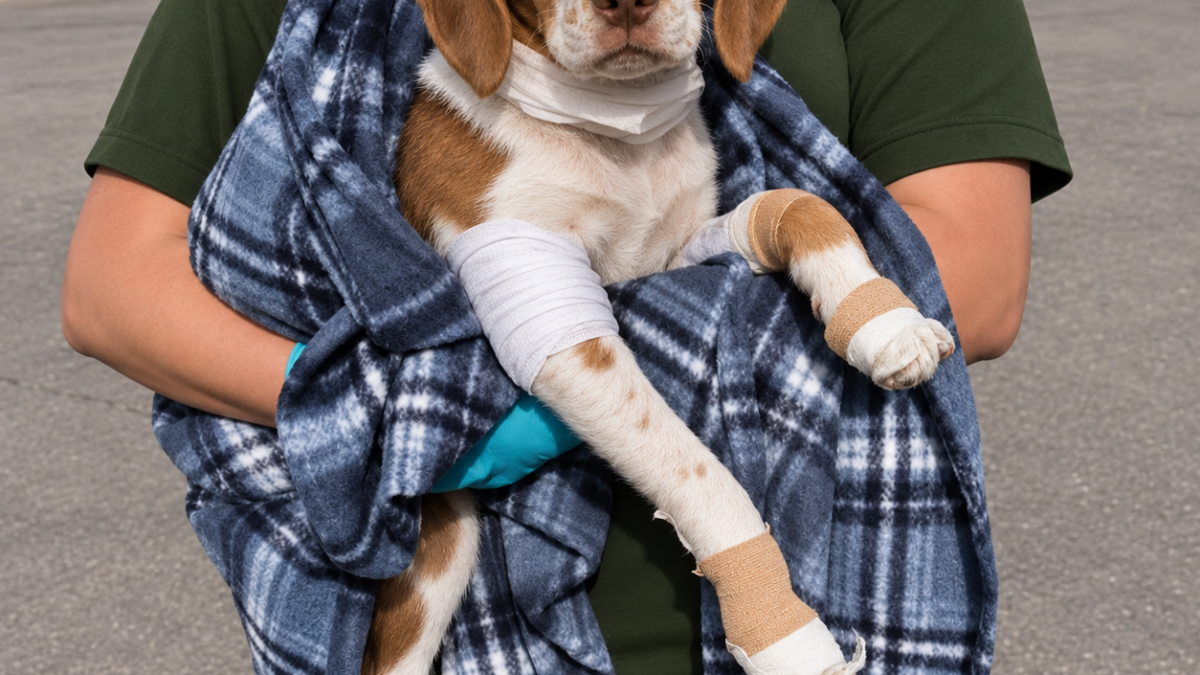
Roy had already survived the fire, but by the time I saw his face, surviving the next twenty-four hours depended on people he’d never met.
His name was sitting on a shelter euthanasia list while raw burns crossed his face, his paws, and much of his body.
And when I looked into his eyes, I had the terrible feeling that the worst part of his story had not happened yet.
I had seen injured dogs before.
You cannot spend much time in rescue without learning how many different kinds of pain an animal can carry into a shelter. Broken legs. Infections. Starvation. Old scars. Fresh wounds. Fear so deep that a dog will press himself into the back corner of a kennel and tremble when someone reaches for him.
But Roy was different.
The first photograph I saw of him stopped me cold.
His face looked swollen and painfully raw. Sections of his skin were burned. The fur that should have covered parts of his head and body was gone, leaving angry patches of damaged tissue behind. His paws were injured too, and even through a phone screen I could tell he was exhausted.
Not aggressive.
Not wild.
Just exhausted.
The message underneath the photograph was short.
House fire.
Owner surrender.
Medical needs beyond what the shelter could provide.
Euthanasia list.
I read those words twice.
Then a third time.
The last two words seemed impossible when placed beside the image of that dog.
He had survived a burning house.
Somehow, while smoke filled the rooms and heat tore through everything familiar, Roy had made it out alive.
And now, after escaping the fire, he might die in a shelter because saving him would require more medical care, more time, and more money than anyone around him had available.
I called the shelter immediately.
“Is Roy still there?”
There was a pause on the other end.
“Yes.”
My hand tightened around the phone.
“How much time does he have?”
Another pause.
That silence told me more than the answer ever could.
“Not much.”
I stood in the middle of my kitchen, staring at nothing.
There are moments in rescue when you have time to plan.
You can arrange transportation, call multiple hospitals, collect donations, find a foster home, compare treatment options, and make careful decisions.
This was not one of those moments.
This was a door closing.
And if we did not get through it quickly enough, it would close on Roy forever.
“What do you need from us?” I asked.
The shelter worker exhaled.
“He needs to leave.”
That was it.
Not tomorrow.
Not when everything was perfectly arranged.
He needed to leave.
I began making calls.
A veterinary hospital had to be found that was capable of managing serious burns. Someone had to commit to transporting him. We needed people willing to take responsibility for a dog whose medical future was uncertain. Even if he survived the next few days, no one could promise what complications might come afterward.
Burn wounds are not simple injuries.
They change.
Damaged tissue can worsen before it improves. Infection can appear. Pain can become difficult to manage. Fluids can become necessary. Bandages must be changed. Skin has to be monitored closely. A dog who seems stable in the morning can look very different by night.
And Roy had already been through enough.
His family had brought him to the shelter after realizing they could not provide the level of care he needed.
I tried not to judge them.
It would have been easy to.
It is always easy when you are looking at someone else’s crisis from the outside.
But whatever had happened before Roy entered that building no longer changed the question in front of us.
He was there.
He was hurt.
And he was running out of time.
By the time transportation was confirmed, I felt as though I had been holding my breath for hours.
Then came the message I had been waiting for.
We have him.
I read it once.
Then again.
Roy was out.
He was no longer just a photograph on a list.
He was ours to fight for.
But when he arrived at the hospital and I saw him in person for the first time, the relief I had been feeling disappeared almost instantly.
The photographs had not shown how tired he really was.
Roy stood quietly while the veterinary team examined him. He did not bark. He did not resist. He did not seem interested in anyone around him.
He simply endured.
And as I watched the staff begin assessing the burns covering his battered body, one thought kept repeating in my head.
Getting Roy out of the shelter had only been the first rescue.
Now we had to find out whether we had reached him in time.
— END OF FACEBOOK OPENING —
The veterinarian stepped away from the examination table and pulled off her gloves.
I searched her face before she said anything.
People who work around sick animals become very good at controlling their expressions. They have to. Owners and rescuers watch every movement, every pause, every breath, looking for clues about whether the news will be good or terrible.
“How bad is it?” I asked.
She glanced back at Roy.
“He’s badly burned,” she said carefully. “But I don’t think this is hopeless.”
Those words landed harder than I expected.
Not hopeless.
I had not realized until that moment how badly I needed someone to say them.
“What does he need?”
“Everything we can give him right now.”
Roy was admitted for intensive care.
His burns needed daily treatment. His pain had to be controlled. His hydration needed to be monitored. His wounds had to be protected while damaged skin began the slow process of repairing itself.
There was no single procedure that would magically fix him.
There was no surgery after which we could say the worst was over.
Healing from burns happens one miserable inch at a time.
The veterinary team cleaned his wounds carefully.
Even with medication, there were moments when Roy tensed.
His body would stiffen.
His eyes would narrow.
Sometimes his breathing changed.
But he never snapped at anyone.
That almost made it harder to watch.
I would have understood anger.
I would have understood growling, biting, fighting every hand that came close.
Instead, Roy seemed to have reached a place beyond resistance.
He allowed people to help him because he had no energy left to do anything else.
The first night, I went home and kept my phone beside me.
I checked it constantly.
Every vibration made my stomach tighten.
At midnight, I looked at Roy’s photograph again.
There was something about his eyes that bothered me.
They did not look defeated exactly.
But they did not look hopeful either.
They looked like the eyes of an animal waiting to see what the world planned to do to him next.
I wondered about the fire.
I wondered what he had heard.
What he had smelled.
Dogs understand danger differently than we do, but they understand it.
He would have smelled smoke long before the flames reached him.
He would have heard people shouting.
Maybe glass breaking.
Maybe alarms.
Maybe walls cracking from heat.
Maybe the panicked voices of the people he trusted most.
And then, somehow, he had survived all of that only to find himself in a shelter kennel with his skin burning from injuries he could not understand.
There was no way to explain any of it to him.
No way to tell him that the people leaning over him now were different.
No way to say, You are safe.
Dogs do not understand promises.
They understand repetition.
The same gentle hand.
The same bowl of food.
The same voice.
The same person returning the next morning.
Safety has to be proven.
So that was what we started doing.
The next day, Roy received another bandage change.
Then another.
The veterinary staff photographed the burns so they could compare them over time.
At first, progress was difficult to see.
When an animal is badly injured, you desperately want dramatic improvement.
You want the swelling to disappear overnight.
You want damaged skin to suddenly turn healthy.
You want him to stand up, wag his tail, and eat an entire bowl of food as if nothing happened.
Real recovery rarely works that way.
Sometimes progress is a wound looking slightly less angry than it did yesterday.
Sometimes it is a temperature remaining normal.
Sometimes it is a dog sleeping for twenty minutes without shifting because something hurts.
Sometimes it is simply making it through another night.
On the third day, I visited him.
“Hey, Roy.”
His eyes moved toward me.
That was all.
I sat beside him rather than reaching for him immediately.
“You don’t have to do anything,” I told him. “You can just rest.”
I knew he could not understand the sentence.
But maybe he understood the tone.
After a while, I slowly placed my hand near the side of his head where the skin was not injured.
Roy did not move away.
I rubbed him gently.
For a moment his eyes closed.
That tiny response nearly broke me.
People sometimes imagine rescue as a series of dramatic moments.
A dog is pulled from danger.
Everyone cheers.
The animal somehow knows he has been saved.
Then comes the happy ending.
But most of rescue is quieter than that.
It is sitting on a hospital floor next to a dog who does not know you.
It is changing dirty blankets.
It is checking a medical chart.
It is asking whether he ate.
It is learning how much pain medication he received.
It is going home knowing that while you sleep, someone else will sit beside him if something goes wrong.
And it is waking the next morning afraid to check your phone.
By day four, Roy still had not given us the moment we were waiting for.
He needed nutrition.
His body was using enormous amounts of energy trying to heal.
But trauma can destroy appetite.
Pain can destroy appetite.
Stress can destroy appetite.
And a dog cannot recover forever without eating.
One of the veterinary technicians tried offering him food from her hand.
Roy sniffed it.
Then turned his head.
She tried something else.
No.
Another food.
No.
“Come on, buddy,” she whispered. “Help us out.”
He closed his eyes.
The concern began creeping into conversations.
Not panic.
Not yet.
But concern.
The veterinarian explained that they would continue supporting him medically, but everyone wanted to see him begin participating in his own recovery.
That is how she described it.
Participating.
I thought about that word all night.
We had gotten Roy out.
Doctors could treat him.
Medication could control his pain.
Fluids could support him.
Bandages could protect his skin.
But somewhere inside that burned body, Roy had to decide to keep going too.
I hated thinking of it that way because it made survival sound like a choice.
It is not.
Animals do not die because they fail to “fight hard enough.”
Bodies fail.
Injuries overwhelm.
Infections spread.
There is no shame in losing a battle biology has made impossible.
Still, when you love an injured animal, you find yourself begging for some sign that his body has not surrendered.
On the fifth morning, I received new photographs.
His burns looked different.
Not healed.
But better.
The swelling had reduced.
Some of the damaged areas were beginning to look cleaner.
The veterinary team was cautiously encouraged.
Six days after Roy entered the hospital, the veterinarian called me.
“I think you’re going to like today’s update.”
I sat down.
“What happened?”
“His burns are improving.”
I covered my mouth.
She continued talking about tissue health, bandage care, medications, and the plan for the next several days.
I listened to every word.
But one sentence kept repeating in my mind.
His burns are improving.
For nearly a week, everything had been measured by fear.
Would he survive the night?
Would infection develop?
Would the damaged skin worsen?
Would his body tolerate treatment?
Now, for the first time, the direction seemed to be changing.
Not toward safety.
We were not there yet.
But toward hope.
Then came the moment none of us were expecting.
Roy ate.
Not because someone forced him.
Not through medical support.
He ate on his own.
A technician put food in front of him and stepped back.
Roy sniffed the bowl.
For a few seconds, nothing happened.
Then he lowered his head.
One bite.
The technician froze.
Roy took another.
She grabbed her phone and recorded a short video.
By the time I received it, I already knew something had happened because the message began with capital letters.
HE’S EATING.
I opened the video.
There was Roy.
Bandaged.
Burned.
Tired.
Eating.
I watched it three times.
Then I cried.
Not because eating was miraculous.
Healthy dogs eat every day.
They inhale breakfast.
They beg at dinner.
They steal food from counters and stare at you as though they have not eaten in weeks even when you watched them finish a meal ten minutes earlier.
Eating is ordinary.
That is what made it so beautiful.
Roy was beginning to do something ordinary.
For the first time since I met him, I could imagine him becoming a regular dog instead of a medical emergency.
The next days were not perfect.
Recovery does not become a straight line simply because something good happens.
Some mornings he seemed brighter.
Other mornings he was exhausted.
Sometimes a wound looked wonderful during a bandage change.
Another area would suddenly cause concern.
But Roy kept eating.
Then he began requiring less support.
Eventually came another milestone.
He could come off his IV fluids.
The line that had followed him through those first frightening days was no longer necessary.
“He’s getting stronger,” the veterinarian said.
I smiled.
“Can I say we’re out of the woods?”
She gave me the look medical professionals give people who are trying to tempt fate.
“Let’s say we can finally see the edge of the woods.”
I accepted that.
The next challenge was deciding where Roy would go when he no longer required hospitalization.
He could not simply be placed anywhere.
He needed a foster home where someone could monitor his wounds.
Someone patient.
Someone comfortable with medication and bandages.
Someone willing to bring him back for follow-up appointments.
Someone who understood that a dog leaving the hospital is not always the same as a dog being healthy.
We found that person.
When Roy left the hospital, I expected celebration.
Instead, I felt nervous.
The hospital had become a strange kind of safety net.
There were doctors.
Technicians.
Medical equipment.
People checking him around the clock.
Now Roy was entering a house.
A normal house.
With furniture.
Other animals.
Everyday noises.
A refrigerator opening.
A television.
Dogs walking through rooms.
Cats appearing on furniture as though they had materialized from another dimension.
For Roy, ordinary life was going to be another form of rehabilitation.
When he first entered the foster home, he moved cautiously.
His body was still healing, and his bandages made some movements awkward.
The resident dogs noticed him immediately.
Roy noticed them too.
For a few seconds everyone stared.
I held my breath.
One of the dogs approached slowly.
Roy sniffed.
The other dog sniffed back.
Nothing dramatic happened.
No fight.
No panic.
Just two dogs introducing themselves.
A cat watched from a safe distance with the suspicious expression cats reserve for almost everything.
Roy looked at the cat.
The cat looked at Roy.
Roy decided the couch was more interesting.
That was another victory.
Curiosity.
It had been missing from him at the hospital.
Now his eyes followed movement.
His nose worked.
He wanted to understand his surroundings.
His foster caregiver sat beside him.
“You’re home for now, buddy.”
Roy rested his head down.
That first night, he slept deeply.
No shelter noise.
No medical machines.
No constant footsteps from hospital staff.
Just a soft place to lie down.
When his foster sent me a picture of him sleeping, I stared at it for a long time.
His body was still covered in evidence of what had happened.
Bandages.
Healing skin.
Missing patches of fur.
But for the first time he did not look like he was waiting for something terrible.
He just looked tired.
There is a difference.
Fear keeps the body ready.
Even exhausted animals remain tense.
Their paws stay tucked under them.
Their ears react to every sound.
Their eyes open the second someone shifts nearby.
Roy began learning that he did not have to do that anymore.
He slept.
Then he woke.
And the same people were still there.
He ate.
And no one took the food away.
Someone touched him.
And the touch did not hurt.
Then he slept again.
Day after day, the evidence accumulated.
This place was safe.
His paw bandages eventually came off.
That was one of the changes that surprised me emotionally.
Bandages had become so much a part of the way Roy looked that seeing his paws uncovered made him seem suddenly different.
Closer to normal.
He tested them carefully.
One step.
Then another.
His foster watched.
“What do you think?”
Roy walked toward her.
She laughed.
“I’ll take that as approval.”
The burns continued healing.
The hair began returning slowly in places.
His energy increased.
And so did his personality.
That is one of the best moments in rescue.
Not physical recovery.
Personality.
When an animal has been sick or terrified, you meet only the version of him that trauma allows you to see.
Then one day something changes.
A toy interests him.
He steals someone’s spot on the couch.
He demands another head rub.
He discovers that the sound of a refrigerator door might mean food.
The real dog begins stepping forward.
Roy liked affection.
That became clear quickly.
Once he learned that hands were safe, he wanted head rubs.
If his foster stopped too soon, Roy would shift toward her.
A little closer.
Then closer again.
Sometimes he pressed his head under her hand.
“You’re subtle,” she told him.
Roy had no interest in subtlety.
He had spent enough time being deprived of comfort.
Now that he had discovered it, he intended to collect what he was owed.
He also discovered the couch.
At first he approached it carefully.
Then he learned that the couch had one purpose.
Naps.
Long naps.
Short naps.
Morning naps.
Afternoon naps.
Naps after meals.
Naps after receiving medication.
Naps after doing absolutely nothing that could reasonably make a dog tired.
His foster began sending pictures.
Roy asleep with his head hanging over the edge.
Roy asleep stretched across two cushions.
Roy asleep while another dog squeezed into the remaining space.
Roy asleep with the expression of a dog who had personally paid for the furniture.
Every picture felt like evidence.
The shelter photo had shown a dog waiting for death.
These pictures showed a dog learning how to live.
But healing brought a new problem.
Itching.
Anyone who has ever had a wound heal knows how maddening that stage can be.
For Roy, it was relentless.
His skin was repairing itself, and that meant areas that had once been painful became unbearably itchy.
He wanted the bandages off.
Immediately.
He became surprisingly skilled at trying to remove them.
His foster would turn around for seconds and discover Roy twisting his body into some impossible position, determined to reach an edge of gauze.
“Roy.”
He froze.
She stared.
He stared back.
“Don’t.”
His expression said he had no idea what she was talking about.
She looked away.
Roy resumed.
“Roy!”
He stopped again.
After several rounds of this game, everyone understood that we needed another solution.
That was how the pajamas appeared.
Not medical-looking clothing.
Not something dignified.
Duck pajamas.
Bright little ducks across the fabric.
When I first saw the photograph, I laughed harder than I had laughed in weeks.
Roy stood in the middle of the room wearing pajamas designed to stop him from interfering with his bandages, staring at the camera with an expression of profound betrayal.
His foster sent a message beneath the picture.
He is not impressed.
I replied immediately.
He looks incredible.
Roy disagreed.
For the first few minutes, he moved stiffly as though the pajamas had destroyed his ability to walk.
Then he realized he could still reach the couch.
Life became acceptable again.
The duck pajamas became part of his recovery.
There he was, this dog who had survived a house fire, escaped euthanasia, endured daily burn treatments, learned to eat again, and now marched through a foster home covered in cartoon ducks.
Something about that image captured his entire story.
Trauma had been dramatic.
Healing was often ridiculous.
And beautiful.
The foster home changed him.
His eyes softened.
His posture relaxed.
His appetite improved.
He became more engaged with the other animals.
He began greeting people.
Sometimes his entire body moved when he was happy.
Not just his tail.
His shoulders.
His hips.
His whole body.
The first time I saw him do it, I thought of the dog in the shelter photograph.
That Roy had looked almost motionless.
Contained by pain.
This dog could barely keep his body still when someone he liked walked into the room.
But the physical scars did not vanish overnight.
Weeks passed.
Then more weeks.
There were veterinary checkups.
Medication adjustments.
New photographs of healing skin.
Bandage changes.
Moments when progress seemed fast.
Moments when it seemed painfully slow.
Rescue has a strange relationship with time.
The emergency happens quickly.
The fire might last minutes.
The decision that places a dog on a shelter list might happen in one afternoon.
A rescue can sometimes be arranged in hours.
But healing does not care about urgency.
Healing follows biology.
Skin cells rebuild when they rebuild.
Fur grows at its own pace.
Trust returns one experience at a time.
You cannot rush it simply because everyone is tired.
Roy had already been through enough rushing.
So we waited.
And while we waited, he lived.
That distinction became increasingly important.
At first, every day had been about keeping Roy alive.
Then gradually, without any clear moment when it happened, his days became about life itself.
He had breakfast.
He followed someone into another room.
He rested beside the other dogs.
He watched the cat.
He received head scratches.
He wore ridiculous pajamas.
He slept on the couch.
He woke up and did it all again.
Eventually, his medical needs became smaller.
The conversations changed.
We no longer asked, “Will he survive?”
We asked, “When will he be ready?”
Ready.
That word frightened me almost as much as the early medical updates.
Because we all knew what it meant.
Adoption.
The goal of foster care is to say goodbye.
That is the cruel little contradiction at the center of rescue.
You bring an animal into a home because he needs safety.
You teach him routines.
You learn what food he likes.
You learn where he sleeps.
You learn the way he asks for attention.
You celebrate every change.
Then, if everything goes right, you send him away.
His foster knew that.
Still, when Roy’s profile was finally prepared for adoption, she stared at it longer than she expected.
The photographs no longer showed a burned dog in crisis.
They showed Roy.
His face had healed dramatically.
His body was stronger.
He looked comfortable.
Alive.
Present.
The description explained his history.
Not to define him by it.
But because his future family deserved to understand how far he had come.
Applications began arriving.
That created a different kind of anxiety.
Saving a dog is not finished when someone says, “I want him.”
Sometimes that is where another dangerous mistake can begin.
The right home matters.
Especially for an animal who has already lost so much.
We wanted people who saw Roy.
Not a rescue story.
Not a dramatic before-and-after photograph.
Not a dog they could use as evidence of how compassionate they were.
Roy needed a family who would still love him on boring Tuesdays.
A family who would care whether he liked his breakfast.
A family who would notice when he wanted a nap.
A family who would understand that his history mattered but did not have to become the center of every day for the rest of his life.
One application stood out.
Then came conversations.
Questions.
More questions.
Would they be comfortable with his medical history?
Yes.
Did they understand what he had survived?
Yes.
Were they prepared for follow-up needs if anything appeared later?
Yes.
But what mattered most to me was something simpler.
They seemed interested in who Roy was now.
They wanted to know what made him happy.
“Head rubs,” his foster said.
The answer came quickly.
“And couches.”
Everyone laughed.
“What about toys?”
“He’s learning.”
“Other animals?”
“He’s curious. He’s done well.”
“What scares him?”
His foster paused.
That question mattered.
Not, Is he perfect?
Not, Is he easy?
What scares him?
The kind of question someone asks when they are already thinking about how to make a dog comfortable.
The adoption process moved forward.
By then Roy had been in rescue for months.
One hundred days passed.
Then more.
People sometimes asked why he had not been adopted sooner.
I understood the question, but rescue does not operate according to a movie script.
There is no perfect day when the bandages come off and the ideal family immediately walks through the door.
Sometimes the dog is medically ready before the home is ready.
Sometimes the home is waiting before the dog is medically ready.
Sometimes everyone simply has to be patient.
Roy had survived because people refused to rush the first part of his story.
We were not going to rush the last part either.
On day 143, the waiting ended.
Roy was adopted.
One hundred forty-three days.
I thought about what that number contained.
It contained the shelter kennel.
The euthanasia list.
The drive to the hospital.
The first burn treatments.
The nights when no one knew whether his body would cooperate.
The day his wounds finally looked better.
The first bite of food he took on his own.
The moment the IV came out.
The foster home.
The cautious introduction to dogs and cats.
The head rubs.
The couch.
The healing skin.
The itching.
The bandages he repeatedly tried to remove.
The duck pajamas.
The appointments.
The photographs.
The applications.
The waiting.
One hundred forty-three days after a burned dog nearly died because there was nowhere else for him to go, Roy walked into a home that belonged to him.
His foster knelt beside him before he left.
This was the moment everyone claims to want.
Successful adoption.
A finished rescue.
A happy ending.
But happy endings can hurt.
She wrapped her arms around Roy carefully.
“You have no idea what you did to us,” she whispered.
Roy leaned against her.
Her voice broke.
“You were supposed to be temporary.”
He pushed his head against her hand.
She laughed through tears.
“Yeah, yeah. One more.”
She rubbed his head.
The new family waited without rushing her.
That mattered too.
Finally she stood.
Roy looked between everyone.
He did not understand the significance of the moment.
Dogs rarely do.
To him, this was simply another door.
Another car ride.
Another place.
Another group of humans asking him to trust them.
The first time Roy had been moved from one place to another after the fire, he had ended up in a shelter.
The next time, he went to a hospital.
Then a foster home.
Now he was being moved again.
I wanted desperately to explain that this time was different.
This door was not temporary.
These people were not preparing him for somewhere else.
This was somewhere else.
This was home.
His family gave him a new name.
BonBon.
At first, I thought I would struggle with it.
To me, he was Roy.
Roy was the name on the shelter photograph.
The name on the medical paperwork.
The name we spoke when begging him to eat.
The name written in messages at midnight.
Roy was the dog we had fought for.
But then I saw him respond to BonBon.
His head lifted.
His tail moved.
“BonBon!”
There went the tail again.
And suddenly I understood.
Roy belonged to the rescue story.
BonBon belonged to the life that came after it.
His family began sending updates.
The first ones were simple.
He slept well.
He ate breakfast.
He followed someone through the house.
He investigated a room.
He took another nap.
The most ordinary messages imaginable.
I loved every one.
Then came a video.
I opened it expecting to see him sleeping.
Instead, BonBon was standing in the middle of his home.
Someone called his name.
His entire body began to move.
Not just a wag.
A wiggle.
The kind of full-body happiness that starts in the shoulders and travels all the way to the tail.
I watched him bounce toward his family.
For several seconds I forgot about the burns.
The shelter.
The hospital.
Everything.
He was simply a happy dog greeting his people.
Then another video arrived.
BonBon had a puzzle toy.
He dropped his head toward it with complete concentration.
He pushed it with his nose.
Paused.
Studied it.
Tried again.
The dog who once barely had the energy to respond to people was now using his brain to figure out how to get treats from a plastic toy.
He became very serious about the problem.
His family laughed in the background.
BonBon ignored them.
This was important work.
He nudged one section.
Nothing.
He tried another.
A treat appeared.
His head shot up.
Then back down.
Now he understood.
I laughed watching him.
And then, without warning, I started crying.
Not sad tears.
Not exactly happy tears either.
Something more complicated.
Because I remembered the first photograph.
The face covered in burns.
The exhaustion.
The message.
Euthanasia list.
There are images that become permanently attached to an animal in your memory.
For a long time, that shelter photograph had been Roy for me.
Even after he improved, some part of my mind returned to it.
When I heard his name, I saw the burns.
When I thought of him, I remembered the fear of being too late.
But now another image was replacing it.
BonBon standing over a puzzle toy.
Thinking.
Wiggling.
Living.
That was the transformation people sometimes missed when they looked only at before-and-after photographs.
The transformation was not simply that his skin healed.
It was not that his fur returned.
It was not that bandages came off.
The real transformation was that pain stopped being the most important thing in his day.
Imagine that.
For a while, Roy’s entire existence had been shaped by pain.
Where he could lie down.
How he moved.
Whether someone touched him.
Whether his wounds needed to be cleaned.
Whether he would eat.
Whether he would live.
Now the most important question in BonBon’s afternoon might be how to get a treat out of a toy.
Or which part of the couch offered the best place to nap.
Or whether someone in the kitchen was opening something interesting.
That is what rescue is trying to create.
Not gratitude.
Animals do not owe us gratitude.
Not inspirational stories.
They do not exist to teach us lessons.
The goal is something much less dramatic and much more meaningful.
Ordinary life.
BonBon deserved to be bored.
He deserved to sleep through an afternoon.
He deserved to become mildly irritated when someone stopped petting him.
He deserved to spend ten minutes solving a toy.
He deserved meals so reliable that he never had to think about whether food was coming.
He deserved a home so safe that waking up there stopped feeling remarkable.
One evening, months after his adoption, I found myself looking through old photographs.
The first image appeared again.
Roy at the shelter.
I nearly scrolled past it.
Instead, I stopped.
I studied his face.
His burned skin.
His tired eyes.
I remembered the phone call.
“Is Roy still there?”
“Yes.”
“How much time does he have?”
“Not much.”
At the time, everything had felt enormous.
Urgent.
Terrifying.
We thought we were saving a dog from one terrible ending.
We could not see all the small things waiting for him on the other side.
The couch.
The pajamas.
The other animals.
The head rubs.
The family.
The new name.
The puzzle toy.
The full-body wiggle.
That is the strange thing about saving a life.
In the moment, you are fighting for years you cannot see.
You are fighting for mornings that have not happened yet.
For meals that have not been served.
For naps that have not been taken.
For people the animal has not met.
For toys that have not been bought.
For a name no one has chosen.
You are fighting for thousands of ordinary moments that do not exist yet.
When we pulled Roy from the shelter, none of us knew whether he would ever have those moments.
We only knew that if he died there, he definitely would not.
That was enough.
People sometimes asked me whether Roy remembered the fire.
I never knew how to answer.
Maybe certain smells stayed with him.
Maybe sudden noises bothered him.
Maybe there were moments when his body remembered something his mind could not explain.
Animals can carry trauma.
But they can also build new associations.
A hand that once meant pain can eventually mean affection.
A car ride that once led somewhere frightening can later end at a park.
A closed door can stop meaning abandonment and start meaning you are safely inside your home.
A name can change.
A life can change.
Not instantly.
Not magically.
But gradually enough that one day you look at the animal in front of you and realize the past is no longer controlling every moment.
That happened to BonBon.
The burns became scars.
The scars became history.
History became something his family knew about him rather than something he was forced to live inside.
And I think that was the ending I had wanted for him from the beginning, even when I did not yet have words for it.
Not revenge.
Not some dramatic punishment for everyone who had failed him.
When you see a dog suffering, anger comes easily.
You want someone to blame.
The fire.
The circumstances.
The system.
The fact that a badly injured dog could survive one disaster only to land on a list where his life might end because there was not enough money, space, or medical capacity to help him.
There were moments when that anger burned hot.
But BonBon did not need revenge.
He needed a future.
And in the end, getting that future was more powerful than anything anger could have given him.
He survived.
That alone would have been remarkable.
But survival was only the beginning.
He learned that people could touch him without hurting him.
He learned that food would come again tomorrow.
He learned the couch belonged to him if he claimed enough of it.
He learned that cats could be tolerated.
He learned that other dogs could become part of the scenery of home.
He learned that pajamas covered in ducks were apparently a humiliation humans expected him to endure.
He learned that toys sometimes contained food.
He learned his new name.
Most importantly, he learned that when his family left the room, they came back.
That lesson might have taken longer than any wound to heal.
The last video I watched of him that night was the puzzle toy again.
BonBon’s body wiggled when someone spoke.
Then he lowered his head.
He pushed one part of the toy.
Nothing.
He changed his angle.
Tried again.
A treat dropped free.
He ate it and immediately returned to the puzzle.
No hospital staff.
No IV.
No bandages.
No shelter kennel.
No clock counting down.
Just BonBon.
Busy.
Safe.
Home.
I froze the video for a second and looked at his face.
There were still signs of the past if you knew where to look.
Healing does not erase history.
But history was no longer the first thing I saw.
I saw concentration.
Curiosity.
Comfort.
I saw a dog who expected tomorrow.
That might be the most beautiful change of all.
When I first met Roy, his whole world seemed to have narrowed into surviving one more hour.
One more treatment.
One more night.
One more bandage change.
One more breath.
Now BonBon made plans, in the small way dogs do.
He expected breakfast.
He expected affection.
He expected his family to come home.
He expected toys to contain treats.
He expected the couch to still be there when he wanted a nap.
He expected another day.
There was a time when none of us knew whether he would have one.
And sometimes I think back to the exact moment someone at that shelter told me he was still alive.
The entire story balanced on that answer.
“Yes.”
He was still there.
Still breathing.
Still reachable.
Not safe.
Not healed.
But alive.
That was enough for people to move.
One person made a call.
Another arranged transportation.
Veterinary staff opened a treatment room.
A foster opened a home.
People covered bills.
People cleaned wounds.
People changed bandages.
People offered food.
People stayed awake.
People waited.
And eventually a family opened the final door.
One life required many hands.
But none of those people got the greatest reward.
BonBon did.
He got a life.
Not a perfect life.
Not a life untouched by pain.
Something better.
A real one.
A life that continued after the dramatic part ended.
A life where no one needed to photograph every day because nothing frightening was happening.
A life where the most exciting event might be a new toy.
A life where a nap was just a nap.
A life where his body could wiggle because the person walking toward him belonged to him.
One hundred forty-three days after we pulled Roy into rescue, his story did not end.
It finally became ordinary.
And after everything he had survived, ordinary was the happiest ending I could have imagined.
Roy survived the fire.
BonBon got the life that came afterward.
And this time, nobody was counting down how much time he had left.
They were simply counting on him being there tomorrow.








