PART 2: When Karen Had My “Junk” Trailer Towed, the Railroad Police Asked Who Gave the Order
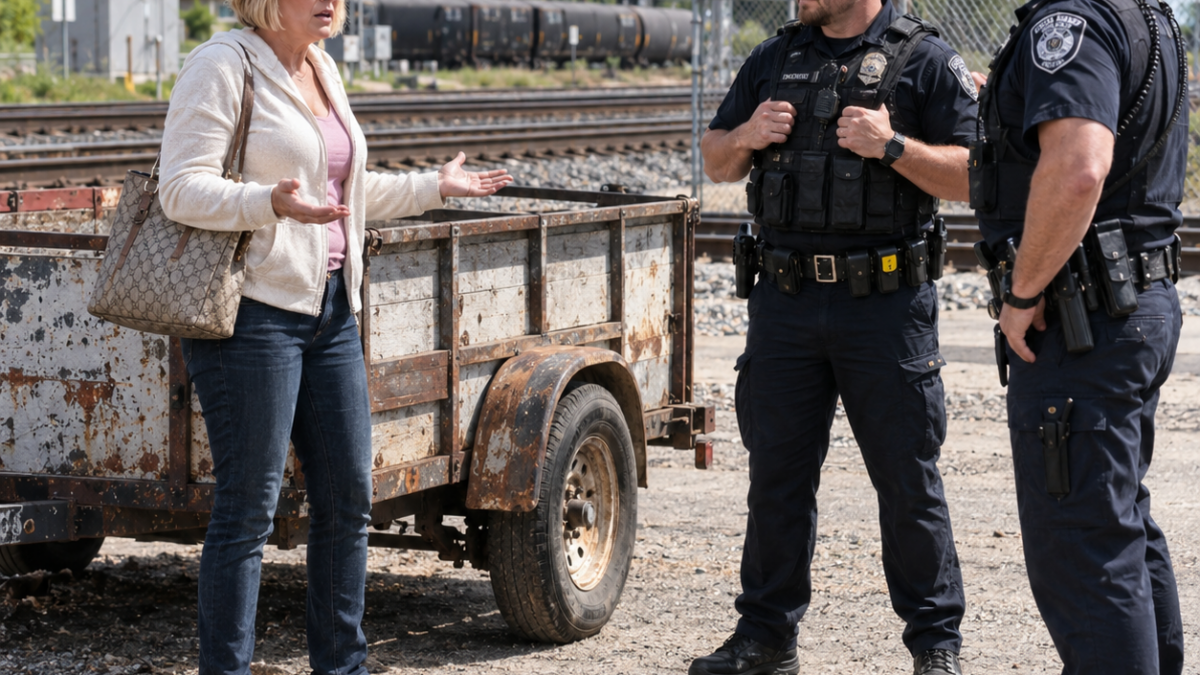
The morning Karen Peterson ordered a tow truck onto the railroad spur behind my workshop, I warned her twice that the ugly little trailer she called “junk” was sitting on property her HOA did not control—and that removing it could turn her neighborhood violation into a criminal investigation.
She smiled, told the driver to hook it anyway, and stood beside her golf cart while seventy-eight thousand dollars’ worth of railroad diagnostic equipment was dragged across the rails hard enough to carve twin scars through the ballast.
What Karen did not know was that I had the recorded easement, the equipment custody agreement, her tow authorization on video, and one phone number I had deliberately saved until she gave me a reason to use it.
“Hook it from the front,” Karen shouted.
The tow driver looked at me.
He was young, maybe twenty-five, with a reflective vest hanging open over a gray work shirt. His hands stayed on the controls, but he wasn’t moving.
“Sir,” he said quietly, “is this yours?”
“I’m responsible for it.”
Karen snapped around.
“He is responsible for an eyesore. I am responsible for this community.”
I wiped grease from my hands and walked closer.
My name is Daniel Mercer. I spent twenty years in military logistics before retiring to Whispering Pines, where I bought five acres at the far edge of the development and converted an old block workshop into the place I intended to spend the quiet half of my life restoring machinery.
The property had one unusual feature.
An abandoned-looking railroad spur crossed its back corner.
The track hadn’t carried a freight car in years, but it wasn’t abandoned legally. Midland & Northern Railway still held a recorded easement over the corridor and retained its rails, ties, ballast, and access rights.
More importantly, the HOA declaration specifically excluded that corridor.
I knew because my attorney had checked before I bought the land.
Karen apparently had not.
“That equipment is on the railroad easement,” I told her. “You don’t have authority to remove it.”
She gave me the smile she used whenever she thought someone beneath her was being difficult.
“I have authority over every property in Whispering Pines.”
“No, you don’t.”
Her face tightened.
For months, she had been looking for reasons to punish me.
My workshop was too industrial.
My fence was supposedly the wrong white.
My lawn was somehow simultaneously too tall near the woods and too sparse beside the driveway.
I answered every notice with photographs, measurements, and copies of her own rules.
That seemed to offend her more than simply ignoring them.
Now she pointed toward the trailer.
“Article Seven prohibits visible commercial equipment.”
“That isn’t commercial equipment stored on my lot.”
“It’s visible.”
“That doesn’t make it yours.”
The tow driver cleared his throat.
“Ma’am, maybe I should call my dispatcher.”
Karen stepped toward him.
“And maybe I should call your employer and explain why Whispering Pines needs another towing contractor.”
That did it.
His shoulders dropped.
He lowered the hook.
I took out my phone.
Karen noticed.
“Oh, please record this,” she said. “I’d love evidence showing how many chances we gave you.”
So I did.
I recorded her ordering the tow.
I recorded the driver asking whether she was authorized.
I recorded Karen saying, clearly, “I am the HOA president and property authority for this community.”
Then I recorded the trailer coming off the track.
Metal screamed against metal.
The specialized rail wheels hit gravel.
One chain slipped, snapped tight again, and twisted the trailer sideways before the driver corrected it.
I almost stopped him.
Almost.
Then I remembered the months of certified letters sitting in my filing cabinet.
I remembered Karen telling me she could place a lien on my home if I “kept challenging board authority.”
And I let the camera run.
When the truck finally disappeared down Oak Ridge Lane, Karen followed in her golf cart without looking back.
At 9:18 that morning, I opened my property file.
At 9:31, I pulled the railroad custody agreement.
At 9:44, I copied the trailer’s serial number.
Then I dialed Midland & Northern Railway’s police communications center.
A dispatcher answered.
“Railroad Police.”
“My name is Daniel Mercer,” I said. “I need to report railroad equipment removed without authorization from a recorded rail corridor.”
The dispatcher began typing.
“What kind of equipment?”
“A mobile wheel-profile calibration unit.”
“Value?”
“Approximately seventy-eight thousand dollars.”
The typing stopped.
There was silence for perhaps two seconds.
Then the dispatcher asked me one question in a completely different tone.
“Mr. Mercer… who authorized its removal?”
PART 2
“The president of my homeowners association.”
Another silence.
This one lasted longer.
“Your homeowners association removed railroad equipment?”
“They hired a tow company. I have video.”
“What company?”
“Barton Recovery and Towing.”
“Do you know where they took the unit?”
“Yes.”
The dispatcher’s voice became clipped and procedural.
“Do not go to the tow yard. Do not attempt recovery yourself. I’m transferring you to Special Agent Evan Miller.”
While I waited, I looked through the open workshop door at the two fresh scars cutting across the gravel beside the rails.
For months, Karen and I had been fighting with paper.
Violation notices.
Certified letters.
Appeals.
Photographs.
Meeting minutes.
That morning was the first time she had physically taken something.
I understood enough about investigations to know that distinction mattered.
A deeper voice came onto the line.
“Mr. Mercer?”
“Yes.”
“This is Miller, Midland & Northern Railway Police. Start from the beginning, and don’t leave anything out.”
So I did.
I told him how I had purchased the property eighteen months earlier.
I told him about the railroad easement.
I explained that I restored heavy mechanical equipment and occasionally fabricated transport components for a regional railroad preservation program.
The calibration trailer had been delivered two weeks earlier under a temporary custody agreement while I rebuilt a damaged mounting cradle. Midland & Northern still owned the instrumentation bolted inside it.
I wasn’t a railroad employee.
I wasn’t pretending to be one.
I simply had lawful custody of equipment that belonged to them.
“Do you have that agreement?” Miller asked.
“Yes.”
“Send it.”
I emailed it.
He asked for the deed exhibit showing the railroad corridor.
I sent that too.
Then he asked for my video.
The file was too large for ordinary email, so he sent me an upload link.
I watched the progress bar crawl across my screen.
When it finished, Miller said, “Give me a few minutes.”
I expected him to hang up.
Instead I heard keyboard clicks.
Then my own voice played faintly through his speakers.
That equipment is on the railroad easement. You don’t have authority to remove it.
Karen’s voice followed.
I have authority over every property in Whispering Pines.
Then the driver.
Ma’am, maybe I should call my dispatcher.
Then Karen’s threat about replacing the towing contractor.
Miller stopped the video.
“Did she sign anything?”
“I don’t know.”
“That’s what I’m going to find out.”
He took the tow company’s address and Karen’s full name.
Then he surprised me.
“Mr. Mercer, why did you wait until after they took it to call?”
It was a fair question.
I stared at the empty stretch of track.
“Because until this morning, she was an HOA president sending me stupid letters. I didn’t want to involve your department in a neighborhood argument.”
“That’s not what I asked.”
He was good.
I leaned back.
“Because I knew she didn’t have authority, and I warned her. Once she ordered it removed anyway, I wanted a clean record of what she had done.”
“So you let her make the mistake.”
“I didn’t tell her to do it.”
“No,” he said. “You certainly didn’t.”
I couldn’t tell whether he approved.
“That trailer may have been damaged,” I said.
“That’s our first concern.”
His tone hardened.
“Second concern is how a private towing company came to believe it had permission to enter a railroad corridor and take our equipment.”
“They believed Karen.”
“We’ll see what they believed.”
Before hanging up, Miller gave me a case number.
“Keep every document.”
“I already do.”
He laughed once.
Not warmly.
More like a man who had suddenly discovered his witness was going to be unusually convenient.
“Good. I’ll call you.”
I wrote the case number on the first page of a yellow legal pad.
Then I opened the steel filing cabinet beside my desk.
Inside were four months of Karen Peterson.
It had started almost innocently.
One month after I moved in, she drove her golf cart across my front lawn while I was trimming brush near the driveway.
She stopped twenty feet from me and held up a spiral-bound book.
“Daniel Mercer?”
“That’s me.”
“I’m Karen Peterson. HOA president.”
She looked past me toward the workshop.
Not at me.
At the workshop.
It was a concrete-block building constructed decades before Whispering Pines existed. I had repaired the roof, replaced the doors, and painted the exterior.
It was cleaner than half the garages in the development.
Karen examined it like she had discovered an oil refinery beside a kindergarten.
She handed me the binder.
“Community rules.”
“I received them at closing.”
“These are the current rules.”
That sentence stayed with me.
Current rules.
I flipped through the binder that evening.
More than a hundred pages.
Some regulations were reasonable.
Trash cans screened from the street.
No abandoned vehicles.
Basic exterior maintenance.
Others looked as though someone had spent years inventing increasingly specific ways to supervise strangers.
Basketball hoops.
Holiday decorations.
Fence colors.
Shed roof pitches.
Flag dimensions.
Acceptable landscape borders.
Even a rule requiring ornamental structures above thirty inches to receive architectural approval.
I followed the rules that actually applied.
Karen still found violations.
First it was my workshop noise.
I bought a decibel meter.
Then it was my fence.
I produced the architectural approval issued to the previous owner.
Then it was grass near my rear property line.
I photographed it beside a ruler.
Every answer irritated her.
Karen didn’t want compliance.
She wanted submission.
I realized that during our third argument.
She had come to my door holding another notice.
“You seem to misunderstand how communities like this work,” she said.
“I understand perfectly.”
“Then stop challenging every violation.”
“If the violation is wrong, I’ll challenge it.”
“You’re creating unnecessary hostility.”
“You came to my house.”
She blinked.
Then she lowered her voice.
“You should think carefully about becoming known as a problem resident.”
That was the first time the conversation felt less like enforcement and more like a threat.
“What does that mean?”
Karen smiled.
“It means cooperation is cheaper.”
She walked away.
After that, I documented everything.
Twenty years in logistics had taught me something most people learn only after a disaster: memory is not evidence.
Dates are evidence.
Signatures are evidence.
Photographs are evidence.
Receipts are evidence.
A contemporaneous note written while an event is still fresh can become more valuable than the most passionate speech made six months later.
So I created a binder.
Karen gave me plenty to put inside it.
By the morning she towed the railroad trailer, my binder was nearly three inches thick.
I had copies of every notice.
Every appeal.
Every certified-mail receipt.
Every photograph.
And every response Karen had either ignored or rejected.
Two hours after speaking with Miller, my phone rang.
Unknown number.
“Daniel Mercer?”
“Yes.”
“This is Officer Miller.”
His voice sounded different.
Sharper.
“We located the trailer.”
My chair scraped the floor.
“Is it damaged?”
“We don’t know yet. Railway mechanical is sending somebody.”
“Where is it?”
“Barton Recovery.”
I exhaled.
“Good.”
“Not entirely.”
Something in his tone tightened my chest.
“What happened?”
“The tow yard had it logged as an HOA impound.”
I frowned.
“So?”
“They required the person ordering the tow to sign an authorization form.”
My fingers stopped moving over the legal pad.
“What did Karen sign?”
“We’re obtaining the original. I’ve seen a photograph.”
“And?”
“She identified herself as the authorized property manager for the railroad corridor.”
For several seconds I said nothing.
Miller continued.
“She also certified that the equipment was abandoned after notice.”
“That is false.”
“I know.”
“I told her on video it was railroad equipment.”
“I know that too.”
The room suddenly felt very quiet.
“She signed that after the driver questioned her?”
“We’re still establishing the timeline.”
Miller paused.
“Mr. Mercer, I need something else from you. Has your HOA sent you any written communication concerning that trailer?”
“Yes.”
“How much?”
“A lot.”
“Send all of it.”
I looked at the filing cabinet.
“How much time do you have?”
That earned an actual laugh.
“Send the important pieces first.”
I scanned the original trailer violation.
The photograph Karen had taken.
My written objection.
Her rejection.
The certified letter warning that the HOA lacked jurisdiction over the rail corridor.
Most important was the delivery receipt.
Karen Peterson had signed for it herself six days before the tow.
I uploaded everything.
Forty minutes later Miller called again.
“You notified her in writing.”
“Yes.”
“And she signed for it.”
“Yes.”
“You specifically told her the railroad retained legal rights over the corridor.”
“Page two.”
“I saw it.”
His voice became careful.
Investigators use that tone when they no longer want to tell a witness what they are thinking.
“We’re going to handle the equipment first. After that, this may expand.”
“What does expand mean?”
“It means don’t throw away your binder.”
“That wasn’t going to happen.”
“I suspected not.”
The next morning, two Midland & Northern mechanical technicians arrived at the tow yard before Barton Recovery opened to the public.
I wasn’t there.
Miller had told me not to be.
At 10:12 he called.
“The unit is coming back.”
“Damage?”
“Preliminary inspection shows impact to one wheel flange, possible misalignment at the sensor frame. We’ll know more after calibration.”
“How bad?”
“Could be nothing. Could be expensive.”
I closed my eyes.
The project itself mattered less than the fact that I had signed custody for the equipment.
That signature had meant something to me.
“I should have stopped them.”
“No.”
“I could have.”
“Maybe.”
Miller’s response surprised me.
“But then you’d have had a physical confrontation with a tow operator acting under paperwork he believed was valid. Nobody needed that.”
“I knew the paperwork wasn’t valid.”
“You’re not a court.”
Neither was Karen.
I didn’t say it.
I didn’t need to.
Miller continued.
“We interviewed the driver.”
“The young guy?”
“Eli Barrett.”
“Is he in trouble?”
“That depends on facts we’re still checking. But he told us he objected twice.”
I remembered the look he had given me.
Embarrassed.
Cornered.
“He did.”
“He also told his dispatcher he was uncomfortable. Dispatch told him the HOA president had signed the authorization and to proceed.”
That mattered.
It meant there was a recording.
Miller confirmed it.
“He didn’t like taking that trailer.”
“No.”
“He may end up being one of your better witnesses.”
After we hung up, I stood behind the workshop for a long time.
The empty track looked wrong.
I had imagined feeling victorious once the railroad got involved.
Instead I felt tired.
Because while Miller was recovering the trailer, Karen was doing something I hadn’t anticipated.
She was escalating.
Three days after the tow, I opened my mailbox and found another violation notice.
$500.
Improper storage of commercial equipment.
I laughed once when I saw it.
Then I turned the page.
There was another charge.
$250 for damage to “community landscape material” along the rear corridor.
The attached photograph showed the gouges left when Barton Recovery dragged the trailer off the track.
I read the paragraph twice.
Karen was fining me for damage caused by the tow she ordered.
That evening, I took the notice next door.
Arthur Henderson answered wearing an old Detroit Tigers sweatshirt with a coffee stain down the front.
He was sixty-eight, retired from an independent repair shop, and had lived in Whispering Pines since before half the houses existed.
I held up the notice.
“You ever seen anything like this?”
Arthur put on his reading glasses.
He read the first page.
Then the second.
Then he began laughing.
Not because it was funny.
Because sometimes absurdity leaves you with no other response.
“She fined you for the tow marks?”
“Yes.”
“That woman has finally gone insane.”
“I don’t think she’s insane.”
Arthur looked at me.
“I think she expects me to surrender.”
His smile disappeared.
“That’s different.”
We sat at his kitchen table.
His wife Martha was asleep upstairs. She had heart problems, and Arthur spoke more quietly whenever he mentioned Karen around her.
After a while, he said, “You know about my Mustang?”
“No.”
He stared into his coffee.
“Sixty-seven fastback. Candy-apple red. Bought it when I was twenty-one.”
He had restored the car twice.
Once when his children were small.
Again after retirement.
Three years earlier, Karen photographed it while Arthur’s garage door was open.
She claimed the red paint violated an exterior appearance rule because the vehicle was “regularly visible from the street.”
“That sounds ridiculous.”
“It was.”
“Why didn’t you fight it?”
“I did.”
Arthur looked toward the staircase.
“For about six months.”
Karen fined him repeatedly.
Then threatened a lien.
Martha’s cardiologist told them stress was affecting her blood pressure.
Arthur finally gave up.
He sold the car.
“I couldn’t enjoy it anymore,” he said. “Every time I looked at it, I saw another letter.”
That sentence changed something for me.
Until then, Karen had been my problem.
An irritating woman with too much time and not enough restraint.
Arthur made me understand that I was simply the newest name on a much older list.
“Did you keep the notices?”
Arthur looked at me over his glasses.
“All of them.”
The next afternoon he arrived at my workshop carrying a cardboard box.
The bottom sagged under the weight.
We spread the contents across my workbench.
Violation letters.
Appeals.
Photographs.
Certified mail.
Board responses.
Three years of pressure against one retired mechanic.
Some of Karen’s language was nearly identical to what she had used against me.
Failure to demonstrate cooperative intent.
Continuing disregard for community standards.
Escalating enforcement may include legal remedies against the property.
Arthur watched me arrange the documents by date.
“What are you doing?”
“Looking for a pattern.”
“You already found one.”
I shook my head.
“I found two people.”
That wasn’t enough.
Arthur understood.
“Who do you need?”
“Anyone else she’s done this to.”
His mouth tightened.
“How many?”
“As many as exist.”
Arthur stared at me.
Then he reached for his truck keys.
“I’m going for a drive.”
That was how the quiet part of the fight began.
Arthur knew Whispering Pines.
Not addresses.
People.
He knew who had divorced.
Who had lost a spouse.
Whose kid came home from college.
Who was barely making payments.
Who kept to themselves.
Most importantly, he knew who had stopped attending HOA meetings.
Within a week, four people came to my workshop.
David and Maria Garcia brought a folder about a cedar swing set they had been forced to remove because Karen claimed the architectural approval covered only pressure-treated pine.
Dr. Rachel Monroe brought notices concerning a temporary yard sign thanking emergency workers during the pandemic.
And Evelyn Gable arrived carrying a leather document case that looked older than Karen’s presidency.
Evelyn was seventy-four.
Her late husband, George, had helped develop Whispering Pines.
“I heard you’re collecting Karen’s greatest hits,” she said.
Arthur coughed to hide a laugh.
Evelyn placed the case on my workbench.
“I may have the first edition.”
Inside was a copy of the original Whispering Pines declaration and bylaws from 1985.
Ten pages.
Not a hundred.
David Garcia was a paralegal.
He placed Karen’s current spiral-bound rulebook beside Evelyn’s documents.
“These aren’t remotely the same thing.”
“We know,” Arthur said.
“No. I mean structurally.”
David started flipping pages.
“The original board has limited enforcement powers. Look here. Assessments, maintenance, common areas. Architectural controls require committee approval.”
He grabbed Karen’s book.
“This version gives the president authority to issue emergency enforcement decisions without a board vote.”
Evelyn frowned.
“That was never intended.”
David kept reading.
“Automatic late charges. Administrative fees. Inspection costs.”
He looked up.
“Where are the amendment records?”
Nobody answered.
“Major amendments should have votes somewhere. Meeting minutes. Member approvals. Depending on what the declaration requires, possibly recordings with the county.”
Evelyn’s expression hardened.
“My husband kept everything.”
“How much everything?”
“Thirty years of everything.”
Arthur grinned.
“I’m starting to like George.”
Evelyn did not smile.
“He would hate this.”
That evening, we began comparing documents.
We found rules that appeared in Karen’s book but not in the original declaration.
Some might have been validly adopted later.
Others looked suspicious.
What mattered immediately was simpler.
Karen repeatedly acted as though she alone could interpret, prosecute, and punish.
But even her own expanded rulebook referred to board review.
“Has anybody ever seen the board review anything?” I asked.
Rachel shook her head.
“Karen is the board.”
“She has two other directors.”
Rachel gave me a tired look.
“Have you met them?”
I had.
Linda Shore and Patricia Wells.
Neither spoke unless Karen looked at them first.
David leaned over the workbench.
“This is not a lawsuit yet.”
Arthur frowned.
“You said she ruined my car.”
“I said what she did looks abusive. Abuse and a winning lawsuit are different things.”
He tapped the documents.
“We need facts. Authority. Votes. Financial records. Consistency. Whether these fines were actually permitted.”
I liked David immediately.
He didn’t turn outrage into fantasy.
“What do we do?”
“First, request records.”
“Karen will refuse.”
“Then her refusal becomes a fact.”
I smiled.
David pointed at me.
“That. That expression right there is why she hates you.”
Over the next two weeks, Karen gave us facts.
Lots of them.
She denied David’s records request because he had “failed to identify a legitimate community purpose.”
She rejected my appeal concerning the trailer fine without a hearing.
She sent Arthur a warning for “unauthorized solicitation” after learning he had been speaking with neighbors.
Then she issued me three more violations.
One for oil stains that were actually water from my irrigation system.
One for excessive workshop noise during permitted daytime hours.
And one for a satellite dish installed years before I bought the property.
I answered every notice.
Not emotionally.
Not angrily.
I cited the relevant rule.
Attached photographs.
Requested the hearing procedure.
Asked for the board vote authorizing the fine.
Sent everything certified.
Karen stopped answering the questions.
Her letters got shorter.
Then more aggressive.
One Friday afternoon she appeared at my workshop.
She didn’t drive the golf cart this time.
She walked.
I was rebuilding a carburetor when her shadow crossed the bench.
“You’re encouraging people to challenge the association.”
I put down the screwdriver.
“I talk to my neighbors.”
“You’re organizing them.”
“Is that prohibited?”
“You know exactly what you’re doing.”
“So do you.”
She crossed her arms.
“Your fines are now over four thousand dollars.”
“According to you.”
“According to the association.”
“Show me the board votes.”
Her jaw moved.
“You don’t get to demand internal documents every time you dislike an enforcement decision.”
“I requested records through the procedure in your own bylaws.”
“You’re abusing that procedure.”
“By using it?”
Karen leaned toward me.
“You moved here eighteen months ago.”
“Yes.”
“I have lived here twenty-three years.”
“I know.”
“I kept this community desirable while people like you showed up wanting exceptions.”
“People like me?”
“People who think ownership means they can do whatever they want.”
That almost made me laugh.
“You had my equipment towed from land you don’t control.”
“You keep calling it your equipment.”
“Fine. Railroad equipment in my lawful custody.”
“It was an ugly trailer.”
“That isn’t a legal category.”
Her eyes narrowed.
Then she said something revealing.
“If I let you win this, every resident who doesn’t like a rule will think they can challenge me.”
There it was.
Not property values.
Not aesthetics.
Authority.
I wiped my hands on a shop towel.
“Karen, rules that survive only because nobody is allowed to question them aren’t strong rules.”
“You think you’re clever.”
“No.”
“You think that binder protects you.”
I glanced toward the filing cabinet.
She followed my eyes.
Then smiled.
“We can lien property, Daniel.”
The smile disappeared from my face.
“I know.”
“We can collect legal fees.”
“I know.”
“And ultimately, unpaid assessments and enforceable charges can put a homeowner in a very serious position.”
“Then you’d better be absolutely certain yours are enforceable.”
She stepped back.
For the first time, I saw uncertainty.
Only for a second.
Then she turned and walked away.
I called Miller as soon as her car left.
He answered on the fourth ring.
“What did she do now?”
“How did you know it was her?”
“Because every time your number appears, I learn a new thing about homeowners associations I wish I didn’t know.”
I told him about the lien threat.
“That part isn’t ours,” he said.
“I know.”
“But the towing investigation is moving.”
“How far?”
“Far enough that I can tell you Barton Recovery has counsel.”
My stomach tightened.
“That bad?”
“For them, maybe.”
He explained that the tow authorization Karen signed was more problematic than I realized.
She had not merely requested removal.
She had represented herself as having control over the location.
The tow company had relied on that representation.
Their dispatcher recording showed Eli Barrett asking whether someone had verified ownership.
A supervisor replied that Karen Peterson had used the HOA account for years and was “good for authorization.”
“So Barton believed her,” I said.
“Maybe.”
“Does that help them?”
“It helps Eli.”
The distinction was obvious.
“What about the owner?”
“He had procedures. Whether he followed them is another question.”
“And Karen?”
Miller went quiet.
“We’re talking to the county prosecutor.”
That was the first moment I understood this had moved beyond a property recovery.
“Are you saying she could be charged?”
“I’m saying we collect facts. Prosecutors decide charges.”
I waited.
Miller added, “You gave her written notice six days before the tow that the corridor was outside HOA control.”
“Yes.”
“She signed for it.”
“Yes.”
“She then signed a tow authorization claiming the opposite.”
“Yes.”
“That’s a fact I’d be uncomfortable explaining to a prosecutor.”
When the calibration trailer came back, I almost didn’t recognize it.
Not because it was destroyed.
Because Midland & Northern delivered it like evidence.
A railroad utility truck backed slowly along the access lane.
Two mechanical technicians walked beside it.
Miller followed in an unmarked SUV.
Eli Barrett—the tow driver—was not there.
The right-side flange was scraped.
One sensor bracket had been bent.
A yellow evidence tag hung from the hitch.
The senior technician, a woman named Denise Holloway, crouched beside the wheel assembly.
“Could’ve been worse.”
“How much worse?”
“If they’d chained across this housing, they would’ve crushed a transducer.”
“Cost?”
“Twelve grand before labor.”
I whistled.
Denise glanced at the rail.
“They dragged it sideways?”
“About six feet.”
She shook her head.
Miller stood behind us.
“Tow yard’s insurance company is going to enjoy that report.”
Karen appeared before Denise finished.
Of course she did.
Her golf cart stopped on the road.
She remained seated for several seconds, watching the railroad truck.
Then she drove onto my property.
Miller noticed.
“Friend?”
“No.”
Karen stopped twenty feet away.
She looked at Miller.
At Denise.
At the equipment.
Then at me.
“What is this?”
I said nothing.
Miller stepped forward.
“Ma’am, please keep clear while railway personnel inspect the equipment.”
“I’m the HOA president.”
Miller nodded.
“Congratulations.”
Karen actually blinked.
“This equipment was removed for violating community covenants.”
Miller took out a small notebook.
“Your name?”
She hesitated.
“Karen Peterson.”
He wrote it down even though he already knew exactly who she was.
That unsettled her.
“I already spoke with your office,” she said.
“No, ma’am.”
“With the railroad.”
“I don’t believe you did.”
“I called customer service.”
“That would be different.”
Karen looked at me.
“He’s manipulating you.”
Miller’s eyebrows rose slightly.
“How?”
“He deliberately parked that thing there because he knew it violated our rules.”
I spoke for the first time.
“It was delivered there because the rail bed was the correct level surface for the work.”
Karen ignored me.
“He has been antagonizing this association for months.”
Miller looked genuinely curious.
“Does the association own this track?”
“No, but—”
“Does it lease the corridor?”
“No.”
“Do you have a written agreement with Midland & Northern granting your association enforcement authority on the corridor?”
Karen’s voice sharpened.
“It crosses our neighborhood.”
“That wasn’t my question.”
For once, she had no immediate response.
Miller closed his notebook.
“We’ll be contacting you formally.”
Her face changed.
“What does that mean?”
“It means exactly what I said.”
“About what?”
“The removal of railway equipment.”
Karen pointed at the trailer.
“That was abandoned junk.”
Denise slowly stood up.
She was wearing coveralls with the Midland & Northern logo over her chest.
“This unit was in active service,” she said.
Karen looked at her.
“It looked abandoned.”
Denise brushed gravel from her gloves.
“That sensor array costs more than your golf cart.”
Miller coughed into his fist.
I looked away so Karen wouldn’t see my expression.
She left without another word.
Two days later, my outstanding HOA balance jumped to $7,850.
That was not a coincidence.
Attached to the statement was a notice demanding payment within ten days.
David read it at my workbench.
“She’s positioning for a lien.”
Arthur swore.
Evelyn went pale.
“You have to pay it,” she said.
“No.”
“Daniel, your house—”
“I’m not paying fraudulent fines.”
“Pay under protest,” she said. “Fight later.”
I understood why.
Evelyn had spent years watching people surrender because losing money was safer than risking property.
But if I paid nearly eight thousand dollars simply because Karen threatened me, every document on my table would mean less.
David tapped the statement.
“She may not have lawful authority to collect most of this.”
“May not?”
“I’m a paralegal, not your attorney.”
“What does your attorney say?”
David had already shown the file to a lawyer at his firm.
“She says we need an injunction immediately if they actually record a lien based on disputed penalties.”
“Then we prepare.”
Arthur stared at me.
“You are very calm for a man discussing somebody attaching eight grand of garbage to his house.”
“I’m not calm.”
That surprised them.
I sat down.
“My pension bought most of this place. I put almost everything I had left into the workshop.”
The room went quiet.
“I don’t have another house.”
Arthur’s expression softened.
For weeks I had acted like documents made me bulletproof.
They didn’t.
Karen could still make my life expensive.
Even when you are right, lawyers cost money.
Hearings cost time.
Banks dislike title problems.
Insurance companies ask questions.
Victory can arrive years after the damage.
That night, after everyone left, I sat alone in the workshop.
The calibration trailer was back on the track.
A new bracket gleamed where Denise had replaced the bent one.
On the bench sat my father’s old torque wrench.
He had given it to me before I joined the service.
He used to say that if you forced a bolt because you were angry, you deserved whatever broke.
Use the right pressure.
Know the limit.
Stop before damage becomes permanent.
I picked up the wrench.
Then my phone buzzed.
A message from David.
CHECK EMAIL.
The HOA had announced a special meeting.
One agenda item.
Review and authorization of legal collection remedies concerning 124 Oak Ridge Lane.
My address.
The meeting was scheduled for Thursday at seven.
Karen was finally going to do what she had been threatening.
She was going to try to put the authority of the HOA behind taking my property as collateral for fines she had largely created herself.
I forwarded the notice to my attorney.
Then to Miller.
Miller called five minutes later.
“You going?”
“Yes.”
“Good.”
His answer was too quick.
“Why?”
“Because we were going to need to speak with Mrs. Peterson anyway.”
“When?”
“Soon.”
“Miller.”
“Yes?”
“Are you coming to that meeting?”
A pause.
“I didn’t say that.”
“You also didn’t say no.”
“I’ll talk to you Thursday.”
He disconnected.
I stared at the phone.
For the first time since the tow, I smiled.
Not because I knew what would happen.
I didn’t.
But because Karen had unknowingly scheduled herself a public appointment with consequences.
Thursday evening, Whispering Pines residents began arriving at the clubhouse forty minutes early.
Karen had expected maybe twelve people.
She got sixty-three.
Arthur had spent the week talking quietly to neighbors.
David had circulated a lawful records petition.
Rachel contacted residents who had stopped attending meetings because they felt nothing could change.
Evelyn brought copies of the original bylaws.
Nobody carried signs.
Nobody shouted.
That would have helped Karen.
Instead people walked in holding folders.
Karen stood behind a folding table at the front of the room.
Linda Shore and Patricia Wells sat beside her.
Linda looked frightened.
Patricia looked angry.
Karen looked delighted.
Crowds did not intimidate her.
Crowds were audiences.
At seven precisely, she struck a small wooden gavel.
“The special meeting of the Whispering Pines Homeowners Association is now called to order.”
Arthur whispered beside me.
“She bought a gavel?”
“Apparently.”
“Of course she bought a gavel.”
Karen began with procedure.
Then community values.
Then property standards.
For twelve minutes, she described me without using my name.
One homeowner.
Repeated noncompliance.
Hostile conduct.
Deliberate refusal.
She called the railroad trailer “abandoned industrial machinery.”
She called my workshop “commercial activity.”
She called my records requests “harassment of volunteer board members.”
Then she displayed my balance.
$7,850.
A murmur moved through the room.
Karen lifted one hand.
“Please.”
Silence returned.
“This board has given the homeowner extraordinary latitude.”
Arthur nearly choked.
Karen continued.
“Unfortunately, noncompliance harms everyone. If rules become optional, property values suffer.”
She looked directly at me.
“Mr. Mercer, would you care to explain why you believe you are exempt from the same obligations as your neighbors?”
I stood.
“I don’t.”
Karen smiled.
“Then will you pay the outstanding balance tonight?”
“No.”
Her smile widened.
“Then I believe we have our answer.”
“I’d like three questions entered into the minutes.”
Patricia looked toward Karen.
Karen nodded.
“Briefly.”
“First, who approved the tow of the calibration trailer?”
“I did.”
“Personally?”
“Yes.”
“Second, did Barton Recovery ask you to sign an authorization?”
Something flickered across her face.
Tiny.
But I saw it.
“So?”
“That’s a yes?”
Karen leaned toward her microphone.
“I authorized removal of a covenant violation.”
“Did you identify yourself as having authority over the rail corridor?”
David stopped writing.
Linda turned toward Karen.
That reaction told me Linda had never seen the tow form.
Karen’s voice cooled.
“I don’t remember the exact language on a routine vendor form.”
I nodded.
“Third question. Before the tow, did you receive my certified letter stating that Midland & Northern Railway retained legal rights to that corridor?”
Karen’s fingers tightened around the gavel.
“You sent dozens of rambling letters.”
“It was three pages.”
“I receive enormous volumes of correspondence.”
“I have your signature on the delivery receipt.”
The room went still.
Karen’s cheeks reddened.
“You are attempting to turn an ordinary enforcement action into some kind of conspiracy.”
“No.”
I looked toward the back doors.
“I’m asking whether you knew the corridor wasn’t controlled by the HOA before you represented that it was.”
Karen slammed the gavel.
“That is enough.”
The clubhouse doors opened.
Nobody gasped dramatically.
There was no movie-style rush of uniforms.
Two men entered calmly.
The first wore a dark navy uniform with MIDLAND & NORTHERN RAILWAY POLICE on his shoulder.
Evan Miller.
Beside him walked another railroad special agent.
Behind them was a county sheriff’s investigator I had never met.
Karen stared.
Then she looked at me.
I sat down.
Miller remained near the door until Karen spoke.
“Can I help you?”
“Yes, ma’am.”
“This is a private association meeting.”
“I understand.”
“You can’t simply interrupt.”
The sheriff’s investigator stepped beside Miller.
“Mrs. Peterson?”
Karen’s face changed.
“Yes?”
“I’m Detective Alvarez with the county sheriff’s office.”
Linda pushed her chair backward.
The legs scraped loudly across the floor.
Patricia whispered, “Karen?”
Karen ignored her.
“What is this about?”
Alvarez walked toward the front.
“The Barton Recovery tow involving Midland & Northern equipment.”
“That has already been handled.”
Miller spoke.
“No, ma’am. The equipment was recovered. The investigation was not concluded.”
Whispers spread across the room.
Karen hit the gavel.
“Order.”
Nobody listened.
Alvarez waited until the noise settled.
Then he said, “Mrs. Peterson, would you come speak with us outside?”
Karen looked around.
At sixty-three residents.
At her two board members.
At me.
She understood what leaving the room would look like.
“No.”
Alvarez’s expression did not change.
“No?”
“If you have questions, ask them here.”
“Karen,” Linda whispered. “Maybe you should—”
“I said no.”
Miller glanced at Alvarez.
The detective reached inside his jacket.
For one absurd second, Karen smiled.
I think she believed he was taking out a business card.
Instead he produced a folded document.
“Karen Peterson, a county judge signed an arrest warrant this afternoon.”
The sound that came from the room was not one gasp.
It was dozens of little breaths.
Karen stared at the paper.
“For what?”
Alvarez’s answer was measured.
“Charges arising from the unauthorized taking of railway equipment and false representations used to obtain the tow. The exact charging language is in the warrant.”
“This is ridiculous.”
“Turn around, please.”
Karen gripped the edge of the table.
“I was enforcing HOA rules.”
Miller stepped closer.
“The railroad corridor is outside the HOA’s control.”
“No, it isn’t.”
“Yes, ma’am.”
“The track crosses this development.”
“That doesn’t transfer property rights.”
Karen pointed at me.
“He set me up.”
Miller followed her finger.
“Mr. Mercer warned you before the tow.”
“He wanted this.”
“He warned you on video.”
“He deliberately parked it there.”
“The railway authorized its placement.”
“He knew I would object.”
Miller’s voice became quiet.
“Mrs. Peterson, none of those statements gave you authority to sign a document saying you controlled railroad property.”
Karen opened her mouth.
Closed it.
Alvarez stepped beside her.
“Turn around.”
She looked at Linda.
“Do something.”
Linda’s face had gone white.
“I didn’t know you signed anything.”
“Linda.”
“You told us the tow company verified jurisdiction.”
Karen’s head snapped toward her.
“I told you it was handled.”
“That’s not what you said.”
Patricia began collecting her purse.
Karen’s world was shrinking by the second.
“Sit down,” she snapped.
Patricia froze.
Then something unexpected happened.
She shook her head.
“No.”
Karen stared at her.
Patricia stood.
“You told me legal approved it.”
“I said the management company approved it.”
“No, you said counsel did.”
“You’re confused.”
“No.”
Patricia’s voice trembled.
“I asked because Daniel kept sending those letters, and you told me to stop worrying because an attorney had checked the easement.”
Every face in the clubhouse turned toward Karen.
David whispered, “There it is.”
Karen looked at Alvarez.
“I want an attorney.”
“That is your right.”
He turned her around.
The handcuffs closed.
There was no cheering.
That mattered to me.
I had imagined this moment more than once.
I had imagined feeling vindicated.
Maybe even satisfied.
Instead I watched a sixty-one-year-old woman who had spent years building her identity around control discover that authority disappeared quickly when other people stopped agreeing to perform it for her.
She looked smaller.
Not innocent.
Not sympathetic.
Just human.
Terrified.
When Alvarez began walking her toward the doors, Karen turned her head toward me.
“You did this.”
I stood.
“No.”
She stopped.
Alvarez gently urged her forward.
“You did this,” I said. “I just kept the paperwork.”
Her face twisted.
Then she was gone.
Miller remained.
The room erupted into noise.
Linda was crying.
Patricia stood beside the wall, talking rapidly to David.
Arthur put one hand on my shoulder.
“Well,” he said.
I looked at him.
“That was considerably worse than painting a Mustang beige.”
He laughed so suddenly he had to sit down.
But the meeting was not over.
Karen’s arrest did not automatically invalidate fines.
It did not erase liens.
It did not rewrite bylaws.
And it certainly did not make everyone who had supported her innocent.
David understood that first.
He walked to the microphone.
“We still have an open meeting.”
Linda looked at him.
“I can’t run this.”
“You don’t have to.”
The room quieted.
David held up a petition.
“Twenty-nine percent of the membership has signed a demand for a special membership meeting to consider removal of the current board.”
Patricia stared at Karen’s empty chair.
Then at Linda.
“I resign.”
Linda began crying harder.
“I do too.”
A man near the back called, “Then who’s the board?”
Nobody answered.
Evelyn Gable stood slowly.
She was seventy-four, five-foot-three, and had spent most of the evening saying nothing.
When she reached the front, she placed the original 1985 bylaws on the table.
“My husband helped write these.”
People became quiet.
“He used to say an association should handle the things neighbors cannot reasonably handle alone.”
She looked toward the door Karen had disappeared through.
“Road maintenance. Shared property. Drainage. Insurance. Not the color of Arthur Henderson’s car.”
Arthur looked down.
“Not somebody’s garden ornaments.”
A few people smiled.
“Not whether a doctor puts a thank-you sign in her yard.”
Rachel’s eyes filled.
“And certainly not whether one woman is allowed to ignore property records because she dislikes a trailer.”
Evelyn placed both hands on the document.
“I want these rules examined by an independent attorney.”
A voice answered from the crowd.
“So do I.”
Then another.
“Me too.”
Within ten minutes, residents had voted to schedule the removal meeting required under the governing documents and state law.
A temporary administrator from the management company was contacted the following morning.
All collection activity involving disputed violation fines was frozen pending legal review.
That meant my house was safe for the moment.
Not permanently.
For the moment.
I slept eleven hours that night.
The next week was uglier than the arrest.
Truth usually is.
Railroad police had focused on the tow.
The sheriff’s office handled the criminal allegations arising from Karen’s authorization.
But once Karen was removed from power, the HOA’s own records became available for review by counsel and new member representatives.
We learned quickly that not every terrible thing we suspected was true.
Karen had not forged the entire hundred-page rulebook.
Some amendments were legitimate.
Several had been approved years earlier.
A few rules I hated were perfectly valid.
David was almost disappointed.
“I wanted one giant fraudulent document.”
“Real life rarely cooperates.”
He sighed.
“It would’ve been cleaner.”
But other discoveries were worse because they were more believable.
Karen had stretched emergency enforcement provisions beyond their intended purpose.
She had sometimes imposed penalties without documenting board votes.
Appeals had been delayed until additional late fees accumulated.
Residents who challenged her aggressively received more inspections than residents who paid immediately.
That pattern appeared in calendars and emails.
Then there were the minutes.
Patricia Wells turned over personal copies she had kept at home.
Several did not match the official versions.
In one case, Patricia’s notes showed the board postponing a decision concerning Arthur’s Mustang.
The official minutes recorded unanimous approval of continued enforcement.
Arthur read that page twice.
“She changed the vote?”
David raised a hand.
“We don’t know who changed it.”
Patricia did.
“She did.”
We all looked at her.
Patricia sat at my workbench with both hands around a paper cup.
“I should have stopped her.”
Nobody spoke.
“She always drafted the minutes herself,” Patricia continued. “Linda and I were supposed to review them. Sometimes we did. Sometimes she would send them late and say she needed approval immediately.”
“Did you approve this?” David asked.
Patricia shook her head.
“I abstained on Arthur.”
Arthur stared at the document.
The official record said unanimous.
Patricia began crying.
“I told myself it wasn’t serious.”
Arthur’s voice was surprisingly gentle.
“I sold that car.”
“I know.”
“My wife cried when it left.”
“I know.”
“You knew?”
Patricia covered her mouth.
“I’m sorry.”
Arthur walked outside.
I followed him.
He stood beside the railroad track with his back to me.
“You okay?”
“No.”
Fair answer.
After a minute he said, “You know what the stupid part is?”
“What?”
“I still have the buyer’s number.”
I smiled.
“That doesn’t sound stupid.”
“She moved to Tennessee.”
“Cars have engines.”
Arthur looked at me.
For the first time that day, his mouth twitched upward.
The HOA attorney’s review took six weeks.
During that time, Karen’s criminal case moved much more slowly than neighborhood rumor wanted.
She was not immediately sent to prison.
She did not lose her house overnight.
She did not vanish.
She retained an attorney.
She pleaded not guilty.
Her lawyer argued that she genuinely believed the HOA had authority and that the towing dispute was civil, not criminal.
That argument was not ridiculous.
It was exactly the kind of question courts exist to decide.
Miller explained it to me over coffee one afternoon.
“Intent matters.”
“I know.”
“Her attorney is going to say she made a mistake.”
“She was warned.”
“That’s evidence.”
“She signed my certified letter.”
“That’s evidence.”
“She told Eli to tow it after I warned her again.”
“More evidence.”
“So what’s the problem?”
Miller looked at me.
“The difference between strong evidence and automatic conviction.”
I nodded.
I appreciated that answer.
Justice that depends on pretending difficult questions do not exist is not justice.
“What happens now?”
“The prosecutor handles it.”
“And you?”
“I testify if needed.”
“What about Barton Recovery?”
“Separate civil and regulatory consequences. Their insurer is dealing with the equipment damage.”
The final calibration bill came to $6,840.
One bent bracket.
A damaged wheel flange.
Technician time.
Transport.
Testing.
No permanent damage.
Barton’s insurance paid Midland & Northern.
The tow company also refunded every charge associated with the impound.
Three months later, Barton changed its policy.
Any HOA-requested tow involving disputed property boundaries now required documentation from the property owner or counsel.
Eli Barrett called me once.
I almost didn’t answer.
“Mr. Mercer?”
“Eli?”
“Yeah.”
He sounded embarrassed.
“I wanted to apologize.”
“You were put in a bad position.”
“I still hooked it.”
“You also questioned the order.”
“Should’ve refused.”
I leaned against my workbench.
“Did you have a mortgage?”
Silence.
“Yeah.”
“Kids?”
“Two.”
“Then I understand why losing your job didn’t feel abstract.”
“That doesn’t make it right.”
“No.”
Another silence.
“I left Barton.”
“Because of this?”
“Partly.”
“What are you doing?”
“Municipal fleet maintenance.”
“That sounds calmer.”
He laughed.
“You have no idea.”
Before hanging up he said, “When she told me she’d cancel our HOA contract, I knew something was wrong.”
“Why?”
“People who are right usually don’t have to threaten you that fast.”
I wrote that sentence in the back of my binder.
Not because it was evidence.
Because it was true.
The membership meeting to replace the board happened in January.
Snow had started falling an hour earlier, but the clubhouse was full.
This time there was no gavel.
Nobody wanted one.
David had helped prepare the legal procedure.
The association’s outside attorney attended.
The management company sent a representative.
Every vote was counted publicly.
Arthur Henderson was nominated for president.
He tried to refuse.
Three people nominated him again.
Finally he stood.
“I don’t want power.”
Evelyn called from the second row.
“That’s why we want you.”
The room laughed.
Arthur rubbed his forehead.
“One year.”
Nobody objected.
Evelyn became treasurer.
Rachel agreed to serve as a director.
David refused because his firm was advising the association during the transition.
Instead he became secretary later, after the legal engagement ended.
Their first major decision was not dramatic.
They hired independent counsel to review every outstanding violation balance imposed during Karen’s final three years.
Mine disappeared first.
The attorney concluded that several charges involved property outside HOA jurisdiction or lacked required procedural steps.
$7,850 became zero.
I received the letter on a Tuesday.
I read it in the kitchen.
Then I read it again.
Arthur called.
“You get yours?”
“Yeah.”
“Well?”
“Zero.”
He let out a long breath.
“Mine too.”
“How much?”
“Three thousand one hundred.”
“What are you going to do with it?”
There was a pause.
“Maybe buy some gasoline.”
“For what?”
“You’ll see.”
Two weeks later, I heard an engine coming down Oak Ridge Lane.
Not a modern engine.
A V8 with an uneven idle.
I walked out of the workshop.
A red 1967 Mustang turned into Arthur’s driveway.
Candy-apple red.
Exactly as he had described it.
Arthur climbed out.
He was crying before the engine stopped.
A woman in her forties stepped from the passenger side.
The Tennessee owner.
She handed him the keys.
“You sure?” Arthur asked.
“My husband and I barely drove it. When you called and told me why you sold it…”
She shrugged.
“It belongs here.”
Arthur had paid her fairly.
She had even driven it back herself.
Martha came slowly onto the porch.
She wore a cardigan over her nightgown.
When she saw the car, she stopped.
Her hands went to her face.
Arthur crossed the driveway.
For a moment neither of them spoke.
Then Martha slapped his arm.
“You bought it back without telling me?”
Arthur laughed through tears.
“You’d have said no.”
“Of course I would’ve said no.”
She touched the red fender.
Then whispered, “Open the garage.”
I turned away.
Some victories don’t need witnesses.
Karen’s case ended seven months after the tow.
Not with a dramatic federal trial.
Not with a judge sentencing her to decades.
Reality was quieter.
Her attorney negotiated.
Karen entered a plea to reduced charges connected to the false authorization and unlawful taking.
She received probation, substantial restitution obligations, community service, and restrictions that prevented her from serving as an officer of the association during the probationary period.
Her insurance did not cover everything.
Her legal fees were significant.
The civil side hurt too.
Midland & Northern recovered its uninsured expenses.
Barton Recovery pursued contribution for part of what its insurer had paid.
The HOA negotiated settlements with several residents whose fines had been improperly imposed.
Karen did not lose her house.
She did lose the thing that had apparently mattered to her more.
Control.
For several months she rarely appeared outside.
Then one Saturday in late summer, I saw her walking beside the community pond.
No golf cart.
No clipboard.
Just Karen.
I was checking a drainage culvert with Arthur.
She stopped when she saw us.
Arthur stiffened.
Karen looked older.
Not dramatically.
Just tired.
“I suppose you’re happy,” she said.
Arthur glanced at me.
I answered.
“About what?”
“You know what.”
I rested the shovel against my shoulder.
“The railroad got its equipment back. My fines were removed. Arthur got his car back.”
Her mouth tightened.
“So yes.”
“I’m relieved.”
Karen looked toward Arthur.
“That car really is too loud.”
Arthur stared at her.
Then, unexpectedly, he laughed.
Karen almost smiled.
Almost.
“You embarrassed me in front of the entire neighborhood,” she told me.
“No.”
Her eyes hardened.
“Don’t start.”
“You told the investigators to question you in the room.”
She looked away.
I continued more quietly.
“You could’ve walked outside.”
For once she didn’t argue.
After a moment she said, “Do you know what happens when you’re president of a place like this long enough?”
“No.”
“Everybody complains.”
She rubbed her arms.
“If you enforce a rule, somebody hates you. If you don’t enforce it, another person wants to know why their neighbor gets special treatment.”
“That sounds difficult.”
“It is.”
“Then why did you keep doing it?”
Karen looked at me.
“Because I was good at it.”
Arthur made a sound under his breath.
Karen ignored him.
“I kept this place orderly.”
“You also scared people.”
“People say that now.”
“They said it before.”
That landed.
She looked at Arthur.
He nodded.
“Martha had heart trouble,” he said. “You knew that.”
“I didn’t make her sick.”
“No.”
Arthur’s voice remained calm.
“But you knew the fines were hurting us, and you kept sending them because winning mattered more than the car.”
Karen opened her mouth.
Nothing came out.
Arthur picked up his shovel.
“I’m done being angry at you.”
He started toward the culvert.
Then stopped.
“But I’m never pretending it didn’t happen.”
Karen watched him leave.
She looked at me one final time.
“You really keep everything in that binder?”
“Almost everything.”
She gave a humorless laugh.
“Of course you do.”
Then she walked away.
I never became friends with Karen.
Neither did anyone else, as far as I know.
But the neighborhood stopped revolving around her.
That was healthier for everyone.
Including her.
A year after the tow, Whispering Pines looked subtly different.
Nobody allowed houses to collapse.
Lawns still got cut.
Shared areas were maintained.
Property values did not plummet because a basketball net frayed.
Rachel kept a small medical-worker sign in her garage and put it out every May.
Evelyn placed three wooden garden gnomes around her flower beds.
Then five.
Then nine.
Arthur accused her of trying to lower property values through organized gnome activity.
She threatened to put twelve in his yard.
The new bylaws were forty-two pages shorter.
Appeals went to a committee whose members were required to recuse themselves if they had initiated the violation.
Fines needed documented authorization.
Homeowners could inspect nonprivileged association records through a clear process.
No president could impose major penalties alone.
And the railroad corridor finally appeared on the HOA map exactly as it should have from the beginning.
Excluded.
One Saturday morning, Evelyn arrived at my workshop carrying a paper grocery bag.
“What’s this?”
“Your contribution to neighborhood beautification.”
I pulled out a wooden gnome.
Hand carved.
Badly.
It wore a blue railroad cap.
In one hand it held a tiny wrench.
In the other was a little white board on which Evelyn had painted four words.
ASK BEFORE YOU TOW.
I laughed so hard Arthur heard me from his driveway.
He came over.
“What’d she make you?”
I showed him.
Arthur nodded solemnly.
“Put him by the track.”
“You think Karen will object?”
“I hope she does.”
We placed the gnome beside the workshop instead.
A few feet from the rail spur.
The calibration trailer was long gone by then.
Midland & Northern had collected it after I finished the mounting cradle.
But the shallow marks from the tow remained beneath the newer gravel.
Sometimes after heavy rain, I could still see where the original grooves had been.
I never repaired that section completely.
Not because I wanted a monument to Karen.
Because it reminded me of something less dramatic and more useful.
The morning she took the trailer, I had wanted to stop her.
I had wanted to grab the tow chain.
Raise my voice.
Stand in front of the truck.
Make somebody listen.
Instead I documented what was happening.
Then I used the process available to me.
Not because paperwork is magical.
It isn’t.
Not because remaining calm guarantees justice.
It doesn’t.
But when people rely on confusion, intimidation, and the assumption that nobody will challenge them, accurate records change the terrain.
Karen had counted on authority being whatever she said it was.
The railroad police asked a simpler question.
Who actually had authority?
That question unraveled everything.
Late that afternoon, I closed the workshop doors and started toward the house.
Arthur’s Mustang sat across the road, brilliant red in the setting sun.
Evelyn’s ridiculous railroad gnome stood beside the track.
And for the first time since I had moved to Whispering Pines, there was nothing waiting for me in the mailbox.
No fine.
No warning.
No certified threat.
Just an empty metal box beside a quiet road.
I closed the lid.
Then I went home.
[END OF STORY]








