PART 2: We Took Our Son to Pick a Birthday Puppy—He Walked Past Every One and Chose the 13-Year-Old Dog Nobody Wanted for 412 Days
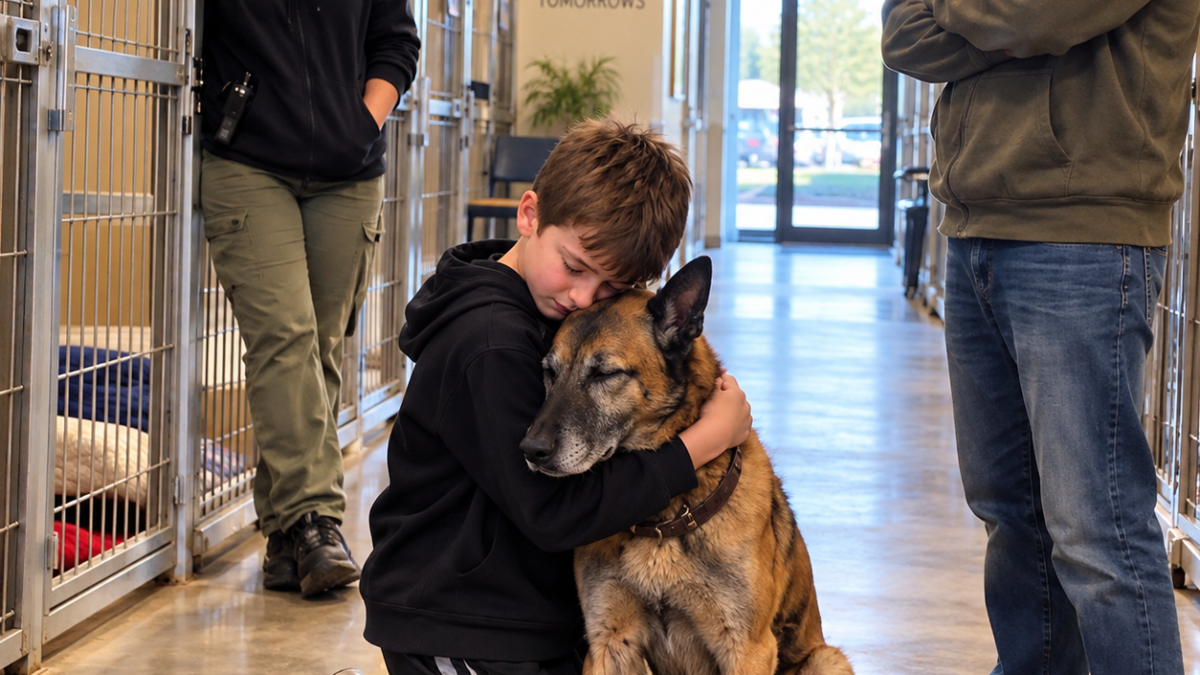
We went to the shelter for a puppy on my son’s eleventh birthday, but he walked past every wagging tail and stopped at the one dog who no longer bothered to stand.
The old shepherd had been abandoned, arthritic, and overlooked for 412 days, and I was already rehearsing how to explain that loving him might mean losing him sooner than we were ready for.
Then my son knelt beside the kennel, whispered six words, and set in motion something none of us could have imagined.
That morning, Ethan had been awake before my alarm.
By six-thirty, he was sitting at the kitchen table in his socks, barely touching the pancakes my wife, Sarah, had made for his birthday.
“Dad,” he asked for probably the fourth time, “what if the puppy doesn’t like me?”
I laughed and reached across the table.
“Then we’ll let him meet you twice.”
Ethan smiled.
For almost a year, he had been saving pictures of puppies on my phone. Golden Retrievers. Beagles. Shepherd mixes. Anything with oversized paws and a face that looked built for trouble.
He had plans for everything.
The puppy would sleep beside his bed.
They would play catch in the yard.
He would teach him to sit, stay, shake, and maybe—according to Ethan—open the refrigerator.
Sarah and I had agreed that eleven was old enough for the responsibility.
So that was the plan.
A puppy.
Then we reached the county shelter.
The puppy wing sounded exactly as you’d expect—barking, whining, paws bouncing against kennel doors.
Ethan’s face lit up.
He stopped at almost every enclosure.
“This one’s cute.”
“Dad, look at his ears.”
“Mom, this one has one blue eye!”
I thought we would be there for hours.
Then we turned into the last hallway.
It was quieter there.
Most of the dogs were older.
Some lifted their heads when we passed. Others watched us with that guarded expression shelter dogs sometimes have after too many strangers have walked away.
At the very end sat a large black-and-tan shepherd mix.
He wasn’t standing at the gate.
He wasn’t barking.
He was curled against the concrete wall with his graying muzzle resting between his front paws.
His ears drooped slightly.
His ribs didn’t show, but age had narrowed his body.
One front leg was stretched awkwardly in front of him.
Ethan stopped.
I nearly walked into him.
“Buddy?”
He didn’t answer.
He stepped closer to the kennel.
The dog didn’t move.
“Hi,” Ethan whispered.
Nothing.
A shelter employee named Maria had been walking with us.
I glanced at her.
“What’s his story?”
Her expression changed.
“That’s Atlas.”
“How old?”
“Thirteen.”
I looked back at Ethan.
Maria lowered her voice.
“He has arthritis in his hips and spine. His family surrendered him when his care became difficult.”
“How long has he been here?”
She hesitated.
“Four hundred twelve days.”
I honestly thought I had misheard her.
“Four hundred and twelve?”
She nodded.
“He’s been passed over a lot. People usually want younger dogs. Atlas doesn’t photograph well because he won’t come to the kennel door anymore.”
Something about that sentence hit me harder than I expected.
He wouldn’t come to the door anymore.
Not couldn’t.
Wouldn’t.
As if at some point Atlas had learned that footsteps in the hallway did not necessarily mean somebody was coming for him.
Ethan crouched.
“Can I meet him?”
Sarah looked at me.
I knew what she was thinking because I was thinking it too.
We had come for a puppy.
A dog who might grow up with Ethan.
A dog we expected to have for twelve or fifteen years.
Not a thirteen-year-old dog whose best days might already be behind him.
But I nodded.
Maria opened the kennel.
Ethan stepped inside slowly and sat on the concrete floor.
He didn’t reach for Atlas.
He just sat there.
“I know you’re sad,” he whispered. “Sometimes I’m sad too.”
Atlas’s ear twitched.
Ethan waited.
Then he said six words.
“You don’t have to be alone.”
For the first time, Atlas lifted his head.
He looked directly at my son.
Slowly, painfully, he pushed himself upright.
One step.
Then another.
He crossed the kennel, lowered his gray muzzle into Ethan’s open hand, and simply stood there.
Ethan’s eyes filled.
Mine did too.
A moment later, Atlas leaned his entire tired body against him.
Ethan wrapped both arms around the old dog’s neck.
When he finally came back out, Sarah crouched in front of him.
“Honey,” she said gently, “remember why we came. You wanted a puppy.”
“I know.”
“A puppy could run with you. Grow up with you.”
Ethan glanced through the gate at Atlas.
Then he looked at us.
His voice shook.
“But Atlas has already waited 412 days.”
He swallowed.
And then my eleven-year-old son asked me the question I still hear in my head.
“If we leave him here today, Dad… how many more days do you think he has to wait?”
PART 2
I didn’t have an answer.
That was the problem.
I could have given Ethan all the practical reasons in the world.
Atlas was thirteen.
He had arthritis.
His veterinary bills would probably be higher than those of a puppy.
He might never chase a ball across our yard.
He might never learn half the tricks Ethan had spent months planning to teach.
And the hardest truth of all was one I didn’t want to say aloud on my son’s birthday.
If we took Atlas home, Ethan might have to say goodbye far sooner than he imagined.
I looked at Sarah.
She understood.
Parents communicate entire conversations sometimes without saying a word.
Her eyes asked, Are we really considering this?
Mine answered, I think we already are.
Ethan turned back toward the kennel.
Atlas had settled beside the gate now.
He wasn’t curled in the far corner anymore.
He was watching us.
Not barking.
Not pawing.
Just watching.
Maria folded her hands in front of her.
“I want you to understand something before you decide,” she said quietly. “Atlas has good days and bad days. He needs anti-inflammatory medication. He needs to keep his weight down. Stairs are difficult for him. He may need more medical care as he gets older.”
Ethan nodded as though she were explaining the rules of a board game.
“I can help him.”
“You’ll have to be patient.”
“I can do that.”
“He may not want to play.”
“That’s okay.”
“He sleeps a lot.”
“I like sleeping.”
That made Maria laugh.
Even Sarah smiled through the tears gathering in her eyes.
Then Ethan said, “Does he have a bed?”
“At the shelter?”
“Yeah.”
“We have blankets and raised beds.”
“No. I mean his own bed.”
Maria’s smile disappeared.
“No,” she said softly. “He doesn’t have anything that belongs only to him.”
Ethan looked at me.
“Dad?”
There are moments when you realize your child is no longer asking you for permission.
He is asking what kind of person you want him to become.
I walked to the kennel.
Atlas raised his head.
Up close, the gray around his muzzle was even more pronounced. There was a cloudy softness in his eyes. His back legs trembled slightly when he shifted position.
I slipped my fingers through the bars.
He sniffed them.
Then he pressed his nose into my palm.
“Okay,” I whispered.
Ethan froze.
“Okay what?”
I looked at Maria.
“We want to adopt him.”
My son made a sound I had never heard from him before—half laugh, half sob.
He threw his arms around me so hard I nearly lost my balance.
Then he grabbed Sarah.
Then, because apparently none of us had enough tears left, he ran back to Atlas and hugged him again.
Maria wiped her cheek.
“I’ve worked here twenty years,” she said. “I don’t see this very often.”
“What?”
“A child choosing the dog everyone else stopped seeing.”
The adoption paperwork took almost an hour.
That was when we learned more of Atlas’s history.
His previous family had surrendered him fourteen months earlier.
The intake form said they were moving and could no longer handle his medical needs.
Atlas had arrived with overgrown nails, untreated arthritis, an ear infection, and a collar so old that Maria had needed scissors to remove it.
There was no documented abuse.
No starvation.
Nothing dramatic enough to make the evening news.
Just neglect disguised as inconvenience.
For some reason, that bothered me even more.
Before leaving, Maria crouched beside Ethan.
“There’s one more thing.”
She handed him a blue nylon leash.
“This was the leash we used the day Atlas arrived.”
Ethan held it carefully.
“Can I keep it?”
“I was hoping you would.”
When we walked Atlas out the front doors, he stopped.
Just stopped.
Sunlight stretched across the parking lot.
Cars moved on the road beyond the shelter fence.
A bird landed on a light pole.
Atlas stared outside as if he had forgotten the world was that big.
“Come on, buddy,” Ethan whispered.
Atlas took one hesitant step.
Then another.
By the time we reached our car, his tail had moved once.
Just once.
But Ethan saw it.
“Dad!”
“I saw.”
“He wagged!”
“I saw.”
We had brought an old blanket for the puppy we thought we were adopting.
Ethan spread it across the back seat.
Atlas climbed in only after I lifted his back legs gently.
Then Ethan sat beside him.
For the first ten minutes, Atlas remained upright, tense, looking out every window as though he expected the trip to end somewhere familiar and terrible.
Then his body slowly relaxed.
He lowered his head onto Ethan’s thigh.
My son stopped breathing for a second.
He looked at me through the rearview mirror.
“Dad,” he whispered.
I smiled.
“Don’t move.”
“I’m never moving again.”
Forty minutes later, my left foot was asleep from driving, Sarah was crying silently beside me, and our son was still sitting perfectly still because a thirteen-year-old dog had fallen asleep on him.
That was how Atlas came home.
Not with barking.
Not with excitement.
With trust.
Tiny, fragile, exhausted trust.
And Ethan treated it like something sacred.
The first night, he made Atlas a bed beside his own.
Not just a blanket.
A real bed.
We went to a pet store and bought the thickest orthopedic dog mattress they sold.
Ethan chose a dark green cover because he said Atlas “looked like a green kind of guy.”
I still don’t know what that meant.
He also chose two stainless-steel bowls, a soft brush, a slow-feeding mat, and three toys.
Atlas ignored all three toys.
He sniffed the stuffed fox once, sneezed, and walked away.
Ethan looked offended.
“You don’t like Mr. Fox?”
Atlas kept walking.
“Well,” Ethan said, “we’ll work on it.”
At home, Atlas explored only the first floor.
The stairs stopped him immediately.
He stood at the bottom and looked up.
His back leg shook.
Ethan noticed before I did.
“My room’s upstairs.”
I could see the disappointment hit him.
Then, just as quickly, he made a decision.
“I’ll sleep downstairs.”
“You will not,” Sarah said.
“For a few days.”
“No.”
“Mom.”
“Ethan.”
“Then Atlas can sleep in the living room and I’ll stay until he falls asleep.”
That became the compromise.
At ten that night, I came downstairs and found Ethan asleep on the rug with one hand resting on Atlas’s shoulder.
Atlas was awake.
His head rested beside Ethan’s chest.
When he saw me, he didn’t move.
He only watched.
There was something unsettling about his eyes in those early days.
He always seemed to be asking the same question.
Is this permanent?
The shelter had warned us that surrendered dogs sometimes struggled to relax because they had learned homes could disappear.
Atlas followed Ethan everywhere but never seemed fully settled.
When Ethan went to the bathroom, Atlas waited outside.
When Ethan went into the yard, Atlas followed as far as the patio.
When Ethan left for school on Monday morning, Atlas stood at the front window for almost an hour.
He did not eat breakfast.
At three twenty-seven that afternoon, I heard the school bus.
Before I could reach the door, Atlas stood.
It took effort.
His hindquarters rose slowly.
Then he walked to the entryway.
The bus stopped.
Ethan came running up the sidewalk.
The instant he opened the door, Atlas’s tail began moving.
Not once.
Not twice.
A real wag.
Ethan dropped his backpack.
“You waited for me!”
He knelt.
Atlas pressed his forehead against Ethan’s chest.
That became their ritual.
Every morning, Ethan said, “I’m coming back.”
Every afternoon, Atlas met him at the door.
For the first few weeks, we assumed Atlas was simply quiet.
Then one Saturday morning, our neighbor dropped a metal trash can lid in his driveway.
CLANG.
Atlas barked.
One deep, booming bark that shook the living room.
All four of us froze.
Atlas looked startled too.
Ethan started laughing.
“You can bark!”
Atlas sneezed.
Ethan hugged him.
“I knew you could.”
The change in Atlas happened gradually.
So gradually that I didn’t notice it until I compared photographs.
In the shelter picture, his head hung low.
His mouth was closed.
His eyes looked dull.
Two months later, I took a photograph of him sitting in the yard beside Ethan.
His ears were up.
His mouth was slightly open.
And his eyes were on my son.
Always my son.
We found a veterinarian, Dr. Priya Patel, who specialized in senior dogs.
At his first examination, she knelt beside Atlas for nearly twenty minutes before asking him to move.
“Severe arthritis,” she said. “But I’ve seen worse.”
“Is he in pain?” Ethan asked.
“Sometimes.”
“Can we fix it?”
Dr. Patel looked at me first.
I appreciated that she didn’t lie to children.
“We can’t make him young again,” she said. “But we can make him comfortable. We can help him move better.”
Ethan nodded.
“What do I have to do?”
She smiled.
“Short walks. No jumping. Keep him lean. Medication every day. Gentle massage can help.”
“Show me.”
She did.
Every evening after dinner, Ethan sat on the rug and massaged Atlas’s hips exactly the way Dr. Patel had shown him.
Slow circles.
Gentle pressure.
Five minutes on each side.
Atlas would close his eyes.
Sometimes he fell asleep.
One night, I stood in the hallway watching them.
“You’re pretty good at that,” I said.
Ethan shrugged.
“He took care of people for thirteen years.”
“How do you know?”
“He looks like he did.”
I didn’t understand until much later how close Ethan was to the truth.
Three months after the adoption, Maria called.
“Is everything okay?” I asked immediately.
“Yes. Atlas is fine?”
“He’s great.”
“Good. I was hoping you might bring him by Saturday.”
“Why?”
“We’re doing a senior-dog adoption event. The staff wants to see him.”
I looked at Atlas asleep beside Ethan’s desk.
“I think he’d like that.”
Saturday morning, Atlas walked into the shelter on the same blue leash he had left on.
The reaction surprised me.
A kennel attendant burst into tears.
One volunteer dropped to her knees.
Maria came around the front desk and hugged Ethan before kneeling beside Atlas.
“Look at you.”
Atlas sniffed her face.
Then he licked her chin.
She laughed.
“He never did that here.”
Ethan looked proud.
“He does that when he likes you.”
The shelter had set up folding tables outside.
There were posters featuring older dogs.
A local newspaper reporter was there covering the event.
At some point, she noticed Ethan sitting under a tree with Atlas.
She asked if she could speak with us.
I agreed.
Ethan told her the story in the simplest way possible.
“We went for a puppy. Atlas needed us more.”
“How did you decide?”
“He had waited 412 days.”
The reporter smiled.
“That’s a long time.”
Ethan nodded.
“Too long.”
A photographer took their picture.
Atlas was lying with his head across Ethan’s shoes.
I thought nothing of it.
Two days later, the story appeared online.
The headline read:
BOY, 11, PASSES UP PUPPY FOR SENIOR DOG WHO WAITED 412 DAYS
By Wednesday, thousands of people had shared it.
Our local television station called.
I declined.
A national website emailed.
I declined that too.
Ethan didn’t care about any of it.
He was more interested in whether Atlas could eat scrambled eggs.
But the story continued spreading.
People mailed letters to the shelter.
Someone donated twenty orthopedic beds.
An anonymous donor paid six months of adoption fees for senior dogs.
Maria told me four dogs over ten years old had been adopted within two weeks.
That part made Ethan happy.
“Atlas helped them,” he said.
“He did.”
Then, one Thursday evening, everything changed.
I was in the garage replacing a broken shelf bracket when I heard Sarah call my name.
Not loudly.
But there was something in her voice that made me set the drill down immediately.
She was standing in the kitchen holding her phone.
“What?”
“Someone emailed me.”
“Who?”
She turned the screen toward me.
The message was only three lines.
That dog belongs to my family.
You had no right to take him.
We want him back.
For several seconds, I just stared.
“What does that mean?”
Sarah shook her head.
“I don’t know.”
At the bottom was a name.
Greg Lawson.
I had never heard it before.
I called Maria.
The moment I said the name, she went silent.
“You know him.”
“Yes.”
“Who is he?”
“Atlas’s former owner.”
My stomach tightened.
“He surrendered him.”
“Yes.”
“Then why is he emailing my wife?”
Maria sighed.
“I was afraid this might happen.”
“What do you mean?”
“The article.”
“What about it?”
“His family saw it.”
“And?”
“And this afternoon he called the shelter.”
I looked through the kitchen doorway.
Ethan was sitting on the floor, reading a book while Atlas slept against his legs.
“What does he want?”
“He says surrendering Atlas was a mistake.”
“A mistake?”
“He wants him returned.”
I almost laughed.
Not because it was funny.
Because the alternative was shouting.
“He left that dog there for more than a year.”
“I know.”
“Four hundred twelve days.”
“I know.”
“And now that Atlas is in the newspaper, he wants him back?”
“That’s what he says.”
“Can he do that?”
“No.”
Maria’s answer came instantly.
“He signed an owner-surrender agreement transferring legal ownership to the shelter. You adopted Atlas legally. Greg has no claim.”
I exhaled.
“Then that’s the end of it.”
I wanted it to be.
It wasn’t.
The next morning, there were three more emails.
Greg’s wife, Danielle, wrote one.
Their adult daughter wrote another.
Greg sent the third.
His tone had changed.
He said Atlas had belonged to Greg’s father, Robert Lawson, a retired sheriff’s deputy.
Robert had raised Atlas from a puppy.
When Robert died, Greg took the dog.
According to Greg, the family had been overwhelmed by the estate, their move, and Atlas’s medical problems.
He described the surrender as “temporary.”
That word bothered me.
I forwarded the email to Maria.
She called ten minutes later.
“It was not temporary.”
“You’re sure?”
“I processed the surrender myself.”
“Did he say anything about coming back?”
“No.”
“Did you tell him he was giving up ownership permanently?”
“Three times.”
She paused.
“And Michael?”
“Yeah?”
“He signed a form acknowledging it.”
That should have ended it.
Instead, Greg began posting publicly.
He wrote that his elderly father’s dog had been “taken from the family during a difficult time.”
He claimed the shelter had pressured him.
He claimed we had been told Atlas had a living family who wanted him.
None of it was true.
But lies have an advantage truth doesn’t.
They can be invented faster than truth can be documented.
Within days, strangers were arguing online about whether we had “stolen a veteran dog.”
Someone found Sarah’s workplace.
Someone else found my social media account.
Most messages were supportive.
A few were not.
We stopped reading them.
But Ethan heard about it at school.
He came home Friday quieter than usual.
Atlas met him at the door.
Ethan hugged him, then looked at me.
“Dad?”
“Yeah?”
“Did we steal Atlas?”
My heart dropped.
“Who told you that?”
“A kid at school said his mom read it.”
I knelt in front of him.
“No.”
“Are you sure?”
“Absolutely.”
“Then why does that man say we did?”
I considered giving him the polished adult answer.
People get confused.
There are two sides to every story.
Sometimes families regret decisions.
But my son deserved something more honest.
“Because sometimes people only understand what they gave up after somebody else loves it.”
Ethan looked down at Atlas.
“Does he want him because he misses him?”
“Maybe part of him does.”
“Then is he sad?”
“Probably.”
Ethan stayed quiet.
Then he asked something that surprised me.
“If he loved Atlas, why didn’t he come during the 412 days?”
I had no answer that would improve on the question.
The following Monday, an animal control officer came to our house.
His name was Officer Lewis.
He was polite.
I was not.
Not at first.
“Are you here to take my dog?”
“No, sir.”
“Then why are you here?”
“A stolen-animal report was filed.”
I stared at him.
“By Greg Lawson?”
He didn’t answer directly.
“I need to verify the dog’s microchip and adoption records.”
Atlas was asleep under Ethan’s desk.
I called Maria before allowing anything.
She had already heard.
“Cooperate,” she said. “I’m sending the surrender paperwork to the officer right now.”
Officer Lewis scanned Atlas’s microchip.
The registration had been transferred properly after adoption.
Then he sat at our kitchen table and read the documents Maria emailed.
I watched his expression change.
“This is an owner surrender.”
“Exactly.”
“It says unconditional transfer of ownership.”
“Exactly.”
“And Mr. Lawson signed it.”
“Yes.”
Officer Lewis looked up.
“Then this isn’t a stolen dog.”
“No.”
His jaw tightened slightly.
“I’ll note that.”
Ethan had been standing in the hallway.
Atlas beside him.
Officer Lewis saw them.
“That your dog?”
Ethan nodded.
“He’s my best friend.”
The officer crouched.
“How old is he?”
“Thirteen.”
“Looks good for thirteen.”
“He gets massages.”
Officer Lewis smiled.
“Lucky dog.”
Before leaving, he turned to me.
“I can’t discuss another person’s report in detail, but keep your paperwork. Don’t hand the dog to anyone. If somebody comes onto your property and refuses to leave, call us.”
That sentence stayed with me.
If somebody comes onto your property.
Three nights later, somebody did.
It was almost eight.
Rain tapped against the windows.
Sarah was upstairs folding laundry.
Ethan sat on the floor beside Atlas.
I heard a vehicle stop outside.
Then the doorbell rang.
I opened the door.
A man in his late forties stood on my porch.
Beside him was a woman.
I knew before he spoke.
“Michael?”
“Greg?”
His eyes moved past me.
He saw Atlas.
Everything in his face changed.
“Atlas.”
The old dog lifted his head.
For a second, nobody moved.
Then Greg stepped forward.
I blocked the doorway.
“You need to leave.”
“Wait.”
“No.”
“I just want to see him.”
“You’ve seen him.”
“Please.”
I looked back at Atlas.
His ears had lowered.
His body was tense.
He did not come forward.
Greg’s eyes filled.
“Buddy.”
He crouched on the porch.
“Atlas, come here.”
Atlas stood.
My stomach twisted.
For one terrible second, I thought he might go.
Then Atlas moved.
Not toward Greg.
Toward Ethan.
He crossed the living room and pressed himself against my son’s legs.
Ethan put both hands on his shoulders.
Greg stared.
“Atlas.”
The dog turned his head away.
The woman beside Greg began crying.
“That doesn’t mean anything,” Greg said.
I could hear the anger replacing the sadness.
“He’s confused.”
“He’s not going with you.”
“He was my father’s dog.”
“And then he was yours.”
“He still is.”
“No. You surrendered him.”
“You don’t know what we were going through.”
“You’re right. I don’t.”
“My father had just died.”
“I’m sorry.”
“We were moving. Danielle was caring for her mother. Atlas needed treatment we couldn’t afford.”
I looked at him.
“Then why didn’t you come back for him?”
His mouth opened.
Nothing came out.
“You knew where he was,” I said. “For 412 days.”
“That’s not fair.”
“No. What wasn’t fair was a thirteen-year-old dog spending 412 days waiting for the family who left him.”
Greg’s face hardened.
“I made a mistake.”
“And my son isn’t going to pay for it.”
Ethan was crying now.
Quietly.
That ended the conversation.
I stepped outside and closed the door behind me.
“You need to leave my property.”
Greg pointed toward the house.
“You think a newspaper story makes you his family?”
“No.”
I stepped closer.
“Staying makes us his family.”
For a moment I thought he might shove me.
His fists tightened.
Then Danielle grabbed his arm.
“Greg.”
He pulled away.
“This isn’t over.”
“It is at this house.”
I watched until they drove away.
When I went inside, Ethan was kneeling beside Atlas.
“Is he taking him?”
“No.”
“Promise?”
I sat beside him.
“Yes.”
“You promise?”
“I promise.”
Atlas laid his head in Ethan’s lap.
That night, he slept beside Ethan’s bed.
So did I.
The next morning, I installed a camera above our front door.
I hated doing it.
Our home had never felt like a place we needed to defend.
But the situation got worse.
Greg filed a civil complaint claiming the shelter had accepted Atlas under misleading circumstances.
His attorney sent us a letter requesting that we “voluntarily return” Atlas while the dispute was resolved.
Our attorney read it and shook his head.
“No.”
“That simple?”
“Legally? Pretty much.”
He tapped the surrender agreement.
“This is clear.”
“Then why are we dealing with this?”
“Because anyone can send a letter.”
I hated that answer.
The shelter provided copies of everything.
The intake paperwork.
The signed surrender.
The notes from Maria’s conversation with Greg.
The veterinary assessment from Atlas’s arrival.
One line in the medical record stopped me.
Owner reports progressive mobility issues for approximately 18 months. No current medication.
Eighteen months.
Atlas had been hurting long before he entered the shelter.
There was another note.
Owner declined low-cost veterinary referral prior to surrender.
I read that sentence three times.
When I showed Sarah, her eyes hardened.
“He said they couldn’t afford care.”
“They were offered help.”
“Did they take it?”
“No.”
That was when my sympathy for Greg began to disappear.
A week later, Maria called again.
This time her voice sounded different.
“Michael, I found something.”
“What?”
“Our archived voicemail system.”
I waited.
“Greg called six weeks after surrendering Atlas.”
My heart accelerated.
“What did he say?”
“He asked whether Atlas had been adopted.”
“And?”
“We told him no.”
I gripped the phone.
“Then what?”
“He said, ‘Okay, just checking.’”
That was all.
Just checking.
Six weeks later, he had known Atlas was still there.
He had not returned.
He had not offered to pay for medication.
He had not asked to visit.
He had said okay.
Just checking.
Maria found another record.
Five months after the surrender, the shelter had emailed Greg because Atlas developed a severe ear infection and the microchip still contained one outdated secondary contact number.
Greg responded.
Thanks for letting me know. We are not in a position to take him back.
That email changed everything.
Not legally.
The surrender form had already settled the law.
But morally?
There was no longer any question.
Greg had been given opportunities.
He had known Atlas was still waiting.
He had chosen not to return.
Twice.
The mediation was scheduled for a Tuesday morning.
Our attorney said I didn’t have to bring Ethan.
I didn’t.
This was an adult mess created by adults.
My son had already carried enough of it.
But I did bring something.
Atlas’s blue leash.
I kept it folded in my jacket pocket.
Greg arrived with Danielle and their attorney.
We sat across a conference table.
For the first twenty minutes, the lawyers talked.
Dates.
Documents.
Ownership.
Transfer.
Microchip records.
Then Greg spoke.
“I loved that dog.”
Nobody answered.
“I did.”
His attorney touched his arm, but Greg continued.
“He was my dad’s dog for twelve years. When my father died, Atlas would sit outside his bedroom every night.”
For the first time, I understood something.
Greg wasn’t entirely lying.
He probably had loved Atlas.
Maybe still did.
That didn’t erase what happened.
But it made it sadder.
“I couldn’t handle everything,” he said. “My dad was gone. We had the house to sell. My wife’s mother was sick. Atlas could barely walk some days. I thought the shelter would find somebody.”
“You did,” I said.
He looked at me.
“They found my son.”
Greg’s face tightened.
“I want the chance to fix what I did.”
Our attorney spoke.
“You cannot fix that by taking the dog from another family.”
Greg looked at me again.
“You don’t understand. When I saw that photograph of him looking happy…”
“I do understand.”
“No, you don’t.”
“I understand exactly.”
I took the blue leash from my pocket.
I laid it on the table.
“This is what he wore the day you left him.”
Greg stared at it.
“You remember it?”
He nodded.
“Then remember the next part too.”
I leaned forward.
“He wore this leash for 412 days while strangers walked past him.”
Greg looked away.
“You called six weeks after surrendering him.”
His head snapped back.
Our attorney slid the call record forward.
“You knew he was still there.”
Silence.
“Five months later, the shelter contacted you again.”
Another page.
“You wrote that you were not in a position to take him back.”
Danielle began crying.
Greg’s shoulders dropped.
I did not raise my voice.
I didn’t need to.
“You didn’t lose Atlas.”
I tapped the papers.
“You left him. Then you confirmed you were leaving him. And when somebody finally chose him, you saw a photograph and decided you wanted the ending back.”
Greg covered his face.
For a moment, the room was completely silent.
Then he whispered, “I screwed up.”
“Yes.”
“I know.”
“Yes.”
“I miss my father.”
That stopped me.
Because there it was.
The real thing underneath everything else.
Atlas wasn’t only a dog to him.
Atlas was the last living piece of his father.
And Greg had thrown that piece away during grief.
Now regret had arrived too late.
I understood him better in that moment.
But understanding someone does not always mean giving them what they want.
Sometimes compassion requires a boundary.
“I’m sorry about your father,” I said.
Greg looked up.
“I mean that.”
His eyes were red.
“But Atlas is not a photograph. He isn’t a piece of your father’s furniture. You don’t get to put him away when grief is inconvenient and reclaim him when the memory becomes valuable again.”
His attorney looked down.
Greg did too.
The mediator eventually asked whether any compromise was possible.
Greg wanted visitation.
I refused unsupervised visits.
After talking with Sarah beforehand, however, I had agreed to one thing.
A final supervised visit at the shelter.
Not because Greg had earned it.
Because Atlas deserved the right to respond however he wanted.
The civil claim was withdrawn that afternoon.
Greg signed a statement acknowledging that he had permanently surrendered ownership and would make no further claim to Atlas.
He also agreed to remove the online posts saying the dog had been stolen.
It was over.
Or so I thought.
The supervised visit happened Saturday.
Ethan insisted on coming.
“You don’t have to,” I told him.
“I know.”
“You sure?”
“Yes.”
“Why?”
“Because Atlas shouldn’t have to do hard things alone.”
So we went.
Maria brought us into a quiet meet-and-greet room.
Atlas lay beside Ethan.
When Greg entered, the dog lifted his head.
Greg stopped several feet away.
“Hey, buddy.”
Atlas watched him.
This time, Greg did not approach.
He sat on the floor.
“I’m sorry.”
His voice broke.
Atlas’s ears moved.
Greg started crying.
“I should’ve come back.”
Ethan looked at me.
I said nothing.
For nearly a minute, Atlas remained beside my son.
Then he stood.
Slowly.
Painfully.
He walked toward Greg.
Greg covered his mouth.
Atlas stopped in front of him.
Greg held out his hand.
Atlas sniffed it.
Then the old dog leaned forward.
Just slightly.
Greg put his forehead against Atlas’s.
“I’m sorry,” he whispered again.
Atlas stood there perhaps ten seconds.
Then he turned around.
He walked back across the room.
And lay down beside Ethan.
Greg understood.
So did I.
There was no triumph in the moment.
No victory.
No revenge that felt good.
Only consequence.
Greg wiped his face.
“Take care of him.”
Ethan answered before I could.
“I already do.”
Greg nodded.
“I know.”
Before leaving, he handed Ethan a small wooden box.
“My dad kept this.”
Inside was an old brass tag.
ATLAS.
Below it was a phone number that no longer existed.
There was also a photograph.
An older man in a sheriff’s deputy jacket sat on a porch beside a young Belgian Malinois mix.
Atlas’s muzzle was black then.
His ears stood tall.
He looked powerful.
Alive.
Young.
Ethan stared at it.
“That’s him?”
Greg smiled through tears.
“That’s him.”
“What was your dad’s name?”
“Robert.”
“Did Atlas love him?”
“More than anything.”
Ethan thought for a moment.
Then he handed Greg the photograph back.
Greg shook his head.
“No. Keep it.”
“You sure?”
“My dad would want Atlas’s family to have it.”
That was the last time Greg tried to reclaim him.
And strangely, that was when the real story of Atlas began to open.
We learned from the box of old records Greg later mailed us that Atlas had spent most of his life with Robert Lawson.
Robert had been a sheriff’s deputy for thirty-one years.
Atlas wasn’t a police dog.
He was simply Robert’s dog.
But they went everywhere together.
Fishing.
Camping.
Hardware store trips.
Long mornings on the porch.
After Robert retired, neighbors rarely saw one without the other.
When Robert developed heart problems, Atlas slept outside his bedroom.
When Robert died at seventy-four, Atlas lay outside the closed bedroom door for three days.
Then Greg took him.
Less than nine months later, Atlas entered the shelter.
Suddenly his behavior made sense.
The waiting.
The doors.
The way he watched Ethan leave for school.
The way he refused breakfast until my son came home.
Atlas had already lost his person once.
Then he lost his home.
Then he waited 412 days for someone else to stay.
Ethan became more serious about his promise after learning that.
Every morning before school, he knelt beside Atlas.
“I’m leaving.”
Atlas watched him.
“But I’m coming back.”
Then he touched two fingers gently to Atlas’s forehead.
“Always coming back.”
I once asked Ethan why he said it every day.
“So he knows.”
“Dogs don’t understand every word.”
“I know.”
“Then why?”
Ethan shrugged.
“Maybe hearts understand stuff ears don’t.”
There wasn’t much I could add to that.
Winter arrived.
Cold weather made Atlas’s arthritis worse.
Some mornings, he struggled to rise.
Ethan learned to slide a support harness beneath his belly.
We put nonslip runners across our hardwood floors.
I built a low ramp from the patio into the yard.
Atlas hated the ramp for two days.
Then he realized it meant he could reach Ethan without negotiating the steps.
After that, he used it proudly.
One Saturday in January, snow fell overnight.
Ethan rushed downstairs.
“Atlas! Snow!”
Atlas looked at him as though snow was not the invention Ethan believed it to be.
Still, he followed.
We put a warm coat on him.
Outside, Ethan made a snowball.
He tossed it gently.
Atlas watched it land.
“Go get it!”
Atlas looked at Ethan.
Then at the snowball.
Then back at Ethan.
I laughed.
“He’s thirteen, buddy. He knows when you’re wasting his time.”
Ethan picked up another snowball.
This one landed beside Atlas.
The old dog lowered his nose.
Sniffed.
Then suddenly shoved his entire muzzle into the powder.
When he raised his head, snow covered his face.
Ethan collapsed laughing.
And then Atlas did something none of us had seen him do.
He ran.
Not far.
Maybe fifteen feet.
Not fast.
His back legs were stiff.
But he ran across the snow while Ethan ran beside him.
Sarah stood in the doorway with both hands over her mouth.
I filmed eight seconds before putting my phone away.
Some moments deserve to belong only to the people inside them.
That night, Atlas slept for almost twelve hours.
But his tail moved in his dreams.
By spring, the conflict with Greg had faded into memory.
Something else had grown in its place.
The shelter began receiving more requests about senior dogs.
People had not forgotten the story.
Maria called one afternoon.
“You know what Ethan started?”
“What?”
“People come in asking for ‘an Atlas dog.’”
I laughed.
“What’s an Atlas dog?”
“Apparently any dog over ten who looks like nobody wants him.”
“That sounds rude.”
“It’s working.”
Seven senior dogs were adopted that month.
Ethan began volunteering with me on Saturdays.
He couldn’t handle dogs alone because of his age, but he filled water bowls, folded blankets, organized food cans, and sat beside frightened dogs.
That last part became his specialty.
He did exactly what he had done with Atlas.
Nothing.
He sat.
He waited.
He talked quietly.
Some dogs approached.
Some didn’t.
Ethan never forced them.
One afternoon, I asked where he had learned to do that.
He pointed toward Atlas.
“He taught me.”
By then, Atlas had been with us eight months.
His fourteenth birthday was unknown, so Ethan chose the anniversary of Robert Lawson’s birthday from the records Greg had mailed.
“We should celebrate the day his first best friend was born,” he said.
So we did.
We made dog-safe cupcakes.
Maria came.
Dr. Patel came.
Even Greg sent a card.
It read:
For Atlas.
Thank you for giving him the home I should have protected.
No excuses.
Just gratitude.
Ethan placed the card beside Robert’s photograph.
Then he gave Atlas half a cupcake.
Atlas swallowed it in approximately two seconds.
For an arthritic dog, his jaws worked remarkably well around food.
“He didn’t even taste it,” Sarah said.
Ethan laughed.
“He’s making up for lost birthdays.”
That summer gave us the version of Atlas I wish everyone could have known.
He was still old.
Still slow.
Still needed medication.
But he had opinions now.
He hated the vacuum cleaner.
Loved cheese.
Refused carrots.
Snored loudly enough to interrupt movies.
Barked at delivery trucks but ignored squirrels completely.
He would follow Ethan from room to room and then pretend he had merely happened to choose the same destination.
If Ethan studied at the kitchen table, Atlas slept beneath it.
If Ethan read on the porch, Atlas lay beside his chair.
If Ethan played video games, Atlas positioned himself directly between Ethan and the television until someone scratched his ears.
“You’re blocking the screen.”
Atlas didn’t care.
“You know exactly what you’re doing.”
Atlas sighed.
“You’re manipulative.”
His tail thumped.
There were difficult days too.
One July morning, Atlas fell in the yard.
His hind legs simply gave out.
Ethan screamed.
I ran outside.
Atlas tried to stand and couldn’t.
We carried him to the car on a blanket.
At the veterinary clinic, Ethan sat on the floor beside him.
“Is he dying?”
Dr. Patel looked at the X-rays.
“Not today.”
Ethan exhaled.
“But his arthritis is progressing.”
“What can we do?”
“We adjust medication. Physical therapy. Maybe laser therapy. And we pay attention to his quality of life.”
Ethan’s face changed.
“What does that mean?”
Dr. Patel pulled over a stool.
“It means we ask whether Atlas is still enjoying being Atlas.”
Ethan looked down.
“He is.”
“I think so too.”
“How will I know if he isn’t?”
That question hung in the room.
Dr. Patel answered gently.
“You know him better than anyone. He’ll tell you.”
On the drive home, Ethan was silent.
Then he said, “Dad?”
“Yeah?”
“Don’t lie to me when it happens.”
My hands tightened on the steering wheel.
“I won’t.”
“Even if you think it’ll make me sad.”
“I promise.”
That was one of the hardest promises I have ever made.
Atlas improved.
The new treatment helped.
He started physical therapy once a week.
The first session involved a water treadmill.
Atlas looked betrayed by the entire concept.
Ethan stood outside the tank encouraging him.
“Come on!”
Atlas stared at him.
“You can do it!”
Atlas took one step.
“Good boy!”
Another step.
“You’re doing it!”
Atlas stopped and gave Ethan a look that clearly said, I am doing this under protest.
Even the therapist laughed.
By September, he could walk farther than he had when we adopted him.
Not miles.
Two blocks.
Sometimes three.
But he wanted to go.
Every evening, Ethan clipped on the blue leash.
They walked to the corner.
Atlas smelled every mailbox.
Every tree.
Every patch of grass.
He had spent more than a year watching the world through chain-link.
Now nobody rushed him.
If he wanted to spend three minutes smelling one bush, we spent three minutes at the bush.
Time worked differently for Atlas.
Maybe because he understood what waiting cost.
On Ethan’s twelfth birthday, exactly one year after the day we first saw him, we returned to the shelter.
Atlas walked through the doors.
This time, he did not stop.
He knew where he was.
Staff members cheered.
Maria knelt.
“Three hundred sixty-five days home.”
Ethan corrected her.
“Three hundred sixty-six. Leap year.”
She laughed.
“Of course you counted.”
“I count all his days.”
That sentence nearly broke me.
The shelter had a surprise.
They had placed a small plaque near the senior-dog corridor.
THE ATLAS CORNER
For dogs who have waited too long.
Below it was a photograph of Ethan and Atlas under the tree from the adoption event.
Ethan stared at it.
“You named it after him?”
Maria nodded.
“Since Atlas’s story was published, thirty-one senior dogs have been adopted from this shelter.”
Ethan’s mouth fell open.
“Thirty-one?”
“Thirty-one.”
He crouched beside Atlas.
“You did that.”
Atlas sneezed.
Maria smiled.
“I think he says you helped.”
That afternoon, Ethan gave Maria an envelope.
Inside was $486.
His birthday money.
His allowance.
Money from mowing our neighbor’s lawn.
Money from selling some old video games.
“What’s this?” she asked.
“For the old dogs.”
“Ethan, you don’t have to—”
“I want to.”
“What should we use it for?”
“Whatever makes them wait less.”
That became an idea.
Then the idea became something bigger.
Ethan called it “The 412 Fund.”
It wasn’t a nonprofit.
Not then.
Just a jar on the shelter counter and a page Maria helped create through the shelter’s existing donation system.
The money paid senior-dog adoption fees.
Then medications.
Then orthopedic beds.
Ethan never asked for his name to be attached.
He wanted Atlas’s number.
412.
Because, as he explained, “Nobody should become just a number, but sometimes a number helps people remember.”
Atlas’s life stayed wonderfully ordinary for another six months.
That ordinary time was the gift.
Breakfast.
Walks.
Homework.
Porch naps.
Car rides.
Cheese.
Rain.
Christmas morning.
Ethan wrapped a present for Atlas.
Atlas tore the paper exactly once, became bored, and waited for Ethan to open it for him.
Inside was a new blanket.
Green.
Of course.
By January, Atlas had begun waking at night.
He paced sometimes.
Not far.
Bedroom door.
Hallway.
Living room.
Back again.
Dr. Patel said senior dogs sometimes become disoriented.
Ethan began leaving a night-light on.
“If he wakes up and forgets where he is,” he said, “I want him to see me.”
Then came the night I knew we were approaching the part of the story I had feared from the beginning.
It was 2:13 a.m.
I woke to Atlas barking.
Not one bark.
Three.
I ran downstairs.
Ethan was already there.
Atlas was lying near the back door.
He had tried to stand.
He couldn’t.
His breathing was fast.
“Dad.”
“I know.”
“Dad, help him.”
We lifted him.
His back legs hung loosely.
At the emergency clinic, the veterinarian suspected a spinal episode connected to advanced degeneration.
They gave him pain medication.
By sunrise, he could move one hind leg slightly.
The doctor said surgery at his age, with his health, carried serious risks and no guarantee.
We took him home.
For three days, Ethan barely left his side.
On the fourth morning, Atlas stood with the support harness.
Five steps.
Then ten.
Ethan cried.
“You’re still here.”
Atlas licked his wrist.
But something had changed.
I could see it.
Dr. Patel could too.
His body was losing the argument with time.
We began keeping a calendar.
Good day.
Okay day.
Hard day.
Ethan marked each one.
For several weeks, the good days still outnumbered the hard ones.
Then they didn’t.
Atlas stopped walking to the corner.
Then he stopped walking to the mailbox.
Eventually, some mornings he didn’t want to go outside at all.
But he still ate.
Still followed Ethan with his eyes.
Still lifted his head when the school bus stopped.
Still thumped his tail when Ethan came through the door.
“Is he still enjoying being Atlas?” I asked Ethan one evening.
He looked at the dog.
“Yes.”
I agreed.
Then came a Saturday in March.
Ethan was sitting in the yard reading.
Atlas lay on the grass beside him.
Warm sunlight covered his black-and-tan coat.
A breeze moved through the maple tree.
I watched from the kitchen.
Ethan read aloud because Atlas seemed to enjoy the sound.
Halfway through the chapter, Atlas lifted his head.
He looked toward Ethan.
Then he struggled to stand.
Ethan set the book down.
“Need help?”
Atlas tried again.
His legs failed.
Ethan reached for the harness.
Atlas did something unusual.
He turned his face away.
He didn’t want to stand.
He laid his head back down.
Ethan froze.
I saw his shoulders change.
He knew.
Not everything.
But enough.
That evening, Atlas refused dinner.
Even cheese.
Atlas had never refused cheese.
Ethan sat beside him.
“Come on, buddy.”
Nothing.
He held a small piece beneath Atlas’s nose.
The dog turned away.
Ethan looked at me.
“Dad.”
I sat down.
“I know.”
His eyes filled instantly.
“You promised.”
I felt something inside me tear.
“Yes.”
“You promised you’d tell me.”
“I did.”
“Is this it?”
I couldn’t answer immediately.
I hated myself for those few seconds.
But I had promised not to lie.
“I think we need to talk to Dr. Patel.”
Ethan lowered his head onto Atlas’s shoulder.
“No.”
Atlas breathed slowly.
“No, no, no.”
Sarah sat behind Ethan and wrapped her arms around him.
“He’s supposed to have more time.”
“I know.”
“He waited 412 days.”
“I know.”
“That’s not fair.”
“No.”
“He waited that long just to get this?”
I touched Ethan’s back.
“To get what?”
“This little bit.”
I swallowed.
“Buddy, look at me.”
He wouldn’t.
“Ethan.”
Finally he did.
His face was soaked.
“Atlas doesn’t know his life as a number of years. He knows breakfast with you. He knows the school bus. He knows the green blanket. He knows your hand on his head. He knows that every time you left, you came back.”
Ethan sobbed.
I continued.
“He doesn’t know he got a little bit.”
I put my hand on Atlas.
“He knows he got home.”
Dr. Patel came to our house Sunday morning.
She examined him on the living-room rug.
Atlas barely reacted when she moved his back legs.
Afterward, she asked Sarah and me to step into the kitchen.
Ethan stood.
“I’m coming too.”
I looked at Dr. Patel.
She nodded.
We sat around the table.
She spoke carefully.
“Atlas is in pain despite the medication.”
Ethan stared at his hands.
“Can you increase it?”
“We can, but it will make him very sleepy. And his mobility is unlikely to recover.”
“Will he get better?”
Dr. Patel’s eyes shone.
“No.”
One word.
There are times when one honest word weighs more than a speech.
Ethan cried silently.
“What happens if we wait?”
“He may have another spinal episode. He may stop being able to relieve himself comfortably. He may become frightened or distressed.”
“Is he scared now?”
“I don’t think so.”
“Why?”
“Because he’s home.”
Ethan stood and walked back into the living room.
We followed.
He lay on the rug beside Atlas.
For a long time, nobody spoke.
Then Ethan whispered, “I told him I would never leave him.”
Dr. Patel knelt.
“You don’t have to.”
Ethan looked at her.
She understood what he meant.
“You can stay the whole time.”
He put his face against Atlas’s neck.
“Can we do it here?”
“Yes.”
“Not at the hospital?”
“No.”
“In his house?”
“Yes.”
“On his blanket?”
“Yes.”
Ethan nodded.
“When?”
Dr. Patel looked at us.
I couldn’t say it.
Ethan did.
“Today.”
My twelve-year-old son made the most loving decision I have ever witnessed.
And it broke him.
We spent the next four hours doing everything Atlas loved.
We carried him onto the porch.
He lay in the sunlight.
Sarah cooked chicken.
He ate three small pieces.
Then, because rules no longer mattered, Ethan gave him cheese.
Atlas ate that too.
“See?” Ethan said through tears. “Still a cheese guy.”
We brought out Robert Lawson’s photograph.
Ethan placed it beside him.
“You had two families,” he told Atlas. “You know that?”
Atlas’s eyes moved toward his voice.
“You had Robert first.”
Ethan stroked his gray muzzle.
“And then you had us.”
He paused.
“I hope he’s there.”
Sarah turned away.
I couldn’t.
I wanted to remember everything.
At two in the afternoon, a car stopped outside.
Greg stepped out.
I had called him.
I didn’t have to.
But it felt right.
He stood at the edge of the yard until Ethan saw him.
“Can he come over?” Ethan asked.
“Your choice.”
Ethan nodded.
Greg walked slowly.
When he saw Atlas on the green blanket, he stopped.
“Oh, buddy.”
He knelt.
Atlas’s tail moved once.
Greg cried.
Not loudly.
He placed Robert’s old brass tag beside Atlas.
“My dad loved you.”
Ethan said, “Atlas knows.”
Greg looked at him.
“Thank you.”
Ethan’s chin trembled.
“For what?”
“For being better to him than I was.”
Ethan shook his head.
“You loved him too.”
“I failed him.”
“Both can be true.”
I looked at my son.
Twelve years old.
Somehow understanding something adults spend entire lives avoiding.
Greg nodded.
“Yeah.”
He stayed ten minutes.
Before leaving, he kissed Atlas between the ears.
Then he stood.
“I won’t make this harder.”
At the gate, he turned back.
“Ethan?”
“Yeah?”
“My dad used to say Atlas always knew who needed him.”
Ethan wiped his face.
“I needed him.”
Greg smiled sadly.
“I think he knew.”
Dr. Patel arrived at three.
We moved Atlas inside because that was where he had spent his first night.
Same rug.
Same living room.
Same family.
Ethan put the green blanket under him.
Sarah sat against the couch.
I sat beside her.
Ethan lay on the floor facing Atlas.
Dr. Patel explained everything before she did it.
Ethan listened.
He never moved his hand from Atlas’s head.
The first medication made Atlas sleepy.
His breathing slowed.
His body relaxed.
Ethan whispered into his ear.
“You don’t have to wait anymore.”
I closed my eyes.
It was almost exactly what he had said in the kennel.
You don’t have to be alone.
Atlas opened his eyes one last time.
He looked at Ethan.
Then his eyes closed.
Ethan pressed his forehead against his.
“I’m here.”
Dr. Patel gave the final medication.
“I’m here.”
Atlas breathed out.
“I’m still here.”
And then he was gone.
No fear.
No kennel.
No concrete floor.
No strangers walking past him.
The last thing Atlas knew in this world was the boy who had chosen him.
For several minutes, nobody moved.
Then Ethan made a sound that will stay with me for the rest of my life.
He sobbed into Atlas’s neck.
“I came back.”
Over and over.
“I came back. I came back. I came back.”
I held my son while he held his dog.
There are no words that make a moment like that smaller.
So we didn’t try.
We just stayed.
That night was the first night our house had been silent in almost two years.
I hated it.
No nails on the floor.
No snoring.
No old dog shifting on his bed.
At three in the morning, I went downstairs.
Ethan was sitting on Atlas’s empty green blanket.
I sat beside him.
For a while, neither of us spoke.
Then he said, “Dad?”
“Yeah?”
“Was it worth it?”
I knew exactly what he meant.
Was loving Atlas worth this pain?
I could have answered immediately.
Instead, I asked, “What do you think?”
Ethan wiped his eyes.
“I would do it again.”
“Me too.”
“Even knowing?”
“Even knowing.”
He leaned against me.
“Then I guess it was.”
Two weeks later, Atlas’s ashes came home.
The shelter had arranged a wooden urn.
On the front was a small brass plate.
ATLAS
HOME AT LAST
Ethan placed Robert’s old tag beside it.
Then the blue leash.
The leash from the day Atlas entered the shelter.
The leash from the day he left.
At school, Ethan’s teacher gave the class an assignment.
Write about someone who changed your life.
Ethan wrote about Atlas.
He brought the essay home.
The final paragraph read:
Atlas waited 412 days because people thought an old dog had less to give. They were wrong. He gave me everything he had. I used to think rescuing meant saving something from danger. Now I think sometimes rescuing means making sure somebody doesn’t spend the end of their life believing they were forgotten.
I read it twice.
Then a third time.
“What grade did you get?”
“A.”
“Should’ve been A-plus.”
He laughed.
It was the first real laugh I had heard from him since Atlas died.
Summer came again.
The 412 Fund kept growing.
A local business donated.
Then Robert Lawson’s former sheriff’s department held a fundraiser in Atlas’s memory.
Greg attended.
So did we.
There was no bitterness between us anymore.
Not exactly friendship either.
Something more complicated.
He had made a terrible choice.
He had tried to undo it in the wrong way.
Then, eventually, he faced it.
Sometimes justice isn’t watching someone suffer.
Sometimes it is watching them finally tell the truth about what they did.
Greg stood at a microphone that afternoon.
I didn’t know he planned to speak.
He unfolded a piece of paper.
“My father loved a dog named Atlas,” he began.
The room quieted.
“When my father died, Atlas became my responsibility. I was grieving. I was overwhelmed. Those things are true.”
He stopped.
“But they are not excuses.”
Ethan looked at me.
Greg continued.
“I surrendered Atlas when he became difficult to care for. The shelter offered resources. I refused them. Later, I learned he had not been adopted. I still did not return.”
His voice shook.
“Then another family adopted him. When their story became public, I convinced myself I had the right to take him back.”
Nobody moved.
“I didn’t.”
He looked toward Ethan.
“A child understood loyalty better than I did.”
Ethan lowered his eyes.
“Atlas spent 412 days waiting because of choices adults made. I cannot change that. But I can make sure his story helps another old dog wait fewer days.”
Greg placed an envelope into the donation box.
Later, Maria told me it contained $10,000 from the sale of part of Robert’s estate.
I never asked Greg about it.
He never mentioned it.
That money helped pay the medical expenses of thirteen senior dogs that year.
One was an eleven-year-old Beagle named Rosie.
She waited 189 days.
Another was a twelve-year-old Labrador named Winston.
He waited 73.
Then there was Duke, fifteen years old, nearly deaf.
He waited nine days.
Ethan loved that number.
“Nine is way better than 412.”
Much better.
On Ethan’s thirteenth birthday, he asked for one thing.
“No presents.”
I stared at him.
“You sure you’re my kid?”
“Dad.”
“I’m serious. There should be paperwork.”
He smiled.
“I want to go to the shelter.”
So we went.
For a moment, walking through those doors hurt.
I could almost see Atlas stopping in the sunlight again.
Maria hugged us.
“Happy birthday.”
“Thanks.”
“You here to work?”
Ethan nodded.
We spent the morning in the senior corridor.
Near the end was a ten-year-old mixed-breed dog named Ruby.
She had cloudy eyes and a white face.
When Ethan approached, she remained curled in the back of the kennel.
I felt something tighten in my chest.
Ethan sat outside.
He didn’t call her.
Didn’t reach through the gate.
He just waited.
Five minutes.
Ten.
Ruby lifted her head.
Ethan whispered something.
I couldn’t hear.
She stood.
Slowly.
She walked toward him.
Maria looked at me.
I already knew what she was thinking.
I shook my head.
“No.”
She smiled.
“I didn’t say anything.”
“Your face did.”
Ethan looked over his shoulder.
“Dad?”
“Oh, no.”
“What?”
“We are not doing this every birthday.”
He laughed.
“I wasn’t going to ask that.”
“Good.”
“I was going to ask if the 412 Fund can cover her adoption fee.”
I paused.
“For who?”
He pointed.
A woman and her teenage daughter were standing farther down the corridor.
They had been watching Ruby.
The mother looked hesitant.
“We’re thinking about her,” she said. “But she needs dental work.”
Maria smiled.
“The fund can help with that.”
Ethan nodded.
“Then do it.”
The woman looked at him.
“Why?”
Ethan glanced at Ruby.
“Because sometimes old dogs just need somebody to make the first part easier.”
Ruby went home that afternoon.
Her final shelter stay was 58 days.
Ethan wrote the number in a notebook.
Over the years, the notebook filled.
58.
59.
60.
61.
62.
63.
Every number represented a dog who had stopped waiting.
On the inside cover, Ethan had written one number larger than all the others.
412.
Underneath it:
This is the number we are trying to beat.
By the time Ethan entered high school, the shelter had expanded the Atlas Corner.
There were six quiet kennels specifically designed for older dogs.
Soft flooring.
Low beds.
Heating pads.
A small fenced garden.
Above the entrance hung Robert’s photograph of Atlas as a young dog beside his first person.
Next to it was the photograph of old Atlas lying across Ethan’s shoes.
Two lives.
Two families.
One dog.
Greg visited once a year.
Usually on Atlas’s adoption anniversary.
He never came empty-handed.
Sometimes he brought food.
Sometimes checks.
Once he brought a new engraved plaque.
It read:
LOVE IS NOT PROVED BY HOW LONG YOU HAD SOMEONE.
IT IS PROVED BY WHETHER YOU STAYED WHEN THEY NEEDED YOU.
Maria mounted it beneath Atlas’s photograph.
Years passed.
My eleven-year-old son became sixteen.
Then eighteen.
The green blanket grew faded.
The blue leash remained hanging in his room.
When Ethan left for college, he took Robert’s photograph with him.
Not the urn.
“That stays home,” he said.
“Why?”
“Atlas lived here.”
I understood.
Ethan studied animal science.
Nobody in our family was surprised.
During his second year, he called me late one night.
“Dad?”
“What happened?”
“Nothing.”
“You don’t call at midnight for nothing.”
He laughed.
“I figured out what I want to do.”
“What?”
“Veterinary medicine.”
I sat up in bed.
“For senior dogs?”
“Mostly.”
I smiled into the darkness.
“Atlas?”
“Yeah.”
Of course.
Years later, when Ethan graduated from veterinary school, Sarah and I sat in the auditorium and watched him walk across the stage.
He was twenty-six.
Tall.
Confident.
Nothing like the little boy swinging his legs in the back seat asking whether a puppy would love him.
Afterward, he found us outside.
Sarah hugged him first.
Then me.
I handed him a small box.
“What’s this?”
“Open it.”
Inside was Atlas’s brass tag.
The one Greg had given him all those years ago.
Ethan stared at it.
“I thought this was at home.”
“It was.”
He ran his thumb over the name.
ATLAS.
His eyes filled.
“You should have this today.”
Ethan closed his hand around it.
“I wish he could see.”
I looked at my son.
The veterinarian.
The man who had dedicated his life to animals that other people too often considered too old, too expensive, too broken, too late.
“Buddy,” I said, “this is him seeing.”
Ethan laughed through his tears.
A year later, he came home with architectural drawings.
He spread them across our kitchen table.
Sarah adjusted her glasses.
“What am I looking at?”
“A clinic.”
“For what?”
“Senior and hospice animals.”
I stared at the name at the top of the page.
ATLAS SENIOR ANIMAL CENTER.
“You’re serious.”
“Completely.”
It took two more years.
Grants.
Loans.
Fundraising.
Planning.
Permits.
Greg donated too.
So did Maria, though she was retired by then.
The county shelter partnered with the clinic.
On opening day, Ethan asked me to arrive early.
The building smelled new.
Sunlight poured through wide windows.
There were nonslip floors.
Low examination tables.
Quiet rooms for fearful dogs.
A garden designed for animals with limited mobility.
And one private room near the back.
Ethan opened the door.
Inside was a couch.
Soft lighting.
A thick green blanket folded on a low bed.
I looked at him.
“The blanket?”
“Not his actual one.”
“Good.”
“That one’s too important.”
On the wall was a plaque.
THE ATLAS ROOM
For goodbyes that deserve to happen at home, even when home has to be here.
I couldn’t speak.
Ethan stood beside me.
“I kept thinking about that day.”
“The day we lost him?”
He nodded.
“We were lucky. Dr. Patel came to our house. Not everybody can do that.”
I ran my hand across the back of the couch.
“So this room?”
“No steel table. No bright lights unless they’re needed. Families can sit on the floor. Kids can lie beside their dogs.”
He swallowed.
“Nobody has to leave.”
There it was again.
The promise.
The same promise from a little boy in a shelter kennel.
You don’t have to be alone.
On the clinic’s first day, the first patient was a fourteen-year-old Shepherd mix named Walter.
His family had adopted him at eleven.
Ethan examined him while I watched from the hallway.
The dog’s muzzle was almost completely white.
His hips were weak.
Afterward, Ethan sat on the floor and showed the owners how to massage Walter’s back legs.
Slow circles.
Gentle pressure.
Exactly as Dr. Patel had once shown an eleven-year-old boy.
I had to walk away for a minute.
Some stories do not end.
They change form.
That evening, after the last patient left, Ethan and I sat outside the clinic.
He took Atlas’s brass tag from his pocket.
“You still carry that?”
“Every day.”
“Really?”
He nodded.
“I keep it in my wallet.”
I smiled.
“Atlas would probably expect royalties.”
“He’d ask for cheese.”
“That too.”
For a while we watched the sun disappear behind the trees.
Then Ethan said, “You know what I remember most?”
“What?”
“Not the day he died.”
I waited.
“The shelter.”
“The first day?”
“Yeah.”
“What part?”
Ethan smiled.
“The moment he stood up.”
I remembered.
Atlas in the back corner.
The drooped ears.
The gray muzzle.
The long hesitation.
Then one painful step toward my son.
“I remember too.”
“I think about it whenever people say an old dog doesn’t have enough time left.”
He turned the tag between his fingers.
“Atlas didn’t need more years to change my whole life.”
No.
He didn’t.
Atlas lived with us for less than two years.
That fact used to hurt me.
Now it doesn’t.
Not in the same way.
Because counting only the years would mean making the same mistake everyone made when they walked past his kennel.
They looked at Atlas and calculated what was left.
My son looked at him and saw what was still there.
Trust.
Loyalty.
Memory.
Pain.
Hope.
Love.
A heart still waiting for somewhere safe to place itself.
Four hundred and twelve days.
That was how long Atlas waited in the shelter.
For years, I hated that number.
Now I understand it differently.
Yes, it represents every morning he woke behind that kennel door.
Every family that walked past.
Every night he went to sleep without knowing whether the next day would be different.
But it also marks the distance between abandonment and belonging.
Because on day 413, an eleven-year-old boy walked into that shelter expecting to choose a puppy.
Instead, he noticed an old dog who had stopped expecting anyone to choose him.
Years ago, on that first night, I stood in Ethan’s bedroom doorway and watched Atlas sleeping beside his bed.
I thought my son had saved a dog.
I was wrong.
Atlas taught Ethan what compassion costs.
He taught him that love is not always choosing what is easiest or newest or most exciting.
Sometimes love is choosing the one whose time may be short.
Sometimes it is sitting on a concrete floor until someone believes in people again.
Sometimes it is giving medicine.
Building ramps.
Cleaning accidents.
Walking slowly.
Waiting patiently.
Keeping promises.
And sometimes love is knowing when holding on has stopped being for them and started being for you.
Atlas taught me something too.
I used to think a good life needed to be long.
Now I know better.
A good life needs to contain moments when someone sees you.
Really sees you.
Robert saw Atlas when he was young.
Ethan saw him when he was old.
And Atlas, somehow, saw both of them too.
The retired deputy who needed companionship at the end of his career.
The grieving boy who didn’t yet understand how powerful his own kindness could become.
Two people separated by generations.
Connected by one dog.
Greg once asked me, during that awful dispute, whether a newspaper story made us Atlas’s family.
At the time I answered no.
Staying did.
I still believe that.
But if I could answer him again, I would add something.
Family is not the person whose name appeared first on the paperwork.
It is not the person who can prove they loved you once.
It is the one who keeps showing up after love becomes inconvenient.
When the walks get slower.
When the medicine gets expensive.
When sleep is interrupted.
When goodbye begins appearing on the horizon.
Family stays.
My son understood that at eleven.
It took the rest of us longer.
Maria died a few years after the Atlas Senior Animal Center opened.
Her daughter gave Ethan something after the funeral.
It was an old shelter intake card.
Atlas’s.
Across the top was his original identification number.
Below it:
AGE: APPROX. 13
OWNER SURRENDER
SENIOR
ARTHRITIS
Under “behavior,” someone had written:
QUIET. WITHDRAWN. GENTLE. DOES NOT APPROACH VISITORS.
Then, in different handwriting, added months later:
DAY 412.
Still waiting.
Ethan framed the card.
It hangs today in the reception area of his clinic.
Beside it is another photograph.
Not the shelter photograph.
Not Robert’s.
It is my favorite.
Ethan is twelve.
Atlas is lying in the grass.
His gray head rests across Ethan’s knees.
Both are looking away from the camera.
There is nothing dramatic about it.
No rescue.
No confrontation.
No tears.
Just a boy.
An old dog.
Sunlight.
Home.
Underneath, Ethan placed one sentence.
NOT EVERY RESCUE NEEDS MORE TIME.
SOME JUST NEED THE TIME THEY HAVE LEFT TO MATTER.
Sometimes visitors stop in front of the photograph.
They ask who Atlas was.
Ethan tells them.
Not every detail.
Usually just this:
“He waited 412 days.”
Then he smiles.
“And then he never had to wait alone again.”
That is the part I choose to remember.
Not the man who surrendered him.
Not the fight over ownership.
Not the letters from lawyers.
Not even the final afternoon on the green blanket.
I remember the shelter.
My eleven-year-old son sitting on cold concrete.
The old dog who had stopped walking to the gate.
The silence.
Then Ethan’s voice.
“You don’t have to be alone.”
I remember Atlas lifting his head.
Standing.
Walking forward.
Choosing to trust one more person.
And now, whenever someone asks me what the best birthday gift we ever gave our son was, I tell them the truth.
We didn’t give Ethan Atlas.
Atlas gave us Ethan.
The version of him he was always capable of becoming.
The boy who learned to notice those everyone else walked past.
The teenager who counted every senior dog that stopped waiting.
The man who built a place where old animals could receive care without being treated like their remaining days were worthless.
The veterinarian who still carries a dead dog’s brass tag in his wallet.
All because, on his eleventh birthday, he refused to walk away.
Atlas had waited 412 days for somebody to choose him.
In the end, an eleven-year-old boy did.
And for the rest of Atlas’s life, whether it was a sunny afternoon in the yard, a painful morning when his legs refused to cooperate, or the final moment when his tired heart stopped beating beneath Ethan’s hand, he never had to wonder again whether that boy would come back.
Ethan stayed.
We all stayed.
And for Atlas, that was finally enough.
[END OF FIRST COMMENT / FULL STORY]








