PART 2: WE THOUGHT THE 3-POUND PUPPY BESIDE THE TRASH CAN WAS DEAD—THEN HER TAIL MOVED
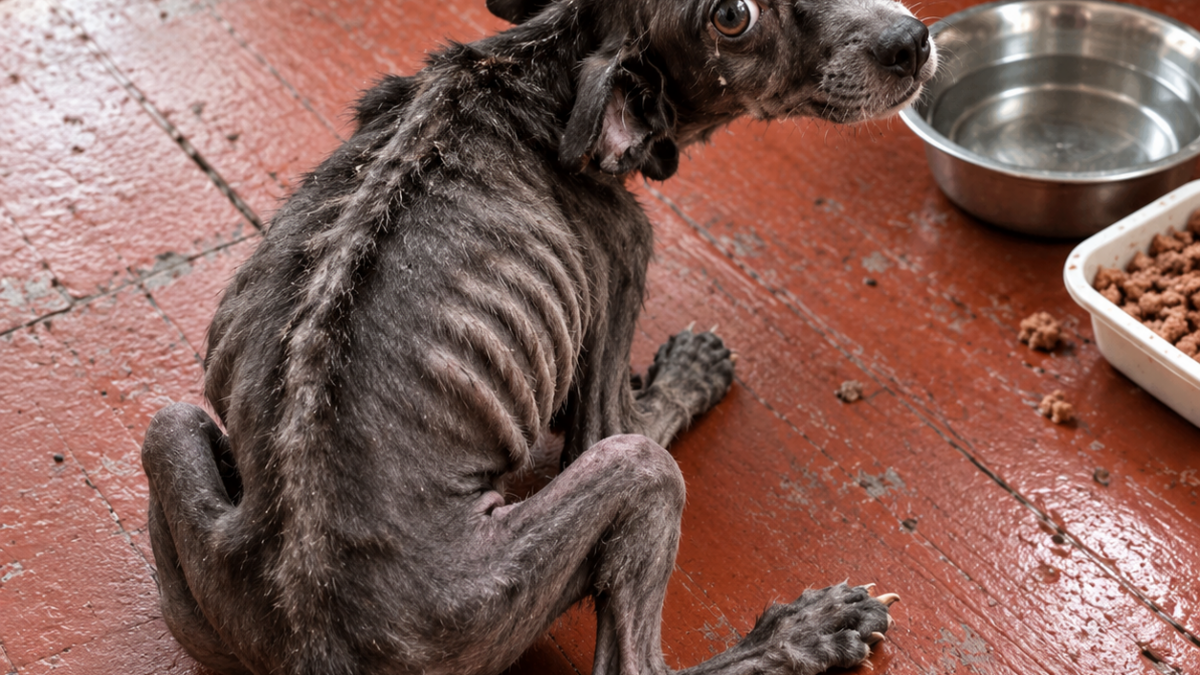
The puppy turned toward the bowl as if hunger alone could pull her forward, but her legs folded before she reached it. I could count every rib beneath her fur, and when she looked up at me, those huge dark eyes seemed far too old for a baby barely two months into the world. What happened next began with a movement so small I almost missed it.
Only a few hours earlier, my husband and I had been driving along a familiar road when I noticed something beside a trash can.
At first, I thought it was a piece of cloth.
Then I saw an ear.
“Stop the car.”
My husband braked hard and pulled over. I was out before he had fully shifted into park.
The heat coming off the pavement hit me first. Then I saw her clearly.
She was tiny.
Painfully tiny.
A little brown puppy lay on her side near the edge of the road, her body so still that my stomach dropped. Her fur was dusty. Her ribs pushed sharply against her skin. Her legs looked like thin sticks stretched beneath her.
For one terrible second, I thought we were too late.
“Oh, baby,” I whispered as I crouched beside her.
She didn’t lift her head.
She didn’t try to crawl away.
My husband came up behind me and said quietly, “Is she breathing?”
I leaned closer.
Her chest moved.
Barely.
Then her tail gave one weak little tap against the ground.
That tiny wag broke me.
Here was a puppy with almost nothing left. No strength to stand or escape. Barely enough strength to breathe in the heat.
But she still had enough left to greet us.
I slid my hands underneath her as carefully as I could. She felt almost weightless.
Later, we would learn she weighed only three pounds.
At that moment, all I knew was that she was burning hot, frighteningly thin, and too weak to hold herself upright. Her paw pads were raw and burned from the pavement. Her mouth was dry. Her body seemed to sag into my arms as if she had finally decided she no longer had to keep herself alive alone.
“We’re going,” I told my husband. “Right now.”
We drove straight to the emergency veterinarian.
I held her the entire way.
Every few seconds, I looked down to make sure her chest was still moving.
“Stay with me,” I kept whispering. “Just stay with me.”
At the clinic, the staff took one look at her and moved fast.
They carried her through the doors while we answered questions we barely knew how to answer.
How long had she been outside?
We didn’t know.
Had she eaten?
We didn’t know.
Did she belong to someone?
We didn’t know that either.
All we knew was where we had found her and how close she had looked to disappearing right there beside that trash can.
The first test results were worse than I expected.
Her red blood cell count was dangerously low. She was severely anemic, dehydrated and overheated. Parasites had been draining a body that had almost nothing left to give.
The veterinarian looked at us with the kind of expression that makes the room suddenly feel smaller.
“She needs a blood transfusion,” she said. “Now.”
I stared through the treatment-room window at that tiny puppy under the bright lights.
A few hours earlier, she had been alone on hot pavement.
Now strangers were fighting for her life.
The transfusion began. Fluids ran through a line into her fragile body. The team worked to stabilize her temperature and treated the parasites that had helped push her toward the edge.
When they finally offered her a little food, Ember—because that was the name we gave her—turned toward it immediately.
Her mind wanted to eat.
Her body couldn’t keep up.
She crouched beside the bowl on trembling legs, took a few bites, and nearly collapsed.
I reached toward her, but the technician gently stopped me.
“Slow,” she said. “After starvation, we have to be careful.”
That was one of the hardest things to hear.
Even food, the thing Ember desperately needed, could not simply be given without caution. Her body had been deprived for so long that recovery itself had to happen one measured step at a time.
I sat beside her enclosure that evening and watched her sleep beneath warming blankets.
Every so often, her paws twitched.
I wondered what a two-month-old puppy could possibly have lived through to arrive here this empty.
Then, sometime after midnight, one of the monitors changed its rhythm.
A nurse stepped quickly toward Ember’s enclosure.
Then another person followed.
And when the veterinarian turned toward me, I knew the night was nowhere near over.
PART 2
“Her temperature is dropping again.”
The veterinarian said it calmly, but I could see the urgency in the way the staff moved.
One technician adjusted the warming system. Another checked Ember’s IV line. Someone pulled a fresh blanket from a heated cabinet.
I stood outside the treatment area with both hands pressed together so tightly my fingers hurt.
My husband put one hand on my shoulder.
“She made it this far,” he said.
I nodded.
But neither of us said the other thing we were thinking.
Sometimes making it this far wasn’t enough.
I had seen animals in bad condition before. I understood that puppies could be resilient. I also understood that Ember had no reserves.
There was nothing extra left in her body.
Every breath cost something.
Every attempt to stand cost something.
Even digestion cost something.
Her heart was trying to run a body that had been deprived of the things a growing puppy needed most—food, fluids, warmth, safety.
The veterinarian eventually came back to us.
“We’ve stabilized her temperature for now.”
“For now?” I asked.
“She’s still critical.”
I looked through the glass again.
Ember was almost completely hidden beneath blankets.
Only her face showed.
Her eyes opened.
And somehow, from across that room, she found me.
I lifted my hand to the glass.
Her eyes stayed on it.
That was the moment I stopped thinking of her as a puppy we had found.
She was Ember.
She mattered to me.
And I wanted her to know that somebody was staying.
“I’m right here,” I whispered.
She couldn’t possibly have heard me through the glass.
I said it anyway.
A technician brought us two chairs.
My husband looked at me.
“You’re not leaving, are you?”
“No.”
“I figured.”
He sat down beside me.
The emergency clinic at two in the morning was a strange place. Phones rang. Machines beeped. Doors opened and closed. Somewhere down the hall a dog barked sharply, then went quiet.
People arrived carrying animals wrapped in towels and blankets.
Some left relieved.
Some didn’t.
Time became meaningless.
At some point my husband found coffee.
I took one sip and forgot about it.
Every time someone approached Ember’s enclosure, I stood.
Every time a monitor made a different sound, my stomach tightened.
Shortly before sunrise, a technician came over.
“She ate a little more.”
“How much?”
“Not much. That’s okay.”
“Did she keep it down?”
“So far.”
I felt ridiculous for becoming emotional over a few bites of food.
But when your whole world has narrowed to a three-pound puppy trying not to die, a few bites can feel like a victory.
The technician smiled.
“She also tried to stand.”
That smile disappeared from my face.
“Is that good?”
“It’s good that she wants to.”
That was the careful language everyone used around Ember.
She wanted to eat.
She tried to stand.
Her temperature was holding for now.
Her blood work had improved a little.
Nobody said she was safe.
By morning, the first transfusion had helped, but she was still profoundly weak.
The veterinarian showed us some of the lab values and explained what the parasites and prolonged malnutrition had done.
I tried to understand every number.
Eventually she stopped and said, “The important thing is this: she’s fighting.”
I looked toward Ember.
“I know.”
“And you got her here in time to give her a chance.”
Those words followed me for weeks afterward.
In time.
I kept thinking about the road.
What if we had taken another route?
What if we had driven past five minutes earlier, before I noticed her?
What if it had been dark?
What if the shape beside the trash can had looked enough like garbage that I never asked my husband to stop?
There are questions that don’t lead anywhere good.
I learned to stop asking them.
The only fact that mattered was that we had stopped.
And Ember was still breathing.
By late morning, my husband convinced me to go home for a few hours.
“You can’t help her if you fall over,” he said.
“I’m not tired.”
“You’ve been awake all night.”
“I’m fine.”
He gave me the look husbands develop after enough years of marriage—the one that says they have decided not to argue with a lie.
“You’re shaking.”
I looked down.
He was right.
“I’ll drive.”
Before leaving, I went to Ember.
A technician opened the enclosure long enough for me to touch her.
I placed two fingers gently against her forehead.
“Listen to me,” I whispered. “I’m coming back.”
Her eyes opened halfway.
“You don’t get to think I disappeared.”
Her tail shifted under the blanket.
I laughed, then immediately cried.
The technician smiled.
“She knows.”
I wanted to believe that.
At home, I showered and lay down.
I lasted nineteen minutes.
Then I sat up and checked my phone.
No missed call.
That should have comforted me.
Instead I called the clinic.
“She’s stable,” they told me.
An hour later, I called again.
Still stable.
My husband finally said, “If you call them every hour, they’re going to assign somebody just to answer you.”
“I’m sure they understand.”
“They do.”
He paused.
“So do I.”
We returned that afternoon.
Ember looked the same.
And yet not the same.
Her eyes followed movement more quickly.
When the technician brought a small dish of food, Ember lifted her head before the bowl even reached her.
The smell seemed to wake something ancient inside her.
She struggled onto her legs.
Her front paws spread wide for balance.
Her back legs trembled.
I held my breath.
She leaned toward the bowl.
One step.
Then another.
Her knees bent.
The technician steadied her with one hand.
“Easy, sweetheart.”
Ember ate.
Only a little.
Then the bowl was removed.
She looked after it.
I almost laughed.
For the first time, Ember seemed offended by something.
“That’s probably a good sign,” my husband said.
“She wants more.”
“Definitely a good sign.”
The next twenty-four hours were measured in tiny achievements.
She drank on her own.
She stood for several seconds longer.
She lifted her head when someone entered the room.
Her temperature became easier to maintain.
When the staff changed her bedding, she tried to climb toward the person holding the clean blanket.
But the blood tests were still concerning.
On the second day, her veterinarian pulled us aside.
“She’s responding,” she said. “But her red blood cell count has dropped again.”
My heart sank.
“What does that mean?”
“We need to watch it closely.”
“Another transfusion?”
“Possibly.”
I looked at Ember through the glass.
She was sleeping.
A pink bandage covered part of one tiny leg where a catheter had been placed.
It seemed impossible that something so small could require so much medicine simply to remain alive.
The veterinarian must have seen the fear on my face.
“This isn’t necessarily a setback,” she said. “She came in extremely compromised. Recovery isn’t always a straight line.”
That sentence turned out to be true in more ways than one.
By the third day, Ember was brighter.
She even barked once.
It was such a weak, scratchy little sound that everyone in the treatment room stopped and looked at her.
Ember seemed surprised too.
Then she did it again.
One of the technicians laughed.
“There she is.”
I pressed my hand to my mouth.
There she was.
Under the starvation.
Under the weakness.
Under the exhaustion.
There was a puppy.
A real puppy who wanted things.
Food.
Attention.
Warm blankets.
People.
Perhaps toys, although she didn’t know that yet.
She had opinions.
She had a voice.
And apparently she planned to use it.
That afternoon, I returned to the place where we had found her.
My husband came with me.
Neither of us really knew what we expected to find.
The trash can was still there.
Cars passed.
Heat shimmered above the pavement.
Standing there without Ember in my arms made the location feel even worse.
“How long do you think she was here?” I asked.
My husband shook his head.
“There’s no way to know.”
We walked along the roadside looking for anything that might explain her.
A collar.
A box.
A blanket.
Anything.
There was nothing.
I knocked on the door of the nearest house.
A woman answered.
I showed her a photo of Ember.
“Have you seen this puppy before?”
She studied the screen.
“No.”
“Nothing? Even earlier this week?”
“I’m sorry.”
At another house, a man thought he might have seen a small dog crossing the road two days earlier, but he wasn’t certain.
That was it.
No answer.
No history.
No explanation for how an eight-week-old puppy had ended up beside a trash can, starving and dehydrated, with burned paw pads and parasites consuming what little strength she had.
I felt anger building inside me.
Not the dramatic kind.
Something colder.
I wanted somebody to explain.
I wanted to know who had looked at Ember when she was stronger and decided she was disposable.
But there was no one there to answer.
My husband touched my arm.
“Come on.”
“I hate this.”
“I know.”
“She almost died here.”
“I know.”
“And whoever—”
My voice broke.
He waited.
“Whoever let this happen gets to keep going like nothing happened.”
He looked toward the road.
“Maybe.”
I turned to him.
“Maybe?”
He nodded toward my phone.
“Look at her.”
The screen still showed Ember’s picture.
Her eyes were enormous.
Her face was exhausted.
But she was alive.
“She doesn’t know anything about getting even,” he said. “She just wants to live.”
At the time, I wasn’t ready to hear that.
I still wanted justice.
Maybe some part of me always will.
But Ember was about to teach me that surviving can sometimes become its own answer.
We went back to the hospital.
On the fourth day, her blood count dropped enough that the veterinarians recommended a second transfusion.
My stomach tightened when they told me.
I had secretly convinced myself the worst was behind us.
It wasn’t.
“Is she in danger again?” I asked.
“She never stopped being fragile,” the veterinarian said gently. “She’s doing much better clinically, but her body still needs help.”
So Ember received blood for the second time.
I sat beside her again.
This time, I understood more about what was happening.
That didn’t make it easier.
Her tiny body lay curled beneath the blanket.
The transfusion line ran beside her.
I watched every rise and fall of her chest.
At one point, she opened her eyes.
“Hey, trouble.”
Her tail moved.
Not one tiny tap this time.
Two.
Three.
I smiled.
“That’s showing off.”
Another wag.
“Okay. I see you.”
The technician nearby laughed.
“She does that when you talk.”
“Does what?”
“Wags.”
I looked at her.
“Only me?”
The technician hesitated.
“Well… she likes pretty much everyone.”
My husband burst out laughing.
For the first time in days, I laughed too.
“That’s fine,” I said. “I’ll accept being one of many.”
Ember had survived long enough to begin collecting people.
That felt important.
The second transfusion gave her what she needed.
Over the next twenty-four hours, the difference became easier to see.
Her gums looked healthier.
Her eyes were brighter.
She stood without immediately collapsing.
Then, on the fifth morning, something happened that I will never forget.
I walked into the treatment area.
Ember saw me.
She stood.
She took three wobbly steps forward.
Then she wagged her entire back end.
The same puppy who had been too weak to lift herself from hot pavement was standing because she wanted to come toward me.
I crouched.
“Come here.”
A technician opened the enclosure.
Ember walked into my hands.
Not gracefully.
Not strongly.
But she walked.
I gathered her against my chest.
She pushed her face underneath my chin.
That was when the veterinarian said the words I had been terrified to hope for.
“If her numbers continue to hold, she can leave today.”
I stared at her.
“Leave?”
“She’s not finished recovering. Not even close. She’ll need medications, careful feeding, monitoring, follow-up blood work and plenty of rest.”
“But she can leave the hospital?”
“Yes.”
I looked down at Ember.
She licked the bottom of my chin.
I started crying.
Again.
By that point, nobody at the hospital seemed surprised.
The discharge instructions were several pages long.
Small meals.
Specific intervals.
Medication.
Parasite treatment.
Watch for weakness.
Watch for vomiting.
Watch her gums.
Keep her warm.
Limit activity.
Protect the burned pads of her paws.
Return immediately if anything seemed wrong.
I read everything twice.
Then I asked the veterinarian to explain it again.
My husband leaned over.
“She already explained that part.”
“I know.”
“Twice.”
“I want to make sure.”
The veterinarian smiled.
“You’re allowed to be nervous.”
Nervous was an understatement.
At the hospital, there had always been someone watching Ember.
Machines.
Technicians.
Veterinarians.
At home, every responsibility suddenly felt enormous.
The first time Ember fell asleep, I touched her chest to make sure she was breathing.
She woke up and looked offended.
“Sorry.”
Ten minutes later, I did it again.
My husband caught me.
“You know puppies sleep, right?”
“This puppy nearly died.”
“I know.”
“So I’m checking.”
“Every ten minutes?”
“Yes.”
He nodded.
“I’m staying out of this.”
We made a recovery space for her where she could rest without having to move far.
Soft blankets.
A low water dish.
A bed.
Her medications organized beside a notebook where I recorded everything.
7:00 a.m.—ate.
7:15—medication.
8:30—water.
9:05—urinated.
My husband saw the notebook.
“You’re documenting bathroom breaks?”
“Yes.”
He slowly backed away.
I didn’t care.
Ember was home.
That first evening, she slept for hours.
When she woke, she lifted her nose.
Food.
Her eyes followed me immediately.
“You’re hungry?”
Her tail started.
For a dog who had nearly starved to death, mealtime carried a complicated weight.
Every instinct in me wanted to fill a bowl and let her eat until she was satisfied.
I couldn’t.
Her meals remained small and controlled.
The first few times I removed the dish, Ember searched the floor.
Then she stared at me.
I felt like a monster.
“I promise there’s more later.”
She stared.
“You’re not going hungry again.”
More staring.
“I know you don’t believe me yet.”
That was the hardest part.
We could tell her she was safe.
But safety is not something a frightened animal learns because humans say the word.
Safety has to happen repeatedly.
Meal after meal.
Night after night.
A hand reaches toward you and doesn’t hurt.
A door closes and you are still warm inside.
A bowl disappears and comes back later.
You fall asleep and wake up in the same soft bed.
Nobody throws you away.
That became Ember’s real recovery.
Her body changed first.
Her heart took longer.
For the first several days, she panicked whenever food appeared.
Not aggressively.
Desperately.
Her entire body became tense.
She would eat as though somebody might take the meal away forever.
Then she would search the floor.
Under the towel.
Beside the dish.
Behind my feet.
Anywhere a crumb might have fallen.
Watching a puppy behave that way does something to you.
She should have been learning how to chase leaves.
She should have been chewing shoes.
Instead, she already understood hunger.
I began sitting near her while she ate.
Not touching her.
Not moving the bowl.
Just sitting.
“You have time,” I told her.
She inhaled the meal.
“You have time.”
Eventually, the frantic eating slowed.
A little.
Then a little more.
One morning she stopped halfway through and looked up at me.
I froze.
She looked at the bowl.
Then at me.
Then she returned to eating.
It was nothing.
And it was everything.
For the first time, she had interrupted a meal voluntarily.
Some part of her had begun to believe the food would remain there.
Her burned paw pads healed gradually.
At first, the pavement outside was out of the question. We carried her to a soft patch of grass.
The first time I set her down, she stood stiffly.
Grass must have felt strange beneath injured feet.
She sniffed.
Moved one paw.
Sniffed again.
Then she looked at me.
“You can walk.”
One step.
Then another.
A breeze moved across the yard.
Ember lifted her nose.
For perhaps the first time since I knew her, she experienced the outside world without fighting to survive it.
She smelled the air.
A bird called from the fence.
Ember’s head snapped toward it.
I laughed.
“That’s a bird.”
Her ears lifted.
The bird hopped.
Ember took three steps toward it.
Then her back legs became tired and she sat abruptly.
The bird flew away.
Ember looked personally insulted.
“You’ll get another chance.”
She did.
Every day gave her another chance.
Her ribs did not disappear overnight.
Neither did her spine.
Healing starvation is not like inflating a balloon.
It is slow.
Sometimes frustratingly slow.
But photographs began to show what my eyes missed from day to day.
Her face filled out.
The hollows above her eyes softened.
Her legs developed muscle.
Her coat became smoother.
Her stomach tolerated larger meals.
Her energy increased.
And then came the day Ember discovered toys.
A friend had brought a small basket.
Inside were a soft rope, a rubber ball and a plush animal nearly half Ember’s size.
I placed them on the floor.
Ember stared.
I rolled the ball.
It moved past her.
She jumped backward.
My husband laughed.
“She thinks it’s alive.”
“Don’t scare her.”
“I didn’t roll it.”
Ember approached the ball slowly.
Sniff.
Step.
Sniff.
She tapped it with one paw.
The ball rolled.
Ember jumped again.
Then something changed.
Her tail lifted.
She tapped it harder.
The ball rolled across the floor.
Ember chased it.
Four steps.
Five.
She stumbled.
Got back up.
Chased it again.
I sat on the floor laughing so hard I cried.
My husband leaned against the doorway.
“Look at her.”
I was.
I couldn’t stop.
The puppy who had once lacked enough strength to reach a food bowl was chasing a ball across our living room.
Ember finally caught it.
She put both front paws around it.
Then she looked up at us with an expression I can only describe as triumph.
“That’s yours,” I told her.
Her ears lifted.
“All yours.”
She picked it up and carried it directly into her bed.
That became Ember’s habit.
Every toy belonged in the bed.
Rope.
Ball.
Plush animal.
Eventually an old sock she stole from my husband.
“That is not hers,” he said.
Ember dragged it away.
“It apparently is now.”
“I was wearing that.”
“Not anymore.”
He looked at Ember.
She looked back.
The sock remained hers.
A few weeks earlier, we had celebrated because she had eaten a spoonful of food.
Now we were negotiating stolen laundry with her.
Recovery is strange like that.
The milestones you dream about during a crisis eventually become ordinary annoyances.
And you are grateful for every one.
Her follow-up blood work continued.
The first appointment terrified me.
I had spent days studying Ember so closely that every yawn looked suspicious.
The veterinarian drew blood.
We waited.
Ember sat on my lap chewing the edge of my sleeve.
When the veterinarian returned, she smiled before speaking.
“Her numbers look much better.”
“How much better?”
“Better enough that I want you to breathe.”
My husband laughed.
“She doesn’t do that anymore.”
I ignored him.
“What about the anemia?”
“Improving.”
“The parasites?”
“Responding to treatment.”
“Weight?”
“She’s gaining.”
“How much?”
The veterinarian gave me the number.
It wasn’t dramatic.
But it was up.
Up was beautiful.
On the drive home, I looked at Ember sitting safely beside me.
“You hear that?”
She yawned.
“You’re gaining weight.”
Another yawn.
“I realize this speech means nothing to you.”
She fell asleep.
I smiled.
“That’s okay.”
The anger about where we had found her still visited me sometimes.
Usually at night.
I would picture the trash can.
The road.
Her motionless body.
I wondered whether she had cried before becoming too weak.
I wondered whether cars had passed.
I wondered whether anyone had noticed.
I wanted a villain I could confront.
A door I could knock on.
Someone I could ask, How could you?
But we never found that person.
There was no satisfying courtroom scene.
No confession.
No moment where someone stood before me and explained how a two-month-old puppy had ended up dying alone.
We reported what we knew.
There simply wasn’t enough information to tell us exactly what had happened before we found her.
For a while, that felt unbearable.
Then one evening, Ember changed the meaning of justice for me.
I was sitting on the floor sorting laundry.
She was stronger by then.
Not completely recovered, but strong enough to become a menace.
She stole a towel.
“Ember.”
She ran.
I stood.
“Give me that.”
She looked over her shoulder.
Then she ran faster.
I chased her through the kitchen.
My husband heard the commotion.
“What happened?”
“She has a towel.”
He watched Ember race around the table.
“You seem to be losing.”
“Help me.”
“No. I’m enjoying this.”
Ember darted behind him.
“Traitor.”
He laughed.
She emerged with the towel still clenched between her teeth.
Her tail was straight up.
Her body was lean but no longer skeletal.
Her legs were working.
Really working.
She ran from me because she could.
I stopped chasing her.
My husband noticed.
“What?”
I shook my head.
Ember stopped too.
She stood across the room, towel hanging from her mouth.
I thought of the puppy beside the trash can.
Too weak to stand.
Too weak to move away from danger.
Then I looked at this little thief.
“Nothing,” I said.
But it wasn’t nothing.
That was revenge.
Not the kind I had imagined.
Better.
Someone or something had reduced Ember’s world to pain, hunger and hot pavement.
Now her world had food, blankets, toys and people willing to chase her around a kitchen because she had stolen a towel.
She had been abandoned beside trash.
Now everything she touched became valuable simply because she loved it.
She dropped the towel.
Then she ran to me.
I scooped her up.
She licked my face.
“You win,” I whispered.
And she did.
As Ember became healthier, we had to face a question I had avoided.
What came next?
Saving an animal during an emergency is one thing.
Deciding where that animal will spend the next ten or fifteen years is another.
My husband raised the subject carefully.
“We should talk about her future.”
I was holding Ember.
“What about it?”
He gave me a look.
“You know what.”
“No.”
“Yes.”
“I genuinely don’t.”
He smiled.
“You’re a terrible liar.”
I hugged Ember closer.
At first, I imagined keeping her.
Of course I did.
How could I not?
I had carried her from the roadside.
Sat through both transfusions.
Counted her meals.
Checked her gums in the middle of the night.
Celebrated every ounce she gained.
There were moments when I thought the story had already chosen its ending.
Ember would simply stay.
But love is not always the same thing as ownership.
Our home had its own realities.
Our schedules.
Our responsibilities.
Other animals and commitments.
As Ember recovered, it became obvious that she was going to be an energetic, social, demanding young dog.
She deserved more than a household keeping her because we were afraid to let go.
She deserved the right household.
That realization hurt.
The rescue people helping us began discussing adoption.
The first time someone used the word, I felt physically sick.
“Not yet,” I said.
“She’s not going anywhere yet,” they assured me.
“I mean… eventually.”
That was harder.
Eventually had felt abstract when Ember was fighting for her life.
Now eventually was coming.
Applications arrived.
Some people saw her photographs and fell in love immediately.
But we had learned too much about Ember to choose based on enthusiasm alone.
She needed a family who understood what she had been through.
Someone patient.
Someone committed to veterinary follow-ups.
Someone who wouldn’t treat her food anxiety as bad behavior.
Someone who would let her become a normal puppy without expecting her past to disappear on command.
We spoke to several families.
One had a beautiful home but was gone ten hours most weekdays.
Another wanted a dog for their older dog to “keep busy.”
One person asked whether Ember would stay very small.
Something about that question made me uneasy.
Ember was not an accessory.
She was not a sad story someone could display.
So we kept looking.
Then we met the family who eventually became hers.
I knew something was different before they touched her.
They sat on the floor.
They waited.
That mattered.
Ember entered the room and immediately began investigating.
She sniffed shoes.
A bag.
A chair.
Then she approached them.
Nobody lunged toward her.
Nobody squealed.
Nobody grabbed.
The woman extended her hand low.
Ember sniffed.
Then Ember climbed directly into her lap.
I looked at my husband.
He looked at me.
Neither of us spoke.
The man smiled.
“Well,” he said softly, “I guess she’s decided.”
“Don’t get too confident,” I said. “She likes everybody.”
The family laughed.
It was the same joke the technician had made after Ember’s second transfusion.
But this time it hurt a little.
Because soon, everybody might mean people who weren’t us.
We talked for a long time.
I told them about the roadside.
The transfusions.
The parasites.
Her food insecurity.
The burned paw pads.
The follow-up tests.
The way she carried every toy into her bed.
The towel theft.
The sock theft.
The fact that she could somehow hear a food container open from three rooms away.
They listened.
Really listened.
Then the woman asked a question nobody else had asked.
“What scares her?”
I paused.
That mattered too.
“Being left alone for too long,” I said. “And sudden movements around her bowl used to scare her, although she’s improving.”
The woman nodded.
“What makes her feel safe?”
I looked down at Ember.
“Consistency.”
They understood.
That did not make handing her over easy.
The adoption day arrived far too quickly.
I woke up before sunrise.
Ember was sleeping on her back, paws in the air, completely shameless.
I sat beside her.
“This is rude.”
She opened one eye.
“You’re supposed to make this easier.”
She closed it.
I touched her chest.
The movement beneath my hand was strong now.
Not the faint rise and fall I had watched beside the road.
Strong.
Steady.
Alive.
My husband entered.
“You okay?”
“No.”
He sat beside me.
“I know.”
“What if she thinks we’re abandoning her?”
“She won’t.”
“How do you know?”
“Because we’re not.”
I looked at him.
“She doesn’t understand paperwork.”
“No. But she understands people.”
He nodded toward Ember.
“And she trusts people now because of what happened here.”
That should have comforted me.
Instead I cried.
Again.
“I hate that you’re right.”
“I know.”
We packed Ember’s things.
Her favorite blanket.
Her food.
Medical records.
Medications.
The rubber ball.
The plush animal.
And, after a brief argument, one of my husband’s old socks.
“You cannot give away my sock.”
“She loves it.”
“She has toys.”
“She loves the sock.”
He stared at me.
“Fine.”
I put it into the bag.
Ember watched all of this from the doorway.
She seemed deeply interested in the bag.
She had no idea it contained pieces of her first safe home.
When her family arrived, Ember greeted them with wild tail wags.
That helped.
And hurt.
They knelt.
She climbed against them.
The woman looked at me.
“We’ll take care of her.”
I nodded.
“I know.”
“If you ever want pictures—”
“Yes.”
She smiled.
“I assumed.”
“I mean a lot of pictures.”
“We can do that.”
“Too many pictures.”
“There probably isn’t such a thing.”
I liked her even more for saying it.
I knelt beside Ember.
She came immediately.
I pressed my forehead against hers.
For several seconds, I couldn’t speak.
Then I whispered, “You were never trash.”
Her tail tapped the floor.
“Do you understand me?”
She licked my nose.
“You were never what somebody treated you like.”
Another lick.
“You were always worth stopping for.”
My throat closed.
I wrapped my arms around her.
“And wherever you go, you remember that.”
Of course Ember did not understand my words.
But maybe dogs understand tone.
Maybe they understand hands that hold them gently.
Maybe they understand when someone is saying goodbye.
She stayed still against me.
Then she turned toward her new family.
That was when I knew it was time.
I handed them the leash.
It felt impossibly heavy.
They walked toward their car.
Ember hopped inside.
Hopped.
That word mattered.
Not lifted because she was too weak.
Not carried because she could not stand.
She jumped into a car on her own four legs.
Before the door closed, she turned toward us.
Her tail was wagging.
I waved.
My husband put his arm around me.
The car drove away.
I cried until it disappeared.
Then I cried some more.
The house felt wrong without her.
Too clean.
Too quiet.
No food bowl scraping against the floor.
No toenails clicking down the hallway.
No stolen laundry.
That night I found one of her toys under the couch.
A little rope.
I sat on the floor holding it.
My husband found me there.
“You want me to call them?”
“No.”
“You sure?”
I looked at the rope.
“Yes.”
He sat beside me.
“She’s where she’s supposed to be.”
“I know.”
Knowing and feeling are not always neighbors.
Sometimes they live miles apart.
The first photograph arrived the next morning.
Ember was asleep on a couch.
Under a blanket.
Only her nose was visible.
The message said she had eaten breakfast, explored the whole house and chosen the couch as her favorite place.
I zoomed in on the picture.
Then again.
My husband looked over my shoulder.
“You know zooming doesn’t make her healthier.”
“I’m examining her.”
“For what?”
“Happiness.”
He shook his head.
“Any diagnosis?”
I smiled.
“Severe.”
More photographs came.
Ember carrying a toy.
Ember asleep against someone’s leg.
Ember investigating the backyard.
Ember sitting beside her new food bowl.
Then a video.
I almost didn’t open it.
I was afraid it would make me miss her more.
Instead, I laughed so loudly my husband came running.
“What?”
I held up the phone.
Ember was sprinting.
Not walking.
Not wobbling.
Sprinting.
She raced across the backyard after her ball, overshot it, skidded in the grass and turned around so fast her back legs nearly passed her front ones.
My husband watched.
“Play it again.”
I did.
Again.
Then again.
On the fourth viewing, I started crying.
He sighed.
“You’re crying at everything this dog does.”
“Look at her legs.”
“I see them.”
“No. Look.”
I paused the video.
Those thin trembling legs were filled out.
Strong.
Muscular.
The same legs that had failed beside a food bowl.
The same legs that had been unable to lift her from hot pavement.
Now they were carrying her faster than she knew how to control.
Months passed.
Ember kept growing.
Her coat became rich and healthy.
Her chest filled out.
The sharp line of her spine vanished beneath muscle and fur.
If someone met her without knowing her history, they might never have guessed how close she had come to dying.
But I knew.
Every photograph contained two dogs for me.
The dog in front of me.
And the ghost of the three-pound puppy beside the trash can.
Her new family kept every promise.
Veterinary appointments.
Good food.
Patience.
Training.
Play.
Routine.
Love.
And pictures.
So many pictures.
One afternoon, I received a photograph that made me sit down.
Ember was standing in front of a window watching snow fall.
Snow.
The puppy we had found overheated on burning pavement was staring at a world turned white.
Her ears were forward.
Her nose nearly touched the glass.
A message followed.
She doesn’t know what to think.
Then another.
We’re taking her outside.
I immediately called my husband.
“You need to see this.”
He came over.
We waited like grandparents watching a live broadcast.
Another video arrived.
The door opened.
Ember stepped out.
She froze.
One paw lifted.
Her nose dipped toward the snow.
She touched it.
Jumped backward.
I laughed.
Then she lunged forward again.
Within seconds, she was running.
Snow flew behind her paws.
She buried her nose in it.
Leaped.
Spun.
Ran in circles.
Her family threw a toy.
Ember launched after it.
At one point she disappeared behind a spray of powder and came charging back with snow covering her muzzle.
Her tail never stopped.
I watched the video three times.
Then I remembered something.
The roadside.
The heat.
Her burned paw pads.
I pictured those same feet touching burning asphalt.
Now they were punching through clean snow while she ran toward people who loved her.
The contrast was almost too much.
My husband looked at me.
“I know.”
I wiped my face.
“I didn’t say anything.”
“You didn’t have to.”
A few weeks later, Ember came to visit.
I worried she might not remember us.
That fear was ridiculous.
The car door opened.
Ember saw me.
For half a second she froze.
Then she exploded.
She hit the end of the leash so fast her family laughed and unclipped it.
“Ember!”
She ran straight into me.
I crouched just before impact.
She climbed halfway into my lap despite no longer fitting there.
Her tail struck everything within reach.
My arms.
The cabinet.
My husband.
He bent down.
“Hey, thief.”
Ember attacked his face with kisses.
“Still no manners.”
She ran through the house as though checking whether everything remained where she had left it.
Kitchen.
Living room.
Hallway.
Then she stopped beside her old recovery spot.
The bed was gone.
She sniffed the floor.
I wondered if she remembered.
Maybe not in the way we do.
Dogs don’t build stories around trauma the same way humans do.
Maybe that was another lesson.
I remembered the suffering because I thought remembering honored what she survived.
Ember seemed more interested in what existed now.
She found the basket of toys.
That mattered.
She pulled one out.
Then another.
Then she discovered the old rope toy I had kept.
She grabbed it.
My husband laughed.
“You kept that?”
“Yes.”
“For months?”
“Yes.”
“You mocked me over one sock.”
“The situations are completely different.”
Ember ran between us carrying the rope.
Her family laughed.
For the next hour, the house felt like it had during her recovery, except nothing was fragile anymore.
Nobody counted breaths.
Nobody checked gum color.
Nobody measured food by fear.
Ember played until she was exhausted.
Then she lay in the middle of the floor surrounded by people.
Her family sat beside her.
I watched the woman rub Ember’s chest.
Ember closed her eyes.
Completely relaxed.
That was when something inside me finally settled.
Until then, I had carried a secret worry that adoption meant we had rescued Ember only to send her away.
Now I understood.
We had not been the destination.
We had been the bridge.
There is dignity in being the bridge.
You carry someone from the worst place they have ever known toward a place you may never own.
Then, if you really love them, you let them cross.
Before Ember left that evening, her family asked whether I wanted to walk her to the car.
I did.
The sun was low.
The pavement had cooled.
Ember trotted beside me.
I looked down at her paws.
Healthy.
No burns.
No hesitation.
At the car, she jumped inside.
Then she turned and put her front feet on the seat, watching me.
“Goodbye, baby.”
Her tail moved.
Her family smiled.
“She’ll visit again.”
“I know.”
I stepped back.
This time, when the car left, I didn’t cry.
Well.
Not much.
I watched until it turned the corner.
Then I went inside.
Months later, I drove past the place where we had found her.
I hadn’t planned to stop.
But I did.
The trash can was still there.
For a moment, the old anger returned.
I could see everything again.
The tiny body.
The ribs.
The dry mouth.
The little paws damaged by the heat.
I remembered kneeling down believing she was dead.
Then the tail moving.
One tiny wag.
I stood there for a long time.
There was still no answer to the question I once thought I needed answered.
I never learned exactly how Ember ended up there.
I never got the confrontation I had imagined.
There was no person standing in front of me forced to face what they had done.
No dramatic punishment.
No perfect explanation.
But I realized something.
If the purpose of revenge is to deny someone the ending they tried to create for you, Ember had already won completely.
That roadside could have been her ending.
It wasn’t.
Hunger could have been her ending.
It wasn’t.
The anemia could have been her ending.
It wasn’t.
The parasites could have been her ending.
They weren’t.
The first night at the hospital could have been her ending.
It wasn’t.
The second transfusion could have been the last desperate attempt before goodbye.
It wasn’t.
Everything that had pushed Ember toward death had failed.
She was somewhere warm.
Probably stealing a sock.
Probably throwing a toy into somebody’s lap.
Probably running on legs that once could not hold her upright.
That felt like justice.
Not perfect justice.
But living justice.
I got into my car.
Before driving away, I opened the latest photograph her family had sent me.
Ember was sprawled across a couch.
One paw hung over the edge.
Her head rested on someone’s leg.
Her eyes were closed.
Behind her was a basket overflowing with toys.
I laughed.
The puppy who once searched desperately for crumbs now had more toys than she knew what to do with.
That evening, another message arrived.
A snowstorm had come through.
The video showed Ember charging across the yard.
She was older now.
Bigger.
Strong.
Her body cut through the snow as if she had been built for nothing else.
Someone behind the camera called her name.
Ember turned.
For one second she stood completely still.
Snow clung to her face.
Her ears lifted.
Then her tail began to wag.
Big.
Wild.
Free.
She ran toward the camera.
I paused the video just before she reached it.
I stared at that frame.
The tail.
That was what got me.
The first thing Ember had given us beside the road had been a tail wag.
Barely visible.
One tiny movement from a puppy whose body had almost shut down.
She had possessed almost nothing then.
No strength.
No food.
No safe place.
No family we knew about.
But somehow, she had found enough energy for that one little wag.
Maybe that was why I could never forget it.
It had been the smallest possible declaration.
I’m still here.
Now I watched that same tail sweep through the air behind a healthy dog racing through snow toward her family.
I thought about the five days in the hospital.
Two blood transfusions.
The IV fluids.
The warming blankets.
The careful meals.
The burned paws.
The sleepless nights.
The fear.
The notebook full of every bite and bathroom break.
The first ball.
The stolen towel.
The old sock.
The adoption day.
All the moments between a trash can and that snow-covered yard.
People sometimes imagine rescue as one dramatic moment.
You see an animal in danger.
You pick her up.
You save her.
But that isn’t what Ember taught me.
Rescue was the stop on the road.
Then rescue was the drive to the emergency clinic.
Rescue was donated blood entering a tiny body.
It was a veterinary technician warming a puppy at two in the morning.
It was feeding a few careful bites when every instinct said to give her an entire bowl.
It was treating parasites.
It was another transfusion.
It was monitoring her temperature.
It was carrying her onto soft grass.
It was letting her learn that bowls come back.
It was finding the right home instead of simply the fastest home.
It was her family respecting the fear she brought with her.
It was consistency.
Again and again.
Until safety stopped being something Ember borrowed from us and became the life she expected.
That may be the most beautiful thing of all.
Ember no longer behaves like a dog waiting for everything good to disappear.
She sleeps deeply.
She leaves food in her bowl sometimes.
The first time her family told me that, I almost couldn’t believe it.
“She left food?”
“Yes.”
“Voluntarily?”
They laughed.
“Yes, Ernestina.”
I had to sit with that.
A puppy who once had to search for crumbs could now walk away from a bowl because she knew there would be another meal.
That is what healing looks like.
Not forgetting hunger.
Learning that hunger no longer controls tomorrow.
One summer afternoon, long after Ember’s adoption, her family invited us over.
When we arrived, Ember met us at the gate.
She was nearly unrecognizable from the puppy I had carried from the roadside.
Her chest was broad.
Her coat shone.
Her legs were powerful.
She raced around us twice before finally allowing anyone to touch her.
My husband laughed.
“She’s still insane.”
Her family smiled.
“You should see her at six in the morning.”
Ember brought us a ball.
Dropped it.
Stared.
My husband picked it up.
“Ready?”
Her entire body tightened.
He threw.
Ember ran.
She covered the yard in seconds.
I watched her return with the ball held proudly in her mouth.
Again.
Again.
Again.
She could have done it all afternoon.
At one point, I stopped looking at Ember and looked at her family instead.
They were watching her the way we had once watched every breath in the hospital.
But there was no fear in their faces.
Only love.
The woman noticed me watching.
“What?”
“Nothing.”
“You have that look.”
“What look?”
“The Ember look.”
I smiled.
“She looks happy.”
“She is.”
“She really is.”
The woman came closer.
“She changed our house.”
I glanced at Ember.
“How?”
“We thought we were adopting a puppy who needed us.”
She laughed softly.
“Turns out we needed her too.”
I understood.
Ember returned and dropped the ball between us.
Then she barked.
Loud.
Impatient.
Healthy.
I bent down.
“You used to barely have enough energy to wag.”
She barked again.
Her family laughed.
“I don’t think she appreciates the history lesson.”
“No.”
I picked up the ball.
“She has important business.”
I threw it.
Ember raced away.
That evening, before we left, she climbed beside me on the porch.
For once, she was tired enough to be still.
I ran my fingers down her back.
There was muscle where bones once protruded.
Warmth where there had once been dangerous cold.
Her breathing was slow and peaceful.
“You did all right,” I whispered.
One ear moved.
“Actually, you did more than all right.”
Ember rested her chin on my leg.
I looked across the yard at the family waiting inside for her.
The food bowl near the kitchen.
The basket of toys.
The blanket on the couch.
A leash hanging near the door.
A life.
An ordinary dog’s life.
People often use the word “miracle” when an animal survives something terrible.
I understand why.
But Ember’s life wasn’t built by one miracle.
It was built by dozens of people choosing not to give up during dozens of small moments.
The person who supplied blood.
The veterinarian who recognized how critical she was.
The technician who warmed her.
The people who helped treat her parasites.
The people who fed her carefully.
The people who helped her recover.
The family who promised she would never again wonder whether someone was coming back.
And yes, my husband and me stopping beside that trash can.
I once thought saving Ember happened when we picked her up.
Now I know that was simply the first yes.
Yes, we see you.
The veterinary staff gave another.
Yes, your life is worth fighting for.
The second transfusion said it again.
Yes.
Every measured meal said it.
Yes.
Every warm blanket.
Every follow-up appointment.
Every toy.
Every night indoors.
Every patient moment from her family.
Yes.
Yes.
Yes.
Until all those answers became louder than whatever had happened to her before.
I sometimes wonder what would have happened if Ember’s tail had not moved that first day.
Would I have touched her anyway?
I believe I would have.
But that little movement changed something.
It told me she was still inside that exhausted body.
Still reaching.
Still willing to meet the world halfway.
So we met her there.
Years from now, Ember will never know why a woman she once knew keeps getting emotional when she runs.
She will never understand why I stare at her legs.
She won’t know why a half-finished bowl of food can make me smile.
She won’t remember the numbers on the blood tests.
The transfusions.
The heat.
The trash can.
Maybe that is a gift.
I remember so she doesn’t have to.
Her job is different now.
Her job is to run.
To steal socks.
To tear stuffing from toys her family swore were indestructible.
To bark when dinner is three minutes late.
To leave nose prints on windows.
To track snow across clean floors.
To sleep diagonally across furniture designed for humans.
To greet the people she loves as if they have been gone for years instead of twenty minutes.
To be annoying.
To be funny.
To be spoiled.
To be safe.
To be a dog.
That is the ending I wanted for her.
Not a grand act of revenge.
Something much stronger.
A life so full that the place where she was almost lost became only the first page.
The last time I visited Ember, snow had started falling again.
She stood at the glass door watching it.
Her family opened the door.
She looked back once.
Then she launched herself into the white yard.
I followed to the porch.
The cold bit through my sleeves.
Ember didn’t care.
She ran in enormous circles.
Her paws threw snow behind her.
She buried her face in a drift and came up snorting.
Everyone laughed.
Then Ember spotted me.
She stopped.
For a heartbeat, I saw the roadside puppy again.
Those eyes.
That face.
That little soul looking toward a human and deciding whether to trust.
“Come here, Ember.”
She ran.
Her body flew across the yard.
No trembling.
No collapsing.
No stopping.
When she reached me, she jumped against my legs so hard I nearly lost my balance.
I knelt.
She covered my face with cold, wet kisses.
“All right, all right.”
Her tail slammed against my coat.
I held her face between my hands.
“You know something?”
Ember panted happily.
“You won.”
She licked my nose.
I laughed.
“You absolutely won.”
Behind us, the door stood open.
Warm yellow light spilled onto the snow.
Her family was inside.
Her bed was inside.
Dinner was inside.
Everything she needed was waiting.
Ember turned toward that light.
Then she looked back at me.
Her tail moved once.
For a second, the world became very quiet.
I thought of another tail wag beside another road.
Tiny.
Weak.
Almost invisible.
The first had said, I’m still here.
This one seemed to say something else.
I’m home.
And then Ember raced through the open door.
The puppy turned toward the bowl as if hunger alone could pull her forward, but her legs folded before she reached it. I could count every rib beneath her fur, and when she looked up at me, those enormous dark eyes seemed far too old for a baby barely two months into the world. What happened next began with a movement so small I almost missed it.
Only a few hours earlier, my husband and I had been driving home when something beside a roadside trash can caught my eye.
At first, I thought it was an old towel.
Then I saw an ear.
“Stop the car.”
My husband hit the brakes and pulled onto the shoulder.
I was out before he had fully shifted into park.
Heat rose from the pavement in waves. The afternoon sun had turned the asphalt into something you could almost feel burning through your shoes.
And there she was.
A puppy.
Tiny.
Motionless.
Her brown fur was dusty and dull. Her ribs pushed against her skin like fingers beneath a thin sheet. Every knob of her spine showed. Her legs looked impossibly narrow beneath her body.
I stopped breathing.
“Oh, no.”
My husband hurried up behind me.
“Is she alive?”
I crouched carefully.
For one awful second, I didn’t know.
She didn’t lift her head.
She didn’t pull away.
I leaned closer until I saw the smallest movement in her chest.
“She’s breathing.”
Barely.
Then her tail moved.
One weak tap against the ground.
That tiny wag broke something inside me.
Here was a puppy with almost nothing left. No strength to stand. No strength to crawl away from strangers. No strength even to lift her head.
But she still had enough left to greet us.
I slid both hands underneath her.
She felt frighteningly light.
Later, the veterinarian would tell us she weighed only three pounds.
At that moment, I knew only that she was burning hot, dangerously thin and completely helpless.
Her paw pads were raw from the pavement.
Her mouth was dry.
Her body sagged against my chest as if she had finally decided she didn’t have to keep herself alive alone.
“We’re taking her in,” I said.
My husband was already opening the passenger door.
I held her all the way to the emergency veterinary hospital.
Every few seconds, I checked whether her chest was still moving.
“Stay with me,” I whispered.
Her eyes opened once.
Just halfway.
“Come on, baby. Stay.”
The moment we entered the clinic, the staff moved fast.
A technician took her from me while another began asking questions.
“How long has she been like this?”
“I don’t know.”
“Has she eaten?”
“I don’t know.”
“Do you know who owns her?”
“No.”
All we knew was where we found her.
Beside garbage.
On hot pavement.
Alone.
The test results came back quickly.
And they were worse than I had imagined.
Ember—as we had already started calling her—was severely dehydrated and overheated.
Parasites had been draining her body.
Her red blood cell count was dangerously low.
The veterinarian looked directly at me.
“She needs a blood transfusion immediately.”
My stomach dropped.
“A transfusion?”
“She’s critically anemic.”
I looked through the treatment-room window.
Ember lay beneath bright lights while strangers worked around her tiny body.
Hours earlier, she had been dying beside a road.
Now an entire team was fighting for her.
They started fluids.
Medication.
Heat support.
Then blood.
When Ember finally became stable enough to try food, a technician placed a small dish in front of her.
The change in her was immediate.
Her nose moved.
Her eyes fixed on the bowl.
She forced herself onto trembling legs.
One step.
Then another.
Her entire body shook.
“Easy,” I whispered.
She lowered her head.
Took a bite.
Then her legs began to give out.
I reached toward her, but the technician gently stopped me.
“We need to go slowly.”
“She’s starving.”
“I know.”
“Then let her eat.”
The technician’s voice remained kind.
“Her body has been deprived too long. Too much food too quickly can hurt her.”
That nearly destroyed me.
Even the thing Ember wanted most could not simply be given to her.
She had been hungry so long that eating again had become another medical procedure.
That night, I sat outside her enclosure watching her sleep under warming blankets.
My husband brought me coffee.
I forgot to drink it.
Every time Ember moved, I stood.
Every time a monitor changed rhythm, my heart jumped.
Then sometime after midnight, one of the machines began sounding different.
A nurse hurried toward Ember.
Then another person joined her.
The veterinarian turned toward me.
And from the look on her face, I knew Ember’s fight was nowhere near over.
[END OF FACEBOOK CAPTION]
[FIRST COMMENT / FULL STORY CONTINUATION]
“Her temperature is dropping again.”
The veterinarian said it calmly, but the room immediately seemed to move faster.
One technician adjusted Ember’s warming system. Another checked the IV line running into her leg. Someone opened a heated cabinet and brought out another blanket.
I stood behind the glass with my hands clasped so tightly that my nails dug into my palms.
My husband placed his hand on my shoulder.
“She made it this far,” he whispered.
I nodded.
Neither of us said what we were both thinking.
Sometimes making it that far wasn’t enough.
Ember had no reserves left.
The veterinarian had explained it to me earlier. A healthy puppy could lose some energy and recover. Ember had nothing left to spend.
Breathing cost energy.
Staying warm cost energy.
Digesting food cost energy.
Even standing for a few seconds could exhaust her.
Everything her body normally would have done without effort had become a battle.
I watched them tuck the blanket around her.
Her face was almost completely hidden.
Then her eyes opened.
Somehow, through the glass and the bright lights and the people moving around her, she found me.
I lifted my hand.
“I’m right here.”
She couldn’t hear me.
I said it anyway.
That first night lasted forever.
At two in the morning, a technician told us Ember had managed several bites of food.
At three, they checked her blood again.
At four, her temperature finally stabilized enough that everyone stopped moving quite so urgently.
When morning came, the veterinarian sat beside us.
“The transfusion helped.”
I exhaled.
“But?”
She gave me a sad smile.
“She’s still critical.”
That became the language of Ember’s recovery.
Better, but fragile.
Eating, but not enough.
Standing, but only briefly.
Improving, but not safe.
I went home for three hours that morning because my husband practically forced me.
“You haven’t slept.”
“I’m fine.”
“You’re shaking.”
“I’m worried.”
“You can be worried after sleeping.”
I gave him a look.
He took the car keys.
“I’m driving.”
At home, I lay on the bed and stared at the ceiling.
After twenty minutes, I checked my phone.
No calls.
Ten minutes later, I checked again.
Finally, I called the hospital.
“She’s stable,” they told me.
That should have been enough.
It wasn’t.
When we returned, Ember was awake.
A technician brought her a tiny meal.
The moment Ember smelled it, she pushed herself upright.
Her front legs spread wide for balance.
Her hind legs trembled.
But she stayed up.
She took two steps toward the bowl.
Then three.
My husband whispered, “Look at her.”
I didn’t dare speak.
Ember ate slowly.
When the technician removed the bowl, Ember stared after it with such obvious disappointment that I laughed for the first time since finding her.
“She’s angry.”
The technician smiled.
“I’ll take angry.”
So would I.
Angry meant Ember had enough strength to want something.
By the second day, her personality began appearing in tiny flashes.
She started lifting her head whenever someone entered the room.
If a technician opened her enclosure, Ember tried to scoot closer to the human hand.
She wanted warmth.
She wanted food.
But more than anything, she seemed to want people.
Then her blood count fell again.
The veterinarian showed us the results.
“We may need another transfusion.”
My stomach tightened.
“I thought she was getting better.”
“She is.”
“Then why is this happening?”
“Recovery isn’t always a straight line.”
I looked at Ember sleeping beneath her blanket.
Nothing about this was fair.
She should have been learning to chase leaves.
Chew shoes.
Fall asleep in someone’s lap.
Instead, at two months old, she was receiving blood to stay alive.
By the fourth day, they made the decision.
Ember needed another transfusion.
I sat beside her again.
This time, when she opened her eyes and saw me, her tail moved.
Once.
Twice.
Then three times.
I laughed through tears.
“You’re showing off now.”
The technician beside me smiled.
“She does that whenever people talk to her.”
“Whenever I talk to her?”
The technician hesitated.
“Well… pretty much everybody.”
My husband laughed.
I looked at Ember.
“You could pretend I’m special.”
Her tail wagged again.
That was good enough.
The second transfusion changed everything.
Over the next twenty-four hours, Ember’s gums became healthier in color.
She held her head higher.
Her appetite strengthened.
She stood for longer periods without collapsing.
Then, on the fifth morning, I walked into the treatment room and watched something I had dreamed about since that roadside.
Ember stood.
She saw me.
And she walked toward me.
Three shaky steps.
Then four.
Her whole back end started wagging.
“Oh, baby.”
A technician opened the enclosure.
Ember stumbled directly into my hands.
I picked her up.
She pushed her face beneath my chin.
The veterinarian stepped beside us.
“If her blood work holds today, she can finish recovering outside the hospital.”
I stared at her.
“You mean she can leave?”
“She’ll need medication, careful feeding, follow-up blood tests and close supervision.”
“But she can come home?”
“Yes.”
I cried so hard the veterinarian handed me tissues.
The first night Ember slept outside the hospital, I checked that she was breathing at least ten times.
My husband caught me with two fingers resting against her chest.
“You know sleeping is normal, right?”
“This dog almost died.”
“I’m aware.”
“So I’m checking.”
“You checked seven minutes ago.”
“And she’s still breathing.”
He walked away shaking his head.
I didn’t care.
Ember was alive.
For the first week, her life revolved around tiny meals and medication.
We kept a notebook.
Breakfast.
Medicine.
Water.
Bathroom.
Sleep.
More food.
I recorded everything.
My husband looked at one page.
“You wrote down that she pooped at 9:12?”
“Yes.”
“Why 9:12?”
“Because that’s when it happened.”
He slowly put the notebook down.
“I’m going outside.”
The hardest part was watching Ember eat.
At first, she ate like every meal might disappear forever.
Her entire body became tense when the bowl appeared.
She swallowed quickly, then searched the floor for crumbs.
Under her blanket.
Behind the dish.
Beside my feet.
Anywhere food might have fallen.
That hurt more than seeing her ribs.
A puppy should not already understand starvation.
So I started sitting beside her during meals.
I never touched her food.
I never moved the bowl.
I simply sat.
“You have time,” I told her.
The first day, she ignored me.
The second day, too.
Then one morning, Ember stopped halfway through the meal.
She looked at me.
Then at the bowl.
Then back at me.
For three seconds, she did nothing.
And I realized something extraordinary.
She trusted the food to remain there.
She didn’t believe every bite had to be swallowed before someone took it away.
That was the beginning of a different kind of healing.
Her paw pads improved.
Her muscles began returning.
Every few days, the scale moved upward.
Three pounds became more.
The bones along her spine slowly disappeared beneath healthy weight.
Then Ember discovered toys.
A friend brought her a rubber ball and a small plush animal.
I rolled the ball toward her.
Ember jumped backward.
My husband laughed.
“She thinks it’s attacking.”
“Be nice.”
Ember approached it again.
One paw touched the ball.
It rolled.
She jumped.
Then her tail lifted.
She tapped it again.
The ball moved farther.
This time, Ember chased it.
Five steps.
She stumbled.
Got up.
Ran again.
I sat on the floor laughing and crying at the same time.
A few weeks earlier, Ember couldn’t stand beside a food bowl.
Now she was chasing a ball through my living room.
That became her favorite game.
Soon she was stealing socks.
Then towels.
Then anything left close enough to the floor.
One evening, she grabbed one of my husband’s socks and ran.
“That is not yours,” he said.
Ember ran faster.
He looked at me.
“Do something.”
“I think she disagrees.”
“This is my sock.”
Ember disappeared around the corner.
I smiled.
Every stolen sock felt like a victory.
The dog who once lacked enough strength to move away from danger now had enough energy to create trouble.
Eventually, though, we had to face the question I didn’t want to discuss.
Where would Ember live permanently?
Part of me wanted to keep her.
How could I not?
I had carried her from the roadside.
I had sat through both transfusions.
I had watched her learn to eat without fear.
But loving Ember meant thinking about what she needed, not only what I wanted.
She was becoming energetic.
Social.
Curious.
She needed a family who could give her years of attention and stability.
So we began looking.
Several people wanted her because they had seen her before-and-after photographs.
That wasn’t enough for me.
I wanted someone who understood that Ember wasn’t a sad story.
She was a dog.
She needed training.
Veterinary care.
Patience.
Routine.
Then one family came to meet her.
They did something different.
They sat on the floor.
And waited.
Ember sniffed the room.
She approached slowly.
The woman extended her hand.
No grabbing.
No excited shouting.
Ember sniffed her fingers.
Then climbed directly into her lap.
I looked at my husband.
He looked at me.
Neither of us needed to say anything.
Before they left, the woman asked me one question.
“What makes her feel safe?”
That was when I knew.
“Consistency,” I said.
She nodded.
“We can give her that.”
Adoption day was one of the hardest days of my life.
I packed Ember’s blanket.
Her favorite toys.
Medical records.
Her ball.
Even one of my husband’s stolen socks.
He protested.
“She stole that.”
“Exactly. It belongs to her now.”
I knelt beside Ember before handing over the leash.
I pressed my forehead against hers.
“You were never trash,” I whispered.
Her tail tapped the floor.
“You were never what somebody treated you like.”
She licked my face.
“You were always worth stopping for.”
Then she walked toward her new family.
Not carried.
Not lifted.
Walked.
When they reached the car, Ember jumped inside by herself.
That nearly broke me.
The puppy who once couldn’t lift herself off burning pavement had just jumped into a car on four strong legs.
The first picture arrived the next morning.
Ember asleep beneath a blanket.
Then came videos of her chasing toys.
Running across the yard.
Destroying things she wasn’t supposed to destroy.
Months later, winter arrived.
Her family sent me a video.
Ember stood inside staring through a glass door at snow.
Then the door opened.
She stepped outside.
Touched the snow with one paw.
Jumped backward.
Then suddenly exploded forward.
She ran.
She spun.
She buried her face in the snow.
She raced across the yard so fast that powder flew behind her.
I watched the video again and again.
All I could see were those legs.
The legs that had trembled beside a food bowl.
The legs that had failed beneath her starving body.
Now they were carrying her through the snow.
That was the moment my anger finally changed.
For months, I had wanted revenge on whoever had allowed Ember to end up beside that trash can.
I wanted someone to answer for her pain.
But we never learned exactly what happened.
There was no confrontation.
No confession.
No dramatic punishment.
And eventually I realized Ember had already delivered the only revenge that truly mattered.
Everything that had tried to destroy her had failed.
The hunger failed.
The parasites failed.
The heat failed.
The anemia failed.
The roadside failed.
Ember survived all of it.
She had food now.
A bed.
Toys.
Veterinary care.
Snow to run through.
People waiting inside a warm house.
The last time I saw Ember, she came running across that snowy yard toward me.
Strong.
Healthy.
Wildly happy.
When she reached me, she jumped against my legs and covered my face with cold kisses.
I held her head between my hands.
“You know something?”
Her tail swept through the snow.
“You won.”
Behind her, the door to her home stood open.
Warm light spilled across the porch.
Her family was waiting.
Her bed was inside.
Dinner was inside.
Everything she needed was there.
Ember looked toward the house.
Then she looked back at me.
Her tail wagged once.
I remembered the tiny movement beside the trash can months earlier.
That first wag had seemed to say:
I’m still here.
This one said something better.
I’m home.
Then Ember turned and ran through the open door.








