PART 2: We Thought It Was a Bag in the Ditch—Then the Dog Lifted Her Head, and We Saw What Someone Had Done to Her Legs
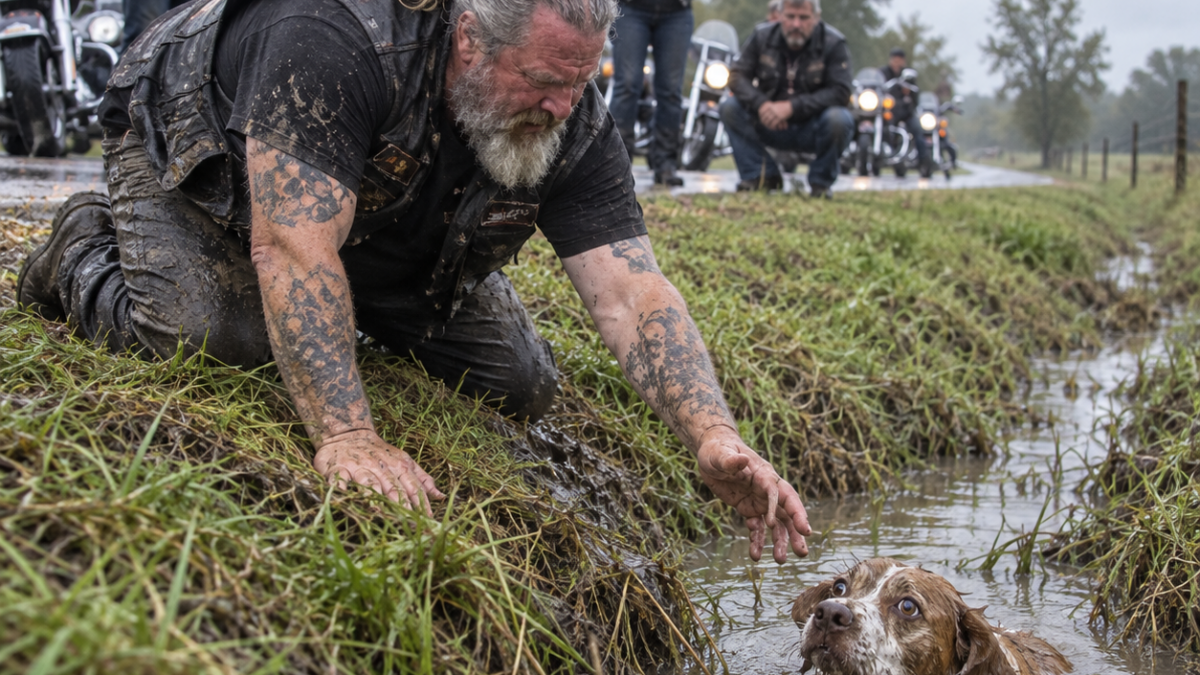
We thought someone had dumped a trash bag in the flooded ditch until the bag lifted its head and looked straight at us.
The dog was drowning only a few yards from the road, and when I reached beneath the muddy water, I discovered that all four of her legs had been tied together so tightly she could do nothing but stretch her neck up for air.
Then a gray van parked farther down the shoulder suddenly sped away, and one of my friends shouted a license plate number that would later turn this rescue into something far bigger than any of us expected.
“Stop!”
Karim’s voice cut through the rain and motorcycle engines.
Six of us were riding a narrow departmental road through the Ardennes toward Charleville-Mézières after delivering boxes of food, diapers, blankets, and bottled water to a small rural aid organization.
I was fifty-eight then.
My name is Marc Delorme.
I’m tall, gray-haired, heavily tattooed, and after thirty years around workshops, construction sites, motorcycles, and people who judge before asking questions, I had stopped caring what strangers assumed about men like us.
Our little volunteer motorcycle group wasn’t impressive on paper.
We had no uniforms.
No sponsors.
No polished social media campaign.
We simply helped where we could.
We built ramps for elderly people.
Carried furniture for families escaping bad situations.
Delivered food when community groups called.
That morning, the rain had turned roadside ditches into long channels of brown water.
Karim was riding second when he spotted something beside a concrete drainage pipe.
At first I saw exactly what he had seen.
A dirty brown shape.
A sack.
Then it moved.
The six motorcycles stopped almost together.
Thierry killed his engine and stared down the embankment.
“Marc.”
His voice sounded wrong.
“What?”
“That’s a dog.”
A brown-and-white female was trapped in the ditch with only her head and part of her shoulders visible.
A pale stripe ran between her eyes.
Her ears were pinned flat against her skull.
She tried to lift herself.
Nothing happened.
Her head sank.
Then surfaced again.
I was already moving toward the edge when Thierry said the words that changed everything.
“Her legs aren’t moving.”
I slid down the wet bank.
Then I saw why.
All four of them had been tied together beneath the water.
Not caught in weeds.
Not trapped beneath debris.
Tied.
My stomach turned cold.
The dog could not swim.
Could not climb.
Could not even put one paw against the bottom.
She could only extend her neck and fight for one more breath.
Thirty or forty yards farther along the road sat a gray delivery van.
A man stood beside the driver’s door.
He looked toward us.
Then toward the dog.
The moment he realized we had seen him, his face changed.
“Karim,” I shouted. “Get the plate.”
Karim already had his phone out.
The man jumped into the van.
Tires sprayed water across the road as he accelerated away.
Thierry called emergency services and gave them the direction of travel.
I barely heard him.
I had stripped off my jacket and boots.
The ditch water reached my chest.
It smelled of mud, leaves, fuel, and stagnant runoff.
The dog saw me coming.
“Easy, sweetheart.”
Her eyes locked on mine.
“I’m coming.”
Her head slipped beneath the surface.
I lunged.
My arm went under her chest just before her nose disappeared completely.
She came up coughing.
Her body shook against me.
With my free hand, I reached underwater.
My fingers found rope.
It had been wound around her legs and pulled so tightly I could barely slide one fingertip beneath it.
“Who did this to you?”
She pressed her face against my shoulder.
I pulled the small safety knife from my pocket.
Behind me, my friends were stopping traffic, shouting information to dispatchers, and watching for the van.
But the whole world had narrowed to one exhausted dog.
One rope.
One blade.
Her breathing became weaker.
I pushed the knife beneath the first binding.
The rope was soaked and swollen.
The blade slipped.
The dog’s head sagged.
“Stay with me.”
I cut again.
One strand snapped.
Then another.
Suddenly I felt one leg move against my wrist.
“Come on.”
Her eyes were closing.
I tightened my arm around her chest.
“Don’t you quit now.”
I slid the blade toward the final knot.
And somewhere behind me, Thierry shouted something that made every one of us turn toward the road.
The gray van was coming back.
PART 2
For one second, I thought Thierry had made a mistake.
Why would the man come back?
He had already escaped.
Karim had photographed the van.
Thierry had given emergency dispatch its direction.
Any sensible person who had done something terrible and realized six witnesses had seen him would keep driving.
But the van was definitely returning.
Fast.
Too fast.
It appeared around the bend, gray body rocking on the wet road.
Karim stood near our motorcycles.
“Marc!”
I was still waist-deep in the ditch with the dog against my chest.
“Move the bikes!”
Three of the men dragged the motorcycles farther onto the shoulder.
Thierry stepped into the road and waved both arms.
The driver did not slow immediately.
For a terrifying moment I thought he intended to hit him.
“Thierry!”
He jumped backward.
The van braked hard maybe twenty meters from us.
Its tires hissed across wet asphalt.
The driver’s door opened.
The same man got out.
He was perhaps forty-five.
Dark jacket.
Jeans.
Short hair plastered by rain.
He looked at the ditch.
Then at me.
“What are you doing?”
I honestly thought I had misheard him.
“What am I doing?”
“That’s my dog.”
Nobody spoke.
The dog trembled in my arms.
I still had only two of the bindings cut.
Her hind legs remained tied.
Karim lifted his phone.
“Good. Then you can explain why her legs are tied.”
The man’s eyes moved toward the phone.
“Put that away.”
Karim laughed once.
Not pleasantly.
“No.”
The driver took two steps toward the ditch.
Thierry moved between us.
“Stay there.”
“You don’t tell me where I can go.”
Thierry was almost sixty, six-foot-four, and built like a wardrobe.
He didn’t raise his voice.
“No closer.”
The man looked around.
Six motorcycles.
Six men.
Several cars now stopped behind us.
Phones beginning to appear.
His confidence shifted.
“It was an accident.”
I looked down at the rope beneath the water.
“You accidentally tied four legs together?”
He ignored me.
“She gets loose.”
Karim stared at him.
“So you tied her and put her in a ditch?”
“I didn’t put her anywhere.”
“Then how did she get here?”
Silence.
The dog coughed again.
That ended my interest in the argument.
“Thierry, keep him there.”
I returned to the rope.
The final knot had tightened around both rear legs.
My knife could not slide between rope and skin safely.
“Karim!”
He came down the embankment.
“What do you need?”
“Hold her chest.”
He stepped into the water without taking off his boots.
Together we raised the dog higher.
Her body was frighteningly limp.
I worked my finger beneath the rope.
Millimeter by millimeter.
The man shouted from the road.
“You’re hurting her!”
Something inside me snapped.
I looked up.
“She is drowning because somebody tied her legs together.”
He went silent.
I pushed the blade through.
The rope broke.
The dog’s legs separated.
But they didn’t immediately move.
For one horrible second, I thought the circulation had been cut off too long.
“Come on, sweetheart.”
Nothing.
Then one hind paw twitched.
Karim saw it.
“There.”
The other moved.
Not much.
But enough.
We lifted her out.
Thierry and Benoît came down to help.
The four of us carried her up the muddy bank.
Her body was cold despite the summer temperature.
She was conscious, but barely.
I wrapped my motorcycle jacket around her.
Then we heard sirens.
The man looked toward the approaching lights.
His entire posture changed.
He turned toward the van.
Thierry said, “Don’t.”
The man stopped.
A gendarmerie vehicle arrived first.
Then an ambulance-style animal rescue van from a nearby municipal service that dispatch had contacted.
Two officers stepped out.
“What happened?”
Karim pointed.
“That man’s van was here when we found the dog.”
The driver immediately said, “She’s mine. These men are stealing her.”
One of the officers looked at the dog.
Then at the wet rope still hanging from my hand.
“What is this?”
I held it up.
“This was around all four legs.”
The officer’s face hardened.
“Sir, stay beside your vehicle.”
“This is ridiculous.”
“Beside your vehicle.”
“I’m telling you, the dog ran away.”
“Then we’ll discuss that.”
The second officer walked to the ditch.
He photographed the water.
The drainage pipe.
The tire impressions.
Then he returned.
“Who saw the vehicle before it left?”
“All of us,” Karim said.
“And who saw him outside it?”
I raised my hand.
“So did Thierry.”
Benoît added, “I saw him too.”
The man shook his head.
“I stopped because I saw the dog.”
Karim held up his phone.
“I recorded you leaving.”
The man stared at him.
“You recorded me without permission?”
Karim smiled thinly.
“You’re worried about privacy now?”
The officer intervened.
“Enough.”
The animal rescue team placed the dog on a stretcher.
A woman wearing a green emergency jacket checked her gums.
“She’s hypothermic.”
“In August?” I asked.
“Cold water, exhaustion, shock.”
“Will she make it?”
“I can’t promise.”
The dog opened her eyes when they began moving her.
Her head turned.
Toward me.
“Can I come?”
The rescuer hesitated.
“You know her?”
“About fifteen minutes.”
That should have sounded ridiculous.
It didn’t.
The dog’s eyes stayed on me.
The woman sighed.
“You can follow us to the veterinary hospital.”
I nodded.
Behind us, one of the gendarmes was now speaking to the van driver beside the patrol car.
The man pointed toward me.
His voice grew louder.
“She belongs to me!”
I looked at him.
The dog heard him too.
Her body tightened beneath the blanket.
That reaction did not go unnoticed.
The rescuer glanced at the officer.
“So much for wanting her owner.”
The man heard that.
“She’s nervous because of these idiots!”
I turned away.
There are moments when the best thing you can do for someone who wants a fight is refuse to give them one.
Besides, I had something more important.
A dog who might not survive the next hour.
—
The veterinary hospital was in Charleville-Mézières.
I followed the rescue van on my motorcycle in wet clothes because my boots were soaked and my jacket was wrapped around the dog.
By the time I arrived, I was shaking almost as badly as she had been.
Karim and Thierry followed.
The others stayed long enough to give statements to the gendarmes.
Inside the clinic, staff rushed the dog through double doors.
A receptionist handed me a towel.
“You’re dripping everywhere.”
“Sorry.”
She looked at me.
Then smiled slightly.
“I’ve seen worse reasons.”
I wrapped the towel around my shoulders.
Karim sat beside me.
His jeans were soaked from the ditch.
“You know your jacket’s gone.”
“What?”
“The dog has it.”
“She can keep it.”
“That was your expensive one.”
“She can still keep it.”
Thierry paced near the wall.
He did not pace.
Thierry was the calmest person I knew.
Seeing him unable to sit frightened me.
Finally a veterinarian came out.
A woman in her early forties.
“Who brought the female mixed breed?”
All three of us stood.
She looked at us.
“All of you?”
“Yes.”
“I’m Dr. Claire Martin.”
“How is she?” I asked.
“Alive.”
That was enough to make me breathe again.
“She inhaled some water, so we’re monitoring her lungs. Her temperature was dangerously low. She has rope abrasions around all four legs, especially the rear limbs.”
“Will she walk?”
“Circulation has returned.”
I closed my eyes.
“Thank God.”
“But.”
I opened them.
“There’s bruising around the joints, and she’s extremely exhausted. She also has older injuries.”
“What kind?”
“Scarring around her neck. Several healed rib fractures.”
Karim’s jaw tightened.
“How old?”
“The fractures?”
“The dog.”
“Maybe four.”
Four.
She had the body language of something much older.
Dr. Martin continued.
“She’s underweight, but not critically starved. This was not an animal living loose for months. Someone has been feeding her.”
“Do you know her name?”
“We scanned a microchip.”
My stomach turned.
“There is one?”
“Yes.”
“And?”
“It’s registered.”
“To him?”
“I can’t disclose personal data, but law enforcement has already requested the record.”
Thierry asked, “Can we see her?”
“For a minute.”
We followed her.
The dog lay inside an oxygen enclosure.
My black motorcycle jacket was folded nearby.
“She can’t have that in here,” Dr. Martin said. “But one of my technicians thought she should keep the smell.”
I almost laughed.
“Seriously?”
“Animals notice familiar scent.”
The dog’s eyes opened.
I crouched.
“Hello again.”
One ear twitched.
“You caused a lot of trouble today.”
Her tail moved slightly.
Karim touched my shoulder.
“Marc.”
“What?”
“Look.”
Her front paw moved against the bedding.
Then a rear paw.
Not much.
But all four moved.
I stared until my eyes blurred.
Dr. Martin smiled.
“I told you circulation returned.”
I whispered, “Good girl.”
Her eyes closed.
—
The gendarmerie called that evening.
The van driver’s name was Alain Vasseur.
Forty-six years old.
The dog was registered to him.
Her name was Bella.
Bella.
That was how I learned the name of the animal I had nearly watched drown.
The investigator, Adjudant Morel, asked me to come in the next morning.
When I arrived, Karim was already there.
“Did you sleep?”
“No.”
“Me neither.”
We gave formal statements separately.
Then Morel called us both into his office.
“We searched the van.”
I sat forward.
“And?”
“There was rope inside.”
Karim asked, “Same kind?”
“Similar. Laboratory comparison will determine more.”
“What else?”
Morel opened a file.
“A wet blanket. Work gloves. A plastic crate. Dog hair.”
“That proves she was in the van.”
“It supports that.”
Karim shook his head.
“You police people love words like supports.”
Morel almost smiled.
“Because words matter in court.”
“What does Alain say?”
“He says Bella escaped from his property earlier that morning. He drove around searching for her and happened to find you near the ditch.”
I stared.
“He says she tied her own legs?”
“He claims he has no explanation for the rope.”
Karim laughed.
Morel continued.
“He says perhaps someone else harmed her after she escaped.”
“Convenient.”
“Yes.”
“Do you believe him?”
Morel closed the file.
“My belief is irrelevant. Evidence is useful.”
That answer annoyed me.
Later I would appreciate it.
“What happens to Bella?”
“She remains under veterinary care and temporary protective custody.”
“He can’t take her?”
“Not while the investigation is active.”
“What if charges fail?”
Morel looked at me.
“Then ownership becomes complicated.”
I felt something cold in my stomach.
“You would give her back?”
“I didn’t say that.”
“She was terrified when he shouted.”
“I know.”
“She has old fractures.”
“I know.”
“He was beside the ditch.”
“I know.”
Morel leaned forward.
“That is why we build the case properly.”
I understood then.
Anger wanted speed.
Justice needed patience.
I wasn’t good at patience.
Bella would teach me.
—
She stayed hospitalized five days.
I visited every day.
So did Karim twice.
Thierry came once and spent forty minutes sitting silently beside her.
On the second day, Bella stood.
Only for three seconds.
Dr. Martin called me into the rehabilitation room.
“She hasn’t taken a step yet.”
Bella stood between two technicians.
Her legs trembled.
“Come on, girl.”
Her eyes found me.
One paw moved.
Then another.
She took three tiny steps.
Straight toward me.
I crouched.
She collapsed against my knees.
I put both arms around her.
The technicians pretended not to be crying.
I did not pretend.
By day five, she could walk across the room.
Slowly.
Her hind legs were stiff.
But functional.
The rescue organization responsible for protective custody needed a foster placement.
I was divorced.
My two daughters were grown.
I lived alone in a small house with a fenced yard.
Dr. Martin looked at me.
“You know where this is going.”
“No.”
“Yes.”
“I ride motorcycles.”
“So?”
“I travel.”
“So do dog owners.”
“I’ve never owned a dog by myself.”
“You carried one out of a flooded ditch.”
“That wasn’t the same.”
Bella was sitting beside my chair.
She placed her chin on my knee.
Dr. Martin smiled.
“Tell her.”
I looked down.
“This is emotional manipulation.”
Bella’s tail thumped.
I became Bella’s temporary foster that afternoon.
Temporary.
That word lasted twelve hours.
—
The first night, Bella refused to sleep.
I made her a bed in my living room.
She stood beside it.
Then paced to the front door.
Back to the kitchen.
Front door again.
Whenever a vehicle passed, she froze.
At midnight, I sat on the floor.
“You’re safe.”
She stared.
“I know you have no reason to believe me.”
I stretched out my legs.
Bella remained five feet away.
“I’m going to sleep here if you are.”
Nothing.
I leaned against the sofa.
Apparently I actually did fall asleep.
At some point before dawn, I felt pressure against my thigh.
Bella.
She had curled beside me.
Not touching fully.
Just one shoulder against my leg.
I didn’t move.
My back hurt.
My neck hurt.
My left foot went numb.
I stayed there until morning.
Trust is expensive when someone has spent years teaching an animal not to give it away.
I wasn’t going to waste the first payment.
—
The investigation grew.
Police located security footage from a gas station twelve kilometers away.
At 7:21 that morning, Alain’s gray van appeared.
Bella was visible through the rear window.
At 7:46, another traffic camera caught the van traveling toward the road where we found her.
At 8:03, Karim shouted for us to stop.
That timeline destroyed Alain’s story that Bella had escaped earlier.
But his attorney offered another explanation.
He had found Bella wandering and put her in the van.
Then she escaped again.
With all four legs tied?
No answer.
Morel found more.
Alain’s former partner, Élodie, learned of the case through local news.
She contacted investigators.
Bella had originally been hers.
When their relationship ended eighteen months earlier, Alain kept Bella.
Élodie had asked repeatedly to take her.
Alain refused.
Why?
According to messages she saved:
Because she’s mine now.
Another:
You walked out. You don’t get to choose what stays.
Then:
Stop asking about the dog.
My stomach turned when Morel later showed me portions that became public evidence.
Bella had not just been a neglected animal.
She had become leverage in a broken relationship.
Élodie testified that Alain had never liked Bella much.
But he knew she loved the dog.
So he kept her.
When she threatened legal action, he told her Bella had been given away.
That had been six months before we found her.
She had believed him.
Instead, Bella remained with Alain.
A neighbor near Alain’s workshop told investigators he had seen a brown-and-white dog tied behind the building.
Often alone.
Sometimes overnight.
Police obtained permission to search the area.
They found a chain.
A damaged plastic kennel.
Old bowls.
And something else.
A length of rope matching the diameter and weave of the rope I had cut from Bella’s legs.
Same manufacturer.
Same color.
Same uncommon black marker stripe.
Not conclusive by itself.
But pieces were accumulating.
—
Alain came to my house for the first time three weeks after Bella entered foster care.
I was in the garage changing the oil on my motorcycle.
Bella barked.
One bark.
Sharp.
Different from her normal sounds.
I walked outside.
A dark car was stopped at the curb.
Alain stood beside it.
“What are you doing here?”
“I want my dog.”
Bella was behind my fence.
She saw him.
Then something happened that erased any remaining doubt about what she felt.
She ran inside.
Not walked.
Ran.
Tail tucked.
Body low.
She disappeared through the open kitchen door.
I looked back at Alain.
“Leave.”
“You’ve got my property.”
“She’s under protective custody.”
“I never agreed to that.”
“You don’t have to.”
“You think because you pulled her out of some water she belongs to you?”
“No.”
I wiped my hands on a rag.
“I think the court will decide what happens.”
He stepped closer.
“You people made this into something it isn’t.”
“You tied her legs.”
“You didn’t see me do anything.”
“No.”
That was true.
“But I saw you watching her drown.”
His face tightened.
“You don’t know what you saw.”
“I know what Bella did when she saw you just now.”
“She’s confused.”
“She ran from you.”
“You poisoned her against me.”
I almost laughed.
“She’s been here three weeks.”
“Dogs are stupid.”
That sentence told me more about him than anything else he said.
Behind the window, Bella’s face appeared.
Alain saw her.
“Bella!”
She vanished.
I stepped between him and the gate.
“Leave.”
He pointed at me.
“This isn’t over.”
I thought about the dog beneath the brown water.
“No.”
I looked at him.
“It isn’t.”
Then I took out my phone.
“I’m calling Morel.”
Alain returned to his car.
Before driving away he lowered the window.
“You’re going to regret this.”
The entire encounter had been captured by the camera above my garage.
Including the threat.
Anger makes careless people useful.
—
A temporary order prohibited Alain from contacting me or approaching Bella.
Two days later, someone slashed the rear tire on my motorcycle.
Couldn’t prove who.
A week after that, a dead rat was left outside my gate.
Again, no proof.
Karim wanted to confront Alain.
“No.”
“He’s trying to scare you.”
“I know.”
“So we scare him.”
“No.”
Karim stared at me.
“You feeling all right?”
“Barely.”
“Because the Marc I know—”
“The Marc you know has learned what Morel keeps saying.”
“What?”
“Evidence.”
I installed another camera.
Thierry installed one facing the alley.
Benoît placed a motion camera behind the garage.
Three nights later, at 2:14 a.m., a man in a hood approached my fence carrying a bottle.
He poured liquid onto the gate.
Then pulled out a lighter.
Before he could ignite anything, Thierry’s motion alert woke him.
He lived five houses away.
He called police first.
Then me.
I turned on the outside lights.
The man ran.
One camera caught his face.
Not Alain.
His cousin.
Police arrested him that morning.
The liquid was gasoline.
His phone contained messages.
One from Alain:
Just scare the old biker. Don’t be stupid.
Another:
Make him understand this isn’t his problem.
That was the mistake.
The rope tied Alain to Bella circumstantially.
The cameras tied his van to the location.
Élodie tied him to prior control and resentment.
But those messages showed consciousness of the dispute and an attempt to intimidate a witness.
The case got much worse for him.
Morel called me after the arrest.
“Marc.”
“Yeah?”
“You all right?”
“I’m angry.”
“That’s not what I asked.”
“I’m fine.”
“Stay that way.”
“What happens now?”
“The prosecutor is expanding the case.”
“Good.”
A pause.
“You sound happy.”
“I am.”
“Don’t be.”
“Why?”
“Because this is the point where angry witnesses make mistakes.”
“I won’t touch him.”
“Promise me.”
I thought about Bella disappearing inside when she saw Alain.
“I promise.”
“Good.”
Then Morel added, “Let the evidence do the hurting.”
I remembered that sentence.
—
Bella changed while the case grew uglier.
That was the strange part.
The world around her became complicated.
Her world became simple.
Breakfast.
Garden.
Walk.
Nap.
Me.
She learned motorcycle engines weren’t terrifying.
The first time I started mine in the driveway, she ran into the kitchen.
So I changed the process.
Engine off.
Let her sniff the bike.
Treat.
Sit nearby.
Treat.
Start it ten meters away while Karim stayed with her.
Treat.
Eventually Bella stopped flinching.
Then she began recognizing the sound of my motorcycle.
When I came home from volunteer deliveries, she waited by the gate.
Her tail would start before I removed my helmet.
I bought a ridiculous little sidecar trailer designed for dogs.
Dr. Martin laughed at me.
“You said you weren’t a dog person.”
“I’m not.”
Bella sat beside her.
Dr. Martin looked at Bella.
“Apparently he’s in denial.”
We trained slowly.
Safety harness.
Short driveway trips.
Then around the block.
Bella loved it.
Absolutely loved it.
The dog who had once trembled inside a gray van began lifting her nose into the wind from a motorcycle sidecar.
I cannot describe what that did to me.
Maybe because vehicles had once carried her toward death.
Now mine carried her toward forests.
Cafés.
The river.
Our volunteer events.
People started recognizing us.
Not me.
Bella.
“Is that the ditch dog?”
I hated the phrase.
So I corrected them.
“Her name is Bella.”
Eventually they learned.
—
Five months after the rescue, the court held the ownership hearing.
Alain wanted Bella returned pending the criminal trial.
His attorney argued that no final conviction existed.
The animal welfare organization argued that returning her created unacceptable risk.
Élodie attended.
So did I.
Bella stayed with Dr. Martin.
I didn’t want her anywhere near Alain.
The judge reviewed veterinary evidence.
Photographs.
The rope injuries.
Old fractures.
Bella’s behavioral assessment.
Then Alain testified.
His attorney asked, “Did you place Bella in the ditch?”
“No.”
“Did you bind her legs?”
“No.”
“Did you intend harm?”
“No.”
“What happened?”
“I saw her near the road. I stopped. Then those bikers arrived and assumed things.”
I almost laughed.
The prosecutor stood.
“At 7:21 a.m., Bella is visible inside your van.”
Alain shifted.
“I picked her up earlier.”
“You previously told police she had escaped your property.”
“I was confused.”
“At 7:46, your van travels toward the recovery location.”
“Yes.”
“At approximately 8:03, witnesses see you standing near the same van while Bella is drowning in the ditch.”
“I had just found her.”
“You did not call emergency services.”
“I was going to.”
“You instead drove away.”
“The bikers were aggressive.”
Karim made a sound behind me.
I elbowed him.
The prosecutor continued.
“Then you returned.”
“Yes.”
“Why?”
“Because she’s my dog.”
“You were afraid of the men, yet you returned to six of them?”
Alain said nothing.
The prosecutor held up the rope.
“Do you recognize this?”
“No.”
“Investigators recovered the same brand, diameter, color, and marker pattern from your workshop.”
“Lots of people buy rope.”
“Yes.”
Then came the messages to his cousin.
The prosecutor read:
Just scare the old biker.
Then:
Make him understand this isn’t his problem.
“Why did you want Mr. Delorme frightened?”
“I was angry.”
“Because he rescued your dog?”
“Because he was interfering.”
The prosecutor paused.
“In what?”
Silence.
It was a simple question.
It did more damage than shouting could have.
In what?
If Marc was merely helping a lost dog, what exactly had I interfered with?
Alain’s attorney objected.
The judge overruled.
Alain eventually said, “My private life.”
The judge looked at him.
“A dog drowning in a public drainage ditch is no longer a private matter.”
I will remember that sentence for the rest of my life.
The judge ordered permanent protective placement pending final disposition and prohibited Alain from reclaiming Bella during the case.
Not final ownership yet.
But she wasn’t going back.
I walked out feeling lighter.
Karim slapped my back.
“Round one.”
“This isn’t boxing.”
“No.”
He smiled.
“Boxing is quicker.”
—
Bella’s final adoption became possible ten months after we found her.
Alain’s attorney negotiated portions of the criminal case rather than risk trial on every count.
The prosecution refused to compromise on animal cruelty and witness intimidation-related charges.
In court, the evidence was presented over several days.
Élodie testified.
The gas-station footage played.
Karim’s original phone video showed Alain leaving the roadside.
My body-camera footage did not exist—I wasn’t an officer—but several motorists had recorded the scene after stopping.
One clip showed Alain returning and shouting that Bella was his before anyone publicly identified her.
That mattered.
He knew immediately which dog she was.
The rope evidence mattered.
The workshop mattered.
The intimidation messages mattered even more.
Then Dr. Martin testified.
She described Bella’s physical condition.
Rope compression.
Water inhalation.
Hypothermia.
Old rib fractures.
Chronic tether marks.
The defense tried to suggest the ropes had been placed by someone else.
Dr. Martin answered honestly.
“I cannot tell you whose hands tied the knots.”
The attorney nodded.
“So medically, you cannot identify my client as the person responsible.”
“No.”
He smiled slightly.
Then Dr. Martin added, “I can tell you the animal would probably have died within minutes had Mr. Delorme not entered the water.”
The smile disappeared.
I testified last among the civilian witnesses.
The prosecutor asked me to describe the moment we stopped.
I did.
The bag.
The head.
The water.
The bound legs.
Alain beside the gray van.
His departure.
His return.
Bella’s coughing.
The rope beneath the water.
Then the defense attorney stood.
“Mr. Delorme, you are part of a motorcycle club?”
“A volunteer group.”
“You wear leather jackets?”
“Sometimes.”
“You have tattoos?”
I looked at my arms.
“So far, yes.”
A few people almost laughed.
The judge didn’t.
The attorney continued.
“Would you consider yourself intimidating?”
“No.”
“Other people might.”
“Ask them.”
“Mr. Delorme, did you threaten my client?”
“No.”
“Did your friends?”
“No.”
“Did you block his vehicle?”
“No.”
“Did Mr. Vasseur leave because he felt surrounded?”
“You’d have to ask him.”
“Yet you testified negatively about his decision to leave.”
“I testified that he left while Bella was drowning.”
“Your interpretation.”
“No.”
I looked at him.
“That is what happened.”
The attorney paced.
“You became emotionally attached to Bella.”
“Yes.”
“You wanted custody.”
“Yes.”
“You therefore benefit if my client loses his rights.”
I thought about that.
“Yes.”
“Then you have a motive to portray him badly.”
I looked toward Alain.
Then toward the judge.
“I don’t need to portray him.”
The attorney stopped.
“What do you mean?”
“I pulled his dog out of a ditch with all four legs tied.”
Silence.
“That picture doesn’t need my help.”
No one laughed.
No one moved.
The attorney changed subjects.
—
The verdict came two weeks later.
Guilty on the principal animal cruelty count.
Guilty on abandonment-related offenses.
Guilty on participating in witness intimidation through the messages to his cousin, though other related counts were handled separately.
The sentencing included fines, restitution, probationary restrictions, mandatory psychological and animal-welfare programs, and a lengthy prohibition on possessing or controlling animals.
His cousin received separate consequences for the attempted intimidation at my property.
The court also permanently forfeited Bella.
That word mattered most.
Forfeited.
Alain no longer owned her.
No more appeals to sentiment.
No more “my dog.”
No more threats.
Bella was free to be adopted.
The rescue organization called me before I even left the courthouse.
“Marc?”
“Yes.”
“Would you like to make the foster placement permanent?”
Karim heard the voice through my phone.
He shouted, “He already bought her a sidecar!”
Everyone in the hallway turned.
I glared at him.
Then answered.
“Yes.”
The woman laughed.
“Yes?”
“Yes.”
“How sure?”
I looked toward the courthouse doors.
Rain was falling outside.
Exactly as it had the morning we found Bella.
“One hundred percent.”
—
We signed the adoption papers at Dr. Martin’s clinic.
She insisted on being there.
So did Thierry.
Karim brought a cake.
“For humans,” he clarified.
“Why?”
“Because you adopted a dog.”
“You never brought cake when Benoît adopted his.”
“Benoît didn’t nearly drown retrieving his.”
Fair.
Bella wore a red collar.
I had chosen red because the rope had been dull brown and I wanted nothing around her body ever again to resemble that day.
The receptionist asked if I wanted to change her name.
“No.”
Bella knew her name.
And whatever had happened before did not deserve to take that too.
Bella Delorme.
That sounded strange on the form.
Then right.
Dr. Martin updated the microchip.
OWNER: MARC DELORME.
STATUS: ACTIVE.
I stared at the screen.
“What?”
Dr. Martin asked.
“Nothing.”
“It’s never nothing with you.”
I scratched Bella’s head.
“I was thinking about the word.”
“What word?”
“Owner.”
She smiled.
“Don’t like it?”
“I don’t know.”
Bella leaned against my leg.
Dr. Martin said, “Guardian, then.”
“That’s worse.”
“Friend?”
I looked down.
“Better.”
Then I signed anyway.
Legally, owner.
In every way that mattered, friend.
—
The most satisfying part of the story did not happen in court.
It happened six months later.
Alain’s restitution payments, combined with donations triggered by Bella’s case, helped the rescue establish an emergency fund for animals found in dangerous circumstances.
Dr. Martin suggested calling it Bella’s Second Breath Fund.
I hated sentimental names.
Then she showed me the first dog it helped.
A nine-year-old Labrador found locked in an abandoned garage.
Heat exhaustion.
Dehydration.
Needed two days of hospitalization.
The fund paid.
He survived.
Then a cat with a fractured pelvis.
Survived.
Then a young Shepherd found tied beside an empty warehouse.
Survived.
I stopped complaining about the name.
Part of Alain’s money was now paying to rescue animals.
There was something almost perfect about that.
He had tried to reduce Bella to something disposable.
Her survival became expensive for cruelty.
That was revenge I could live with.
Not fists.
Not threats.
Not fire.
A living dog.
A court record.
Money redirected toward rescue.
And every time Bella climbed into her sidecar, she made the strongest argument of all.
She was still here.
—
Our motorcycle group changed too.
Before Bella, we mostly delivered supplies to people.
After Bella, shelters started calling.
We transported food.
Built kennel ramps.
Moved donated washing machines.
Repaired fencing.
Thierry designed raised beds for elderly dogs.
Karim became obsessed with collecting blankets.
“You have sixty-three blankets in your garage.”
“They’re donations.”
“You bought half.”
“Still donations.”
Bella became our unofficial seventh member.
I had a small leather patch made for her sidecar.
BELLA — ROAD CREW.
No club logo.
No tough slogan.
Just her name.
At charity events, children always found her before they found us.
Six tattooed bikers standing beside motorcycles?
Ignored.
One brown-and-white dog wearing a red bandana?
Celebrity.
Thierry complained.
“We used to have dignity.”
“No, we didn’t.”
“True.”
Bella loved Thierry most after me.
He pretended otherwise.
Whenever we stopped, she sat on his boots.
“I hate dogs,” he would say.
Bella leaned against him.
“Especially this one.”
Then he fed her ham.
Complete fraud.
—
Élodie visited once.
I had wondered whether she would.
She contacted the rescue first.
Asked permission.
Then asked me.
I agreed.
Not because I owed her.
Because Bella had once loved her.
We met in a quiet park.
Élodie stood fifty feet away when we arrived.
She was in her early forties, thin, nervous.
Bella saw her.
Stopped.
Élodie began crying immediately.
“Bella.”
Bella’s ears rose.
Her body changed.
Not fear.
Recognition.
She took one step.
Then another.
I released more leash.
Bella walked toward her.
Élodie knelt.
“Oh, my girl.”
Bella sniffed her face.
Then suddenly her tail exploded into motion.
She climbed halfway into Élodie’s lap.
Élodie sobbed.
“I’m sorry.”
I looked away.
Some moments belong to people and animals who knew each other before you entered the story.
After several minutes, Élodie sat beside me on a bench.
Bella lay between us.
“I thought he had rehomed her.”
“I know.”
“I should have pushed harder.”
“You did what you thought you could.”
“No.”
She looked at me.
“I could have done more.”
I respected that.
No excuse.
No request for me to erase her guilt.
Just truth.
“Do you want her back?” I asked.
Her eyes widened.
“No.”
I hadn’t expected that.
“She’s yours.”
Bella lifted her head.
Élodie stroked her ear.
“I love her.”
“Then why—”
“Because love isn’t always reclaiming.”
She looked at Bella.
“She trusts you.”
I said nothing.
“She has a life now.”
Her voice shook.
“I already let one selfish person make her life unstable. I’m not going to do the same thing because I miss her.”
That sentence changed how I saw Élodie.
She visited twice a year after that.
Never unannounced.
Never demanding.
Bella loved seeing her.
Then Bella came home with me.
That arrangement worked.
Sometimes love is not about winning possession.
Sometimes it is knowing where someone is safest and refusing to disrupt it.
—
Three years passed.
Bella became a different animal.
Not completely.
Certain things remained.
She hated rope.
Any rope.
Jump rope.
Clothesline.
Thick cord.
If she saw one lying on the ground, she walked around it.
So I removed every unnecessary rope from the house.
She disliked deep water.
That was understandable.
We never made her swim.
But she loved shallow streams.
The first time she stepped into one voluntarily, I almost cried.
We were hiking near a forest road.
Water flowed only ankle-deep over stones.
Bella stopped.
Sniffed.
One paw entered.
Then another.
She froze.
I waited.
No encouragement.
No leash pressure.
After a minute, she walked across.
On the other side, she shook herself and looked at me.
“Big accomplishment.”
Tail wag.
“You know you’re supposed to be traumatized.”
She sneezed.
“Exactly.”
That became our rule.
Never force.
Let Bella decide.
Her world had contained enough decisions made for her.
—
The road where we found her remained difficult for me.
I avoided it for two years.
Then one morning, I decided we were going back.
Karim came.
So did Thierry.
Bella rode in the sidecar.
We stopped near the drainage ditch.
It looked ordinary.
That offended me.
I don’t know why.
Part of me expected a place where something terrible happened to look permanently different.
But weeds had grown.
Water moved beneath the concrete pipe.
Cars passed.
The world had continued.
Bella stepped out.
She sniffed.
Then froze.
She knew.
I would swear she knew.
Her tail dropped.
Thierry whispered, “We can leave.”
I nodded.
But Bella moved before I did.
She walked toward the ditch.
Not into it.
Just to the edge.
She looked down.
Then back at me.
I crouched.
“That’s where I met you.”
Bella came closer.
I touched her forehead.
“You were having a bad day.”
Karim laughed quietly.
“Understatement.”
Bella sniffed the grass.
Then did something beautifully disrespectful.
She peed beside the ditch.
Thierry began laughing so hard he had to turn away.
I looked at Bella.
“Well.”
She scratched dirt backward with both hind legs.
The same legs that had been tied beneath that water.
Karim wiped his eyes.
“That is revenge.”
Maybe it was.
Not the kind people write dramatic movies about.
But I liked it.
Bella marked the place that had nearly become her grave.
Then turned around and climbed willingly into a motorcycle sidecar.
We rode home.
—
At seven, Bella began slowing down.
At eight, her old rib injuries caused stiffness in winter.
At nine, arthritis appeared in her rear legs.
Dr. Martin looked at the X-rays.
“She’ll need medication.”
“How bad?”
“Manageable.”
“For how long?”
She looked at me.
“Marc.”
“What?”
“You can’t negotiate with aging.”
“I negotiate everything.”
“Not this.”
I hated when veterinarians were reasonable.
We shortened rides.
Added padding to the sidecar.
Built a little ramp.
Thierry built it, naturally.
Bella refused to use it.
“What did you build wrong?” I asked.
“Nothing.”
“She hates it.”
“She’s stubborn.”
“You’re insulting my dog.”
“Your dog is insulting my craftsmanship.”
Eventually cheese solved the problem.
Cheese solves many engineering disputes.
Bella continued attending volunteer events.
Less walking.
More supervising.
She sat beneath folding tables while we worked.
Children still recognized her.
Adults sometimes did too.
“Is that Bella?”
“Yes.”
“The dog from the ditch?”
I stopped correcting people eventually.
Because by then the phrase had changed meaning.
Not the dog someone tried to drown.
The dog who survived the ditch.
There is a difference.
—
When Bella was ten, our volunteer group received a call from a woman whose husband had died.
She needed help clearing a garage before moving into smaller housing.
We arrived Saturday morning.
Bella came.
The woman was eighty-one.
Her name was Jeanne.
While we moved boxes, Bella sat beside her.
Jeanne stroked her head.
“She’s calm.”
“She wasn’t always.”
“What happened?”
I gave the short version.
Jeanne listened.
Then said, “People talk about rescue as if it’s one moment.”
I stopped carrying a box.
“What do you mean?”
“You pulled her out of water. That was one moment.”
She scratched Bella’s ear.
“But this?”
She pointed at the dog lying peacefully beside her.
“This took years.”
I never forgot that.
She was right.
Cutting the rope took seconds.
Teaching Bella that hands were safe took months.
Teaching her that engines could mean home took longer.
Learning when not to push her took me years.
Rescue isn’t always the dramatic act.
Sometimes rescue is the next morning.
And the next.
And the next.
It is medication.
Routine.
Boundaries.
Patience.
Showing up so often that fear becomes boring.
—
Alain disappeared from our lives after completing the legal consequences attached to the case.
I never sought him out.
Karim once asked if I wished I could tell him what Bella had become.
“No.”
“Really?”
“Yes.”
“Why?”
“Bella doesn’t exist for him anymore.”
Karim frowned.
“She exists.”
“Exactly.”
I looked at her sleeping beside the motorcycle.
“She exists for herself.”
That was enough.
Years later, however, I learned something unexpected.
Dr. Martin called me.
“Do you remember the restitution program?”
“Of course.”
“One of the payments helped cover emergency treatment for a dog last week.”
“Good.”
“A dog belonging to Alain’s elderly mother.”
I went silent.
“What?”
“She wasn’t involved in Bella’s case. Her little spaniel developed pyometra. She couldn’t afford emergency surgery.”
I tried to understand how I felt.
“And the fund paid?”
“Yes.”
“Alain’s own restitution money?”
“Indirectly, yes.”
I sat down.
Life is strange.
“Did he know?”
“I don’t know.”
“Did the dog survive?”
“Yes.”
I smiled.
Then laughed.
“What?”
Dr. Martin asked.
“Nothing.”
It wasn’t revenge anymore.
It was better.
The money created by Alain’s cruelty had eventually saved an animal belonging to his own family.
There was something almost unbearably fitting about that.
Pain had been converted into care.
No one needed to suffer for the ending to feel just.
Bella had already won.
—
Her last summer came when she was around twelve.
We didn’t know her exact age.
I chose July 7 as her birthday because that was the date we found her.
Every year, six motorcycles arrived at my house.
Karim.
Thierry.
Benoît.
Luc.
Samir.
And me.
Bella got chicken.
A new bandana.
Sometimes a toy.
She hated party hats.
We tried once.
Never again.
On her twelfth Found Day, Thierry arrived with a framed photograph.
It showed the six of us beside our motorcycles several months after the rescue.
Bella sat in the middle.
Healthy.
Red bandana.
Tongue out.
On the bottom he had engraved:
SIX BIKERS STOPPED.
ONE DOG KEPT US MOVING.
I stared at it too long.
Thierry looked uncomfortable.
“If you cry, I’m leaving.”
“I’m not crying.”
“You are.”
“Rain.”
“We’re indoors.”
“Condensation.”
Bella was sleeping at our feet.
Old.
Gray around the muzzle.
Safe.
—
That autumn, she began coughing.
At first Dr. Martin suspected an infection.
Then imaging found a mass near one lung.
Cancer.
The word entered the room quietly.
I hated it immediately.
“Can we operate?”
“Possibly.”
“Then do it.”
“Marc.”
“What?”
“She’s twelve.”
“So?”
“She has arthritis, cardiac changes, and the mass is positioned badly.”
“So what are you saying?”
“I’m saying we need to think about Bella, not your fear of losing her.”
That hurt.
Because she was right.
We consulted a specialist.
Treatment might buy time.
It might also turn much of that time into hospital visits, recovery, nausea, and stress.
Bella hated clinics more as she aged.
I asked the specialist one question.
“If she were yours?”
He paused.
“I would prioritize comfort.”
So we did.
Medication.
Short walks.
Favorite foods.
Sunlight.
Sidecar rides when she wanted them.
No heroic war against time.
Bella did not know she had cancer.
She knew breakfast was late.
She knew Thierry still carried ham.
She knew the heater vent was warm.
She knew my hand.
That was enough.
—
Her breathing worsened in February.
One morning, she refused to get into the sidecar.
Bella had never refused a ride.
I crouched.
“You sure?”
She turned toward the house.
I understood.
We stayed home.
A week later, she stopped eating breakfast.
Then chicken.
Not good.
The next morning she stood in the yard for a long time.
Snow from the previous night had melted around the edges.
Bella looked toward the gate.
I opened it.
She walked outside.
Slowly.
I followed without a leash.
We went maybe fifty meters.
She stopped beside my motorcycle.
Touched her nose to the sidecar.
Then looked at me.
“You want one?”
Tail movement.
So I lifted her inside.
We didn’t go far.
Ten minutes.
Slow streets.
No highway.
Bella raised her nose once.
The cold wind moved through her fur.
I watched her in the mirror.
Eyes half closed.
Peaceful.
When we returned, she didn’t want to get out.
I carried her.
Twelve years earlier, I had carried her out of a ditch because her legs were tied.
Now I carried her into my house because age had made them weak.
The difference mattered.
The first time, a stranger had decided whether she lived.
The last time, someone who loved her did.
—
Dr. Martin came that afternoon.
I had already called the others.
Karim arrived first.
Then Thierry.
Benoît, Luc, Samir.
Six men.
The same six.
Older now.
More gray.
More pain in our knees.
Less patience for nonsense.
Bella lay on a thick blanket in my living room.
Thierry knelt beside her.
“You remember me?”
Tail movement.
“Of course you do. I’m handsome.”
Karim snorted.
Bella’s tail moved again.
“That was laughter,” I said.
“Traitor.”
Each man said goodbye differently.
Benoît whispered into her ear.
Luc kissed her forehead.
Samir gave her a tiny piece of cheese.
Karim sat beside her without speaking for almost ten minutes.
Then Thierry placed one hand beside Bella’s paw.
“Marc.”
“Yeah?”
“Look.”
Bella moved her paw onto his hand.
The room fell silent.
The paw.
Not tied.
Not underwater.
Not reaching for balance.
Resting wherever she wanted.
I had to turn away.
Eventually the others left.
Thierry stayed until the end of the driveway.
He looked back.
“Call me.”
“I will.”
“No, you won’t.”
He knew me.
“Then come tomorrow.”
“I will.”
Bella and I were alone with Dr. Martin.
I sat on the floor.
My old motorcycle jacket lay beneath Bella’s head.
The same jacket.
The one I had wrapped around her on the road.
I had kept it.
Never worn it again.
Bella’s eyes were open.
I touched the pale stripe between them.
“You really ruined that jacket.”
Tail movement.
“Cost me a fortune.”
Another movement.
“I should send you a bill.”
She breathed slowly.
Dr. Martin prepared the sedative.
“You ready?”
“No.”
She waited.
I looked at Bella.
“But she is.”
Dr. Martin nodded.
The first medication relaxed her.
Her breathing became easier.
I placed my hand beneath her chest exactly where I had placed it in the ditch.
The memory hit me so hard I could smell muddy water.
“Remember?”
Bella’s eyes moved toward me.
“You went underwater.”
I swallowed.
“I told you not to quit.”
Her paw shifted.
I took it.
“No ropes now.”
My voice cracked.
“Nothing holding you.”
Dr. Martin waited.
I nodded.
The final medication went in.
I leaned close.
“You can stop swimming.”
Bella breathed out.
I pressed my forehead to hers.
“I’ve got you.”
Those were almost the first words I had spoken to her.
They became the last.
Her heart stopped beneath my hand.
The room became impossibly quiet.
I sat there for a long time.
No one rushed me.
Eventually Dr. Martin touched my shoulder.
“She had a good life.”
I looked at Bella.
“No.”
Dr. Martin waited.
“She had a hell of a life.”
She smiled through tears.
“Fair.”
—
We scattered part of Bella’s ashes beside a forest trail she loved.
The rest stayed with me.
The six of us rode together that day.
No volunteer delivery.
No event.
Just Bella.
Her empty sidecar traveled beside me.
I almost left it at home.
Thierry said no.
“She rode with us.”
So it came.
At the forest clearing, Karim placed the ROAD CREW patch beneath a tree.
I placed a small stone.
No long inscription.
Just:
BELLA
FOUND IN THE WATER.
LIVED IN THE WIND.
Thierry stood beside me.
“That’s good.”
“I know.”
“Arrogant.”
“Also true.”
We laughed.
Then we stood there in silence.
Six bikers who had once stopped because we thought a dog was a bag in a ditch.
None of us had known how much that stop would change.
—
The Bella’s Second Breath Fund still exists.
Years after her death.
The motorcycle group still delivers supplies.
New riders joined.
Some old ones stopped riding.
Thierry eventually sold his bike because of his knees.
He still comes in a van and complains constantly about traffic.
Karim remains incapable of passing a pet store without buying something unnecessary.
There is now a framed photograph of Bella in the local rescue’s reception area.
Not the ditch photograph.
I refused that.
She deserved better than to be remembered at her worst moment.
The picture shows her in the sidecar.
Red bandana.
Ears moving in the wind.
Mouth open.
Alive.
Beneath it are six words:
SHE WAS NOT WHAT HAPPENED TO HER.
That is how I remember Bella.
Not bound.
Not drowning.
Not helpless.
Running through grass.
Stealing cheese.
Terrified of party hats.
Bossing six grown men around without making a sound.
Choosing when to step into water.
Choosing when to ride.
Choosing who she trusted.
Choice was the thing cruelty had stolen from her.
So freedom became the thing we gave back.
—
People still ask me if I hate Alain.
I used to.
For years.
Then something changed.
Hatred kept returning him to the center of Bella’s story.
He didn’t deserve that position.
He was one chapter.
An ugly one.
But one chapter.
Bella lived thousands of days after him.
Thousands.
Breakfasts.
Walks.
Rides.
Naps.
Visitors.
Birthdays.
Rainstorms watched from a warm room.
Summer afternoons.
Cheese stolen from unattended plates.
One terrible morning should not own all of those.
Neither should one terrible man.
So no.
I don’t spend much time hating him anymore.
Justice dealt with what he did.
Bella dealt with the rest by living.
And perhaps that was the most complete revenge possible.
He left her in water unable to move her four legs.
Years later, those same four legs carried her through forests.
Across my garden.
Into veterinary hospitals where frightened rescue dogs met her.
Onto stages at charity events.
Up the little ramp Thierry built toward her sidecar.
He tried to make her last memory a muddy ditch.
Instead, her last ride was through cold winter air beside the man who had once reached underwater and cut her free.
Sometimes I think about how close we came to missing her.
If Karim had been looking the other direction.
If we had taken another road.
If we had been five minutes later.
If the water had risen another inch.
Life can turn on embarrassingly small things.
A glance.
A shout.
A motorcycle stopping.
A cheap safety knife.
One strand of wet rope breaking.
That is why I still stop now.
I’m older.
I ride less.
But whenever something beside a road doesn’t look right, I look twice.
Always twice.
Because once, on a rainy road in the Ardennes, six men thought they saw a discarded sack in a ditch.
Then the sack raised its head.
Her name was Bella.
Someone had tied all four legs together and left her with only her neck above the water.
The man responsible thought the ditch would be the end of her story.
He was wrong.
It was only where ours began.
We Thought It Was a Bag in the Ditch—Then the Dog Lifted Her Head, and We Saw What Someone Had Done to Her Legs
[FACEBOOK CAPTION — APPROX. 1,100 WORDS]
We thought someone had dumped a trash bag in the flooded ditch until the bag lifted its head and looked straight at us.
The dog was drowning only a few yards from the road, and when I reached beneath the muddy water, I discovered that all four of her legs had been tied together so tightly she could do nothing but stretch her neck up for one more breath.
Then a gray van parked farther down the shoulder suddenly sped away, and one of my friends shouted a license plate number that would later turn this rescue into something far bigger than any of us expected.
“Stop!”
Karim’s voice cut through the rumble of six motorcycle engines.
I squeezed the brake and looked over my shoulder.
We had been riding along a narrow country road through the Ardennes, heading toward Charleville-Mézières after spending most of the morning delivering supplies to a small community aid group.
Food.
Diapers.
Blankets.
Bottled water.
Nothing dramatic.
Just one of those jobs our little group did whenever somebody called and needed extra hands.
My name is Marc Delorme.
I was fifty-eight years old then, six-foot-two, gray hair tied behind my neck, a beard that made strangers think I was angrier than I actually was, and enough tattoos on my arms to make elderly women occasionally pull their purses a little closer when I entered an elevator.
I had spent thirty years working between repair shops, construction sites, warehouses, and motorcycles.
My hands were permanently rough.
My back hurt every morning.
And by then I had stopped worrying about what people thought when they saw six large men in leather jackets riding together.
They saw bikers.
What they didn’t see were the bags of groceries in our saddlebags.
The wheelchair ramp Thierry had spent three weekends building for an eighty-year-old widow.
The school supplies Karim collected every August.
Or the number of couches the six of us had carried up narrow staircases for families starting over with almost nothing.
That morning, heavy rain had passed through the region.
Water filled the drainage ditches on both sides of the road.
Brown runoff flowed through weeds and around concrete culverts.
Karim had been riding behind me when he sounded his horn and pointed.
At first I saw nothing unusual.
Then I noticed a dark brown shape lodged near the mouth of a concrete drainage pipe.
It looked exactly like an old sack.
Wet.
Dirty.
Half-submerged.
I probably would have kept riding.
Then it moved.
Not much.
Just enough.
The shape lifted its head.
My stomach tightened.
“That’s a dog,” Thierry said.
We stopped almost simultaneously.
The dog was female.
Brown and white.
A narrow pale stripe ran between her eyes and down her muzzle.
Her ears were flattened against her head.
Only her neck and part of her shoulders remained above the muddy water.
She tried to rise.
Nothing happened.
Her head sank lower.
Then jerked back up.
She gasped.
I dropped my helmet on the shoulder.
“Something’s wrong.”
Thierry had already walked closer to the embankment.
He stared for maybe three seconds.
Then his face changed.
Thierry was the calmest man in our group.
Nearly sixty.
Huge shoulders.
Soft voice.
I had watched him deal with broken-down vehicles, angry strangers, and emergencies without raising his tone once.
But when he spoke that morning, his voice shook.
“Marc… her legs aren’t moving.”
I slid halfway down the wet slope.
That was when I saw it.
Rope.
All four legs had been pulled together beneath the surface.
Tied.
Not tangled in vegetation.
Not caught under a branch.
Tied deliberately.
For a second my brain refused to understand what my eyes were showing me.
The dog tried to paddle.
Her shoulders moved.
Her neck stretched.
But below the water, her body remained almost completely helpless.
She couldn’t push against the mud.
Couldn’t swim.
Couldn’t climb.
Every time she became tired, her muzzle dropped toward the water.
“She’s drowning,” I said.
Karim swore behind me.
Then Benoît shouted.
“Hey!”
I turned.
About forty yards farther down the road, a gray delivery van was parked partly on the shoulder.
A man stood beside the driver’s door.
He wasn’t looking at traffic.
He was looking directly at us.
Then at the dog.
The moment our eyes met, something changed in his face.
He turned quickly.
“Karim,” I yelled. “Get that plate.”
Karim already had his phone raised.
The stranger jumped into the van.
The engine revved.
The tires spun briefly on the wet shoulder before catching.
Then the van accelerated away.
Karim shouted the plate aloud while recording.
Thierry immediately called emergency services.
“Gray van heading east,” he said. “We have a partial plate. Possible animal cruelty. Dog in water, legs bound. She’s still alive.”
Still alive.
Those two words decided everything for me.
I stripped off my leather jacket.
Then my boots.
“What are you doing?” Luc asked.
“What does it look like?”
“The water could be deep.”
“So?”
“Marc—”
“She doesn’t have time.”
I pulled the folding safety knife from the small emergency kit I always carried in my saddlebag.
Then I went down.
The bank was slick with mud.
I lost my footing almost immediately and slid the final few feet on my backside.
Cold brown water hit my legs.
Then my waist.
Then my chest.
The ditch was deeper than it looked.
The bottom sucked at my feet.
The dog saw me.
Her eyes were wide.
But she didn’t growl.
Didn’t bark.
Didn’t even try to move away.
She only watched.
“Easy, sweetheart.”
I held one hand open.
“I’m coming.”
Her head dropped.
Water covered her nose.
“Damn it.”
I lunged.
My arm slid under her chest just as her face disappeared beneath the surface.
I pulled upward.
She came out coughing violently.
Her entire body trembled against me.
She was heavier than she looked because her coat was soaked, but beneath the wet fur I could feel every rib.
“Got you.”
Her head rested against my shoulder.
“Stay with me.”
I reached underwater with my free hand.
My fingers followed one front leg downward.
Then I found the rope.
It was wrapped around her ankles, crossed under her body, and cinched again around the rear legs.
The wet fibers had swollen.
The knots were tight enough to cut into the skin.
My anger came fast.
Whoever had done this had not simply thrown a dog into water.
They had made sure she couldn’t swim first.
I pushed the anger away.
There would be time for it later.
If she survived.
I opened the knife.
“Karim!”
He was already coming down the bank.
“What?”
“Get in here.”
He kicked off his boots and entered the water.
I guided his arm under Bella’s chest—though I didn’t know her name yet.
“Keep her head up.”
Karim took her weight.
The dog coughed against him.
Her eyes were beginning to close.
I slid the blade under the first section of rope.
Too tight.
I pulled it away from her skin with two fingers.
Cut.
Nothing.
Again.
The wet rope resisted.
“Come on.”
The blade finally bit through.
One strand snapped.
The dog’s front leg jerked.
“Good girl.”
Another cut.
Another strand.
One front paw came free.
But the rear binding remained.
And that one was worse.
The knot had tightened around both hind legs so severely I couldn’t get the knife underneath without risking slicing her.
Her breathing became shallow.
“Marc,” Karim said.
“I know.”
“She’s fading.”
“I know.”
The dog’s chin slipped from his forearm.
He lifted it.
“Hey. No. Stay up.”
I pushed my finger beneath the rope.
The pressure hurt even through my glove.
I managed barely enough space for the tip of the blade.
“Don’t move, sweetheart.”
I sawed carefully.
One fiber.
Two.
Three.
Then the rope gave.
Her legs separated.
For one terrible second, nothing happened.
No movement.
I stared.
“Please.”
Then one rear paw twitched.
Karim saw it too.
“There!”
The other moved.
I nearly laughed.
“We’ve got her.”
Thierry and Benoît were already descending.
Together we lifted her from the water and started carrying her toward the road.
Her head rested against my chest.
My black jacket was waiting at the top of the embankment.
I wrapped it around her.
She felt frighteningly cold.
Then Thierry suddenly stopped.
His eyes fixed on the curve behind us.
“Marc.”
“What?”
He pointed.
I heard an engine before I saw the vehicle.
Fast.
Too fast for that wet road.
A gray shape appeared around the bend.
Karim’s face hardened.
“That’s him.”
The same van.
The same man.
Coming straight back toward us.
And this time, he wasn’t slowing down.
[END OF FACEBOOK CAPTION]








