PART 2: We Searched for Hours for a Starving Dog Family—What Police Found Behind That Wall Made Everyone Go Silent
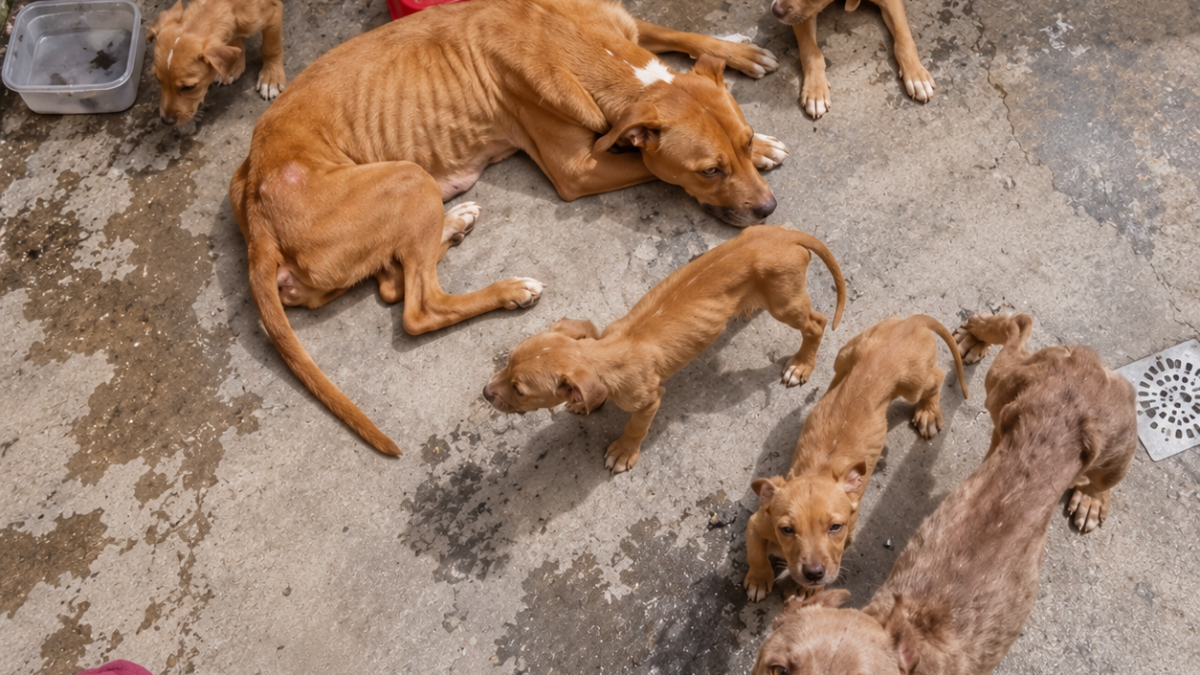
PART 2
The first thing Mia did when I moved closer was lower her head.
Not aggressively.
Not submissively either.
She simply looked exhausted.
There is a kind of tiredness you see in animals that goes far beyond missing sleep.
It comes from being hungry too long.
Thirsty too long.
Waiting too long for something to change.
I had seen it before.
But never in an entire family at once.
“Easy,” I whispered.
I stopped several feet away.
Mia’s eyes moved from me to Elena, then toward the gate.
Toretto stood behind her.
He was larger, broad-headed, probably powerful when healthy.
Now his legs trembled.
His shoulders looked too narrow for his frame.
His skin hung loosely around his ribs.
One of the officers, Sergeant Moreno, crouched near the doorway without entering farther.
“How many?”
Elena counted silently.
“Mia, the male, and…”
She looked around.
“One, two, three, four…”
A puppy emerged from behind a broken crate.
“Five.”
Another tiny face appeared.
“Six.”
Six puppies.
Eight dogs total.
My stomach twisted.
One of the puppies tried to cross the yard.
Three steps.
Pause.
Two more.
Then its back legs folded.
I stood immediately.
“We need fluids ready.”
Elena was already calling the veterinary team.
“We have eight,” she said into the phone. “Two adults, six puppies. Severe body-condition loss. Possible dehydration. Some mobility weakness.”
She listened.
“Yes. We’re bringing everybody.”
Sergeant Moreno raised a hand.
“Not yet.”
I looked at him.
“What?”
“We have to document before removal.”
“They need treatment.”
“I know.”
“Then document while we move them.”
His expression did not change.
“Rachel, if this becomes a criminal case and we destroy the scene before photographing it, we can hurt the case.”
I hated that he was right.
He saw it on my face.
“Five minutes,” he said. “My officers are already working.”
Five minutes felt obscene.
But those five minutes mattered later.
Photographs were taken.
Video.
Water containers.
Food bowls.
The condition of the yard.
The improvised enclosures.
The waste.
The damaged fencing.
A pile of empty feed sacks.
Several old veterinary medication boxes.
Then an officer called Moreno toward a shed.
“Sergeant?”
“What?”
“You need to see this.”
Moreno walked over.
I stayed with the dogs.
At least I tried.
Curiosity kept pulling my eyes toward that shed.
A few minutes later, Moreno returned carrying a transparent evidence bag.
Inside were several papers.
“What is it?” I asked.
“Records.”
“What kind?”
He looked at Mia.
“Breeding records.”
My jaw tightened.
Elena heard him.
“You’re sure?”
“Names. Dates. Litter numbers. Payments.”
He glanced toward Toretto.
“And descriptions matching these two adults.”
The thought landed hard.
These dogs had not simply been forgotten in a yard.
Someone had tracked them.
Someone had written down pregnancies.
Births.
Sales.
Money.
They had been valuable when they produced puppies.
Yet here they were.
Starving.
I looked at Mia again.
Her body had carried litter after litter, according to what we would later learn.
And when her usefulness began fading, so apparently did the care.
I felt anger rise.
Not useful anger.
Not yet.
The dangerous kind.
Elena touched my arm.
“Later.”
I nodded.
She knew me too well.
We began removing the puppies first.
Soft blankets.
Plastic crates padded with towels.
Each puppy was weighed before transport.
The numbers were terrible.
The smallest one barely reacted when I lifted her.
She rested her head against my wrist.
I could feel every vertebra.
“You’re okay,” I whispered.
I knew that wasn’t true yet.
But I needed to say something.
Toretto was next.
He resisted the leash at first.
Not because he wanted to stay.
Because standing hurt.
We used a support sling beneath his abdomen.
He looked at the open gate.
Then at us.
For one moment, I thought he might panic.
Instead, he took a step.
Then another.
Slowly.
Every movement looked expensive.
When he reached the van ramp, he froze.
Elena climbed inside first.
“Come on, handsome.”
He looked at her.
“You can do this.”
One paw.
Pause.
Second paw.
His hind legs shook.
I supported his weight.
Together, we got him inside.
Mia was last.
She had remained near the wall, watching every puppy disappear through the gate.
That mattered.
She was weak, but she was still counting them.
Still tracking them.
Still their mother.
When we approached with the sling, she backed away.
Only half a step.
There wasn’t enough strength for more.
I knelt.
“We’re taking you where they went.”
Her eyes stayed on mine.
“I promise.”
I slid my hand beneath her chest.
She flinched.
Not from aggression.
Pain.
“Easy.”
We wrapped the sling around her carefully.
When we lifted slightly, she made a low sound.
I stopped.
Elena looked at me.
“Joint pain?”
“Maybe.”
We adjusted.
Mia stood.
Her legs trembled violently.
Then she started moving.
At the gate, she stopped.
Outside were people.
Police.
Neighbors.
Volunteers.
Strangers.
Some had tears in their eyes.
Someone whispered, “That’s the mother.”
Mia looked at them all.
Then walked through.
I have never forgotten that moment.
There was no cheering.
No applause.
Nothing dramatic.
People simply made space.
Sometimes respect is quiet.
The hospital was ready when we arrived.
Eight dogs meant eight intake examinations.
Eight blood panels.
Eight hydration assessments.
Eight body-condition scores.
Eight different sets of needs.
The puppies were separated by condition, not by convenience.
The weakest went first.
Mia and Toretto were examined in neighboring rooms.
I stayed with Mia.
The veterinarian, Dr. Priya Shah, ran her hands gently along Mia’s ribs.
She looked at me.
“Do we know how long?”
“No.”
“Any history?”
“Police found breeding records.”
Dr. Shah stopped.
“How many litters?”
“Unknown yet.”
She continued examining Mia.
Her gums were pale.
Her nails were long.
There were calluses on her elbows.
Her mammary tissue suggested repeated nursing.
Her coat was dull.
Skin infections had started in several areas.
But what frightened Dr. Shah most was her weight.
“She is profoundly underconditioned.”
“How bad?”
“Bad enough that we have to refeed carefully.”
I knew what that meant.
You cannot simply put a huge bowl of food in front of a severely starved animal.
Their bodies may no longer process sudden nutrition safely.
Recovery has to be controlled.
Measured.
Monitored.
Even kindness can cause harm when the body is fragile enough.
“What about Toretto?”
Another veterinarian stepped into the doorway.
“Similar. Severe muscle loss. Dehydrated. Anemic.”
“And the puppies?”
“Mixed. Two are more compromised than the others.”
My chest tightened.
“Will we lose any?”
The veterinarian did not answer immediately.
“We’re going to give them every reasonable chance.”
That phrase again.
Every reasonable chance.
In rescue, nobody honest promises survival.
We promise effort.
The first night, volunteers sat in shifts.
The puppies slept in heated bedding.
Mia received fluids and carefully measured meals.
Toretto drank for almost a full minute the first time clean water was placed in front of him.
I had to look away.
There is something uniquely painful about watching a thirsty animal discover that water is not going to disappear.
He drank.
Paused.
Looked at us.
Drank again.
Elena stood beside me.
“He was waiting.”
“For what?”
“For somebody to take it away.”
I swallowed.
Nobody did.
By midnight, all eight dogs were stable enough that Dr. Shah told us to go home.
None of us did.
I sat on the floor outside Mia’s enclosure.
She remained curled on a blanket.
Her puppies were elsewhere receiving treatment.
Every so often, she lifted her head.
I wondered whether she could hear them.
At 1:40 a.m., she shifted closer to the kennel door.
I put my hand against the floor.
She sniffed.
Then, slowly, moved her nose toward my fingers.
Touch.
Just once.
Then she rested again.
I smiled.
“Okay.”
That was the first time Mia chose contact.
The next morning, police called.
The property owner had been located.
His name was Victor Hale.
He claimed the dogs were not his.
That became his first story.
The breeding records said otherwise.
Receipts found in the shed contained his name.
Messages recovered from an old phone on the property referenced planned litters.
Photographs showed Mia and Toretto years earlier, healthier, standing beside puppies advertised for sale.
When investigators confronted Victor with the documents, his story changed.
He said the dogs belonged to a cousin.
Then he said he had only helped sell puppies.
Then he said someone else had been responsible for daily care.
Every new explanation created another question.
Who had fed them?
Who had provided veterinary care?
Why was there no water?
Why had the puppies remained on the property?
Why were both adults severely underweight?
And why had no one asked for help?
The investigation expanded.
A second person was identified.
Victor’s former partner, Lisa.
She told police she had left the property two months earlier after repeated arguments about the animals.
According to her statement, Mia had stopped producing large litters.
Toretto had developed recurring health issues.
Money from puppy sales had decreased.
Food purchases decreased too.
Lisa claimed she had begged Victor to surrender the dogs.
He refused.
“Why?” Sergeant Moreno asked her.
Her answer came later in the report.
“Because he didn’t want anyone seeing what condition they were in.”
That sentence made me put the papers down.
I was in the rescue office when Moreno showed us copies.
Elena sat across from me.
I reread the line.
“He knew.”
“That’s what she alleges.”
“He knew they were starving.”
“She says he knew they were deteriorating.”
I pushed the paper away.
“Same thing.”
Moreno remained careful.
“Rachel.”
“What?”
“We prove what we can prove.”
I hated that phrase too.
But over the next months, I learned to respect it.
Anger wants certainty.
Justice requires evidence.
Meanwhile, Mia and Toretto knew nothing about investigations.
They knew food.
Water.
Blankets.
Medicine.
And fear.
For the first week, Mia ate every meal as though someone might change their mind.
She would finish, then lick the bowl repeatedly.
Then check the floor.
Then look at me.
“More later,” I told her.
Her eyes followed the bowl when I removed it.
“You’re getting another meal in three hours.”
She did not believe me.
How could she?
Trust is just memory pointed toward the future.
Mia’s memories had taught her that resources disappeared.
So we built new ones.
Breakfast.
Then lunch.
Then dinner.
Then breakfast again.
Water that stayed full.
Blankets that returned after washing.
Hands that touched gently.
Doors that opened toward safe places.
By the fourth day, Mia began waiting near the front of her enclosure when I arrived.
Toretto recovered differently.
He was more social from the beginning.
Despite weakness, he wanted contact.
He leaned against anyone who sat beside him.
At first, I thought he was affectionate.
Then I realized something else.
He needed support to remain standing.
So leaning had become survival.
A volunteer named Jason sat beside him one afternoon.
Toretto pressed his entire body into Jason’s legs.
Jason laughed.
“Big baby.”
Dr. Shah watched.
“He’s using you as furniture.”
“That’s okay.”
Toretto looked up.
Jason scratched under his chin.
“Best furniture he’s ever had.”
Within two weeks, the puppies began changing quickly.
Puppies often do when nutrition improves.
Their bellies filled out.
Eyes brightened.
Energy returned.
Then chaos arrived.
One started stealing towels.
Another climbed halfway over a pen wall.
Two fought over the same toy despite three identical toys lying nearby.
The weakest female, whom we named Daisy, discovered barking.
Constantly.
Elena walked into the puppy room one morning.
Daisy barked.
Elena looked at me.
“You saved this?”
“Apparently.”
Bark.
“She has complaints.”
Bark.
“Many complaints.”
That sound was beautiful.
At rescue, noise is sometimes proof of healing.
The puppies entered foster homes in pairs whenever possible.
Mia and Toretto went together to a quiet temporary home owned by a retired couple, Ruth and Daniel.
They had fostered more than twenty medical cases over the years.
Their house had a fenced yard, no stairs on the main level, and more dog beds than human chairs.
When we brought Mia and Toretto there, both stopped at the front door.
Ruth crouched inside.
“No rush.”
Toretto stepped first.
Mia waited.
She sniffed the threshold.
Then crossed.
Inside, she immediately looked for exits.
Door.
Hallway.
Back door.
Windows.
Places to hide.
Ruth noticed.
“She’s mapping.”
“Yes.”
“I won’t corner her.”
That was why I trusted Ruth.
She understood that rescue is not affection forced onto frightened animals.
It is control returned gradually.
That first night, Mia slept near the kitchen doorway instead of the bed prepared for her.
Toretto chose the bed.
Then rolled off it.
Then climbed halfway back on.
Daniel sent us a photograph.
Toretto’s front half was on the bed.
Back half on the floor.
Caption:
“Compromise.”
I laughed for the first time in days.
The investigation grew more serious when police found financial records.
Puppy sales.
Deposits.
Advertisements.
Messages from buyers.
Dates.
Some of the puppies sold for substantial amounts.
Mia had been bred repeatedly.
Toretto was listed as sire on multiple litters.
The dogs had generated money.
That fact would later become central to the cruelty case.
The defense would argue financial hardship.
The records showed income from animals while care deteriorated.
An investigator asked Dr. Shah to document expected costs of basic food and water.
She did.
It was not complicated.
The cruelty was not hidden inside some impossible financial equation.
Water was not expensive.
Basic feeding was not impossible.
Calling a rescue was free.
Surrendering animals was possible.
Help existed.
Someone had simply chosen not to use it.
Three weeks after rescue, Mia gained enough strength to walk around Ruth’s yard without trembling.
The first time I visited, she was standing beneath a small tree.
I stopped at the gate.
Ruth smiled.
“Wait.”
Mia saw me.
For one second, nothing happened.
Then her tail moved.
Once.
Twice.
She walked toward me.
Not fast.
Not dramatic.
But voluntarily.
I knelt.
“Hi, mama.”
She came within arm’s reach.
Sniffed my hands.
Then leaned her forehead against my chest.
I closed my eyes.
There are moments when an animal gives you something so small that nobody else would understand the weight of it.
Mia had spent her life being used.
Handled.
Bred.
Kept.
Fed when convenient.
Ignored when not.
Now she was choosing a person.
That choice meant more to me than obedience ever could.
Toretto came barreling behind her.
Well, what counted as barreling for a dog still rebuilding muscle.
He shoved his head under my arm.
Ruth laughed.
“He’s jealous.”
“He’s rude.”
Toretto wagged.
“He’s proud of it.”
Their recovery became steady.
Not perfect.
Mia developed digestive problems after months of poor nutrition.
Medication helped.
Toretto had joint pain.
Supplements and controlled exercise improved it.
Both had dental issues.
Both required treatment for parasites.
Both remained mildly anemic for weeks.
But every follow-up blood test looked better.
Every weigh-in brought good news.
Five pounds.
Eight.
Ten.
Their coats changed.
Mia’s became softer and darker.
Toretto’s shoulders filled out again.
Their faces changed most.
Fear left slowly.
It disappeared around the eyes first.
One afternoon, Ruth sent a video.
Mia was asleep on her back.
All four legs in the air.
I watched it three times.
Dogs do not sleep exposed like that when they believe danger is near.
I forwarded it to Sergeant Moreno.
He responded:
“That’s a different dog.”
I wrote:
“Same dog. Different life.”
The puppies flourished.
We named them Daisy, Scout, Milo, Penny, Finn, and Rosie.
Daisy remained loud.
Scout became fearless.
Milo followed people everywhere.
Penny slept under furniture.
Finn stole socks.
Rosie loved water so much that her foster family bought a shallow kiddie pool.
The irony was not lost on us.
A puppy rescued from a yard without drinking water became obsessed with splashing.
I visited her once.
She jumped into the pool.
Water went everywhere.
Her foster father shouted, “Rosie!”
She jumped harder.
I laughed until my sides hurt.
Those were the moments we had searched for.
Not dramatic transformation photographs.
Normal problems.
Mud.
Chewed slippers.
Too much barking.
Stolen laundry.
Happy inconvenience.
But the case continued.
Two months after the rescue, charges were filed.
Animal neglect.
Failure to provide adequate food and water.
Failure to provide necessary veterinary care.
Breeding-related violations.
Additional local ordinance offenses.
Victor’s attorney argued that volunteers had exaggerated conditions to gain publicity.
That infuriated me.
But Moreno warned us.
“Do not respond publicly.”
“Why?”
“Because your photographs and medical records are stronger than arguments online.”
So we stayed quiet.
The evidence did the talking.
Body-condition scores.
Bloodwork.
Parasite burdens.
Weight records.
Photos taken before the dogs were moved.
Empty water containers.
Breeding logs.
Sales records.
Messages.
Witness statements.
The defense also claimed the dogs had only recently lost weight due to illness.
Dr. Shah addressed that directly.
Muscle wasting at that level did not happen overnight.
Neither did the condition of their skin.
Neither did chronic neglect of nails, teeth, or parasites.
The puppies’ developmental condition added more evidence.
This was not one bad week.
It had been happening.
At the preliminary hearing, I sat behind Moreno.
Victor entered wearing a dark jacket.
He looked ordinary.
That bothered me.
I think part of us expects people connected to terrible neglect to look different.
They don’t.
They shop for groceries.
They pay bills.
They complain about traffic.
They look like everyone.
The prosecutor displayed a photograph of the yard.
Victor looked away.
Then the breeding ledger appeared.
He looked at his attorney.
The prosecutor read entries.
“Mia—litter.”
“Toretto—sire.”
“Deposit received.”
“Puppies reserved.”
Money attached to births.
Then the final photographs.
Mia.
Toretto.
Bones visible.
No water.
Silence filled the courtroom.
The defense argued that Victor had been away from the property frequently.
The prosecutor produced messages where someone had warned him the dogs were losing weight.
One message read:
“You need to bring food. Mia looks bad.”
Another:
“Water barrel is empty again.”
His response:
“I’ll handle it.”
That message had been sent eleven days before the rescue.
I felt Elena grip my wrist.
“He knew.”
This time, nobody corrected me.
Victor eventually accepted a plea agreement covering several charges rather than taking the full case to trial.
Some people were disappointed.
They wanted a dramatic conviction after weeks of testimony.
But the agreement had teeth.
He was prohibited from breeding animals.
He lost ownership rights to Mia, Toretto, and the puppies.
He was barred from possessing animals for a court-ordered period.
He faced fines, restitution toward veterinary costs, inspections related to compliance, and mandatory animal-care education.
The property’s breeding operation was shut down.
Equipment was removed.
Local licensing authorities opened separate proceedings regarding his past commercial activity.
There was no shouting when the judge approved the agreement.
No revenge speech.
No dramatic collapse.
Victor signed papers.
The clerk stamped them.
That was justice in real life.
Paper.
Dates.
Restrictions.
Records.
But there was one moment I remember.
After the hearing, Victor passed me in the corridor.
He stopped.
“You’re the rescue woman.”
I looked at him.
“One of them.”
“How are the dogs?”
My first instinct was anger.
My second was worse.
I wanted to hurt him with the answer.
I wanted to describe every needle.
Every parasite.
Every frightened meal.
Every weak step.
Instead, I said, “Alive.”
His face shifted.
“I never wanted them to die.”
I stared at him.
“That was a very low standard.”
He looked away.
“I had problems.”
“So did they.”
“You don’t understand what was happening.”
I thought about Mia watching an empty bowl.
Toretto drinking like someone might remove the water.
Six puppies stumbling through dirt.
“No,” I said. “I understand exactly what was happening to them.”
He sighed.
“I was going to fix it.”
“When?”
No answer.
“When Mia stopped being able to stand?”
He flinched.
“When one of the puppies died?”
His head snapped toward me.
“No puppy died.”
“Because somebody found the video.”
Silence.
I stepped closer, not threatening, only certain.
“You had options. Surrender them. Call a rescue. Ask for help. Give them away. Fill a water container.”
He looked toward the courtroom door.
“You’re making me sound like a monster.”
“I’m telling you what choices were available.”
He said nothing.
Then I said the sentence I had carried for weeks.
“They were making money for you when they were useful. When they stopped being useful, you stopped treating them like lives.”
His face hardened.
“That’s not true.”
“Then prove it by never doing this again.”
I walked away.
That was the only confrontation we had.
For months, I had imagined revenge.
I imagined yelling.
I imagined forcing him to watch videos of Mia struggling to stand.
I imagined making him feel small.
None of that happened.
And strangely, I didn’t need it.
Because two days later, I went to Ruth’s house.
Mia met me at the gate.
She ran.
Not fast.
Not perfectly.
But ran.
Her tail moved so hard her whole body curved.
Toretto came behind her carrying a stuffed toy.
The sight erased the courtroom.
For a while.
Mia jumped her front paws against me.
I laughed.
“You’re not supposed to do that.”
Ruth stood on the porch.
“You created this.”
“I absolutely did not.”
“She steals bread now.”
“Mia?”
Mia looked innocent.
“She opened the pantry.”
I stared at her.
“You spent your whole life hungry and chose crime the moment you got strong?”
Tail wag.
Toretto dropped the toy on my shoe.
Ruth shook her head.
“Both criminals.”
That was when I understood what revenge really looked like.
The property had treated them like production animals.
Their new homes treated them like troublemakers.
Loved troublemakers.
Mia had choices.
Toretto had toys.
The puppies had families fighting over who got to clean up after their chaos.
That was better.
One by one, the puppies reached adoption age.
We screened applications carefully.
Very carefully.
More carefully than usual.
Perhaps unfairly.
But nobody wanted their second chapter rushed.
Daisy went first.
Her foster family had already failed at fostering.
That is rescue language for falling in love.
They signed the papers.
Daisy barked through the whole process.
“Does she ever stop?” I asked.
Her adopter grinned.
“No.”
“You understand what you’re signing?”
“Yes.”
Daisy barked.
“Good luck.”
Scout went to a couple with a large yard.
Milo was adopted by a school counselor who wanted a companion for long evening walks.
Penny went to an older woman who lived quietly and had been looking for a gentle dog.
Finn’s foster family kept him after he destroyed three socks, one slipper, and the corner of a rug.
Apparently that was love.
Rosie went to a family with two teenagers and, more importantly, a backyard pool.
When we delivered her, she discovered the pool within six minutes.
She jumped in.
Everyone screamed.
Rosie swam in a circle like she had been waiting her entire life.
Elena looked at me.
“That dog was rescued from dehydration.”
“I know.”
“And now she thinks she’s an otter.”
“Recovery is complicated.”
Eventually, every puppy had a home.
That left Mia and Toretto.
Ruth and Daniel insisted they would foster until the right family came.
Then weeks became months.
I visited one evening.
Mia was asleep beside Daniel’s chair.
Toretto lay across Ruth’s feet.
I sat down.
“So.”
Ruth looked at me.
“No.”
“I haven’t said anything.”
“You’re about to ask about adoption.”
Daniel turned down the television.
Ruth crossed her arms.
“They stay together.”
“I agree.”
“They need a fenced yard.”
“Yes.”
“Someone home often.”
“Preferably.”
“No small children. Mia likes quiet.”
“Correct.”
“Toretto needs joint management.”
“Yes.”
“And whoever adopts them needs to understand they may have long-term medical costs.”
“Yes.”
Ruth nodded.
“Good.”
I waited.
Then she said, “We qualify.”
I smiled.
Daniel laughed.
“I told you.”
Ruth pointed at him.
“Quiet.”
Mia opened one eye.
Toretto continued sleeping.
“You want to adopt them?”
Ruth looked offended.
“They already live here.”
“That’s not paperwork.”
“Paperwork is your problem.”
I laughed.
A week later, they signed.
Mia and Toretto stayed together.
That mattered to all of us.
They had survived the same yard.
Shared the same hunger.
Raised puppies together.
Now they would share something better.
A home.
Their adoption photograph was terrible.
Mia looked away.
Toretto tried to sit on Daniel’s foot.
Ruth blinked.
I loved it.
Perfect photographs are overrated.
Real families move.
Months later, the police asked whether our rescue would participate in a training session for officers responding to animal-neglect calls.
Elena volunteered me without asking.
“Why me?”
“Because you complain loudly enough to teach.”
Fair.
I brought photographs from the case.
Not graphic ones.
Just enough.
I explained body-condition scoring.
Dehydration signs.
Why scene documentation matters.
Why moving animals immediately can conflict with evidence preservation.
Why police and rescue teams need protocols before emergencies.
Sergeant Moreno spoke after me.
He described the address problem.
“How did you finally find the property?” one officer asked.
Moreno smiled.
“People.”
“What do you mean?”
“A delivery driver recognized a corner. A resident recognized a wall. Volunteers checked streets. Patrol officers cross-referenced incomplete directions. Nobody had enough information alone.”
He paused.
“The case was solved because people shared what they knew.”
That stayed with me.
One video.
One person sent it.
Another forwarded it.
Someone called.
Someone searched.
Someone recognized a street.
Someone kept looking.
Mia’s life had hung on a chain of strangers refusing to assume someone else would handle it.
That idea changed how our rescue operated.
We created a rapid-location protocol for anonymous neglect videos.
Screenshot landmarks.
Check utility poles.
Store signs.
Road surfaces.
Wall materials.
Sun direction.
Listen for church bells, traffic, trains, construction.
Ask delivery drivers.
Ask sanitation workers.
Ask mail carriers.
People who move through neighborhoods notice things maps do not.
The next time a vague report came in, we found the location in forty minutes.
Mia’s case had taught us how.
A year after the rescue, Dr. Shah invited Mia and Toretto back for photographs.
Not publicity.
She wanted to show her staff.
Several technicians had cared for them on the first night.
When Ruth walked into the clinic with both dogs, the front desk went silent.
Then Sarah, one of the original technicians, came around the counter.
“That cannot be Toretto.”
Toretto immediately leaned against her.
She laughed.
“Oh, yes it can.”
Mia approached more cautiously.
Sarah crouched.
“Hi, mama.”
Mia sniffed her hand.
Then accepted a scratch.
Sarah’s eyes filled.
“I remember her weight.”
“So do I,” Dr. Shah said.
They weighed them.
Healthy.
Not overweight.
Strong.
Bloodwork showed no major remaining abnormalities.
Toretto still required joint care.
Mia still had some chronic digestive sensitivity.
But they were stable.
Dr. Shah looked at me.
“Remember the first night?”
“I try not to.”
“You asked me if we’d lose any.”
“I remember.”
“All eight.”
I looked at her.
“What?”
“All eight lived.”
The sentence hit me differently hearing it out loud.
All eight lived.
Mia.
Toretto.
Daisy.
Scout.
Milo.
Penny.
Finn.
Rosie.
Every dog from that yard.
Every one.
I sat down.
Dr. Shah smiled.
“You okay?”
“No.”
She laughed.
“I mean yes.”
I wiped my eyes.
“Just give me a minute.”
Ruth hugged me.
Toretto tried to insert himself between us.
Mia watched with mild suspicion.
That was another thing recovery restored.
Personality.
Mia was serious.
She liked routines.
She hated rain.
She loved soft blankets.
She disliked loud men.
She liked Daniel because he was quiet.
She enjoyed chicken but refused carrots.
Toretto loved everybody.
He considered personal space a rumor.
He stole cushions.
He carried shoes without chewing them.
He snored.
Loudly.
The puppies developed completely different personalities.
The yard had made them look like one tragedy.
Safety allowed them to become individuals.
That might be the part of rescue I love most.
Suffering makes animals look alike.
Thin.
Afraid.
Still.
Healing makes them specific.
One steals bread.
One hates thunder.
One swims.
One barks too much.
One sleeps upside down.
One refuses carrots.
Personality is luxury.
And they finally had enough safety to afford it.
The property where we found them changed owners the following year.
The old kennels were removed.
The shed was demolished.
A family bought the house.
They had no connection to Victor.
One afternoon, the new owner contacted us.
“I know what happened here,” she said.
I went quiet.
She continued.
“We’re fixing the backyard.”
“Okay.”
“My daughter wants to plant a tree where the kennels were.”
I didn’t know what to say.
“She asked whether one of the dogs has a favorite kind.”
I laughed softly.
“Mia likes shade.”
“Then we’ll plant something that makes good shade.”
A few months later, she sent a photograph.
A young tree stood in fresh soil.
No plaque.
No dramatic memorial.
Just a tree.
I appreciated that.
The dogs did not need their worst place turned into a shrine.
The yard belonged to another family now.
Life had moved forward.
So had they.
The last legal matter closed shortly afterward.
Victor completed the required programs and remained under the ownership restrictions imposed by the court.
The breeding records were retained as evidence.
Several past puppy buyers were contacted during the investigation.
Some were shocked.
They had purchased healthy-looking puppies years earlier.
They remembered Mia only as “the mother dog.”
One woman called us after learning what happened.
“I bought one of her puppies four years ago.”
“Really?”
“He’s asleep beside me.”
She sent a photograph.
A healthy adult dog.
Same eyes as Mia.
Same white marking on the chest.
I stared at it.
“How is he?”
“Wonderful.”
She began crying.
“I didn’t know what she was living through.”
“You couldn’t have.”
“I met her once.”
I waited.
“She was behind a gate.”
The woman’s voice broke.
“I thought that was normal.”
There was no useful way to answer.
We talked for twenty minutes.
Before hanging up, she said, “Can Mia meet him?”
I asked Ruth.
We arranged it carefully.
Neutral park.
Leashes.
Space.
No expectation.
Mia arrived with Toretto.
The adult son approached slowly.
Mia stopped.
He stopped.
They sniffed.
No magical recognition.
No dramatic reunion.
Dogs are not obligated to fulfill human stories.
Then the younger dog wagged.
Mia sniffed his face.
He bowed.
She stepped away.
Toretto immediately tried to play instead.
Everyone laughed.
The puppy buyer wiped her eyes.
“I thought maybe she’d know him.”
“Maybe she does. Maybe she doesn’t.”
Mia walked toward Ruth.
“But she knows who she belongs with now.”
The woman nodded.
That was enough.
Afterward, she became one of our monthly donors.
Not from guilt, she said.
From responsibility.
“Buying a puppy made me realize how much I never asked.”
She started educating friends about seeing breeding conditions, meeting parent dogs, checking veterinary care, and walking away from sellers who hid animals.
Mia’s story traveled in ways I never expected.
Not as outrage.
As changed behavior.
That mattered more.
The second anniversary of the rescue fell on a Sunday.
We decided to bring the entire family together.
Not because dogs need anniversaries.
People do.
We rented a secure fenced field.
One by one, the cars arrived.
Daisy first.
She barked before the door opened.
Scout.
Milo.
Penny.
Finn.
Rosie.
Then Ruth and Daniel arrived with Mia and Toretto.
For several minutes, we introduced everybody carefully.
We did not assume family relationships would automatically make eight adult and nearly adult dogs safe together.
Slow introductions.
Leashes.
Observation.
Then release.
Chaos.
Pure, ridiculous chaos.
Rosie found a water trough.
Of course.
Finn stole a tennis ball.
Daisy barked at everyone.
Scout ran laps.
Milo followed Elena.
Penny stayed near her adopter.
Toretto tried to greet six dogs simultaneously.
Mia stood beside Ruth watching all of it.
I went to her.
“Your children are a disaster.”
Tail wag.
“You did your best.”
She leaned against my leg.
Then Rosie ran past.
Mia joined her.
For perhaps ten seconds, mother and daughter raced across the grass.
I stopped breathing.
Not because it was a miracle.
Because it was ordinary.
That was what we had fought for.
Ordinary.
Eight dogs in a field.
Nobody hungry.
Nobody thirsty.
Nobody trapped.
Nobody waiting for rescue.
Later, we took a group photograph.
It was impossible.
Daisy looked left.
Finn looked backward.
Toretto sat too close to Mia.
Rosie was wet.
One adopter was laughing.
Another had grass stains.
The final image was terrible.
We printed it anyway.
It hangs in the rescue office.
Underneath, Elena wrote one sentence:
FOUND.
Not saved.
Not victims.
Found.
Because that had been the first battle.
Finding them.
I still think about those hours.
Driving street after street.
Looking at walls.
Asking strangers.
Watching the sun move across the sky.
Imagining that somewhere, puppies were getting weaker.
That helplessness was almost unbearable.
The rescue itself became possible only after location became certainty.
People often think compassion is the hard part.
Sometimes logistics are harder.
You can care desperately and still fail if you cannot find the animal.
That case taught us that rescue is also investigation.
Maps.
Phones.
Neighbors.
Persistence.
Pattern recognition.
Coordination.
The emotional moment comes later.
First, someone has to find the gate.
Years passed.
Daisy’s adopter still sent videos.
Rosie became an excellent swimmer.
Finn remained a sock thief.
Milo grew into a gentle dog who accompanied his owner during counseling sessions at home.
Penny became inseparable from the older woman who adopted her.
Scout took hiking trips.
Mia and Toretto aged together.
Toretto developed more arthritis.
Daniel built him a small ramp from the porch.
Mia became gray around the muzzle.
She still disliked carrots.
Some things never heal because they were never injuries.
They are opinions.
I visited them one winter afternoon.
Rain tapped against the windows.
Mia lay on a thick bed near the fireplace.
Toretto slept beside Daniel.
Ruth handed me tea.
“Remember the video?”
I nodded.
“I found it on an old phone.”
“Why would you do that to yourself?”
“I don’t know.”
She sat down.
“I watched ten seconds.”
“That was enough.”
“She didn’t look like Mia.”
I looked at the dog near the fire.
“Yes, she did.”
Ruth frowned.
“No.”
“Same dog.”
“I know technically.”
I understood what she meant.
The dog in the video looked reduced to suffering.
The dog in front of us looked like herself.
Ruth reached down.
Mia lifted her head.
“You know what still bothers me?”
“What?”
“That she waited.”
I looked at her.
“For what?”
“For somebody.”
Ruth’s voice softened.
“She was behind that wall with puppies. No water. No food. And she had to wait for a stranger to send a video.”
I didn’t have a comforting answer.
Sometimes stories end well without making their beginnings acceptable.
The rescue succeeding does not erase the days before it.
Justice does not undo hunger.
A soft bed does not retroactively fill an empty bowl.
But it changes what comes next.
That is what we get to change.
Not yesterday.
Next.
That afternoon, Mia woke and walked toward the back door.
Ruth opened it.
Rain.
Mia stopped.
Turned around.
Returned to the fire.
I laughed.
“Still hates rain?”
“Deeply.”
Toretto opened one eye.
Ruth said, “He doesn’t care.”
“Of course not.”
Toretto would have walked through a hurricane if someone promised attention on the other side.
I sat on the floor between them.
For a while, nobody spoke.
No need.
Years earlier, Mia and Toretto had been breeding animals on a ledger.
Male.
Female.
Litter.
Deposit.
Sale.
Now their lives could not fit in columns.
Favorite blankets.
Medical routines.
People they trusted.
Rooms they preferred.
Sounds they disliked.
That is what neglect steals first.
Not only health.
Individuality.
You become a body with a problem.
Rescue gives the details back.
A month later, Sergeant Moreno retired.
At his small retirement gathering, he brought up the dog case.
“I thought that would be simple,” he said.
We laughed.
Nothing about it had been simple.
He looked at me.
“Remember when you tried to move the dogs before we finished scene photos?”
“I remember you wasting five minutes.”
“Those five minutes helped convict your bad guy.”
“He took a plea.”
“Same evidence.”
I smiled.
“You were right.”
He put a hand to his ear.
“What?”
“Don’t ruin it.”
“Say it again.”
“No.”
Then his expression changed.
“Rachel.”
“Yes?”
“That case changed our department.”
“How?”
“We used to treat animal calls like secondary work unless there was an immediate public-safety issue.”
I waited.
“We don’t anymore.”
That surprised me more than the court ruling.
He continued.
“We learned how neglect cases connect to other problems. Property violations. Illegal business. Domestic conflict. Public health. And we learned that rescue groups often see things before we do.”
He raised his coffee cup.
“Mia did more training than half our instructors.”
I laughed.
“She’d hate the attention.”
“Send her a steak.”
“Ruth will.”
The following week, I told Ruth.
She actually bought steak.
“Moreno said one.”
“There are two dogs.”
“Toretto wasn’t the training consultant.”
“He suffered too.”
Fair.
They both got steak.
Years after the rescue, someone asked me during a community event whether I believed Victor got what he deserved.
I did not know how to answer.
What does someone deserve for allowing eight animals to live like that?
People want numbers.
Years.
Money.
Punishment.
I understand.
I wanted those things too.
But punishment and repair are not the same.
The court could restrict him.
Fine him.
Order restitution.
Ban breeding.
Require education.
What it could not do was give Mia back the litters her body endured.
It could not remove Toretto’s arthritis.
It could not erase the puppies’ earliest weeks.
There is no sentence that rewrites time.
So I stopped measuring justice by whether Victor suffered enough.
I measured it by whether dogs were safer afterward.
He could not breed them again.
He could not own more animals during the restriction.
The property was closed to that operation.
Police had better procedures.
The rescue had better protocols.
Buyers became more educated.
Eight dogs lived.
That was concrete.
That was useful.
If you ask what revenge looked like, though, I can answer.
It looked like Mia gaining twenty pounds.
It looked like Toretto stealing Daniel’s pillow.
It looked like Daisy barking during her own adoption photograph.
It looked like Rosie diving into a pool.
It looked like six puppies growing into dogs nobody would ever call inventory again.
It looked like Victor’s breeding ledger ending while their lives kept going.
That was revenge I could live with.
One spring morning, Ruth called me.
Her voice sounded different.
My heart sank.
“What happened?”
“Mia’s slowing down.”
Mia was older now.
Exactly how old, nobody knew.
Years of breeding and neglect had aged her body.
We arranged an appointment.
Dr. Shah examined her.
Arthritis.
Some kidney values beginning to change.
Nothing catastrophic.
Not yet.
But age had arrived.
On the drive back, I sat beside Mia in Ruth’s car.
She rested her head on my leg.
I stroked her ears.
“You know, you’re allowed to get old.”
Her eyes closed.
“For a while, I wasn’t sure we’d get this complaint.”
Ruth smiled from the driver’s seat.
“What complaint?”
“Senior-dog problems.”
“I’ll take them.”
“So will I.”
Mia started medication.
Adjusted diet.
More frequent blood tests.
She responded well.
Toretto slowed too.
Their walks became shorter.
The yard became enough most days.
Daniel added rugs so they would not slip.
Ruth moved another bed into the kitchen.
They slept more.
And somehow, that aging felt like victory too.
A dog has to live a long time to become old.
That simple fact broke me sometimes.
One afternoon, I found Mia lying in a patch of sun near the back door.
I sat beside her.
Her muzzle was almost entirely gray.
She opened one eye.
“Remember me?”
Tail tap.
“I’m going to count that as yes.”
Toretto came over and lowered himself painfully beside us.
“You too.”
I looked at both.
When we found them, I thought rescue meant removing them from the yard.
Then I thought it meant getting them healthy.
Then adoption.
Then court.
Then recovery.
I had been wrong every time.
Rescue wasn’t one event.
It was a chain.
The search.
The gate.
The hospital.
The food.
The foster home.
The legal case.
The adoption.
The arthritis medication years later.
Staying is rescue too.
Maybe the longest part.
When Mia eventually died, it happened at home.
Years after that backyard.
Years after starvation.
Years after the puppies.
She had been declining from age-related illness.
Ruth called me early one morning.
I arrived before the veterinarian.
Mia lay on her favorite bed near the window.
Toretto was beside her.
Ruth sat on the floor.
Daniel held Mia’s paw.
I knelt.
Her breathing was slow.
She recognized me.
I know because her tail moved once.
Barely.
Same as the first weeks.
I touched her forehead.
“Hi, mama.”
She closed her eyes.
There was no emergency.
No panic.
No empty water bowl.
No concrete wall.
No stranger deciding whether she was useful.
Only her family.
The veterinarian came to the house.
Mia left quietly.
Loved.
Old.
Safe.
Afterward, Ruth cried into Daniel’s shoulder.
Toretto sniffed Mia’s blanket.
Then lay down.
I stepped outside and broke apart.
Elena found me sitting on the porch.
“She got years,” she said.
“I know.”
“She got old.”
“I know.”
“You wanted that.”
“I know.”
Knowing did not make goodbye easier.
It made it meaningful.
We buried none of her story with her.
Her puppies were alive.
Her case had changed procedures.
Her photograph remained in our office.
People still learned from her.
Ruth kept the bed.
For weeks, Toretto slept beside it.
Then slowly, he adjusted.
He lived another year and a half.
When his time came, he was almost completely gray.
He still leaned against people.
Even at the end.
Daniel said, “He spent his whole life using humans as furniture.”
I laughed through tears.
Toretto died with his head against Daniel’s leg.
Exactly where he wanted it.
Afterward, Ruth gave me the first photograph we had taken of Mia and Toretto after rescue.
I almost refused.
“I don’t want that one.”
“Take it.”
They looked terrible.
Bones.
Exhausted eyes.
Medical blankets.
Then Ruth handed me another photograph.
Their adoption day.
Mia looking away.
Toretto sitting on Daniel’s shoe.
“Keep them together,” she said.
So I framed both.
Not because suffering defines them.
Because distance matters.
Between those two images lived everything people had done right after so much had gone wrong.
The six puppies outlived both parents.
Each adopter was informed when Mia died.
Every family sent photographs.
Daisy asleep on a couch.
Scout on a mountain trail.
Milo beside his owner’s desk.
Penny wrapped in a blanket.
Finn carrying a sock.
Rosie standing in water.
I printed them.
Six photographs around Mia and Toretto.
The family together again.
Not physically.
But whole.
Sometimes new volunteers stand in front of that wall of pictures.
They ask, “What happened?”
I tell them.
A video arrived.
We didn’t know the address.
Police helped.
People searched.
We found the wall.
We found eight dogs.
We found no water.
We found records.
We found evidence.
We found foster homes.
We found adopters.
We found consequences.
Most importantly, we found them in time.
That last part still gives me chills.
In time.
Those two words hold an entire universe.
What if the video had arrived one day later?
What if nobody recognized the neighborhood?
What if Maya had been weaker?
What if one puppy had stopped breathing?
We will never know.
Rescue sometimes lives frighteningly close to too late.
That is why I no longer dismiss vague reports.
A blurry video can matter.
A partial street name can matter.
A wall can matter.
A barking sound behind a gate can matter.
You follow what you have.
Because somewhere at the end of incomplete information may be a life waiting.
Years later, the tree planted in the old backyard grew tall enough to cast shade.
The new property owner sent me another photograph.
Her daughter was sitting beneath it reading.
A water bowl sat nearby.
Their adopted dog slept beside her.
I stared at the image.
Same property.
Different choices.
That might have been the most satisfying ending of all.
Places do not remember cruelty the way people do.
They can be used differently.
A yard that once held starving dogs could become a place where a child read beside a sleeping rescue dog.
That did not erase anything.
It simply refused to repeat it.
I sent the photograph to Ruth.
She responded:
“Mia would like the shade.”
Then another message:
“Toretto would knock over the water bowl.”
I laughed.
Perfect.
Today, when people ask which rescue I remember most, I never say the worst one.
I say the one we almost couldn’t find.
Because that is what I remember.
Not first the bones.
Not the empty water.
Not the breeding ledger.
I remember streets.
Wrong turns.
Phone calls.
Volunteers checking alleys.
Police comparing addresses.
Strangers asking neighbors.
A city full of people searching for dogs whose names they did not know.
Then the call.
“We found the wall.”
Everything after that began with those words.
We found the wall.
Then we found Mia.
Then Toretto.
Then six puppies.
We carried them out one at a time.
And years later, when I think about revenge, justice, rescue, or hope, I keep returning to that gate.
On one side was the life someone had chosen for them.
Hunger.
Thirst.
Breeding.
Confinement.
Silence.
On the other side was everything they had not met yet.
Veterinarians.
Food.
Water.
Blankets.
Foster homes.
Swimming pools.
Hiking trails.
Stolen socks.
Steak.
Old age.
Grief.
Family.
The gate opened once.
That was enough.
Mia walked through trembling.
Toretto needed support.
The puppies were carried.
But every one of them crossed.
And they never went back.
That is the ending I wanted for them.
Not that nothing bad ever happened again.
Life does not offer that promise.
The ending was that the worst place they had known stopped being where their story belonged.
Their story belonged with Ruth calling Mia a bread thief.
With Daniel laughing while Toretto stole his pillow.
With Daisy barking.
With Rosie swimming.
With Finn stealing socks.
With Scout running trails.
With Milo resting beside someone who needed him.
With Penny asleep under a blanket.
With a courtroom order shutting down the breeding operation.
With officers learning new procedures.
With strangers learning that a blurry video should not be ignored.
With six grown dogs carrying pieces of Mia and Toretto into homes filled with water bowls that never stayed empty.
The people responsible once kept records of those dogs in terms of profit.
Female.
Male.
Litter.
Sale.
Deposit.
But the final accounting looked very different.
Eight dogs removed.
Eight dogs treated.
Eight dogs survived.
Six puppies adopted.
Two parents adopted together.
One breeding operation closed.
One family finally safe.
And two dogs who had once been reduced to skin and bones lived long enough to become gray around the muzzle.
No punishment could ever give them back the days they suffered.
But nothing their former owner had done could take away the years that came after.
That became their victory.
And when I look at the photographs now, I no longer see the backyard first.
I see Mia sleeping in sunlight.
I see Toretto leaning against Daniel.
I see Rosie in a pool.
I see Daisy barking at a camera.
I see a family scattered across different homes but no longer scattered by fear.
It began with one terrible video.
A wall.
An address nobody could find.
And people who refused to stop looking.
By the time the story ended, the people who had treated those dogs like disposable breeding stock had lost the right to control their lives.
Mia and Toretto had gained something far more important.
Names.
Choice.
Safety.
Family.
And enough ordinary days to finally forget what hunger felt like.
The months after the case closed were quieter than everything that had come before.
No police cars.
No courtroom hallways.
No reporters asking questions.
No frantic calls about evidence.
For the first time since that terrible video reached us, Mia, Toretto, and their puppies were simply allowed to live.
And that turned out to be the part of their story I loved most.
Ruth sent me pictures almost every week.
Mia asleep beneath the kitchen table.
Toretto stretched across the hallway as though the entire house belonged to him.
Mia sitting beside Daniel while he drank his morning coffee.
Toretto carrying one of Ruth’s slippers from room to room without ever chewing it.
They had stopped looking like rescued dogs.
They looked like family.
That mattered more than I can explain.
For months, everyone who met them had seen what had happened to them first.
The ribs.
The weak legs.
The empty water containers.
The breeding records.
The photographs from the property.
The legal case.
But eventually, people stopped asking about the backyard.
They started asking ordinary questions.
“Does Mia still steal bread?”
Yes.
“Does Toretto still snore?”
Louder than ever.
“Does he really carry shoes around?”
Every day.
“Does Mia still hate carrots?”
With remarkable consistency.
That was how I knew their lives had truly changed.
They had become more than what had been done to them.
The puppies were changing too.
Daisy remained exactly as loud as she had been in foster care.
Her adopter sent me a video one morning of Daisy standing at the living room window barking at a delivery driver who was still three houses away.
The caption said:
“Your rescue alarm system is working perfectly.”
Scout had become an outdoor dog in the best possible way.
Not abandoned outside.
Not forgotten.
Loved outdoors.
His family took him hiking every weekend.
They sent photographs of him standing on trails with his tongue hanging out, staring across mountains as though he owned every tree.
Milo became the gentlest of the six.
His adopter worked as a counselor and sometimes held virtual sessions from home.
Milo learned quickly that when someone on the screen sounded upset, he should place his chin on his owner’s knee.
Nobody taught him.
He simply did it.
Penny chose the quietest life.
She slept on an older woman’s couch beneath a handmade blanket and refused to go outside when it rained.
Her adopter told me, “She acts like she pays the mortgage.”
I told her that meant Penny had recovered.
Finn remained a thief.
Not food.
Not valuables.
Socks.
Only socks.
His family created a basket specifically for clean socks they were willing to sacrifice.
Finn ignored that basket and continued stealing the ones they actually wanted.
Rosie, of course, remained obsessed with water.
Her family installed a small plastic pool every summer.
The moment they filled it, Rosie jumped in.
She splashed until everyone nearby was soaked.
Every time I saw those videos, I remembered the dry yard.
The empty containers.
The way the adult dogs had watched water when we first placed it in front of them.
And then I would see Rosie throw herself into a pool just because she could.
That was healing.
Not forgetting.
Having enough good memories that the bad ones no longer owned everything.
One evening, almost three years after the rescue, I drove to Ruth and Daniel’s house.
Mia was waiting near the porch.
She was older now.
Gray hairs covered her muzzle.
Her walk had slowed.
But when she recognized my car, her tail started moving.
I got out.
“Hi, mama.”
She came toward me.
No fear.
No hesitation.
Just Mia.
Toretto followed more slowly.
His arthritis had worsened.
Daniel had built another ramp because the small step from the porch had become difficult.
“You’re getting spoiled,” I told him.
Toretto leaned against me.
Daniel laughed.
“He considers that medical equipment.”
Ruth came outside carrying three cups of coffee.
“You’re late.”
“Traffic.”
“Mia has been waiting.”
I looked at Mia.
She had already walked away.
“I’m sure she was devastated.”
We sat on the porch while the dogs rested nearby.
For a while, nobody mentioned the past.
Then Ruth said quietly, “I drove by the old property yesterday.”
I looked at her.
“Why?”
“Accident.”
She stared into her coffee.
“The tree is bigger.”
I knew exactly which tree she meant.
The family who bought the property after the breeding operation ended had planted it where some of the old enclosures had been.
“Good,” I said.
“There was a dog sleeping underneath it.”
I turned toward her.
“Their dog?”
“I think so.”
“Water?”
“Big bowl.”
I smiled.
Ruth did too.
“That felt good.”
The same ground.
Different choices.
That was one of the hardest things rescue taught me.
Places are not cruel.
People make cruel decisions inside them.
And people can make different decisions later.
That backyard had once contained hunger.
Now it contained shade.
A full water bowl.
A sleeping dog.
No court order could have created a more satisfying image.
A few weeks later, Sergeant Moreno called.
He had been retired almost a year by then.
“You busy?”
“Depends.”
“I found something.”
That sentence still made my stomach tighten.
“What?”
“Old training records.”
“For the case?”
“Yes.”
He sent me a photograph.
It was taken during the first animal-neglect response training our rescue had helped develop after Mia and Toretto were found.
In the picture, Moreno was standing in front of a room full of officers.
Behind him was a projected slide showing an image of a dry water container.
Not the dogs.
Just the container.
Underneath were three words:
LOOK. DOCUMENT. ACT.
I called him back.
“You kept this?”
“Apparently.”
“You look younger.”
“Watch yourself.”
I laughed.
Then he became serious.
“We’ve used that training package in four districts now.”
I went quiet.
“Because of their case?”
“It started there.”
I looked across our rescue office.
On the wall hung the group photograph from the reunion.
Eight dogs.
Nobody looking at the camera properly.
Rosie wet.
Daisy barking.
Finn facing backward.
Mia standing beside Ruth.
Toretto too close to everyone.
“That matters,” I said.
Moreno answered, “Yeah.”
I thought about how many times people had said the legal penalties were not enough.
Maybe they weren’t.
Maybe no penalty could ever feel proportional.
But change had spread farther than I realized.
Officers recognized neglect faster.
Rescue groups and police coordinated better.
Anonymous reports were handled more seriously.
Commercial breeding records were checked.
Veterinarians documented cases knowing their notes might become evidence.
The next neglected family might not have to wait as long.
That was not revenge.
It was prevention.
I had come to value prevention more.
Mia’s health began to decline gradually.
There was no single catastrophic moment.
She simply started sleeping more.
Her kidneys became less efficient.
Arthritis made cold mornings difficult.
She occasionally refused breakfast, which terrified Ruth because Mia had once been so desperate for food.
Dr. Shah adjusted medications.
Changed her diet.
Added supplements.
We monitored bloodwork.
Nothing about it felt like the old emergency.
That was important.
Mia was not starving.
Not abandoned.
Not neglected.
She was aging.
There is a strange privilege in watching a rescued animal grow old.
Aging sounds sad until you remember that dying young had once seemed likely.
Every gray hair was proof of time she had almost been denied.
One afternoon, I sat beside her while Ruth prepared medication.
Mia rested her head across my ankle.
“You know what you’ve done?” I whispered.
Her ear moved.
“You made getting old look impressive.”
Ruth called from the kitchen.
“She can hear you being sentimental.”
“I’m talking privately.”
“You are sitting in my living room.”
Mia sighed.
I scratched behind her ear.
She had scars we could still feel beneath her coat.
Some from old skin damage.
Some from medical procedures.
Her body carried history even when the eye could no longer see it.
But the body also carried years of safety.
That counted too.
When Mia entered her final decline, Dr. Shah told us before we were ready.
Her kidney disease had progressed.
Her appetite dropped.
She became tired after walking only a few yards.
The treatment options could support her, but not reverse what was happening.
Ruth sat quietly during the appointment.
Daniel stared at the floor.
I asked the question.
“How much time?”
Dr. Shah shook her head.
“Days to weeks. Maybe longer. We follow her.”
Ruth whispered, “How do we know?”
Dr. Shah looked at Mia.
“When the bad days become the life instead of interruptions in it.”
That sentence stayed with all of us.
For another month, Mia had good mornings.
She ate chicken.
She sat in the yard.
She slept near the fireplace.
Toretto followed her everywhere.
Sometimes she still stole food if Ruth forgot to close the pantry.
The first time it happened after her diagnosis, Ruth called me laughing.
“She took half a loaf.”
I almost cried from relief.
“What did you do?”
“What do you think? I let her have some.”
“Terrible discipline.”
“She’s retired.”
Mia was allowed to be spoiled.
She had earned nothing.
I hated that phrase.
Dogs should not have to earn care.
So I corrected myself.
She was loved.
That was enough.
Her final morning was quiet.
Ruth called before sunrise.
I heard her breathing before she spoke.
“I think it’s today.”
I was in my car within ten minutes.
Mia lay on the bed beside the window.
A blanket covered her back.
Daniel sat beside her.
Toretto rested close enough that their paws touched.
I knelt.
“Hi, mama.”
Mia opened her eyes.
Her tail moved once.
That tiny movement broke me more than anything.
Years earlier, I had watched her tremble behind a wall.
Now she was leaving life inside a warm house with three people who could not imagine their home without her.
The veterinarian arrived.
Nobody rushed.
That mattered to Ruth.
Mia was given medication to relax.
Her breathing slowed.
I kept one hand against her shoulder.
Daniel held her paw.
Ruth kissed her forehead.
Toretto remained beside her.
There was no fear in the room.
Only grief.
That is not the same thing.
When Mia died, she did not die thirsty.
She did not die hungry.
She did not die wondering whether anyone was coming.
She died old enough to have gray hair.
She died knowing the sound of her family’s voices.
She died on a bed that belonged to her.
That was the victory.
Afterward, Toretto changed.
He searched the rooms for several days.
He smelled her blanket.
Waited near the back door.
Sometimes he stood beside her empty bed.
Ruth considered removing it.
Daniel stopped her.
“Leave it.”
They did.
Toretto eventually began sleeping partly on it.
Front legs on Mia’s bed.
Back legs on his.
Exactly the strange half-on, half-off way he had slept when he first arrived.
“Still compromise,” Daniel told me.
Another year passed.
Toretto’s body slowed dramatically.
His arthritis became harder to manage.
His heart remained strong, but his legs did not.
Daniel carried him down the porch ramp on bad mornings.
Toretto still leaned against people.
Always.
Even when standing became difficult, he wanted contact.
On his final day, I sat on the floor beside him.
He placed his head against Daniel’s leg.
Ruth stroked his back.
“He’s doing the furniture thing.”
Daniel laughed through tears.
“Of course.”
Toretto’s eyes closed.
I thought about the first time we found him.
So weak that leaning against a person had been a way to keep himself upright.
Years later, leaning had become affection.
Same action.
Different meaning.
He died peacefully.
Safe.
After both were gone, Ruth called me one evening.
“I don’t know what to do with the house.”
“What do you mean?”
“It’s quiet.”
I understood.
No paws in the hallway.
No Toretto snoring.
No Mia waiting for bread.
“You don’t have to do anything yet.”
“I know.”
Two months later, Ruth and Daniel fostered another dog.
An old mixed breed with poor eyesight.
They told everyone it was temporary.
Nobody believed them.
The dog stayed.
That was another piece of Mia and Toretto’s legacy.
Love had made more room.
We held one last reunion with the six puppies several years after their rescue.
They were all older.
Daisy still barked.
Finn still stole socks.
Rosie moved more slowly but immediately found the water.
Scout had gray hairs beneath his chin.
Milo stayed close to his owner.
Penny spent most of the afternoon resting under a chair.
We placed photographs of Mia and Toretto on a picnic table.
Not as a memorial ceremony.
Just because they belonged there.
At one point, all six dogs were spread across the grass.
Different directions.
Different families.
Different lives.
I stood beside Elena.
“Look at them.”
“I am.”
“We almost couldn’t find them.”
She nodded.
That was the part we never forgot.
Before veterinary care.
Before fostering.
Before court.
Before adoption.
There had been a map with the wrong address.
A blurry video.
A wall.
A city full of possibilities.
And time running out.
“We were lucky,” I said.
Elena shook her head.
“We were persistent.”
“Both.”
She accepted that.
The six dogs in front of us were proof of something I had learned slowly.
Rescue is not one heroic act.
It is a chain of ordinary people refusing to stop at the point where stopping would be easier.
The person who forwarded the video.
The volunteer who answered the phone.
The police officer who checked another street.
The delivery driver who recognized the neighborhood.
The veterinarian who stayed late.
The foster parent who washed another blanket.
The witness who testified.
The adopter who took home a damaged animal without requiring perfection.
Every link mattered.
Years after the case, someone asked me what I thought the real punishment had been for the people who neglected Mia and Toretto.
I said I no longer thought about punishment that way.
The court had done what courts could do.
Restrictions.
Fines.
Restitution.
Breeding prohibitions.
Records that followed the case.
That mattered.
But the outcome I cared about was visible in front of me.
The breeding ledger stopped.
Their lives did not.
Someone had once reduced Mia to the number of puppies she could produce.
Someone had once reduced Toretto to a sire.
Someone had calculated deposits, litters, and sales.
But nobody had recorded the things that ultimately mattered.
Mia hated rain.
Toretto snored.
Daisy barked at everything.
Rosie loved water.
Finn stole socks.
Scout loved mountains.
Penny wanted quiet.
Milo knew when someone needed comfort.
Those things had no value on a breeding ledger.
They were priceless in a family.
That was the ending.
Not revenge through suffering.
Revenge through abundance.
Full bowls.
Clean water.
Medical care.
Old age.
Beds.
Names.
People.
Years.
The things they had been denied became the things they had in excess.
One summer afternoon, I drove past the old property again.
The tree had grown taller.
The dog I had seen there years earlier was gone, but another dog lay beneath the shade.
A child was filling a water bowl with a garden hose.
The bowl overflowed.
Water spilled across the ground.
Nobody shouted.
Nobody rationed it.
The dog drank.
The child laughed when the dog stepped in the puddle.
I parked across the street for less than a minute.
Nobody there knew who I was.
Nobody knew why I was watching.
That was fine.
I looked at the wall.
The same wall we had searched for.
The same gate police opened.
The same yard where Mia once waited with six puppies and a weakened mate.
But now the gate stood open.
Just slightly.
Enough for sunlight to cut across the ground.
I thought about Mia crossing that threshold for the first time.
Trembling.
Weak.
Unsure.
Toretto behind her.
Puppies carried out one at a time.
Then I thought about everything beyond it.
Mia stealing bread.
Toretto stealing pillows.
Rosie swimming.
Finn with socks.
The reunion field.
Gray muzzles.
Veterinary appointments for old age.
Goodbyes inside warm homes.
I had once believed the rescue ended when we carried the last puppy through the gate.
Then I believed it ended when the court case closed.
Then when the adoptions were finalized.
I know better now.
A rescue like theirs keeps echoing.
Every officer trained differently.
Every buyer who asks one more question.
Every volunteer who follows a vague address because Mia taught us not to dismiss it.
Every foster home opened because Ruth and Daniel learned they still had room.
Every person who fills a water bowl and understands that the simplest care can mean everything.
Those are pieces of the same rescue.
Mia and Toretto are gone now.
But the ending is still happening.
It happens every time Daisy’s family sends another birthday picture.
Every time Rosie climbs into water.
Every time someone stands in our office and looks at the photograph marked FOUND.
People sometimes ask me whether I still have the original video.
I do.
I almost never watch it.
I don’t need to.
I remember enough.
Mia’s ribs.
Toretto’s shaking legs.
The puppies searching the dry yard.
I also know that image is not the last one.
That matters.
The last image I choose is different.
Mia asleep in sunlight.
Toretto leaning against Daniel.
Six dogs scattered across a reunion field.
Full bodies.
Full lives.
Nothing left behind a wall.
When I think of that family now, I don’t think:
We saved eight starving dogs.
I think:
We found them in time.
And then they got to become themselves.
For me, that will always be enough.








