PART 2: WE RESCUED RAINEY FOR HER BENT LEGS—THEN THE VET FOUND SOMETHING FAR MORE DANGEROUS
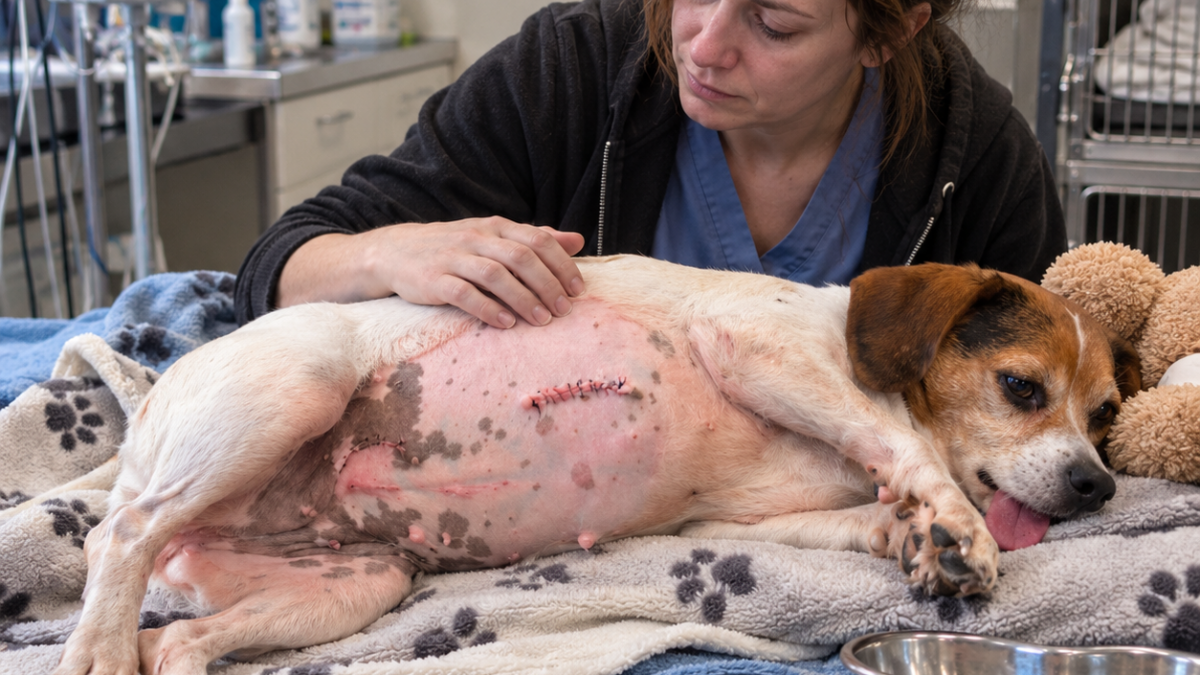
We thought the worst thing Rainey had survived was written into the strange bend of her little legs, but the real danger was hiding where none of us had thought to look.
I sent her to the veterinarian expecting X-rays, an orthopedic opinion, and maybe a long rehabilitation plan, never imagining that one routine decision would turn an ordinary appointment into an emergency surgery.
By the time my phone rang that afternoon, Rainey was already asleep on the operating table, and the question I had to answer could not wait for money, permission, or preparation.
Rainey was only five years old when she arrived from a Kentucky shelter.
The first thing I noticed was her face.
Soft brown eyes.
A hesitant wag.
The kind of expression rescue dogs sometimes wear when they desperately want to trust you but still aren’t sure whether kindness is temporary.
Then she stood up.
That was when I noticed her legs.
“Look at her wrists,” I whispered.
One of our volunteers crouched beside her.
Rainey’s front legs seemed to bend where they shouldn’t.
Not enough to stop her from walking.
Enough to make every step look slightly wrong.
She moved carefully across the floor, placing each paw as though she had spent years teaching herself how to compensate.
We suspected carpal laxity.
Sometimes poor nutrition during puppyhood can affect developing bones and joints. Sometimes genetics are involved. Sometimes dogs grow up without the proper medical care, and by the time someone finally notices, their bodies have already adapted to damage that should have been addressed years earlier.
Whatever had happened to Rainey, she didn’t complain.
That was almost worse.
She leaned against my knee while I examined her paws.
“You’ve been dealing with this for a while, haven’t you, girl?”
Her tail moved once.
I scheduled her veterinary evaluation immediately.
The plan seemed straightforward.
X-rays.
Orthopedic examination.
Bloodwork.
Then, because Rainey was already going to need anesthesia and had not been spayed, we made the practical decision to have that done at the same time.
One anesthesia event.
One recovery.
Less stress for her.
I dropped her off that morning.
Before the technician took her into the back, Rainey turned around twice.
The second time, I knelt beside her.
“I’m coming back.”
She pressed her forehead into my chest.
“I promise.”
I watched the door close behind her.
For the next few hours, I worked through the usual rescue chaos.
Medication schedules.
Transport arrangements.
Adoption applications.
A dog with diarrhea.
Another foster reporting that a terrified hound had finally eaten from her hand.
Ordinary rescue problems.
Then my phone rang.
The veterinarian.
I answered immediately.
“How are the X-rays?”
There was a pause.
That pause changed everything.
“Her legs are not actually why I’m calling.”
My stomach tightened.
“What happened?”
“Rainey is stable. She’s still under anesthesia.”
Stable.
Whenever a veterinarian begins with that word, you stop breathing normally.
“What did you find?”
“During her spay preparation, I palpated several mammary masses.”
For a second, I genuinely didn’t understand.
“Masses?”
“Multiple.”
I sat down.
The room suddenly seemed too quiet.
“How many?”
“There is one fairly substantial mass, and another chain containing three additional masses.”
Four.
Rainey was five years old.
Five.
“Do you think it’s cancer?”
“We cannot know without histopathology.”
The veterinarian continued explaining options.
Wake her up.
Schedule another surgery later.
Or remove what could safely be removed while she was already anesthetized.
There were risks.
More surgical time.
A larger incision.
A harder recovery.
More expense.
And there was another reality.
The masses were already there.
Waiting would not make them disappear.
“How much more?” I asked.
The estimate came.
I looked at the rescue account on my computer.
We had not raised money for this.
Nobody knew we needed it.
Yesterday, Rainey’s medical plan had been an orthopedic workup.
Now we were talking about removing tumors.
The veterinarian asked gently, “What would you like us to do?”
I looked at the photograph we had taken when Rainey arrived.
Bent little legs.
Hopeful face.
A dog who had probably spent years learning to live with whatever care she had not received.
Money mattered.
Of course it did.
Rescue organizations cannot save animals with good intentions alone.
But there are moments when a decision becomes very simple.
“If she were your dog,” I asked, “what would you do?”
“I’d remove them.”
That was enough.
“Then remove them.”
“We can proceed now?”
“Yes.”
I closed my eyes.
“Please don’t leave anything behind just because we weren’t expecting the bill.”
When I hung up, my hands were trembling.
We had sent Rainey in because her legs looked wrong.
Now pieces of her body were being sent to a laboratory to answer a question none of us had known to ask.
And whatever that answer turned out to be, I knew one thing already.
Rainey had spent enough of her life without someone choosing her.
We were not going to become the next people who looked at a suffering dog and decided her care was inconvenient.
PART 2
The final bill came to $812.
Under different circumstances, that number might not sound catastrophic.
In rescue, $812 can be a month of preventatives.
It can vaccinate several dogs.
It can cover emergency boarding when foster homes are full.
It can buy prescription food for animals whose bodies cannot tolerate anything else.
And in our case, the money had been spent before we had even told anyone there was an emergency.
But when the veterinarian called again three hours later, I wasn’t thinking about money.
“Rainey is awake.”
I let out a breath I didn’t realize I had been holding.
“How is she?”
“Groggy. Uncomfortable, obviously, but stable.”
“And the masses?”
“We removed the larger one and the additional chain of three. Everything has been submitted for histopathology.”
“How long?”
“Usually several business days.”
Several days.
People say waiting is passive.
It isn’t.
Waiting for pathology is work.
Your mind works.
Your stomach works.
Your fear works.
Every possibility you don’t want walks through the room and sits beside you.
Benign.
Malignant.
Clean margins.
Additional treatment.
Metastasis.
More surgery.
Cancer.
That word kept circling even though nobody had officially said it belonged to Rainey.
“When can I see her?”
“Give us another hour.”
I arrived fifty-three minutes later.
The receptionist barely had time to finish saying, “She’s still waking up,” before I asked if I could sit somewhere close to her.
A technician finally appeared.
“She’s pretty sleepy.”
“That’s fine.”
“She looks rough.”
“That’s fine too.”
“And her incision is much larger than a normal spay incision because of the mammary surgery.”
I nodded.
“Just take me to her.”
Rainey was lying on several folded blankets in a recovery kennel.
The first thing I saw was the cone.
The second thing was her eyes.
Half-open.
Heavy.
Confused.
Then her tail moved.
One tiny sweep against the blanket.
“Hey, sweetheart.”
I crouched.
She tried to lift her head.
“No. Don’t.”
Her head settled again.
The technician opened the kennel.
I slid my hand inside.
Rainey placed her chin across my fingers.
That was all.
But that small amount of weight almost broke me.
Hours earlier, she had arrived at this clinic because we were worried about her legs.
She woke up missing multiple masses none of us had known existed.
“You had a bigger day than we planned,” I whispered.
Her eyes closed.
“I’m sorry.”
Then I corrected myself.
“No.”
I stroked the side of her face.
“I’m not sorry we found them.”
The veterinarian came over a few minutes later carrying the X-rays.
“Want to talk about her legs?”
I almost laughed.
It felt absurd.
“Yes.”
We stepped into an examination room while Rainey continued resting nearby.
The radiographs glowed on a screen.
The vet pointed carefully.
“There are abnormalities in her front limbs, but I’m not seeing the kind of acute injury that would explain this as something recent.”
“So she was probably born this way?”
“Not necessarily.”
She zoomed in.
“There are developmental changes. Poor nutrition during growth could certainly be part of it. Genetics could contribute. Early orthopedic instability that was never addressed could contribute.”
“Can we fix it?”
The veterinarian paused.
“There’s an important distinction between fixing what looks unusual and treating what causes suffering.”
I listened.
“Rainey has adapted. She’s five. We need to evaluate how much pain she is actually experiencing before we start talking about aggressive orthopedic intervention.”
“So maybe no surgery?”
“Maybe supportive care. Weight management. Joint support. Controlled exercise. Physical therapy. Possibly braces depending on how she moves once recovered.”
I stared at the X-ray.
Her bones told a history nobody had written down.
“You think she was malnourished?”
“I think it’s possible.”
That word again.
Possible.
Rescue is full of possibilities you can never completely prove.
Possible neglect.
Possible backyard breeding.
Possible nutritional deficiency.
Possible untreated injury.
Possible cancer.
You rarely receive a complete biography with an abandoned dog.
You receive the dog.
And the consequences.
“Could somebody have noticed this when she was younger?”
“Yes.”
The answer came too quickly.
That hurt.
I looked through the window toward Rainey.
She was sleeping.
“Would early treatment have helped?”
“Potentially.”
Another word that did nothing to make me feel better.
On the drive home, Rainey slept on a padded bed in the back.
Every few minutes I checked the mirror.
Her chest rose.
Fell.
Rose.
Fell.
I had taken her to the clinic imagining that the hard part would be helping her legs.
Now the hard part was waiting for a laboratory technician in another building to examine pieces removed from her body under a microscope.
At a red light, I heard Rainey move.
I turned.
She had raised her head.
“You okay?”
Her eyes met mine.
That little tail moved.
“You have no idea what kind of trouble you caused today.”
Another wag.
I smiled despite myself.
“Fine. You win.”
At home, we created what we jokingly called the Rainey Recovery Suite.
It was really my laundry room.
But by the time we finished, it contained more equipment than some hospital rooms.
Thick bedding.
Water within easy reach.
Medication chart.
Disposable pads.
A baby gate.
Ice packs.
Extra towels.
Soft food.
A camera so I could check her without constantly waking her.
Because of the incision, she needed restricted movement.
That was almost easy.
Rainey had never been reckless.
She moved through the world like a dog who had learned early that her body required caution.
The first night, she wouldn’t eat.
I sat on the floor.
“Just a little.”
Nothing.
I warmed canned food.
No interest.
I tried boiled chicken.
Her nose moved.
Progress.
“One bite.”
She licked it.
“Excellent.”
Then she turned away.
“Half a bite is still technically progress.”
She closed her eyes.
I slept beside her.
Not because she needed me every second.
Because I needed to hear her breathe.
Around midnight she began trembling.
I sat up.
“Rainey?”
She shifted.
Pain.
I checked the medication schedule.
She wasn’t due yet.
I called the emergency number the clinic had given us.
The veterinarian explained what signs would indicate a true emergency.
Pale gums.
Difficulty breathing.
Uncontrolled bleeding.
Collapse.
Severe abdominal swelling.
Rainey had none of them.
Just pain.
Normal postoperative pain.
I hated the phrase.
Normal pain.
I understood the medical meaning.
I still hated it.
I sat beside her until the trembling stopped.
At two in the morning, she finally ate three small pieces of chicken.
I photographed the empty spot on the plate like a proud parent.
The next day was slightly better.
Then the next.
By the fourth morning, Rainey stood at the baby gate and wagged when she saw me.
She still walked strangely.
Of course she did.
But now I noticed something different.
Before surgery, I had looked at her legs first.
After surgery, I looked at her eyes.
Her appetite.
Her incision.
Her comfort.
Her mood.
Her body had reminded me how dangerous it is to reduce an animal to the problem we notice first.
Rainey was not “the dog with bent legs.”
She was a whole life.
And one part of that life had almost remained hidden.
We posted her medical update.
We explained what had happened.
No dramatic language.
No attempt to make anybody feel guilty.
Just the truth.
We expected an orthopedic evaluation.
The veterinarian found mammary masses.
One large mass and a chain of three others were removed.
Histopathology was pending.
The total was $812.
Then we waited.
People sent messages.
Some were comforting.
Some shared stories of dogs who had survived mammary cancer.
Others shared stories that ended differently.
I stopped reading those at night.
One woman wrote:
“My dog’s mass was benign. Don’t panic.”
Another wrote:
“My girl’s wasn’t. We still got two beautiful years.”
Both messages made me cry for different reasons.
Three days after surgery, the clinic called.
My heart jumped so hard I nearly dropped the phone.
“Is it back?”
“No. Sorry. Not yet. I was calling about her incision.”
I leaned against the counter.
“Don’t do that to rescue people.”
The technician laughed apologetically.
“Sorry.”
“No, it’s okay. How does it look?”
We emailed photos.
Mild swelling.
Normal healing.
No drainage.
No obvious infection.
Good news.
I should have been grateful.
Instead, when I hung up, I stared at the phone.
Still waiting.
On the fifth day, Rainey became interested in toys.
A small stuffed duck had been placed in her recovery area.
She picked it up carefully.
Then looked at me.
“You want that?”
She carried it three steps.
Dropped it.
Picked it up again.
That became the most beautiful thing I had seen all week.
Pain makes a dog’s world small.
Healing makes curiosity return.
That afternoon, one of our volunteers, Hannah, came to help.
She sat beside Rainey.
“Look at you.”
Rainey placed the duck in her lap.
Hannah looked at me.
“Do you think she’s going to be okay?”
“I don’t know.”
I hated saying it.
Hannah stroked Rainey’s ears.
“She’s only five.”
“I know.”
“What if it’s cancer?”
“We handle what’s in front of us.”
“That sounds very calm.”
“It’s not.”
She smiled sadly.
“You’re terrified.”
“Yes.”
“Me too.”
Rainey rolled slightly onto her side.
Hannah stopped petting.
“Can I touch near the incision?”
“Not yet.”
She looked at the shaved skin.
“So many scars.”
“Most are fresh.”
“I don’t mean those.”
I knew what she meant.
The legs.
The fear.
The way Rainey flinched if somebody moved too quickly with a mop handle.
The way she devoured food the first few days as though uncertain another meal would come.
The body remembers things records don’t.
“I keep wondering where she was before Kentucky,” Hannah said.
“So do I.”
“Do we know anything?”
“Almost nothing.”
The shelter intake listed her as a stray.
No microchip.
No collar.
No owner found.
That should have been the end of it.
Except something about Rainey’s condition bothered me.
Not because every stray has a mystery that needs solving.
Most do.
Because Rainey had been five years old, unspayed, with multiple mammary masses and skeletal changes that may have developed when she was young.
Somebody had known this dog.
Dogs do not appear from nowhere at five years old.
Somebody had fed her.
Or failed to feed her enough.
Somebody had watched her legs develop strangely.
Somebody had either missed or ignored masses growing along her mammary chain.
And then somehow Rainey ended up alone.
I called the Kentucky shelter.
A woman named Denise answered.
I explained who I was.
“Oh, Rainey.”
“You remember her?”
“I do.”
My chest tightened.
“Can I ask how she came in?”
“County pickup.”
“Stray?”
“That’s what the paperwork says.”
“Where?”
There was a pause.
“Let me check.”
I heard typing.
Then Denise became quieter.
“She was found on a rural road near Mill Creek.”
“Anything else?”
“Not in the public notes.”
Public notes.
That phrasing caught me.
“Are there other notes?”
Another pause.
“Why?”
I told her about the masses.
The surgery.
The suspected developmental issues.
Denise exhaled.
“Give me your number.”
“You can’t tell me?”
“Not yet.”
That answer sat in my stomach for the rest of the day.
Denise called back the following morning.
“We had another dog from that road.”
“When?”
“Two months before Rainey.”
“What condition?”
“Female hound mix. Thin. Unspayed. Significant dental disease.”
“Same property?”
“I didn’t say property.”
I understood.
There were privacy rules.
Investigation rules.
Things she legally could not tell a stranger over the phone.
“Was animal control involved?”
“They’re aware.”
That was all she would say.
I thanked her.
Then she added, “Keep your pathology report.”
“Why?”
“Just keep all the medical records.”
I sat very still after she hung up.
Hannah found me at the kitchen table.
“What happened?”
“I don’t know yet.”
That was true.
But something had changed.
Until then, Rainey’s past had felt unknowable.
Now there was a thread.
Thin.
Fragile.
But real.
I told myself not to pull it too hard.
Rainey needed healing.
That was our job.
Not playing detective.
Not inventing villains.
Not turning an injured dog into evidence for a story we hadn’t proved.
So I waited.
And on the seventh day, the veterinarian finally called.
I knew before answering that this was different.
Maybe it was instinct.
Maybe I had simply spent a week waiting for that number.
“Hello?”
“Hi. I have Rainey’s pathology.”
Everything inside me stopped.
“Okay.”
The veterinarian paused.
“We have mixed results.”
My knees weakened.
“Tell me.”
“The largest mass was benign.”
I covered my mouth.
One.
One was safe.
“And the others?”
“The chain contained multiple lesions. Two are benign mammary adenomas.”
I closed my eyes.
“And the third?”
Another pause.
“It is malignant.”
There it was.
Cancer.
One word.
One dog.
One room.
“Is it aggressive?”
“The pathology identifies it as a low-grade mammary carcinoma.”
Low grade.
I clung to those words immediately.
“Margins?”
“Clean.”
My eyes filled.
“Clean?”
“Yes. Based on the submitted tissue, the pathologist believes the mass was completely excised.”
I sat down.
“So we got it?”
“We removed what was there.”
“That’s not the same answer.”
“No.”
I appreciated her honesty even while hating it.
“Does she need chemotherapy?”
“Not automatically. We need staging.”
“Chest X-rays?”
“Yes. Possibly abdominal imaging. We want to look for any evidence of spread.”
My relief became fear again so quickly it was almost embarrassing.
“Could it have spread?”
“Any malignant tumor can potentially spread.”
“But low-grade and clean margins are good?”
“Yes. Very good.”
I cried then.
Quietly.
Not because the news was good.
Not because it was bad.
Because it was both.
Cancer.
Found unexpectedly.
Removed.
Maybe early enough.
Maybe not.
The veterinarian let me cry.
Then she said something I will never forget.
“If you had only brought her in for her legs and decided not to spay her that day, nobody might have noticed those masses yet.”
I looked across the room.
Rainey was sleeping on her bed.
Her duck tucked between her front paws.
Her strange legs folded beneath her.
The problem that brought her to us may have saved her life.
“How soon can we stage her?”
“As soon as the incision is healed enough for transport and positioning.”
We scheduled the appointment.
That night I sat beside Rainey.
“You had cancer.”
She wagged.
“You understand exactly none of this.”
Another wag.
“Probably healthier that way.”
I held her face gently.
“You scared us.”
She licked my chin.
Then stole a piece of chicken from the plate beside me.
“Apparently not enough.”
The staging X-rays showed no obvious metastasis in her lungs.
Ultrasound found nothing immediately alarming.
The veterinarian would not promise a cure.
Good veterinarians rarely make promises biology can break.
But she was cautiously optimistic.
“Monitor her mammary tissue regularly.”
“We will.”
“Recheck.”
“We will.”
“Any new lump, call.”
“We will.”
“And keep her lean. It will help her joints.”
That brought us back to the reason she had come in originally.
Her legs.
After several weeks of healing, we met with an orthopedic specialist.
Dr. Callahan watched Rainey walk across a long examination room.
Once.
Back.
Again.
Then slower.
Then on a different surface.
He knelt.
Moved each joint.
Pressed along the tendons.
Studied her X-rays.
Finally, he sat back.
“I understand why everyone thought carpal laxity.”
“Is it?”
“Partly. But I suspect what you’re seeing is the long-term result of developmental weakness combined with compensatory structure.”
“In English?”
He smiled.
“She probably grew up without everything her body needed.”
Nutrition.
Stable surfaces.
Proper activity.
Possibly veterinary attention.
Maybe several of those things.
“Can we straighten her legs?”
“We could discuss surgical correction.”
I waited.
“But?”
“But I don’t recommend operating on a five-year-old dog who is functional, comfortable, and has adapted unless we see pain or progressive breakdown that justifies the risk.”
“So we leave them?”
“We support them.”
Physical therapy.
Controlled strengthening.
Weight management.
Joint supplements.
Non-slip surfaces.
Possibly custom supports if needed later.
“And she can have a normal life?”
Dr. Callahan looked at Rainey.
She was attempting to steal a treat from his coat pocket.
“She appears to have strong opinions about having a normal life.”
I laughed.
For the first time since pathology, I laughed without fear sitting immediately behind it.
Rainey started physical therapy two weeks later.
She hated the underwater treadmill.
The first time the water rose around her legs, she looked at me as though I had personally betrayed every agreement we had ever made.
“You’re safe.”
She stared.
“You are.”
Stare.
The therapist offered chicken.
Rainey reconsidered her legal options.
By session three, she was walking.
By session six, she had learned that the treadmill predicted food.
By session eight, she entered the therapy room willingly.
Her legs did not become straight.
That was never the goal.
They became stronger.
That mattered more.
Meanwhile, the thread from Kentucky returned.
Denise called.
“Are you still working with Rainey?”
“Every day.”
“How is she?”
“Cancerous mass removed. No obvious spread. Orthopedic specialist thinks her legs may reflect developmental nutritional issues.”
Silence.
Then Denise said, “Can you email the medical records to our animal control supervisor?”
“Why?”
“We have an open welfare investigation.”
My pulse quickened.
“Related to where she was found?”
“I can’t discuss details.”
Of course.
“But her records may help establish a pattern.”
I looked at Rainey.
She was asleep in a patch of sunlight.
“What kind of pattern?”
Denise lowered her voice.
“Unspayed adult females. Reproductive overuse. Inadequate veterinary care. Poor body condition.”
My stomach turned.
“You think she was bred?”
“I did not say that.”
She didn’t have to.
Multiple mammary tumors in an unspayed female.
Developmental abnormalities.
No chip.
Rural pickup.
Other neglected female dogs from the same area.
None of it proved Rainey had been used for breeding.
But it formed a picture ugly enough to make my hands shake.
I sent every record.
X-rays.
Surgical report.
Pathology.
Orthopedic notes.
Photographs from intake.
Body condition score.
Everything.
Then we did the hardest thing.
Nothing.
Because investigations do not move at the speed of anger.
Weeks passed.
Then months.
Rainey improved.
Her coat became glossy.
Muscle developed over her shoulders.
She learned stairs were forbidden but couches were apparently negotiable.
She discovered squeaky toys.
Her favorite was a blue pig that made a sound so offensive I considered accidental disappearance.
Rainey guarded it like treasure.
She also started doing something we had not expected.
Running.
Not far.
Not gracefully.
But whenever she went into the fenced yard, she would trot toward the grass, look back, and then suddenly break into the strangest little crooked run.
Front feet wide.
Body swaying.
Ears flying.
Absolute joy.
The first time she did it, Hannah screamed.
“Look at her!”
“I’m looking!”
“She’s running!”
“She’s not supposed to overdo it!”
“Let her have ten seconds!”
So we did.
Ten beautiful seconds.
Rainey ran.
Then stopped beside me, panting.
I knelt.
“That’s enough, athlete.”
She licked my nose.
A month later, we celebrated her first completely uneventful veterinary recheck.
No new masses.
Incision healed.
Weight ideal.
No lung abnormalities on follow-up imaging.
We were not declaring victory.
Cancer doesn’t respect celebration.
But we allowed ourselves one photograph.
Rainey sitting between Dr. Callahan and her primary veterinarian.
Her crooked legs visible.
Her face ridiculously proud.
Then, six months after the first surgery, Denise called again.
“I can finally tell you something.”
I sat down.
“What happened?”
“The investigation is public now.”
My heart accelerated.
Animal control had executed a warrant at a rural property not far from where Rainey had been picked up.
Twenty-three dogs had been removed.
I couldn’t speak.
“Twenty-three?”
“Mostly females.”
My hand covered my mouth.
“Condition?”
“Varied.”
That word sounded terrible.
“Some underweight. Several with untreated medical problems. Two pregnant. Multiple older females with mammary masses.”
I closed my eyes.
Rainey’s face appeared in my mind.
“How long had this been going on?”
“We don’t know.”
“Was it a breeder?”
“There’s evidence dogs were being sold.”
My anger finally found somewhere to land.
“What happened to the owner?”
“Charges are pending.”
“Animal cruelty?”
“Multiple counts related to neglect and failure to provide necessary veterinary care.”
It was not the cinematic kind of revenge people imagine.
No dramatic confrontation.
No one screaming in a courtroom.
No rescue worker throwing a folder onto a table and destroying a villain with one speech.
Real accountability is slower.
Paperwork.
Veterinary records.
Photographs.
Body scores.
Dates.
Statements.
Invoices.
Expert opinions.
Quiet facts lined up until excuses have nowhere left to hide.
“Did our records matter?” I asked.
“Yes.”
That single word hit me harder than I expected.
“How?”
“Rainey helped establish that at least one dog associated with that area showed long-term developmental concerns and untreated mammary disease.”
I looked across the room.
Rainey was chewing the blue pig.
Her legs bent exactly as they always had.
Her scars hidden under new fur.
“She mattered.”
“She did.”
I wiped my eyes.
Denise continued.
“There’s something else.”
“What?”
“One of the dogs removed looks a lot like her.”
I stopped breathing.
“What do you mean?”
“Same size. Similar coat. Similar structure.”
“Related?”
“We don’t know.”
“Can you send a picture?”
“I’ll have to check.”
Two days later, a photograph arrived.
The dog was older.
Maybe seven.
Female.
Tan-and-white coat.
Long ears.
And front legs that angled outward in an eerily familiar way.
I stared for a long time.
Hannah looked over my shoulder.
“Oh my God.”
“Don’t.”
“That could be—”
“We don’t know.”
“But look at the legs.”
“I know.”
“Look at the face.”
“I know.”
We called her Maribel because the county intake number felt too impersonal.
Her medical examination revealed dental disease, parasites, chronic ear infection, and two small mammary nodules.
I nearly threw the phone when Denise told me.
“Are they removing them?”
“Yes.”
“Sending them to pathology?”
“Yes.”
“Good.”
“Thought you’d say that.”
Both nodules were benign.
I cried anyway.
Maribel entered foster care.
I wanted to bring her here.
Every emotional instinct screamed to put her beside Rainey and see what happened.
Instead, we listened to behavior specialists.
Possible relatives do not automatically want reunion.
Dogs live in the present far better than humans.
So we arranged a careful introduction weeks later.
Neutral property.
Two handlers.
Loose leashes.
No expectations.
Rainey saw Maribel from thirty feet away.
She froze.
Maribel froze too.
Hannah whispered, “Do they know?”
“I don’t know.”
Rainey walked forward.
Slowly.
Maribel did the same.
They sniffed.
Circled.
Sniffed again.
Then Rainey sneezed.
Maribel sneezed back.
And both dogs began wagging.
Not a movie reunion.
No dramatic recognition.
No collapsing into each other.
Just comfort.
Within ten minutes, they were walking side by side.
Within twenty, Rainey had attempted to steal Maribel’s treat.
“That proves they’re sisters,” Hannah said.
“It proves Rainey is a thief.”
We never proved they were related.
Eventually I realized I didn’t need to.
They were two dogs whose bodies carried similar evidence of lives that should have been easier.
Now both were safe.
That was enough.
The court case moved slowly.
The property owner pleaded not guilty.
His attorney argued that many of the dogs were rescues.
That he had been overwhelmed.
That some medical conditions were age-related.
That officials had misunderstood the situation.
When I heard that, something in me burned.
Overwhelmed.
I understand overwhelmed.
Every legitimate rescuer does.
We know empty bank accounts.
We know midnight emergencies.
We know the terror of opening a veterinary estimate when three other animals already need treatment.
But being overwhelmed does not give you permission to keep collecting lives you cannot care for.
Compassion without limits can become another form of neglect.
The prosecutor contacted our veterinarian.
Then the orthopedic specialist.
Then me.
“Would you testify if necessary?”
My stomach dropped.
“I’m in another state.”
“We may need a written declaration first.”
“About Rainey?”
“Yes.”
I looked at her.
She was sleeping upside down on the sofa, all four legs pointed in directions no anatomy book would recommend.
“Yes.”
Writing the statement was harder than expected.
I removed emotion.
That was the point.
Date transferred from Kentucky shelter.
Observed limb abnormalities.
Veterinary referral.
Mammary masses discovered.
Surgery performed.
Histopathology identified malignant mammary carcinoma among removed masses.
Orthopedic opinion indicated developmental changes potentially consistent with inadequate nutrition or unresolved instability during growth.
Every sentence felt colder than the life behind it.
But facts do not need anger to be powerful.
Months later, the defendant changed his plea as part of an agreement.
Several cruelty-related counts remained.
He surrendered ownership rights to all seized animals.
He was prohibited from breeding or possessing more than a limited number of animals for a court-defined period and subjected to inspections.
Fines.
Restitution.
Probation.
It was not enough for everyone.
Online comments wanted prison forever.
Others defended him.
Some said rescue had exaggerated everything.
Some said people should mind their own business.
I looked at Rainey.
Then at the photograph from the day she arrived.
Bent legs.
Unspayed.
Tumors growing quietly.
A dog does not understand probation.
She understands whether somebody comes when she hurts.
She understands whether food arrives.
Whether the floor is warm.
Whether hands are gentle.
Whether a mass stays in her body because treatment costs money.
For Rainey, justice was simpler.
She was safe.
So were twenty-three others.
Maribel was adopted by a retired teacher named Susan.
She slept under Susan’s piano during the day and on Susan’s bed every night.
One of the pregnant dogs delivered safely in foster care.
Another senior female had three mammary tumors removed.
A young male needed heartworm treatment.
A terrified hound spent seven months learning humans could approach without hurting him.
Not every story became pretty.
One dog’s cancer had already spread.
She received hospice care.
Three quiet months.
Soft beds.
Chicken.
Sunshine.
Then a peaceful goodbye with her foster family beside her.
Saving does not always mean curing.
That lesson never gets easier.
Rainey, however, kept surprising us.
At her one-year cancer recheck, the veterinarian examined every inch of her mammary chain.
Nothing suspicious.
Chest films looked clear.
The vet smiled.
“I like boring appointments.”
“So do I.”
Rainey sat between us, hoping boring appointments included cheese.
They did.
Her orthopedic condition remained stable.
She could not go on long hikes.
She would never be a jogging companion.
Slippery floors were still difficult.
We used rugs.
Lots of rugs.
Our house eventually looked like a carpet store had exploded.
She didn’t care.
She had routes.
Bed to water.
Water to kitchen.
Kitchen to back door.
Back door to couch.
Couch to wherever a human was eating.
Perfect system.
Then came the question we had been avoiding.
Adoption.
Rainey had originally been meant for foster care.
That is how rescue works.
You help them heal.
Then they move on.
If every foster family keeps every dog, eventually there is no room for the next one.
I knew that.
I had preached it.
Then Hannah asked, “So when are we listing her?”
Rainey was asleep with her head on my foot.
“Soon.”
“You said soon last month.”
“She needed another recheck.”
“Done.”
“She needs physical therapy.”
“She can do that with an adopter.”
“Cancer monitoring.”
“Adopters can monitor cancer.”
I glared at her.
Hannah smiled.
“You’re keeping her.”
“No.”
Rainey sighed.
“You are.”
“I run a rescue. I cannot keep every medical case.”
“You don’t keep every medical case.”
“I absolutely do not.”
“You kept Jasper.”
“He was unadoptable.”
“You kept Molly.”
“She hated everyone except me.”
“You kept Bean.”
“That was an administrative error.”
Hannah stared.
“What administrative error?”
“I adopted him accidentally.”
“You signed adoption paperwork.”
“Exactly. Paperwork failure.”
Rainey opened one eye.
Hannah pointed.
“Tell her.”
“I’m not discussing this in front of the patient.”
Two weeks later, I posted Rainey’s adoption profile.
I hated every word.
Five-year-old female.
Sweet.
Affectionate.
Special orthopedic needs.
History of mammary carcinoma completely excised with clean margins.
Ongoing monitoring required.
No long-distance running.
Rugs helpful.
Excellent with gentle adults.
Likes toys.
Strong preference for chicken.
I pressed publish.
Applications arrived.
Some were terrible.
One person asked if her crooked legs could “be fixed so she looks normal.”
Delete.
One wanted an outdoor farm dog.
Delete.
Another wanted a dog for daily six-mile runs.
Absolutely not.
Then came one from a couple named Mark and Lisa.
Quiet home.
Both worked partly from home.
Previous senior dog experience.
Fenced yard.
No children.
They had lost their Labrador to lymphoma the year before.
Their application was thoughtful.
Too thoughtful.
I hated them immediately.
Hannah read it.
“They sound perfect.”
“I disagree.”
“With which answer?”
“Their name is Mark.”
“What’s wrong with Mark?”
“I don’t trust Marks.”
“You have a brother named Mark.”
“Exactly.”
She laughed.
The meet-and-greet was scheduled.
I cleaned Rainey’s ears.
Brushed her.
Trimmed her nails.
Then became irrationally annoyed when she looked beautiful.
“You don’t need to impress them.”
Tail wag.
“You live here.”
Another wag.
“They are strangers.”
Rainey walked toward the front door when the bell rang.
Traitor.
Mark sat on the floor before touching her.
Good.
Lisa waited for Rainey to approach.
Better.
They did not stare at her legs.
They asked about pain.
Mobility.
Cancer surveillance.
Diet.
They asked whether she liked sleeping in a crate.
“No.”
“Bed?”
“Yes.”
“Furniture?”
“She believes property law strongly favors dogs.”
Mark smiled.
“We can work with that.”
I wanted to dislike him.
Rainey made that difficult.
She put her head in Lisa’s lap.
Lisa’s eyes filled.
“Our old dog used to do that.”
I saw it.
Grief recognizes familiar gestures.
After an hour, they left.
Hannah asked, “Well?”
“No.”
“Why?”
“They’re perfect.”
“That is usually good.”
“I don’t like it.”
“You’re keeping her.”
“I am running a rescue.”
“You’ve mentioned.”
I looked at Rainey.
She looked at me.
That evening, I opened her intake photograph.
Then the surgery picture.
Then physical therapy.
Then running in the yard.
Then sleeping upside down.
Somewhere along the way, the dog I was preparing to save for someone else had become mine.
That scared me.
Not because I didn’t want her.
Because wanting is easy.
Commitment comes after the exciting part.
Rainey might develop another tumor.
She might need expensive imaging.
Her joints might worsen.
She might need braces.
Medication.
Surgery someday.
Adopting her meant accepting future problems we could not see yet.
Then I realized how ridiculous that fear was.
We never know what comes next with anyone we love.
Healthy dogs get sick.
Young dogs age.
Perfect bodies fail.
The only difference was that Rainey’s uncertainty had arrived with paperwork.
The next morning, I called Mark and Lisa.
“I owe you an apology.”
Lisa became quiet.
“I don’t think Rainey is available.”
“Oh.”
Disappointment.
Real disappointment.
“I’m sorry.”
“No, that’s okay.”
“She—”
My throat tightened unexpectedly.
“She’s home.”
There was a pause.
Then Lisa laughed softly.
“I wondered.”
“You did?”
“The way you watched her.”
Embarrassing.
“I’m really sorry.”
“Don’t be.”
She paused.
“Do you have another dog who needs us?”
I stopped.
“What?”
“We’re ready. Maybe Rainey brought us there for somebody else.”
Two weeks later, Mark and Lisa adopted a nine-year-old Labrador mix named Clover.
Gray muzzle.
Arthritis.
Owner had died.
Almost no applications.
Clover walked into their house, found the couch, and apparently decided the matter was legally settled.
That was one of the first times I understood that keeping Rainey had not necessarily taken a home from another dog.
Sometimes one dog leads people to another.
Rainey became our unofficial ambassador.
Not intentionally.
She simply had a face people remembered.
When new fosters arrived frightened, Rainey ignored them until they were ready.
When puppies became obnoxious, she gave one quiet growl and they suddenly discovered manners.
When humans cried, she leaned.
Always.
One evening, nearly two years after her surgery, I received an email from a woman named Caroline.
Subject line:
I Think I Know Rainey.
I stared at it for several minutes before opening.
Caroline lived in Kentucky.
She had seen an article about the animal neglect case and later found our rescue page.
She included an old photograph.
A younger Rainey stood beside a weathered wooden shed.
Her legs were already bent.
Behind her were several other dogs.
My heart pounded.
The email continued.
Caroline had lived near the property years earlier.
She remembered a little female dog that looked like Rainey.
The dogs were sometimes advertised online.
She had once tried to buy one because she felt sorry for them.
The owner refused when Caroline asked to see veterinary records.
She reported concerns.
She never knew what happened.
I studied the photograph.
There was no definitive proof.
Markings can be similar.
Dogs can resemble each other.
But the white patch on the chest.
The ears.
The slight mark above one eye.
The legs.
Hannah looked over my shoulder.
“That’s her.”
“Probably.”
“No. That’s Rainey.”
I zoomed in.
Rainey was younger.
Maybe two.
The leg deformity already obvious.
That answered one question.
Somebody had seen.
Not us.
Somebody in her past.
Her legs had not suddenly become strange at five.
They had been strange for years.
Visible.
Every day.
I sent the photograph to Denise.
She replied the next afternoon.
“Please forward Caroline’s contact information with permission.”
Caroline agreed.
Her statement became part of the case record even though the plea agreement had already been reached.
It did not change the sentence.
It changed something in me.
For years, I had wondered whether Rainey’s condition had simply gone unnoticed.
Now that possibility felt smaller.
Someone may have watched her grow that way and decided she was good enough for whatever purpose they needed.
I was furious.
I wanted confrontation.
I imagined driving to Kentucky.
Standing at that property.
Holding Rainey’s veterinary records.
Demanding an explanation.
Why didn’t you take her to a veterinarian?
Why wasn’t she spayed?
Did you know about the masses?
How many litters?
How many dogs?
Did you ever look at her legs and wonder whether they hurt?
Anger writes satisfying scenes in your head.
Real life rarely cooperates.
I never went.
There was no answer that could straighten Rainey’s bones.
No apology that could remove the scar from her abdomen.
No argument that could give her a different puppyhood.
The strongest revenge available was already happening.
The operation that might once have profited from dogs like Rainey was gone.
The remaining animals had been removed.
Medical records existed.
People were watching.
And Rainey was sleeping beside me with her head on a pillow she technically was not supposed to own.
That was enough.
More than enough.
At her third annual oncology check, I sat in the examination room with my stomach twisted exactly the way it had been during the first pathology wait.
Rainey had developed a tiny lump near one remaining mammary gland.
I found it during our monthly check.
Smaller than a pea.
The veterinarian aspirated it.
Results were inconclusive.
Surgery was recommended.
The fear came back immediately.
Cancer does that.
Years can pass.
Then one tiny lump opens every old door.
We scheduled removal.
This time, unlike the first surgery, we knew what might happen.
We had money reserved.
We had pathology planned.
We had staging protocols.
We were prepared.
I still didn’t sleep.
The night before surgery, I sat beside Rainey.
“You remember the first time?”
She was chewing the blue pig.
The same kind, anyway.
Original Pig had died heroically in the line of duty.
“You went in for X-rays and came out with half the clinic worried about you.”
Squeak.
“Tomorrow, no surprises.”
Squeak.
“I mean it.”
She dropped the pig.
Placed her chin on my leg.
I stroked the crooked line of her front leg.
“I need more time.”
That was selfish.
I knew.
But sometimes love is honest enough to admit selfishness while still making the right medical decisions.
The mass was removed.
Three days later, pathology came back.
Benign.
I read the word five times.
BENIGN.
I called Hannah.
She answered, “What?”
Because after years in rescue, nobody calls casually.
“Benign.”
She screamed.
I held the phone away.
Rainey began barking because Hannah was screaming through the speaker.
Then I started laughing.
Then crying.
Then doing both.
We bought Rainey a cheeseburger.
The veterinarian would have preferred lean chicken.
We did not ask.
Years moved.
Her muzzle whitened.
The five-year-old rescue dog became six.
Then seven.
Then eight.
Her legs eventually developed arthritis.
Not surprising.
We added medication.
Physical therapy became gentler.
Walks became shorter.
Rugs multiplied.
The dog who had once learned to run for ten seconds became a dog who preferred five-minute investigations of the same patch of grass.
That was fine.
I learned from Rainey that progress does not always mean doing more.
Sometimes progress is remaining comfortable while the world asks less of your body.
At eight, she became fascinated with one particular corner of the yard.
Every morning she walked there.
Sniffed.
Stood.
Then returned.
“What is there?”
Nothing visible.
Hannah joked that Rainey had buried evidence.
I dug once.
Nothing.
Rainey watched with obvious disappointment at my intelligence.
At nine, her chest imaging remained clear.
At ten, still no recurrence.
By then, several of the dogs from the Kentucky seizure had died of old age or illness.
Others were thriving.
Maribel was still alive.
Susan sent birthday photographs.
Maribel wore ridiculous hats with the resigned expression of a dog who understood humans could not always be saved from themselves.
Every year, Rainey and Maribel met once.
No proof of relation ever surfaced.
We stopped caring.
They were family because we chose the word.
When Rainey turned ten, Denise visited us.
She had retired from the shelter.
She drove several hours during a trip and asked if she could stop.
When she walked into the yard, Rainey barked once.
Denise knelt.
“Do you remember me?”
Probably not.
Rainey approached.
Sniffed.
Then leaned.
Denise started crying.
“I put her on the transport list.”
“I know.”
“I almost didn’t.”
My stomach tightened.
“What?”
“We were full.”
She stroked Rainey’s ears.
“Senior intake that week. Two cruelty cases. Kennels doubled.”
Rainey’s tail moved.
“I saw her legs and thought nobody would take her.”
I sat beside them.
“What changed your mind?”
Denise laughed through tears.
“She wagged.”
Of course.
“One stupid little wag.”
“Not stupid.”
“No.”
She looked at Rainey.
“I remember thinking, somebody has to at least try.”
I swallowed.
“You did.”
“No.”
Denise looked at me.
“We started the chain.”
That was true.
Rescue is rarely one hero.
A county worker picks up a stray.
A shelter employee makes a phone call.
A transporter drives two hours.
A volunteer opens a crate.
A veterinarian palpates where nobody expected a problem.
A surgeon removes what shouldn’t be there.
A pathologist studies tissue.
A donor pays ten dollars.
A foster loses sleep.
An adopter says yes.
One life survives because dozens of small decisions point in the same direction.
Rainey stretched her crooked legs across the grass.
Denise looked at them.
“We thought those legs were going to be the big story.”
I smiled.
“So did we.”
“Funny.”
“What?”
“The thing everybody noticed wasn’t the thing most likely to kill her.”
That stayed with me.
Because it was bigger than Rainey.
How often do we look at the obvious wound and assume we understand the whole life?
Bent legs.
Thin body.
Dirty coat.
Fear.
Behavior.
We see what presents itself.
But suffering hides.
Cancer hides.
Trauma hides.
Loneliness hides.
And sometimes the act of caring about one visible problem is what allows us to discover another before it becomes too late.
Rainey lived well beyond the day we feared she might not.
Not because we were brilliant.
Not because rescue is magical.
Because a shelter worker noticed.
Because we scheduled an evaluation.
Because a veterinarian did a careful physical examination instead of focusing only on the reason written at the top of the chart.
Because when unexpected masses were discovered, nobody said:
Wake her up. We didn’t budget for this.
That decision cost $812.
Years later, I can tell you exactly what we bought.
Not surgery.
Not pathology.
Not X-rays.
Time.
We bought Rainey mornings in the yard.
We bought squeaky pigs.
We bought physical therapy arguments.
We bought chicken stolen from plates.
We bought annual photographs.
We bought her friendship with Maribel.
We bought nights with her sleeping upside down on the couch.
We bought the chance to discover another lump early.
We bought the chance to watch her muzzle turn white.
No one knows how much time any medical decision purchases.
Sometimes none.
Sometimes weeks.
Sometimes years.
But when Rainey was already under anesthesia and the veterinarian asked what to do, we made the only decision we could live with.
Treat the dog in front of us.
Not the bank balance.
Not the plan we had yesterday.
Not the version of rescue that looks clean on social media.
The dog.
Rainey eventually became an old lady.
A very opinionated old lady.
She demanded breakfast earlier every year.
She developed selective hearing so advanced that she could ignore “come inside” from five feet away but detect a cheese wrapper through two closed doors.
Her legs stiffened.
We bought more orthopedic beds.
She used the couch.
We bought a ramp.
She used the other door.
We placed rugs everywhere.
She occasionally chose the three inches of exposed floor and then stared at us as though we had personally created gravity.
She was ridiculous.
She was wonderful.
At eleven, her kidneys began showing early changes.
Nothing catastrophic.
Diet adjustment.
Monitoring.
More water.
At twelve, she needed stronger arthritis medication.
At twelve and a half, she stopped running completely.
I missed that crooked run.
But she still wagged.
Still ate.
Still leaned.
Still greeted people she loved.
Good life is not measured by speed.
Then, one autumn morning, Rainey refused breakfast.
That got my attention immediately.
Rainey had once attempted to eat a paper towel because it smelled like roast chicken.
Refusing food was not normal.
I offered chicken.
Nothing.
Cheese.
Nothing.
Blue Pig.
She looked at it, then away.
We went to the veterinarian.
Bloodwork showed her kidney values had worsened.
Fluids.
Medication adjustment.
Special food.
For several months, she rallied.
Then gradually, the pattern changed.
Longer sleeps.
Shorter walks.
More help standing.
Less interest in visitors.
I began the quality-of-life chart.
Rescue had taught me not to wait until suffering became obvious to everyone except the person afraid to let go.
Good day.
Bad day.
Good day.
Good day.
Bad day.
Then two bad.
Then one good.
Cancer never returned.
That felt like an enormous victory.
Time was simply doing what time does.
One night, Rainey woke me at 2:17.
She was standing beside the bed.
Unsteady.
I helped her outside.
Cold air.
Clear sky.
She walked slowly to her favorite corner.
The mysterious one.
She stood there.
Sniffed.
Then lay down.
“Rainey?”
I knelt.
She looked at me.
No panic.
Just tired.
I sat on the cold grass beside her.
For ten minutes neither of us moved.
Then she rested her head across my ankle.
I knew.
People sometimes say you know.
I used to think that was sentimental nonsense.
Then I knew.
The next morning, the veterinarian examined her.
There was no single dramatic crisis.
No tumor.
No catastrophic organ failure.
Just an old body reaching the point where maintaining comfort required more than that body could give.
The veterinarian looked at me.
“You don’t have to decide today.”
I appreciated that.
But I looked at Rainey.
She was lying on the floor.
Eyes closed.
Not interested in the treats.
The same dog who had once fought an underwater treadmill for chicken.
I asked the hardest question.
“If she were yours?”
The veterinarian’s eyes filled.
“I would let her go on a peaceful day instead of waiting for an emergency night.”
Years earlier, I had asked another veterinarian nearly the same question when unexpected masses were found.
If she were your dog, what would you do?
Remove them.
We did.
Now love required a different answer.
We scheduled an at-home goodbye for the next afternoon.
I hated every hour between the decision and the appointment.
Then I realized those hours were a gift.
Rainey slept in her favorite place.
We opened the windows.
Hannah came.
Denise joined by video call.
Susan sent a picture of Maribel.
Mark and Lisa sent a photograph of Clover’s old collar beside a candle—Clover had died two years earlier.
People who had entered Rainey’s story because of rescue somehow remained connected long after their individual chapters changed.
I gave Rainey chicken.
She ate one piece.
Then another.
I laughed.
“You’ve been faking this whole thing.”
Tail wag.
Tiny.
Still there.
I brought Blue Pig.
Actually Blue Pig Number Nine.
The lineage had been complicated.
I placed it beside her.
She rested one paw on it.
Hannah started crying.
“Don’t,” I said.
“You’re crying.”
“That’s unrelated.”
“To what?”
“Everything.”
We laughed like idiots.
That mattered.
The veterinarian arrived at four.
Rainey was on her bed near the window.
I sat behind her.
One arm around her chest.
My hand rested over the place where years earlier surgeons had removed the mammary chain.
The scar was almost impossible to find under her fur.
But I knew where it was.
“I thought your legs were the problem,” I whispered.
Her ear moved.
“You fooled everybody.”
The veterinarian gave the sedative.
Rainey relaxed.
All the stiffness left her face.
For several minutes she looked like the five-year-old dog who had arrived from Kentucky.
Not because her legs were straight.
They never were.
Because pain had released her.
I kissed her head.
“You were worth every dollar.”
Hannah sobbed.
“You were worth every ruined rug.”
A tail movement.
“Every terrible pig toy.”
Another.
“Every mile.”
I pressed my forehead against hers.
“And every time we were scared.”
Her breathing slowed.
The veterinarian waited.
I thought about that first operating room.
The unexpected call.
The masses.
The decision made without fundraising.
The pathology.
The fear.
The investigation.
The dogs removed.
Maribel.
Years.
So many years.
Had we done nothing that first day because we were unprepared, I would have spent the rest of my life wondering whether Rainey’s cancer might have been caught in time.
Instead, she had grown old.
There are few victories in rescue greater than watching a dog you once feared losing to disease become old enough to die from being old.
I nodded.
The veterinarian gave the final medication.
Rainey’s breathing became softer.
Then stopped.
No drama.
No fear.
Just quiet.
Her crooked legs rested against my lap.
For the first time since I met her, I didn’t wish they had been different.
Those legs had brought her to us.
They made a shelter worker look twice.
They made us schedule X-rays.
That appointment led to the examination that found the masses.
The thing I once wished somebody had prevented may have been the very thing that saved her.
Life is cruel and strange that way.
After Rainey died, we received her ashes in a simple wooden box.
I placed Blue Pig Number Nine beside it.
Three days later, a transport arrived from Kentucky.
I almost laughed when I saw the first dog.
Young female.
Odd gait.
Nothing as dramatic as Rainey’s.
But enough.
The transporter handed me the leash.
“She needs an orthopedic evaluation.”
Of course she did.
I crouched.
The dog hesitated.
Then leaned forward.
I examined her legs.
But not only her legs.
I ran my hands gently over her shoulders.
Chest.
Abdomen.
Mammary tissue.
Everywhere.
Hannah watched me.
“Rainey taught us something.”
“Yes.”
The new dog wagged.
I looked toward the shelf where Rainey’s collar hung.
The $812 bill from that first surgery was still inside her folder.
I kept it.
Not because we regretted it.
Because that piece of paper became the beginning of everything.
Sometimes people ask why rescues spend hundreds or thousands of dollars on a dog who might never repay it.
That question misunderstands rescue.
Dogs do not repay medical bills.
They do not owe us gratitude.
They do not have to become inspirational.
They do not need to justify the cost of keeping them alive.
Rainey never owed us anything.
We owed her the chance she should have had from the beginning.
She may have grown up without enough nutrition.
She may have gone years without anyone correcting or even investigating the strange shape of her legs.
She lived long enough for mammary masses to grow inside her while no one sought treatment.
By the time she reached us, we could not rewrite those years.
But we could control what happened next.
So when the veterinarian called and said, “We found something,” we said yes.
When pathology said cancer, we staged her.
When her legs needed strengthening, we took her to therapy.
When officials needed records, we sent them.
When another dog might have shared her history, we helped.
When Rainey needed monitoring, we monitored.
When she needed rugs, we covered the floors.
When she needed medication, we gave it.
When she needed us to stop fighting time, we let her go.
That is the kind of revenge I believe in now.
Not cruelty returned for cruelty.
Not humiliation.
Not destruction.
The best revenge against neglect is care so consistent it becomes undeniable.
The best answer to the people who treated a living creature as disposable is to build a life in which she never feels disposable again.
The person responsible for the Kentucky property lost the ability to continue as before.
Dogs were removed.
Records followed him.
Inspectors knew the address.
Courts knew the facts.
But the part that mattered most happened far away from any courtroom.
Rainey slept on a couch.
Maribel slept under a piano.
Twenty-three dogs learned the sounds of different houses.
Some discovered toys.
Some gained weight.
Some received surgeries.
Some lived years.
Some only months.
But nobody on that property had the final word about what those lives were worth.
That was the justice.
Rainey arrived with bent legs.
We thought they were the crisis.
Then a veterinarian found four masses.
One of them was malignant.
We removed it before we ever knew how we would cover the bill.
Years later, when Rainey was old and white around the muzzle, I sometimes placed my hand over the faint scar along her belly.
She would look up at me.
Tail wagging.
Impatient for snacks.
Completely uninterested in the symbolism humans love attaching to survival.
Maybe that was one more thing she taught me.
She did not spend her life mourning what happened before rescue.
She lived the life in front of her.
Sunlight.
Food.
Grass.
Toys.
People.
Comfort.
Another morning.
Another dinner.
Another ridiculous pig.
Another year.
And another.
And another.
Until there were no more years to ask for.
The day Rainey arrived, I thought I was going to save a dog with unusual legs.
I was wrong.
First, her legs led us to a hidden cancer.
Then her cancer led us to questions.
Those questions became records.
The records became evidence.
The evidence helped expose a larger pattern.
And somewhere along the way, the dog we thought needed rescuing began changing everyone around her.
She taught a shelter worker that one wag was enough reason to try.
She taught us that an unexpected veterinary bill is not always a disaster; sometimes it is the receipt for time you have not lived yet.
She taught adopters to look beyond perfect bodies.
She helped connect another senior dog with the home that was meant for her.
She helped officials understand what long-term neglect can look like when it is written into bone and tissue instead of words.
And she taught me that when you promise a rescue dog, “You have us now,” those words have to mean something after the photograph is taken.
They have to mean surgery.
Waiting.
Money.
Fear.
Laundry.
Medicine.
Follow-up appointments.
Ugly days.
Hard decisions.
And eventually, if you are lucky enough, gray fur.
Rainey became gray.
That is the ending I once didn’t dare imagine.
Not a miraculous cure.
Not perfect legs.
Not a body untouched by damage.
Something better.
She became old.
She lived long enough for us to forget to count the months after cancer.
Long enough for her first surgery scar to disappear beneath soft fur.
Long enough to destroy nine blue pigs.
Long enough to teach newcomers where the kitchen was.
Long enough to turn a rescue intake into a family story.
People sometimes look at the photograph from her first week and say, “Her poor legs.”
I understand.
That was what we saw too.
Now when I look at that photograph, I notice something else.
Her eyes.
She was watching us.
Waiting to learn what kind of people we would be.
Maybe someone had failed her before.
Maybe several people had.
I cannot prove every part of her past.
I don’t need to.
What mattered was the moment her future reached us.
A veterinarian found something unexpected.
The phone rang.
There was no fundraiser.
No prepared emergency fund for Rainey’s cancer.
No time to build a campaign.
Just a dog asleep on an operating table and a decision.
Do we wake her up because this was not part of the plan?
Or do we treat her like she is already ours?
We chose her.
Again and again.
For the rest of her life.
And if I could return to that phone call, knowing every bill, every fearful pathology report, every appointment, every sleepless night, and the heartbreak waiting at the end, my answer would not change.
Remove them.
Send everything to pathology.
Do whatever she needs.
Because rescue was never supposed to mean saving only the easy parts.
It means taking the whole dog.
Bent legs.
Hidden tumors.
Old scars.
Uncertain history.
Unexpected costs.
All of it.
Rainey had spent enough years living with problems nobody addressed.
From the moment she became ours, she would never face one alone again.
And she never did.








