PART 2: We Opened a Rusted Cage Behind a Rural House—The Dog Inside Had Almost Stopped Believing Anyone Would Come
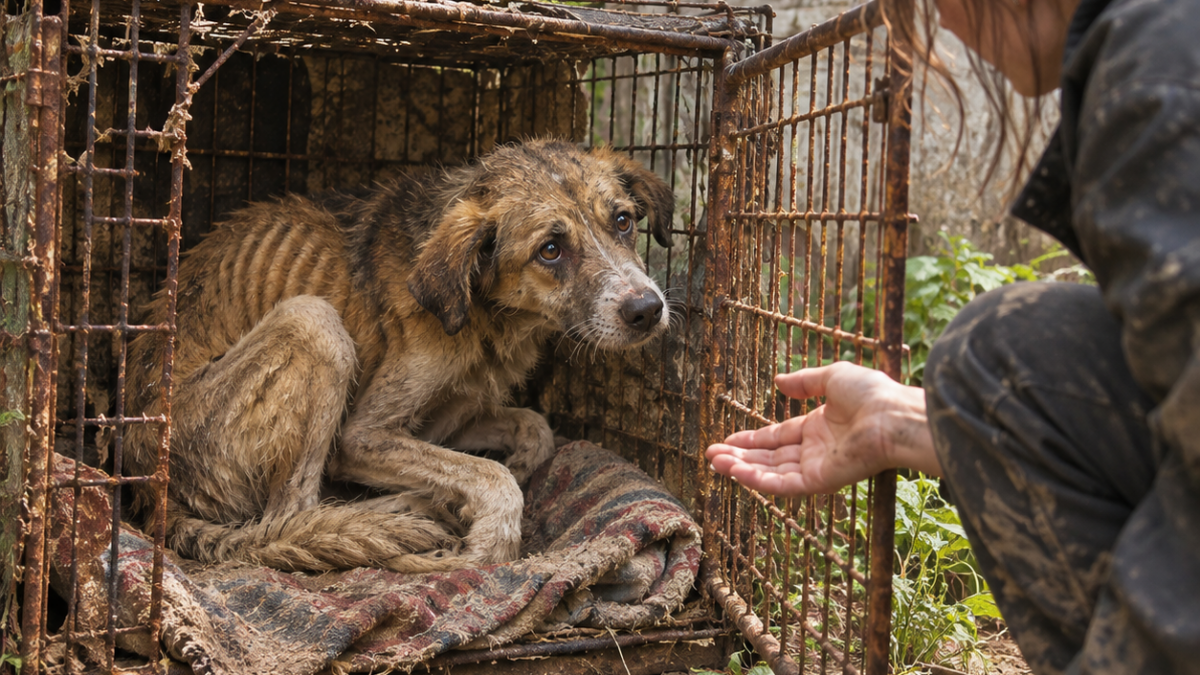
The first time I saw Bucky, he was sitting alone in the cold concrete corner of a rusted cage behind a rural house, so starved that his ribs and hips pushed sharply through his skin, yet the most frightening thing was not how little of his body remained—it was the empty way he looked at us, as though he had already spent too many days waiting for help and had finally decided no one was coming.
When we unlocked that cage and stepped closer, Bucky did not bark, run, wag his tail, or even try to stand; he simply watched us through exhausted eyes while the smell of infected wounds filled the air, and I realized we were not rescuing a frightened dog who wanted to escape—we were trying to reach an animal who had almost forgotten that escape was possible.
But as we carried his nearly weightless body toward the vehicle, I had no idea that the hardest fight would not be getting him through the first night, because somewhere beyond that property were people who would eventually have to explain how a dog could disappear in plain sight for so long—and Bucky himself would one day return an answer none of them could hide from.
The call had come after someone passing near the property noticed something that felt wrong.
The yard was too quiet.
Not peaceful.
Wrong.
There was a gate, an old house, several scattered pieces of equipment and, behind the building, a concrete area partly hidden from the road.
The person who reported it said they thought they heard movement.
Maybe a dog.
Maybe not.
We went anyway.
The smell reached us before we saw the cage.
I remember stopping.
One of the rescuers behind me whispered, “What is that?”
I already knew.
Neglect has a smell.
Infection.
Waste.
Wet concrete.
A body that has been left too long without proper care.
We came around the side of the house.
Then I saw him.
Bucky.
He sat against the back of the cage with his front legs stretched awkwardly beneath him.
His coat was dirty and thin.
His ribs were impossible to miss.
His hips looked collapsed inward.
Parts of his ears were swollen and damaged from a severe infection that had clearly been ignored for far too long.
Open wounds covered sections of his weakened body.
Some were old.
Some looked newer.
And in places where wounds had gone untreated, maggots had begun feeding on dying tissue.
One rescuer turned away for a second.
I couldn’t.
Bucky was looking at me.
Not begging.
Not pleading.
Just watching.
“Hey, buddy.”
His ears barely moved.
I crouched near the cage.
“No one’s going to rush you.”
There was no bedding beneath him.
No clean water I would have trusted him to drink.
No place where he could escape the cold concrete.
I looked at the lock.
“How long has he been like this?”
Nobody had an answer.
The officer accompanying us documented everything before the cage was opened.
Photographs.
Conditions.
Water container.
Floor.
Wounds.
Body condition.
Then finally:
Click.
The lock released.
The cage door opened.
For one strange second, I expected Bucky to move.
He didn’t.
The door was open.
Freedom was three feet away.
Bucky remained in the corner.
I placed one hand on the concrete.
“Come on.”
Nothing.
I moved a little closer.
His body tightened.
So I stopped.
That told me everything.
He did not understand that the open door meant safety.
Maybe doors had opened before and nothing good followed.
Maybe hands had reached toward him before.
Maybe he had simply been trapped too long to believe anything could change.
I waited.
Then Bucky lowered his head.
Not toward me.
Down.
As though he were surrendering to whatever came next.
That nearly broke me.
We slid a blanket beneath him as gently as possible.
When we lifted, I expected weight.
There was almost none.
Bucky was not a small dog.
But starvation had taken muscle from his shoulders, hips, legs, everywhere.
I could feel bones through the blanket.
“You’re okay.”
His eyes opened.
“We’ve got you.”
I didn’t know whether that was true yet.
At the clinic, the veterinary team moved immediately.
Warm blankets.
Fluids.
Bloodwork.
Wound care.
Temperature support.
Controlled nutrition.
Every infection had to be assessed.
Every organ mattered.
His heart rate worried them.
His blood values worried them.
His ears worried them.
Almost everything worried them.
The veterinarian looked at me after the first examination.
“He is extremely fragile.”
“Can he survive?”
“I don’t know.”
That answer stayed with me through the night.
We cleaned wounds no animal should ever have been forced to carry.
We treated infection.
Removed dead tissue.
Picked maggots from places where living flesh should have been protected.
Bucky barely reacted.
I almost wished he would growl.
Snap.
Fight us.
Anything that said he still had energy to object.
Instead, he lay beneath the blanket and watched.
That first night, nobody promised tomorrow.
Then morning came.
I walked into the room.
“Bucky?”
His eyes opened.
Just that.
Two tired eyes opening toward my voice.
I smiled.
“You’re still here.”
He was.
And three days later, something even smaller happened.
His tail moved.
Barely.
A flicker against the blanket.
One technician gasped.
“Did you see that?”
I did.
It wasn’t a happy wag yet.
But after everything Bucky had lost, that tiny movement felt like the first answer he had given us.
Maybe he had not stopped hoping after all.
PART 2
The tail moved once.
Then stopped.
Nobody spoke for several seconds.
That sounds ridiculous when I describe it now, because dogs wag their tails every day.
People barely notice.
But Bucky had spent his first three days with us conserving every possible ounce of energy.
He had not barked.
Had not complained.
Had not fought.
He ate when we carefully encouraged him.
He drank.
He slept lightly.
And whenever a person entered, he watched.
That was all.
So when his tail touched the blanket with that tiny movement, it felt enormous.
I crouched beside him.
“Was that for us?”
Bucky’s eyes remained on me.
The technician laughed softly.
“Don’t pressure him.”
“I’m not.”
“You’re asking for another one.”
“I’d accept another one.”
Nothing.
“Fine.”
I placed my hand several inches from his face.
Bucky sniffed once.
Then rested.
The veterinarian came in for morning rounds.
“How was he overnight?”
“Stable.”
“Eating?”
“Small portions.”
“Vomiting?”
“No.”
“Diarrhea?”
“Controlled.”
I waited until he finished examining Bucky.
Then I said, “He wagged.”
The veterinarian looked at me.
“His tail?”
“Yes.”
“How much?”
I demonstrated with one finger.
He stared.
“You called me away from rounds for that?”
“You came here anyway.”
He smiled.
“Good.”
That was what recovery became with Bucky.
Not dramatic transformation.
Not one miracle.
Hundreds of tiny signs.
A tail movement.
A swallow.
A slightly stronger pulse.
A wound looking cleaner.
A fever dropping.
A blood value improving.
One additional ounce of food tolerated.
One hour of deeper sleep.
The veterinary team had to feed him carefully because severe starvation changes the rules.
People see a skeletal dog and want to put a giant bowl of food in front of him.
It feels compassionate.
It can be dangerous.
Bucky’s body had adapted to deprivation.
Feeding him too aggressively could overwhelm systems already struggling to function.
So his meals were measured.
Small.
Frequent.
Monitored.
Bucky did not appreciate the medical logic.
By the fourth day, his appetite had returned enough for him to stare at the bowl every time we removed it.
“That’s all for now.”
His eyes followed the food.
“You’ll get more.”
Still staring.
“You don’t believe me.”
The bowl disappeared behind the door.
Bucky lifted his head.
It was the highest I had seen him hold it.
I laughed.
“Food finally got your attention.”
He lowered it again.
But an hour later, when the next small meal arrived, Bucky’s ears moved before the bowl touched the floor.
Good.
Let hunger become expectation instead of desperation.
We kept the schedule consistent.
Same intervals.
Same gentle voices.
No teasing.
No taking food away once it was offered unless medically necessary.
No hands reaching into his bowl.
If he showed tension, we gave space.
Food insecurity can live long after starvation ends.
Bucky had already had enough things taken from him.
We were not going to turn feeding into another battle.
His ears required more difficult decisions.
The infection had gone far beyond something that could simply be cleaned and forgotten.
Parts of the tissue had deteriorated badly.
The veterinarian explained what could be saved and what could not.
“We may need to remove some damaged tissue.”
“How much?”
“We won’t know until we assess it fully.”
I looked at Bucky.
His ears had probably hurt for weeks.
Maybe months.
He could not tell us.
No one had helped him.
Now we were talking about cutting away pieces because neglect had been allowed to make decisions before medicine ever arrived.
That anger stayed with me.
But anger was useless at the treatment table.
So we did what Bucky needed.
The dead tissue was removed.
The infection treated aggressively.
His wounds were cleaned.
Pain managed.
Dressings changed.
Every time someone approached his ears, Bucky froze.
His body would become completely rigid.
Sometimes his eyes shut before we touched him.
That reaction bothered me more than growling would have.
He seemed to expect pain.
One afternoon, while a technician prepared to clean the area, Bucky began trembling.
“Stop.”
She stopped immediately.
I moved closer.
“Bucky.”
His eyes opened.
I let him smell my hand.
Then touched his shoulder first.
Not the ear.
The shoulder.
“Here.”
His breathing slowed slightly.
The technician waited.
We started again.
Slowly.
The moment he became overwhelmed, we paused.
Then continued.
The entire dressing change took twice as long.
Nobody complained.
Speed was not the priority.
Teaching Bucky that he had some control mattered too.
Afterward, he rested his chin against my wrist.
I sat there until my arm went numb.
I did not move.
For the first week, Bucky rarely slept deeply.
We knew because whenever anyone entered—even quietly—his eyes opened.
Door.
Eyes open.
Footsteps.
Eyes open.
Metal tray.
Eyes open.
A dog barking down the hall.
Eyes open.
He was exhausted but still monitoring everything.
That kind of vigilance consumes energy.
I wanted him to stop.
But trust cannot be commanded.
Then, on the eighth night, something changed.
I came in around ten.
Bucky was asleep.
I walked closer.
Nothing.
His chest rose slowly.
One front paw twitched.
Dreaming.
I stood there.
A technician came behind me.
“What’s wrong?”
I put a finger to my lips.
“He’s sleeping.”
She looked confused.
“He sleeps all the time.”
“No.”
I whispered.
“This is different.”
Bucky did not wake when we spoke quietly.
For the first time since the cage, his body had decided the room was safe enough to stop keeping watch.
I wanted to cry.
Instead, I backed away.
Let him sleep.
He slept almost three hours without waking.
The next morning, he ate better.
Recovery was doing what recovery does.
Building itself from things nobody would ever put in a dramatic headline.
By the second week, Bucky could lift himself onto his chest more easily.
Standing remained difficult.
The muscle loss was severe.
His back legs trembled even when supported.
We began gentle rehabilitation.
Nothing ambitious.
Positioning.
Range of motion.
Support under his body.
Helping his muscles remember they had work to do.
The first time we tried to help him stand, Bucky looked confused.
One technician supported his chest.
I supported his hips.
“Ready?”
We lifted gently.
His paws touched the floor.
His legs shook violently.
I thought they would collapse immediately.
“Good.”
Five seconds.
Six.
Seven.
Bucky lowered himself.
We returned him to the bed.
He looked exhausted.
“That was terrible.”
One technician laughed.
“You’re supposed to encourage him.”
“I am.”
I scratched his chin.
“You were terrible magnificently.”
Bucky licked my finger.
That was new.
I froze.
“Did you see that?”
“Yes.”
“Was that intentional?”
The technician sighed.
“You are going to document every normal dog behavior as a miracle.”
“Yes.”
Absolutely.
The first lick.
The first real tail wag.
The first bark.
The first time he walked.
I remembered all of them.
At two weeks, Bucky’s tail wagged for real.
A volunteer named Maria had started sitting with him during afternoon breaks.
Maria was older than most of our volunteers and had the calmest energy of anyone I knew.
She never leaned over dogs.
Never forced eye contact.
Never talked in that high excited voice people sometimes use with frightened animals.
She simply sat.
The first three times, Bucky ignored her.
The fourth, he sniffed her sleeve.
The fifth, he rested closer.
Then one afternoon, Maria entered and said:
“Hello, handsome.”
Bucky’s tail moved.
Left.
Right.
Left.
Maria froze.
I saw it from the doorway.
“Do that again.”
She looked at me.
“What?”
“Talk.”
She laughed.
“Hello, handsome.”
Wag.
Maria’s face changed.
“Oh.”
Bucky looked from her to me.
His tail continued.
That was the first moment I saw joy in him.
Not full joy.
Not confidence.
Recognition.
A person he liked had entered.
His world now contained at least one anticipated good thing.
That mattered.
By the third week, his personality began appearing.
He was gentle.
Food obsessed.
Suspicious of mops.
Hated having his feet handled.
Loved chin scratches.
Preferred women at first.
Liked soft voices.
Did not like doors slamming.
And he had a strange habit of pressing his forehead against the side of anyone he trusted.
Not head-butting.
Resting.
As though holding himself against another body helped confirm they were still there.
The first time he did it to me, I almost missed the meaning.
I was sitting on the floor.
Bucky had managed to walk three supported steps that afternoon.
He was tired.
He moved toward me slowly.
I held out my hand.
He ignored it.
Instead, he placed his forehead against my chest.
Then stayed.
I wrapped one arm lightly around his shoulders.
“No cage.”
His eyes closed.
“No concrete.”
He breathed.
“No disappearing.”
I stayed like that until a technician finally said:
“You know you have other work?”
“Yes.”
“Are you doing it?”
“No.”
“Okay.”
She left.
Around that time, the investigation into Bucky’s condition became more serious.
The property where he had been found did have a person responsible for the animals there.
In the fictional extension of this story, investigators began building a case from photographs, veterinary records, witness accounts and the conditions documented at rescue.
I wanted fast consequences.
Reality did not work that way.
Evidence had to be gathered.
Statements taken.
Ownership established.
Responsibility connected.
Dates confirmed.
The officer handling the case called one afternoon.
“We need updated medical records.”
“Again?”
“Yes.”
“You have the original ones.”
“We need his progression too.”
“Why?”
“To show the severity and duration of treatment.”
I looked toward Bucky.
He was asleep on a soft mat.
“His body is evidence.”
The officer was quiet.
“In cases like this, yes.”
I hated that.
Every wound.
Every lost pound.
Every damaged piece of ear tissue.
Every infection.
Things Bucky had survived now had to be translated into paperwork so humans could decide what another human had done wrong.
“Will it matter?”
“Yes.”
“Will there actually be consequences?”
“I can’t promise an outcome.”
Everyone in legal processes loves saying that.
I hated it every time.
“But documentation gives the case weight.”
Bucky opened his eyes.
I said:
“He already lost enough weight for everybody.”
The officer understood the anger.
He did not argue.
Weeks passed.
Bucky gained weight slowly.
At first, the changes were so small we needed the scale.
Then we could see them.
The sharp spaces between ribs began softening.
His hips looked less severe.
Muscle started returning to his shoulders.
His coat improved.
The gray, dull look faded.
And his eyes changed most.
The emptiness disappeared.
In its place came questions.
Who is that?
Do they have food?
Are we going outside?
Why did you stop scratching me?
Can I have more?
Where is Maria?
Questions are life.
Bucky had them again.
The first time he barked, everyone jumped.
It happened because lunch was late.
A technician walked past carrying a bowl intended for another dog.
Bucky stood behind his kennel door.
Then:
“Woof.”
The technician stopped.
I looked up.
Another bark.
Not loud.
But clear.
I walked over.
“You have a voice?”
Bucky wagged.
The technician laughed.
“He’s demanding room service.”
“His meal isn’t for twenty minutes.”
Bucky barked.
“You survived one of the worst neglect cases I’ve seen and now you’re complaining about twenty minutes?”
Another bark.
I smiled.
“Perfect.”
That afternoon, I wrote in my personal notes:
**Bucky complained today. Best sound yet.**
A month after rescue, he walked the entire length of the treatment room without support.
Slowly.
His back legs still lacked strength.
But nobody touched him.
Maria stood at one end.
I stood at the other.
Bucky looked toward her.
Then me.
Maria called:
“Come on.”
One step.
Another.
Pause.
His legs shook.
I nearly moved.
Maria held up her hand.
“Let him.”
Bucky continued.
Three more.
Then six.
His gait was awkward.
Who cared?
He reached Maria.
She crouched.
Bucky pressed his head into her knee.
Everyone in the room cried.
Even the veterinarian.
He denied it.
We all saw.
From there, walking became part of every day.
Five minutes.
Rest.
Another.
Outside eventually.
The first time Bucky stepped onto grass, he froze.
Concrete had been his whole world for too long.
Grass moved beneath his paws.
Soft.
Uneven.
Alive.
He lifted one foot.
Sniffed.
Placed it down.
Then the other.
I crouched nearby.
“Different, huh?”
Bucky lowered his nose.
Sniffed for nearly a full minute.
Then took another step.
A bird moved somewhere.
His head lifted.
Wind touched his face.
His tail moved.
Within ten minutes, Bucky was walking slowly across the small fenced yard.
No chain.
No cage.
Just a leash for safety, hanging loose.
He stopped under a tree.
Looked back toward me.
I swear something about his face had changed.
Maybe I was assigning meaning.
Probably.
But I know what I felt.
The world had become larger than concrete.
That evening, Bucky slept nearly six hours without waking.
The legal case moved slower than his recovery.
In our fictional continuation, the man responsible for the property eventually gave a statement.
His name was Aaron.
He claimed Bucky had “always been skinny.”
When I heard that, I nearly exploded.
Always skinny.
Veterinary photographs showed a dog with severe muscle wasting, infected wounds, advanced ear damage and tissue death.
Not a naturally thin dog.
Neglect had almost erased him.
Aaron said:
“I fed him.”
How often?
Answers changed.
He said water had been available.
Photographs disagreed with the condition we found.
He said Bucky was difficult.
Aggressive.
That surprised every person at the clinic.
Bucky had never bitten.
Not once.
Even during painful wound treatment.
Could he have behaved differently on the property?
Absolutely.
Fear can change behavior.
But “difficult” does not explain starvation.
“Aggressive dogs still need food,” I said when an officer repeated the statement.
“I know.”
“They still need veterinary care.”
“I know.”
“They still need clean water.”
“I know.”
“Then why are we talking about whether he was difficult?”
“Because everything gets documented.”
I hated process.
But process mattered.
Then one afternoon Aaron appeared at the clinic.
Not inside Bucky’s treatment area.
Reception stopped him.
I heard voices.
Went out.
A man stood near the desk.
“I’m here about my dog.”
My body went cold.
“Which dog?”
He looked toward the hallway.
“Bucky.”
I knew.
No one needed to tell me.
“You can’t see him without authorization.”
“He’s mine.”
“That issue is being handled through the case.”
“I just want to see him.”
I should have stayed calm.
Mostly, I did.
“You had a long time to see him.”
His jaw tightened.
“You don’t know what happened.”
“I know what his ears looked like.”
He looked away.
“I was dealing with things.”
“So was he.”
“I didn’t come here to argue.”
“Then don’t.”
Reception called the proper authorities.
Aaron left before the situation escalated.
Bucky never saw him that day.
I was glad.
Then angry at myself for being glad.
I had no idea what Bucky would have wanted.
Animals do not process legal ownership the way people do.
They recognize voices, smells, histories.
Some still seek affection from people who failed them.
That does not erase neglect.
Eventually, as part of the case process in this fictional extension, a controlled meeting was considered appropriate.
I opposed it.
The behaviorist said:
“If Bucky is uncomfortable, it stops immediately.”
Maria came.
I came.
An officer came.
The meeting happened in a neutral fenced space near the clinic.
Bucky entered first.
He had gained enough weight by then that people who had only seen recent pictures might never understand how close to death he had been.
His ears were permanently altered from the damage.
Some scars remained.
Those could not be hidden.
Aaron stood outside the gate.
Bucky saw him.
Stopped.
Everything changed.
Tail lowered.
Head moved slightly down.
His body became still.
Maria looked at me.
“Do you see that?”
“Yes.”
Aaron said:
“Bucky.”
The dog’s ears moved.
He knew the voice.
I am certain of that.
Aaron crouched.
“Come here, boy.”
Bucky did not.
He took one step backward.
Aaron tried again.
“Come on.”
Bucky moved behind Maria.
Not far.
Just enough that her legs became a barrier.
Aaron’s face tightened.
“He knows me.”
I answered:
“Yes.”
Aaron looked at me.
“You think he hates me?”
“No.”
I didn’t.
Hate is a human word.
“What does that mean, then?”
I looked at Bucky.
“Ask yourself why he’s choosing distance.”
Aaron extended his fingers through the fence.
Bucky did not approach.
Then Aaron said something that made my anger rise.
“He used to be fine.”
Maria’s voice was calm.
“He was almost dead.”
“He wasn’t that bad when—”
“When what?”
Aaron stopped.
The officer intervened.
Facts.
Questions.
No emotional confrontation.
But Bucky had already answered the only question I cared about.
Given a choice, he did not move toward him.
The meeting ended.
As we walked back toward the clinic, Bucky’s tail remained low.
Maria crouched.
“You’re okay.”
Bucky pressed his head against her.
The tail began moving.
Slowly.
Then normally.
The past had entered the room.
Then left.
That became a pattern in his recovery.
Something frightened him.
A metal gate slamming.
A chain rattling.
A raised male voice outside.
For a moment, his body went back to the cage.
Then one of us stayed.
And Bucky returned.
Healing did not mean forgetting.
It meant the present became strong enough to compete with memory.
Around six weeks after rescue, adoption questions began.
I wasn’t ready.
Bucky probably was.
That difference mattered.
Rescuers sometimes become possessive without realizing it.
We tell ourselves we are protecting the animal.
Sometimes we are protecting ourselves from goodbye.
A family applied.
Mother.
Father.
One daughter, twelve years old.
Her name was Emma.
They had recently lost an older rescue dog to cancer.
Quiet house.
Secure yard.
No other pets.
Good veterinary history.
Stable routine.
They understood Bucky’s medical follow-up.
Still, I was suspicious.
Not because they did anything wrong.
Because I was suspicious of everybody.
Maria noticed.
“You’re impossible.”
“I’m careful.”
“You rejected a family because they said they wanted to ‘spoil him.’”
“They also had an unsecured yard.”
“You focused on the word spoil.”
“I dislike vague promises.”
Maria laughed.
“You want a signed blood oath.”
“Would help.”
The family came to meet Bucky.
Emma entered quietly.
That mattered immediately.
She did not run toward him.
Did not squeal.
Did not reach.
She sat on the floor about six feet away.
Bucky stayed near me.
Emma looked at him.
Not directly into his eyes.
Softly.
“Hi.”
Bucky sniffed.
She had brought treats but waited for permission.
I handed her one.
“Place it on the floor.”
She did.
Bucky looked at me.
Then the treat.
Then Emma.
He moved forward.
One step.
Two.
Took it.
Retreated.
Emma smiled.
She did not try again immediately.
Good.
Her father sat farther back.
Mother beside him.
Nobody pressured.
Five minutes later, Bucky approached Emma again.
No treat this time.
He sniffed her shoe.
Her hand.
Then stepped away.
Emma stayed.
Ten more minutes.
Bucky returned.
This time he stood beside her.
Emma whispered:
“Can I touch him?”
“Let him decide.”
She placed her hand palm-down near her knee.
Bucky sniffed.
Then did what he did with people he trusted.
He lowered his head.
Rested it against her knee.
Emma froze.
Her mother covered her mouth.
I forgot how to breathe.
No dramatic tail wag.
No jumping.
No licking.
Just Bucky deciding her body could be a safe place to rest his head.
Emma looked at me.
“Can I pet him now?”
My voice cracked.
“Yes.”
She touched his shoulder gently.
Bucky closed his eyes.
That was the moment I knew.
Not because one gesture guarantees an adoption.
It doesn’t.
But I saw possibility.
The family visited again.
Then again.
We did a home assessment.
Secure yard.
Quiet bedroom.
Dog bed already prepared.
No wire crate placed outside.
I noticed that immediately.
The father asked:
“Would a crate indoors ever help him?”
“For some dogs, yes, if introduced positively as a safe space.”
He nodded.
“We were afraid it might remind him of the cage.”
“Could.”
“So we won’t rush it.”
Good.
Emma had put a blanket near her bed.
“Is he sleeping with you?”
Her mother laughed.
“She thinks so.”
Emma looked embarrassed.
“I just want him to know someone is there.”
My chest tightened.
We approved a trial.
The night before Bucky left, I stayed late.
He was sleeping.
I sat beside him.
“Tomorrow you’re leaving.”
One eye opened.
“I hate this part.”
Bucky shifted closer.
“You could stay here.”
His head came against my leg.
“But this is a clinic.”
I scratched his neck.
“You deserve to become somebody’s boring dog.”
That was what I wanted.
Boring.
Breakfast.
Walk.
Yard.
Bed.
Family.
No bandage changes.
No evidence photographs.
No legal meetings.
No one discussing his wounds.
Just Bucky.
The next morning, Emma arrived with her parents.
She was nervous.
So was I.
Bucky wore a new collar.
Nothing heavy.
Soft.
Blue.
When I clipped the leash on, he looked at me.
“You hate collars?”
Tail movement.
“That’s fair.”
We walked outside.
The family’s car waited.
Bucky stopped several feet away.
Cars were still unfamiliar.
Emma sat in the back seat.
“Come on.”
Bucky sniffed.
I let him take his time.
One front paw up.
Then down.
He hesitated.
The father offered to lift him.
“Wait.”
Bucky tried again.
Front paws inside.
Back legs.
Pause.
Then he climbed.
By himself.
Emma stayed still until he settled.
Then Bucky moved toward her.
Rested against her side.
I turned away.
Maria laughed.
“You’re crying.”
“Shut up.”
“You cry constantly.”
“I work with dogs.”
“That is not an explanation.”
It was.
The first night at the family’s house was difficult.
Bucky followed Emma everywhere.
If she disappeared behind a door, he waited.
When she went to the bathroom, he lay outside.
At bedtime, they put his bed beside hers.
He stood.
Would not lie down.
Emma climbed into bed.
“Good night, Bucky.”
He stared.
Then walked to the bedroom door.
Back to her.
Door.
Her.
Finally Emma moved his bed so it touched the side of hers.
Bucky circled.
Lay down.
One side pressed against the bed frame.
He slept.
The next morning, Emma texted through her mother.
**He woke up three times and checked if I was here.**
I replied:
**And were you?**
**Yes.**
That was the treatment.
Presence.
Night two.
Two checks.
Night three.
One.
By the end of the first week, Bucky slept through the night.
He still woke before everyone else because breakfast mattered.
The father sent me a video.
Six in the morning.
Bucky standing beside the bed.
Tail wagging.
Emma under blankets.
“Not yet.”
Bucky stared.
“Bucky, it’s six.”
Tail faster.
“Six thirty.”
Bucky barked.
Emma groaned.
Video ended.
I laughed.
The dog who once sat silently in a cage had become an alarm clock.
Perfect.
He discovered the yard gradually.
The first day, he remained close to the back door.
Grass was no longer completely new, but the space was.
Trees.
Fence.
Patio.
Different smells.
Emma walked with him.
No pulling.
By day three, Bucky began exploring alone while the family supervised.
Day seven, he ran.
Not far.
A short burst across the grass after Emma.
The father caught it on video.
Bucky’s body looked different in motion.
He still had scars.
His ears would always show damage.
But he ran.
Four legs pushing.
Tail high.
Emma laughing.
I watched the video more times than I will admit.
Then I remembered Aaron saying:
“He used to be fine.”
No.
This was fine.
Running without a chain.
Eating without uncertainty.
Sleeping without concrete.
That was what fine looked like.
The legal case concluded months later.
In this fictional continuation, Aaron faced fines, restrictions on future animal ownership, and financial responsibility for a portion of Bucky’s documented medical expenses.
People expected me to feel victorious.
I didn’t.
The decision arrived in an email.
I read it at the clinic.
Maria asked:
“Well?”
“He can’t legally reclaim Bucky.”
“Good.”
“There are penalties.”
“Good.”
I looked toward my phone.
A photograph from Emma sat on the screen.
Bucky asleep upside down on a couch.
One paw hanging off.
His stomach full.
Scarred ears relaxed.
I smiled.
“This matters more.”
Maria understood.
Legal consequences matter because animals need protection.
But punishment does not heal wounds.
Bucky had already been doing the important work elsewhere.
Living.
Several months after adoption, the family brought him back for a checkup.
I was working in another room when someone said:
“Your boyfriend is here.”
“Who?”
“Bucky.”
I almost ran.
He stood in reception.
Healthy weight.
Clean coat.
Blue collar.
Emma holding the leash.
“Bucky?”
His head turned.
Tail exploded.
He pulled toward me.
I crouched.
He reached me.
Pressed his forehead into my chest.
Exactly like before.
I hugged him.
“You remember.”
Emma smiled.
“He always remembers people.”
Bucky greeted Maria too.
Then the veterinarian.
He did not like the exam table.
Some things never change.
Afterward, we weighed him.
I looked at the number.
Healthy.
The veterinarian smiled.
“Remember the first day?”
“Yes.”
“Hard to believe.”
I touched Bucky’s side.
His ribs were there.
Of course.
Where ribs belong.
But no longer the first thing your eye saw.
His body finally looked like a dog instead of evidence.
Emma asked:
“Can I see the old pictures?”
Her mother glanced at me.
“Are you sure?”
Emma nodded.
We had been careful about how much of Bucky’s rescue history she saw.
She was young.
The worst photographs were difficult.
I chose a few less graphic images.
Bucky in the cage.
Bucky under blankets.
Bucky standing with support.
Emma stared.
“That’s him?”
“Yes.”
“He was that skinny?”
“Yes.”
Her eyes filled.
She looked down at Bucky.
He was sniffing the floor.
“Did someone do that to him?”
I answered carefully.
“Someone failed to give him what he needed, and he suffered terribly because of it.”
Emma looked angry.
“Why?”
“I don’t have an answer that makes sense.”
She sat on the floor.
Bucky moved toward her automatically.
She wrapped her arms around him.
“They don’t get him back.”
“No.”
“Ever?”
“No.”
She rested her face against his neck.
“Good.”
That was enough.
The family did not make Bucky’s trauma the center of every day.
I loved them for that.
They knew his history.
Respected his triggers.
But they did not remind him constantly that he was a victim.
Bucky was allowed to become annoying.
He developed habits.
Some terrible.
He stole socks.
Never destroyed them.
Just collected them beneath Emma’s bed.
The first time her mother found six socks, she called.
“Why?”
“I don’t know.”
“Is this trauma?”
I laughed.
“Maybe he just likes socks.”
“Oh.”
Not everything is trauma.
That lesson matters.
A rescued dog can have personality unrelated to suffering.
Bucky liked socks.
Hated baths.
Loved chicken.
Was suspicious of oranges for reasons nobody understood.
He barked at delivery drivers but welcomed them instantly if they had treats.
He slept upside down.
Snored.
Refused to enter the yard in heavy rain.
And believed Emma’s bed had been purchased primarily for him.
He became normal.
Wonderfully normal.
Around the one-year anniversary of the rescue, the family asked if they could visit the property.
I hesitated.
“Why?”
Emma was thirteen now.
She answered.
“I want to see where he came from.”
Her parents had discussed it.
The legal case was over.
The property had changed hands.
The cage was gone.
I asked the behaviorist.
Would taking Bucky back help him?
Probably not.
Would it harm him?
Possibly, depending on associations.
We decided Bucky did not need to go.
Emma did.
So we went without him.
The house looked smaller than I remembered.
The concrete area remained.
The cage had been removed.
Marks on the ground showed where it had once stood.
Emma stopped.
“Here?”
“Yes.”
She stared at the corner.
“He lived here?”
“For some time.”
“No bed?”
“Not when we found him.”
She looked toward the yard.
The family had brought a small bouquet, but Emma suddenly seemed embarrassed by it.
“What do I do with these?”
I shrugged.
“You don’t have to do anything.”
She placed them near the edge of the concrete.
Then stood there.
“I hate this place.”
I understood.
Her father put a hand on her shoulder.
Emma said:
“I thought it would feel bigger.”
“What?”
“The cage.”
I looked at the empty space.
“No.”
It was horribly small.
On the drive home, Emma was quiet.
When we reached her house, Bucky ran to the door.
Tail wagging.
Emma entered.
Dropped to her knees.
Bucky pressed into her.
She cried.
Then laughed.
“Your house is so much bigger.”
Bucky licked her face.
That was the only return to the past anyone needed.
Years passed.
Bucky aged into his new life.
At two years post-rescue, he became confident enough to greet visitors before Emma did.
At three, he learned to swim badly.
Very badly.
The family took him to a safe shallow lake.
Bucky stepped in.
Paddled.
Turned sideways.
Swallowed water.
Came out immediately.
Never went back.
Emma called him a coward.
I defended him.
“He has boundaries.”
At four, Bucky became a foster brother.
The family agreed to temporarily foster a frightened puppy rescued from another neglect situation.
Her name was June.
June hid behind furniture.
She flinched when people reached toward her.
Bucky noticed.
Did not push.
He lay several feet away.
June watched.
The first night, she slept alone.
The second, closer to Bucky.
The fourth, Emma sent a photograph.
June had curled against Bucky’s side.
Bucky’s head rested over her back.
I stared at the image.
The dog who had once needed people to teach him hands could be kind was now helping another dog discover the same thing.
Emma messaged:
**Do you think he remembers being scared?**
I answered:
**Maybe. But he doesn’t need to remember for kindness to matter.**
June was adopted two months later.
Bucky searched for her for a day.
Then accepted that she was gone.
Other fosters followed occasionally.
Never too many.
Bucky deserved peace.
But he became a steady presence.
The nervous dog.
The senior dog.
One terrified hound who refused to enter the house until Bucky walked through first.
Emma laughed.
“He’s teaching them.”
Maybe.
Or maybe animals simply believe other animals when they say a place is safe.
Humans use words.
Dogs use bodies.
Bucky slept on the rug.
So the rug was safe.
Bucky drank from the bowl.
So the bowl was safe.
Bucky let Emma touch his ears.
So perhaps hands could be safe.
That was enough.
At five, Bucky developed chronic sensitivity in his damaged ears.
The old infections had left consequences.
We managed them.
Regular checks.
Careful cleaning.
Medication when needed.
Bucky still disliked anyone touching them unexpectedly.
Emma had learned his signals perfectly.
“Can I?”
She would show him the cotton pad.
Bucky sniffed.
Sometimes he walked away.
She waited.
“Later.”
That was love too.
Not forcing care just because you believe you know best.
Choice wherever possible.
The veterinarian once said:
“He lets Emma do things he doesn’t let us do.”
“Because he trusts her.”
“Yes.”
I smiled.
The dog who once froze when hands approached his ears now placed his head in a teenager’s lap and allowed her to clean them.
That was recovery measured in inches.
At six, Bucky’s muzzle began to gray.
I complained.
Emma, now nearly an adult, laughed.
“He’s getting distinguished.”
“He’s getting old.”
“Don’t say that.”
“Why does everyone yell at me for stating biology?”
“Because we hate biology.”
Fair.
Bucky’s body remained strong.
He still ran.
Slower.
He still climbed onto Emma’s bed.
More carefully.
The family bought him an orthopedic bed.
He refused it.
Slept on the couch.
They moved the orthopedic bed beside the couch.
He slept on the floor.
Finally Emma put one of her old sweaters on the bed.
Bucky immediately used it.
Her mother sent me a message:
**We spent $180 on a dog bed and apparently the essential feature was a dirty hoodie.**
I replied:
**Advanced medical insight.**
At seven, Emma left for college.
That became Bucky’s hardest emotional transition since adoption.
She was not far away.
But the house changed.
Her room remained.
Her smell remained.
She disappeared.
The first night, Bucky slept outside her door.
The second.
The third.
Emma’s mother called me.
“He’s eating.”
“Good.”
“Walking.”
“Good.”
“But he waits.”
“He will adjust.”
“What do I do?”
“Keep his routine.”
Emma video-called.
Bucky heard her voice from the phone.
His ears lifted.
He searched the room.
That made Emma cry.
She came home the following weekend.
Bucky heard the car.
Ran to the door.
When Emma entered, he jumped.
Actually jumped.
Old ear scars.
Gray muzzle.
All dignity gone.
He cried.
A high, strange dog sound I had never heard from him.
Emma fell to the floor.
“I’m here.”
Bucky climbed onto her.
She laughed and cried.
“I’m here.”
He eventually learned the new routine.
Emma leaves.
Emma returns.
Again.
Again.
Trust updated itself.
At eight, Bucky’s legal file was finally old enough that almost nobody thought about it anymore.
That mattered to me.
For years he had been:
The cage dog.
The starvation case.
The neglected dog.
Now, at the clinic, newer employees knew him as:
Emma’s dog.
That is what rescue should do.
Change the noun that comes after the name.
Bucky, abuse case.
Becomes Bucky, patient.
Then Bucky, foster.
Then Bucky, adopted dog.
Then simply Bucky.
At nine, arthritis appeared.
Mostly hips.
We adjusted.
Shorter walks.
Joint medication.
Weight management.
A small ramp to the car.
Bucky hated it.
He tried to jump around it.
Emma blocked him.
“No.”
Bucky stared.
“Use the ramp.”
He tried the side.
“No.”
Bucky barked.
“You are nine.”
Bark.
“You have arthritis.”
Bark.
“You cannot negotiate your skeleton.”
He eventually used the ramp.
Then discovered it was easier.
Within a week, he stood beside it waiting.
Emma sent me video.
“Fraud.”
Bucky wagged.
At ten, he slowed.
The family’s yard became more important than long walks.
He still patrolled the fence.
Still barked at delivery drivers.
Still collected socks.
Some habits never age.
One morning, Emma came home and found seven socks beneath his bed.
She texted:
**He is building retirement savings.**
I replied:
**Do not interfere with his financial planning.**
At eleven, one of the ears developed another serious infection.
Scar tissue made treatment more complicated.
For the first time in years, Bucky had to undergo a procedure under anesthesia.
Emma panicked.
I met her at the clinic.
“He survived starvation.”
“Don’t.”
“What?”
“Don’t say he survived worse.”
She was crying.
“This is now.”
She was right.
Past survival does not guarantee future survival.
Every risk gets to be frightening on its own.
We waited.
The procedure went well.
Bucky woke.
Groggy.
Offended.
Emma sat beside him.
He smelled her.
His tail moved.
She leaned down.
“I’m never leaving.”
I almost corrected her.
Nobody can promise never.
Instead, I let her say it.
Some promises are about intention, not eternity.
Bucky recovered.
Another year.
Then another.
His body became older.
Gray spread across his muzzle and around his eyes.
His coat remained soft.
His weight stayed healthy.
His scars never disappeared.
I was glad.
Not because I wanted evidence of suffering.
Because scars are not failure.
They were simply part of his body.
People sometimes asked Emma:
“What happened to his ears?”
She usually answered:
“He was neglected before he was rescued.”
If they pushed:
“How bad?”
She changed the subject.
Bucky did not owe strangers the worst details of his life.
At twelve, Emma moved into her own apartment.
Pet friendly.
Ground floor.
Small private patio.
The family expected Bucky to stay with her parents because he had known that house for years.
Emma disagreed.
“He’s coming with me.”
Her mother said:
“He’s old.”
“That’s why he’s coming.”
They asked me.
I said:
“Let Bucky tell you.”
We tried a weekend.
Bucky entered Emma’s apartment.
Sniffed.
Found her bed.
Found his bed.
Found food.
Found patio door.
Slept through the night.
Decision made.
Emma’s mother complained.
“He chose her.”
I laughed.
“He chose her the first day.”
Fair.
At the new apartment, Bucky’s world became quieter.
Emma worked partly from home.
He slept under her desk.
Morning walk.
Breakfast.
Nap.
Lunch break outside.
Evening.
Bed.
The cage had once been his entire physical world.
Now old age made his world smaller again.
But this time, smallness was chosen around comfort.
There was a door he could walk through.
A bed he could leave.
Water he could drink whenever he wanted.
Small is not the same as trapped.
At thirteen, kidney values began changing.
Early.
Manageable.
Diet adjustments.
Monitoring.
Emma became obsessive.
She measured water.
Tracked meals.
Recorded bathroom habits.
I visited.
There was a spreadsheet.
I stared.
“You made a spreadsheet?”
“Yes.”
“For Bucky’s pee?”
“Basically.”
“You need help.”
“He needs monitoring.”
Both true.
Bucky looked at us.
Bored.
Months remained stable.
Then his arthritis worsened.
The ramp became necessary.
Long walks ended.
Emma bought a wagon so he could ride to the park, get out, sniff for ten minutes, then ride home.
At first, I laughed.
Then I saw him in it.
Bucky sitting in a wagon.
Gray face.
Scarred ears.
Tail moving.
Emma pulling.
Children waving.
He looked like royalty.
“He loves this,” Emma said.
“He loves not walking.”
“Same.”
They went every weekend.
At the park, Bucky still insisted on getting out.
He sniffed trees.
Grass.
Other dogs.
Then stood beside the wagon when done.
“Ready?”
Bucky looked at it.
Emma helped him inside.
They went home.
One autumn afternoon, I joined them.
Leaves covered the path.
Bucky moved slowly.
He stopped beneath a tree.
Emma sat on the ground beside him.
“You know he’s been with me longer than he was alive before we met.”
“Much longer.”
She stroked his neck.
“Do you think he remembers the cage?”
I looked at Bucky.
“I don’t know.”
“I hope not.”
“Me too.”
She was quiet.
“Sometimes I do.”
“What?”
“Remember it.”
Of course.
Humans carry photographs animals may not.
“That’s okay.”
“I hate that I think of it when he looks tired.”
I understood.
A weak step.
A day without appetite.
Suddenly the old rescue images return.
Bones.
Concrete.
Silence.
“His body being old is not the same as his body being neglected.”
Emma nodded.
“I know.”
“Say it.”
She looked at Bucky.
“You’re old because you lived.”
Exactly.
At fourteen, the kidneys worsened.
Medication.
Diet.
Fluids.
Good weeks.
Then bad.
Bucky’s appetite, once legendary, became unpredictable.
Chicken worked.
Then didn’t.
Cheese.
Then didn’t.
One morning Emma called.
“He didn’t eat breakfast.”
“How is everything else?”
“Tired.”
“Drinking?”
“Some.”
We went in.
Bloodwork.
Kidneys worse.
Anemia.
Arthritis.
Old age piling one problem on another.
The veterinarian spoke carefully.
“We can support him.”
Emma stared.
“But?”
No one likes that word.
“But we need to start asking what each intervention gives him.”
“What do you mean?”
“Time is only useful if the time feels like Bucky.”
That sentence stayed.
Time that feels like Bucky.
Does he want Emma?
Yes.
Food?
Sometimes.
Outside?
Yes, briefly.
Socks?
Surprisingly yes.
We knew because he stole one two days later.
Emma sent me a photograph.
Old Bucky asleep with a sock under his paw.
Caption:
**Apparently not dying today. Still committing crimes.**
I laughed.
Today.
That became our measure.
Today he ate.
Today he sniffed the park.
Today he asked for affection.
Today he slept comfortably.
Good day.
Then the good days became less frequent.
Bucky stopped using the patio unless Emma helped.
He no longer wanted the park.
Even in the wagon.
He still wanted to be near her.
Always.
One evening, Emma sat on the floor beside him.
I was there.
Bucky’s head rested in her lap.
She whispered:
“Remember the first day?”
“I do.”
“I barely touched him.”
“You did everything right.”
“I was terrified.”
“You hid it.”
“I thought if I moved wrong, he’d leave.”
Bucky breathed slowly.
“Now I’m terrified he’ll leave anyway.”
I had no answer.
That is the cruelty of loving anything alive.
Eventually the relationship ends in some form.
No perfect home avoids that.
The goal was never to make Bucky immortal.
The goal was to make his life belong to him while he had it.
The final decision came on a cold morning.
Appropriate, maybe.
I wish it had been warm.
But life does not arrange symbolism for us.
Emma called.
“Can you come?”
Her voice told me everything.
Bucky had fallen trying to get up.
He had not injured himself.
But after we helped him onto the bed, he did not try again.
He refused chicken.
Refused cheese.
Even water required encouragement.
The veterinarian came to the apartment.
Examination.
Quiet discussion.
We could hospitalize.
IV fluids.
Stronger support.
Maybe several days.
Possibly more.
Emma asked the only question that mattered.
“Would he come home feeling better?”
The veterinarian was honest.
“Maybe briefly.”
“And then?”
Silence.
Emma looked at Bucky.
His eyes were open.
Still watching her.
She began crying.
“I don’t want his last memory to be a hospital.”
It would not be.
We arranged everything at home.
Before the veterinarian returned later that afternoon, Emma did one thing.
She brought out a small plastic container.
Inside were Bucky’s stolen socks.
Years of them.
Not all.
A few she had saved because the habit made her laugh.
She placed one beside him.
Bucky sniffed.
His tail moved.
Barely.
Emma laughed through tears.
“Criminal.”
I sat beside them.
Bucky’s old blue collar lay on the table.
He no longer wore it indoors.
The scars on his ears had softened beneath gray fur.
I thought about the cage.
The concrete.
The lock opening.
Bucky refusing to move.
Then I looked at the apartment.
Soft bed.
Water.
Emma.
Sock.
No cage.
No lock.
The veterinarian arrived.
Emma asked:
“Can we take him outside first?”
The patio was only a few steps.
We helped him gently.
Cold air.
Bucky lifted his nose.
Sniffed.
The city carried a thousand smells.
Someone cooking nearby.
Cars.
Wet pavement.
Another dog.
Leaves.
Emma wrapped a blanket around him.
“Remember the yard?”
Bucky leaned against her.
“You used to run.”
His eyes were tired.
“You were so fast.”
Not really.
But love edits memory kindly.
We stayed five minutes.
Then Bucky looked toward the door.
Home.
Emma understood.
We brought him inside.
The veterinarian prepared the first medication.
Emma lay beside Bucky.
I sat near his head.
Maria came too.
She had been part of his life from the beginning and deserved the goodbye.
She entered quietly.
“Hello, handsome.”
Bucky’s ears moved.
Fourteen years disappeared.
The same phrase.
The same woman.
A tail that had once barely flickered now moved once against the bed.
Maria covered her mouth.
“He remembers.”
Of course.
She touched his shoulder.
Bucky relaxed.
The veterinarian waited.
Nobody rushed.
Emma stroked Bucky’s face.
“You know what I hate?”
She cried.
“You spent so long thinking nobody was coming.”
Her hand shook.
“And then when we finally came…”
She looked at me.
“I wish we could have gotten there sooner.”
So did I.
We always do.
Bucky breathed slowly.
Emma leaned closer.
“But we came.”
Yes.
“We came.”
Her forehead touched his.
“And we stayed.”
That was the part Bucky knew.
The veterinarian gave the first medication.
Bucky’s muscles relaxed.
His old aching body softened.
Emma whispered:
“No more cold concrete.”
I swallowed.
“No more cage.”
Maria turned away.
“No more waiting.”
Bucky’s eyes closed.
Emma kissed his head.
“You can sleep.”
The veterinarian gave us time.
Then Emma nodded.
The final medication entered.
One slow breath.
Another.
Then stillness.
The dog we had once feared would die alone behind a rural house died old in a warm apartment with three people crying because his life had mattered to them.
For several minutes, nobody moved.
Then Maria noticed something.
“His head.”
Bucky’s forehead was resting against Emma’s leg.
Exactly as he had rested it against her knee during their first meeting.
A frightened dog had chosen that place years earlier.
An old dog had returned to it at the end.
Emma saw it too.
She broke.
I held her.
There is no way to make that moment painless.
A satisfying ending is not one without grief.
It is one where grief has earned its place through years of love.
Bucky’s ashes came home to Emma.
She placed them beside a framed photograph.
Not the cage photograph.
Never.
The photograph showed Bucky running through the family yard about a year after adoption.
His body healthy.
Ears scarred.
Mouth open.
Tail high.
Emma was visible behind him, laughing.
That was Bucky.
Months later, the legal restrictions connected to his old neglect case came up for review in our fictional continuation.
Someone asked whether I wanted to provide another statement.
I did.
But not the statement they expected.
I did not write about revenge.
I wrote about cost.
Medical cost.
Time.
Pain.
Permanent ear damage.
Years of fear responses.
The burden placed on rescuers and adopters because one person had failed to meet basic responsibilities.
And I wrote one final paragraph:
**Bucky survived, but his survival should never be used to minimize what happened to him. Recovery does not make neglect less serious. The fact that an animal eventually receives love does not excuse the person who allowed suffering to occur.**
The restrictions remained.
I felt relief.
Then I closed the file.
For good.
Bucky deserved to exist beyond it.
A year after his death, Emma visited the rescue.
She was an adult now.
Working full time.
She brought boxes.
Dog beds.
Blankets.
Food.
And one strange item.
A bag of socks.
I stared.
“What is this?”
She laughed.
“Clean socks.”
“Why?”
“For enrichment toys. Tie treats inside. Supervised.”
I understood immediately.
“Bucky.”
“Obviously.”
We made scent games for nervous dogs.
Old clean socks.
Food tucked safely inside.
Dogs sniffed.
Pulled.
Played.
One frightened dog refused to approach people but loved the sock game.
Emma sat outside his kennel.
Waited.
The dog played.
Then eventually came closer.
Emma looked at me.
“He would’ve liked him.”
“Probably stolen the toy.”
“Definitely.”
We laughed.
That became the best kind of memorial.
Not a statue.
Not a sad post.
Something useful.
Blankets where there had once been concrete.
Food where there had once been hunger.
Enrichment where there had once been a cage.
Choice where there had once been none.
Years later, new volunteers still occasionally found Bucky’s old case photographs in training materials.
They asked:
“Did he make it?”
I always knew what they meant.
Did he survive?
“Yes.”
“How long?”
“Long enough.”
“What does that mean?”
“Fourteen years after rescue.”
Their faces changed.
“No way.”
“Yes.”
I showed them the later photograph.
Healthy Bucky running.
Then older Bucky on the couch.
Then gray Bucky in the wagon.
I wanted them to understand something.
Rescue stories should not stop at survival.
If we only show the cage and the first clinic night, we keep the animal trapped there forever in people’s minds.
Bucky got out.
His story must too.
Yes, he was starved.
Yes, his ears were severely damaged.
Yes, his wounds had become infested.
Yes, he had almost no strength.
Yes, he had stopped expecting people to help.
All true.
But later:
He stole socks.
He barked for breakfast.
He slept beside Emma.
He hated swimming.
He mentored foster dogs.
He got arthritis.
He rode in a wagon.
He became gray.
He became old.
Those facts matter just as much.
Maybe more.
Because neglect almost took the chance for any of them to happen.
People sometimes asked whether Bucky ever truly forgot the cage.
I don’t know.
No one can know.
There were sounds that frightened him for years.
Metal hitting metal.
Chains.
Doors slamming.
Certain raised voices.
But fear became shorter.
Early on, one sound could ruin an hour.
Later, it ruined a minute.
Then Bucky looked for Emma.
She was there.
The present won.
Again.
Again.
Again.
That is what healing often is.
Not erasing memory.
Giving memory competition.
The cage said:
You are trapped.
Emma opened doors.
The cage said:
No one is coming.
Emma returned every day.
The cage said:
Food disappears.
Breakfast arrived every morning.
The cage said:
Hands hurt.
Hands cleaned ears gently.
The cage said:
Concrete is where you sleep.
Bucky stole half of Emma’s mattress.
Eventually, the old story became outnumbered.
That was his revenge.
Not pain inflicted on anyone.
Not cruelty returned.
Being so thoroughly loved that neglect became statistically insignificant compared with everything that came after.
One winter afternoon, years after Bucky was gone, I drove past the road where the rural property had been.
I had not planned to.
The house had been renovated.
New fence.
Different paint.
The area behind it had changed.
I could no longer see the exact concrete corner.
For a second, that upset me.
Then I realized I did not need to.
That corner had already taken enough space in my memory.
I pulled over farther down the road.
Took out my phone.
Found the video Emma had sent years ago.
Bucky running in the yard.
I watched.
Again.
The dog crossed the grass.
Emma laughed.
He turned.
Ran back.
Nothing extraordinary to anyone who did not know.
I smiled.
Then drove away.
The property disappeared behind me.
That felt right.
The cage had once been Bucky’s entire world.
In the end, it became a place we could drive past.
There is one question people ask more than any other:
“How could someone do that?”
I never found an answer that satisfied me.
Financial hardship does not explain untreated wounds without any attempt to seek help.
Stress does not fill an empty water container.
Being overwhelmed does not make infection disappear.
A difficult life does not excuse creating a worse one for an animal completely dependent on you.
But I also learned that asking “how could they?” can become another way of centering the person who caused harm.
Bucky deserved more attention than Aaron ever did.
So eventually I changed the question.
Not:
How could someone do that?
But:
What happened after somebody finally stopped it?
That story I can answer.
People opened the cage.
Veterinarians fought infection.
Volunteers sat beside him.
Food came slowly.
His tail moved.
He slept.
He stood.
He walked.
He trusted Maria.
He met Emma.
He chose her knee.
He went home.
He ran.
He aged.
He died loved.
That is a better story.
Harder.
Longer.
More important.
When I think of Bucky now, I rarely see the cage first.
I see his face pressed against Emma.
I see him barking for breakfast.
I see scarred ears moving when Maria says:
“Hello, handsome.”
I see an old dog riding in a wagon as though the park belonged to him.
And I see his forehead resting against Emma’s leg at the very end.
The same gesture that once said:
Maybe I can trust you.
Years later, it said:
I know exactly where I belong.
That was the ending Bucky held on long enough to reach.
The world had once carried on without noticing him.
Cars passed.
People walked by.
Days moved.
A dog vanished inside a cage.
Then somebody stopped.
A gate opened.
A lock turned.
And because of that one interruption, Bucky did not die as the anonymous dog behind a rural home.
He became somebody’s alarm clock.
Somebody’s sock thief.
Somebody’s foster brother.
Somebody’s best friend.
Somebody’s old dog.
He became Bucky.
Not the cage dog.
Not the starvation case.
Just Bucky.
And if you ask me what justice looked like for him, I would not show you the penalties or the case file.
I would show you one photograph.
Emma asleep in bed.
Bucky stretched beside her.
His scarred ears relaxed.
His ribs hidden beneath a healthy body.
A stolen sock under one paw.
No lock.
No concrete.
No fear in his eyes.
Because the person who neglected Bucky once controlled almost everything he had.
Food.
Water.
Space.
Comfort.
Freedom.
But in the end, that person did not control the most important thing.
The ending.
Bucky did.
He survived long enough to choose it himself.








